
Dog and cat nutrition guide
Can dogs eat spicy food? Every spice in an Indian kitchen, one at a time
Every page on this subject says spices are bad for dogs and prints no number. Capsaicin has been measured in conscious dogs. Salt has a published lethal dose. Turmeric has a beagle pharmacokinetic study. Nutmeg, the one everyone calls toxic, has one published canine figure that is unreferenced and does not scale by body weight, and saying so is the honest answer.
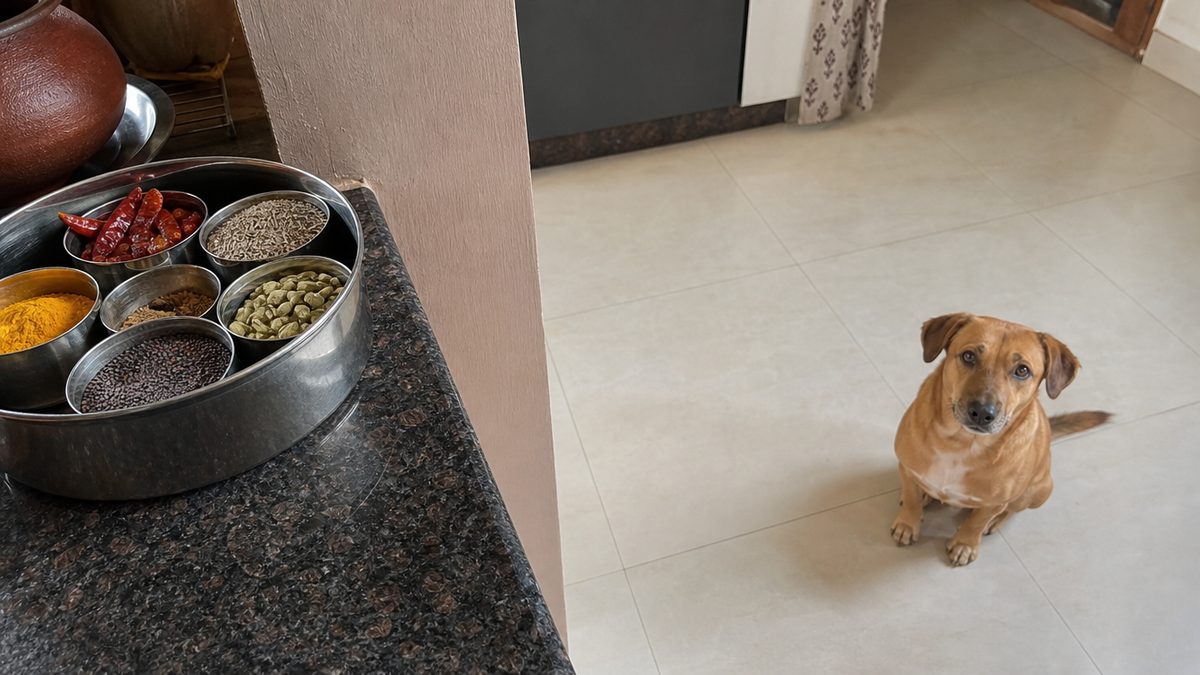
Quick answer
Can dogs eat spicy food? No, and the reason is irritation rather than poisoning. Capsaicin acts on gut receptors that trigger strong colonic contractions and diarrhoea in dogs, measured directly. Salt is the one Indian seasoning with a real published toxic dose. Nutmeg in garam masala is genuinely toxic but has no canine dose. Turmeric is not toxic and does almost nothing at kitchen amounts. Lift the animal's share out before the tadka.
This guide is general information for Indian pet owners and is not a diagnosis. Always consult a registered veterinarian near you before acting on anything you read here, and treat any sudden change in your pet's condition as urgent.
Can dogs eat spicy food, and what actually happens when they do
Dogs cannot eat spicy food comfortably, and the reason is a motility event rather than a poisoning. Capsaicin reaching a dog's colon triggers giant migrating contractions and defecation, which has been measured directly in conscious dogs rather than inferred from a receptor in a dish.
Researchers at Tohoku University put capsaicin into the proximal colon of conscious dogs fitted with strain-gauge force transducers and watched what the colon did. Capsaicin at 5 and 10 mg evoked giant migrating contractions in a dose-independent manner, and it induced defecations with more than 90 percent probability in neurally intact dogs. Atropine and hexamethonium abolished the effect, which places it on a cholinergic nerve pathway rather than on tissue damage.
That is the mechanism behind the diarrhoea, and it is worth being precise about what it is not. A giant migrating contraction is the colon's own emptying reflex running at full strength. It is the same contraction that accompanies an ordinary bowel movement, fired by a chemical the colon reads as an irritant. Nothing in that sequence is a poisoning, and nothing in it is harmless either, because a dog that empties its colon under a forced contraction loses water it did not plan to lose.
Getting that category right is the first correction this page makes. The highest-ranking page with real content on this query states that spicy foods can be toxic for dogs, and argues the case from the number of taste buds a dog has rather than from anything measured in a gut. Toxic and irritant are different words with different consequences, and an owner who cannot tell them apart will either panic over a lick of chutney or refuse to take a nutmeg exposure seriously. Chilli is an irritant. Nutmeg and the Allium in the same masala packet are the toxins.
Three Indian spice compounds, three gut channels, one outcome
Capsaicin is not the only pungent compound in an Indian kitchen with a channel in a dog's gut, and the convergence is the most useful thing on this page. Allyl isothiocyanate, the compound mustard seed releases, and cinnamaldehyde, the compound that makes cinnamon smell of cinnamon, both act on a different channel called TRPA1, which the same group cloned from the dog. In conscious fasted dogs, allyl isothiocyanate stimulated gastric antrum and jejunum motility and induced giant migrating contractions in the colon.
| Compound | Where it comes from in an Indian kitchen | Channel | What was measured in conscious dogs |
|---|---|---|---|
| Capsaicin | Green and red chilli, lal mirch powder, chutney | TRPV1 | 5 and 10 mg into the colon evoked giant migrating contractions and defecation in over 90 percent of trials |
| Allyl isothiocyanate | Rai and sarson, released when the seed is crushed or spluttered | TRPA1 | 10 mg into the colon produced giant migrating contractions in 10 of 10 experiments and defecation in 9 of 10 |
| Cinnamaldehyde | Dalchini, and the essential oil of Indian tej patta | TRPA1 | Named as a TRPA1 agonist in the dog cloning study; no separate canine dose published |
Read that table as the page's spine. Three different compounds, two different receptors, one shared endpoint, and none of the three is a toxin in the sense that onion is. They are irritants with a measurable effect on how fast a dog's gut moves.
The one published safe level, and why cats sit lower than dogs
A regulator has actually set a number. The EFSA panel on feed additives assessed capsaicin as a sensory feed additive for all animal species and concluded that the additive capsaicin is safe at the maximum use level proposed by the applicant, 6.5 mg per kg of complete feed, for a long list of species including dogs, while for cats and other species not considered, 5.3 mg per kg of complete feed is considered safe. Its own working table puts the maximum safe use level at 31.7 mg per kg of complete feed for dogs against 5.3 for cats, on assumed daily feed intakes of 17 and 20 g of dry matter per kg of body weight.
Convert that to an animal. A 10 kg dog eating 170 g of dry matter a day has room for about 5.4 mg of capsaicin at the dog ceiling. A 4 kg cat eating 80 g has room for about 0.42 mg. Now take the chilli. Scientists at Manipur University measured six local cultivars by HPLC and found capsaicin from 0.17 percent by weight in Haomorok up to 2.06 percent in Umorok, the Naga king chilli. A single ordinary green chilli of about 2 g therefore carries somewhere between roughly 3 and 41 mg of capsaicin depending on which chilli it is.
At the mildest cultivar in that Manipur set, one 2 g chilli is about two thirds of a 10 kg dog's entire daily capsaicin ceiling. At the hottest, it is nearly eight times it, and about a hundred times a 4 kg cat's. The arithmetic is ours, the two inputs are published, and the honest caveat is that a feed-additive ceiling is a chronic daily figure rather than a single-exposure threshold. It tells you there is no sensible room for chilli, not that one chilli is an emergency.
Two limits belong on all of this and we are not hiding them. The Tohoku doses went directly into the colon through a catheter, not down the throat, so they tell you what capsaicin does once it arrives rather than how much of a mouthful survives the journey. And the EFSA figure is a feed ceiling for a purified additive, not a reading of a chutney. Our guide to Indian food for dogs sets out the receptor evidence on canine chilli sensitivity, which points the opposite way to the usual claim, and this page is the measured gut half of the same question.
Salt toxicosis: the one seasoning with a real published dose
Salt is the only thing in an Indian masala dabba with a published toxic dose in dogs. The acute oral lethal dose of salt in dogs is about 4 g per kg, and clinical signs of toxicosis can appear after ingestion of 2 to 3 g per kg.
Hold that figure against an animal before anything else. For a 10 kg dog, 2 g per kg is 20 g of salt in one sitting. India's own food standard requires common salt to be not less than 96.0 percent sodium chloride on a dry basis, so 20 g of Indian table salt is about 7.9 g of sodium. That is the number to convert Indian foods into.
The same source carries the condition that decides almost every real case. Salt toxicosis is unlikely to occur as long as sodium-regulating mechanisms are intact and fresh drinking water is available. Excess salt intake in dogs results in vomiting within several hours after ingestion, and clinical signs can progress to weakness, diarrhoea, muscle tremors and seizures. Serum and cerebrospinal fluid sodium above 160 mEq/L is the diagnostic marker, and the correction of hypernatraemia is deliberately slow, at 0.5 to 1.0 mEq/L per hour, with the slower rate for chronic cases.
Papad, achaar and namkeen, converted into the actual dose
Now put measured Indian foods into that arithmetic, which no page on this subject has done. A survey of 5,686 packaged products in Hyderabad and New Delhi by The George Institute for Global Health found pickled vegetables at a mean of 1,759 mg of sodium per 100 g across 43 labelled products, with a range from 1 to 8,000 mg, and Indian snack foods at a mean of 627 mg per 100 g across 127 labelled products, range 0 to 2,000. Sauces and spreads were the saltiest group overall at a mean of 2,217 mg per 100 g, and within the meal-based sauces sub-category the mean was 3,240 mg, with individual products running from 0 to 21,218 mg per 100 g.
| Food, as measured | Sodium per 100 g | Amount needed to reach 7.9 g of sodium | Is that a quantity a dog could actually eat? |
|---|---|---|---|
| Papad, mean of the Indian survey | 1,219 mg | about 646 g | No. Papad is not an acute poisoning risk at any plausible amount |
| Indian snack foods, mean of 127 labelled products | 627 mg | about 1.26 kg | No. A bowl of namkeen is a chronic load, not an emergency |
| Pickled vegetables, mean of 43 labelled products | 1,759 mg | about 449 g | Unlikely, though a knocked-over jar is not impossible |
| Pickled vegetables at the top of the measured range | 8,000 mg | about 99 g | Yes. Roughly a few large spoonfuls of the saltiest achaar measured |
| Sauces and spreads at the top of the measured range | 21,218 mg | about 37 g | Yes. Two tablespoons of the saltiest product in the survey |
That table is the whole salt answer and it cuts both ways. A papad is not a poison, and a page that implies it is has misled you. A dog that gets into the saltiest achaar an Indian survey has measured, at about 100 g, is in the range where a veterinary toxicology reference says clinical signs can appear. Those are different events and they deserve different reactions.
There is a reason achaar sits at the top of that range and no other Indian food does. Salt and oil are what carry a cut vegetable through a humid monsoon and the months after it without refrigeration, so an Indian pickle is not a salted food, it is a food preserved by salt. The 8,000 mg per 100 g end of the measured range is the preservation working as intended. That also explains why the jar is usually within reach on the kitchen counter rather than in the fridge, which is the practical half of the risk.
Every figure above assumes the animal has fresh drinking water, because that is the condition the published threshold itself assumes. A dog shut on a terrace through a humid Chennai or Kolkata afternoon with an empty bowl and a salted snack is a different animal from the one in the arithmetic. Refill the water before you worry about the papad.
Two gaps here are real and we are not filling them with a guess. There is no published cat threshold in that reference, which gives figures for dogs, swine, horses and cattle and not for cats, so none of the arithmetic above transfers to a cat and we have not pretended it does. And the papad figure comes from the George Institute's own 2016 survey of 5,796 products as reported in the Deccan Herald, which stated that papads have a mean sodium content of 1,219 mg per 100 g with a range of 2 to 4,000 mg. We read that figure in the newspaper report and not in the survey document itself, and it is flagged that way rather than dressed up.
The chronic side of salt, which is the one that matters for a dog eating Indian family food every day rather than raiding a jar once, is costed on our roti page against a dog's published sodium minimum. A dog already on a sodium-restricted prescription diet for mitral valve disease, and a cat on one for chronic kidney disease, are having a different conversation again, and it belongs with the veterinarian who set the diet.
Turmeric: what a dose that did anything would actually have to be
To give a dog a turmeric dose that has been shown to put curcumin into its blood, you would have to feed it most of a 100 g packet of haldi, and even that produced a peak plasma concentration of 4.22 nanograms per millilitre before dropping to extremely low levels.
This is the spice Indian owners add deliberately, believing it is medicinal, so it deserves the arithmetic rather than an opinion. Twenty-four female beagle dogs weighing 10 to 15 kg were given unmodified curcumin at 150 mg per kg by mouth after a 12 hour fast. Curcumin reached a maximum plasma concentration of 4.22 ng/mL at 40 minutes post-dose, which rapidly dropped to extremely low levels after. The same paper records that the oral half-life of curcumin in beagle dogs is about 0.85 hours, a figure it takes from earlier work rather than measuring itself, and notes that in its own curcumin group the concentration at several time points fell below the lower limit of quantification.
Now convert the dose into haldi. India's own standard requires turmeric powder to have colouring power expressed as curcuminoid content of not less than 2.0 percent by weight on a dry basis, and permits total starch up to 60.0 percent by weight. A 12.5 kg beagle at 150 mg per kg received 1,875 mg of curcumin. At the legal minimum curcuminoid content, that is about 94 g of turmeric powder, which is most of a standard retail packet, eaten at one sitting, to reach a blood level of four nanograms per millilitre for forty minutes.
Nothing above says haldi hurts a dog. It says a pinch of haldi on a bowl delivers a dose several hundred times smaller than the one a controlled study needed to produce a barely detectable blood level. The honest verdict on turmeric is that it is near-certainly harmless and near-certainly useless at the amounts Indian owners actually use, and that is a more useful sentence than either of the two currently on offer.
The figure the top-ranking Indian page gets wrong
The page ranking first in India for spices and dogs states that curcumin has an estimated acceptable daily intake of up to 3 mg per kg body weight in dogs, and links that claim to a 2023 review. Open the review. It says that in 2004 the FAO/WHO Expert Committee on Food Additives established an ADI of up to 3 mg per kg body weight for curcumin, and in the sentence immediately before it defines ADI as the amount of a given substance, expressed in mg per kg of human body weight per day, that a person can take from all sources throughout life without harming the organism.
It is a human food-additive figure, defined as a human figure on the same line, attached to dogs by the page citing it. We are publishing the disagreement rather than repeating either version, because an owner reading that sentence will conclude a canine dose exists when none has been set.
Black pepper is why Indian cooks pair haldi with kali mirch
Piperine, the pungent compound in black pepper, is a known inhibitor of hepatic and intestinal glucuronidation, which is the pathway that destroys curcumin before it reaches the blood. Researchers at St John's Medical College in Bangalore gave rats curcumin at 2 g per kg and found the bioavailability increased by 154 percent when piperine at 20 mg per kg was given with it. In humans, after a dose of 2 g of curcumin alone, serum levels were either undetectable or very low, and with 20 mg of piperine the increase in bioavailability was 2000 percent.
Two things follow for a dog owner. The pairing of haldi and kali mirch in Indian cooking is pharmacologically real rather than folklore, and it still does not rescue the arithmetic above, because 2000 percent of an undetectable amount at a dose of 2 g is nowhere near what a pinch on a bowl delivers. No equivalent piperine study in dogs exists that we could find, and the figures above are from rats and people.
On black pepper itself, the Indian page that ranks first lists it among spices that are toxic to dogs and should be strictly avoided, alongside garlic, onion and nutmeg, and attaches no source or dose to that classification. We could find no published canine toxic dose for black pepper and have left the row empty rather than borrowing its confidence.
Hing: what is actually inside the block
Hing is a plant resin from the carrot family and not an onion, so the Allium mechanism does not apply to it, and that question is answered in full on a page of ours that already owns it.
Read our onion and garlic toxicity page for the whole treatment. It sets out India's own food standard definition of asafoetida as the oleogumresin of Ferula species, the fact that Ferula sits in Apiaceae rather than in the onion family, and the composition of the compounded bandhani hing most Indian households actually buy, which is that resin blended with gum arabic, edible starch or edible cereal flour. We are not re-deriving any of it here.
One thing is worth adding, and it is the thing this page is for. Hing smells sulphurous and that smell is why cooks use it in a no-onion kitchen, but the resemblance is aroma chemistry rather than the specific organosulphur compounds that damage a red blood cell. We went looking for a published veterinary dose for asafoetida in dogs or cats on 21 October 2026 and found none, in either direction. The practical reading is narrow. Hing is the reason a no-onion tadka is possible at all, which makes it the most useful thing in this cabinet for an animal, and that is a culinary argument rather than a claim that it is safe to feed.
Compounded hing is mostly starch or cereal flour carrying a little resin. For a dog with a diagnosed wheat problem confirmed by a proper elimination trial, that is a real ingredient rather than a trace, and it is the one reason to read the hing packet. Our roti page sets out what a wheat food trial actually involves and why removing one food while the dog still gets everything else proves nothing.
Nutmeg in garam masala: genuinely toxic, with no canine dose that scales by weight
Nutmeg is the one spice in an Indian blend that a veterinary poison control service treats as a genuine toxin, and no canine dose for it has been published, which is why the figures circulating on this query do not agree with each other.
Start with what is in the packet. India's own standard defines curry powder as the powder obtained from grinding clean, dried and sound spices belonging to the group of aromatic herbs and seeds such as black pepper, cinnamon, cloves, coriander, cardamom, chillies, cumin seeds, fenugreek, garlic, ginger, mustard, poppy seeds, turmeric, mace, nutmeg, curry leaves, white pepper, saffron and aniseeds, requires that the proportion of spices be not less than 85.0 percent by weight, and permits added starch and edible common salt up to 5.0 percent by weight on a dry basis. Nutmeg and mace are on that list, and so are garlic and mustard.
That single clause does more work than any warning. A masala packet legally contains garlic, which is the category-one toxin covered on our onion and garlic page, plus nutmeg, plus up to five percent salt, and it is not required to tell you the proportions. India publishes no separate composition standard for garam masala, sambar podi, Maharashtra's goda masala or the Bengali panch phoron that a Kolkata kitchen keeps, so which blend on your shelf carries nutmeg is a question for its own ingredient list.
Where the two sources on nutmeg disagree
Pet Poison Helpline states that nutmeg contains a toxin called myristicin, that if a very large amount of nutmeg is ingested myristicin toxicity can cause hallucinations, disorientation, increased heart rate, high blood pressure, dry mouth, abdominal pain and possibly seizures, and that symptoms can last up to 48 hours. Its position on quantity is explicit: a pet would need to ingest a very large amount of nutmeg, and animals eating food seasoned with nutmeg are very unlikely to reach that dose.
Google's own AI Overview for the query, captured live on 21 October 2026, says something different. It states that consuming about one teaspoon or more of ground nutmeg, or a whole seed, can trigger severe central nervous system and neurological symptoms, and that signs usually start within 3 to 8 hours and can last up to 48 hours. We could not find the teaspoon figure in any veterinary toxicology source, and we are publishing both positions rather than averaging them.
Nutmeg is real toxicology, not an irritant, and the uncertainty is about the threshold rather than about the mechanism. Telephone a veterinary surgeon if your animal has eaten nutmeg or a whole jaiphal rather than a dusting of a blend, and say how much and when. Do not attempt to decide the dose yourself from a web page, including this one.
Mustard seed, cumin, coriander and fenugreek: the four seeds in the tadka
Mustard seed is the only one of the four tadka seeds with any canine measurement behind it, and the other three have none, which is the honest answer rather than an awkward one.
Mustard seed's pungency is allyl isothiocyanate, released when the seed is crushed or spluttered in hot oil, and India sets a legal floor for how much of it the seed must contain. Mustard, rai or sarson, must carry allyl isothiocyanate on a dry basis of not less than 1.0 percent by weight in Brassica nigra and not less than 0.7 percent in Brassica juncea.
That is the same compound the dog studies used. Fifteen beagle dogs of 11 to 13 kg received allyl isothiocyanate into the proximal colon. At 5 mg it caused giant migrating contractions in 7 of 10 experiments and defecation in 6 of 10; at 10 mg, giant migrating contractions in 10 of 10 and defecation in 9 of 10, against 0 of 10 for placebo. The effect was abolished by atropine, hexamethonium, ondansetron and a TRPA1 antagonist, so it runs on the same cholinergic and serotonergic wiring as the capsaicin response.
The same paper reports, citing the earlier dog cloning study, that allyl isothiocyanate at a dose of 1 mg per kg administered orally in dogs induced giant migrating contractions at the distal colon. We have not read that oral figure at its own source and are citing it as Someya and colleagues report it. Taken at face value, 1 mg per kg is 10 mg for a 10 kg dog, and at India's legal minimum of 0.7 percent for Brassica juncea that is at most about 1.4 g of rai seed, which is well under a teaspoon.
The mustard goes into the oil first and the dog's portion usually comes out of the pot after. Of everything on this page, the tadka seed has the smallest gap between a kitchen quantity and a quantity shown to move a dog's colon. The timing instruction that fixes it is on our Indian food guide for dogs, which owns it.
A southern tadka and a northern one are not the same exposure
Which compounds reach the pot depends on where the kitchen is, and this is the one place on the page where the region genuinely changes the answer. A tempering in Tamil Nadu, Karnataka or coastal Kerala starts with mustard seed spluttering in oil, usually with dried red chilli and curry leaf behind it. That puts both compounds with canine measurements behind them, the allyl isothiocyanate and the capsaicin, into the same thirty seconds of cooking. A north Indian tadka more often begins with cumin in ghee, and cumin is the one with no measurement at all.
The practical reading is that a dog in a Chennai or Bengaluru household is more likely to meet the two measured irritants in an ordinary week than one in a Delhi household, and a Mumbai or Pune kitchen running both styles meets them on alternate days. None of that changes the instruction, which is the same everywhere. It changes how often the instruction matters.
Cumin, coriander and fenugreek: no data, said plainly
- Cumin, jeera. No published canine or feline toxic dose found on 21 October 2026, and no entry in the ASPCA toxic plant database. It is not an Allium, carries no myristicin and has no measured gut-channel effect in a dog. The honest verdict is unknown rather than safe.
- Coriander, dhania. Same position. Seed and leaf both appear on no veterinary toxicology list we could find, and no dose exists in either direction.
- Fenugreek, methi. Same again, and worth saying twice because methi is given deliberately in some Indian households. We searched the ASPCA plant database for fenugreek on 21 October 2026 and the search returned no entry for it. The absence of a toxicity listing is not evidence of safety at a feeding dose.
- Cardamom, elaichi. No published canine dose. The whole pod is a small hard object and a physical hazard argument applies to it that has nothing to do with chemistry.
Four unknowns in a row is an uncomfortable thing to publish and it is the accurate state of the literature. A row that says nobody has measured this tells you which question to take to your own veterinarian. A row that invents a figure tells you nothing and may do harm.
Cinnamon, cloves and bay leaf: the eugenol group
Cinnamon, cloves and bay leaf share a chemistry that matters more to a cat than to a dog, because all three carry phenolic essential oils and cats cannot clear phenols the way dogs can.
Cinnamon powder has the only quantity anybody publishes in this group. Pet Poison Helpline states that it takes a larger amount of ingested cinnamon powder to cause problems in our pets, greater than 1 teaspoon of powder for most pets, while only a small amount of the essential oil is needed, and that large overdoses or essential oil exposure can lead to low blood sugar and liver disease as well as vomiting, diarrhoea and changes in heart rate. It adds a hazard nobody expects, which is that a dog inhaling the powder it is eating can get bronchospasm, because the powder is very irritating to the lungs.
The Merck Veterinary Manual names cassia bark and cinnamon oil among the essential oils that are potentially hepatotoxic, alongside birch tar, pennyroyal and tea tree, and gives no toxic dose for any of them in any species. Dalchini sold in India is usually cassia rather than true Ceylon cinnamon, so the oil named there is the one in most Indian kitchens.
The bay leaf in your biryani is not the bay leaf on the toxic list
This is the distinction nobody draws and it changes what the warning means. The ASPCA lists Bay Laurel, Laurus nobilis, family Lauraceae, as toxic to dogs, cats and horses, with toxic principles given as eugenol and other essential oils, and clinical signs as vomiting and diarrhoea, adding that large ingestion of whole leaves can cause obstruction.
Indian tej patta is a different plant. ICAR's Indian Institute of Spices Research states that Indian bay leaf, commonly known as tejpat, is obtained from Cinnamomum tamala, an evergreen tree belonging to the family Lauraceae, that it is botanically distinct from the Mediterranean bay laurel, Laurus nobilis, though used similarly as a cooking spice, and that its essential oil contains eugenol and cinnamaldehyde. It is grown in Uttarakhand and Himachal Pradesh and is native to the Himalayan region and Northeast India. Wikipedia records the same split, noting that tejpat leaves are often sold simply as bay leaves, causing confusion with the Mediterranean laurel, and that the two differ in appearance and aroma.
The database entry warning you about bay leaf is about a plant that is not in your biryani. That is not reassurance, because Indian tej patta carries eugenol too, by India's own research institute's description, and the obstruction risk from a swallowed whole leaf is identical in either species of tree. Fish the leaf out of the dog's share, which you were going to do anyway.
Cloves, laung, are the concentrated eugenol source in the group and have no published canine feeding dose that we could find. Pet Poison Helpline lists clove oil among the essential oils known to cause poisoning in cats, together with cinnamon oil, wintergreen, citrus, pine, ylang ylang, peppermint, pennyroyal, eucalyptus and tea tree. A whole clove in a pulao and a bottle of clove oil are not the same exposure, and only the second one is in that list.
| Spice | The compound at issue | Published figure, if any | Verdict |
|---|---|---|---|
| Cinnamon powder, dalchini | Cinnamaldehyde, plus coumarin in cassia | Greater than 1 teaspoon of powder for most pets before problems | Irritant at a kitchen dusting, a real problem as oil. Also a TRPA1 agonist in dogs |
| Cinnamon essential oil | Concentrated cinnamaldehyde | A small amount is enough to cause problems; named as potentially hepatotoxic | Keep away from both species, and from cats especially |
| Clove, laung | Eugenol | No canine feeding dose found. Clove oil listed among oils that poison cats | Whole clove is a physical object to remove. The oil is a genuine hazard |
| Bay laurel leaf | Eugenol and other essential oils | No dose. Toxic to dogs, cats and horses; whole leaves can obstruct | Remove the leaf. Not the leaf most Indian kitchens use |
| Indian bay leaf, tej patta | Eugenol and cinnamaldehyde | None. A different species from the one on the toxic list | Remove the leaf anyway. Obstruction does not care about the species |
Why the cat is the restricted species on almost every row
Cats sit lower than dogs on nearly every figure on this page, and the reason is one missing liver enzyme rather than a general delicacy.
The Merck Veterinary Manual puts it directly. Although both dogs and cats can be affected by essential oils, cats are more sensitive because they are deficient in the enzyme glucuronyl transferase, and this enzymatic deficiency makes cats very sensitive to phenol and phenolic compounds, which some oils contain. Dogs do not have the same enzyme deficiency as cats, and are still at risk for toxicosis from exposure to essential oils.
Eugenol is a phenolic compound. So is the phenol fraction of cinnamon and clove oil. That one enzymatic gap is why a clove-oil exposure that gives a dog a bad evening is a liver question in a cat, and it is why the entire eugenol row above has a sharper verdict for the second species.
The regulator reached the same conclusion independently and from a different direction. EFSA set the maximum safe capsaicin level in complete feed at 31.7 mg per kg for dogs against 5.3 mg per kg for cats, and its conclusion singles cats out as the exception to the level it cleared for every other species on its list. A cat is both smaller and less able to clear what it absorbs, and the two effects compound.
- Grooming turns a spill into a meal. A cat that walks through spilt masala or oil ingests it off its own coat, which is why a dermal exposure in a cat is an oral one within the hour.
- A cat is a quarter of a dog's weight. Every per-kilogram figure on this page shrinks accordingly, and the cat thresholds mostly do not exist to shrink.
- No published cat salt threshold. The reference that gives 4 g per kg for dogs gives no figure for cats at all, so the achaar arithmetic in the salt section does not transfer.
- A cat refusing food is its own emergency. Our Indian food guide for cats covers why, and it is the reason to take a spice-related food refusal in a cat more seriously than in a dog.
What to do at the stove, and what to do after
To keep an animal's food unspiced, take its share out of the pot before the tadka rather than picking through a finished dish, because nothing on this page is removable once it has gone in.
That timing instruction is the single most useful thing in this whole subject, and it is set out in full with the four-category framework behind it on our guide to Indian food safe for dogs. This page is the chemistry that explains why it works. Every compound named here, the capsaicin, the allyl isothiocyanate, the eugenol, the salt and the myristicin, enters an Indian dish in the last two minutes of cooking, which is exactly the window the instruction protects.
Five things to say when you telephone
- Name the spice or the dish, and say whether the blend's packet lists nutmeg, mace, garlic or onion.
- Estimate the amount by weight or by spoons rather than saying some.
- Give the time to the nearest half hour, because the capsaicin and mustard responses are fast and the nutmeg one is not.
- Give the animal's current body weight, because every figure in veterinary toxicology is per kilogram.
- Keep the packet, so the clinic can read the ingredient list itself rather than trusting your memory of it.
How urgent is it, by what went in
| Tier | What belongs here | What to do |
|---|---|---|
| Telephone now | Nutmeg or a whole jaiphal eaten directly. Any essential oil. A real quantity of achaar or a salted gravy in a small animal. Any gravy with an onion or garlic base. Any animal already vomiting repeatedly, tremoring or unsteady | Telephone a veterinary surgeon immediately and follow what you are told. Do not wait for a second sign |
| Telephone today | A chilli-heavy dish eaten by a dog that is otherwise bright. A cat that licked something spiced. A whole bay leaf or clove that was swallowed rather than spat out. Any animal on a prescription diet | Call the clinic during the day, describe the amount, and ask whether they want to see the animal |
| Watch and be ready | A lick of a mildly spiced plate by a healthy adult dog that is eating, drinking and bright, with water available | Offer water, expect loose stool within a day, and call if it continues past 24 hours or anything else changes |
Bonbeno names no medicine and no dose, and nothing here tells you to make an animal vomit at home. Whether to do that depends on what was eaten, how long ago and the animal in front of the clinician, and getting it wrong is worse than doing nothing. Do not give milk, ghee or curd to put out a chilli either, because a fatty meal on top of an irritated gut is the one combination our pancreatitis page is about.
One habit prevents most of this and it costs nothing. Keep one steel bowl for the animal's unsalted share and fill it from the pot before the tempering, every time you cook, in the same motion. Our homemade dog food guide sets out what that share has to contain to be a meal rather than a side dish, and our vegetarian household guide covers the protein question that an unspiced Indian bowl runs into first.
What this page can prove, and what it cannot
Eight claims on this page are measurements with a denominator or a legal text behind them, and seven widely repeated claims about Indian spices and pets are not established, so the line is drawn here rather than left for you to guess.
Eight claims are established, and each names its source.
- Capsaicin at 5 and 10 mg into the proximal colon of conscious dogs evoked giant migrating contractions and induced defecation with more than 90 percent probability.
- Allyl isothiocyanate at 10 mg into the proximal colon produced giant migrating contractions in 10 of 10 experiments and defecation in 9 of 10, against 0 of 10 on placebo, in 15 beagles.
- EFSA set the maximum safe capsaicin level in complete feed at 31.7 mg per kg for dogs and 5.3 mg per kg for cats.
- The acute oral lethal dose of salt in dogs is about 4 g per kg, with clinical signs from 2 to 3 g per kg, and toxicosis is unlikely while sodium regulation is intact and fresh water is available.
- Pickled vegetables sold in India averaged 1,759 mg of sodium per 100 g across 43 labelled products, with a measured range to 8,000 mg.
- Unmodified curcumin at 150 mg per kg by mouth produced a peak plasma concentration of 4.22 ng/mL at 40 minutes in beagle dogs.
- India requires turmeric powder to carry not less than 2.0 percent curcuminoid content and mustard seed not less than 0.7 to 1.0 percent allyl isothiocyanate, and permits nutmeg, mace, garlic and up to 5 percent salt in curry powder.
- Indian tej patta is Cinnamomum tamala, botanically distinct from the Laurus nobilis on the toxic plant list, and its essential oil contains eugenol and cinnamaldehyde.
Seven claims are not established, and this list marks where the page reasons or reports rather than measures.
- No published canine or feline toxic dose exists for cumin, coriander, fenugreek, cardamom, asafoetida or black pepper that we could find on 21 October 2026. Nutmeg is the one exception and a weak one: a WSAVA congress proceeding reports that a full teaspoon of ground nutmeg or one to three whole nutmegs cause toxic effects in dogs, a figure that is unreferenced, hedged by its own author and flat rather than per kilogram, so it does not scale from a 3 kg dog to a 40 kg one. Pet Poison Helpline, which gives a pet quantity for cinnamon on the same page, keeps its nutmeg position qualitative, that a very large amount is required.
- The capsaicin and allyl isothiocyanate doses were delivered into the colon through a catheter, not eaten, so they measure what the compound does on arrival rather than how much of a mouthful gets there Someya S, Nagao M, Shibata C, Tanaka N.
- The oral figure of 1 mg per kg of allyl isothiocyanate inducing giant migrating contractions is reported inside the Someya paper citing earlier work, and we have not read it at its own source.
- The EFSA ceiling is a chronic daily feed-additive figure for a purified compound, not a single-exposure threshold for a chutney, and the conversions into chilli weight are our arithmetic on two separate published inputs Sanatombi K and Sharma GJ.
- The Manipur cultivar measurements cover six cultivars of three Capsicum species grown in one state. They are not a national survey of Indian chilli and should not be read as one.
- The papad sodium figure was read in the Deccan Herald's report of the George Institute survey rather than in the survey document itself.
- No published salt toxicosis threshold for cats was found in the reference that supplies the dog figures, so none of the salt arithmetic on this page applies to a cat.
Two things circulating on this query that do not survive a check
The first is the curcumin ADI. The page ranking first in India for spices and dogs attributes an acceptable daily intake of 3 mg per kg body weight to dogs and links the review that defines the same figure, on the same line, as a human food-additive ADI set by JECFA in 2004 Kepinska-Pacelik J and Biel W. The second is the nutmeg teaspoon. Google's AI Overview, captured live on 21 October 2026, names about one teaspoon of ground nutmeg as the threshold for severe neurological signs, and the veterinary poison control source it would have to rest on says instead that a pet would need a very large amount and that food seasoned with nutmeg is very unlikely to reach it.
Finally, the boundary. Bonbeno names no product, ranks no brand, prescribes no diet and gives no dose. If your animal has eaten something seasoned and is vomiting, tremoring, unsteady, passing loose stool for more than a day or refusing food, the decision belongs to the veterinarian who can examine it, which is why this page publishes under the medical disclaimer at the top.
Common questions
What happens if dogs eat spicy food?
Spicy food in a dog produces a gut motility event rather than a poisoning. Capsaicin placed in the colon of conscious dogs at 5 and 10 mg evoked giant migrating contractions, the colon's full-strength emptying reflex, and induced defecation with more than 90 percent probability. Expect drooling, discomfort and loose stool within hours. Offer water and telephone a veterinary surgeon if vomiting repeats or the stool stays loose past a day.
Can dogs tell if food is spicy?
Yes. Dogs carry the TRPV1 receptor that capsaicin acts on, and they carry the TRPA1 receptor that mustard's allyl isothiocyanate and cinnamon's cinnamaldehyde act on, which researchers cloned from the dog itself. Spiciness is a chemical irritation rather than a taste, so a dog feels it without needing taste buds for it, and it reacts in the gut as well as in the mouth.
Which spices are toxic to dogs?
Two, properly speaking. Garlic and onion powder, which almost every Indian masala blend legally contains, are the genuine toxins and have published doses per kilogram. Nutmeg is the second, through myristicin, though no canine dose has been published for it. Chilli, mustard and cinnamon are irritants rather than toxins. Salt is in its own category, with a real dose that ordinary Indian snacks do not reach.
Is garam masala safe for dogs?
No. India's own standard for curry powder permits garlic, mustard, nutmeg and mace among its ingredients and allows up to 5 percent edible common salt by weight on a dry basis, with no requirement to publish the proportions. That means a masala packet can legally carry the one genuine Allium toxin, the one genuine neurotoxic spice and a meaningful salt load at once, and the ingredient list is the only way to know which.
What happens if a dog eats a little bit of nutmeg?
A little is very unlikely to cause serious harm, though it may upset the stomach. Pet Poison Helpline states that a pet would need to ingest a very large amount of nutmeg for myristicin toxicity, and that dogs eating food seasoned with nutmeg are very unlikely to reach that dose. Signs, if they appear, can last up to 48 hours. No canine dose has ever been published, so telephone rather than estimating.
Is it okay if a dog eats a little bit of salt?
Yes, for a healthy dog with water available. The acute oral lethal dose of salt in dogs is about 4 g per kg and clinical signs can appear from 2 to 3 g per kg, which for a 10 kg dog is 20 to 30 g of salt at once. A papad will not get near that. Roughly 100 g of the saltiest achaar measured in an Indian survey would. Water availability is the condition the threshold itself assumes.
How much turmeric can I give my dog?
No veterinary dose for turmeric in dogs has been established. What exists is a pharmacokinetic study in which 24 beagles given unmodified curcumin at 150 mg per kg by mouth reached a peak plasma level of 4.22 ng/mL before it dropped to extremely low levels. At India's legal minimum of 2.0 percent curcuminoid content, that dose is about 94 g of haldi powder. A pinch delivers a tiny fraction of it.
Do vets recommend turmeric for dogs?
No veterinary body we could find recommends a turmeric dose for dogs, and no canine acceptable daily intake has been set. The 3 mg per kg figure circulating on Indian pages is a human food-additive ADI established by the FAO/WHO Expert Committee on Food Additives in 2004, defined in its own source as mg per kg of human body weight per day. Ask the veterinarian treating your own animal rather than a page.
Is cinnamon and nutmeg safe for dogs?
They sit in different categories. Cinnamon powder needs more than one teaspoon to cause problems in most pets, though cinnamon oil is a concentrated hazard and Merck names it among potentially hepatotoxic essential oils. Nutmeg is a genuine toxin through myristicin at a large dose, with no published canine threshold. Neither belongs in a bowl, and only nutmeg warrants a telephone call on its own.