
Cat nutrition guide
Indian food safe for cats: the short list, and the arithmetic behind why it is short
The dog answer does not transfer. A dog can live on an Indian household bowl and a cat cannot, because a cat cannot make taurine, cannot make enough arginine, and cannot slow its own protein burn when the bowl runs short. Here is what that costs, in grams.
Quick answer
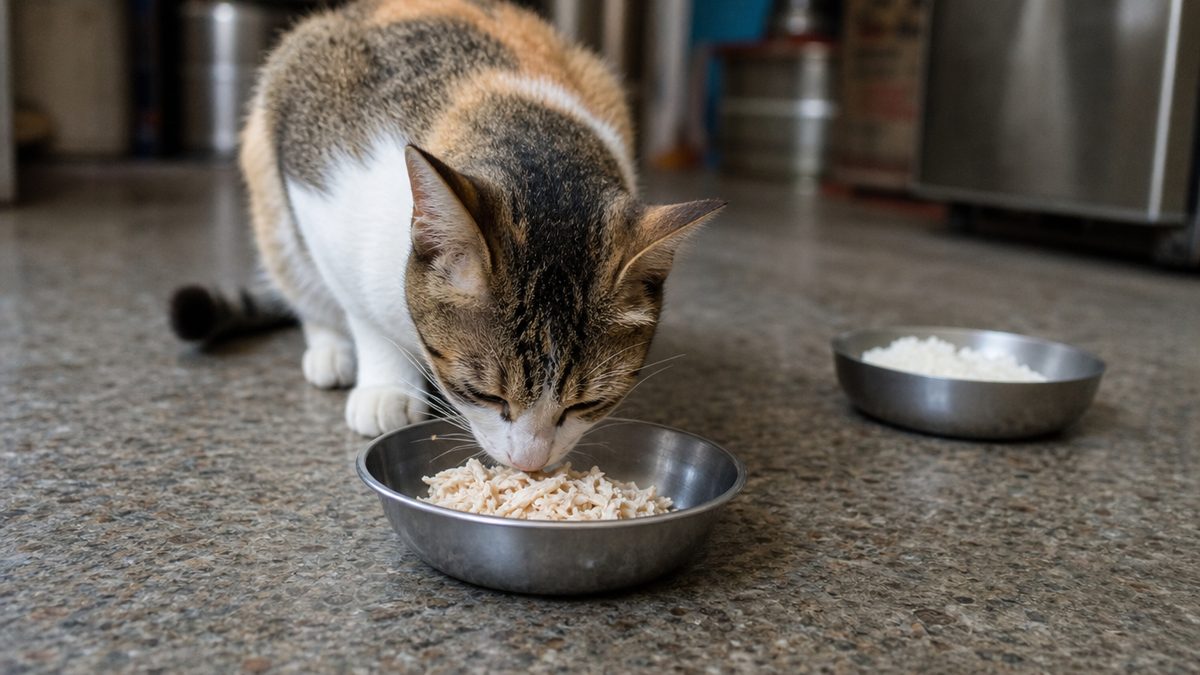
Indian food safe for cats is a short list. Plain cooked chicken, plain cooked mutton, cooked boneless fish now and then, a plain cooked egg and clean water. Everything else is capped or refused. A cat is an obligate carnivore, so the problem with rice, roti, dal and curd is not poison but protein density. Milled rice carries 22 grams of protein per 1,000 kcal against the 65 grams a cat's food must supply.
This guide is general information for Indian pet owners and is not a diagnosis. Always consult a registered veterinarian near you before acting on anything you read here, and treat any sudden change in your pet's condition as urgent.
Indian food safe for cats: the whole list
The list of Indian household foods a cat can safely be given is five items long. Plain cooked chicken or mutton, plain cooked boneless fish now and then, a plain cooked egg, a small spoon of plain unsweetened curd for the cats that tolerate it, and clean water. Everything else on the plate is capped, pointless or refused.
That is the honest answer and it is shorter than the equivalent list for a dog, which is the subject of this page. Our guide to Indian food for dogs sorts a thali into four problems and concludes that most of it is an energy question rather than a poison question. Run the same plate past a cat and the conclusion changes, because almost nothing in an Indian kitchen carries what a cat is built to eat.
One genuine poison does sit on an ordinary Indian plate, and it is the onion and garlic base under the gravy. Cats are the most susceptible species to Allium toxicosis, followed by dogs, and toxicosis has been reported in cats after less than a teaspoon of cooked onion or 5 g per kg of raw onion. That is one sentence of toxicology because our onion and garlic page carries the rest of it in grams per kilogram for both animals. Everything else on this page is about what the bowl is missing rather than what it contains.
| From your kitchen | Verdict | The limit, and why |
|---|---|---|
| Chicken or mutton, plain, cooked, boneless, unsalted | Yes | The only household food that comes close to what a cat's bowl has to be made of. Still not complete on its own |
| Fish, plain, cooked, every bone removed | Yes, occasionally | Four separate problems arrive with a fish habit, set out below. Rotation, not routine |
| Egg, cooked, white and yolk | Yes | Cook it. Raw white binds biotin, and a cooked egg costs you nothing |
| Curd or dahi, plain and unsweetened | A spoon, for some cats | Most adult cats cannot digest the lactose. See can cats drink milk |
| Rice, roti, idli, dosa, dal, poha | A spoon at most, and it buys nothing | Protein density is a third to a half of what a cat's food must carry. The arithmetic is below |
| Sabzi, curry, biryani, tikka masala, dal tadka | No | Built on an onion and garlic base, to which cats are the most susceptible species |
| Milk, in any quantity that matters | No | Intestinal lactase collapses after weaning. One page covers it, linked above |
| Mithai, kheer, sweetened curd, biscuits | No | Pure displacement. A cat cannot taste the sugar and gets nothing from the rest |
| Achaar, papad, namkeen, fried items | No | Salt and oil a cat's bowl has no room for |
| Dog food, from the same house or the same sack | No | Missing taurine, short on arginine and niacin. Its own section below |
Read the right-hand column rather than the middle one. A yes-or-no list is what every page on this query already publishes, and it is the least useful thing you can hand an Indian cat owner, because the question in front of you is almost never whether a food is poisonous. It is whether the bowl adds up.
One row on that table surprises people, so it is worth a sentence. A cat ignores mithai rather than resisting it. The sweet-receptor gene Tas1r2 is a pseudogene in the cat, carrying a 247 base pair deletion in exon 3 and stop codons in exons 4 and 6, with no detectable messenger RNA and no protein, so the functional sweet receptor cannot form at all; the tiger and the cheetah carry the same defect. Your cat is not being sensible about the kheer. It cannot tell the sugar is there, which also means it will not refuse a sweetened curd on taste.
Why the dog answer does not transfer
A dog is a facultative carnivore and a cat is an obligate one, and that is not a slogan about ancestry. It is a set of published numbers. An adult cat's food must carry 65 g of crude protein per 1,000 kcal of metabolisable energy against 45.0 g for an adult dog, 2.60 g of arginine against 1.28 g, and a taurine minimum that the dog profile does not contain at all. Our guide to feeding a dog in a vegetarian household works through what a meat-free bowl takes for a dog. For a cat there is no equivalent page, because there is no equivalent answer.
For a dog, the Indian question is what to keep out of the bowl. For a cat, it is what the bowl is made of. A cat that eats no onion, no chocolate and no sweets, and lives on rice, curd and a piece of fish, is in more trouble than a dog eating exactly the same thing.
Street cats are in the same position with none of the choices. Rice and milk is what most Indian households put out for them, and it is the worst of the available options. Put out plain cooked chicken or a complete dry cat food and clean water instead, which our guide to community cats in India covers alongside the rest of the civic picture.
Five numbers that separate a cat from a dog
Five rows in the published nutrient profiles explain the whole of this page, and four of them are higher for a cat than for a dog. Crude protein, arginine, niacin and thiamine all rise, and taurine appears for the cat and is absent for the dog.
The Association of American Feed Control Officials publishes a nutrient profile for adult dog maintenance and a separate one for adult cat maintenance, each expressed both as a share of dry matter and per 1,000 kcal of metabolisable energy. Setting the two side by side is the cleanest way to see what obligate carnivore means in a table rather than in an argument.
| Nutrient | Adult dog | Adult cat | What the gap means in an Indian bowl |
|---|---|---|---|
| Crude protein | 45.0 g | 65 g | A cereal-heavy bowl misses by half for a dog and by two thirds for a cat |
| Arginine | 1.28 g | 2.60 g | A single arginine-poor meal is an acute event in a cat, not a slow one |
| Taurine, extruded food | no row in the dog profile | 0.25 g | Plants carry none. A vegetarian bowl has no route to it |
| Taurine, canned food | no row in the dog profile | 0.50 g | Twice the dry figure, because wet and heat-processed food loses more |
| Niacin | 3.4 mg | 15 mg | Over four times as much, and a cat cannot make its own from tryptophan |
| Thiamine | 0.56 mg | 1.40 mg | Two and a half times as much, and cooking destroys most of what meat holds |
One row moves the other way and it is worth naming rather than hiding. The adult dog minimum for vitamin A is 1,250 IU per 1,000 kcal and the adult cat minimum is 833 IU. The cat needs less of it by quantity. What changes is the form, because a cat cannot split beta-carotene into retinol, so the carrot and the pumpkin in your sabzi supply a dog some vitamin A and supply a cat none. Our homemade cat food guide sets out that nutrient and the other three a cat cannot make, and this page does not repeat it.
Taurine is the famous one and arginine is the fast one
Taurine has the history, and arginine has the stopwatch. Most breeds of dog can make enough taurine from methionine and cysteine; young and adult cats cannot, because of low cysteine dioxygenase and cysteinesulfinic acid decarboxylase activity, and taurine deficiency in a cat produces dilated cardiomyopathy, heart failure, central retinal degeneration, blindness, deafness and poor reproduction. That is the slow failure, and it takes months to years.
Arginine is the one almost nobody writes about and it is measured in hours. Cats have a very limited ability to make citrulline and arginine, and when dietary arginine is insufficient, food intake falls and hyperammonaemia follows within one to three hours of the meal, with vomiting, neurological signs, ataxia, tetanic spasms and death. The same review ranks sensitivity to dietary arginine deficiency as cats, then dogs, then rats, and suggests that the higher protein requirement of cats comes in part from that much lower ability to make arginine.
You will not produce that in a kitchen by giving a cat a bowl of rice once. It is a laboratory finding about an arginine-free diet. It belongs on this page because it is the clearest available demonstration that a cat's margin for a thin meal is not a dog's margin, and because the same amino acid sits low in exactly the plant foods an Indian bowl is built from.
Taurine, arachidonic acid, preformed vitamin A and niacin are already set out, with the FEDIAF and NRC minimums, on our homemade cat food page. This page takes the next question instead, which is what the Indian plate in front of you actually delivers against those numbers.
What rice and roti actually put in the bowl
Rice and roti put about a third and about a half of a cat's protein minimum into the bowl, and that single comparison answers most of the questions Indian cat owners ask. The figures come from India's own national food composition tables set against the published feline minimum.
The ICMR-National Institute of Nutrition's Indian Food Composition Tables record milled raw rice, sampled in six regions, at 7.94 g of protein and 1,491 kJ per 100 g, and wheat atta at 10.57 g of protein and 1,340 kJ per 100 g. Convert the kilojoules and divide, and rice supplies 22 g of protein per 1,000 kcal while atta supplies 33 g. The adult cat minimum is 65 g.
| Food, per 100 g as printed | Protein | Energy | Protein per 1,000 kcal | Share of the cat minimum of 65 g |
|---|---|---|---|---|
| Rice, raw, milled | 7.94 g | 1,491 kJ (356 kcal) | 22 g | 34 percent |
| Rice, parboiled, milled | 7.81 g | 1,471 kJ (352 kcal) | 22 g | 34 percent |
| Rice, raw, brown | 9.16 g | 1,480 kJ (354 kcal) | 26 g | 40 percent |
| Rice flakes, poha | 7.44 g | 1,480 kJ (354 kcal) | 21 g | 32 percent |
| Rice, puffed | 7.47 g | 1,514 kJ (362 kcal) | 21 g | 32 percent |
| Wheat flour, atta | 10.57 g | 1,340 kJ (320 kcal) | 33 g | 51 percent |
Those last two columns are Bonbeno's arithmetic on the rows cited, not figures printed anywhere. The conversion is the published kilojoule value divided by 4.184 to get kilocalories, then the protein figure scaled to 1,000 of them. Check it yourself; the inputs are both public.
Regional habit barely moves the answer. A roti-led bowl in Delhi and a rice-led bowl in Chennai land in the same place, 33 g and 22 g against the 65 g a cat's food must carry, and the wheat is the better of the two only because wheat is a slightly better cereal, not because it is food for a cat.
Note what the table does not say. It does not say rice is toxic, and it does not say a spoon of rice in a complete bowl is a problem. It says that every kilocalorie a cat takes from rice is a kilocalorie that has to be made up somewhere, and that a bowl which is mostly rice cannot be made up at all. The same rows put rice at half the dog minimum of 45.0 g, so rice fails the protein test for a dog too. The difference is what you are allowed to add to fix it.
Why crude protein flatters these numbers
Crude protein counts nitrogen, not usefulness, so the real shortfall is worse than the table shows. Plant foods carry no taurine and no creatine at all, which is why cats must be given at least some animal-sourced food or the same nutrients from a synthetic supplement. A bowl can therefore clear a crude protein figure and still leave a cat short of the one amino acid whose absence stops its heart.
There is a real credit on the other side and this page is not going to hide it. A cat's natural food, meat, holds under 5 percent glycogen on a dry matter basis and no starch, so gluconeogenesis from amino acids supplies the glucose its brain and red cells need; when a cat is fed enough digestible carbohydrate, less of that glucose has to be made from amino acids. A spoon of cooked rice in an otherwise complete bowl genuinely spares a little protein. It earns its place as a small part of a complete diet and it earns nothing as the diet.
Curd rice, and why it is two questions rather than one
Curd rice fails twice over, once on the curd and once on the rice. The lactose half is settled and we have published the measurements separately, so read can cats drink milk in India for the enzyme figures and the calorie cost of a saucer. The half that page does not cover is what happens when curd rice is the meal rather than the treat, which in a great many households across Tamil Nadu, in Bengaluru and in Hyderabad is exactly what it is. A bowl of rice at 22 g of protein per 1,000 kcal, thinned further with curd, is a long way below 65 g, and it will not look like anything is wrong for a year.
Poha is in the table above as rice flakes, at 21 g of protein per 1,000 kcal. Idli and dosa are not, and we are not going to print a figure we have not read. Their batter is rice with urad dal, so the dal lifts the protein above plain rice by some amount nobody here has measured, and it does not lift it to 65 g, because dal is a pulse and pulses carry no taurine. A piece of idli is not poisonous and it is not food for a cat either. The salt in the batter is a second reason to keep it to a taste rather than a portion.
The cat cannot ration its own protein, and that is the whole argument
A cat on a diet below its protein requirement keeps burning protein at a rate it cannot turn down, so it funds the shortfall out of its own body. That is the mechanism behind every slow failure on this page, and it has been measured.
Start with the classical finding, because it is the one textbooks repeat. The activities of aminotransferases and urea-cycle enzymes in a cat's liver do not differ between a diet carrying 70 percent crude protein and one carrying 17.5 percent. The machinery that disposes of amino acids runs at the same rate whether the cat is eating a plate of chicken or a bowl of rice.
The modern work refines that and partly contradicts it, and both halves matter. Nine adult cats were fed four semipurified diets supplying 7.5, 14.2, 27.1 and 49.6 percent of metabolisable energy as protein, with nitrogen balance trials and indirect calorimetry on each. Protein oxidation tracked intake closely, at 10.4, 14.1, 25.0 and 53.2 percent of total energy expenditure, so cats clearly do adapt. The exception is the row that matters here.
| Diet | Share of energy from protein | Protein oxidised per gram eaten | What that is |
|---|---|---|---|
| Low protein | 7.5 percent | 1.39 | A net loss. The cat is funding the gap from itself |
| Adequate protein | 14.2 percent | 1.00 | Balance |
| Moderate protein | 27.1 percent | 0.93 | Balance, with a little retained |
| High protein | 49.6 percent | 1.07 | Balance. Surplus protein is simply burned |
The authors' conclusion is precise and it is the sentence this page is built on. Cats adapt protein oxidation across a wide range of dietary protein, provided their minimum requirement is met. Below it, they do not. At 7.5 percent of energy from protein the ratio of oxidation to intake was 1.39, which the paper records as a net loss of protein.
Now put that beside the Indian bowl. Seven and a half percent of metabolisable energy as protein works out at roughly 19 to 21 g of protein per 1,000 kcal, depending on whether you convert at 4.0 or 3.5 kcal per gram of protein, and that is Bonbeno's arithmetic rather than a figure the paper prints. Milled rice sits at 22 g. A cat living mainly on rice is being fed, near enough, the experimental diet on which cats lost protein faster than they took it in.
Where the literature disagrees, and why we are publishing both halves
Two readings of the same cat are in print and neither has been withdrawn. The older enzyme work says a cat cannot downregulate its nitrogen-disposal machinery at all. The calorimetry says a cat's actual protein oxidation does fall with intake. The review that carries both resolves them this way: feline tissues hold high basal activity of those enzymes and cannot turn the enzymes down, but the metabolic flux through them falls anyway when amino acids and cofactors in the cell are scarce.
For a reader standing over a cat's bowl, the practical reading survives either version. Above the requirement, a cat copes. Below it, the adaptation runs out and the cat draws on muscle. Nothing in either camp supports feeding a cat a bowl whose protein density is a third of the published minimum.
Cats have been fed taurine-deficient diets for up to three years without any loss of appetite. A cat does not refuse a deficient bowl, does not look unwell for a long time, and gives you no warning you can act on. Appetite is not a nutrition test, and neither is a glossy coat.
Fish: four separate problems, and only one of them is raw fish
Fish brings four distinct problems to a cat's bowl, and raw fish is only the first. Vitamin E depletion, thiaminase, the thiamine that cooking destroys, and the simple fact that fish alone is not a diet all arrive with a fish habit, and three of them survive cooking.
Nowhere is this more relevant than in India, where the cat that gets the fish head is a fixture of Kolkata, Chennai, coastal Karnataka and every fishing village between them. The habit is old, the affection behind it is real, and the published consequences are specific.
Problem one, oily fish and yellow fat disease
Pansteatitis, also called steatitis or yellow fat disease, is inflammation of fat tissue caused by vitamin E deficiency, which arises from too little vitamin E in the diet, too many unsaturated fatty acids depleting what there is, or both. A Lisbon teaching hospital series of 10 cats seen between 1988 and 1996 found 8 of them had been fed mainly oily fish, and the two remaining cats, a mother and daughter, had been fed mainly pig's brain.
The clinical picture in that series is worth knowing because it does not look like a diet problem. Every affected cat except one showed inappetence, fever, depression, reluctance to move and painful lumps under the skin of the abdomen. An owner meeting that would reasonably think of infection rather than of the fish.
Problem two and three, thiaminase and the cooking that fixes it
Raw fish and shellfish carry thiaminase, an enzyme that destroys thiamine, with the viscera of a thiaminase-containing fish holding more of it than the muscle or the skeleton. Cooking solves that, because thiaminases are heat labile and are destroyed by cooking and standard food processing, although the thiamine lost depends on how long the raw fish sat in contact with the rest of the food before it went on the heat.
The fix creates the next problem. Cooking destroys between 73 and 100 percent of the thiamine in most meat. An Indian kitchen that boils everything is therefore running a cat's thiamine supply down from both directions, and the cat needs more of it than a dog does. The NRC allowance for an adult cat is 1.4 mg of thiamine per 1,000 kcal against 0.56 mg for an adult dog.
One honest note on that comparison. The same paper describes cats as having approximately a threefold higher thiamine requirement than dogs, while the two allowances it quotes work out at two and a half times. We have published both the words and the numbers rather than picking the one that sounds better.
The induction stage generally develops within one week of a cat starting a severely thiamine-deficient diet, and shows as reduced appetite, vomiting or both; on a diet that is merely low rather than devoid, weeks to months is more typical. The later signs are neurological. A cat that is wobbly, circling, or holding its head down after months on a fish-and-rice bowl needs a veterinary surgeon the same day, not a diet change at home.
Problem four, and the one that is not published
Fish on its own is not a complete diet, which is the least dramatic of the four and the one that causes most of the damage, because it is the one nobody notices. A cat fed fish and rice gets protein and gets very little else, and the protein arithmetic above tells you what the rice half contributes.
Raw feeding of any kind is a separate argument with its own risks to the cat and to the household, and our Eid and your pet page covers raw meat, raw offal and the Toxoplasma shedding window in cats. Nothing in this section is an argument for raw fish.
Mercury belongs here as context rather than as a finding. Methylmercury accumulates up the food chain and reaches its highest levels in species at the top of it, and India's own contaminant limits cap mercury in fish sold for people at 0.5 ppm, rising to 1.0 ppm for predatory fish such as tuna, marlin, swordfish and elasmobranchs. Nobody has measured what a 4 kg cat eating Indian fish daily for a decade accumulates, and we are not going to invent that number. The limit is a useful reminder that a daily tuna habit is a different thing from a weekly piece of rohu.
- Cook it, every time, and never serve it raw.
- Debone it by hand, including the fine pin bones that a cooked fillet hides.
- Serve it plain, with no salt, no masala and no gravy, because the gravy is where the onion is.
- Rotate it rather than repeating it, so fish is one protein among several and not the diet.
- Refrigerate the cat's share the moment it cools, because cooked fish left out through a humid monsoon afternoon in Mumbai or Kolkata is not the food it was at lunch.
Treat all of that as how to serve an occasional fish, not as permission to build a bowl on it. The complete-diet question belongs to our cat diet chart for India, which gives the daily grams any topper has to be subtracted from.
Dog food in the cat's bowl
Do not feed a cat dog food, because a dog food is formulated against a profile that contains no taurine row and much less arginine and niacin. This matters in India in two places, the multi-pet flat and the sack of food a street feeder buys for everybody.
The two AAFCO profiles make the problem concrete rather than theoretical. Adult dog maintenance requires 45.0 g of crude protein, 1.28 g of arginine and 3.4 mg of niacin per 1,000 kcal, and carries no taurine requirement at all. Adult cat maintenance requires 65 g of crude protein, 2.60 g of arginine, 15 mg of niacin, and 0.25 g of taurine in an extruded food or 0.50 g in a canned one.
A dog food can therefore be perfectly complete, meet every number it was designed to meet, and still be a deficient diet for the cat eating out of the same bowl. Nothing on the pack is wrong. It was simply written for the other animal.
- Feed the two animals in separate rooms, or at separate times, rather than trusting a height difference to do it.
- Lift both bowls when the meal ends, because a cat grazes and will come back to whatever is still down.
- Buy the smaller cat pack rather than one large dog pack, if the cost of two bags is what is driving the shared bowl.
- Check the nutritional adequacy statement on the pack and confirm it names cats, since that statement is what tells you which profile the food was formulated against.
Reading an Indian pack without being misled by the moisture
To compare two packs honestly, convert both to a dry matter basis first, because the guaranteed analysis on a label is printed as fed and a wet food is mostly water. Subtract the moisture percentage from 100 to get the dry matter, then divide the protein guarantee by that and multiply by 100.
The worked example is startling the first time you run it. A canned food guaranteeing 12 percent protein at 78 percent moisture is 54.5 percent protein on a dry matter basis, while a dry food guaranteeing 37 percent at 12 percent moisture is 42 percent. The tin that looks weakest on the label is the strongest in the bowl. The adult cat minimum to measure both against is 26 percent of dry matter.
Bonbeno does not rank or recommend a named commercial cat food, here or anywhere outside a first-hand review. What it will do is give you the arithmetic to judge the pack in your hand, which is the part the pages selling you a pack leave out.
The cat that will not eat cat food
A cat that refuses commercial food is usually telling you what its mother ate, not what it needs. Food preference in cats is set early, by the queen's diet and by the first foods the kitten meets, and it can be moved, slowly, by offering rather than by withholding.
Food refusal is the question that follows every piece of advice like the one on this page, and the research on it is better than the advice usually given. Food preferences in kittens during weaning are strongly influenced by their mother's, and can change considerably across at least the first year of life. Mother cats trained to eat unusual foods, including mashed potato and banana, produced kittens that mostly preferred the mother's diet when offered a choice between that and meat.
One observation in that work describes the Indian cat exactly. In a preference test across nine litters, the queen of the ninth litter had been fed almost only fish by its owner and repeatedly refused to eat in the test; 3 of its 4 kittens also refused, against 4 refusing kittens across the other 8 litters, a difference significant on a Fisher exact test at P = 0.03. A fish-fed mother produces fish-fixed kittens, and in a country where most pet cats arrive off the street from queens living on fish scraps, that is the population you are drawing from.
The monotony effect is the lever, and most owners push the wrong way
Cats also show the opposite tendency, which is the lever you want. The monotony effect reduces the perceived palatability of a food that has recently made up a large share of the diet, in favour of a food with contrasting sensory characteristics, and it has been found in kittens and adults, in catteries and in free-ranging populations. Its strength appears to be greater in free-ranging cats, such as farm cats and cats taken in as strays, than in cats raised entirely on complete diets.
Read that twice if your cat came off an Indian street. The same animal that refuses the new food today is the animal most likely, over weeks, to tire of the old one. The strategy that works is patience with two bowls down, and the strategy that fails is an empty bowl and a hungry cat.
- Put the new food in a second bowl beside the old one rather than mixing it in, because a cat offered a tainted version of a familiar food often refuses both.
- Warm the new food slightly, since cats take warm food more readily than cold.
- Move the proportion in small steps across 7 to 10 days, and go backwards a step whenever intake drops.
- Weigh the cat weekly on a kitchen scale through the switch, because a cat loses condition faster than it looks.
- Count the meals the cat actually finishes, not the meals you put down, and write the number somewhere.
Do all of that slowly, if the cat has eaten one thing for years. The next section is the reason the slowness is not optional.
Never starve a cat onto a new food
Never withhold food to force a cat onto a better diet, because a cat that stops eating can develop hepatic lipidosis, and the experimental model of that disease is a diet switch the cat refused. This is the most urgent paragraph on the page and most Indian cat owners have never heard of it.
Hepatic lipidosis is the accumulation of triglyceride inside liver cells until the liver stops working, and cats are uniquely prone to it. In more than 90 percent of cases it is secondary to some other condition, such as obesity, diabetes, cancer, hyperthyroidism, pancreatitis or kidney disease, and its appearance is almost always preceded by or accompanied by anorexia, the near-total avoidance of food. In an anorexic cat, fat moves from body stores to the liver faster than the liver can process it, and it collects there.
The experimental detail is the one that should change how you manage a diet change. When obese cats were forced to lose weight by a controlled 50 percent reduction in calories, the weight loss happened without hepatic lipidosis developing. When otherwise healthy obese laboratory cats had their diets switched and stopped eating, they lost 30 to 40 percent of their body weight over 6 to 7 weeks and developed it.
Read those two sentences together. The danger is not the calorie deficit. The danger is the refusal. A measured reduction supervised by a veterinary surgeon is a different event from a cat that will not touch the new pouch and is quietly not eating while you wait for it to give in.
How long is too long, and where the popular figure comes from
The published series are less precise than the internet is. The duration of anorexia and the degree of weight loss before hepatic lipidosis appears are variable, ranging from several days to several weeks, with a fall in weight of 25 percent or more. The widely repeated 24 to 48 hour figure, which the third-ranking Indian cat nutrition page states with no source attached, is not what the case literature reports.
That is not a reason to relax, and we are not publishing it as one. It is a reason to act earlier than the number suggests rather than later, for three reasons. The anorexia is usually a symptom of something else, since more than 90 percent of cases are secondary. A 25 percent weight loss is invisible in a cat until it is advanced. And the condition is likely to be fatal if it is not treated promptly, while cats that survive an episode rarely relapse.
If a cat refuses food for a full day, or starts leaving meals it used to finish, put the old food back and telephone a veterinary surgeon. Do not wait to see whether the appetite returns, and do not treat it as stubbornness about the new bowl. Aggressive nutritional support is the cornerstone of treatment for hepatic lipidosis, and the earlier that starts the better the odds.
One behavioural sign is worth carrying in your head because it is so specific. Cornell's Dr Sharon Center describes affected cats as avoiding the food bowl entirely, moving away quickly when they see it and sitting salivating, and becoming reclusive and jaundiced, with a yellow tinge in the ears and gums. A cat that looks frightened of its own bowl is not being fussy.
Weight is where this connects to the rest of Indian cat keeping, because an overweight flat cat carries the risk and an overweight flat cat is common. Our obesity in dogs and cats page covers the weight-loss side, including why a cat must never be crash dieted.
The vegetarian household, where the cat answer is not the dog answer
A vegetarian Indian household can feed a dog and cannot feed a cat the same way, and the practical problem is not formulation but logistics. The honest question is not how to build a meat-free cat diet, because there is not one, but how to keep a cat in a kitchen that meat does not enter.
Take the formulation question off the table first. Plant-sourced foods carry no taurine and no creatine, so cats must be provided with animal-sourced food or the same essential nutrients from synthetic supplements. Our homemade cat food in India page searched Indian-facing sellers for a complete plant-based premix for cats and found none. Our guide for vegetarian dog households sets out the opposite case for dogs, which is genuinely contested and genuinely workable. For a cat it is not contested.
What is left is a household management problem, and it has a clean answer that almost nobody states plainly. A complete commercial cat food requires no meat to be bought, cut, cooked or stored in your kitchen. It arrives sealed, it is served from the pack into a bowl, and the only thing that touches your utensils is the bowl, which can live apart from everything else. A lacto-vegetarian household in Ahmedabad, Pune or anywhere else is not being asked to start cooking chicken.
- Keep one bowl, one scoop and one storage box for the cat, washed separately, if separation is the point rather than purity of ingredient.
- Store the pack outside the kitchen, in a dry cupboard away from the monsoon damp, since heat and humidity are the enemy of an opened bag.
- Use a complete wet food if hydration is the worry, served from the pouch, since a cat's thirst drive is weak.
- Add a cooked egg as the household compromise if eggs are acceptable, remembering that an egg is a topper and not a diet.
- Have the veterinary conversation before you adopt rather than after, if the household rule is absolute, because this is a decision about whether to keep a cat at all.
What a cooked egg and a spoon of curd do and do not close
Egg and curd are animal-sourced, which is the right instinct, and they do not add up to a diet. Cook the egg, because cooking destroys the avidin in raw white that otherwise binds biotin. Curd is limited by lactose in most adult cats and by its calorie cost, both of which are measured on our milk page. Neither closes the taurine gap at the 0.25 to 0.50 g per 1,000 kcal the profiles require, and neither is a reason to skip a complete food.
A household that cannot keep a sealed pack of complete cat food indoors cannot keep a cat well. That is a hard sentence and it is kinder than the alternative, which is a cat on rice and curd developing a heart or retinal problem three years later in a home that meant nothing but kindness by it.
What this page can prove, and what it cannot
Six claims on this page are published measurements and seven widely repeated claims about Indian food and cats are not established, so the line between them is drawn below rather than left for you to guess.
Six claims here are established, and each names its source.
- An adult cat's food must carry 65 g of crude protein, 2.60 g of arginine, 15 mg of niacin and 0.25 to 0.50 g of taurine per 1,000 kcal, against 45.0 g, 1.28 g, 3.4 mg and no taurine row for an adult dog.
- Milled rice supplies 7.94 g of protein per 100 g at 1,491 kJ, and atta 10.57 g at 1,340 kJ, both sampled in six Indian regions. The conversion to 22 g and 33 g per 1,000 kcal is ours.
- Nine cats fed 7.5 percent of energy as protein oxidised 1.39 g of protein for every gram eaten, a net loss, while cats on adequate and higher protein held balance.
- Eight of 10 cats in a Lisbon pansteatitis series had been fed mainly oily fish.
- Cooking destroys 73 to 100 percent of the thiamine in most meat, and an adult cat needs 1.4 mg per 1,000 kcal against a dog's 0.56 mg.
- Obese cats on a controlled 50 percent calorie cut did not develop hepatic lipidosis, while obese cats whose diet was switched and who stopped eating lost 30 to 40 percent of body weight over 6 to 7 weeks and did.
Seven further claims are not established, and the list below marks where this page reasons, borrows or declines rather than reports.
- Nobody has published a survey of what Indian cat owners actually feed their cats. We searched for one and found none, so every statement on this page about the Indian bowl describes foods rather than frequencies, and carries no national denominator.
- India's food composition tables carry rice, poha and atta as single ingredients and carry no cooked mixed dish, so there is no published protein figure for idli, dosa, sambar or a katori of curd rice. Where this page talks about those, it is reasoning from the ingredients rather than reading a row.
- The pansteatitis series is Portuguese, 10 cats, seen between 1988 and 1996, and the preference work was done in British cat colonies. Neither was measured in an Indian household, and both are the best evidence that exists.
- No study has measured what a cat eating Indian fish daily accumulates. India's 0.5 ppm mercury ceiling for fish is a limit for people, and extending it to a 4 kg cat eating the same fish is reasoning, not a reading.
- Dairy tolerance in individual Indian cats has not been measured, so the spoon of curd on the list above rests on the general position rather than on a local figure.
- The 1.39 oxidation ratio was produced on semipurified laboratory diets, not on rice. Putting it beside the rice figure is an argument about protein density, and we have shown the conversion so you can check whether you accept it.
- Whether the classical enzyme finding or the calorimetry finding is the better description of a cat's protein metabolism is unsettled in the literature itself Green AS, Ramsey JJ, Villaverde C, and this page has published both rather than choosing.
One figure circulating on this query that does not survive a check
The third-ranking Indian cat nutrition page states that food refusal for 24 to 48 hours risks hepatic lipidosis. It attaches no source, as it attaches no source to roughly a hundred other numbers on the same page, and it is published by a brand selling its own wet cat meals. The clinical review puts the anorexia preceding hepatic lipidosis at several days to several weeks with 25 percent or more weight loss. We have left the published range in place and told you to act on the first missed day anyway, which is a stricter instruction arrived at honestly rather than a round number arrived at by assertion.
Finally, the boundary this page keeps. Bonbeno names no product, ranks no brand, prescribes no diet and gives no dose. If your cat is losing weight, refusing meals, vomiting, straining to urinate or has been on rice, milk or fish for years, what goes in its bowl is a decision for the veterinary surgeon who has examined it, which is why this page publishes under the medical disclaimer at the top.
Common questions
What Indian food can cats eat?
Cats can eat plain cooked chicken or mutton, plain cooked boneless fish occasionally, a plain cooked egg, a small spoon of plain unsweetened curd if they tolerate dairy, and clean water. Everything must be unsalted, unspiced and free of onion and garlic. Rice, roti, idli and dal are not toxic and supply a third to a half of the protein density a cat's food requires, so they belong in a bowl as a spoon rather than as the meal.
Is chapati good for cats?
No, chapati is not good for a cat, although a bite of plain chapati will not harm one. Wheat atta supplies about 33 g of protein per 1,000 kcal, computed from India's national food composition tables, against the 65 g an adult cat's food must carry. It also carries no taurine, which a cat cannot make for itself. Chapati is filler in a bowl that has no room for filler.
Can cats eat curd rice?
Occasionally and in a spoon, never as a meal. Curd rice fails twice. Most adult cats lose the intestinal lactase that digests milk sugar after weaning, and milled rice supplies about 22 g of protein per 1,000 kcal against the 65 g a cat's food must carry. A cat fed curd rice as its daily meal will look well for many months and will be running short the whole time.
Can cats eat idli?
A taste of plain idli is harmless and it feeds a cat almost nothing. Idli batter is rice with urad dal, so the dal lifts its protein above the 21 to 22 g per 1,000 kcal that India's food tables record for rice, by an amount nobody has measured, and nowhere near the 65 g an adult cat's food must carry. Pulses also carry no taurine. Skip any idli served with sambar or chutney, because both usually carry onion, garlic, chilli and salt.
How often can my cat eat fish?
Treat fish as an occasional rotation rather than a routine, because a fish habit brings four separate problems. Oily fish depletes vitamin E and has caused pansteatitis, with 8 of 10 cats in one published series fed mainly oily fish. Raw fish carries thiaminase. Cooking fixes the thiaminase and destroys most of the thiamine. Fish alone is not a complete diet. There is no published safe frequency, so rotate proteins and build the bowl on a complete food.
How to prepare fish for cats?
To prepare fish for a cat, cook it through, remove every bone including the fine pin bones, and serve it plain with no salt, masala or gravy. Never serve it raw, because raw fish carries thiaminase that destroys thiamine and cats need two and a half times a dog's thiamine allowance. Refrigerate the cat's portion as soon as it cools, and keep fish as one protein in a rotation rather than the daily meal.
Is tikka masala toxic to cats?
Yes, treat tikka masala as off limits. The gravy is built on an onion and garlic base, and cats are the most susceptible species to Allium toxicosis, with cases reported after less than a teaspoon of cooked onion or 5 g per kg of raw onion. Garlic is 3 to 5 times more toxic again. The salt, oil, chilli and cream add nothing a cat needs. Keep a plain unsalted portion of the chicken back before any of the masala goes in.
What can I feed a cat if I don't have cat food?
Plain cooked boneless chicken is the single best stopgap in an Indian kitchen, with a cooked egg as the next option and cooked deboned fish after that. Serve it unsalted and unspiced, with clean water. Treat this as a bridge of a day or two, not a diet, because none of it carries the taurine, arginine and niacin levels a cat's food must supply. Buy a complete cat food as soon as you can.
What is a cat's favorite human food?
There is no single favourite, and the premise is worth correcting. A cat's preferences are set early by its mother's diet and by the first foods it meets, then shifted by the monotony effect, which makes a food less appealing the more of the recent diet it has formed. Cats also cannot taste sugar at all, because the sweet-receptor gene is a pseudogene, so a cat ignores mithai rather than resisting it.
Can cats eat dog food?
No, not as a diet. The adult dog nutrient profile contains no taurine requirement, 1.28 g of arginine and 3.4 mg of niacin per 1,000 kcal, against 2.60 g, 15 mg and a taurine minimum of 0.25 to 0.50 g for an adult cat. A dog food can meet every number it was designed to meet and still leave the cat eating from the same bowl deficient. Feed the two animals separately and lift both bowls afterwards.