
Dog and cat festival guide
Eid and your pet in India: the sweet bowl at Eid al-Fitr, and the raw meat, offal and bones at Eid al-Adha
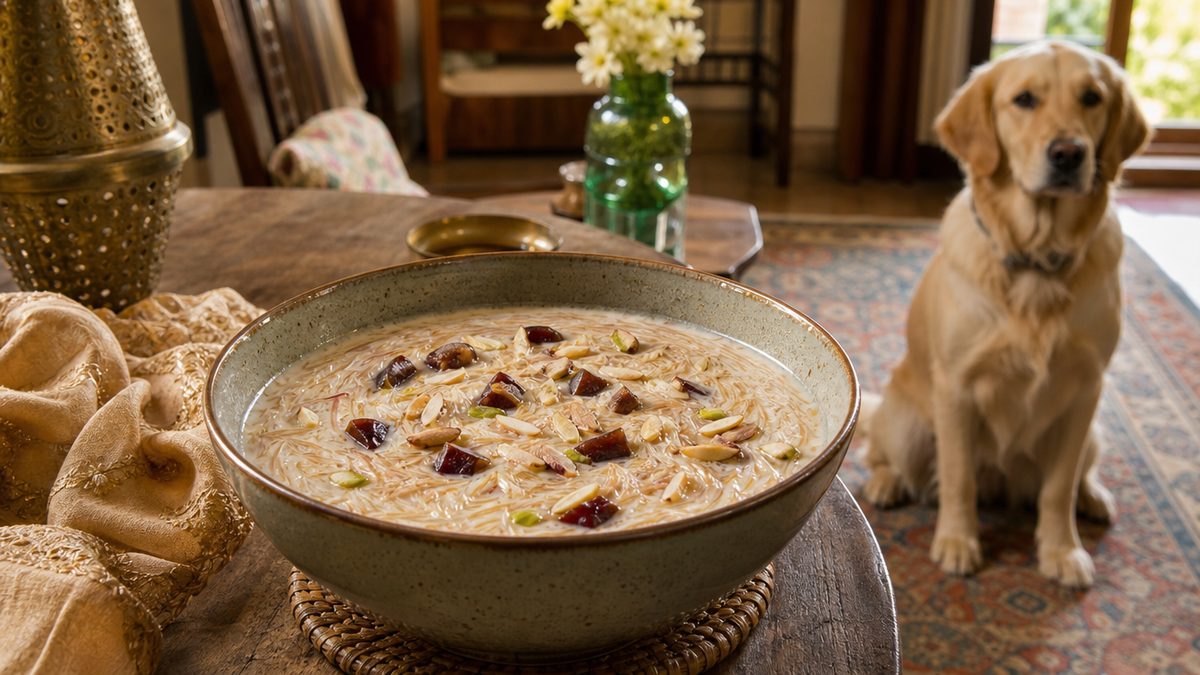
Sheer khurma carries dates in every bowl and raisins in many, and you cannot tell them apart by looking. Raw offal carries something worse: in one Maharashtra study, 4.34 percent of dog faecal samples were positive for echinococcosis.
Quick answer
Eid pet safety splits in two. At Eid al-Fitr the risk is food and visitors. Sheer khurma holds dates in every bowl and raisins in many, and more than one raisin per 4.5 kg of body weight can threaten a dog's kidneys. At Eid al-Adha the risk is raw meat and offal. Shut your dog or cat in another room for the qurbani, never give raw offal, because it carries hydatid tapeworm to dogs, and bag meat waste as wet waste.
This guide is general information for Indian pet owners and is not a diagnosis. Always consult a registered veterinarian near you before acting on anything you read here, and treat any sudden change in your pet's condition as urgent.
Why the two Eids are two different problems for an animal
The two Eids are two different problems because one brings food and visitors into the house and the other brings a live sacrificial animal, raw meat, offal and bones. Eid pet safety written as though they were one festival misses most of what actually happens to a dog or a cat.
Eid al-Fitr closes Ramadan, and the dish at the centre of it is sheer khurma. It is served on the morning of Eid after the prayer as breakfast, and then throughout the day to all the visiting guests. For an animal in the house that means two things at once: a bowl of warm milk, sugar, vermicelli and dried fruit at roughly nose height, and a front door that opens thirty or forty times.
Eid al-Adha is a different event entirely. It falls on the 10th of Dhu al-Hijjah, and celebrations and observances are generally carried forward to the three following days, known as the Tashreeq days. So this is a four-day period, not one morning. The meat from the qurbani is customarily divided into three parts, the family keeping a third while the remainder is divided equally between friends and relatives and the poor.
Read that division from the floor. Two thirds of what was butchered leaves your house over several days, and meat from two or three other households arrives in its place. The kitchen is handling raw meat, offal and bone repeatedly, at odd hours, with the door opening each time somebody brings a share or takes one away. That is the shape of the risk, and it is why a single evening of vigilance does not cover it.
| Eid al-Fitr | Eid al-Adha | What the animal actually meets |
|---|---|---|
| Sheer khurma served from breakfast onward and offered to every guest | Raw meat and offal handled repeatedly across four days | A sweet bowl at floor height against a bag of raw viscera on the kitchen floor |
| Visitors arriving and leaving all day | Visitors plus deliveries of meat in and out of the house | A gate and a front door opened far more often than the animal is used to |
| No change to the street outside | A sacrificial animal tethered nearby for days, then waste on the lane | An unfamiliar live animal within smell and sight, then an unattended food source |
| Risk is a toxic ingredient in a small quantity | Risk is a parasite, a bacterium and a large fat load | One is a same-day phone call, the other can be silent for months |
| One main day | Four days, from the 10th of Dhu al-Hijjah through the Tashreeq days | The plan has to last the whole period, not one evening |
Nothing from either Eid belongs in your animal's bowl in the form a person eats it. Everything that does reach the animal reaches it by accident, from a floor, a guest's hand, an open bin or an unattended kitchen, which is where the whole of this page is aimed.
One thing this page does not cover. Whether a household should keep a dog at all, and what the religious and cultural texts of India actually say about that, is a separate question with its own evidence, and it is answered on is it auspicious to keep a dog at home. Everything below assumes the animal is already yours and the festival is already happening.
Sheer khurma, and the bowl you cannot sort by eye
To judge a bowl of sheer khurma for a dog, look for raisins rather than dates, because only one of the two has a documented toxicosis and in thickened milk and fried vermicelli they look identical.
Start with what is in the dish. The name is Persian for milk and dates, and the main ingredients are vermicelli, whole milk, sugar and dates, with cardamom, pistachios, almonds, cloves, saffron, raisins and rose water added depending on the region. Dates are therefore in every bowl by definition. Raisins are regional, common, and the thing that matters.
The dose is lower than almost any owner expects. In general, more than one grape or raisin per 4.5 kg of body weight may contain enough tartaric acid to pose a risk for renal effects in dogs, and tartaric acid is the proposed toxic principle. For a 5 kg Indie pup or a Shih Tzu in a Mumbai flat, that line falls at the second raisin. For a 10 kg dog it falls at the third.
The timeline is the reason not to wait and watch. Most dogs develop vomiting or diarrhoea within 6 to 12 hours, with lethargy, anorexia, abdominal pain, weakness, dehydration, polydipsia and tremors also reported. Oliguric or anuric renal failure develops within 24 to 72 hours after exposure, and once anuric renal failure develops, most dogs die or are euthanised. A dog that looks fine at bedtime has told you nothing.
Dates are not the toxin, and that is exactly the problem
Dates carry no named toxicosis in dogs. The food hazards chapter of the veterinary reference runs to seven topics in total: garlic and onion, avocado, bread dough, chocolate, macadamia nut, grape with raisin and tamarind, and xylitol. Dates are not among them, and nothing we read puts them there.
That sounds reassuring and is not. In a bowl of sheer khurma, a chopped date and a soaked raisin are the same size, the same dark colour and the same soft texture, sitting in the same opaque milk. You cannot clear the bowl by looking at it, and a guest who made it in another kitchen cannot tell you either. So treat any sheer khurma a dog has reached as a raisin exposure and telephone a veterinary surgeon the same day, whatever the dog looks like.
For cats the honest answer is that nobody knows. Cases reported to date have been in dogs, and anecdotal reports exist of renal failure in cats and ferrets after ingesting grapes or raisins, although there are no published case reports in these species. Absence of published cases is not evidence of safety, and a cat that licked out a bowl still gets the phone call.
Two other things in the bowl belong on other pages and we will not rebuild them here. The milk is a lactose question, and Bonbeno sets out what cow and buffalo milk actually do to a cat in can cats drink milk. The wider argument about festival sweets, khoya, ghee and sugar sits on Diwali sweets and your dog, which works through the toxic ingredients and the calorie arithmetic in full.
Seviyan, shemai and kheer are built the same way and frequently carry raisins. A dog that reached a bowl of any of them, at Eid or at any other time, is the same same-day call. Do not try to make the dog vomit and never use salt water.
The days before: a sacrificial animal in the lane
A sacrificial animal arrives in the neighbourhood days before Eid al-Adha, tethered on a terrace, in a parking bay or on the pavement, and the job in those days is keeping your dog away from it rather than introducing them.
Indian law already has a view on where that animal may be killed, and most households do not know it. The Animal Welfare Board of India, writing to the Chief Secretary and the Director General of Police of every state before Bakrid, sets it out plainly: under Rule 3 of the Prevention of Cruelty to Animals (Slaughter House) Rules, 2001, no person shall slaughter any animal within a municipal area except in a slaughter house recognised or licensed by the competent authority.
The same advisory lists the conditions on the animal itself. No animal shall be slaughtered which is pregnant, or has an offspring less than 3 months old, or is under 3 months of age, or which has not been certified by a veterinary doctor that it is in a fit condition to be slaughtered. It also records the Food Safety and Standards Authority of India direction of 6 August 2014 restricting the permitted species to ovines, caprines, suillines and bovines plus poultry and fish, which the Board reads as meaning that camels cannot be slaughtered for food at all.
None of that is a pet-care rule, and all of it changes what a pet owner should expect. If the qurbani in your building is happening in a licensed facility, there is no live animal and no blood on your lane, and most of this section does not apply to you. If it is happening in the parking area, you are living beside an unlicensed slaughter for a day, and the practical consequences land on your animal.
What a resident dog actually does about a tethered goat
This part is reasoning rather than measurement, and we will label it as such, because we found no study counting what Indian pet dogs do when livestock appears in their territory. The mechanism is not in doubt. A tethered goat or sheep in a space a dog patrols is a novel animal that cannot leave, which is the setup for sustained barking, lunging and fence-line frustration across several days.
- Keep the dog on lead for every walk from the day the animals arrive, including the short night walk it normally does off lead in the compound.
- Change the route rather than the dog. Walking past a tethered goat twice a day to prove a point rehearses the behaviour you are trying to stop.
- Separate the smell from the house. Wash hands and change clothes before handling your animal, because a dog that smells livestock on you works the house looking for it.
- Supervise children with both animals. A goat with horns and a frustrated dog on a lead are each capable of injuring a child who steps between them.
- Refuse every invitation to introduce them. There is no version of this meeting that helps either animal.
A dog that gets loose and kills a tethered goat turns a festival into a compensation dispute, a complaint to the society and sometimes a demand that the dog be removed. Our guide to pets in apartments in India covers how those conversations usually run in a housing society and what actually resolves them.
Should your pet be present for the qurbani? No
No. Shut your dog or cat in another room with the door closed for the whole of the qurbani and the butchering that follows, and decide which room the day before rather than in the middle of it.
Five things go wrong when an animal is loose during the butchering, and each of them is ordinary rather than dramatic.
- Blood, trimmings and viscera sit at floor height. A dog does not need to be greedy to swallow something in the three seconds nobody is watching it.
- Knives are in use at waist height by people concentrating on the animal. A pet moving underfoot is how a person gets cut.
- The gate and the door are open for people carrying things in and out, which is the route by which frightened animals leave and are not found.
- A frightened cat hides somewhere it should not be, and the places it chooses during a commotion are behind appliances, under vehicles and inside stacked crates.
- Whatever the animal eats in those few seconds, you then spend the next three days managing.
Set the room up in the morning, before anybody arrives. An enclosed interior room with the door shut, water down, the animal's own bedding already in it, a meal given early so the animal is not hungry, and one named person who owns that door for the day. The wider household plan, including who handles visitors and how to keep the routine steady across a festival, is set out on Diwali with your pet and applies here unchanged.
Tell visitors the rule once, at the door. Most people who feed somebody else's dog a piece of meat believe they are being kind, and a sentence at the threshold works better than ten corrections later. Hand a guest who wants to give your dog something a piece of the dog's own food instead.
A short tether is not a closed door. A dog that panics on a tether can injure its neck badly trying to escape, and a tethered dog that cannot retreat from an approaching stranger is the classic bite scenario. The room works because the animal is contained without being restrained.
Raw offal and the hydatid tapeworm almost nobody mentions
Never give a dog raw offal from a sacrificed goat or sheep, because liver and lung are precisely where the hydatid tapeworm's cysts sit and the dog is the host that completes its life cycle.
This is the single most consequential fact about Eid al-Adha for a dog in an Indian household, and it does not appear on any page currently ranking for the query, in Delhi, Bengaluru, Pune or anywhere else. The hydatid tapeworm, Echinococcus granulosus sensu lato, has dogs, wolves, coyotes, foxes and several other wild carnivores as its definitive hosts. Its intermediate hosts are sheep, goats, cattle, pigs, horses, deer, moose, some rodents and occasionally humans, and in those animals the cysts sit commonly in liver and lungs.
Follow the arrow. The dog eats a cyst inside a raw organ, the adult worm establishes in the dog's small intestine, and eggs leave in the dog's faeces. People, including the children in that household, then become infected by ingesting those eggs. The reference manual states it directly: association with infected dogs may result in human infection with metacestodes of E granulosus in various tissues, by ingestion of eggs passed in dog faeces.
India has measured this, and the numbers are not small. Researchers examined slaughtered food animals, dogs and humans across Maharashtra from April 2010 to March 2017. At post-mortem inspection they scientifically examined 9,464 cattle, 3,661 buffalo, 47,189 sheep, 33,350 goats and 13,579 pigs. Dog faecal samples were analysed separately and showed the prevalence of echinococcosis as 4.34 percent, 19 of 438, by sedimentation, with positive samples confirmed by PCR assay. Among high-risk humans, 11.09 percent of sera were positive, and over the seven years 58 patients were found to have been surgically operated for hydatid cyst removal.
Nearly one dog in twenty-three, in a sampled Indian population, was already carrying this. We read the abstract of that paper rather than the full text, which sits behind a subscription wall, so every figure above is taken from the published abstract and not from the tables.
The worm is 6 mm long and the dog looks completely well
Nothing about an infected dog tells you it is infected. The adult worm's strobila is 2 to 6 mm long with 3 to 5 segments, which is to say you will never see a segment on the dog's bedding the way you would with the flea tapeworm. And adult cestodes in the intestine of dogs and cats rarely cause disease. There is no vomiting to notice, no weight loss to explain, nothing.
A routine stool test does not settle it either. All faecal flotation methods have low sensitivity, and the eggs of Taenia species and Echinococcus species cannot be differentiated by microscopic examination, so PCR assay methods are required. A clean flotation from a neighbourhood clinic is not a clean bill of health on this particular question, and it is worth knowing that before you ask for one.
Where the Indian and the global numbers disagree
The two best measurements of how often the cysts are actually in the meat do not agree, and we publish both rather than averaging them. A global systematic review and meta-analysis of 57 published references with 130 data reports put the pooled prevalence of hydatid cysts in raw meat at 9.9 percent, with a 95 percent confidence interval of 9.26 to 10.55. By animal, sheep were highest at 12.32 percent, then cattle at 11.85 and buffalo at 10.65. By WHO region, the South-East Asian region was lowest at 2.77 percent and the European region highest at 33.21 percent, with Sudan lowest by country at 0.01 percent and Italy highest at 69.86 percent.
Set that against the Maharashtra post-mortem figures from the same decade: 0.09 percent of sheep and 0.01 percent of goats, against 3.00 percent of cattle, 2.05 percent of buffalo and 1.28 percent of pigs. For sheep that is two orders of magnitude apart from the global sheep figure.
Both can be true and the reason matters. One is routine inspection of an enormous throughput at working slaughterhouses, where a small cyst in a lung is easy to miss and nobody is looking for it specifically. The other pools surveys designed to find cysts. The meta-analysis also reports its own South-East Asia regional figure as 2.77 percent, far below the 12.32 percent it reports for sheep worldwide, so even inside one paper the regional and species numbers pull apart. What nobody has published is a dedicated Indian survey of goats sacrificed at Bakrid.
| Part | The specific risk | Position |
|---|---|---|
| Raw liver | A primary site for hydatid cysts in sheep and goats, and the organ most often handed to a dog | Never raw. Cook it through, or bin it |
| Raw lung and pluck | The other primary cyst site, and the part most often treated as waste and thrown out | Never raw, and never into an open bin |
| Raw kidney, heart, tripe and trimmings | Bacterial load plus whatever the animal was carrying; frozen storage does not decontaminate | Cook it through if it is going in a bowl at all |
| Reproductive tissue and birth products | The classic Brucella melitensis route into a dog | Never, in any form, cooked or raw |
| Cooked bones from the curry cut, ribs, vertebrae and trotters | Brittle shards, oesophageal lodgement, fractured teeth | Binned in a closed bin outside the kitchen |
| Fat trimmings and skin | A sudden high-fat load in one sitting | Not fed; this is the pancreatitis half of the day |
On treatment, we report what the manual says and recommend nothing. Praziquantel is the approved treatment for Echinococcus species in dogs, and the manual records that in regions where E granulosus sensu lato is a concern, dogs at risk of developing intestinal infections, for example by ingestion of internal organs of ruminants, can be treated every 6 weeks at the approved dosage to prevent shedding of eggs in the environment. Whether that applies to your dog, at what dose and how often, is a decision for a veterinary surgeon who knows the animal. This page prints no dose. Your ordinary worming interval and what it does and does not cover is set out on our dog deworming schedule for India.
The entire parasite argument on this page collapses the moment the meat is cooked through. Raw or uncooked offal is the problem, not mutton. If you want your dog to share the day, cook a plain piece properly and leave the raw bag on a counter the animal cannot reach.
Brucella, and the trimmings nobody thinks about
Brucella melitensis is a goat and sheep organism that infects dogs as well, and the exposure route it needs is the one Eid al-Adha creates in a domestic kitchen.
Sheep and goats are the primary hosts for B. melitensis, and infections have also been reported in cattle, yaks, water buffalo, Bactrian and dromedary camels, alpacas, dogs, captive blue foxes, horses and pigs. Geographically it occurs in the Middle East, some southern and eastern European countries, and parts of Asia and Latin America.
In dogs, infections with B. melitensis often seem to be asymptomatic, and the organism was reported to be eliminated quickly in some cases. However, abortions, orchitis, epididymitis and other signs of brucellosis have been reported. The concern is taken seriously enough that, because dogs are susceptible to infection, some countries require that shepherd dogs also be either euthanised or treated with antibiotics and castrated.
Two details change how you handle the kitchen. Small ruminants acquire the organism largely by contact with vaginal discharges and birth products such as placenta, fetus and fetal fluids, and most animals are thought to become infected by ingestion. And survival times of years have been reported in frozen meat, so putting the bag in the freezer is storage, not decontamination.
Be clear about what is and is not established here. That dogs can be infected with B. melitensis is documented. How often an Indian pet dog is actually infected this way is not measured, and we found no Indian study that counts it. We are reporting a route, not a rate, and we would rather say that than imply a number that does not exist.
Wash the floor the bag stood on, not just the counter. A dog finds the drips. Separate the raw-meat area from the animal's feeding area for the whole four days, wash the animal's bowls separately, and wash your own hands between handling meat and handling the animal.
Cats, raw mutton, and a window of three to ten days
A cat that eats raw mutton trimmings can begin shedding Toxoplasma oocysts three to ten days later, and the single household habit that breaks the chain is emptying the litter tray every day.
Cats and other felids are the only species that develop patent infections with T. gondii, shedding oocysts 3 to 10 days following ingestion of bradyzoites in raw meat, and 19 to 48 days following ingestion of oocysts. Raw mutton is bradyzoites in tissue. That is the fast route, and Eid al-Adha is the day of the year an indoor cat is most likely to find it.
The timings are what make this manageable rather than frightening. Oocysts shed by cats become infective, meaning sporulated, in 1 to 5 days, and then survive for months to years in the environment. So a freshly passed stool is not yet infectious. The parasite council's own recommendation follows from that arithmetic: remove cat faeces on a daily basis from the litter box, because T. gondii oocysts must develop for 1 to 5 days after being passed in the faeces to become infectious.
A tray emptied every single day, for the four days after any possible raw-meat exposure and ideally always, never holds an infectious oocyst. That is the whole intervention, and it costs nothing.
The cat shows you nothing, and a test does not settle it
Do not expect to notice. Cats usually do not develop any clinical disease associated with oocyst shedding, and cats with clinical toxoplasmosis are unlikely to be shedding oocysts in their faeces. The sick cat and the shedding cat are generally two different cats.
Testing during the window is worse than unhelpful. Most cats shedding oocysts are seronegative at the time of shedding, and serologic testing cannot accurately predict oocyst shedding status in cats. Faecal flotation is not recommended as a clinical means of evaluating the infection status of an individual cat, because active shedding occurs over approximately 1 to 3 weeks, so the great majority of infected cat faeces does not contain oocysts. Clean the tray daily instead of chasing a test.
The rates are worth seeing because the spread is wide. At any point in time, approximately 1 percent of cats in the United States have intestinal infection and will be shedding oocysts, and across six state surveys oocyst shedding ranged from 0.0 to 6.6 percent with a mean of 0.7 percent. Much higher prevalence has been cited from other countries, for example 19 percent in Ethiopia, 23 percent in Costa Rica, 40 percent in Turkey and 41 percent in Egypt. India does not appear in the list that guideline gives, and we found no comparable Indian survey of oocyst shedding in owned cats to put beside it.
Say so to your veterinary surgeon before Eid, not after. The guidance is explicit that particular care should be taken by pregnant women and immunocompromised individuals to avoid infection, that people can become infected by ingesting infective oocysts or undercooked meat containing encysted stages, and that where a cat is shedding, it could be quarantined until shedding ceases if any household members are pregnant or immunocompromised. Somebody else empties the tray, daily, with gloves.
The simplest prevention is the one the guideline leads with: keep cats indoors and prevent them from hunting and consuming undercooked meat. Our guide to indoor cat safety in India covers how to hold that line in an Indian flat with a balcony, and the cat deworming schedule for India covers what routine worming does and does not reach.
One large fatty meal of mutton, in one sitting
A sudden large helping of fatty mutton is the dietary indiscretion that veterinary medicine names as a common risk factor for pancreatitis in dogs, and Eid al-Adha produces exactly that in one afternoon.
Dietary indiscretion is believed to be a common risk factor in dogs, and a history of dietary indiscretion combined with vomiting and abdominal pain may suggest pancreatitis in dogs. That is the warning, and it is fair.
Here is the part that gets left out. The same entry refers to the few cases in which a risk factor or cause can be identified, which means most episodes have no identified cause at all. Nobody can tell you that a dog which eats a plate of mutton will get pancreatitis, and nobody can tell you that a dog which eats nothing unusual will not. The honest framing is that you are removing a known risk factor, not buying a guarantee.
Pancreatitis is a condition rather than a festival question, and Bonbeno covers it properly on its own page. Pancreatitis in dogs sets out the Indian caseload from the Chennai series, why amylase and lipase are not the test, what the cPL test costs here and why the old advice to starve the dog has been overturned. Read it before Eid if your dog has had an episode, because that is the dog for whom one generous helping is genuinely dangerous rather than merely unwise. This page does not re-explain the disease.
What is specific to Eid al-Adha is the shape of the exposure, and five rules handle it.
- Decide the dog's share before the cooking starts, and put it aside raw and separate. A portion decided at the table is a portion decided by whoever is holding the plate.
- Cook it plain, lean and boneless. No onion, no garlic, no masala, no salt, no ghee. Onion and garlic are a separate acute problem covered on our onion and garlic toxicity page, and they are in almost every Eid dish.
- Substitute, do not add. Take the mutton out of that day's ration rather than putting it on top of it, and the dog diet chart for India runs the arithmetic by weight.
- Introduce one new thing at a time across the four days. A dog that gets mutton, liver, biryani rice and a bone in one evening gives you nothing to work with when it is ill on day two.
- Give a dog with a previous episode none of it. Not a taste, not a corner. That dog eats its ordinary food for the whole festival.
The general method for sorting any Indian dish for a dog, including whether a given plate is an acute poison, a chronic load or just a physical hazard, is on Indian food safe for dogs, which is the hub page for this whole question.
Repeated vomiting, refusing food, a tender belly and a dog that stands with its front end down and its back end up are the signs that take a dog to a clinic on the day, not the next morning. This page names no drug and no dose, because that is a veterinary decision made on the individual animal.
Cooked bones, and the Bakrid bone set
Bin every cooked bone from Bakrid, because cooking drives water out of bone and leaves it brittle enough to shard rather than crush, and Bonbeno argues that case in full on its own page rather than here.
The conclusion is not contested by any veterinary source we have read, Indian or foreign. Cook the meat and bin the bone, in a closed bin outside the kitchen. The mechanism, the case series behind it, what happens if a bone has already been swallowed and the genuinely contested question of raw bone are all set out on bones for dogs in India, which also covers the curry cut, paya and buffalo marrow bones specifically. We are not re-arguing it here.
What is specific to Eid al-Adha is volume and simultaneity. On an ordinary Sunday a household produces the bones from one dish. Across the Tashreeq days it produces the bones from a whole animal, repeatedly, and receives more in the shares arriving from other houses. Goat ribs, chops and vertebrae from the curry cut, the trotters for paya, the shoulder and the leg all appear at once, on plates, in vessels waiting to be washed, and in bags on the floor.
That changes where the bones actually reach an animal, and the list below is about geography rather than chemistry.
- The vessel soaking in the sink with the bones still in it, which is where a cat gets up at two in the morning.
- The plate left on a low table while a guest takes a phone call.
- The bag of waste standing by the kitchen door waiting for somebody to take it down.
- The share arriving from a neighbour, handed over at the door while the dog is standing right there.
- The lane outside, after the bins have been emptied and the bags have been torn open.
No bone, cooked or raw, is left anywhere an animal can reach it, at any hour, for any length of time. That is easier to enforce than a rule with exceptions, and it is the only version that survives a house full of people who did not read this.
Meat waste, and what happens when it reaches the street
Bag meat waste as wet waste and hand it to the local body, because India's solid waste rules classify meat as wet waste and discourage littering, and an open bag of offal on a lane draws every community dog in the area.
India's law on this changed recently and most Eid advice has not caught up. The Union Ministry of Environment, Forest and Climate Change notified the Solid Waste Management Rules, 2026, superseding the Solid Waste Management Rules, 2016, under the Environment (Protection) Act, 1986, with full effect from 1 April 2026.
Two provisions decide what a household does with a bag of offal. Waste is required to be segregated into wet waste, dry waste, sanitary waste and special care waste, and wet waste includes kitchen waste, vegetables, fruit peels, meat and flowers, which shall be composted or processed through bio-methanation at the nearest facility. Local populations are encouraged to hand over waste to local bodies and discouraged from littering.
So meat waste is wet waste, it goes to the local body, and leaving it on a lane is the thing the rules exist to stop. That is a cleaner answer than the opinions the ranking pages offer, and it happens to be the answer that protects animals.
- Bag it as you go, during the butchering, rather than collecting it in an open vessel and bagging it at the end.
- Double-bag the offal and the bones specifically, because a single thin bag tears on a bone edge and a torn bag on a lane is an open feeding station.
- Separate it from dry waste before it leaves the house, which is what the rules require and also what stops a collector tipping it loose.
- Hand it to the municipal collection rather than leaving it beside a community bin overnight, and if the collection is not running on the holiday, hold it closed and refrigerated until it is.
- Wash the vessel and the floor afterwards, because the smell is what brings animals back to a spot for days.
What raw offal in the street does to community dogs
The parasite loop closes in the lane rather than in your kitchen. A community dog that eats raw liver or lung from a sacrificed goat becomes the definitive host, and the eggs it then passes sit in soil and dust where children play. The Maharashtra work found 4.34 percent of dog faecal samples positive and 11.09 percent of high-risk human sera positive in the same study population. That is the public health argument for bagging offal, and it is considerably stronger than the tidiness argument everyone else makes.
Be honest about the limit. We found no Indian study counting infection in community dogs before and after Eid, in Hyderabad, Lucknow, Kolkata or anywhere else. The mechanism is established and the Eid-specific rate is not measured, and we would rather state that than invent a number.
If you want to feed community animals during the festival, the legal and nutritional position is covered properly elsewhere. Feeding community dogs in India sets out what Rule 20 of the Animal Birth Control Rules, 2023 and the Supreme Court actually require about designated feeding spots, and community cats in India covers the cat side. Plain cooked food and clean water, at a designated spot, is a better gift than a bag of raw trimmings tipped onto a pavement.
Raw meat on a lane concentrates animals that do not normally share space, and competition over a high-value food source is when dogs that have never troubled anybody become dangerous to walk past. Do not try to clear a bag that dogs have already reached. Call the municipal line or a local rescue group, and read free-ranging dogs in India for the civic position.
A plan for the four days
To run the four days, give each one a single job, because the observance runs from the 10th of Dhu al-Hijjah through the three Tashreeq days that follow and meat keeps moving between houses for all of it.
| When | The one job | What it actually looks like |
|---|---|---|
| The week before | Containment and identification | Pick the room, test the door latch, check the collar tag and the microchip record, walk the dog on lead once the animals appear in the lane |
| The morning of the 10th | The door | Feed early, animal in the room before anybody arrives, one named person owns that door, nobody opens it to show a guest the dog |
| While the butchering happens | The floor | Nothing raw below waist height, the raw bag never on the floor, the meat area kept separate from the feeding area |
| That evening | Waste out, kitchen down | Double-bag the offal and bones, floor washed, vessels emptied rather than left to soak overnight |
| Tashreeq days one to three | The shares arriving and leaving | The same door rule each time meat is handed over, and a daily sweep of the floor, the sink and the lane outside your gate |
| The following week | Watching | Litter tray emptied daily for a cat, and any vomiting, refusal of food, hunched posture or straining in a dog reported to a vet rather than waited out |
Two things belong on the list that have nothing to do with meat. Keep your animal's own feeding times unchanged through the whole period, because a disrupted routine is the thing that makes a dog work the kitchen in the first place. And if your neighbourhood sets off crackers to mark the festival, the preparation and the management of noise fear are set out in full on firecracker anxiety in dogs in India.
Heat is the quiet variable in much of this. Where Eid al-Adha falls in a hot or humid month, which it does across most of India for several years at a stretch because the Islamic calendar moves against the Gregorian one, raw meat left out spoils faster, bins smell sooner and animals are drawn to them earlier. Through a Mumbai or Pune monsoon, and in the summer heat of Delhi, Bengaluru, Chennai, Hyderabad and Kolkata, that is the difference between a bag that keeps until morning and a bag that does not.
What this page can prove, and what it cannot
Six claims on this page are measurements or government documents and five widely repeated claims about Eid and pets are not established, so the line is drawn here rather than left for you to guess.
- Established: 4.34 percent of 438 dog faecal samples in a Maharashtra study were positive for echinococcosis by sedimentation and confirmed by PCR, alongside 11.09 percent of high-risk human sera.
- Established: dogs are the definitive host of Echinococcus granulosus, the cysts sit commonly in the liver and lungs of sheep and goats, the adult worm is 2 to 6 mm long and rarely causes disease in the dog, and faecal flotation cannot distinguish its eggs from Taenia.
- Established: more than one raisin per 4.5 kg of body weight may pose a risk of renal effects in a dog, with renal failure developing within 24 to 72 hours.
- Established: cats shed Toxoplasma oocysts 3 to 10 days after eating bradyzoites in raw meat, and those oocysts need 1 to 5 days to become infectious.
- Established as law: slaughter within a municipal area is restricted to a licensed slaughter house and the animal must be certified fit by a veterinary doctor; meat is wet waste under the Solid Waste Management Rules, 2026.
- Established: Brucella melitensis infects dogs as well as its primary sheep and goat hosts, and survives for years in frozen meat.
- Not established: how often an Indian pet dog actually acquires Echinococcus at Bakrid. No study has looked at the festival specifically, and the sheep and goat cyst rates at Maharashtra post-mortem disagree with the global pooled figures by two orders of magnitude Fakhri Y, Omar SS, Dadar M, Pilevar Z.
- Not established: whether raisins harm cats. There are no published case reports in the species, only anecdote.
- Not established: any Indian rate of Toxoplasma oocyst shedding in owned cats. India does not appear in the country list the parasite council gives.
- Not established: how often a dog that eats a large fatty meal develops pancreatitis. A cause is identified in only a few cases.
- Not established: that any amount of raw offal is safe if it looks clean. Cysts in a liver are not reliably visible to a person cutting up meat in a kitchen, which is the entire reason post-mortem inspection exists.
The page ranking first in India for this query belongs to a pet-supply retailer, carries no citation of any kind, and prints a table of emergency costs in rupees with no source behind a single figure. The rest of that result page is not about Eid at all. Nothing currently ranking mentions the hydatid tapeworm, Toxoplasma, the Slaughter House Rules or the waste rules. Those four are the whole of what a household observing the festival actually needs, which is why they are what this page is built from.
Common questions
Can dogs eat khurma?
No, on either reading of the word. Khurma means dates, and sheer khurma is the Eid pudding built from them, and neither belongs in a dog. Dates have no named toxicosis but the pudding also carries milk, sugar and, in many regions, raisins, which you cannot pick out of thickened milk by looking. More than one raisin per 4.5 kg of body weight may pose a risk of kidney damage, so treat any bowl a dog has reached as a raisin exposure and telephone a veterinary surgeon the same day.
Which raw meat is safe for dogs?
None of the raw meat a Bakrid kitchen produces is established as safe, and raw offal is the part to refuse outright. Liver and lung are where hydatid cysts sit in sheep and goats, and a dog that eats a cyst becomes the definitive host of the tapeworm and then sheds eggs that infect people. Set a lean boneless piece aside before the cooking starts, cook it through with no onion, garlic, masala or salt, and take it out of that day's ration.
What if my dog ate raw meat?
Work out what it was before you decide how worried to be. Plain raw muscle meat in a small quantity is usually uneventful. Raw offal is the one to telephone your veterinary surgeon about, because liver and lung carry the hydatid tapeworm's cysts and an infected dog shows nothing at all, the adult worm being 2 to 6 mm long and rarely causing disease. Write down what was eaten and roughly how much, because a routine stool test cannot settle this question on its own.
Can dogs eat goat liver, kidney or other offal?
Not raw, ever. Liver and lungs are the organs where Echinococcus granulosus cysts commonly sit in sheep and goats, and the dog is the host in which the adult tapeworm develops. In one Maharashtra study, 4.34 percent of 438 dog faecal samples were positive for echinococcosis, confirmed by PCR. Cooked offal in a small quantity is a different question and mainly one of richness, so cook it through and keep the portion small.
Is it safe to give my dog the bones from Bakrid?
No. Cooking drives water out of bone and leaves it brittle, so a cooked bone shards instead of crushing, and the goat ribs, chops, vertebrae and trotters that a Bakrid kitchen produces are precisely the shapes that lodge in a dog's oesophagus. Bin every bone in a closed bin outside the kitchen. Bonbeno sets out the full case series evidence, the raw bone argument and what to do if a bone has already been swallowed on its bones page.
Should my dog or cat be around during the qurbani?
No. Shut the animal in an interior room with the door closed before anybody arrives, with water, its own bedding and a meal given early. Blood and viscera sit at floor height, knives are in use, and the gate and front door are open while people carry meat in and out. Give one named person responsibility for that door. Never use a tether instead of a closed door, because a panicking tethered animal injures itself and bites.
My dog ate a lot of fatty mutton. What should I do?
Telephone your veterinary practice rather than waiting to see. Dietary indiscretion is named as a common risk factor for pancreatitis in dogs, and repeated vomiting, refusal of food, a tender belly or a dog standing with its front end lowered and its back end raised is a same-day clinic visit. Do not give any human medicine, do not try to make the dog vomit, and do not starve the dog on your own initiative, because that advice has been overturned.
Can my cat catch anything from raw mutton?
Yes. Cats are the only hosts that shed Toxoplasma oocysts, and they begin shedding 3 to 10 days after eating bradyzoites in raw meat. The cat itself usually shows nothing. Shed oocysts need 1 to 5 days to become infectious and then survive for months to years, so emptying the litter tray every single day is the one habit that breaks the chain. Tell your vet before Eid if anyone in the house is pregnant or immunocompromised.
How should I dispose of meat waste so it does not reach street dogs?
Double-bag the offal and bones as you go, keep them separate from dry waste, and hand them to the municipal collection rather than leaving them beside a community bin. Under India's Solid Waste Management Rules, 2026 meat is wet waste, to be composted or processed through bio-methanation at the nearest facility, and households are discouraged from littering. A torn bag of raw offal on a lane is a feeding station and a parasite route at the same time.
Is it safe for my dog to meet the goat before Eid?
No, and there is no version of that meeting that helps either animal. A tethered goat or sheep that cannot leave is the setup for days of barking and lunging, and a dog that gets loose and injures one turns a festival into a compensation dispute with your neighbours. Walk the dog on lead from the day the animals appear, change the route rather than the habit, and keep children away from both.