
Cat care guide
Keeping a cat safe indoors in India: balconies, windows, nets and high-rise falls
The site's single home for the balcony question and the rest of indoor safety: the 1,125-fall Berlin series and the 1987 New York and 2004 Zagreb series by season, hour, age, floor and survival; what Indian bye-laws call a high-rise and what a 1 m parapet is to a cat; five Indian net sellers with their mesh sizes and per-square-foot prices read on 18 September 2026 and run through the exchange-rate test; the AWBI adoption protocol's netting clause against the AWBI's 2015 society guidelines; lilies, money plant, kaner, sago palm and aloe from the ASPCA list; paracetamol, phenyl, coils, rat poison and the dog spot-on; thread, fans, geysers, washing machines, the lift and the Supreme Court's Diwali window; and International Cat Care's indoor-or-outdoor decision with the five pillars for a flat.
Quick answer
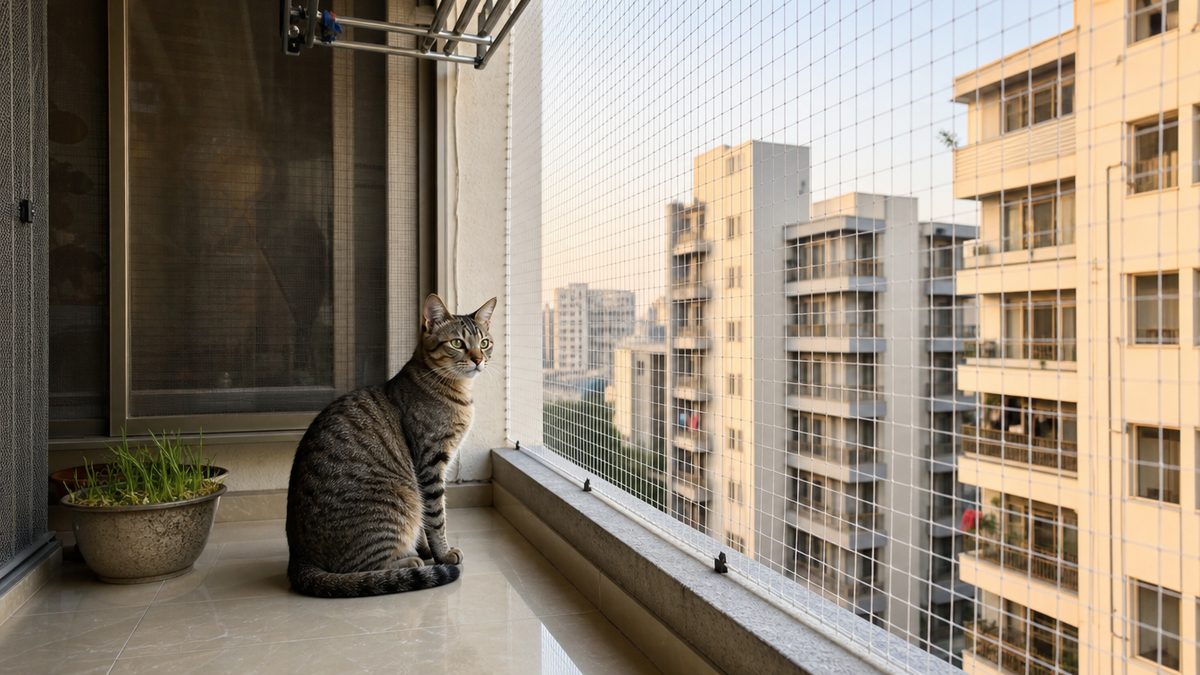
A cat net for balcony is the first purchase for an indoor cat in an Indian flat: a 25 to 40 mm mesh net fixed floor to ceiling, at Rs 16 to Rs 30 per square foot from Indian installers, plus mesh on every opening window. In the 1,125-fall Berlin series 96 in 100 fallers were injured, 77 percent in summer and 62 percent after 6 pm. Lilies, paracetamol, phenyl, thread and the dog's spot-on are the poisons; the nearby vet decides each case.
This guide is general information for Indian pet owners and is not a diagnosis. Always consult a registered veterinarian near you before acting on anything you read here, and treat any sudden change in your pet's condition as urgent.
Why indoor cats fall from balconies and windows: the evidence from 1,125 Berlin cases
Indoor cats fall from balconies and windows while playing, chasing a bird or an insect, or slipping off a railing, mostly in the warm months and mostly in the evening and at night, and the largest series on record, 1,125 falls treated at the Freie Universitaet Berlin small animal clinic between 2004 and 2013, gives every one of those patterns a denominator.
The Berlin series counted falls, not cats: 1,125 falls by 1,117 cats, because eight cats fell twice, every one from at least 4 metres, which the authors define as the second floor of a post-1950 building or the first floor of an older one. Of the 1,085 falls with a recorded age, 296 (27.3 percent) were cats under one year, 645 (59.4 percent) were 1 to 8 years old and 144 (13.3 percent) were over 8; the median age was 2.3 years, the median weight 4.1 kg, and males (54.1 percent) and females (45.9 percent) fell at nearly the same rate. The adult cat, not the kitten, is the typical faller in that city; the Zagreb series below found the opposite, and the Berlin authors put the difference down to how closely each city's owners supervise young cats Vnuk D, Pirkic B, Maticic D, Radisic B.
Season and hour are the two patterns that matter for an Indian flat. 867 of the 1,125 falls (77 percent) happened between April and September, with July alone accounting for 201 (17.9 percent), August 165 and June 152, and January the quietest month; of the 1,034 falls with a recorded time, 642 (62.1 percent) happened between 6 pm and 6 am, 371 of them after 10 pm. The authors' explanation is ventilation: Berlin flats have no air conditioning, windows and balcony doors are shut while owners are at work and opened for the breeze when they come home, and the cat goes out through the opening in the dark. They contrast Thessaloniki, where cats had balcony access by day and most falls happened in daylight. The hour is the owner's habit, not the cat's.
The landing surface was recorded in only 227 of the 1,125 files, and 165 of those 227 cats hit something hard: concrete, asphalt, stone, a car, a grille, a railing, a fence or a bin. The paper prints two figures for that one fraction, 74.2 percent in its abstract and 72.7 percent in its results table, and 165 divided by 227 is 72.7, so this page uses the table's figure and reports the abstract's beside it. Sixteen of the 1,125 falls (1.4 percent) were second falls by the same cat, which the authors read as homes where no barrier went up after the first one; 340 cats (30.2 percent) had been treated somewhere else first, and those cats arrived later, 196 of 294 more than 4 hours after the fall.
The older series: New York 1987, Zagreb 2004 and the 2022 review
The 1987 New York paper that gave high-rise syndrome its name for most of the web saw 132 cats in 5 months at one hospital, mean age 2.7 years; 90 percent had some thoracic trauma, 68 percent of those lung contusions and 63 percent pneumothorax, 37 percent needed emergency treatment, 30 percent needed none, and 90 percent of the treated cats survived. The Zagreb series saw 119 falls in four years, 8.5 percent of the 1,402 cats the clinic admitted; 68 of the 114 with a known age (59.6 percent) were under one year, the average fall was four storeys, 115 of 119 (96.5 percent) survived, 46.2 percent had a fractured limb, 33.6 percent chest trauma, and falls from the seventh storey or higher carried more severe injuries and more chest trauma. The 2022 review of the whole literature says animals fall after slipping from windowsills, during mating behaviour or chasing prey, that affected animals are younger and falls commoner in warmer months, and that feline survival after treatment exceeds 90 percent with no prognostic factor yet identified.
| Series | Cats and years | Age | Season and hour | Survival |
|---|---|---|---|---|
| Berlin, 2025 Candela Andrade M, Slunsky P, Nerlich | 1,125 falls, 2004 to 2013 | Median 2.3 years; 27.3 percent under 1 | 77 percent April to September; 62.1 percent 6 pm to 6 am | 975 of 1,125 (86.7 percent) |
| New York, 1987 | 132 cats in 5 months | Mean 2.7 years | Not in the abstract | 90 percent of treated cats |
| Zagreb, 2004 | 119 cats, 1998 to 2001 | Mean 1.8 years; 59.6 percent under 1 | Commoner in the warmer period | 115 of 119 (96.5 percent) |
| Review, 2022 | The published literature | Affected animals are younger | Commoner in warmer months | Exceeds 90 percent after treatment |
Every pedigree an Indian buyer asks about is in the Berlin breed table. Of the 1,122 falls with a recorded breed, 911 were European Shorthairs, 42 crossbreeds, 33 British Shorthairs, 33 Maine Coons, 28 Persians, 21 Siamese, 15 Norwegian Forest Cats, 2 Bengals, 2 Ragdolls and 1 Scottish Fold, and the authors say the split mirrors the cats Berlin owns rather than any breed's tendency to fall. A long-haired, flat-faced or hairless cat is not safer on a railing; it is the same cat on the same 1 metre of parapet.
Fall height, injury and survival: what each floor did to the cats
A fall from any floor above the first injured 96 in 100 cats in the Berlin series, and the share with severe injuries rose from 51.8 percent below 5 metres to 76.4 percent at 8 to 11 metres and 100 percent above 24 metres, so fall height changes how badly a cat is hurt, not whether it is hurt.
The injury pattern in 1,125 falls was shock in 547 (48.6 percent), chest trauma in 656 (58.3 percent), of which lung contusion in 527 and pneumothorax in 277, injuries to the face and mouth in 575 (51.1 percent), of which nosebleed in 208, a split hard palate in 144 and a fractured lower jaw in 114, a limb fracture in 47.2 percent, a pelvic fracture in 11.1 percent, abdominal trauma in 164 (14.6 percent), of which blood in the urine in 84, a spinal injury in 48 (4.3 percent) and a brain injury in 32 (2.8 percent). Hindlimbs broke more often than forelimbs, 497 fractures against 402, and 102 of the 531 fracture cases were open fractures. On the authors' severity scale 42 cats (3.7 percent) were uninjured, 283 (25.2 percent) had minor injuries, 282 (25.1 percent) medium, 227 (20.2 percent) severe but not life-threatening and 291 (25.9 percent) life-threatening.
| Height group | Floor of a new building | Falls | Severely injured |
|---|---|---|---|
| Under 5 m | Second | 137 (12.2 percent) | 71 of 137 (51.8 percent) |
| 5 to 7 m | Second to third | 245 (21.8 percent) | Not printed per group; the trend rises with height |
| 8 to 11 m | Third to fourth | 348 (30.9 percent) | 266 of 348 (76.4 percent) |
| 12 to 15 m | Fourth to fifth | 288 (25.6 percent) | Not printed per group |
| 16 to 21 m | Sixth to eighth | 85 (7.6 percent) | Not printed per group; survival still above 80 percent |
| 22 to 24 m | Ninth | 14 (1.2 percent) | 13 of 14 (92.9 percent) |
| Over 24 m | Tenth and above | 8 (0.7 percent) | 8 of 8 (100 percent) |
The survival rate was 975 of 1,125, or 86.7 percent. Of the 150 that did not survive, 79 (7.0 percent) were euthanased for a poor prognosis, 55 (4.9 percent) died despite treatment, and 16 (1.4 percent) were euthanased at the owner's request, mainly over the cost of treatment. Survival stayed above 80 percent for falls up to 21 metres and dropped to about 60 percent beyond that, and the association between height and survival was significant. Shock was the other predictor: 431 of 547 cats in shock survived (78.8 percent) against 545 of 579 without (94.1 percent). Cats under one year had less severe injuries than older cats, body weight made no difference, and 124 of 165 cats that landed on a hard surface (75.2 percent) were severely injured against 31 of 62 (50 percent) on a soft one.
The seven-storey story, and what the larger series say about it
The claim that a cat falling from above seven storeys is hurt less than one falling from below comes from the 1987 New York series, and the ranking pages still carry it: Wikipedia repeats a six-storey version and PetMD says cats falling more than seven storeys "suffer fewer injuries";. The Berlin authors describe that literature as a curvilinear pattern and report the opposite in their own 1,125 falls: a linear rise in severity with height, with every cat that fell from above 24 metres severely injured. Zagreb found the same direction, an injury score of 1.98 for the second storey against 3.50 for the seventh and higher. Both findings are published here with their sizes: 132 cats in 1987, 1,244 cats across the 2004 and 2025 series, and the two larger series find no height at which a cat is safer.
Only 42 of 1,125 fallers (3.7 percent) were uninjured, 547 were in shock, and the chest injuries that killed were found on radiographs, not by looking. The Red Cross first-aid page adds that a cat that survives a fall often runs and hides, and that this does not mean it is not seriously injured, so search bushes, stairwells and under parked cars first. Sixteen Berlin cats were put down over cost, which is the case for reading pet insurance in India before the fall and not after it; the reader's nearby vet decides what the cat needs, this page only says to go.
Indian flats: what the bye-laws call a high-rise, what a parapet is to a cat, and why there is no safe season
An Indian high-rise starts at 15 metres or four storeys under the Model Building Bye-Laws, which puts the ordinary fourth-floor flat in Mumbai, Pune or Gurugram at the top of the Berlin series' 12 to 15 metre band and just above the 8 to 11 metre band where 266 of 348 fallers (76.4 percent) were severely injured, so the Indian flat is inside the fall data, not below it.
The definitions are short. The Model Building Bye-Laws define a "Multi-Storeyed Building or High Rise Building" as "a building above 4 stories, and/or a building exceeding 15 meters or more in height above the average level of front road", and a "Balcony" as "a horizontal projection, cantilevered or otherwise including a parapet, handrail, balustrade, to serve as a passage or sit out place";. Delhi's Unified Building Bye-Laws 2016 add that a balcony has "at least one side fully open, except being provided with railing or parapet wall for safety", that a verandah on an upper floor has a "1.0 m high parapet/railing" on its open side, that a ventilator is "an opening in a wall", and that a building is a high-rise from 15 metres, or 17.5 metres including a stilt floor. A 1 metre parapet is built for a person and is a sitting ledge for a cat; the Berlin authors note that windows and balconies in both their building types sit 0.8 to 1 metre above the floor, and the Zagreb authors that cats slip while walking the edge of a balcony railing or a window Vnuk D, Pirkic B, Maticic D, Radisic B.
No safe season in the tropics
Berlin's 77 percent summer peak is a ventilation pattern, and India ventilates for longer. The authors report that in warmer climates falls dip only in the hottest, most humid weeks, when air conditioning keeps windows shut, and that in tropical climates, where temperature is constant through the year, no seasonal variation in falls has been observed, citing a Rio de Janeiro series of 43 cats. A Chennai or Kolkata flat has its windows open from March for the heat and through the monsoon for the damp, with the fan running, and the only Indian weeks that copy a Berlin winter are the ones with the AC on and the sliding door shut. International Cat Care's heat advice is to open the windows for a breeze, and its flood advice is to keep the cat indoors, preferably upstairs, until the water goes down; the fall data say the open window is the route out, so the order is mesh first, then open. Heat itself, the signs of heat stress and how to keep a flat cool are in heat safety for cats in India.
The grille, the sliding door, the AC sleeve and the drying rack
An Indian window carries a steel grille and an Indian balcony a railing at parapet height, often behind a full-height sliding door, and neither is a barrier unless its gaps are smaller than the mesh a cat-net maker would sell for the cat. Maxi Zoo puts cat-net gaps at 3 to 4 centimetres for an agile, slim cat and 5 centimetres for a larger or older one, and Cat's Best says to choose the smaller of the 20 to 50 millimetre sizes so the cat cannot slip through, so measure the space between the grille bars with a tape and compare Cat's Best (JRS). A kitten passes a gap an adult cannot, which is why kitten care in India puts the net before day one. The other routes out of a flat are the sleeve cut for the air-conditioner pipe, the gap above a ceiling-hung drying rack's pulley, the space under a sliding door that does not seat, and the bathroom ventilator, which the Delhi bye-laws define as "an opening in a wall for ventilating the space inside";. The national adoption protocol's rule for a multi-floor home covers all of them in one sentence: "the balconies and windows must be netted to avoid the risk of the pet escaping or falling";.
Cat net for balcony: mesh size, material and what five Indian sellers charge per square foot
A cat net for balcony in India is a knotted nylon or HDPE net with a 25 to 40 millimetre square mesh, fixed on a wire rope or hooks around the whole opening, and it costs Rs 16 to Rs 30 per square foot from the installers whose pages printed a price on 18 September 2026, before any minimum order or visit charge MK Bird Net Services.
| Seller and city | Price as printed | Mesh and material | Divided by 84.38 and by 74 | What the page does not say |
|---|---|---|---|---|
| Vpestify Services, New Delhi, on IndiaMART | Rs 16 per square foot | 30 mm (1.2 in) square, nylon HDPE, 2.0 mm twine, knotted, UV stabilised | 0.19 and 0.22, a rupee price | Filed under bird protection netting; no minimum order or fixing charge printed |
| Durga Safety Nets, Bengaluru | Rs 18 to 24 per square foot, 'entirely dependent on quality' | 30 mm or 40 mm square, nylon, UV stabilised, on a 304 steel wire-rope border; transparent net in 0.7 and 0.8 mm | 0.21 to 0.28 and 0.24 to 0.32, a rupee price | Its own H2 promises '100% Pigeon Free'; no mesh for a kitten |
| MK Bird Net Services, nine cities from Mumbai to Kolkata | Approx. Rs 30 per square foot; minimum order 100 square feet, so Rs 3,000 | Nylon; the product table says a 5 mm mesh hole, the running copy says 20 to 50 mm | 0.36 and 0.41; Rs 3,000 is 35.6 and 40.5, a rupee price | The running copy is catsbest.eu's text sentence for sentence; which mesh arrives is a phone call |
| YPL Safety Nets, Chennai | Not printed | Not printed | Nothing to test | Everything; quote on enquiry |
| HOMYPOWER, Amazon.in, 10 x 26 ft roll, 260 square feet | Rs 12,671, M.R.P. Rs 39,310.92; about Rs 49 per square foot | Stainless-steel-reinforced cord, bite and tear resistant; mesh size not in the title | 150.17 and 171.23; the M.R.P. divides to 465.88 and 531.23 | An M.R.P. printed to the paisa is a converted figure, not an Indian list price; a DIY roll with no installer |
Every rupee figure above was divided by 84.38 and by 74 before it was printed; the per-square-foot rates divide to cents at both rates and are Indian prices, and the Amazon roll divides to no round dollar figure at either rate but carries paise on its M.R.P., which no Indian rate card prints, so it is reported as a marketplace price rather than an Indian list price. Each is one seller's page on one day, so get two quotes. A balcony opening 10 feet wide and 8 feet high is 80 square feet, which is Rs 1,280 at Vpestify's rate and Rs 1,920 at the top of Durga's before any fixing charge, and Rs 3,000 at MK because of its 100 square foot minimum; the window meshes are extra, and for most flats the net is the single largest safety spend Durga Safety Nets, Bengaluru MK Bird Net Services.
Which mesh size and which material
Cat's Best puts balcony cat nets at 20 to 50 millimetres and says to choose the smaller so the cat cannot slip through, and to insist on UV-resistant, tear-resistant and bite-resistant material; Maxi Zoo puts the gap at 3 to 4 centimetres for an agile, slim cat and 5 centimetres for a larger or older one, and says the net must enclose the balcony completely; Huck Nets says the mesh must be small enough that the cat can neither squeeze through nor get stuck, and the material must survive weather and sun. Read against that, Vpestify's 30 mm and the Amazon category's 25 mm listing sit inside the range, Durga's 40 mm sits at the top of the adult range and outside a kitten's, and the 5 mm in MK's product table is a mosquito-mesh figure that its own copy contradicts, so ask which net the installer will bring Durga Safety Nets, Bengaluru MK Bird Net Services. The transparent 0.7 to 0.8 millimetre monofilament that Durga sells is the version the NSW Cat Protection Society describes as fitted "to comply with building regulations and keep balconies looking tidy without obstructing views", and it is the one to offer a society that objects on looks Cat Protection Society of NSW. No page opened here compares nylon with HDPE for life in Indian sun; both are sold UV stabilised, and the pigeon-net trade has run both on Indian balconies for years, so the question to ask is the mesh, not the polymer.
How to attach cat netting to a balcony, with and without drilling
To attach cat netting to a balcony without drilling, Huck Nets' method is the one procedure for installing a net on the ranking pages, and it maps onto what an Indian installer does with hooks and wire rope; the five steps are listed below Durga Safety Nets, Bengaluru.
- Measure the width and the full height of the opening, floor to ceiling, and order with a margin; Huck recommends at least 2 metres of height or the net run to the ceiling.
- Fix the net to the railing with UV-treated cable ties every few centimetres for a no-drill fit, or, with the installer, to hooks and a wire-rope border drilled into the wall, which is how Durga specifies its 304 steel rope Durga Safety Nets, Bengaluru.
- Extend the height with telescopic posts or beams strapped or screwed to the railing so the net reaches the ceiling, because a cat on a railing is already 1 metre up.
- Secure the bottom so the net is taut and there is no gap at the floor, and close the pulley gap of a ceiling drying rack and the sleeve around the AC pipe the same way.
- Trim the excess and test every edge by pushing the net with a flat hand along the floor, the walls and the ceiling line before the cat goes out; a net that gives at one corner is a pigeon net.
The window meshes, the window screens of the American pages, go up the same day. A fixed fine mesh on a frame the cat cannot push out, on every window that opens, is what lets an Indian flat follow International Cat Care's breeze advice and the Berlin data at once Candela Andrade M, Slunsky P, Nerlich.
The society objection: what the AWBI says about nets, pets and lifts, and what it does not
A residents' welfare association can ask that a balcony net be transparent and tidy and that nothing be drilled into the facade without permission, but the AWBI's guidelines of 26 February 2015 say it cannot ban pets, cannot frame bye-laws at variance with the law, cannot bar pets from lifts and cannot impose fines, and the AWBI's adoption protocol of 17 May 2022 makes a netted balcony a condition of a pet-friendly home Animal Welfare Board of India.
The 2015 guidelines were issued by the Board's chairman under section 9(k) of the Prevention of Cruelty to Animals Act, replacing a circular of 20 February 2014, and their section for residents' welfare associations and apartment owners' associations says that even by consensus or majority they "cannot legally introduce any sort of 'ban' on the keeping of pet dogs", that "the general body cannot frame bye-laws or amend them in a manner that is at variance with the laws of the country", that they "cannot disallow pets from the use of lifts; and no charges can be imposed by them either", that they cannot insist on muzzles, cannot impose fines or special charges over excreta, and that intimidating an owner into giving up a pet "is an offense in law";. Those six pages are titled for pet and street dogs; the words cat, net and balcony do not appear in them, so for a cat net they give the principle and not a sentence.
The sentence is in the 2022 adoption protocol. Its "Pet friendly house" section opens with clause V.1, "In apartments or houses with multiple floors, the balconies and windows must be netted to avoid the risk of the pet escaping or falling", continues with V.3, that the shelter "should inform the adopting family in advance regarding certain harmful plants, chemicals, incense sticks and food items which are toxic to pets, with guidance of a veterinarian", and V.4, that "electrical fittings accessible to pet shall be covered with tape";. The protocol is dog-worded too, and how a cat's adoption certificate still issues under it is in how to adopt a cat in India; what matters here is that the national adoption standard treats a net as the mark of a fit home, which is the document to hand a committee that calls it a defacement.
The European pages that rank for balcony safety expect the same argument: Maxi Zoo says cat-proofing "depends on property management or residents' association rules" and that building regulations may limit hooks on exterior walls or altering the block's view, and Cat's Best tells a tenant to clear a Plexiglas panel with the landlord first Cat's Best (JRS). The practical offer that answers most committees is a transparent monofilament net inside the railing line, fixed to the railing with ties rather than drilled into the facade, with the AWBI clause quoted in the letter Cat Protection Society of NSW. What a society can and cannot do about pets in general, with the case law, is in pets in Indian apartments. The reason not to lose the argument is in International Cat Care's line that an indoor cat which escapes is at greater risk than a cat used to the outdoors, because it has never learned the street.
The 2015 guidelines: no ban on pets, no bar on lifts, no fines, no bye-law against the law, and nothing at all about cats or nets. The 2022 protocol: balconies and windows "must be netted" in any multi-floor home that adopts an animal. Neither is a statute and both stand today; the 2022 protocol is the one that names the net, and it is the later document.
Toxic plants in Indian homes: lilies first, then money plant, kaner, sago palm, dumb cane and aloe
Lilies are the plant that kills an indoor cat in India, because less than one leaf, a lick of pollen groomed off the coat or a drink from the vase water can cause kidney failure, and after them the common Indian house and balcony plants on the ASPCA list are money plant, kaner, sago palm, dumb cane and aloe vera ASPCA Animal Poison Control ASPCA Animal Poison Control.
Lilies have no safe part and no safe variety. International Cat Care says pollen, flowers, stem and leaves are all toxic, that eating less than one leaf or drinking from the vase can be fatal, and that "pollen-free" lilies sold as cat-safe are still unsafe. The ASPCA names the kidney lilies, Lilium species sold as Asiatic, Easter, Stargazer and Oriental lilies and the daylilies (Hemerocallis), separates them from the Peruvian lily (Alstroemeria), which causes stomach upset only, the peace lily (Spathiphyllum), whose calcium oxalate crystals hurt the mouth but rarely more, and lily of the valley, which is a heart poison, and warns that an ageing bouquet drops pollen and leaves onto a floor the cat can reach even when the vase could not be. The clinical course, from the Sydney owners' guide, is vomiting, depression and loss of appetite within about two hours, an apparent improvement by 12 hours, then acute kidney failure at 24 to 72 hours and death in three to seven days if untreated. The ASPCA's line on time is that kidney injury can be prevented by aggressive hospital treatment but is often fatal when treatment is delayed beyond 18 hours.
| ASPCA entry | Sold in India as | Toxic principle | Signs the ASPCA lists |
|---|---|---|---|
| Lilium species and Hemerocallis | Lily and day lily; the florist's bouquet | Not identified; the kidney is the target | Vomiting, then acute kidney injury; fatal if treatment is delayed past about 18 hours |
| Golden pothos, Epipremnum aureum | Money plant, in the bottle on the window sill | Insoluble calcium oxalates | Oral irritation, intense burning of mouth, tongue and lips, drooling, vomiting, difficulty swallowing |
| Oleander, Nerium oleander | Kaner, in the compound garden and the balcony pot | Cardiac glycosides | Drooling, abdominal pain, diarrhoea, colic, depression, death |
| Sago palm, Cycas revoluta | Sago palm or cycas, the potted 'palm' at the entrance | Cycasin | Vomiting, black stool, jaundice, thirst, bleeding gut, bruising, clotting failure, liver failure, death |
| Dieffenbachia | Dumb cane, the broad-leaved office plant | Insoluble calcium oxalates and a proteolytic enzyme | Oral irritation, intense burning, drooling, vomiting, difficulty swallowing |
| Aloe, Aloe vera | Aloe vera or gwarpatha, on the kitchen sill | Saponins and anthraquinones in the leaf | Vomiting, lethargy, diarrhoea; the ASPCA says the gel is considered edible |
The ASPCA list is by botanical species, and the Indian name is not the species. Its non-toxic entries include basil as Ocimum basilicum and hibiscus as Hibiscus syriacus, while the tulsi on an Indian balcony is Ocimum tenuiflorum and the gudhal is Hibiscus rosa-sinensis, different species that the two entries do not cover, so search the list by botanical name before trusting a plant and treat a plant the list does not name as unknown rather than safe. International Cat Care's rule is that tender houseplants pose the most risk, that a cat with no grass will nibble what is in the pot, and that dumb cane and lilies are dangerous enough to leave out of a home with cats altogether; the NSW factsheet's answer is a pot of cat grass in a pot too heavy to tip. The AWBI adoption protocol puts the briefing on the shelter: "certain harmful plants, chemicals, incense sticks and food items which are toxic to pets", explained to the adopter "with guidance of a veterinarian";.
A cat that has chewed a lily, groomed pollen off its coat or drunk from the vase goes to the vet the same day, with the plant or a photo of it, because the ASPCA puts the window for preventing kidney injury at about 18 hours and the Sydney guide says the cat can look better at 12 hours and be in renal failure at 24 Braddock J, White J. The vet decides the treatment; the owner's job is the clock.
Household poisons: paracetamol, phenyl, mosquito coils and vaporisers, rat poison and the dog spot-on
Paracetamol is the household poison an Indian cat is most likely to be given on purpose, and one 500 mg tablet is 125 mg per kilogram for a 4 kg cat, two and a half to three times the 40 to 50 mg per kilogram at which the Merck Veterinary Manual says toxicosis generally occurs in cats and more than twelve times the 10 mg per kilogram at which some cats have shown signs.
Paracetamol. Cats have low glucuronyl transferase activity, so the drug is cleared by sulfation, and when that pathway saturates the toxic metabolite builds; methaemoglobin turns the gums brown or muddy within a few hours, with a fast heart, laboured breathing, weakness and lethargy, then liver damage, and kidney injury is possible; toxicosis can occur at lower doses with repeated exposure, and facial or paw swelling is one of the listed signs. International Cat Care puts the first signs within 4 hours and almost always within 6 to 24, lists brown gums and tongue, weakness, fast breathing, vomiting and crying out, and says the drug is "sometimes given by owners who are worried their cat is in pain" and that even a small dose can be fatal International Cat Care. The 500 mg and 650 mg tablets sold over the counter in India are the human dose; there is no cat dose in either source, and a cat in pain gets a vet, not a quarter tablet.
Phenyl and the floor. The Merck Veterinary Manual says phenol and cresols are "highly toxic to cats because cats are deficient in the enzyme UDP-glucuronosyl transferase" and that "phenol-based disinfectants are best avoided in feline environments (home, shelter, veterinary clinic, etc)". The floor cleaner Indian homes call phenyl takes its name from phenol; where the label lists phenol, cresols or coal-tar derivatives, it is the class Merck says to keep out of a cat's home, and a cat that walks a wet floor swallows it off its paws, because cats groom any substance off their coats International Cat Care. International Cat Care adds bleach, disinfectants containing quaternary ammonium compounds such as benzalkonium chloride, laundry capsules and concentrated liquids to the list, and says detergents burn skin and paws if not washed off promptly. Mop, let the floor dry with the cat in another room, and store the bottle in a closed cupboard, because cats push things off shelves.
Mosquito coils and liquid vaporisers. Goodknight's own page says branded registered repellents contain actives "such and transfluthrin, d-trans allethrin". Merck classes allethrin among the type I pyrethroids with permethrin, says that "among pets, cats appear to be more sensitive to pyrethroid toxicity", and notes that toxicity may also come from the solvent. International Cat Care lists pyrethroids among the insecticides toxic to cats, and says pesticides other than rodenticides are normally safe for cats at their correct working strength if cats are excluded from the treated area. What is not evidenced should be said plainly: no veterinary toxicology source opened for this page reports a series of cats poisoned by a coil or a plug-in vaporiser used as labelled, so the sourced rule is International Cat Care's, the labelled strength and the cat out of the treated room, with the liquid refill and the coil itself, which are the concentrated form, stored where a kitten cannot chew them Merck Veterinary Manual.
Rat poison. Rodenticides are the pesticide most often seen in cat poisonings, usually because the cat ate a poisoned rat or mouse, and the compounds International Cat Care names, brodifacoum, difenacoum, chlorophacinone, coumatetralyl, alphachloralose and cholecalciferol, are the anticoagulants and the vitamin D poison sold as cake and paste in Indian hardware shops. A netted balcony keeps the cat off the compound's bait stations; the cake under the kitchen sink is the owner's to remove.
The dog's spot-on. Permethrin is in many spot-on flea and tick products for dogs, and the largest published record of what it does to cats is 286 cases reported to the Veterinary Poisons Information Service in London: 96.9 percent were symptomatic, 87.8 percent had twitching, tremor or convulsions, convulsions lasted 38.9 hours on average and tremors 32, recovery took 2 to 3 days and sometimes 5 to 7, and 10.5 percent died. Poisoning follows a dog product put on a cat or close contact with a freshly treated dog. Which Indian dog products carry it, and what to use on the cat instead, is in cat ticks and fleas in India.
- Keep every medicine strip in a closed box, because a cat cannot dose itself but an owner can, and the first sign of paracetamol poisoning is brown gums at 4 hours.
- Read the phenyl label for phenol or cresol, and keep the cat off the floor until it is dry.
- Store the vaporiser refill and the coil, not just the smoke, out of a kitten's reach.
- Take the rat cake out of the flat rather than hiding it better, because the poisoned rat is the usual route.
- Read the dog's spot-on before the dog comes near the cat, and keep them apart until it is dry.
- Ring the nearest vet the moment you suspect any of these, because every source above says the sooner treatment starts the better the chance of survival, and the vet, not this page, decides what the cat gets.
String, thread and the linear foreign body: the tailor's spool, the Diwali toran and the wand toy
A swallowed thread is the indoor hazard with the worst published outcome after a fall: in 208 gastrointestinal foreign body cases at one UK first-opinion hospital, cats with a discrete object all survived and cats with a linear object survived in 63 percent of cases, while a 2023 university series of 56 cats had every linear case survive at the price of longer surgery, higher cost and more wound infections.
A linear foreign body is anything long and thin the cat swallows one end of while the other stays put: sewing thread, wool, ribbon, dental floss, tinsel, the plastic cord of a toran, the wire of a string of fairy lights, a rakhi or a puja thread. The 2009 series found that a longer duration of signs, a linear foreign body and multiple intestinal procedures were each associated with higher mortality, that neither partial against complete obstruction nor the object's location changed survival, and that prompt presentation, diagnosis and surgery improved the outcome. The 2023 series of 38 discrete and 18 linear cases found no postoperative peritonitis and no deaths, but the linear cats had longer surgeries, a higher total bill, more surgical site infections and more postoperative antibiotics. The two figures are published here together: 63 percent survival over 48 months at a charity first-opinion hospital and 100 percent at a university hospital between 2009 and 2021, and the difference is where the cat was seen and how soon.
The Indian calendar hands a cat a thread every few weeks. The sewing box with the spool and the needle, the wool basket in winter, the kite string in January, the toran and fairy lights at Diwali, the rakhi in August and the mauli tied at every puja are all linear, and a cat that plays with the end swallows the end. Humane World's indoor tip is the practical rule: play with a wand or a string toy, then store toys with strings attached out of reach. International Cat Care's ledger for the indoor cat starts with the same point, that a cat at home is still curious enough to eat or chew what it should not. Vomiting, refusing food, straining or a quiet cat after a festival is the nearby vet's call the same day, because the 2009 series ties the outcome to how long the signs have run.
- Wand and string toys go into a drawer after play, never left on the floor.
- The sewing box closes, and the thread bin has a lid; a needle rides a thread into the mouth.
- Torans, tinsel and fairy lights hang above jumping height and are tied, not draped, and lights are unplugged when the flat is empty.
- Rakhi, mauli and kite string are cut off and binned, not left on the table.
- A cat that vomits or stops eating after a festival sees the vet that day, because time on the clock is the one factor the surgical series agree on.
Ceiling fans, geysers, washing machines, the front door, the lift and Diwali
The ceiling fan, the geyser, the washing machine and the front door are the four household hazards with no published cat series behind them, and International Cat Care's indoor article covers them in one line, that a cat at home can still burn itself, become trapped or be injured by furniture and doors, so this section gives the check rather than a figure.
The fan matters because the safe place a cat wants is raised: the ISFM guidelines describe it as private, secure and "often in a raised location", which in a flat is the top of the almirah or a wall shelf, so the shelf goes on the wall the fan does not sweep, and the fan goes off before the cat goes up. The geyser bucket and the bathroom floor wet with phenyl are the two reasons the bathroom door stays shut. A front-loading washing machine with its door left open is a warm drum a cat sleeps in, so the drum is checked before every load. The front door opens to a delivery a dozen times a week, and the lift lobby is the one place an indoor cat can reach the street; the AWBI's 2015 guidelines say a society cannot bar a pet from the lift, which is the rule for carrying the cat down in a carrier, not a reason to let it wander the lobby.
An escaped indoor cat is a cat with no map. International Cat Care says an indoor cat that accidentally escapes is at greater risk than a cat used to the outdoors, because it has never navigated the street; the AAHA/AAFP guideline says "all cats should be microchipped for permanent identification", International Cat Care lists the chip with neutering, vaccination and parasite control as preventive care for an indoor cat, and Cats Protection puts it as "in case of any daring escapes"; Cats Protection (UK). India has no national registry, so where the number is recorded and what the chip costs is in microchipping a dog or cat in India. The check before the flat is left empty is listed below, in the order the routes out get used.
- Every window that opens has its mesh in place, and the balcony door is shut or the net is up, because the Berlin falls clustered at the hours nobody was watching.
- The fan is off over the shelf the cat sleeps on, or the shelf is on a wall the fan does not reach.
- The bathroom door is shut, with the geyser off and the floor dry.
- The washing machine door is shut with the drum checked, and the dryer the same.
- The lilies are not in the flat, and the medicines and the phenyl are behind a cupboard door International Cat Care.
- The wand toys, thread and torans are away.
- The chip number and the vet's number are in the phone, and the carrier is by the door.
Diwali, New Year and the fireworks clock
Diwali has a legal clock. The Supreme Court's order of 23 October 2018 in Arjun Gopal v Union of India directs that "on Diwali days or on any other festivals like Gurpurab etc., when such fireworks generally take place, it would strictly be from 8:00 p.m. till 10:00 p.m. only", that on Christmas eve and New Year eve it "would be from 11:55 p.m. till 12:30 a.m. only", and that direction (xiv) "would be applicable throughout India";. Enforcement varies by street, so 8 pm to 10 pm is the floor of the noise, not its ceiling. The cat's answer is the first ISFM pillar set up before dusk: a private, enclosed, raised place it already uses, in a room with the door shut and the netted windows closed, so the bang cannot send it out of an opening in the dark, which is the Berlin evening pattern with a firework behind it Candela Andrade M, Slunsky P, Nerlich. The full festival routine, with the behaviour clinic's method and when to see the vet beforehand about medication, is in adult cat care in India.
Indoors or outdoors in an Indian city: International Cat Care's decision and the five pillars for a flat
International Cat Care says there is no right or wrong answer to keeping a cat indoors or letting it out, only a trade between fewer physical risks indoors and more stimulation outdoors, and in an Indian flat the netted balcony and the meshed window seat take the safety without paying the full price in boredom.
The ledger is explicit. Indoors, a cat is safer from territorial fights, infectious disease, dog attack, cars and antifreeze and "may live a longer life"; the disadvantages are that accidents still happen at home, poisonous plants, human medicines, cleaning products, burns, being trapped by doors and falls from windows, that an escaped indoor cat is at greater risk than an outdoor one, that neighbouring cats seen through the glass but not chased off can drive spraying and scratching indoors, and that the biggest issue is a predictable, monotonous life that leads to stress, obesity and, in multi-cat homes, cystitis and over-grooming. The AAHA/AAFP guideline's Lifestyle Choices box says the same in two sentences: an indoor-only life may decrease injury, predators, poisoning and infection and may increase compromised welfare, illness, obesity and behaviour problems, so "appropriate environmental enrichment is thus essential", and supervised or controlled outdoor access through leashed walks or cat-proof enclosures may reduce some of the outdoor risks. The lifespan claim is contested: Cats Protection says there is "limited evidence" that either lifestyle lengthens life and that a healthy cat lives to about 14, and this page prints that beside International Cat Care's "may" rather than choosing International Cat Care.
In an Indian city the outdoors is the free-ranging dog, the traffic, the resident tom and the neighbour who objects, which is why the shelters in how to adopt a cat in India make netting a condition of the adoption. International Cat Care's age rules translate directly: no free outdoor access for a kitten until it is microchipped, fully vaccinated and recovered from neutering, which it says can be done from 4 months, with supervised sessions until 6 months, and a rehomed adult kept in for two to three weeks to settle. On a fourth floor the netted balcony is the outdoors, the two to three weeks is how long the new cat gets the one room before the flat, and the balcony door is the last one to open.
The five pillars in a two-bedroom flat
To keep an indoor cat well, the ISFM and AAFP environmental needs guidelines name five pillars, and each has a flat version; the five are listed below with the Indian line attached.
- Provide a safe place: private, secure and raised, a shelf or the almirah top on the wall the fan does not sweep, and the room the cat gets on Diwali night.
- Provide multiple, separated key resources: food, water, tray, scratching post, play and rest in different spots, one tray per cat plus one, with the tray sizes and litter in litter training a cat or kitten in India Ellis SLH, Rodan I, Carney HC, Heath S.
- Provide opportunity for play and predatory behaviour: a wand toy caught at the end of every session and food hidden or fed through a puzzle, with the ideas by life stage in things to do with your cat in India Ellis SLH, Rodan I, Carney HC, Heath S.
- Provide positive, consistent and predictable human interaction: the same people, the same times, the cat choosing the contact.
- Respect the cat's sense of smell: no phenyl residue on the floor it walks and no incense in the room it retreats to, which is the protocol's V.3 warning in pillar form Animal Welfare Board of India.
International Cat Care's own prescription for the indoor cat is vertical space, shelves and a climbing tree, daily play with varied toys, and scratching posts spread through the home, because cats like to be up high and a cat with a view from a meshed window has the birds without the fall. The annual routine around all of this, from the booster to the body condition score, is in adult cat care in India, and the changes after ten in senior cat care in India.
Common questions about balcony nets and indoor cat safety in India
How do I cat proof my balcony?
To cat proof a balcony, enclose the whole opening from floor to ceiling in a knotted nylon or HDPE net with a 25 to 40 mm mesh, fixed to a wire-rope border or tied to the railing, close the floor gap, the drying-rack pulley and the AC sleeve, and mesh every window that opens. Indian installers printed Rs 16 to Rs 30 per square foot on 18 September 2026, before any fixing charge.
How can I protect my balcony from cats?
A fixed balcony net works both ways: it keeps your cat in and the neighbours' cats and the compound's strays out, and the 30 mm cat net Indian installers sell is the same net they fit against pigeons. That matters for an indoor cat too, because International Cat Care says cats seen through the glass but not chased off, or entering a home for food, are a real source of stress and spraying.
What is the best anti-cat netting for a balcony?
The best netting is the smallest mesh the cat can neither pass nor get stuck in, 3 to 4 cm for a slim cat and 5 cm for a larger one, in UV-stabilised knotted nylon or HDPE, and transparent monofilament if the society objects to the look. In India that is Vpestify's 30 mm at Rs 16 per square foot or Durga's 30 mm at Rs 18 to 24, not the 40 mm pigeon size for a kitten.
How to attach cat netting to balcony?
Measure the width and the full height, fix the net to the railing with UV-treated cable ties or, with an installer, to hooks and a wire-rope border drilled into the wall, extend the height with posts so the net reaches the ceiling, secure the bottom so there is no gap at the floor, trim the excess and push-test every edge with a flat hand before the cat goes out.
Is it safe to allow a cat on the balcony?
Not on an open balcony. In the Berlin series of 1,125 falls, 96 in 100 cats were injured, 58.3 percent had chest trauma, 47.2 percent broke a limb and 13.3 percent died or were put down, and most falls were from 8 to 15 metres, the third to fifth floor. On a balcony netted floor to ceiling the fall risk is nil and the cat gets the sun, the birds and the breeze.
Can I have a cat if I have a balcony?
Yes, with the balcony netted before the cat arrives, not after the first scare. The AWBI's adoption protocol of 17 May 2022 makes it the first rule of a pet-friendly home: in apartments or houses with multiple floors, the balconies and windows must be netted to avoid the risk of the pet escaping or falling. Indian shelters write the same condition into their adoption papers.
Do cats know not to jump off the balcony?
No. The Zagreb series describes cats jumping from a window or over a railing while chasing a bird or an insect, or slipping while walking the edge, and in Berlin 16 of 1,125 falls were second falls by cats that had already fallen once. Cats that have used a balcony safely for years still fall, and the righting reflex lands them on their feet without making the landing safe.
How to cat proof a balcony without drilling?
Tie the net to the existing railing with UV-treated cable ties every few centimetres, strap telescopic posts or beams to the railing to carry the net up to the ceiling, weight or tie the bottom edge so nothing lifts at the floor, and trim the excess. Huck Nets' five-step method needs no tools; Plexiglas panels, the other no-drill option, need the landlord's permission first.
What cat is best for indoors?
No breed is safer on a balcony: the Berlin fall table holds 20 breeds and a crossbreed row, including 28 Persians, 33 British Shorthairs, 33 Maine Coons, 21 Siamese and 2 Bengals. International Cat Care instead names the cats that should stay indoors for their own sake, those with FIV, deaf or blind cats, cats with limited mobility or senility, the hairless Sphynx in sun or cold, and white cats, which risk skin cancer.
Is it okay to keep my cat indoors?
Yes. International Cat Care says there is no right or wrong answer, and the AAHA/AAFP guideline says an indoor-only life may decrease injury, predators, poisoning and infection while it may increase obesity and behaviour problems, so appropriate environmental enrichment is essential. In an Indian flat that means the five pillars, a meshed window seat and a netted balcony rather than a shut door.
How long should a cat stay indoors?
International Cat Care does not recommend free outdoor access for a kitten until it is microchipped, fully vaccinated and recovered from neutering, which can be done from 4 months, with supervised sessions until 6 months, and it asks that a rehomed adult stay in for two to three weeks to settle. In a fourth-floor Indian flat the answer is for life, with the netted balcony as the outdoors.
Is it okay to have an indoor cat?
Yes, and the evidence on lifespan is contested rather than settled: International Cat Care says an indoor cat may live longer because it faces fewer physical risks, while Cats Protection says there is limited evidence that either lifestyle lengthens life and that a healthy cat lives to about 14. Both agree the indoor cat needs climbing space, daily play and scratching posts to stay well.
Can a cat get better on their own?
Not after a fall. Only 42 of 1,125 Berlin fallers (3.7 percent) were uninjured, 547 were in shock, and the chest injuries that killed were found on radiographs rather than by looking, so a cat that walks away is not a cat that is fine. The Red Cross adds that a fallen cat often runs and hides, which is not a sign of health, and the nearby vet decides what it needs.