
Cat care guide
Things to do with your cat in India, by life stage
Kitten, adult and senior activity tables built on the AAFP and ISFM five pillars, the studies with denominators on play, scratching, laser pointers and clicker training, and what a wand, a puzzle feeder, a post, a cat tree and a balcony net cost in India on 18 September 2026.
Quick answer
The things to do with your cat in India are the five needs from the AAFP and ISFM guideline: a safe place, separated resources, daily predatory play, contact the cat starts, and respect for its nose. A kitten needs handling and play inside the socialisation window, an adult two wand hunts a day, a puzzle feeder and a netted window, and a senior shorter floor-level play and a carpet pad. A wand cost Rs 196 and a balcony net about Rs 30 per square foot in September 2026.
What a cat needs to do every day: the five pillars, and why a list of 101 ideas is the wrong shape
A cat needs five things every day, as the 2013 AAFP and ISFM Feline Environmental Needs Guidelines set them out: a safe place, multiple and separated key resources, opportunity for play and predatory behaviour, positive and predictable human contact, and an environment that respects its sense of smell.
The pages that rank for things to do with your cat are lists. Care.com prints 101 items, from a birthday party to ice fishing at a koi pond, Outdoor Bengal prints 62 and a UK rescue prints 50, and not one of the three cites a guideline or a study. A list is the wrong shape because the guideline's third pillar is not 'entertain the cat'. It is 'allow the cat to express as many aspects of the predatory sequence as possible', which means watch, stalk, chase, pounce, catch and bite, and the guideline names the two routes to it, food and play. Every activity on this page is one of those two routes, or serves one of the other four pillars, and the tables say which.
The evidence that play matters has a denominator. A 2021 survey of 1,591 cat guardians in 55 countries found that the number of different games a cat regularly played was associated with a higher quality-of-life score, that daily play time was associated with a closer cat-guardian relationship but not with the quality-of-life score, and that exclusively indoor cats scored higher on both than cats with outdoor access. Of the 468 guardians who described what happened when play stopped, 22.2 percent reported more attention-seeking, 15.6 percent more vocalising, 10.5 percent a cat that withdrew, 10.0 percent more destructive behaviour and 9.0 percent more aggression. So variety beats minutes, which is the one thing the 101-item lists get right by accident, and a bored cat announces itself.
International Cat Care's answer to an indoor life that is 'predictable and monotonous' is vertical space, climbing trees and a daily play session with a variety of toys, which is what the lists call interactive playtime. The adult cat care guide translates each pillar into a two-bedroom flat; this page works the play, scratching and outdoor-access parts out by life stage and in rupees. The five pillars, each with one activity that serves it, are listed below.
- Pillar 1, a safe place: a raised box, a covered bed, a cat tree platform, and the carrier left out as a den
- Pillar 2, multiple separated resources: two resting places, two feeding places, two litter trays, and a scratching area in its own spot
- Pillar 3, play and predatory behaviour: a hide-and-seek with kibble in several places, scattered or tossed dry food, puzzle feeders, and a wand moved like flying or ground prey
- Pillar 4, predictable human contact: short sessions the cat starts, stroking on the head and cheeks, and no forced holding
- Pillar 5, respect for smell: facially marked corners left unwashed, unscented litter, and no strong cleaners on the cat's things
Things to do with a kitten in India, 8 weeks to 1 year: the socialisation window and size-appropriate play
The things to do with a kitten are handling, new experiences and play, in that order, because the 2021 AAHA and AAFP Feline Life Stage Guidelines put the sensitive socialisation period at 'as early as 2 to 3 weeks' and 'closing by 9 to 10 weeks', with 30 to 60 minutes of pleasant human interaction a day as the target.
By the time most Indian kittens come home at 8 weeks, most of that socialisation window has already passed at the breeder, the shelter or on the street, which is why the kitten care guide and the bringing a kitten home guide both start with the safe room and the first vet visit rather than with toys. What is left of the window is used by pairing every new thing, the doorbell, the pressure cooker, the lift, children, the carrier, a nail trim, with food, and by letting the kitten approach on its own terms, because the guideline says a kitten 'that is startled or subjected to rough handling may develop fears that last a lifetime';.
Play changes shape across the first year. Intercat social play peaks at about 12 weeks and object play then takes over, so a single kitten in a Pune flat needs the owner to stand in for a littermate with a wand toy, never with a hand, because 'cats will learn that this is an appropriate form of play and it can lead to scratching or biting injuries'. The environmental needs guideline adds that kittens need 'greater intensity and duration of play' than adults and 'size-appropriate toys and puzzle feeders' to prevent injury. An Indian veterinary company's page that ranks for the India query gives the same instruction in its own words, two wand sessions a day and never hands or feet, and it is the only ranking page that does. The kitten table follows.
| Activity | What it does for the kitten, and who says so | The Indian flat constraint | Cost, Supertails, 18 September 2026 |
|---|---|---|---|
| Two wand hunts a day, each ending in a catch and a treat | Pillar 3, the predatory sequence completed; kittens need more intensity and duration than adults (ISFM 2013) | Play the length of the longest room, away from the balcony door and the stove; put the wand away afterwards, string is an ingestion risk (see the kitten care guide for the flat set-up) | Rs 196 (Barkbutler x Fofos wand, MRP Rs 225) |
| Handling and new-experience sessions, 30 to 60 minutes a day in short pieces | The socialisation window, 2 to 3 weeks to 9 to 10 weeks; pair each stimulus with food (AAHA 2021) | Doorbell, lift, festival noise, visiting relatives, the carrier; let the kitten approach, never chase it | Rs 0 |
| Scatter feeding and a toilet-roll puzzle for part of the ration | Pillar 3 by the food route; obesity prevention starts with kittens (AAHA 2021) | Pick up scattered kibble within the hour in summer, before the ants do | Rs 0 home-made; Rs 478 for a plastic puzzle feeder (MRP Rs 999) |
| A low platform, a cardboard box on its side and the carrier left out | Pillar 1, a safe place, placed low for a kitten (ISFM 2013) | One-room living: the box goes on a shelf the kitten reaches by a chair, out of the walkway | Rs 1,033 (16 in jute activity tree, list Rs 3,657) |
| A scratching pad from day one, beside the sleeping spot | Provide scratching surfaces 'as soon as they enter the home' (AAHA 2021) | A cardboard pad lasts a Mumbai monsoon better on a shelf than on the floor | Rs 719 for two cardboard pads (MRP Rs 1,198) |
| A five-minute clicker session before the evening meal | Age did not affect learning in the 100-cat clicker study (Kogan 2017) | Same room, same time each day, as the study's trainers did | Rs 0 with a retractable pen as the marker |
Two things stay off the kitten list. Laser pointers, for the reason the cat toys section gives, and unsupervised balcony time, because the average cat in the Berlin fall series was 2.3 years old, a young cat in the months an Indian window stands open. The Persian page scores that breed's activity 2 of 5 and the British Shorthair 1 of 5; a placid kitten still needs the two sessions, it simply will not ask for them.
Both guidelines say it and no ranking list does. The AAHA and AAFP guideline tells clinics to teach owners 'not to use their hands or feet as toys during play';, and the environmental needs guideline says 'all toys with string or other parts that can potentially be ingested by the cat should be put away after play';. Purina India's cat-proofing page adds the Indian kitchen version, the binding string on a joint of meat and balls of wool, which 'can cause serious health problems if swallowed';. Rakhi thread, kite manjha and the drawstring on a pyjama belong on the same list.
Things to do with an adult cat, 1 to 10 years: the daily hunt, the puzzle, the window and the post
The things to do with an adult cat are two wand hunts a day, a puzzle feeder for part of the ration, a netted window or balcony to watch from, an upright post at least 3 ft tall, and a five-minute training session, and each one has a source and a rupee price.
The adult years are where the 1,591-owner finding bites: more games, a higher quality-of-life score; more minutes, a closer relationship; so an adult needs both a routine and a rotation. The environmental needs guideline says to rotate toys 'to prevent habituation and boredom';. Food puzzles are the cheapest route to the third pillar and the least used: of 3,192 cat owners surveyed in 2018, 30 percent used one and another 18 percent had tried one and stopped, and many of the rest did not know how to choose or introduce one. The veterinary review that opened the food-puzzle literature exists to teach clinics how to introduce one and how to troubleshoot it, and it ties indoor housing to lower urinary tract signs and problem behaviours that working for food may mitigate.
An Indian flat sets three limits the American lists never meet. Heat: International Cat Care's hazardous-weather page says to keep a cat inside 'when the sun is at its warmest', to give it tiles and shade, to run a fan only when supervised, and to treat panting, drooling and lethargy as heatstroke signs that need the vet immediately, so from April to June the wand session moves to before 8 am and after sunset. Height: the window and the balcony are the adult cat's outdoor life, and the fall numbers sit in the catio section below. Space: in a one-room flat the resources still have to be separated, food away from water, the tray away from both, the post by the bed and the play area the length of the floor, because the second pillar is about separation, not square footage. The real cat TV is the window, and it is the one thing on this list that has to be netted before it is used. The adult table follows.
| Activity | What it does for the cat, and who says so | The Indian flat constraint | Cost, Supertails and one installer, 18 September 2026 |
|---|---|---|---|
| Two wand hunts a day, flying prey then ground prey, ending in a catch | Pillar 3; the guideline's own method (ISFM 2013) | Before 8 am and after sunset from April to June (ICC heat advice) | Rs 196 to Rs 360 (Fofos, Skatrs and Trixie wands) |
| A puzzle feeder for a quarter of the dry ration | Pillar 3 by the food route; 30 percent of 3,192 owners use one (Delgado 2020) | Wash the puzzle daily and keep it off the kitchen floor, or the ants find it first | Rs 478 (Pet Vogue puzzle, MRP Rs 999); Rs 0 for an egg carton |
| A window perch or netted balcony to watch the street from | Vertical space and a view of the outdoors (ISFM 2013; International Cat Care) | Net first: 1,125 falls at one Berlin clinic, 77 percent in summer (Candela Andrade 2025) | Rs 30 per sq ft, 100 sq ft minimum, about Rs 3,000 for a 10 by 10 ft opening (MK Bird Net Services) |
| A cat tree or upright post at least 3 ft tall, by the sleeping spot | Rope, upright, at least 3 ft, base 3 ft or narrower: the 4,331-owner survey (Wilson 2016) | Fix it to the wall, and keep the top platform out of the ceiling fan's arc | Rs 2,299 (Skatrs 3.5 ft cat tree, MRP Rs 4,999); Rs 3,499 (115 cm post, MRP Rs 4,199) |
| A five-minute clicker session, target then sit | 79 of 100 shelter cats learned to target in 15 five-minute sessions (Kogan 2017) | Before the evening meal, in the same room each day | Rs 0 |
| A harness walk along the corridor or the netted balcony | Supervised outdoor access on a leash may reduce some outdoor risks (AAHA 2021) | Never the street: free-ranging dogs and rabies do not respect a leash | Rs 468 (Trixie harness with leash, MRP Rs 550) |
| A slow blink exchange when the cat is settled | Cats half-blink back and approach a slow-blinking person more often (Humphrey 2020) | Works from across the room, so it suits a cat that does not want to be picked up | Rs 0 |
| A weekly toy rotation, three toys out, the rest in a box | Rotation prevents habituation (ISFM 2013); more games, higher quality of life (Henning 2023) | A shoebox on top of the wardrobe is the rotation box | Rs 0 |
The dose varies by breed. The Bengal page scores activity 5 of 5 and records Indian sellers quoting 45 to 60 minutes of play a day, the Siamese scores 4 with two wand sessions and a puzzle feeder, and the Maine Coon scores 4 and is the one most often reported to walk on a harness, while the Persian and the British Shorthair sit at 2 and 1, cats that do not exercise unless you start the session, twice a day. A playful cat and a placid one get the same five pillars; the playful one simply empties the rotation box faster.
Things to do with a senior cat, 10 years and over: modified play, low perches and a carpet pad
The things to do with a senior cat are the same five needs at a lower height and a slower pace, because the environmental needs guideline says 'older cats still need to play, but the type and intensity of play may need to be modified', and that boxes, perches and shelves for a cat with limited mobility go 'at a relatively low height or at levels that can be reached via ramps';.
The reason is arthritis. The AAHA and AAFP guideline calls osteoarthritis 'one of the most significant and underdiagnosed diseases in cats', asks the clinic to read increased night-time activity and vocalisation as possible cognitive decline, reduced mobility, pain or failing vision, and reads reduced grooming as a possible sign of joint pain. A cat that stops jumping to the window sill has not lost interest in the street; it has lost the jump. The senior cat care guide covers how to see arthritis in a cat that never limps and what the senior screening panel costs in India, and your nearby vet decides what a change in play means for your cat. This section is what to do in the flat once you know.
The scratching post changes too. In the 4,331-owner survey, cats aged 10 to 14 preferred carpet most often while every other age group preferred rope first, and the life stage guideline's authors suggest the older cat's carpet preference 'may be due to age-related musculoskeletal changes';. A flat rope or carpet mat on the floor beside the bed asks less of stiff shoulders than a tall post, and the 2,465-owner study found flat scratching surfaces were among the provisions associated with fewer reports of unwanted scratching, as was the cat being 7 years of age or older. The senior table follows.
| Activity | What it does for the senior cat, and who says so | The Indian flat constraint | Cost, Supertails, 18 September 2026 |
|---|---|---|---|
| Short floor-level wand sessions, ground prey only, several a day | Older cats still need play, modified in type and intensity (ISFM 2013) | Three minutes on the cool tiles beats ten on a hot afternoon; stop when the cat sits down, and read the mobility limits first | Rs 196 (wand) |
| A flat rope or carpet scratching mat beside the bed | Cats 10 to 14 preferred carpet; flat surfaces linked to less unwanted scratching (Wilson 2016; Cisneros 2022) | On the floor, not on a shelf, so no jump is needed | Rs 934 (20 by 16 in rope mat, MRP Rs 1,061) |
| A step or stool up to the window perch, and a low box den | Low heights and ramps for limited mobility (ISFM 2013) | A plastic stool from the kitchen does it; the perch stays behind the net | Rs 0 |
| An easy puzzle feeder, or kibble spread in a muffin tray | Pillar 3 by the food route, at a pace the cat can manage (ISFM 2013) | Wet food in a shallow tray in summer, back in the fridge between meals | Rs 478 (puzzle feeder) or Rs 0 |
| A grooming session the cat starts and ends | Pillar 4, contact the cat controls; reduced grooming can signal joint pain (AAHA 2021) | Short and daily, on the cat's terms; stop at the hips if the cat flinches | Rs 0 with the brush you have |
| A vet visit when play, jumping or grooming declines | Osteoarthritis is significant and underdiagnosed (AAHA 2021) | Your nearby vet decides what the change means; the senior cat care guide has the screening prices | See the senior cat care guide for the screening panel prices |
A senior cat in a hot flat is the one most at risk of sitting still in a hot room. International Cat Care's advice is the same as for any cat, tiles, shade, water in several places, and a fan when someone is present, but a cat that moves less has fewer chances to find them, so put the cool spot, the water and the flat mat where it already lies. The vertical world shrinks to what a stool can reach, and that is enough, provided the window behind the perch is netted.
Cat toys: the prey sequence, how long to play, and why laser pointers are debated
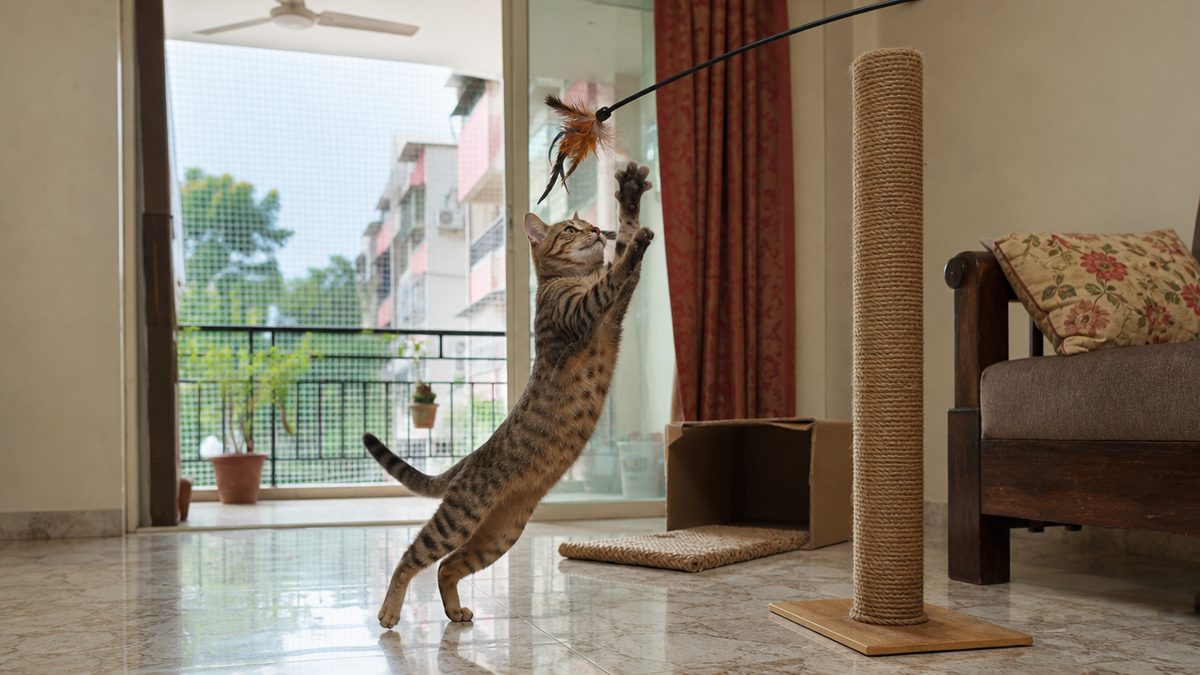
Cat toys work when they let the cat finish the predatory sequence, which is why the environmental needs guideline's method is a rod or wand with fur or feathers moved 'in a way that mimics flying prey (swooping through the air) or ground prey (moving in straight lines swiftly away from the cat)', then 'let the cat catch the toy' to simulate a capture, then a treat.
What the guideline says a toy should do
Four kinds of toy do the job. Wand toys for the chase and the catch, feather and fur toys the cat can pounce on and toss into the air, large soft toys it can rake with the back feet and bite, and toys that hold food, with the whole set rotated so the cat does not habituate. Avoid toys with 'small, ingestible parts and bells' or remove those parts first, and put every string toy away after the session. Catnip toys, boxes and noisy toys were among the games the 1,591-owner survey counted, and the more of them a cat had, the higher its quality-of-life score. The Supertails prices on 18 September 2026 were Rs 196 for a Barkbutler x Fofos wand (MRP Rs 225), Rs 249 for a Skatrs feather teaser on a 45 cm stick (MRP Rs 468) and Rs 360 for a Trixie butterfly playing rod (MRP Rs 450); the three divide to 2.32, 2.95 and 4.27 at 84.38 and to 2.65, 3.36 and 4.86 at 74, none a price a dollar shop would print, so they are rupee-native Supertails, Trixie Playing Rod…. The cheapest wand and a cardboard box cover the third pillar for under Rs 200; the sturdy post in the next section is where the money goes.
How long to play: the number the ranking pages give, and what the study found
The ranking pages agree on a number and none of them sources it. Arm and Hammer says 'about 15 minutes at a time, two times per day', and the Indian veterinary page says 'two dedicated play sessions of 10 to 15 minutes daily';. Neither guideline gives a duration. The one study with a denominator found that total daily play time correlated with the owner-cat relationship score (R = 0.271, a moderate correlation) but not with the cat's quality-of-life score, while the number of different games did, so two 10-minute sessions is a reasonable habit and the variety inside them is what the evidence supports.
Why laser pointers are debated
A laser pointer is on every ranking list. Care.com, the UK rescue's 50 and the American clinic's 'Catch the Red Dot' all recommend one. The concern is that a light cannot be caught, so the sequence never ends. A 2021 survey of 618 cat guardians found significant associations between how often the laser was used and every abnormal repetitive behaviour asked about except overgrooming, with the strongest patterns for chasing lights or shadows, staring at lights or reflections and fixating on one toy; indoor-only cats and cats aged 1 to 2 years were also more likely to show them. The same authors repeated the survey with 468 guardians recruited a different way, in case the first sample was biased, and reported that 'the primary conclusions of the two studies were the same';. Both studies are correlational, so they cannot prove the laser caused the behaviour, and the authors say so. The guideline's rule that the cat must be allowed to catch the toy is the practical answer: if a laser is used at all, end the session on a wand or a thrown toy the cat can catch, then a treat. The four toy rules from the two guidelines are listed below.
- Move the wand like prey, flying then ground, and let the cat catch it
- Use hands and feet for nothing in play, at any age
- Rotate toys and games, because variety, not minutes, tracked quality of life
- Put string, feathers on thread and anything with a bell away after the session
Cat scratching post: substrate, height, placement, and what it costs in India
A cat scratching post that gets used is upright, at least 3 ft (91 cm) tall, wrapped in rope, on a base no wider than 3 ft and placed near where the cat sleeps or walks, which is what 4,331 cat owners in 39 countries reported in the only large survey of scratching behaviour.
Scratching is not a habit to break. The AAHA and AAFP guideline tells clinics it is 'imperative to educate cat owners that scratching is a normal feline behavior' and to have posts provided 'as soon as they enter the home', near resting areas and high-traffic pathways. The environmental needs guideline counts the scratching area as a key resource in its own right and as a scent post, because the pads of the feet carry glands, which is why a post by the front door gets used and one in the store room does not. In the survey, rope was the substrate used most when offered though carpet was the one offered most, unwanted scratching fell as the number of different posts in the home rose, and cats aged 10 to 14 chose carpet first. The 2,465-owner study of 2022 found 58 percent of owners reported unwanted scratching, fewer reports where owners provided sisal rope, flat surfaces and extra posts, rewarded use of the post and applied an attractant, and more reports where owners used verbal or physical correction.
The Indian post market, and the Pakistani one Google shows you
The Google India results for 'cat scratching post' on 18 September 2026 were six Pakistani shops out of nine, Daraz, PetsOne, PetsPark, Royalpets, Petco.pk and Cage Life Care, quoting prices in Pakistani rupees under the same 'Rs' an Indian shop uses, so a Rs 1,200 single-pole post on those pages is not an Indian price. The Indian prices below come from one Indian retailer's product pages, read through the store's own product data on the same day, and every figure was divided by 84.38 and by 74 to check it was not a converted dollar list. The table holds the five products opened, a 115 cm rope post, a 3.5 ft cat tree, a 16 in jute activity tree, a flat rope mat and a pair of cardboard pads Supertails, Furrlovers Jute Scratching… Supertails, Talking Dog Club Rope Scratcher… Supertails, Emily Pets Sofa Bed Scratching….
| Product, Supertails, 18 September 2026 | Height and substrate | Meets the rope, upright, at least 3 ft rule? | Price (MRP), and the quotients at 84.38 and 74 |
|---|---|---|---|
| FurryLiving Coconut Tree Scratching Post | 115 cm rope-wrapped upright post on a 40 by 40 cm base | Yes on all three | Rs 3,499 (Rs 4,199); 41.47 and 47.28 |
| Skatrs Cloud Haven Cat Tree | 3.5 ft, rope posts with platforms | Yes; a cat tree with two or more levels was the survey's other used shape | Rs 2,299 (Rs 4,999); 27.25 and 31.07 |
| Furrlovers Jute Scratching Posts Activity Tree | 16 in jute posts with a hanging ball | No on height; a second, low post for a kitten or a senior | Rs 1,033 (Rs 3,657); 12.24 and 13.96, the second close to a round dollar figure, so one data point |
| Talking Dog Club Rope Scratcher Mat | 20 by 16 in flat rope mat | Flat, the shape linked to fewer unwanted-scratching reports in the 2022 study | Rs 934 (Rs 1,061); 11.07 and 12.62 |
| Emily Pets cardboard scratching pads, pack of two | 44 by 19 cm corrugated cardboard | Flat; cardboard was offered less than rope in the survey | Rs 719 (Rs 1,198); 8.52 and 9.72 |
Placement and repair are the two things the lists skip. Put the tall post where the cat already scratches, which in most flats is the sofa arm nearest the door, and a second flat mat by the bed, because unwanted scratching fell as the variety of posts rose. A post that has gone bald is re-wrapped, not replaced: the guideline's own example of an outdoor scratching area is 'a wooden upright post covered with sisal rope', and a coil of sisal from a hardware shop and a staple gun rebuild the substrate on any of the posts above. Rewarding the cat at the post and never correcting it at the sofa is the other half, and it is the half the 2,465-owner study measured.
Catios and harness walking in India: netting the balcony, and where a leash is safe
A catio in an Indian flat is a netted balcony, priced at approximately Rs 30 per square foot with a 100 square foot minimum by one installer with service centres in nine cities, and it turns the most dangerous place in the flat into the cat's outdoor life.
The danger has numbers. The largest series of cats falling from buildings, 1,125 cases at one Berlin university clinic between 2004 and 2013, all from at least 4 metres, found the average faller was 2.3 years old, 77 percent fell in summer, 62.1 percent at night, and 74.2 percent landed on a hard surface. Part 2 of the same study reports 87 percent survived, 13.3 percent died or were euthanased, thoracic trauma in 58.3 percent and limb fractures in 47.2 percent. The adult cat care guide has the fallers by breed; the one-line version is that the balcony net goes up before the cat arrives.
MK Bird Net Services lists a nylon pet-protection net with a 5 mm mesh hole at approximately Rs 30 per square foot, minimum order 100 square feet, with service centres in Mumbai, Pune, Bangalore, Ahmedabad, Jaipur, Delhi, Chennai, Kochi and Kolkata, so a 10 by 10 foot opening is about Rs 3,000 before the visit charge; Rs 30 divides to 0.36 and 0.41, a rupee price, and it is one installer's list price on one day, so get two quotes. Mesh matters: the same page says balcony cat nets run from 20 to 50 mm and that a smaller mesh stops a cat slipping through, so ask for the 5 mm or the smallest sold, and check the AC sleeve, the drying-rack pulley gap and every window that opens. Once netted, the balcony carries the guideline's outdoor list, a scratching post, a raised perch with a view of the street, water in a second place, and shade, because International Cat Care's heat advice applies twice over on a west-facing balcony in April International Cat Care. A cat that can climb to a netted perch and watch the crows has the window views the ranking pages promise, at a fall risk of nil.
Harness walking: where the leash is safe in India
Both guidelines name the leash. The environmental needs guideline shows 'a leash for outdoor exercise or walking' and a fenced enclosure as its two examples of a safe outdoor environment, and the AAHA and AAFP guideline says supervised access 'during leashed walks or via cat-proof enclosures' may reduce some of the risks of the outdoors Quimby J, Gowland S, Carney HC, DePorter T. The Indian question is where. The building corridor, the terrace and the netted balcony are leash territory; the street is not, because the risks the free-ranging dogs guide and the cat vaccination schedule guide describe, dog packs and endemic rabies, do not care about a leash. A Trixie cat harness with leash, sized 11 to 18 inches at the girth, was Rs 468 on Supertails on 18 September 2026 (MRP Rs 550), which divides to 5.55 and 6.32. Fit it indoors for a week of treats before the first door opens, pair it with food and let the cat set the pace, which is the guideline's rule for any new stimulus. The Maine Coon page notes the breed's reputation for walking on a harness; the Persian page does not, and that is about right.
The Berlin fallers were young adults, in summer, at night, on hard ground. Fit the net before the adoption date, and re-check the hooks every monsoon, because the installer's own page sells the net on its stainless steel hooks and the fact that it 'can be refixed', not on permanence.
Clicker training a cat: the 100-cat study that says it works, and a five-minute plan
Clicker training works on cats, and the evidence is a 2017 study in which 100 shelter cats each had 15 five-minute sessions over two weeks, after which 79 percent had mastered touching a target, 60 percent spinning, 31 percent a high-five and 27 percent sitting, with the gains on all four behaviours significant at p = 0.001.
Three details from that study decide how you do it at home. Age and sex made no difference to learning, so the adult from the shelter and the ten-year-old learn as well as the kitten; food motivation predicted the gains on targeting and high-five, so the session comes before the meal, as it did in the study, with the treats as the reward; and bolder cats gained more, so a shy cat gets its sessions in the safe room with the door shut. The sessions ran twice a day at fixed times, 75 minutes of training per cat in total, in a setting the authors call 'likely one of the most stressful living arrangements these cats have ever encountered', and the cats still learned.
Clicker training appears on two of the ranking lists, Care.com and Outdoor Bengal, as an idea without a method or a source. It serves two pillars at once, predictable human contact the cat can walk away from, and the food route to predatory play, since every click ends in a small piece of food the cat has worked for. A commercial clicker is not required; the study used a clicker and 'a plastic chopstick or finger' as the target, and a retractable pen and a finger do the same two jobs. The five-minute plan, in the order the study taught the behaviours, is below.
- Charge the marker: click, then a treat, ten times, until the cat looks for food at the click. Two minutes, day one.
- Target: hold the chopstick or your finger 2 cm from the nose; the cat sniffs it, click, treat. Move it further away and lower each day. This was the behaviour 79 percent of the cats mastered.
- Spin: lead the nose with the target in a slow circle and click as the circle closes; 60 percent mastered it.
- Sit: raise the target a little above and behind the head so the rump lowers, and click as it touches the floor; 27 percent mastered this one, so expect it to take longest.
- High-five: hold the target where a lifted paw touches it, and click the touch; 31 percent mastered it.
- Stop at five minutes, end on a success, then feed the meal.
The training carries into the rest of this page. A cat that targets can be led onto the scales, into the carrier for the vaccination visit, onto the harness for the first time and away from the balcony rail, with no lifting, which is the guideline's 'let the cat initiate, choose and control' rule turned into a tool. The authors suggest the trained behaviours may make shelter cats more desirable to adopters, which is a point for anyone reading the adopting a cat guide Kogan L, Kolus C. Train a cat to sit and you have also trained it to stretch up on the post for a treat, to climb to the perch on cue, and to come in off the balcony when the net is being refixed.
Common questions about things to do with your cat
What is the 3-3-3 rule of cats?
The 3-3-3 rule is an adoption timeline shelters hand out: 3 days to decompress, when a new cat may hide, not eat and skip play; 3 weeks to learn the routine, when it should use the tray consistently and come out more; and 3 months to feel at home, when scratching, purring, kneading and play appear. It is a rule of thumb from adopter handouts, not a study.
What to do with my cat for fun?
Play the hunt. Move a wand toy like a bird and then like a mouse, let the cat catch it, and give a treat; hide part of the ration around the room or in a puzzle feeder; give it a window behind a net to watch from; and rotate the toys weekly. Those are the environmental needs guideline's own methods, and variety across games tracked quality of life in a 1,591-owner survey.
How do I say "I love you" in cat?
Slow blink. In a 2020 study, cats narrowed their eyes and half-blinked more often when their owner slow-blinked at them than when there was no interaction, and cats approached a stranger more often after a slow blink than after a neutral face. Sit at the cat's level, soften your eyes, close them slowly, and wait for the reply.
What are 100 things I can do with my cat?
The lists that rank for this question run to 50, 62 and 101 items, and every item on them is one of five needs: a safe place, separated resources, predatory play by food or by toy, contact the cat starts, and respect for its sense of smell. The kitten, adult and senior tables above hold twenty activities that serve those five, each with a source and a rupee price.
Do cats really need a scratching post?
Yes, a cat needs somewhere to scratch. The AAHA and AAFP guideline calls scratching a normal feline behaviour and tells clinics to have owners provide posts as soon as the cat enters the home. In a 2,465-owner study, unwanted scratching was reported less often where owners provided sisal rope, flat surfaces and extra posts, and more often where they used verbal or physical correction.
What does a cat scratching post do?
A scratching post gives the cat a place to use its claws and to mark territory, because glands in the paw pads leave scent where it scratches. The environmental needs guideline lists the scratching area as a key resource in its own right, to be placed in its own location, and as part of how a cat keeps its scent profile in the home, which is why a post by the door gets used.
What type of scratching post do cats like best?
Cats used a rope-wrapped post most, standing upright or as a cat tree with two or more levels, at least 3 ft tall, on a base 3 ft wide or narrower, in a survey of 4,331 owners across 39 countries. Carpet was offered more often but used less, except by cats aged 10 to 14, who chose carpet first. Two different posts beat one.
How do I fix my cat's scratching post?
To fix a worn post, re-wrap the pole with sisal rope from a hardware shop, the rope substrate cats used most in the 4,331-owner survey, and staple the ends underneath. To fix a wobbling one, screw the base to a wider board or fix the post to the wall, keeping it upright and at least 3 ft tall, the two features that survey linked to use.
What toys do most cats like?
Toys that behave like prey. The environmental needs guideline names four kinds: a wand with fur or feathers moved like flying or ground prey, feather and fur toys the cat can pounce on and toss, large soft toys it can rake and bite, and toys that hold food. No open-access study ranks brands, and the guideline says to rotate whatever you have so the cat does not habituate.
What are the toys for cats?
The toys for cats sold in India fall into five groups: wand teasers (Rs 196 to Rs 360 on Supertails on 18 September 2026), puzzle and treat feeders (Rs 478), large soft toys to rake and bite, scratching pads and posts (Rs 719 to Rs 3,499), and cat trees (Rs 2,299 for 3.5 ft). A cardboard box, an egg carton and a paper ball cost nothing and are on the guideline's list.