
Cat care guide
Senior cat care in India: what changes after ten
A cat is senior from ten under the 2021 AAHA/AAFP guideline. This guide sets out what changes after that and what to do about it in an Indian flat: the six signs and the disease each points to, the screening panel the 2023 AAHA senior care guideline asks for and what IVRI, BASU and a private chain charge for it, the four diseases with their denominators, the protein rule the ranking pages get backwards, the manufacturer's own feeding chart priced, and the one insurer that prints a cat age band.
Quick answer
Senior cat care in India starts at ten, the age the 2021 AAHA/AAFP guideline calls senior: a vet examination every 6 months, a yearly panel of blood count, kidney chemistry, urinalysis, total T4 and blood pressure, weight on the same scale every two months, more protein rather than less, water in several places, a low-sided tray and ramps for joints that are arthritic in 90 of 100 cats over twelve. Indian government rate cards price the panel at Rs 700 to Rs 3,420.
This guide is general information for Indian pet owners and is not a diagnosis. Always consult a registered veterinarian near you before acting on anything you read here, and treat any sudden change in your pet's condition as urgent.
When a cat becomes senior: 10 by the 2021 guideline, 11 by International Cat Care
A cat is senior from the age of ten under the 2021 AAHA/AAFP Feline Life Stage Guidelines, which set four age stages, kitten to 1 year, young adult 1 to 6, mature adult 7 to 10 and senior over 10, with end of life as a fifth stage that can arrive at any age.
International Cat Care draws the line one year later. Its senior page, updated 26 September 2025, calls a cat mature at 7, senior from 11 to 14 and super senior at 15 and over. Cats Protection and the Feline VMA's owner site use the same 11 Cat Friendly Homes, VCA uses 10 with geriatric at 15, and Cornell's feline centre quotes a clinician putting old age at 12 to 14. The 2023 AAHA Senior Care Guidelines settle it for this page: they define a senior cat as one over 10 years, citing both the life stage guideline and the 2021 AAFP Feline Senior Care Guidelines. The number matters less than what it triggers, and every document triggers the same thing. Senior cats are seen at least every 6 months, the Feline VMA asks for every 4 months past 15, and the ISFM kidney guideline starts the 6-monthly regular health checks, with body weight, body condition and blood pressure, at 7.
| Source | Mature | Senior | Very old |
|---|---|---|---|
| 2021 AAHA/AAFP Feline Life Stage Guidelines | 7 to 10 | over 10 | end of life, any age |
| 2023 AAHA Senior Care Guidelines | not restated | over 10 | frailty used as a descriptor, not an age |
| 2021 AAFP Feline Senior Care Guidelines | not restated | over 10 (as cited by AAHA 2023) | not restated |
| International Cat Care, 2025 | 7 | 11 to 14 | 15 and over, 'super senior' |
| Cats Protection | 7 | 11 | 15, 'super senior' or geriatric |
| VCA Animal Hospitals | not stated | over 10 | over 15, 'geriatric' |
| Cornell Feline Health Center | not stated | 12 to 14 (quoted clinician) | not stated |
Cat years to human years
The conversion International Cat Care uses is the first two years equal to 24 human years and every year after that worth four, so a 10 year old cat is about 56 and a 16 year old is 80. The Feline VMA rounds an 11 year old cat to about 60. Cornell's centre adds that 'not long ago' cats were considered senior at eight, and that its clinician's oldest feline patient reached 22. The same arithmetic, with the dog column beside it, sits in the dog age in human years guide. What the numbers hide is speed. A cat moves from 56 to 80 human years in six calendar years, which is why the guidelines halve the checkup interval rather than trusting the owner's eye.
| Age reached | Cats alive at that age in the cohort | Chance of dying in the next year | Average years still to live |
|---|---|---|---|
| Birth | 7,936 | 3.9 percent | 11.74 |
| 7 | 6,005 | 4.1 percent | 7.46 |
| 10 | 5,125 | 6.9 percent | 5.46 |
| 12 | 4,353 | 10.9 percent | 4.24 |
| 15 | 2,797 | 21.2 percent | 2.72 |
| 17 | 1,662 | 34.1 percent | 1.90 |
| 20 and over | 332 | 52.4 percent | 1.32 |
Read the table as a senior cat's owner rather than a kitten's: a cat that has reached 10 has, on average, five and a half more years, and one that has reached 15 has nearly three, which is the span the twice-yearly check is protecting. The earlier VetCompass study of 4,009 deaths put the median at 14.0 years, 15.0 for neutered cats against 11.0 for entire ones.
Everything on this page assumes a cat past ten. The years before that, the annual routine and the weight control that decide how the senior years go, are in the adult cat care in India guide, and the booster interval that continues into old age is in the cat vaccination schedule in India guide; VCA's advice is to keep an old cat vaccinated because its ability to fight infection falls with age. Cornell's line is the one to keep: growing older is not a disease, and some old cats do not change at all. The 2019 life tables give a female cat 12.51 years at birth against a male's 11.18, a crossbred 11.89 against a purebred's 10.41, and the breed pages for the Persian at 10.93 years, the Siamese at 11.69, the British Shorthair at 9.58 and the Maine Coon at 9.71 carry the same study's breed columns, which agree with it.
What changes after ten: six signs and the disease each one points to
Six changes an owner notices first in a cat past ten, appetite, thirst, litter habits, grooming, night-time vocalisation and weight, each map to a short list of diseases, and the 2021 life stage guideline's rule is that a senior cat showing new or unusual behaviour is evaluated for a medical condition before anything is put down to age.
Ageing alone explains less than owners assume. International Cat Care's signs of ageing are a duller nose and palate, poorer digestion of fat and protein, weaker hearing and immunity, sleeping longer, playing and grooming less, being more vocal and becoming more dependent. The table below is the signs of disease that hide inside them.
| What you notice | What ageing alone can explain | What your vet rules out first |
|---|---|---|
| Eats less, turns fussy, sniffs and walks away | A duller nose and palate; food that is less digestible with age | Dental pain, kidney disease, any chronic illness: hyporexia and anorexia are on the 2023 AAHA list of common chronic-disease signs |
| Eats more but loses weight | Nothing; this is not normal ageing | Hyperthyroidism, diabetes |
| Drinks more; larger, more frequent urine clumps | Nothing | Kidney disease, diabetes, liver disease; VCA's ceiling is a daily water intake 'significantly less than 100 mL per kg' |
| Misses the tray or goes beside it | Stiff joints and a high-sided tray | Urinary tract disease, constipation, diabetes, pain, weak balance |
| Coat matted over the lower back and hindquarters | A stiffer spine that cannot reach | Chronic pain from arthritis or dental disease |
| Yowls at night, wakes the house | Declining hearing and sight | Cognitive dysfunction, pain, hyperthyroidism, high blood pressure |
| Weight drifts down over months | Sarcopenia: up to a third of lean mass lost between 10 and 15 | Kidney disease, hyperthyroidism, cancer, dental pain |
This table maps what a sign can mean; it is not a diagnosis. Every row ends at the same place, the veterinarian near you who examines the cat, runs the panel in the next section and knows its history, and that vet decides what any of it means for your animal. Two rows should not wait for the next scheduled visit: eating more while shrinking, and drinking visibly more VCA Animal Hospitals.
International Cat Care's own list of when to contact the vet runs to eleven items: loss of appetite, weight loss, drinking more, stiffness or difficulty jumping, lethargy, lumps, balance problems, toilet accidents, disorientation, uncharacteristic behaviour such as hiding, aggression or excessive vocalisation, and changes in grooming. The 2021 guideline adds the one owners most often miss, the cat that 'doesn't like his window seat anymore';, and the 2023 guideline treats that kind of change as chronic pain until proven otherwise. The 2021 guideline lists the four causes of the night-time yowl in one sentence, sensory decline, cognitive dysfunction, pain, and hyperthyroidism or hypertension, and three of them are found with a blood test and a cuff.
Weight is the sign with a number, so monitor it. The 2023 guideline's ideal body condition for a cat is up to 6 on the 9-point scale, and it notes that underweight cats carry the greater morbidity and mortality risk, the opposite of the dog picture. Slow loss is invisible to the eye. The Feline VMA suggests a baby scale at home, VCA the same scale at least every two months VCA Animal Hospitals. A 4 kg cat that has lost 400 g has lost a tenth of itself, and in a senior cat the 2023 guideline reads that as disease until the panel says otherwise.
Weighing a cat at home takes four steps and no equipment beyond a bathroom scale.
- Weigh yourself holding the cat, then without it, and subtract; a baby scale or a kitchen scale under the carrier is more precise, and the Feline VMA suggests one for a cat under 5 kg.
- Use the same scale every time, at the same time of day, before a meal, because VCA's rule is the same scale at least every two months and a different scale hides a 200 g change.
- Write the figure down with the date, in the phone note you bring to the vet, so the trend is visible across six months rather than remembered.
- Act on the trend, not the day: a senior cat that has drifted down over two readings is booked in, because the 2023 guideline reads weight loss in a senior as disease until the panel says otherwise.
The senior screening panel: what the guideline asks for, and what it costs in India
The minimum database for a senior cat is 'a detailed blood profile including thyroid panel and urinalysis', in the words of the 2023 AAHA guideline, and its test table for cats adds blood pressure as strongly recommended every year, every 6 to 12 months once the cat is geriatric.
The guideline's table for a cat runs like this. A complete blood count, a chemistry panel (total protein, albumin, ALT, glucose, urea, creatinine, sodium, potassium, calcium and SDMA if available) and a urinalysis every 6 to 12 months; total thyroxine (T4) strongly recommended annually; blood pressure strongly recommended annually and every 6 to 12 months in healthy geriatric cats; a faecal test once or twice a year; retroviral testing on the individual cat's risk. The 2021 AAFP senior guideline goes a step further and lists blood pressure as a minimum diagnostic procedure in both apparently healthy and ill cats. The 2016 AAFP hyperthyroidism guideline explains why T4 sits on the list: measuring it on senior wellness panels is what now catches the disease 'long before the cat becomes the classic scrawny, unkempt, agitated patient with a bulge in its neck';.
In India the panel is priced test by test, and the price depends on whose door you walk through. Two government teaching hospitals publish rate cards. ICAR's Indian Veterinary Research Institute at Bareilly, with charges in force from July 2022, lists a dog-and-cat registration of Rs 50, a CBC at Rs 250, a kidney function test (urea and creatinine) at Rs 200, a routine urine examination at Rs 100 and phosphorus at Rs 100, plus tax, and no thyroid test at all. Bihar Animal Sciences University's Veterinary Clinical Complex in Patna, on a page dated 31 July 2026, lists Rs 200 registration, CBC Rs 300, kidney function test Rs 700 (or creatinine Rs 100 and urea Rs 100 separately), routine urine Rs 100 and a thyroid function test (T4 and TSH) at Rs 2,000. Neither card has a line for blood pressure or SDMA.
| Item | IVRI Bareilly, from July 2022 | BASU Patna, page dated July 2026 | Vetic clinics, April 2026 |
|---|---|---|---|
| Registration or consultation | Rs 50 | Rs 200 | not on the page |
| Complete blood count | Rs 250 | Rs 300 | Rs 799 |
| Kidney function (urea, creatinine) | Rs 200 | Rs 700 | Rs 1,249 |
| Phosphorus | Rs 100 | Rs 120 | not on the page |
| Urinalysis | Rs 100 | Rs 100 | not on the page |
| Total T4 | not offered | Rs 2,000 (T4 and TSH) | not on the page |
| Blood pressure | not listed | not listed | not listed |
| SDMA | not listed | not listed | not listed |
| Sum of the lines above | Rs 700 plus tax, without a T4 | Rs 3,420 | Rs 2,048 for two lines |
The private figures come from Vetic's own price page of 20 April 2026, which lists a CBC at Rs 799, a kidney function test at Rs 1,249 and a pre-anaesthetic panel at Rs 3,599, and gives Rs 500 to Rs 4,000 or more as the range for cat blood work as a whole. Vetlab, a NABL-accredited veterinary laboratory with centres in Delhi, Gurgaon, Chandigarh, Jaipur, Dehradun and Mumbai, bundles a CBC, liver and kidney function, T4, stool and urine into a senior wellness package listed at Rs 4,550 and offered at Rs 3,600 with home collection; the package is labelled for dogs over seven and the page lists no cat-specific package, so for a cat it is a quote to ask for rather than a price. None of these rupee figures divides evenly by 84.38 or by 74, so none is a converted dollar list. A clinic in Pune, Bengaluru or a district town will quote its own lines; ask for the panel by test name and write the price against each.
SDMA is missing from every rate card for a reason with a price of its own. The Bionote Vcheck SDMA kit, the in-clinic test a veterinarian would run, lists at Rs 32,578 for ten tests on Netmeds, or Rs 3,258 in reagent per cat before the analyser and the clinician's time. The ISFM kidney guideline is candid that SDMA 'cannot currently be recommended as a single screening test for CKD' and is most useful to support a diagnosis in cats with marked muscle loss, where creatinine reads falsely low. Creatinine, urea, urine specific gravity and phosphorus, the four lines every Indian card does carry, remain the working panel. Ask for blood pressure by name: the equipment is a Doppler probe and a cuff, and its absence from a price list does not mean the clinic cannot do it.
The visit goes better with five things in hand.
- A phone video of the cat jumping, walking on the tiles and using the tray, because the 2023 guideline treats client videos as a screening tool for pain, mobility and early neurological disease.
- Your weight log, taken on the same scale each time.
- A rough daily water figure, bowl fills against the 100 mL per kg ceiling.
- Every product the cat gets, including supplements and anything sold as natural, because the guideline lists turmeric, St John's Wort and melatonin among the products that interact with drugs it prescribes to seniors.
- The last deworming and booster dates: the guideline keeps a faecal test once or twice a year for a senior, and the intervals sit in the cat deworming schedule in India guide.
The four diseases of the old cat, with the denominators the ranking pages leave out
Four conditions account for most of what a senior screen finds, chronic kidney disease, hyperthyroidism, degenerative joint disease and cognitive dysfunction, and each has a prevalence study with a denominator, which is what separates a figure from a guess.
Chronic kidney disease: 43 of 86 randomly selected cats
Kidney disease is the most common health problem of the old cat, and the best measured. In a study that randomly selected 86 cats from one feline practice across four age bands, 43 had CKD, 50 percent, most at IRIS stage 2; prevalence was similar in the three bands under 15 (37.5, 40.9 and 42.1 percent) and rose sharply in the 21 cats aged 15 to 20. The ISFM consensus guideline puts the figure at 30 to 40 percent or more of cats over ten, against about 4 percent across all cats in UK first-opinion practice. Renal disorder was the joint leading cause of death in 4,009 English cats, 12.1 percent, a whisker behind trauma at 12.2. The Persian cat page carries the breed figure: renal disease is the Persian's most common cause of death, 23.4 percent, and polycystic kidney disease was found in 36.8 percent of 76 Persian and Persian-related cats screened by ultrasound; the British Shorthair inherited the same PKD mutation through Persian outcrosses. In the random-selection group five of seven Siamese (71.4 percent) and three of six Maine Coons (50 percent) were positive for chronic kidney disease, numbers too small to rank breeds and large enough to test early.
Hyperthyroidism: 8.7 percent of cats aged ten and over
An overactive thyroid was diagnosed in 2,276 of 95,629 cats attending 84 English practices between 2009 and 2011, 2.4 percent overall and 8.7 percent of cats aged 10 or above. Purebred cats had a third of the odds of non-purebreds; the Persian's odds ratio was 0.17 and the Siamese cat's 0.4, so the domestic shorthair most Indian homes keep is the higher-risk cat. The signs are the ones in the second row of the table above, a cat that eats more and shrinks, and the test is a single total T4 on the senior panel. The 2016 AAFP guideline's position is that every hyperthyroid cat is treated, whatever else it has, and monitored so that treatment does not worsen a comorbid disease such as kidney disease; the 2023 guideline adds the diet, high protein, limited carbohydrate and controlled iodine, with fish-based foods avoided.
Degenerative joint disease: 90 of 100 cats over twelve
Joint disease is nearly universal and almost never limped on. Of 100 cats older than 12 whose radiographs were reviewed at a US teaching hospital, 90 showed degenerative joint disease. A prospective study that sedated and radiographed 100 randomly selected cats of all ages found it in 92, with 91 having at least one limb joint affected and the score rising 13.6 percent for every year of age; a Dutch series of 100 client-owned cats aged six and over found osteoarthritis in 61, associated with reduced mobility, reduced grooming and more inappropriate elimination. The 2021 life stage guideline gives the spread as 40 to 92 percent of cats with clinical signs, and the 2023 guideline's clinical point is that, unlike dogs, cats rarely have crepitus in an affected joint, so more than 60 percent carry arthritis that a hand on the leg will not find.
Cognitive dysfunction: over half of cats aged fifteen and older
Feline cognitive dysfunction shows up as a behaviour problem first. A study cited by Gunn-Moore and colleagues found that 28 percent of pet cats aged 11 to 14 develop at least one geriatric-onset behavioural problem, rising to over 50 percent at 15 and older. The 2021 review from the same group files the signs under VISHDAAL: excessive Vocalisation, altered Interaction with owners (often more clingy, not less), altered Sleep-wake cycles, House-soiling, Disorientation, altered Activity, Anxiety and Learning or memory deficits, with beta-amyloid and tau deposits in the brain like those of early human Alzheimer's disease. The 2023 guideline calls it a diagnosis of exclusion, reached only after the blood panel, urinalysis and a neurological examination have ruled out pain, organ disease and hypertension, and notes that cats, unlike dogs, tend to become more interactive and more vocal rather than withdrawn. Night lights near the tray and the water, a fixed routine, and every resource within easy reach so the route is short are the management the owner sites share; the 2023 guideline adds that early treatment works best and that anxiety is part of the syndrome and can itself be treated.
Three of the four diseases can present as the same night-time yowl. The 2021 guideline lists cognitive dysfunction, pain, hyperthyroidism and hypertension as the differentials for that one sign, and the two that are cheapest to find, a T4 at Rs 2,000 on the Patna rate card and a blood pressure reading, are the two most often skipped.
Pain and mobility: how to see arthritis in a cat that never limps
To find pain in a senior cat, watch what it stops doing rather than how it walks, because the 2023 guideline says cats rarely have crepitus in an arthritic joint and owners read the changes as normal ageing when they are clinical chronic pain.
The behaviours the guidelines name are reduced jumping and climbing, hesitation at the counter, a window seat abandoned, and less grooming of the hindquarters; the 2021 guideline tells clinicians to listen for 'doesn't like his window seat anymore' as a presenting complaint. The Feline VMA publishes a degenerative joint disease questionnaire for owners to fill in before a visit and suggests keeping videos of the cat jumping over the years, so a change of a few centimetres is not lost to memory. International Cat Care adds the coat as evidence: matting over the lower spine and hindquarters in a cat that used to be immaculate is a pain sign until a vet says otherwise, and the grooming and coat care an old cat needs from its owner, a soft brush, a fine comb and matts teased out rather than cut, doubles as a daily check for lumps and sores.
Treatment is multimodal, and in cats the drug choice runs into the kidney. Non-steroidal anti-inflammatories control arthritis pain in cats, but 68.8 percent of 128 cats recruited to degenerative joint disease trials also had chronic kidney disease, which is why the authors of that study call for kidney screening before any long-term painkiller is chosen. The 2023 guideline's options run from weight management and omega-3 fatty acids, which have anti-inflammatory effects in the joint, through rehabilitation to environmental change, and it warns that turmeric, sold across India as a joint remedy, has caused gastrointestinal ulceration in people and mice. Your vet chooses the drug; you can change the flat, and helping the cat at home is the part that costs least.
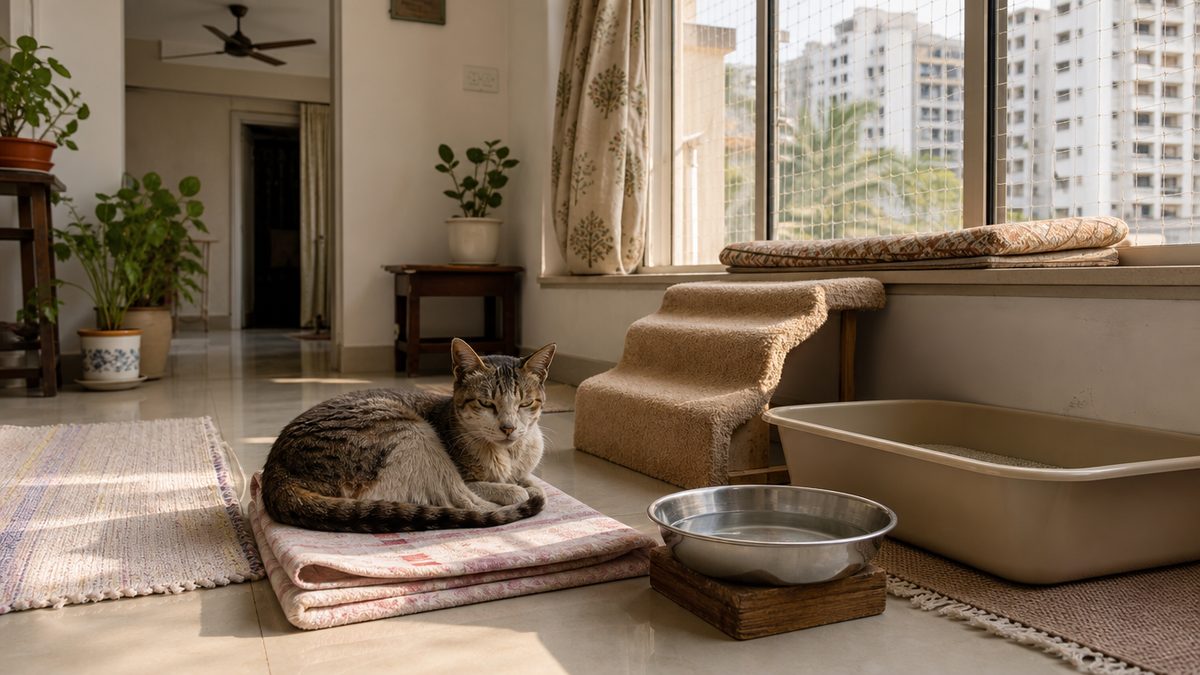
The home changes the guidelines and International Cat Care agree on are seven.
- A ramp or a two-step stool to the bed, sofa and window ledge, so the cat climbs rather than jumps, and something soft under a narrow ledge for a cat losing its balance.
- A low-sided, open litter tray on the floor the cat lives on; a high-sided box is the commonest reason an arthritic cat starts going beside it.
- Raised food and water bowls, on a box or the first stair, so a stiff neck and shoulders do not bend to the floor.
- Runners and mats on tiled, marble or wooden floors, the rugs and yoga mats the guideline lists for footing.
- Every resource on one level once stairs are a struggle: food, water, tray, bed and scratching post.
- A horizontal scratcher in place of a tall post, which loads arthritic shoulders.
- A warm, draught-free bed away from the air-conditioner outlet, because an arthritic cat feels the cold more.
Claws need a look too: older cats retract them less and can overgrow them into the pad, and International Cat Care asks owners to trim only after a vet has checked, because overgrown claws can themselves signal arthritis or hyperthyroidism. Mobility is also the reason the 2021 guideline suggests gabapentin or a pheromone before the vet visit itself: a cat that hurts on the way in is examined badly.
The Indian flat for an old cat: heat, water, the tray and the outdoor question
An old cat in an Indian flat needs four things arranged for it that a young cat arranges for itself: a cool retreat in summer, water in more than one place, a tray it can reach, and a decision about the balcony and the street.
Summer
Heatstroke in a cat shows as excessive panting, lethargy, drooling, fever, vomiting and collapse, and International Cat Care's rule is that the cat confined to a hot room is the one at risk, because a free cat finds the tiles. A senior cat is confined by its joints. The charity's heatwave list is water replaced several times a day, several bowls, a fan under supervision, shade, cool surfaces, and a frozen water bowl wrapped in a towel in the cat's favourite spot. Add the physiology: VCA notes that an ageing cat feels thirst less, so dehydration risk rises with any kidney insufficiency. If the flat is a top floor in Delhi, Hyderabad or Chennai in May and the afternoon room passes body temperature, the cat spends the afternoon in the coolest room with the door open, not on the balcony. The monsoon brings the opposite problem: a humid flat, a coat that is no longer groomed and does not dry, and matts that form over the hindquarters in a week, so the comb comes out daily from June. Adapt the flat around the cat, not the cat around the flat.
Water and hydration
Water stations are the cheapest kidney treatment there is. Both guidelines and both charities say the same thing: multiple bowls, away from food, wide and shallow so the whiskers do not touch, raised for the arthritic cat, and a fountain or a dripping tap for the cat that prefers moving water International Cat Care. VCA puts a bowl on every floor and asks owners to track water intake, because a rise is the earliest sign of kidney, liver and diabetic disease. Wet food is the other route to hydration: an 85 g pouch of the Royal Canin senior gravy in the next section is 80 percent moisture, 68 g of water the cat does not have to go and find.
The tray and toilet habits
Every senior cat gets a litter tray indoors, even one that has always gone outside, because International Cat Care wants owners able to see the urine and faeces, and because an old cat stops wanting to go out in rain and cold. Low sides, an open top, on the floor where the cat sleeps, and one extra tray within a short walk for a cat with cognitive dysfunction. What changes in the tray is the early warning: larger, more frequent clumps point to kidney disease or diabetes, straining points to constipation, and going beside the tray points to the joints. Litter types and their Indian prices sit in the cat litter training in India guide; for an old cat the rule is the litter it already accepts, and no change of brand without a reason.
Indoors or out, late in life
The outdoor question resolves itself for most old cats. International Cat Care observes that older cats hunt less, go out less and become reluctant to leave the house because they can no longer defend their patch against other cats. The mortality data do not say the street kills old cats: trauma was the leading cause of death across 4,009 English cats at 12.2 percent, but at a median age of 3.0 and mostly under the wheels of a car, and in cats over five it fell to 5.8 percent of deaths while renal disorder rose to 13.6. What the data do say is that the old cat's killers are the ones an owner watches for indoors, in the tray, the bowl and on the scale. For a cat that has always roamed the lane, the move indoors is easier at 12 than at 2, and easier still with a netted balcony, a window perch reached by a ramp and a tray it can reach. Keep the cat wormed on the schedule for a cat that still goes out, because an old cat that stops grooming carries more of what it picks up. The winter note for the north is the charity's: an inactive cat that has lost muscle feels the cold, so a draught-free bed and, for the very old, a covered box with a blanket, away from the room heater.
Feeding a senior cat: more protein, not less, and what a pouch costs
Healthy mature adult and senior cats should not be protein restricted, in the words of the 2021 AAHA/AAFP guideline, which recommends a diet of at least 30 to 45 percent protein on a dry-matter basis and cites a study showing that ageing cats need more protein, not less, to hold on to muscle.
The physiology behind that is specific. Protein is less digestible in 20 percent of cats older than 11 and fat in up to a third, so the same bowl delivers less; lean body mass falls by up to 33 percent between 10 and 15; and senior cats may need up to 50 percent more protein to slow that loss. Energy needs fall until about ten and then rise, so the 2021 guideline multiplies a senior cat's resting energy requirement by 10 to 20 percent, sometimes 25. The 2023 guideline's prescription for a healthy senior cat is a higher-calorie, higher-protein, more digestible and more palatable food fed in smaller amounts more often; International Cat Care makes that four to six small meals a day, warmed to just below body temperature for a cat whose nose has dulled, in a quiet corner, with uneaten wet food cleared within the hour. Nutrition and weight management are the same job in a senior cat: feed to the body condition score, not to the bag.
Two ranking pages say the opposite. Supertails' senior cat article of March 2023 tells owners that senior cats need 'a decrease in caloric intake' and 'should switch to a prescription diet that is lower in calories and fat';; Cats Protection says older cats need 'fewer calories but higher levels of good-quality protein';. The guidelines govern: a healthy senior cat losing condition needs more food, not a lighter one, and a prescription diet is for a diagnosed disease. The exception is real, and it is the kidney. Renal diets carry 6 to 7 g of protein per 100 kcal against 9 to 10 in maintenance foods and much less phosphate, and in cats with diagnosed CKD they reduce uraemic signs and significantly prolong life; the 2023 guideline places protein restriction as something to consider at IRIS stage 2 and to recommend at stage 3, never for a healthy cat or early disease. A hyperthyroid cat gets the reverse, a high-protein, low-carbohydrate diet with iodine controlled.
What the manufacturer's own feeding chart costs
Royal Canin India sells exactly one senior cat food on its Indian site, Ageing 12+ thin slices in gravy, 85 g pouches, 9.5 percent protein and 0.13 percent phosphorus as fed at 80 percent moisture, which works out to about 47 percent protein on a dry-matter basis, above the guideline's 30 to 45. Its feeding table gives a 3 kg cat 2 pouches a day, a 4 kg cat 2 and a half, a 5 kg cat 3 and a 6 kg cat 3 and a half, or one pouch plus 22 to 49 g of dry food. Pets Lifestyle, an Indian retailer, listed the 12-pouch box at Rs 1,440 with a sale price of Rs 1,225 on 18 September 2026, Rs 120 or Rs 102 a pouch. Neither figure divides evenly at 84.38 or at 74.
| Feeding plan | Pouches a day | Cost a day at Rs 120 | Cost a day at Rs 102 | Cost a month |
|---|---|---|---|---|
| Pouches only | 2 and a half | Rs 300 | Rs 255 | Rs 7,650 to Rs 9,000 |
| Mixed: one pouch plus 31 g dry | 1 | Rs 120 plus the dry food | Rs 102 plus the dry food | Rs 3,060 to Rs 3,600 plus the dry food |
That is the manufacturer's own number, and it explains why most Indian senior cats stay on dry food with a pouch on top. The home-cooked route, with the taurine and calcium a cat cannot make for itself, is worked through in the homemade cat food in India guide, and its arithmetic applies with more force to a cat losing muscle. Whatever the food, the switch is made at home, the new food offered beside the old rather than in place of it, because a stressed change of diet in an old cat creates a food aversion that is hard to undo. An underweight old cat that is eating is a cat to feed more, and then to test.
Senior cat insurance, a budget of care, and the last decision
A cat can be insured in India until it turns 7 and stay insured to 12 under the one policy wording that prints a feline age band, and past that the 2021 AAFP senior guideline's phrase for what an owner sets is a 'budget of care', agreed with the vet before the crisis rather than in it Ray M, Carney HC, Boynton B.
Bajaj General Insurance's pet policy wording, 21 pages, sets entry for cats of all breeds at 3 months to 7 years and exit at 12, closes four of its covers, mortality, long-term care, OPD and theft, to any cat over 8 unless the policy was renewed without a break, and lets the insurer ask for medical reports on any fresh proposal for a pet over 4. The other four insurers the pet insurance in India guide read print dog ages only. In plain terms, a cat insured at 5 and renewed every year is covered through its senior years; a 9 year old presented for the first time is not, and at 13 a cat is past the only exit age any Indian wording prints for a cat. The premiums and the exclusions that bite are on that page.
The budget is the honest part. The 2023 guideline says outright that some owners will not pursue diagnostics, for reasons that include the pet's age and financial constraints, and that the veterinarian's job is then to explain what symptomatic treatment can do for quality of life rather than to withhold care. In Indian money the Patna rate card's Rs 3,420 panel twice a year is Rs 6,840, a month of pouches on the manufacturer's chart is Rs 7,650 to Rs 9,000, and the two are the same order of cost. Deciding which of them a household can sustain for five years, and what it will do at the first serious diagnosis, is a conversation to have at the first senior visit, not the last.
Quality of life, measured on a calendar
Very few quality-of-life scales for animals are validated and most found online are not, so the 2023 guideline's practical tool is a calendar: mark each day good or bad and let the pattern, not the worst day, guide the decision. The clinical situations it lists as bearing on an end of life decision are anorexia, progression of signs, severe or unrelenting chronic pain, deterioration during active treatment, cognitive dysfunction progressing and mobility failing. Palliative care, symptom and pain management alongside or instead of treatment, is offered at a chronic or terminal diagnosis, and hospice is its last stage; the guideline notes that home euthanasia services have become more available and that the plan for the death, whether euthanasia or a palliated one, is discussed early rather than on the day. The Feline VMA's owner page says it in fewer words: work through the assessment with your veterinarian and prepare, because preparation does not remove the grief but makes the process calmer. What follows the decision, from the vet's paperwork to cremation in an Indian city, is in the when your pet dies in India guide.
Age is not a reason to stop treating. The 2023 guideline says advanced age alone is not a contraindication to anaesthesia, that a senior pet can safely be anaesthetised more than once, and that dental work in particular often produces a large improvement in quality of life. The 14 year old cat that stopped eating because of a resorbing tooth is not dying of old age. Whether it is fit for the anaesthetic is a question for the vet who has its creatinine and its blood pressure in front of them.
Common questions about caring for an old cat in India
How long can senior cats live?
A cat that has reached 10 has 5.46 more years on average, one that has reached 15 has 2.72 and one at 17 has 1.90, from the 2019 UK cohort life table built on 7,936 confirmed deaths; life expectancy at birth was 11.74 years. In the earlier VetCompass study of 4,009 deaths the median was 14.0 years and the oldest cat 26.7.
Is a 12 year old cat old?
Yes, a 12 year old cat is senior under the 2021 AAHA/AAFP guideline, which starts the stage at over 10, and it sits inside International Cat Care's 11-to-14 senior band. In human terms it is about 64. The practical consequence is a vet visit every 6 months with blood pressure, T4, kidney chemistry and urinalysis on the table.
What to expect from a 17 year old cat?
Expect at least one of four things. Over half of cats aged 15 and older show a geriatric-onset behaviour change such as night-time yowling, 90 of 100 cats over 12 had radiographic joint disease, kidney disease prevalence rises sharply after 15, and hyperthyroidism affects 8.7 percent of cats over ten. A 17 year old has 1.9 years left on average, and the Feline VMA asks for a check every 4 months past 15.
How to take care of a senior cat?
To take care of a senior cat, book a vet visit every 6 months, run the blood, urine, T4 and blood pressure panel yearly, weigh the cat every two months on the same scale, feed more protein in smaller meals, keep water in several places, lower the litter tray, add ramps, keep it cool in summer, and treat any new behaviour as medical until your vet has ruled that out.
My 20-year-old cat isn't eating. Should I be worried?
Yes. Loss of appetite heads International Cat Care's list of signs that need a vet appointment, and the 2023 AAHA guideline lists hyporexia and anorexia among the common signs of chronic disease in a senior pet, with dental pain, kidney disease and hyperthyroidism the common causes. A 20 year old cat that stops eating is seen the same day, not watched for a week.
What are end of life signs in an elderly cat?
The 2023 AAHA guideline names anorexia, worsening signs, severe or unrelenting chronic pain, deterioration during active treatment, progressing cognitive dysfunction and failing mobility as the situations that bear on an end of life decision, and asks owners to mark good and bad days on a calendar rather than judge by the worst one. Your vet reads that pattern with you.
Can a cat live for 40 years?
No verified cat has reached 40. The Guinness World Records oldest cat ever is Creme Puff of Austin, Texas, born 3 August 1967 and died 6 August 2005, at 38 years and 3 days. In the largest UK study the oldest of 4,009 cats with confirmed deaths reached 26.7 years, and the median was 14.
What is the average lifespan of a cat in India?
No published Indian study answers this. A Europe PMC search on 18 September 2026 for cat life expectancy, longevity or lifespan with India in the title or abstract returned nothing, while the same search for England returned the VetCompass study of 4,009 cats with a median longevity of 14.0 years. Until an Indian clinic or university publishes its records, the UK figure is the nearest measured one.