
Cat training guide
Litter training a cat or kitten in India: box, litter type, placement and problem solving
The litter rules from the AAFP and ISFM guidelines applied to an Indian flat: two boxes per cat at one and a half times the cat's length, 3 cm of unscented clumping litter, daily scooping, eight litter types sold in India priced per kg and per month on 18 September 2026, the four causes of house-soiling with a Thai teaching-hospital denominator, and where used litter goes under the Solid Waste Management Rules 2026.
Quick answer
How to litter train a cat in India: put two open trays, each 1.5 times the cat's length, in quiet spots, fill them 3 cm deep with unscented clumping litter, place a kitten in a tray after each meal and nap, and scoop daily. Adult rescues train the same way, from one room. A cat that stops using the tray sees a vet first, because urinary disease is one of four causes. Unscented bentonite costs Rs 264 to Rs 319 per 5 kg, a month.
This guide is general information for Indian pet owners and is not a diagnosis. Always consult a registered veterinarian near you before acting on anything you read here, and treat any sudden change in your pet's condition as urgent.
How to litter train a cat: the first week with a kitten
To litter train a cat, put an open tray of unscented clumping litter in a quiet corner of one room, set the kitten in it after every meal and nap, and let instinct do the rest: the 2021 AAHA/AAFP life stage guideline calls cats innately fastidious and naturally drawn to sand-type substrates, and says toileting habits are learned from the queen before a kitten reaches you.
The guideline's kitten column says to start with unscented clumping sand litter and/or the litter the kitten was previously using, and to let it choose by offering a variety of litters in separate trays, because individual preferences are documented. Cats eliminate away from where they rest and cover what they leave, which is why a tray a kitten can dig in gets used. International Cat Care adds the mechanics: most kittens learn by watching their mother, and one that has not can be stood in the tray after sleeping or eating and shown the motion with one of its own forepaws.
The seven steps for the first week, from the guidelines
- Set up one room before the kitten arrives. Tray in a discreet corner, food bowl on the opposite side, water a few feet from the food and away from both, a bed away from all three, windows closed.
- Use the litter the kitten already knows for the first 1 to 2 weeks, or unscented clumping sand litter; change litter and food gradually, never in the same week.
- Choose a low-sided open tray, because the guideline says the edges must not be too high for a kitten or a senior cat to enter and exit.
- Place the kitten in the tray when it wakes, after each meal, and whenever it sniffs, scratches or begins to crouch.
- Keep it in that one room for the first days, with a second tray where the family sits, because a kitten's bladder and bowel control are less developed than an adult's.
- Scoop as soon as the tray is used and never scold. A kitten that soils outside the tray is examined for congenital urinary or gut problems, parasites or infection, not punished.
- Call the vet on day two if nothing has happened. An anxious cat may not eat or use the tray in the first twenty-four hours; beyond that, International Cat Care says to speak to your veterinary team.
How long it takes has no guideline figure, and the ranking pages disagree by a factor of ten: Supertails says 2 to 3 days, Hill's says up to a month, Catsan says 4 to 6 weeks, and none cites a study. All of them add positive reinforcement, a treat straight after the tray is used; the guidelines say only that punishment is never used. The only dated threshold with an authority behind it is International Cat Care's twenty-four hours before you call the vet. The rest of the first year is in the kitten care guide, and the shelters and the first month with an adopted cat in how to adopt a cat in India.
Can an adult cat be litter trained? Street rescues and adopted adults
Yes, an adult cat can be litter trained, and most adopted adults need no training: International Cat Care says cats are fastidious about their toilet habits and consistently use a litter tray indoors if one is provided, or loose earth or sand outside.
The Indian rescue that has toileted outdoors all its life needs a bridge, not a lesson. The 2014 AAFP and ISFM house-soiling guideline says cats may prefer the substrate they used outdoors, soil or sand, and that the chosen litter can be added to it gradually; the 2013 environmental needs guideline describes a cat's own outdoor toilet as a rakeable surface of sand or soil in a quiet spot, which is what a construction-sand heap in Bengaluru has been to that cat. Fine sand-like litter reads as familiar, pine pellets and silica crystals do not, and a veterinarian on one ranking page suggests a little garden soil in the tray at first.
The remedial protocol when an adult refuses the tray
The Louisiana SPCA's remedial protocol starts with a vet visit even if the cat was examined weeks ago. Then you confine the cat: a small room with no carpets, mats or beds to adopt as a toilet, an inch of water in the sink and tub if it has used smooth surfaces, food at one end and the box at the other, fine-grained unscented clumping clay, scooping twice a day and a weekly wash. After two to four weeks it gets the flat back one room at a time with a box in each room; a cat that still fails gets a large crate with litter across its floor and a perch. In a one-bathroom flat the room is a bedroom with the mattress lifted and the rugs removed. The 3-3-3 sheet adopters ask about, Pasadena Humane's, expects an adult to use the litterbox consistently by 3 weeks and house soiling to be resolved by 3 months, with a vet consulted before a trainer; it is a handout, not a study.
One thing that looks like a training failure is not one. Urine spraying is marking: the cat stands, treads with its back feet, quivers its tail and sprays a small amount onto a wall, a door or a shopping bag, while a cat emptying its bladder squats on the floor. Louisiana's protocol calls that a scent-marking problem, not a box problem; marking is mostly intact males, though about 10 percent of sterilised cats marked in one study. For an unneutered male rescue the cat neutering guide comes before any box change, and the Siamese page adds that urine outside the box is among the three most reported signs of separation-related problems, a stress diagnosis rather than a lesson forgotten.
How many litter boxes, how big, open or hooded, and where in an Indian flat
A single cat needs two litter boxes in two separate places, each at least one and a half times the cat's length from nose to base of tail, and the 2014 AAFP and ISFM house-soiling guideline says outright that many commercial litter boxes prove to be too small.
How many litter boxes a home needs has one answer in all three guidelines: a minimum of two toileting areas, each away from food, water and beds; one box per cat plus one, or one per social group plus one; two boxes in two locations for a single cat, with the plus-one rule called a historical rule of thumb rather than an absolute. The 2014 guideline adds two details the ranking pages miss: cats perceive two boxes side by side as one, so the openings face at right angles or sit around a corner, and every floor needs a box. The number is not decoration: in the Chiang Mai teaching-hospital study, 60 of 78 cats with lower urinary tract disease lived with fewer boxes than cats, against 39 of 78 healthy age-matched controls, an adjusted odds ratio of 3.28.
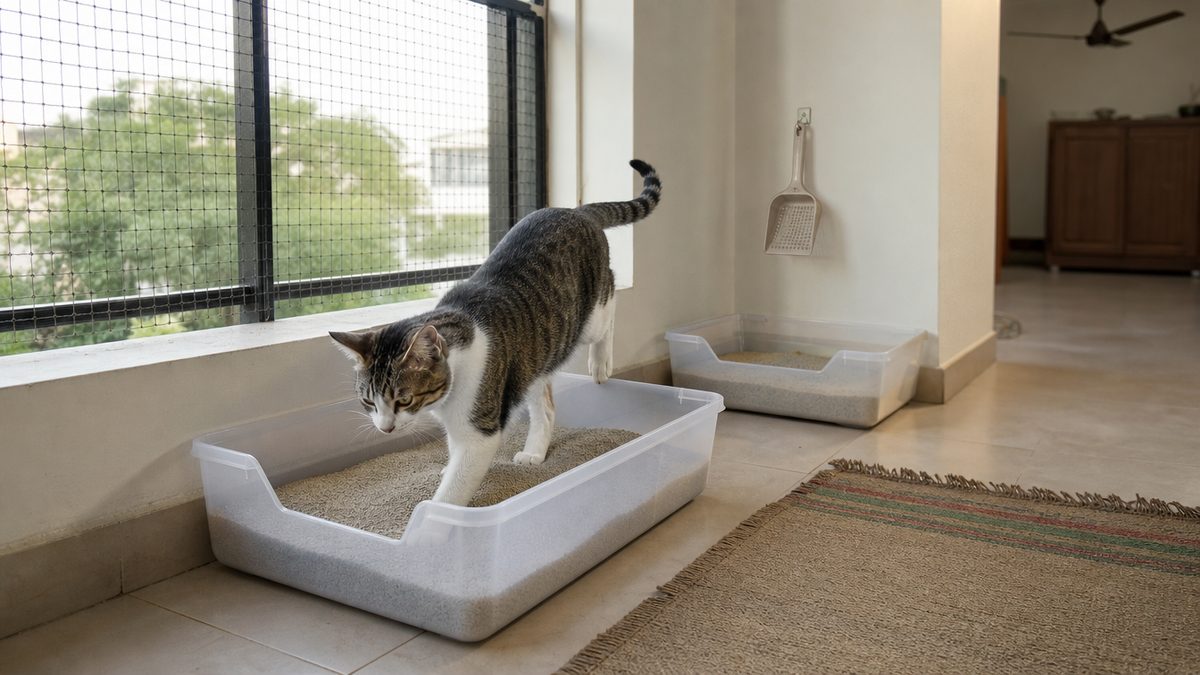
Choosing a litter box starts from the cat's length. The 2021 guideline wants at least one and a half times the length from nose to tip of tail, says most manufactured boxes are not large enough, and suggests storage containers. International Cat Care and the 2014 guideline measure to the base of the tail, want a rectangular tray, cite a study in which adult cats preferred an 86 by 39 cm box over a smaller one, and name concrete mixing trays and under-bed boxes as substitutes with the lid stood upright behind to protect the wall Carney HC, Sadek TP, Curtis TM, Grigg EK. For a cat of 45 cm from nose to tail base that is a 68 cm tray: a 60-litre plastic storage tub from a hardware shop with one long side cut down to 10 cm, not the tray sold beside the litter.
Open or hooded: what the one experiment found
The hooded question has been tested once. Grigg and colleagues gave 28 cats identical 82.5 by 50.2 cm tub boxes, one covered and one open, with fine clumping litter and daily scooping, and weighed the waste for 14 days: of the 27 analysed, 19 showed no preference, 4 used the covered box more and 4 the open one, and none of the six cats of 6 kg or more preferred the covered box. One Persian avoided the covered box while it held scented litter and used it once the litter was unscented. The 2014 guideline concludes that cats are equally divided, so open boxes are recommended because the owner sees when to scoop, a small covered box stops a large cat posturing, and a covered box holding a smell is avoided until cleaned; International Cat Care adds that a hooded tray's flap should come off. The British Shorthair page makes the Indian point: in a closed Chennai or Delhi flat in May a hood traps heat and ammonia around a cat that is already warm.
Placement follows the cat's sense of threat: ample separation from every other resource, nowhere near cat flaps, full-length glass or busy areas, an escape route, no food or water close by, no washing machine beside the box, and a path no despot cat can block. In a one-bathroom Indian flat that rules out the obvious spot: a bathroom door shut for a bucket bath or a wash cycle is a box the cat cannot reach when it needs it, and a balcony is a box only if netted and shaded, since a full-length glass door beside it is the sight line cats avoid. The workable pair is one tub in a bedroom corner away from the bed and one in the passage or store room. The Italian survey of 3,106 cats shows what owners in small flats do: 51.92 percent kept the box in the bathroom, 30.88 percent in the bedroom, 19.48 percent on the balcony, and 47.33 percent of cats had only one box.
| Rule | What the guideline says | Source | In an Indian 1BHK |
|---|---|---|---|
| Number of boxes | Two toileting areas per cat as a minimum; one per cat plus one; one per social group plus one | ISFM 2013; AAHA/AAFP 2021; AAFP/ISFM 2014 | Two tubs for one cat, three for two cats, never side by side |
| Size | At least 1.5 times the cat's length, nose to base of tail; most shop trays fail | AAHA/AAFP 2021; AAFP/ISFM 2014; International Cat Care | A 60-litre storage tub, one side cut to 10 cm, for a 4 kg cat |
| Open or hooded | Cats are equally divided; open recommended so the owner scoops in time; remove any flap | Grigg 2013; AAFP/ISFM 2014; International Cat Care | Open, because a hood traps ammonia and heat in a closed flat |
| Litter depth | About 3 cm of fine sand-like unscented clumping litter | AAFP/ISFM 2014; International Cat Care | Rs 264 to Rs 319 of unscented bentonite a month for one cat |
| Placement | Away from food, water, beds, cat flaps, full-length glass and noisy appliances, with an escape route | ISFM 2013; International Cat Care; AAFP/ISFM 2014 | Bedroom corner and passage, not a bathroom that gets locked or a balcony behind glass |
| Spacing | Adjacent boxes count as one; openings at right angles; one box per floor | AAFP/ISFM 2014 | In a duplex, one tub per floor; in a flat, two rooms apart |
What is cat litter, and which types are sold in India: price per kg and per month
Cat litter is a loose absorbent substrate, a mineral clay, a sand, a plant fibre or silica gel, poured about 3 cm deep into a tray so a cat can dig, eliminate and cover as it would in sand or soil, and the 2014 AAFP and ISFM guideline wants it fine, sand-like, non-scented and clumping in most cases.
The guidelines agree on the litter and disagree only on the kitten. The 2014 guideline says cat litter is marketed to people, not to cats, that cats often find aromatic litter and deodorisers offensive, and that liners, slotted grills and deodorising powders are to be avoided; the 2021 guideline says most adult cats prefer clumping, plain unscented litter and that a cat with a urinary history is best on it; the 2013 guideline lists scented litter among the products that disrupt a cat's scent profile; International Cat Care puts the preferred depth at about 3 cm. The one Indian article on the SERP, from a treat seller, gets the box and the scent right and then advises 2 to 3 inches of litter, roughly twice the guideline depth.
What India sells is mostly the opposite. On 18 September 2026 the Supertails cat-litter collection listed 45 litter products in five types plus one pine pellet; 29 are sold as scented in their own titles and 14 as unscented or non-scented. Its pack labels give the conversion, 4 kg of bentonite to 5 litres and 2.5 kg of tofu to 6 litres Supertails, Gishiki Health Pro Premium Tofu…. The table prices one product of each type from the seller's own data and applies the guideline rule.
| Type | Product and pack | Price (MRP) | Per kg | Per month, one cat | Guideline test |
|---|---|---|---|---|---|
| Bentonite clay, unscented, clumping | BearHugs, 5 kg | Rs 264 (Rs 399) | Rs 53 | Rs 264: the seller's own bentonite pages say a 5 kg pack lasts 3 to 4 weeks for one adult cat | Passes: fine-grained, unscented, clumps |
| Bentonite clay, unscented, clumping | Petcrux Eco Clump, 5 kg | Rs 319 (Rs 450) | Rs 64 | Rs 319, same basis | Passes: second data point at the same price band |
| Bentonite white sand, lavender scented, clumping | Scoopy, 5 kg; 10 kg | Rs 349 (Rs 999); Rs 559 | Rs 56 to Rs 70 | Rs 349, the page's own 3 to 4 week figure | Fails on scent; costs more per kg than the unscented BearHugs |
| Indian brown sand, lavender scented, clumping | Scoopy Brown Sand, 2 x 5 kg | Rs 549 (Rs 1,600) | Rs 55 | Rs 275 at 5 kg a month | Fails on scent |
| Tofu (soy), clumping, sold as unscented | Gishiki Health Pro, 2.5 kg (6 L) | Rs 973 (Rs 1,299) | Rs 389 | No seller figure per cat | Clumps; the page's own description mentions a fragrance |
| Wood fibre, unscented, clumping | Cat's Best Original, 5.2 kg | Rs 1,701 (Rs 1,900) | Rs 327 | Seller says up to 5 weeks before a full change, quantity unstated | Passes on scent and clumping; the dearest per kg |
| Pine pellets, scented, non-clumping | PetCrux Organic Pine, 5 kg | Rs 890 | Rs 178 | No seller figure per cat | Fails twice: scented, and coarse non-clumping pellets |
| Silica crystals, unscented, non-clumping | Petcrux Best Friend, 5 L | Rs 1,175 | Rs 235 per litre | Seller's collection page: one tray lasts 3 to 4 weeks | Fails on clumping and texture; seller itself bars it for kittens under 6 months |
The per-month column rests on one seller claim: the Scoopy bentonite page says a 5 kg pack lasts 3 to 4 weeks for one adult cat with daily scooping and a full change every 3 to 4 weeks, and the Pet Pattern page on the same shop repeats it. On that basis one cat gets through 13 to 17 packs a year, because 3 to 4 weeks is shorter than a month, so a guideline-compliant unscented bentonite costs about Rs 286 to Rs 461 a month and Rs 3,430 to Rs 5,530 a year Supertails, Petcrux Eco Clump Bentonite…. Wood fibre at Rs 327 per kg is five to six times the clay per kilogram but absorbs more, and the seller does not say how much a cat uses. The pine pellets fail both rules: the page says they will not clump, and the title says scented. None of the eight prices divides cleanly by 84.38 or by 74, so they are Indian rupee prices, not a converted dollar list.
Two pages contradict their own titles. The Gishiki tofu litter is titled unscented and its description promises a gentle, cat-friendly fragrance; the Petcrux silica page is titled unscented silica and its description describes a lavender and lemon scented bentonite. Read unscented on a label as a claim, and open the bag before pouring it for a cat with a urinary history.
Kittens and clumping clay: four sources, three answers, and which governs
The 2021 AAHA/AAFP table tells the kitten column to start with unscented clumping sand litter and/or the litter the kitten used before. International Cat Care's page on raising a litter says a low-sided tray from about three weeks, sand, wood or paper rather than clay because some kittens eat it, and no silica gel under eight weeks. The New Zealand SPCA page says no clumping litter before 4 months; the Scoopy page says its bentonite suits kittens above 3 months; the same shop's collection page tells owners of kittens under 3 months to use fine-grained unscented clumping litter and to avoid silica until 6 months. For a weaned kitten of eight weeks or more that does not mouth its litter, the 2021 guideline governs: clumping and unscented. For an orphan under eight weeks, International Cat Care's sand, wood or paper advice is the cautious one and that kitten's nearby vet decides; the hand-rearing weeks are in newborn kitten care in India.
One disposal rule decides the purchase: the seller's own FAQ says clay, bentonite and silica must never be flushed because they expand and block Indian plumbing, and only litters labelled flushable, typically tofu, wood or corn, may go down the toilet in small quantities. Nothing here ranks brands.
How to clean cat litter: scoop, wash, change, and dispose of it under the 2026 waste rules
To clean cat litter, scoop clumps and stools at least once a day and ideally twice, top the tray back up to 3 cm, wash it with hot water every one to four weeks, and bag the used litter for the dry-waste stream, because the Solid Waste Management Rules 2026 name no stream for pet litter and define dry waste as everything that is not wet, sanitary or special care waste Ministry of Environment.
The 2021 guideline says boxes are scooped daily, cleaned regularly and replaced, with hot water rather than soap or strong chemicals; the 2014 guideline says waste is removed at least once a day and the box washed every 1 to 4 weeks, weekly being the behaviourists' optimum, with soap and hot water only and never ammonia; International Cat Care sets the higher bar of scooping at least twice a day, a complete change of clumping litter every 2 to 4 weeks and of non-clumping litter weekly. In the covered-box experiment one scoop a day kept cats using even the hooded boxes, and in the Italian survey 80.58 percent of 3,106 cats were scooped at least daily, 52.77 percent had a full replacement weekly and 28.53 percent only monthly.
| Task | How often | Detail | Source |
|---|---|---|---|
| Scoop clumps and stools | At least twice a day; once a day as the floor | Cats like to urinate in one place and defecate in another, and some refuse a tray with any deposit in it | International Cat Care; AAHA/AAFP 2021; AAFP/ISFM 2014 |
| Top up | Daily, after scooping | Back to about 3 cm; cats without soiling problems dig more than soiling cats do | International Cat Care; AAFP/ISFM 2014 |
| Full change, clumping litter | Every 2 to 4 weeks | Every 1 to 4 weeks in the 2014 guideline; weekly is the behaviourists' optimum | International Cat Care; AAFP/ISFM 2014 |
| Full change, non-clumping litter | Weekly | Pine pellets and sand that do not clump hold urine at the bottom of the tray | International Cat Care |
| Wash the tray | At each full change | Hot water and mild soap only; no ammonia, no strong chemicals, no scented cleaners | AAHA/AAFP 2021; AAFP/ISFM 2014; ISFM 2013 |
| Clean an accident spot | Same day | Enzymatic cleaner, or a 10 percent solution of biological washing powder rinsed with cold water, then a light spray of surgical spirit once dry | International Cat Care |
| Store the bag | Between top-ups, sealed | Bentonite absorbs ambient moisture and cakes in an unsealed bag in a humid Indian home, on the seller's own page | Supertails Scoopy page |
Ammonia-based floor cleaners smell like urine to a cat, and International Cat Care and the 2014 guideline both say to avoid them on the tray and on accident spots Carney HC, Sadek TP, Curtis TM, Grigg EK. A phenyl-mopped bathroom floor beside the tray is the same mistake at room scale. Dealing with accidents follows the same logic: hot water, a little mild soap, and an enzymatic cleaner on the spot the cat used are the whole kit, because a cat that can still smell its own urine on a rug goes back to the rug.
Monsoon humidity and the bag
No study measures what a Mumbai or Kolkata monsoon does to clumping, so the honest statement is the seller's: the Scoopy page says to keep the bag sealed between top-ups because bentonite absorbs ambient moisture and cakes in an unsealed bag in a humid Indian home. Buy the 5 kg pack rather than the 20 kg sack between June and September, keep it in a lidded bin, and scoop twice a day while the air is wet. A hooded box in that weather holds the ammonia the humid air already holds, the British Shorthair page's ventilation point.
Where used litter goes: the four streams of 2026
The instrument that governs disposal today is the Solid Waste Management Rules, 2026, notified as S.O. 388(E) on 27 January 2026 and in force from 1 April 2026 in supersession of the 2016 rules Press Information Bureau. Rule 5(1)(b) makes every waste generator segregate at source into wet, dry, sanitary and special care waste; rule 5(1)(c) sends sanitary waste, defined in rule 3(zp) as used diapers, sanitary towels, tampons, condoms, incontinence sheets and any other similar waste, wrapped into a separate sanitary bin; wet waste in rule 3(zzl) is kitchen, food, meat, fruit and flower waste, and dry waste in rule 3(s) is waste other than wet, sanitary and special care waste. A search of the 144-page gazette finds pet, cat and litter nowhere except as littering, so used cat litter has no named stream. By the definitions, used clay, sand or silica is dry waste, bagged and tied, unless the bye-laws that rule 39(5) requires every urban local body to frame by 31 March 2027 say otherwise; a bag holding cat faeces is also close to the sanitary stream's any other similar waste, and that bin is where a collector who objects to it in dry waste will put it.
Two earlier positions show the drift. The 2016 rules had three streams and put wrapped sanitary waste into the dry bin; a Bengaluru waste columnist wrote in 2022 that apartment communities told owners to wrap pet poop in newspaper, plastic carry bags being banned in Karnataka, and hand it over as reject waste with the sanitary stream. Both predate April 2026, and the four streams govern now. The seller's line, a sealed plastic bag into your regular household waste, names no stream, and its FAQ bars flushing clay, bentonite and silica. A sanitary bin, if your society runs one, takes the knotted bag; otherwise it goes in dry.
When a cat stops using the litter box: medical causes first, then box, litter, location and stress
A cat that stops using the litter box is examined by a vet before anything about the box is changed, because the 2014 AAFP and ISFM guideline names medical disease and feline idiopathic cystitis as two of the four causes of house-soiling, and only 31.7 percent of house-soiling cats in a 2016 study were ever evaluated by a veterinarian for it.
The four causes are medical etiologies, feline idiopathic cystitis, marking, and elimination driven by environmental or social factors, and they often coexist. The medical explanations come first because an owner cannot see them: urolithiasis, chronic kidney disease, urinary tract infection, diabetes, hyperthyroidism, arthritis and neoplasia, worked up with a urinalysis examined within 30 to 60 minutes, blood work if the urine is dilute, a thyroid level for a cat over 8, and radiographs, because about 20 percent of cats with lower urinary tract disease have bladder stones. Idiopathic cystitis is what remains when episodes of urinary disease have no stone, infection or tumour behind them; no test confirms it, it can obstruct, and excess weight, low activity, multi-cat households and indoor housing raise the risk. International Cat Care says it plainly: idiopathic cystitis is stress-related, and urine outside the tray is a common sign of it.
The denominator comes from a tropical teaching hospital. Of 3,486 cats seen at Chiang Mai University between November 2016 and October 2017, 78, or 2.24 percent, had lower urinary tract disease; 45 of the 78 had idiopathic cystitis and 14 had struvite stones. The sign they arrived with was rarely soiling: 43 of the 78 presented with urethral obstruction, 18 with blood in the urine and only 4 with urine outside the tray, so by the time an Indian cat is soiling the disease has usually been there a while. Seventy of the 78 were male and 21 were Persians against 52 domestic shorthairs, which is why the Persian page treats a Persian off its box as urinary until proven otherwise; fewer boxes than cats carried 3.28 times the odds of disease after adjustment.
A cat that strains in the tray and passes little or no urine must be seen urgently, in International Cat Care's words, because a urethral obstruction kills, and it is more common in young, overweight and male cats Carney HC, Sadek TP, Curtis TM, Grigg EK. In the Chiang Mai series 43 of 78 urinary cases arrived already obstructed. Repeated trips to the tray, crying, licking the genitals and a hard belly are the same emergency. That means the nearest vet open now, not the clinic that opens at ten, and it is the one place on this page where nothing about boxes or litter applies.
The order to work through after the vet
- Medical first. Examination, urinalysis, and the imaging above; a clean bill of health does not end the enquiry, because idiopathic cystitis has no confirming test and a cat that felt pain in the tray may keep avoiding it after treatment.
- Spraying or squatting? Standing, tail quivering, small volume on a vertical surface is marking; squatting a full bladder on a horizontal surface is toileting; the two get different plans and neutering comes first for an intact cat.
- The box. Count them, measure them, lift the hood, and be honest about cleaning; in Horwitz's 144 cats the problem cats' covered boxes were cleaned about every five days and the controls' daily Carney HC, Sadek TP, Curtis TM, Grigg EK.
- The litter. A changed brand, a scented refill, a deodorising powder, a liner, or too little depth; a cat balancing on the rim with one or two feet in the box is telling you it dislikes the substrate or the state it is in.
- The location. A tray moved beside the washing machine, behind a door that gets shut, next to the food, or facing a full-length window; a cat using the tray only at night is a cat that does not feel safe using it by day.
- Stress and other cats. A new cat, a new baby, visitors, renovation, or one cat guarding the passage to the only box; the fix is the five pillars, separate resources per social group, and synthetic pheromones as an adjunct.
- A bad association. Medication given in the tray, a child trapping the cat there, or pain during a bout of cystitis or constipation; move the tray and offer a different, deeper, sandier one.
Punishment goes on no list: International Cat Care says it only makes the cat fearful and the problem worse, and the 2014 guideline says it increases the motivation to spray and pushes marking into less obvious places. A cat that used its tray for a year and stopped is describing its day or its bladder; the Bengal page reports how often owners of an active short-coated breed still meet the problem. Your nearby vet decides for your animal; this page decides only the order of questions.
Kittens, senior cats and multi-cat homes: what changes
The litter rules change at three points in a cat's life, and the 2021 AAHA/AAFP life stage table sets each one: unscented clumping sand litter and a choice of litters for the kitten, a box re-checked for length and height as the cat grows, and boxes moved off stairs and lowered for the senior with degenerative joint disease.
For the kitten the litter section above carries the disagreement; the tray is low-sided from about three weeks and offered in a variety of litters from eight weeks. Senior cats reverse the geometry: the senior column says to review box locations to avoid stairs for painful cats and to adjust size, height and cleaning; International Cat Care wants a low-sided wide tray with soft granular litter and a step; the 2014 guideline adds a very shallow opening, a second box near where the old cat sleeps, and a night light. A senior that starts soiling with no history of it gets a full work-up, because polyuria from kidney disease, diabetes or hyperthyroidism is a common reason an old cat cannot reach the tray in time.
Multi-cat homes are where the plus-one rule earns its keep. The 2014 guideline says affiliated cats may share boxes, unaffiliated cats need separate litter stations, a despot cat can stop a timid one reaching or leaving the box, and each social group needs its own resources in different places Ellis SLH, Rodan I, Carney HC, Heath S; International Cat Care wants multi-cat trays scooped at least twice a day and open, or de-flapped, so a cat can see who is coming. In the Italian survey 44.85 percent of respondents kept two or three cats while 47.33 percent of cats had only one box, and in Chiang Mai fewer boxes than cats was the one household factor that survived adjustment.
Signs the set-up is failing before the soiling starts
- Balancing on the rim of the box with only one or two feet inside, which the 2014 guideline reads as aversion to the litter or to its state
- Digging less than before, since cats without house-soiling problems dig in the box more than soiling cats do
- Using the tray only in the middle of the night, which International Cat Care describes in anxious new cats that do not feel safe by day
- One cat sitting in the passage to the only box while another waits, the despot pattern the 2014 guideline describes
- Small urine marks on a wall, a door or a shopping bag rather than a puddle on the floor, which is marking and not a box problem
- A covered box that nobody has scooped since yesterday, the five-day cleaning gap Horwitz found in problem homes
The Indian flat set-up: a checklist and what it costs a month
A guideline-compliant litter set-up for one cat in an Indian flat costs Rs 264 to Rs 319 a month in unscented bentonite plus two storage tubs, and every line below traces to a guideline or to a seller's page read on 18 September 2026 Supertails, Petcrux Eco Clump Bentonite….
- Two rectangular tubs, each at least 1.5 times the cat's nose-to-tail-base length, in two rooms, openings not facing each other
- No hood, or a hood with the flap removed, so the tray stays visible and gets scooped in time International Cat Care
- Unscented clumping bentonite 3 cm deep; 5 kg a month for one cat on the seller's figure, Rs 264 to Rs 319 Supertails, BearHugs Unscented Bentonite… Supertails, Petcrux Eco Clump Bentonite…
- No liner, no slotted grill, no deodorising powder, no scented litter or scented cleaner near the tray Ellis SLH, Rodan I, Carney HC, Heath S
- Trays away from food and water, the washing machine, a full-length glass door and any door that gets locked Ellis SLH, Rodan I, Carney HC, Heath S
- Scooped twice a day, topped up daily, fully changed every 2 to 4 weeks and washed with hot water and mild soap
- The litter bag sealed in a lidded bin through the monsoon
- Used litter knotted in a bag into dry waste, or the society's sanitary bin if it runs one; never down the toilet Supertails, Cat Litter Online India…
- A kitten placed in the tray after meals and naps in one room for the first days; an adult rescue given a two-to-four-week one-room start if it refuses Louisiana SPCA, Remedial Litter Box…
- A vet visit before any box change once a trained cat starts soiling, the same hour if the cat is straining International Cat Care
The cost line is the finding most owners do not expect. The cheapest unscented bentonite on the Indian shop, BearHugs at Rs 53 per kg in the 5 kg bag and Rs 50 per kg in the 15 kg pack, is cheaper per kilogram than every scented sand on the page at the same pack size, where Scoopy's lavender white sand runs Rs 56 to Rs 70 and its brown sand Rs 55 to Rs 58, so the litter the guidelines specify is also the cheapest litter listed Supertails, Scoopy Cat Litter Supertails, Cat Litter Online India…; the second unscented bentonite, Petcrux at Rs 64, sits inside the scented band. The scented majority, 29 of 45 products, sells to the owner's nose, which is what the 2014 guideline meant by litter marketed to people Carney HC, Sadek TP, Curtis TM, Grigg EK.
This page ranks no litter brands, claims no testing, and replaces no examination. Where sources disagreed, the kitten column and the disposal stream, both are printed with their dates and the one that governs today is named. The reader's nearby vet decides for the reader's cat.
Common questions about litter training a cat in India
How long does it take to litter train a cat?
No guideline gives a number, and the ranking pages disagree by a factor of ten: Supertails says 2 to 3 days, Hill's says up to a month, Catsan says 4 to 6 weeks, and none cites a study. Most kittens arrive trained by copying the queen. The only dated threshold with an authority behind it is International Cat Care's: a new cat that has not used the tray in twenty-four hours needs a call to the vet.
Are cats easy to litter train?
Yes, cats are easy to litter train because the 2021 AAHA/AAFP guideline records them as innately fastidious, naturally attracted to sand-type substrates, and taught their toileting habits by the queen. The work is in the set-up, not the teaching: an open tray at least 1.5 times the cat's length, unscented clumping litter 3 cm deep, two trays in two quiet places, and daily scooping.
Can an adult cat be litter trained?
Yes, an adult cat can be litter trained, and the Louisiana SPCA's remedial protocol is the published method: a vet check first, then two to four weeks in a small room with no rugs or beds, food at one end and a large open tray of fine unscented clumping clay at the other, scooped twice a day, then the home returned one room at a time. A street rescue that toileted in sand accepts a sand-like litter faster.
How do I stop my cat from peeing everywhere but the litter box?
Start with a vet visit, because the 2014 AAFP and ISFM guideline lists medical disease and idiopathic cystitis as two of the four causes, and a urinalysis, bloods and radiographs come first. Then decide whether the cat sprays on walls (marking, neuter first) or squats on floors (toileting). Then fix the box in order: two boxes, 1.5 times the cat's length, open, unscented clumping litter 3 cm deep, scooped daily, away from food and noise. Never punish.
How do I stop my cat pooping on the floor?
Have the cat examined first, because the 2014 guideline's work-up for defecating outside the box starts with a faecal examination and a check for constipation or diarrhoea, either of which can stop a cat reaching the tray. Then add a second tray, since International Cat Care says cats like to urinate in one place and defecate in another and some refuse a tray with any deposit in it. Scoop twice a day and keep the litter 3 cm deep.
What draws a cat to a litter box?
A fine, sand-like, unscented clumping substrate about 3 cm deep draws a cat to a litter box, because the 2021 AAHA/AAFP guideline says cats are innately fastidious and naturally attracted to sand-type substrates. The box draws the cat when it is big enough to turn and dig in, open, clean, and far from food, water and noise. Scent, a liner, a hood over a smell, a high rim and another cat in the doorway repel it.
How much does 10 kg of cat litter cost?
On 18 September 2026 the Indian seller Supertails listed 10 kg of clumping bentonite at Rs 516 for two 5 kg bags of unscented BearHugs, Rs 549 for lavender-scented Scoopy brown sand and Rs 559 for Scoopy white sand, so Rs 52 to Rs 56 per kg, against Rs 1,513 for 10 kg of scented pine pellets. At the seller's own figure of 5 kg per adult cat per month, 10 kg is about two months for one cat.
Is there a 3-3-3 rule for cats?
Yes, there is a 3-3-3 rule for cats, and it is an adopter's sheet rather than a study. Pasadena Humane's version says a new cat may miss the litterbox in the first 3 days, should use it consistently by 3 weeks if adult, and should have house soiling resolved by 3 months, with a vet consulted before a trainer. It is written for adopted adults, says nothing about kittens, and describes a settling curve rather than a deadline.