
Cat first weeks guide
Bringing a kitten home in India: the first two weeks
Ranking pages tell you to get a safe room ready and book a vet. This guide names the receipt a pet shop must hand you under rule 7(13) of the Pet Shop Rules, 2018, prices nine items and a balcony net from Indian sellers on the day it was written, sets the room up by the ISFM/AAFP five pillars, walks the first night and the first vet visit, and says what is left of a socialisation window that has mostly closed by the time a kitten is eight weeks old.
Quick answer
Bringing a new kitten home in India starts at the seller: eight weeks or older, the vaccination card and deworming dates in hand, and from a pet shop the Form IV receipt rule 7(13) of the Pet Shop Rules, 2018 makes it issue. At home: one quiet room set up before arrival, the balcony netted, the carrier left open, the same food in four to six meals, no visitors for twenty-four hours, a vet visit within days, and the last of a socialisation window that closes by ten weeks spent on handling and sounds. Nine basics cost Rs 4,732 to Rs 5,003 from one Indian seller.
This guide is general information for Indian pet owners and is not a diagnosis. Always consult a registered veterinarian near you before acting on anything you read here, and treat any sudden change in your pet's condition as urgent.
What to have in hand before you collect the kitten
Before you collect a new kitten in India, have in hand its vaccination card with the vial sticker for each dose, its deworming dates, and, for a kitten bought from a pet shop, the shop's receipt in Form IV, because rule 7(13) of the Prevention of Cruelty to Animals (Pet Shop) Rules, 2018 makes the shop issue that receipt with the kitten's age and vaccination details on it and hand you the original.
The Pet Shop Rules were notified as G.S.R. 844(E) on 6 September 2018, are read here from the Karnataka animal husbandry department's copy, and are the only Indian instrument that says anything about a kitten sale; the Dog Breeding and Marketing Rules, 2017 that govern a puppy purchase do not mention cats. Rule 2(1)(p)(ii) defines an un-weaned animal to include "kittens and pups below eight weeks", rule 7(15) reads "No pet shop shall sell un-weaned or underage animals or birds", and rule 7(13) requires a receipt "for every pet animal sold in Form IV", a form that carries the kitten's breed, age and vaccination details, the sale amount and your name and contact, with "the original to be given to the Purchaser";.
Three more clauses work for you at the counter: rule 7(26) makes the shop keep vaccination records, rule 8(5) opens its record books to "any intending purchaser", so you may ask to see the Form V register that names the breeder, and rule 7(25) bars a sale from an unregistered breeder; rule 7(16) chips puppies only, so a shop owes a kitten no chip number and a vet can implant one later.
| What you leave with | Clause | What to check on the day |
|---|---|---|
| A kitten aged eight weeks or more | Rule 2(1)(p)(ii) with rule 7(15) | The date of birth on the record against today's date; count the weeks yourself |
| A receipt in Form IV, original to you | Rule 7(13) and Form IV | Age, breed and vaccination details filled in, not left blank; the shop's registration number at the top |
| The vaccination record behind the receipt | Rule 7(26) | The vaccine name, vial sticker and date for each dose, and the next due date |
| The shop's register, open to you | Rule 8(5) with Form V | The breeder's name and address in the Form V register; ask to see the row for this kitten |
| A kitten from a registered breeder | Rule 7(25) | Ask which State Animal Welfare Board registered the breeder |
| A microchip | Rule 7(16), puppies only | Not owed for a kitten; ask your vet about a chip at the first visit |
A kitten from a private breeder or a neighbour's litter
No Indian rule reaches a kitten sold or given away privately, so International Cat Care's questions for any seller are your instrument: what the kittens experienced in their first eight weeks (a home with people, noises, visitors, children and dogs, or a pen), the mother's temperament and whether you may see her and the litter, whether you may handle the kitten, its sex and age, its food and litter, whether it has been wormed and flea-treated and with what, and whether it has had a vaccination, in which case take the certificate; for a pedigree kitten, ask about inherited-disease tests. The health clues are runny eyes or nose, dirty ears and a dirty or sore area under the tail, and the last instruction is to walk away rather than buy a sick or frightened kitten out of pity. Domestic kittens are homed at around eight weeks and pedigree kittens usually at over twelve; what a Persian, Siamese, Bengal or British Shorthair breeder should be able to show is on each breed page.
A kitten from a shelter or rescue
An adopted kitten arrives under the shelter's paperwork, and the national template is the Animal Welfare Board of India's adoption protocol of 17 May 2022: an adopter over 18, a house-check form at Annexure I, photo ID with address proof, an adoption form at Annexure II signed on every page, a veterinary check-up with vaccination and deworming after adoption, and an adoption certificate stating species and age. Read the whole protocol and the word cat appears 0 times and dog or dogs 13 times; shelters use it for kittens anyway, and its clause V.1 is the one you want: "the balconies and windows must be netted to avoid the risk of the pet escaping or falling";. The shelters in Mumbai, Delhi, Bengaluru, Chennai and Kolkata, their fees and their house checks are in how to adopt a cat in India. Whoever the kitten comes from, read its card against the cat vaccination schedule for India and its worming dates against the cat deworming schedule for India before the first vet visit.
A kitten offered below eight weeks by a shop is a breach of rule 7(15), and the welfare line falls in the same place: International Cat Care homes domestic kittens at around eight weeks and Blue Cross calls it "essential that your kitten is at least eight weeks old before they come home with you";. If a younger kitten has already landed on you, an orphan or a rescue, the bottle, the warmth and the weaning are in newborn kitten care in India.
Collection day: the carrier and the journey home
Collect the kitten in a solid plastic carrier with a removable top, lined with an absorbent pad and a piece of bedding that smells of its litter, with no meal in the four to five hours before the journey and water offered until you leave, because those are International Cat Care's rules for a cat travelling by car International Cat Care.
The carrier is the first purchase, and the type matters. International Cat Care rates solid plastic as the carrier that cleans easily if the kitten soils it, opens with quick-release clips, has a secure door, slats for ventilation and a removable top half so the vet can examine the cat in its own base; it warns off cardboard and cheap light plastic beyond a very short trip, fabric and wicker because they are hard to clean, and backpack carriers because the cat cannot hide and the ventilation is poor. The ISFM/AAFP guideline calls a carrier "a transportable, safe place that smells familiar to the cat" and has it left out for daily use. On Supertails on 18 September 2026 a hard plastic Trixie Capri 1, 48 x 32 x 31 cm for a pet up to 6 kg with a seat-belt slot, was Rs 2,450 at its printed MRP, and the larger Capri 2 was Rs 2,205 against an MRP of Rs 3,150 Supertails, Trixie Capri 2 Transport….
In the car, International Cat Care puts the carrier in the footwell behind a front seat or seat-belted on the back seat, never in the boot or the back of a hatchback, where it may overheat; you speak calmly, you do not open the carrier however much the kitten cries, and in hot weather you check it often, because the temperature inside a parked car rises fast, shade and an open window are not enough, and heatstroke can be fatal. Most Indian kittens come home in a cab or an auto-rickshaw, and the same rules carry over: the carrier on your lap rather than the floor, the door clip checked before you get in, a light cotton cloth over the sunny side, and the trip timed for early morning or after dusk in the hot months, April to June in Delhi, Hyderabad or Ahmedabad and the humid stretch after it in Mumbai, Chennai and Kolkata. For a train International Cat Care asks for a very secure carrier with a solid base and absorbent pads, kept on your lap; the Railway rules are in pets on trains in India.
- Check the carrier door clip and the base clips before the kitten goes in, and again before you get into the vehicle
- Take a blanket or towel that smells of the mother and littermates; International Cat Care recommends bringing bedding home as the one familiar thing
- Photograph every page of the vaccination card and the deworming record before you leave, so a lost card is not a lost history
- Write down the food, the brand and the litter in use, because the same diet and the same litter go on for the first one to two weeks
- Note the time of the last meal, so the four-to-five-hour rule and the first meal at home are both timed
- Carry water and a small bowl, offered up to the moment you leave and again on a long journey
At home the kitten goes straight to its safe room inside the carrier; you open the door and let it come out in its own time, you never lift it out, and the carrier stays in the room as its retreat. International Cat Care's arrival rule for any journey is one secure room, water and a little food offered, and no alarm if the cat does not eat until it has settled.
The safe room: set up before the kitten arrives
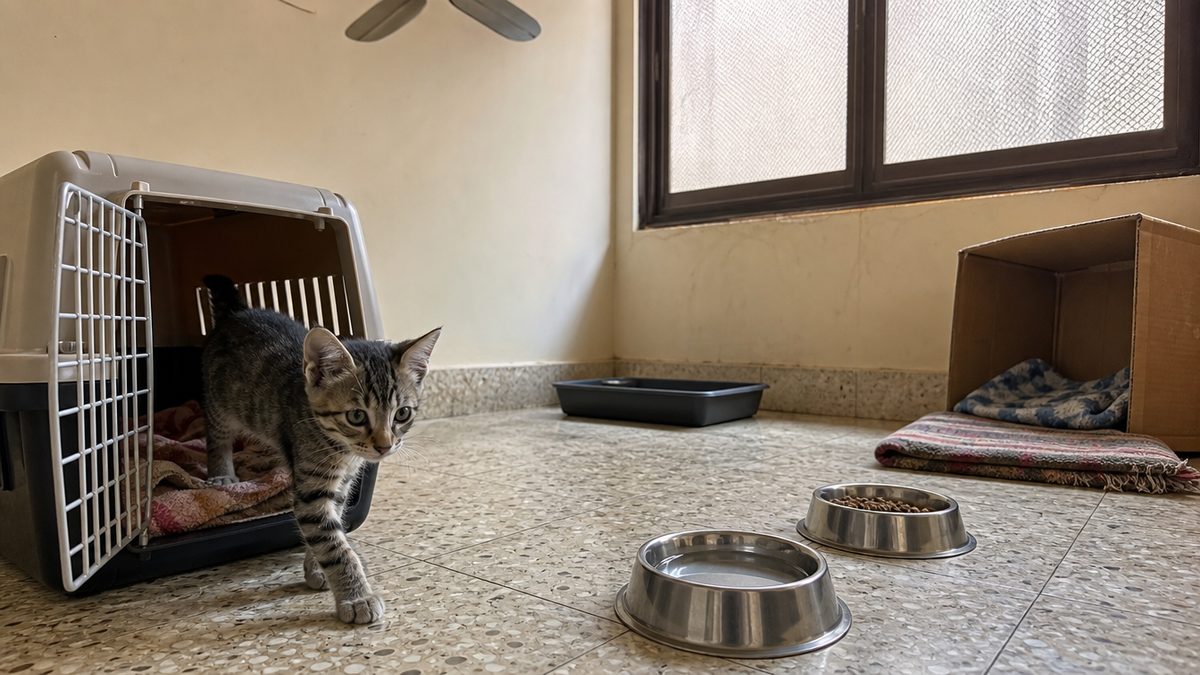
The safe room for a new kitten is one quiet room, set up before it arrives, with the litter tray in a discreet corner, the food bowl on the opposite side, the water bowl a few feet from the food, a padded washable bed away from all three, a scratching post, a cardboard box on its side, the windows closed and the cables, breakables and medicines gone; that is International Cat Care's list, and the kitten lives in that room for the first few weeks.
International Cat Care's kitten-proofing of the room is specific: no full-length curtains, which the kitten will climb; no exposed cables or poisonous plants; medicines and cleaning products locked in cupboards it cannot open, because kittens squeeze into very small spaces; breakables off shelves and windowsills; windows securely closed; the litter and the diet it had before for the first one to two weeks; no string toy left out unsupervised; and a kitten-sized scratching post now, replaced by a taller one as it grows, because a cat should be able to stretch its full length up the post. A cardboard box on its side with a fleece inside is its hiding place, and the carrier stays in the room as a second retreat.
The ISFM/AAFP environmental needs guideline, the document behind every good cat-room list, gives the reason in five pillars: a safe place, multiple and separated key resources, an outlet for play and predatory behaviour, positive and predictable human interaction, and respect for the cat's sense of smell. Applied to one room in an Indian flat, the table below is what each pillar asks for this fortnight.
| Pillar | What the guideline says | In the safe room, this fortnight |
|---|---|---|
| 1. A safe place | A private, secure area, often raised; a box on its side with a perch on top; the carrier left out; for kittens, boxes and perches at a low height | A cardboard box on its side, the open carrier, and a low shelf or stool it can reach without a jump |
| 2. Separated key resources | Feeding, drinking, toileting, scratching, play and resting each in its own location, and in multiples | Tray in one corner, food on the far side, water a few feet from the food, bed away from all three, scratcher by the bed |
| 3. Play and predatory behaviour | Toys, play with the owner, feeding that makes the cat work; size-appropriate toys for kittens; string toys put away after play; no small parts or bells | Two wand sessions a day, the wand put in a drawer after each; a few dry-food pieces scattered on the floor at one meal |
| 4. Positive, predictable human contact | Regular, friendly, consistent handling from a young age reduces fear; social preferences vary widely | Sit on the floor, stay calm and let it come; the same person feeds at the same times; children supervised and brief |
| 5. The sense of smell | Avoid cleaners, detergents, scented litter and other products that disrupt the cat's scent profile; keep footwear at the entrance | Unscented litter, a floor mopped with water rather than a perfumed cleaner for the first weeks, no agarbatti in the room, and shoes left outside the door |
One Indian detail sits in the AWBI adoption protocol rather than in any foreign list: shelters are to warn adopters about "certain harmful plants, chemicals, incense sticks and food items which are toxic to pets";.
The balcony and the windows: net them before the kitten comes
A balcony net goes up before the kitten arrives, not after the first scare. The AWBI protocol's clause V.1 reads "the balconies and windows must be netted to avoid the risk of the pet escaping or falling";, and the largest study of cats falling from buildings, 1,125 falls treated at one Berlin university clinic between 2004 and 2013, found that 296 of the 1,085 fallers with a recorded age, 27.3 percent, were under one year old. Two Indian installers print a rate: Durga Safety Nets in Bengaluru puts pet and cat nets at "Rs.18-24 per square feet" depending on quality, in 0.7 and 0.8 mm nylon, and Vpestify Services in New Delhi lists apartment balcony cat netting on IndiaMART at Rs 16 per square foot, a nylon net with a 30 mm mesh filed under bird netting. A balcony opening 10 feet wide and 8 feet high is 80 square feet, which at those rates is Rs 1,280 to Rs 1,920 before any fixing charge; ask for the smallest mesh the installer stocks and a net fixed to the frame without a gap at the floor, because a pigeon net is sized to stop a pigeon. Window mesh, the ceiling fan and summer heat in a flat are in kitten care in India, the first year.
In an Indian city the balcony is the kitten's outdoors, and International Cat Care does not recommend free outdoor access for any kitten until it is microchipped, fully vaccinated and recovered from neutering, with supervised sessions until six months. Until the net is up, the balcony door stays shut.
The first 48 hours and the first night
The first 48 hours with a new kitten are for one room, the carrier left open, the food it ate before in four to six small meals, and no visitors: International Cat Care's rule is twenty-four hours without new people or children, patience while it explores, and the room left to it once it has found its food, water and litter tray.
How you behave matters more than what you buy. International Cat Care says to interact when the kitten initiates it, never to coax a hiding kitten out but to sit on the floor until it comes to you, never to wake it, and to feed the food it ate before in four to six small meals a day, with no cow's milk, which causes diarrhoea; little interest in food at first is normal. Any diet change comes later, over 7 to 14 days, to a food labelled complete; whether home-cooked food can replace kibble is a question for homemade cat food in India, not for this fortnight.
The litter tray needs placement, not training: kittens learn from their mother, and if yours has not found the tray, place it there on waking and after meals or when it sniffs, scratches or crouches. The 2021 AAHA/AAFP guideline adds the rule that decides the next fifteen years: cats "should never be reprimanded for toileting in undesired locations and should never be taken to a litter box punitively", and a kitten that soils outside the tray is examined for parasites or a congenital problem rather than scolded. Litter types, prices and the tray count for a second cat are in how to litter train a cat in India.
The first night
The first night goes in a bed with high sides against draughts, a low front and a thick lining, in the quiet part of the safe room, with routines set from day one because cats are active at dawn and dusk and a kitten soon learns your hours. Purina UK's page, the one Google India ranks for the sleep question, wants the kitten closer: "this is not the time to leave a kitten on their own", a warm spot next to your bed for the first few weeks, a low night light while it learns the room, and a warning that kittens sleep up to 22 hours a day in fits and starts. The two agree when the safe room is your bedroom, which in a one-bedroom flat it is; in a bigger home, International Cat Care's version is a closed door and a bed with sides in the kitten's room. Purina says to wait before sharing your bed, because a kitten is not yet reliably litter trained, and Blue Cross suggests a warm, not hot, water bottle under a blanket for the first nights.
The 3-3-3 rule is written for adopted cats
The 3-3-3 rule that shelters print, three days to decompress, three weeks to learn the routine, three months to feel at home, is Pasadena Humane's handout for adopted cats, and its text marks the litter-tray milestone "(adults)" at three weeks and "(adults and older juveniles)" at three months. The clinic page ranking second on Google India for new kitten applies the stages to kittens without naming a source, and no guideline body publishes the rule. International Cat Care's clock is shorter and comes with signs: settling takes "several days to a week or two", and a settled cat greets you at the door, rests on its side with its belly showing, plays, rubs its face on the furniture, and eats, drinks, toilets, scratches and grooms normally.
- Scratching or pawing at the door and windows
- Meowing for several minutes at a time
- Pacing by the door, or rearing up at it
- Swiping at you when you try to leave the room
Those four are International Cat Care's signs that a cat is frustrated with one room, and the answer is a second room or a corridor rather than a longer wait. The opposite case has a deadline too: a really anxious new cat may not eat or use the tray for the first twenty-four hours, and if that carries on beyond twenty-four hours you speak to your veterinary team.
The Indian shopping list, priced on 18 September 2026
The basic shopping list for a new kitten costs Rs 5,003 from one Indian seller's own pages on 18 September 2026 with a 400 g bag of Royal Canin Kitten, or Rs 4,732 with a 400 g bag of Drools kitten food, before the balcony net and the vet. Nine items, one seller, one day, every price against its printed MRP.
The nine rows are the items International Cat Care's room list and Blue Cross's checklist both name, read from Supertails' own product pages Blue Cross (UK), Bringing your new kitten…. The carrier is the one purchase sized for the adult cat; the tray, the scratcher and the food pack are sized for the kitten and are replaced within months.
| Item | Product read | Price (Rs) | MRP (Rs) |
|---|---|---|---|
| Carrier, hard plastic, seat-belt slot | Trixie Capri 1, 48 x 32 x 31 cm, pet up to 6 kg | 2,450 | 2,450 |
| Litter tray, low-sided starter | Savic Cat Litter Tray, 15 x 10 x 2 in | 348 | 395 |
| Litter, unscented clumping, 5 kg | BearHugs Unscented Bentonite | 264 | 399 |
| Litter scoop | Trixie scoop for heavy litter, M | 118 | 135 |
| Bowls, stainless steel, pair | Skatrs anti-skid bowl, pack of 2, size S 225 ml each | 187 | 798 |
| Scratcher, corrugated cardboard | Skatrs Scratch Away, with 2 g catnip | 299 | 498 |
| Bed, washable, raised sides | Skatrs round donut bed, size S | 699 | 2,999 |
| Kitten food, 400 g | Royal Canin Kitten | 442 | 480 |
| Kitten food, 400 g, budget row | Drools Ocean Fish Kitten | 171 | 180 |
| Wand toy | Barkbutler x Fofos teaser wand | 196 | 225 |
| Total with Royal Canin (eight items plus the first food row) | 5,003 | 8,379 | |
| Total with Drools (eight items plus the budget row) | 4,732 | 8,079 |
Every figure passed this site's exchange-rate test: none of the nine prices divides to a whole number of US dollars at 84.38 (the quotients run from 1.40 for the scoop to 29.04 for the carrier) or at 74, and each carries a printed Indian MRP, so they are rupee-native prices from one seller on one day; re-price before you order. The one figure on this page that comes close is Vetic's struck-through Rs 5,065 list price for the kitten vaccine course, within Rs 3 of 60 dollars at 84.38; the Rs 3,999 it charges does not divide, so read the list figure as a list figure.
What is on the list, and what is deliberately not
The balcony net is not in the table because it is priced per square foot, above, and for most flats it is the biggest single spend. Three items are bought once and replaced: the cardboard scratcher by a tall post, the same seller's made-in-India jute post being Rs 1,033 against an MRP of Rs 3,657 International Cat Care; the starter tray by one the adult can turn in, which the AAHA/AAFP guideline sizes at one and a half times the cat's length from nose to tail tip; and the 400 g pack by the 2 kg bag at Rs 2,059. Three things are left off on purpose: a collar, which International Cat Care fits only from six months, breakaway, and never for its own sake; a pheromone diffuser, which it says "may also help" and no page opened here evidences; and the dewormer and vaccines, because the vet sets both and the Indian packs are priced in the cat deworming schedule for India. A kitten that arrives with fleas needs a product chosen by weight and age, in cat ticks and fleas in India.
International Cat Care's rule is the same food as the previous home for the first one to two weeks, then a change over 7 to 14 days if you want one. Ask the seller the brand before you shop, and buy the smallest pack listed: Royal Canin Kitten is Rs 207 for 220 g and Rs 442 for 400 g against Rs 2,059 for 2 kg, and Drools kitten is Rs 171 for 400 g. The 2 kg bag can wait until you know the kitten eats it.
Introducing the kitten to a resident cat or dog
Introduce a new kitten to a resident cat in International Cat Care's five steps, scent swapping, access to each other's areas, seeing each other through a barrier, supervised physical contact and short unsupervised periods, and only once the kitten is settled in its own room; introduce it to a dog in four steps that never put the cat in a crate International Cat Care.
Step one starts before the kitten arrives. Its room is one the resident cat does not use and you do not need constant access to, and everything in it is new or the kitten's own, because a resident cat's tray or bed in the kitten's room carries the resident's smell and the resident feels the loss of a resource. The kitten then settles, which takes several days to a week or two, and shows the signs listed in the section above before any introduction begins; a synthetic pheromone diffuser in both cats' areas may help.
- Swap scent by putting one piece of each cat's bedding in the other's bed, so each lies on the other's smell and a communal scent forms; a cat that hisses at or avoids the bedding is telling you to go slower
- Open each cat's area to the other in turn, the resident briefly confined while the kitten explores, then the reverse, only once the kitten is fully settled
- Let them see each other through a barrier they cannot pass, a glass door, a stair gate or a mesh panel, with both cats going about their business and glancing rather than staring; distract the instigator by calling its name at any hiss, growl or rotated ears, and never punish
- Allow supervised physical access by quietly removing the barrier while both are occupied, aiming for comfort in each other's presence rather than interaction, and replacing the barrier at any sign of distress
- Allow short unsupervised periods, a few minutes at first and repeated often with the kitten separate in between, lengthening only while both stay friendly, with every resource duplicated plus one extra around the home
Two of International Cat Care's rules run against the ranking pages. Do not use food or play to distract or reward the cats during introductions, because cats eat and play alone and being asked to do either within sight of another cat is stressful; call the cat's name and lead it to a quiet room instead. And introduce one resident cat at a time, keep sessions short, end on a positive, and go back a step at any sign of trouble; a breakdown after a good start is a reason to ask your vet for a qualified clinical animal behaviourist.
A resident dog
With a dog the first job is to keep the resident animal's life unchanged: the dog keeps its usual part of the home with all its resources, the household is time-shared with baby gates or closed doors, and the dog gets extra walks and play so the kitten's arrival is a good thing for it too. International Cat Care's steps are scent swapping with a towel slept on for a few days; investigating each other's areas while the other is elsewhere; visual contact through a baby gate mostly covered by a towel, both animals calmly occupied and sessions ended while both are relaxed; and actual contact with two people present, the dog on a harness and a loose, trailing lead, the cat free to retreat or climb, and food or a toy used to lure them apart rather than anyone grabbing. One line is in capitals in the original: "A cat should never be placed in a crate for cat-dog introductions";. Terriers and chasing breeds are more driven to chase, and a kitten that met dogs before eight weeks is easier to introduce.
Children come last and briefly: International Cat Care allows young children limited, supervised contact at first so the kitten is not over-handled, and the AAHA/AAFP guideline has the kitten approach people and other pets on its own terms, with hands and feet never used as toys, because a cat that learns skin is prey scratches and bites for life.
The first vet visit and what it checks
The first vet visit for a new kitten falls a few days after it comes home, on Blue Cross's timing, with the vaccination and deworming record in hand, and the 2021 AAHA/AAFP guideline sets what the visit checks: a heart murmur, a hernia, a cleft palate, the teeth, signs of upper respiratory or parasitic disease and the weaning history, because an orphaned or undersocialised kitten may carry behaviour problems the vet needs to know about Quimby J, Gowland S, Carney HC, DePorter T.
The guideline's kitten visit is a history as much as an examination. The vet asks about vaccination and parasite-control history, the health of related cats, weaning history and any unwanted behaviour, then examines for a murmur, a hernia, a cleft palate and teeth that do not meet, and uses a faecal scoring chart so that "loose" means the same thing to both of you. For a kitten with an unknown history of care the guideline calls it prudent to give a broad-spectrum parasite treatment covering intestinal worms and fleas, with resident dogs and cats treated at the same time, and it has oral health, microchipping and the timing of sterilisation raised at these first visits. Carry the card, the deworming dates and the seller's Form IV receipt; the vet reads the sticker on the card, not the seller's word.
| When | WSAVA 2024 guideline | Vetic's national page |
|---|---|---|
| Days 1 to 5 at home | The AAHA/AAFP kitten examination and history above | A free check-up (weight, temperature, ears, eyes, skin) with each vaccine visit |
| 8 weeks (day 60) | First trivalent core dose (panleukopenia, herpesvirus, calicivirus) at 6 to 8 weeks | 60th day: CRP (Tricat or Feligen) |
| 12 weeks (day 90) | Repeat every 2 to 4 weeks; rabies per local law, in some countries not before 12 weeks | 90th day: anti-rabies and CRP |
| 16 weeks or older (day 120) | The final kitten core dose, at 16 weeks of age or older | 120th day: CRP and anti-rabies; package from Rs 3,999 for the three visits |
| 26 weeks or older | A further dose, because up to 37 percent of kittens have maternal antibody interference beyond 4 months | Not on the page's kitten schedule; ask for it |
| 4 to 5 months | Not a vaccination matter; International Cat Care neuters from around 4 months | Booked at this visit; the by-five-months case is in the sterilisation guide |
WSAVA's feline core schedule is an initial trivalent kitten vaccine at 6 to 8 weeks, then every 2 to 4 weeks until 16 weeks of age or older, with a further dose at 26 weeks or older, and the reason for the last dose is a number: "Up to 37% of kittens ... have been shown to have persistent maternal antibody interference with response to one or more core vaccines beyond 4 months of age";. Vetic's schedule agrees on the first three visits and stops at day 120; the two calendars and what each visit costs are compared dose by dose in the cat vaccination schedule for India. Book the sterilisation date at this visit rather than at six months, because the case for doing it by five months is in cat neutering in India, and the first-year calendar that follows this fortnight is in kitten care in India, the first year.
Call the vet: the signs in the first two weeks
Call the vet the same day if a new kitten has not eaten or used the tray in its first twenty-four hours, strains at the tray or soils outside it, has diarrhoea or vomiting, a runny nose or eyes, a dirty or sore area under the tail, breathes with its mouth open, or has fallen from any height, because those are the signs International Cat Care and the AAHA/AAFP guideline treat as a veterinary call rather than a wait Quimby J, Gowland S, Carney HC, DePorter T International Cat Care Candela Andrade M, Slunsky P, Nerlich.
- No food eaten and no use of the tray beyond the first twenty-four hours, International Cat Care's line for an anxious new cat
- Straining at the tray, or urine or stool outside it, which the AAHA/AAFP guideline treats as a prompt visit because a urinary blockage is life-threatening and house-soiling in a kitten can mean parasites or a congenital problem
- Diarrhoea beyond a single loose stool on the day of the diet change, or any vomiting Quimby J, Gowland S, Carney HC, DePorter T
- A runny nose or eyes, dirty ears, or a dirty or sore area under the tail, the health clues International Cat Care tells a buyer to look for at the seller's
- Coughing, or breathing with the mouth open, which the guideline lists among signs of respiratory disease to be raised at once
- A fall from a balcony or window, even when the kitten walks away, because in the Berlin series 27.3 percent of fallers were under one year old and the injuries are internal
- A kitten that is still reactive when touched after the first weeks, which International Cat Care says can be illness or pain rather than temperament
None of these is a diagnosis, and this page does not offer one. The guideline's own framing is that a kitten's health risks depend on its history and exposure, which is why the first visit takes that history in detail; a kitten from a shared shop enclosure or a street litter carries a different risk from one raised at home with its mother, and only the vet who examines your kitten can weigh it.
Every timing on this page, the four-to-six meals, the twenty-four-hour rule, the vaccine days, the by-five-months surgery, is a guideline figure for a healthy kitten of normal weight. A kitten that is underweight, wormy, sneezing, a flat-faced Persian with noisy breathing, or simply the runt, is a case for the vet who examines it, and the answer to "is this normal" comes from that examination, not from this page or from the seller.
Common questions
What is the 3-3-3 rule for new kittens?
The 3-3-3 rule for new kittens is borrowed from a shelter handout for adopted cats: three days to decompress, three weeks to learn the routine, three months to feel at home. Pasadena Humane, which prints it, marks the litter-tray milestones for adults and older juveniles; a clinic blog applies it to kittens without a source, and no guideline body publishes it. Use it as an outer limit, not a schedule.
What should I expect in the first days with a new kitten?
Expect hiding, little interest in food at first, long sleeps, and a kitten that explores its one room in its own time. International Cat Care's rules for those days are no new people for twenty-four hours, four to six small meals of the food it ate before, interaction only when the kitten starts it, and a call to the vet if it has not eaten or used the tray after twenty-four hours.
What age should I get a new kitten?
Get a new kitten at eight weeks or older. An Indian pet shop may not sell a kitten below eight weeks, because rule 2(1)(p)(ii) of the Pet Shop Rules, 2018 defines it as un-weaned and rule 7(15) bars the sale; International Cat Care homes domestic kittens at around eight weeks and pedigree kittens usually at over twelve, after a first vaccination, and Blue Cross calls eight weeks essential.
How do I introduce a new kitten?
Introduce a new kitten to a resident cat in five steps, and only once it is settled in its own room: swap bedding so the two scents mix, let each cat explore the other's area in turn, let them see each other through a stair gate or glass door, allow supervised contact, then short unsupervised periods. That is International Cat Care's method, with no food or play used as a distraction and never punishment.
What is the 3-3-3 rule for kittens?
There is no 3-3-3 rule for kittens in any guideline; it is a shelter timeline for adopted cats. Pasadena Humane's version gives three days, three weeks and three months, and marks its litter-tray milestones "(adults)" and "(adults and older juveniles)". A kitten's clock is shorter: International Cat Care puts settling at several days to a week or two, and a kitten that will not eat or use the tray past twenty-four hours is a vet call, not a wait.
Can I leave my 8 week old kitten alone at night?
Yes, in its closed safe room with its bed, tray and water, but Purina UK's first-night page says it is not fair to leave a tiny kitten alone in a strange place and puts it next to your bed for the first few weeks; if it must sleep apart, Purina wants a hazard-free room and an enclosed pen. International Cat Care's version is a high-sided bed in the kitten's own quiet room, door closed.
Where should a kitten sleep the first night home?
In the one quiet room it will live in for the first few weeks, in a padded washable bed with high sides and a low front, set away from the food, water and tray, with the carrier left open beside it and a piece of bedding from its previous home inside. No visitors that night, the windows closed, and the kitten left to explore and settle in its own time.
What should I do when bringing a kitten home for the first time?
Carry the kitten in its carrier straight to the prepared safe room, open the carrier door and let it come out in its own time, never lift it out, then sit quietly while it finds the food, water and tray, and leave the room once it has. Feed the food it ate before, keep new people and children away for twenty-four hours, and leave the carrier in the room as its retreat.
Should kittens be left in the dark at night?
Kittens can be left in the dark, because cats see in very low light, but Purina UK suggests a low night light for the first nights while the kitten learns the layout of a strange room. What matters more than the light is the room itself: door closed, windows latched, cables and breakables away, and the tray and water within reach of the bed.
Is a 10 week old cat still a kitten?
Yes. The 2021 AAHA/AAFP feline life stage guidelines define the kitten stage as birth up to one year, followed by young adult from one to six years. At ten weeks a kitten is at the end of its socialisation window, which the guideline says may be closing by nine to ten weeks, and in the middle of a core vaccine series that runs to sixteen weeks or older.
Do kittens get sad when left alone?
Cats Protection's answer for cats in general is that most are fine alone with food, water and things to do, and may enjoy the quiet, but a cat strongly bonded to its owner can show separation-related problems. For young kittens it sets a maximum of a few hours at a time, because they need small frequent meals and watching, which is a safety limit rather than a sadness one.
Can I leave my 2 month old kitten alone overnight?
No. Cats Protection's rule is that young kittens are left for a maximum of a few hours at a time, because they have small stomachs, need feeding little and often, and get into danger unwatched; overnight is eight hours or more with no meal. No guideline opened for this guide sets an hour count, and the honest answer is a kitten-sitter or a neighbour with a key rather than an empty flat.
Do and don'ts with kittens?
Do give one quiet room, the previous home's food in four to six small meals, 30 to 60 minutes of gentle handling a day, a wand toy put away after play, and a netted balcony before the kitten arrives. Don't use hands or feet as toys, give cow's milk, scold it or carry it to the tray as punishment, leave string out, coax it from hiding, or let it meet unknown cats before the vaccine course ends.
Where should a kitten sleep at night?
In its safe room, in a bed with high sides to keep out draughts, a low front for easy access and a thick lining, in the quiet part of the room away from the food, water and tray; that is International Cat Care's night set-up, with routines set from day one. Purina UK puts the same bed next to yours, which is the same answer when the safe room is your bedroom.
Can I leave my 10 week old kitten alone?
Yes, for the gap between two of its four to six daily meals, in its kitten-proofed room with the tray, water and no string toys out. No guideline opened for this guide sets an hour count; Cats Protection's line for young kittens is a maximum of a few hours at a time, so a working day is too long at ten weeks and needs a lunchtime visit from someone with a key.
The socialisation window: what is left after eight weeks
The socialisation window for a kitten is two to seven weeks of age in International Cat Care's account, and the 2021 AAHA/AAFP guideline says it begins as early as two to three weeks and may be closing by nine to ten weeks, so a kitten collected at eight weeks arrives with most of that window behind it and one to two weeks of it left Quimby J, Gowland S, Carney HC, DePorter T.
Most of the work was done, or not done, before you met the kitten. International Cat Care's litter-rearing article reports the research: kittens handled by four or five different people, men, women, adults and children, before seven weeks are more sociable to people as adults, while a kitten handled by one person is affectionate to that person and suspicious of everyone else; the dose that produced confident kittens was 30 to 60 minutes of handling a day in short sessions. Its buyer's article draws the consequence: kittens keep learning after eight weeks, "but if the fundamentals are missing there may be little or nothing to build upon", and a fearful kitten is likely to be a fearful cat.
What remains for you is the tail of the window and the habits that outlast it. The AAHA/AAFP guideline asks for 30 to 60 minutes a day of pleasant human interaction and for the kitten to be "gently, gradually, and positively acclimated" to people including children, noises, other animals, car transport and the veterinary practice, and to nail trims, grooming and medicating, each paired with food, with no rough handling, because a startled kitten "may develop fears that last a lifetime";. International Cat Care's exposure list for a litter transfers straight to the first fortnight at home: vacuum cleaners and washing machines, the carrier, floor surfaces, litter materials, music and television, wet and dry food, car journeys and furniture, one or two at a time when the kitten is active and receptive.
One Indian clinic chain prints the opposite. Vetic's national cat vaccination page ends its kitten schedule with "Note: Do not socialise your kitten before all 3 vaccines and boosters are complete", which on its own calendar is the 120th day, about seventeen weeks. The guideline it disagrees with says the window may have closed by ten weeks, and International Cat Care's infection rule is narrower: no outdoor access and no unknown cats until at least a week after the primary course ends. Read the clinic's note as "no unvaccinated cats and no outdoors", which is right, not as "no people, no sounds and no handling", which would spend the last of the window waiting. The guideline governs.
Play, not hands
Play is the other half of socialisation, and the guideline is blunt: kittens learn predatory behaviour by watching, swatting, chasing, pouncing and catching, social play with other cats peaks at around twelve weeks, and owners "should be taught not to use their hands or feet as toys", because it ends in scratching and biting injuries. The ISFM/AAFP guideline wants play with the owner and size-appropriate toys, every toy with string or a swallowable part put away after the session; the Rs 196 wand in the shopping list is that toy, and the drawer it goes back into is part of the purchase.