
Cat health guide
Ticks and fleas on cats in India: prevention, safe removal and which dog products are toxic to cats
Fleas are the parasite an Indian cat actually carries; ticks are the one that gets the dog's pipette reached for. This guide gives the Indian numbers with their denominators, the flea life cycle as it runs in a flat, every cat-labelled product class sold in India with a dated price, the removal method written for a cat, and the permethrin figures no ranking page prints.
Quick answer
Cat ticks in India are usually the brown dog tick, but fleas are the commoner problem on a cat: the cat flea, Ctenocephalides felis, whose eggs, larvae and pupae make up about 95 percent of the population and live in your flat. Prevention is a cat-labelled product all year, daily vacuuming where the cat sleeps and a hot wash of bedding. Remove a tick with a hook or tweezers, never with oil, alcohol or Dettol. Never use a dog spot-on: 10.5 percent of 286 permethrin-exposed cats died.
This guide is general information for Indian pet owners and is not a diagnosis. Always consult a registered veterinarian near you before acting on anything you read here, and treat any sudden change in your pet's condition as urgent.
Fleas are the bigger problem on an Indian cat, ticks the rarer one
Fleas, not ticks, are the parasite an Indian cat is most likely to carry. The cat flea, Ctenocephalides felis, is "the most common flea found on dogs and cats around the world, especially in urban areas", while ticks are parasites "of dogs and, less frequently, cats";.
The clinic view matches: ticks "are much less commonly found on cats than on dogs";, and fleas are "the most common of all external feline parasites";. So fleas get most of this page; ticks get the removal method, the Indian evidence and the one warning that matters most, because the tick question is where an owner reaches for the dog's pipette.
What the Indian evidence shows, with denominators
One Indian survey counted fleas on cats. In Guwahati, between August 2020 and July 2021, 24 of 120 cats carried fleas, 20 percent; strays 62.4 percent against pet cats 13.2 percent, and Ctenocephalides felis alone on 90 percent of infested cats. In Puducherry, an ICMR team took 2,625 ectoparasites from 792 pets and livestock, 2,140 of them ticks and 326 fleas; C. felis felis was "the only flea species observed". The abstract does not separate cats and the full text is paywalled.
| Place and period | Animals | Finding | Source |
|---|---|---|---|
| Guwahati, Assam, August 2020 to July 2021 | 120 cats (and 244 dogs) | 24 cats with fleas (20 percent); strays 62.4 percent, pets 13.2 percent; C. felis on 90 percent of infested cats | Begam et al. 2024 |
| Puducherry, pets and livestock | 792 animals | 2,625 ectoparasites: 2,140 ticks, 326 fleas, 180 lice; C. felis felis the only flea; 8 tick species including R. sanguineus | ICMR-VCRC 2021 |
| Four Kerala districts, March 2018 to June 2019 | 111 apparently healthy cats | 10 (9.01 percent) PCR-positive for flea-borne haemoplasmas; none seen on blood smears | Malangmei et al. 2020 |
| Sylhet, Bangladesh, December 2021 to May 2022 (the nearest cat-only count across the border) | 62 cats (and 12 dogs) | 17 cats infested (27.4 percent) with Ctenocephalides fleas or R. sanguineus ticks | Nyema et al. 2024 |
That is the whole open-access record. Europe PMC title-scoped searches on 18 September 2026 for cat or feline with ectoparasite, flea, tick or Ctenocephalides and India returned nothing beyond Guwahati; the nearest cat-only denominator is Sylhet in Bangladesh, 17 of 62 cats. No study has counted ticks on pet cats in Mumbai, Delhi, Bengaluru, Chennai, Hyderabad, Pune or Kolkata. Read the Guwahati split as the useful number: an indoor pet cat is in the 13 percent group, a rescued street cat arrives from the 62 percent group. Two facts colour every figure: cats "are more tolerant to flea bites than dogs";, and grooming "effectively removes fleas", so a quiet cat with clean fur is not evidence of a flea-free flat.
The flea life cycle in a flat: 95 percent of the problem is off the cat
About 95 percent of a flea population lives off the cat, as eggs, larvae and pre-emerged adults in cocoons around the flat: "Nearly 95% of the flea life cycle occurs in the environment which is contaminated by the immature stages ... which represent the source of infestation";.
A female cat flea starts laying within 24 to 36 hours of her first blood meal, up to 40 to 50 eggs a day. The eggs fall wherever the cat sleeps, hatch in 1 to 6 days, and the larvae crawl away from light into carpet bases and under furniture "where access for vacuuming is difficult"; ESCCAP Guideline 03. The cocoon defeats most owners: the adult inside "may be delayed for 6 months or more" until it feels the carbon dioxide, vibration or warmth of a host. The whole cycle takes 12 to 14 days at the fastest and usually 3 to 8 weeks, so a flea on the treated cat in week four hatched from a cocoon already in the floor.
| Stage | Where it is | How long it lasts | What reaches it |
|---|---|---|---|
| Egg | Falls off the cat into bedding, sofa seams, the cat's favourite windowsill | Hatches in 1 to 6 days | Vacuuming; an insect growth regulator such as methoprene in a spot-on or a room product |
| Larva | Base of carpets, under furniture, cracks between floor tiles, away from light | 5 to 11 days, up to 2 to 3 weeks; dies below 50 percent humidity | Daily vacuuming where the cat rests; hot wash of bedding; growth regulator |
| Pupa in its cocoon | Same hidden places, protected from sprays and dry spells | Days to 6 months or more, waiting for vibration, warmth and CO2 | Nothing kills it reliably; it is waited out while every emerging adult meets a treated cat |
| Adult | On the cat within minutes of emerging; needs daily blood meals | 1 to 3 weeks on a grooming cat, up to about 5 months | The licensed monthly product on the cat, which kills it before it lays |
Why an Indian flat never has a flea season
An Indian flat never has a flea season because nothing in it gets cold or dry enough to break the cycle. Fleas die only below 3 degrees C for several days, and larvae die below 50 percent relative humidity. Mumbai, Chennai and Kolkata are humid most of the year, a Delhi or Pune flat stays warm indoors through the monsoon, and fleas are "well adapted to indoor environments", developing "independently of seasonality";. TroCCAP's rule for the tropics: "the prevention of flea infestations must be done throughout the year";.
Can indoor cats get fleas and ticks?
Yes, because both arrive on people and other animals. "People may unintentionally bring fleas into their households";, and the untreated household dog is the commoner route. Cornell's answer for ticks is to keep the cat indoors and use only feline-approved products; a Bengal walked on a harness needs ESCCAP's regular prevention and daily cleaning of its resting places.
How to check a cat for fleas
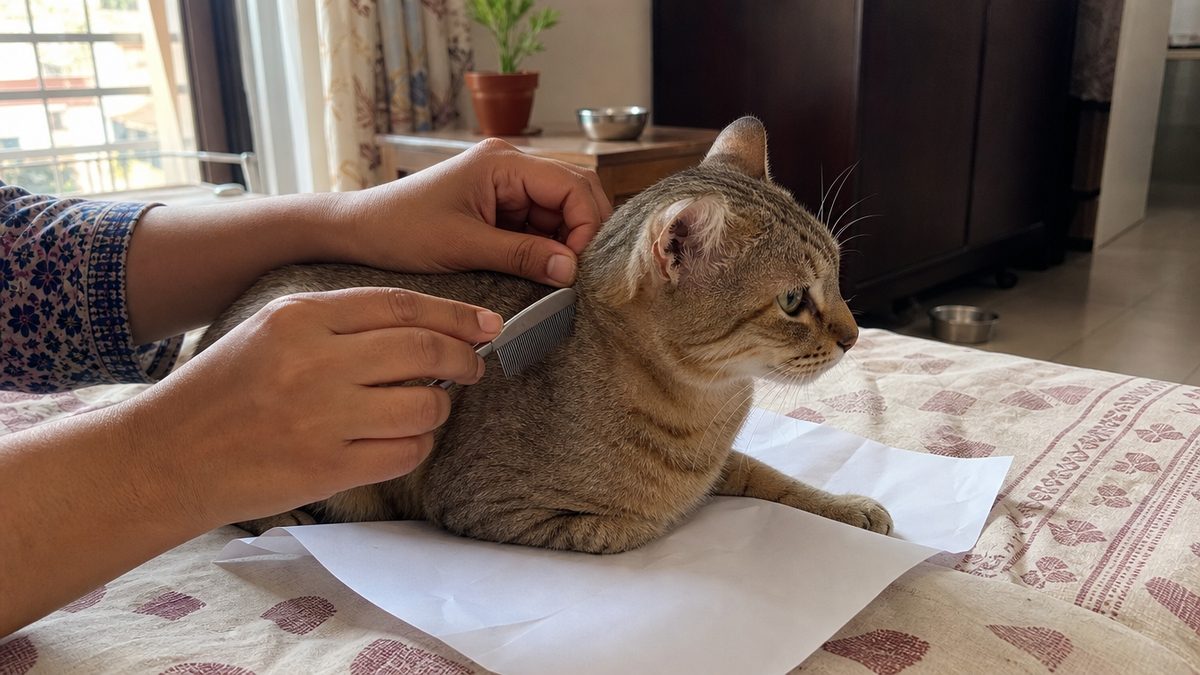
To check a cat for fleas, comb it over white paper with a fine-toothed flea comb, "the most sensitive method to detect flea infestation", working the neck, the lower back above the tail and the belly Tropical Council for Companion Animal…. Wipe the combings onto damp tissue: flea dirt is digested blood, so each black speck spreads into a red ring. On a long, dense coat, a Persian or a British Shorthair, take the comb through to the skin, because low numbers of fleas "may remain undetected" under thick hair.
What fleas do to a cat: itch, flea allergy dermatitis, anaemia in kittens, tapeworm and blood parasites
Fleas harm a cat in five ways: irritation and over-grooming, flea allergy dermatitis, anaemia in heavily infested kittens, the flea tapeworm Dipylidium caninum, and flea-borne blood infections such as haemoplasmas and Bartonella henselae.
Flea allergy dermatitis brings most cats to the vet. The bumps are not bites but "a system-wide allergic reaction to having been bitten by fleas": small crusting papules over the back, neck and face, feline miliary dermatitis, sometimes with a "racing stripe" along the back. Cats under 1 year rarely have it, and "fleas may not be visible on extremely allergic cats due to grooming", so the diagnosis rests on flea dirt, the comb and the response to treatment. Six signs point to fleas.
- Scratching, over-grooming or nibbling at the back end, the itch every cat feels and an allergic cat cannot stop.
- Broken hairs, bald patches or a spiky coat along the lower back and tail base.
- Crusty bumps over the back, neck and face, the miliary dermatitis of flea allergy.
- Flea dirt in the coat, black specks that turn a wet tissue red.
- Pale gums, weakness or tiredness in a kitten, the anaemia of a heavy infestation.
- Rice-grain segments at the anus or in the litter, the flea tapeworm arriving after a flea was swallowed.
Anaemia is a kitten problem: "it doesn't take too much of this sucking to cause anemia in a kitten that is carrying innumerable fleas"; Tropical Council for Companion Animal…. A rescued kitten with pale gums and flea dirt is a same-day vet visit, and its product is chosen by weight and age, which is why the kitten care guide and the product table below carry minimum ages. The tapeworm rides in on the flea: C. felis and C. canis "are also intermediate hosts of Dipylidium caninum which is a very common tapeworm in dogs and cats";, so a cat "should be wormed at the same time as being treated for fleas";, by the cat deworming schedule for India.
The blood parasites are the part no ranking page mentions. Feline haemoplasmas "are transmitted by Ctenocephalides felis", and in 111 apparently healthy cats sampled across four Kerala districts in 2018 and 2019, 10 (9.01 percent) were PCR-positive, seven for Candidatus Mycoplasma haemominutum, two for Mycoplasma haemofelis and one for Candidatus Mycoplasma turicensis; none showed on a blood smear. Fleas also carry Bartonella henselae and Rickettsia felis to cats and people, which the last section covers.
A scratching cat with no flea in sight is not a cat without fleas. Grooming "effectively removes fleas" from the coat, so an allergic cat reacts to a population it has already swallowed, and the diagnosis rests on flea dirt, the comb and the response to a licensed product Dryden MW. Fleas of Cats. MSD Veterinary…. Treat the cat, treat the flat, and let your nearby vet decide whether the skin needs anything else.
Ticks on cats in India: the brown dog tick, and what the evidence says about tick-borne disease in cats
The tick on an Indian cat is most likely the brown dog tick, Rhipicephalus sanguineus, which TroCCAP records as the tick "most common ... infesting dogs and eventually cats in the tropics";; Puducherry's eight tick species across 792 animals included it, with R. haemaphysaloides and two Haemaphysalis species.
The dog tick guide explains why this tick lives indoors and breeds all year; a flat with a tick-carrying dog is where a cat meets ticks. Ticks attach where the skin is thin, at the ears, armpits, groin, eyes and between the toes; an engorged female reaches 1 cm, larvae and nymphs are hard to see.
How to check your cat for ticks, and the symptoms of a cat tick bite
To check your cat for ticks, run your fingers over the whole body once a day, feeling for a firm bump at the ears, chin, neck, armpits, groin and toes, and part a long coat, a Persian above all, to the skin. The symptoms of a cat tick bite are local first, an inflamed nodule or a wound that "may become infected";; a bite that turns red or swollen is a prompt vet visit, and heavy infestations "can also cause anemia, paralysis, or other complications";.
Which tick-borne diseases Indian cats actually get
Indian cats get tick-borne blood parasites, but the evidence is three studies from two states and it disagrees with itself. ESCCAP finds "cats appear to be less affected by TBDs than dogs";, and cats are "very resistant" to Lyme disease. The organisms found in India are Hepatozoon felis, caught by swallowing an infected tick, and Cytauxzoon, "earlier thought to be endemic in North America"; Namrata N, Shekhar P, Kumar M.
| Study | Cats | Hepatozoon | Cytauxzoon | Babesia | Haemoplasmas (flea-borne) |
|---|---|---|---|---|---|
| Kerala, four districts, apparently healthy cats, March 2018 to June 2019 | 111 | 10 (9.01 percent) | 3 (2.70 percent) | 0 | 10 (9.01 percent) |
| Kerala, Thrissur, Kannur and Wayanad, domestic cats, 2023 | 122 | 7 (5.7 percent) | 29 (23.8 percent) | 2 (1.6 percent) | not tested |
| Patna, Bihar, 90 symptomatic cats out of 390 screened, 2025 | 90 | not tested | 34 (37.77 percent) by PCR; 24 (26.66 percent) on smear | not tested | not tested |
The two Kerala series, five years apart, put Cytauxzoon at 2.7 and 23.8 percent of unselected cats Vincy P, Tresamol PV. Prevalence…; the Bihar figure is a diagnostic yield in sick cats, and its authors "could not spot ticks on any of the infected cats";. A cat can carry a tick-borne parasite with no tick found, so a tick found today is a reason to watch the cat, not to panic. Six signs mean the vet the same day.
- Fever, or a cat that is unusually quiet in the weeks after a tick, the "weakness, lethargy, or decreased appetite" Cornell asks owners to report.
- Refusal of food and fast breathing, two of the four commonest findings in the 34 PCR-positive Bihar cats.
- Pale gums or yellow gums and eyes, the anaemia and jaundice recorded in the same series.
- A bite site that turns red or swollen.
- Dozens of ticks, a vet-clinic removal and an anaemia check, not a tweezers job.
- Tremors, wobbliness or a seizure after any spot-on, treated as poisoning until proven otherwise.
No vaccine covers any of these, so the cat vaccination schedule for India does not protect against ticks or fleas. Your nearby vet decides whether a feverish cat with a tick history gets a smear, a PCR panel or both; the Kerala series found nothing on smears that PCR found in 9 percent of cats.
What kills ticks instantly on cats? Nothing safe, and the dog spot-on can kill the cat
Nothing kills a tick on a cat instantly and safely, and the product an Indian owner reaches for, the dog's spot-on, is the one that is fatal to cats: of 286 cats exposed to dog permethrin spot-ons and followed up by the Veterinary Poisons Information Service in London, 96.9 percent developed signs and 10.5 percent died.
The VPIS series is the largest published record of permethrin poisoning in cats. Convulsions were recorded in 125 of the 286 (43.7 percent) and lasted 38.9 hours on average, there is "no specific antidote", and permethrin "is the main toxicological cause of feline deaths reported to the VPIS". About 1 ml of a 45 percent dog product on a 4.5 kg cat has caused life-threatening effects; the strongest 2 ml dog pipette carries three times that.
The reason is feline biochemistry, "a feline deficiency of glucuronidase transferase";, the same missing enzyme that makes phenolic disinfectants "highly toxic to cats";. The pipette need not go on the cat: cats "are also at risk from secondary exposure through contact with other pets treated";, and "if you put it on a dog and let a cat lick the medication off while it's wet, it can kill the cat";. TroCCAP: "Highly concentrated synthetic pyrethroids (with the exception of flumethrin) or amidines are toxic for cats";; CDC, on a human-health page: "Never use products that contain permethrin on cats";. In India that covers the permethrin spot-ons, amitraz dips and cypermethrin shampoos sold for dogs, listed by name in the dog tick guide.
Wash the cat now, then go to the vet. VPIS advice is to wash "thoroughly with copious quantities of lukewarm water" and a mild detergent such as dish soap, because permethrin is insoluble in water; never hot water, which increases absorption; rinse the detergent off and dry the cat well, because a cold cat fares worse. Put on a collar to stop grooming, isolate the cat from other animals, and take the pack with you: signs usually start within 3 hours but can be delayed up to 72 hours, and seizure control is the vet's job.
The honest answer to the question: hours, not seconds
The licensed cat products work in hours and the only instant step is your hand. On a cat treated with Bravecto Plus, fleas and ticks "must attach to the host and commence feeding in order to be exposed to the active substance";; the Indian fipronil spot-on for cats claims fleas within 24 hours and ticks within 48; with most products fleas "may live and feed on a pet for 6 to 24 hours before being killed";. A tick you can see comes off with a hook or tweezers today; the larvae and nymphs you cannot see are what the product is for. Anything promising an instant kill on a cat is a contact powder or a dog product.
Cat-labelled product classes sold in India, with prices read on 18 September 2026
Six product classes labelled for cats are sold in India: fipronil spot-ons and sprays, selamectin spot-ons, an imidacloprid plus moxidectin spot-on, a fluralaner plus moxidectin spot-on, an imidacloprid plus flumethrin collar, and propoxur powders labelled for dogs and cats. The table gives one cited Indian example of each with the transacted price and MRP on one national seller on 18 September 2026.
This is a class table, not a ranking; which flea treatment your cat gets is your nearby vet's call on weight, age, pregnancy and the other animals in the house. Every topical product here goes on the skin at the back of the neck; the collar is the one exception.
| Class and form | What the cat label claims | Indian example and price | Interval and minimum age | What it does not do |
|---|---|---|---|---|
| Fipronil + S-methoprene spot-on | Adult fleas, ticks and lice; S-methoprene stops eggs and larvae | Savavet Fiprofort Plus for cats, 0.5 ml, Rs 194 (MRP Rs 197) | Monthly; cats and kittens from 8 weeks | No repellent effect; no bath 48 hours either side; shampooing and swimming cut efficacy |
| Fipronil spray, 0.25 percent | Ticks, fleas and lice on dogs and cats, dosed by weight | Savavet Fiprofort spray, 100 ml Rs 391 (MRP Rs 398), 250 ml Rs 682 (MRP Rs 703) | As the vet doses; the coat air-dries | Slow to apply on a cat that hates spray; same wash-off caveat |
| Selamectin spot-on | Fleas and flea allergy dermatitis, ear mites, roundworm, hookworm, heartworm (Zoetis India label) | Petcare Selamec, 0.5 ml, Rs 323 (MRP Rs 330); Savavet Selaforte, 0.75 ml, Rs 552 (MRP Rs 563) | Monthly; kittens from 8 weeks; waterproof after 2 hours | No tick claim on the manufacturer's Indian label, whatever the seller page says; no tapeworm |
| Imidacloprid + moxidectin spot-on | Fleas, heartworm, roundworm, hookworm, lungworm, ear mites, Notoedres mange | Advocate for cats above 4 kg, 3 x 0.8 ml, Rs 2,830 (MRP Rs 2,888), sold on prescription | Monthly | No tick claim on the page; no tapeworm |
| Fluralaner + moxidectin spot-on (an isoxazoline) | Fleas and ticks including Rhipicephalus sanguineus for 12 weeks, ear mites, Toxocara cati, Ancylostoma tubaeforme, heartworm | Bravecto Plus for cats: 1.2 to 2.8 kg Rs 1,437 (MRP Rs 1,600); 2.8 to 6.25 kg Rs 1,616 (MRP Rs 1,800); 6.25 to 12.5 kg Rs 1,760 (MRP Rs 2,000) | Every 12 weeks; not under 9 weeks or 1.2 kg; not in pregnant, lactating or breeding cats | Indicated only when ticks or fleas and another target parasite need treating together; FDA class warning on tremors, ataxia and seizures |
| Imidacloprid + flumethrin collar | Fleas, ticks, larvae and lice for up to 8 months | Elanco Seresto collar for cats, Rs 2,426 (MRP Rs 2,450) | One collar per 8 months, breakaway | Flumethrin is the one pyrethroid TroCCAP exempts for cats; the seller page's directions still say to place it around "the dog's neck" |
| Propoxur powder, 1 percent | Contact kill of ticks, fleas and lice on dogs and cats, and on bedding | Petcare Notix, 100 g, Rs 236 (MRP Rs 243), marked prescription | During an infestation | A carbamate cholinesterase inhibitor; no residual protection; nothing the next day |
Prices and compositions come from each product's own page, opened 18 September 2026 Supertails, Savavet Fiprofort Supertails, Petcare Selamec Supertails, Savavet Selaforte Supertails, Bayer Elanco Advocate Supertails, MSD Animal Health Bravecto… Supertails, MSD Animal Health Bravecto 250… Supertails, MSD Animal Health Bravecto 500… Supertails, Elanco Seresto collar for cats Supertails, Petcare Notix, and the Bravecto Plus and Revolution claims from the manufacturers' Indian pages Zoetis India, Revolution. All 22 rupee figures were divided by 84.38 and by 74; none divides cleanly. The three Bravecto Plus MRPs, Rs 1,600, Rs 1,800 and Rs 2,000, land on 20.00, 22.50 and 25.00 at a flat 80, which any round rupee number does, so we treat them as rupee-native list prices.
What each class is for, in one line each
Fipronil "accumulates in the sebaceous glands" with "prolonged residual activity on both dogs and cats", which is why it is the cheapest cat-labelled product and why a bath undoes it. Selamectin is absorbed through the skin and "distributed via the blood", a systemic flea and worm product with no tick indication on the Zoetis India label. Fluralaner is an isoxazoline, "the dominant parasiticide drug class in small animal veterinary medicine worldwide", and the one cat-labelled product in India with a 12-week claim naming the brown dog tick MSD Animal Health India; the FDA's class fact sheet records "muscle tremors, ataxia, and seizures in some dogs and cats", even "without a prior history", so a cat with a seizure history is the vet's call. Flumethrin is the one pyrethroid TroCCAP exempts for cats. Propoxur is a carbamate cholinesterase inhibitor, never combined with another one on the animal or in the room.
Kitten ages on the Indian labels, and where the seller pages and labels disagree
The Indian labels give three minimum ages: 8 weeks for the fipronil spot-on, 8 weeks for selamectin, and 9 weeks and 1.2 kg for fluralaner plus moxidectin; below those, the tools are a flea comb, a hot-washed bed, the vet and the kitten care guide. The herbal kitten shampoos on the seller page are no substitute; flea shampoo "doesn't tend to be good at killing fleas";. Seller pages and labels disagree in three places, and the label governs: two selamectin spot-ons are sold as "tick and flea control" while Zoetis India's Revolution page carries no tick claim Supertails, Petcare Selamec Zoetis India, Revolution; a Kiltix collar labelled "for small and medium sized dogs" sits under the seller's heading for flea collars for cats, and its Seresto-for-cats page says to place the collar around "the dog's neck"; Supertails, Elanco Seresto collar for cats; and the Bravecto sold for cats in India is Bravecto Plus, indicated "exclusively" for cats needing tick or flea control and another parasite treated together.
The class decides what a product can claim; the vet who knows your cat decides the product within the class. The one rule that is not negotiable is the section above: nothing labelled for dogs only goes on, or near, a cat.
How to remove a tick from a cat: the hold, the hook or the tweezers, and what goes on the bite
To remove a tick from a cat, have a second person hold the cat with all four paws on a table, put on gloves, grasp the tick at the skin with a tick hook or fine-tipped tweezers, and take it off in one motion: a hook is rotated as its instructions say, tweezers are pulled straight up with steady, even pressure and never twisted Cornell Feline Health Center.
A cat is not a dog, and the hold is most of the job. "Cats like to have all four paws in contact with the surface they're on", so the helper holds the cat "around the front limbs and shoulders, with the forearms gently restraining the body and your cat's rear against the helper's stomach"; alone, kneel behind the cat and hold it between your knees, and if it fights, the vet removes the tick. Eight steps follow.
- Gather everything first, gloves, hook or tweezers, a container of alcohol and a tissue, so the cat is held for seconds.
- Hold the cat as above, calm and gentle, with the rear blocked so it cannot reverse.
- Part the fur to the skin so the mouthparts are visible, not just the body.
- With a hook, slide the slit around the tick's head so the curve cups the body, then rotate in one direction until it lets go.
- With tweezers, hold them flat to the skin, grip the tick where it meets the skin, never the swollen body, and pull "directly outward from the skin in a single motion";.
- Drop the tick into alcohol or crush it inside a tissue, never between your fingers.
- Clean the bite with salt water, check the rest of the cat and its bedding for more ticks, and wash your hands.
- Monitor the site and the cat, and call the vet for redness, swelling or discharge, or weakness, lethargy or a poor appetite "in the days/weeks following tick removal".
What must not go on the tick is a shorter list. ESCCAP: "oil, alcohol or ether should not be used!";. MSD: never bare hands, because some tick-borne organisms "can be immediately transmitted through breaks in the skin", and no hot matches. Dettol fails twice: the Indian bottle is chloroxylenol 4.8 percent w/v with 13.1 percent alcohol, and chloroxylenol is a phenolic, a family "highly toxic to cats" and "best avoided in feline environments";. After removal, ESCCAP still advises a licensed acaricide, because larvae, nymphs and unengorged adults "may not be detected on the animal", and mouthparts left in can produce "a micro-abscess", so a fragment is a vet visit, not a second dig.
Twist or pull? The tool decides, and the ranking pages do not say so
Twist with a hook, pull with tweezers. Blue Cross, first on Google India for this query, says "Twisting them off your cat is the best removal method" with a slit-type remover; Cornell says tweezers and "directly outward from the skin in a single motion";. Both are right about their own tool: a hook's slit "cups the tick's abdomen, which reduces the pressure exerted on the mouthparts, making it safe to use a twisting action", while with tweezers you "never twist the tick";. TroCCAP accepts "tweezers or any tick removal device";. For the tweezers most Indian homes own, Cornell's straight pull governs.
Treating the flat for fleas: the pupal window, the wash and the dog-and-cat household rule
To get rid of fleas in a flat, treat every cat and dog in the house on the same day with a product licensed for its species, vacuum daily where the cat sleeps, hot-wash the bedding, and keep the monthly product going for two to three months, because pupae already in the floor keep hatching for weeks after the cat is treated Dryden MW. Fleas of Cats. MSD Veterinary….
That is how to get rid of fleas, and how it is usually done wrong. The adults on the cat are "only a very small proportion of the total flea population";; fifty fleas on the cat means "up to one thousand fleas and eggs" in the home, and they "can survive for up to a year";. ESCCAP's first cause of a failed protocol is "failing to treat all animals simultaneously in the household", naming "dogs and especially cats";. Household flea treatments mean room products and animal products together in a heavy infestation. Nine steps clear a flat.
- Treat every cat and dog the same day, each with a product licensed for its species, and put the next dose in the calendar.
- Give praziquantel for the flea tapeworm the same week, by the cat deworming schedule for India PDSA (UK veterinary charity).
- Wash the cat's bedding, throws and your bedcover at 60 degrees C and dry them in the sun; repeat weekly.
- Vacuum daily where the cat rests, along skirting, sofa seams, under the bed and between floor tiles, and empty the vacuum outside the flat.
- Apply a room product with an insect growth regulator such as methoprene to the sleeping area and hiding places, chosen with your vet, with the cat out until it is dry.
- Repeat the room treatment 7 to 10 days later in a severe infestation.
- Comb the cat over white paper weekly to monitor the count, ESCCAP's measure of whether the protocol is working.
- Expect fleas for weeks: the ones you see are hatching from cocoons and dying on the treated cat within 6 to 24 hours.
- Keep the monthly product going for 2 to 3 months, then all year.
The wait is the pupal window. An adult can sit in its cocoon for months and emerge in seconds when a warm body walks past, which is why a flat treated in June still produces fleas in July and why nothing you spray reaches it. What reaches it is the cat: a treated cat kills each flea that emerges before it lays.
The dog-and-cat household rule
In a house with a dog and a cat, the dog's product is chosen for the cat. Preparations toxic for cats "should be avoided in mixed dog/cat households";, and the dog tick guide names the Indian dog products that contain permethrin, cypermethrin or amitraz. PDSA's rule for room products: "Never put a dog flea treatment or a household flea spray on a cat", because household sprays "often contain permethrin";. A sprayed flat is re-entered when every surface is dry, and a treated dog does not share the cat's bed until the label's drying time has passed.
Fewer fleas on the comb each week, none by week eight to twelve, and no bites on your ankles. PDSA says it "can take a few weeks" and MSD says control of an established infestation "can take 2 to 3 months"; Dryden MW. Fleas of Cats. MSD Veterinary…. A single flea in week four is a hatching cocoon meeting a treated cat, not a failed product, and the product stays on schedule all year in an Indian flat.
Cat fleas on humans, cat scratch disease, and whether a cat's tick can bite you
Cat fleas bite humans but cannot live on them, so the risk to a household is the infested home rather than the cat: fleas "can't live on humans, but can bite us", usually around the ankles, and people are bitten "when a large number of adult fleas hatch due to heavy infestation and no other suitable host is available";.
Can humans catch fleas from a cat? They catch the bites, not the flea: "it is the newly emerged, unfed fleas that infest pets and bite people";. Bites on your ankles mean cocoons are hatching in the room, a sign to treat the flat, not to bathe the cat.
The infection that matters is cat scratch disease. Bartonella henselae is carried by fleas, cats "most commonly become infected with B. henselae through flea bites", and "up to 1 in 3 healthy cats, particularly kittens" carry it in their blood. It reaches a person "when the scratch is contaminated with flea feces", and shows as a low fever, a papule at the scratch and tender lymph nodes 1 to 3 weeks later, commonest in children under 15. The Indian human record is thin but real: at a tertiary eye hospital in New Delhi, Bartonella-like organisms grew from the blood of 4 of 29 optic neuritis patients; no Indian survey of Bartonella in cat fleas turned up on this search. Five household rules follow from CDC's list.
- Keep fleas off every cat all year, because a flea-free cat cannot pick up or pass on the bacterium.
- Avoid scratches, bites and licks from kittens and stray cats, especially for anyone with a weak immune system, and wash any scratch with soap and water.
- Wash hands after handling cats.
- Never use products that contain permethrin on cats, CDC's own words on its human-health page.
- Do not test or treat a healthy cat for Bartonella; testing "is not recommended, unless your pet is sick", and neither is declawing.
Are the ticks on a cat a risk to the people in the house?
Rarely, and through the home rather than the cat. TroCCAP records the brown dog tick as "a proven vector of R. rickettsii in some areas of United States and Mexico" and asks for "continuous year round ectoparasite control" where pets carry zoonotic pathogens; CDC is explicit that "there is no evidence showing Bartonella are spread to people through tick bites";. The rules are the ones already on this page: gloves for removal, never bare fingers on a tick, disposal so it cannot "move to another host", and a flat treated whenever ticks turn up off the animal ESCCAP Guideline 03.
Questions people ask Google India about cat ticks and cat fleas
Are cat ticks harmful to humans?
Rarely, and through the home rather than the cat. The brown dog tick that infests dogs and eventually cats in the tropics is a proven vector of Rickettsia rickettsii to people in parts of the United States and Mexico, so TroCCAP asks for year-round ectoparasite control where pets carry zoonotic pathogens. Wear gloves to remove a tick, never crush it between your fingers, and treat the flat if ticks turn up off the animal.
Should I worry if my cat has a tick?
A little, and usefully. Remove it now with a hook or fine-tipped tweezers, check the rest of the cat and its bedding for more, and watch the cat for three weeks. Cornell asks owners to report weakness, lethargy or a poor appetite in the days or weeks after removal, and redness, swelling or discharge at the site. Dozens of ticks, or pale gums, is the vet the same day.
How do you get rid of cat ticks?
Remove every visible tick with a tick hook or tweezers, then apply an acaricide licensed for cats, because larvae, nymphs and unengorged adults are easy to miss on the animal. ESCCAP's rule after a tick is found is prophylaxis for the rest of the season for the cat and every associated animal, which in India means all year, and an environmental treatment from a different chemical group if the brown dog tick has settled into the flat.
What kills ticks instantly on cats?
Nothing safe kills a tick on a cat instantly. The licensed cat products kill in hours after the tick attaches and feeds, and the only instant step is removal by hand. The product that seems instant, the dog's permethrin spot-on, is the main toxicological cause of cat deaths reported to the Veterinary Poisons Information Service: of 286 exposed cats, 96.9 percent developed signs, 43.7 percent convulsed and 10.5 percent died.
How harmful are cat fleas?
Harmful in five ways. Fleas cause irritation and over-grooming, flea allergy dermatitis in sensitised cats, anaemia in heavily infested kittens, the flea tapeworm Dipylidium caninum, and flea-borne infections including Bartonella henselae, Rickettsia felis and the feline haemoplasmas, which were found by PCR in 10 of 111 healthy Kerala cats. TroCCAP notes cats tolerate flea bites better than dogs, which is why a quiet cat can still carry a heavy load.
Do I need to treat my house if my cat has fleas?
Yes. About 95 percent of a flea problem lives in the home as eggs, larvae and pupae, so 50 fleas on the cat means up to 1,000 fleas and eggs in the flat, and they can survive for up to a year. Treat every cat and dog the same day, vacuum daily where the cat rests, wash bedding at 60 degrees C, and use a room product chosen with your vet with the cat out until it is dry. Never put a household flea spray on the cat.
Should I be worried if my cat has fleas?
Worried enough to act this week, especially for a kitten. Fleas are the commonest external parasite of cats, a hypersensitive cat scratches open wounds that get infected, and a kitten carrying innumerable fleas can become anaemic. Comb the cat over white paper to confirm, start a cat-labelled product, worm for tapeworm, and treat the flat, because putting a product on the cat while ignoring the environment never resolves it.
What kills cat fleas instantly in the house?
Nothing kills every flea in a house instantly, because the pupae inside their cocoons are protected from sprays and can wait for months. What works is the combination: a licensed product on every animal, which kills each emerging flea within 6 to 24 hours before it lays, washing bedding and rugs, daily vacuuming of sofa crevices and under beds, and a room spray or fogger safe around cats, repeated 7 to 10 days later in a severe infestation. Control of an established infestation typically takes 2 to 3 months.