
Dog and cat legal guide
Microchipping a dog or cat in India: when it is required, what it costs and how to register it
Which Indian instruments actually require a microchip, quoted from the gazette and the AQCS's own forms; what Chennai, Bengaluru, Delhi and Chandigarh ask; what the two private Indian registries do and cost; the UK adverse-event data with denominators; and how to make a 15-digit number lead back to you.
Quick answer
A dog microchip is required in India in four places: for every pup a registered breeder or pet shop sells (Rule 8(1)(e) of the 2017 Dog Breeding and Marketing Rules, Rule 7(16) of the 2018 Pet Shop Rules), for any dog or cat leaving or entering the country, and for a pet dog licensed in Chennai. Delhi and Chandigarh do not ask, Bengaluru's rule is a draft, and India has no national registry. A chip costs Rs 599 to Rs 1,500, cannot track a dog, and lasts its lifetime.
This guide is general information for Indian pet owners and is not a diagnosis. Always consult a registered veterinarian near you before acting on anything you read here, and treat any sudden change in your pet's condition as urgent.
What a dog microchip is, and what it is not
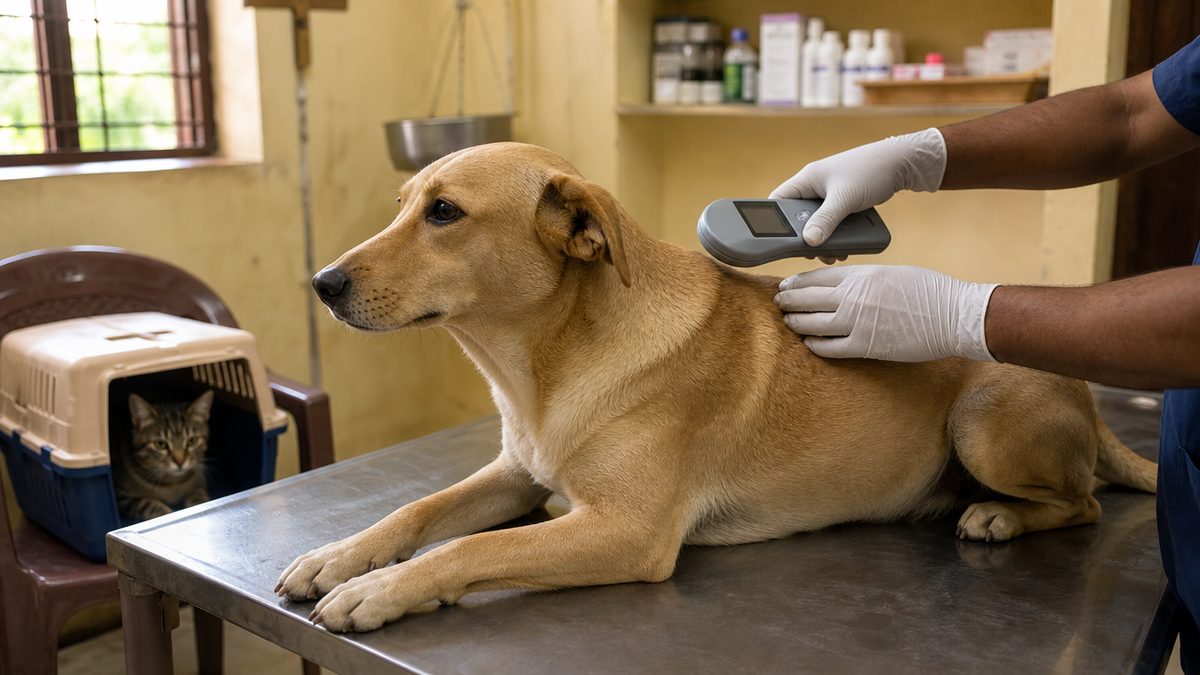
A dog microchip is a glass-cased radio transponder the size of a grain of rice, implanted under the skin between the shoulder blades, that carries one identification number and nothing else: no GPS, no battery and none of your details. The number leads to you only if a registry holds it against your phone number, which is why half of this page is about registries rather than chips.
How does a microchip work? A scanner's radio waves activate the chip, the chip transmits its number, and the scanner displays it. The international standard is ISO 11784 and ISO 11785, a 15-digit number read at 134.2 kHz, and an ISO chip is what the AQCS and every destination border reads. The first three digits are a country or manufacturer code, and chips starting with 900 may not be traceable to a single maker because several share that code. The two Indian sellers whose pages name a standard both sell the ISO type: Whizzles a 2.12 by 12 mm FDX-B chip to ISO 11784/85, AirPets an 8 mm chip to ISO 11784/11785 AirPets India (a pet relocation agent's own….
Can I track my dog with a microchip? No. The AVMA's answer is that 'a pet microchip is not a GPS device and cannot track your animal'; pet chips 'usually contain only a unique identification number (nine, 10, or 15 digits long)';. The Royal Kennel Club says the chip 'only provides information to anyone that is next to your dog and scans them';. PetLink, which ranks for this query, sells a registry and a separate GPS collar as two products, under a blog post titled 'Microchip and GPS: You know the difference, some pet owners don't';.
| Question | Answer | Why it matters in India |
|---|---|---|
| Does it track the dog's location? | No. It is not a GPS device and cannot track your animal | A lost dog in Chennai or Delhi is found by whoever scans it, not by an app |
| Does it store your name and number? | No. It stores only the identification number; your details sit in a registry | With no national registry in India, you choose where that number is recorded |
| Does it expire or need a battery? | No. Designed to last the pet's lifetime; ask your vet to scan it at checkups | One implant, but one scan a year to confirm it still reads |
| Does it replace a collar tag? | Absolutely not. A tag lets any finder call you; a chip needs a scanner | Most finders in India are neighbours, not clinics; keep the tag on |
| Can any scanner read any chip? | Universal scanners read 125, 128 and 134.2 kHz chips; older scanners read one type | Buy the 15-digit ISO type, the one Indian clinics and airports read |
How long does a microchip stay in a dog? For the dog's life. Pet microchips 'are designed to last for your pet's lifetime' because they have no battery; Humane World for Animals puts the design life at 25 years and says the tissue bonds to the chip within 24 hours; the Royal Kennel Club says it 'should last for the whole of their life';.
The number is half the system, and the registry is the other half
The largest study of chipped animals arriving at shelters shows why registration decides the outcome. Across 7,704 microchipped animals entering 53 US shelters in 2007 and 2008, the owners of 2,191 of 2,956 stray dogs (74.1 percent) and 298 of 469 stray cats (63.5 percent) were found. For the 876 animals whose owners were not found, the main reasons were an incorrect or disconnected telephone number (310, 35.4 percent), an owner who did not answer (213, 24.3 percent) and a chip registered to another group such as the shelter or breeder (151, 17.2 percent); of 1,943 chips looked up in a registry, only 1,129 (58.1 percent) were registered at all. Scanning misses too: in 3,949 dogs and cats at six shelters, none of four scanners found 100 percent of chips, and the universal scanners detected 94.8 percent or more of 128 and 134.2 kHz chips. A chip with a dead phone number behind it is a glass bead.
When a microchip is required in India, instrument by instrument
A microchip is required in India by four instruments only: the 2017 Dog Breeding and Marketing Rules for every pup a registered breeder sells, the 2018 Pet Shop Rules for every puppy a pet shop sells, the AQCS's export and import paperwork for any dog or cat crossing the border, and the Greater Chennai Corporation's pet licence for dogs kept inside its 15 zones. No national law requires a pet dog or cat kept at home to be chipped, and the Delhi and Chandigarh registration forms do not ask for one.
The 2017 Rules bind breeders, not owners. Rule 8(1)(e) requires that 'each pup sold is micro-chipped and complete record of treatment and vaccination is maintained', and Rule 8(1)(g) that a copy of the sale receipt is 'retained with the micro-chip number of the pup sold and name, address and phone number of the purchaser';. Rule 9(2) makes the breeder record each dog's 'micro-chip number' and the 'names and microchip numbers of sire and dam', and Second Schedule paragraph 30, 'Identification of dogs', requires that 'identification of all breeding stock and of pups over three months, are performed by a veterinary practitioner through micro-chipping';. A 'breeder' under Rule 2(1)(c) owns dogs of specific breeds for breeding and sale and 'includes boarding kennel operator, intermediate handler and trader'; a family with one Labrador is outside it.
The 2018 Pet Shop Rules say the same for shops, and only for puppies. Rule 7(16): 'Every puppy shall be micro-chipped by a veterinary practitioner, and each pet shop shall have a functional micro-chip reader within the premises and it is a requirement of these rules that only micro-chipped puppies shall be sold';. The Rules count 'kittens and pups below eight weeks' as un-weaned at Rule 2(1)(p)(ii), so kittens are inside the Rules and outside the chip clause; a Persian kitten from a registered shop need not be chipped by law. Both gazettes hyphenate 'micro-chipped', which is why a search for 'microchip' in either returns nothing.
For export the chip is document 2 of 9. The AQCS's list of attached documents for export of a pet puts 'Microchip Certificate' at serial 2, behind only the local vet's fit-to-fly certificate and ahead of the vaccination record, passport, ticket, airway bill, authority letter, the importing country's own requirements and two photographs Animal Quarantine and Certification…. The procedures page adds 'All livestock meant for export must be microchipped for better identification';; the FAQ on the same site is softer, 'Micro-chipping is also advised for identification', and says who may do it, 'any registered veterinary practitioner under his/her certification';. Two AQCS pages, two verbs; the checklist is what the counter works from.
For import the chip certificate is on the SOP, not on the older web page. The AQCS's procedures for pet dogs and for pet cats list 'Vaccination and Microchip certificate' among the documents uploaded on the ATITHI 2.0 portal at least seven days before embarkation, after which the Advance NOC issues within one working day, and the form has a 'Microchip No.' field AQCS, Standard Operating Procedure…. The 'Import of Pets under Baggage' page, which lists the health certificate, the rabies vaccination and the two-year stay-abroad proof, does not name a chip. The SOP is the newer document and the one the portal enforces; the route is in importing a dog to India.
| Instrument | Who it binds | What it says about the chip | Clause or page |
|---|---|---|---|
| PCA (Dog Breeding and Marketing) Rules, 2017 | Registered breeders, traders, boarding kennels | Every pup sold is micro-chipped; the chip number sits on the receipt; breeding stock and pups over three months are chipped by a vet | Rule 8(1)(e), 8(1)(g), 9(2); Second Schedule Part IV para 30(b) |
| PCA (Pet Shop) Rules, 2018 | Registered pet shops | Only micro-chipped puppies may be sold; a working reader on the premises; kittens not named | Rule 7(16) |
| AQCS export certificate | Anyone taking a dog or cat out of India | 'Microchip Certificate' is document 2 of 9; 'all livestock meant for export must be microchipped' | Export document list; procedures page AQCS, Import and export procedures |
| AQCS import NOC | Anyone bringing a dog or cat into India | 'Vaccination and Microchip certificate' uploaded on ATITHI 2.0; a 'Microchip No.' field on the form | Dog and cat SOPs AQCS, Standard Operating Procedure… |
| Greater Chennai Corporation pet licence | Dog owners in the 15 GCC zones | Chip and anti-rabies vaccination before the Rs 50 licence; optional for cats | Portal chip check; The Hindu, 1 December 2025 The Hindu (news report) |
| Greater Bengaluru Authority draft bye-laws | Pet dog owners, once gazetted | 'Compulsory microchipping at owner's cost'; a draft, not in force | The Hindu, 18 February 2026 |
| Municipal Corporation Chandigarh bye-laws, 2025 | Pet dog owners in Chandigarh | No chip clause in 29 pages; identification is a metal token on the collar | Registration clause; Schedule A |
| Municipal Corporation of Delhi registration | Pet dog owners in Delhi | Four documents: rabies certificate, identity proof, residence proof, photograph; no chip | SOP section 4 |
| Animal Birth Control Rules, 2023 | Street dogs in ABC programmes | A V-shaped notch on the right ear; the word 'chip' does not appear | Rule 11(16) |
| Kennel Club of India registration | Pedigree dog owners | A 'Microchip No.' box on Form C/1; an imported dog's chip is 'scanned and verified'; the word 'mandatory' does not appear | K.C.I. Form C/1 |
Every major destination reads the microchip date against the rabies vaccination date. GOV.UK: 'You must get your pet microchipped before, or at the same time as, their rabies vaccination. If you do not, they'll need to be vaccinated again';. A Siamese or a Labrador booked to fly next month whose chip went in after last year's rabies shot needs a fresh vaccination, and for titre countries a fresh wait, before the AQCS certificate is worth anything. The calendar by destination is in taking your pet abroad from India.
Chennai requires it, Bengaluru has drafted it, Chandigarh and Delhi do not ask
Chennai is the one Indian city that requires a pet dog to carry a microchip today, as a precondition of the Rs 50 Greater Chennai Corporation licence, while Bengaluru's requirement sits in a draft not gazetted as of 18 September 2026, and neither Chandigarh's October 2025 bye-laws nor Delhi's MCD document list mentions a chip Chandigarh Administration Gazette Municipal Corporation of Delhi.
Chennai: chip and rabies shot first, then the Rs 50 licence. The Hindu's explainer of 1 December 2025 gives the sequence: vaccinate the dog against rabies and microchip it at a GCC pet clinic or a private clinic, then apply online through the portal launched in October 2025 and pay Rs 50 a year per pet; 'while microchipping for cats is optional', cats are vaccinated before the same registration. Both services are free at the six GCC pet clinics at Thiru Vi Ka Nagar, Nungambakkam, Kannammapet, Meenambakkam, Pulianthope and Lloyds Colony, 8 a.m. to 3 p.m. every day, for pets from GCC areas; in Tambaram 'microchipping and registration for pets are not mandatory', and the fine announced for an unlicensed pet after the deadline was Rs 5,000. The Corporation's own page prints the Rs 50 fee and 9,115 licences issued in 2024 and names microchipping only as an ABC-centre duty for caught street dogs. SKS Veterinary Hospital's blog says the mandate covers 'all dogs and cats';; The Hindu, reporting the Corporation's briefing, governs. The screens and the renewal form are in the GCC pet licence guide.
The portal checks the number against a list it already holds. The licence portal's own application code carries a chip-check dialog: you type a number, digits only, the portal queries its /api/v1/microchip/verify endpoint, and it answers 'Given ICAR microchip Id is available', 'Invalid ICAR microchip Id', or 'The entered ICAR microchip number is mapped to Dog name' followed by the name on file. On 18 September 2026 that endpoint answered a made-up 15-digit number with an empty list, which the screen shows as invalid. The Corporation is in effect running a chip register of its own, seeded with the numbers its clinics and enrolled vets implant, so a chip bought online and implanted elsewhere may not be on it; have the vet you name on the application verify the number before you pay.
Bengaluru: compulsory on paper that is not yet law. The Greater Bengaluru Authority's draft, reported by The Hindu on 18 February 2026, lists 'Compulsory microchipping at owner's cost' beside a fee exemption for Indie and rescued dogs. Bangalore Mirror, on 17 September 2026, reported uniform Pet Dog Licensing Bye-Laws being prepared by all five city corporations, under which 'neutering and microchipping of all pet dogs will be mandatory' with a Rs 500 annual fee and Rs 50 for a street dog, and quoted a GBA official that the rule 'once gazetted, will be applicable from the date it is issued'. Until then an Indian Pariah or a Labrador in Bengaluru needs no chip; other cities' fees are in dog registration in India.
Bengaluru's street dogs are the one place microchipping is in court. The Animal Welfare Board of India's annual report for 2024-25 lists Writ Petition No. 29002 of 2024, Save Our Animals Charitable Trust v Union of India, challenging the BBMP's request for proposal No. BBMP/2023/24/SE0495 of 29 February 2024 'for the procurement and implantation of microchips in stray dogs' on the ground, as the Board summarises it, that microchipping is not 'a component of the legally mandated Animal Birth Control (ABC) programme under the ABC Rules, 2023';. The Rules bear that out: Rule 11(16) identifies a sterilised street dog by a V-shaped notch on the right ear, and 'chip' does not appear in the 41-page gazette. Chennai's Corporation nonetheless lists microchipping among its own ABC-centre duties, so a Chennai street dog may already carry a GCC chip when a family adopts it. The ABC framework is in free-ranging dogs in India.
Chandigarh and Delhi identify the dog another way. The Municipal Corporation Chandigarh Pet and Community Dogs Bye-laws, 2025, notified on 29 October 2025, register a pet dog for Rs 500 (pedigree) or Rs 50 (Indie) for five years, issue 'a metal token which is to be attached to the collar', and ask for 'Colour and identification mark' and two photographs; the word 'chip' appears nowhere in the 29-page gazette, 73,802 extracted characters. Delhi's MCD lists four documents for a new Rs 500 registration, an anti-rabies certificate, identity proof, residence proof and a photograph of the applicant with the dog, and no chip.
- In Chennai, chip and vaccinate at a GCC clinic for free or at a private clinic for a fee, then license the dog online for Rs 50; a cat is licensed with or without a chip.
- In Bengaluru, nothing is due until the bye-laws are gazetted; the draft puts the chip at your cost.
- In Delhi and Chandigarh, the chip is your choice; the municipality wants the rabies certificate, and Chandigarh a collar token.
- Everywhere, a dog or cat that will ever fly out of India needs the chip before its next rabies shot.
There is no national microchip registry in India, so here is what a private one does
India has no national microchip registry: a search of the Department of Animal Husbandry's site, the Animal Welfare Board's site and the Veterinary Council of India's site on 18 September 2026 returned import forms, livestock guidelines and the two sale rules, and no database in which an owner can register a chip number or a finder can look one up. The two Indian registries that exist are private companies, and each presents itself as the country's only one Pet Chip India, What is Microchip?.
The control. A site-restricted Google India search for 'microchip' on dahd.gov.in returned four documents, all import or livestock forms; on awbi.gov.in it returned ten, among them the 2017 Rules, the ABC handbook restating the Pet Shop Rule and the 2024-25 annual report; 'pet registry' on awbi.gov.in and 'microchip' on vci.dahd.gov.in returned nothing. PubMed returned no paper on microchipping dogs or cats in India, while the US shelter studies on this page returned normally in the same session. The absence is not unusual: the AVMA says 'the U.S. doesn't have a single, centralized database for registering pet microchips' either, and the UK runs 24 privately operated databases that meet a government standard. What India lacks is the standard and the list.
Pet Chip India, first for every Indian query in the harvest, sells a chip for Rs 1,500 'including shipping costs, microchip certificate, taxes etc.', delivered in 5 to 7 days for your own vet to implant, with 'FREE registration on Pet Chip India database'; Pet Chip India (a private registry's own…. Its home page reports '500+ pets microchipped so far by us' and '3000+ pets info is stored safely in our database', names a team of four, and carries the copyright of Pawsome Hotels Pvt Ltd; the database is 'accessible only to our team and you', so a finder phones the company, and its FAQ's line about registering 'in a national database like www.petchipindia.org/register' pointed at a page that returned HTTP 404 on 18 September 2026 Pet Chip India, What is Microchip? Pet Chip India, How to Microchip?. One line to read twice: the home page calls its chip 'ISO 9001 certified';. ISO 9001 is a quality-management standard for the factory; the identification standard that borders and universal scanners read is ISO 11784 and 11785, the line to ask for on the certificate.
Whizzles calls itself 'India's first and only Pet Microchip Registry and Recovery Service', bundles an ISO 11784/85 chip into a lifetime registration at Rs 2,400 plus GST, still shows an 'introductory offer' of Rs 1,200 plus GST 'till 30th September 2023', and prices a transfer at Rs 300, a correction at Rs 300 and a certificate at Rs 180 plus 18 percent GST; it reports '12 K + Micro Chipped' and offers a recovery hotline rather than a public search. Both companies' counts are their own claims, and neither publishes a method.
No international lookup covers an Indian registry. PETMAXX, which queries 31 microchip databases at once, lists databases across Europe, the Americas, South Africa, Australia and Turkey, and none in India. The AAHA's lookup, which the AVMA and Humane World point to, 'was created to primarily serve chips distributed in the United States', shows no owner details, and for a 900-prefix chip returns the companies that may have sold it Humane World for Animals. An Indian chip traces back to its owner only if the number was put into a registry somewhere, and the finder has to know which one.
- Scan the animal at a clinic with a universal scanner, twice and over the whole body.
- Check the number on the GCC portal's chip dialog if you are in Chennai; a number the Corporation holds comes back mapped to a dog's name.
- Search the number on PETMAXX and the AAHA lookup for a chip implanted abroad or registered with an international company.
- Phone the two Indian registries with the number, since neither offers a public search.
- Trace a 900-prefix chip through the manufacturer's record of who bought it, the 'trackback' route the AAHA tool describes.
- Ask the seller or breeder for the receipt copy the 2017 Rules oblige them to keep with the chip number.
The chip only ever says a 15-digit number. In the US shelter study, 41.9 percent of the 1,943 chips looked up were registered nowhere, and a third of the owners who could not be reached had changed their phone number. In India, with no national database and two private ones a finder must already know about, an unregistered chip is the default. Register the number the day it goes in, write down where, and put that registry's name on the collar tag.
What a microchip costs in India, from the sellers' own pages
A microchip costs Rs 599 to Rs 1,500 in India on the sellers' own pages read on 18 September 2026, plus the vet's fee to implant it, and it is free at Chennai's six GCC pet clinics for a pet from the Corporation's zones The Hindu (news report). The AQCS charges nothing for the chip itself; its fees are Rs 500 to certify an export and Rs 1,000 to process an import application.
| Seller | What the price buys | Price on the page | Divided by 84.38 / 74 | Read on |
|---|---|---|---|---|
| Pet Chip India, online | Chip, certificate, shipping, taxes, registration in its database; your vet implants it | Rs 1,500 | 17.78 / 20.27 | 18 September 2026 |
| SKS Veterinary Hospital, Chennai, regular | Chip and implantation at a branch; doctor's fee and licence help extra | Rs 1,250 | 14.81 / 16.89 | Page dated 8 November 2025, accurate as of 8 December 2025 |
| SKS Veterinary Hospital, drive of 9 November 2025 | Chip and implantation on the drive day | Rs 599 | 7.10 / 8.09 | Same page |
| AirPets India, shop | 8 mm ISO 11784/11785 chip, implantation by the agent's team | Rs 1,500 | 17.78 / 20.27 | 18 September 2026 |
| Whizzles, lifetime registration | Chip, implantation and registration as one package | Rs 2,400 plus GST; 'offer' Rs 1,200 plus GST dated 30 September 2023 | 28.44 / 32.43; 14.22 / 16.22 | 18 September 2026 |
| GCC pet clinics, Chennai | Chip and anti-rabies vaccination for pets from GCC areas | Free | 0 / 0 | 1 December 2025 |
| A UK vet, for comparison | Implantation | About GBP 10 to 15 | Not a rupee figure | 18 September 2026 |
None of the rupee prices is a converted dollar figure. None of the divisions in the table lands on a round dollar number, so each reads as a price an Indian seller set. The one dollar figure on an Indian page is Whizzles' 'The RFID Pet Microchip alone costs $18', reported here as a dollar figure. SKS's blog that ranks for the query carries three ranges on one page, Rs 1,500 to Rs 2,500 in the body, Rs 700 to Rs 2,000 in its FAQ and Rs 1,250 at its counter, so only the counter price is used above.
What the AQCS charges, and what it does not. The Department of Animal Husbandry and Dairying's order of 28 April 2025 fixed, from 1 May 2025, 'the processing charges for export certifications issued by AQCSs ... at Rs.500/- as token charges' and import clearance 'at Rs.1,000/- per bill of entry or per application', with quarantine accommodation for a dog or cat at Rs 800 a day; the FAQ repeats the Rs 1,000. No line prices a chip: you buy and implant it privately, and the AQCS reads the certificate. Pet Chip India's line that a chip 'is mandatory for buying pet insurance' is the seller's claim; whether a policy asks for one is in its wording, set out in pet insurance in India Pet Chip India (a private registry's own….
The Corporation's six pet clinics chip and vaccinate for nothing, 8 a.m. to 3 p.m. seven days a week, and the licence is Rs 50 online, so the whole of Chennai's requirement can cost Rs 50 Greater Chennai Corporation. A private clinic in the same city charges Rs 599 to Rs 1,250 for the same chip plus a consultation.
How safe a microchip is: migration, failure and reactions, with denominators
A microchip's known risks are migration, failure and a reaction at the implant site, and the only public dataset that counts them, the UK Veterinary Medicines Directorate's review of 1,420 reports received between April 2014 and December 2015, concluded that against an estimated 8.5 million dogs and 7.5 million cats 'the likelihood of an animal experiencing an adverse event is very low'. India has no reporting scheme and no published series, so the UK figures are the denominators available; your nearby vet decides for your animal.
Migration is the commonest report, and half of it is not migration. Of the 1,420 reports, 729 described migration, 674 in dogs and 53 in cats. Almost 300 of those, 272 dogs, 19 cats and a rabbit, 'were assessed as being unlikely to be migrations' because the chip was still within the neck, scapula or shoulder area, and 302, 279 dogs, 22 cats and a tortoise, 'appear to be true migrations'; in dogs the movement was most often detected six months to a year after implantation. The AVMA calls migration the most frequently reported issue, one that in most cases 'does not affect the pet's health' but can hide the chip from an incomplete scan.
Failure is rarer than the reports suggest. The VMD received 630 failure reports, 482 (77 percent) in dogs and 145 (23 percent) in cats; in 538 the chip's presence was never confirmed by another means, and in only 51 were a working scanner, a full-body scan and a chip confirmed by palpation or imaging all recorded. Chips that approved scanners cannot read 'are not true failures', the review says, which is the frequency mismatch a universal scanner solves. The BSAVA tells a vet who cannot find a chip to check the scanner, scan and re-scan the whole animal, try a second scanner and then palpate or image, and adds that 'the most common reason for failing to detect an implanted microchip is that it migrated out of the animal shortly after implantation';.
Reactions are the smallest group. Sixty-one of the 1,420 reports (4.3 percent) described a reaction, 39 in dogs, 21 in cats and 1 in a rabbit, and 35 of the 39 dog reports were lumps, masses or swellings at the site. The BSAVA's categories are haematoma or infection soon after implantation, an inflammatory lump, a very small number of paralysis cases from a chip placed into the spinal cord, and a very small number of cancers at the site whose link to the chip is unproven; the AVMA says such tumours 'are extremely rare, and a cause-and-effect relationship has not been established in dogs and cats';, and the Royal Kennel Club, with every UK dog chipped by law, calls side effects 'extremely rare';.
| Event type | Reports | Dogs | Cats | What the review found |
|---|---|---|---|---|
| Migration | 729 | 674 | 53 | About 300 unlikely to be migrations; 302 true migrations; most dog cases found 6 to 12 months after implantation |
| Failure | 630 | 482 | 145 | 538 with the chip's presence unconfirmed; 51 confirmed present by palpation or imaging with a working scanner |
| Reaction | 61 | 39 | 21 | 35 of the 39 dog reports were lumps, masses or swellings at the site; one rabbit |
| All reports | 1,420 | 84.2 percent | Against an estimated 8.5 million dogs and 7.5 million cats; no rate computed because the VMD receives no chip sales figures |
- Have the chip implanted by a registered veterinary practitioner, which the AQCS certifies and the AVMA advises, because depth and placement decide whether it reads for life.
- Read the number on a scanner before you leave, and check it against the certificate.
- Scan it at every annual visit, the AVMA's one maintenance rule, so a failure is found before the day you need it.
- Record where the chip was placed on the certificate; without the implant site, the BSAVA notes, a vet cannot tell migration from a chip placed off-centre.
- Re-chip an animal whose chip cannot be read, and for travel have the vet record both numbers, because an unreadable chip means refused entry or quarantine.
The UK's numbers describe UK chips, scanners and vets; PubMed returned no paper on microchipping dogs or cats in India on 18 September 2026, so no Indian rate exists to print. Take the shape, not the figure: migration and failure are caught by a yearly scan, and a lump at the site is what to show a vet without waiting.
Puppies, kittens, bought dogs and adopted dogs: what to do at each point
The right moment to microchip is the first vaccination visit, around eight weeks for a puppy and 10 to 12 weeks for a kitten by the sources below, and the right first step with a bought or adopted animal is to scan it, write down the number and register it in your own name American Veterinary Medical Association.
Age. The Royal Kennel Club says a dog can be chipped at any age and most vets suggest seven to eight weeks, because a chip put into a very young pup can migrate; Blue Cross of India's humane education officer, quoted by The Hindu during the Chennai drive, gave the same answer for India, 'an ideal age for microchipping a puppy would be at eight weeks';. For cats, Purina India's page says 10 to 12 weeks and 'must be done before 20 weeks of age', at GBP 15 to 30; that deadline and that price are England's law and prices on an Indian domain, and no Indian rule sets a kitten's age Ministry of Environment. Chip at a vaccination visit, before the first rabies shot if the animal may ever travel; the schedules are in the dog vaccination schedule for India and the cat vaccination schedule for India.
Buying a puppy from a breeder or a shop
A puppy from a registered breeder or pet shop arrives chipped by law, with the number on the paperwork: Rule 8(1)(g) keeps the receipt copy 'with the micro-chip number of the pup sold', and Rule 7(16) allows only micro-chipped puppies to be sold Ministry of Environment. Take the number on the receipt and the implant certificate, have your own vet scan the pup at the first visit, and register it against your phone number rather than the breeder's, since 'registered to another group' was the third commonest reason a chipped stray's owner could not be reached. The Kennel Club of India's single-dog form has a 'Microchip No.' box and its imported-dog note records that the chip 'was scanned and verified', though the form never calls it mandatory. The first fortnight is in bringing a puppy home in India, and what the papers prove in KCI registration explained.
Adopting a dog or cat
An adopted animal may already carry a chip in someone else's name. The AVMA's advice is to ask the shelter for the number, since many shelters chip the animals they rehome, and to have a clinic scan the animal at its first checkup if the shelter cannot say. In Chennai the Corporation's ABC centres chip the street dogs they sterilise, so an Indian Pariah picked up from a GCC street may already read on the portal, and the licence application then maps the number to your name Greater Chennai Corporation pet licence…. Outside Chennai a street-born dog has an ear notch, not a chip. The routes are in how to adopt a dog in India and how to adopt a cat in India.
Travelling
A dog or cat that will fly out of India needs the chip before its rabies vaccination, and the AQCS needs the certificate seven days before embarkation with the rest of the export file Animal Quarantine and Certification…. GOV.UK's warning applies at every border that reads ISO chips: 'Your pet will be refused entry or put into quarantine if its microchip cannot be read';. A Siamese or Persian chipped and vaccinated in the right order needs no repeat; one chipped after the shot is re-vaccinated and, for a titre destination, waits again. The Rs 500 certificate and the titre laboratories are in taking your pet abroad from India.
How to register a microchip in India and keep it useful
To register a microchip in India you choose the database yourself, because no office assigns one: the seller's registry if you bought the chip from Pet Chip India or Whizzles, the GCC portal if you live in Chennai, the KCI form for a pedigree dog, and an international registry the AAHA and PETMAXX tools can search if the animal may travel Greater Chennai Corporation pet licence… Kennel Club of India, K.C.I. Form C/1 American Animal Hospital Association. The number then leads to you for exactly as long as the phone number beside it works.
- Buy a 15-digit ISO 11784/11785 chip and have the seller or vet write the standard, the number and the implant site on the certificate.
- Implant it at a registered vet at a vaccination visit, before the rabies shot if the animal may ever travel.
- Scan it before leaving and check the display against the certificate, the step Pet Chip India's own instructions put last.
- Register the number the same day in the seller's database, or on the GCC portal in Chennai, and keep the confirmation with the vaccination book.
- Enter it on the KCI form if the dog is being registered and on the AQCS application if it is travelling, so one number sits on every record.
- Update the registry within a day of changing your phone number, the single failure behind 35.4 percent of the unreturned animals in the shelter study.
- Transfer the record when the animal changes hands, a change of ownership Whizzles prices at Rs 300 and UK databases at an administration fee The Royal Kennel Club (UK).
Put the registry's name where a finder will see it. The AVMA's answer to whether a chip replaces a tag is 'Absolutely not', because a person who finds a dog in the street has no scanner, and a clinic that scans it cannot know which of two Indian companies, a Chennai portal or a foreign registry holds the number. A collar tag reading 'chipped, registered with X, call Y' turns a 15-digit number into a phone call; UK law makes the same point by requiring a chipped dog in public to wear a tag as well. Keep the implant certificate too: the AQCS reads a certificate, not a registry entry, and the date on it is what proves the chip preceded the vaccine GOV.UK, Bringing your pet dog.
A microchip that is implanted and never registered protects nobody. In the shelter study the registry had no record for 41.9 percent of the chips looked up, and of the owners with a record, one in three had a phone number that no longer worked. In India there is no national database to catch you, so the day the chip goes in is the day the number goes into a registry, and the day your number changes is the day the registry hears about it.
Common questions about microchipping a dog or cat in India
Can I track my dog with a microchip?
No, you cannot track your dog with a microchip. The AVMA's FAQ says a pet microchip 'is not a GPS device and cannot track your animal'; it holds a 9, 10 or 15 digit number that a scanner reads from a few centimetres away. A GPS collar with a battery and a subscription is a separate product, which PetLink sells beside its registry.
What does a microchip do for a dog?
A microchip gives a dog a permanent 15-digit number that a scanner can read and a registry can match to your phone number. In a study of 7,704 chipped animals at 53 shelters, owners of 74.1 percent of stray dogs were found, and the failures were mostly wrong phone numbers or unregistered chips, not the chip itself.
Can I microchip my dog in India?
Yes, you can microchip your dog in India at any registered veterinary practitioner, which is who the AQCS says may implant and certify a chip. Sellers such as Pet Chip India post the chip to you for Rs 1,500 for your vet to implant, Chennai clinics charge Rs 599 to Rs 1,250, and the six GCC pet clinics do it free for pets from the Corporation's zones.
How long does a microchip stay in a dog?
A microchip stays in a dog for the rest of its life. It has no battery or moving part, so the AVMA says it is 'designed to last for your pet's lifetime', Humane World for Animals puts the design life at 25 years, and the tissue bonds to it within about a day. The one maintenance step is a scan at each yearly visit to confirm it still reads.
How much does it cost to microchip a dog in India?
It costs Rs 599 to Rs 1,500 to microchip a dog in India on the sellers' own pages: Rs 1,250 at SKS Veterinary Hospital's Chennai branches plus the doctor's fee, Rs 599 on its 9 November 2025 drive, Rs 1,500 for a posted chip from Pet Chip India or AirPets, and free at the six Greater Chennai Corporation pet clinics for a pet from a GCC zone.
Can I travel with my dog without a microchip?
No, you cannot take a dog out of India without a microchip: the AQCS's own list of documents for export of a pet puts 'Microchip Certificate' at serial 2 of 9, its procedures page says all livestock meant for export must be microchipped, and the import SOP for the return journey asks for the 'Vaccination and Microchip certificate' on the ATITHI portal. Within India by train or air, no rule asks for one.
Are there any risks to microchipping a dog?
Yes, three small ones: migration, failure and a reaction at the site. The UK regulator's review of 1,420 reports over 21 months found 729 migrations, about 300 of them not real migrations, 630 failures, only 51 of them confirmed with the chip present, and 61 reactions, mostly lumps at the site, against 8.5 million dogs, and judged the likelihood 'very low'. Your nearby vet decides for your animal.
Is there a national database for pet microchips?
No, India has no national database for pet microchips: searches of dahd.gov.in, awbi.gov.in and the Veterinary Council of India's site on 18 September 2026 returned only import forms and the two sale rules. The AVMA notes the United States has no single central database either; the difference is that India also has no government standard and no published list of private registries.
How much does it cost to microchip a cat in India?
It costs the same as a dog, Rs 599 to Rs 1,500 plus the vet's fee, because the chip and the syringe are the same product, and in Chennai the GCC clinics chip a cat free although the Corporation treats a cat's chip as optional for the Rs 50 licence. No Indian rule requires a kitten to be chipped, including the Pet Shop Rules, which name puppies only.
Is pet registration compulsory in India?
Pet registration is compulsory city by city, not nationally: Delhi's MCD registers a pet dog for Rs 500 on four documents, none of them a chip; Chennai licenses dogs and cats for Rs 50 after vaccination, with a chip required for dogs; Chandigarh registers dogs for Rs 500 or Rs 50 with a collar token. A microchip is a condition of registration only in Chennai today.