
Dog festival guide
Diwali sweets and your dog: the kishmish nobody warns about, the dose that matters, and what one piece of mithai really costs
Three questions sort any sweet in ten seconds. Does it carry cocoa, does it carry kishmish or imli, and is it sugar-free. Everything else on the thali is not poison, it is just the wrong food in a quantity most owners badly underestimate.
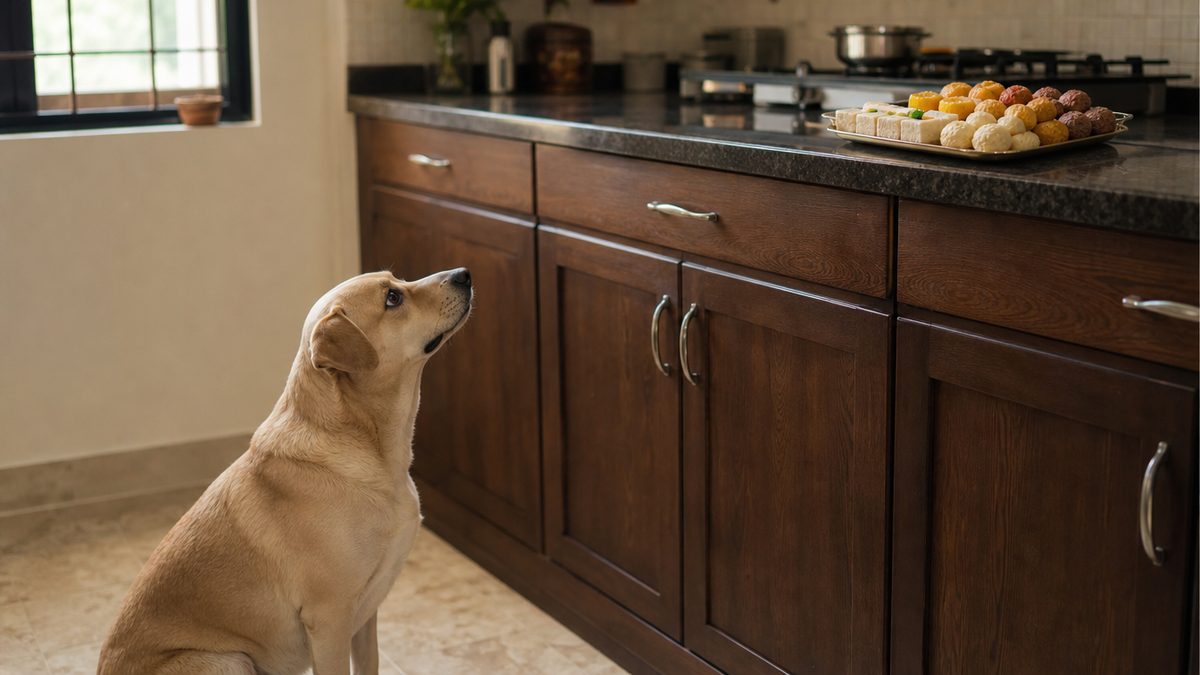
Quick answer
Can I give kaju katli to my dog? Skip it. Kaju katli carries no cocoa, no kishmish and no sugar substitute, so it is not poisonous, but one 25 gram piece is roughly 108 kilocalories, close to twice the whole daily treat allowance of a 10 kg dog and about three times that of a 5 kg dog. The Diwali sweets that are genuinely dangerous are chocolate mithai, anything containing kishmish or raisins, and any sugar-free sweet. Call a veterinary surgeon the same day if your dog eats one of those three.
This guide is general information for Indian pet owners and is not a diagnosis. Always consult a registered veterinarian near you before acting on anything you read here, and treat any sudden change in your pet's condition as urgent.
Which Diwali sweets are poisonous to a dog, and which are only bad for one
Diwali sweets fall into three groups for a dog. Chocolate mithai, anything carrying kishmish or raisins, and any sugar-free sweet are the poisonous group. Plain khoya, sugar and ghee sweets such as kaju katli, peda and gulab jamun are not poisonous and are still the wrong food. Nothing on a mithai thali was built for a dog.
Take kaju katli first, because it is the sweet people ask about. Kaju katli is cashew paste, sugar and ghee. It carries no cocoa, no kishmish and, from a halwai counter, no sugar substitute, which puts it outside every toxicity class on this page. What it carries instead is fat and sugar in a form a dog absorbs very efficiently, and the arithmetic further down shows that a single 25 gram piece is close to twice the entire daily treat allowance of a 10 kg dog.
Memorising a list of sweets is the wrong method, because the hazard travels with the ingredient rather than with the name. A barfi is safe or dangerous depending on what the halwai put in it, and the same shop sells both. Ask three questions of whatever is in your hand.
Three questions that sort any sweet in ten seconds
- Does it contain cocoa or chocolate? Theobromine is the toxin, the dose that matters scales with your dog's body weight, and semisweet dark chocolate carries roughly twice the methylxanthines of milk chocolate.
- Does it contain kishmish, raisins, sultanas, currants or imli? Each carries tartaric acid, which dogs excrete poorly, and the published threshold is far lower than almost any owner expects.
- Is it sugar-free? Xylitol is a legally permitted caloric sweetener in India, and a dose above 500 mg/kg has produced hepatic failure in dogs MSD Veterinary Manual.
Three noes mean the sweet is not poisonous. It does not mean the sweet is food for your dog, and the section on what one piece costs explains why that distinction matters more than most Diwali advice admits.
| Sweet | What is in it | The hazard that matters | What to do |
|---|---|---|---|
| Chocolate barfi, chocolate modak, cocoa fudge | Cocoa solids, sugar, milk solids | Theobromine and caffeine, dose-dependent on body weight | Call a veterinary surgeon the same day with the dog's weight and the amount eaten |
| Kesar or dry-fruit barfi, kaju anjeer roll, dry-fruit laddoo | Khoya, sugar, nuts, and very often kishmish | Tartaric acid from the kishmish, a kidney risk at a low count | Call a veterinary surgeon the same day, even if the dog seems entirely well |
| Any sugar-free or diabetic mithai | Khoya or nut paste plus a permitted sweetener | Xylitol if present, causing a rapid insulin release in dogs | Read the pack and call a veterinary surgeon; counter-bought sugar-free mithai carries no label at all |
| Kaju katli, badam barfi | Cashew or almond paste, sugar, ghee | Fat and sugar load, not toxicity | No emergency. Withhold the next meal's treats and watch for loose stools |
| Peda, kalakand, milk cake, khoya barfi | Khoya, sugar | Fat, sugar and lactose, with pancreatitis the real concern in a big helping | No emergency from one small piece; a large fatty helping is a veterinary call |
| Gulab jamun, rasgulla, jalebi | Fried or boiled dough in sugar syrup | Sugar syrup and, for jalebi, frying fat | No emergency. Expect wind and loose stools |
| Imli candy, imli chutney, chaat water | Tamarind pulp, sugar, salt, spices | Tartaric acid at a far higher concentration than grapes | Call a veterinary surgeon if the dog ate the pulp or a candy rather than licking a plate |
| Chivda, namkeen, chakli, fried savouries | Flour, oil, salt, often onion and garlic powder | Fat, salt and the allium content | Keep the bowl off low tables; call a veterinary surgeon for anything more than a crumb |
Three Diwali ingredients put a dog in a clinic: cocoa, kishmish, and any sugar substitute. All three hide inside sweets whose names give no warning, and all three need a phone call rather than a wait-and-see evening.
Chocolate: the dose that matters, by your dog's weight
Chocolate harms a dog in proportion to body weight and cocoa content. Mild signs appear around 20 mg of methylxanthines per kg of body weight, cardiotoxic effects at 40 to 50 mg/kg, and seizures at 60 mg/kg and above, and for milk chocolate roughly 62 g/kg is potentially lethal.
Theobromine is the main toxin and caffeine adds to it. Chocolate holds three to ten times as much theobromine as caffeine, and both act by blocking cellular adenosine receptors, which produces central nervous stimulation, diuresis and tachycardia. Theobromine has a half life of 17.5 hours in dogs, which is why signs can run for up to 72 hours in a severe case and why a dog that looks normal at bedtime has not cleared the drug.
Cocoa content is the whole story, so the type of chocolate decides the amount that matters.
| Type | Methylxanthines | 5 kg dog | 10 kg dog | 20 kg dog | 30 kg dog |
|---|---|---|---|---|---|
| Cocoa powder | 28.5 mg/g | 3.5 g | 7 g | 14 g | 21 g |
| Unsweetened baker's chocolate | 15.5 mg/g | 6 g | 13 g | 26 g | 39 g |
| Dark bar at 65 per cent cocoa | about 10.1 mg/g | 10 g | 20 g | 40 g | 59 g |
| Semisweet and sweet dark chocolate | 5.3 to 5.6 mg/g | 18 to 19 g | 36 to 38 g | 71 to 75 g | 107 to 113 g |
| Milk chocolate | 2.3 mg/g | 44 g | 87 g | 174 g | 261 g |
| White chocolate | 0.04 mg/g | negligible | negligible | negligible | negligible |
The gram figures in that table are arithmetic on the manual's own numbers, not a substitute for a veterinary assessment. The manual itself works the dark-chocolate line the same way, noting that a 65 per cent cocoa bar contains about 15.5 mg multiplied by 0.65, or 10.1 mg of methylxanthines per gram. Read the table as a sense of scale. A 5 kg Indian Spitz and a 30 kg Labrador are not in the same situation after the same piece.
Two practical consequences follow. A chocolate modak made with real dark chocolate is a different event from a milk-chocolate bar, and cocoa powder is the most concentrated form in any Indian kitchen, which matters because it sits in a jar rather than in a wrapper.
Why the festival matters more than the chocolate
The only measured festival effect in the literature comes from the United Kingdom, and it is large. A surveillance network covering 229 UK veterinary practices screened 2.7 million consultation narratives recorded between November 2012 and May 2017, found 1,722 mentioning chocolate, and confirmed 386 that met a chocolate-exposure case definition, from 375 individual animals. Chocolate exposure was 4.74 times more likely at Christmas than at ordinary dates, with a 95 per cent confidence interval of 3.04 to 7.40, and 1.97 times more likely at Easter. Valentine's Day and Halloween showed no significant effect.
That is the single most transferable finding on this page, and it is not about chocolate at all. It is about a box of sweets sitting open, at dog height, in a house full of visitors, for a fortnight. Nobody has run the equivalent study for Diwali. We would rather say that plainly than imply an Indian figure that does not exist.
The same paper is also the best antidote to panic. Of the 386 confirmed exposures, 101 presented within an hour and 217 within six hours; vomiting was noted in 64 cases, neurological signs in 12, and a heart rate above 120 beats per minute in 28. No seizures were reported in any case, and none of the clinical signs seen was considered life threatening. Where a theobromine dose could be worked out from the record, 41 per cent of those doses, 75 of 185, were below the 20 mg/kg threshold and therefore non-toxic.
Most chocolate scares are not emergencies, and the reason to phone a veterinary surgeon anyway is that you cannot tell which kind yours is without the dog's weight, the type of chocolate and the amount. Chocolate still accounts for 25 per cent of acute presentations for intoxication in dogs, so the call is cheap and the guess is not.
Kishmish: the sweet-shop ingredient that reaches the kidneys
Kishmish is the most under-reported hazard in an Indian sweet box, because raisins and sultanas carry tartaric acid and dogs handle tartaric acid badly. Dogs lack the organic acid transporters other species have, so tartaric acid accumulates in the proximal renal tubular cells.
Tartaric acid is the proposed toxic principle, identified only in 2022. Reports of dogs developing acute kidney injury after eating cream of tartar or tamarind were pulled from the ASPCA Animal Poison Control Center database and compared with grape and raisin cases; the clinical signs, laboratory findings and histopathologic lesions matched, which pointed to tartaric acid as the common component. Twenty years of unexplained grape toxicity resolved into one organic acid.
The dose is the part that stops people. More than one grape or raisin per 4.5 kg of body weight may contain enough tartaric acid to pose a risk of renal effects in a dog. For a 5 kg dog that is a second raisin. For a 10 kg dog it is a third. Count the kishmish in a piece of dry-fruit barfi before deciding that a small piece is harmless.
- Hidden in sweets: kesar barfi, dry-fruit barfi, anjeer rolls, dodha barfi, mohanthal, many commercial laddoo mixes.
- Hidden in cooked dishes: kheer, sheera, sooji halwa, gajar halwa, sweet pulao, shahi tukda.
- Hidden in the gift box: dry-fruit trays, where the raisin compartment is the one a dog can reach on a low table.
- Hidden in plain sight: a bowl of kishmish left out for prasad.
Signs follow a known sequence. Most dogs vomit or develop diarrhoea within 6 to 12 hours, with lethargy, anorexia, abdominal pain, weakness, dehydration, polydipsia and shivering also reported. Serum creatinine tends to rise before urea nitrogen and rises disproportionately, and oliguric or anuric renal failure develops within 24 to 72 hours of exposure. Once anuric renal failure is established, most dogs die or are euthanased. That timeline is why a dog that seems fine three hours after eating a dry-fruit sweet has told you nothing useful.
Where the two best sources disagree, and why both are right
The veterinary manual's threshold and the largest published cohort do not sound like the same subject, and we publish both rather than pick one. Against the manual's one-raisin-per-4.5 kg risk line, a Dutch Poisons Information Center series followed 95 dogs and 13 cats with proven ingestion of grapes, raisins or related Vitis fruit through 2018. Fourteen of the 95 dogs developed any clinical sign, an incidence of 14.7 per cent, mostly vomiting, and exactly one dog of 95, or 1 per cent, developed acute kidney injury.
Both statements are true and they answer different questions. The manual states the quantity above which the risk is no longer negligible; the Dutch series states how often, in practice and with prompt treatment, that risk became kidney disease. The treatment is a large part of the difference. Emesis was induced in 72 of the 95 dogs with a 100 per cent success rate, and it removed the fruit in 98 per cent of cases when induced within four hours and 83 per cent when induced between four and twelve hours.
The honest reading for an Indian owner is that kishmish is not a death sentence and is absolutely a same-day veterinary call. The low AKI rate in the Dutch data is the rate among dogs who reached a vet and were decontaminated. It is not the rate among dogs whose owners waited to see.
Creatinine rises before urea nitrogen and the failure declares itself over 24 to 72 hours. A normal result in the first hours after a kishmish sweet does not clear the dog, which is why vets repeat testing over the following days rather than sending you home on one panel.
Imli: the tartaric acid source no Indian page warns about
Imli belongs on the same list as kishmish, and it is more concentrated. Tamarind pulp contains a general range of 8 to 18 per cent tartaric acid, while grapes are reported at as much as 2 per cent with a general range of 0.35 to 1.1 per cent.
That comparison is not a rounding difference. By weight of pulp, tamarind carries roughly eight to fifty times the tartaric acid of a grape, and for scale the same paper puts cherries at 0.008 per cent and raspberries at 0.009 per cent. The veterinary manual has already followed the evidence: its topic is titled grape, raisin and tamarind toxicosis in dogs, and it records that tamarind ingestions have resulted in renal failure in dogs.
The case series behind that is small and grim. Four dogs that ate tamarind and two that ate cream of tartar were identified from the ASPCA database; decontamination was not performed and treatment was delayed in these cases; despite intravenous fluids and supportive care, two became anuric and one oliguric, four were euthanased and the outcome is unknown for two.
Six dogs is not an epidemiology. State what is established and what is not, because the gap matters here more than anywhere else on this page.
- Established: tartaric acid is the proposed toxic principle, tamarind pulp is a concentrated source, and tamarind ingestion has caused fatal acute kidney injury in dogs MSD Veterinary Manual, Grape, Raisin.
- Not established: any dose threshold for tamarind. No published figure says how much imli is too much for a dog of a given weight.
- Not established: whether a dilute imli chutney or the imli water in a plate of pani puri carries a meaningful dose. Concentration, not the name of the dish, is what would decide it.
- Practical: treat an imli candy, a block of imli or a bowl of concentrated chutney as a same-day veterinary call, and treat a licked plate as a reason to watch rather than to panic.
This matters in India in a way it does not elsewhere. Imli is not an occasional ingredient here; it is in chutney, in candy, in rasam, in sambar and in every chaat counter from Delhi to Chennai, and it reaches the floor constantly during festival weeks. No Indian page we read on 20 October 2026 connected imli to grape and raisin toxicity, and the veterinary manual has had tamarind in the title of that topic since its September 2024 review.
Sugar-free mithai, xylitol, and the one label line that answers it
Sugar-free mithai is the hardest sweet to clear, because the answer depends entirely on which sweetener the maker used and Indian law gives you a way to find out. Xylitol is classified as a permitted caloric sweetener under regulation 3.2.2 of India's food additive rules, alongside sorbitol, mannitol, isomalt, maltitol and lactitol.
Xylitol is dangerous to dogs for a reason specific to the species. In most mammals it does nothing much to insulin; in dogs it triggers a rapid, dose-dependent insulin release that can produce profound hypoglycaemia. Doses above roughly 100 mg/kg have been associated with hypoglycaemia, and some dogs ingesting above 500 mg/kg develop severe hepatic insufficiency or failure. In the study the manual cites, 62.5 per cent of dogs with clinical signs of liver injury died or were euthanased despite aggressive veterinary intervention.
Timing makes it worse. Signs of hypoglycaemia can appear within 30 minutes, or be delayed 12 to 18 hours when the xylitol sits in a substrate that slows absorption such as chewing gum, and signs of liver injury may not appear for 24 to 48 hours even though enzyme rises are often detectable within 4 to 12 hours. Cats are not at risk of either effect.
The label line Indian law puts on the box
Read the sweetener declaration, because Indian labelling rules require it to be there. A package of food containing a sweetener listed in Appendix A of the food additive regulations must declare "This contains......(name of the sweetener)", a package permitted to contain an artificial sweetener must carry "CONTAINS ARTIFICIAL SWEETENER AND FOR CALORIE CONCIOUS", and one containing a non-caloric sweetener must carry "CONTAIN NON-CALORIC SWEETENER";. A packaged sugar-free mithai therefore names its own sweetener on the box, in letters the rules set at not less than 1.5 mm.
That gives you a thirty-second test at home and exposes the real gap. Sugar-free mithai weighed out at a halwai counter arrives in a cardboard box with no ingredient list at all, so there is nothing to read and no way to know. Counter-bought sugar-free mithai is the one category where a dog that has eaten a piece cannot be cleared by you, only by a veterinary surgeon who treats it as a possible xylitol exposure.
Sorbitol and maltitol are not xylitol
Several Indian pet pages state flatly that sugar-free Indian sweets contain xylitol. That is an assumption rather than a finding, and the distinction is clinically real. Sorbitol, maltitol, isomalt and lactitol are separate substances in the same regulatory class as xylitol, and none of them is the compound that drives the canine insulin release described above. What they do produce is an osmotic effect in the gut, which Indian labelling rules acknowledge directly by requiring the declaration "Polyols may have laxative effect" and, for 10 per cent or more sorbitol, a warning that it "May have laxative effect, cause bloating and diarrhea in children";.
Xylitol appears in sugar-free gum, mints, chewable vitamins, toothpaste, mouthwash and sugar-free medicinal syrups. A handbag on a low chair during a Diwali visit is a more realistic exposure route than a mithai box, and a packet of gum is a far more concentrated source than any sweet.
Khoya and ghee: why a fatty helping is its own emergency
Khoya and ghee make mithai a high-fat meal rather than a sugary one, and a sudden large fatty meal is the trigger owners are warned about for pancreatitis. Indian law sets the floor: khoa must contain not less than 30.0 per cent milk fat on a dry matter basis, with total solids not less than 55.0 per cent.
Work that minimum through and a legally compliant khoa is at least 16.5 per cent fat as sold, before the halwai adds ghee. Measured product sits above the floor. A published analysis of lal peda, a khoa-based sweet from eastern India, found 12.4 per cent moisture, 16.7 per cent lactose, 17.2 per cent protein, 18.5 per cent fat, 3 per cent ash and 32.2 per cent sucrose. Almost a fifth fat, almost a third sucrose, and a sixth of it milk sugar.
Pancreatitis is a condition rather than a food question, and Bonbeno covers it properly elsewhere. Our page on pancreatitis in dogs sets out what the disease is, the Indian caseload behind it, how it is diagnosed and what treatment costs. Read it before Diwali if your dog has had an episode, because a dog with a history is the dog for whom one generous helping is genuinely dangerous rather than merely unwise.
The lactose is a smaller, more common problem. Khoa is concentrated milk, so a khoa sweet delivers a milk-sugar load in a few bites, and the measured 16.7 per cent in that lal peda analysis is the number to hold. Most owners read the resulting wind and loose stools as the sugar. It is mostly the milk.
- Highest fat per bite: khoya barfi, milk cake, kalakand, mysore pak, anything finished with a ladle of ghee.
- Highest sugar per bite: gulab jamun, jalebi and imarti, where the sweet sits in syrup.
- Highest combined load: dry-fruit barfi and laddoo, which stack nut fat, ghee, sugar and frequently kishmish.
- Lowest risk of the lot, and still not a dog treat: a plain unsweetened piece of paneer, which is neither mithai nor a reason to start.
Repeat helpings across a three-week festival season are a separate problem from one piece. Weight gained over Diwali is rarely lost afterwards, and the conditions that follow are documented on our pages for obesity in dogs and cats and diabetes in dogs and cats.
What one piece of mithai actually costs a dog
One piece costs far more of a dog's daily allowance than almost any owner estimates, which is why "a small piece won't hurt" is the wrong frame. Treats should always make up less than 10 per cent of a dog's daily calorie intake, and a single 25 gram khoa sweet clears that ceiling for every dog under about 30 kg.
Three published figures give the whole calculation, with no estimate in the chain. The composition of a khoa sweet is measured at 18.5 per cent fat, 17.2 per cent protein and 48.9 per cent sugars once sucrose and lactose are added. Energy follows at 9 kilocalories a gram of fat and 4 a gram of protein and sugar, which puts 100 grams at roughly 431 kilocalories and a 25 gram piece at roughly 108. Daily energy follows the AAHA formula, resting energy requirement equal to body weight in kilograms to the power 0.75 multiplied by 70, then multiplied by a life stage factor of 1.4 to 1.6 for a neutered adult dog.
| Dog weight | Resting energy (kcal) | Daily need, neutered adult | 10 per cent treat ceiling | One 25 g piece, as a share of that ceiling |
|---|---|---|---|---|
| 5 kg | 234 | 328 to 374 kcal | 33 to 37 kcal | about 3 times the whole day's allowance |
| 10 kg | 394 | 551 to 630 kcal | 55 to 63 kcal | about 1.7 to 2 times |
| 20 kg | 662 | 927 to 1,059 kcal | 93 to 106 kcal | roughly the entire allowance |
| 30 kg | 897 | 1,256 to 1,436 kcal | 126 to 144 kcal | about three quarters of it |
Treat the 108 kilocalories as an upper estimate rather than a measurement. It is arithmetic on a published composition, and pet-food labels use slightly lower energy factors than the general ones used here, so the figure a veterinary nutritionist would quote sits a little below it. The conclusion does not move. For a 5 kg dog, one piece of mithai is three days of treats.
Run it for your own dog
Four steps give you the number for any dog and any sweet. Type your dog's weight in kilograms into a phone calculator turned sideways, press the x to the power y key, enter 0.75 and press equals; multiply by 70 for the resting figure; multiply by 1.4 to 1.6 for a neutered adult; take 10 per cent World Small Animal Veterinary Association…. Our dog diet chart for India runs the same arithmetic across weights and food types if you want it done already.
Scale is easier to feel with a comparison. The WSAVA's own list of common human foods puts one 17 gram digestive biscuit at 75 kilocalories and 28 grams of cheddar at 120, and notes that for some dogs just one of these can exceed the maximum daily treat allowance. A piece of mithai sits above the biscuit and close to the cheese.
The question is not whether one piece will hurt your dog. It is what you are spending the day's entire treat budget on, and whether a 108 kilocalorie piece of khoya and sugar is a better use of it than the food your dog can actually digest. Put that way, most people put the barfi down.
Treat that arithmetic as a worked example for one khoa-based sweet, not a figure that covers the whole box. Mithai composition varies sharply by region, and nobody has published a table of it. A chhena-based Bengali sandesh or rosogolla from Kolkata is built on drained curd rather than reduced milk solids. A Mysore pak from Karnataka or Bengaluru is closer to equal parts ghee, sugar and besan. A Maharashtrian puran poli from Pune or Mumbai is largely jaggery and dal. A Delhi or Lucknow barfi sits nearer the khoa figures used above. The honest position is that the fat and sugar load of the specific sweet in your hand is usually unknown, so the safe assumption is that any piece is energy-dense enough to matter to a small dog.
Cashew, almond, macadamia and the silver leaf on top
Of the nuts in an Indian sweet box, only macadamia has a named toxicosis in dogs, and macadamia is the one nut Indian mithai rarely contains. Dogs have developed clinical signs after ingesting macadamia at 2.4 g/kg, with weakness, central nervous depression, vomiting, ataxia, tremors or hyperthermia appearing within 12 hours.
Macadamia toxicosis is unpleasant rather than deadly. The syndrome is typically non-fatal, clinical signs generally resolve within 12 to 48 hours, most affected dogs recover without specific treatment, and dogs are the only species in which it has been reported. Macadamia appears in India mainly in imported cookies and premium gift hampers rather than in mithai, which is where to look for it.
Cashew and almond are a different question and the answer is less dramatic than the internet suggests. Neither kaju nor badam has a toxicosis topic in the veterinary manual's food hazards chapter, whose topic list runs garlic and onion, avocado, bread dough, chocolate, macadamia, grape with raisin and tamarind, and xylitol. The problems with a handful of cashews are fat load, salt on the roasted variety, and the obstruction and choking risk that the WSAVA attaches to treats of the wrong size and shape. That is a reason not to feed them, not a reason to go to a clinic.
What the silver leaf actually is
Vark is a thin sheet of metallic silver and the quantity on a piece of barfi is tiny. Under regulation 2.11.4 of India's food product standards, chandi ka warq must be a sheet of uniform thickness, free from creases and folds, weighing up to 2.8 g per square metre, with silver content of minimum 999/1000 fineness, and it must not be manufactured using any material of animal origin at any stage. A 5 cm square of that sheet weighs about 7 milligrams.
So the silver on a compliant sweet is not the issue. The issue is whether it is silver. FSSAI has directed state commissioners of food safety to run surveillance and enforcement because some food business operators still manufacture warq using material of animal origin, and Gujarat's Food and Drug Control Administration described cases of aluminium foil being passed off as silver leaf, which strict surveillance had reduced. Aluminium is a contaminant, not a garnish.
A dog that eats one vark-topped barfi has a khoya and sugar problem, not a silver problem. Nothing in this section changes what the sweet underneath is doing, and the decorative foil is the least important thing on the plate.
What to do if your dog has already eaten a sweet
To act correctly after a dog eats a Diwali sweet, move the dog away from the rest of it, telephone a veterinary surgeon immediately, and follow the advice you are given. Never watch and wait.
Three instructions from the RSPCA's guidance are the ones people get wrong, and each is explicit. Do not attempt to treat or medicate dogs yourself, because some medicines for humans and other animals are poisonous to dogs. Never attempt to make a dog vomit, and do not use salt water, which is extremely dangerous. Contact a vet immediately and tell them when, where and how it happened, taking the packaging or the substance with you if you can do that safely.
Inducing vomiting is a veterinary decision for a specific reason. Emesis is induced with prescription drugs under supervision, and in the Dutch grape and raisin series it was effective, removing the fruit in 98 per cent of dogs when induced within four hours. That is an argument for getting to a vet quickly, not for improvising at home. Salt in particular causes a separate poisoning of its own.
Five things to have ready when you call
- Your dog's current weight in kilograms, because every dose on this page is per kilogram.
- What the sweet was, named as specifically as you can, and whether it contained cocoa, kishmish or a sweetener.
- How much is gone, estimated in pieces or grams rather than described as some.
- The time it was eaten, to the nearest fifteen minutes if possible.
- The box, the wrapper or a photograph of the ingredient list, which is the only record of what was actually in it.
Indian owners face one practical gap worth planning around. The three 24-hour animal poison services the veterinary literature routinely names, the ASPCA Animal Poison Control Center, the Pet Poison Helpline and the Veterinary Poisons Information Service, are US and UK services, and the RSPCA itself describes the VPIS Animal PoisonLine as a fee-charging UK line. India has no equivalent national service that we could find on 20 October 2026, which makes your own veterinary practice the first and only call. A 24-hour veterinary hospital is a realistic option in Mumbai, Delhi, Bengaluru, Chennai, Hyderabad, Pune and Kolkata, and is not in most of the country.
No emetic, no activated charcoal, no antidote and no dose appears on this page on purpose. Those are veterinary decisions made on the individual animal, its weight, its age and what else is going on with it, and this page publishes under the medical disclaimer for exactly that reason.
Store the phone number of your veterinary practice and of the nearest 24-hour hospital in your phone before the festival rather than searching for one at 11 pm. Ten minutes on a Monday afternoon saves the worst ten minutes of a Diwali night.
Keeping the box out of reach for a three-week season
Plan for weeks rather than a night, because mithai boxes start arriving before Dhanteras and the last of them is still on a sideboard after Bhai Dooj. The exposure risk is not the festival dinner; it is the open box at dog height while the house is full of people who do not live there.
The UK chocolate data is a lesson about households rather than about chocolate, and it transfers. Chocolate exposure peaked when seasonal confectionery became more accessible within the home, including gift selections, advent calendars and tree decorations, and was significantly less common in older dogs than in dogs under four. Young dogs and open boxes, for a fortnight.
- Put every box in a closed cupboard the moment it arrives, not on the dining table, and tell the household the rule once rather than enforcing it ten times.
- Brief visiting relatives before they sit down, because the guest holding a laddoo under the table is a common route into a dog.
- Keep the dry-fruit tray off low surfaces for the whole season, since the kishmish compartment is the dangerous one.
- Check the floor after every gathering, under the sofa and behind the curtains, where a dropped piece waits until the house is quiet.
- Hand a guest who wants to feed your dog something a piece of its own food instead, which satisfies everyone and costs nothing.
Feed your dog its normal meal before the guests arrive. A dog that has already eaten is a dog less interested in the table, and keeping the diet steady through a disrupted fortnight is easier than correcting it afterwards. Our guides to the dog diet chart for India and to homemade dog food in India cover what that bowl should hold.
Community dogs deserve a word, because Diwali is when people feed them sweets out of kindness. Mithai is the wrong gift for a street dog for every reason on this page, and a dog with no owner has nobody to notice vomiting at 2 am. Plain food and clean water are better, and our guide to feeding community dogs in India covers the practice and the law.
One honest observation to close on. The Animal Welfare Board of India's Deepavali message asks people to provide safe, quiet places for pets and strays along with access to clean drinking water, and devotes itself to firecracker noise, eco-friendly diyas and natural rangoli colours. It says nothing at all about food. India's own animal welfare regulator has not addressed the festival's biggest food risk to dogs, which is part of why so little reliable Indian material on it exists.
Noise is the other half of this festival and it is covered separately. If your dog is frightened by crackers as well, read our guide to firecracker anxiety in dogs in India, which handles the safe room, the preparation weeks and what the law actually requires.
Storage is the part people forget once the box has been open a week. Mithai is a fresh dairy product, and in the humid weeks that follow the monsoon across Ahmedabad, Mumbai and the coastal south it turns well before it looks wrong. A sweet going off is not just a wasted sweet, because mouldy food is its own hazard to a dog that finds it in a bin. Refrigerate what you keep, bin what you are unsure of, and put the bin somewhere the dog cannot open. The season is long: in Tamil Nadu and much of the south the sweets arrive again within weeks for the next festival, so the habit matters more than the single night.
Common questions
Can I give kaju katli to my dog?
No, though not because it is poisonous. Kaju katli is cashew paste, sugar and ghee, with no cocoa, no kishmish and usually no sugar substitute, so it sits outside every toxicity class. The reason to skip it is quantity. One 25 gram piece is roughly 108 kilocalories, and treats should make up less than 10 per cent of a dog's daily calorie intake, which for a 10 kg dog is 55 to 63 kilocalories a day.
What sweets are poisonous to dogs?
Three groups of sweet are genuinely poisonous to a dog. Anything containing cocoa or chocolate, because theobromine produces mild signs from about 20 mg/kg, cardiotoxic effects at 40 to 50 mg/kg and seizures at 60 mg/kg and above. Anything containing kishmish, raisins, sultanas, currants or tamarind, because of tartaric acid. And any sugar-free sweet that contains xylitol. Everything else on a mithai thali is unsuitable rather than toxic.
What sweets are safe for dogs to eat?
No Indian sweet is a safe treat for a dog, because every one of them is sugar carried in fat. The nearest thing to a safe festive treat is a small piece of the dog's own food, a plain boiled vegetable or a commercial dog treat whose calories you can count, kept inside the 10 per cent of daily calories that treats are allowed. A sweet that merely lacks cocoa, kishmish and xylitol is not poisonous, which is a different claim from safe.
My dog ate one piece of barfi. What should I do?
Work out what was in it, then telephone a veterinary surgeon rather than waiting. If the barfi contained cocoa, kishmish or any sweetener, treat it as a same-day call whatever the dog looks like. Do not attempt to make the dog vomit and never use salt water, which is extremely dangerous. Keep the box or a photograph of the ingredient list, note the time and the amount, and never watch and wait.
How much chocolate is dangerous for a dog?
It depends on body weight and cocoa content, which is why a single answer does not exist. Mild signs begin around 20 mg of methylxanthines per kg of body weight. Milk chocolate holds 2.3 mg per gram, semisweet dark 5.3 to 5.6 mg per gram and cocoa powder 28.5 mg per gram, so for a 10 kg dog the 20 mg/kg line falls at roughly 87 g of milk chocolate, 36 g of dark, or 7 g of cocoa powder. For milk chocolate, about 62 g per kg of body weight is potentially lethal.
Are raisins in kheer and mithai really dangerous for dogs?
Yes, and at a lower count than most owners expect. More than one grape or raisin per 4.5 kg of body weight may contain enough tartaric acid to pose a risk of renal effects, so a 10 kg dog is over the line at three. Against that, a Dutch poisons centre series of 95 dogs with proven ingestion found clinical signs in 14.7 per cent and acute kidney injury in one dog, or 1 per cent, with most of those dogs decontaminated promptly. Both figures are real and both point to the same action, which is a same-day veterinary call.
Is sugar-free mithai safe for dogs?
No, and it is the hardest sweet of all to clear. Xylitol is a permitted caloric sweetener in India, doses above 100 mg/kg have been associated with hypoglycaemia in dogs and doses above 500 mg/kg with hepatic failure. A packaged sweet must name its sweetener on the label under Indian labelling rules, so read the box. Sugar-free mithai weighed out at a halwai counter has no label, which means it cannot be cleared at home at all.
Is the silver leaf on mithai harmful to a dog?
Compliant silver leaf is not the problem. Indian standards require chandi ka warq to be a uniform sheet weighing up to 2.8 g per square metre at minimum 999/1000 fineness, which puts only a few milligrams of metallic silver on a piece of barfi. The enforcement concern is substitution, with FSSAI directing states to act against warq made using material of animal origin and officials reporting aluminium foil passed off as silver. The sweet underneath remains the real issue.
Can dogs eat jaggery or gur instead of sugar?
Jaggery is not a toxin and it is not a health food for a dog either. Gur is concentrated cane or palm sugar, so a piece of gur laddoo spends the same daily calorie budget as a piece of sugar laddoo and counts against the same ceiling, which is less than 10 per cent of daily calories from all treats combined. Swapping the sweetener changes nothing a dog's pancreas or waistline can detect.