
Dog nutrition guide
What fruits can dogs eat? 12 Indian fruits measured, and the seeds nobody counts
Every page that ranks for this query sorts apples, bananas and blueberries. None of them opens India's own food composition tables, and none of them checks the claim that jamun and chikoo seeds carry cyanide. We did both. The flesh is almost never the problem. The seed, the stone and the rind are.
Quick answer
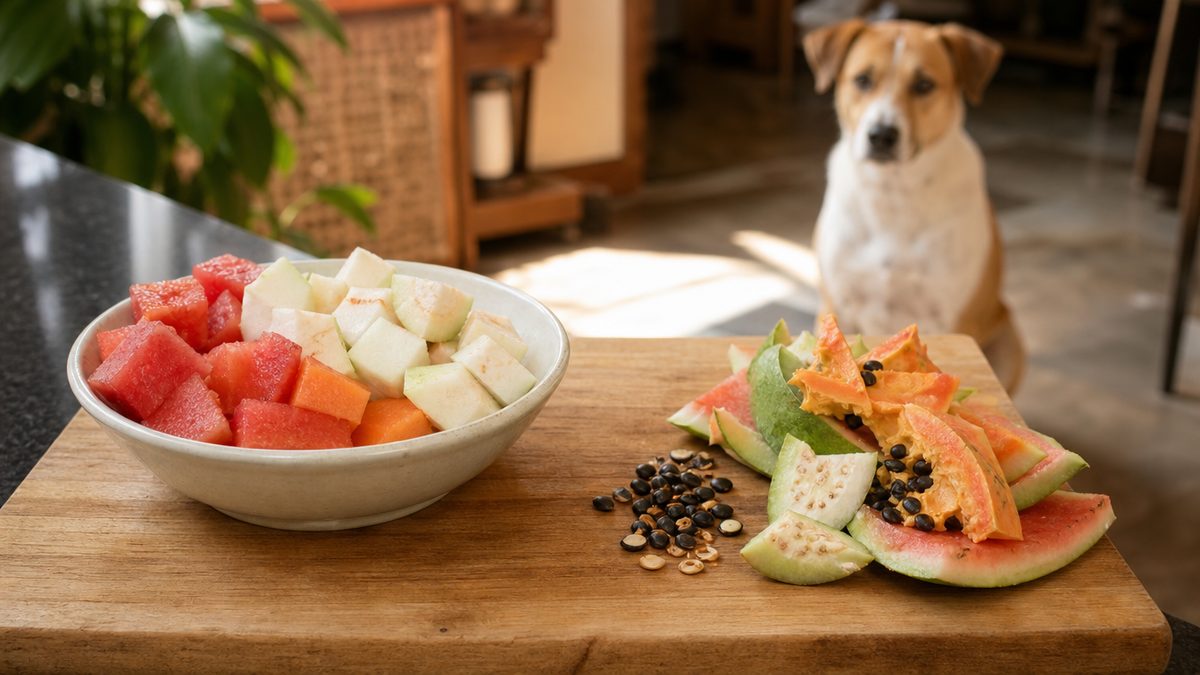
What fruits can dogs eat? Guava, papaya, watermelon, muskmelon, pomegranate arils, ber, amla, ripe chikoo, sitaphal and peeled lychee flesh are all safe in counted amounts. The seed, stone or rind causes the trouble, not the pulp. Grapes and raisins are the one real exception and are never safe. Portion by energy rather than by eye, because a healthy 10 kg dog's daily fruit ceiling runs from 47 g of sitaphal to 231 g of watermelon.
This guide is general information for Indian pet owners and is not a diagnosis. Always consult a registered veterinarian near you before acting on anything you read here, and treat any sudden change in your pet's condition as urgent.
What fruits can dogs eat, and which part of each one is the problem
Dogs can eat the flesh of almost every fruit an Indian household buys, in counted amounts, once the seed, stone or rind is out. The flesh is rarely the question. The part you were going to throw away is.
Start with the verdict, then read why. The table below sorts every fruit this page measures into three tiers, names the part that decides the tier, and says where the evidence stands. Note how few rows are about poison.
| Fruit | Verdict | The part that decides it | Where the evidence stands |
|---|---|---|---|
| Watermelon, muskmelon | Give, counted | Rind off, seeds out | The two lowest-energy fruits here at 70 to 116 kJ per 100 g. Muskmelon is on the ASPCA non-toxic list; watermelon has no entry either way |
| Papaya, ripe | Give, counted | Peel off, black seeds out | 23.9 kcal and 4.09 g of free sugars per 100 g. No entry on any poison-control list we could find |
| Guava, white or pink | Give, counted | Hard central seeds out | 8.59 g of total dietary fibre per 100 g in white-fleshed guava, second only to chikoo |
| Amla (Indian gooseberry) | Give, counted | Central stone out | 23.7 kcal per 100 g, 7.75 g fibre, 751 mg of citric acid per 100 g. Sour enough that most dogs decline it |
| Pomegranate arils | Give, counted | Rind, pith and membrane off | 253 mg of total oxalate per 100 g, the highest fruit figure in IFCT. No canine threshold exists for that |
| Ber (Indian jujube) | Give, counted | Stone out, every single one | 48.8 kcal per 100 g. A hard pointed stone swallowed whole, with no canine measurement behind it either way |
| Lychee, ripe | Give, counted, ripe only | Skin off, stone out | No dog evidence exists in either direction. The Muzaffarpur toxin is a human finding in fasting children |
| Chikoo (sapota), ripe | Give, counted | Peel off, hard hooked seeds out | 73.4 kcal and 12.30 g of free sugars per 100 g, so the portion is small |
| Sitaphal (custard apple), ripe | Give, counted | Every black seed out, skin off | The most energy-dense fruit here at 98.9 kcal per 100 g. The seed carries squamocin, a measured acetogenin toxin |
| Banana, jackfruit | Give, counted | Peel off; jackfruit seeds out | 105.2 and 72.2 kcal per 100 g. Banana is one of three fruits here the ASPCA explicitly calls non-toxic |
| Apple, peach, plum, apricot, cherry | Flesh only, seeds and stones absolutely out | Pips and stones | The ASPCA lists apple and the whole Prunus group as toxic to dogs, with cyanogenic glycosides named as the toxic principle |
| Sugarcane, raw singhara | Skip | The whole thing | Sugarcane juice is filed under Sugars, not Fruits, in India's own food tables. The cane itself is a hard chew and a fibrous mass |
| Any dried fruit, any fruit juice | Skip | The missing water | Drying the same fruit multiplied its energy by 5.7 and its free sugars by 6.4 in the only fresh-to-dried pair IFCT measures |
| Grapes, raisins, kishmish | Never, at any weight | The fruit itself | The one genuinely toxic fruit on an Indian shelf. Our Diwali page carries the dose and the case series |
One row deserves its whole answer here so you do not have to read on. Grapes, raisins, kishmish, sultanas and currants cause acute kidney injury in dogs, the proposed toxic principle is tartaric acid, and the quantity that matters is far smaller than owners expect. We will not repeat that case here, because grapes and raisins toxicity in dogs carries the dose per kilogram, the 2022 identification of tartaric acid and the published cohorts that disagree about how often ingestion becomes kidney disease. Read it. Everything else on this page is arithmetic.
The three questions that sort any fruit
To sort a fruit nobody has written about, ask three questions in order, because only the first has a same-day consequence.
- Does it poison? Almost no fruit does. Grapes and raisins do, and the seeds of the Rosaceae group carry cyanogenic glycosides.
- Does it obstruct? A stone, a pit or a mass of hard seeds injures by shape rather than by chemistry, and the dose logic above does not apply to it at all.
- Does it displace? A fruit with no toxin and no stone still carries energy, and energy taken on top of a full bowl is the commonest harm of all.
Our guide to Indian food safe for dogs sets out that four-category test in full and applies it to the rest of the plate. This page applies it to fruit, where the second question dominates in a way it does not for rice or dal.
Deseed and peel the dog's piece into its own bowl before anyone starts eating. One motion removes the stone, the rind and the temptation to hand over whatever is left on the plate. Everything else on this page is about how much of what is in that bowl.
Why an Indian fruit bowl needs its own page
The pages ranking for this query sort a different shelf. Every top-ten result we read on 21 October 2026 leads with apples, bananas, blueberries, strawberries and cantaloupe. Those are real fruits and most Indian households do not buy them weekly. Guava, papaya, chikoo, sitaphal, ber, amla, jamun and singhara appear on none of the international lists, and the Indian commercial pages that do cover them carry no composition source at all.
The seasons are different too, which is why a single safe list is useless. The National Horticulture Board records guava as the fourth most important fruit in India after mango, banana and citrus, harvested nearly year-round except May and June, with the north Indian peak in August for the rainy-season crop, November and December for the winter crop and March and April for the spring crop. Sapota flowers in October and November and again in February and March, giving harvests in January and February and in May and June, mostly in Gujarat, Maharashtra, Karnataka, Tamil Nadu, Andhra Pradesh and Kerala. So the fruit in reach of a dog in a humid coastal flat in Chennai in January is not the fruit in reach of a dog in Delhi in August.
That matters because exposure is seasonal and repeated. A fruit that reaches a dog once a year is a different problem from a fruit that is on the table every evening for ten weeks.
What Indian fruit actually contains, from India's own food tables
Indian fruit composition comes from the Indian Food Composition Tables 2017, compiled at the ICMR-National Institute of Nutrition in Hyderabad, which analyses Indian cultivars sampled across Indian regions rather than importing a foreign value. Twelve of the fruits on this page have an IFCT row, across fifteen separate entries, because watermelon, muskmelon and guava are each analysed twice. Several fruits have none at all, and that absence is itself a finding.
Read the table below as the basis for every gram figure further down. Energy is published in kilojoules; the kilocalorie column is our conversion at 4.184 kJ per kcal. Free sugars means the measured sum of fructose, glucose, sucrose and maltose.
| Fruit (IFCT food code) | Energy, kJ | Energy, kcal | Free sugars, g | Total dietary fibre, g | Regions sampled |
|---|---|---|---|---|---|
| Water melon, pale green (E066) | 70 | 16.7 | 3.00 | 0.78 | 6 |
| Water melon, dark green, sugar baby (E065) | 85 | 20.3 | 3.66 | 0.70 | 6 |
| Musk melon, orange flesh (E045) | 97 | 23.2 | 2.99 | 1.51 | 5 |
| Amla, Indian gooseberry (E021) | 99 | 23.7 | 3.39 | 7.75 | 5 |
| Papaya, ripe (E049) | 100 | 23.9 | 4.09 | 2.83 | 6 |
| Musk melon, yellow flesh (E046) | 116 | 27.7 | 2.36 | 1.49 | 6 |
| Guava, white flesh (E028) | 135 | 32.3 | 4.10 | 8.59 | 5 |
| Guava, pink flesh (E029) | 195 | 46.6 | 7.79 | 7.39 | 5 |
| Ber, Zizyphus jujube (E068) | 204 | 48.8 | 8.29 | 3.73 | 1 |
| Litchi (E035) | 225 | 53.8 | 9.30 | 1.34 | 4 |
| Pomegranate, maroon arils (E055) | 229 | 54.7 | 10.87 | 2.83 | 6 |
| Jack fruit, ripe (E030) | 302 | 72.2 | 12.21 | 3.62 | 5 |
| Sapota, chikoo (E060) | 307 | 73.4 | 12.30 | 9.60 | 6 |
| Custard apple, sitaphal (E016) | 414 | 98.9 | 13.35 | 5.10 | 1 |
| Banana, ripe, robusta (E012) | 440 | 105.2 | 13.65 | 1.94 | 6 |
Three things fall straight out of that table and none of them appears on a ranking page. The energy spread across one fruit cart is more than six-fold, from 70 kJ in pale watermelon to 440 kJ in a robusta banana, so a spoonful of one is not a spoonful of another. Fibre does not track sugar: white guava carries 8.59 g of total dietary fibre per 100 g and litchi carries 1.34 g, while chikoo manages to be the most fibrous fruit here at 9.60 g and the third most sugary at 12.30 g. And the number of regions sampled is printed beside every row, so you can see which figures are robust (papaya and pomegranate, six regions each) and which rest on a single sample (ber and sitaphal, one region each).
The fruits India's own tables do not analyse
Four fruits on this page have no usable IFCT row, and we are naming the gap rather than borrowing a foreign number.
- Jamun has no entry at all. IFCT 2017 contains no Syzygium cumini. Its index maps the Hindi word jamun to two different foods, E013 Black berry (Rubus sp.) and E031 Jambu fruit (Syzygium samarangense), and neither is the Indian blackberry that ripens on roadsides across the country in June and July. Any jamun figure you read online is therefore from somewhere other than India's national food tables.
- Singhara is filed as a different species. The index maps singhara to F016, which IFCT lists under Roots and Tubers as Water Chestnut (Eleocharis dulcis), the Chinese water chestnut, rather than the Trapa the Indian fruit cart sells.
- Sugarcane is not in the fruits group. Sugarcane juice is I002, under Sugars, next to jaggery. India's own classification already answers the question.
- No Indian dried fruit of the kinds sold here, such as amla candy, murabba or dried ber, is analysed separately, so this page gives no gram figure for any of them.
Where two Indian government sources disagree about chikoo
IFCT and the National Horticulture Board do not agree about how sugary a chikoo is, and we are publishing both rather than averaging them. ICMR-NIN measured free sugars in sapota at 12.30 g per 100 g across six regions, with available carbohydrate at 13.90 g. The NHB's own sapota project report states that the fruit is a good source of digestible sugar at 15 to 20 percent.
The methods differ, which explains most of it. IFCT's free sugars are the individual sugars measured and summed. The NHB range reads like a total soluble solids figure, and total soluble solids include acids and other solutes as well as sugar. We have used IFCT throughout because it is the national food composition standard and because it reports energy measured on the same samples. Take the midpoint of the NHB range as available carbohydrate at 4 kcal per gram and chikoo comes out nearer 88 kcal per 100 g than 73.4, which moves a 10 kg dog's ceiling from about 64 g to about 53 g. That conversion is ours rather than either source's. Either way the answer is a portion size rather than a ban.
How much fruit, in grams, by your dog's weight
To size a fruit portion, divide one tenth of your dog's daily energy by the fruit's energy per 100 g. That is the method our mango page established for a single fruit, and this page extends it across the whole cart rather than re-deriving it.
Two published numbers do the work. The WSAVA Global Nutrition Committee's guide to treats states that treats should always make up less than 10 percent of a dog's daily calorie intake and that treats should never replace a meal. The WSAVA calorie table gives a healthy adult dog in ideal body condition 280 to 351 kcal a day at 5 kg, 470 to 590 at 10 kg and 940 to 1,174 at 25 kg, calculated from the 2006 National Research Council maintenance equations at 130 kcal and 95 kcal times body weight to the power 0.75.
The table below applies the treat ceiling to the lower end of each WSAVA range, which is the conservative choice and the right one for a dog in a Mumbai or Bengaluru flat walked once a day. Energy per 100 g is IFCT's, converted from kilojoules.
| Fruit | kcal per 100 g | 5 kg dog (28 kcal) | 10 kg dog (47 kcal) | 25 kg dog (94 kcal) |
|---|---|---|---|---|
| Water melon, pale green | 16.7 | 167 g | 281 g | 562 g |
| Water melon, dark green | 20.3 | 138 g | 231 g | 463 g |
| Musk melon, orange flesh | 23.2 | 121 g | 203 g | 405 g |
| Amla | 23.7 | 118 g | 199 g | 397 g |
| Papaya, ripe | 23.9 | 117 g | 197 g | 393 g |
| Guava, white flesh | 32.3 | 87 g | 146 g | 291 g |
| Guava, pink flesh | 46.6 | 60 g | 101 g | 202 g |
| Ber | 48.8 | 57 g | 96 g | 193 g |
| Litchi | 53.8 | 52 g | 87 g | 175 g |
| Pomegranate arils | 54.7 | 51 g | 86 g | 172 g |
| Jack fruit, ripe | 72.2 | 39 g | 65 g | 130 g |
| Sapota (chikoo) | 73.4 | 38 g | 64 g | 128 g |
| Custard apple (sitaphal) | 98.9 | 28 g | 47 g | 95 g |
| Banana, ripe, robusta | 105.2 | 27 g | 45 g | 89 g |
Read the spread rather than any single row. A 10 kg dog's ceiling is 231 g of watermelon and 47 g of sitaphal, a difference of nearly five times for the same treat budget. Nobody eyeballs that correctly. A small bowl of sitaphal pulp is most of a small dog's entire allowance for the day, and the same bowl of watermelon is barely a fifth of it.
Every figure above assumes fruit is the only extra crossing the treat line that day, which in an Indian kitchen it will not be. Halve it if the dog also got a piece of roti or a spoon of curd. Halve it again for a dog on a weight plan, because a dog eating below maintenance by design has a smaller ration for the ceiling to come out of. The WSAVA table itself says these recommendations are for guidance only and that some dogs have higher or lower requirements.
Why a fruit portion comes out of the bowl, never on top of it
Subtract the fruit from dinner. A treat budget carved out of the day caps the energy; a treat budget bolted onto a full bowl caps nothing, and the dog gains weight at a rate nobody notices for six months. Our dog diet chart for India carries the daily grams by body weight that the subtraction comes out of, and obesity in dogs and cats covers how a reduction ration is set.
Weigh the fruit the first few times. A kitchen scale costs less than one veterinary consultation and it recalibrates your eye permanently. After a fortnight you will know what 50 g of guava looks like and you will not need the scale again.
The dogs for whom the table does not apply
Three groups sit outside the assumption above and each needs its own conversation. A diabetic dog's fruit question is about when the sugar arrives relative to insulin and meals, not only how much, and that belongs with the veterinarian who set the treatment; see diabetes in dogs and cats. A puppy handles a novel sugary food worse than an adult, so start at a tenth of the figure. And a dog with any history of gastrointestinal foreign body is a dog for whom the deseeding rule below is absolute rather than advisory.
One more group is worth a line because of a number in the composition table. Pomegranate arils carry 253 mg of total oxalate per 100 g, of which 178 mg is soluble, which is the highest oxalate figure of any fruit IFCT analyses and roughly 32 times the amla figure of 7.96 mg. Calcium oxalate is, with struvite, the commonest stone type in dogs, and small breeds including the Shih Tzu, Lhasa Apso, Yorkshire Terrier and Chihuahua are more commonly affected. We are not turning that into a feeding rule, because the same veterinary reference does not name dietary oxalate as a lever at all; it discusses reduced protein, calcium and sodium and a high-moisture diet. If your dog has formed calcium oxalate stones, raise the pomegranate with your vet rather than with a blog, and read bladder stones in dogs.
Seeds, stones and pits: which are an obstruction and which are a poison
A fruit seed harms a dog in one of two ways, and the two are almost never the same seed. Large smooth stones obstruct. Small Rosaceae pips carry cyanogenic glycosides. Confusing the two is the single commonest error on this subject.
The United States Food and Drug Administration states the mechanical case plainly: while not necessarily toxic, some food items can cause a gastrointestinal obstruction, and it names avocado pits, corn cobs and bones as things that get stuck in a pet's oesophagus, stomach or intestines. A fruit stone belongs in that category. The WSAVA treats guide makes the same point from the other direction, warning that the wrong treat can result in obstruction and even death, and telling owners to ensure that any treat offered is an appropriate size and shape to reduce the risk of choking.
The size argument, which is the whole of it
Obstruction is decided by dimension against gut diameter, not by how poisonous the object is. Sort the Indian fruit stones by that test and the ranking is obvious once stated.
- Large, smooth, single stones: the real obstruction group. Ber, lychee, jamun and the stone fruits. A ber stone is hard and pointed and a lychee stone is a smooth dark ovoid, and a dog swallows either whole without chewing. Nobody has measured either against a dog's gut, which is exactly why they belong in a closed bin rather than in a portion.
- Hard, hooked or clustered seeds: a smaller but real group. Chikoo seeds are glossy, hard and flattened, sitaphal carries dozens of hard black seeds in a single fruit, and guava's central seed mass is a cluster rather than a stone. One of these is unlikely to obstruct; a mouthful of a whole fruit's worth is a different object.
- Soft or tiny seeds: not an obstruction question. Papaya's black seeds, watermelon and muskmelon seeds, pomegranate's own crunchy aril centres. Remove them because they add nothing, not because one of them will block a bowel.
- Rinds and peels: an obstruction question that nobody files as one. A watermelon rind, a jackfruit skin and a pomegranate shell are tough, indigestible and swallowed in sheets.
What happens next if a stone does lodge is not this page's subject. Our guide to bones for dogs in India carries the clinical picture of a gastrointestinal foreign body in full, including the published case series, the signs that mean an emergency and what to do on the day. Our mango page carries the only published case series of a fruit stone obstructing a dog. Read whichever applies. This section's job ends at stating which stones are the wrong size.
The cyanogenic argument, and the one fruit on the ASPCA's toxic list
Here is the finding that should change how you read every other page on this query. The ASPCA toxic and non-toxic plant database lists apple, Malus sylvestrus, family Rosaceae, as toxic to dogs, toxic to cats and toxic to horses, with the toxic principle given as cyanogenic glycosides. The entry notes that the stems, leaves and seeds contain cyanide, that the plant is particularly toxic in the process of wilting, and that the clinical signs are brick red mucous membranes, dilated pupils, difficulty breathing, panting and shock. The same database carries separate toxic entries for apricot, cherry, peach and plum, all Prunus.
Apple is the fruit that heads nearly every safe list we read. It is also the only common fruit on the ASPCA's own toxic roll, and the reason is the pips. Both statements are true at once, and the resolution is dose.
The Merck Veterinary Manual gives the dose. The acute lethal oral dosage of hydrogen cyanide in most animal species is approximately 2 mg per kg, and plant materials containing 200 ppm or more on a wet-weight as-fed basis of cyanogenic glycosides are dangerous. It adds three things that matter for a fruit page: plant seeds and leaves typically have higher cyanogenic potential than flesh, chewing and crushing release the glycosides from the plant cell vacuoles where they are stored, and dogs have lower overall rhodanese activity than other species, rhodanese being the enzyme that detoxifies cyanide.
Put those together and the practical reading is specific rather than alarmist. A pip swallowed whole is not crushed, so the glycoside is never released. A dog that grinds a mouthful of apple cores has done the thing the chemistry needs. The species note cuts the other way and is worth knowing: a dog is not better protected than a cow here, it is worse.
There is no fruit on this page where leaving the seeds in buys the dog anything. Deseeding costs thirty seconds and removes both arguments at once, the mechanical one and the chemical one. If your dog has already swallowed a stone or a mouthful of pips, telephone a veterinarian the same day rather than waiting for a symptom, and do not try to make the dog vomit at home. Our guide to foods toxic to dogs sets out how to work out the dose and what the evidence actually says about inducing vomiting. Bonbeno names no drug and no dose; that is a decision made on the animal in front of a clinician.
Lychee, Muzaffarpur, and what the human outbreak does not tell you about dogs
The Muzaffarpur lychee outbreak is a human finding in undernourished, fasting children, and no dog evidence exists in either direction. We are setting it out in full because it is the most serious thing anyone can say about an Indian fruit, and because transferring it to dogs without saying so would be exactly the error this site exists to avoid.
What happened is documented to an unusual standard. Between 26 May and 17 July 2014, 390 children aged 15 or under meeting the case definition were admitted to two referral hospitals in Muzaffarpur, Bihar, India's largest litchi-growing region, and 122 of them, 31 percent, died. On admission 204 of 327 children, 62 percent, had a blood glucose concentration of 70 mg/dL or less.
A nested case-control study compared 104 cases with 104 age-matched hospital controls. Litchi consumption in the 24 hours before illness onset carried a matched odds ratio of 9.6 (95 percent confidence interval 3.6 to 24), and the absence of an evening meal carried 2.2 (1.2 to 4.3). Missing the evening meal modified the effect strongly: the odds ratio for eating litchis was 7.8 (3.3 to 18.8) without an evening meal and 3.6 (1.1 to 11.1) with one.
The chemistry was nailed down too. Metabolites of hypoglycin A, methylenecyclopropylglycine or both were found in 48 of 73 urine specimens from case patients, 66 percent, and in none of 15 controls; 72 of 80 case specimens, 90 percent, showed abnormal plasma acylcarnitine profiles consistent with severe disruption of fatty acid metabolism. In 36 litchi arils tested from Muzaffarpur, hypoglycin A ranged from 12.4 to 152.0 micrograms per gram and MCPG from 44.9 to 220.0 micrograms per gram. Tests for infectious agents and for pesticides were negative.
Every sentence above is about children. The investigators' own recommendations were to minimise litchi consumption, ensure receipt of an evening meal and implement rapid glucose correction for suspected illness. Two of those three are about feeding status, not about the fruit.
The toxin level is not fixed, and that is measurable
Litchi toxin content varies by cultivar and by how long the fruit has been stored. A Chinese study quantified both compounds in the aril of three cultivars and found Feizixiao highest at 10.66 to 14.46 mg per kg of hypoglycin A and 0.60 to 0.83 mg per kg of MCPG, Huaizhi next at 0.63 to 1.54 and 0.08 to 0.12, and Nuomici lowest at 0.35 to 0.91 and 0.09 to 0.11. The authors state that the toxin levels were highly associated with litchi cultivar and storage time.
Hold those two sets of figures side by side, because the comparison is the useful part. The Muzaffarpur arils ran from 12.4 to 152.0 micrograms per gram of hypoglycin A, which is 12.4 to 152 mg per kg. The highest Chinese cultivar topped out at 14.46 mg per kg. The Indian upper bound is roughly ten times the Chinese upper bound. One range is not the other, the methods and sampling are not identical, and nobody should assume a litchi bought in Pune carries either figure.
The animals that do get hypoglycin A poisoning are not dogs
Hypoglycin A does have a well-documented animal disease, and it is in horses. Equine atypical myopathy is caused by hypoglycin A and methylenecyclopropylglycine, the known protoxins of sycamore maple, Acer pseudoplatanus, and the toxins are activated mainly in skeletal muscle, where they inhibit the acyl-CoA dehydrogenases of short-chain, medium-chain and branched-chain fatty acids. Lychee and sycamore maple sit in the same plant family, the Sapindaceae, which is why the same toxin reaches both.
The reference list of that paper shows how the syndrome has spread across species in the literature: horses, Père David's deer, and Bactrian camels. Every one is a grazing herbivore that ate a quantity of seeds in a pasture. Neither that pattern nor the Muzaffarpur one describes a fed pet dog given two peeled lychees after dinner.
What we searched for, and what came back empty
We looked for dog evidence rather than assuming it did not exist, and we are publishing the searches so you can repeat them. On 21 October 2026, a PubMed search for Litchi[MeSH] AND Dogs[MeSH] returned zero records. A search for hypoglycin A combined with dog, dogs or canine returned three records in total: a 1990 paper on Warthin's tumour in Jamaica, a 1969 review of hypoglycin from ackee and a 1969 paper on hypoglycin and related hypoglycaemic compounds. Not one of the three titles concerns a dog, and we are recording the search result rather than claiming to have read the papers.
So the honest verdict on lychee is this. Ripe, peeled, de-stoned lychee flesh has no established toxicity in dogs, no reported canine case, and no measured canine dose, and it also has no study showing it is safe. The portion table above treats it as an ordinary 53.8 kcal fruit, because that is what the composition says. Unripe lychee is a different matter only because the human evidence points there and because nobody has looked in dogs at all, which makes avoiding it a precaution rather than a finding.
Unripe lychee, eaten by a fasting undernourished child, caused a lethal hypoglycaemic encephalopathy in Bihar. No dog has been reported poisoned by lychee anywhere, and nobody has tested one. Those two sentences are both true and the second does not cancel the first. Give ripe peeled flesh, count it, bin the stone, and do not give green lychees.
Sitaphal, chikoo and jamun: three seeds Indian pages call cyanogenic, checked
Three Indian fruit seeds are routinely described online as containing cyanide. We checked all three against the primary literature on 21 October 2026, and the claim is wrong about two of them and unsupported for the third. The seeds are still worth removing, for better reasons.
This matters beyond pedantry. A reader who believes chikoo seeds are cyanogenic will panic over one swallowed seed and may miss the thing that is actually true about it. Getting the mechanism right changes what you watch for.
Sitaphal seed: the toxin is real, and it is not cyanide
The custard apple seed has a named acute toxicant, isolated in 2026. A toxicity-guided isolation study in zebrafish larvae identified squamocin, an annonaceous acetogenin, as the principal toxic constituent of Annona squamosa seeds, and the authors describe it as the first reported acute toxicant from the species. Squamocin showed multi-organ toxicity at nanomolar concentrations, with LC10 at 62 nM and LC50 at 75 nM, plus dose-dependent neurotoxicity: locomotor suppression at 20 nM and motor incoordination at 40 nM. Acetogenins are mitochondrial complex I inhibitors. They are not cyanogenic glycosides and they do not work the way the apple pip does.
India also supplies the human case literature, and it is not about eating. Six consecutive patients at a Bengaluru eye hospital in Karnataka developed toxic keratoconjunctivitis within 6 to 12 hours of ocular exposure to custard apple seeds, which are used in native medicine for the management of head lice and skin exfoliation. The authors report that topical steroid worsened the toxicity and predisposed to microbial keratitis, and that the patients responded well to fortified antibiotics and lubricants. That is a human case series, not a canine one. It is relevant anyway, because a household that grinds sitaphal seeds into a lice paste has put a potent material at nose height, and a dog investigates with its face.
Chikoo seed: a hook, a saponin, and no cyanide in the literature
A 2026 review of Manilkara zapota phytochemistry covering 2013 to 2026 lists what the plant's fruits, leaves, seeds and bark actually contain: gallic acid, caffeic acid, quercetin, catechin, myricetin, kaempferol, beta-sitosterol, stigmasterol, alkaloids, tannins, saponins, triterpenes and glycosides. The review states that available toxicological evidence suggests certain extracts were well tolerated under specific experimental conditions and that further standardised safety assessments remain necessary. No cyanogenic glycoside appears in that list.
What is true about a chikoo seed is its shape. It is hard, glossy and flattened, and Indian pages and Google's own AI summary of this query both describe a small hook at one end, though we could not find a measurement of it anywhere. That summary, read on 21 October 2026, reached the right instruction by the wrong route: it warned about the hook and about cyanide in the same breath, and only one of those has anything behind it.
Jamun seed: the cyanide claim has no primary source we can find
A PubMed search for Syzygium cumini combined with cyanogenic returned exactly one record on 21 October 2026, and that record is about Syzygium samarangense, a different species, reporting taxiphyllin 6'-O-gallate and two other compounds from its leaves. Taxiphyllin is a cyanogenic glycoside, so the search is not returning noise. It is returning the wrong species and the wrong plant part.
Two independent gaps therefore sit under the jamun advice you will read elsewhere. India's own food composition tables have no Syzygium cumini row at all, so there is no national figure for jamun's energy, sugar or fibre. And the toxicological claim repeated by Indian pet-retail pages and by Google's own AI summary of this query traces, as far as we can establish, to nothing.
Remove every sitaphal, chikoo and jamun seed. Remove them because they are hard objects of roughly the wrong size, because sitaphal's seed carries a measured acetogenin, and because nobody has measured what any of them does to a dog. Do not remove them because of cyanide, and do not tell another pet parent that is why, because repeating an unsourced claim is how it became universal.
Fresh against dried, juice, and what a kitchen does to the sugar
Drying a fruit removes water and concentrates everything else, so the same weight of dried fruit carries several times the sugar and energy of the fresh version. India's own tables measure that once, and the ratio is larger than most people guess.
IFCT 2017 analyses the same fruit fresh and dried exactly once within its fruits group, and the pair is grapes and raisins. Seedless round green grapes carry 9.60 g of free sugars and 224 kJ per 100 g. Dried black raisins carry 61.51 g of free sugars and 1,279 kJ per 100 g. That is 6.4 times the sugar and 5.7 times the energy for the same weight of food.
Read the ratio, not the fruit. Raisins are the one item on this page your dog must never have at any weight, for reasons that have nothing to do with sugar and are set out on grapes and raisins toxicity in dogs. The arithmetic still generalises, because it is arithmetic about water. Dates, the driest fruit in IFCT's fruit group at 11.14 percent moisture, carry 66.63 g of free sugars and 1,340 kJ per 100 g, against fresh fig at 75.60 percent moisture, 8.64 g and 341 kJ.
Now apply that to an Indian shelf. Amla is 87.02 percent water as fresh fruit. Amla candy and amla murabba are what is left after most of that water has gone and sugar has been added. IFCT analyses neither, so this page gives no figure for them, and anyone who quotes you one has made it up or borrowed it. The honest instruction is that a dried or candied Indian fruit is a sweet, and belongs with the mithai rather than with the fruit.
Juice removes the one thing that was slowing the sugar down
Juicing strips the fibre and leaves the sugar, which is the opposite of what a dog needs from fruit. Compare two rows in the composition table: white guava delivers 4.10 g of free sugars alongside 8.59 g of total dietary fibre, so the fibre outweighs the sugar two to one. Guava juice has none of that structure left.
Fibre is not decoration. Soluble fibre forms a gel that slows gastric emptying and increases transit time through the small intestine, and the water content of the faeces is inversely proportional to stool viscosity; insoluble fibre increases faecal volume or bulk, thereby stimulating peristalsis and decreasing intestinal transit time. Remove the fibre and the sugar arrives all at once.
What happens then has a name. In many species including dogs and cats, either poorly digestible carbohydrates or an overload of simple sugars in the gastrointestinal tract may cause adverse changes including osmotic diarrhoea and flatulence. A dog handed a katori of fresh juice has taken exactly that. So has a dog handed half a bowl of aamras or a glass of sugarcane juice on a humid afternoon.
Peel it, deseed it, and serve it fresh and plain in the dog's own bowl. Skip anything with added sugar, salt or masala, which our spices, salt and masala guide covers with the measured doses. And start any new fruit at one small cube and wait a day, because most loose stool after fruit is a dose-and-novelty problem rather than an intolerance.
Skin on or off, and when the answer is genuinely off
Peel anything whose skin is tough, waxed or likely to be sprayed. Guava and apple skin are thin and edible and mostly harmless on a well-washed fruit. Papaya skin, jackfruit rind, pomegranate shell, watermelon and muskmelon rind, and the papery outer layer of a lychee are all tough, indigestible and swallowed in pieces rather than chewed, which puts them in the obstruction column rather than the nutrition one.
Wash every fruit before it reaches the dog, for the same reason you wash it before it reaches you. We found no Indian measurement of pesticide residue on fruit skin specific enough to quote here, so we are not giving you a number, only the instruction.
Sugarcane, singhara and the things on the cart that are not fruit
Two items an Indian fruit cart sells are not fruit at all, and India's own food tables say so. Treating them as fruit is where the advice online goes wrong on both.
Sugarcane is filed under Sugars, next to jaggery
Sugarcane juice sits in IFCT 2017 as food code I002, in group I, Sugars, immediately after I001 Jaggery, cane. It carries 13.11 g of available carbohydrate and 242 kJ per 100 g, of which 12.85 g is free sugars and 10.03 g of that is sucrose, against just 0.56 g of total dietary fibre. India's own national classification has already answered the question of what it is.
A 10 kg dog's entire daily treat budget buys 81 g of sugarcane juice or 197 g of papaya. Spending all of it on the liquid with 0.56 g of fibre per 100 g makes no sense at any time of year, and least of all on the humid afternoon when the dog actually wanted water.
The cane itself is a separate problem and a worse one. It is a hard, fibrous stalk, and the WSAVA treats guide warns specifically that excessively hard chews and treats and those with sharp edges should be avoided, and that the wrong treat can result in trauma and obstruction. Chewed cane produces a wad of indigestible fibre, which is the shape of object the FDA describes getting stuck in a pet's oesophagus, stomach or intestines. If your dog wants something to chew, our enrichment guide covers what to give instead.
Singhara is a tuber, and the Indian one is a different species from the one in the tables
Water chestnut appears in IFCT under Roots and Tubers as F016, Eleocharis dulcis, at 73.34 percent moisture and 400 kJ per 100 g, with Table 6 attributing 15.93 g per 100 g to starch and only 1.95 g to free sugars. The index maps the vernacular names singhara, pani phal, shingoda and shingara to that entry. Eleocharis dulcis is the Chinese water chestnut; the singhara sold on an Indian cart in winter is Trapa, a different plant, and IFCT 2017 does not analyse it.
There is a second reason to cook singhara rather than hand it over raw. Fasciolopsis buski, the giant intestinal fluke, is acquired from raw aquatic plants and is present in India: a 2022 report detected infection in 14 paediatric patients in Sitamarhi, Bihar, and in pigs in Sivasagar, Assam, and called for proper diagnostic methods and surveillance to estimate the true burden of the disease in India. Those are humans and pigs. We found no report of a dog, so we are not claiming one. The instruction survives the gap: boiled plain singhara is a starchy snack with a portion size, raw singhara off a cart is not worth the unknown.
The fruit on the ground, and the dog who finds it
Fallen fruit is the one exposure route nobody plans for, and in India it runs for months at a time. A fruiting tree on a lane, a market's discard pile and a household bin all put whole fruit, stones and rinds at dog height without anyone deciding to feed anything.
The season does most of this. Guava fruits in most of the country for all but two months of the year, sapota crops twice, and jamun, ber, litchi and sitaphal each carpet the ground under their own trees for a few weeks. A dog that lives on a lane in Kolkata, Chennai or Pune encounters more fallen fruit in a year than most owners hand over deliberately in a lifetime.
What a dog finds on the ground is not the same object as what you would have given it. It is the whole fruit, stone included; it is often overripe or fermenting; and in a humid month it is frequently mouldy. None of those three is covered by the composition table above, and the first is the one that puts dogs in surgery.
If you feed community dogs, the practical version is short. Our guide to feeding community dogs in India covers the broader question of what to put down and how. For fruit specifically, do this.
- Cut the flesh off and bin the stone where no dog can reach it, rather than tossing a whole fruit.
- Skip anything overripe, split, fermenting or visibly mouldy, because none of those is a fruit question any more.
- Pick up fallen stones under a tree you walk past daily, which takes a minute and removes a month of risk.
- Keep kitchen bins closed, since a bin is where the stones go and a dog knows it.
- Give water rather than juice on a hot day, because a dog's thirst is not a sugar problem.
Frozen fruit is the one preparation worth more than it costs
Freeze the portion you were going to give anyway. A frozen cube of watermelon or papaya in summer is the same counted grams, takes several minutes instead of several seconds to eat, and gives a dog something to work at. That is enrichment, not extra food, and it is the only preparation on this page that improves on plain fresh fruit. Our enrichment guide covers how to build a session around it and what the feeding-trial evidence actually supports.
Do not freeze fruit into a hard solid lump for a dog to chew. A frozen block is an excessively hard chew by the WSAVA's own description, and the point is to slow the dog down, not to give it something to crack a tooth on.
Cats and fruit, in one short section
Cats have no nutritional reason to eat fruit and mostly will not. This section is short because the honest answer is short, and because the long version lives elsewhere.
A cat is an obligate carnivore with a much shorter list of acceptable human foods than a dog, and our guide to Indian food safe for cats sets out the five numbers that separate the two species and why the feline list is so much shorter. Nothing in the composition table above is a reason to offer a cat guava.
The ASPCA entries that apply to dogs apply to cats as well. Apple and the Prunus group are listed as toxic to dogs, cats and horses alike, with cyanogenic glycosides named as the toxic principle; banana and muskmelon are listed as non-toxic to all three.
The mechanical risk, if anything, is worse. A cat is smaller than every dog in the portion table, so a ber stone or a lychee stone is a larger object relative to its gut. Bin the stones for the cat's sake too.
What this page can prove, and what it cannot
Six things here are measured at a source we opened, and six are gaps we are naming rather than filling. Both lists are short on purpose.
What is measured.
- Energy, free sugars, fibre, moisture and oxalate for twelve Indian fruits across fifteen IFCT rows, read from the Indian Food Composition Tables 2017 PDF on 21 October 2026.
- The daily energy range for a healthy adult dog at 5, 10 and 25 kg, and the published 10 percent treat ceiling, both read in the WSAVA documents themselves.
- The Muzaffarpur case-control study's denominators, odds ratios, urine findings and aril toxin ranges, and the cultivar and storage dependence of litchi toxin levels.
- That equine atypical myopathy is caused by hypoglycin A, a Sapindaceae toxin, in horses and other grazing herbivores.
- That squamocin, an acetogenin, is the principal acute toxicant of custard apple seed, and that six Bengaluru patients developed toxic keratoconjunctivitis from ocular exposure to those seeds.
- That the ASPCA plant database lists apple and the Prunus group as toxic to dogs on cyanogenic glycosides, and banana and muskmelon as non-toxic.
What we could not establish, and what we did instead.
- There is no canine evidence for lychee in either direction. PubMed returned zero records for Litchi[MeSH] AND Dogs[MeSH] on 21 October 2026 and three off-topic records for hypoglycin A with dog terms. We have labelled the Muzaffarpur evidence as human in every sentence that uses it.
- There is no IFCT row for jamun, for Indian singhara, or for any Indian dried or candied fruit, so this page publishes no composition figure for them and says so in place of borrowing one.
- The widely repeated claim that jamun and chikoo seeds are cyanogenic has no primary source we could find. The one PubMed hit concerns a different Syzygium species and its leaves, and a 2026 phytochemistry review of Manilkara zapota lists no cyanogenic glycoside.
- Two Indian government sources disagree about chikoo sugar, at 12.30 g per 100 g of free sugars against 15 to 20 percent digestible sugar National Horticulture Board. We have published both and shown how the portion moves.
- No canine dietary oxalate threshold exists. We have given the pomegranate figure and said plainly that the veterinary reference on canine urolithiasis does not name dietary oxalate as a lever.
- No dog has been reported with Fasciolopsis buski from raw singhara. The Indian detections are in children and pigs, and we have not extended them.
One absence is worth recording on its own. Of the twelve Indian fruits in the composition table, the ASPCA toxic and non-toxic plant database carries an entry for two, banana and muskmelon, both non-toxic. Guava, papaya, pomegranate, chikoo, sitaphal, jackfruit, ber, amla, litchi and watermelon appear in neither direction, and nor do jamun, singhara or sugarcane. Absence from that list is not evidence of safety and it is not evidence of danger. It is evidence that the most quoted pet plant list in the world was not written for an Indian kitchen, which is the reason this page exists.
Common questions about dogs and fruit
What fruits can't dogs eat?
Grapes, raisins, kishmish, sultanas and currants are the fruits dogs cannot eat at any quantity, and the list of genuinely toxic fruits is shorter than most pages suggest. Beyond those, the parts to refuse are the seeds and stones rather than the fruits: the ASPCA plant database lists apple and the whole Prunus group as toxic to dogs on cyanogenic glycosides, and every large fruit stone is an obstruction risk by shape.
What fruit should dogs avoid?
Dogs should avoid grapes and raisins completely, all fruit stones and pips, every dried fruit, every fruit juice, and anything unripe. Dried fruit concentrates sugar several-fold: India's own tables measure 9.60 g of free sugars per 100 g in fresh grapes against 61.51 g in raisins, which is 6.4 times for the same weight. Sugarcane is filed under Sugars rather than Fruits in those tables, and the cane itself is a hard chew.
What is the safest fruit for a dog to eat?
Watermelon is the safest common fruit for a dog by the numbers, because at 70 to 85 kJ per 100 g it has the lowest energy density of all 68 fruit entries in India's national food composition tables, with a sugar load of 3.00 to 3.66 g per 100 g. A healthy 10 kg dog's daily ceiling is 231 g of dark-green watermelon flesh and 281 g of the pale-green kind. Remove the rind and the seeds, because both are mechanical hazards rather than toxic ones.
Which seeds are toxic to dogs?
Apple pips and the stones of apricot, peach, plum and cherry are the fruit seeds with a documented toxic principle: the ASPCA plant database names cyanogenic glycosides and lists the whole group as toxic to dogs, cats and horses. The glycosides release cyanide only when the seed is crushed or chewed, so a pip swallowed whole usually passes. Custard apple seed has a separate named toxicant, squamocin, which is an acetogenin and not a cyanogenic compound.
Are lychees toxic to dogs?
No lychee toxicity has ever been reported in a dog, and no study has tested one either. A PubMed search on 21 October 2026 for Litchi and Dogs as indexed subject headings returned zero records. The serious lychee evidence is human: in Muzaffarpur, Bihar, 390 children were admitted with acute encephalopathy in 2014 and 122 died, with litchi consumption and a missed evening meal both associated with illness. Give ripe peeled flesh only, bin the stone, and skip unripe fruit.
How much watermelon can I give my dog?
Give a healthy 10 kg dog up to 231 g of dark-green watermelon flesh a day, a 5 kg dog up to 138 g and a 25 kg dog up to 463 g. Those are one tenth of the lower end of the WSAVA daily energy range for a dog in ideal body condition, calculated against the 20.3 kcal per 100 g that India's food tables measure. Halve them if the dog gets anything else that day, and remove the rind and seeds first.
Are pomegranate seeds ok for dogs to eat?
Pomegranate arils are fine for dogs in counted amounts, and the rind, pith and membrane are not. The arils carry 10.87 g of free sugars and 54.7 kcal per 100 g, which puts a 10 kg dog's ceiling at about 86 g. They also carry 253 mg of total oxalate per 100 g, the highest of any fruit in India's tables. No canine dietary oxalate threshold exists, so raise that with your vet if your dog has formed calcium oxalate stones.
Is any part of guava poisonous?
No part of a guava is poisonous to dogs, and the hard central seeds are still worth removing. Guava appears nowhere on the ASPCA toxic plant database in either direction, and no veterinary toxicology reference assigns it a dose. White-fleshed guava carries 4.10 g of free sugars against 8.59 g of total dietary fibre per 100 g, so the fibre outweighs the sugar two to one, which makes it one of the better-value fruits in a dog's treat budget at 146 g a day for a 10 kg dog.
What will happen if my dog eats apple seeds?
Most dogs that swallow a few apple seeds whole are fine, because cyanogenic glycosides are released only when the seed is crushed and the enzyme reaches them. The dose matters: the acute lethal oral dose of hydrogen cyanide in most animal species is about 2 mg per kg, and plant material is considered dangerous at 200 ppm or more. One point does apply to dogs specifically, which is that dogs have lower overall rhodanese activity than other species. Telephone your vet if your dog chewed a quantity of cores.
Is papaya a laxative for dogs?
Papaya loosens a dog's stool through sugar more than through fibre, and it is a mild effect at a sensible portion. Ripe papaya carries only 2.83 g of total dietary fibre and 4.09 g of free sugars per 100 g, which is among the lowest sugar loads here. Loose stool after any new fruit is usually a dose and novelty problem: an overload of simple sugars in the gut can cause osmotic diarrhoea and flatulence in dogs and cats. Start with one small cube and wait a day.
Can my dog eat Indian gooseberry?
Yes, a dog can eat fresh amla flesh with the central stone removed, and most dogs decline it because it is sour. Amla carries 23.7 kcal, 3.39 g of free sugars and 7.75 g of total dietary fibre per 100 g, plus 751 mg of citric acid, so a 10 kg dog's ceiling is about 199 g. Skip amla candy and amla murabba entirely: India's food tables do not analyse them, and both are what is left after most of the fruit's 87 percent water has been replaced with sugar.