
Dog nutrition guide
Can dogs eat mango? The stone is the part that puts dogs in surgery
India grows 20.6 million tonnes of mango a year and throws away every stone. The flesh is the easy half of this question. The stone is smooth, indigestible and almost exactly the wrong size for a medium dog's intestine, and in the only published case series all three dogs needed an enterotomy.
Quick answer
Can dogs eat mango? Yes, peeled ripe mango flesh is safe in small amounts. The stone is the danger. It is smooth, indigestible and the wrong size for a dog's gut, and the only published case series needed surgery in all three dogs. Peel the fruit, cut the flesh off the stone, bin the stone where the dog cannot reach it, and keep the portion small. Mango skin, aam panna and mango pickle each change the answer.
This guide is general information for Indian pet owners and is not a diagnosis. Always consult a registered veterinarian near you before acting on anything you read here, and treat any sudden change in your pet's condition as urgent.
Can dogs eat mango, and which part of the fruit is the problem
Dogs can eat ripe mango flesh, peeled and cut off the stone, in small amounts. The flesh is the least interesting part of this question. Almost everything that sends a dog to a veterinary surgeon in mango season is attached to it rather than inside it.
A mango is botanically a drupe, which the Ministry of Food Processing Industries defines as a fruit consisting of a mesocarp, the edible fleshy part, and an endocarp, the large woody flattened part. That second word is the whole page. The endocarp is the thing Indian households call the stone or the guthli, it is not food, it does not break down, and a dog that is given a mango to finish will usually try to swallow it.
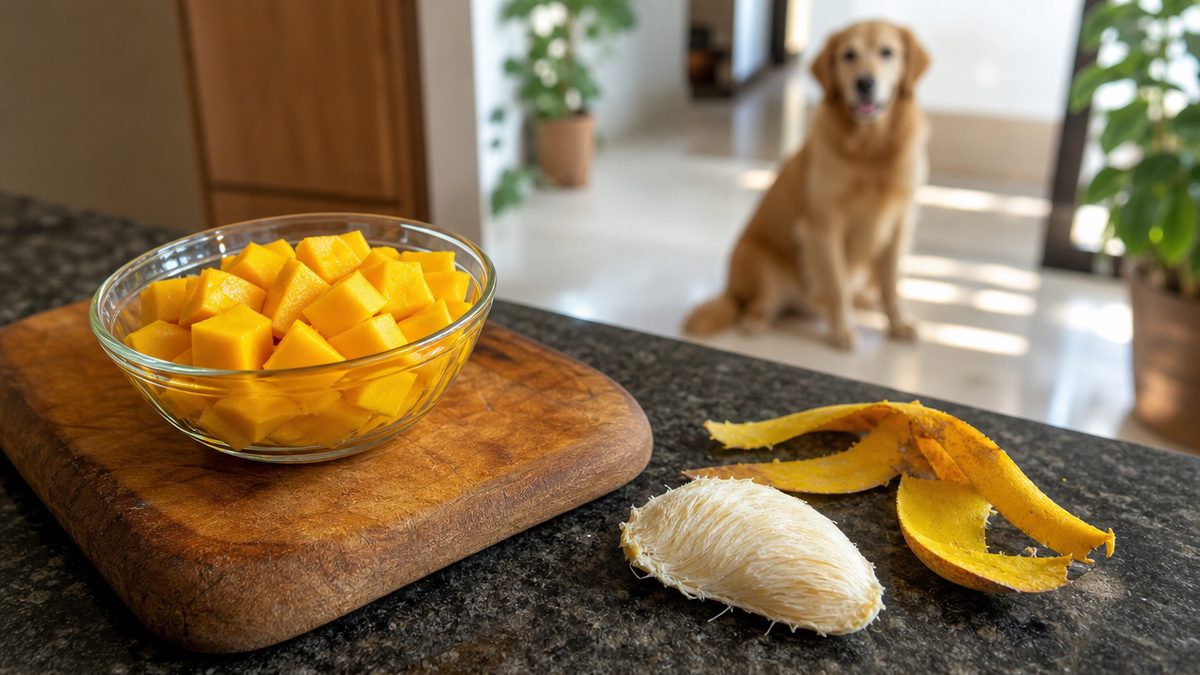
Sort the fruit into four parts before you decide anything.
| Part | What it is | The risk | What to do |
|---|---|---|---|
| Flesh (mesocarp) | Ripe pulp, 7.77 to 9.24 g of free sugars per 100 g | Energy and sugar load only. No toxin. | Feed it, peeled, cut off the stone, within a counted portion size |
| Stone (endocarp plus kernel) | A smooth woody object weighing 13.50 to 28.36 g and running most of the fruit's length | Intestinal obstruction. Surgical, not wait and see. | Bin it where the dog cannot reach it, every single time |
| Skin | Tough peel carrying 5-resorcinol, the mango relative of urushiol | Contact reaction in sensitised individuals, plus a fibrous lump of nothing | Peel and discard |
| What people add | Aam panna, aamras, mango pickle, chutney, murabba, amchur | Salt, sugar, chilli, mustard oil. The additions, not the mango. | Treat each as its own food, not as mango |
If you remember one thing from this page, remember that the dangerous part of a mango is the part you were going to throw away anyway. The flesh is a treat with a portion size. The stone is a foreign body with a surgery attached.
Why this question is bigger in India than anywhere else
India ranks first in the world for mango production and consumption, at 20.6 million tonnes in 2020, which is 45 percent of global production, and more than 1,000 varieties are cultivated here. The National Horticulture Board calls it the most important commercially grown fruit crop of the country and counts about 1,500 varieties, of which roughly 1,000 are commercial.
That scale turns into exposure. The peak season runs from April to July, and it is staggered by region: varieties from north and east India fruit late, from June into late August, while south and west Indian varieties come in across May and June. Andhra Pradesh is the single largest producing state at about 4.7 million tonnes a year, followed by Uttar Pradesh and Bihar. A household in Delhi is cutting Dasheri and Chausa. One in Mumbai or Pune is cutting the Alphonso and Pairi that Maharashtra grows down the Ratnagiri, Sindhudurg and Raigarh coast. One in Chennai is cutting Banganapalli and the Totapuri that Tamil Nadu and Karnataka also call Bangalora, supplied from the Karnataka belt the horticulture board lists as Kolar, Bangalore and Tumkur. One in Hyderabad is cutting Banganapalli and Suvarnarekha, one in Kolkata is cutting Himsagar, and one in Ahmedabad is cutting Kesar National Horticulture Board.
The calendar is set by the rains. Dry weather before blossoming is what produces profuse flowering, rain during flowering is detrimental to the crop, and heavy rain during ripening damages the fruit. So most of India's mango is picked and eaten in the hot months before the monsoon breaks, and the raw fruit taken earlier in the same window is what becomes achar, amchur and panna for the rest of the year.
So for roughly four months a year, in most of the country, there is a stone on a plate at dog height every single day. That is a different kind of risk from a once-a-year festival food, and it is why this page is about the stone rather than about the sugar.
Two of the three dogs in the only published case series of mango-seed obstruction were guard dogs living on a mango farm, where fallen and rotting fruit litters the ground and the seeds sit within easy reach. The third was an indoor dog whose owner admitted the household had been eating a lot of mango for two days, and the dog took the stone out of the kitchen bin. Indian readers will recognise both animals.
The mango stone is the real hazard, and the reason is its shape
The mango stone causes trouble because it is large, smooth, indigestible and almost exactly the wrong size for a medium dog's small intestine. It is not sharp and it is not poisonous. It simply does not fit, and it does not go away.
Start with how big the object is. A study of twelve mango cultivars grown at Narendra Deva University of Agriculture and Technology in Faizabad, Uttar Pradesh, weighed the stone of each. The lightest was Gaurjeet at 13.50 g and the heaviest Dashehari at 28.36 g, with Samarbahist Chausa at 27.53 g and Zardalu at 26.33 g close behind. In a 169.00 g Dashehari, the stone is 16.8 percent of the whole fruit by weight. Pulp to stone ratios across the twelve ran from 2.82 in Lucknow Safeda to 6.66 in Banarasi Langra.
Weight understates the problem, because what blocks an intestine is dimension rather than mass. The same twelve fruits measured 5.63 cm to 9.37 cm long, and the stone runs most of that length. In a French military case the removed mango pit was an ovoid solid roughly 5 cm long, and that was in a 25.8 kg Belgian Malinois, a dog far larger than the Indian Spitz, Shih Tzu, Pomeranian or small indie that most Indian households keep.
The only published case series, and what happened to all three dogs
Three adult dogs were admitted to a surgery clinic with a single day of colicky abdominal pain, vomiting, loss of appetite, no defecation and lethargy: a three-year-old male indoor German Shepherd, a five-year-old male outdoor German Shepherd and a one-year-old female Rottweiler. Their blood counts, electrolytes and creatinine were all normal, which is the first useful warning: an early obstruction does not show up in routine bloods.
At laparotomy the obstruction sat in the jejunum in two dogs and the terminal ileum in the third, with the bowel above it distended and the bowel below it empty and collapsed. The surgeon tried to break or push the mass through by digital compression and could not. An enterotomy was performed in every case and a mango seed came out of all three. All three recovered and went home three days after surgery.
Note what that series is and is not. It is three dogs, from one clinic, reported because the author could find no previous report of mango seeds causing acute small intestinal obstruction in the veterinary literature. It is not a prevalence figure. Nobody can tell you what fraction of dogs that swallow a mango stone end up in surgery, because no one has counted.
The Indian case, and why it ended worse
India's published contribution is a single case inside a five-case review from the Referral Veterinary Polyclinic at ICAR-IVRI, Izatnagar, Bareilly. A three-year-old male Labrador retriever was presented with anorexia and no defecation for one week. Ultrasonography found a foreign body obstructing the intestine; exploratory laparotomy found a mango kernel in the jejunum.
The difference from the three-dog series is the week. By the time the dog reached the table the affected segment of intestine was necrosed, so a simple enterotomy was not enough. The surgeons performed an intestinal resection and anastomosis, cutting out the dead length of bowel and joining the ends, and they say plainly that resection was required because of loss of vascular integrity, to prevent toxaemia.
That is the whole argument for not waiting. In 208 consecutive first-opinion cases of gastrointestinal foreign bodies in dogs and cats, 91 percent of animals recovered overall, and survival was 94 percent in dogs with a discrete foreign body against 80 percent with a linear one. A longer duration of clinical signs, a linear foreign body and multiple intestinal procedures were each associated with significantly increased mortality. A mango stone is a discrete foreign body, which is the favourable category. Duration of signs is the variable you personally control.
The same series found that 63 percent of canine obstructions occurred in the jejunum, which is exactly where two of the three mango seeds were and where the IVRI kernel was. The mango stone behaves like the rest of its category, and the category is well described.
Across every case above, the mango stone came out through a cut in the intestine. Not one passed on its own, and in one dog digital compression by a surgeon with the bowel in his hands could not move it. Castor oil, ghee, extra food, a walk and a wait do not apply here. Telephone a veterinarian on the day it happens.
Why a mango stone is not like a swallowed bone
A mango stone differs from a bone in three ways, and each one changes what happens next. Our guide to bones for dogs in India carries the full clinical picture of a bone foreign body, with the oesophageal denominators and the emergency signs. This section covers only what is specific to a stone.
First, stomach acid does nothing to it. A bone that reaches the stomach is being actively dissolved from the moment it arrives, which is the whole reason the bone literature debates whether to feed bread on top. A mango endocarp is lignified plant tissue. It will sit in an acid bath indefinitely and come out the same shape it went in.
Second, it is smooth rather than sharp. In all three dogs of the case series there was no obvious bowel ischaemia, necrosis or perforation at the time of surgery. A mango stone is unlikely to cut its way out of the gut. What it does instead is sit there and block, which is slower, quieter and easier to miss.
Third, its surface is fibrous and hairy rather than hard all over, and the author of the case series thinks the shape itself is why it jams: a long, hard, rough object can obstruct the bowel obliquely while passing through the small intestine. It wedges across the lumen rather than plugging it end-on.
The disagreement about whether a mango stone shows up on an X-ray
Two published cases say opposite things about this, and we are publishing both rather than picking the convenient one.
The three-dog series reports that abdominal radiographs revealed many dilated small intestinal loops filled with gas and an intraluminal radio-opaque foreign body that completely obstructed the small bowel, and that all three dogs met the standard radiographic obstruction thresholds of a maximum small intestinal diameter to fifth lumbar vertebral body height ratio of 2.4 or more, a maximum to minimum diameter ratio of 3.4 or more, and a maximum to average diameter ratio of 1.9 or more. On that account the diagnosis was a plain film.
The French military case reports the opposite experience. The mass showed as an ovoid, tissue-dense structure surrounded only by a thin layer of gas opacity, and the authors state that segmental intestinal dilations are not universally present and that foreign bodies do not invariably manifest as visible lesions on radiographic imaging. They go further and say the dilation ratios were not consistent with their case, because the diameters were difficult to assess with so little gas present. They reached the diagnosis by adding an abdominal ultrasound, which confirmed a solid non-digestible object in an intraduodenal position.
The Indian case went the same way. The IVRI dog's obstruction was found on ultrasonography, not on a plain film, and in another dog in the same five-case review the cause of the obstruction could not be confirmed radiographically, which the authors attributed to the radiolucent nature of the foreign body.
A clear X-ray is not an all-clear. If you know a mango stone went down and the radiograph is unremarkable, ask whether an ultrasound is available, and say that two of the three published mango-stone cases were diagnosed sonographically rather than radiographically. That is a reasonable question to put to a clinician, and it is not a diagnosis you are making yourself.
The stone can sit silently for weeks before it obstructs
The French dog is the uncomfortable case. An eight-year-old Belgian Malinois had returned from a five-month deployment in Gabon, where the handler reported significant quantities of mangoes, one and a half months before he fell ill. The authors conclude the pit could not have been swallowed in France and had been ingested at least two months earlier. It remained in the stomach without causing any symptom the owner could detect, then passed the pylorus, probably on the day before or the day of the anorexia, and obstructed the intestine.
So a dog that swallowed a stone last week and seems fine is not necessarily out of it. A stone sitting in the stomach is not causing an obstruction yet; it becomes one the moment it leaves. The dog presented with two days of weakness and loss of appetite, vomiting undigested kibble with yellow fluid, a heart rate of 170, and a body condition score of 3 out of 9. Three months of quiet, then two days of this.
The practical reading is that the window for watchful waiting is longer than the window for safety. Tell your veterinarian about the stone even if the dog looks well, and tell them again if the dog goes off food weeks later.
What to do if your dog has already swallowed a mango stone
To handle a swallowed mango stone, telephone a veterinarian the same day, do not try to make the dog vomit, and do not wait for a symptom to arrive before you act.
- Remove the rest of it. Clear the plate, the bin and the floor before the dog goes back for a second stone, because mango is rarely eaten one at a time in an Indian household.
- Write down three things: the time, the cultivar or at least the size of the fruit, and your dog's current weight in kilograms. Every clinical decision after this is made on object size relative to the animal.
- Telephone the clinic now, not after a symptom. Duration of clinical signs is one of the few variables associated with increased mortality in canine foreign body obstruction, and it is the one in your hands.
- Do not induce vomiting at home ASPCA, Is It Ever Safe to Induce Vomiting? Blue Cross, Emergencies and first aid…. A 28 g woody object coming back up the oesophagus is a second problem, and whether to empty a stomach is a decision made on the animal in front of a clinician.
- Do not give any medicine, because Blue Cross puts it flatly, do not give a dog any human medication including painkillers. No laxative, no antacid, no painkiller from the human cupboard, no ghee, no castor oil.
- Ask about imaging, and ask about ultrasound specifically if the X-ray is unremarkable, for the reason set out above.
- Watch for vomiting, refusing food, no stool, a tense or painful belly, lethargy and colicky restlessness. Those are what all three case-series dogs presented with.
- Keep watching for weeks, not days, because a stone can sit in the stomach and obstruct later.
Nothing on this page tells you to medicate a dog or to make one vomit. Those are veterinary decisions made on an individual animal, and getting them wrong with an intestinal obstruction is worse than doing nothing. This page publishes under the medical disclaimer for that reason.
On cost, we will not give you a number we cannot stand behind. We could not find any published Indian price list for an exploratory laparotomy with enterotomy in a dog, and the figures that circulate online are American. What is certain is the shape of the bill: imaging, anaesthesia, abdominal surgery, two to three days of hospitalisation on intravenous fluids, and antibiotics and analgesia for five days afterwards Abu-Seida AM, Mango Seed Causing Acute…. Our guide to what a vet visit costs in India covers consultation and diagnostics, and building an emergency vet fund is the honest answer to a surgical bill nobody can quote you in advance.
One more rupee note worth keeping in proportion. India exported 21,033.58 tonnes of fresh mangoes in 2020-21, worth Rs 271.84 crore, which is ₹271.84 crore of fruit leaving the country. Against 20.6 million tonnes grown, essentially all of India's mango is eaten here, and essentially all of the stones are discarded here too.
Cyanogenic glycosides in the mango kernel, reported accurately
Mango kernel does contain cyanogenic glycosides, and obstruction still dominates the risk by a wide margin. Both halves of that sentence are true, and most pages on this subject get one of them wrong.
Cyanogenic glycosides are plant compounds that release hydrogen cyanide when the plant tissue is damaged and the glycoside meets its own hydrolysing enzyme. They are the reason apricot kernels and bitter almonds have a toxicology. The mango kernel, which is the soft seed inside the woody endocarp, is one of the plant materials that carries them.
Now the measurement. One study determined hydrocyanic acid in raw kernel flours from three fruits by the same method in the same laboratory. Mango raw kernel flour contained 37.20 plus or minus 3.74 mg per 100 g on a dry weight basis. Apricot raw kernel flour contained 189.90 plus or minus 9.91 mg per 100 g and peach 165 plus or minus 7.49 mg per 100 g. Mango carried the lowest cyanogenic content of the three by a factor of five, and soaking and heating removed it completely.
Against that, the veterinary toxicology reference gives two numbers. The acute lethal oral dosage of hydrogen cyanide in most animal species is approximately 2 mg per kg, and plant materials containing 200 ppm or more on a wet-weight as-fed basis of cyanogenic glycosides are dangerous. Two hundred parts per million is 20 mg per 100 g.
The arithmetic, and the three places it breaks
For a 10 kg dog, 2 mg per kg is 20 mg of hydrogen cyanide. At 37.20 mg per 100 g, that is about 54 g of dried mango kernel flour. A whole mango stone, husk and all, weighs 13.50 to 28.36 g, and the kernel is only the part inside the husk. So on the face of it a 10 kg dog would need to eat, chew and fully digest the kernels of several mangoes at once.
Three things break that sum, and we are stating all three rather than presenting a clean answer.
- Dry weight is not as-fed weight. The 37.20 mg figure is measured on dried, milled kernel flour, while Merck's 200 ppm danger threshold is specified on a wet-weight as-fed basis Radke S, Cyanide Poisoning in Animals. They are not directly comparable, and converting between them without the moisture content of the specific sample would be inventing a number.
- The sum assumes complete hydrolysis and complete absorption. A cyanogenic glycoside has to be released by tissue damage before it becomes cyanide. A dog that swallows a stone whole has not crushed the kernel at all, because the kernel is sealed inside a fibrous woody husk.
- Published values for mango kernel disagree by more than an order of magnitude. Other reports put the figure near 1 mg per 100 g and others far higher than 37 mg. We could not open those sources at their own pages on 21 October 2026 and are therefore not quoting them as measurements, only recording that the literature is not settled.
What nobody has measured, said plainly
There is no published canine dose for cyanide from mango kernel. There is no case report of a dog poisoned by cyanide from a mango that we could find. A search of the ASPCA toxic and non-toxic plant database on 21 October 2026 returned no entry for Mangifera indica in either direction, so the most-cited pet toxicology list has nothing to say about mango at all.
The animal-feed literature points the same way. A review of mango seed kernel as a poultry feed ingredient lists tannins, phytate, cyanide, antitrypsin, oxalate and saponins among its anti-nutritional factors, and then says that amongst these factors, tannins are largely responsible for the poor nutritional value. The same laboratory study that measured 37.20 mg of hydrocyanic acid per 100 g in raw mango kernel flour measured 513.76 mg of tannins per 100 g in the same material, 2.6 times the apricot figure, and 986.50 mg of total phenols. When feed scientists worry about mango kernel, they worry about tannins.
Saying a mango stone will poison your dog with cyanide is alarmist and unsupported. Saying it is harmless because the cyanide figure is low is worse, because it misses the thing that actually happens. The stone is a mechanical problem. Three published dogs went to surgery for it and none of them had cyanide poisoning.
Free sugars and portion size for an Indian mango
A healthy 10 kg dog's daily mango ceiling works out at 79 to 112 g of flesh, depending on cultivar, if mango is the only extra it gets that day. That is more than most pages allow and less than most households give.
Use Indian numbers for an Indian fruit. The Indian Food Composition Tables 2017, compiled at the ICMR-National Institute of Nutrition in Hyderabad, analysed seven named ripe mango cultivars separately, which is a level of detail no foreign table offers. Free sugars, meaning the sum of fructose, glucose and sucrose, ranged from 7.77 g per 100 g in Banganapalli to 9.24 g per 100 g in Totapuri. Energy ran from 175 kJ per 100 g in Banganapalli to 248 kJ in Totapuri, which is about 42 to 59 kcal.
The sugar profiles differ in kind, not only in amount. Banganapalli is sucrose-dominated, at 4.66 g sucrose against 2.38 g fructose. Totapuri is almost pure fructose, at 7.33 g fructose against 0.86 g sucrose. That matters less for a dog than the total does, but it is worth knowing that the two mangoes are not the same food.
Against that, the World Small Animal Veterinary Association's calorie table gives a healthy 10 kg adult dog in ideal body condition a daily requirement of 470 to 590 kcal, a 5 kg dog 280 to 351 kcal, and a 25 kg dog 940 to 1,174 kcal. Our Indian food guide for dogs sets the treat ceiling at one tenth of the day's energy, and the table below applies that to the lower end of each WSAVA range, which is the conservative choice.
| Cultivar (IFCT 2017) | Free sugars, g per 100 g | Energy, kcal per 100 g | 5 kg dog | 10 kg dog | 25 kg dog |
|---|---|---|---|---|---|
| Banganapalli | 7.77 | 42 | 67 g | 112 g | 225 g |
| Neelam | 7.94 | 43 | 66 g | 110 g | 221 g |
| Himsagar | 8.06 | 45 | 63 g | 105 g | 210 g |
| Paheri (Payri) | 8.48 | 45 | 62 g | 105 g | 209 g |
| Gulabkhas | 8.13 | 50 | 56 g | 94 g | 188 g |
| Kesar | 9.00 | 55 | 51 g | 85 g | 170 g |
| Totapuri | 9.24 | 59 | 47 g | 79 g | 159 g |
Read the table as an upper bound for a healthy dog, not a target. It assumes mango is the only thing crossing the treat line that day, which in a real Indian kitchen in June it will not be. Halve it if the dog also got a piece of roti, and halve it again for a dog on a weight plan.
To picture the grams: a Dashehari weighing 169.00 g yields about 114.17 g of pulp, and a Banarasi Langra weighing 186.67 g yields about 135.50 g. So a 10 kg dog's ceiling is roughly three quarters of one small north Indian mango, and a 5 kg dog's is roughly half.
Three Indian sources disagree about how sugary a mango is
This is worth publishing rather than smoothing over, because the disagreement is large and it moves the portion.
ICMR-NIN's IFCT 2017 puts free sugars at 7.77 to 9.24 g per 100 g across seven cultivars. The Faizabad study measured total sugars, meaning reducing plus non-reducing sugars, at 13.74 percent in Gulab Khas to 15.54 percent in Banarasi Langra across twelve cultivars. The National Horticulture Board states flatly that good mango varieties contain 20 percent of total soluble sugars. Lowest to highest, that is a factor of 2.6.
The methods are not the same, which is most of the explanation. IFCT's free sugars are the measured individual sugars summed. The Faizabad total sugars were determined by a standard fruit-analysis titration and sit alongside total soluble solids of 16.19 to 20.78 degrees Brix in the same table, and total soluble solids include acids and other solutes, not only sugar. The NHB figure reads like a restatement of that Brix range.
We have used IFCT because it is the national food composition standard and because it reports energy measured on the same samples. If the higher figures are nearer the truth, a 100 g serving carries closer to 65 or 70 kcal than 42 to 59, and a 10 kg dog's ceiling falls to roughly 70 g rather than 79 to 112 g. Either way the number is a portion, not a ban.
Is mango a laxative, and why the stool goes soft
Loose stool after mango is common and it has a named mechanism. In many species including dogs and cats, either poorly digestible carbohydrates or an overload of simple sugars in the gastrointestinal tract may cause adverse changes in intestinal metabolism, including osmotic diarrhoea and flatulence. A dog that is handed half a mango has just taken an overload of simple sugars, and the mango's own fructose dominance in cultivars like Totapuri is exactly the shape of that problem.
Fibre adds a smaller second effect. IFCT puts total dietary fibre in ripe mango at 1.55 to 2.02 g per 100 g, of which 0.64 to 0.98 g is soluble. Soluble fibre dissolves in water and, where it forms a gel, slows gastric emptying and increases transit time through the small intestine, while the water content of the faeces is inversely proportional to stool viscosity. Insoluble fibre works the other way, increasing faecal bulk and stimulating peristalsis.
The National Horticulture Board, writing about people rather than dogs, records that the ripe fruit has fattening, diuretic and laxative properties. We have found no canine study of mango and stool at all, so treat the soft stool as a predictable response to a sudden sugar load in an unaccustomed gut rather than as a property of mango.
The first time a dog eats mango, give one small cube and leave it a day. Diarrhoea from mango is usually a dose and novelty problem rather than an intolerance, and a dog that handles 10 g will handle 50 g a week later. Diarrhoea that lasts beyond a day, or comes with blood, lethargy or vomiting, is a veterinary call and not a mango question.
Mango skin, urushiol and what is actually known
Mango skin carries 5-resorcinol, the compound that cross-reacts with urushiol from poison ivy, and the evidence behind that is human rather than canine. The practical instruction survives the gap anyway: peel it.
Mango belongs to the Anacardiaceae, the same plant family as poison ivy and poison oak, which carry high levels of urushiol. Cross-sensitisation between those plants and mango is attributed to an overlap between the urushiol antigen and 5-resorcinol, found predominantly in the skin, leaves and stems of mango fruits, where it sits alongside other phenols collectively known as mango latex.
The reaction is a type IV hypersensitivity, mediated by T cells rather than antibodies, and it is delayed. After initial sensitisation to urushiol, subsequent exposure produces a cell-mediated memory response after two to three days. In the reported human case the rash began four days after the patient had handled and eaten two mangoes, and his wife, who ate the same mangoes and handled the same peels but had no history of poison ivy, was unaffected.
Two findings from that paper matter for a pet owner. Mango pickers with severe rashes were found to have had prior exposure to poison ivy or poison oak compared with pickers who had mild or no rashes working in the same conditions. And the allergens appear to be negligible in the actual fruit of the mango, so people with a history of mango dermatitis may still eat the fruit if it is peeled by someone else.
What this does and does not mean for a dog
It means the compound is real and it is concentrated in the part you were going to peel off. It does not mean your dog has a mango allergy. We found no canine case series of mango contact dermatitis, no veterinary prevalence figure and no reported dose. Poison ivy is not an Indian plant, so the sensitisation route described in that paper does not apply to Indian dogs in the way it applies to a patient in Texas.
What a dog does have is a muzzle. A dog that noses a pile of peels in a kitchen bin, or chews the skin off a mango it has stolen, gets the latex on the hairless skin around its lips and nose and then licks it. If your dog reliably develops a red, itchy muzzle in mango season and nowhere else, that is worth describing to a veterinarian, including the two to three day delay, because the timing is the diagnostic clue in the human literature. Our page on atopic dermatitis in dogs covers itchy skin that is not seasonal in this way.
There is also a duller reason to peel. Mango skin is tough and fibrous, it delivers almost nothing, and it is one more thing in the gut of a dog that has already swallowed something it should not have.
Aam panna, aamras, mango pickle and chutney
Aam panna, aamras, mango pickle and mango chutney each change the answer completely, because in all four the additions matter more than the mango. This is the half of the question that no page covering mango and dogs addresses.
India does not mostly eat mango as a cut fruit. The National Horticulture Board lists the traditional products made from raw mango as raw slices in brine, amchur, pickle, murabba, chutney and panhe, the sharbat that most of the country calls aam panna. Totapuri and Alphonso alone account for about 90 percent of India's processing volume, with Totapuri at roughly 76 percent. The mango that reaches most dogs has been through a kitchen.
- Aam panna. Raw mango pulp, sugar or jaggery, black salt, roasted jeera and often mint. The salt is the reason to say no, not the mango. Salt is the one seasoning in an Indian kitchen with a published canine toxic dose, and our spices, salt and masala guide carries that dose and the arithmetic. Do not give aam panna to a dog; give water.
- Aamras. Mango pulp, usually sweetened, often loosened with milk or curd. The sugar arithmetic is below. If there is dairy in it, our dairy for dogs guide owns that question and sets the portion.
- Mango pickle, aam ka achar. Salt and oil here are preservation rather than seasoning, which is how a cut raw mango survives a monsoon and the humid months after it in an Indian kitchen with no refrigeration. Indian pickle is the saltiest category measured in Indian packaged-food surveys, and our spices, salt and masala guide carries those measured figures and the dose they have to be read against. The answer is no, and the reason is the brine, not the fruit.
- Mango chutney. Sugar, chilli and frequently garlic. Garlic has its own toxicology, covered in our guide to onion and garlic toxicity in pets, and chilli belongs to the spices page. Another no.
- Amchur and murabba. Dried raw mango powder is concentrated acid and usually arrives inside a masala, so it travels with everything else in the blend. Murabba is mango preserved in sugar syrup. Neither belongs in a dog.
Aamras, in grams
A 150 g katori of plain mango pulp, before anybody adds a spoon of sugar, carries about 12 to 14 g of free sugars and 63 to 89 kcal, working from the IFCT cultivar range. For a 10 kg dog on the lower end of the WSAVA range that is 13 to 19 percent of the entire day's energy, from one small bowl, before the sugar goes in.
That is the honest reason aamras is a worse idea than mango. It is the same fruit with the fibre broken down, served in a quantity nobody would hand over as fruit, with added sugar that is never measured and often dairy on top. If you want to give your dog mango, give it mango.
Raw mango, kachcha aam, is a different food
Raw green mango is sourer and less sugary than ripe, and India's own food composition tables treat it as a separate item: ICMR-NIN lists green raw mango in the vegetables group rather than the fruits group. Across twelve ripening cultivars at Faizabad, titratable acidity ran from 0.24 percent in Samarbahist Chausa to 0.49 percent in Rataul, and an unripe fruit sits above that range.
A small piece of plain raw mango is not toxic to a dog. It is simply sour enough that most dogs decline it, more acidic on an empty stomach, and almost never served plain in an Indian household. By the time raw mango reaches a table it is usually panna, achar or chutney, and then the answer is governed by the salt, sugar and spice rather than by the fruit.
Take the dog's piece out before anything is added. Peel a slice, cut it off the stone, put it in the dog's own bowl, and then go and make the panna or the aamras for everybody else. The same instruction protects the dog from the salt, the sugar, the chilli and the stone in one motion.
Diabetic dogs, overweight dogs and the dogs who should skip it
A diabetic dog and an overweight dog need mango counted rather than banned, and the counting is not something this page can do for you.
The portion table above assumes a healthy adult at ideal body condition on the WSAVA maintenance range. Two groups of dogs fall outside that assumption and both are common in Indian cities.
A dog on a weight-reduction plan is eating below maintenance by design, so the treat allowance shrinks with the ration rather than staying at a tenth of a healthy dog's figure. Our page on obesity in dogs and cats covers how that ration is set, and our dog diet chart for India carries the daily grams by weight.
A diabetic dog is a different conversation again, because the question is not only how much sugar but when it arrives relative to insulin and meals. That is managed by the veterinarian who set the treatment, and it is covered on our page on diabetes in dogs and cats. Bonbeno names no insulin and no dose, and a fruit page is the wrong place to improvise around a prescription.
Two more groups deserve a line. A puppy's gut handles a novel sugary food worse than an adult's, so start smaller. And a dog with any history of gastrointestinal foreign body is a dog for whom the mango stone rule is absolute rather than advisory, because the behaviour that put the first object in the gut has not changed.
Cats and mango, in short
Cats mostly ignore mango, and the reason is genetic rather than fussiness. This section is short because the honest answer is short.
Domestic cats possess an otherwise functional sense of taste but, unlike most mammals, do not prefer and may be unable to detect the sweetness of sugars. The mammalian sweet-taste receptor is a heteromer of two proteins encoded by Tas1r2 and Tas1r3. In the cat, Tas1r3 is apparently functional and expressed, but Tas1r2 carries a 247 base pair microdeletion in exon 3 and stop codons in exons 4 and 6, making it an unexpressed pseudogene. A functional sweet-taste receptor cannot form, so the cat lacks the receptor likely necessary for detecting sweet stimuli.
So a cat that shows interest in your aamras is interested in the texture, the fat of the milk in it, or the fact that you are eating. It is not tasting the sweetness, and there is no reason to offer it. Our guide to Indian food safe for cats sets out why the feline list is so much shorter than the canine one.
The stone hazard is not species-specific. A cat is smaller than every dog in the published cases, so a mango stone is, if anything, a worse object for a cat's intestine than for a dog's. The 208-case foreign body series included cats, and survival in cats with a discrete foreign body was 100 percent, while survival in cats with a linear foreign body fell to 63 percent. Cats are far likelier to swallow string than a mango stone, which is why the stone is a dog page. Bin it anyway.
What this page can prove, and what it cannot
Five things on this page are measured, and five are gaps we are naming rather than filling.
What is measured, at a source we opened.
- Free sugars, energy and fibre in seven named ripe Indian mango cultivars, from the national food composition tables.
- Mango stone weight and pulp to stone ratio across twelve cultivars grown in Uttar Pradesh.
- Three dogs whose mango-seed obstruction needed an enterotomy, and one Indian dog whose week-long delay turned an enterotomy into a resection and anastomosis Kumar R, Verma NK, Saxena AC.
- Survival and site data for 208 consecutive canine and feline foreign body cases.
- Hydrocyanic acid in raw mango kernel flour against apricot and peach by the same method, and the general animal lethal oral dose of hydrogen cyanide.
What we could not establish, and what we did instead.
- There is no Indian denominator for mango-stone obstruction. India publishes case reports, not counts. We have reported the single IVRI case as a case and not as a rate.
- There is no canine cyanide dose for mango kernel, and no reported case of a dog poisoned by one. We have refused to estimate one, and have instead given the general animal figure and said what it does not cover.
- There is no canine mango dermatitis series. The urushiol and 5-resorcinol evidence is human, and we have labelled it as human throughout.
- There is no published rupee figure for what an enterotomy costs an Indian owner. We have described the components of the bill rather than invent a total.
- Three Indian sources disagree about mango sugar by a factor of 2.6 Singh A and Pathak S National Horticulture Board. We have published all three, named the methods, and shown how the portion moves if the higher figures are right.
One more absence worth recording. A search of the ASPCA toxic and non-toxic plant database on 21 October 2026 returned no entry for Mangifera indica, so the most widely quoted pet plant list classifies mango neither as toxic nor as safe. Absence of a listing is not evidence of safety, and it is not evidence of danger either.
Common questions about dogs and mango
Is mango toxic for dogs?
No, ripe mango flesh is not toxic to dogs. No veterinary toxicology reference assigns mango flesh a toxic dose, and a search of the ASPCA plant database on 21 October 2026 returned no entry for Mangifera indica in either direction. The risks are mechanical and nutritional rather than toxic: the stone obstructs the intestine, the skin carries a contact allergen documented in people, and the flesh carries 7.77 to 9.24 g of free sugars per 100 g.
What happens if a dog swallows a mango pit?
A swallowed mango pit can lodge in the small intestine and block it, which is a surgical emergency. In the only published case series, three dogs presented with one day of colicky pain, vomiting, no defecation and lethargy. The seeds sat in the jejunum in two dogs and the terminal ileum in one. A surgeon could not push any of them through by hand, so all three had an enterotomy and all three recovered and went home on the third day.
Is a mango pit poisonous to dogs?
The mango kernel inside the pit carries cyanogenic glycosides, and the obstruction risk dominates by a wide margin. One laboratory measured hydrocyanic acid in raw mango kernel flour at 37.20 mg per 100 g on a dry weight basis, against 189.90 mg in apricot kernel flour by the same method. There is no published canine dose for mango kernel and no reported case of a dog poisoned by one, and a swallowed stone is not crushed, so the glycoside is never released.
Can I give my dog a mango stone?
No. Never give a dog a mango stone to chew. It is a smooth, indigestible object weighing 13.50 to 28.36 g across Indian cultivars and running most of the fruit's length, which is close to the worst possible shape for a medium dog's small intestine. Stomach acid does not dissolve it the way it dissolves bone, and in every published case the stone came out through a cut in the gut wall. Bin it where the dog cannot reach it.
How much mango can I feed my dog?
Keep ripe mango flesh to about 79 to 112 g a day for a healthy 10 kg dog, 47 to 67 g for a 5 kg dog and 159 to 225 g for a 25 kg dog, with the lower figure for Totapuri and the higher for Banganapalli. Those are one tenth of the lower end of the WSAVA daily energy range, and they assume mango is the only extra that day. Halve them for a dog on a weight plan.
Is mango a laxative for dogs?
Mango loosens stool in dogs mainly through sugar rather than fibre. An overload of simple sugars in the gut can cause osmotic diarrhoea and flatulence in dogs and cats, and a dog handed half a mango has taken exactly that. Ripe mango adds only 1.55 to 2.02 g of total dietary fibre per 100 g. Start with one small cube, wait a day, and treat diarrhoea lasting beyond a day as a veterinary question.
Is raw mango okay for dogs?
A small piece of plain raw mango is not toxic to a dog, and it is rarely the real question. Raw green mango is more acidic and less sweet, so most dogs decline it, and India's food composition tables classify green raw mango as a vegetable rather than a fruit. In practice raw mango reaches the table as aam panna, achar or chutney, and then the salt, sugar and spice decide the answer rather than the fruit.
Is mango juice safe for dogs?
Skip mango juice, aamras and aam panna. A 150 g katori of plain mango pulp alone carries about 12 to 14 g of free sugars and 63 to 89 kcal, which is 13 to 19 percent of a 10 kg dog's daily energy before anyone adds sugar. Aam panna adds black salt, which is the real objection. If the aamras is loosened with milk or curd, that is a separate question again. Give the dog plain mango flesh and water.
Why do cats love mango?
Most cats do not love mango, and a cat that shows interest is not tasting sweetness. Domestic cats carry a 247 base pair microdeletion and premature stop codons in Tas1r2, one of the two genes encoding the mammalian sweet-taste receptor, making it an unexpressed pseudogene. The receptor cannot form, so cats cannot detect sweet stimuli. A cat nosing at your aamras is responding to texture, to the milk in it, or to you.