
Dog care guide
Things to do with your dog in India, by life stage: puppy, adult and senior activities with the heat hours, the rules and the rupee costs
Three activity tables, one per life stage, each row carrying what the activity does for the dog and the source that says so, the Indian constraint on it, and the rupee cost where a venue prints one. Plus dog walking as its own section: how much by breed, the coolest hour in your city, the lead rule, and what walkers charge.
Quick answer
Things to do with your dog in India change with the AAHA life stage: a puppy does carried socialisation outings, a class from 7 to 8 weeks and car rides; an adult does a breed-sized daily walk, a weekly training or scent session, a pool slot and a leashed park picnic; a senior does shorter sniff walks and puzzle feeders. Every outdoor row sits in the pre-dawn hour from April to June, because 372 of 551 recorded exertional heat events followed an ordinary walk.
What decides the activity: the dog's life stage and four Indian limits
The right things to do with your dog depend on the AAHA life stage the dog is in and on four Indian limits that no activity list mentions: the heat hours, the monsoon, the community dogs already living in the park, and the leash rule of the city you walk in. AAHA's 2019 guideline defines a puppy as birth to the end of rapid growth, about 6 to 9 months, a young adult to 3 or 4 years, a mature adult until the last 25 percent of expected lifespan, and a senior from there to the end of life.
Every row in the three tables below carries the same four things: the activity, what it does for the dog with the study or guideline that says so, the Indian constraint on it, and the cost where a venue prints one on its own page. Where no venue prints a fee, the row says so rather than borrowing a number from a reel. The guideline behind all three tables is the same AAHA line, repeated for every stage: exercise, mental stimulation and enrichment 'appropriate for age, breed, and temperament', with daily exercise needs discussed at every visit and continued training classes recommended 'for behavior, socialization, and well being';.
| Limit | What it means for an outing | Where it comes from |
|---|---|---|
| Heat hours | Delhi averages 35 C from 08:30 to 18:30 IST in June and its coolest hour is 04:30 at 29.1 C; Mumbai's block is 10:30 to 16:30 in April with 05:30 the coolest at 24.7 C | NASA POWER hourly means 2019 to 2023, this guide's own query; the nine-city table sits on the heat guide |
| Monsoon | 80 percent of 162 dogs examined in Mumbai and 75.3 percent of 162 in Delhi carried ticks in a June to September survey | Abd Rani and colleagues, 2011, 525 dogs in four cities |
| Community dogs at the park | A street dog is released 'at the same place or locality from where they were captured' after sterilisation, so the dogs at your park are legally resident; feeding spots must sit away from children's play areas | Animal Birth Control Rules 2023, rules 11(19) and 20 |
| Leash and muzzle rules | Chandigarh: leashed at 1.5 to 2.0 metres outdoors, and seven named gardens closed to dogs; Delhi: no aggressive dog in a public place without a muzzle, Rs 500 for an unscooped poop | Chandigarh Pet and Community Dogs Bye-laws 2025, clauses 4(b) and 5; MCD pet registration terms, clauses 9 and 10 |
The heat limit is the one that reorders every other row. Exertion, not a hot car, triggered 74.2 percent of 1,259 heat-illness events in the UK study that deconstructed the causes, and of the 551 exertional events whose exercise type was recorded, 372, which is 67.5 percent, followed an ordinary walk, 97 followed running or cycling and 76 followed play. In India the heat-wave season runs March to June with May the peak month, and IMD's own do's and don'ts say to avoid strenuous activity when the outside temperature is high, to avoid the outdoors between 12 noon and 3 pm, to carry water, and never to leave children or pets in parked vehicles. So the tables put every outdoor row in the pre-dawn hour from April to June and treat an IMD orange or red alert as a no-walk day, the rule the heat safety guide sets out city by city.
Things to do with a puppy, 8 weeks to about 9 months
The things to do with a puppy are socialisation outings before the vaccine course is finished, because the AVSAB position statement says the primary socialisation window is the first three months of life, that puppies should meet 'as many new people, animals, stimuli and environments as can be achieved safely', and that this should be 'the standard of care for puppies to receive such socialization before they are fully vaccinated';.
The reason AVSAB gives is a denominator most Indian owners never hear: behavioural problems, not infectious disease, are 'the number one cause of death for dogs under three years of age', and the number one cause of surrender to shelters, so the risk of infection from a careful outing is 'relatively small compared to the chance of death from a behavior problem';. The Finnish survey of 6,000 pet dogs measured what under-socialisation costs later: dogs with less socialisation during puppyhood were more likely to fear other dogs (chi-squared 82.91, p below 0.001) and to fear strangers, and dogs living in a more urban environment were more fearful still. AAHA adds that a survey found only one-third of puppies were getting exposure to people and dogs outside the home during the sensitive period, and states there is 'no medical reason to delay puppy classes or social exposure until the vaccination series is completed' provided sick animals are excluded and hygiene is kept.
| Activity | What it does for the puppy, and who says so | Indian constraint | Cost |
|---|---|---|---|
| Puppy class from 7 to 8 weeks | AVSAB: classes can start at 7 to 8 weeks with one set of vaccines at least 7 days before the first class and a first deworming; classes 'more quickly improve their responsiveness to commands' and are the safest way to socialise | Classes are a metro service; where none exists, run the puppy training basics at home and stage the outings below yourself | No class publishes a fee on the pages this guide opened; not priced here |
| The carried walk | AVSAB: exposure to people, places and traffic in the first three months, in arms or a sling until the course is complete; AAHA: positive and structured exposure during sensitive periods | Dog parks and areas 'highly trafficked by dogs of unknown vaccination or disease status' are to be avoided, which in India means the street pack; rule 8(1) of the ABC Rules makes the owner responsible for the puppy's vaccination | Free |
| Car rides | AVSAB: puppies should accompany owners 'on as many car trips as possible'; the Rule of Sevens asks for seven one-mile car rides by 7 weeks | IMD: never leave a pet in a parked vehicle; the ride is the activity, the parked car is the hazard | Free |
| Surfaces, stairs, tunnels and seven food bowls | AVSAB: 'a variety of surfaces, tunnels, steps, chutes' enrich the puppy's environment; the Rule of Sevens lists seven substrates, seven containers and seven locations by 7 weeks | The monsoon-proof row: all of it happens indoors, on a wet balcony or a stairwell | Free |
| Meeting vaccinated adult dogs | AVSAB: expose to 'well-socialized animals'; Puurunen 2020, N = 5,973: poor puppy socialisation raised the odds of fearing other dogs | A friend's vaccinated, sterilised adult is the partner; a community dog of unknown vaccination status is not, however friendly | Free |
| Handling and grooming practice | AVSAB: puppies 'should be handled from birth, learning to accept manipulation of all body parts'; AAHA lists desensitisation and grooming needs at the puppy visit | Ears and paws in the monsoon are the parts that need it most; the routine is in dog grooming at home | Free |
| Alone time with a stuffed food toy | AVSAB: time 'must be scheduled for puppies to play alone' with a stuffed food toy or nap in a crate, which 'may help to prevent problems of over attachment' | The apartment row: the one activity that prepares a puppy for a working household | A toy; no price sourced |
| Short lead walks after the course | AAHA: daily exercise 'appropriate to age, breed and temperament'; no guideline body sets a minutes-per-month figure, and the '5 minutes per month of age' line on wagNbush's Bengaluru page is that walker service's own rule | Pre-dawn only from April to June; the vaccination course that opens the pavement is on the dog vaccination schedule | Free |
| First train ride, in a basket | IRCTC: 'puppies/kittens which can be carried in a basket can be carried by owners in any class after payment of usual booking charges' | AVSAB: a crate-trained puppy 'will be less stressed if they must be ... confined for travel'; the booking steps are on pets on trains | The usual booking charges, per the trains guide |
AVSAB's one exclusion is specific: 'visits to dog parks or other areas that are not sanitized and/or are highly trafficked by dogs of unknown vaccination or disease status should be avoided';. In an Indian colony that is the pavement outside the gate, because the ABC Rules return every sterilised street dog to 'the same place or locality from where they were captured';. Carry the puppy there, let it watch, and walk it on a clean terrace, a friend's floor or a car park until the course on the dog vaccination schedule is complete. Your nearby vet decides the date for your puppy.
The Rule of Sevens is the checklist the two Google questions about a '7 7 7 rule' point at, and it is a breeder's tool rather than a guideline: by 7 weeks a puppy should have been in seven locations, eaten from seven containers, been held by seven people, taken seven car rides, been crated seven times, played with seven kinds of toy, walked on seven substrates and met seven challenges such as a box, a tunnel or steps. A puppy that arrives at 8 weeks has usually had none of it, so the table above is the same list run in the first month home.
Things to do with an adult dog, from the end of growth to the senior years
The things to do with an adult dog are a daily walk sized to the breed, one training or activity session a week, and the outings the city allows, because the Finnish survey of 6,000 dogs found that dogs walked less than one hour a day had 1.58 times the odds of fearing other dogs of dogs walked more than three hours, and dogs that took part in activities or training only seldom or never had 1.54 to 1.56 times the odds of dogs that trained sometimes or weekly.
AAHA calls the years from 6 months to 3 the most challenging for an owner, 'as the dog matures socially and behaviorally', and asks vets to discuss breed-specific behaviours, individual exercise needs and 'appropriate cognitive engagement' so that expectations are realistic and unruly behaviour is managed rather than punished. The second Finnish survey, of 13,700 dogs, found the same pattern for non-social fear: dogs afraid of fireworks, thunder, new situations or surfaces had 'participated less frequently in activities or training' and lived in more urban environments. An Indian flat is that urban environment, so the table treats the weekly session as a need rather than a treat. Agility, flyball and tracking, the sports the US lists lead with, exist in India as a handful of metro clubs, so the weekly class is the realistic form of the same idea; and the swimming pool, the road trip and the flight are the outings where the venue's rules and the carrier's rules decide more than the dog does.
| Activity | What it does for the dog, and who says so | Indian constraint | Cost |
|---|---|---|---|
| The daily walk | Puurunen 2020, N = 5,973: under one hour a day, 1.58 times the odds of fear of dogs versus over three hours; the Kennel Club sets 'more than 2 hours per day' for a Labrador and a German Shepherd and 'up to 1 hour' for a Beagle or a Pug | The coolest hour of the hottest month is 04:30 in Delhi and 05:30 in Mumbai; 372 of 551 recorded exertional heat events followed a walk, not a run | Free, or Rs 102 to Rs 199 a walk on the walker pages below |
| Sniff walk and nose work | A 2026 pilot of 26 dogs found more formal nose work training went with less giving up on an unsolvable task and higher owner-rated executive function, with no fitness difference between groups | Monsoon-proof: a scent search runs indoors on a wet day; the method is in puppy training basics | Free |
| Trick training and a weekly class | AAHA: 'recommend continued training classes for behavior, socialization, and well being' at every stage; Puurunen: seldom or never, 1.54 to 1.56 times the odds of social fear | In Chandigarh a dog trainer must register with the Municipal Corporation (clause 15 of the 2025 bye-laws); ask any trainer which body they answer to | No trainer prices a class on the pages this guide opened |
| Swimming | The one summer activity a venue schedules around heat: Pune Pet Park tells patrons to avoid the 12:30 and 14:45 slots in summer because 'your pet may get a heat stroke', requires vaccination proof, refuses dogs with ticks, cuts or skin infection, and caps a first-timer at 20 minutes | Pool 8 am to 5 pm, closed Thursday, slot booked in advance, no walk-ins; a Rs 600 penalty for a dog found with ticks and a Rs 3,000 fine for vomiting or defecating in the pool | Rs 1,000 per dog for a two-hour non-member slot plus Rs 500 one-time registration and Rs 300 per person (Pune); Rs 499 an hour at Therpup, Bengaluru |
| Hiking and running | Hall 2020: 97 of 551 exertional heat events (17.6 percent) followed running or cycling; young male dogs had the greatest odds of exertional heat illness | Pre-dawn, water carried, and never on an IMD orange or red day; hill-station forecasts come from the local IMD page, not a city table | Free |
| Dog park and off-leash play | AAHA lists dog parks under infectious and parasitic disease exposure at every life stage; AVSAB bars them only for unvaccinated puppies | Hyderabad's GHMC dog park at Gachibowli is the one municipal dog park this guide found, and GHMC publishes no fee page; Chandigarh's clause 5 closes Sukhna Lake, the Rose Garden and five other gardens to dogs | GHMC: no fee on any corporation page on 18 September 2026; third-party listings print Rs 20 and Rs 50 and disagree |
| Picnic in a public park | AVSAB: exposures 'should continue into adulthood to maintain an outgoing and sociable dog' | Sunder Nursery, Delhi: dogs on a leash, entry blocked if a pet is seen off it, away from water bodies and the wilderness zone, carry a bag; summer hours 7 am to 10 pm | Rs 50 adult ticket, Rs 25 for a child; no dog fee printed |
| Pet-friendly cafe | AAHA: 'encourage adult training and active lifestyle based on the individual'; a cafe is a settle-on-a-mat exercise with distractions | Therpup's Bengaluru site prices its pool, not its cafe entry; the entry charge circulates on social posts, which this guide does not quote | Not printed by a venue page this guide opened |
| Train travel, road trips and air travel | IRCTC: dogs travel in First AC or First Class 'only when entire 4 berth cabin or 2 berth coupe is allotted to a single PNR'; booking opens after the first chart and closes at the final chart; a road trip is the AVSAB car ride at length, with the IMD rule of never leaving a pet in a parked vehicle | Freight is paid through the SBI gateway and 'no refund of the freight charges is admissible', even if the train is cancelled; the tariff is on pets on trains and the airline rules on pets on flights | The Railway freight, per the trains guide |
| Volunteering with the colony's dogs | ABC Rules 2023, rule 20(1)(iv): designated feeders 'are allowed to volunteer for the vaccination, catching and release of dogs' in the ABC programme | Chandigarh registers volunteers, dog lovers and NGOs under clause 12; the rest of the law is on free-ranging dogs and feeding community dogs | Free |
How to build an adult dog's week around the Indian calendar
- Fix the walk hour by city, not by habit. From April to June the walk is the pre-dawn hour, 04:30 to 05:30 IST in Delhi and Mumbai, and the evening walk waits until the mean falls under 35 C, which is 19:30 in Delhi and 17:30 in Mumbai.
- Put one session a week on the calendar. A class, a trick session or a scent game, because 'seldom or never' is the level that carried 1.54 to 1.56 times the odds of social fear.
- Book the pool for the morning. Pune Pet Park's first slot is 8 am, its last 2:45 pm, and its own guidance is to skip the two afternoon slots in summer.
- Choose the park by its rules, then read the leash length. Sunder Nursery blocks entry to an off-leash dog; Chandigarh sets the lead at 1.5 to 2.0 metres and names the gardens that are closed Municipal Corporation Chandigarh.
- Book the train after the first chart. IRCTC opens the dog booking only once the first chart is prepared and refunds nothing on cancellation.
Things to do with a senior dog, the last quarter of expected life
The things to do with a senior dog are shorter, more frequent and more scent-led versions of the adult list, because in the Dog Aging Project's sample of 11,574 dogs aged 6 to 18, each unit of physical activity halved the odds of a clinical score for canine cognitive dysfunction (odds ratio 0.53, 95 percent CI 0.45 to 0.63), with 287 dogs over the clinical threshold.
The authors say plainly that a cross-sectional study 'cannot determine causality': a dog already losing its mind may simply move less. What it does show is that the active senior is the one with the better cognitive score, and AAHA's senior rows ask for exactly that kind of dog: routine evaluation for cognitive changes, environmental adaptations for mobility, sight and hearing, traction on floors and stairs, and an awareness that a dog that 'may not hear approaching vehicles' or people is at more risk on the road and more likely to bite when startled. Heat weighs on the senior twice: a dog of 12 years or more had 1.75 times the odds of heat-related illness of a dog under two, and older dogs had the greatest odds of the environmental kind, the hot room, the terrace, the parked car.
| Activity | What it does for the dog, and who says so | Indian constraint | Cost |
|---|---|---|---|
| Two or three short walks a day | Bray 2023: activity and cognitive score move together across 11,574 dogs; Hall 2020: 12 years and over, 1.75 times the heat odds | The pre-dawn hour and the shortest loop; a senior does not walk on a yellow-alert day, and never on an orange or red one | Free |
| The sniff walk | The nose work pilot's dogs kept trying longer on an unsolvable task; a slow sniff walk asks nothing of the joints and everything of the brain | Monsoon: dry the coat and ears afterwards, the routine on senior dog care | Free |
| Assisted swimming | Low-impact exercise with a person in the water: Pune Pet Park sells assistance and caps first-timers at 20 minutes; Therpup adds a blow-dry | Pune Pet Park's own page prints two prices for assistance, 'an additional charge of Rs 500' and 'Rs 1500 per session', on the same screen; ask which applies before booking | Rs 500 or Rs 1,500 for assistance on top of the Rs 1,000 slot (Pune, both printed); Rs 1,099 for an hour with blow-dry (Therpup) |
| Puzzle feeders and trick refreshers | AAHA: 'schedule routine evaluation for symptoms of cognitive changes'; the refresher is the owner's weekly test of what the dog still knows | Indoors, so the monsoon and the heat do not cancel it | Free with a muffin tin and kibble |
| Car ride to a cafe, no exertion | AVSAB: exposures continue into adulthood; AAHA: the senior needs adaptations, not retirement | Older dogs carried the greatest odds of environmental heat illness, so the parked car and the noon terrace are the risks, not the ride | Not printed by a venue page this guide opened |
| First AC train journey | IRCTC: the whole cabin or coupe on one PNR, so the dog lies beside you rather than in the luggage van | The request for a cabin goes to the divisional railway manager's office; 'due consideration' is what IRCTC promises, not a guarantee | The Railway freight, per the trains guide |
| A gentler weekly class | AAHA recommends continued training classes at every stage; Hakanen 2020: less activity and training went with more non-social fear across 13,700 dogs | A trainer registered with the municipal body where the city requires it, Chandigarh being the one that does | No trainer prices a class on the pages this guide opened |
Every row above is general. A senior with arthritis, a heart murmur, a laryngeal problem or a flat face has its own ceiling, and AAHA's guideline puts the senior on a six-monthly exam for that reason. Take the table to the vet who knows your dog and let them cross rows out.
Dog walking in India: how much, at what hour, on what lead, and what a walker charges
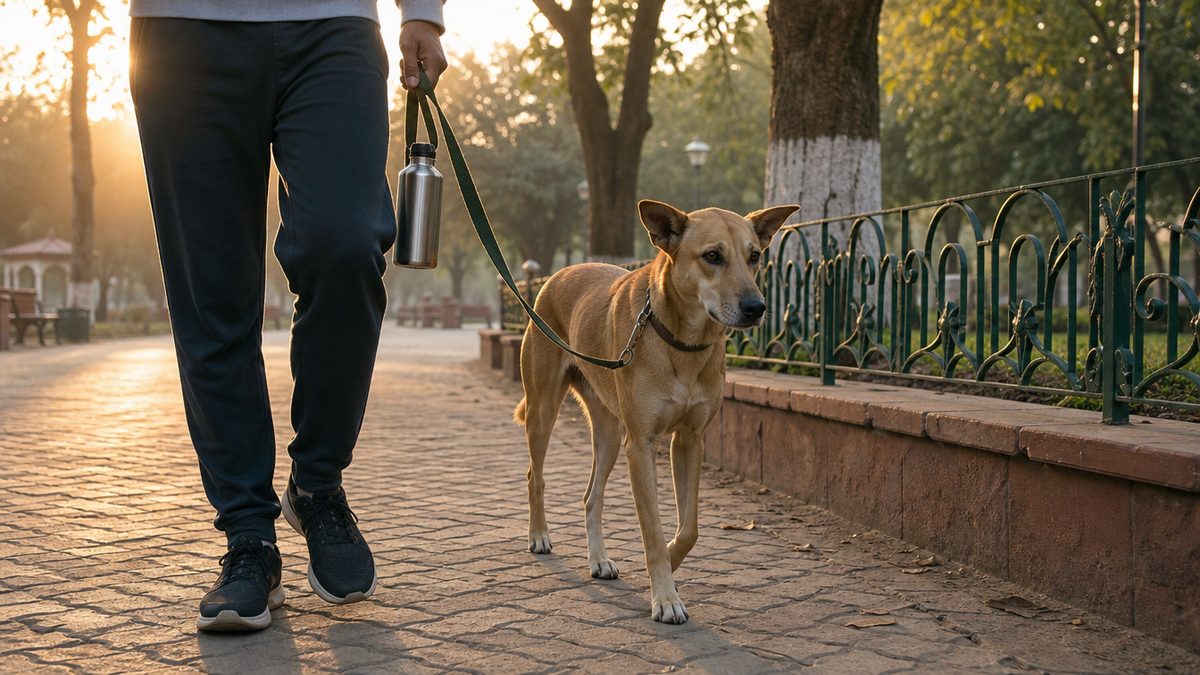
Dog walking in India means more than two hours a day for a Labrador or a German Shepherd and up to an hour for a Beagle or a Pug by the Kennel Club's breed pages, taken in the coolest hour of the day from April to June, on a lead of 1.5 to 2.0 metres where a bye-law sets one, and for Rs 102 to Rs 199 a walk where a walker service prints its price Municipal Corporation Chandigarh Sploot, Dog Walking Services in Delhi.
How much walking, by breed group
To size the walk, start from the breed body's figure and cut it for heat rather than for convenience. The Kennel Club prints an exercise band on every breed page, and the four below cover most Indian households; the Indian native breeds have no published band from any body, so the Indian Pariah Dog page carries what is known about the breed rather than an hour The Kennel Club (UK), Breeds A to Z The Kennel Club (UK), Breeds A to Z The Kennel Club (UK), Breeds A to Z.
| Breed | Kennel Club exercise band | Size of home | The Indian reading |
|---|---|---|---|
| Labrador Retriever | More than 2 hours per day | Large house | Two hours split pre-dawn and after the block ends; the base breed in the heat study, so the odds in the next section are measured against it |
| German Shepherd | More than 2 hours per day | Large house | Same band; heat odds 0.92 against the Labrador, not significant, so no extra allowance and no discount |
| Beagle | Up to 1 hour per day | Small house | An hour on the lead: a scent hound off the lead in a city follows its nose into traffic; heat odds 1.15, not significant |
| Pug | Up to 1 hour per day | Flat or apartment | The hour is a ceiling that the heat cuts further: 3.24 times the Labrador's odds of heat illness, so the pre-dawn hour only, and none on an alert day |
| Indian Pariah Dog | No band published by any breed body | Any | Short-coated and long-nosed, the lowest-risk shape in the heat model, but unmeasured; the same hours as a Labrador until a study says otherwise |
The coolest hour in your city
The coolest hour of the hottest month is 04:30 IST in Delhi, at a five-year mean of 29.1 C, and 05:30 in Mumbai at 24.7 C; the block where the mean air temperature sits at or above 35 C runs 08:30 to 18:30 in Delhi's June and 10:30 to 16:30 in Mumbai's April. Those two rows come from this guide's own query of NASA POWER's hourly archive for 2019 to 2023, and they reproduce the nine-city table on the heat safety guide to the decimal, so use that table for Jaipur, Ahmedabad, Hyderabad, Kolkata, Chennai, Pune and Bengaluru. Delhi's evening mean falls under 35 C only at 19:30 in June, and its 07:30 mean is already 34.0 C, so the 7 am walk that feels early is the last cool minute of the day. IMD declares a heat wave when a plains station reaches 40 C and runs 4.5 to 6.4 C above normal, or 45 C outright; the season is March to June with May the peak, Mumbai's humid April is the hardest month for a panting dog because wet air blunts evaporative cooling, and the colour-coded warning refreshed at 0800 and 1600 IST is the switch: a yellow day is the coolest hour only, an orange or red day is no walk India Meteorological Department.
The pavement is the second clock. The Kennel Club's test is to place the back of your hand on the pavement for seven seconds, and if it is too painful for your hand it is too painful for the paws; grass stays cooler because plants release water. The same test circulates as a 'five-second rule' in North American clinic pages, and the count is the only difference. Delhi's air is 36.4 C by 08:30 in June, so the tarmac test fails from the first hour of sun and the walk is a grass or shade walk after that.
Lead, harness and the law
Chandigarh is the one Indian city whose bye-law states a lead length: clause 4(b) of the 2025 Pet and Community Dogs Bye-laws requires the dog 'chained/leashed (not longer than 1.5-2.0 meters) while taking them outside', a ferocious dog muzzled with a stick carried, and clause 4(e) makes the owner answerable for a dog walker's violations, so the walker must 'know how to keep dog(s) in control' and know the bye-laws. Delhi's registration terms are narrower: clause 9 says the owner 'shall not allow an aggressive dog to roam freely without muzzle at any public place', and clause 10 charges Rs 500 per unscooped poop. Neither instrument names a harness; wagNbush's own walker standard is 'a harness rather than a collar for pulling breeds', which is a service's practice, not a rule. A park adds its own line: Sunder Nursery blocks entry to a visitor whose dog is seen off the leash. Registration itself is on the dog registration guide.
What a walker charges, on the walker's own page
Three walker services print a per-walk price on their own city pages, and two of the three print two different prices on the same page, so the table quotes both and dates them Petsfolio, Dog Walking Services… wagNbush, Dog Walking in Bengaluru.
| Service and city | What the page prints | Exchange-rate test | Note |
|---|---|---|---|
| Sploot, Delhi | Trial walk Rs 199 (struck from Rs 300); plan cards '20 Mins Walk Plans starts from Rs 116 per walk' and '40 Mins from Rs 160'; cost section 'Basic Plan of 20-minute walks at Rs 102 per session, billed monthly' and 'Premium Plan 40 minutes at Rs 141'; 'Basic Dog Walking Plan of 20-minute for Rs 2,999' | 102 / 84.38 = 1.21 and 102 / 74 = 1.38: rupee-native | Two prices for the same 20-minute walk on one page; Rs 2,999 a month is about Rs 100 a day |
| wagNbush, Bengaluru | 'From about Rs 120 per walk'; provider cards 'starting from Rs 150' | 120 / 84.38 = 1.42: rupee-native | The page also prints its own heat rule, 'before 8am or after 6pm', and a monsoon policy of a shorter covered route |
| Petsfolio, Hyderabad | Header 'starting at just Rs 110 per walk'; FAQ 'our dog walking rates in Hyderabad start at Rs 199 a walk, with prices dependent on time and area' | 110 / 84.38 = 1.30: rupee-native | Rs 110 and Rs 199 as the starting price on one page; 15-minute to 60-minute walks offered |
Two things follow. A 20-minute walk is a toilet break, not the Kennel Club's two hours, so a walker plan for a Labrador is a supplement to the owner's pre-dawn hour, not a replacement. And a walker's heat rule is the walker's, not a guideline: 'before 8am' in Bengaluru is inside the cool band in that city's April, but the same rule in Delhi's June puts the dog on a 34 C pavement NASA POWER, Hourly API documentation.
Which dog should not do which activity in the heat
A flat-faced dog should not run, hike, swim unassisted or sit on a terrace at noon in the Indian summer, because in the study of 905,543 UK dogs a Pug carried 3.24 times the Labrador Retriever's odds of heat-related illness, a French Bulldog 6.49, a Bulldog 13.95 and a Chow Chow 16.61, and brachycephalic dogs as a group carried 2.10 times the odds of dogs with an ordinary muzzle.
The trigger paper splits the risk by activity. Brachycephalic dogs had 1.32 times the odds of exertional heat illness, 2.36 times the odds of environmental heat illness and 3.07 times the odds of the vehicular kind, and the manner of the exertional event was overwhelmingly ordinary: of 551 events with the exercise recorded, 372 followed walking, 97 running or cycling, 76 play and 6 a competition. Fourteen point one eight percent of the 395 events in the incidence study killed the dog. So the activity a flat-faced dog should skip is not the exotic one; it is the 8 am walk in May.
| Dog | Odds ratio (95 percent CI) | What to drop from the tables above |
|---|---|---|
| Chow Chow | 16.61 (6.21 to 44.44) | Everything outdoors between 07:30 and 19:30 from March to June; indoor nose work and a pre-dawn toilet walk |
| Bulldog | 13.95 (8.01 to 24.29) | Hiking, running, unassisted swimming, the parked car; the cafe only in an air-conditioned room |
| French Bulldog | 6.49 (3.62 to 11.63) | Same as the Bulldog; the train only in First AC with the cabin cooled before boarding |
| Pug | 3.24 (1.67 to 6.29) | Hiking and running off the list; the Kennel Club's 'up to 1 hour' taken pre-dawn and never on an alert day |
| Golden Retriever | 2.65 (1.40 to 5.01) | The coat, not the face: the two-hour band split into two cool sessions, dried after every monsoon walk |
| Labrador Retriever | Base | The full adult table in the cool hours; exertional risk still peaks in young males |
| Beagle | 1.15 (0.34 to 3.86), not significant | No breed discount; the same hours as the Labrador |
| German Shepherd | 0.92 (0.35 to 2.48), not significant | No breed discount; the long coat is the reason to split the two-hour band into two cool sessions and to dry the dog after every monsoon walk |
| Any dog over 50 kg | 3.42 (1.54 to 7.57) against under 10 kg | Bodyweight is a risk on its own; a dog at or above its breed mean weight had 1.42 times the odds of one below it |
No study has measured heat illness in the Indian Pariah Dog or any other Indian native, so this page gives them no odds ratio. The heat model's lowest-risk shape is a long nose, a short coat and a moderate weight, which every native breed has; the Greyhound, built the same way, still carried 4.26 times the Labrador's odds through exertion, so the shape lowers the risk of the hour and does not cancel it. The signs and the cool-first, transport-second first aid are on the heat safety guide; the vet who knows your dog decides the ceiling for it.
Monsoon and community dogs: the two limits the activity lists skip
The monsoon moves the outing indoors and onto the grooming table, and the community dogs at the park are legally resident under the ABC Rules 2023, so a dog owner's outing is planned around both: in the one four-city field survey, done from June to September, 80 percent of 162 dogs examined in Mumbai and 75.3 percent of 162 in Delhi carried ticks, against 17 percent of 101 in Sikkim and 11 percent of 100 in Ladakh, and 261 of all 525 dogs were PCR-positive for at least one tick-borne pathogen.
Monsoon: what changes from June to September
Those were stray and shelter dogs in an ABC programme, so the percentages describe animals that live outdoors in the rain rather than a pet on a sofa; the direction is what transfers, and it is the reason the monsoon rows above are the indoor ones. The practical monsoon list for an outing is short. Walk the wet season in the same pre-dawn window, on the hard-standing rather than the flooded verge; dry the coat, the ears and between the toes after every wet walk; run the tick check the tick prevention guide describes on the same evening; and move the weekly session indoors, where nose work and trick training lose nothing. A walker service's monsoon policy is worth reading before you sign: wagNbush's is 'a shorter covered-route walk' and, in severe rain, a deferral to the owner's choice of a covered walk, indoor play or rescheduling. The seasonal skin, ear and paw routine is on the adult dog care guide and the wave's monsoon care guide.
Community dogs at the park: what the ABC Rules 2023 say
The ABC Rules 2023 classify animals in two groups: pet animals, 'dogs owned and kept indoor by individuals', and street dogs, 'community owned Indian dogs or abandoned pedigreed dogs which are homeless, living on the street or within a gated campus';. Three rules shape a walk. Rule 8(1) puts the deworming, immunisation and sterilisation of a pet on its owner, and rule 8(2) puts the same duty for street dogs on the local authority; rule 11(19) requires a captured dog to be released 'at the same place or locality from where they were captured'; and rule 20 makes the resident welfare association or local body responsible for feeding spots that are 'far from children play areas, entry and exit points, staircase', at times 'least frequented by children and senior citizen';. Read together, the dogs in your park are not trespassers to be removed by a complaint, and your own dog's vaccination is your duty, not theirs.
- Walk on the lead through a resident pack's territory and keep the pace steady; the pack is legally where it is, and a leashed dog is the one variable you control.
- Keep the vaccination current, because rule 8(1) makes it the owner's responsibility and a park is where the exposure is; the intervals are on the dog vaccination schedule Ministry of Fisheries.
- Feed only at the designated spot, if you feed at all. Rule 20 puts the spot and the time with the RWA or the local body, and a park's own rule can go further: Sunder Nursery's dog rules end with 'Do not feed stray dogs'; Sunder Nursery Heritage Park, New Delhi.
- Volunteer through the rule, not around it. Rule 20(1)(iv) lets a designated feeder volunteer for vaccination, catching and release with the ABC programme; the route is on free-ranging dogs in India and feeding community dogs Ministry of Fisheries.
- Read the city's list of closed gardens before you drive. Chandigarh's clause 5 bars pet dogs from Sukhna Lake, the Rose Garden, Shanti Kunj, the Rock Garden, Leisure Valley, the Bougainvillea Garden and the Botanical Garden at Sarangpur, and clause 8 requires the owner or walker to scoop in any public place.
Where the ABC Rules and a park notice disagree, both are printed here with their dates: the Rules of 10 March 2023 govern where a community dog may be fed, and a park's own rule governs what a ticket holder may do inside its gate, so a Sunder Nursery visitor does not feed inside the park and a colony feeder feeds at the RWA's spot outside it.
What it costs in rupees, from the venue's own page
Most things to do with your dog in India cost nothing, and the ones that cost money run from Rs 50 for a park ticket to Rs 1,000 for a two-hour pool slot, with every figure below read on the venue's or the service's own page on 18 September 2026 and divided by 84.38 and by 74 to check that it is a rupee price and not a converted dollar list.
| Item | Price as printed | Who prints it, and when read | Exchange-rate test |
|---|---|---|---|
| Park ticket, Sunder Nursery, Delhi | Rs 50 adult, Rs 25 child (5 to 12), Rs 200 foreign visitor; no dog fee | sundernursery.org, visit page, 18 September 2026 | 50 / 84.38 = 0.59: rupee-native |
| Dog park, GHMC Gachibowli, Hyderabad | No fee on any GHMC page; third-party listings print Rs 20 and Rs 50 | ghmc.gov.in searched 18 September 2026; the corporation's site returns the pet licence portal and no dog-park page | Not tested: no corporation figure exists |
| Pool slot, Pune Pet Park (non-member) | Rs 1,000 per dog for two hours, Rs 500 each additional dog, Rs 300 per person in the pool, Rs 500 one-time registration; assistance Rs 500 'additional' and Rs 1,500 'per session', both printed | punedogsquad.com/swimming, 18 September 2026 | 1,000 / 84.38 = 11.85; / 74 = 13.51: rupee-native |
| Pool slot, Pune Pet Park (member) | Rs 200 to Rs 700 per dog by size and tier; humans Rs 150 to Rs 200 | Same page | Rupee-native |
| Pool hour, Therpup, Bengaluru | Rs 499 for one hour, Rs 1,000 exclusive, Rs 1,099 with blow-dry | therpup.com booking widget, page modified 30 May 2025 | 499 / 84.38 = 5.91; / 74 = 6.74: rupee-native |
| Walker, 20 minutes, Delhi | Rs 102 per session (cost section) and Rs 116 per walk (plan cards); Rs 2,999 a month | sploot.space/dog-walking/delhi, 18 September 2026 | Rupee-native; the two figures are the page's own inconsistency |
| Walker, per walk, Bengaluru | 'About Rs 120'; provider cards from Rs 150 | wagnbush.com, 18 September 2026 | Rupee-native |
| Walker, per walk, Hyderabad | Rs 110 (header) and Rs 199 (FAQ) | petsfolio.com, 18 September 2026 | Rupee-native; two starting prices on one page |
| Poop penalty, Delhi | Rs 500 per instance, from DEMS | MCD pet registration terms, clause 10 | A penalty, not a price |
| Penalty band, Chandigarh | Rs 20 to Rs 13,400 under the Solid Waste Management rules; Rs 250 a day maintenance if the dog is impounded | MCC bye-laws 2025, clause 23 | A penalty, not a price |
| Train, dog in First AC or basket | The Railway freight, paid through the SBI gateway, no refund on cancellation | IRCTC pet booking PDF | The tariff is on the trains guide |
| Puppy class, cafe entry, trainer's fee | Not printed on any venue page this guide opened | Instagram reels and third-party listings carry figures; none is the venue | Not tested |
Two figures deserve a second look. A swimming pool visit is the dearest line, and a Rs 2,999 monthly plan for one 20-minute walk a day is about Rs 100 a walk, which is where Sploot's Rs 102 comes from, and its Rs 116 plan card is the same walk on a shorter commitment. And a Rs 1,000 pool slot with a Rs 300 human fee and a Rs 500 registration is Rs 1,800 for a first visit with one dog and one person, which is the number to compare with Therpup's Rs 499 hour, not the headline. The penalties belong on the same table because they are the cost of getting the rules wrong: Delhi's Rs 500 is per unscooped poop, and Chandigarh's band tops out at Rs 13,400 Municipal Corporation Chandigarh.
Before you leave the house: the checklist for any outing
To leave the house with a dog in India, check the IMD colour for the day, the hour against the city's cool window, the lead length, the vaccination card and the bag, in that order, because those five items cover the heat rule, the bye-law and the venue rule that end an outing early Municipal Corporation Chandigarh Sunder Nursery Heritage Park, New Delhi.
- Check the day's colour. IMD refreshes the heat warning at 0800 and 1600 IST; green is a normal day, yellow is the coolest hour only, orange or red is no walk.
- Check the hour against the city. Delhi's cool hour is 04:30 and its block runs 08:30 to 18:30 in June; Mumbai's is 05:30 with a block of 10:30 to 16:30 in April; the other seven cities are on the heat guide.
- Test the pavement. The back of your hand for seven seconds; if you cannot hold it, walk on grass or wait.
- Clip the lead at 1.5 to 2.0 metres and, for a dog the city calls ferocious, the muzzle; a walker you hire is your liability in Chandigarh under clause 4(e).
- Carry the vaccination card, water and a bag. A pool asks for the card at the gate, IMD says carry water, and a poop without a bag is Rs 500 in Delhi India Meteorological Department Municipal Corporation of Delhi.
- Book what needs booking. A pool slot in advance with no walk-ins, and a train dog ticket only after the first chart.
- Match the dog to the row. A flat-faced, heavy-coated, overweight or senior dog takes the pre-dawn version of every activity and skips the rest on a hot day.
The ordinary walk is the activity that hurts dogs in the heat, not the adventure: 372 of the 551 exertional heat-illness events with a recorded exercise type followed a walk. Move the walk, and most of the rest of this page takes care of itself.
The companion page for a cat household is things to do with your cat in India; a puppy's first month at home is on puppy care in India; and a dog that is new from a shelter gets the 3-3-3 settling period on the adoption guide before any of the outings above.
Questions Indians ask Google about things to do with a dog
What activities can you do with your dog?
By life stage: a puppy does carried socialisation outings, a class from 7 to 8 weeks, car rides and handling practice; an adult does a breed-sized daily walk, one training or scent session a week, a pool slot, a leashed park picnic and a First AC train journey; a senior does shorter sniff walks, assisted swims and puzzle feeders. AAHA's guideline asks for exercise and enrichment 'appropriate for age, breed, and temperament' at every stage.
What is the 5 second rule for walking dogs?
The 5 second rule is the pavement hand test: press the back of your hand to the road, and if you cannot hold it there for five seconds it is too hot for the dog's paws. The Kennel Club prints the same test as a seven second rule; the count is the only difference. Delhi's air is 36.4 C by 08:30 in June, so the test fails from the first hour of sun and the walk moves to grass or to 04:30.
Does Vande Bharat allow pets?
Not an adult dog. A Vande Bharat runs AC Executive and AC Chair Cars only, two and fourteen on the 16-coach Nagpur to Indore rake, so it has neither the First AC cabin or coupe that IRCTC requires for a dog nor a luggage van. IRCTC's own terms let a puppy or kitten 'which can be carried in a basket' travel 'in any class after payment of usual booking charges', which is the one route on a chair-car train. The trains guide covers the sleeper version.
What is the 3-3-3 rule for dogs?
The 3-3-3 rule is a shelter's timeline for a newly adopted dog: 3 days to decompress, when the dog may not eat, may hide and may have accidents; 3 weeks to learn the routine, when stress signs fall and house soiling should reduce; and 3 months to start to feel at home, with play, a loose wiggly greeting and treats taken gently. It is a guide to patience, not a study, and it means the outings on this page start in month two, not day two.
What is the 7 7 7 rule for dogs?
The 7 7 7 rule is the Rule of Sevens, a breeder's socialisation checklist adapted from Pat Hastings: by 7 weeks a puppy should have been in seven locations, eaten from seven containers, been held by seven people, taken seven car rides, been crated seven times, played with seven kinds of toy, walked on seven substrates and met seven challenges such as a box or steps. A puppy bought at 8 weeks has usually had none of it, so the list is run in the first month home.
Is India a dog friendly country?
In law, more than most: the ABC Rules 2023 make the local authority responsible for sterilising and vaccinating street dogs and return each one to the place it was caught, and make a pet's vaccination its owner's duty. In practice it is uneven city by city: Chandigarh's 2025 bye-laws close seven named gardens to pet dogs and set a 1.5 to 2.0 metre lead, Delhi fines an unscooped poop Rs 500, Indian Railways carries a dog in First AC only when the whole cabin is yours, and the one municipal dog park this guide found is in Hyderabad.
How much is a dog walker for 1 hour?
No Indian walker page this guide opened prints an hourly price. Sploot's Delhi page prices a 40-minute walk at Rs 141 per session on a monthly plan or Rs 199 as a single walk, and a 20-minute walk at Rs 102 or Rs 116 depending on which part of the page you read; Petsfolio in Hyderabad offers 15 to 60-minute walks and prints two starting prices, Rs 110 and Rs 199; wagNbush in Bengaluru says about Rs 120 a walk. Ask for the hour's price in writing and compare it with those.
What are fun activities to do with my dog?
Indoors, which is where the Indian summer and the monsoon put most of them: a scent search for kibble hidden in three rooms, a muffin-tin puzzle, a trick session with a clicker, a stuffed food toy the dog works alone, and a stairwell obstacle course for a puppy. A 2026 pilot of 26 dogs found the dogs with more formal nose work training kept trying longer on an unsolvable task, which is the closest thing to fun a study has measured.