
Dog training guide
Puppy training basics: what to teach in the first six months and how, without punishment
What to teach a puppy in its first six months and in what order, why the veterinary behaviour bodies say rewards only, when an Indian puppy can start a class, how long it can be crated, and what Indian trainers charge and sell.
Quick answer
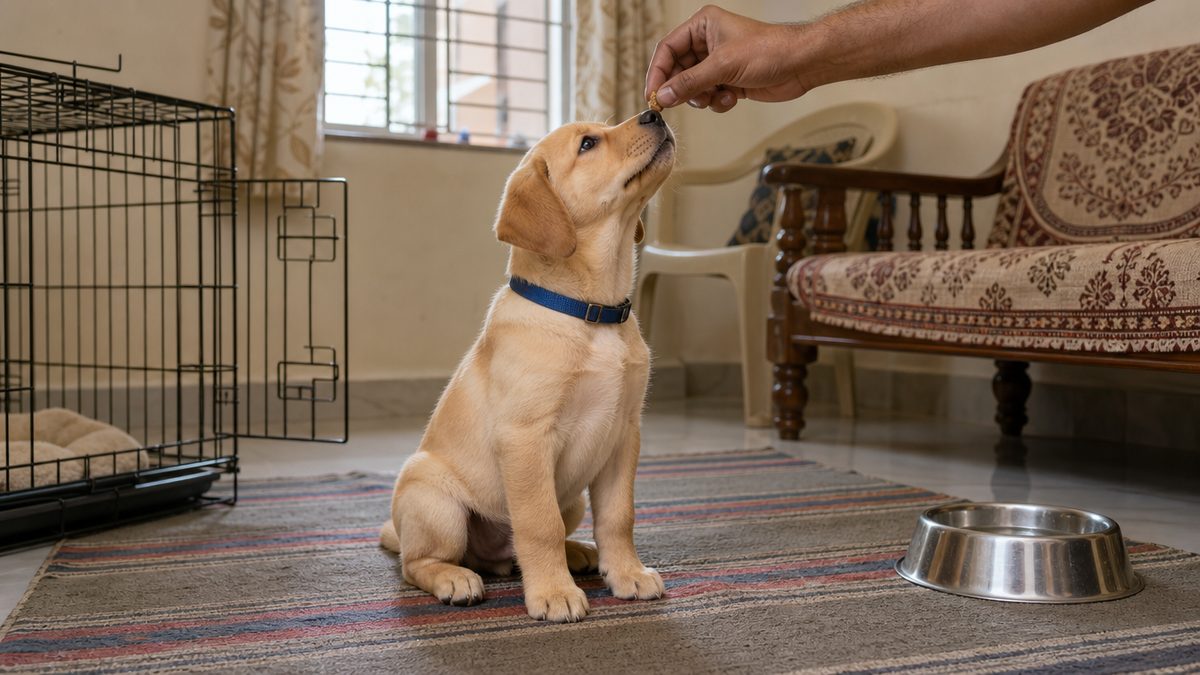
Puppy training should use reward-based methods only, the American Veterinary Society of Animal Behavior's 2021 position, starting the day the puppy arrives: name and toilet spot first, sit and handling in week one, recall, settle and the crate by week four, and a class from 7 to 8 weeks once one vaccine set is 7 days old and a deworming is done. No Indian body licenses trainers, shock and prong collars sell openly, and a Bengaluru trainer charges Rs 800 to Rs 3,500 a session.
Puppy training in 2026 is reward-based, and the evidence has denominators
Puppy training should use reward-based methods only. That is the position of the American Veterinary Society of Animal Behavior, whose 2021 statement reads: "Based on current scientific evidence, AVSAB recommends that only reward-based training methods are used for all dog training, including the treatment of behavior problems";. The statement cites 21 references, and the studies behind it have sample sizes a reader can weigh.
AVSAB defines the two camps plainly. Reward-based training teaches the puppy what to do and pays for it with food, play, praise or a toy. Aversive methods "rely on application of force, pain, or emotional or physical discomfort", and the conclusion is that "there is no evidence that aversive methods are more effective than reward-based methods in any context";. The same document answers the objection Indian owners hear from an older trainer: reward-based "does not mean dogs are allowed to do anything they want"; boundaries are taught, but "without the use of fear, intimidation, or pain";.
The four studies worth knowing by their numbers
Four studies carry the weight, and the table holds their numbers. The one to remember is Vieira de Castro's: 92 companion dogs from seven training schools, and the 28 from schools using many aversive methods showed more stress behaviours, were tense more often, had higher post-training cortisol rises and made more "pessimistic" choices in a cognitive bias test than the 42 reward-school dogs. In Hiby's 364 owners, obedience rose with the number of tasks trained by reward and the number of problem behaviours rose with the number trained by punishment.
| Study | Design and sample | What it found |
|---|---|---|
| Hiby, Rooney and Bradshaw 2004 | Questionnaire, 364 pet dog owners, UK | Obedience correlated with reward-trained tasks; problem behaviours correlated with punishment-trained tasks |
| Vieira de Castro and colleagues 2020 | 92 companion dogs from 7 schools: 42 reward, 22 mixed, 28 aversive; video, saliva cortisol, cognitive bias test | Aversive-school dogs: more stress behaviours, more time tense, higher cortisol rise, more pessimistic outside training |
| China, Mills and Cooper 2020 | 63 dogs with off-lead problems, 3 groups of 21, up to 150 minutes over 5 days | Reward-based group: better Sit and Come after one cue, shorter response latency than the shock-collar group |
| Cooper and colleagues 2014 | 63 dogs referred for recall problems, 3 groups of 21, two 15-minute sessions a day for 4 to 5 days | Shock-collar group more tense and yawned more; 92 percent of owners reported improvement in every group |
| Ziv 2017 | Review of 17 studies | Aversive methods "can jeopardize both the physical and mental health of dogs"; no evidence they beat positive reinforcement |
Two limits belong next to those numbers. Surveys cannot separate cause from effect, and AVSAB says so: owners of dogs with problems may reach for harsher tools. Ziv's review flags small samples and missing effect sizes across the field. What survives both is the direction of every result: no study found aversive tools more effective, and several found them worse for the dog.
What a body's recommendation means for a Labrador puppy in a Pune flat
A recommendation from a veterinary behaviour body is a floor, not a fashion. AAHA's 2019 guideline tells veterinarians to "educate on selecting appropriate trainers" at the puppy visit, citing Ziv's review. PDSA's vets write that "telling your dog off rarely helps with training", because a puppy cannot connect a scolding to a shoe chewed ten minutes ago. Dogs Trust shows the mechanism in reverse: a puppy jumping up at someone who says "No, get down" while staring and pushing has been rewarded with attention, so it jumps again. For a Labrador Retriever or an Indian pariah dog puppy in a city flat the method is the same: arrange the room so the wrong choice is hard, reward the right one at once, and repeat.
When to start: the day the puppy arrives, and a class from 7 to 8 weeks
Puppy training starts the day the puppy comes home, and a puppy class can start at 7 to 8 weeks of age once the puppy has had "a minimum of one set of vaccines at least 7 days prior to the first class and a first deworming", which is AVSAB's condition in its socialisation statement. The reason is a clock: "the primary and most important time for puppy socialization is the first three months of life", and most of it has passed by the time an eight-week-old puppy arrives.
Two bodies say the same thing. AVSAB holds that "it should be the standard of care for puppies to receive such socialization before they are fully vaccinated", because "behavioral issues, not infectious diseases, are the number one cause of death for dogs under three years of age";. AAHA's 2019 guideline states "there is no medical reason to delay puppy classes or social exposure until the vaccination series is completed as long as exposure to sick animals is prohibited, basic hygiene is practiced, and diets are high in quality", and notes a survey in which only one-third of puppies met people and dogs outside the home during the critical period.
The Kennel Club's Puppy Foundation course leaves the minimum age to the club: "some training clubs may enrol puppies for their course from as young as 10 weeks, other clubs may ask that puppies have completed their second vaccination", with a ceiling of 12 months and a minimum of four weekly sessions. Dogs Trust answers without a number: "puppy training starts as soon as you bring your dog home";.
The Indian calendar, and what the breeder should already have done
In India the class condition is met at about nine weeks for a lawfully sold puppy. The Dog Breeding and Marketing Rules 2017 forbid the sale of pups under eight weeks (Rule 8(1)(a)), require the breeder to give the buyer in writing the "dates of inoculations and de-worming of the pup" (Rule 8(2)), and state that vaccination "can start at the age of seven-eight weeks" and is "usually completed at the age of eighteen weeks";. A puppy collected at eight weeks with one dose and one worming on that record is class-eligible seven days later; the doses are in the dog vaccination schedule in India and the wormings in the dog deworming schedule for India.
The same Rules set a socialisation duty on the breeder that no ranking page mentions. Second Schedule Part IV paragraph 24(6)(e) counts "socialising with people at suitable intervals equaling at least three hours per day for adult and five hours per day for pups less than four months of age" as exercise a breeder may provide, Part III paragraph 7 requires "all socialisation opportunities, vaccinations, and de-worming", and Rule 8(3) has the breeder screen buyers for their ability to meet the dog's "grooming, socialising, spatial and veterinary needs";. Ask a breeder how those five hours were spent. The papers to collect are in bringing a puppy home in India; the adoption route, where the history is often unknown, is in how to adopt a dog in India.
Why the class matters more than the cue
The one study that followed puppies into adulthood measured whether they kept their homes. Duxbury and colleagues surveyed the owners of 248 adult dogs adopted as puppies from a humane society and found higher retention for dogs that had attended puppy classes, were handled often, answered cues, or slept on or near the owner's bed; they recommend enrolling at 7 to 12 weeks. AVSAB's limits for a class are a washable indoor floor and every puppy vaccinated and parasite-free at the door.
Waiting for the last vaccine dose at 16 weeks before any training or outing spends the whole socialisation window. AVSAB, AAHA and VCA all say start before the series is complete, with the class condition of one vaccine set at least 7 days earlier plus a deworming, and keep the puppy off streets and parks until the vet clears it. Your nearby vet decides the dates for your puppy.
What to teach in the first six months, in order
To teach a puppy in the first six months, start with its name and toilet spot on day one, add sit and handling in the first week, recall and settle in weeks two to four, the crate alongside, loose-lead walking once the vet clears pavements, and leave it and food manners by month four; that is the order the Kennel Club's Puppy Foundation Assessment, Dogs Trust's Puppy Training 101 and the AKC's timeline agree on when read together Dogs Trust (UK), Puppy Training 101 American Kennel Club. India's own instrument names the same core: the AWBI's November 2025 SOP tells pet owners to "train basic commands: sit, stay, leave, come" and to "socialize dogs with people and other animals";. The Kennel Club's Puppy Foundation is the first of four levels in its Good Citizen scheme, established in 1992 and the largest dog training programme in the UK, open to unregistered dogs.
| Skill | Starts | What passing looks like | Source |
|---|---|---|---|
| Name | Day one; it "naturally begins from the moment you first call their name" | Kennel Club Exercise 3: the puppy pays at least brief attention to its name on lead | Dogs Trust; Kennel Club Puppy Foundation The Kennel Club (UK) |
| Sit | Week one, "as soon as your puppy comes home (as early as eight weeks)", before every meal | Kennel Club Exercise 8: stand, sit and down, each briefly, with any reasonable incentive | AKC timeline; Kennel Club The Kennel Club (UK) |
| Handling | From birth at the breeder; daily at home from day one | Kennel Club Exercise 6: allows handling of its body and inspection, mild fidgeting acceptable | AVSAB socialisation statement; AAHA 2019; Kennel Club Creevy KE, Grady J, Little SE, et al. |
| Recall | Weeks two to four indoors, a few feet apart, then a secure quiet outdoor space | Kennel Club Exercise 7: returns from two or three paces in an enclosed area, with any incentive | PDSA; Kennel Club; AKC by 6 months The Kennel Club (UK) American Kennel Club |
| Settle and stay | Weeks two to four, on a mat after play and meals | Kennel Club Exercise 10: stays about 10 seconds on lead with the handler one pace away | Dogs Trust settle training; Kennel Club The Kennel Club (UK) |
| Crate | From 8 weeks, meals in the crate first | Humane World step 3: stays quietly about 30 minutes with you mostly out of sight before it is used for absences or nights | Humane World; AAHA 2019 puppy checklist Creevy KE, Grady J, Little SE, et al. |
| Loose lead | Indoors from week two; pavements once the vet clears the puppy | Kennel Club Exercise 9: about 20 paces with a turn, and a tight lead is not a fail | Kennel Club; AKC by one year American Kennel Club |
| Leave it, drop it, food manners | Month three to four, with toys first | Kennel Club Exercises 11 and 12: gives up an article when asked and takes a treat without snatching | Kennel Club; AKC by 6 months and by one year American Kennel Club |
8 to 12 weeks: the socialisation month
The first month at home is exposure before obedience. The AKC's timeline, from certified trainer Kate Naito, sets the goal at 8 to 16 weeks as "exposure to the environment", traffic noise, car rides, passers-by, other dogs, vet visits and body handling, so the puppy learns "the world is a fun, not scary, place"; the first true lesson is impulse control, usually a sit before food. Dogs Trust names the two things that begin on their own, name learning and house training; toilet training has its own page, toilet training a puppy in an Indian flat or house. Mouthing peaks now, the AAHA checklist has the vet "discuss bite inhibition";, and the how-to is in how to stop puppy biting.
3 to 4 months: recall, settle, crate and the first pavement
By month three the puppy can hold a ten-second stay and come from three paces, the Kennel Club's assessed standard. The AKC's list for six months is polite play with a "drop it", steady housetraining, being alone for short periods through crate training, a recall where the puppy "loves coming right up to you", and a sit before everything it wants. PDSA's recall method is the one to copy: somewhere quiet and secure, walk away, say the name and "come", get down to the puppy's level, reward on arrival, then a quiet public place a few feet apart, increasing the distance. An Indian street is not that place; its free-ranging dogs of unknown vaccination status are what AVSAB says to keep a puppy from, and their rules are in stray dogs in India.
4 to 6 months: leave it, food manners and the adolescent test
The last two months of the AAHA puppy stage, which ends at the "cessation of rapid growth" at about 6 to 9 months, are where the Kennel Club's last two exercises land: giving up an article and taking a treat without snatching The Kennel Club (UK). AAHA warns that 6 months to 3 years "can be the most challenging for owners as the dog matures socially and behaviorally". A German Shepherd or Border Collie never asked to settle shows it here; a Beagle never paid for a recall follows its nose. The order below is the first fortnight's, and it holds for any breed.
- Name and toilet spot on day one, rewarding every glance at the name and every outdoor toilet.
- Sit before meals from the first evening, lured with a treat drawn up and back over the nose.
- Handling every day, ears, paws, mouth and tail, paired with a treat, so the vet's examination is nothing new.
- Meals in the crate from day two, door open, then closed for a few minutes after eating.
- Recall indoors from week two, a few feet apart, favourite reward in hand.
- Settle on a mat after play, rewarded for lying still, building to a ten-second stay.
- A puppy class booked for week two, once one vaccine set is 7 days old and the first worming is done.
How reward-based training works: lure, mark, reward, fade
Reward-based training works by paying the puppy for the behaviour you want immediately after it happens, using four tools that VCA's board-certified behaviourists set out for owners: a lure to show the movement, a marker to say "yes", a reward to pay for it, and a cue added only once the puppy already performs the behaviour. AVSAB's own list of what a reward-based trainer uses is the same: "verbal or visual cues", "a clicker or verbal marker", and "toys, treats, or other appropriate reinforcers", with capturing, shaping and luring as the methods.
Luring means a treat held "like a magnet" at the nose so that where the nose goes the body follows; VCA's example for sit is a treat drawn slowly up and back, which drops the rump, and most puppies switch to an empty hand in the same shape "within 5-10 repetitions";. Capturing means waiting for the puppy to do the thing on its own, marking it and paying. A marker is a brief, unique signal, a clicker, a short "yes", a whistle or a thumbs up, and it "must always be followed by the reward so your dog can be confident they've got things right";. Shaping pays for each step toward a harder goal.
The cue comes last. VCA's rule is that cues "should not be used until you're certain the puppy understands how to do the behavior"; "cue" has replaced "command" because a cue promises a reward while a command "carries the undertone of 'do it or else'";. And the treats never stop: "plan to continue 'paying' your dog a reward in exchange for work throughout her entire life";.
Teaching sit, the PDSA way, in six steps
- Hold a treat or toy in front of the puppy's nose to get its attention.
- Move the treat slowly from the nose up and over the top of the head toward the back.
- Let the bottom drop on its own; do not push it down, though a hand resting gently on the back is fine.
- Say "sit" as the puppy moves into the position, not before it understands the movement.
- Reward the instant the bottom touches the floor, so the puppy links the reward to sitting.
- Phase the treat out gradually once the puppy sits on the word, keeping praise and occasional food.
Session length, timing and the reward that fits the puppy
Sessions are minutes, not hours. VCA says individual sessions "should be no more than a few minutes long at first and can be done a few times a day", quiet skills when the puppy is calm, exciting skills when it is energetic, in a quiet room and, if it helps, before a meal. PDSA's vets keep sessions short and consistent, with the whole family using the same words, and their sit method keeps the hands gentle: a hand may rest on the back, but the bottom is never pushed down. Every paid repetition reinforces the behaviour. Dogs Trust adds the rewards that cost nothing: a few paces of nice lead walking paid with the release, four paws on the floor paid with the greeting.
A puppy that will not respond is rarely defiant. VCA's causes are distraction, confusion, a new place or surface such as a slippery floor, a competing motivation, tiredness, fear or illness, and the fix is to meet that need or try later. Marble and vitrified tile, the floor in most Indian flats, is that slippery surface; teach sit and down on a rug first. For fear or aggression AVSAB's route is a veterinarian or a board-certified veterinary behaviourist, never "a heavy hand";. Your nearby vet decides whether a behaviour has a medical cause first.
The reward has to follow the behaviour immediately, which is why a marker exists: the word "yes" is said as the bottom hits the floor and is always followed by the treat. A treat given after a delay pays for whatever the puppy did last, usually standing up again VCA Animal Hospitals.
Crate training a puppy: a den in the bedroom, not storage on the balcony
Crate training a puppy means teaching it that a wire crate is its own bed, entered for meals and naps with the door open long before it is ever shut, and never used as punishment; the Royal Kennel Club's summary is that a crate "should be a calm, safe and pleasant haven" and "should never be a place of punishment";. The hours have a ceiling: Humane World for Animals says "puppies under 6 months of age shouldn't stay in a crate for more than three or four hours at a time".
The behaviour bodies want the crate for the puppy's sake. AVSAB says "proper confinement training using pens or crates helps to ensure that puppies have safe and secure places for rest", that crated puppies "will be less stressed if they must be hospitalized or be confined for travel", and that "crates should serve as comfort or play areas";. AAHA's puppy checklist has the vet "discuss the benefits to crate training relative to housetraining, safety, and comfort";. Humane World's caution is the other half: a dog crated all day and night "can become depressed or anxious", and a crate is no remedy for separation anxiety, where a dog "may get injured in an attempt to escape";.
How many hours, by age: two sources that disagree
| Puppy's age | Humane World, at a time | Humane World, months plus one | Royal Canin India, per day | Which governs |
|---|---|---|---|---|
| 2 months | 3 to 4 hours | 3 hours | No more than 4 to 5 hours a day, built up gradually | 3 hours at a stretch, and the night is separate Royal Canin India |
| 3 months | 3 to 4 hours | 4 hours | No more than 4 to 5 hours a day | 4 hours at a stretch |
| 4 months | 3 to 4 hours | 5 hours | No more than 4 to 5 hours a day | The 3 to 4 hour cap, the stricter rule |
| 5 months | 3 to 4 hours | 6 hours | No more than 4 to 5 hours a day | The 3 to 4 hour cap |
| Adult, house-trained | "No more than 4-5 hours during the day" | Not applicable | Not stated | 4 to 5 hours, and Dogs Trust says ask your vet what your dog can cope with |
Humane World prints two rules on one page, a flat cap of three or four hours at a time under six months and a formula of "their age in months plus one hour"; the formula overtakes the cap at four months, and the cap governs because the same page says a puppy "can't control their bladders or bowels for that long, even during potty training";. Royal Canin India's "four or five hours per day" is a daily total, so a household that crates for a morning and again for an evening is over it. Dogs Trust's answer for the night is a playpen with the crate inside, because pens "offer more space for movement";.
The Indian flat: where the crate goes and what it costs
The crate goes in the bedroom first. The AKC's first-night sequence is a crate beside your bed, a blanket that smells of the mother, a treat for going in, a hand through the bars for crying, and a "quick, boring potty break" if the puppy cannot last, with the night trip usually ending by four to five months. Humane World's night step is the same: "put the crate in your bedroom or nearby in a hallway, especially if you have a puppy";. The Kennel Club's placement rule, "away from direct heat or draughts", rules out the balcony and the spot under the window AC in an Indian summer; the walk windows and the signs of heat illness are in heat safety for dogs in India.
Size and price are small problems. The crate must let the dog "stand up, turn around, and comfortably lie flat";, bought for the adult size. On 18 September 2026 a single-door iron crate with a removable tray, size S, listed at Rs 1,579 against an MRP of Rs 1,999 on Supertails; divided by 84.38 that is USD 18.71 and by 74 it is USD 21.34, neither round, so the price reads as Indian. The full priced shopping list is in bringing a puppy home in India.
Humane World's four steps, and how long they take
- Introduce the crate in the room the family uses, door propped open, treats dropped nearer and then inside; "this step may take a few minutes or as long as several days".
- Feed every meal in the crate, the bowl further back each time, closing the door only once the puppy eats calmly and opening it the moment it finishes, then a few minutes longer each meal to about 10 minutes.
- Practise longer periods with you home: a cue such as "crate", a treat, five to ten minutes beside it, then a few minutes out of sight, several times a day, until the puppy is quiet for about 30 minutes with you mostly out of sight.
- Only then crate for absences and nights, put in the crate 5 to 20 minutes before you leave, departures matter-of-fact, arrivals low-key, and short crated spells while you are home so the crate does not mean being left.
A puppy that has followed the steps has never been let out for whining, so Humane World's rule is to ignore it for several minutes, then use the toilet word; if the puppy lights up, take it out for a trip with a purpose, not play. Never punish the whining, and if the crate has become a place of dread, start the steps again from the open door The Royal Kennel Club.
Hiring a trainer in India: no licence exists, aversive tools are sold openly, and what reward-based trainers charge
No Indian body licenses dog trainers, so "certified" on an Indian trainer's page means certified by whoever the trainer chose. On 18 September 2026 the Animal Welfare Board of India's site listed its online services as recognition of welfare organisations, ABC project recognition, financial assistance, performing animals, honorary welfare representatives, colony animal caretakers and complaints, with no trainer register, and its training page carried a two-week Animal Birth Control programme, a Gaushala module, an IGNOU diploma endorsement and a booklet on humane dog handling for catchers. The Veterinary Council of India registers holders of a B.V.Sc. and A.H. degree from a recognised university under the Indian Veterinary Council Act 1984, and nothing else.
That absence was checked with a control. Both sites publish the registers they do keep, the AWBI's colony caretaker and performing-animal recognitions and the VCI's practitioner register, and the word "trainer" appears zero times on the AWBI home page, the VCI home page and the VCI registration page as read on 18 September 2026 Veterinary Council of India. The one Indian government document that speaks to pet-dog training is the AWBI's SOP of 27 November 2025, issued on the Supreme Court's direction in Suo Motu Writ Petition (Civil) No. 5 of 2025: keep dogs leashed in public, "train basic commands: sit, stay, leave, come", socialise them with people and other animals, and "address anxiety or fear behavior early with a veterinarian or trainer", without saying who a trainer is.
Shock, prong and choke collars are on sale, and the evidence against them
The tools AVSAB says an appropriate trainer avoids, "choke chains, prong collars, or electronic shock collars", are on open sale in India. On 18 September 2026 IndiaMART's Dog Training Collars category listed 61 products, among them a "Dog Shock Collar, Dog Training Collar With 2300Ft Remote" at Rs 1,299 a piece from a New Delhi seller with the stimulation mode printed as "Static Shock", a "Dog Choke Collar" at Rs 90 a unit from Kolkata, a SportDOG remote trainer at Rs 9,000 and a Dogtra collar at Rs 12,700. On Amazon.in a "Prong Collar for Dogs - No Pull Choke Pinch Training Collar" listed at Rs 3,411 with 2,381 ratings, ranked 154th in a category the site names "Dog Choke Collars". The four figures divide to USD 15.39, 1.07, 40.42 and 106.66 at 84.38 and to nothing round at 74, so they are Indian prices. They are cited as evidence of sale, not as products.
AVSAB's list of what to avoid also names squirt bottles, shaker cans, compressed air, shouting, staring, alpha rolls, leash jerking and flooding, and a trainer who talks of "dominance", "leader of the pack" or "alpha" should not be hired. One case report belongs here: a one-year-old German Shepherd disciplined during training by being held off the ground by its choke chain became increasingly ataxic, circled to the left and showed reduced consciousness; MRI showed severe cerebral oedema from ischaemia, and the dog was euthanised. Recall is the most common reason owners buy a shock collar, and in the two controlled trials it bought nothing: no difference in disobeyed cues, slower responses than the reward-trained group, and more time tense Cooper JJ, Cracknell N, Hardiman J.
What a reward-based trainer's own page says it charges
Published Indian prices come from the trainers themselves, so they are claims, printed here as such. Paws of Persistence, a single reward-based trainer in Bengaluru, Karnataka, wrote on 24 August 2026 the bands in the table below and listed shock or prong collars, promised overnight results and a refusal to let you watch a session as red flags. Coopie's Dog Training School in Pune, Maharashtra, states "100% positive reinforcement and force-free methods", takes puppies from 8 weeks, asks for "a flat collar or harness (no choke chains or prong collars)" in class, and prints no price. The booking platform Petsfolio says prices "begin at 499/session", its trainers use positive reinforcement and clicker training, and they are "certified" with no body named. At 84.38 to the dollar the Bengaluru bands are USD 9.48 to 41.48 a session, not a converted foreign list.
| Format | Stated price | Who states it | Method stated |
|---|---|---|---|
| Group puppy class, per session | Rs 800 to Rs 1,500 | Paws of Persistence, Bengaluru | Reward-based; shock or prong collars a red flag |
| In-home one-to-one, per session | Rs 1,500 to Rs 3,500 | Paws of Persistence, Bengaluru | Reward-based |
| Full puppy programme | Rs 15,000 to Rs 35,000 | Paws of Persistence, Bengaluru | Reward-based |
| Board and train, 4 to 8 weeks | Rs 35,000 to Rs 60,000 | Paws of Persistence, Bengaluru | Reward-based |
| Platform floor, per session | From Rs 499 | Petsfolio | Positive reinforcement and clicker training, per the platform |
| Puppy class, Pune | Not printed | Coopie's Dog Training School | 100 percent positive reinforcement, force-free, no choke or prong collars in class |
The questions to ask any trainer follow AVSAB's advice to veterinarians, which is to "interview and observe a trainer's methods before recommending them";. The list below is what that looks like for an owner in Mumbai, Chennai or Delhi.
- Which tools do you use? Any answer that includes a choke chain, prong or shock collar ends the conversation.
- Can I watch a full session before I pay? A refusal is on a reward-based Indian trainer's own red-flag list.
- What happens when the puppy gets it wrong? The reward-based answer is management and a rewarded alternative, never a correction.
- Who certified you, and can I read their standards? No Indian body licenses trainers, so the name of the course is the whole credential.
- Do you use the words dominance, alpha or pack leader? AVSAB says walk away if they do.
- When do you refer to a vet? Fear, aggression and separation anxiety need a veterinary evaluation first, because a medical cause has to be excluded.
Seven mistakes that undo puppy training, and what the sources say instead
Seven mistakes undo most puppy training in Indian homes: scolding after the fact, rewarding the jumping you meant to stop, waiting for the last vaccine before any outing, using the crate as a punishment or a parking place, flooding a fearful puppy, hiring on the word "certified", and buying the collar the shop recommends. Each has a source that names it and a fix that costs nothing.
- Scolding after the fact. PDSA's vets say "telling your dog off rarely helps" because the puppy cannot link the scolding to the shoe; fix by managing the room and rewarding the chew toy instead. In Hiby's 364 owners, 66 percent used vocal punishment and it bought no obedience.
- Paying for jumping with attention. Dogs Trust's example is the person who says "No, get down" while staring and pushing, which is a reward; fix by asking for a sit before the greeting and letting the greeting be the pay.
- Waiting for the 16-week dose. AVSAB and AAHA both say socialise before the series ends, with the class condition met and streets avoided; the window closes at about three months whether or not you used it.
- The crate as punishment or as a parking place. The Kennel Club, Dogs Trust and Humane World all say never as punishment, and Humane World caps a puppy under six months at three or four hours at a time Humane World for Animals.
- Flooding a fearful puppy. AVSAB lists flooding, "exposure", among the techniques to avoid, and AAHA says exposure without watching the response sensitises rather than socialises; fix by distance, food and the puppy's own pace.
- Hiring on the word certified. No Indian body licenses trainers; ask who certified them and watch a session before paying.
- Buying the collar the shop recommends. Choke, prong and shock collars are on open sale from Rs 90 to Rs 12,700 and AVSAB says an appropriate trainer avoids all three; a flat collar or harness and a treat pouch are the whole kit American Veterinary Society of Animal… Coopie's Dog Training School (Pune).
One number keeps the list in proportion. AVSAB's socialisation statement says behavioural problems are "the number one cause of relinquishment to shelters" and, for dogs under three, the number one cause of death, and Duxbury's 248 adopted dogs kept their homes more often when they had been to a class, were handled often, answered cues and slept near the owner's bed. Every item in this guide is one of those four things. What a puppy needs beyond training in its first year, the vaccines, wormings, food and the licence, is in puppy care in India.
Puppy training questions people ask Google India
What is the first thing you should train a puppy?
The first thing you should train a puppy is its name, alongside the toilet spot, because Dogs Trust says both "naturally begin early on": the name from the first time you call it, house training from the first trip outside. The AKC's first true lesson after that is a sit before every meal, started the week the puppy comes home.
What is the 3-3-3 rule for puppies?
The 3-3-3 rule for puppies is a shelter timeline for an adopted dog's adjustment, not a veterinary one: 3 days to decompress, 3 weeks to learn the routine and 3 months to start to feel at home, as Pasadena Humane prints it. For an eight-week-old puppy the evidence-based clock runs the other way, because AVSAB's socialisation window closes at about three months of age.
What age should I take my puppy to training?
Take a puppy to training from 7 to 8 weeks of age, AVSAB's figure, provided it has had one set of vaccines at least 7 days before the first class and a first deworming. Indian puppies sold lawfully at eight weeks with a written vaccination record meet that at about nine weeks; the Kennel Club notes some clubs enrol from 10 weeks and others after the second vaccination.
Where should a puppy sleep at night?
A puppy should sleep at night in a crate beside your bed. The AKC puts the crate in the bedroom with a blanket that smells of the mother, a treat for going in and a hand through the bars for crying, and Duxbury's survey of 248 adopted dogs found those that slept on or near the owner's bed were more likely to keep their homes.
What is the first thing you should train a puppy on?
The first thing to train a puppy on is attention to its name, which VCA's behaviourists teach by capturing: when the puppy looks at you and moves toward you on its own, say the name, mark the movement with "yes" and pay with a treat when it arrives. Dogs Trust names the same starting point, because every later cue rides on the puppy turning to its name.
Where should a puppy sleep the first night?
The first night a puppy should sleep close to you, and Purina's answer to the bed question is that a crate beside your bed is "easier and more practical" than the bed itself, which is your choice only if you want the dog there for life. Whatever you choose, "they need to be close to you", with one boring toilet trip on an alarm.
At what age should a puppy be crate trained?
A puppy should be crate trained from 8 weeks old, Humane World's figure, starting with the door open and meals inside. AAHA's puppy checklist has the vet discuss crate training for housetraining, safety and comfort at the first visits, and AVSAB says a puppy used to a crate is less stressed when hospitalised or travelling by car or plane.
Should I put my puppy in a crate at night?
Yes, put a puppy in a crate at night once it eats and rests in it calmly by day, with the crate in your bedroom or a nearby hallway so you hear it whine for the toilet, which is Humane World's night step. Dogs Trust prefers a playpen with the crate inside for nights because a pen gives more room to move.
What are common mistakes in crate training?
Common mistakes in crate training are using the crate as punishment, crating too long, moving through the steps too fast, and using a crate to treat separation anxiety. Humane World caps a puppy under six months at three or four hours at a time, says a dog crated all day can become depressed or anxious, and warns an anxious dog may injure itself trying to escape.
What is the fastest way to crate train a puppy?
The fastest way to crate train a puppy is Humane World's four steps without skipping one: treats and an open door, every meal inside, short closed spells with you home until the puppy is quiet for about 30 minutes, and only then absences and nights. It says the process "can take days or weeks" and that going too fast is what makes it longer.
Socialising a puppy in an Indian city before the 16-week dose: carried, not walked
To socialise a puppy in an Indian city before its vaccine series ends, carry it: in your arms, in the car crate, in the lift and to friends' homes with calm vaccinated dogs, because AVSAB's rule is exposure "to as many new people, animals, stimuli and environments as can be achieved safely" while avoiding "areas that are not sanitized and/or are highly trafficked by dogs of unknown vaccination or disease status";. An Indian pavement is the second thing, and the stray dogs on it are the reason; the law on them is in stray dogs in India.
The quality of each exposure matters more than the count. AAHA warns that "exposure without evaluation of the puppy's response to the situation may result in increased problem behaviors as a result of sensitization instead of positive socialization", and that "puppies generally do not 'outgrow' their problems";. VCA's signs of enough are cowering, urinating and refusing treats, and its rule is to "always let your puppy guide the pace of experiences", with a vet check if a 16-week-old suddenly seems afraid. The Kennel Club sets the distances: noise "at least several paces from the puppy", a stranger who does not descend on it, and a placid unknown dog on lead, where "playful growling, mild wariness or aloofness is acceptable";.
Two Indian dates fall inside the window for a puppy collected in the festival half of the year. AAHA names fireworks alongside storms as the noise phobias to ask about; a puppy collected in September meets Diwali at twelve to fourteen weeks, so household sounds at low volume, paired with food, start in week one. The summer sets the hours. In the largest study of heat illness in dogs, 905,543 UK dogs under primary care in 2016 with 1,259 events, exertion triggered 74.2 percent of events and "young male dogs had greater odds of exertional heat-related illness"; outdoor sessions belong in the pre-dawn windows set out city by city in heat safety for dogs in India, or indoors, never on a hot terrace. The monsoon changes the surface rather than the hours: wet grass is on VCA's list of surfaces a puppy may not yet respond on, so a cue learned on a dry rug is taught again on the wet compound.
Twelve Indian exposures a puppy can have before it touches a pavement
A breeder's puppy has a head start the buyer can check: the Dog Breeding and Marketing Rules 2017 count five hours a day of socialising with people for pups under four months as exercise, and require positive human contact at least once daily for any dog housed without another dog. An adopted puppy's first three months are usually unknown, which is what the shelter timeline in the FAQ, the 3-3-3 rule, is for, and why how to adopt a dog in India tells you what to ask.