
Dog training guide
Toilet training a puppy in an Indian flat or house: the day-by-day schedule, pee pads, the RWA rules and the vet check
What AVSAB, AAHA and the VCA behaviourists actually say about house training, the hours a puppy can hold on at 2, 3 and 4 months in three competing versions, a first fortnight day by day with a sample 2BHK timetable, the lift, the balcony and the pad-to-compound transition, the AWBI guidelines, Delhi's Rs 500 scoop penalty and Chandigarh's Rs 10,000 bye-law fine, the monsoon calendar and heat hours when the walk is off, the cleaners that remove the scent priced through the exchange-rate test and why phenyl fails, ten mistakes each contradicted by a source, and the UTI, Giardia and worm checks that come before any retraining.
Quick answer
Dog toilet training is one spot, one timer and one reward: take the puppy to the same place on waking, within 15 minutes of every meal, after play and every hour awake, wait 5 minutes, treat it there the moment it finishes, and watch, tether or crate it in between. By day a puppy holds on for about one hour per month of age, so an 8-week puppy needs 8 to 10 trips a day, and VCA's behaviourists count 8 to 12 accident-free weeks before it earns the flat. Never punish an accident; clean it with an enzymatic cleaner, not phenyl. A sudden lapse is a vet visit first.
This guide is general information for Indian pet owners and is not a diagnosis. Always consult a registered veterinarian near you before acting on anything you read here, and treat any sudden change in your pet's condition as urgent.
How dog toilet training works, and the three numbers that decide the schedule
Dog toilet training is the habit of eliminating in one chosen place, built by taking the puppy there before it needs to go, rewarding it there within seconds, and cleaning every accident so the scent does not call it back; three numbers set the schedule, the hours a puppy can hold on for its age, the minutes after a meal before it goes, and the weeks without an accident that earn more freedom.
Potty training, house training and toilet training are one method under three names, and it fits one sentence of the AVSAB's 2021 position statement: "Common training issues such as jumping, barking, and housetraining can be managed by arranging the environment appropriately and reinforcing desirable responses";. Arranging the environment means a small area, a crate or pen for naps, one exit door and one consistent toilet area; reinforcing means a treat at the spot within seconds of the puppy finishing. The VCA behaviourists' handout says the same in fewer words, "All you need is consistency, supervision, and positive reinforcement";. Breeds differ in how quickly they respond, but the UC Davis behaviour service's handout is explicit that "the same principles of housetraining apply", so a Labrador Retriever, a Beagle and an Indian Pariah puppy run the same schedule.
The first number is bladder control by age, and it is printed three different ways by pages that never mention each other. The table has all four versions, and the same puppy comes out at 2, 3 or 4 hours at 2 months depending on which you read.
| Source | The rule in its own words | 2 months | 3 months | 4 months |
|---|---|---|---|---|
| PetSmart trainer's page (Robyn Wolf) | "your puppy can hold his bladder for about as many hours as they are months in age"; | 2 hours | 3 hours | 4 hours |
| Humane World for Animals | "a puppy may be able to hold their bladder for about one hour for every month of age"; | 2 hours | 3 hours | 4 hours |
| VCA, Horwitz and Landsberg, veterinary behaviourists | "a 2-month-old puppy may have up to 3 hours of control, a 3-month-old puppy up to 4 hours, and a 4-month-old puppy up to 5 hours", by day, once it has just relieved itself | up to 3 hours | up to 4 hours | up to 5 hours |
| UC Davis Clinical Animal Behavior Service | Breaks per day rather than hours: 8 to 10 at 6 to 14 weeks, 6 to 8 at 14 to 20 weeks, 4 to 6 at 20 to 30 weeks, 3 to 4 from 30 weeks | 8 to 10 breaks a day | 8 to 10, then 6 to 8 | 6 to 8 breaks a day |
Which governs: the two one-hour-per-month versions are the floor and set the daytime timer; the VCA figure is a ceiling, worded "up to" and conditional on a rested puppy that has just emptied, and it is the number for a crate, never for the interval between trips. On nights VCA's two handouts differ, and both are printed here: the crate handout says "many puppies can control themselves through the night by 3 months of age", the house-training handout says "puppies may need overnight outings until they are 5 months of age"; VCA Animal Hospitals. Full capacity comes much later: "Dogs don't have full bladder capacity until they are approximately 12 months of age";.
The second number is minutes after a meal. The Kennel Club's page, which ranks first for this query, gives the tightest timings anywhere in the results: "puppies normally urinate within fifteen minutes of eating, and defecate within half an hour of eating", and they "need to urinate at least every hour or two";. VCA's list of compulsory trips is longer, every half hour during running and playing, every 1 to 2 hours when awake, every 4 hours even after resting, after a meal or a big drink, immediately after waking from a nap, and during the night.
The third number ends the training: "Once your puppy has gone 8 to 12 weeks without mistakes, they are probably ready for more freedom". That count is why the ranking pages disagree on how long does it take: VOSD promises "seven days or less";, SniffSociety says four to six weeks for consistency and three to four months for reliability, Purina India and Humane World say four to six months Humane World for Animals. Seven days is how long the routine takes to settle; 8 to 12 accident-free weeks is when the puppy can be trusted with the flat, and that is the count this page uses.
The first two weeks, day by day: the toilet training schedule for an 8 to 12 week old puppy
The first two weeks of toilet training run on a timer, not on the puppy's signals: to the spot on waking, within 15 minutes of each meal, after every play and nap, and every hour in between, with a 5-minute wait at the spot, a treat the moment it finishes, and the puppy watched, tethered or crated at all other times.
The fortnight below assumes a puppy of 8 to 12 weeks in a flat, with the spot chosen before it arrives. The first 48 hours at home are covered on their own page; this one starts the toilet clock on day one and keeps it running.
- Day 1. Carry the puppy from the car to the spot and wait there before it goes anywhere else, then lead it "through the same exit door" every time after. Set up the crate or pen the same day; AAHA's 2019 guideline has the vet discuss "the benefits to crate training relative to housetraining, safety, and comfort" at the puppy visit. Start the Kennel Club's diary of when it eats, sleeps, urinates and defecates; the pattern shows inside three days.
- Days 2 and 3. Run the timer, 8 to 10 trips a day at 6 to 14 weeks: on waking, within 15 minutes of each of the four meals, after each play, and hourly between. Wait quietly for 5 minutes at the spot; if nothing comes, "take him back inside and supervise him closely" and go out again at the first restlessness. Give the treat "while you are still outside near the area of elimination rather than when you get back inside", within 5 seconds in the Walkerville vet's rule Walkerville Vet (Adelaide).
- Days 4 to 7. Add the verbal cue, said quietly as the puppy is in position and about to go. The Kennel Club uses different words for urinating and defecating so each can be prompted later, and warns against "good boy" as the cue, because every later praise then risks a puddle. Play only after it has gone; VCA postpones play "until your puppy has finished eliminating", which teaches it to go quickly.
- Days 8 to 10. Keep the interval and start reading the signs a dog needs to toilet: sniffing the floor, circling, restlessness, a sudden pause and squat, heading for the door. At night, lift the water bowl about two and a half hours before bed, after which most puppies sleep about seven hours. One night trip is normal under 3 months, and VCA allows overnight outings to 5 months for some VCA Animal Hospitals; keep it functional, with no play.
- Days 11 to 14. Stretch nothing yet. Count accident-free days, because the 8 to 12 weeks VCA sets before more freedom run from the last accident, not from day one. When you must go out, a crate holds for "no more than 3 hours"; longer means a pen with a resting spot at one end and a pad at the other.
A sample day for a 10-week-old puppy in a 2BHK
The timetable below gives ten trips, which matches the UC Davis count for a puppy of 6 to 14 weeks, and it is a template to shift around your own meal times, not a rule. Feed the four meals the puppy care guide sets out at the same times each day, because a fixed feeding schedule is what makes the trips predictable.
| Time | What happens | Why this trip |
|---|---|---|
| 06:00 | Wake, straight to the spot, cue, treat | Puppies urinate immediately after waking |
| 06:30 | Spot again, 15 minutes after breakfast; wait for the poo by 06:45 | Urine within 15 minutes of eating, faeces within half an hour |
| 07:30 | Spot after 20 minutes of play, then nap in the crate | Play is a trigger; the crate holds a rested puppy |
| 09:30 | Spot on waking from the nap | Immediately after waking |
| 10:30 | Spot, hourly trip while awake | Every 1 to 2 hours when awake |
| 12:15 and 12:45 | Spot after lunch, and again for the poo | The two post-meal timings |
| 14:30 | Spot on waking from the afternoon nap | After a nap |
| 16:15 | Spot after the third meal | Within 15 minutes of eating |
| 18:00 | Compound spot or a short walk inside the city walk window, then dinner at 19:00 and the spot at 19:15 | The evening trip; heat hours in the next section |
| 20:30 and 23:00 | Water bowl up at 20:30; last trip at 23:00, then the crate | Water lifted about two and a half hours before bed |
| 02:30 to 03:30 | One functional night trip if the puppy wakes | Overnight outings until 3 to 5 months VCA Animal Hospitals |
Two Indian conditions bend this table. When the 06:00 trip is a lift ride to the compound, the interval includes the lift, and when the 18:00 trip lands inside the hours the heat safety guide marks as the block to avoid in your city, it moves to a covered spot on the balcony; both are worked out in the next two sections.
Toilet training a puppy in an Indian flat: the lift, the balcony, pee pads and the designated spot
Toilet training in an Indian high-rise means the toilet area is a pad inside the flat, a corner of the balcony, or a patch in the compound that the puppy reaches by lift, and each works only if it is the same spot every time, accessible at 3 am, and cleaned after every use.
The lift: what the AWBI guidelines say
The Animal Welfare Board of India's guidelines of 26 February 2015 tell pet owners that "you cannot be debarred by RWAs or Apartment Owners' Associations from the use of lifts or elevators for your dogs", tell the associations that they "cannot disallow pets from the use of lifts; and no charges can be imposed by them either", and ask owners only not to object to an alternate lift where more than one works. For a 10-week puppy on the fourteenth floor the lift ride is part of the interval, and two ranking pages disagree about it. Purina India says "Don't carry the puppy outside", so that walking stimulates the bladder; the RSPCA Australia page says that when a sign shows you "pick your puppy up and take them to the designated toilet spot" because "speed matters";. In a high-rise the lift decides: carry until the puppy can hold the ride, then let it walk the corridor.
Pee pads, their price, and the transition off them
A pad is an indoor latrine, neither shortcut nor mistake, and the pages split on when to use one. VCA treats "indoors on absorbent pads" as a legitimate target from the start; PetSmart's trainer says to decide the long-term goal first, because a pad taught and then removed "may confuse them";; Purina India keeps the pad "close to the door to help your puppy associate it to going out";; the RSPCA Australia page says pads add "an extra training step" and a turf patch eases the move outdoors. SniffSociety, which sells a coir pad, argues that plastic-backed pads teach softness rather than a location, so the bath mat is next.
The price is small against a soiled flat. On 18 September 2026 Heads Up For Tails listed its own charcoal pads, 60 by 45 cm, at Rs 360 for 10, Rs 1,350 for 50 and Rs 2,250 for 100, which is Rs 22.50 to Rs 36 a pad; Supertails listed Skatrs pads, 45 by 60 cm, at Rs 599 for 20 against a printed MRP of Rs 1,598. The exchange-rate test passes, Rs 360 divided by 84.38 is 4.27 and by 74 is 4.86, neither a price a US shop would print, so these are rupee-native. Our arithmetic on the seller's price: six pads a day for eight weeks is 336 pads, Rs 7,560 at the 100-pack rate.
The transition off the pad follows four steps, the pad's own scent doing the work.
- Place the pad by the exit door from day one, never in the kitchen or the crate, so the door itself becomes part of the cue.
- Move the pad, not the puppy. After the first accident-free fortnight, take the used pad down to the compound spot and lay it on the ground for a week; Humane World's page uses the same trick, placing soiled paper at the correct spot "to help your puppy associate the scent with the correct bathroom location".
- Reduce the pad. The Walkerville vet's sequence is that once a puppy is used to going on the pads or paper, "you might be able to slowly reduce the floor covering until it's just in a corner", and then remove it.
- Keep one pad in a fixed place as the fallback for monsoon days and heat hours, on the balcony or in a bathroom corner, so the puppy never has to choose between holding on and the hallway.
The balcony as the covered spot
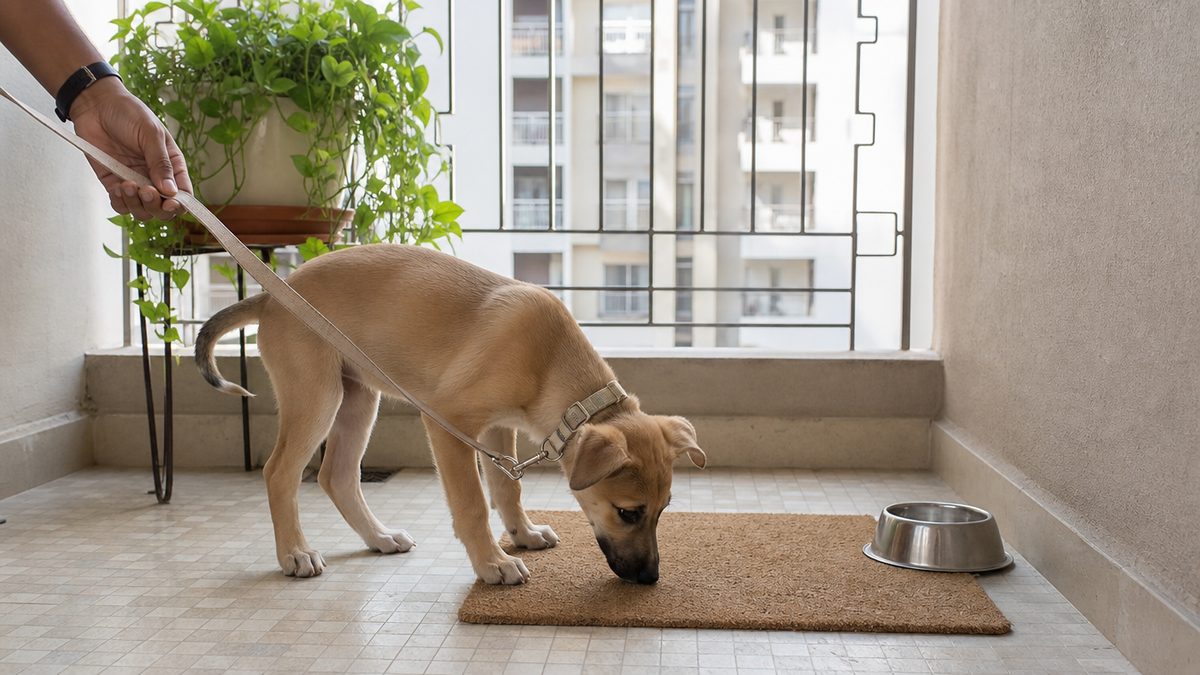
A covered balcony corner is the spot the RSPCA Australia page names for apartment living, alongside "a corner of the laundry/bathroom", and Pedigree India asks for an area "protected from rain and bad weather"; Pedigree India (Mars). Two conditions apply. The door has to be open at 3 am; SniffSociety's Gurgaon observation is the common failure, a balcony spot behind a door shut at night and a puppy that wakes needing to go. And the corner is washed daily, because Chandigarh's 2025 bye-laws require premises where a dog is housed to be kept "in a clean and sanitary condition at all times" against the "foul odour" that reaches an RWA first.
The designated spot in a gated community, and who can fine
The AWBI's 2015 guidelines are the Indian instrument, and they name the arrangement: "pet corners can be designated, in which pets can be trained / encouraged to relieve themselves; and a corner of the complex / park can be designated as area where pet poop can be collected and deposited and composted, using sawdust, etc.", adding that "it is for each residential community and complex to decide which method works best for them, and solutions cannot be imposed on anybody";. The same document tells associations they may "experiment with the creation of pet defecation areas within community premises", and that in the absence of a central or state law on pet excreta they cannot impose rules or fines, only request, while owners are advised to accept "reasonable and lawful requests";. Rule 20 of the ABC Rules 2023 is written for community animals, not pets, but its siting rule, "far from children play areas, entry and exit points, staircase", is the one an RWA already applies to a feeding spot, and the stray dogs guide explains the Rule 20(2) committee that hears an RWA dispute. Two corporations have since supplied the law the AWBI said was absent.
| Instrument | Date | What it says | Fine |
|---|---|---|---|
| AWBI Guidelines for pet owners, care-givers and RWAs | 26 February 2015 | Pet corners can be designated; RWAs cannot ban pets, bar them from lifts or fine for excreta "in the absence of central or state laws"; they can request, and owners are advised to accept reasonable requests | None; an advisory under section 9(k) of the PCA Act |
| ABC Rules 2023, Rule 20 | 10 March 2023 | The RWA or apartment owners' association designates feeding spots for community animals away from play areas, gates and staircases; a dispute goes to a Rule 20(2) committee | Not a pet-dog rule |
| MCD Delhi, pet registration terms, clause 10 | Read 18 September 2026 | The owner "shall not allow his/her pet to defile public places and shall scoop the poop instant to clean up the spot"; | Rs 500 per negligence, levied by DEMS |
| Chandigarh Pet and Community Dogs Bye-laws 2025, clause 8 and Schedule VIII row 10 | Gazetted 29 October 2025 | No defecation in any public place "except within their own premises"; the owner or walker shall scoop and bag it and take the dog "to defecate in isolated areas not frequently visited by the residents"; | Rs 500 fine plus Rs 9,500 administrative charges under the Solid Waste Management Bye-laws 2018 |
Which governs today: in Delhi and Chandigarh the municipal corporation can fine, and the AWBI's 2015 line about absent laws no longer describes those two cities; the RWA itself still has no power to fine anywhere, only to designate a corner and to ask. Your own corporation's registration conditions, which the dog registration guide collects city by city, are where to look before choosing the corner.
AVSAB's socialisation statement says that "visits to dog parks or other areas that are not sanitized and/or are highly trafficked by dogs of unknown vaccination or disease status should be avoided", while still calling early socialisation the standard of care; the RSPCA Australia page applies it to an apartment block, advising against the shared grass if other dogs use it "until they're fully vaccinated";. The reason is measurable: in 212 dog faecal samples collected from ten Chandigarh parks in 2015, Giardia cysts were found in 49, which is 23.1 percent. Until the 16-week dose in the vaccination schedule, the spot is a pad, the balcony, or a patch of the compound no other dog uses.
Monsoon weeks and heat hours: what to do when the walk is off
The walk is off for part of every Indian year, in the monsoon from the first days of June in Kerala until the withdrawal after September, and in the heat block of the hottest months, and a puppy that has only ever toileted on the walk then has nowhere to go; the answer is a second, covered spot taught in the first fortnight rather than found in the first downpour.
The monsoon calendar is the IMD's. The southwest monsoon "normally sets in over Kerala around 1st June" and "covers the entire country around 15th July";; withdrawal from the extreme north-west "is not attempted before 1st September", and from the south peninsula, and so from the whole country, "only after 1st October";. For a puppy in Kochi, Mumbai or Kolkata that is three to four months in which the 06:00 trip to the compound can land in a downpour, and in Chennai the north-east monsoon adds October and November on top.
The heat calendar is on the heat safety page, which computed the hours to avoid for nine cities from NASA POWER hourly means: Delhi's mean air temperature reaches 35 C by 08:30 in June and stays there until 18:30, Ahmedabad's block runs 09:30 to 19:30 in May, and the humid cities, Chennai, Mumbai and Kolkata, have shorter blocks but a peak wet-bulb of 25.7 to 27 C at which panting stops working. Bengaluru and Pune are the exceptions, with a 21 C pre-dawn hour and only 3 to 7 hours above 35 C, and the coolest hour in every one of the nine cities is 04:30 to 05:30. A 10-week puppy that needs ten trips a day cannot take them all in the pre-dawn hour, so from April to June in most metros the compound trips are the first and the last of the day, and the pad or balcony corner takes the rest.
The Kennel Club describes the trap this creates, from the other direction: a puppy taught to toilet only at home "will not toilet when out on a walk, yet relieves itself the second it gets back home", and the cure is an early-morning walk that does not end until it has gone. The same habit runs both ways, and a puppy taught only on the street is stranded by rain. The fix is three habits set in the first fortnight.
- Teach two spots from day one, the compound patch for the first and last trips and a covered pad or balcony corner for the rest, with the same verbal cue at both, so that neither surface is strange when the weather removes the other.
- Cover the outdoor spot if you can; Pedigree India's one Indian-specific line asks for an elimination area "protected from rain and bad weather".
- Prefer a natural surface for the outdoor spot, because Purina's page notes that most puppies "like to go somewhere natural rather than concrete or paving" and pick up their own scent from it; a coir mat or a turf tray on the balcony carries that surface indoors.
- Keep the walk short and early in the heat months, inside the window the heat page prints for your city, with water carried and the pavement checked by hand, and move the toilet trip indoors on any IMD alert day.
None of this changes the count. A monsoon week on the balcony pad still counts toward the 8 to 12 accident-free weeks, provided the pad is one fixed place and the accidents are cleaned the way the next section describes.
Cleaning an accident so it does not repeat: enzymatic cleaner, the washing-powder alternative, and why phenyl fails
An accident cleaned wrong repeats, because the odour of urine or faeces is the cue that makes a dog use the same location again, so the cleaner has to break the residue down rather than cover it; an enzymatic cleaner does, a biological washing powder solution does, and phenyl and ammonia-based cleaners do not.
The reason is stated by the VCA behaviourists: "Good cleanup is crucial to discourage future toileting in the same spot" because "the odor of urine or feces is a cue to use the location again in the future";. The UC Davis handout gives the same instruction, an enzymatic cleaner "to remove residual smells that may entice puppy to revisit the area";. Enzymatic means the product carries bacteria and enzymes that digest the urine residue, which is why Supertails' product page for one cleaner describes "pro bacteria and enzymes specific to pet messes that work together to break down" the stain.
What not to use: ammonia-based cleaners and phenyl
Two common Indian cleaners fail this test in two different ways. Ammonia-based cleaners smell like urine: the Kennel Club lists "using ammonia-based cleaning compounds (which smell similar to urine)" among its toilet-training errors, and the RSPCA Australia page says ammonia "may attract your puppy back to the same spot"; RSPCA Pet Insurance (Australia). Phenyl fails on a second count as well. What Indian shops sell as black or white phenyl is a phenolic-type disinfectant fluid; IS 1061:2017 specifies both fluids as a mixture of "coal tar acids or similar acids derived from petroleum", "phenolic compounds" and "a suitable emulsifier";. The Merck Veterinary Manual says of phenol that "oral ingestion or extensive application to skin can cause systemic toxicosis, manifested primarily by CNS and cardiovascular effects; death may result", of cresol, the derivative "commonly used as a surface disinfectant", that ingestion "may cause local mucocutaneous damage and extensive systemic toxicosis", and that phenol-based disinfectants "are best avoided in feline environments";. A puppy licks the floor it walks on. Neither source claims phenyl removes the urine scent; like ammonia, it masks and does not break down.
Prices on 18 September 2026, from the sellers' own pages and not a ranking: Simple Solution Stain and Odor Remover for Dogs, 1 L, Rs 1,195 at Supertails and Rs 1,195 at Heads Up For Tails, an identical figure that is the printed MRP and so one data point; Odo-Rite Pet Area Cleaner, an Indian-made product describing "natural enzymatic bacteria", Rs 475 for 500 mL and Rs 899 for 1 L at Supertails. The exchange-rate test: Rs 1,195 divided by 84.38 is 14.16 and by 74 is 16.15, Rs 475 gives 5.63 and 6.42, none a dollar price a shop would print, so these are rupee-native. SniffSociety's "Rs 300-500" has no seller behind it and is not used here.
The washing-powder alternative and the four-step routine
The cheap alternative is in the RSPCA's instructions and on no Indian page: clean the area "using a warm solution of biological washing powder (one part washing powder to nine parts water) and rinse with water";; Dogs Trust says the same, "a biological cleaning preparation, so that the smell is completely broken down";. Biological washing powder is the one with enzymes, which is the whole point. The routine for an accident is four steps.
- Say nothing and remove the puppy from the room, because Purina India's advice is to clean up "ideally when your puppy's not watching" and VCA's is to clean "ideally with your dog out of the room";.
- Blot, then soak the spot with the enzymatic cleaner or the one-in-nine washing powder solution, reaching everything the urine reached; PetSmart's trainer notes that on carpet the urine has usually reached the padding underneath.
- Rinse and let it dry, as the RSPCA's method ends with a water rinse.
- Move the soiled paper to the right spot, the trick Humane World describes, so the scent that would have drawn the puppy back to the hallway now draws it to the pad or the compound patch instead.
Ten mistakes, each contradicted by AVSAB, a veterinary handout or the Kennel Club
The ten mistakes below each appear on a page that ranks for this query or in an ordinary Indian routine, and each is contradicted by a source quoted on this page, beginning with punishment, which AVSAB's 2021 position statement rules out for all dog training.
- Punishing an accident. AVSAB's conclusion is that "only reward-based training methods are used for all dog training" and that aversive methods "should not be used in canine training". The RSPCA adds the practical cost: a shouted-at dog "may learn that it's only safe to go when you're not around";.
- Rubbing the nose in it, or hitting. VCA: "Never rub a dog's nose in an elimination, and never strike your puppy". UC Davis calls the rolled newspaper and the nose-rubbing "ineffective" and warns they "may lead to further and more serious behavioral problems";.
- Startling the puppy with a loud noise. Pedigree India's page says "startle him with a loud noise and immediately take him outside". AVSAB lists "shaker noise cans" and "shouting" among the intimidation tools a trainer should avoid, and VCA's instruction is to "create a distraction that will interrupt him without scaring him", an odd sound or a tap on your leg. AVSAB governs.
- Training to be "the alpha";. The same Pedigree page says classes teach the puppy "that you are the alpha, or top, dog in the household". AVSAB says a trainer who "discusses out-dated ideas such as 'dominance', 'leader of the pack', or 'alpha' theories" should not be hired.
- Cleaning with ammonia or phenyl. The Kennel Club's error list and the Merck entry above.
- Sending the puppy out alone. VCA: "Do not send puppies outside alone to toilet"; until trained, most "become distracted and do not eliminate until they are back indoors". The Kennel Club asks how a puppy left alone in the garden is "supposed to learn that going outdoors is the preferred option, if you are not there to show your approval";.
- Expecting the puppy to ask. The Kennel Club calls this "unrealistic" and says to take the puppy out at regular intervals instead; VCA says a puppy can learn to ask only "once your puppy is physically mature enough to hold her bladder consistently";.
- Giving the run of the flat in week two. VCA's puppy is in one of three modes at all times, directly supervised within 3 metres, confined where it could eliminate if it had to, or crated for no more than 3 hours, until it has gone 8 to 12 weeks without a mistake.
- Crating past the limit. VCA: "Never leave the puppy in its crate for longer than it can control its bowels or bladder or it may be forced to eliminate in the crate"; the AVSAB socialisation statement wants crates to "serve as comfort or play areas", never as punishment.
- Moving the spot, or using the shared lawn before the vaccine course is complete. SniffSociety's rule is not to move the spot "for at least the first two months", because the puppy is "building a spatial memory"; AVSAB's line on areas trafficked by dogs of unknown vaccination status is in the note above.
One disagreement inside the veterinary sources is worth knowing. VCA's crate-training handout, edited in 2019, still suggests a shaker can "tossed at the crate when the pup barks" or a water sprayer to stop crate crying; AVSAB's 2021 statement lists shaker noise cans and squirt bottles under intimidation and says the learner "must always feel safe";. The 2021 statement is the later document and the specialist body's, and it governs this page: ignore the crying if it is short, release only when quiet, and never throw anything at the crate.
When it is not a training problem: the medical causes, UTI, Giardia, worms, and the vet visit
A puppy that was reliable and starts soiling again, a puppy that strains, dribbles or passes loose stool with urgency, or a puppy that never gets past the second week is a vet visit before it is a training problem, because the VCA behaviourists list underlying physical illness as one of the four causes of house soiling and put the vet check first.
The four causes in the VCA handout are incomplete house-training or a lapse, physical illness, behavioural illness such as fear or anxiety, and marking; its instruction is that "if your dog is house soiling, particularly if the behavior has started suddenly, it is important to ask your veterinarian to check for a physical illness";. Its conditions fall into four groups: those that make a dog drink and urinate more (kidney or liver disease, infection, diabetes mellitus, diabetes insipidus, Cushing's disease, corticosteroids), those that increase stool (inflammatory bowel disease, food hypersensitivity, maldigestion, intestinal parasites, a high-fibre diet), those that make elimination painful (cystitis, urinary stones, colitis, orthopaedic or neurological pain), and central nervous system disease including "age-related cognitive decline";. The RSPCA Australia page names the commonest in a puppy, "a urinary tract infection or other condition affecting bladder control";. The signs that mean a vet today are listed below.
- Straining, crying or repeatedly squatting with little urine, because dogs "that experience pain during elimination may be reluctant to finish" and need more frequent access.
- Far more water and far more urine than the week before, the pattern of the illnesses that "cause increased urine volume" and the urgency that follows.
- Loose stool with urgency, since dogs "that have frequent bouts of diarrhea may experience urgency that can lead to house soiling", and in a puppy that is a faecal test for Giardia and worms first.
- A trained dog soiling again, particularly suddenly; the VCA's own words are that "if your previously well-trained dog begins house soiling, always consult your veterinarian".
- An old dog forgetting, which the AAHA guideline treats as a senior evaluation for "cognitive changes and/or dysfunction", not as a lapse to retrain.
Giardia and worms: the Indian denominators
Giardia and worms are the Indian part of that list. In the only Indian park survey found for this page, 212 dog faecal samples from ten Chandigarh parks in January and September 2015 held Giardia duodenalis cysts in 49, which is 23.1 percent, strongyle-type eggs in 34 (16.0 percent) and Toxocara eggs in 6 (2.8 percent), with Giardia higher in winter than in the monsoon. The zoonotic side has an Indian denominator too: in a tea-growing community in north-east India, people living with a Giardia-positive dog had 3.01 times the odds of carrying Giardia themselves (95 percent confidence interval 1.11 to 8.39). That is why AAHA's Table 2 lists "feces removal from environment" among the zoonotic-risk actions for every life stage, and why the poop is scooped from the balcony and the compound corner, not left. The deworming schedule guide carries the puppy calendar and the price of a faecal test at a government veterinary hospital.
Two more patterns are not training failures. VCA describes submissive and excitement-related urination, a puppy that wets while greeting, as behaviour the dog "has little or no conscious control over", managed by calm, one-handed greetings rather than by more trips. And marking, a leg lifted against a vertical surface by an intact dog, is communication, for which the VCA handout names desexing among the options; the sterilisation guide carries the AVMA's word for the effect, which is "reduces", not "ends";.
The AVSAB statement gives the vet's place in one sentence: the veterinarian "plays an important role in evaluating the health of the animal to determine if there are medical factors contributing to the behavior concern";. AAHA's guideline has the vet ask, at every puppy visit, about house training as one of the behaviours "that often result in relinquishment or euthanasia";, which is the strongest reason on this page to raise an accident problem at the 12-week appointment rather than wait for it to resolve.
This page is general information and not a diagnosis. A registered veterinarian near you decides for your puppy, and the two tests that separate a training problem from an illness are a urine examination and a faecal examination; the deworming guide prints a government hospital's Rs 100 faecal test fee. A puppy that strains, bleeds, drinks far more than before or has diarrhoea with urgency goes today, not after another week of the timer.
Retraining an adult dog or an adopted Indie: the same method, a longer count
Toilet training an adult dog, whether a rehomed pedigree or an Indie taken off the street, uses the same three tools, supervision, a schedule and a reward at the spot, restarted from day one as if the dog were a puppy, with the count running longer because the dog is unlearning a habit as well as learning one.
The VCA behaviourists' instruction for an adult that soils is to "restart training as though your dog were a young puppy", once the vet has cleared a physical cause. The adult numbers replace the puppy ones: "A healthy adult dog can usually hold urine for about 3 to 4 hours if they are not active", and "most dogs defecate 1 to 3 times daily, and often do so shortly after eating a meal". The RSPCA says the stages for an untrained adult are the same as for a puppy but "it may take longer";; Dogs Trust adds that "even fully trained dogs have accidents sometimes, especially when settling into a new home";. Purina India's one line on the subject is right: a rehomed dog "won't automatically know where they're expected to go in their new home";.
An adopted Indie has toileted wherever it stood for its whole life, usually on soil, and tile is a new surface. VCA is reassuring on exactly this: dogs "can easily be conditioned to eliminate in new locations", the example given being a move from a rural area to a city "where their dogs must learn to eliminate on concrete instead of grass", because the relief of emptying a full bladder "serves as a reward" wherever it happens. That same sentence is the warning: every accident on the hallway tile rewards the hallway tile. The adopting a dog guide covers the first weeks after handover and the 3-3-3 settling rule; the toilet part of those weeks is below.
- Vet first, on the way home, with a faecal sample, because a street dog arrives with the parasite load the Chandigarh survey measured and the deworming schedule starts on day one.
- Confine to one room and tether, in VCA's three modes, supervised within 3 metres, confined where soiling does no harm, or crated only once the dog accepts the crate.
- Out every 3 to 4 hours and after each meal, the adult interval, to one spot, with the treat given there.
- Interrupt with a novel sound, never a scolding, and if the dog has already gone, "do not interact, just clean up quietly".
- Keep the journal VCA asks for, urinations and defecations per day with diet and health changes, because it "may reveal an underlying physical or behavioral illness" and it shows the first accident-free week when it comes.
- Retrain, do not wait it out. An intact male marking indoors is a separate conversation with the vet about desexing, and a dog that soils only when left alone is showing separation-related behaviour that the RSPCA says is "very common" and needs its own plan.
Breed changes the patience, not the method. Purina India says smaller breeds such as "Shih Tzus, Dachshunds, Maltese and Pugs can be a little harder to toilet train", with small bladders and a faster metabolism; SniffSociety, from Indian flats, says the breed effect is real but "overstated" and that the owner's consistency matters more; UC Davis says breeds "may vary in their responsiveness" and the principles do not. So a Shih Tzu or Pug puppy runs the same fortnight at a shorter interval, every 30 minutes during the day in Purina's version, and an Indie runs it at the adult interval. The sit, the recall and the crate itself are in puppy training basics; this page is only the toilet.
Common questions about toilet training a dog in India
What is the quickest way to toilet train a dog?
The quickest way is the VCA behaviourists' routine run without gaps: one spot reached by the same door, a trip on waking, within 15 minutes of each meal, after play and every hour awake, a 5-minute wait, a treat at the spot within seconds, and supervision, a tether or a crate at all other times. There is no faster method; the VOSD's "seven days" is when the routine settles, and 8 to 12 accident-free weeks is when the dog can be trusted alone.
How do I stop my dog from peeing and pooping in the house?
First rule out illness, because the VCA behaviourists list physical illness as one of four causes of house soiling and put the vet check first, especially if it started suddenly. Then restart training as though the dog were a young puppy: supervise or confine, take it to one spot on a schedule, reward there, interrupt with a novel sound rather than a scolding, clean accidents with an enzymatic cleaner, and keep a journal of every elimination.
How long does it take to toilet train a dog?
The routine settles in about a week, the count that ends training is 8 to 12 weeks without a mistake in the VCA handout, and full bladder capacity arrives at about 12 months by the RSPCA's figure. Purina India and Humane World put full house training at four to six months. An adult dog runs the same stages and, by the RSPCA and Dogs Trust, usually takes longer than a puppy.
Is it possible to train a dog to use a toilet?
Yes, to an indoor toilet area, not to a flush toilet. The VCA handout says dogs "can easily be taught to eliminate outdoors, indoors on absorbent pads, or in any other specific area", which includes a pad, a litter tray or a turf tray on a balcony, taught with the same schedule and reward. No veterinary source opened for this page describes training a dog to use a human toilet, so this page does not.
At what age should a puppy be toilet trained?
By stages rather than one age. VCA's behaviourists say many puppies control themselves through the night by 3 months, that daytime control is up to 3 hours at 2 months, 4 at 3 and 5 at 4, and that some need overnight outings until 5 months. The reliable stage is 8 to 12 weeks without an accident, which a puppy started at 8 weeks typically reaches at 4 to 6 months, and full bladder capacity comes at about 12 months.
What is the 10-10-10 rule for puppies?
It is a trainer's construct, not a veterinary one. The US trainer's page that defines it describes "cycles of 10 minutes in the yard, 10 feet of potty area in the yard, 10 minutes of supervision": the puppy is leashed to a small toilet area for 10 minutes, and if it does not go it comes back inside under 10 minutes of close watching before the next try. The VCA version of the same idea is a 5-minute wait, then back inside and supervised.
Are puppies hard to potty train?
No, but they are relentless. AVSAB says housetraining "can be managed by arranging the environment appropriately and reinforcing desirable responses", and the UC Davis handout says breeds vary in responsiveness while the principles stay the same. The hard part is the count: 8 to 10 trips a day at 6 to 14 weeks, every one supervised, for 8 to 12 accident-free weeks. Small breeds run the same routine at a shorter interval.
Can my housing society fine me when my puppy poops in the compound?
The society itself cannot: the AWBI's 2015 guidelines say RWAs cannot impose fines or special charges for pet excreta and can only request, while advising owners to accept reasonable requests and to scoop. The municipal corporation can, where its rules say so: Delhi's MCD registration terms set Rs 500 per failure to scoop, and Chandigarh's 2025 bye-laws set Rs 500 plus Rs 9,500 in charges for a dog defecating in a public place.