
Dog care guide
Monsoon care for dogs in India: ticks, ears, skin, paws and walks in the rain
The IMD onset date for your city, the Indian leptospirosis studies and what the vaccine vial covers, the rainy-season skin, ear and tick series with their denominators, the AWBI and NDMA flood advice, and a priced monsoon kit.
Quick answer
Monsoon care for dogs in India means three things on a calendar: the Leptospira dose and the tick product before the IMD onset date for your city (1 June in Kochi, 27 June in Delhi), a drying routine for paws, ears and coat after every wet walk, and no wading in flooded streets or stagnant water, which predicted acute leptospirosis in a 2025 Chennai study. Skin, ear and tick disease all peak in the rains; the numbers and a priced kit follow. Your nearby vet decides for your dog.
This guide is general information for Indian pet owners and is not a diagnosis. Always consult a registered veterinarian near you before acting on anything you read here, and treat any sudden change in your pet's condition as urgent.
When the monsoon reaches your city: the IMD calendar a dog owner can plan on
The monsoon reaches Kochi around 1 June, Mumbai around 11 June and Delhi around 27 June on the India Meteorological Department's own normal dates, and it withdraws from Delhi around 25 September and from Mumbai around 8 October, so the dog's Leptospira dose, tick product and drying kit are in place before the onset date for your city, not after the first storm. IMD declares onset over Kerala when, after 10 May, 60 percent of 14 listed stations from Minicoy to Mangalore report 2.5 mm or more of rain on two consecutive days with the wind and radiation criteria also met, and it does not attempt a withdrawal from north-west India before 1 September or from the whole country before 1 October India Meteorological Department.
Two IMD pages disagree on one date, so both are printed with their dates. The onset page still says the monsoon 'covers the entire country around 15th July'; the 2020 revision by Pai and eight colleagues in IMD's journal MAUSAM, computed on operationally declared onset dates from 1961 to 2019, brought that forward to 8 July, and IMD's own press release of 29 June 2025 uses the revised figure, 'against the normal date of 08th July'; India Meteorological Department. The 2020 normals govern the bulletins today, so the table uses them, with the old 1901 to 1940 date beside each for comparison. The last column is a planning allowance, not a guideline figure: two weeks before the onset date, so that an annual dose given on that day is on board when the street first floods, and your vet sets the actual date.
| City | Normal onset (1961 to 2019) | Old normal onset (1901 to 1940) | Normal withdrawal (1971 to 2019) | Plan the Leptospira dose and tick product by |
|---|---|---|---|---|
| Thiruvananthapuram and Kochi | 1 June | 1 June | Not dated separately; the north-east monsoon follows | 18 May |
| Bengaluru | 3 June | 2 June | Not dated separately | 20 May |
| Guwahati | 5 June | 3 June | 14 October | 22 May |
| Chennai | 7 June | 29 May | Not dated separately; the north-east monsoon, October to December, is the wet season | 24 May, and again before October |
| Pune | 10 June | 8 June | 9 October | 27 May |
| Mumbai | 11 June | 10 June | 8 October | 28 May |
| Hyderabad | 11 June | 8 June | 13 October | 28 May |
| Kolkata | 12 June | 7 June | 14 October | 29 May |
| Patna | 16 June | 11 June | 8 October | 2 June |
| Nagpur | 16 June | 9 June | 7 October | 2 June |
| Bhopal | 20 June | 13 June | 3 October | 6 June |
| Lucknow | 23 June | 18 June | 3 October | 9 June |
| Ahmedabad | 26 June | 14 June | 28 September | 12 June |
| Delhi | 27 June | 29 June | 25 September | 13 June |
| Chandigarh | 28 June | 30 June | 23 September | 14 June |
| Jaipur | 29 June | 25 June | 23 September | 15 June |
Chennai is the exception the table's blank hides. The south-west monsoon retreats from most of the country by about 15 October and the north-east monsoon then establishes itself over the south peninsula, so Chennai's wettest weeks come in October to December, and the Chennai leptospirosis study below found that the north-east monsoon, not the south-west, was the season that predicted acute disease Sarangi S, Vijaya Bharathi M. For a dog in Chennai, Puducherry or coastal Tamil Nadu the calendar runs October to December and the dose date moves with it. The four dates that fall out of the table are listed below.
- Two weeks before onset: the annual Leptospira dose, or the second dose of a first course. WSAVA 2024 makes the vaccine core where the disease is endemic and MSD's Indian L4 leaflet gives two doses 4 weeks apart for a first course, so a first course starts six weeks before the date MSD Animal Health India. The dog vaccination schedule in India guide lays out the vials.
- The week before onset: the tick product, on its label interval, because TroCCAP says a dog in the tropics is protected 'throughout the year' and the brown dog tick 'can complete more than one generation per year in the tropics'. The dog ticks in India guide compares the products.
- Onset to withdrawal: the drying routine after every walk, the kibble bin closed, and the walk route off any flooded street, for the reasons in the sections below.
- Two weeks after withdrawal: the skin and ear check that catches what the rains started, and the deworming the NDMA guideline asks for after a flood.
The walk in the rain: what to avoid on the street and the ten-minute routine at the door
Walking your dog in the rain is safe when the dog stays out of standing water and is dried to the skin within ten minutes of coming home, because the two exposures the Indian evidence ties to disease are contact with wet soil or stagnant water, a predictor of acute leptospirosis in 210 Chennai dogs (p = 0.046), and a coat, paw and ear canal left damp, which a veterinary dermatologist names as the condition, 'heat, humidity', for Malassezia yeast overgrowth and which the Jammu otitis series blamed for its August peak Kumar S, Hussain K, Sharma R, Chhibber S.
Before the walk: the route and the gear
Before the walk, the choice is the route and the gear, not the dog's mood. Rodent exposure and outdoor management were two more predictors in the Chennai study (p = 0.001 and p = 0.047), so a route past the open drain, the garbage point or the flooded underpass is the wrong route even when the dog pulls for it. A waterproof raincoat keeps the back and belly dry on a double coat that otherwise stays wet for hours; boots keep the interdigital skin, which Bajwa lists among the sites Malassezia colonises even in healthy dogs, out of the water. Boehringer Ingelheim's Indian page says the same in one line, avoid 'walks in flooded or muddy areas' and use 'lightweight raincoats or paw protection' when the dog has to go out. Both are priced from an Indian seller's page in the kit section.
The ten-minute routine at the door
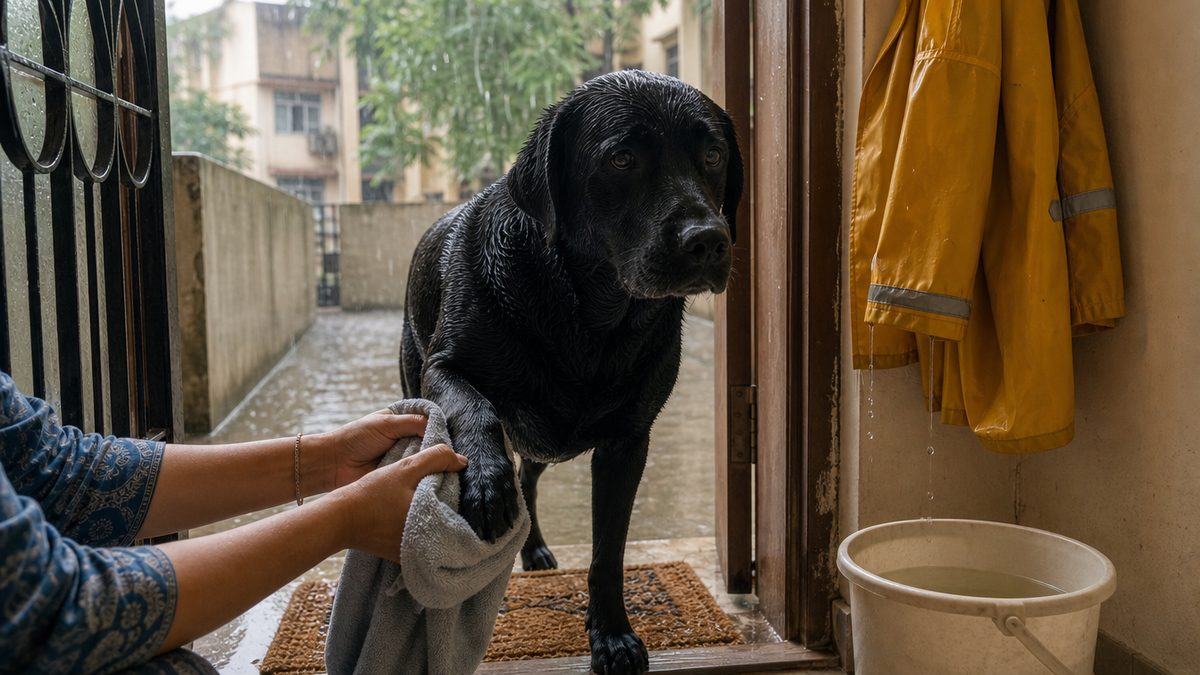
The routine at the door is the same six steps every time, listed below in order, and it runs faster than the walk.
- Rinse the paws in a cup or bucket of clean water at the door, before the dog reaches the floor, and dry between every toe; the interdigital skin is a yeast site and a tick site.
- Towel the coat to the skin, belly, armpits and groin first, then a dryer on cool at arm's length for a double coat; a wet coat is the humidity the yeast needs.
- Wipe the ear flap and the opening dry with the towel, never a bud into the canal; the Jammu authors put their August peak down to 'relative humidity' and named 'pendulous ears' among the factors.
- Run your hands over the dog for ticks, ears, armpits, groin and between the toes, and remove any tick with tweezers the way the dog ticks in India guide shows; TroCCAP asks for 'regular visual inspection and prompt removal';.
- Look for the early signs, a rancid smell, a greasy patch, a head shake, a licked paw, reddish-brown staining at the claw folds, because these are the presenting signs Bajwa lists for yeast dermatitis and they are a vet visit, not a wait.
- Hang the raincoat and the towel to dry away from the bed; the AWBI's monsoon advisory puts even a street dog's shelter 'higher than ground level' and 'well-ventilated', and a damp towel on the bedding undoes the towelling.
Bathing frequency is the one habit that goes down in the rains, not up. The page ranking first for the query settles on a bath every 14 to 21 days, and that is a fair default for a dog that is towelled after every walk. The evidence-backed prescription for a yeast overgrowth is different: a 2 percent miconazole and 2 percent chlorhexidine shampoo twice a week, which is a treatment the vet times after a slide under the microscope, not a routine wash, and 'trial therapy is of minimal benefit in the absence of cytological evidence'. The dog grooming at home in India guide has the bath, brush and dryer method by coat type and the tick check that belongs in every session.
Rain falling on a dog is water; a puddle is water that has stood in a street rodents use. In the Chennai series a history of contact with wet soil or stagnant water predicted acute leptospirosis (p = 0.046) and rodent exposure did so more strongly (p = 0.001), and in the Kolkata ringworm series 213 of 285 fungal cases fell in June to August. Walk in the rain if you must; do not let the dog wade, drink from the street or lick its feet before they are rinsed.
Leptospirosis: the monsoon disease with Indian numbers, and what the vaccine vial covers
Leptospirosis is the disease the monsoon brings to dogs in India, and the Indian numbers are large: 123 of 210 suspected dogs around Chennai carried anti-leptospiral antibodies, 49 of them (23.33 percent) had acute disease, and the north-east monsoon season was one of five predictors of it; 146 of 205 Kerala sera (71.12 percent) were positive; 28 of 50 apparently healthy, unvaccinated Cauvery delta dogs (56.0 percent) were seropositive and 12 of the 50 had leptospires visible in their urine Khedekar PH, Balakrishnan S, Manimaran K. Every one of those denominators is a hospital or survey sample rather than the pet population, and each is read that way below.
The monsoon is the mechanism, not a coincidence. Leptospires shed in the urine of rats and other carriers survive in water and wet soil for weeks; the Indian One Health review names 'heavy rain and flooding' as the events that wash them into standing water, and lists Tamil Nadu, Karnataka, Kerala and Puducherry as the endemic southern states, with Maharashtra, Gujarat, Kolkata and Odisha endemic but with less reported information Rohilla P, Khurana R, Kumar A, Batra K. The NDMA's April 2026 disaster guideline lists leptospirosis as the bacterial disease of 'contaminated water' that veterinary teams must expect after a flood, and notes that flooding 'can lead to a proliferation of vectors like mosquitoes and rodents';. A dog wading a flooded lane in Mumbai in July is standing in the transmission route.
| Series | Dogs and method | Result | Serogroups found | What it says for the monsoon |
|---|---|---|---|---|
| Chennai and around, TANUVAS, 2025 | 210 suspected dogs; MAT with a 1:100 cut-off, PCR, logistic regression | 123 (58.57 percent) seropositive, 67 of them to more than one serogroup; 49 (23.33 percent) acute; 13 of the 49 urine-PCR positive | Australis and Autumnalis predominant | Adult age 1 to 5 years (p = 0.001), north-east monsoon season (p = 0.011), outdoor management (p = 0.047), rodent exposure (p = 0.001) and contact with wet soil or stagnant water (p = 0.046) predicted acute disease |
| Kerala, Mannuthy, 2013 | 205 sera from Thrissur, Kozhikode and Palakkad, March 2011 to February 2012; MAT against nine serovars | 146 (71.12 percent) positive; the paper's results and methods sections swap its two healthy groups, so quote its counts rather than that split | Autumnalis 36 (23.97 percent of positives), Australis 28, Pomona 20, Grippotyphosa 14, Canicola 14, Icterohaemorrhagiae 13, Pyrogenes 12, Javanica 9, Patoc 5 | The commonest serovar, Autumnalis, is not in the vaccine the authors say Kerala clinics use |
| Cauvery delta, Tamil Nadu, 2025 | 50 apparently healthy unvaccinated dogs; MAT against 12 serovars, dark-field microscopy of serum and urine | 28 (56.0 percent) seropositive; leptospires seen in 12.0 percent of serum and 24.0 percent of urine samples | Icterohaemorrhagiae 46.4 percent of positives, Grippotyphosa 32.1, Australis 32.1, Canicola 25.0, Autumnalis 17.9 | Healthy dogs carry and shed; the authors propose dogs as sentinel animals |
| Mumbai, 2014 | 100 blood and 18 urine samples from rodents and suspected dogs, 2006 to 2008; PCR and MAT | 14 of 71 (19.7 percent) antibody-positive | Pyrogenes in 7 of 7 suspected dogs and 6 of 7 rodents | The city's dogs and rats share a serovar |
| Haryana, 2020 | 239 urine samples from healthy dogs, April 2018 to March 2019; qPCR | 0 of 239 shedding pathogenic Leptospira | None detected | A drier northern state; healthy pet dogs were not a source there |
The vaccine covers four serogroups and the Indian series report a fifth. MSD's Nobivac L4, sold in India, carries Canicola, Icterohaemorrhagiae, Australis and Grippotyphosa; WSAVA 2024 says commercial vaccines worldwide 'variously contain serovars belonging to serogroups Icterohaemorrhagiae, Canicola, Grippotyphosa, Pomona and Australis', and none of the five is Autumnalis, the commonest serovar in the Kerala series and one of the two predominant serogroups around Chennai World Small Animal Veterinary Association… Ambily R, Mini M, Joseph S Sarangi S, Vijaya Bharathi M. The Kerala authors said so in 2013, that 'the emergence of serovars other than the vaccinal serovars necessitates the incorporation of these in the vaccines', and WSAVA says the same in general terms, that 'a vaccine cannot be designated as core if it is uncertain which vaccine should be given'; World Small Animal Veterinary Association…. So the vaccine is worth having, because Australis, Icterohaemorrhagiae and Grippotyphosa are in the Indian lists too and WSAVA notes that 'quadrivalent vaccines provide broader protection'; it is not a licence to wade.
The schedule is two doses, then one a year. WSAVA 2024 gives two doses 2 to 4 weeks apart from 8 weeks of age and annual revaccination, and makes the vaccine core 'in countries or regions where canine leptospirosis is endemic, implicated serogroups are known and suitable vaccines that include implicated serovars are commercially available'; the L4 leaflet gives its two doses 4 weeks apart, and WSAVA adds that the vaccines 'provoke strong but transient seroconversion' while protection lasts longer than the antibody, up to 15 months in the study it cites MSD Animal Health India. An Indian 7-in-1 or 9-in-1 vial carries a Leptospira component whose serogroups vary by maker; the dog vaccination schedule in India guide reads each vial's label antigen by antigen, so the conversation with the vet starts from the vial in the fridge.
The signs are not specific, which is why the monsoon history matters. The Indian review lists fever, lethargy, shivering, muscle tenderness, a change in the amount of urine, dehydration and loss of appetite, with vomiting, diarrhoea, indigestion and laboured breathing depending on the route of infection, and the 2025 Chennai study set its acute-case titre at 1:800 in unvaccinated dogs and 1:1600 in vaccinated ones, so a vaccinated dog can still be a case. A dog off its food with a fever in the fortnight after a waterlogged walk is a same-day vet visit, and the word 'leptospirosis' said at the desk changes the tests that are run.
Leptospirosis passes from animals to people through urine and the water it reaches. The Mumbai series found the same Pyrogenes serovar in 7 of 7 suspected dogs and 6 of 7 rodents, and the Cauvery delta series saw leptospires in the urine of 12 of 50 healthy dogs Khedekar PH, Balakrishnan S, Manimaran K. Wash hands after cleaning up urine, keep a sick dog's urine off the floor the children play on, and tell the doctor the dog's diagnosis if anyone at home runs a fever. This page is information, not a diagnosis; your nearby vet decides for your dog.
Skin, yeast, ringworm and ears: the Indian rainy-season series with their denominators
Skin infections in the monsoon are three organisms with three Indian counts: ringworm, where 213 of 285 fungal cases in dogs, cats and their owners around Kolkata fell in June to August (74.8 percent) and Microsporum canis was 60.0 percent of isolates; Malassezia yeast, the commensal that overgrows in 'heat, humidity'; and otitis externa, where 60 of 273 dogs with skin disease in Jammu had it and 28.33 percent of those 60 presented in August, the wettest month of the series Kumar S, Hussain K, Sharma R, Chhibber S.
| Series | Sample | Finding | Season signal |
|---|---|---|---|
| Kolkata dermatophytes, West Bengal University of Animal and Fishery Sciences, 2015 | 362 clinically suspected cases, 123 dogs, 202 cats and 37 people, January to August 2013 | 285 (78.7 percent) culture-positive, 108 of them dogs; M. canis 60.0 percent of isolates, M. gypseum 22.5, T. mentagrophytes 15.8; male dogs 58.3 percent of canine cases | 213 of 285 (74.8 percent) in June to August, 79 animal cases in July alone; 16 of 19 human cases were in-contact owners |
| Jammu otitis externa, 2014 | 273 dogs with skin disease, August to December 2011, a teaching hospital, the Central Veterinary Hospital at Talab Tillo and private clinics | 60 (21.97 percent) had otitis externa; bacteria ahead of fungi in the canals; 55 percent of cases were dogs of 3 years and over; German Shepherds and Labradors led the breed list | 28.33 percent of the 60 presented in August, 26.66 percent in October, 10.00 percent in December; the authors name 'pendulous ears and relative humidity' |
Ringworm is the monsoon skin disease a family catches from the dog. In the Kolkata series 16 of the 19 human cases were people in contact with an infected pet, the incidence was highest in young animals and in owners aged 21 to 30, and the authors' conclusion was one line, that 'fungal infections are mostly prevalent during rainy seasons, in pet animals such as cats and dogs which can act as potential sources for human infections';. A round, scaly, hairless patch on a puppy in July is a vet visit and a hand-wash, not a home cream, because the same fungus can be on a child's arm a fortnight later.
Yeast is already on the dog and needs only the weather. Malassezia pachydermatis lives on the lips, chin, interdigital and perianal skin of healthy dogs, overgrows when 'favorable environmental conditions (heat, humidity)' or a change in the host tip the balance, and shows as face rubbing, paw licking, a greasy coat, reddish-brown staining of the claw folds and 'an offensive, rancid odor'; the diagnosis is cytology under the vet's microscope, because pyoderma and allergy look the same, and the ear form is 'a pruritic, erythematous, and ceruminous otitis externa';. Breeds at raised risk include the Shih Tzu, Basset Hound, American Cocker Spaniel, Dachshund and Poodle, plus any dog with skin folds. An itchy dog in the rains is a dog to show, not to shampoo blind.
Ears: the August peak against the calendar
The ear peak lands on the wettest weeks of the calendar. Jammu's rains arrive with the monsoon's north-western limb in late June, the series opened in August, and 17 of its 60 otitis cases (28.33 percent) presented that month; the authors found bacteria ahead of fungi in the canals, saw dogs of three years and over in 55 percent of cases, and named 'pendulous ears and relative humidity' among the factors favouring the organisms Pai DS, Bandgar A, Sunitha Devi, Musale M. Its limits travel with it: the denominator is dogs already presented with skin disease, and the window has no pre-monsoon month to compare against.
The dogs whose ears are wiped after every wet walk are the drop-eared ones, the Labrador Retriever, the Beagle and the English Cocker Spaniel, whose pages carry their ear-disease odds; an erect-eared Indian Pariah Dog has the canal the climate built for. The dog grooming at home in India guide holds three further Indian otitis series, which disagree on the peak season, and the full literature belongs on the otitis externa in dogs page.
A head-shake, a sour smell or a dog scratching one ear in the monsoon is examined before it is cleaned. Bacteria outnumbered fungi in the Jammu canals and yeast makes its own ceruminous otitis, and which organism it is decides the drops Bajwa J. Malassezia species and its…. Wipe the flap and the opening dry after every wet walk; leave the canal to the otoscope.
Ticks: the monsoon peak with a denominator, by city and by pathogen
Ticks peak in the rains, and the one Indian survey run inside the monsoon put a number on it by city: examined in June to September 2008, 80 percent of 162 Mumbai dogs and 75.3 percent of 162 Delhi dogs carried ticks, against 17 percent of 101 in Sikkim and 11 percent of 100 in Ladakh, and 261 of all 525 dogs (49.7 percent) were PCR-positive for at least one tick-borne pathogen. Those were stray and shelter dogs in Animal Birth Control programmes, 77 percent of them strays, so the rates describe dogs that live in the rain; the direction, not the percentage, is what a pet owner takes from it.
| Finding | Mumbai (162 dogs) | Delhi (162 dogs) | Sikkim (101 dogs) | Ladakh (100 dogs) |
|---|---|---|---|---|
| Ticks seen on the dog | 80 percent | 75.3 percent | 17 percent | 11 percent |
| Hepatozoon canis | 38.3 percent | 43.8 percent | 0 | 24 percent |
| Ehrlichia canis | 39.5 percent | 27.2 percent | 0 | 0 |
| Mycoplasma haemocanis | 17.3 percent | 14.2 percent | 1 percent | 12 percent |
| Anaplasma platys | 13 percent | 8 percent | 0 | 0 |
| Babesia vogeli | 8.6 percent | 7.4 percent | 2 percent | 0 |
The lesson is geographic and it is the monsoon's. Rhipicephalus, the brown dog tick, was the genus on every Mumbai and Delhi dog that carried ticks, the two hot, wet cities held every co-infection in the study (75 dogs with two pathogens, 22 with three, 4 with four), and the two cold, dry stations held almost none; Hepatozoon canis at 30 percent and Ehrlichia canis at 20.6 percent led the pathogen list across all 525 dogs. TroCCAP's guideline for the tropics is written for that map: dogs 'should be protected from ectoparasite infestations throughout the year', the brown dog tick 'can complete more than one generation per year in the tropics', 'even dogs living mostly indoors may be frequently exposed to ticks' at parks and groomers, and where infestation is heavy 'environmental treatment with proper acaricides may be necessary';.
So the routine does not change with the season; the checks do. The tick product is on the dog before the first rain, on its label interval, the hand check moves from most days to every day, and the bedding wash goes weekly. The dog ticks in India guide carries the product classes with their Indian prices, the tweezers method, the Kerala and Odisha tick-borne disease series, and the signs that mean the vet today; the adult dog care in India guide sets the same routine inside the whole year, and the cat ticks and fleas in India guide covers the cat that shares the flat, because TroCCAP warns that concentrated synthetic pyrethroids and amidines in dog products 'are toxic for cats';.
Flooded streets and waterlogging: what the AWBI and NDMA advisories say
Flooded streets are the one monsoon hazard two Indian authorities have written about this year: the Animal Welfare Board of India's advisory of 14 July 2026 asks citizens, owners and caretakers to protect animals from 'heavy rains, floods, and related challenges', and the National Disaster Management Authority's April 2026 guideline on animal-inclusive disaster risk reduction, circulated by the AWBI on 11 August 2026 for the Assam and Gujarat floods, is the first national document to tell a pet owner what to pack.
The AWBI letter is short and its five points apply to a pet as much as to a street dog. It asks for temporary shelters 'at a dry place which is higher than ground level, well-ventilated', placed 'away from pathways, parks, staircases and parking areas where animals are more prone to accidents'; clean water 'in containers that are stable and not easily tipped over preferably in metal bowls with a wide opening'; coordination with local veterinary services; community volunteers; and 'proper drainage systems to prevent water logging, which can pose a threat to stray animals', with waste disposed of so it does not contaminate 'food and water sources';. It is signed by the Board's Secretary, refers back to the same letter of 10 July 2024, and is copied to every District Collector, Director General of Police and municipal corporation in the country. The feeding community dogs in India guide is where the street-dog side of it lives.
The NDMA guideline is the document to read before the water rises. It defines companion animals as 'pets such as dogs and cats kept in homes as companions', records that 'almost three-quarters of pet owners would attempt to take their animals with them if evacuated' and that owners 'refuse evacuation or re-enter hazardous areas if provisions are not made for pets', names 'the lack of pet-friendly emergency shelters' as the complication, and notes that 'the absence of permanent identification, such as microchips or tags, hampers reunification with owners';. The pet microchipping in India guide prices the chip. The 'Grab-and-Go' bag the guideline says 'all animal owners must be trained to maintain' is 'a pre-packed emergency kit with essentials', and its eight printed items are listed below with what each means in an Indian flat.
- Food: three or four days of the dog's usual kibble in a sealed bag, because an opened sack that gets damp re-moulds within days (the food section below has the threshold).
- Water: bottled, since the same guideline lists leptospirosis as the disease of 'contaminated water' after a flood.
- Meds: the tick chew, the deworming tablet and any prescription, with the label on.
- Records: the vaccination card with the rabies and Leptospira dates, and the municipal licence the dog licence and pet registration in India guide covers.
- Carrier: one the dog already knows, because owners 'must habituate animals to carriers/crates during peace-time to prevent panic during rapid evacuation'.
- Leash: a fixed-length lead, not a retractable one, in moving water.
- Waste bags: the flooded street is not a toilet, and the guideline's public-health section is about exactly that water.
- Comfort items: a blanket or toy that smells of home.
After the water goes down the guideline has two more lines for a dog. Veterinary teams are told to expect leptospirosis ('contaminated water') and ringworm ('hygiene/crowding') among the diseases of a disaster, and that 'post-disaster, animals like cattle, buffalo, sheep, goat, pigs, dogs, and poultry need to be dewormed with a suitable broad-spectrum anthelmintic';. The dog deworming schedule for India guide has the tablet doses per kilogram; a dog that has waded a flood has its faecal test in the quarter the flood fell in.
The flat, the terrace and the food bin: humidity, mould and aflatoxin
The flat is the monsoon's second hazard for a dog, because the humidity that grows yeast on the skin grows mould in an opened bag of kibble: once a sack is open its hygroscopic contents climb above 17 percent relative humidity, Aspergillus conidia germinate and aflatoxin production restarts, faster 'with increasing ambient temperature, relative humidity, and time of consumption of the sack content', with the toxin's regulatory genes most active at 28 to 30 degrees Celsius, which is a humid Mumbai kitchen in July.
Aflatoxicosis is rare, and it kills when it happens. The review's table of acute outbreaks in dogs fed contaminated dry food runs from 2 of 2 dogs dead in Brazil to 96 of 100 in South Africa, 34 of 50 (68 percent) in Israel and 26 of 72 (36.1 percent) in the United States, with the toxin measured in the feed at up to 4,946 micrograms per kilogram, and it notes that India is among the countries whose permitted maximum for aflatoxin in animal feed generally is above the 20 micrograms per kilogram used elsewhere. That comparison is about feed, not about the bag in your kitchen, and for the bag the Indian figure runs the other way: Table 3 of IS 11968:2019, the Bureau of Indian Standards specification for pet food for dogs and cats, caps Aflatoxins B1 at 10 ppb, which is 10 micrograms per kilogram, in complete pet food up to 12 percent moisture, tested by Annex K of IS 1374. So a compliant Indian pet food is held to half the 20 microgram figure, and what the monsoon changes is not the limit but whether an opened bag still meets it. The signs it lists are vomiting, refusal of food, black or bloody stool, jaundice, a swollen belly and, later, depression and seizures, and they follow either a high dose or long ingestion of a lower one.
The storage rule that follows is arithmetic, not a product. Buy the bag the dog finishes in three to four weeks in the rains rather than the 20 kg sack that is cheaper per kilo; stand the whole bag inside an airtight bin the day it is opened rather than tipping the kibble in, and keep the scoop outside the bin; store it off the kitchen floor and away from the window; and throw away, rather than sniff and risk, any kibble that clumps, smells musty or shows a green or white bloom, because the review's point is that once the conidia have germinated the bag is the source. Virbac India's own monsoon page says to seal the pack after each use and not to leave food in the bowl 'for several hours at a stretch', and Boehringer Ingelheim's says to 'store food in airtight containers to prevent spoilage'; both are manufacturers of medicines, not food, which is why the line is worth repeating Boehringer Ingelheim India. Keep the bag rather than tipping the kibble out, because the bag is the barrier and carries the batch code: the FDA asks owners to store pet food in its original bag and, where a container is used, to put the whole bag inside it, which our guide to storing pet food in Indian humidity sets out in full. The homemade dog food in India guide covers the cooked alternative, which goes into the fridge as soon as the meal is over.
Bedding, the terrace and the dog that will not go out
Bedding is where a monsoon flat holds water longest. The AWBI's shelter rule for a street dog, a dry place higher than ground level and well-ventilated, is the rule for a pet's bed too; Boehringer Ingelheim's Indian page says to keep bedding 'raised off the floor' and to 'wash and sun-dry it weekly, especially in coastal cities like Mumbai or Chennai, where humidity lingers', and the brown dog tick is the second reason for the weekly wash, since TroCCAP allows that heavy infestations need the environment treated, not just the dog Boehringer Ingelheim India Tropical Council for Companion Animal…. A covered terrace or a roofed balcony gives a flat-bound dog a dry place to sniff and relieve itself between showers, and it is the one surface to hose and dry every day, because a wet terrace is a puddle the dog stands in.
Thunder
Thunder is the monsoon's behaviour problem, and it is common. In 13,715 Finnish pet dogs answered for by their owners, noise sensitivity was the most common anxiety trait at 32 percent, fear of fireworks the most common subtrait at 26 percent, and 'the prevalence of noise sensitivity increased with age, especially fear of thunder';. The plan that works for Diwali works for a July storm: a closed, curtained room the dog already uses, the radio on, the walk done before the evening build-up, and the vet consulted for medication if the dog injures itself or will not eat. The adult dog care in India guide sets that plan out for the fireworks week, with the law on the noise, and the things to do with your dog in India guide fills the indoor hours a wet week takes away.
The monsoon kit in rupees, from an Indian seller's page, with the exchange-rate test
The monsoon kit for a dog costs about Rs 2,000 without boots and Rs 3,700 to Rs 4,400 with them, on the prices one Indian seller printed on 18 September 2026, and every figure in the table was divided by 84.38 and by 74 to check that it is not a converted dollar price. Two quotients landed near a whole dollar, the Fofos raincoat in size L at Rs 1,012 (11.99 at 84.38) and the paw butter at Rs 252 (2.99 at 84.38), and both are sale prices off an MRP that does not divide (Rs 1,150 and Rs 265), so both are Indian prices with a coincidental quotient; the rest divide to nothing Supertails, Bark Out Loud Beeswax Paw….
| Item | Price (MRP) | Divided by 84.38 | Divided by 74 | Why it is in the kit |
|---|---|---|---|---|
| Skatrs RainRider Pro reflective waterproof raincoat, sizes S to XXXL, one price | Rs 499 (MRP Rs 1,999) | 5.91 | 6.74 | Keeps the back and belly dry; the reflective strip matters on a dark, wet street |
| Barkbutler x Fofos reflective raincoat, size M (sizes to XXXXL) | Rs 876 (MRP Rs 995) | 10.38 | 11.84 | The hooded alternative, priced by size up to Rs 1,439 for XXXXL |
| Truelove waterproof boots, set of 4, size M (XXS to 3XL) | Rs 2,385 (MRP Rs 2,650) | 28.26 | 32.23 | Keeps the interdigital skin, a yeast and tick site, out of the water |
| Protex PawZ disposable and reusable boots, size M (XS to XL) | Rs 1,722 (MRP Rs 2,100) | 20.41 | 23.27 | The thin rubber option for a dog that refuses a boot |
| Groom My Pet paw cleaner cup, 5 by 4 inches | Rs 449 (MRP Rs 599) | 5.32 | 6.07 | The rinse at the door; a bucket does the same job |
| Skatrs microfibre towel, 140 by 70 cm | Rs 449 (MRP Rs 889) | 5.32 | 6.07 | The drying step; one towel per dog, hung to dry away from the bed |
| Virbac Ketochlor antifungal and antiseptic shampoo, 200 ml | Rs 349 (MRP Rs 356) | 4.14 | 4.72 | The medicated wash the vet prescribes and times, not the routine bath |
| Bark Out Loud beeswax paw butter, 30 g | Rs 252 (MRP Rs 265) | 2.99 | 3.41 | Cracked pads after a wet month |
Two items are missing from the table on purpose. The ear cleanser and the tick product are prescribed, not bought on a hunch: the dog grooming at home in India guide prices a chlorhexidine ear cleanser and the dog ticks in India guide prices every product class, and the vet picks which one this dog gets. The Ketochlor is in the table because every ranking page tells the reader to buy an antifungal shampoo, and the honest line is that the evidence-backed formulation for yeast is 2 percent miconazole with 2 percent chlorhexidine twice a week as a prescribed course, so the bottle is bought when the vet says which one, and the routine bath in the rains is the plain one.
Prices move within weeks; the MRP moves slower than the sale price, and the date on each row is part of the figure. Bonbeno reports these as published prices, not as offers, and does not sell any of them. Insurance, which the pet insurance in India guide prices policy by policy, is the one monsoon purchase that has to be made before the rains to count, because a leptospirosis admission is the claim it exists for.
Signs that mean the vet today, and the words to say at the desk
Five monsoon signs decide when to see a vet, and for each the answer is today; each has a sentence that changes which test is run, and they are listed below.
- Fever, lethargy, vomiting or a change in how much the dog urinates in the fortnight after a waterlogged walk. Say 'leptospirosis' and say where the dog waded; the Chennai study's predictors were wet soil, stagnant water, rodents and the monsoon itself, and its acute-case titre was set higher in vaccinated dogs, so vaccination does not rule it out.
- Vomiting, refusal of food, black stool, yellow gums or a swollen belly on a dog eating from an opened bag. Bring the bag; the aflatoxin review lists exactly those signs, and the feed is the sample that proves it.
- A head shake, a sour smell or scratching at one ear. Say 'otitis' and ask for the canal to be looked at before anything is put in it; the Jammu series found bacteria ahead of fungi, and which one it is decides the drops.
- A round, scaly, hairless patch, or the same patch on a child. Say 'ringworm' and wash hands; 16 of 19 human cases in the Kolkata series were in-contact owners.
- A greasy coat, a rancid smell, stained paws or constant paw licking. Say 'yeast' and ask for a slide; the dermatologist's rule is that trial therapy without cytology is of minimal benefit.
Ticks have their own signs, and the dog ticks in India guide carries them with the Indian tick-borne disease series; the heat that follows the withdrawal has the heat safety for dogs in India guide, and the cold that follows it in the north has the adult dog care in India guide. None of this is a diagnosis. The vet who examines the dog, in your city, in this week's weather, decides what is wrong with it and what it gets.
Common questions
Do dogs really need the Lepto shot?
Yes, a dog in India needs the Leptospira vaccine, because WSAVA 2024 makes it core 'in countries or regions where canine leptospirosis is endemic, implicated serogroups are known and suitable vaccines that include implicated serovars are commercially available', and the Indian series above show the disease in Chennai, Kerala, the Cauvery delta and Mumbai dogs with denominators. It is two doses 2 to 4 weeks apart, then one dose a year, timed before the onset date for your city. Your nearby vet picks the vial.
Why is the Lepto vaccine controversial?
The Lepto vaccine is argued over because immunity is largely serogroup-specific and the vial may not match the local strains. WSAVA 2024 says that in many parts of the world 'it remains undetermined which serogroups would need to be included in vaccines for local use', that commercial vaccines carry only Icterohaemorrhagiae, Canicola, Grippotyphosa, Pomona and Australis, and that they 'provoke strong but transient seroconversion' so a dog needs a dose every year. The Kerala series found Autumnalis, which no vaccine carries, the commonest serovar. That is a reason to vaccinate and still avoid puddles, not a reason to skip it.
How likely are you to get lepto from a dog?
A person is far more likely to catch leptospirosis from flood water and rats than from a pet dog, but a sick or shedding dog is a real route. In Haryana 0 of 239 healthy dogs shed pathogenic Leptospira in their urine over a year; in the Cauvery delta 12 of 50 healthy unvaccinated dogs had leptospires in their urine; in Mumbai the same Pyrogenes serovar turned up in 7 of 7 suspected dogs and 6 of 7 rodents. Wash hands after cleaning urine, keep a sick dog's urine off the floor, and mention the dog's diagnosis to your doctor if anyone at home runs a fever.
How long can a dog stay in the rain?
No guideline sets a number of minutes, because the harm is not the rain but what follows it: a coat, paws and ear canals left damp, which a veterinary dermatologist names as the 'heat, humidity' that lets Malassezia yeast overgrow, and standing water, which predicted acute leptospirosis in 210 Chennai dogs. A dog can be walked in steady rain for its usual walk if it stays out of puddles and is towelled to the skin, paws and ear flaps first, within ten minutes of coming home. The rule is the drying, not the clock.
What happens if a dog gets wet in the rain?
A dog that gets wet in the rain and dries within minutes comes to no harm; a dog that stays damp for hours grows what the damp favours. Malassezia yeast, a normal resident of canine skin, overgrows in 'heat, humidity' and shows as paw licking, a greasy coat, a rancid smell and a ceruminous ear; ringworm peaked in June to August in the Kolkata series, 213 of 285 cases; and the Jammu otitis series put 28.33 percent of its cases in August. Towel the dog to the skin, dry between the toes, wipe the ear flaps, and show the vet any smell, patch or head-shake.
Which season is good for dogs?
The season after the monsoon withdraws and before the heat builds is the good one for a dog in most of India, roughly mid-October to February, on the IMD's own normal dates: withdrawal from Delhi around 25 September, Mumbai 8 October and Kolkata 14 October, with the country clear by about 15 October, while Chennai's north-east monsoon runs October to December and its good season starts later. Skin, ear and tick disease all peak in the rains in the Indian series, and the heat that follows has its own guide; the dry, cool months between are when a new puppy is easiest to raise and an old dog walks furthest.
How do I calm my dog when it rains?
Calm a storm-frightened dog with a plan made before the first thunder, because the fear is common and grows with age: in 13,715 Finnish pet dogs, noise sensitivity was the most common anxiety trait at 32 percent and 'the prevalence of noise sensitivity increased with age, especially fear of thunder'. Give the dog a closed, curtained room it already uses, keep the radio on, walk before the evening build-up, stay matter-of-fact yourself, and ask your vet about medication if the dog injures itself, will not eat or shakes for hours. The Diwali plan in the adult dog care guide is the same plan.
What vaccinations does my dog need before the monsoon in India?
Before the monsoon a dog in India needs its annual Leptospira dose, or both doses of a first course, plus rabies on the licence's clock and whatever core booster its schedule is due, and it needs them before the onset date for its city rather than after the first flood. MSD's Indian L4 leaflet gives the first course as two doses 4 weeks apart; WSAVA gives annual revaccination. The tick product and the deworming tablet go on in the same week. The vet in your city decides the vial and the date; the calendar section gives the date to plan around.