
Dog and cat life guide
Pet proofing your home in India: the room-by-room hazard sweep
Every pet proofing checklist on page one was written for a house in Ohio or Surrey. None of them contains the almirah, the phenyl bucket, the rat cake or the glue pad, which are the four things most likely to hurt an animal in an Indian flat.
Quick answer
Pet proofing your home in India means sweeping the rooms a Western checklist never sees. The almirah holds naphthalene balls, the mothball type two poison centres call the most toxic, and one ball can poison a dog. The bathroom holds acid cleaner, after which vomiting must never be induced. The rat shelf holds two opposite poisons. A cat has been measured jumping to 1.6 metres, so a counter is not out of reach.
This guide is general information for Indian pet owners and is not a diagnosis. Always consult a registered veterinarian near you before acting on anything you read here, and treat any sudden change in your pet's condition as urgent.
Pet proofing your home in three minutes, for an animal arriving today
To pet proof your home in the next three minutes, walk the flat once and move eight things. Everything else on this page is the long version of that walk, with the evidence behind each item.
- Empty the almirah floor. Naphthalene balls roll out when a cupboard opens and land at nose height. Collect every loose ball and put the packet in a closed container on a high shelf.
- Shut the bathroom door. Acid toilet cleaner, phenyl, a wet floor and a standing bucket are four hazards in one room with one latch.
- Lift the rat bait. A bait cake or a glue pad on the kitchen floor is placed at exactly the height of a puppy's mouth and a kitten's feet.
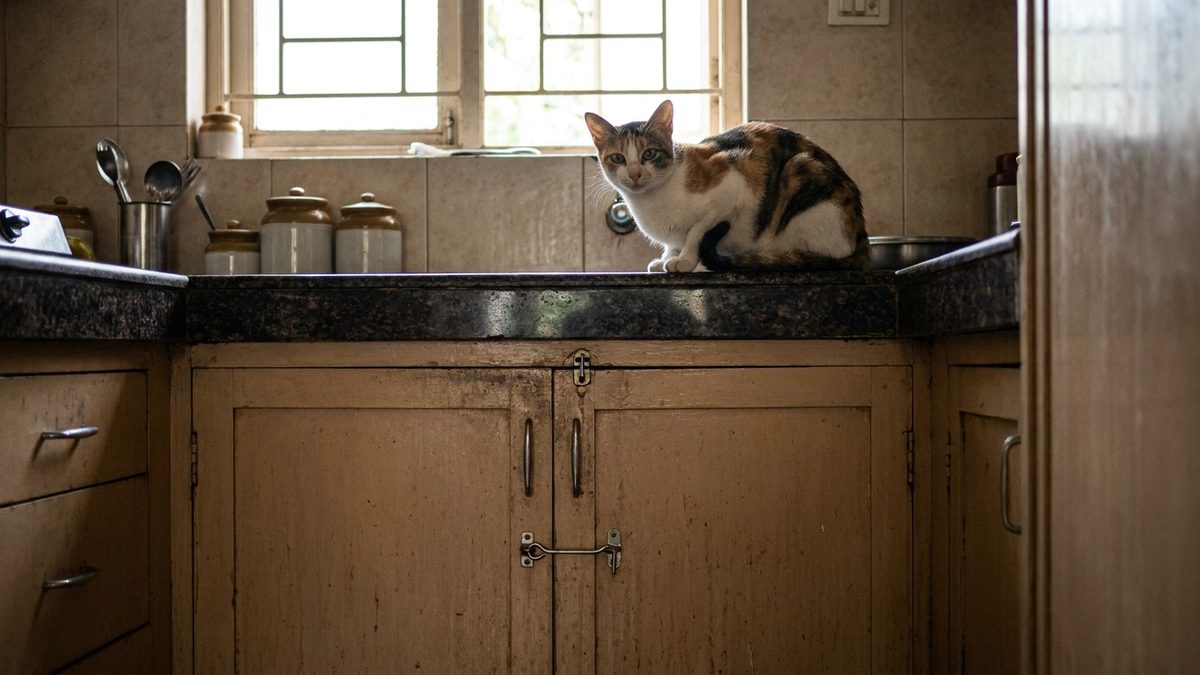
- Clear the counter, not just the floor. A cat was trained to jump 1.6 metres in the only force-plate study of maximum-height jumping, so the kitchen slab is not out of reach.
- Move the medicine strips into a drawer that shuts. Over-the-counter medicines and supplements were the single largest category of pet poison exposure in 2025.
- Take the camphor tablet off the shelf the animal can reach. Camphor is absorbed through skin and Merck ranks it the most toxic of the three mothball actives.
- Move the mosquito liquid refill and the spare coils, which are the concentrated form, into the same closed box as the medicines.
- Save a 24-hour clinic's number in your phone now. India has no animal poison helpline, so there is no national number to ring at 2 am.
That walk takes three minutes and removes most of what is going to go wrong in the first week. It is deliberately not a list of twenty tips. The American Animal Hospital Association's pet-proofing advice opens with the one instruction worth keeping from the Western pages, which is to get down on the animal's level and look at the room from there, and then lists cords, furniture, decor, plants, medicines, trash, drawers, toilets, shoes and clutter. Nine of those ten items exist in an Indian flat too. The ones that are missing from that list, and from every list on page one, are the ones this page is about.
Bonbeno already has pages on the individual hazards, and this one links out rather than repeating them. The balcony, the window grille, the netting and the cat's household poisons are in keeping a cat safe indoors in India. Flooring, stairs and the dog's balcony railing are in keeping a dog in an Indian flat. Open flame, fairy lights and chewed wires are in Diwali diya pet safety. The first hour after any swallowed poison is in foods toxic to dogs.
Out of reach: a counter is not a barrier and a shelf is not a barrier
Out of reach, for a cat, starts somewhere above 1.6 metres. That is the height a cat was trained to reach in the only published force-plate study of maximum-height jumping in cats, in which animals jumped from the plate to touch a cotton ball suspended as high as 1.6 m.
Hold that figure against the surfaces in an Indian flat. A kitchen platform sits at roughly waist height. A dining table is lower. A bathroom shelf, a fridge top, a washing machine lid and a window sill are all lower still. Every one of them is inside 1.6 metres, which means every one of them is inside a healthy adult cat's demonstrated range in a single jump, from standing, with no run-up and no intermediate perch. The word "counter" doing the work in a Western pet proofing checklist is not doing it here.
Two caveats belong with that number, and both run in the same direction. The study trained its cats to jump maximally, so 1.6 metres is a trained ceiling rather than a typical household leap. But the cats jumped from a force plate on the floor, with nothing to climb, which is the hardest version of the task. A cat in a flat has a chair, a bed, a stool, a sofa back and a stack of suitcases, and it uses them. The practical ceiling in a furnished room is higher than the laboratory one, not lower.
The popular figure is a ratio, and the sources cannot agree what it is a ratio of
The claim everybody repeats is a multiple, and the multiples disagree with each other in a way that matters. The International Cat Association states that cats can typically jump five to six times their body length in a single leap. A great many pages state the same multiple of the cat's height at the shoulder instead, which for a cat roughly 25 centimetres at the shoulder and 46 centimetres long is a difference of about a metre in the answer. This page prints the measured figure rather than the ratio, because a ratio whose denominator is contested is not a number you can plan a shelf around The International Cat Association.
What this changes about where things go
The storage rule that follows is about the container, not the altitude. A closed box on a reachable shelf beats an open bowl on an unreachable one, because height alone has been quietly doing all the work in the advice you have read and it cannot. A cupboard with a working latch, a tin with a lid, and a drawer that shuts are the three controls that do not depend on guessing the animal's reach.
Dogs reach differently and the same correction applies. A dog does not jump to a counter, it stands against it, and a large dog standing on its hind legs puts its muzzle well above a kitchen platform. The height that matters for a dog is the height of its nose when its front paws are on the slab, which is a measurement you can take tonight with a tape. The vertical dimension of an Indian flat, and how a cat uses it when you give it somewhere to go, is in how to make my house cat friendly.
The top of the kitchen platform, the top of the fridge or washing machine, and the sill of the window the animal watches. Those three numbers tell you which surfaces are storage and which are simply floor with a longer approach. A cat has been measured clearing 1.6 metres in one jump from a standing start, so treat anything below that as floor.
The almirah: naphthalene balls, camphor and the float test
The almirah is the single most India-specific hazard in the house, because the mothball India keeps in it is the type Western pet pages have largely stopped warning about. Older mothballs usually contain naphthalene, most modern mothballs sold in the United States contain paradichlorobenzene instead because of concern about naphthalene's flammability and toxicity, and camphor mothballs are more commonly found in Asia.
India did not make that switch. The Bureau of Indian Standards certifies the product under IS 539, titled "Specification for Naphthalene", in two grades, Grade 1 (Pure) and Grade 2 (Hot pressed), and its product manual defines a control unit as "Naphthalene balls produced continuously in a day from same distillation batch of Naphthalene powder/flakes". The Indian standard for a mothball is a naphthalene standard. The ball in the Indian almirah is, by national specification, the chemistry the American advice is written to steer people away from.
That matters because of the dose. Pet Poison Helpline states plainly that naphthalene mothballs, the old-fashioned kind, are considered the most toxic type of mothball, that cats are more sensitive to the toxic effects while dogs are more likely to eat them, and that the chemicals can be inhaled, absorbed through the skin, or absorbed through the stomach and intestines. On the quantity, VCA's answer is the one to carry around: as little as one mothball could poison a dog, with the toxic dose depending on the animal's size, the ball's size, the type and whether it was eaten or only breathed.
One ball is a real unit, and it is small. A 100-ball naphthalene pack listed on Amazon.in on 22 October 2026, packed in Kolkata, gives a net quantity of 250 grams and a size of 2.5 g per ball. A 2.5 gram white sphere that rolls when the almirah door opens is the exact object this warning is about. The same listing calls the product "100% Safe and Stain Free" in its own title and carries no warning of any kind in its description. The claim on the pack and the claim in the toxicology are not reconcilable, and the toxicology is the one with a source.
Camphor, kapur and loban: where two authorities disagree, and the disagreement is published
Camphor is in Indian homes for reasons that have nothing to do with moths, which is why it belongs in this section anyway. It is burnt in daily puja, it is kept in the almirah and in rice tins, it appears in loban and dhoop preparations, and it is the active in the topical balms Indian households keep for colds and aches.
The two best sources rank camphor's danger in opposite directions, and this page prints both rather than choosing. Merck's professional entry states that "Camphor is considered the most toxic of the mothball active ingredients, followed by naphthalene, then PDB", and that camphor exposure primarily causes central nervous system depression, altered mentation, CNS excitation and seizures. VCA's owner-facing page, written for Pet Poison Helpline, says the opposite about mothballs specifically: that mothballs containing camphor have a low risk of poisoning, with stomach upset the most common sign, although large ingestions can stimulate the nervous system and cause seizures. The two are compatible only if the disagreement is really about typical ingested quantity rather than about the molecule.
On one point they do not disagree at all, and it is the one an Indian owner most needs. Pet Poison Helpline's camphor entry states that camphor is readily absorbed across the skin and "should never be applied to dogs or cats due to risks for poisoning", naming the ordinary household rubs and balms as the common sources. Rubbing a camphor-containing balm on a dog's chest for a cough, or on a cat at all, is a route of poisoning rather than a home remedy. Nothing goes on an animal's skin that was bought for a person's.
The float test: identifying a mothball in your own kitchen in two minutes
To identify which mothball is in your almirah, float it, in two steps that Merck sets out for clinicians and that need nothing a kitchen does not have.
- Drop the ball in room-temperature water. If it floats, it is camphor. If it sinks, it is either naphthalene or paradichlorobenzene.
- Drop the sinker into saturated salt water, made by dissolving 45 g of ordinary salt, about 3 tablespoons, in 125 mL of tepid water. If it floats in that, it is naphthalene. If it sinks, it is paradichlorobenzene.
- Write the answer on the packet and keep the packet, because the identification is the first thing a veterinary surgeon will ask for and the second is the packet itself.
Do the test once, on a quiet evening, before anything happens. Doing it during an emergency wastes the minutes the emergency needs.
| Active | Float test | Toxicity rank | What exposure causes |
|---|---|---|---|
| Camphor | Floats in plain water | Most toxic of the three per Merck; low risk per VCA. The disagreement is published here rather than resolved Schmid R, Brutlag A, Flint C | CNS depression, altered mentation, CNS excitation and seizures; also absorbed through skin from balms Pet Poison Helpline, Camphor |
| Naphthalene | Sinks in water, floats in saturated salt water | Second per Merck; most toxic mothball type per Pet Poison Helpline and VCA Pet Poison Helpline, Mothballs | Vomiting and anorexia first, then haemolytic anaemia, methaemoglobinaemia, pale or brown gums, laboured breathing; tremors and seizures in rare cases |
| Paradichlorobenzene | Sinks in water, sinks in saturated salt water | Least toxic of the three, and still a poisoning | Abdominal pain, vomiting, lethargy and trembling; weakness, ataxia and tremors at large or repeated doses |
Mothballs dissolve slowly, so poisoning can be delayed for several days and, unusually among poisons, decontamination is still worth doing after an appreciable amount of time has passed. Merck puts induced emesis at up to 4 hours after exposure in an animal with no signs, and activated charcoal as useful even after the window for vomiting has closed. Do not induce vomiting yourself and do not give anything by mouth unless a veterinary surgeon tells you to; take the packet and any loose balls with you in a sealed bag. The vet decides the treatment. The owner's job is the clock and the packet.
On ubtan, haldi and the festival paste, the honest answer is that nothing supports the warning. No veterinary toxicology source opened for this page records turmeric or an ubtan preparation as a poisoning hazard in dogs or cats. The documented festival-season skin hazards are camphor-containing balms, covered above, and applied colour, which is the subject of Holi with your pet in India. Repeating an unevidenced warning crowds out the evidenced one sitting next to it.
The bathroom: acid toilet cleaner, phenyl and the standing bucket
The Indian bathroom holds three different cleaning chemistries and a quantity of standing water, and the three chemistries need three different responses. Acidic household products include toilet bowl cleaners, and alkaline corrosive agents include drain openers, with some toilet cleaners in each group.
Acids and alkalis injure differently, and the difference decides how long you have. Acids produce immediate coagulative necrosis and marked pain on contact, which can limit the exposure because the animal stops, and the extent of an acid burn is usually evident shortly after contact. Alkaline agents produce penetrating liquefactive necrosis, and because there is no notable discomfort on contact the exposure can go on longer, so alkali burns tend to be deeper and more extensive. Burns from alkaline agents can take up to 12 hours to become fully apparent, and in Merck's words the absence of notable oral burns does not necessarily indicate that no oesophageal damage has developed.
The instruction that follows is the opposite of the instinct, and it is the single most useful sentence in this section. Merck states that "Under no circumstances should emesis be attempted, because of the risk of further mucosal exposure to corrosive material";. Gastric lavage is contraindicated for the same reason. Trying to neutralise an acid with a weak alkali, or the reverse, is also contraindicated because the reaction is exothermic and adds a thermal burn to a chemical one. Activated charcoal is ineffective and impedes healing of the damaged lining. What is correct is immediate dilution with water or milk for a recent oral exposure, and copious flushing with water or saline for skin or eyes, with eyes flushed for at least 20 minutes.
Everything that comes up passes the throat a second time. After a corrosive, give water or milk to dilute, flush skin and eyes with plenty of water, and go to the clinic; do not induce vomiting, do not try to neutralise it, and do not give charcoal. This is the exception to the general poisoning advice in foods toxic to dogs, which covers the exposures where emptying the stomach is the right call and how a veterinary surgeon decides.
Phenyl, surface sprays and the cat that walks on a wet floor
Phenyl is the third chemistry and it has a separate page. The floor cleaner Indian homes call phenyl takes its name from phenol, and the phenol and cresol class is specifically dangerous to cats; that argument, with the Merck source behind it, is set out in keeping a cat safe indoors in India and is not repeated here.
What belongs here is the fourth bottle, the quaternary ammonium surface spray and the fabric softener, which Merck classes as cationic detergents. Cats are at increased risk of oral exposure because of their grooming habits, concentrations of 2 percent or below have been associated with oral mucosal ulcers in cats, and signs arise 6 to 12 hours after ingestion, so a cat that walks across a freshly sprayed surface and grooms its paws is a delayed presentation rather than an immediate one. Induced emesis and activated charcoal are contraindicated for these too. The working rule for every bottle in the bathroom is the same: mop, let the surface dry with the animal in another room, and put the bottle behind a door that shuts.
The bucket, the tank and what is honestly not known
A filled bucket and a drum standing in the bathroom through a humid monsoon week are a fixture of Indian flats, and there is no published series of pet drownings in domestic water storage in India or anywhere else that was found for this page. The hazard here is stated as geometry, not as evidence: a bucket taller than a kitten or a small puppy, with smooth sides and water in it, is a container an animal can get into and cannot climb out of. The same is true of the overhead tank hatch left propped open and the sump cover left off. The low-cost controls, a lid on the bucket and a shut bathroom door, cost nothing and do not depend on the hazard being quantified. Where a claim has no denominator, this page says so rather than inventing one.
The kitchen at floor level, where Indian cooking actually happens
The Indian kitchen puts more hot and more edible things within reach of an animal's mouth than a Western one does, because more of the work happens low down. A tawa cooling on the floor, a cooker releasing steam at knee height, a sil batta, a kadhai set down to drain and a thali eaten seated are all at nose height for a dog and paw height for a cat.
Heat and flame are covered elsewhere and this page points rather than repeats. Diwali diya pet safety holds the burn depths, the reason a thick coat hides a burn, the cooling instruction and the electrical injury from a chewed cord, and that page also carries the finding that an animal's burn looks mildest when it is deepest. The point to carry into the kitchen is the same one it makes about diyas: the hazard is the height, not the object.
On food, the kitchen's job in a pet proofing sweep is containment rather than education, because the individual toxins each have a page. Send every specific question to the page that holds it, as listed below, and spend your kitchen time on the bin lid instead.
- Onion, garlic, ginger-garlic paste and the masala dabba go to onion and garlic toxicity in pets and spices, salt and masala for pets.
- Mithai, chocolate and anything sugar-free go to Diwali sweets and your dog, chocolate toxicity in dogs and xylitol and sugar-free products.
- Bones in the bin after a non-veg meal go to bones for dogs in India, which holds the obstruction picture.
- Anything already swallowed goes to foods toxic to dogs, which holds the dose arithmetic and the first hour.
- A dog that eats fast and then bloats is a clinical emergency covered in bloat and GDV in dogs.
Two physical controls do most of the work in a kitchen and neither is about food. A bin with a lid that latches, kept inside a cupboard where the layout allows, removes the single most reliable route by which a dog reaches onion skins, bones, cooked fat and discarded masala in one visit. And a door or a gate across the kitchen entrance during cooking removes the scald risk and the swallowing risk together, which is why the advice to keep the animal out while you cook survives translation from the Western pages intact.
The counter is not the third control, for the reason set out above. A cat clears 1.6 metres from standing, and in an open-plan flat the kitchen platform is often the tallest uncluttered surface in the room, which makes it the most attractive one. Put the thing inside something, not on top of something.
Rat poison and glue traps: two Indian emergencies that need opposite handling
India's rodent-control shelf holds two chemically opposite poisons plus an adhesive board, and an owner who treats them as one category will get the emergency wrong. Rodenticides accounted for 6.5 percent of the items in ASPCA Poison Control's 2025 call data, the seventh largest category.
The common Indian household rat cake is an anticoagulant. Bromadiolone 0.005% RB, a wax-block or grain bait, is the formulation Indian suppliers list for domestic rat control, and it works by blocking vitamin K recycling so that clotting fails over days. An anticoagulant poisoning is slow, it has a specific antidote, and the animal can look entirely well for two or three days before the bleeding starts. That delay is the whole danger: the owner who sees nothing on day one concludes nothing happened.
The other half of the shelf behaves nothing like that. Phosphide rodenticides, sold as zinc, aluminium or magnesium phosphide in pastes, powders, grains and pellets at 0.5 to 10 percent, react with stomach fluid to release phosphine gas. Merck gives suggested lethal doses in dogs of 20 to 40 mg/kg, with one tenth of the lowest lethal dose widely accepted as a toxic dose requiring decontamination and care. Signs can start within minutes or, rarely, take up to 24 hours, and in severe cases cardiovascular collapse and death can occur within 5 hours. The one encouraging number is the outcome: in a retrospective study across 5 years and 362 patients, the survival rate was 98.3 percent.
Phosphine gas carries a very distinct decaying-fish or garlic odour, is quickly absorbed from the gut and the airway, and poses substantial risk to humans, which is why Merck instructs that owners transport pets to the clinic with the windows open in case the animal vomits on the way. Emesis is induced only in a controlled, well-ventilated place, by a clinician, and food is withheld beforehand because food raises stomach acid and acid is what releases the gas. If the smell is in the car, open every window.
Why the distinction is the practical point
You cannot tell the two apart from the animal, so tell them apart from the packet. The single most useful thing in a flat with rat bait in it is the wrapper, kept, with the active ingredient and the percentage readable. The anticoagulant has an antidote and a long fuse; the phosphide has no antidote, a short fuse and a hazard to the people in the car. Those are two different phone calls and the wrapper is what makes the right one possible.
The glue trap, which the Animal Welfare Board of India asked every state to ban
The glue pad is the third item and it is the one with an Indian legal position attached. In a circular dated 4 August 2001 to the Chief Secretaries of all State Governments, the Directorate General of Foreign Trade and the Indian Pest Control Association, the Animal Welfare Board of India described glue traps as boards with "non-drying adhesive on one side of its rigid flat surface so that small animals get stuck to the glue boards by their feet or by their fur when they attempt to run across them", concluded that "the use of glue traps for controlling rats / rodents is in contravention of the provisions contained in the PCA Act 1960", asked the DGFT to ban their import, and requested all State and Union Territory governments "to issue appropriate directions to prohibit the manufacture, sale and use of Glue traps for catching rats";.
Because the circular went to the Chief Secretary of every state, Maharashtra, Karnataka and Tamil Nadu were each asked, like the rest, to stop the manufacture and sale 25 years ago. Twenty-five years later a glue pad is a normal retail product. One Indian pest-supply retailer listed a pack of 10 large pads, 21 cm by 32 cm folded, at Rs 660 before GST and ₹779 with 18 percent GST on 22 October 2026, describing them as "Peanut-flavoured, ready-to-use glue pads for safe and poison-free rats control" and "Ideal for home and professional use";. Read those two documents together and the pet-proofing conclusion writes itself. The Board's own description is of a board that catches small animals by the feet or the fur, and it does not say rats; the retailer's own description is of a peanut-flavoured board placed on the floor in a home. A puppy or a kitten crossing one is the predictable case, and no poison is involved, which is exactly why owners leave them down.
If a rodent problem is real, the controls that do not endanger the animal living in the house are exclusion and sanitation first, then a covered bait station the pet cannot open, sited where the pet cannot go. India's one comprehensive government extension guideline on this, published by MANAGE, an organisation of the Ministry of Agriculture and Farmers Welfare, at Rajendranagar, Hyderabad in August 2019, devotes two chapters to rodents in human habitations and one to household pesticides, and states that its target group is "the grass-root level functionaries in rural and urbanizing human habitations" and pest management professionals. It is written for the person applying the pesticide, not for the household living with it, and that gap is the gap this page sits in.
The repellent that runs all night in the bedroom
The mosquito coil, the liquid vaporiser and the plug-in repellent deserve a careful look for one reason: they run for eight hours, in the room where the animal sleeps, for months of the year. Two separate hazards sit inside that one habit and Bonbeno has a page for each.
The smoke is an air quality question and it is measured. What a nightly coil does to a lung, with the figures, is in air pollution and your pet in India, which also carries the indoor-source table and the only rule that covers coils, agarbatti, dhoop, diyas and the kitchen at once.
The chemistry is a toxicology question and it is covered too. The pyrethroid actives in coils and liquid refills, what they do to a cat specifically, and what a cat that chews a refill needs, are in keeping a cat safe indoors in India.
What a pet proofing sweep adds to those two pages is a storage instruction, and it is about the object rather than the smoke. The concentrated form is the unburnt coil in the box and the full refill bottle in the cupboard, not the vapour in the air, and an unburnt coil at floor level beside a plug point is within reach of a puppy that chews. Insecticides were 3.8 percent of ASPCA Poison Control's 2025 exposures, and the centre's own advice on that category is about reading labels for correct dilution and putting bags away after use. Put the box and the spare refill in the same closed container as the medicines, and site the plug-in above the animal's reach rather than at the skirting socket beside its bed.
One thing is worth saying about what is not established. No source opened for this page reports a series of dogs or cats poisoned by a coil or a plug-in vaporiser used exactly as labelled, and the absence of that series is not the same as safety; it is an absence of counting, which is the theme of the last section of this page.
The edges of the house: balcony, grille, terrace and drain
The edges of an Indian home are the best-covered hazard on this site, so this section is a map rather than a treatment. Open each link; none of this is repeated here.
- The balcony and the window grille for a cat: keeping a cat safe indoors in India holds the fall evidence, the mesh sizes, the installer prices, the no-drill fitting method and the argument to put to a housing society.
- The balcony railing for a dog: keeping a dog in an Indian flat holds the point that a railing is built to a height and not to a gap, plus flooring and stairs.
- A new kitten's first days behind a netted opening: bringing a kitten home in India.
- A new puppy's first 48 hours: bringing a puppy home in India.
- Wet surfaces, drains and the walk back in: monsoon care for dogs in India.
Two edges are not covered anywhere, and the honest treatment of both is short. The terrace parapet is built to a human standard and has the same defect as a balcony railing, which is that a height is not a gap; measure the gap under it and above it against the animal rather than reading the height off a bye-law. The open floor drain and the nali outside the door are a hygiene and foot-injury question with no published veterinary series behind them, so the sensible control is a grating that the animal cannot lift and a look at the paws after a monsoon walk, offered here as prudence rather than as evidence.
Measure the gap, not the height. A railing, a grille, a parapet and a drain cover are all specified by a dimension that was chosen for an adult human, and in every case the number that decides whether an animal gets through is a different number from the one in the specification. Take a tape to each opening once and you will never have to think about it again.
Room by room, in one table you can walk with
Room by room, the sweep is twenty minutes with a phone torch and a tape. The table below is the whole page in one view, ordered the way you would actually walk a flat, starting at the front door.
| Room | The Indian item a Western checklist misses | What to do in one move |
|---|---|---|
| Entrance and lobby | The shoe rack, the delivery that opens the door a dozen times a week, and the lift lobby as the only route to the street | Shoes and socks inside a closed rack; a rule that the inner door is shut before the outer one opens |
| Bedroom | Naphthalene balls in the almirah; the mosquito coil or liquid vaporiser burning at floor level all night | Loose balls collected, packet in a closed container high up; coil and refill boxes into a shut cupboard ASPCA, The Top 10 Toxins of 2025 |
| Almirah and store room | Camphor tablets, loban, the rice tin, the sewing box | Camphor off any reachable shelf; nothing camphor-based ever applied to the animal's skin |
| Kitchen | Floor-level cooking and eating; the open bin; the platform treated as out of reach | Latched bin inside a cupboard; a gate across the door while cooking; everything in a container rather than on a height |
| Bathroom | Acid toilet cleaner, alkaline drain opener, phenyl, the surface spray, the standing bucket | Door shut by default; bottles behind a door that latches; a lid on the bucket |
| Utility and service area | Rat bait cake, glue pad, pest-control residues, the washing machine drum | Bait wrapper kept and readable; glue pads out; drum checked before every load Animal Welfare Board of India |
| Living room | Medicine strips on the table, supplements, the puja shelf at reachable height | Every strip into a drawer that shuts, because OTC medicines and supplements are the largest single exposure category |
| Balcony, terrace and windows | The grille gap, the railing gap, the parapet, the drying-rack pulley | Measure the gap, not the height; then read keeping a cat safe indoors in India and keeping a dog in an Indian flat |
Do the walk twice, a week apart. The second pass catches what the household put back, which is most of it, and it is the pass that tells you which control is going to hold. A latch that everybody opens and leaves open is not a control; a shelf above 1.6 metres with a box on it is.
What India counts, and what it does not
India counts none of this. No Indian body publishes a register of household poisoning or injury in pet dogs and cats, there is no Indian animal poison control centre to generate one, and that absence is the most honest statement on this page.
Here is what the searching turned up, so the claim is checkable rather than rhetorical. A PubMed search for (poisoning OR toxicosis) AND (dog OR cat) AND India, run on 22 October 2026, returned 419 records, and the recent entries are dominated by rabies, dog bite and human public-health work rather than by any series of poisoned pets. Searches for retrospective canine poisoning series returned published counts from Thailand, Italy, Nigeria, Tunisia and Canada and none from India. Those are real series with denominators, and India has no equivalent.
What stands in for it on this page is a United States call-centre dataset, and its limits have to be stated before its numbers are used. In 2025 ASPCA Poison Control received calls about over 376,000 items that pets were exposed to, and ranked the household hazards behind them. That is a count of what Americans telephoned about, not an incidence in a population, and it is shaped by what is in an American house and by who can afford a call. Read it as a map of a different country's floor.
| Rank and category | Share of exposures | How it reads in an Indian home |
|---|---|---|
| 1. OTC medications and supplements | 16.9 percent | Transfers directly. Paracetamol, vitamins and pain medicines are in every Indian house and in every handbag |
| 2. Food and drink | 16.4 percent | Transfers, with a different menu. Grapes, raisins, onion and garlic are named in the US data and all four are Indian kitchen staples |
| 3. Human prescription medications | Share not printed | Transfers directly |
| 4. Chocolate | 13.6 percent | Transfers, and is seasonal here rather than constant |
| 5. Veterinary products | 9.1 percent | Flavoured chewable tablets and soft chews, a smaller category in India than in the US |
| 6. Plants and fungi | 7.5 percent | Transfers with a different species list, covered for cats in keeping a cat safe indoors in India |
| 7. Rodenticides | 6.5 percent | Transfers, with two chemistries on the Indian shelf instead of one |
| 8. Household products, mostly cleaners and paints | 6.4 percent | Understates India, where phenyl, acid toilet cleaner and the surface spray are all in one small bathroom |
| 9. Insecticides | 3.8 percent | Understates India, where a repellent runs all night for months |
| 10. Recreational drugs | 1.9 percent | Transfers at a much lower rate |
The three items that are missing from the list entirely
Naphthalene, camphor and the glue trap appear nowhere in that top ten, and all three are ordinary furniture in an Indian home. Mothball ingestion makes up a small percentage of calls to Pet Poison Helpline, which is consistent with a country that largely moved off naphthalene decades ago. India did not move off it: the national standard for the product is a naphthalene standard. A hazard that is rare where the counting happens and common where it does not is invisible in exactly the way that matters, and it is the reason a Western pet-proofing checklist is not a safe translation.
What would change this page
One Indian teaching hospital publishing five years of its own toxicology admissions, with a denominator, would move this page more than any new foreign study could. Until that exists, the sourcing discipline here is to use the international toxicology for mechanism and dose, the Indian standards and circulars for what is actually in the house, and to say plainly which is which. Every figure above is one or the other, and the citation list marks it.
This page is a hazard survey, not a treatment guide. It names no dose and no drug for an animal, because doses are a veterinary decision made for one animal with one weight and one exposure. If you suspect any exposure, telephone a veterinary surgeon, say what, how much, how concentrated and how long ago, and take the packet with you Gwaltney-Brant SM. India has no animal poison helpline, so the number to save tonight is the nearest 24-hour clinic's, whether the flat is in Mumbai, Delhi, Chennai or anywhere else.
Common questions
How to pet proof your house?
To pet proof your house in India, walk it once at the animal's eye level and move eight things: loose naphthalene balls out of the almirah, cleaners behind a door that latches, rat bait and glue pads off the floor, medicine strips into a shut drawer, camphor off reachable shelves, coil and vaporiser refills into a closed box, the bin inside a cupboard, and a 24-hour clinic's number into your phone. Then measure the gap under every railing and grille.
What household items are toxic to pets?
Household items toxic to pets, ranked by ASPCA Poison Control's 2025 calls about over 376,000 items, are over-the-counter medicines and supplements at 16.9 percent, food and drink at 16.4 percent, human prescription medicines, chocolate at 13.6 percent, veterinary products at 9.1 percent, plants and fungi at 7.5 percent, rodenticides at 6.5 percent, household cleaners and paints at 6.4 percent, insecticides at 3.8 percent and recreational drugs at 1.9 percent. Three Indian items, naphthalene, camphor and glue traps, are absent from that list entirely.
What are the top 10 toxic household items?
The top 10 toxic household items for pets, from ASPCA Poison Control's 2025 data, run from OTC medicines and supplements at number one through food and drink, prescription medicines, chocolate, veterinary products, plants and fungi, rodenticides, household cleaners and paints, insecticides and recreational drugs. That ranking counts American telephone calls rather than measuring incidence anywhere, so it maps an American house. In an Indian flat the cleaners, insecticides and rodenticides categories are all larger than the list suggests.
Are naphthalene balls toxic to dogs?
Naphthalene balls are toxic to dogs, and they are the most toxic kind of mothball. Pet Poison Helpline classes naphthalene mothballs as the most toxic type, and VCA states that as little as one mothball could poison a dog, with the dose depending on the animal's size, the ball's size and the type. The Indian ball matters because India's national standard, IS 539, is a naphthalene specification, while most modern American mothballs use paradichlorobenzene instead.
What will happen if my dog eats a mothball?
If a dog eats a mothball, expect vomiting, anorexia and abdominal pain first, because naphthalene irritates the gut before it acts systemically, then possibly haemolytic anaemia, methaemoglobinaemia with pale or brown gums, laboured breathing and, rarely, tremors or seizures. Signs can be delayed for several days because mothballs dissolve slowly. Telephone a veterinary surgeon the same day, do not induce vomiting yourself, and take the packet and any loose balls in a sealed bag.
What happens if a dog smells mothballs?
If a dog smells mothballs, the exposure is real but much smaller than eating one, because long-term exposure to mothball fumes can harm pets and people while ingestion is the route that causes most poisonings. Mothballs are designed to be used inside a sealed container so the vapour stays trapped, and used that way they are relatively safe to keep in a home with pets. Loose balls in an open almirah or scattered in a room are the version to fix.
Is the smell of camphor toxic to dogs?
The published danger from camphor is contact and ingestion rather than smell. Pet Poison Helpline states that camphor is readily absorbed across the skin and should never be applied to dogs or cats, and lists skin irritation, vomiting, diarrhoea, depression and seizures in large amounts. Merck ranks camphor the most toxic of the three mothball actives while VCA calls camphor mothballs low risk, and this page prints that disagreement rather than resolving it. Never rub a camphor balm on an animal.
What to do if a dog drinks toilet cleaner?
If a dog drinks toilet cleaner, dilute immediately with water or milk and go to a clinic, and under no circumstances induce vomiting, because everything that comes back up burns the throat a second time. Do not try to neutralise an acid with an alkali, because the reaction is exothermic and adds a thermal burn. Do not give activated charcoal, which is ineffective here and impedes healing. Flush any skin or eye contact with plenty of water, eyes for at least 20 minutes.