
Dog health guide
Xylitol poisoning in dogs: two syndromes, two doses, and what a sugar-free label in India actually tells you
A dog that has eaten xylitol can look completely normal for hours. Most sugar-free products sold in India are sweetened with sucralose, aspartame or stevia, which are a different and far lower risk, and the ones that do carry xylitol almost never tell you how much.
Quick answer
Xylitol poisoning in dogs takes two forms at two different doses. Above roughly 100 mg per kg of body weight it triggers a surge of insulin and a crash in blood sugar, which can start within 30 minutes. Above 500 mg per kg some dogs develop liver failure, and those signs may not appear for 24 to 48 hours. A dog can look completely normal in between. Telephone a veterinary surgeon immediately, take the packet with you, and never induce vomiting yourself.
This guide is general information for Indian pet owners and is not a diagnosis. Always consult a registered veterinarian near you before acting on anything you read here, and treat any sudden change in your pet's condition as urgent.
What to do right now, if your dog has just eaten something sugar-free
To act correctly right now, take the product away from the dog, read the ingredient list for the word xylitol, and telephone a veterinary surgeon immediately whether or not the dog seems unwell. Do not wait for a symptom, and do not try to make the dog vomit.
The reason for the phone call is timing rather than panic. Signs of low blood sugar can develop within 30 minutes of a dog eating xylitol, and they can also be delayed by 12 to 18 hours when the xylitol sits in something that slows absorption, which includes some chewing gum. Liver injury runs on a different clock again, and its signs may not appear until 24 to 48 hours afterwards even though the enzyme rise behind it is often detectable within 4 to 12 hours. A dog that is bright and normal an hour after eating a packet of mints has told you almost nothing.
- Separate the dog from whatever is left, and keep the rest of it.
- Read the ingredient panel for xylitol. It may also be written as birch sugar or wood sugar, and it carries the additive number 967.
- Weigh the dog, or use its last recorded weight, because every threshold on this page is per kilogram.
- Estimate how much is gone, in pieces or grams rather than as a little.
- Note the time to the nearest fifteen minutes.
- Telephone your veterinary practice and say the word xylitol, then carry the packet or wrapper in with you.
Carry the packaging because there is no shortcut around it. No test detects xylitol in a dog after ingestion, so the diagnosis rests on the history of exposure, the clinical signs and blood work. The wrapper is the only physical record of what the dog actually ate, and the ingredient list on it decides whether this is an emergency or a quiet evening.
Emesis should be attempted only under veterinary supervision and only in a dog that is still clinically normal, because the onset of hypoglycaemia can be rapid. A vet is unlikely to induce vomiting at all unless the ingestion was under 30 minutes ago and no signs of low blood sugar have started. A dog made to vomit while its blood sugar is crashing can inhale the vomit.
One thing not to do is reach for activated charcoal. It does not appreciably bind xylitol and is not recommended, a finding that traces back to an in vitro study showing its adsorption of xylitol is unreliable. Giving it wastes the minutes that matter.
The two syndromes, and the two doses that separate them
Xylitol produces two distinct problems in a dog at two distinct doses. Hypoglycaemia is the common one and begins above roughly 100 mg per kg of body weight. Hepatic insufficiency or failure is the rarer and far more dangerous one, and some dogs develop it above 500 mg per kg.
Hold both numbers, because they ask for different things. The 100 mg/kg line is the point at which a dog should be hospitalised and have a baseline blood glucose measured; the 500 mg/kg line is the point at which baseline liver enzymes are measured as well, and at which dextrose is given even to a dog whose blood sugar is still normal.
Where the published thresholds disagree
The upper threshold is agreed and the lower one is not, which is worth knowing before you read a confident figure anywhere else. On the liver line, three independent sources give the same number: the veterinary manual puts severe hepatic insufficiency or failure above 500 mg/kg, and a UK veterinary service states that dogs eating over 0.5 g/kg are at risk of serious liver damage. The eight-dog case series sits above both, with its lowest hepatic-failure dose at 1.4 to 2.0 g/kg.
The hypoglycaemia floor is where they part company, and we publish the spread rather than pick from it. The manual puts it above approximately 100 mg/kg. The two ASPCA poison-centre authors who first described the liver syndrome wrote that in their experience ingested xylitol at a dose of 0.15 g/kg has caused hypoglycaemia in dogs, which is 150 mg/kg, while separately recommending that any dog ingesting more than 0.1 g/kg be treated. The UK service publishes a lower figure again, calling xylitol toxic at 0.075 to 0.1 g per kg and illustrating it as around 1 g for a 10 kg dog.
So the practical floor sits somewhere between 75 and 150 mg/kg depending on whose number you read, and nobody puts it at zero. For a 5 kg Indian Spitz that spread runs from 375 mg to 750 mg, which is the difference between one small mint and two. There is no version of this in which a confident single figure is honest, and the useful consequence is that you treat the lowest published figure as the one to act on rather than the one that suits the evening.
| Dog weight | 100 mg/kg, the hypoglycaemia line | 500 mg/kg, the liver line | What the vet does above each |
|---|---|---|---|
| 2 kg | 200 mg | 1.0 g | Admit and check glucose above the first; add liver enzymes above the second |
| 5 kg | 500 mg | 2.5 g | Same |
| 10 kg | 1.0 g | 5.0 g | Same |
| 20 kg | 2.0 g | 10 g | Same |
| 30 kg | 3.0 g | 15 g | Same |
Dose does not predict who dies
The most uncomfortable finding in the literature is that the liver syndrome does not scale neatly with the amount eaten. In the first published series of eight dogs with xylitol-associated hepatic failure, the doses ran from 1.4 to 2.0 g/kg at the lowest to 16 g/kg at the highest, and the authors recorded plainly that survival did not appear to correlate with dose. The dog that ate the most survived. The dog that ate the least died in about two days.
The outcomes in that series were bad. Three dogs were euthanased, two died, two made a complete recovery and one was recovering when lost to follow-up. Five of the eight carried widespread petechial, ecchymotic or gastrointestinal haemorrhages, because acute liver failure takes the clotting factors with it.
Set against that, the ordinary case is not the catastrophic one. The prognosis for uncomplicated hypoglycaemia is good where treatment starts promptly, and mild rises in liver enzymes usually resolve within a few days. Most dogs treated aggressively for hypoglycaemia after eating xylitol recover and have a good prognosis. Both of those statements are true at once, and the thing that moves a dog from the second group to the first is delay.
Not every dog that develops xylitol liver injury becomes hypoglycaemic first. In the eight-dog series, six showed no early signs of low blood sugar at all and instead presented with acute hepatic failure roughly 9 to 72 hours after eating it. The authors' conclusion is the line to remember: delaying treatment, even in a dog with no clinical signs, may increase the risk of fatal hepatic necrosis.
Why xylitol poisons dogs and not the person who bought it
Xylitol poisons dogs because of one species difference in the pancreas. In most mammals xylitol has no notable effect on insulin, but in dogs it stimulates a rapid, dose-dependent insulin release that can produce profound hypoglycaemia.
In people, xylitol does not stimulate the release of insulin from the pancreas; in dogs it is absorbed more quickly into the bloodstream and may produce a potent insulin release, dropping blood sugar within 10 to 60 minutes. The size of that release is the part worth holding. It is 3 to 7 times the amount of insulin that would normally be needed to deal with the same quantity of ordinary sugar. The dog's body reads a sweetener that carries almost no usable glucose as though it were a large sugar load, and then clears glucose that was never there.
The liver syndrome has a different and less settled explanation. The mechanism of xylitol-induced hepatic necrosis is unclear, and the proposed routes are depletion of cellular ATP by phosphorylated intermediates formed during xylitol metabolism, or damage from reactive oxygen species produced downstream of it Dunayer and Gwaltney-Brant. Either could be responsible, or both together.
Two details follow from this that change how an owner should think. First, there is no antidote, because the problem is the dog's own insulin rather than a poison to be neutralised, which is why treatment is dextrose and time. Second, the species difference is why no warning appears on the packet: the product is behaving exactly as designed for the person who bought it.
How many pieces of gum it takes, and why you cannot finish the sum
To work out whether your dog has crossed a threshold, multiply its weight in kilograms by 100 to get the hypoglycaemia line in milligrams, by 500 for the liver line, then divide by the xylitol in one piece. The last number is the one you will usually not have.
Start with what is known. A peer-reviewed survey of products sweetened mainly with xylitol measured 0.67 to 1.06 g of xylitol per piece across seventeen gums, and 0.40 to 0.55 g per piece across mints. Run those against the thresholds and the scale becomes clear.
| Dog weight | Pieces to reach 100 mg/kg | Pieces to reach 500 mg/kg |
|---|---|---|
| 2 kg | under a third of one piece | one to two pieces |
| 5 kg | under one piece | three to four pieces |
| 10 kg | one to two pieces | five to eight pieces |
| 20 kg | two to three pieces | ten to fifteen pieces |
| 30 kg | three to five pieces | fifteen to twenty-two pieces |
Those are arithmetic on a published range, not a measurement of the packet in your hand, and the next paragraph is why that distinction matters more here than anywhere else on this site.
The number you need is the one nobody prints
The exact amount of xylitol in a product varies wildly and can vary even between flavours of the same brand. The product survey makes the same point structurally: where xylitol was one of several polyols rather than the main one, the authors could not calculate the per-piece amount at all and recorded it as not calculable, including for a mainstream gum in which xylitol was the third of three polyols listed.
The case literature puts a number on how far that varies. Working back from the two gum ingestions recorded in the eight-dog series, a 7.4 kg Scottish Terrier that ate 30 pieces received an estimated 7.0 g/kg, which implies about 1.7 g of xylitol per piece, while a 5.0 kg Miniature Dachshund that ate 100 pieces received an estimated 16.0 g/kg, implying about 0.8 g per piece. Two gums, one of them carrying roughly twice the xylitol of the other, in the same case series.
So the honest instruction is the opposite of the one these pages usually give. Do the calculation if you can, because it tells the vet something useful, and then go to the vet regardless, because the declared information almost never lets you complete it. An estimate built on a per-piece figure you do not have is not safer than a phone call. It is the same guess with more steps.
Toothpastes in the same survey ran from 10 to 36 per cent xylitol, with oral rinses at 15 to 30 per cent. The paper's own working assumes a 1 g dose of toothpaste per brushing. At 25 per cent, that single ribbon carries 250 mg of xylitol, which clears the 100 mg/kg line for any dog under 2.5 kg and means a 5 kg dog needs only about 2 g of paste. A chewed tube is a different quantity again.
What sugar-free actually means on an Indian shelf
Sugar-free in India usually does not mean xylitol. Indian food law splits permitted sweeteners into two classes, and the products most Indian households buy sit in the class xylitol is not in.
Regulation 3.2.2 of India's food additive rules classifies sweeteners as caloric or non-caloric. The caloric group, defined as substances with more than 2 per cent of the caloric value of sucrose per equivalent unit of sweetening capacity, is sorbitol, sorbitol syrup, mannitol, isomalt, polyglycitol syrup, maltitol, maltitol syrup, lactitol and xylitol. The non-caloric group is erythritol, steviol glycoside, thaumatin, aspartame, sucralose, neotame, acesulfame potassium, aspartame-acesulfame potassium salt and saccharins.
That split is the single most useful thing an Indian owner can know about this subject, because the second list is where the common Indian products live. The regulator's own note on non-sugar sweeteners records that FSSAI has laid down safety limits for non-caloric sweeteners such as stevia, acesulfame potassium, aspartame, sodium and calcium saccharin, sucralose and sorbitol as additives for use in various food products. Xylitol is not among the ones it names there.
None of those non-caloric sweeteners causes the canine insulin release described above. Aspartame, sucralose, saccharin and steviol glycoside are not xylitol, they are not sugar alcohols at all, and treating every sugar-free packet in an Indian kitchen as a xylitol emergency is both wrong and expensive. The sugar alcohols in that caloric list that are not xylitol, such as sorbitol and maltitol, have their own effect, which Indian labelling itself names: polyols may have a laxative effect. Loose stools are not liver failure.
The ICMR-INDIAB national survey of 113,043 adults across 31 states and union territories put the weighted prevalence of diabetes at 11.4 per cent, 10,151 of 107,119 individuals, with prediabetes at 15.3 per cent. More than a quarter of Indian adults therefore have a reason to buy something sugar-free. The category is not a fad here and it is not going away, which is exactly why knowing which sweetener is in the packet matters more than avoiding the aisle.
Where xylitol genuinely does turn up in India
Six categories carry the real risk, and only one of them is food you would think to check.
- Imported and dental chewing gum and mints, which are the commonest reported exposure route and the most concentrated per gram.
- Toothpaste and mouthwash, where concentrations of 10 to 36 per cent are normal and the tube sits at nose height in a bathroom.
- Some peanut and nut butters, which matter disproportionately because nut butter is the thing people use to hide a tablet.
- Chewable vitamins and dietary supplements, including children's chewables.
- Sugar-free medicinal syrups and elixirs, where xylitol is used as the base.
- Sugar-free baked goods and desserts, where a home or in-store baker has substituted xylitol for sugar by weight.
The sweet-shop version of this question belongs to another page. Sugar-free mithai and what a counter-bought Indian sweet box does and does not declare is covered on our guide to Diwali sweets and your dog, and the general sorting of what is safe off an Indian plate sits on Indian foods safe for dogs.
Two of those six categories deserve emphasis because they are not food and so nobody treats them as a food hazard. A tube of toothpaste is chewable, smells of mint and is stored at floor level in a great many Indian bathrooms. A bottle of sugar-free cough syrup sits in the same cupboard as everything else in the medicine drawer. Never use human toothpaste on a dog, and use a pet product instead. Our page on periodontal disease in dogs and cats covers what brushing a dog's teeth actually requires.
What an Indian label tells you, and what it does not
An Indian label tells you the name of the sweetener in a packaged food and, in almost every case, not the quantity. That asymmetry is written into the regulations, and it is the reason the arithmetic above usually stops halfway.
Three separate rules decide what appears on the pack, and they do not ask for the same thing.
| Product type | What the label must say | Can you calculate a dose from it? |
|---|---|---|
| A polyol sold as a table top sweetener | Contains, with the name of the sweetener and the purity and weight percent of the marker compound, plus the warning that polyols may have a laxative effect | Usually yes, because a weight percent is declared |
| Any packaged food carrying a sweetener from Appendix A | This contains, followed by the name of the sweetener | No. The name is required, the amount is not |
| A packaged food permitted to contain a non-caloric sweetener | CONTAIN NON-CALORIC SWEETENER | Not needed. Xylitol is classified caloric, so this box points away from it |
| Chewing gum and bubble gum | Food additives permitted under Appendix A are allowed, and where only an artificial sweetener is used the sucrose and reducing-sugar limits stop applying | No |
| Toothpaste, mouthwash and medicines | Nothing under these rules, because they are not food | No |
Read the third row twice, because it is the most useful line on this page. Xylitol is a caloric sweetener under regulation 3.2.2, so a packet carrying the declaration CONTAIN NON-CALORIC SWEETENER is telling you its sweetener comes from the aspartame, sucralose, saccharin and stevia group instead. That is not a guarantee and it is not a substitute for reading the ingredient list, but it is a thirty-second signal in the right direction, and no page we read on 21 October 2026 mentioned it.
There is no legal maximum to work back from
Where xylitol is listed as a permitted additive in India's food category table, the maximum permitted level is given as GMP, the same entry carried by sorbitol, mannitol, isomalt, maltitol, lactitol and erythritol. GMP means the quantity good manufacturing practice requires rather than a figure in milligrams per kilogram. So there is no ceiling in the regulation that an owner could use as a worst case, which closes the last route to completing the calculation from public information.
Toothpaste and mouthwash close it from the other direction. India's food labelling regulations are made under food safety law and apply to food, and a tube of toothpaste is not food, so the sweetener declaration box simply does not appear on it. You are reading an ordinary cosmetic ingredient list, in which xylitol may appear anywhere in the order and at no stated concentration.
Xylitol is also sold and labelled as birch sugar or wood sugar, and in an Indian additive list it appears as INS 967. A pack that says birch sugar and never says xylitol is a xylitol pack. Check for all three before you decide a product is clear.
Cats, and the honest answer about them
Cats are not known to be at risk from xylitol, and the evidence base behind that statement is much thinner than the confidence with which it is usually said. The sources also contradict each other, so here is what each actually claims.
The veterinary manual is unambiguous. Dogs are the only domestic species in which xylitol toxicosis has been reported, and cats are not at risk of hypoglycaemia or liver injury from it.
The only controlled feeding study is small. Six healthy middle-aged cats were given xylitol dissolved in deionised water at 100, 500 and 1,000 mg/kg of body weight, doses the authors note are considered toxic in dogs; blood was taken before dosing and at 6, 24 and 72 hours for a complete blood count and for ALT, ALKP, GGT, GLDH, bile acids, urea, creatinine, phosphate, protein, albumin, sodium and potassium. There were no significant changes in any haematological or biochemical parameter. Blood glucose did not shift either, except at the 1,000 mg/kg dose, where a mild but significant increase was observed that remained within the physiological range.
Note what that last detail is. At the top dose the cats' blood sugar went up, not down, which is the opposite of the canine response and a useful piece of positive evidence rather than an absence of it. Note also that it is six cats.
Where the sources disagree, and why it matters
The FDA gives a different reason for the same conclusion. Its position is that xylitol does not seem to be as dangerous for cats and other pets, and that cats appear to be spared, at least in part, by their disdain for sweets. That is a behavioural explanation, and it is not the same claim as the manual's physiological one. A cat that is physiologically unaffected is safe around a dropped mint. A cat that is merely uninterested in sweet things is safe only until it eats one.
Against both, veterinary pages still in circulation describe xylitol as toxic to cats or describe its effects in cats as unknown. We are not resolving that here, because the published evidence cannot. What we can say is the shape of it: one small controlled study found no effect at doses that poison dogs, the largest veterinary reference states flatly that cats are not at risk, and the regulator's stated reason is partly about feline taste rather than feline biochemistry.
Treat xylitol as a dog problem and keep doing what you would anyway. If a cat has eaten a xylitol product, telephone a veterinary surgeon and say so rather than assuming it is fine on the strength of six cats. The FDA also notes that ferrets have developed low blood sugar and seizures like dogs after eating xylitol products, so the species boundary is around dogs and ferrets rather than around dogs alone. Our guide to indoor cat safety in India covers the wider household audit.
What the vet will do, and over how long
To treat xylitol ingestion, a veterinary surgeon decontaminates early if the window allows, gives intravenous dextrose, and then monitors blood glucose and liver enzymes on two separate schedules. The monitoring, not the drug, is what makes this an inpatient problem.
The schedule is specific and it is worth knowing before you are asked to agree to it. A dog that has ingested more than 100 mg/kg should be hospitalised with a baseline blood glucose measured; a dog above 500 mg/kg should have baseline liver enzymes measured too. Blood glucose is then monitored every 1 to 2 hours for at least 12 hours, and liver enzyme activity every 24 hours for at least 72 hours. Cornell's figure for the inpatient stay is a minimum of 12 to 24 hours, with liver enzymes often rechecked three days after exposure.
Hypoglycaemia is managed with intravenous boluses or constant-rate infusions of dextrose, and it may persist for 24 hours or more, so treatment continues until a normal blood glucose holds without supplemental dextrose. Above 500 mg/kg, dextrose is given even to a dog whose blood sugar is still normal, and hepatoprotectants may be considered, although the manual records that their efficacy in limiting liver injury is not known.
Bonbeno names no drug and no dose on this page. The class of treatment is a sugar given intravenously and supportive care for the liver, and every specific decision in it belongs to the clinician examining your animal, which is why this page publishes under the medical disclaimer.
Whether a smaller Indian city has what this needs
The drug is not the scarce part, and that is genuinely reassuring. Glucose injection appears twice in India's National List of Essential Medicines 2022: at 25 per cent under medicines used to treat hypoglycaemia, and at 5, 10, 25 and 50 per cent under solutions correcting water and electrolyte disturbances. Both entries are marked P, S, T, meaning primary, secondary and tertiary levels of healthcare. That designation is national, so it applies in a district town in Maharashtra, Karnataka or Tamil Nadu exactly as it does in Delhi.
Two honest caveats belong with that. The NLEM is a human-medicine list and says nothing about what any individual veterinary practice stocks, and we could not establish from any published source what proportion of Indian veterinary clinics hold intravenous dextrose or run in-house biochemistry. What the published treatment protocol requires is not just the fluid but hourly glucose measurement through the night and an analyser that can repeat liver enzymes on three consecutive days. A 24-hour veterinary hospital able to do all of that is a realistic option in Mumbai, Delhi, Bengaluru, Chennai, Hyderabad, Pune, Kolkata and Ahmedabad, and is not the norm across most of the country.
- Find out this week, not on the night, which practice near you admits animals overnight and which can run a blood glucose and a liver panel in house.
- Save both numbers in your phone, along with the nearest 24-hour hospital even if it is two hours away.
- Ask your regular vet directly whether they stock intravenous dextrose, because it is a cheap and basic fluid and the answer is usually yes.
- Ask what their plan would be for a dog needing twelve hours of hourly glucose checks, since that answer tells you whether you would be referred and how far.
India has no national 24-hour animal poison line that we could find on 21 October 2026. The services the veterinary literature routinely names are American and British. Your own veterinary practice is the first and only call.
The signs, in the order they arrive
The first signs are usually vomiting and the effects of low blood sugar, and the liver signs come much later. Reading them in order is what tells you which syndrome you are dealing with.
Low blood sugar produces vomiting, weakness, ataxia, lethargy, seizures and coma. Cornell's list for the first 30 to 60 minutes runs lethargy, disorientation, incoordination or stumbling, tremors, vomiting, seizures and coma. The FDA describes vomiting followed by decreased activity, weakness, staggering, incoordination, collapse and seizures. Hypokalaemia and hypophosphataemia may sit underneath all of it.
Liver injury announces itself differently and later, with lethargy, vomiting, icterus and coagulopathy, alongside raised alanine aminotransferase, hyperbilirubinaemia, thrombocytopenia and hyperphosphataemia. Icterus means a yellow tinge in the gums or the whites of the eyes. Coagulopathy means bleeding that does not stop, which in the eight-dog series showed up as pinpoint and bruise-like haemorrhages in the skin and mucous membranes, bloody faeces and continued bleeding from needle sites.
- Go now: collapse, a seizure, tremors, stumbling, or a dog that cannot be roused.
- Go now: yellow gums or eyes, unexplained bruising, or bleeding that does not stop.
- Telephone now, whatever the dog looks like: any known or suspected ingestion of a xylitol product, because the useful window closes before the signs open.
- Keep watching for three days: a dog treated and sent home still needs its liver enzymes rechecked, because the second syndrome runs on a 72-hour clock.
One Indian differential is worth naming for the clinician's benefit. Vomiting, lethargy and jaundice in a dog have several common causes here before xylitol, including tick-borne disease, and volunteering the food or product history is what lets a vet test for both rather than chase one. Our page on onion and garlic toxicity in pets in India makes the same point about a different toxin, and the habit is the same: say what the animal ate, unprompted, at the start of the consultation.
Keeping it out of reach, in an Indian household
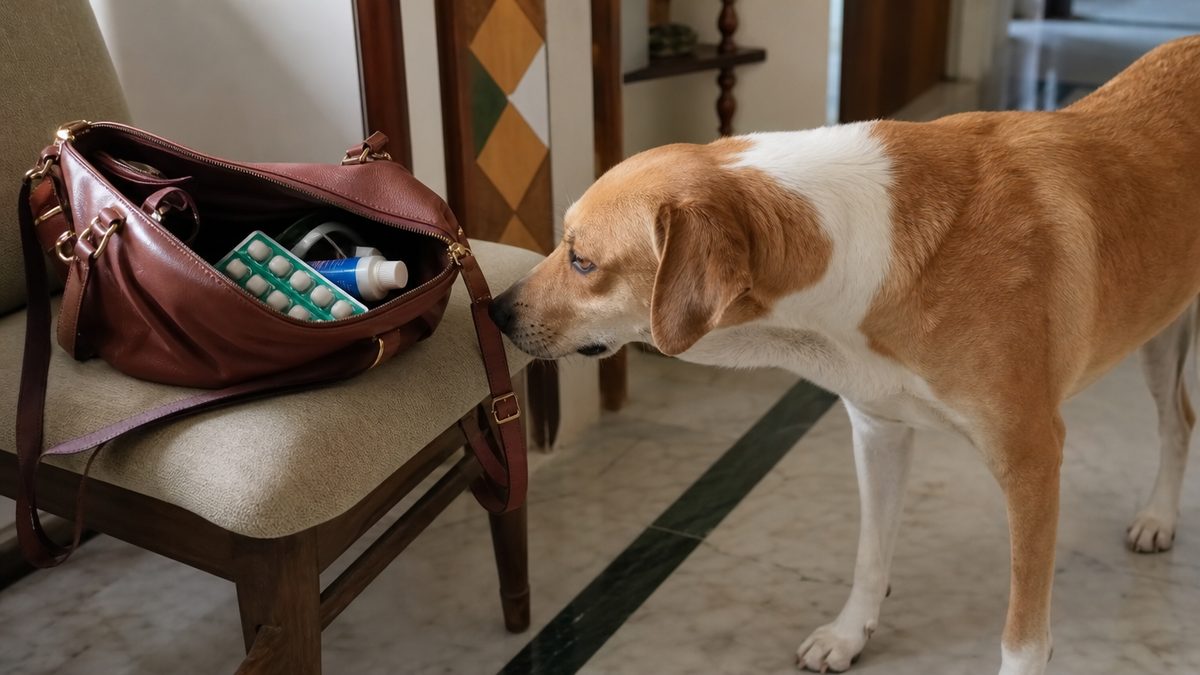
To prevent this, move four categories of product above dog height and brief whoever else lives in the house, because the handbag on a low chair is the commonest route in.
Xylitol products are rarely stored like hazards, which is the whole problem. Gum lives in a handbag, toothpaste on a bathroom shelf, supplements on a kitchen counter, and a guest's bag goes wherever the guest sits down. None of those is a place anyone thinks of as food storage.
- Move gum, mints and chewable vitamins into a closed cupboard, not a bedside drawer a dog can nose open.
- Put toothpaste and mouthwash behind a bathroom cabinet door, and keep the bathroom door shut if there is no cabinet.
- Read the label of any nut butter before you use it to hide a tablet, which is the one habit on this list that turns a kindness into an exposure.
- Ask visitors to keep bags off the floor and off low chairs, which costs one sentence at the door.
- Check the medicine drawer for sugar-free syrups, and store them as you would any other medicine.
Feeding your dog properly is the quiet half of this. A dog that is fed on a schedule it can rely on scavenges less, and a household that does not hand the dog human food has fewer occasions to reach for a sweetened one. Our dog diet chart for India sets out what the bowl should hold and when.
One category deserves a direct warning rather than a bullet. Human toothpaste is not a substitute for pet toothpaste, and the instruction from the regulator is to use pet toothpaste for pets only, never the human product. People brush their dogs' teeth with the family tube in a great many Indian homes, usually with good intentions and no idea that a sugar-free variant is a different proposition entirely.
A dog with diagnosed diabetes lives in a household that almost certainly holds sugar-free products, and a dog on insulin is already being managed around its blood glucose. Tell your vet about every sugar-free item in the house at the next appointment rather than after an incident. Our page on diabetes in dogs and cats covers the condition itself.
Common questions
How long does it take for a dog to show symptoms of xylitol poisoning?
It takes between 30 minutes and 48 hours, depending on which syndrome develops. Signs of low blood sugar can appear within 30 minutes, or be delayed 12 to 18 hours when the xylitol is in something that slows absorption such as gum. Signs of liver injury may not appear until 24 to 48 hours afterwards, although the enzyme rise behind them is often detectable within 4 to 12 hours. A dog that looks normal at bedtime has not been cleared.
What are the first signs of xylitol poisoning in dogs?
The first signs are usually vomiting and then the effects of a crashing blood sugar. Those are lethargy, weakness, disorientation, stumbling or incoordination, tremors, and in severe cases seizures and coma. Low potassium and low phosphate often sit underneath. Liver signs come much later and look different, with jaundice, continued bleeding and bruising, so the absence of early signs does not mean the dog is out of it.
What happens if my dog eats a small amount of xylitol?
It depends entirely on the dog's weight, because the thresholds are per kilogram. Hypoglycaemia has been associated with doses above roughly 100 mg per kg, which is 500 mg for a 5 kg dog and under one piece of a xylitol-sweetened gum. The published floor is disputed and runs from about 75 to 150 mg per kg depending on the source. A small amount for a Labrador can be a large amount for an Indian Spitz, so telephone a vet with the weight and the quantity rather than judging it by eye.
Will one piece of xylitol gum hurt a dog?
One piece can cross the hypoglycaemia threshold for any dog up to about 10 kg. Gums sweetened mainly with xylitol have been measured at 0.67 to 1.06 g per piece, and the 100 mg per kg line is 1.0 g for a 10 kg dog and 0.5 g for a 5 kg dog. One piece is very unlikely to reach the 500 mg per kg liver threshold for a medium or large dog. The amount per piece is rarely declared, so treat one piece as a reason to telephone a vet.
What should I do if my dog eats chewing gum?
Read the ingredient list for xylitol, or for birch sugar or wood sugar, then telephone a veterinary surgeon immediately and take the packet with you. Do not induce vomiting yourself, because hypoglycaemia can start within 30 minutes and a dog made to vomit during it can inhale the vomit. Gum that contains sugar rather than xylitol is not a poisoning but can still be a physical obstruction, so the call is worth making either way.
What will the vet do if my dog ate xylitol?
The vet will decontaminate if the window allows, give intravenous dextrose, and monitor on two schedules. Above 100 mg per kg the dog is hospitalised with a baseline blood glucose; above 500 mg per kg baseline liver enzymes are taken too. Blood glucose is then checked every one to two hours for at least 12 hours and liver enzymes every 24 hours for at least 72. Vomiting is usually induced only if the ingestion was under 30 minutes ago and no signs have started. Activated charcoal is not used, because it does not reliably bind xylitol.
Can my dog survive xylitol poisoning?
Yes, and most do, with the outcome depending on which syndrome develops and how fast treatment starts. The prognosis for uncomplicated hypoglycaemia is good when treatment is prompt, and most dogs treated aggressively recover well. Liver injury is far more serious: in the first published series of eight dogs with xylitol hepatic failure, three were euthanased, two died, two recovered completely and one was lost to follow-up. Survival in that series did not correlate with the dose eaten, which is why delay rather than quantity is the thing to avoid.
Does all peanut butter contain xylitol?
No, and most does not, but some nut butters do and the label is the only way to tell. This category matters more than its size suggests because nut butter is what people use to hide a tablet, so an unchecked jar delivers xylitol directly and deliberately. Check the ingredient list of any nut butter before giving it to a dog, and check it again when you buy a different flavour or brand, because xylitol content varies between flavours of the same brand.
Can cats tolerate xylitol?
The evidence says yes, and the evidence is thin. The MSD Veterinary Manual states that dogs are the only domestic species in which xylitol toxicosis has been reported and that cats are not at risk of hypoglycaemia or liver injury. The only controlled study gave six healthy cats 100, 500 and 1,000 mg per kg and found no significant haematological or biochemical change, with blood glucose rising slightly rather than falling at the top dose. The FDA's reason differs, attributing it partly to cats disliking sweet things. Telephone a vet anyway if a cat eats a xylitol product.
Are Indian sugar-free sweets and sweeteners dangerous to dogs?
Most Indian sugar-free products are sweetened with substances that are not xylitol and carry a far lower risk. Indian food rules classify sweeteners as caloric, which includes xylitol, sorbitol and maltitol, or non-caloric, which includes aspartame, sucralose, saccharins and steviol glycoside. The regulator names stevia, acesulfame potassium, aspartame, saccharin, sucralose and sorbitol as the ones it has set limits for in Indian foods. None of the non-caloric group causes the canine insulin release that xylitol does, so read the ingredient list rather than assuming.