
Dog life guide
Keeping a dog in an Indian flat: the floor, the stairs, the balcony gap and the hours that actually decide it
Floor area is the smallest number in this question. A slippery floor carried 1.6 times the odds of clinical hip dysplasia in 1,733 Boxers, and the only space figure in Indian law is 8 square metres for a one-metre dog.
Quick answer
Keeping a dog in a flat works when the dog gets the hours, not the floor area. The only floor-space figure in Indian law is four dog-lengths by two, about 8 square metres for a one-metre dog, and the same rules ask for an hour of exercise and three hours of human company a day. What a flat actually costs a dog is measurable elsewhere: a slippery floor carried 1.6 times the odds of clinical hip dysplasia, stairs before three months raised hip dysplasia risk, and a balcony railing is built to a height and not to a gap.
This guide is general information for Indian pet owners and is not a diagnosis. Always consult a registered veterinarian near you before acting on anything you read here, and treat any sudden change in your pet's condition as urgent.
Is a flat big enough for a dog? Indian law's own two numbers
A flat is big enough for almost any dog, because the only floor space figure written into Indian law is small and the time figure printed beside it is large. The Prevention of Cruelty to Animals (Dog Breeding and Marketing) Rules, 2017 set a minimum enclosure of four dog-lengths by two dog-lengths, and the same Schedule asks for thirty minutes of exercise twice a day and three hours of human company.
Do the arithmetic on your own dog. Measure it from the tip of its nose to the base of its tail. A one-metre dog, which is roughly a Labrador, gets an enclosure of 4 metres by 2 metres, so 8 square metres. A 60-centimetre indie gets 2.4 metres by 1.2 metres, so 2.88 square metres. That clause is a duty on a breeder rather than on you, and our guide to the dog breeding rules in India uses it the way it was written, as something a buyer checks on a breeder's premises with a tape measure. It is quoted here for a different reason: it is the only figure an Indian instrument has ever attached to how much room a dog needs.
Now put that beside the room you are standing in. The Model Building Bye-Laws set the minimum habitable room in India at 9.50 square metres on plots above 50 square metres and 7.50 square metres below, with a minimum width of 2.40 metres and 2.10 metres. One legally minimal Indian bedroom is larger than the kennel the law requires for a one-metre dog. Any 1BHK clears it. The small space argument, in the only form Indian law has ever put a number to, is already settled before you open the front door.
| What the rule sets | The figure | Where it sits in the instrument | What a flat does with it |
|---|---|---|---|
| Floor space per dog | Length four times the dog, breadth two times the dog | Second Schedule, Part IV, paragraph 21(5) | 8 sq m for a 1 m dog, which one minimum habitable room already exceeds |
| Exercise | Thirty minutes twice a day | Second Schedule, Part IV, paragraph 24(6)(d) | Has to be found outside the flat, every day, twice |
| Human company | Three hours a day for an adult, five for a pup under four months | Second Schedule, Part IV, paragraph 24(6)(e) | The number a nine-hour working day has to answer |
| Floor construction | Floors that protect the animal's feet and legs from injury | Second Schedule, Part IV, paragraph 21(4)(j) | The clause a polished vitrified floor does not satisfy |
What those rules are, and what they are not
Read the scope before you lean on the numbers. These rules bind breeders, boarding kennel operators, traders and exhibitors, not the family flat, and they describe a legal floor for a commercial kennel rather than a welfare target for a pet. Nobody should aim at eight square metres. The reason they are worth quoting is that they are the only place an Indian instrument has ever attached a figure to how much room a dog needs, and the figure it attached is small while the figure it attached to time is not.
The research literature has not filled that gap either. We looked for a study measuring floor area against a dog welfare outcome and did not find one. What has been measured is the dog's activity, and it points the same way. In a survey of Finnish pet dogs, dogs that took part in activities or training only seldom or never were more fearful than dogs that trained at least weekly, and dogs living without another dog were more fearful than dogs with canine company.
Eight square metres is what the law forbids a commercial kennel from going below. It is not an answer to what a dog needs, and this page is not suggesting that it is. Use it the other way round: if the space argument against flats were sound, the number Indian law set would be much larger than one bedroom, and it is not.
The useful question is therefore not how many square feet you have. It is whether you can produce two walks and three hours of company a day, every day, from a fourth-floor flat in Mumbai or Pune in May. The rest of this page is about the physical obstacles between your dog and that routine, because those are the parts nobody writes down.
Which dogs struggle in a flat, and why it is not the big ones
Dogs that struggle with a flat are the small, under-exercised and solitary ones rather than the large ones. In the largest survey to measure fear of surfaces and heights, covering 2,932 pet dogs, large dogs had 0.40 times the odds of a small dog and medium dogs 0.369, a dog trained seldom or never had 2.26 times the odds of one trained at least weekly, and an only dog had 1.88 times the odds of a dog living with another dog.
That trait matters here more than any other, because a flat is made of surfaces and heights. The same research group put the prevalence of fear of surfaces and heights at 24 percent of pet dogs, and noted that before their own work no study of the environmental factors behind it existed at all. Dogs living in a more urban environment were more likely to show it, on a chi-squared value of 7.27, and the paper prints that result's p value as 0.0007 in its text and 0.0070 in its own Table 2, which is a discrepancy we are reporting rather than resolving.
Every Indian page ranking for this question answers it the opposite way, with a list of the best dog breeds for apartments. A Kerala builder's blog states plainly that it is better to have a small dog or a cat because big dogs are not suitable for apartments. A veterinary chain's list names Shih Tzu, Pug, Bichon Frise and Indie dogs. Royal Canin's India page names Long-Coat Chihuahuas and Yorkshire Terriers as ideal apartment dogs because they do not need a lot of exercise.
| Claim | Who says it | What the measurement shows |
|---|---|---|
| Big dogs are not suitable for apartments | An Indian builder's blog, undated on the page | Large dogs had 0.40 times a small dog's odds of fear of surfaces and heights |
| Small, low-exercise breeds adapt best | A veterinary chain's breed list and Royal Canin India | Low activity and training carried 2.26 times the odds of the same fear |
| Square footage decides it | Google's own AI Overview says the opposite, that well-being depends on activity rather than square footage | No study has measured floor area against a dog welfare outcome |
None of this means pick a large dog for a flat. It means body size is the wrong axis, and the axis that the data actually moves along is how much the dog does and how much company it has. A bored Labrador in a flat is a problem. A bored Chihuahua in a flat is the same problem with a smaller dog in it.
The two things that do genuinely narrow the list in India
Heat narrows it first. A flat-faced dog in an Indian summer carries measured risk that has nothing to do with the flat and everything to do with the climate outside it, and our guide to heat safety for dogs in India carries the city-by-city walk windows and the breed odds. If you are choosing between a Pug and a Siberian Husky for a flat in Chennai, the question is not floor area, it is the airway and the coat, and our page on brachycephalic obstructive airway syndrome covers the first of those.
Build narrows it second, and only in one direction. A long-backed dog such as a Dachshund does a different thing on stairs from a square-built dog, which is covered in the next section. A short-coated native dog such as an Indian pariah dog is heat-adapted, moderate in size and does not carry the concentrated inherited risks of a closed studbook, which is a better argument for an indie in an Indian flat than any of the breed lists make.
Exercise needs vary far more within a breed than the lists admit, and an individual dog's energy, age and health outrank its label. Read the exercise and grooming load on the breed page for the dog you are actually considering, then ask whether your week contains it. The breed is a prior, not a verdict.
Flooring: the one flat hazard with a published number
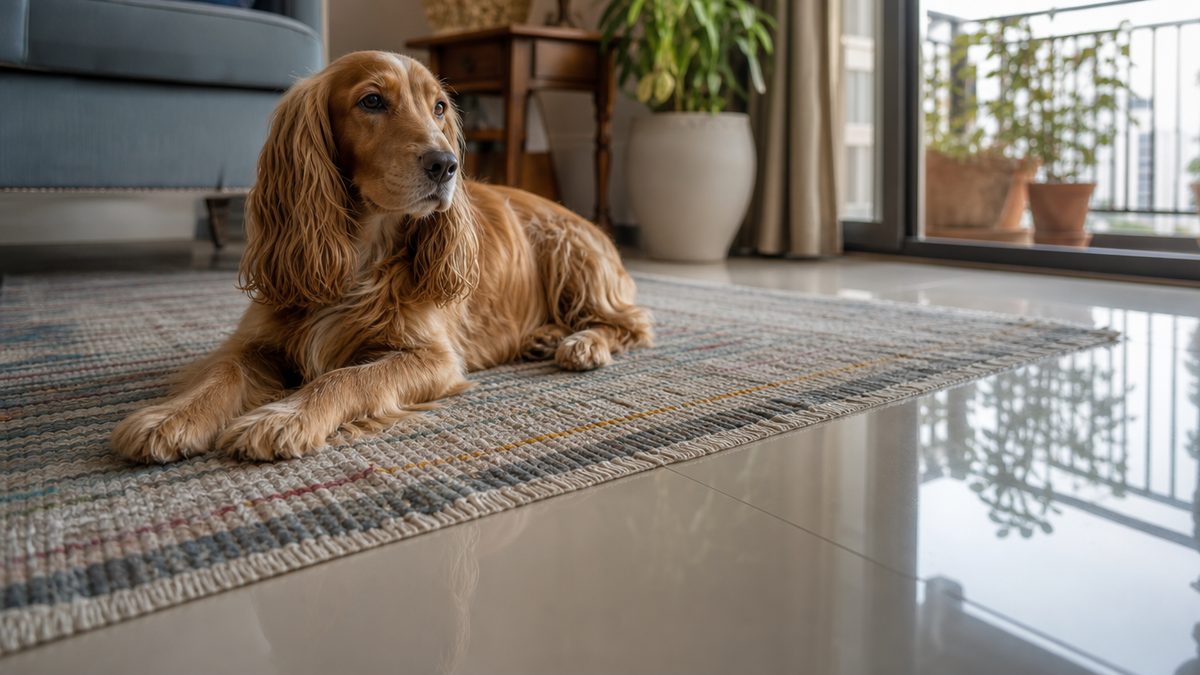
Flooring is the flat hazard that has a figure behind it. In a birth cohort of 1,733 Boxers from 325 litters followed from 7 weeks to 8 years of age, dogs kept on a floor covered with a slippery material were 1.6 times as likely to develop clinical signs of hip dysplasia as dogs kept on a non-slippery floor.
The rest of that study puts the figure in proportion. The cumulative hazard of clinical hip dysplasia across those 1,733 dogs was 8.5 percent, dogs from litters with high preweaning mortality were at double the risk, dogs neutered before diagnosis were 1.5 times as likely, dogs over five years of age 1.8 times as likely, and the estimated effective heritability was 0.11. Flooring sits alongside genetics and age rather than above them, and it is the only one of those four that you can change this afternoon.
Three honest caveats come with the number. It is one breed, in the Netherlands, in a cohort that ran two decades ago. Floor type was owner-reported. And an association in a survival model is not a demonstration that the floor caused the disease. We are quoting it because it is, as far as we can find, the only published figure anywhere that ties household flooring to a joint outcome in dogs. Everything else the internet says about slippery floors traces back to pages selling toe grips, paw wax or boots.
This matters more in India than in the countries that produced the research. The standard Indian flat floor is polished vitrified tile, marble, granite or kota, chosen because it survives a monsoon and mops clean, and all four are harder and glossier than the carpet and timber the foreign advice assumes. The mechanism those commercial pages describe is that a dog grips by digging its claws into a surface with some give and by loading its paw pads, and that a glazed floor offers neither; no study has measured that in a dog, and we are reporting it as a described mechanism rather than a finding.
Indian owners already know this, and the only place it is written down is a comment thread. On Google India on 21 October 2026, across four seed queries, the single mention of flooring anywhere on page one was a five-year-old r/india post whose snippet reads that the flooring of flats is generally not good for dogs as it is a bit slippery resulting in less grip, and that this could lead to bone problems. An anonymous comment is carrying the one hazard with a cohort behind it.
Indian law has exactly one line about this, and it is in the breeding rules rather than anywhere a flat owner would look. A primary enclosure must have floors that are constructed in a manner that protects the animal's feet and legs from injury. A polished floor across a whole flat does not obviously satisfy that clause, and no Indian instrument applies it to a home.
Where to lay the runners, and the test that shows you where
Lay the runners on the turns, not across the whole floor. Watch the dog for two days and mark the three places where it scrabbles: almost always the corner it takes at speed when the doorbell goes, the spot where it stops short at the food bowl, and the patch where it pushes up from lying down. Those three points are the whole job. A cotton dhurrie, a rubber-backed runner or a yoga mat on each of them changes the floor at the moments the dog loads it hardest, and it is the cheapest intervention on this page by a wide margin.
- Watch for the scrabble before buying anything, because the places a dog loses traction are specific and few.
- Cover the turn into the hallway, which is where a dog accelerates towards the front door and where its hind feet slide out.
- Cover the stopping point at the water and food bowls, where a dog brakes on four legs at once.
- Cover the route out of the bed, which is the push-up an older or arthritic dog finds hardest.
- Trim the hair between the paw pads on a long-coated dog, which is a reversible cause of slipping indoors.
If your dog already has a joint diagnosis, the flooring question becomes a clinical one and the home setup changes with it. Our pages on hip dysplasia in dogs, arthritis in dogs and cats and luxating patella in dogs cover those conditions, and our senior dog care guide sets out the full home modification list for an older dog, including raised bowls and a gated staircase.
Slipping that is new, or that happens on a floor the dog used to cross confidently, can be a sign of weakness, pain or a neurological problem rather than a flooring problem. A dog that has begun to slip, to hesitate before a hard floor, or to struggle to rise needs your veterinarian to examine it before you reach for a rug. This page is general information and does not replace veterinary advice.
Stairs and lifts: the journey a flat dog makes six times a day
A dog living above the ground floor makes the same vertical journey six times a day, and the one age at which that journey carries measured risk is the first three months. In a prospective cohort of 501 Norwegian dogs from 103 litters, puppies walking on stairs from birth to 3 months of age had an increased risk of radiographic hip dysplasia, and the authors concluded that puppies of three months or under should not be allowed access to stairs.
Read the rest of that study before you lock the puppy in. Of the 501 dogs, 123, which is 24.6 percent, were classed as affected on radiographic screening. Off-leash exercise from birth to 3 months lowered the risk, as did being born in spring or summer and being born on a farm, and the authors' recommendation is not rest but outdoor exercise on soft ground in moderately rough terrain. The finding is about steps, not about movement. A young puppy carried down four floors and then allowed to run on grass is doing exactly what the paper recommends.
Indian building rules decide how hard that journey is, and they are more permissive than most people assume. The Model Building Bye-Laws allow a stair riser of up to 19 centimetres in a residential high-rise, against 15 centimetres in other buildings, limited to twelve steps per flight, with a minimum stairway width of 1.25 metres for flats and group housing. Fifteen metres is the height at which Indian building law starts treating a building as a high-rise, which is roughly the fifth floor.
Put the geometry together. A fourth-floor flat with two twelve-step flights per storey is 96 steps down to the street, and the dog has to climb all 96 again to get home. Three walks a day is about 576 step movements, every one of the descending ones a 19-centimetre drop onto the forelimbs. That is a number no page in this field has written out, and it is the honest reason the lift matters.
The opposite finding, from the breed most often told to avoid stairs
Do not over-restrict an adult dog, because in the largest survey of the breed most associated with stair advice, restriction pointed the wrong way. DachsLife 2015 collected responses on 2,031 Dachshunds, of which 310 were veterinary-diagnosed cases of intervertebral disc disease, an overall prevalence of 15.7 percent with a 95 percent confidence interval of 14.1 to 17.3. The finding that matters for a flat is the one about furniture: on univariable analysis, dogs that were not allowed to jump on and off furniture were at increased odds of the disease, alongside dogs that exercised for less than 30 minutes a day, while dogs their owners considered highly or moderately active were at decreased odds.
That is cross-sectional and univariable, and the obvious reading is reverse causation: owners restrict the dog that is already unwell. The authors describe their lifestyle findings as hypothesis-generating for future prospective studies rather than as proven protection. Even read conservatively, it is a warning against turning a small flat into a cage out of caution. Our page on IVDD in dogs carries the same survey's exercise odds in full with their confidence intervals, and the grades, costs and Indian evidence behind the disease. The restriction that is well supported here is narrow and age-bound: no stairs under three months.
What to do when the lift is out
Plan the lift failure before it happens, because in most Indian buildings it will. Your right to use the lift with a pet is a legal question and it is not this page's subject; our guide to pets in Indian apartments sets out what a society or RWA can and cannot do about lifts, parks and fees. What this page is about is the day the lift is simply not working.
- Teach the stairs before you need them, on a lead, slowly, in both directions, while the lift still works.
- Carry a dog under three months, every time, which is the one restriction the cohort evidence supports.
- Fit a harness with a back handle on a large or elderly dog so you can take weight on the descent rather than on its forelimbs.
- Split the trip for an older or arthritic dog, resting at a landing rather than running the whole flight.
- Cut the number of journeys, not their length, by making one of the day's outings longer instead of adding a fourth trip downstairs.
The best page in the English-language field raises all of this and attaches no number to any of it. Dogs Trust asks the reader to consider how they will introduce the dog to the lift, how long the lift takes, and what would happen if the lift stopped working, and advises talking to a vet about whether a dog will cope with stairs. Those are the right questions. The figures above are what this page adds to them.
Balconies and grilles: a 1 metre railing is built for an adult, not a dog
An Indian balcony railing is specified by height and not by gap. The Model Building Bye-Laws require parapet walls and handrails on the edges of a roof terrace or balcony to be not less than 1.0 metre and not more than 1.5 metres in height, and say nothing whatever about the space underneath them.
That single omission is the whole of balcony safety for a dog. A 1 metre rail stops an adult human toppling over the edge, which is what it was written to do. It does nothing about a 20-centimetre gap between the slab and the lowest horizontal member, and a puppy or a small dog goes under a barrier rather than over it. Measure the gap at the floor against your dog's chest, not the rail against your own waist.
The balcony itself is small by rule. The bye-laws permit a balcony of 1.2 metres in width with an area not exceeding 3.5 square metres per bedroom and not more than three per flat. That is a corridor, not a garden, and it is the only outdoor surface most Indian flats have.
The veterinary literature on what happens next is thin but it exists. In 81 dogs treated after falling from height, the dogs fell from 1 to 6 storeys, and of the 52 falls that were witnessed, 39, which is 75 percent, were jumps rather than slips. Dogs falling less than three storeys had a high prevalence of extremity fractures, higher falls produced more spinal injuries, and all but one of the 81 dogs survived.
A 2022 review of the same syndrome in both species adds the part that matters for a dog owner who has read the cat version. High-rise syndrome is defined as a fall of two or more storeys; animals fall after slipping from windowsills, during mating behaviour, or while chasing prey; affected animals are younger; falls are more frequent in the warmer months; and cats suffer less severe injuries than dogs because of their righting reflex and smaller body mass. The review puts feline survival above 90 percent and notes that the canine literature is sparse, with the largest retrospective study reporting over 90 percent survival to discharge and a greater need for surgical stabilisation in dogs.
Two of those findings land hard in India. Falls cluster in warm months, and in coastal Maharashtra and Tamil Nadu, in Mumbai, Chennai, Hyderabad and Kolkata, the warm months are most of the year, which is also when the balcony door stands open for the breeze. And the common trigger is a chase, which on an Indian balcony means a pigeon, a squirrel or a cat on the parapet opposite.
- Measure the gap under the railing against the dog's chest depth, because the rule sets the height and not the gap.
- Block off any gap the dog's head fits through, since a dog that gets its head through will follow with its shoulders.
- Close the balcony when nobody is in the room, which is the only control that works against a chase.
- Check the floor temperature with the back of your hand before letting a dog out onto an exposed balcony in summer.
- Treat window sills as balconies, because the published trigger list names a windowsill slip first.
Pet proofing a balcony for a cat is a different job with a different mesh and a different set of Indian suppliers, and our guide to keeping a cat safe indoors in India covers the netting question in full. For a dog, the question is the gap at the bottom rather than a net across the top. The hot-surface half of this belongs with heat safety for dogs in India, which carries the paw test and the city hours.
Three quarters of the witnessed falls in the 81-dog series were jumps, which means supervision and not sturdiness is the control that works. A dog that has fallen from any height needs an immediate veterinary assessment even if it gets up and walks, because the published injury pattern includes chest and abdominal trauma that is not visible from outside. Your veterinarian decides what imaging that needs.
Where the dog's own space goes in a two-bedroom flat
Put the dog's bed out of the entrance corridor, out of the kitchen and off the balcony, because the only placement rules in Indian animal law are about what surrounds the dog rather than about how much room it has.
Those rules are worth borrowing even though they were written for kennels. Primary enclosures must be placed so as to protect the animals from excessive light, must provide shelter and protection from extreme temperatures, and must let the animal turn around freely, stand, sit and lie down in a comfortable, normal position. Translated into a flat, that is a corner with a wall behind it, out of the afternoon sun, away from the traffic.
Apply the floor space arithmetic to the corner rather than to the flat and it becomes useful. A 60-centimetre indie needs 2.4 metres by 1.2 metres to clear the kennel minimum, which is the strip beside a sofa in most Indian living rooms. A one-metre dog needs 4 metres by 2 metres, which is a whole small bedroom, and that is a genuine reason to give a large dog a defined area rather than a basket.
Four places a dog bed should not go in an Indian flat
- Facing the main door. The entrance is the busiest square metre in a flat, with the lift, the corridor, deliveries and the domestic help all arriving at it, and a dog that sleeps there never gets an uninterrupted rest.
- In the kitchen. The Model Building Bye-Laws set the minimum Indian kitchen at 4.50 square metres with a width of 1.50 metres, which is a corridor with an open flame and hot oil in it.
- On the balcony as a permanent home. The breeding rules exclude from outdoor housing any dog that cannot tolerate local temperatures, naming long-haired breeds in high-temperature locations, along with sick, infirm, aged or young animals.
- Against the shared wall with the lift shaft or the pump room. Machinery noise runs through a reinforced concrete frame, and a resting place next to it is a resting place the dog will not use.
Give the dog two places rather than one. A bed in the room the family uses, so the dog is not isolated from its company for the hours it is awake, and a second quieter spot it can choose when the flat is full. The second one matters most in a 2BHK during a festival week or a family visit, when the dog has nowhere to go and no door to put between itself and a room full of strangers.
Noise between neighbours, and what to do when a dog barks in a flat, is a separate subject with its own answers, and it is covered on our guide to dog barking and your neighbours in India rather than here.
The daily logistics: the door kit, the wet paws and the hours nobody is home
Run a flat on a door kit and a fixed route, because every trip a dog makes outside begins and ends in the same half metre of hallway, three or four times a day, every day of the year.
Keep the whole operation within arm's reach of the door. A lead and harness on a hook at adult shoulder height, a towel folded on a shelf below it, a small bucket or mug of water and a second dry towel for the monsoon, a roll of bags in the pocket of the lead, and the municipal tag already on the collar. The point is not tidiness. It is that a routine with six separate fetch steps in it breaks on the day you are late, and a routine that breaks is a walk that gets skipped.
- Hang the lead and harness at the door, not in a bedroom cupboard, so the trip starts in ten seconds.
- Keep two towels at the door, one for rain and one for paws, and wash them weekly.
- Stand the paw water outside the flat door if your landing allows it, so the mud stops before the threshold.
- Dry the feet and the belly, not just the feet, after a wet walk, because an Indian monsoon walk soaks the undercarriage.
- Clean the lift floor if your dog has come in wet, which costs twenty seconds and removes a recurring complaint about dogs in a shared building.
The monsoon version of that routine is longer, and the reasons are clinical rather than cosmetic. Ticks, ear canals and skin all behave differently in wet heat, and our guide to monsoon care for dogs in India carries the Indian denominators and the ten-minute drying routine.
Outdoor access is the structural constraint behind all of it. A flat dog has no garden, which means every toilet trip is a planned journey involving a lift, a lobby and a compound. Where a flat-kept dog relieves itself, and whether that is a pad, a balcony corner or a patch of the compound, is set out on our guide to toilet training a puppy in an Indian flat, which also covers the designated pet corner and the municipal fines on excreta. The relevant point here is the arithmetic: three walks from the fourth floor is about twenty minutes of stairs or lift time a day on top of the walks themselves, and that is the commitment people underestimate.
The hours nobody is home are the real limit, and Indian law has a number for them too. The breeding rules ask for socialising with people equalling at least three hours a day for an adult dog and five hours a day for pups less than four months of age. Set that against a nine-hour office day plus a Bengaluru or Mumbai commute and the gap is obvious. The Finnish survey points the same way from the other side: an only dog had 1.88 times the odds of fear of surfaces and heights of a dog living with another dog, and a dog that trained seldom or never had 2.26 times the odds of one trained weekly.
A midday walker, a half-day at home, a second dog or a neighbour with a key are all answers to that. Being out for ten hours with none of them is not, and no amount of floor area fixes it. Loud nights are a separate problem with its own evidence, and our guide to firecracker fear in dogs covers the preparation that works in a flat during the festival season.
Write out one real weekday, hour by hour, including the commute, and mark where the two walks and the three hours of company sit. If they do not fit on paper they will not fit in life. This is the single most useful ten minutes of planning available to anyone deciding whether to get a dog, and it costs nothing.
Heat indoors: the tile floor, the fan and the power cut
Plan the hot hours around the power cut rather than around the air conditioner, because two-fifths of urban Indian households face an outage at least once a day.
That figure comes from the India Residential Energy Survey, a nationally representative survey of nearly 15,000 households in 1,210 villages and 614 wards across 152 districts in 21 states. It found the average Indian household receiving 20.6 hours of grid supply a day, with urban areas on 22 hours against 20 in rural areas, 76 percent of households facing unanticipated supply interruptions, and two-thirds of rural and two-fifths of urban households facing outages at least once a day. The report's own conclusion notes that even in urban areas unscheduled outages last up to 12 hours.
Where you live changes that number more than anything you can do about it. Delhi, Kerala and Gujarat held slightly over 23 hours of average supply in both urban and rural areas, while households in Uttar Pradesh, Jharkhand, Haryana, Assam and Bihar faced the longest outages. A flat in Delhi and a flat in Patna are not running the same summer risk for a dog left at home, and the plan should not be the same either.
Indian animal law already anticipates this, in the same breeding rules quoted above. A dog housing facility must have reliable and adequate electricity supply including a backup provision in case of outage. No equivalent rule touches a flat, and most domestic inverters in India carry lights and ceiling fans but not an air conditioner. So the practical plan is a fan on the inverter circuit in the room the dog uses, not an air conditioner you will lose at 2 pm in a humid May afternoon in Ahmedabad or Kolkata.
The tile floor cuts the other way in summer and is one of the few things an Indian flat does better than a carpeted one. A dog will lie flat on cool stone or tile and shed heat through contact, and the same polished surface that costs it traction in the monsoon gives it a heat sink in May. Leave a bare patch of floor uncovered in the coolest room rather than rugging wall to wall.
Water needs the same structural thinking as the lead. Two bowls in two rooms, wide and heavy enough that they cannot be tipped, both refilled when you leave, is a different proposition from one bowl in the kitchen with the kitchen door shut. Everything else about Indian heat, including the walk windows by city, the signs of heat illness and the first aid, belongs with our guide to heat safety for dogs in India and is not repeated here.
A top-floor or west-facing flat holds heat after sunset, and a closed flat with the fan off during an afternoon power cut is a sealed box. If you leave a dog alone on a hot day, leave a window open where it is safe to do so, leave the fan on an inverter circuit if you have one, and leave water in two places. A dog showing heavy noisy panting, drooling, bright red gums, weakness or collapse is an emergency and needs cooling and a veterinarian immediately.
When a flat is genuinely the wrong home, and what to do then
A flat is the wrong home when the hours cannot be found, not when the floor area is small. Four situations make it genuinely wrong, and none of them is about square feet.
- Nobody can be home, and nobody can be paid to be. An adult dog needs three hours of human company a day by the standard Indian law sets for kennels, and a household out for ten hours with no walker, no day care and no second adult cannot produce it.
- The building and the dog cannot be reconciled. A large dog with diagnosed hip or spinal disease on the fifth floor of a walk-up is a daily problem that no rug or harness solves, given a 19-centimetre riser and twelve steps per flight.
- The climate and the dog cannot be reconciled. A heavy-coated cold-climate breed in a top-floor flat in Chennai or Nagpur, in a household that cannot guarantee cooling through a 12-hour outage, is a welfare problem rather than a logistics problem.
- The dog is telling you. A dog that has stopped eating, will not settle, or is injuring itself when left is giving you clinical information, and that is a veterinary and behavioural consultation rather than a flat-size debate.
The honest options are ordered by how little they cost. A midday dog walker or a day care place fixes the first situation outright, and the running cost of both is set out in our guide to the monthly cost of a dog in India. A ground-floor flat or a building with a reliable lift fixes the second, and is worth more than an extra bedroom to a dog. Choosing a different dog, before you commit, fixes the third, and our guide to adopting a dog in India is the place to start.
If a dog is already with you and none of it is working, say so early and say so to the organisation you got it from. A good Indian rescue would far rather rehome a dog at month four than at year four, and most of them will help you work the problem before it gets to that. There is no moral failure in a flat that does not suit a particular dog. There is a real one in a dog that spends a decade in a flat nobody adjusted.
For most people reading this, none of that applies. The flat is fine, the dog is fine, and what is needed is a rug on three turns, a measured gap under the balcony railing, a harness for the stairs, a fan on the inverter and two walks that actually happen. Our guide to things to do with your dog in India covers what those walks can be once they are in the diary.
Keeping a dog in a flat: the questions Indian searchers ask
Is it fair to keep a dog in a flat?
Yes, when the flat comes with the hours. The only floor-space standard in Indian law gives a one-metre dog an enclosure of 4 metres by 2 metres, which one minimum habitable room already exceeds, and the same rules attach far bigger numbers to time: an hour of exercise and three hours of human company a day. Unfairness in a flat comes from a dog that is alone and under-exercised, not from a dog with less carpet.
Is it okay to keep a dog in an apartment?
It is okay, and the risks that are actually measurable are physical rather than spatial. A slippery floor carried 1.6 times the odds of clinical hip dysplasia in a cohort of 1,733 Boxers, stairs before three months of age raised hip dysplasia risk in a cohort of 501 dogs, and Indian balcony railings are specified by height with no rule on the gap beneath. Fix those three and the apartment is not the problem.
Should I have a dog in an apartment?
Decide it on your week rather than your floor plan. Write out one ordinary weekday and mark where two walks and three hours of company fit around your commute. If they fit, an apartment is a workable home for most dogs, including large ones. If they do not fit, a bigger flat will not help, and a dog walker, a day care place or a later start are the honest answers.
What is the best dog to have in a small apartment?
There is no single best breed, and the Indian lists that name one are arguing from the wrong variable. In the largest survey of fear of surfaces and heights, covering 2,932 pet dogs, large dogs had 0.40 times the odds of small dogs and medium dogs 0.369, so small size is not protective against the fears a flat produces. Choose on exercise need, coat and heat tolerance for your city, and read the breed page before you commit.
Can we keep dogs in flats?
Yes, across India, and the limits worth planning for are practical. A dog above the ground floor makes about six vertical journeys a day, an Indian residential high-rise may have a 19-centimetre stair riser with twelve steps per flight, and the lift is a part of the routine that will fail at some point. Teach the stairs before you need them and keep a harness with a back handle for a large or elderly dog.
Are dogs allowed in apartments in India?
Yes. What a housing society, RWA or apartment owners association can and cannot require of a pet owner is a legal question with its own instruments, including the Animal Welfare Board of India's 2015 guidelines and several High Court and Supreme Court orders, and our guide to pets in Indian apartments covers it clause by clause. This page deliberately covers the physical side of flat living instead, because nobody else does.
What is the no. 1 lazy dog?
Bonbeno does not rank dogs by laziness, because a low-energy label is a poor guide to whether a dog suits a flat. In a survey of 2,031 Dachshunds, dogs exercising less than 30 minutes a day were at increased odds of intervertebral disc disease while dogs exercising more than an hour a day were at decreased odds. Choosing the least active dog you can find is not the same as choosing the right one.