
Dog health: orthopaedic
IVDD in dogs: the five grades, what each grade means for walking again, and what it costs in India
The five grades of IVDD with the published proportion of dogs that walked again at each grade, medically and surgically, every rate carrying the number of dogs it was measured in. The chromosome 12 retrogene that causes it, two odds ratios that disagree, the Beagle result almost nobody knows, three Indian government rate cards, and why the conservative arm matters more here than anywhere else.
Quick answer
IVDD in dogs is intervertebral disc disease, in which a disc degenerates early, hardens and bursts into the spinal canal, and it is graded 1 to 5 from pain alone to paralysis with no feeling in the toes. Lifetime prevalence across 43,517 United States dogs was 1.2 percent, rising to 15.34 percent of 541 Dachshunds. Recovery runs from 80 percent without surgery at the mild end to 21 percent at grade 5. Your nearby vet grades your dog.
This guide is general information for Indian pet owners and is not a diagnosis. Always consult a registered veterinarian near you before acting on anything you read here, and treat any sudden change in your pet's condition as urgent.
Signs of Intervertebral disc disease in dogs
The 12 signs to watch for are listed below. Any one of them is a reason to consult your nearby vet; none of them is a diagnosis.
- Yelping or flinching when picked up, touched along the back, or moved
- A hunched or arched back, with the head held low
- Shivering, trembling or muscle spasms that are not from cold
- Refusing stairs, the sofa or the bed the dog used yesterday
- A wobbly, drunken gait in the back legs
- Knuckling, so the paw drags or turns over onto its top
- Sudden inability to stand or use the back legs at all
- Dragging both back legs while the front legs work normally
- No reaction to a firm toe pinch on a paralysed leg
- Dribbling urine, or a bladder that does not empty
- A neck held stiffly, with reluctance to turn the head or lower it to a bowl
- Signs that get worse hour by hour rather than staying steady
Breeds on this site that document this condition
Each breed page below carries the figure for this condition with its denominator and its source. The 10 breeds listed are the ones on this site that document it, not a ranking of risk.
India has published no prevalence figure for canine IVDD, no surgical series and no breed-level denominator, and a PubMed search on 23 September 2026 for intervertebral disc with dog, dogs or canine and India in the title or abstract returned 0 records while four controls on the same instrument passed. The affiliation search finds what the title search misses. Exactly one Indian canine IVDD record exists, a Beagle at ICAR-IVRI Izatnagar with a Hansen type I herniation at T12 to T13 diagnosed on computed tomography, and a larger series from the same institute covers 44 canine spinal cord injuries of mixed cause. The practical Indian problem is imaging. Magnetic resonance imaging is metro-only, no Indian government rate card publishes an MRI price at all, and Madras Veterinary College prices a computed tomography scan four ways from Rs 2,000 to Rs 3,000 while ICAR-IVRI and BASU Patna publish neither CT nor MRI. That matters because DachsLife recorded 80.0 percent of 65 radiograph-only dogs managed conservatively against 16.0 percent of 148 dogs that had CT or MRI, so the scanner an Indian owner can reach predicts the treatment arm. No Indian hospital publishes a price for a spinal decompression, and the only Indian rupee range in print comes from a pet e-commerce blog that cites no source. India's Dog Breeding and Marketing Rules 2017 name eleven genetic defects a breeding dog must be tested for and this is not one of them, and the words intervertebral, chondrodystrophy, spine and spinal appear nowhere in the 14-page gazette notification.
What IVDD in dogs is, and why it is a disease of short legs rather than long backs
IVDD in dogs is intervertebral disc disease, in which a spinal disc degenerates early, hardens and then bursts into the spinal canal, and in most affected dogs the cause is a gene that also made the legs short. Thoracolumbar disc extrusion is the most common cause of sudden paraparesis and paraplegia in dogs, and it has been recognised in veterinary medicine since the 1880s.
The disc is a cushion with a gel centre. In chondrodystrophic breeds, expression of a fibroblast growth factor 4 retrogene on chromosome 12 is associated with dramatically accelerated disc degeneration, in which early chondroid metaplasia, degeneration and mineralisation of the nucleus pulposus end in failure of the whole disc unit and extrusion of mineralised material into the vertebral canal. That process has a name, Hansen type I extrusion, and it also happens in normal-legged breeds at a much lower frequency and without the retrogene.
The timing is what makes it so different from a human slipped disc. In chondrodystrophic breeds, premature calcification of the nucleus pulposus begins between birth and one year of age and degenerates every disc in the spine while the dog is still young. The dog is not wearing its back out. It was born with discs that were going to fail. This is an inherited disease rather than an injury, and the laboratory that developed the DNA test describes chondrodystrophy as autosomal dominant for intervertebral disc disease and semi-dominant for height, so a single copy carries the disc risk in full.
The word chondrodystrophy is the one to get right, because it is not the same as having short legs. Chondrodysplasia is the short-legged shape that many breed standards require, and chondrodystrophy is a separate mutation that brings the short legs plus abnormal premature disc degeneration and susceptibility to herniation. Two different retrogenes, on two different chromosomes, do those two different jobs, and a dog can carry one without the other.
How common IVDD is, and in which population
The best population figure comes from 43,517 companion dogs in the United States, and it is lower than most owners expect. Lifetime prevalence of owner-reported IVDD was 1.2 percent, which is 520 dogs of 43,517 enrolled in the Dog Aging Project between 26 December 2019 and 31 December 2022. Read that as a whole-population baseline, because the breed figures below run more than twelve times higher.
Where the disc fails is predictable. About 65 percent of IVDD problems involve the thoracolumbar region, the mid to lower back, and about 18 percent are in the neck alone, with the rest a combination. Among 310 veterinarian-diagnosed Dachshund cases the causal disc was thought to be thoracolumbar in 88.1 percent, which is 273 dogs, and cervical in 7.7 percent, or 24 dogs. The two commonest single sites are between the eleventh and twelfth thoracic vertebrae and between the second and third lumbar vertebrae.
Neck discs are a smaller and differently distributed problem. Cervical herniations occur in 15 percent of disc herniation patients, and 80 percent of those patients are Dachshunds, Beagles or Poodles. That is the first of several places on this page where the Beagle turns up in company an Indian owner would not expect.
Hansen type I and type II, and why the distinction changes the urgency
Two failure modes carry the same label and behave differently. In type I the mineralised nucleus extrudes suddenly and slams into the spinal cord, and the classic patient is a young dog of a short-legged, long-backed breed. In type II the disc bulges slowly over months or years, the German Shepherd Dog is the typical patient, and the signs creep rather than arrive.
The practical difference is time. A type I extrusion in a Dachshund is an event with an hour and a date attached, and in the largest survey of the breed 41.7 percent of 310 cases, which is 128 dogs, went from normal to clinical signs in under 24 hours, with another 32.6 percent, or 100 dogs, doing it over one to three days. Three quarters of this disease arrives inside 72 hours. An owner who plans to watch and wait for a week is planning for the wrong disease.
The five grades of IVDD, and the published odds of walking again at each one
IVDD in dogs is graded 1 to 5 by what the dog can still do, and the grade is the single best predictor of whether it walks again. Grade 1 is pain with no neurological deficit and grade 5 is paralysis with no feeling in the toes, and between those two ends the published recovery rate falls from 80 percent to 21 percent without surgery.
The scale itself is short. Southeast Veterinary Neurology sets out all five in one place, and it is the only page ranking for this condition in India that prints them.
| Grade | What the owner sees | Recovered with medicine and rest | Recovered with surgery |
|---|---|---|---|
| Grade 1 | The dog is only experiencing pain, without any neurological deficits | 80 percent of 115 dogs, counted together with grade 2 | 98.5 percent of 336 dogs, counted together with grade 2 |
| Grade 2 | There is weakness in one or more limbs, but the dog is able to walk | 80 percent of 115 dogs, counted together with grade 1 | 98.5 percent of 336 dogs, counted together with grade 1 |
| Grade 3 | The dog is unable to walk, but can still move its limbs | 81 percent of 131 dogs | 93 percent of 341 dogs |
| Grade 4 | The dog is paralysed, but still has feeling in its toes | 60 percent of 67 dogs | 93 percent of 548 dogs |
| Grade 5 | The dog is paralysed and cannot feel its toes | 21 percent of 48 dogs | 61 percent of 502 dogs |
Two sources are doing two jobs in that table and it is worth saying which. The grade definitions are the neurology service's. The recovery figures are the ACVIM consensus statement's own summary of the published literature, in which spinal pain and ambulatory paraparesis are counted as one stratum, then non-ambulatory paraparesis, then paraplegia with deep pain present, then paraplegia with deep pain absent. Those four strata are grades 1 and 2, grade 3, grade 4 and grade 5.
Read the grade 5 row twice, because it is the row that decides everything. A dog that has lost deep pain sensation recovers about one time in five with rest and medicine and about three times in five with surgery. That is the widest gap on the table and it is the reason a paralysed dog is a today problem rather than a tomorrow problem.
Deep pain sensation is the one thing an owner must not miss. A vet tests it by pinching a toe hard and watching whether the dog turns its head, cries or reacts, rather than whether the leg twitches, because a leg can pull back on a reflex in a dog that feels nothing. Deep pain is the last thing to go, after position sense, after voluntary movement and after surface pain, so a dog that has lost it has lost everything above it too. If your dog is dragging its back legs and does not react to a firm toe pinch, that is a go-now visit, not a morning appointment. Take the dog to a clinic today and say those exact words, that you think it has lost deep pain. Our veterinary directory lists clinics if you do not have one.
Grades do not climb a ladder in order. A dog may start showing signs of an advanced grade without ever having shown signs of the earlier ones. A Dachshund can be fine at breakfast and grade 5 by evening, which is exactly what the 41.7 percent of cases that declared themselves inside 24 hours looked like to their owners.
Which grade dogs actually arrive at, and what that means for the average reader
Most dogs that reach a veterinary diagnosis are already past the mild end. Of 310 veterinarian-diagnosed Dachshund cases, 17 dogs, or 5.6 percent, arrived with pain and discomfort but no neurological deficits, 25.2 percent, which is 77 dogs, were unsteady but still walking, and 69.3 percent, which is 212 dogs, could not walk at all on presentation. Seven owners in ten were already looking at grade 3 or worse by the time they got to a clinic.
The 48-hour line is the other number to hold. For a dog that cannot walk but still has deep pain, surgical success is reported at 83 to 93 percent; for a dog with no deep pain that has been down for under 48 hours, that drops to 50 to 60 percent, and after 48 hours the prognosis is much worse. Read that as a reason to travel today rather than as a deadline that closes, because the ACVIM panel reviewed the same question across the whole literature and concluded that the evidence does not generally support a specific timeline for urgent decompression, even for paraplegic dogs without deep pain.
Those two readings disagree and Bonbeno prints both rather than picking one. A widely used clinical reference gives a hard 48-hour figure; the specialist consensus panel, reviewing 114 papers on decision-making alone, says the timing evidence is mixed and that the larger and more recent studies suggest no association. For an Indian owner who may be six hours from a referral neurologist, the honest version is that going now is better than going later and that a long drive is still worth making.
The first signs of IVDD in dogs, and when to go to a clinic today
The first signs of IVDD in most dogs are pain and a changed way of moving, before any weakness appears. A dog that yelps when lifted, holds its head low, arches its back, shivers, or refuses the sofa it jumped on yesterday is showing spinal pain, and in a short-legged breed that is a disc until proved otherwise.
Pain comes first because of where the nerves sit. Position sense goes before voluntary movement, voluntary movement before surface pain, and surface pain before deep pain, because the fibres that carry each one sit at different depths in the spinal cord. That order is why a dog that is knuckling its back paws over is further along than a dog that is only sore, and why a dog that has stopped reacting to a toe pinch is at the end of the sequence rather than the start.
The signs list at the top of this page is the scannable version. Four of those signs change the plan from watching to going.
- Sudden inability to use the back legs, which is grade 3 or worse and the presentation 69.3 percent of 310 diagnosed Dachshunds arrived with.
- No reaction to a firm toe pinch, meaning deep pain may be gone, which is the grade 5 finding that halves the surgical success rate.
- Loss of bladder or bowel control, because retention incontinence travels with cord compression and a bladder that cannot empty becomes a second problem within a day.
- Signs that are getting worse hour by hour rather than holding steady, since progressive deterioration is the situation in which the consensus panel recommends short hospitalisation to monitor rather than home rest.
Go to a clinic today, not tomorrow, if your dog suddenly cannot use its back legs. This page does not carry a site-wide emergency banner because many dogs that develop IVDD arrive in pain and still walking, and a banner that fires for every reader stops meaning anything. The acute case is different and it is genuinely urgent. A dog that goes from walking to dragging inside a day, that cries when its back is touched and will not settle, that cannot empty its bladder, or that does not respond to a hard toe pinch, needs a veterinary examination the same day. Say on the phone that you suspect a spinal disc and that the dog has gone off its back legs, because that sentence changes how a reception desk triages you. Find a clinic through our veterinary directory and go.
One thing is worth knowing before you handle a painful dog. Dogs with back problems can be in severe pain, so even a sweet dog may snap or growl, and patience rather than correction is the right response. Support the chest and the hindquarters together when you lift, keep the spine level, and do not let a child pick the dog up.
Your nearby vet decides what your dog needs and nothing written here replaces that examination. Before you go, note the hour the gait changed, whether the dog can still lift its tail, whether it has urinated since the signs began, and whether it reacts when you touch its back, because those four observations shape the first ten minutes of the consultation.
How IVDD is diagnosed, and what the scan costs at an Indian government hospital
IVDD is diagnosed in two steps, a neurological examination that establishes the grade and the level, then imaging that shows which disc and on which side. The examination comes first and the imaging exists to plan an operation, so a dog that is not going to surgery may reasonably never be scanned.
Advanced imaging is the standard and it has a purpose beyond confirming the obvious. Magnetic resonance imaging can guide treatment decisions such as how far to extend a decompression, and it provides prognostic information in paraplegic dogs, particularly those without deep pain, where the extent of high signal within the cord on T2 sequences tracks the locomotor outcome. Its limitations are acquisition time, availability and cost, which is the sentence that matters most in India.
Older routes still work and are worth knowing, because they are what many Indian clinics actually have. Myelography, in which iodine-based contrast is injected around the spinal cord under general anaesthesia, identifies the area of compression in 85 to 95 percent of cases. Computed tomography shows calcified disc material clearly and is faster than magnetic resonance imaging. A plain radiograph on its own cannot show the spinal cord and cannot confirm the diagnosis, although it can show a narrowed disc space and calcified discs.
The finding no page outside this one prints: the scanner you can reach predicts the treatment you get
Which machine a dog goes into changes what happens to it next, and that association has been measured. Among 310 veterinarian-diagnosed Dachshund cases, of the 65 dogs whose only imaging was a radiograph, 52 of them, or 80.0 percent, were treated with cage rest and medication only; of the 148 dogs that had computed tomography or magnetic resonance imaging, only 12 of them, or 16.0 percent, were managed that way. That is a five-fold difference in who ends up in the conservative arm, decided by which scanner was available.
Apply that to India directly. Magnetic resonance imaging for dogs exists in a handful of metros and almost nowhere else, so the Indian dog is structurally far more likely to be in the radiograph-only group, and therefore in the arm where four owners in five managed the case with rest and medicine. That is not an Indian failure. It is a statistical fact about what imaging access does to treatment choice, and it is the single strongest argument for taking the conservative arm on this page seriously.
The same survey shows how the imaging split fell when access was not the constraint. Across the 310 cases, magnetic resonance imaging was used in 39.0 percent, which is 121 dogs, plain radiography in 38.1 percent, or 118 dogs, myelography in 13.9 percent, or 43 dogs, and computed tomography in 13.2 percent, or 41 dogs. Even in the United Kingdom, plain radiography was almost as common as magnetic resonance imaging.
What three Indian government veterinary hospitals charge to image a spine
Three Indian government teaching hospitals publish fee tables, and one of them prices a computed tomography scan four different ways.
| Item | Madras Veterinary College, Chennai | ICAR-IVRI, Izatnagar | BASU Veterinary Clinical Complex, Patna |
|---|---|---|---|
| Registration | Small animal Rs 100, valid 7 days | Dog or cat Rs 50 in normal hours, Rs 150 after 12:30 pm, Rs 300 after 5:00 pm or on a holiday | Rs 200 for the 9:00 am to 1:00 pm outpatient window, valid 10 days; Rs 300 for the 2:00 pm to 8:00 pm emergency window, valid 5 days |
| Radiograph | X-ray Rs 100 | Plain radiography Rs 150, plus tax | X-ray, canine or feline, Rs 400 |
| Contrast study, the myelography class | Contrast Rs 500 | Cystography, IVP and other contrast procedures Rs 300, plus tax | No contrast line published |
| Computed tomography | CT plain Rs 2,000, CT plain with report Rs 2,500, CT contrast Rs 2,500, CT contrast with report Rs 3,000 | No CT line published | No CT line published |
| Magnetic resonance imaging | No MRI line published | No MRI line published | No MRI line published |
| Chemical restraint or anaesthesia | Not separately listed | Chemical restraint Rs 100, plus tax | Not separately listed |
Every rupee figure in that table was divided by 84.38 and by 74 before publication and not one resolves to a round dollar amount, so these are Indian rate cards and not converted American ones Bihar Animal Sciences University. The absence in the bottom row is the finding. Not one of the three publishes a price for magnetic resonance imaging, the modality the consensus statement treats as standard, while Madras Veterinary College prices a computed tomography scan four ways down to whether a written report is included Olby NJ, Moore SA, Brisson B, Fenn J.
Read a subsidised teaching tariff for what it is. It is the fee charged at the counter, not the economic cost of the service, and it assumes a queue, a teaching caseload and hospital timings that close at 1:00 pm in Chennai and 8:00 pm in Patna Bihar Animal Sciences University. It is a floor for what this can cost in India, and a useful one, because it is published and dated.
Treatment options for IVDD in general terms, and what crate rest can and cannot do
Treatment for IVDD in dogs is either medical or surgical, and the grade decides which is recommended rather than the owner's preference. Ambulatory dogs can be managed medically with good results, non-ambulatory and paraplegic dogs with deep pain do better with surgery, and for a paraplegic dog without deep pain the consensus recommendation is surgery.
Medical management is a package of nursing rather than a prescription. Its core components are activity restriction, pain management, treatment of retention incontinence, and the prevention and treatment of skin damage and pressure sores where a dog is down. This page names drug classes and prints no dose anywhere, because the choice of drug and the amount of it belong to the veterinarian who has examined your dog. Whether to operate is a grade decision rather than a preference. Surgical management is recommended for non-ambulatory paraparetic dogs and for paraplegic dogs whether or not deep pain is present, although the panel notes that dogs with deep pain can also be managed medically with success.
On drugs the consensus is more cautious than most pages you will read. Corticosteroids are not recommended for routine use in the acute phase of medical management, there is limited evidence that they are associated with poorer outcome, worse quality of life and a higher recurrence rate than non-steroidal anti-inflammatory drugs in ambulatory dogs managed medically, and a short anti-inflammatory course may still help some dogs in the chronic phase. If a clinic reaches for a steroid injection as the first move on an acute case, that is a fair thing to ask about.
Crate rest, honestly: four weeks, and the evidence behind it is weak
Confinement is the centre of conservative management and the consensus panel is candid that the evidence for it is thin. At least four weeks of restricted activity is recommended, putatively to let the outer ring of the disc heal, and that period should mean confinement to a crate or a small room without furniture except for rehabilitation exercises and outdoor toileting, with no off-lead walking, no jumping on or off furniture and no stairs. The panel labels its own recommendation as supported by low-level evidence.
One study went looking for the effect and did not find it. In a retrospective series of 223 dogs, duration of restricted activity ranging from none to more than four weeks was not associated with outcome. Treatment failures are often blamed on inadequate confinement, and the panel notes that no published literature directly addresses that claim. Crate rest is worth doing and it is not a guarantee, and an owner whose dog relapses has not necessarily failed at it.
Recurrence is the honest limit of the medical arm. Recurrence rates after medical management range from 15 percent to 66 percent across the published series, against much lower rates in dogs managed by both decompression and fenestration of the disc. A dog treated with rest keeps the disc it burst and all the other degenerated discs in its spine.
What the surgery is, and what it does not fix
Decompressive surgery removes bone to reach the extruded material. A hemilaminectomy takes away part of the bony arch over the affected segment so the disc material pressing on the cord can be lifted out, and after surgery the same activity restrictions apply while the cord heals. The consensus panel recommends at least four weeks of confinement after surgery as well, and notes that activity restriction does not mean avoiding rehabilitation exercises.
Surgery treats the disc that burst and does not cure the disease that burst it, because the retrogene that degenerated that disc degenerated every other disc in the same spine. There is no cure for chondrodystrophy and no operation that reverses it, and what decompression buys is the recovery of the cord that is compressed today Olby NJ, Moore SA, Brisson B, Fenn J.
Recovery times differ by starting grade and they are measured in weeks. Dogs that still have voluntary motor control commonly walk again within two weeks, while dogs with deep pain but no voluntary movement may need up to four weeks. Nursing a dog that cannot walk is intensive work, including expressing the bladder, keeping the dog clean and dry, turning it, and doing the physiotherapy the surgeon prescribes.
Progressive myelomalacia, the complication that decides a small number of cases
One complication is untreatable and it is why grade 5 is a different conversation. Progressive myelomalacia is a syndrome of progressive necrosis, ischaemia and haemorrhage that spreads up and down the cord from the original injury, ending in loss of limb reflexes and muscle tone and ultimately in respiratory failure. It usually develops within 24 hours to 14 days of the injury and is not always apparent when the dog first presents.
It is uncommon overall and not uncommon at the severe end. Studies of paraplegic dogs without deep pain report a prevalence of progressive myelomalacia of 10 to 33 percent, and it has also been reported in a small number of dogs that presented less severely and then deteriorated. No treatment reverses it, and it is one of the reasons a paralysed dog needs to be seen and monitored rather than nursed at home on hope.
One surgical variation is under active study and worth asking about. In one series, dogs treated with laminectomy and durotomy were 3.32 times more likely to regain the ability to walk than dogs treated by hemilaminectomy alone, no dog in the durotomy group developed progressive myelomalacia, and 21.5 percent of the hemilaminectomy-alone dogs died of presumed myelomalacia; in a separate prospective cohort of paraplegic dogs without deep pain, 16 of 22 followed up, or 72 percent, recovered independent walking and 1 dog, or 5 percent, developed myelomalacia.
IVDD surgery cost in India, and what is actually published in rupees
IVDD surgery cost in India is not published by any veterinary hospital that names the operation, and the honest answer has three parts. Three government rate cards price the surgical class and the imaging, one Indian retail blog prints a rupee range with no source behind it, and no Indian referral neurology service publishes a figure at all.
Start with what is sourced. Neither ICAR-IVRI nor BASU Patna nor Madras Veterinary College lists a spinal decompression, a laminectomy or a hemilaminectomy anywhere on its published fee table, and the ICAR-IVRI table runs to 46 surgical and imaging line items without one Bihar Animal Sciences University Tamil Nadu Veterinary and Animal Sciences…. What they do publish is the surgical class a spinal decompression would fall into.
| Line item | Rate | Hospital |
|---|---|---|
| Specialized surgery | Rs 3,000 | Madras Veterinary College, Chennai |
| Emergency surgery | Rs 2,500 | Madras Veterinary College, Chennai |
| Major surgery | Rs 1,500 | Madras Veterinary College, Chennai |
| Major operation, canine or feline | Rs 2,500 | BASU Veterinary Clinical Complex, Patna |
| Bone plating, external fixation or interlocking nailing | Rs 600, plus tax | ICAR-IVRI, Izatnagar |
| Thoracotomy, its largest listed soft-tissue operation | Rs 500, plus tax | ICAR-IVRI, Izatnagar |
| Physiotherapy and acupuncture | Rs 100, plus tax | ICAR-IVRI, Izatnagar |
| Indoor stay, per animal per day | Rs 200 | BASU Veterinary Clinical Complex, Patna |
| Dressing, per day | Free | BASU Veterinary Clinical Complex, Patna |
Every figure in that table went through the exchange-rate test, divided by 84.38 and by 74, and none lands on a round dollar amount, so this is an Indian price list rather than a converted American one Tamil Nadu Veterinary and Animal Sciences…. The useful row for a conservative case is the cheapest one. Physiotherapy and acupuncture at Rs 100 plus tax at ICAR-IVRI is the whole rehabilitation arm priced at less than a taxi fare, and rehabilitation is the part of medical management the consensus statement treats as standard rather than optional Olby NJ, Moore SA, Brisson B, Fenn J.
The one Indian page that prints a rupee figure, and what is wrong with it
One page in the Indian search results does answer the cost question in rupees. PetIndiaOnline publishes approximate Indian costs of Rs 5,000 to Rs 25,000 for diagnosis by magnetic resonance imaging or computed tomography, Rs 2,000 to Rs 8,000 for medical management and Rs 30,000 to Rs 1,50,000 for surgery, adding that costs vary by city and hospital. Those figures ran through the same exchange-rate test and none of them resolves to a round dollar amount either, so they are not a converted American list.
Treat them as a signpost rather than a quotation, for three reasons. The page is a pet e-commerce blog rather than a clinic, it names no hospital and cites no source for any of the six numbers, and it gives no date or city basis for them. Bonbeno prints the range because it is the only Indian rupee figure published anywhere for this operation and an owner deserves to know it exists, and prints the caveat because an unsourced range is not a price.
The contrast with the rest of the ranking set is stark. MaxPetz, the largest Indian clinic page on this query, runs 2,308 words about spinal disc disease in Delhi and prints no rupee figure and does not use the word India once. PDSA has a section headed Cost and prints no number inside it. PetMD answers the same question at USD 2,000 to USD 8,000, excluding pre-operative and post-operative treatment, consultations, laboratory work and medication. Bonbeno does not convert that dollar range into rupees, because a converted American price is not an Indian price.
Budget for an episode rather than a line item. A referral consultation, advanced imaging under general anaesthesia, the operation, several days of hospitalisation, weeks of nursing and a course of rehabilitation are six separate costs, and recurrence after medical management runs from 15 percent to 66 percent, so a second episode is a realistic line in the budget. Geography is the other catch, and the rate cards carry it on their face. The three institutions above sit in Izatnagar in Uttar Pradesh, Patna in Bihar and Chennai in Tamil Nadu, and nobody is driving a paralysed Dachshund across the country for a Rs 3,000 tariff Bihar Animal Sciences University Tamil Nadu Veterinary and Animal Sciences…. For an owner in Mumbai, Bengaluru, Hyderabad, Pune, Kolkata or Ahmedabad the realistic comparison is a private referral hospital in their own city, and no Indian private clinic publishes what it charges for a spinal decompression on any page that ranked for this query. Ask three clinics near you for a written quotation and ask each whether it covers the imaging, the anaesthesia, the implants where relevant, the hospital stay and the rechecks, because the government tariffs above show how far apart two honest Indian prices for one surgical class can sit.
Cover has to exist before the diagnosis, which is the one thing you can still do today. Our guide to pet insurance in India reads the Indian policies clause by clause, and a chondrodystrophic breed bought without cover is a decision about this condition whether or not the buyer knows it.
The gene behind IVDD, the CDDY test, and the two odds ratios that disagree
The gene behind IVDD in dogs is an FGF4 retrogene on canine chromosome 12, and it is the one fact no page ranking for this condition carries. A 2017 genome-wide study identified it as the cause of both the short-legged shape and the premature disc degeneration, and reported an odds ratio of 51.23, with a 95 percent confidence interval of 46.69 to 56.20, for intervertebral disc disease.
That single number reframes the condition. Chondrodystrophy in dogs is defined by dysplastic, shortened long bones together with premature degeneration and calcification of intervertebral discs, and independent genome-wide analyses for short limbs within one breed and for IVDD across breeds both landed on the same region of chromosome 12. The leg length and the disc disease are one mutation. A breeder cannot sell you one without the other.
Two published odds ratios, and why both are right
A second study measured the same retrogene and got a different number, and the difference is the population rather than the science. Across 569 surgical IVDD cases and a separate mixed-breed case-control analysis, the chromosome 12 retrogene was associated with disc herniation at an odds ratio of 18.42, with a 95 percent confidence interval of 7.44 to 50.26. The same paper reports that the relative risk of disc surgery associated with the retrogene varied from 5.5 to 15.1 within the breeds that segregate it and in mixed breeds.
Print both and read them for what each measures. Brown 2017's 51.23 came from an across-breed comparison in which the retrogene tracks breed identity as well as disease, so it carries the whole difference between a Dachshund and a Labrador. Batcher 2019's 18.42 came from mixed-breed dogs, where breed is not doing the work, and its 7.44 to 50.26 interval overlaps the earlier estimate at the top. The retrogene is a large effect on any reading, and the precise multiplier depends on which dogs you compare with which.
The same paper settles two mechanical questions. One or two copies of the chromosome 12 retrogene were associated with a significantly younger age at first surgery, acting in a dominant manner, and the retrogene had an additive effect on radiographic disc calcification while the chromosome 18 retrogene had none. One copy is enough to bring the disease forward in a dog's life. Genotype is still not destiny for an individual animal, and the laboratory says so plainly, that multiple factors are thought to influence whether a particular disc herniates in a particular dog. That is why the Pembroke Welsh Corgi can sit at an allele frequency of 0.8323 and a measured prevalence of 1.51 percent of 331 dogs at the same time Wee C, Nin DZ. Demographic and lifestyle….
The finding that could actually fix this, and nobody is acting on it
Short legs and disc disease can be separated, and a 2022 morphology study says so in plain terms. Two FGF4 retrogenes exist, FGF4L1 on chromosome 18 and FGF4L2 on chromosome 12, both reduce height at the shoulder and forearm length, and FGF4L1 has much the greater effect on leg length. The authors' conclusion is the practical one. Selectively breeding dogs with FGF4L1 and without FGF4L2 would likely reduce the FGF4L2-related risk of intervertebral disc herniation while keeping the shortened legs that FGF4L1 produces.
In other words, the breed could keep its shape and drop the disease. The same study notes that Dachshunds are nearly homozygous for both retrogenes while Beagles and Scottish Terriers are homozygous for just one, which is why breed-by-breed genotype data matters rather than a single rule.
The CDDY DNA test, what it costs, and whether it is worth doing for your dog
One laboratory runs the screening test and it assays the causal variant rather than a linked marker. The University of California Davis Veterinary Genetics Laboratory offers a combined chondrodystrophy and chondrodysplasia test, reports results as N/N, N/CDDY or CDDY/CDDY, and states that with respect to IVDD the inheritance follows a dominant mode, so one copy is sufficient to cause disc degeneration and predispose a dog to herniation. The listed price is USD 58 for a single test per animal and USD 27 as an additional health test on the same animal, with a turnaround of at least 15 business days. Bonbeno does not convert those into rupees, and an Indian owner should add international sample shipping to whatever they work out.
Here is the part that saves most Indian owners the money. The laboratory says plainly that for breeds in which the CDDY allele is fixed, meaning the allele frequency is 1.0 and only CDDY is present, genetic testing is not necessary, because it is reasonable to assume every dog in that breed is homozygous. If you own a Dachshund at 0.9179 allele frequency or a Beagle at 0.9482, the test will almost certainly tell you your dog carries it. The test earns its fee in breeds that genuinely segregate, such as the Poodle, and in mixed-breed dogs, where the laboratory specifically recommends it because the allele is present in mixes.
The laboratory returned HTTP 403 to a plain fetch on 23 September 2026 and served the full page at HTTP 200 through a rendering proxy on the same day, so an Indian reader who finds the page blocked should try a different browser or network before concluding it has moved.
Screening by X-ray, which is what the breed clubs actually do
A second screening route exists and it looks at the discs rather than the genes. X-ray back scoring counts calcified discs, has been used in Scandinavia for several years, and is currently the best available tool for reducing the genetic risk of IVDD, with the correlation between disc calcification and clinical herniation best when dogs are screened between two and four years of age; since 25 May 2021 the United Kingdom programme has been managed by the Kennel Club. There is no Indian back-scoring scheme, no Indian results database and no Indian equivalent of that register.
Conformation is the third lever and it has a measured effect. A study of thoracolumbar disc extrusion risk found the ratio of back length to height at the withers positively associated with risk, with the probability of extrusion at 0.30 for Miniature Dachshunds when that ratio equalled 1.1 against 0.68 when it equalled 1.5, and concluded that selection for longer backs and for miniaturisation should be discouraged in high-risk breeds. Buy the least exaggerated dog in the litter.
Which breeds get IVDD, the Beagle result nobody expects, and what India has published
The breeds that get IVDD are the chondrodystrophic ones, and the ten cards below each carry the number of dogs the rate was measured in. The Dachshund leads at 15.34 percent of 541 dogs, the French Bulldog follows at 8.37 percent of 227, and the Beagle sits third at 6.60 percent of 303, which is the result that surprises most Indian owners.
Read those cards as a United States owner-reported measurement, because that is what they are. The figures come from Table 3 of the Dog Aging Project analysis, which ranked the 35 pure breeds with at least 200 recorded dogs by lifetime prevalence of owner-reported IVDD, and the adjusted odds ratios come from a model controlling for age, sex and sterilisation status against mixed-breed dogs.
The adjusted odds tell a slightly different story from the raw rates. Against mixed-breed dogs, French Bulldogs carried 21.1 times the odds, with a 95 percent confidence interval of 12.5 to 35.8, Dachshunds 13.4 times, Beagles 5.19 times, Cavalier King Charles Spaniels 4.00 times and Newfoundlands 3.66 times. The French Bulldog is now the highest-odds purebred dog for this condition, ahead of the breed the disease is named after in every popular article.
The Beagle, the breed Indian families actually buy
The Beagle is a chondrodystrophic dog and almost nothing written for Indian owners says so. Its CDDY allele frequency is 0.9482, with a 95 percent confidence interval of 0.9180 to 0.9679, in a laboratory sample of 100 to 499 dogs, which is higher than the Dachshund's 0.9179. Beagles are homozygous for one of the two retrogenes where Dachshunds are nearly homozygous for both, which is why the Beagle has longer legs and still carries the disc risk.
The clinical data agrees. Beagles are one of the three breeds that make up 80 percent of cervical disc herniation patients, alongside Dachshunds and Poodles, and the lifetime prevalence of owner-reported IVDD in Beagles was 6.60 percent of 303 dogs against 0.51 percent of 2,531 Labrador Retrievers. An Indian family choosing a Beagle over a Labrador because it is smaller and easier to keep in a flat is choosing roughly thirteen times the measured disc risk, and no Indian breed page tells them.
Three published answers to when it happens, and the population behind each
Age of onset has three sourced answers that do not agree, and the disagreement is informative rather than embarrassing.
| Source | Answer | What was measured |
|---|---|---|
| Dog Aging Project, 43,517 dogs | Median age at diagnosis 11.0 years for Dachshunds (IQR 8.4 to 13.2) and 12.1 years for Beagles (8.9 to 13.5), but 4.6 years for French Bulldogs (2.6 to 6.8) | Owner recall of a diagnosis at any point in a dog's life, collected once at enrolment |
| DachsLife 2015, 2,031 Dachshunds | Mean age at diagnosis 5.42 years, standard deviation 2.40 | 310 veterinarian-diagnosed cases reported by owners in a breed-specific survey |
| Cornell Riney Canine Health Center | Dachshunds may be clinically affected by 3 to 6 years of age | A clinical statement on a veterinary school health page, with no denominator given |
The gap between 5.42 years and 11.0 years for the same breed is a gap between instruments, not a contradiction. A cross-sectional survey that asks an owner whether a dog has ever been diagnosed skews towards older dogs, because an older dog has had more years in which to be diagnosed, while a breed-specific survey of confirmed cases is measuring the age the event happened. Plan for the earlier number and do not relax at seven.
One more Indian-relevant figure sits inside the Dog Aging Project model. Overweight dogs carried 1.67 times the odds of owner-reported IVDD, with a 95 percent confidence interval of 1.38 to 2.01, toy and small dogs 1.85 times, male dogs 1.36 times and purebred dogs 1.66 times, while higher daily active time, a commercial diet and regular use of a staircase were all associated with reduced odds. Weight is the one lever an owner controls completely, and our dog diet chart for India has the portions by weight.
The exercise finding runs against almost every Indian care page and it has been measured twice. Dachshunds walked under 30 minutes a day carried 2.49 times the odds of IVDD, with a 95 percent confidence interval of 1.85 to 3.52, while dogs walked over an hour a day sat at 0.50 times the odds, with an interval of 0.39 to 0.64. The authors raise reverse causality themselves, since owners of affected dogs may walk them less afterwards, and also offer a mechanism running the other way, that more exercise builds the musculature that supports the spine. Both readings point at the same instruction. Do not under-walk a short-legged dog out of fear for its back.
What India has actually published on this condition, and what it has not
India has published two canine spinal records that an owner can read, and neither is a prevalence study. A four-year-old male Beagle presented to the Division of Surgery at ICAR-IVRI Izatnagar, dragging its pelvic limbs after a paraplegia that had developed spontaneously three weeks earlier, having already proved refractory to medical management; computed tomography showed a Hansen type I herniation at the T12 to T13 space, and neurological examination found superficial pain perception absent while deep pain was conserved. In the language of the grade table above, that is a grade 4 dog. It was treated without surgical decompression, using allogenic bone marrow-derived mesenchymal stem cells transplanted percutaneously alongside oral supportive drugs, and it began bearing weight on both pelvic limbs. That is one dog and an experimental therapy rather than a treatment recommendation, and it is the only published Indian canine IVDD case record we could find. Its usefulness to an Indian reader is that it is a real Indian dog, at a real Indian institute, in the grade where the published medical recovery rate is 60 percent of 67 dogs.
The second is larger and less specific. A study from the same institute evaluated allogenic bone marrow mesenchymal stem cells in 44 clinical cases of canine spinal cord injury against conventional therapy and reported significantly better recovery scores in the stem cell group. Forty-four dogs with spinal cord injury of mixed cause is not 44 dogs with disc disease, and the useful part for a reader is simply that Indian veterinary institutes are working on this cord, at this scale.
Now the absence, stated with the search that established it. A PubMed search for intervertebral disc combined with dog, dogs or canine and India in the title or abstract returned 0 records on 23 September 2026, and the same combination with an India affiliation filter returned 3, of which exactly one is a canine IVDD record. Searches for IVDD, disc extrusion or hemilaminectomy with an India affiliation returned 0, and chondrodystrophy, FGF4 or CDDY with an India affiliation returned 0. The controls all passed on the same instrument in the same session, with parvovirus and India affiliation at 84 records, ehrlichiosis and India affiliation at 50, intervertebral disc worldwide at 828 and hemilaminectomy worldwide at 281. The instrument was working and the Indian literature is genuinely thin.
So there is no Indian prevalence figure for IVDD, no Indian surgical series, no Indian breed-level denominator and no Indian screening register. Every rate on this page comes from a United Kingdom or United States population, and the honest reading is that those figures tell an Indian owner which breeds are at risk and not how many dogs in Chennai or Delhi have it. Note also that the roster search recorded for this page used India in the title and abstract, which returns nothing; the affiliation search is the one that finds the Indian work, and affiliation and topicality are different questions.
India's breeding rule does not name this condition either, and we read the gazette to check. Sub-rule (10) of rule 8 of the Prevention of Cruelty to Animals (Dog Breeding and Marketing) Rules, 2017 requires that dogs shall have been tested for genetic defects, including hip dysplasia, progressive retinal atrophy, night blindness, hypothyroidism, entropion, ectropion, overshot, undershot jaw, wry mouth, two or more missing teeth, and unilateral or full cryptorchid males. The words intervertebral, chondrodystrophy, spine and spinal do not appear anywhere in the 14-page notification.
One nuance is worth stating precisely, because it cuts the other way. The rule says genetic defects including that list, not genetic defects being that list, so the eleven named conditions are illustrative rather than exhaustive and an Indian regulator could read the clause as already covering a heritable disc disease. Nobody does. In practice a registered Indian breeder is asked for hips and eyes and never for a spine. A Kennel Club of India registration certificate records a dog's ancestry rather than any health screening, and the testing duty in the 2017 rules sits on the breeding establishment rather than on any kennel club, so KCI papers tell a buyer nothing about a spine either. Our breeder checks guide covers what you can actually verify at the point of sale.
Living with a dog that has had IVDD, in an Indian flat
A dog that has recovered from IVDD lives an ordinary life with three things changed, the floor it runs on, the heights it jumps from and the weight it carries. Most dogs that get this condition do recover, with 80 percent of 115 medically managed dogs at the mild end and 93 percent of 548 surgically managed dogs at grade 4 returning to function.
Start with the floor, because an Indian home is usually tiled or laid with polished stone. A short-legged dog scrabbling for grip on a smooth floor loads its spine on every turn, and it gets worse in the monsoon, when wet paws, a humid house and a polished doorway meet several times a day. Rugs and runners along the corridor the dog sprints down, and mats at the door and beside the bed, cost less than one consultation and change the daily load more than anything else you can buy.
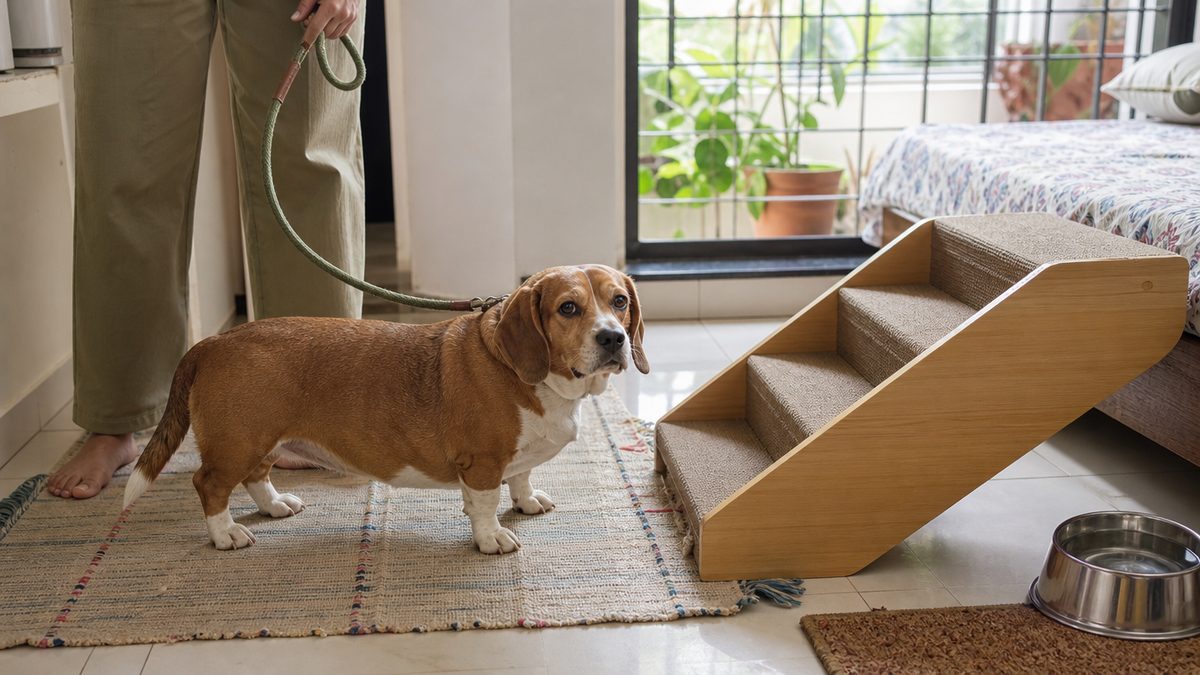
Then take the jumping down out of the day. Landing off a bed or a sofa onto tile is the everyday mechanism, and steps or a ramp remove it without removing the dog from the family. This is the one place where the popular advice and the evidence need reconciling, because the Dog Aging Project found regular use of a staircase associated with reduced odds of owner-reported IVDD across 43,517 dogs. Read the two together as a rule about landings rather than climbing. Block the high jump down, keep the dog fit enough to use stairs, and do not confine a healthy dog to one room out of fear.
Weight is the lever with the cleanest number attached. Overweight dogs carried 1.67 times the odds of owner-reported IVDD, with a 95 percent confidence interval of 1.38 to 2.01, in the largest dataset available. Weigh the dog monthly, write it down, and let your vet set the target rather than your eye.
- Lay grip on the routes the dog runs, meaning the corridor and the doorway where the turns happen, rather than carpeting the whole flat.
- Block the sofa and the bed with a ramp, steps or a closed door, and teach the dog to be lifted down rather than to leap.
- Lift with two hands, one under the chest and one under the hindquarters, keeping the back level, and never let a child pick the dog up.
- Weigh monthly and keep the dog lean, since overweight dogs carried 1.67 times the odds of diagnosis.
- Keep the walks long and the surfaces soft, because dogs walked under 30 minutes a day carried 2.49 times the odds of IVDD and dogs walked over an hour sat at 0.50 times.
- Recheck at the first yelp, since the disease recurs in 15 to 66 percent of medically managed dogs and the second episode is graded from scratch.
Bladder care is the part nobody warns Indian owners about. Retention incontinence travels with cord compression, and treating it is one of the four core components of medical management alongside activity restriction, pain control and the prevention of pressure sores. A dog that is down needs its bladder expressed on a schedule your vet teaches you, and skin checked daily at the hips, hocks and elbows where it lies.
The outlook for most dogs is genuinely good, and that is the message to take away. A dog that can still walk when it is seen recovers about 80 percent of the time with medicine and rest and about 98.5 percent of the time with surgery, measured across 115 and 336 dogs. Even at grade 4, where the dog is paralysed but can still feel its toes, 93 percent of 548 surgically managed dogs recovered. The grades where the answer turns hard are grade 5 and the small number of dogs that develop progressive myelomalacia. Our senior dog care guide for India covers the mobility and pain years that follow.
The dogs that do not walk again deserve naming rather than glossing. Permanent paralysis was the outcome for about four in five grade 5 dogs managed without surgery and about two in five managed with it, and in the older literature not one of 88 paraplegic dogs without muscle tone recovered on medical management, against 102 of 156, or 65 percent, of paraplegic dogs that still had tone. A dog that does not regain walking can still live well in a cart with good bladder management and skin care, and that decision belongs to you and your vet together.
There is no cure for the underlying disease and that is the honest frame for the rest of the dog's life. The retrogene degenerated every disc in the spine before the dog was a year old, surgery treats the disc that failed, and the discs that have not failed yet are still there Olby NJ, Moore SA, Brisson B, Fenn J. What good management buys is a dog that walks, a lower chance of the next episode, and years rather than months.
Ask your own vet before you change anything on this page. The grade is a judgement made by hands on a particular dog on a particular day, and the dog in front of them is the one that counts.
Questions Google India asks about IVDD in dogs
Can your dog recover from IVDD?
Usually yes, and the grade decides the odds. Dogs still walking when seen recovered in 80 percent of 115 cases with medicine and rest and 98.5 percent of 336 with surgery. Dogs that were paralysed but could still feel their toes recovered in 93 percent of 548 surgical cases. Dogs with no feeling in the toes recovered in 21 percent of 48 medical cases and 61 percent of 502 surgical ones.
What are the first signs of IVDD in dogs?
Pain comes first, before weakness. The earliest signs are yelping when lifted or touched along the back, a hunched back with the head held low, shivering or muscle spasms, and a sudden refusal to jump onto furniture or climb stairs. Only after that do owners see a wobbly back end, knuckled paws, dragging legs and, at the severe end, no reaction to a firm toe pinch.
What is the life expectancy of a dog with IVDD?
No published study reports life expectancy for dogs with IVDD, so treat any single number you read as unsourced. What is published is recovery, and most dogs recover. The nearest figure to an answer is age at diagnosis, which was a median of 11.0 years for Dachshunds and 12.1 years for Beagles in a survey of 43,517 dogs, meaning most affected dogs are already old when it happens.
What dog breed is most prone to IVDD?
The Dachshund, on measured prevalence, at 15.34 percent of 541 dogs. On adjusted odds the French Bulldog is now higher, at 21.1 times a mixed-breed dog against the Dachshund's 13.4 times. The Beagle is third on prevalence at 6.60 percent of 303 dogs, which surprises most owners, and the Pug is fourth at 4.37 percent of 252.
Can a dog live with a slipped disc?
Yes, and many dogs do so for years. A dog that is still walking is usually managed with at least four weeks of confinement, pain relief and rehabilitation rather than surgery, and 80 percent of 115 such dogs recovered that way. The limit is recurrence, which runs from 15 percent to 66 percent after medical management, because every other disc in a chondrodystrophic spine is already degenerate.
How much does it cost to fix a slipped disc in a dog?
No Indian veterinary hospital publishes a price for a spinal decompression. The nearest sourced Indian figures are government rate cards: specialized surgery at Rs 3,000 and a CT scan from Rs 2,000 at Madras Veterinary College, and a canine major operation at Rs 2,500 at BASU Patna. One Indian retail blog prints Rs 30,000 to Rs 1,50,000 for surgery with no source behind it.
How to heal a dog with a slipped disc?
Confine it and get it graded, in that order. Standard medical management is at least four weeks of restricted activity in a crate or a small room without furniture, with no off-lead walking, no jumping and no stairs, plus pain control, bladder care and skin protection. Rehabilitation exercises are part of the plan rather than a break from it. Your vet chooses the drugs and the grade decides whether surgery is advised.
What is the life expectancy of a dog with slipped discs?
It is not shortened for most dogs, because most recover and live out a normal span. The published outcomes describe walking rather than lifespan, and they are good at every grade except the last. The dogs whose outlook is genuinely poor are those paralysed with no deep pain sensation, and the 10 to 33 percent of those that develop progressive myelomalacia, a spreading cord injury with no treatment.
Is IVDD in dogs genetic, and can I test for it?
Yes. An FGF4 retrogene on canine chromosome 12 causes both the short legs and the premature disc degeneration, with a reported odds ratio of 51.23 for IVDD. The UC Davis Veterinary Genetics Laboratory sells a CDDY test at USD 58, reported as N/N, N/CDDY or CDDY/CDDY. The laboratory says testing is unnecessary where the allele is fixed, which covers most Dachshunds and Beagles.
Does any Indian rule require spine testing before breeding a Dachshund?
No. Sub-rule 10 of rule 8 of the Dog Breeding and Marketing Rules 2017 requires testing for genetic defects including hip dysplasia, progressive retinal atrophy, night blindness, hypothyroidism, entropion, ectropion, jaw faults, missing teeth and cryptorchidism. Intervertebral disc disease is not named, and the words intervertebral, chondrodystrophy, spine and spinal appear nowhere in the 14-page gazette notification.