
Dog life guide
Dog paw care in India: what a pad is, what nail length really does, and whether the after-walk wash helps
Three of the four things Indian owners do for their dogs' feet have never been tested on a dog. The paw-washing ritual, pad toughening and paw balm have no published trial behind any of them. What is documented is the thing between the toes, and two Indian clinic series put numbers on it.
Quick answer
Dog paw care in India comes down to three habits. Check all four paws by hand once a week, feeling between every toe. Keep nails short enough that the dog stands on its pads, not its claws. And if you wash paws after a walk, dry the webbing properly, because damp interdigital skin is where most Indian paw trouble starts. Balms, boots and pad toughening are all sold harder than the evidence supports.
This guide is general information for Indian pet owners and is not a diagnosis. Always consult a registered veterinarian near you before acting on anything you read here, and treat any sudden change in your pet's condition as urgent.
What a dog's paw pad actually is
A dog's paw pad is a three-layer shock absorber rather than a slab of tough skin, and the softest layer, not the hard outer one, does most of the work.
A finite-element study of the canine paw pad separated it into three layers and measured how each behaves. The outer stratified epithelium is the hardest material. Beneath it sit the dermal papillae, matrix tissue whose cross-section is full of holes arranged in a honeycomb-like fashion, with a reticulated layer of collagen fibre bundles and a few interspersed elastic fibres. Under that lies the subcutaneous layer, which holds a large amount of adipose tissue separated into many small compartments by collagenous membranes, and which the authors call the softest material and the foremost energy absorber of footpads.
The spread between those materials is the striking part. Across the layers, the Young's modulus has about 6,000 times difference between the hardest and softest materials, and all three layers work as a whole to meet the biomechanical requirements of animal locomotion. The structured outer layer provides an offloading mechanism by transferring load to the hard stratified epithelium, and the fat underneath absorbs the impact energy.
Two practical things follow from that structure. A scrape that takes off surface epithelium removes the hard layer and leaves the energy-absorbing one intact, which is why a superficial pad graze is uncomfortable rather than serious. A cut that goes all the way through reaches a different tissue entirely, and the clinical record reflects that difference.
A retrospective review of 120 traumatic footpad injuries in pet and military working dogs found that most were lacerations of a front-leg footpad. Short-term complications occurred in 27 percent of dogs, and no long-term complications or disabilities were identified. Dogs with full-thickness lacerations carried a higher risk of major short-term complications, while partial-thickness lesions healed well regardless of treatment, and suture repair and bandaging of full-thickness lesions did not clearly reduce complications or improve healing.
That last finding is worth sitting with, because it is the opposite of what most owners assume. The dressing is not what fixes a cut pad. Getting the dog assessed is.
Pad toughening: a claim with nothing behind it
Pad toughening, the idea that walking a dog progressively on rough ground conditions its pads into something harder, is repeated constantly and has never been tested. A Europe PMC title and abstract search on 21 October 2026 for paw pad conditioning, footpad conditioning, pad toughening, paw conditioning or toughening of the pads returned 2 records, one a physics preprint matched on the letters PaW and one about conditioned pain modulation in dogs, neither about pads at all. The same index, in the same session, returned 103 records for paw pad or footpad together with dog, dogs or canine. That is a genuine absence rather than a query that failed.
What is documented about repeated contact with rough surfaces runs in the other direction. In confined dogs, follicular trauma may be related to surface trauma from wire cages, concrete, or rough ground, and lesions in confined dogs are likely to recur unless the dog is removed from wire or concrete surfaces. The one recorded effect of hard, abrasive ground on a dog's feet is injury.
Skin adapts to load everywhere else on the body, so it is plausible that pads do too. Nobody has measured it in a dog, which means nobody can tell you where conditioning stops and damage starts. Treat a graduated build-up as sensible caution, not as a protective programme, and stop at the first roughened patch rather than the first limp.
Nail length: what has been measured, against what everyone says
Nail length has exactly one controlled measurement behind it, published in 2026, and it found the opposite of what the entire category assumes.
The near-universal claim is that an overgrown nail hits the ground first, tips the toe back, changes the angle the foot loads at and strains the joints above it. A 2026 study put that to a pressure-sensing instrumented treadmill. Seven privately owned dogs, six female and one male, aged 2.5 to 6.5 years and averaging 25.3 kg, were recorded across 137 trials before and after a nail trim. The breeds were a German Shepherd, two Rottweiler-type dogs, a Malinois, a Flat-Coated Retriever, a Pyrenean Shepherd and a Border Collie, and their nails were subjectively assessed to be long.
Nothing moved. Stride duration, stance duration, swing duration, stride length, peak vertical force, paw contact area, paw width and centre-of-pressure path length were all unchanged, with p values from 0.108 to 0.977. Peak vertical force and impulse did not differ in fore or hind limbs, and fore-hind weight distribution was unaffected.
Two small things did change. The forepaw measured about 2.2 mm longer before trimming, which is the claw itself showing up in the contact area, and the medio-lateral centre-of-pressure path was about 0.83 percent of paw width shorter before trimming. Neither is an orthopaedic finding.
The authors' own reading inverts the usual advice. They write that claw length might be a consequence rather than a cause of altered locomotion patterns, and suggest that a dog already moving differently makes less claw-ground contact, wears its nails less, and so grows them longer.
| The claim | What the measurement found | What is fair to say |
|---|---|---|
| Long nails change how a dog loads its legs | No significant change in stride, stance, swing, stride length, peak vertical force, contact area or paw width, in 7 dogs over 137 trials | Unsupported in healthy dogs. The study was small enough that a real effect could have been missed. |
| Long nails cause joint strain and arthritis | Never tested. No study has followed dogs with long nails for joint outcomes | An extrapolation, not a finding. |
| A dog that walks on hard surfaces does not need nail trims | No study has measured how any substrate wears a dog's nail | Plausible and unmeasured. Check rather than assume. |
| Long nails are a sign something else is wrong | The 2026 authors propose exactly this, that altered gait reduces claw contact and so lengthens nails | A hypothesis from the only team to measure it, and the most useful idea on this page. |
| Overgrown nails are rare in well-kept dogs | 433 of a random sample of 3,729 UK Beagles (11.61 percent) were recorded with overgrown nails in one year, the third most diagnosed disorder in the breed | Common, and commonly missed. |
What an overgrown nail does do
It grows into the pad. That is not a gait question, it is a puncture wound, and it is the reason the frequency question matters at all. Overgrown nails are also far more common than owners think: in UK primary-care records for 2019, 433 of a random sample of 3,729 Beagles carried the diagnosis, 11.61 percent with a 95 percent confidence interval of 10.58 to 12.64, making it the third most diagnosed disorder in the breed.
No equivalent Indian figure exists, because India has no small-animal surveillance network of the kind that produced that number. Researchers at Madras Veterinary College made the point directly: while surveillance networks for livestock and poultry are emphasised in India, the lack of one for small animals may exact a toll on encountering emerging diseases.
Does walking on Indian roads wear a dog's nails down?
Nobody has measured it. A Europe PMC search on 21 October 2026 for claw or nail together with wear, abrasion, substrate or hard surface, restricted to dogs, returned 3 records: the 2026 gait study, a leopard claw morphometry paper and a Japanese forensic article on blunt-object injuries. The 2026 authors themselves name limited movement on hard surfaces among the causes of excessive nail growth, and link greyhound nail problems to decreased exercise on hard surfaces later in life, but publish no data on either.
So the honest version is this. A tarred road is abrasive and a tiled flat is not, and a dog walked forty minutes a day on a Delhi or Pune street almost certainly wears more nail than a dog that paces a Mumbai apartment. How much more, and whether it is enough, is not something anyone can give you a number for. Check the nails instead of trusting the surface.
Dew claws, which nothing wears at all
Dew claws touch no ground, so no surface wears them, and they are the nail that curls back into the leg while the other four look fine. Check them every single time you check the feet, on the front legs always and on the hind legs where the dog has them.
On whether they should be removed, the published literature is thin and mostly beside the point. A search of dewclaw records on 21 October 2026 returned genetics papers placing the dewclaw locus on chromosome 16, surgical case reports using the first digit as a tissue source, and two letters in the Veterinary Record about one breed, with nothing measuring what a dew claw does or what removing it costs the dog. Anyone who tells you the answer is certain is going beyond the evidence.
The quick is the living core of the nail and it lengthens as the nail does, so a long-neglected nail cannot be shortened in one go however much you want to. The technique, the clipper and grinder choice and the styptic answer are all in our guide to grooming a dog at home in India. This page is about whether and when, not how.
Between the toes, where Indian paw problems actually live
Most paw trouble presenting at an Indian clinic is interdigital rather than on the pad, and two Indian series put numbers on it that no ranking page quotes.
At the veterinary medicine department of Guru Angad Dev Veterinary and Animal Sciences University in Ludhiana, 768 canine dermatological cases were reviewed and pododermatitis was recorded in 99 of them, 12.89 percent. Fifty of those dogs were worked up in detail: 24 (48 percent) had bacterial dermatitis, 14 (28 percent) atopic dermatitis, 6 (12 percent) demodicosis, 3 (6 percent) dermatophytosis, 2 (4 percent) a mixed infection and one (2 percent) superficial necrolytic dermatitis. Licking was the commonest sign at 69.69 percent, ahead of erythema at 29.29 percent, and the problem was present in all four paws in 61.61 percent of cases.
The same series found pododermatitis concentrated in dogs aged one to three years (34.34 percent), in males (71.71 percent), and in Labradors (30.30 percent), followed by Pugs (18.18 percent) and Beagles (13.13 percent). The seasonal peak was autumn, at 33.1 percent.
Further south, 273 dogs presented to the dermatology ward of the Teaching Veterinary Clinical Complex at Madras Veterinary College in Chennai between September 2017 and February 2018. Pyoderma dominated at 60.8 percent (166 dogs), followed by otitis at 11.7 percent, allergy and atopy at 10.3 percent, demodicosis at 8.1 percent, and generalised dermatitis and pododermatitis together at 4.4 percent. On chi-square analysis, age, sex and breed had no significant effect on which disease a dog had.
| Series | Where and when | Dogs | What it found about paws |
|---|---|---|---|
| Preeti and colleagues, 2020 | GADVASU, Ludhiana, Punjab | 768 dermatological cases | Pododermatitis in 99 (12.89 percent); licking in 69.69 percent; all four paws in 61.61 percent; autumn peak at 33.1 percent |
| Varughese and Chitra | Madras Veterinary College, Chennai, Tamil Nadu, September 2017 to February 2018 | 273 dermatology presentations | Generalised dermatitis and pododermatitis together 4.4 percent (12 dogs); pyoderma 60.8 percent; no significant risk-factor effect |
Those two figures, 12.89 percent and 4.4 percent, look irreconcilable and are not. The Chennai study grouped generalised dermatitis with pododermatitis into a single row, so its paw cases are inside a larger category rather than counted separately, and its window ran September to February while the Punjab series found its peak in autumn. Different definition, different region, different months. We publish both and average neither, because the gap is itself the finding: India has no agreed denominator for this problem.
The mechanism behind an interdigital lesion is better established than its Indian prevalence. Inciting damage to the environment of the interdigital web allows the development of microbial overgrowth, and that damage can come from conformational problems that result in increased friction, moisture, and maceration of tissue. Some breeds, including the Chinese Shar Pei, Labrador Retriever and English Bulldog, carry short bristly hairs on the webbing between the toes, and the short shafts of those hairs are easily forced backward into the hair follicles during locomotion, a process the manual calls traumatic implantation.
Conformation decides who is exposed. Breeds with wider paws and a greater distance between the digital pads, named as the Labrador Retriever, English Bulldog, German Shepherd Dog and Pekingese, may be more likely to bear weight on the haired skin between the pads, and more pressure is put on interdigital spaces in overweight dogs or those with abnormal weight bearing due to lameness or conformation abnormalities.
That converges with the Indian data in a way worth noticing. The Labrador is both the most frequently affected breed in the Punjab series and one of the wide-paw breeds the manual names Moriello KA (peer reviewed by Carnevale J). The caution is that the Labrador is also one of the commonest pet dogs in that clinic's catchment, so a breed's share of cases is not the same as its risk. Neither Indian study calculated a risk ratio.
Why it comes back
Recurrence is usually structural rather than unlucky. A veterinary dermatologist's framework sorts every case into four categories: primary causes, predisposing factors, perpetuating factors and secondary factors, and expects at least one primary cause and one or more other factors in each presenting case.
- Primary causes start the inflammation. Allergic disease, endogenous foreign body (hair, keratin) or exogenous foreign body (sharp objects, vegetation including grass seeds and splinters), endocrine disease, parasites, infection, autoimmune disease, neoplasia, trauma and musculoskeletal disease all appear on the list.
- Predisposing factors alter the local environment without causing disease themselves. The published list is a short hair coat or matted hair, obesity and large size, and altered weight bearing from body conformation, osteoarthritis, limb deformity or cruciate disease.
- Perpetuating factors are why treatment appears to fail. They include pedal scarring, furunculosis and ingrown hair, changes in conformation and weight bearing, and persistent infection, and they can maintain paw disease even after the primary cause has been identified and corrected.
- Secondary factors are the bacterial and fungal infections that follow. When several paws are affected, each paw may carry a different infection, which is why one swab from one foot can mislead.
The single commonest driver of recurrence is named plainly in the manual: a granulomatous reaction to the presence of free keratin in the tissues. A hair shaft pushed backwards into the skin is a foreign body the dog's immune system cannot dissolve, so the inflammation continues after the bacteria are gone. Chronic recurrent interdigital furunculosis is most often caused by an inappropriate antimicrobial course, concurrent steroids, demodicosis, an anatomic predisposition, a foreign body reaction to keratin, or a missed whole-body skin disease.
If hair has to come off the paws, the manual is explicit: do not clip the hair over the paws with electric clipper blades, because this may cause microtrauma and lead to hair shafts becoming traumatically inoculated into tissue. Use scissors. Indian salons clip paws with blades as routine. Tell the groomer, and see what dog grooming in India includes in our grooming cost guide.
The grass seed that looks exactly like a furuncle
A migrating grass awn and interdigital furunculosis are close to indistinguishable at the door. In 59 dogs sent for interdigital ultrasound, 27 had interdigital furunculosis and 32 had an abscess secondary to a migrating grass awn. Pruritus or licking appeared in 74 percent of the furunculosis group and 70 percent of the grass awn group, a discharging interdigital wound in 63 percent of each, and front-limb involvement in 88 percent and 75 percent respectively.
Only imaging separated them reliably. A cut-off of 0.83 cm for the length of the main multilinear element on ultrasound gave 91 percent sensitivity and 87 percent specificity for a migrating grass awn. One pattern helps at home: lesions caused by a foreign body such as a grass awn are usually solitary and often on a front foot, and recurrence is not common in those cases, whereas bacterial furunculosis tends to produce several nodules with new ones appearing as others resolve.
That matters in India after the monsoon withdraws, when roadside verges, maidans and society lawns across Maharashtra, Karnataka and the Deccan dry into seed heads. One swollen front toe two days after a walk through dry grass is a foreign body until a vet says otherwise.
Yeast, and how small the counting study is
Malassezia is the overlooked passenger. Comparing interdigital folds, one study found 83.8 plus or minus 126.0 colony-forming units in dogs with pododermatitis against 0 in healthy dogs, with cytology and qPCR agreeing, and concluded that Malassezia pachydermatis acts as an opportunistic agent in the condition. The honest caveat is the size: 13 dogs in total, 15 affected samples against 3 healthy ones. The humid-season picture, with Indian denominators, is in our monsoon care guide for dogs, and this page does not repeat it.
The lump between the toes that every Indian clinic calls an interdigital cyst is almost never cystic. Histologically these are areas of nodular pyogranulomatous inflammation, which is to say deep pyoderma. The name matters because a cyst sounds like something you drain and forget, and a deep pyoderma needs aggressive long-term treatment of three to six weeks. Related conditions are covered on our pages for hot spots and pyoderma in dogs and mange in dogs in India.
Washing paws after every walk, examined honestly
Washing a dog's paws after every walk has never been tested on a dog, and the mechanism that makes a careless wash risky is better documented than any benefit anyone claims for it.
Start with what is not there. A Europe PMC title and abstract search on 21 October 2026 for foot soak, paw wiping, wiping paws, paw washing or footbath, restricted to dogs, returned 1 record, and it was a study of biosecurity on Korean broiler chicken farms. The same index in the same session returned 103 records for paw pad or footpad in dogs. Nobody has tested whether washing a dog's paws removes allergens, reduces infection, prevents anything, or does any harm.
This is the single most widely performed act of dog care in urban India. It happens at the door of flats in Mumbai, Bengaluru, Kolkata, Hyderabad and Chennai several times a day, and not one published study says whether it helps.
What is documented is the condition that follows a wash done badly. Microbial overgrowth in the interdigital web follows damage to the web's environment, and that damage is described as increased friction, moisture, and maceration of tissue. Moisture is one of the three named ingredients, and a paw rinsed twice a day and never dried between the toes supplies it on a schedule.
The only large dataset that counted wet paws found them the commonest paw problem of all. Across 373 adult dogs examined at 20 commercial breeding facilities, wet paws were recorded in 12.6 percent, ahead of calluses at 11.26 percent, erythema at 6.97 percent and matted paw fur at 6.17 percent, with pododermatitis in 4.29 percent and interdigital furuncles in 2.68 percent.
The surface split in that study is dramatic and must be reported with its own caveat. Descriptively, wet paws were found in 29 percent of dogs housed on concrete with concrete, against 1.5 percent on concrete with gravel and 4.9 percent on diamond-coated expanded metal with concrete. But the authors' own models found no significant effect of flooring substrate, body condition score or breed for any of the conditions of interest. A raw difference that large with no significant model result is a finding to report, not to spin. It is consistent with concrete holding water, and it is not proof of it.
The treatment for an infected paw is washing it. The standard instruction is to bathe the affected feet daily with antimicrobial soaks and shampoos. So the risk in the Indian after-walk ritual is not the water. It is a wet web, a wet nail fold and a wet dew claw crease, left wet, on a dog that then lies on a cool floor for four hours.
Indian law has a line about this that no Indian pet page quotes, and it is in an unexpected place. The Prevention of Cruelty to Animals (Dog Breeding and Marketing) Rules, 2017 require that primary enclosures enable the animals to remain dry and clean and have floors that are constructed in a manner that protects the animal's feet and legs from injury, and separately that standing puddles of water in animal enclosures and adjacent areas shall be drained or mopped up. Those clauses bind registered breeders rather than households. They are nonetheless the only place in Indian law where keeping a dog's feet dry and its floor safe is written down as a duty, and they are a reasonable standard for a flat.
The routine that follows from the evidence
- Decide what you are removing. Mud, street dust and whatever the lift lobby was mopped with are worth removing. A dry-season walk on clean tile is not a reason to wet four feet.
- Use plain water unless a vet has prescribed something else. Nothing in the literature supports a routine medicated wash on a healthy paw, and an unnecessary one is an experiment on your own dog.
- Spread each paw and dry the webbing, not just the pads. The web is the site that macerates, and it is the site a towel wipe across the sole never touches.
- Press the towel rather than rubbing it. Friction is the first of the three named ingredients of interdigital damage, so working a rough towel back and forth through the web supplies one problem while removing another.
- Dry the nail folds and the dew claw crease. Pododermatitis by definition includes the nail folds, so a dry web and a wet nail fold is half a job.
- Inspect while you dry. Spreading the toes to towel them is already the examination, so look at what you are holding. Done at the door it costs nothing extra.
- Treat refusal as information. A dog that has always allowed this and now pulls the foot away is telling you where it hurts.
What changes by city
Humidity decides how long a washed paw stays wet, which means the same routine has different consequences in different Indian cities. In Chennai, Mumbai and Kolkata the air is humid for most of the year and a damp web stays damp, so the towel has to do the work the air will not. In Delhi and Ahmedabad through the dry months the web dries in minutes while the pad surface itself dries out and cracks, which is the opposite failure. Pune, Bengaluru and Hyderabad sit between the two and change with the season.
That is plain physics rather than a measurement, and we say so: nobody has published a drying time for a dog's foot in any Indian city. The rains are a separate question with Indian numbers behind it, and our monsoon care guide for dogs carries the leptospirosis, yeast and tick evidence. Dry-season cracking belongs with winter care for dogs in India.
Paw balms and butters: what is actually known
Paw balm has no published evidence behind it in either direction, so every claim you read about it, including the sceptical ones, is opinion.
A Europe PMC search on 21 October 2026 for petroleum jelly, coconut oil, emollient, moisturiser, moisturizer, paw balm or paw wax, combined with paw pad, footpad or pododermatitis, returned 0 records. That query is narrow, so a zero from it is weaker than a zero from a broad one, and we flag that rather than over-reading it. Nothing has been tested.
The separate question of whether a balm protects a pad from hot ground was searched and answered on our cooling vests and summer gear guide, which records the same absence for that claim. This page does not repeat that work.
Three things are worth saying anyway, and none of them is a product recommendation.
- A cracking pad can be a disease, not a dry one. Footpad hyperkeratosis sits on the published list of primary causes of pododermatitis alongside autoimmune disease and neoplasia. A pad that cracks and keeps cracking despite moisturising is a reason to see a vet rather than to buy a bigger tin.
- Whatever goes on a pad goes into the dog. Licking was the commonest presenting sign in the Punjab series at 69.69 percent, so the population most likely to have something applied to its feet is the population most likely to eat it.
- A greasy pad is a slippery pad on Indian floor tile. This is a hazard nobody prices in, and it matters most for the senior dogs covered in our senior dog care guide.
Bonbeno does not rank or recommend a named product it has not tested first-hand. The honest summary is that paw balm is probably harmless, possibly useless, and definitely untested.
Dog boots and socks, in one section rather than ten
Dog boots are a tool for a named hazard rather than daily wear, and the two published biomechanics studies behind that conclusion already sit on another Bonbeno page.
Whether a dog tolerates boots, what they do to limb loading, and the week-long habituation protocol that both published studies used, are all set out with their numbers in our guide to do dogs need clothes in India. The thermal trade-off, which is that the pad is one of the few patches of a dog's skin built to exchange heat, is in the cooling vests and summer gear guide. Trail and scree surfaces are in trekking with a dog in India. None of that is repeated here.
What belongs on this page is the paw-side reading. Booties appear in the veterinary literature as a protective measure specifically where surface trauma is the trigger, listed beside management of substrates in kennels and exercise areas. That is the use case: a known hazard, for the duration of that hazard.
And one caution that follows directly from the rest of this page. A boot is a sealed, warm, unventilated space around the exact tissue that fails from friction, moisture and maceration. A dog that comes home from a humid Mumbai evening in boots and keeps them on while the household eats dinner has spent two hours in the condition the manual warns about. Boots come off at the door, and the web gets dried, exactly as it would after a wash.
The Indian street: debris, glass, tar, drains and lobby floors
Street hazards injure the front feet first, and the Indian ones that matter most are the two nobody writes about, which are construction debris and the chemical the lobby is mopped with.
The shape of a traumatic paw injury is consistent. Of 120 traumatic footpad injuries reviewed in pet and military working dogs, most were lacerations of a front-leg footpad, 27 percent of dogs had a short-term complication, and no long-term complications or disabilities were identified. Front feet lead, front feet brake, and front feet find the glass.
We looked for an Indian count of paw lacerations caused by street debris and found none. No Indian clinic series, municipal record or welfare organisation appears to publish one. Treat every figure you see attached to this claim on an Indian pet page as unsourced until it names a denominator.
| Hazard | What it does to the paw | What to do |
|---|---|---|
| Construction and demolition debris on the footpath | Tile shards, cut rebar ends and brick grit produce full-thickness lacerations, the injury type with the higher complication risk | Route around it. Debris piles stay for weeks and the sharp edges work up through the dust. |
| Broken glass | A clean deep cut, often with nothing visible until the dog has walked on it | Check the sole and between the toes after any walk past a bar, a bus stop or a waste point. |
| Softened tar in the hot months | Sticks to the pad and to the hair between the toes, and pulls when it sets | Do not use petrol, kerosene or paint thinner. Those are solvents on skin that may already be burnt. This is a clinic visit. |
| A freshly mopped lift lobby | Residue on the pads and in the web, then swallowed, with irritant contact dermatitis among the recognised triggers of interdigital disease | Walk the dog past wet floors, not across them. The phenyl chemistry is on our puppy and indoor-cat pages. |
| Open drains and standing water after rain | A different problem from a wet paw, and a documented infection exposure | Covered with Indian denominators in the monsoon guide, not here. |
| Hot ground in the middle of the day | Contact burn, which is the one paw hazard with a measured temperature behind it | Owned entirely by the heat guide, including the hand test that detects it. |
On hot ground, the position is settled and sits elsewhere. Our heat safety guide for dogs in India carries the measured asphalt temperatures and the seven-second hand test, and its conclusion is that hot pavement is off limits once the sun is up on an Indian street. The companion finding, that no product earns you a walk on ground that fails the test, is in the cooling vests and summer gear guide. This page writes nothing more about heat.
The lobby floor deserves one more sentence, because it is the hazard that is specific to Indian flat living and is invisible. Allergic contact and irritant dermatitis are named among the pruritic triggers whose licking and self-trauma contribute to interdigital furunculosis. A dog that crosses a wet, freshly phenyl-mopped lobby twice a day is in repeated contact with a residue on the one part of its body it will then put in its mouth. The toxicology of phenyl itself is already set out on our puppy toilet training guide and our indoor cat safety guide.
Partial-thickness pad lesions healed well regardless of treatment, and suture repair and bandaging of full-thickness lesions did not clearly reduce complications or improve healing. Apply pressure with a clean cloth to control bleeding and go. Do not pack the wound with turmeric, ash or powder, do not pull out an embedded object you cannot see the end of, and do not decide at home which thickness you are looking at.
A paw year in India, season by season
Four things change across an Indian year for a dog's feet: the ground temperature, how long the web stays wet, how much seed is in the grass, and how fast the pad surface dries out.
There is one Indian seasonal signal in the published literature and it is a single clinic. The Ludhiana series recorded its highest share of pododermatitis in autumn, at 33.1 percent. One north Indian teaching hospital's caseload across one period is not a national curve, and the Chennai series, whose window ran September to February, calculated no seasonal split at all. Use the table below as a routine, not as epidemiology.
| Season | What happens to the paw | What to change |
|---|---|---|
| Summer, roughly March to June | Ground temperature is the hazard and the pad surface dries out in the dry-heat cities | Move the walk, do not buy a product. Full detail in the heat guide. |
| Monsoon, June to September depending on your city | The web stays wet for hours and never properly dries; infection exposure rises | Dry between every toe after every walk, not just after a wet one. Monsoon guide for the rest. |
| Post-monsoon and autumn, September to November | Grass dries into seed heads along verges and lawns; the one Indian series with a seasonal split peaked here | Check front feet after any walk through long dry grass. One swollen front toe is a foreign body until proven otherwise. |
| Winter, December to February | Dry cold air in the north cracks the pad surface; there is no road salt in India, so most imported winter paw advice does not apply | Winter care guide carries the cold. Watch for splits, not for ice balls. |
| All year, every city | Nails grow, dew claws grow faster in proportion because nothing wears them, and the web macerates whenever it is left damp | The weekly check below. |
Two of those rows are not this page's to write, and saying so is the point. Hot ground and the pavement test belong to heat safety for dogs in India. The rains, with Indian leptospirosis and otitis denominators, belong to monsoon care for dogs in India. Cold and cracking belong to winter care for dogs in India. What this page owns is the paw itself, in every season.
The weekly paw check, in two minutes
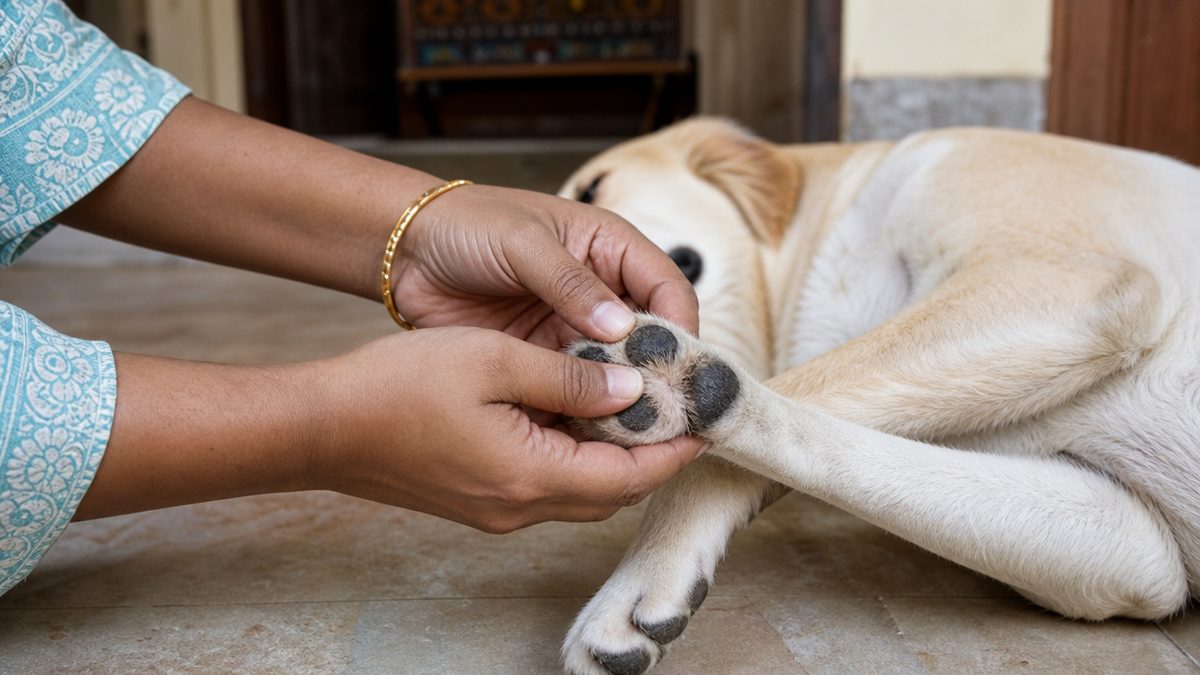
To check a dog's paws properly, work through the same eight points in the same order every week, with the dog lying down and the light good.
- Look at how the dog is standing before you touch anything. Weight should sit on the pads. A dog standing on its claws has nails that are too long for it.
- Spread each pair of toes and look into the web, both on top of the paw and underneath. Early interdigital lesions appear as focal or generalised areas of erythema and papules in the webbing, and furuncles are most commonly found on the dorsal aspect of the paw.
- Feel for a lump before you can see one. A furuncle at 1 to 2 cm is reddish purple, shiny and fluctuant, and may rupture when palpated. If something moves under your thumb, stop pressing and book the appointment.
- Run a finger across each pad for splits, embedded grit and a surface that has gone glassy or thickened.
- Check all the nails, then check the dew claws separately. Nothing on the ground wears a dew claw, so it is the one that curls into skin while the others look fine.
- Smell the paw. A rancid or yeasty smell off a foot is a reason to see a vet rather than to wash harder.
- Count the feet. Involvement of all four paws was recorded in 61.61 percent of the Indian pododermatitis cases, so a problem on one foot and a problem on four are different problems.
- Write the date and what you found. Two dated photographs six weeks apart settle more at a consultation than any description does.
A dog limping on one foot. A swelling between the toes. A paw the dog will not let you hold when it used to. Licking that has become constant rather than occasional. Any smell. Pedal pain and lameness can come from the primary disease, from secondary infection, or from both, so none of these is a wait-and-see.
Older dogs need the check more often, not less, because altered weight bearing from osteoarthritis is on the published list of things that predispose a paw to disease. Our page on arthritis in dogs and cats covers the joint side, and the same list names obesity and large size, which our obesity page deals with.
What a vet will actually do, and what to bring
To get a paw problem resolved rather than postponed, expect the vet to look for a cause rather than to hand over a cream, and bring the three things that let them do it.
The baseline workup is a thorough history, a detailed physical examination, and basic dermatologic tests: deep skin scrapings, hair plucks and cutaneous cytology. Hair plucks look for Demodex, and cytology tells inflammation apart from infection, which matters because inflammation alone does not indicate infection.
Where there are nodules or draining tracts, tissue culture sampling is preferred over superficial skin swabs, because a surface swab may not represent the bacteria in deeper tissue. When several paws are affected, separate cultures from individual paws should be considered, since sampling one paw may not represent the infection in the others.
Expect the course to be longer than you want. Interdigital lesions need aggressive long-term treatment of three to six weeks, and dogs with multifocal lesions benefit from systemic antimicrobial treatment for at least four to six weeks. A five-day course that stops when the foot looks better is one of the named causes of chronic recurrence.
- Dated photographs of each affected paw, taken in daylight, including the top of the paw and not only the sole.
- Which paw, and when it started. Front or hind changes the differential, and the Indian series found all four paws involved in most cases, so say whether it is spreading.
- What the dog walks on. Tile, lawn, tarred road, construction site, terrace, and how long the dog was in boots if it wears them.
- What you have already applied. A balm, a human antiseptic or a leftover ointment changes what cytology shows, and the vet needs to know before the slide goes under the microscope.
Do not use a human antifungal, a leftover antibiotic from another dog, or a steroid cream on a paw. Short courses of corticosteroid have a place under veterinary direction and long-term use is not advised, because steroids are comedogenic and immunosuppressive and can make both the comedones and the bacterial infection worse. Bonbeno names no drug and no dose. That is a veterinary decision on the individual dog, and this page publishes under the medical disclaimer for that reason.
If the dog is itchy somewhere other than its feet as well, the paw may be the symptom rather than the disease. Canine atopic dermatitis is a common cause of recurrent interdigital furunculosis, and licking and other pruritic behaviour associated with an underlying allergy contributes to the local trauma that starts it. Our page on atopic dermatitis in dogs sets out how that is diagnosed.
Common questions about dog paw care
Should I clean my dog's paws after every walk?
Clean them when they are actually dirty, and dry the webbing properly whenever you do. No published study has tested paw washing, wiping or soaking in dogs, so nobody can tell you it helps. What is documented is that moisture and maceration of the interdigital web allow microbial overgrowth, so a paw rinsed twice a day and never dried between the toes is supplying one of the three named ingredients of interdigital disease.
What is the best way to clean dog paws?
Plain water, then a towel pressed into the webbing rather than rubbed across the pads. Spread each pair of toes, dry the web, the nail folds and the dew claw crease, and look while you dry, because that is your inspection. Avoid rubbing hard, since friction is the first of the three named contributors to interdigital damage. Use a medicated wash only if a vet has prescribed one.
What do unhealthy paws look like?
Look for erythema and small papules in the webbing rather than on the sole, because early interdigital lesions start there and furuncles are most commonly found on the dorsal aspect of the paw. A developed lesion is a reddish purple, shiny, fluctuant nodule of one to two centimetres that may rupture when pressed. Also count the feet: Indian clinic data recorded all four paws involved in 61.61 percent of cases. Any smell, limp or constant licking is a vet visit.
What happens if I don't trim dog nails?
The nail eventually grows into the pad, which is a puncture wound, and that is the real reason to trim. The widely repeated claim that long nails change a dog's gait has one controlled test behind it and failed it: in seven healthy dogs over 137 trials, stride, stance, swing, peak vertical force, contact area and paw width were all unchanged after a trim. The authors suggest long claws may be a consequence of altered gait rather than its cause.
How often do indoor dogs need their nails trimmed?
Check fortnightly and trim on what you see, because no study has measured how any surface wears a dog's nail. A search of the veterinary literature for claw wear by substrate returned three records and none of them measured it. Indoor dogs grow more nail than street-walked dogs for the obvious reason, and limited movement on hard surfaces is named among the causes of excessive growth, but the interval is yours to find rather than anyone's to prescribe.
Why does my dog keep licking his paws even though there's nothing there?
Because the commonest causes leave nothing for you to see. Licking was the presenting sign in 69.69 percent of Indian pododermatitis cases, ahead of visible redness at 29.29 percent, so licking usually arrives before anything is visible. Allergic skin disease, Demodex, early interdigital inflammation and a migrating grass seed all present this way. Persistent licking with a normal-looking paw is a reason for skin scrapings and cytology, not for a cone.
Is it normal for dogs' paw pads to have cracks?
Common, yes. Normal in the sense of harmless, no. Footpad hyperkeratosis appears on the published list of primary causes of canine pododermatitis, alongside autoimmune disease and neoplasia, so a pad that keeps cracking can be a disease rather than a dry surface. No Indian prevalence figure for cracked pads exists. A pad that splits deeply enough to bleed, or that cracks again within weeks of healing, needs a diagnosis rather than another tin of balm.
Is vaseline or coconut oil better for dog paws?
Neither has been tested, so the honest answer is that nobody knows. A literature search on 21 October 2026 for petroleum jelly, coconut oil, emollient, moisturiser, paw balm or paw wax combined with paw pads, footpads or pododermatitis returned zero records. Three things are worth weighing anyway: a dog licks off whatever you apply, a greasy pad is slippery on Indian floor tile, and a pad that keeps cracking despite moisturising needs a vet rather than a different jar.