
Dog life guide
Do dogs need clothes in India: what a garment does, which dogs it helps, and how to fit one
Every Indian winter page tells you which dogs feel the cold. None of them tells you that a dog is thermally comfortable between about 20 C and 30 C, that India's own national average crossed below that floor in only two months of 2024, or that the same letter size covers a 28-inch chest on one published chart and a 44-inch chest on another.
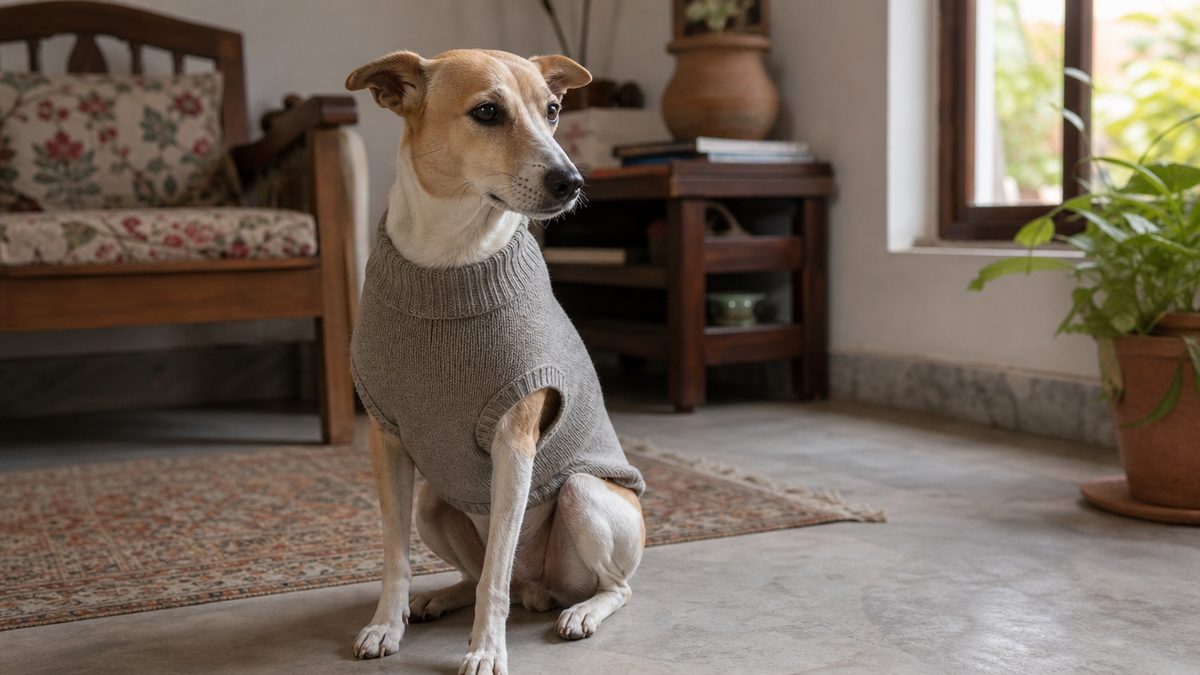
Quick answer
Do dogs need sweaters in winter in India? Most do not. A dog spends the least energy holding its temperature steady between about 20 C and 30 C, and India's all-India mean temperature fell below that floor in only two months of 2024, January and December. A garment earns its place on a hairless, short-coated, toy, very young, elderly, thin, clipped or unwell dog. On a double-coated dog it can flatten the undercoat that is doing the work. Measure chest girth, not weight. Your nearby vet decides for your dog.
This guide is general information for Indian pet owners and is not a diagnosis. Always consult a registered veterinarian near you before acting on anything you read here, and treat any sudden change in your pet's condition as urgent.
Which dogs in India need a sweater, and which do not
Most dogs in most of India need no sweater at all, and the group that genuinely benefits is small. It covers hairless and short-coated dogs, toy breeds, puppies, elderly dogs, thin or unwell dogs, recently clipped dogs, and dogs moved from a warm region to a cold one. The reason is a number rather than an opinion. A dog spends the least energy holding its body temperature steady inside its thermoneutral zone, which runs from about 20 C to 30 C, and the Indian year mostly sits inside that band.
The India Meteorological Department publishes its own all-India monthly mean temperature series, 1901 to 2024, as open government data. Read the 2024 row against the 20 C floor and the picture is unambiguous. The national monthly mean crossed below 20 C in exactly two months, January at 18.37 C and December at 19.46 C, and it crossed above 30 C in two more, May at 31.08 C and June at 30.55 C. The annual mean for 2024 was 25.74 C, which is near the middle of the zone.
| Month | All-India mean, 2024 | Where it sits |
|---|---|---|
| January | 18.37 C | Below the floor |
| February | 21.10 C | Inside the zone |
| March | 24.92 C | Inside the zone |
| April | 29.06 C | Inside the zone |
| May | 31.08 C | Above the ceiling |
| June | 30.55 C | Above the ceiling |
| July | 28.65 C | Inside the zone |
| August | 27.79 C | Inside the zone |
| September | 27.88 C | Inside the zone |
| October | 26.92 C | Inside the zone |
| November | 23.14 C | Inside the zone |
| December | 19.46 C | Below the floor |
| Whole year | 25.74 C | Inside the zone |
2024 was not a freak year. Averaging the same table's 2015 to 2024 rows gives a January mean of 18.27 C and a December mean of 19.37 C, the only two months below the floor, with February already at 21.18 C. Two months out of twelve is the honest national shape of this question.
A national average is a national average, and this one flattens a very large country. It averages Leh and Srinagar together with Chennai and Thiruvananthapuram. The northern plains, where Delhi, Lucknow and Kanpur sit, carry a real cold season that the average hides, and that season has its own page: winter care for dogs in India holds the India Meteorological Department's cold wave criteria, the cold wave days by state, and the heating hazards that actually injure dogs in January. A dog in Chennai, Mumbai, Bengaluru, Hyderabad, Pune or Ahmedabad is in a different argument from a dog in Amritsar, and the table above is the reason the first group is the larger one.
Why every page gives you a long answer to a short question
This is mostly a shopping category, and the search data says so before any page does. Bonbeno's own People Also Ask harvest of 20 October 2026 put six clothing queries to Google India. Two of them, for dog raincoats and for pet bandanas, returned no People Also Ask box at all, which is what Google does when it cannot find informational demand behind a query. A third, for dog clothes in India, drifted to "What is the best online pet shop in India?" and "What is a popular dog fashion brand?". Only three of the six carried real questions, and those three are the ones this page answers.
The result pages behave the same way. In a Google India search for this exact query on 21 October 2026, three different Indian retailer blogs ranked under the identical title, "Winter Wear for Dogs: Do Indian Dogs Really Need Sweaters?", and not one of them cites a study, a government document or any temperature figure with a source attached Pawgy Pets, Winter Wear for Dogs.
No garment, brand or seller is named or recommended anywhere below. Bonbeno publishes a verdict on a product only after testing it first-hand, and none of these has been tested here. What follows is how a garment works, which dogs it helps, how to measure for one, and how to tell when it is making things worse. Where a published size chart is quoted as data, the seller's identity sits in the source list so the figure can be checked.
How a dog holds its heat, and what the thermoneutral zone is
To hold its heat, a dog narrows the blood vessels in its skin, then changes posture, then moves to generate heat, and only shivers when the temperature falls past its lower critical temperature, and every one of those steps costs energy that staying inside the thermoneutral zone does not.
The thermoneutral zone is the band of ambient temperature in which an animal's basal metabolic rate barely moves. Inside it, the European Food Safety Authority records, the increase in basal metabolic rate is modest and almost negligible; as the temperature approaches either edge the rate rises, and at the edges themselves it starts to increase exponentially. The two edges have names, the lower critical temperature and the upper critical temperature, and below the lower one metabolic heat production climbs through shivering and vasoconstriction.
A dog is not a small human in fur, and the difference runs in both directions. The cooling route is panting rather than whole-body sweating, which is why heat is the bigger Indian problem and why it has its own page in heat safety for dogs in India. The warming route is a layer of insulation the dog grows itself, which no human has. That is the asymmetry a garment has to be judged against, because adding a layer to an animal that already carries one is not the same move as putting on a jumper.
The published figures for where that band sits disagree with each other, and the disagreement is more useful than any single number. Five sources give five answers, and the spread is not small.
| Source | Figure as published | What it was measured on or written for |
|---|---|---|
| Wang and colleagues, 2026, stating the figure in a coat trial | Thermoneutral zone 20 C to 30 C | Dogs in general |
| EFSA 2023, reading the animal-based measures across two chamber studies | Neutral 16 C to 27 C, cold 8 C to 12 C, hot above 33 C | Three adult dogs of 10 kg and six Greyhounds of about 30 kg |
| Hales and Dampney 1975, as reported by Carter and colleagues | About 16 C to 24 C | Greyhounds |
| Gerth and colleagues 2010, as reported by Carter and colleagues | Minus 25 C to 10 C | Inuit sled dogs |
| Hammel and colleagues 1958, as reported by Carter and colleagues | Lower critical 15 C to 20 C, upper critical 30 C to 35 C | Dogs in general |
| EU Animal Welfare Platform, quoted inside the EFSA report | Indoor accommodation 10 C to 26 C, optimal 15 C to 21 C | Adult dogs in breeding establishments |
| UK Home Office 2014, as reported by Carter and colleagues | 15 C to 24 C | Housed dogs |
The sled dog figure is the one to hold on to. A sled dog's lower limit sits 45 degrees below the pet-dog figure in the same table Wang T, Smit M, Cai X, Corner-Thomas RA. No single temperature can tell you whether your dog needs a sweater, because the number moves with the dog by more than the entire Indian winter is wide. This is also why the 10 C threshold that the Indian result pages run on has no author. One of them, a Kolkata page, calls the threshold out in its own opening and then restates it two sentences later, writing that most dogs experience discomfort below 10 C and that sensitive dogs benefit below 15 C, with no source for either.
Why a Chihuahua and a Saint Bernard are different problems
A Chihuahua and a Saint Bernard are different problems because a small body carries more surface area for every kilogram of tissue it has to keep warm, so the floor of its thermoneutral zone sits higher than a large dog's.
The European Food Safety Authority states the geometry directly. Small mammals typically have higher metabolic rates and larger surface-to-volume ratios, making them more susceptible to heat loss, so the lower boundary of their thermoneutral zone is often higher than that of larger animals. The same passage adds the other half, which matters more here than the first: some breeds have specialised adaptations, such as thick fur, which expand their thermoneutral zone. Body size moves the floor. Coat moves both edges.
That geometry has been measured on real pet dogs rather than assumed. Researchers took tympanic membrane temperatures and infrared thermography from dogs of different body mass, age, coat type and head shape, before and after a 45-minute moderate walk, across three seasons. Heat dissipation rates correlated positively with body mass, and the authors' reading of it was that small dogs allocate a bigger proportion of their metabolism to the inefficiencies of heat production, to offset greater heat loss. A small dog is not colder because it is delicate. It is paying more, per kilogram, to stay the same temperature.
Puppies sit at the extreme of the same curve. Newborn puppies have a relatively high surface area to body mass ratio, which makes them susceptible to heat loss, and they also have limited ability to generate heat through shivering or muscle activity. The answer for a newborn litter is a warm, draught-free box, not a garment, and the first fortnight is set out in newborn puppy care in India.
What small size does not mean
Small size shifts the floor, it does not decide the verdict. A toy breed in a Bengaluru December is still sitting inside the zone for most of the day, and a 30 kg dog with a thin single coat on a Delhi January morning may be outside it. Weight alone is a poor instrument for this question, which is also why it is a poor instrument for picking a garment size, as the sizing section below shows. The same study that found body mass mattered found that age did not emerge as a major determinant of thermoregulation in its best subset models, which is a useful caution against reading a dog's needs off its birthday.
Single coat, double coat, and the undercoat a garment can flatten
A single coat is one layer of hair, a double coat is a dense undercoat beneath a longer protective topcoat, and a hairless dog has neither, which is why coat structure decides this question more than coat length does.
The European Food Safety Authority sorts dogs into exactly those three categories and describes each one. Single-coated dogs have a single layer of fur, often consisting of shorter hair. Double-coated dogs possess two layers, a dense undercoat and a longer protective topcoat. Hairless dogs lack significant fur and may have patches of hair or be completely hairless. It adds that short-coated breeds have fur positioned close to the body that is not providing a lot of insulation, while medium-coated and long-coated breeds have fur that is longer and thicker with sufficient undercoat, and that a denser, thicker coat increases the capacity for trapping heat near the skin.
Now the part almost no page states. The insulation is not the hair. It is the air. Pelage reduces heat flux by trapping air within it, and thicker pelage provides more insulation by trapping more air. A dog's undercoat is a scaffold that holds a layer of still air against the skin, and the thickness of that trapped air layer is the whole of its insulating value. The same physics explains the other direction: thick, insulative pelage impedes the movement of wind through the coat and lowers the rate of convective cooling, which is why a heavy coat is a liability in heat.
From there the mechanism follows. Anything that compresses the coat reduces the depth of trapped air it is holding, and a garment strapped over a dense undercoat compresses it. A tight knit over a Siberian Husky is not adding a layer to the dog's insulation; it is partly replacing one layer with a thinner one. The honest caveat belongs with it. No study was found, on any search, that measures a dog's coat insulation with and without a garment over it. The trapped-air mechanism is measured; the compression step is physics applied to a dog, and this page labels it as reasoning rather than evidence.
The practical reading is that a double-coated dog starts from a wider thermoneutral zone than a single-coated one, because thick fur expands that zone. A garment has less to add, and a badly chosen one has something to take away.
Never clip or thin a double coat so that a garment sits better on it. You would be removing the insulation to make room for a thinner substitute, and the undercoat also shades the skin in summer. The brushing routine that keeps an undercoat lofted rather than matted, which is what keeps it trapping air, is in dog grooming at home in India. A matted undercoat insulates badly for the same reason a compressed one does.
What the one controlled trial on dog coats actually found
The one controlled trial on dog coats found that coated dogs slept more, not that they were measurably warmer: eight outdoor-kennelled working dogs slept for 48.1 percent of the coat window against 40.0 percent without one, p = 0.008.
The design is worth knowing before the result. Eight adult working-breed dogs at a university canine unit in Palmerston North, New Zealand, wore a coat or no coat overnight from 15:00 to 09:00 in a randomised cross-over, between 7 and 17 October 2024, with behaviour classified from triaxial accelerometers. Ambient temperature over the period ranged from 2.7 C to 18.4 C with a daily mean of 12.0 C. Alongside the sleep result, time spent resting fell from 25.9 percent to 22.5 percent and time spent in active behaviours fell from 32.7 percent to 28.2 percent when the coats were on, while total daily activity was effectively unchanged at 5,464 against 5,531 units.
What the trial does not show is as important. There were eight dogs at one site. No core body temperature, cortisol, melatonin or heart rate variability was measured, and the authors say the mechanism behind the extra sleep remains speculative in the absence of those measurements. They also note that 12 C, while below the thermoneutral zone, may represent only a mild thermoregulatory challenge for healthy adult dogs, so the effect could be larger in genuinely cold conditions.
Read against India, the trial describes a specific dog. These were working dogs kennelled outdoors through the night at a mean of 12 C. That is a January night on the northern plains and a dog that lives outside. It is not a Pune flat with a dog on a sofa. The result is good evidence that a coat helps an outdoor dog below the zone and no evidence at all about an indoor one inside it.
| The dog | Does a garment help | What that looks like in practice |
|---|---|---|
| Hairless or near-hairless | Yes, the clearest case of all | A light cover when the room is below the zone, and sun cover outdoors, because there is no fur to trap air at all |
| Short-coated toy breed | Often, on cold mornings only | A lightweight layer for the walk, off again indoors; small bodies lose heat faster per kilogram |
| Thin single-coated sighthound | Often | Chest and belly coverage matters more than the length down the back; a single coat is one layer of shorter hair |
| Puppy under about 12 weeks | Warmth yes, a garment rarely | A draught-free box and bedding beat clothing on a body with a high surface area to mass ratio |
| Elderly or arthritic dog | Sometimes | A layer at night and grip underfoot; a stiff old dog is a veterinary conversation first |
| Recently clipped dog | Temporarily | Until the coat grows back, because a clipped dog has lost the layer that was trapping the air |
| Thin, unwell or recovering dog | Ask the vet | The underlying illness decides this, not the weather |
| Dog moved from a warm region to a cold one | For the first season | A denser winter coat is one of the thermal adaptations that occurs in colder months, and a dog arriving in December has not grown one |
| Healthy adult double-coated dog | No | Thick fur already expands the thermoneutral zone; a garment compresses the layer doing the work Riddell EA, Patton JL |
| Indian street or community dog | No, and a wet one is worse | A dry, raised, windproof shelter outperforms any garment left on an unsupervised animal |
Hairless dogs are the one case nobody argues about
A hairless dog has no insulating layer to add to, which makes it the only category where the case for a garment is structural rather than circumstantial. Both directions apply in India. The Chinese Crested Dog and the Xoloitzcuintle need cover on a cold morning and they need cover from the sun, and Indian ultraviolet is the bigger of the two risks for them. The chronic skin damage that follows, and what to do about it, is in sunburn and solar dermatitis in dogs. This page adds only the garment half of it.
The dogs that need nothing, which is most of them
A healthy, acclimatised adult dog with a double coat needs no sweater in an Indian winter, and that covers a very large share of the dogs in Indian homes. So does the Indian pariah dog, which is short-coated but lives at the temperature it evolved in. The two ranking pages that disagree do so without evidence. One answers the question "Should street dogs or Indie dogs wear sweaters in winter?" with "Yes, many street dogs, especially older or sick ones, can get very cold and need extra warmth", on a page that cites nothing and sells sweaters. The harder problem for a street dog is damp, not air temperature, and a donated sweater that soaks up dew holds water against the skin for the rest of the day. Shelter and bedding for street dogs in winter are covered properly, with the national guidance behind them, in winter care for dogs in India.
Reading the dog instead of the thermometer
To read the dog instead of the thermometer, watch the order in which it responds to cold, because a dog works through a predictable ladder of behaviour long before it shivers.
The European Food Safety Authority sets out that ladder in order. Below its comfort zone a dog seeks sheltered areas, or burrows into blankets and pillows, or seeks warm spaces. It may curl up, or tuck its paws and tail close to the body to reduce heat loss. It may move about to generate heat through muscle contractions. Vasoconstriction is working the whole time, invisibly. Only when the temperature drops below the lower critical temperature does the dog shiver to generate body heat. The signs your dog is cold therefore arrive in that sequence, and the last one is the one every ranking page leads with.
- Seeking and burrowing. The dog moves to a sunny patch, under a blanket, against you, or off the tile floor.
- Curling and tucking. It lies in a tight ball with paws and tail pulled in, which reduces the surface area it is losing heat from.
- Restlessness or extra movement. Muscle activity generates heat, so a dog that cannot settle on a cold night may be working at it.
- Reluctance at the door. A dog that normally pulls towards a walk and now hesitates is giving you information about the air outside.
- Shivering. A late sign, not an early one, and the point at which metabolic heat production is climbing steeply.
How often does a real dog get there? One welfare survey across seasons in shelters in central Italy used panting and shivering as thermal comfort measures and recorded that no dog was noticed shivering at 9 C with a relative humidity of about 70 percent, while about 20 percent of dogs were seen panting during summer at 24 C, 27 C and 28 C. EFSA's reading of those observations is that dogs can already show signs of heat stress at an ambient temperature of 25 C with relative humidity up to 50 percent. Those were medium to large mixed-breed kennel dogs and their coat types were not recorded, so this is one population rather than a rule. It is still the most decision-relevant pair of observations available to an Indian reader, because 9 C is colder than most of this country gets and 25 C is a mild afternoon in most of it.
That is why the test has to run both ways. In an Indian living room the likelier failure is not a cold dog in no sweater; it is an overheating dog in one. Panting that starts after the garment goes on, a dog that will not settle, damp fur under the fabric or a dog that keeps trying to back out of it are all the same message.
The three-minute test that settles it
Run this once, the first time, and you will not have to guess again.
- Put the garment on in a quiet room and let go of the dog completely.
- Watch for three minutes without talking to it. A dog that freezes, lowers its body, walks oddly, backs out of the garment or tries to shake it off is telling you the answer.
- Take it off and watch for three more. Compare the two. If the dog is more itself without it, that is your result for this dog, this garment and this room.
- If it settles, leave it on for twenty minutes and then check underneath. Run a hand over the chest, the armpits and the groin. Warm is fine. Damp, hot or reddened is not.
- Repeat the check outdoors once, because a layer that is right on a 6 am walk can be wrong by the time the sun is up.
Everything above is about comfort. A dog that is weak, disoriented, breathing shallowly or collapsing after exposure to cold is a different and urgent problem, and it is not a clothing problem. The signs, the first aid and the mistakes people make while warming a dog are set out in winter care for dogs in India. Call your nearby vet rather than reaching for a sweater. This page is information, not a diagnosis.
Measuring your dog, and why chest girth picks the size
Chest girth picks the size because it is the widest part a garment has to pass over and the first place a tight one rubs, and weight does not pick it, because two dogs of the same weight can be shaped very differently.
Three measurements decide a fit, and measuring your dog takes about five minutes with a soft tape. Take them with the dog standing on a flat floor in a natural position, keep the tape flat against the coat without pressing it down, and take each one twice; if the two readings differ, use the larger.
- Neck girth. Around the base of the neck, where a collar naturally sits.
- Chest girth. Around the widest part of the ribcage, just behind the front legs. This is the measurement that picks the size.
- Back length. From the base of the neck to the base of the tail, with the dog standing rather than sitting.
- No tape at home. Use string, a ribbon or a phone charger cable, pinch where it meets, then lay it flat along a steel scale.
- Between two sizes, go up. A slightly roomy garment still lets a dog walk, sit, lie down and toilet; a slightly tight one rubs at the neck and the armholes.
- Check the fit with two fingers. You should be able to slide two fingers under the garment at both the neck and the chest.
What a medium dog sweater is, which is nothing in particular
A letter on a dog garment is not a size. It is a label whose meaning is set by whoever printed the chart, and the three published charts below disagree with each other by up to 16 inches of chest girth on the same letter. This is the single most useful thing on this page for anyone about to buy, and no Indian page carries it. The nearest any of them gets is the instruction to "always check the specific brand's sizing chart, as measurements can vary", with no chart and no indication of how far they vary.
| Published size chart | Size L chest | Size XL chest | Size XXL chest | Weight band for the largest size shown |
|---|---|---|---|---|
| An Indian seller's own chart, published in inches | 28 in | 35 in | 44 in | 40 kg and above |
| An Indian brand's chart on a marketplace listing, published in centimetres | 61 cm, about 24 in | 66 cm, about 26 in | 71 cm at 2XL, about 28 in | Not published |
| A general chart published outside India, in inches and pounds | 22 to 26 in | 26 to 32 in | 31 to 38 in | 65 lb and above, about 29 kg |
Read the XXL column. One chart's XXL fits a 28-inch chest, another's tops out at 38 inches, and a third's is 44 inches Size chart published on an Amazon.in… Glomore Grooming. Those two letters span a 16-inch difference in chest girth, which is the gap between a medium dog and a giant one. Even the weight bands fail inside a single chart: the Indian chart in inches jumps from 5 to 10 kg at medium to 15 to 25 kg at large, leaving every dog between 10 and 15 kg unassigned, which its own help text resolves by telling you to ignore the weight and read the chest. Take that advice generally. Match your dog's chest girth in centimetres or inches to the seller's own numbers, and treat the letter as a filing code.
A bare number such as 40 cannot be a size at all, because it carries no unit and no body part. Across the three charts above, 40 lands in four different places. Read as 40 centimetres of chest it is below the smallest size on both Indian charts and an extra-small on the general one. Read as 40 inches of chest it sits above the largest size listed on two of the three and between XL and XXL on the Indian chart in inches. Read as 40 centimetres of back length it falls between small and medium on that same chart and just under the smallest size listed on the Indian chart in centimetres. The number means nothing until you say what you measured and in what unit Size chart published on an Amazon.in… Glomore Grooming.
Five ways a bad fit hurts a dog
A garment that does not fit is not merely useless, and these five failures are the ones to check for.
- Restricted movement. The American Veterinary Medical Association's rule for anything you put on an animal is that it must not block the pet's sight, hearing, breathing, mouth or movement.
- Rubbing at the neck and the armholes. Those are the two places a tight garment presses, they are thin-skinned, and they move with every stride, so a snug one turns into a friction sore there first while a slightly roomy one does not.
- Overheating. An Indian room above 25 C is already a temperature at which dogs have been observed panting, and a layer over the coat reduces the dog's ability to shed heat by convection Riddell EA, Patton JL.
- Chewed off and swallowed. Nothing should have pieces that can easily be chewed off or cause choking, which is the same professional rule, written for costumes and applying to every strap, toggle and button.
- Snagging. A loose garment catches on a gate latch, a balcony grille or a branch on a dog nobody is watching, which is why the same rule ends with never leaving a dressed animal unsupervised.
A chewed-off strap is the worst shape of object a dog can swallow, because it is linear. In 208 consecutive gastrointestinal foreign body cases from first-opinion practice, 94 percent of dogs with a discrete object recovered against 80 percent of dogs with a linear one, and the presence of a linear foreign body was associated with significantly increased mortality. That series does not record how many of its objects were clothing, and this page does not claim any of them were. It records what a strip of fabric does once it is inside a dog. Vomiting, refusing food or straining after a garment has gone missing is a same-day veterinary visit.
A raincoat does a different job from a sweater
A raincoat does a different job from a sweater, which is to keep the coat dry, and a dry coat is an insulating coat because the insulation is the still air trapped inside it.
The mechanism is the same one that makes a double coat work, run backwards. Pelage reduces heat flux by trapping air within it, and more trapped air means more insulation. Water displaces that air. A soaked dog is not carrying a wet version of its insulation; for the period it stays wet it is carrying much less insulation, which is why a dog that would be entirely comfortable on a dry 18 C evening can be visibly uncomfortable on a wet one. The same caveat as before applies and is worth repeating: the trapped-air physics is measured, the wet-dog version of it has not been measured on dogs, and this page will not invent a figure for it.
The second job is the skin. A coat that stays damp for hours in Indian humidity is the condition that lets yeast and fungal skin disease take hold, and the monsoon is when Indian clinics see it. That evidence has a home already, with Indian denominators attached, in monsoon care for dogs in India, and the acute version of a damp, rubbed, infected patch is in hot spots and pyoderma in dogs. This page adds only the garment question, which is whether a raincoat helps.
What a raincoat has to do to be worth putting on is a short list, and it is about function rather than fabric names. It has to cover the back and the flanks, where most of the water lands. It has to be genuinely waterproof rather than water-resistant, because a shell that wets through is a wet layer held against the dog. It has to clear the belly and the rear so the dog can toilet without soaking the garment. It must not put a hood over the eyes or the ears. It has to come off at the door and go somewhere it can dry, not back onto the dog's bed. And it has to be light enough that the dog still walks normally, because a raincoat is worn during exercise and a heavy one is a second problem.
Whether most dogs tolerate one is a fair question with no published answer. No study was found that measures acceptance of raincoats in dogs. The only professional guidance that transfers is the habituation rule written for costumes, which is to get the animal accustomed to the garment before the day you need it. In practice that means short indoor sessions with the raincoat on and something good happening, several days before the first wet walk, not wrestling a dog into one in a doorway while it rains.
A soaked raincoat, sweater or improvised cloth held against the skin keeps the coat wet long after the rain has stopped, which is the opposite of what any of them is for. Take it off at the door, towel the dog to the skin, and hang the garment somewhere ventilated. This matters most for the dogs nobody is checking, which is why donated clothing on a free-ranging dog is a poor idea and a dry, raised shelter is a good one.
Boots, and whether vets recommend dog shoes
No veterinary professional body publishes a general recommendation that dogs wear shoes, and the two published biomechanics studies both found that dog boots change how a dog loads its legs, even after a week of getting used to them Bieber B, Reicher B, Tichy.
The first study put six clinically sound beagles through a cross-over design, trotting them over a force plate barefoot and shod. Stance time, peak vertical force and vertical impulse did not differ. Peak vertical instantaneous loading rate did: it was significantly greater shod than barefoot. The authors' own conclusion was that while canine boots may provide environmental protection, increases in loading rate indicate alterations in foot strike that may result in overloading of musculoskeletal structures, and that caution must be taken when introducing footwear to ensure an adequate adjustment period.
The second measured five Labrador Retrievers on a pressure platform, after giving each dog at least a week to get used to the boots in its everyday environment. It tested boots on all four limbs, on both front limbs, on both hind limbs, on one front limb and on one hind limb. The largest change appeared with a single boot on one front limb. The summary was that there were small changes in ground reaction forces between booted and unbooted walking, but signs of reduced stability between paw and ground during the stance phase of the front legs, which should be considered when using dog boots, and the authors note that the boots' own manufacturer warns against unsupervised use and prolonged wearing. Whether long-term use affects orthopaedic health is, in their words, something that needs to be explored in further studies.
Put those together and the honest answer to whether vets recommend dog shoes is this. Boots are a protective tool for a named hazard, used for the duration of that hazard, with an adjustment period first and supervision throughout. They are not daily wear, and one boot on one limb is the configuration that most changes how a dog moves, so a single boot belongs over a dressing rather than on a walk. The same literature records the upside plainly: boots can fulfil a protective function and reduce the number of paw injuries.
The Indian hazard is not snow. It is hot ground. Surface temperature on a sunlit Indian road in the hot months is high enough to injure skin on contact, and the measured figures and the hand test that detects it are set out in heat safety for dogs in India. Boots are one answer to that and the better answer is free, which is to move the walk to the cool hour. The second Indian case is a flooded or debris-strewn street during the monsoon, which monsoon care for dogs in India covers along with what is in the water. A third is a dog that is dragging its feet from a neurological problem, where boots are a veterinary prescription and not a purchase.
Introducing boots takes about a week and skipping it is what produces the videos of dogs walking like marionettes.
- Fit them to the paw, not to the dog's size letter. Measure the widest point of the paw with the dog standing and bearing weight on it.
- Start indoors with all four on, for two minutes. Both published studies habituated their dogs before measuring anything, and one allowed at least a week.
- Build up over several days, a few minutes at a time, with food and movement the dog likes.
- Watch the gait before you leave the house. A dog lifting its legs unnaturally high has not finished habituating.
- Use all four or none for a walk. One boot produced the largest change in limb loading in the Labrador study.
- Take them off at the end of the walk. The manufacturer in that study warns against unsupervised and prolonged wear, and a boot left on traps moisture between the toes.
Google's People Also Ask box for dog shoes in India asks "Which shoes are best for dogs?" and "Where can I buy dog shoes in India?". Bonbeno does not rank or recommend a product it has not tested first-hand, so neither question is answered here. What is answerable is what the evidence above says: fit to the paw, habituate over days, use four or none, and take them off afterwards.
What not to put on a dog
Do not put anything on a dog that has pieces it can easily chew off, that blocks its sight, hearing, breathing, mouth or movement, or that it will be wearing while nobody is watching, which is the American Veterinary Medical Association's own rule for costumes and holds for every garment.
The association's guidance is four lines long and it is the only professional-body statement on dressing an animal that this research found. A garment should fit properly and be comfortable. It should not have any pieces that easily can be chewed off or cause choking. It should not block the pet's sight, hearing, breathing, mouth or movement. And owners should take time beforehand to get the pet accustomed to it, and never leave a costumed pet unsupervised. Costume safety is the heading those lines sit under, and nothing about them is specific to costumes.
Seven things fail that test and turn up on Indian dogs every winter and every festival season.
- Costume outfits with small parts. Bells, buttons, beads, sequins and toggles are exactly what the choking clause describes.
- Anything over the face. Hoods that slip over the eyes, masks and headpieces block sight and hearing, which the same rule bars outright.
- Dangling items. Capes, scarves and trailing ties catch on grilles, gates and furniture on a dog moving at speed.
- A garment on an unsupervised dog. Never leave a dressed pet unsupervised is the rule as written, and it covers the dog left alone in a sweater all day.
- A wet garment left on. Damp fabric against skin for hours is the opposite of insulation, and it is also the condition that skin disease needs.
- A layer indoors in a warm room. Dogs have been observed panting at 24 C to 28 C, so a sweater in a heated or simply mild Indian room is an overheating risk rather than a comfort.
- Improvised human clothing. A child's t-shirt has no belly clearance and no chest strap, so it rides up, bunches at the armpit and rubs.
Festival dressing deserves its own sentence, because the risk changes. An outfit worn for photographs around open flame is a different object from the same outfit on a sofa, and the burn risk from diyas and candles is set out in diyas, candles and burn risk to pets. The wider festival-day plan is in Diwali with your pet and Holi with your pet, and the noise half of it, which matters more to the dog than the outfit does, is in how to calm dogs during firecrackers in India. A dog that is frightened and dressed is harder to catch, harder to cool and harder to examine.
When a layer is genuinely needed, breathable materials matter more than insulating ones, because the realistic failure in an Indian home is a dog that cannot shed heat rather than one that cannot hold it. A light, breathable garment that comes off at the door does the job on a cold morning. A heavy one that stays on all day does not, and it is harder to check the skin underneath.
What an Indian winter actually asks you to spend on
Spend on a dry, raised, draught-free bed before you spend on clothing, because only two months of the Indian year sit below the canine thermoneutral zone and the things that injure dogs in those two months are not about knitwear.
The hazards of a north Indian January are heaters, braziers, carbon monoxide, damp bedding and the dogs living outside, and all of them are set out with the Indian evidence behind them in winter care for dogs in India. That page is the one to read if you live where it is actually cold. This page exists because the question people type is about sweaters, and the sweater is the least important item on that list.
Three things are worth the money ahead of a garment. A bed with some loft, off the floor and out of the draught, because tile and stone are the coldest surfaces in an Indian flat and a dog on the floor is losing heat by conduction all night; the layout for a stiff old dog is in senior dog care in India. A brushing routine that keeps a double coat lofted rather than matted, since a matted undercoat traps less air and insulates worse, which dog grooming at home in India covers by coat type. And a veterinary appointment for the dog that has become reluctant on cold mornings, because stiffness, thyroid disease and weight loss all look like feeling the cold and none of them is fixed by a sweater.
A last word on the state of this subject. The search data says it is a shopping question before it is an information question. Two of six clothing queries put to Google India on 20 October 2026 returned no People Also Ask box at all, and a third drifted to questions about online pet shops and fashion brands. The pages that rank match that. Three different Indian retailer blogs hold the same title in one result set, none cites a source, the best of them attacks the unsourced 10 C threshold and then repeats it, and the page in first place credits "the vets at Supertails" without naming one PinkPaws, Do Dogs and Cats in Kolkata… Pawgy Pets, Winter Wear for Dogs. If you came here to be told which sweater to buy, the honest answer is that most dogs in most of India need nothing, and that the dogs which do need something need the right chest girth rather than the right brand.
Common questions
Should I put a sweater on my dog in the winter?
Put a sweater on a dog that is hairless, short-coated and small, very young, elderly, thin, recently clipped, unwell, or newly arrived from a warmer region, and skip it for a healthy adult with a double coat. Thick fur expands a dog's thermoneutral zone on its own, and a garment strapped over a dense undercoat compresses the trapped air that is doing the insulating.
Does a dog need clothes in winter?
Most dogs in India do not. A dog uses the least energy holding its temperature steady between about 20 C and 30 C, and the all-India mean temperature fell below 20 C in only two months of 2024, January at 18.37 C and December at 19.46 C. Clothing is for the dogs outside that average, which means the northern plains, outdoor dogs, and the short-coated, small, old, young or unwell.
How to tell if a dog is too cold at night?
Watch the behaviour rather than the thermometer, because a dog works through a sequence. It seeks shelter or burrows into bedding, then curls tight with paws and tail tucked in to cut heat loss, then moves about to generate heat, and shivers only once the temperature is past its lower critical point. Shivering is a late sign, not a first one.
What should dogs wear in the winter?
A dog that needs a layer should wear something light and breathable that covers the back and the chest, clears the belly so it can toilet, has no pieces it can chew off, does not block sight, hearing, breathing, mouth or movement, and comes off indoors. Nothing should be left on a dog that nobody is watching. That last rule is the American Veterinary Medical Association's own.
How to size a dog sweater?
Measure three things with the dog standing: neck girth where a collar sits, chest girth around the widest part of the ribcage just behind the front legs, and back length from the base of the neck to the base of the tail. Take each twice and use the larger reading. Match the chest girth to the seller's own numbers, because the chest is what decides the fit, and go one size up if the dog falls between two.
What size is a medium dog sweater?
There is no standard, which is the real answer. On three published size charts read on 21 October 2026, medium and every other letter cover different measurements, and at XXL the published chest girth ranges from 28 inches on one chart to 44 inches on another. Read the chart's own chest girth figure in centimetres or inches and ignore the letter, which is a filing code rather than a size.
Is my dog L or XL?
Your dog is whatever the chart in front of you says its chest girth is, and that answer changes from seller to seller. One Indian chart puts L at a 28 inch chest and XL at 35 inches; another puts L at 61 cm, about 24 inches, and XL at 66 cm, about 26 inches. Measure the chest, read that seller's numbers, and never reuse a letter that fitted a garment from somewhere else.
Is 40 size L or XL?
Neither, because 40 on its own is not a size. It has no unit and no body part attached. Across three published charts read on 21 October 2026, 40 centimetres of chest is smaller than the smallest size on both Indian charts, 40 inches of chest is larger than the largest size listed on two of the three, and 40 centimetres of back length falls between small and medium on one Indian chart and just under the smallest size on the other. Say what you measured and in what unit first.
Do vets recommend dog shoes?
No veterinary professional body publishes a general recommendation that dogs wear shoes, and both published biomechanics studies found measurable changes. Six beagles showed a significantly greater peak vertical loading rate when shod, and five Labradors showed reduced stability between paw and ground even after a week of habituation. Boots are a tool for a specific hazard, introduced slowly, used on all four feet and taken off afterwards.
Is it a good idea for dogs to wear shoes?
It is a good idea when there is a named hazard and a bad default otherwise. Hot ground in an Indian summer, a flooded monsoon street and a dog dragging its feet from a neurological problem are real reasons. Everyday wear is not, because the same studies that found boots protect paws also found they alter foot strike and limb loading, and the boots in one study carried a manufacturer warning against prolonged and unsupervised use.