
Dog health guide
Newborn and orphaned puppy care in India: feeding, warmth and the first four weeks
Birth to four weeks with the mother and without her: the box temperatures and feeding volumes quoted from the Merck Veterinary Manual and three milk replacer makers, the day-2 weight rule from 8,550 French puppies, what a tin of puppy milk cost on Indian pages on 18 September 2026, the signs that mean a vet the same day, and what the Animal Birth Control Rules 2023 say about the community litter under your car.
Quick answer
Newborn puppy care in India starts with warmth, not milk: a chilled puppy is rewarmed over 30 to 60 minutes and fed only once it is warm. Leave a litter with a mother who is feeding it. Hand-rear an orphan on puppy milk replacer, never cow's milk, 6 to 8 feeds a day for two weeks, belly down, in a box at 29 to 32°C in week one, and weigh it daily; any loss by day 2 is a vet visit. Cold, limp, crying or refusing to suckle means a vet today.
This guide is general information for Indian pet owners and is not a diagnosis. Always consult a registered veterinarian near you before acting on anything you read here, and treat any sudden change in your pet's condition as urgent.
The first hour with a newborn puppy: warm it, check it, weigh it, then feed it
The first hour with a newborn puppy runs in one order: clear the mouth, dry it, warm it, check it, weigh it, and only then feed it, because a chilled puppy cannot digest milk and one fed while cold can regurgitate and inhale it The Royal Kennel Club.
Most mothers open the sac and clean the puppy; if one is left in its sac, break the membrane with a fingertip, clear the mouth and make sure it breathes. Rub it dry with a warm towel, muzzle and chest first, because body temperature drops rapidly while a neonate is damp; never swing a puppy to clear its airway, which can cause a brain haemorrhage.
Warmth comes before food. Puppies have no thermoregulation until 4 weeks, so the surroundings must hold their body temperature at 36°C or above, and a chilled puppy is rewarmed slowly over 30 to 60 minutes, never on a bare hot surface; tube or bottle feeding waits until it is warm, because hypothermia stalls the gut and regurgitation and aspiration follow. A puppy that feels cold, cries and does not suckle goes onto the mother's rear teats, which give the most milk, or against your body under a towel, and its temperature is corrected before anything else Madden A. New Puppy Care: 0-7 Weeks. PetMD.
Then look at it. Within 24 hours every puppy gets a complete check: no cleft palate, a dry umbilicus with no redness, an open anus and urethra, pink moist gums and a suckle reflex, or in the Royal Kennel Club's plainer words two eyes, two ears, mouth, tail and limbs all formed, and a puppy that wriggles enthusiastically when handled The Royal Kennel Club Purina India, Looking After New-born…. The umbilical stump drops off at about 3 days, and an infected stump is a common route into sepsis, so it is checked daily.
- Clear the mouth and nose, dry the puppy briskly with a warm towel, and change the towel when it is wet.
- Warm it slowly for 30 to 60 minutes against the mother or a towel-wrapped bottle of warm water, never on a bare heating pad, which burns a puppy that cannot move away.
- Check the palate with a clean fingertip, the umbilicus, the anus and the gums, and speak to the vet the same day about anything that looks wrong.
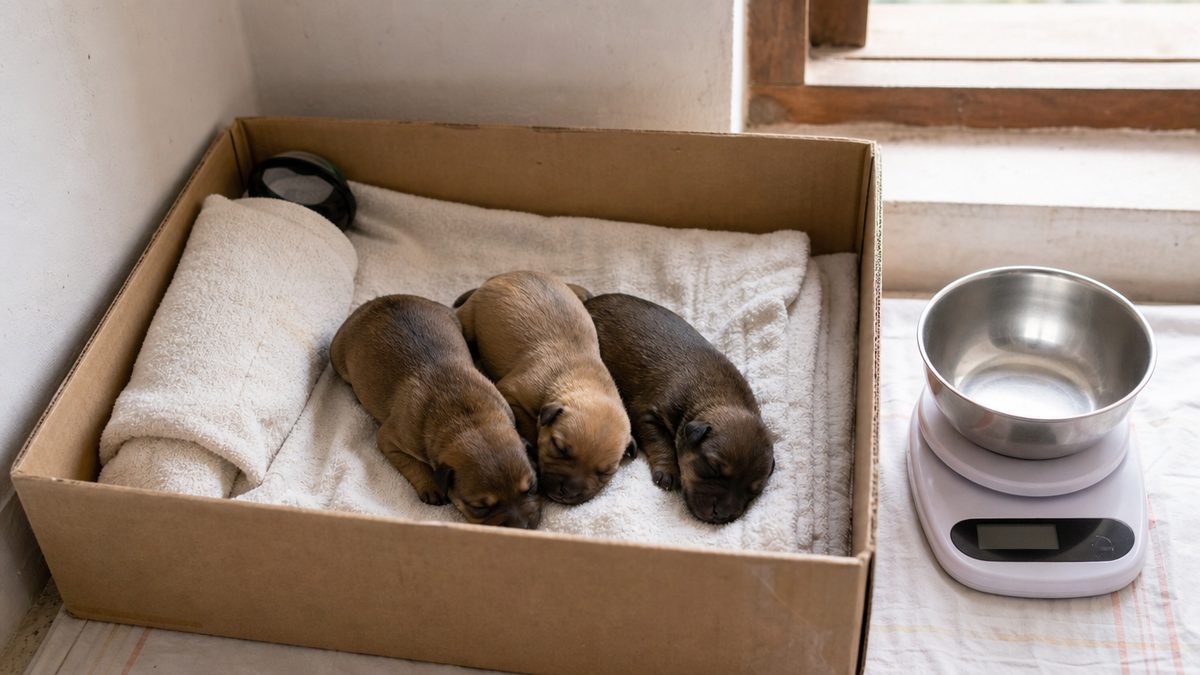
- Weigh it in grams on a kitchen scale, again at 12 and 24 hours, and write both figures down with a mark that tells the littermates apart.
- Feed it only once warm, at the rear teats if the mother is there or with puppy milk replacer in the volume the feeding section gives.
- Book the vet's check of the mother and the whole litter within 48 hours of the birth; many vets do it as a home visit The Royal Kennel Club.
Do not feed a cold puppy. Merck says tube feeding should be delayed until the neonate is euthermic, because hypothermia induces ileus and regurgitation and aspiration can result, and that chilled neonates are rewarmed slowly over 30 to 60 minutes; once warm it is fed without delay, because even minimal fasting can cause hypoglycaemia, a blood glucose under 30 to 40 mg/dL.
When the mother is there: colostrum, the 48-hour check, and what she cannot do for you
When the mother dog is present she supplies colostrum, milk, warmth and toileting, and what is left for you in the first four weeks is a warm quiet box, a daily weight for every puppy, her own food and worming, and a vet visit for the whole litter within 48 hours or at the first sign of trouble The Royal Kennel Club.
Colostrum is the reason to keep even a weak puppy at the teat. About 95 percent of a newborn's maternal antibody comes from colostrum, the gut absorbs it for up to 24 hours after birth and especially in the first 4, and a puppy that never suckles has little or, more likely, no passive protection. Merck closes the window at 24 hours and PetMD at 16, and both name the clinic's fallback, pooled serum from a vaccinated adult dog. So the smallest puppy goes to the rear teats first, helped by a drop of milk squeezed onto the teat and a fingertip opening its mouth.
A normal litter is quiet: puppies nurse 8 to 10 times a day in week one, about every two hours for 45 to 50 minutes, and feed and sleep at least 90 percent of the time, so a puppy off by itself, crying or restless is short of milk, cold or ill, and you look in every couple of hours Barnes C, Hunter T. After a caesarean her instincts usually return within 24 to 48 hours, and nursing is supervised until they do.
The numbers around a normal birth are worth knowing. In 10,810 litters of 224 breeds registered with the Norwegian Kennel Club in 2006 and 2007, 8 percent of puppies died before day 8 (4.3 percent stillborn, 3.7 percent in the first week), one litter in four lost at least one puppy, and only 1 percent of puppies died between day 8 and week 8; the risk was highest in a first litter, rose with litter size and the mother's age, and doubled in litters with a stillborn puppy. In 784 French litters the Labrador averaged 7.8 puppies at 409.9 g each and the German Shepherd 7.0 at 513.7 g. The birth itself is on the dog pregnancy care guide.
| Milestone | Age | Who says so |
|---|---|---|
| Umbilical cord dries and falls off | About 3 days | PetMD, Rover |
| Supports itself on the front legs | Days 5 to 6 | PetMD |
| Eyes open | 8 to 14 days (RKC); 10 to 14 days (PetMD, Best Friends) | Both |
| Ear canals open | 5 to 8 days (Best Friends); 10 to 14 days (PetMD) | They disagree by a week |
| Hears clearly | 2.5 to 3 weeks | Dogs for Good, via SkyEc's 14 to 21 days |
| First attempts to walk | 18 to 21 days | PetMD, Rover |
| First teeth | 3 to 4 weeks | PetMD, Purina India |
| Passes urine and stool without stimulation | 2 weeks (Best Friends); about 3 (PDSA); 3 to 4 (RKC) | A two-week spread |
| Holds its own body temperature | 2.5 weeks (Rover); 3 to 4 (RKC); 4 (Merck); about 38 days (Best Friends) | Merck governs this page |
| No longer a neonate | 4 weeks | PetMD, Merck |
What she cannot do is tell you her milk has failed: a litter that cries constantly and does not gain can die within 24 to 48 hours, so a flat-bellied restless puppy gets supplemental feeds one to three times a day and the vet checks her glands. Eclampsia, the calcium crash of heavy lactation, arrives most often at 3 to 5 weeks as panting, stiffness and tremors, and is an emergency; a mother who will not stay in the box usually wants to be near you, so move the box, and one who kills a puppy that fails to thrive is acting on an old instinct. Her worming runs with the puppies' from their second week on the dog deworming schedule for India, and TroCCAP says to treat the dam at the same time.
Warmth by week: the box temperatures six sources print, and what they mean in an Indian room
The warmth target for a newborn puppy without its mother is a whelping box at about 29 to 32°C in the first week, falling to the mid twenties in weeks 2 and 3 and to room temperature by the end of the first month, and the sources that print a schedule disagree by 2 to 3 degrees at every step, so all of them are in the table The Royal Kennel Club.
| Age | Merck Veterinary Manual | VCA handout 2024 | Royal Kennel Club | PDSA 2019 | Best Friends | Indian ranking pages |
|---|---|---|---|---|---|---|
| Week 1 | 28.9 to 31.7°C | 29.5 to 32°C for the first 4 days | 29 to 32°C initially | 29 to 32°C | 29.4 to 32.2°C for 4 to 5 days | 30 to 32°C (Petindiaonline, SkyEc); 29.4 to 32.2°C for 4 days (Pedigree India) |
| Days 7 to 10 and week 2 | 26.7°C | About 26.7°C by day 7 to 10 | Lowered each week | Gradually adjusted | 26.7°C by day 7 to 10 | 26°C (Purina India, SkyEc); 27 to 29°C (Petindiaonline) |
| Week 3 | 26.7°C | Reducing | Lowered each week | Gradually adjusted | Reducing | 23°C (Purina India); 24 to 27°C (Petindiaonline) |
| Week 4 | 20.6 to 23.9°C | About 22.2°C by the end of week 4 | Room temperature by week 4 | Gradually adjusted | 21 to 24°C by the end of week 4 | Not stated |
| Weeks 5 and 6 | 20.6°C at week 5 | Not stated | Room temperature | Room temperature, 21°C, by week 6 | Not stated | Not stated |
What the box temperature does to a puppy
Keeping newborn puppies warm is physiology, not comfort, and a hypothermic puppy is a puppy that cannot digest. A newborn cannot shiver or narrow its skin vessels until the end of its first week and holds itself only about 12 Fahrenheit degrees above the room, so it takes the temperature of whatever it lies on. Merck's normal rectal range is 35 to 37.2°C in week 1, 36.1 to 37.8°C in weeks 2 and 3 and 37.2 to 38.3°C in week 4; below about 36°C immunity, nursing and digestion all suffer, and humidity of 55 to 65 percent is recommended alongside the heat.
Reading the table in an Indian room
In an Indian room the table reads differently from the way it reads in Surrey. On an April afternoon in Chennai, Nagpur or Ahmedabad the room is already at or above the week-1 target, so the lamp or towel-wrapped hot-water bottle is for nights, a Mumbai or Kolkata monsoon evening, an air-conditioned bedroom in Bengaluru or Hyderabad and a Delhi January, and the summer risk runs the other way. The Royal Kennel Club's thermometer is the puppies' behaviour: quiet, feeding and gaining means the temperature is right, restless and crying means adjust it, cold to the touch means more heat, and crawling away from the heat source means less. A large litter huddles and needs a lower setting, and the box must be big enough to crawl away from the heat, with the source in the centre The Royal Kennel Club. Merck prefers an overhead lamp to a heating pad, which burns a neonate that cannot move off it; the Kennel Club allows pads under thick padding with no chewable wires, the Indian pages say lowest setting and never unsupervised, and SkyEc Pharma's 30 to 32°C in week one and 26°C by week two sits inside Merck's range Guha G. How to Care for a Newborn Puppy… SkyEc Pharma, Managing Puppies in Their….
Why warmth is also an antiviral
Warmth is also the only defence a home has against canine herpesvirus, which replicates best at the low body temperatures neonates keep: deaths fall in puppies 1 to 3 weeks old, onset is sudden, death follows an illness of 24 hours or less, the tell is the absence of fever, and an affected litter's mortality often reaches 100 percent. Rearing exposed littermates in an incubator at 35°C may cut losses, and the prevention Merck names is keeping the pregnant bitch away from other dogs for the last 3 weeks of pregnancy and the first 3 after. Merck records no vaccine in the US; WSAVA notes a subunit vaccine for pregnant bitches, so ask your vet whether it exists where you are Squires RA, Crawford C, Marcondes M.
Feeding an orphaned puppy: how much, how often and in what position
Feed an orphaned puppy a puppy milk replacer, never cow's milk, in 6 to 12 small meals a day for the first two weeks, on its belly with its head level, in a daily volume the tin, Merck and the ranking pages set anywhere between 27 and 100 ml for a 250 g puppy, which is why the daily weight, not the chart, decides whether it is enough PDSA, Hand rearing puppies.
Volume by body weight, and why the sources disagree
Merck's requirement is 133 kcal per kg of body weight a day in week 1, 155 in week 2, 175 to 198 in week 3 and 220 in week 4, which for a 250 g puppy on day 3 is 33 kcal, about 27 ml of a replacer delivering 1,250 kcal per litre Beaphar, Lactol Milk Replacer for Puppies…. The makers print far more: Beaphar's table gives a 250 g puppy 100 ml a day on days 2 to 14, PetAg gives 30 ml per 115 g a day for Esbilac, about 65 ml, and the one ranking page with a weight chart gives 15 ml per 2 oz a day, again about 65 ml, and no source explains the gap O Keeffe A. Newborn Puppy Feeding Chart…. Treat the tin's daily figure as a ceiling split across the feeds, start a starved or chilled puppy below it, and let the scale arbitrate: a puppy gaining 5 to 10 percent a day with normal stool is fed enough, and PetMD says to err towards underfeeding, because overfeeding causes the diarrhoea that dehydrates.
| Puppy weight | Volume per day | Age | Feeds a day |
|---|---|---|---|
| 250 g | 100 ml | Days 2 to 14 | 6 to 8, including overnight |
| 500 g | 160 ml | Days 15 to 21 | 6, including overnight |
| 1 kg | 250 ml | Days 22 to 28 | 6, including one overnight |
| 2 kg | 400 ml | Days 29 to 35, weaning under way | 4 to 6 |
| 5 kg | 900 ml | Days 36 to 42, weaning under way | 2 to 6 |
| Age | Royal Kennel Club | PDSA | Raised Right | Best Friends | PetAg Esbilac | Beaphar |
|---|---|---|---|---|---|---|
| Week 1 | Every 2 hours, day and night | Every 2 hours | Every 2 hours | Every 2 to 3 hours, 6 to 8 meals | Every 3 to 4 hours | 6 to 8 feeds |
| Week 2 | Every 2 hours, reducing | Every 3 hours | Every 3 hours | Every 2 to 3 hours | Every 3 to 4 hours | 6 to 8 feeds |
| Week 3 | Reducing | Every 3 hours | Every 4 hours | Every 2 to 3 hours | Every 3 to 4 hours | 6 feeds |
| Week 4 | Weaning begins | Every 4 to 6 hours, water and soft food offered | Every 5 to 6 hours | Gruel 4 times a day | Every 3 to 4 hours to 6 weeks | 6 feeds, then solids from day 28 |
Position, teat and temperature
Position decides whether the milk reaches the stomach or the lungs: belly down with the head level, never on its back, because a neonate's gag reflex is poor and milk fed on the back goes into the windpipe; bubbles at the nose mean stop and restart slower Best Friends Animal Society. Upside down the bottle should need a light squeeze to drip, and human baby bottles deliver too much PDSA, Hand rearing puppies. Tilt the bottle so the puppy swallows milk rather than air, never force it, burp it against your shoulder after every feed, and if it will not suck, drip small amounts from a syringe onto the tongue; tube feeding is a technique your vet shows you, because done wrong it fills the lungs PDSA, Hand rearing puppies.
Warm the milk to about 38°C, blood heat, and test it on the inside of your wrist; prepared milk lives in the fridge for 24 hours at most and is reheated before a feed Best Friends Animal Society. Bottles and teats are washed after every feed and kept sterile, in a chemist's sterilising solution or a baby-bottle steriliser, because a hand-reared puppy without colostrum has little immunity to spare. Two faults have fixes: clumpy formula from water at the wrong temperature constipates, and PDSA's first move is to mix it correctly and, once, replace a feed with cooled boiled water; yellow curdled diarrhoea is overfeeding, and Merck's fix is to dilute the formula 50 percent with water Davidson AP. Management of the Neonate….
Puppy milk replacer in India: what is sold, what it cost on 18 September 2026, and why cow's milk fails
Puppy milk replacer in India means two imported powders, Royal Canin Babydog Milk at an MRP of Rs 3,200 for 400 g and Beaphar Lactol at Rs 999 against an MRP of Rs 1,150 for 200 g, two Indian-made packs at Rs 735 to Rs 752, and a PetAg Esbilac listing that was unavailable on the day, and every veterinary source in this guide says cow's milk is not a substitute Supertails, Drools Absolute Milk… The Royal Kennel Club.
| Product | Pack | Price on the page | Where | What the page said |
|---|---|---|---|---|
| Royal Canin Babydog Milk | 400 g, in sachets with a bottle and teats | MRP Rs 3,200; an offer of Rs 2,675.20 shown on the same page | Amazon.in, sold by Heads Up For Tails | In stock |
| Royal Canin Babydog Milk | 2 kg | Rs 8,316, MRP Rs 9,450 | Amazon.in | In stock |
| Beaphar Lactol Puppy Milk | 200 g | Rs 999, MRP Rs 1,150 | Amazon.in, sold by R & R | In stock, non-returnable |
| PetAg Esbilac powder | 12 oz (340 g) | No price shown | Amazon.in | Currently unavailable |
| Drools Absolute Milk for Newborn Puppies | 500 g | Rs 752, MRP Rs 800 | Supertails | In stock; the 5 x 500 g pack sold out |
| Vetina Puppy and Kitten Milk | 200 g | Rs 735, MRP Rs 750 | Supertails | In stock |
The exchange-rate test and what is in the tin
Each rupee figure went through the exchange-rate test this site runs on every Indian price, dividing by 84.38 and by 74: Rs 3,200 gives 37.92 and 43.24, Rs 999 gives 11.84 and 13.50, Rs 752 gives 8.91 and 10.16 and Rs 735 gives 8.71 and 9.93, none a round dollar figure, so all of them read as Indian marketplace prices rather than a converted US list Supertails, Drools Absolute Milk… Supertails, Vetina Puppy and Kitten Milk…. The Esbilac that two ranking pages name as the product to buy had no price at all on the day, because the only Amazon.in listing was marked currently unavailable SkyEc Pharma, Managing Puppies in Their…. Royal Canin India lists Babydog Milk as a complete replacer from birth to 2 months, 33 percent protein, 39 percent fat, no starch because very young puppies cannot digest it, and 5,757 kcal per kg in the page's product data; the mix is 10 ml of powder to 20 ml of low-mineral bottled water at about 70°C, served lukewarm, and the feeding table is on the data sheet in the box, not on the page. Beaphar prints 24 percent protein and fat, 7 level scoops (30 g) to 100 ml and about 1,250 kcal per litre; the Indian listing's description says 31 g and six scoops while its legal text says 30 g and seven, so use the scoop and table on the pack you bought. Esbilac is mixed one part to two of warm water.
Cow's milk, buffalo milk and the home substitutes
Cow's milk, buffalo milk, condensed milk, Cerelac and baby formula are what people reach for at 11 pm, and every source's position is short. The Royal Kennel Club: no, cow's milk carries different nutrients and calories and is not a suitable substitute. PDSA: cow's milk and supermarket puppy or kitten milk are both unsuitable, and a puppy formula comes from a vet or a reputable pet shop. Petindiaonline, the one Indian page that lists them, names cow's milk, condensed milk and human baby formula as things never to feed. Merck's line is the one to keep: commercial replacers beat homemade versions and none equals the mother's milk, so a lactating foster mother beats every tin Madden A. New Puppy Care: 0-7 Weeks. PetMD. Nothing in any of them makes buffalo milk, the milk most Indian kitchens hold, an exception.
Warmth is the emergency, not the meal; a warm puppy can wait for the morning delivery more safely than a cold one can take milk. If a puppy is limp, twitching or too weak to suck, the signs of low blood sugar, Best Friends says a few drops of corn syrup on the gums and a call to the vet, Pedigree India says honey or sugar solution on the tongue, and Merck says dextrose on the gums works only if the circulation is adequate and a non-responsive puppy needs it into a vein at the clinic Pedigree India, Orphaned Newborn Puppy Davidson AP. Management of the Neonate…. An eye dropper is an emergency tool, not a feeding method; buy a proper teat with the tin. Your nearby vet decides for your puppy.
Toileting, bedding, hygiene and weaning: birth to four weeks without the mother
A puppy under about three weeks cannot pass urine or stool on its own, so an orphan's carer stimulates it with warm damp cotton wool after every feed, keeps it on paper over a towel until it can lift its head, lets nobody in with outdoor shoes, and starts weaning onto a gruel at three to four weeks PDSA, Hand rearing puppies Best Friends Animal Society.
Stimulating elimination is the mother's job, done by licking under the tail, and you copy her with warm damp cotton wool, wiping the genitals and bottom until the puppy goes and then wiping it clean; most puppies pass stool after a feed, so that is the moment PDSA, Hand rearing puppies. How long it is needed is one more spread, about 2 weeks by Best Friends and Pedigree India, about 3 by PDSA and 3 to 4 by the Kennel Club, so keep going until you have seen the puppy go on its own PDSA, Hand rearing puppies The Royal Kennel Club. The stool tells you what the feeding is doing: meconium passes in the first 48 hours, normal milk stool is pasty and yellow or tan, green or yellow watery stool is overfeeding, white stool suggests lactose intolerance, foamy yellow stool suggests herpesvirus and blood suggests sepsis or coccidia, each of the last three a same-day call. Urine should be pale yellow, and the darker it is the more dehydrated the puppy; a neonate cannot concentrate urine until about 3 weeks and wets two to three times as often as an adult, which is why bedding is changed daily Guha G. How to Care for a Newborn Puppy….
Bedding for the first week is newspaper over a flat towel, not a soft blanket a newborn can get caught in and suffocate; towels come in once the puppies lift their heads. Hygiene stands in for the immunity an orphan never got: wash your hands before every feed, change clothes and shoes after a shelter, clinic or dog park, keep visitors out or shoeless, and do not bath a puppy before 8 weeks, since a bath chills it Coleman L. Newborn Puppies. Fleas on a small puppy cause anaemia, and the first flea and tick product waits for the label age, usually 6 to 8 weeks, with the vet choosing it.
Weaning starts at 3 to 4 weeks, as soon as the puppy will lap, and the sources agree on its shape where they differ on the day. The steps are listed below.
- Offer a shallow dish of water in the third week, small enough not to tip and not to climb into.
- Soak a puppy-specific dry food in warm water or prepared milk replacer until it is porridge, or blitz the kibble first, and put it in a low pan for the puppies to lap; a 25 to 30 percent protein puppy food is PetMD's target.
- Feed the gruel four times a day, warmed and not too thick, before the milk feed rather than after, and take away what is uneaten after about 10 minutes Madden A. New Puppy Care: 0-7 Weeks. PetMD The Royal Kennel Club.
- Thicken the gruel as they lap it, and with a mother present separate her from the litter for short periods a couple of times a day, up to about 4 hours a day by 6 weeks.
- Finish on dry puppy food and water by about 6 weeks (Best Friends, PDSA), 6 to 8 (PetMD, Purina India) or 7 to 8 (the Kennel Club), with water always available from one month Madden A. New Puppy Care: 0-7 Weeks. PetMD The Royal Kennel Club.
The tins agree: Beaphar says change slowly to solids after day 28, PetAg calls Esbilac complete to 6 weeks and Royal Canin labels Babydog Milk for 0 to 2 months PetAg, Esbilac Puppy Milk Replacer Powder… Royal Canin India. Weaning is also when a mother's calcium can crash, which the dog pregnancy care guide covers, and when the puppies' fortnightly worming, begun at 2 weeks, starts to matter for the household Tropical Council for Companion Animal….
Weight by day: the gain to expect, the day-2 rule and the breed cut-offs
A newborn puppy may lose up to 10 percent of its birth weight on day 1 and then gains 5 to 10 percent of its weight every day, doubling by day 10 to 14, and the figure that changes what you do is the second-day weight: in 8,550 French puppies a normal-birth-weight puppy that was more than 8.7 percent below its birth weight on day 2 had a 23 percent chance of dying by two months against 3.2 percent for the rest The Royal Kennel Club Mugnier A, Gaillard V.
The gain to expect, and the two rules that disagree
The daily weight is the only instrument a home has: at birth, at 12 and 24 hours, then daily at the same hour for two weeks, every three days to a month, and once or twice a week after that Purina India, Looking After New-born…. Merck accepts a loss of at most 10 percent on day 1 and then expects steady gain, normally 5 to 10 percent of body weight a day, a figure SkyEc and Rover repeat; the Kennel Club's rule is 2 to 4 g a day per kilogram of adult weight and Merck's is 1 to 3 g, so a Labrador puppy expected to reach 30 kg gains 30 to 120 g a day depending on the rule SkyEc Pharma, Managing Puppies in Their… Coleman L. Newborn Puppies. Doubling the birth weight takes about 10 days by the Kennel Club and Purina India, and 10 days nursing but 14 formula-fed by PetMD; a puppy that fails to gain goes to the vet as soon as possible, because you cannot tell by picking it up Purina India, Looking After New-born… Madden A. New Puppy Care: 0-7 Weeks. PetMD Barnes C, Hunter T.
The second-day rule, with its denominator
The largest dataset on early growth is 8,550 live-born puppies of 24 breeds from 127 French kennels, weighed daily: 8.9 percent died before two months and 88 percent of those deaths fell in the first 21 days. The average puppy gained 1.6 percent on day 1, 6 percent on day 2 and 67 percent by day 7, and the thresholds that separated the dead from the living are in the table; the practical version is that any loss by day 2 in a small puppy, and a loss of more than about 9 percent in a normal one, is a vet visit that day rather than a bigger feed.
| Birth weight group | Growth measured | Threshold | Died by 2 months, below the threshold | Died by 2 months, at or above it |
|---|---|---|---|---|
| Normal birth weight (7,259 puppies) | Birth to day 1 | Loss of more than 4.1 percent | 14 percent of 1,002 | 3.6 percent of 4,526 |
| Normal birth weight | Birth to day 2 | Loss of more than 8.7 percent | 23 percent of 404 | 3.2 percent of 5,947 |
| Normal birth weight | Birth to day 7 | Gain of less than 26 percent | 6.3 percent of 474 | 1.7 percent of 5,445 |
| Low birth weight (1,291 puppies) | Birth to day 1 | Loss of more than 1.8 percent | 36 percent of 359 | 12 percent of 616 |
| Low birth weight | Birth to day 2 | Any loss beyond 0.4 percent | 37 percent of 284 | 9.2 percent of 754 |
| Low birth weight | Birth to day 7 | Gain of less than 31 percent | 25 percent of 117 | 4 percent of 775 |
What counts as a low birth weight, breed by breed
Low birth weight is a breed figure, not a single number, and the same French group published the cut-offs for 10 breeds from 4,971 puppies: below them, 8.8 percent of low-birth-weight puppies and 55.3 percent of very-low-birth-weight puppies died in the first three weeks against 4.2 percent of the rest. Merck's shorthand for a medium-size breed is under 350 g.
| Breed (puppies) | Mean birth weight | Mean litter | Low birth weight | Very low birth weight | Died in 3 weeks, low against very low |
|---|---|---|---|---|---|
| Labrador Retriever (1,903) | 409.9 g | 7.8 | 248 to under 406 g | Under 248 g | 8.7 percent against 57.7 percent |
| German Shepherd (281) | 513.7 g | 7.0 | 338 to under 480 g | Under 338 g | 12.2 percent against 71.4 percent |
| Golden Retriever (588) | 394.8 g | 7.8 | 177.5 to under 417 g | Under 177.5 g | 8.1 percent against 66.7 percent |
| Rottweiler (111) | 403.8 g | 8.2 | 345 to under 410 g | Under 345 g | 17.5 percent against 53.3 percent |
| Cocker Spaniel (779) | 262.6 g | 5.7 | 142.5 to under 280 g | Under 142.5 g | 6.1 percent against 68.4 percent |
| Shih Tzu (270) | 175.5 g | 5.3 | 128.5 to under 176 g | Under 128.5 g | 20.0 percent against 75.0 percent |
No such table exists for the Indian pariah dog or the mixed community litters most Indian rescuers raise, so for those the rule is relative: an underweight puppy, noticeably smaller than its littermates or losing weight between birth and day 2, goes to the rear teats first, the bottle first, and the vet. The record a vet can read over the phone is listed below.
- Weight in grams at the same hour each day, with the birth weight or the first weight you took.
- Millilitres taken at each feed and the number of feeds in 24 hours.
- Stool and urine after each stimulation, with colour and consistency.
- Crying, restlessness, muscle tone and how much of the day the puppy sleeps.
Fading puppy syndrome: the signs that mean a vet today
Fading puppy syndrome is the name for a puppy born apparently healthy that stops gaining, stops suckling, cries or goes quiet and dies, usually inside the first three weeks, the period in which 88 percent of deaths before two months fall, and the signs that mean a vet the same day are listed below Davidson AP. Management of the Neonate….
- Weight that is flat, falling, or more than 10 percent below the birth weight after day 1 The Royal Kennel Club.
- Refusing the teat or the bottle, or a puppy that seems to feed yet stays restless and cries.
- Cold to the touch, limp, or a rectal temperature below 35°C, the point at which suckling and digestion stop.
- Crying that does not stop after warming and a feed; unusual vocalisation is on Merck's sepsis list.
- Gums that are dry, sticky or pale instead of pink and moist, or skin that stays tented when the scruff is lifted, which is dehydration.
- Twitching, weakness, a lethargic puppy that will not rouse, or seizures, the signs of low blood sugar.
- Diarrhoea that persists, blood in the urine or stool, vomiting, a swollen painful belly, or no stool for a day.
- Breathing that is laboured, a nasal discharge, sticky eyelids, or a puppy that is suddenly ill with no fever, which is the herpesvirus pattern.
Most causes look the same from outside, which is why warmth and sugar come first and the diagnosis second. Bacterial sepsis, most often E. coli, streptococci, staphylococci and Klebsiella, is let in by a mother's uterine or mammary infection, a long labour, badly mixed formula, a dirty box, low birth weight and chilling below about 35.6°C, and can kill before any sign shows. Canine herpesvirus kills puppies of 1 to 3 weeks in 24 hours or less, without fever, and can take a whole litter. Hypoglycaemia sits under both: a neonate has no glycogen to spare, a puppy unfed for 24 hours may still hold its blood sugar but after that it falls hard, and Merck's threshold for treatment is under 30 to 40 mg/dL Madden A. New Puppy Care: 0-7 Weeks. PetMD.
The denominators are in the sections above: 8 percent of puppies in 10,810 Norwegian litters dead before day 8, 8.9 percent of 8,550 French puppies dead before two months, 55.3 percent of the very-low-birth-weight puppies in a 4,971-puppy series dead in three weeks, all in pedigree litters weighed daily Mugnier A, Chastant-Maillard S, Mila H. No Indian study of community litters was found for this page, and the Indian pages that call cold stress a leading killer give no figure.
What the clinic does is why the visit is worth the auto fare: slow rewarming, a rectal temperature, a drop of blood for glucose, dextrose into a vein or bone for a non-responsive puppy, warm dextrose by stomach tube for one too weak to suck, pooled serum for an orphan under 12 hours old that missed colostrum, and an antibiotic such as ceftiofur or amoxicillin-clavulanate if sepsis is suspected. An unfed litter can die within 24 to 48 hours, so the mother and every littermate go with the sick puppy, and the vet near you decides; nothing on this page is a diagnosis.
Puppies are very sensitive and delicate and can quickly deteriorate, in the Royal Kennel Club's words, so do not delay in contacting your vet; the Indian page that ranks fourth says puppies can go downhill in a matter of hours Guha G. How to Care for a Newborn Puppy…. Merck notes that sudden death may preclude recognition of clinical signs at all, which is the strongest argument for the daily weight.
A community litter under a car: when to leave it, when to take it, and what the ABC Rules 2023 say
A litter of community puppies in India stays with a mother who is feeding it, because no tin equals her milk, and the law that reaches them is the Animal Birth Control Rules 2023: rule 11(9) keeps a female with puppies off the sterilisation van until her litter is two months old and rule 20 puts the feeding of community animals on the resident welfare association and the local body Ministry of Fisheries.
The rules are short and worth quoting. Rule 2(j) defines community animals as "any animal born in a Community for which no ownership has been claimed by any individual or an Organisation, excluding wild animals", which takes in an Indian pariah dog and her litter in a drain, a stairwell or under a parked car. Rule 11(9) reads: "Street dogs under the age of six month shall not be captured for and undergo sterilisation and female animals with puppies shall not be captured for sterilisation till their litter is two months of age";. Rule 20(1) makes it "the responsibility of the Resident Welfare Association or Apartment Owner Association or Local Body's representative of that area to make necessary arrangement for feeding of community animals residing in the premises";. So a nursing mother is neither picked up by the van nor driven off the compound, and the resident's job for eight weeks is her food, water and shade, on the lines of the stray dogs in India guide.
When you do have to take a litter, because the mother is dead, gone for a day or too sick to feed, the shelter is often the worst place for a neonate and a foster home the best: Friendicoes in Delhi says its own shelter can be a high-risk zone for infections and asks fosters for a minimum of three weeks. The AWBI's adoption protocol lets a pup taken from the street have its papers processed through any municipal body, panchayat or district SPCA "along with medical check-up and vaccination", with an adopter over 18 who ensures a vet check, vaccinations, parasite control and deworming; the protocol and the fees shelters ask are on how to adopt a dog in India Animal Welfare Board of India. Petindiaonline's rescue rule is the right order: warmth first, then feeding, then the vet. The day you find a litter runs like this.
- Look for the mother before touching anything: a quiet, round-bellied, sleeping litter is being fed, and a mother who is away for a feed comes back.
- Leave a fed litter where it is, keep children, dogs and society staff away, and put food, water and shade within her reach, which rule 20 makes the association's duty rather than a favour.
- Count the puppies and look for the signs above, cold, crying, limp, flat-bellied, without moving the nest.
- Take the litter only if the mother is dead, missing for many hours or unable to feed, and then warm first, weigh, and feed a puppy milk replacer, not cow's milk.
- Call a nearby vet or an NGO the same day for an orphaned litter, and ask about a lactating foster mother before you commit to bottles.
- Book the mother's sterilisation for when the puppies are two months old, through the local authority's programme, on the routes the dog sterilisation guide lists.
What the breeding rules add for a litter born at a breeder
For a litter born at a registered breeder the Dog Breeding and Marketing Rules 2017 set the floor: rule 8(1)(a) says "pups less than eight weeks in age are not sold", rule 8(2) makes the breeder hand the buyer, in writing, the feeding details, the inoculation and de-worming dates and the attending vet's name, Second Schedule Part IV paragraph 21(1) bars keeping "sick, infirm, aged or young animals" outdoors without the vet's written approval, and paragraph 21(6) gives "each female dog with nursing pups" extra floor space. A breeder who offers a five-week-old puppy is offering an unweaned puppy the rules say may not be sold.
Under the Animal Birth Control Rules 2023 the sterilisation and immunisation of a community dog is the local authority's programme, the capture of a nursing mother waits until her litter is two months old under rule 11(9), and feeding in a compound is the association's arrangement under rule 20. A resident raising a litter is doing the part the rules leave to residents, and can ask the ward for the rest.
From four to eight weeks: worms, the first vaccine, socialisation and the handover
From four weeks a puppy reared by its mother or by hand moves onto the ordinary puppy calendar: worming that began at 2 weeks and repeats every 2 weeks to 8, the first core vaccine at 6 to 8 weeks, daily handling inside a socialisation window that opens at about 3 weeks, and a handover at 8 weeks to bringing a puppy home in India and puppy care in India Tropical Council for Companion Animal… Squires RA, Crawford C, Marcondes M Madden A. New Puppy Care: 0-7 Weeks. PetMD.
Worming starts before the vaccines. TroCCAP, the parasite guideline written for the tropics, says puppies should be treated with a registered anthelmintic labelled for puppies at 2 weeks of age, to stop worms acquired in the womb and the milk from becoming patent, then every 2 weeks until 8 weeks, with the dam treated at the same time; the 2019 AAHA guideline, Purina India and the Kennel Club all put the first dose at two weeks Creevy KE, Grady J, Little SE, Moore GE Purina India, Looking After New-born… The Royal Kennel Club. The doses per kilogram and the Indian tablets are on the dog deworming schedule for India.
Vaccines begin later, and an orphan needs a conversation rather than a date. WSAVA recommends the first core dose at 6 to 8 weeks and repeats every 2 to 4 weeks until 16 weeks or older, because maternal antibody, which halves every 9 to 10 days, blocks earlier doses; it does not in general vaccinate under 4 weeks but starts shelter puppies at 1 month. A puppy that never had colostrum has little maternal antibody to wane, which is why PDSA says a vet may start a hand-reared litter at 6 weeks and Best Friends starts foster puppies at 4 to 6 PDSA, Hand rearing puppies Best Friends Animal Society. Indian law agrees: the breeding rules' Second Schedule says vaccination "can start at the age of seven-eight weeks, and are usually completed at the age of eighteen weeks";. The 7-in-1 and 9-in-1 vials Indian clinics use, and the rabies dose that unlocks the municipal licence, are on the dog vaccination schedule for India.
Handling from day one, socialising from week three
Handling starts at birth and socialisation at three weeks. The AAHA guideline says to begin socialising and handling from the neonate, because gentle handling and structured exposure on a daily basis in the first weeks can have significant benefits later in life, so the daily weigh-in is also the daily handling. PetMD puts the critical time to begin at 3 weeks and the window's close at 12 to 14 weeks, warns that abrupt weaning, sudden separation from littermates and isolation in a crate can have lifelong effects, and flags a puppy that had a hard start, low birth weight, feeding trouble or sepsis, as at higher risk of fear and aggression later. The checklist people search for as the 7 7 7 rule is the Rule of Sevens, adapted from Pat Hastings and spelled out in the FAQ below: 7 places, 7 containers, 7 people, 7 surfaces and so on by 7 weeks. The first fear period arrives at about 6 to 8 weeks, so the exposures before it are kept short and positive.
At eight weeks the puppy leaves, and not before. Rule 8(1)(a) of the Dog Breeding and Marketing Rules 2017 forbids the sale of a pup under eight weeks, PDSA says a hand-reared puppy still needs to be eight weeks before a new home even though it is not leaving a mother, and Purina India adds that some toy breeds stay to 12 PDSA, Hand rearing puppies Purina India, Looking After New-born…. What goes with it is the record this page has had you keep, the daily weights, the worming dates, the first vaccine if given and the vet's name, which is what rule 8(2) makes a breeder hand over in writing; from there the first 48 hours at home and the first year take over.
Common questions about newborn and orphaned puppies in India
What to expect from a newborn puppy?
Expect a puppy that is blind, deaf and toothless, cannot walk, keep itself warm or pass urine and stool without its mother's licking, nurses 8 to 10 times a day in the first week and sleeps about 90 percent of the time. The cord drops off at about 3 days and the eyes open at 8 to 14 days. Warm and fed, it is quiet; crying and restless, it is cold, hungry or ill.
What is a newly born dog called?
A newly born dog is called a puppy, or pup, and veterinary texts call it a neonate. PetMD says that once puppies are 4 weeks old they are no longer considered neonates, Merck runs its neonate chapter to the same 4 weeks, and PetMD and Best Friends both label birth to 2 weeks the neonatal stage and 2 to 4 weeks the transitional stage.
How old is a newborn puppy?
A newborn puppy, in the sources this page uses, is a puppy in its first two weeks, the neonatal stage PetMD and Best Friends run from birth to 14 days, before the eyes and ears open. Merck stretches the neonatal period to 4 weeks because a puppy has no thermoregulation until then, which is why the warmth and feeding rules here run to the end of the first month.
Can I touch a newborn puppy?
Yes, and you must: the Royal Kennel Club says it is fine to pick puppies up to check them, weigh them and clean the box while limiting how much they are handled, and the 2019 AAHA guideline says to begin socialising and handling from the neonate. Wash your hands first, keep it brief so the puppy does not chill, and put it back beside the mother.
How long can newborn puppies go without milk?
Not long. PetMD says a puppy that does not eat for 24 hours may hold its blood sugar, after which glucose declines severely; Merck says even minimal fasting can cause hypoglycaemia; VCA says an unfed litter can die within 24 to 48 hours. Week one is therefore a feed every 2 hours, day and night, and a puppy that refuses two feeds is a vet call.
How long until you can touch puppies after birth?
There is no waiting period. The Royal Kennel Club has you weigh each puppy 12 and 24 hours after birth, and Merck asks for a complete check of every puppy within the first 24 hours, so handling starts on day one. What the sources limit is the amount: short handling for checks and weights, no cuddling for its own sake, and only the household for the first two to three weeks.
What do you feed a newborn puppy without a mother?
Feed a newborn puppy without a mother a commercial puppy milk replacer, warmed to about 38°C, from a puppy bottle with the puppy on its belly; on Indian pages on 18 September 2026 that meant Royal Canin Babydog Milk at an MRP of Rs 3,200 for 400 g, Beaphar Lactol at Rs 999 for 200 g or Drools Absolute Milk at Rs 752 for 500 g. A lactating foster mother beats any tin, and cow's or buffalo milk is not a substitute.
What should you not do with newborn puppies?
Do not feed a cold puppy, feed it on its back, use cow's milk or human formula, swing it to clear its airway, lay it on a bare heating pad, use loose soft bedding in the first week, bath it before 8 weeks, let visitors in with outdoor shoes, skip the daily weight, or wait and see when it stops gaining or goes cold.
Is a 1 month old puppy can eat rice?
A 1 month old puppy is at the start of weaning and eats a gruel of soaked puppy food and milk replacer, not plain rice. Royal Canin's Babydog Milk page says its formula contains no starch because very young puppies do not secrete enough enzyme to digest it, and rice is starch. No source opened for this page recommends rice at four weeks; the Royal Kennel Club says to feed a food formulated specifically for puppies, soaked to porridge.
What to give newly born puppies?
Give newly born puppies their mother's colostrum within the first hours, because about 95 percent of a puppy's maternal antibody comes from it and the gut absorbs it for up to 24 hours, especially the first 4, then her milk and warmth for the first three to four weeks. If she is not there, give warmth first, then a puppy milk replacer in small frequent feeds, and a vet's check within 48 hours.
What can a 4-week-old puppy eat?
A 4-week-old puppy can eat a soft gruel of puppy food soaked in warm water or milk replacer, offered in a low pan about four times a day alongside milk feeds, plus a shallow dish of water. PDSA's week-4 line is milk every 4 to 6 hours with a saucer of water and softened puppy food to lap, Beaphar says change slowly to solids after day 28, and by 6 weeks most puppies eat dry puppy food.
What to feed a 3 week old puppy without mom?
Feed a 3 week old puppy without its mother a puppy milk replacer six times a day, including one overnight feed: Beaphar's own table gives a 500 g puppy 160 ml a day on days 15 to 21 and a 1 kg puppy 250 ml a day on days 22 to 28. Offer a shallow dish of water in the third week and the first lapped gruel at the end of it, and keep weighing daily, because the tin's figure is a ceiling and the scale decides.
How long should I wait to touch puppies after birth?
You should not wait at all to touch puppies for the checks that matter: weighing at 12 and 24 hours, a look at the palate, umbilicus and gums, and helping a weak puppy onto a rear teat, all with washed hands. What waits is everything else: the Royal Kennel Club asks you to limit handling in the first days, and the ranking pages keep visitors out for two to three weeks.
How to take care of newborn puppies for the first time?
To take care of newborn puppies for the first time, keep them warm before anything else, in a box at 29 to 32°C for the first week with a cooler corner, leave them with a mother who is feeding them, feed orphans a puppy milk replacer every 2 to 3 hours on their bellies, stimulate them to toilet after each feed, weigh each one daily and book the vet within 48 hours; a cold, limp, crying or non-gaining puppy goes to the vet the same day.
What is the 7 7 7 rule for puppies?
The published version is the Rule of Sevens, a socialisation checklist adapted from Pat Hastings' 'The Puppy Puzzle': by 7 weeks a puppy should have been in 7 places, eaten from 7 containers, been held by 7 people, taken 7 car rides, been in a crate 7 times, played with 7 kinds of toy, walked on 7 surfaces, been somewhere alone 7 times and met 7 small challenges.