
Dog health: dermatology
Mange in dogs in India: Demodex versus Sarcoptes, the ivermectin warning and what treatment costs
Demodectic and sarcoptic mange share a name and nothing else. One is an overgrowth of a mite every puppy already carries and is not contagious; the other spreads on contact and reaches people. This page splits them, puts Indian denominators on both, and prints the ivermectin warning the ranking pages leave out, without printing a dose.
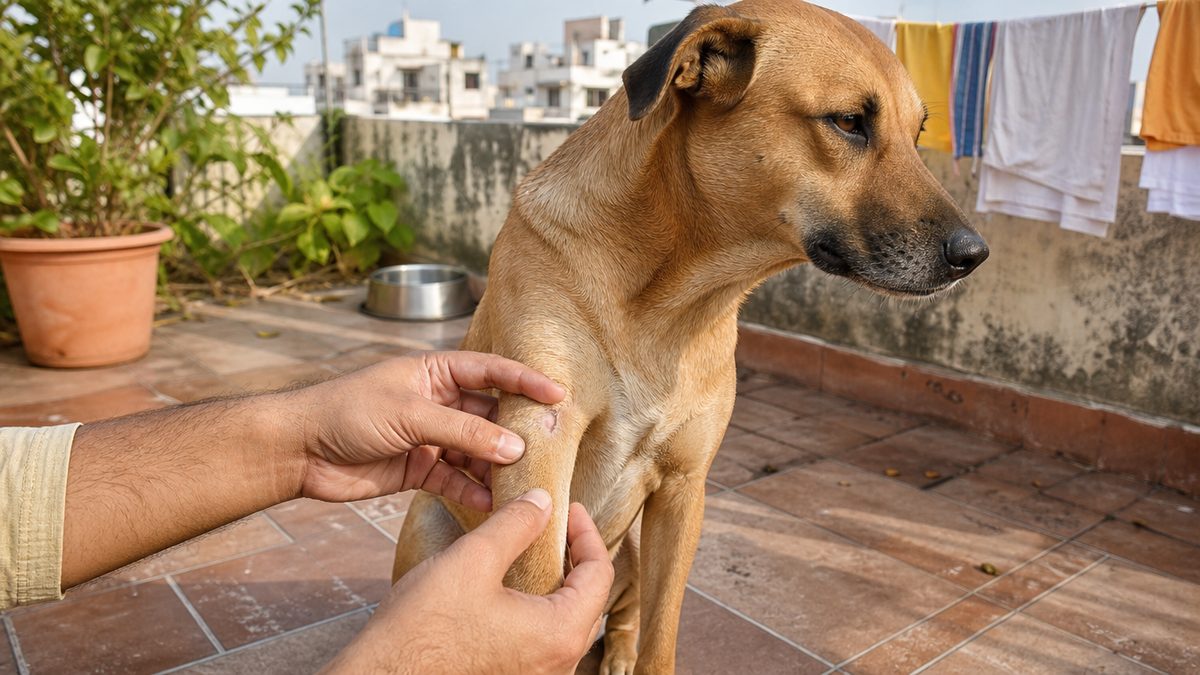
Quick answer
Mange in dogs is two different diseases. Demodectic mange is an overgrowth of Demodex canis, a mite every puppy gets from its mother while nursing, and it is not contagious. Sarcoptic mange is Sarcoptes scabiei, which spreads readily between dogs and does reach people. In UK primary care demodicosis ran at 0.48 percent in dogs under two and 0.05 percent in dogs over four. A skin scraping tells the two apart, and the ivermectin sold over Indian counters is the part that goes wrong.
This guide is general information for Indian pet owners and is not a diagnosis. Always consult a registered veterinarian near you before acting on anything you read here, and treat any sudden change in your pet's condition as urgent.
Signs of Mange
The 9 signs to watch for are listed below. Any one of them is a reason to consult your nearby vet; none of them is a diagnosis.
- Patchy hair loss around the eyes, mouth and head in a puppy
- Bald patches that spread beyond five separate spots
- Intense scratching that does not settle and wakes the dog
- Thick yellow crusts on the ear edges, elbows and hocks
- Coarse, dry, reddened skin over large areas
- Pustules that break open and ooze, with a bad smell
- Hair loss starting on the belly and chest
- A person in the house with a new itchy rash
- A dog over three losing coat for the first time
Breeds on this site that document this condition
Each breed page below carries the figure for this condition with its denominator and its source. The 10 breeds listed are the ones on this site that document it, not a ranking of risk.
India changes four things about mange in dogs. First the mix: at Navania in Udaipur, demodectic mange was the commonest skin diagnosis among 205 skin cases from 987 dogs, at 45 cases against 13 for scabies, about three and a half to one. Second the season: demodectic mange peaked in summer at 18 cases (40.00 percent) against 15 in the rains, inverting the monsoon rule that held for pyoderma and fungal disease in the same study. Third the population: across 20,915 free-roaming dogs at Jamshedpur, mange was an adult disease at 2.54 percent against 0.61 percent in puppies, the reverse of the owned-dog picture, because street mange is overwhelmingly the contagious kind. Fourth the drug: ivermectin moves across Indian counters without a prescription, three Indian veterinary case reports from Maharashtra, Uttar Pradesh and Haryana describe owner-administered poisoning in a pit bull cross, a nondescript bitch and a German Shepherd cross, and about 10 percent of German Shepherds carry the MDR1 mutation. No Indian clinic publishes a mange rate card, so the only firm Indian price is a retail isoxazoline chew at Rs 1,729 covering twelve weeks.
What mange in dogs is, and why it is two different diseases
Mange in dogs is two separate mite diseases that share one name. Demodectic mange is an overgrowth of Demodex canis, a mite that lives in the hair follicles of normal dogs, is transmitted from the dam to her puppies during nursing within the first 72 hours after birth, and causes a disease that is not considered to be contagious. Sarcoptic mange, also called canine scabies, is Sarcoptes scabiei var canis, a mite that burrows into the outer skin, is readily transmissible between dogs by direct contact, and is zoonotic, so humans who come in contact with infested dogs may be infected.
The two types of mange in dogs are named after their mites, and how dogs get mange differs completely between them. That split decides four things at once: whether the other dogs in the house need treating, whether the people do, how fast the itch arrived, and how long the course runs. Demodex is present in small numbers on normal canine skin and usually causes no clinical disease at all, which is why an Indian study that went looking for it found it where nobody expects to. At a veterinary college in Mizoram, 75 pet dogs were examined by skin scraping whether or not they showed skin lesions, and 25 of them, one in three, were positive for Demodex canis; the authors' stated conclusion is that the technique identifies the follicular mite even from apparently healthy skin.
| The question an owner actually asks | Demodectic mange (Demodex canis) | Sarcoptic mange (Sarcoptes scabiei) |
|---|---|---|
| Will my other dogs catch it? | No. The mite passes from dam to pup while nursing, and the disease is not considered contagious | Yes. Readily transmissible by direct contact, and by combs, brushes, towels and blankets |
| Can people catch it? | No. TroCCAP records the public health significance of Demodex as None | Yes. Pregnant women or immunosuppressed people in contact can develop lesions on arms, chest or thighs |
| How itchy is it? | Often mild until secondary bacterial infection starts | The most pruritic cutaneous disease of dogs, from hypersensitivity to mite products |
| Which breeds are at risk? | Seven breeds with raised odds in UK juveniles, led by the British bulldog at 11.26 | None. No breed, age or sex predisposition has been demonstrated |
| Which age does it hit? | Median age at first diagnosis 7 months, and 508 of 702 cases were under a year old | Any age. Signs appear 10 days to 8 weeks after contact |
| Where do the lesions start? | Circumscribed hair loss around the eyes, mouth and head | Ventral abdomen, chest, ear edges, elbows and hocks |
| Do the in-contact dogs need treating? | No | Yes. All dogs in contact with a diseased dog should also be treated |
| Can it clear on its own? | Localised disease can generally be left untreated and spontaneous recovery is frequent | Not described as self-resolving anywhere in these sources; systemic treatment clears the mite |
The three forms of demodectic mange, and only one needs a long course
Merck separates canine demodicosis into three forms, and the form decides the plan. Localised demodicosis shows as a few circumscribed patches, can generally be left untreated, and its prognosis is usually good with spontaneous recovery frequent. Juvenile-onset generalised demodicosis is the result of an inherited immunologic defect associated with the cell-mediated immune system, spreads as erythema, papules, hair loss, oily seborrhoea, oedema, hyperpigmentation and crusts, is usually aggravated by secondary bacterial infection, and requires treatment. Adult-onset generalised demodicosis looks clinically similar but appears in dogs typically over three years old, and is typically associated with or triggered by a neoplastic process or a debilitating disease causing immunosuppression, such as malignant lymphosarcoma, hyperadrenocorticism, hypothyroidism or diabetes mellitus, although in many cases no underlying condition is found.
TroCCAP, writing for tropical practice rather than temperate practice, puts a countable line under generalised disease at more than five lesions, the point at which the skin becomes coarse, dry and erythematous, the red mange Indian owners describe. It also records that concomitant staphylococcal pyoderma is common in generalised cases, that pustules develop, break open and ooze, and that this can be a life-threatening disease. Demodicosis is the most common dermatological disease in young dogs, between three and six months of age.
Why sarcoptic mange has no breed list at all
Sarcoptic mange carries no breed table because no breed predisposition has been found. The 2023 critically appraised topic on systemic treatment states that dogs worldwide can be affected and that no breed, age or sex predisposition has been demonstrated so far. That gives an owner one quick test to apply to any article: a page that lists breeds prone to mange, without saying which mange, is describing demodicosis and calling it something else.
The two diseases also disagree about the environment, and so do the sources, so both readings are printed here. TroCCAP says sarcoptic mites do not survive for long in the environment and that transmission is primarily via direct contact between animals. The appraised topic says contamination occurs through direct contact with an infested host or with a fomite, because the mite can survive and remain infective in the environment for up to 21 days. Merck sits between the two, naming direct contact as the main route while recording that transmission via indirect contact may also occur by combs, brushes, towels and blankets. Nobody on the internet resolves that disagreement, and the practical reading is the cautious one, which is to wash the bedding.
When to take a dog with mange signs to the vet
Take a dog with mange signs to a veterinarian the same week, and the same day if the skin is broken, the coat smells, or the dog has gone off food. The symptoms of mange in dogs overlap almost completely with other itchy skin disease, so mange cannot be separated from an allergy, a fungal infection or a flea reaction by looking at it, which is why the diagnosis is a scraping and a microscope rather than a photograph.
Urgency comes from what each disease does when it is left alone. Dogs with juvenile-onset generalised demodicosis can develop systemic illness with generalised lymphadenopathy, lethargy and fever once deep pyoderma, furunculosis or cellulitis sets in. Dogs with chronic generalised sarcoptic mange develop seborrhoea, severe skin thickening with fold formation and crust buildup, peripheral lymphadenopathy and emaciation, and TroCCAP records that dogs so affected may even die. Seven changes move an appointment from next week to today.
Two words describe how a mangy dog looks and they are worth learning, because they are what a vet will write down. Pruritic means itchy, and sarcoptic mange is the most pruritic cutaneous disease of dogs. Crusted describes the thick yellow papulocrustous eruptions with excoriation, erythema and hair loss that form on the ear edges, elbows and hocks, which is the pattern a vet is looking for when they turn an ear inside out.
- Skin that is broken, oozing or smelling, the secondary staphylococcal pyoderma that makes generalised demodicosis dangerous.
- Hair loss that has passed five separate patches, TroCCAP's own line between localised and generalised disease.
- A dog off its food, feverish or unusually flat, since generalised demodicosis can become systemic illness.
- Itching severe enough to stop the dog sleeping, which points at Sarcoptes rather than Demodex.
- A second dog or a person in the house starting to itch, which changes who gets treated.
- Crusting on the ear edges, the elbows and the hocks, the sites sarcoptic mange starts on.
- Any of it in a dog over three that has never had skin trouble, because adult-onset generalised demodicosis usually means something else is wrong.
Do not put a steroid cream, ointment or tablet on an itchy dog before a veterinarian has scraped the skin. Merck is explicit that local and systemic corticosteroids are contraindicated in any patient diagnosed with demodicosis, and a steroid is exactly what an itchy dog is most likely to be handed by anybody trying to stop the scratching quickly. Suppressing the immune response is the mechanism by which localised demodicosis becomes generalised demodicosis, because immunosuppression, natural or iatrogenic, can precipitate clinical disease. The same caution applies to the bottle left over from the last dog. What is right for scabies and what is right for demodicosis are chosen from a skin scraping that neither you nor a shop can do.
How common mange in dogs is in India, and what each Indian number counted
Mange in dogs is common in India, and the Indian figures that exist are hospital caseloads rather than population rates, which is a different kind of number and has to be read as one. Four Indian studies carry their own denominators, and together they say demodectic mange is the commonest skin diagnosis in an Indian small-animal clinic while scabies runs about a third as often.
Start with the largest. Across 12 hospitals in five districts of Orissa, 50,987 dogs were presented for treatment during five years from 1987-1988 to 1991-1992, and demodicosis was detected in 1,697 of them, 3 percent. That is the biggest Indian denominator anyone has published on this disease and it is nearly thirty years old. Inside the same study, 912 dogs with natural dermatitis were examined and 35 percent of them had demodicosis, of which 208 (65 percent) had localised lesions and 111 (35 percent) had generalised lesions. Those two counts sum to 319, which is 35 percent of 912 to within a fifth of a dog, so the study's internal arithmetic closes.
One thing that study is often misread on is worth saying plainly. Its breed figures, Tibetan apso 47 percent against Doberman 23 percent, Alsatian 18 percent and mongrels 12 percent, sum to exactly 100. They are the breed composition of the demodicosis caseload, not the risk of any breed catching it. A hospital breed table counts the breeds that walk through that hospital's door, and in 1990s Orissa those were the breeds people kept.
| Study and place | Population counted | What was found | What kind of figure it is |
|---|---|---|---|
| Nayak 1997, 12 hospitals across five districts of Orissa | 50,987 dogs presented over five years, 1987-1988 to 1991-1992 | 1,697 demodicosis cases, 3 percent | A share of a hospital caseload, not a population rate |
| Patra 2019, Mizoram | 75 pet dogs, examined with or without skin lesions | 25 positive for Demodex canis, one in three | Carriage of the mite, including on apparently healthy skin |
| Khinchi 2019, Navania, Udaipur, Rajasthan | 987 dogs presented July 2017 to June 2018, of which 205 had skin disease | 45 demodectic mange cases and 13 scabies cases among the 205 | The commonest skin diagnosis in that clinic year |
| Smith 2025, Jamshedpur, Jharkhand | 20,915 free-roaming dogs through one clinic, May 2014 to December 2018 | Adults 2.54 percent with mange, puppies 0.61 percent | A street-dog clinic intake rate, diagnosed by visible appearance |
| O'Neill 2020, UK primary care, for comparison only | 455,553 dogs at 304 clinics during 2013 | 788 demodicosis cases, a one-year period prevalence of 0.17 percent | The only true population prevalence here, and it is British |
Read the last row against the others rather than alongside them. A British insured and primary-care population is not an Indian clinic caseload, and the UK authors say as much themselves, listing the Orissa study among the previous work done on populations whose demographics and healthcare were expected to differ significantly from the UK. They also record that published prevalence estimates for canine demodicosis range from 0.4 to 23 percent, and attribute that spread to skewed populations from diverse geographical locations and to studies that do not distinguish between the forms of the disease.
One limitation runs through every Indian figure on this page and no ranking page mentions it. Not one of the four Indian series was done in Delhi, Mumbai, Bengaluru, Chennai, Kolkata, Hyderabad or Pune, which is where most of India's pedigree dogs live. The evidence an owner in a metro reads was gathered in Orissa, in Mizoram, at Navania in Udaipur in Rajasthan and at Jamshedpur in Jharkhand Patra G, Behera P, Ghosh S, Mohanta D Khinchi RK, Sharma SK, Goklaney D Smith LM, Kartal T, Rawat S, Chaudhari, and the three ivermectin case reports come from Udgir in Maharashtra, Mathura in Uttar Pradesh and Rohtak in Haryana Jaiswal M, Singh S, Panigrahi PN Sheikh Tajamul Islam, Ganaie MY, Kubra SS. Neither Tamil Nadu nor Karnataka appears anywhere in that list, and nor does any coastal metro. A reader in Chennai or Bengaluru is therefore working from an inland, small-town evidence base, and should treat the Udaipur summer peak as the closest available signal rather than as a local measurement.
The Indian seasonal finding that inverts the monsoon rule
Demodectic mange peaks in the Indian summer rather than in the rains, and in its own study it is the only skin diagnosis that does. At Navania in Udaipur, the overall skin caseload behaved as expected, with 81 of 205 cases (39.51 percent) in the rainy season against 75 (36.58 percent) in summer and 49 (23.90 percent) in winter. Demodectic mange ran the other way, 18 cases (40.00 percent) in summer against 15 (33.33 percent) in the rains and 12 (26.66 percent) in winter. Scabies tied, at 5 cases (38.46 percent) in summer and 5 in the rains against 3 (23.07 percent) in winter. The paper prints those seasonal rows rather than a yearly total for each disease, so the 45 demodectic and 13 scabies cases quoted above are the sums of its own published rows, and both reproduce its printed percentages exactly. Udaipur's pre-monsoon months are hot and already humid, so the honest Indian statement is that demodicosis runs with the heat rather than with the rain. An owner in Chennai or Mumbai who has been told the monsoon is the skin season is being told something true about pyoderma and fungal disease and something false about demodicosis. Our guide to monsoon care for dogs in India covers the wet-season routine, and the hot months need the same attention on the coat.
Indian street dogs turn the age rule upside down
In owned dogs mange is a young dog's disease, and in Indian free-roaming dogs it is an adult's, by a wide margin. Across 20,915 dogs through the Humane Society International catch-neuter-vaccinate-release clinic in Jamshedpur between May 2014 and December 2018, adult dogs had a 2.54 percent probability of entering the clinic with mange (95 percent CI 2.22 to 2.82) against 0.61 percent for puppies (0.46 to 0.78), an odds ratio of 4.32 (3.22 to 5.55). Male dogs ran at 1.90 percent (1.66 to 2.20) against 1.29 percent for females (1 to 1.41). Set that beside UK owned dogs, where demodicosis was about ten times commoner in dogs under two than in dogs over four, and the inversion is itself the clue. Street mange is overwhelmingly the contagious kind, and the contagious kind has no age predisposition.
The same study found a lever, and no ranking page mentions it. The probability of a dog arriving with mange fell significantly with each year since the programme began, an odds ratio of 0.45 (95 percent CI 0.40 to 0.50), and the authors conclude that a sterilisation coverage of around 60 percent may be associated with a reduction in mange and in transmissible venereal tumour disease, although it was not enough to reduce the population size. Every dog sterilised in that programme was also treated with ivermectin, which is worth holding on to for the next section but one. Our guide to dog sterilisation in India covers the procedure itself.
How veterinarians diagnose mange in dogs
To diagnose mange in dogs a veterinarian takes deep skin scrapings and reads them under a microscope, because the two mites look nothing alike and the treatment follows the mite. Demodex is cigar-shaped with very short legs and sits inside the hair follicle; Sarcoptes is roughly circular, its surface covered with small triangular spines, and it burrows into the stratum corneum MSD Veterinary Manual.
The awkward part is that a negative scraping means very little for sarcoptic mange. Only 20 to 50 percent of skin scrapings from infested dogs come back positive, because the mites are difficult to find in early infection and in animals harbouring low levels of parasitism. Merck adds a trap that fits Indian pet-keeping exactly, scabies incognito in well-groomed dogs, which are pruritic and infested but whose crusts and scales have been removed by regular bathing, making the mites hard to demonstrate. Serology exists, and a specific and sensitive commercially available ELISA has been developed, but seroconversion occurs three to five weeks after infection or one to three weeks after signs start, so a test run too early reads negative on an infested dog Dumitrache MO, Cadiergues MC. The most…. For demodicosis the picture reverses and diagnosis is typically not difficult, with deep skin scrapings or hair plucking revealing mites, eggs and larval forms in high numbers.
Six steps make up a first mange consultation, and an owner who arrives with the first two already answered saves the dog a visit.
- History first, covering the dog's age, every other animal in the house, and whether any person at home has developed a new itchy rash.
- A look at where the lesions began, since Demodex starts around the eyes, mouth and head while Sarcoptes starts on the ventral abdomen, chest, ear edges, elbows and hocks.
- Several deep skin scrapings from non-excoriated skin, because mites are recoverable there and not from skin the dog has already scratched raw.
- An adhesive tape preparation with skin squeezing for the awkward sites, around the eyes, the lips and between the toes.
- A count of the lesions, since more than five is the line TroCCAP draws between localised and generalised demodicosis.
- A hunt for an underlying disease in any dog over three, because adult-onset generalised demodicosis is typically triggered by immunosuppression.
Why a treatment trial is a legitimate way to diagnose scabies
Because scrapings miss so much scabies, a therapeutic trial is one of the most frequently used methods of confirming the diagnosis in a dog whose presentation fits but whose test results are negative. That is a veterinary decision rather than an owner's, and the appraised topic spells out why: in that situation only the most effective molecules should be used to confirm the diagnosis or to treat the disease. A weak product that fails proves nothing about the dog, which is the precise reason buying a shampoo and waiting a month is worse than doing nothing. It neither treats the animal nor produces information, and meanwhile the itch and the spread continue.
Two further diagnostic notes matter in an Indian household. Asymptomatic carriers of Sarcoptes exist, so the quiet dog in the same house is not evidence that the itchy one has something else. And in cats and older dogs a diagnosis for the underlying disease should always be considered alongside the mite, rather than after it.
The ivermectin warning, and why it matters more in India
Ivermectin is the cheapest mange drug on an Indian counter and it is the one that puts dogs in the clinic. Merck states that ivermectin is contraindicated in Collies and Collie crosses, that idiosyncratic toxicity may be seen in any breed, and that testing for mutation in the MDR1 allele (ABCB1) may be required before initiating therapy.
MDR1 is a gene, and a dog carrying the mutated version cannot keep certain drugs out of its brain. Washington State University's Program in Individualized Medicine, which runs the test, reports that approximately three of every four Collies in the United States have the mutant MDR1 gene, that the frequency is about the same in France and Australia, and that most Collies worldwide therefore probably carry it. The same page records the mutation in Shetland sheepdogs, Australian shepherds, old English sheepdogs, English shepherds, German shepherds, long-haired whippets, silken windhounds and a variety of mixed-breed dogs.
| Breed | Approximate frequency | What it means for an Indian owner |
|---|---|---|
| Collie | 70 percent | Roughly three in four US Collies carry it, and likely most worldwide |
| Australian Shepherd, standard and miniature | 50 percent each | Both sizes carry the same frequency |
| Long-haired Whippet | 50 percent | Uncommon in India, listed for completeness |
| McNab | 30 percent | Uncommon in India |
| Silken Windhound | 30 percent | Uncommon in India |
| Chinook | 25 percent | Uncommon in India |
| English Shepherd | 15 percent | Uncommon in India |
| Shetland Sheepdog | 15 percent | Kept in Indian cities as a small collie type |
| German Shepherd | 10 percent | One of India's most common large pedigree dogs, and about one in ten carries it |
| Herding breed cross | 10 percent | A crossbred herding dog is not exempt |
| Mixed breed | 5 percent | One in twenty, which is why the test exists rather than a breed list |
| Old English Sheepdog | 5 percent | Uncommon in India |
| Border Collie | No frequency printed | Listed as affected, with the frequency cell left blank |
| Black Mouth Cur and Carolina Dog | Not enough tested to calculate | An honest blank, not a zero |
| Golden Retriever and Siberian Husky | Unknown | Listed, with the frequency not yet established |
Read the German Shepherd row twice. The German Shepherd is among the most common large pedigree dogs in Indian cities, about one in ten carries the MDR1 mutation on WSU's own figures, and ivermectin moves across Indian counters without anybody asking a question. The WSU page is equally clear that the breed list is not the safeguard, because the only way to know whether an individual dog has the mutant MDR1 gene is to have the dog tested, and as more dogs are tested more breeds will probably be added to the list. It also records the mutant gene in a Saint Bernard mix that had an adverse drug reaction, which is the whole argument against reasoning from a breed name.
What actually happened to Indian dogs, in three published case reports
At least five Indian veterinary case reports describe owner-administered ivermectin poisoning, and not one of the dogs was a Collie. Three are described in full below; the Udgir paper's own discussion adds a litter of Doberman pinscher pups and a Pomeranian puppy, and the MDR1 drug sensitivity in dogs page carries all five with their denominators. At the Teaching Veterinary Clinical Complex of the College of Veterinary and Animal Sciences at Udgir in Maharashtra, a two-year-old American Pit Bull Terrier crossbred bitch being treated by her owner for heavy tick infestation was admitted in lateral recumbency three hours after being given an oral ivermectin tablet, paddling her hind legs, howling intermittently, hyperthermic at 103.5 degrees Fahrenheit and tachycardic at 130 beats a minute, with severe granulocytic leukocytosis, lymphocytopenia and anaemia; she recovered after treatment. At the teaching clinic of DUVASU in Mathura, Uttar Pradesh, a ten-year-old nondescript bitch treated by her owner for ticks went apparently blind twelve hours later, with cloudiness of the eye, severe lacrimation, absent pupillary light reflex, mydriasis, hypothermia and ataxia, and recovered over three days of follow-up. At IIVER in Rohtak, Haryana, a one-year-old German Shepherd cross whose owner had injected ivermectin for ticks showed hypothermia at 98.5 degrees Fahrenheit, ataxia, partial blindness, a dilated pupil and a negative pupillary light reflex twelve hours after the injection, and recovered uneventfully.
Three states, three kinds of dog, one pattern. The Udgir authors name the mechanism and hedge it, in their own words: slight overdosing of anthelmintics with a narrow margin of safety, or the use of drugs without a valid veterinarian's prescription by animal owners, may lead to cases of toxicity. The Rohtak report explains why some breeds fail at lower amounts, naming the Collie, Australian Shepherd and Shetland Sheepdog and attributing it to a comparatively more permeable blood-brain barrier. The Indian harm on the record, though, is not MDR1 in herding dogs. It is ordinary dogs given a drug by people who had no way to know the amount, and that is the commoner failure and the one this page exists to prevent. Both Mathura and Rohtak involved owners treating ticks rather than mange, which makes the point broader rather than narrower: the tube is in the house for one reason and gets used for another. Our guide to tick prevention for dogs in India covers the licensed routes, and ticks and fleas on cats in India covers the other animal in the same house.
Bonbeno names drug classes and never amounts. Ivermectin belongs to the avermectin family of macrocyclic lactones, is not licensed for this use in every country, and the 2023 appraised topic lists against it the high probability of side effects in some breeds and the reported refractory cases, even while acknowledging that it may be preferred for its low cost. At mange amounts it is the drug an MDR1-affected dog cannot tolerate, and Merck records that idiosyncratic toxicity may be seen in any breed. The MDR1 test is a DNA test, it exists, and whether your dog needs it before treatment is a decision for the veterinarian standing in front of your dog MSD Veterinary Manual. Two further checks belong to a prescriber and not to a shop. Merck advises evaluating the dog's Dirofilaria immitis status before treatment with a macrocyclic lactone, and records selamectin as safe even in ivermectin-sensitive breeds, which is a substitution only a vet can make. The MDR1 drug sensitivity in dogs page covers the gene and the test in full.
Dog mange treatment, in general terms, and the isoxazoline route
Dog mange treatment runs in three parts that happen together: clear the mite with a systemic acaricide the veterinarian chooses, treat the secondary bacterial infection aggressively with an appropriate antimicrobial, and find and fix whatever let the mite get ahead. The modern first choice for both diseases is the isoxazoline class, meaning afoxolaner, fluralaner, lotilaner and sarolaner.
Merck's position on demodicosis is unambiguous. Systemic isoxazolines, topical or oral, have become the preferred treatment for both juvenile-onset and adult-onset generalised demodicosis, with studies demonstrating effectiveness when they are given monthly in the case of afoxolaner, lotilaner or sarolaner, or once every 12 weeks in the case of fluralaner. Demodicosis is not an approved indication for any of them, so a veterinarian prescribing this way is using a licensed product off-label, which is ordinary practice and also the reason an owner cannot work the schedule out from a box. The whole-body amitraz dips that Indian clinics once relied on are no longer available in the United States, which is part of why the class changed.
For sarcoptic mange the evidence is a formal review rather than a manual entry. The 2023 critically appraised topic searched PubMed and CAB with no time limit up to October 2022, returned 51 and 47 results, and kept 16 clinical trials that met its criteria. Its finding is that afoxolaner, fluralaner and sarolaner, and several macrocyclic lactones including selamectin, moxidectin and milbemycin oxime, can all lead to parasitological and clinical cure, and that the similarity of their efficacy is itself the result. The review measured two endpoints throughout, the mite gone from scrapings and the pruritus and lesions gone from the skin, and they do not arrive together. Where it can separate the molecules it is on speed: in its only head-to-head comparison of a macrocyclic lactone against an isoxazoline, sarolaner reached 100 percent efficacy by day 60 against 96 percent for a product containing imidacloprid plus moxidectin.
| Route | What the trials measured | When it happened |
|---|---|---|
| Fluralaner, one oral chew or one topical dose | Mites cleared from scrapings, with skin lesions and itch significantly improved | By day 28 |
| Fluralaner oral or topical, and oral sarolaner | Skin judged clinically clear | By day 84 |
| Afoxolaner, and afoxolaner with milbemycin oxime added | Skin judged clinically clear | By day 56 |
| Sarolaner against imidacloprid plus moxidectin | Efficacy at the end of the comparison | 100 percent against 96 percent by day 60 |
| Selamectin, or imidacloprid plus moxidectin, two monthly applications | Mites cleared from scrapings | Between day 22 and day 60, depending on the trial |
| Weekly subcutaneous ivermectin with vitamin E and selenium added | Efficacy in one trial | Rose from 82 percent to 100 percent by day 28 |
Why the skin still looks bad long after the mites have gone
Resolution of alopecia in dogs with sarcoptic mange increases significantly after day 56, and a period of four weeks between giving the treatment and judging the result is most likely too short to allow complete resolution of the lesions. That one sentence settles the commonest argument in an Indian consulting room, which is the owner who says the medicine has not worked after a month. Merck sets the endpoint for demodicosis by test rather than by appearance, requiring that antiparasitic therapy continue not only until clinical signs abate but until at least two consecutive negative skin scrapings are obtained at one-month intervals. TroCCAP says the same thing differently, asking for treatment of generalised infestations for over two months after the animal is clinically cured and no mites are found in skin scrapings. Some dogs respond rapidly and others need several months of treatment.
The four things that must happen alongside the mite drug
A prescription on its own is not the plan, and four steps sit beside it. Ask which of them applies to your dog before you leave the clinic, because three of the four are things you have to do at home.
- Treat the secondary bacterial infection aggressively with an appropriate antimicrobial, since it is the part that makes generalised demodicosis dangerous.
- Treat every in-contact dog when the diagnosis is sarcoptic mange, which TroCCAP states without qualification.
- Stop every corticosteroid, which are contraindicated in any patient diagnosed with demodicosis.
- Find and treat the underlying immunosuppressive condition in an adult-onset case, rather than treating the skin alone.
One thing the review looked for and did not find is worth recording, because it changes what an Indian owner should spend money on. None of the 16 studies reported treatment of the environment, and where several animals were involved with no possibility of housing them individually, the in-contact dogs were treated instead. For a household with a terrace, a gully and other people's dogs on the same street, that means the money goes into the animals rather than into the floor. The one environmental job that stays worth doing is washing what the dog lies on, because Merck records indirect transmission by combs, brushes, towels and blankets.
What mange treatment costs in India, and what nobody publishes
No Indian veterinary hospital publishes a rate card for mange, so the honest cost of treatment in India is built from one product with a printed price and an unpriced consultation, each labelled for what it is. Bonbeno prints only figures read off a page we opened ourselves.
The firm figure is the isoxazoline chew, and it is firm because it is a transacted retail price rather than an estimate. On 23 September 2026 the live variant price for a single fluralaner chew covering a dog of 10 to 20 kg was Rs 1,729 against a maximum retail price of Rs 2,063, and the chew for a dog of 20 to 40 kg was Rs 1,743 against the same Rs 2,063. The product description on that page states up to 12 weeks of protection from one chew, which matches the once-every-12-weeks fluralaner schedule Merck records for generalised demodicosis. Dividing Rs 1,729 across three months puts a mid-sized Indian dog at about Rs 576 a month.
The same page then contradicts itself, which is worth showing rather than tidying away. Lower down it carries its own price table listing the 10 to 20 kg chew at Rs 1,870 with no maximum retail price printed, and the 20 to 40 kg chew at Rs 2,380 against an MRP of Rs 2,800. That second figure sits Rs 637 above the live price for the same product on the same page on the same day. Both sets are published here and neither is preferred, because both are on the page and neither is labelled as out of date.
Every rupee figure on this page was divided by 84.38 and by 74. None of them lands on a round dollar amount, so none of them is a converted American list price wearing a rupee sign, which is the commonest way a fake Indian price gets published.
| Item | Figure, read 23 September 2026 | Where it came from | How much weight it carries |
|---|---|---|---|
| Fluralaner chew, dog of 10 to 20 kg, one chew | Rs 1,729 (MRP Rs 2,063) | Live variant price on the product page | A transacted listed price, the firmest figure here |
| Fluralaner chew, dog of 20 to 40 kg, one chew | Rs 1,743 (MRP Rs 2,063) | Live variant price on the product page | A transacted listed price |
| The same 10 to 20 kg chew, in the page's own table | Rs 1,870, no MRP printed | Marketing table lower down the same page | Contradicts the live price above it |
| The same 20 to 40 kg chew, in the page's own table | Rs 2,380 (MRP Rs 2,800) | The same marketing table | Contradicts the live price by Rs 637 |
| Fluralaner chew, dog of 2 to 4.5 kg | Rs 1,700 (MRP Rs 2,000) | The page's own price table | Table figure only, no live variant checked |
| Fluralaner chew, dog of 4.5 to 10 kg | Rs 1,870 (MRP Rs 2,200) | The page's own price table | Table figure only, no live variant checked |
| Twelve weeks of cover for a 10 to 20 kg dog | About Rs 576 a month | Our arithmetic on the live price and the stated duration | Shown so you can check it |
| Skin scraping, cytology and the consultation | Not published | No Indian clinic rate card found for this page | Ask your own clinic for its list |
Nobody else prices this at all. Of the five ranking pages opened on 23 September 2026, not one prints an Indian treatment cost. VOSD, which ranks first on the Indian query and runs to about 3,030 words, carries exactly one rupee figure anywhere on the page, and it is the sanctuary's own average monthly cost of a dog's upkeep rather than a price for treating anything. PetMD and the American Kennel Club price nothing American Kennel Club, Mange in Dogs: Signs. If a clinic near you publishes its own list, that list beats every figure above, and it is worth asking for before the first recheck rather than after.
One budgeting point follows from the treatment section. Because the endpoint is two consecutive negative skin scrapings a month apart rather than skin that looks better, the real bill is the product plus at least two rechecks, and a generalised case can need several months of treatment. Budget for the rechecks when you budget for the first visit, because skipping them is how a treated dog becomes a dog whose mange recurs.
Mange treatment at home, honestly, and whether humans catch it
Mange treatment at home cannot work, because the one thing home care cannot do is the thing that decides the treatment. Only a skin scraping read under a microscope separates Demodex from Sarcoptes, and the two need opposite decisions about the other animals and the people in the house.
That is not an argument for doing nothing at home. It is an argument for doing the four things that genuinely help, none of which is a medicine, and all of which make the clinic visit shorter and the diagnosis likelier to be right first time.
- Photograph the lesions the day you find them, so the vet can see how fast they are spreading rather than guessing from one moment.
- Count the patches, because more than five is TroCCAP's line between localised and generalised demodicosis and it changes the plan.
- Wash the bedding, combs, brushes and towels, since indirect transmission of Sarcoptes by those items is recorded.
- Write down every other itchy animal and person in the house, which is diagnostic information rather than gossip, and is the fastest way to tell the two diseases apart before a scraping.
Can humans catch mange from dogs, and why the answer differs by mite
Humans catch sarcoptic mange from dogs and do not catch demodectic mange. Merck records that Sarcoptes mites are mostly host specific but that the disease is zoonotic, and that humans who come in contact with infested dogs may be infected. TroCCAP, under public health significance for sarcoptic mites, records that pregnant women or immunosuppressed people in contact with dogs with mange can develop lesions on arms, chest or thighs. Under the same heading for Demodex it records a single word, None. That contrast, from one document, is the clearest statement of the difference anywhere in these sources, and not one ranking page reproduces it.
The human infestation is usually self-limiting rather than permanent, because Sarcoptes infests a wide range of hosts but with a significant degree of host specificity, so when interspecific transmission does occur the resulting dermatitis tends to be atypical and transient. That is a reason not to panic, not a reason to ignore it. A new itchy rash on a person after a dog starts scratching is a reason to see a doctor and to mention the dog in the first sentence.
What Indian awareness research found, and it is not what you would guess
A Gujarat study interviewed 120 dog owners across Ahmedabad, Anand and Vadodara about the zoonotic importance of canine scabies and dermatophytosis, and its results cut against the obvious assumption. Extension contact, mass-media exposure and management orientation each had a significant relationship with what owners knew about zoonotic disease, while education, experience in dog keeping and housing space were all observed to have a negative and non-significant relationship with that knowledge. In plain terms, a well-educated owner who has kept dogs for years in a large house is not, on that evidence, better informed about whether the family can catch scabies from the dog. What moved the number was contact with people who explain it, which is an argument for asking your own vet the question out loud rather than assuming you already know.
On home remedies the evidence is thin in one direction and clear in the other, so this page says what the sources support and stops there. The article that ranks alongside the veterinary sources on the Indian query is an Ayurvedic treatment piece carrying its own herbal product section, and across about 2,399 words it names ivermectin, isoxazolines and MDR1 zero times. This page does not repeat its recommendations, because the treatment evidence that exists is the 16-trial review and the manual entries above, and no herbal route appears in either MSD Veterinary Manual. What the evidence genuinely supports at home is narrow and worth knowing: clinical signs of localised infestations in dogs can resolve without treatment, and everything generalised needs a prescribed systemic acaricide. Grooming still matters around all of it, and our guide to grooming a dog at home in India covers the routine, with one caution carried over from the diagnosis section, which is that a heavily bathed dog can be infested and still scrape negative.
Home care is the part before and after the clinic. It cannot choose the drug, because that choice follows the mite, and it cannot tell you which mite you have. What it can do is get the dog seen earlier, stop the household passing Sarcoptes back and forth, keep the skin clean while the secondary infection is treated, and keep the course running long enough, since the endpoint is two consecutive negative scrapings a month apart rather than skin that looks better. To prevent sarcoptic mange, TroCCAP advises avoiding contact with diseased dogs and using a monthly preventative, and notes that all dogs in contact with a diseased dog should also be treated. There is no vaccine and no screening scheme for either disease. Your nearby veterinarian prescribes for the animal in front of them, after a scraping.
Recovery and management of mange in dogs, and what a relapse means
Most dogs with mange recover, and the two diseases recover on different clocks. Localised demodicosis can generally be left untreated, its prognosis is usually good and spontaneous recovery is frequent; generalised demodicosis has historically carried a guarded prognosis, and recurrence within the first year of treatment is not uncommon, so a dog whose mange recurs is following a documented pattern rather than a failure of care.
For demodicosis, age is the single best predictor of what happens next. In UK primary care the one-year period prevalence was 0.48 percent in dogs under two years old (95 percent CI 0.45 to 0.52) and 0.05 percent in dogs over four (0.04 to 0.06), which makes juvenile-onset disease about ten times more common than the adult-onset form. The median age at first diagnosis was 7 months, with an interquartile range of 4 to 13 months, and 508 of the 702 cases with a recorded age, 72.4 percent, were under a year old. A bull-type dog that reaches two years without demodicosis has largely passed through the window.
The breed spectrum flips between the two forms, and that is the finding
The breeds at risk of juvenile demodicosis and the breeds at risk of adult demodicosis are mostly different sets, which is the strongest available evidence that these are distinct diseases rather than one disease at two ages. In dogs under two, seven breeds carried increased odds against crossbred dogs, led by the British bulldog at 11.26 (95 percent CI 7.94 to 15.97), the Staffordshire bull terrier at 7.11 (5.65 to 8.93), the Chinese shar-pei at 6.57, the dogue de Bordeaux at 5.92, the pug at 5.41, the French bulldog at 5.07 and the boxer at 2.04. In dogs over four the order changes completely, with the Chinese shar-pei at 21.91 (7.16 to 67.00), the Shih Tzu at 15.42 (7.91 to 30.06) and the West Highland White terrier at 8.34 (4.18 to 16.65).
The Shih Tzu is the clean demonstration. Its odds of demodicosis under two years old were 0.44 times those of crossbreds, meaning the breed was protected, and its odds over four years old were 15.42 times, meaning it sat among the highest risk of any breed; the authors write that this suggests an aetiopathogenesis distinct from that in bull-type dogs, which generally manifest demodicosis only early in life. The Staffordshire bull terrier runs the same contrast from the other end, at 7.11 in juveniles and 1.15 with a P value of 0.785 in adults. Five of the seven juvenile breeds belong to one genetic clade of bull-type dogs, and a US study independently found seven of its nine highest-odds breeds in that same clade, which is why a hereditary basis is suspected. Indian buyers choosing a Staffordshire Bull Terrier, a Pug or a French Bulldog are buying into the juvenile end of that table.
One note on reading that paper, for anyone who checks the arithmetic, because it decides which denominator the breed cards above carry. Its Table 1 prints a breed count, a case count and a breed prevalence for dogs under two, and the prevalence does not reproduce from the first two columns. The British bulldog's 47 cases against the 1,274 dogs printed beside them give 3.69 percent, not the 3.56 percent published, and the same small offset runs through every breed in that column, while the over-four and all-ages columns close on their own counts. Each published prevalence does reproduce exactly against the breed totals in the regression table, 1,321 dogs for the British bulldog and 8,937 for the Staffordshire bull terrier, so those are the denominators used on the cards above.
Bodyweight appears too, and modestly. Dogs under two whose adult bodyweight was equal to or higher than their breed and sex mean had 1.50 times the odds (95 percent CI 1.18 to 1.91) of demodicosis, and the median adult bodyweight of cases was 19.5 kg against 12.6 kg for non-cases. The Pug's raised risk shows up twice over, at 5.41 times crossbred odds in the demodicosis study and as demodectic mange at 5.6 times the risk of non-Pugs in the separate VetCompass study of the breed Royal Veterinary College VetCompass. Neutering shifts the figure slightly as well, with higher odds in neutered females at 1.44 and neutered males at 1.32 compared with entire females, which is one input among several into timing rather than a reason to change a plan.
Five questions worth asking at the second episode
A second episode is a different consultation from the first, and these are the five questions a dermatology referral would open with. Ask them in this order.
- Which mite is it this time, since a dog that has had demodicosis can still catch scabies, and the two need opposite household decisions.
- Have we found an underlying disease, because adult-onset generalised demodicosis is typically triggered by one.
- Are the scrapings negative twice, a month apart, which is the endpoint rather than skin that looks better.
- Should the in-contact dogs be treated as well, which is standard practice for sarcoptic mange.
- Is this dog's MDR1 status known, if an avermectin is on the table at all.
One last point belongs to breeding rather than to treatment, and it is the only true prevention anybody has for demodicosis. Merck names not breeding from a dog that developed juvenile-onset generalised demodicosis as the sole prophylactic measure for the disease, and TroCCAP extends it to males and females alike. Since evidence of a hereditary predisposition for generalised disease is described as strong, and the predisposed breeds cluster in one genetic clade O'Neill DG, Turgoose E, Church DB, an Indian buyer looking at a bull-type puppy has a fair question for the breeder about whether either parent or any littermate has had demodicosis. A breeder who has never been asked it will not have the answer ready, and the answer is worth more than the pedigree.
What Google India asks about mange in dogs
How do you get rid of mange on dogs?
You get rid of mange with a systemic acaricide a veterinarian prescribes after a skin scraping identifies the mite. Isoxazolines, meaning afoxolaner, fluralaner, lotilaner and sarolaner, are the preferred treatment for generalised demodicosis, given monthly or once every 12 weeks. Secondary bacterial infection is treated alongside, and every in-contact dog is treated when the mite is Sarcoptes.
Can I touch a dog with mange?
You can touch a dog with demodectic mange safely, since TroCCAP records its public health significance as None. Touching a dog with sarcoptic mange carries real risk, because pregnant women or immunosuppressed people in contact with mangy dogs can develop lesions on arms, chest or thighs. Until a scraping says which it is, wash your hands and keep the dog off shared bedding.
How to tell if your dog has mange?
To tell if your dog has mange you need a deep skin scraping read under a microscope, because the signs overlap with allergy, fungal disease and flea reaction. Two clues help beforehand. Demodex starts as circumscribed hair loss around the eyes, mouth and head, while Sarcoptes starts on the belly, chest, ear edges, elbows and hocks with intense itching.
Can a dog recover from mange on its own?
A dog can recover from localised demodectic mange on its own, and Merck records that this form can generally be left untreated, with a usually good prognosis and frequent spontaneous recovery. Generalised demodicosis requires treatment, and sarcoptic mange is not described as self-resolving in any of these sources. More than five lesions is the line between the two.
What is the fastest way to treat mange in dogs?
The fastest documented route is an isoxazoline. In the 16-trial review of sarcoptic mange, one oral or topical dose of fluralaner cleared mites from scrapings with significant improvement in lesions and itching by day 28, and sarolaner reached 100 percent efficacy by day 60 against 96 percent for imidacloprid plus moxidectin. The skin itself takes longer than the mites do.
Can humans catch mange from dogs?
Humans catch sarcoptic mange from dogs and do not catch demodectic mange. Merck records that Sarcoptes is mostly host specific but that the disease is zoonotic, so humans in contact with infested dogs may be infected. Because host specificity is significant, the human dermatitis tends to be atypical and transient rather than lasting, but it is still worth seeing a doctor.
Is ivermectin safe for mange in dogs in India?
Ivermectin is not something to buy over an Indian counter. Merck states that it is contraindicated in Collies and Collie crosses and that idiosyncratic toxicity may be seen in any breed. Three published Indian case reports describe owner-administered poisoning in a pit bull cross, a nondescript bitch and a German Shepherd cross, and none of those dogs was a Collie.
How much does mange treatment cost in India?
No Indian clinic publishes a rate card for mange. The one firm Indian price is the isoxazoline chew. On 23 September 2026 a single fluralaner chew for a dog of 10 to 20 kg listed at Rs 1,729 against a maximum retail price of Rs 2,063, which works out at about Rs 576 a month across its stated twelve weeks of cover.