
Dog life guide
A dog that refuses to walk: the questions that separate fear, pain, heat and habit while you are standing there
Every page that ranks for this lists the same five causes and tells you to check the paws. None of them tells you how to decide which cause you are looking at, which is the only thing that matters at the moment the lead goes tight.
Quick answer
A dog refuses to walk for one of six reasons, and the first question is whether it will not move or cannot move. Note where it happens, when it started, which direction the dog will still go in, and what its body is doing. Fear picks a spot. Pain picks no spot. Heat starts minutes from the gate. A dog that walked happily last week and will not move today needs a vet, not a training plan.
This guide is general information for Indian pet owners and is not a diagnosis. Always consult a registered veterinarian near you before acting on anything you read here, and treat any sudden change in your pet's condition as urgent.
The first question is whether the dog will not move or cannot move
To tell a refusal from an emergency, find out whether the dog is declining to move or is unable to move. Those two look identical from the end of a lead and they lead to completely different afternoons.
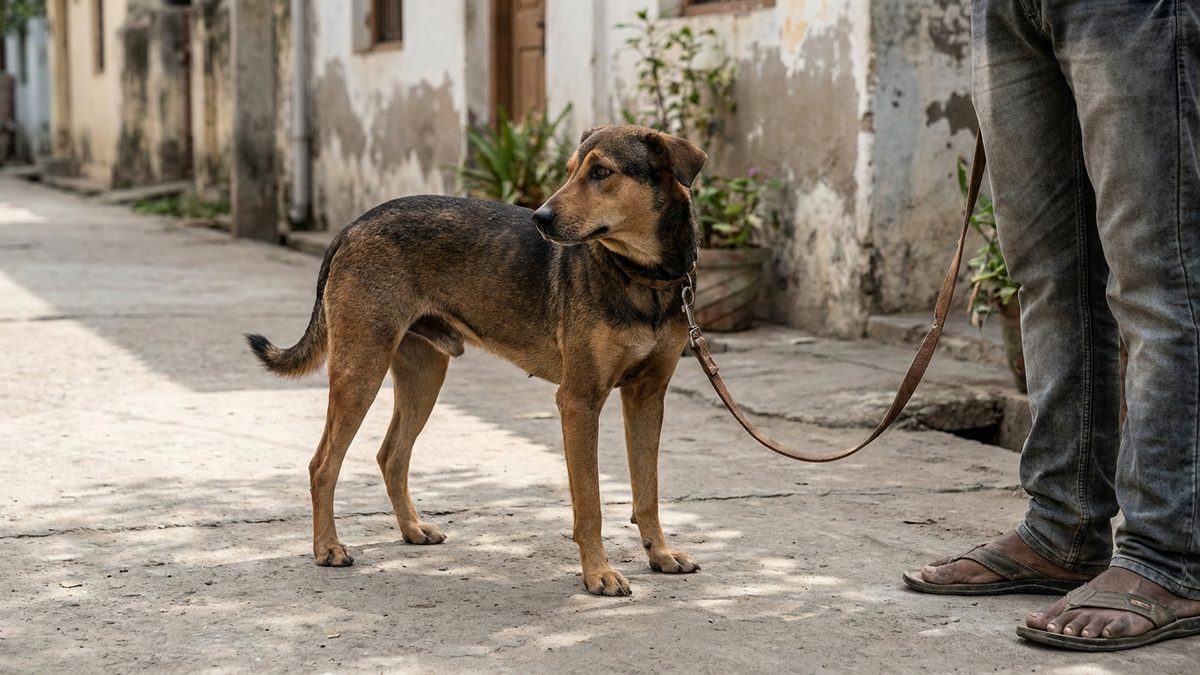
A dog that will not move is making a choice, and a dog making a choice still has directions it is happy to take. Ask it to come to you. Step back the way you came. Offer something it likes, held at nose height, half a metre behind it. A dog that will not go forward past the hoarding will almost always turn and walk home, and the moment it does, you know the legs work and the problem is about that place, that surface or that moment.
A dog that cannot move does none of that. It tries and fails, or it tries and something goes wrong in the trying. The signs are specific: a paw that folds over and is walked on at the knuckles, a back foot that scrapes the ground, a back end that sways or crosses, a dog that cannot push itself up from lying down, a head held at a tilt, a cry when a particular spot is touched, or a dog that stands rigid with its back arched and will not lower its head.
The ranking pages for this query do not make this cut at all. Every one of the American veterinary-practice blog posts on page one opens with the same undifferentiated list, joint pain and injury and fear and insufficient leash training, as though the reader's job were to pick one from a menu. The reader's actual job is to decide, in the next sixty seconds, whether this is a clinic trip or a route problem.
The WSAVA pain guidelines warn that debilitating disease can dramatically reduce the range of behavioural indicators of pain an animal would normally show, and give the example that dogs may not vocalise and may be reluctant to move to prevent worsening pain. The dog is not quiet because it is fine. It is quiet and still because moving hurts, and stillness is the only thing it can do about that. Silence is not reassurance here.
What a dog that will not move still does
Four things separate a dog that will not move from one that cannot, and you can check all four without touching the dog.
- It takes a step in some direction when you move away from the thing it stopped for, even if that direction is backwards.
- It shifts its weight normally, rather than holding one leg light, loading one side or standing with its feet oddly placed.
- It can lower its head to sniff the ground, which a dog with neck or spinal pain often will not do.
- It will take food where it is standing, which a dog in real pain or real panic usually will not.
None of those four is diagnostic on its own. Together they are the difference between a dog you can walk home and a dog you should carry to a vehicle. If you are unsure, treat it as the second one. The cost of an unnecessary consultation is an afternoon and a fee, which our guide on what a vet visit costs in India sets out. The cost of walking a dog home on a spine that has just herniated is not recoverable.
The five observations that separate the causes
Five observations separate the six common reasons a dog refuses to walk, and none of them requires equipment. Note where it happens, when it started, which direction the dog will still move in, what the body is doing, and whether the dog will eat on the spot.
The table below is the whole point of this page. Everything after it is detail. Read down the third column first, because the direction a stopped dog is still willing to go in tells you more, faster, than anything else you can observe, and no page currently ranking for this query asks the question at all.
| Cause | Where it happens | When it started | Which direction the dog will still move in | What the body is doing | What to do first |
|---|---|---|---|---|---|
| Fear of something on the route | The same spot, or the same hundred metres, nearly every time | Often datable to one specific walk | Away from the thing, readily, and in any direction that avoids it | Low body, weight shifted back, tail tucked, head turned away, eyes fixed on one point | Let it move away, then change the route while you work on the association |
| Fear of a surface | At an edge: a metal grate, a wet marble entrance, a gap in a slab, the first metal step | Gradual, and the survey evidence says it gets more common with age | Back the way it came, and along any route that avoids the edge | Neck stretched forward, sniffing the surface, one paw testing it, hind feet planted behind the line | Walk around it. Do not lift the dog across it |
| Pain | Anywhere, and progressively earlier in the walk as weeks pass | Gradual over weeks, unless there was a nameable injury | No direction readily, including towards home and towards food | Quiet, slow to rise, weight shifted off one limb, often nothing dramatic at all | Veterinary examination this week, before any training plan |
| Heat | Within minutes of leaving the gate, and often in the first patch of shade | Seasonal. It happens on hot days and not on cool ones | Towards shade, towards water and towards home | Open mouth, fast shallow panting, lifting feet off the surface, pressing against a wall | Go home now and cool the dog, then move the walk hour |
| Over-arousal or adolescence | Wherever there is most to look at, and nowhere consistent | Between roughly six and twelve months of age | Fine for a different handler, often within seconds of the lead changing hands | Up on the toes, ears forward, scanning, tail high, mouth closed, not frightened | Hand the lead over as a test, then shorten and simplify the walk |
| Learned that stopping works | Near the usual turning point, or within sight of home | Built over weeks, after walks started ending whenever the dog stopped | Towards home, immediately and cheerfully | Relaxed and loose, watching you, no tension anywhere | Stop ending the walk at the stop, and make the rest of the route worth doing |
Which direction will it still go in?
The direction test works because the six causes differ in what the dog is avoiding. Fear is attached to a thing or a place, so every direction except one stays open. Pain travels with the dog, so no direction is attractive and the reluctance is even in all of them. Heat is relieved by shade, so the dog has a clear preferred direction and it is not forward. Habit has one destination, home, and the dog goes there happily.
Run the test deliberately rather than by accident. Walk four or five metres back the way you came and call the dog without tightening the lead. Then step sideways onto a different road. Then face forward again. Three attempts take under a minute and you will know whether the refusal is directional, which splits the six causes almost in half.
Will it take food where it is standing?
A dog that eats on the spot is not in the state that a dog refusing food is in. Reduction in appetite sits in the WSAVA list of behavioural signs of pain alongside altered mobility, which the guideline gives as lameness and reluctance to move. Frightened dogs stop eating too, at the point where the fear stops being mild. So food is not a test of which cause you have, it is a test of how far along the cause has got.
Use it that way. A dog that stops at the corner and still takes a piece of chicken is telling you the feeling is manageable and you have room to work. A dog that stops and will not take anything it normally loves is over its own threshold, and nothing you teach it in that minute will be learned. Take it home and start again tomorrow, further back.
The six rows are not exclusive. An old dog with sore hips that then gets a fright at a construction site will refuse at that spot and also refuse generally, and treating only the fright leaves half the problem untouched. When the pattern fits two rows, work the pain row first, because it is the one with a clock on it.
Sudden onset is the one that must not be missed
Sudden onset means a change you can date, and a dog that walked happily last week and will not move today has usually changed physically rather than emotionally. Fear and habit are built across repeated walks. Pain, injury and neurological disease arrive on a particular day.
That asymmetry is the most useful rule on this page. Behavioural causes need repetition to form, because a dog has to meet the frightening thing more than once to learn that the route contains it, and has to be taken home more than once to learn that stopping ends the walk. Physical causes need nothing. A disc can herniate between one walk and the next. A pad can split on a single piece of glass. A tick-borne illness can take a dog from normal to flat inside two days.
The signs that mean a vet today, not a training plan
- Knuckling. A paw that folds over so the dog stands on the top of it, even once, is a neurological sign and not a stumble.
- Dragging. A back foot that scrapes the ground, or nails that are suddenly worn flat on one side only.
- A wobbling or crossing back end, or a dog that sits down halfway through standing up.
- Crying, flinching or turning to the spot when a particular part of the back, neck or a limb is touched.
- A hunched back with a lowered head that the dog will not raise, which is a classic spinal pain posture.
- A head tilt, circling or flicking eyes, which point at the balance system rather than the legs.
- Collapse at any point, even brief, even if the dog gets up again and seems normal afterwards.
None of those seven is a reason to wait and see. Several of them have a time window in which treatment works better than it does later, which is why our page on intervertebral disc disease in dogs sets out the grades and what each one implies. Get to a clinic the same day and keep the dog as still as you reasonably can on the way there.
The cheapest explanation for a sudden refusal is the simplest one. A thorn, a shard of glass, a lump of hot tar, a cracked pad or a strand of kite string wrapped round a toe will stop a dog instantly and completely, and all five are common on an Indian street. Our guide on dog paw care in India covers the examination and what each injury looks like. Do this first, because it takes thirty seconds and it resolves a real share of sudden refusals outright.
The age assumption that the ranking pages all make, and one Indian series that contradicts it
Every page on the first results page ties joint pain to arthritis and arthritis to old age. The commonest Indian orthopaedic presentations do not follow that pattern. At the Veterinary College and Research Institute in Namakkal, Tamil Nadu, 1,204 orthopaedic cases were seen in the twelve months from March 2021, of which 193 were suspected of a hip disorder on history and orthopaedic examination and 122 were confirmed on radiographs. Hip disorders in that series were commonest in dogs aged 1 to 5 years, followed by dogs aged 6 months to 1 year.
The clinical signs recorded in that series are worth knowing because they are what you would actually see on a pavement: hindlimb limping, bunny hopping, non-weight bearing and a shortened limb. A dog that stops and then limps on for a few steps is giving you a different signal from a dog that stops and stands square.
A young dog that will not walk is therefore not automatically a behavioural case, and the reflex to treat a two-year-old's refusal as stubbornness and a ten-year-old's as arthritis gets it wrong in both directions. The full picture for the older dog is on arthritis in dogs and cats and senior dog care in India, and the breed and screening picture for the young one is on hip dysplasia in dogs. This page is only here to tell you which door to walk through.
The Namakkal paper reports its 122 radiographically confirmed hip disorders as accounting for 16.03 percent. That percentage is 193 of 1,204, the number suspected on examination, not 122 of 1,204, which is 10.13 percent. We cannot tell from the paper which number the authors intended, so both are printed here rather than one being chosen. Either way the direction of the finding, that hip disorders were a substantial share of an ordinary Indian orthopaedic caseload and were commonest in young adult dogs, is unaffected.
What is actually measured about dogs refusing to walk, and what is not
Almost nothing about this subject has been measured directly. No study this page could find has asked why pet dogs stop on a walk, counted the reasons or put a denominator under any of them, and a reader should know that before trusting any number they meet on this topic.
That matters because the field reads as though it were settled. The American veterinary-practice pages that dominate this query state their five causes flatly and in the same order, with no citation on any of them, and the repetition across a dozen near-identical pages produces an impression of consensus that is really an impression of one template. We could not find a source behind any of it.
What does exist is four pieces of adjacent evidence, each measuring something real and none of them measuring this. The table sets out what each one can and cannot tell you.
| What has been measured | Population | What it tells you about a dog that stops | What it cannot tell you |
|---|---|---|---|
| Fear of surfaces and heights, Salonen and colleagues, 2020 | 13,715 dogs across 264 breeds in Finland, owner questionnaire | 23.5 percent were rated highly fearful, and the questions behind that rating are about difficulty walking on a metal grid, on shiny floors and moving from one surface to another | Anything about Indian streets, and anything about the other five causes |
| Reluctance to move as a behavioural sign of pain, WSAVA Global Pain Council | A clinical guideline, no denominator | Altered mobility, given as lameness and reluctance to move, is listed among the signs of pain, and the guideline warns a dog may move less specifically to avoid worsening pain | How often a refusing dog is actually in pain |
| Baulking as an outcome measure in walking-equipment trials, 2025 review | A review of collar, harness and head collar studies | Refusal to walk is counted, but only as an adverse response to the device under test, and head collars are the device it is associated with | Anything about refusals that the gear did not cause |
| Adolescent non-response to the carer, Asher and colleagues, 2020 | 93 guide-dog-scheme Labrador Retrievers, Golden Retrievers and crosses of the two | Odds of repeatedly not responding to a sit cue from the carer were 2.14 times higher at 8 months than at 5 months, with no equivalent change for a stranger | Whether the effect extends to walking, or to breeds outside that scheme |
Read the third row carefully, because it is the clearest sign of how thin this field is. The only context in which the veterinary literature counts refusal to walk at all is inside trials of walking equipment, where baulking appears as an adverse response to a harness or a head collar rather than as a thing worth studying for its own sake. A behaviour that stops a daily activity for a large number of dogs has been measured almost exclusively as a side effect of product testing.
One practical consequence follows from that row rather than from the gap around it. If a refusal began in the same week as a new head collar or harness, the gear is a live candidate and an easy one to test by going back to what the dog wore before. The full comparison of what each type of equipment does, with the pulling and pressure studies behind it, is on collar or harness for dogs in India, and this page does not repeat it.
Fear of surfaces, and why an Indian street produces so much of it
Fear of surfaces is the cause most often misread as stubbornness, and it is the one with the largest measured population behind it. In a Finnish survey of 13,715 dogs across 264 breeds, 23.5 percent were rated by their owners as highly fearful of surfaces and heights.
The reason that figure belongs on an Indian page is what the questionnaire actually asked. Owners were asked whether their dog had difficulties walking on different surfaces, including on a metal grid, on shiny floors, or moving from one surface to another, and whether it had difficulties climbing stairs where you can or cannot see between the steps, walking next to glass railings, climbing metal stairs, and walking over narrow bridges. A dog was counted as highly fearful if the owner answered often or always to even one of those.
Read that list against a walk in any Indian city. A metal grid is a nullah cover and a storm drain grating. A shiny floor is the polished granite at a shop entrance, wet from the morning wash. Moving from one surface to another is what an Indian pavement is made of. Stairs you can see between are the open-riser steps on a terrace. The questionnaire was written in Finland and it reads like an inventory of a walk in Chennai.
The measured state of the surface an Indian dog walks on
Indian pavements are not continuous, and there is now a figure for it. A 2026 assessment of major Indian cities found that only 13.2 percent of the assessed 100 metre footpath units were continuously walkable, with Lucknow highest at 28 percent and Jhansi last at 3.4 percent, and reported that in most cities usable footpaths appeared as short pockets rather than connected pedestrian corridors. Delhi has no footpath on 44 percent of its roads, and only a little over a quarter of those that exist meet the prescribed width and height norms. In Pune, 53 percent of roads have a footpath at all.
The same assessment scores each city on walkability out of 100, and reading it at source on 28 October 2026 the scores ran from 39.0 in Warangal to 49.0 in Gurgaon, with Bengaluru at 45.7, Delhi at 46.0, Hyderabad at 45.9, Chennai at 45.2, Mumbai at 44.3 and Ahmedabad at 42.3. Not one of the thirteen cities listed reaches half marks.
Put the two findings side by side and the Indian version of surface fear stops being mysterious. A frequent trigger in the measured construct is moving from one surface to another, and the measured Indian street is a sequence of surface changes rather than a surface. A dog that trots happily round a park and balks every forty metres on the road home is not being inconsistent. It is meeting, on that road, the exact stimulus the questionnaire was built to detect, several times per kilometre.
The think-tank article that reports the 13.2 percent figure describes the assessment as covering 12 major Indian cities. The live ranking, read at source on 28 October 2026, lists 13. The likeliest explanation is that a city was added after the article was published in September 2026, but we have not verified that, so both counts are printed rather than one being picked.
What this page does not cover, and where it lives instead
Indoor floors are a separate subject with their own evidence, and it is already written up. The slippery vitrified tile, marble and granite that Indian flats are finished in, where to lay runners, the cohort study that found dogs kept on slippery flooring were more likely to develop clinical signs of hip dysplasia, and the stairs and lift that a flat dog uses several times a day are all covered on keeping a dog in a flat in India. This page is about the surfaces outside the gate.
Note also that surface fear is not fixed. The same survey reports that fear of surfaces and heights increased with age across the population, which means an older dog that has started hesitating at a step it used to take is doing something the data predicts, and is also doing something that a sore hip would produce. The two explanations overlap, and the way to separate them is the direction test above plus a veterinary examination, not a guess.
The dog that only ignores you: adolescence, and a test you can run today
A dog between roughly six and twelve months that refuses for you and walks on for somebody else is probably adolescent rather than frightened, sore or badly trained. That pattern has been measured, and the measurement is unusually specific about who gets ignored.
Researchers observed 93 dogs from a guide dog scheme, Labrador Retrievers, Golden Retrievers and crosses of the two, responding to a sit cue from their own carer and from a consistent stranger. The odds of repeatedly not responding to the carer were 2.14 times higher at 8 months than at 5 months, with a 95 percent confidence interval of 1.46 to 3.11. Carers scored their dogs lower on trainability at 8 months than at either 5 or 12 months, while the dogs' trainers, who knew them less well, scored them higher over the same period.
The university's own account of the study adds the detail that makes it usable: responses to strangers actually improved between five and eight months. The adolescent dog has not got worse at listening. It has got worse at listening to you, specifically, and briefly.
The hand-over test, and the one thing it cannot tell you
Hand the lead to someone else and keep walking. If the dog follows them within a few seconds, having refused you for a minute, you have ruled out a great deal at no cost: pain does not switch off when the lead changes hands, a frightening object does not become less frightening, and hot pavement does not cool down. What changes is the social relationship the dog is currently negotiating.
This test is already in circulation, and it is worth noticing where. The highest-voted practical answer in the busiest discussion thread on this query is a stranger on a forum suggesting exactly this, walking with another person and passing the lead over when the dog stops. Owners found the test by trial and error years before anyone explained why it works. The study explains why, and bounds it: the effect was caregiver-specific and it was a phase, with trainability back up by 12 months.
The one thing the test cannot do is diagnose a young dog that refuses for everybody. That is not adolescence, and the adolescent explanation becomes an excuse at exactly that point. A six-month-old that will not walk for any handler is a dog to examine, not a teenager to wait out.
Adolescence is the age at which a large number of dogs are given up, and it is also the age at which owners are most tempted to escalate. The dog is bigger, it has started ignoring cues it knew perfectly at five months, and the walk has become an argument. The measured answer is that the ignoring is temporary and specific to you. The handling that follows from that is to keep the walks short, keep them winnable and keep the rewards generous, which is the approach set out on puppy training basics in India.
What not to do when a dog refuses to walk, and the mechanism behind each
Four responses make the next walk worse, and each does it by a different route. Dragging, lifting, scolding and forcing the dog past the thing all teach the dog something you did not intend to teach it.
The governing evidence here is not about walks specifically, it is about what aversive handling does to learning in general, and it is settled enough that professional bodies state it as policy. The American Veterinary Society of Animal Behavior lists physical correction techniques, naming leash jerking and physical force, and flooding, which it glosses as exposure, among the techniques an appropriate trainer avoids, and states that the learner must always feel safe and have the ability to opt out of training sessions.
The same statement names the consequences. The documented fallout from aversive training methods includes increased anxiety and fear-related aggression, avoidance, and learned helplessness, and animals may be less motivated to engage and less likely to interact with human members of the household. Avoidance is the one that matters on a pavement: a dog that has learned the walk contains being hauled starts refusing at the door rather than at the corner.
| What people do | What the dog learns from it | Where the harm shows up | What to do instead |
|---|---|---|---|
| Dragging on the lead | That stopping is followed by pressure on the neck or chest that it cannot escape | The refusal moves earlier, from the frightening spot to the gate, and then to the lead coming out | Release the tension, step back the way you came, and let the dog choose to move |
| Lifting the dog and carrying it past | That being picked up predicts the frightening thing arriving at close range with no escape | The dog starts avoiding being picked up, which costs you the one tool you need in a genuine emergency | Walk round the thing at whatever distance the dog can manage, even if that is the other side of the road |
| Scolding or shouting | That the frightening place also contains an angry handler, which is one more reason to avoid it | The association strengthens rather than fades, and the dog stops looking to you at the moment you want it to | Say nothing, and move. A refusal is information, not disobedience |
| Forcing the dog to stand next to the thing until it calms down | Nothing useful. This is flooding, and it is on the professional avoid list by name | Either sensitisation, so the fear grows, or a dog that has shut down and looks calm while learning that nothing it does works | Gradual exposure at a distance the dog is comfortable at, which the same statement contrasts with flooding |
Lifting a refusing dog is a different act from carrying a puppy
Carrying is not banned, and this page is not saying never pick a dog up. An unvaccinated puppy carried past the stretch of street where the resident dogs sit is a sensible thing to do and is covered on puppy training basics in India. Lifting an adult dog that has just refused is different in one way that decides it: the puppy has not stopped, so nothing is being overruled.
Lifting a dog out of a refusal overrules the one decision it has just made, and it does so at the moment the dog is most attentive to what happens next. The dog has no way to read that as anything other than the stop being pointless. Carry a dog for its safety, carry it when it is injured, and carry it when you have run out of road. Do not carry it as a way of winning the argument.
Shutting down looks like success. The dog stops pulling back, stops looking around, lowers its head and stands there. That is on the professional list of consequences as learned helplessness, and it is the state that most often gets described as the dog finally relaxing. The way to tell them apart is what happens next time: a dog that genuinely settled approaches the spot more easily on the following walk, and a dog that shut down approaches it worse. Our guide to reading your dog's body language sets out the signals in detail.
Six Indian route triggers a reader does not think of
Six things on an ordinary Indian route stop dogs, and most of them are invisible to an owner because they are not aimed at people. The table gives the cue that identifies each one and the page that handles it, because this page is a differential and not a treatment manual.
Work through these before concluding that the problem is the dog. All six are changes to the route rather than changes to the animal, which means all six are fixable this week rather than over months.
| Trigger | The cue that identifies it on the pavement | Where the handling lives |
|---|---|---|
| Surface temperature underfoot | The refusal starts within minutes of the gate, on hot days only, with feet lifting and the dog heading for shade | Heat safety for dogs in India, which holds the pavement test and the city walk windows |
| An unfamiliar surface the dog has never met | A stop at an edge, with the neck stretched out and a paw testing, and no problem once past it | This page. Walk round it, and never lift the dog across |
| Monsoon water on a fixed route | Seasonal refusal at the same low point of the road, worse after rain, fine on dry days | Monsoon care for dogs in India |
| Free-ranging dogs holding a stretch of the route | Refusal at a fixed point, worse at certain hours, with the dog orienting at something ahead rather than down | Night walks and street safety in India and stray dogs in India |
| Construction or drilling on the route | Refusal that appeared the week the work started, at the same hundred metres, and eases on Sundays | Pets during renovation and building work |
| The lift, the stairwell or the lobby floor | The refusal happens before you reach the street, at the lift door or on polished stone | Keeping a dog in a flat in India |
The seventh, and the one owners most often reach for last, is noise. A dog that will not leave the building during the firecracker season, or in the days after it, is not refusing the walk, it is refusing the outdoors, and the handling for that is a different programme with its own evidence. It is set out on firecracker fear in dogs in India, and the distinguishing cue is that the refusal is total rather than located: the dog will not go in any direction, including ones it likes, and it is no better on a route it has never walked.
The monsoon row deserves a note because it is the one that recurs on a calendar. Standing water sits in the same dips of the same roads year after year in Mumbai, Chennai, Kolkata and Bengaluru, so a dog that balked at one stretch last August will meet exactly that stretch again, and the refusal looks like a new problem when it is an annual one. Write down where it happened, because next year the note saves you the diagnosis.
Humid heat deserves a separate warning because it does not feel like the trigger it is. An owner judges the walk by air temperature, and a dog on a humid evening in a coastal city is losing heat far less efficiently than the thermometer suggests. A refusal that happens on warm humid days and not on hot dry ones is pointing at humidity rather than at the sun, and the walk hour is the lever.
When the honest answer is to change the walk rather than the dog
Change the walk first, if the refusal is tied to a place, an hour or a surface. A route is a choice you make every day and a dog's fear of a specific hundred metres is not a character defect that has to be trained out before the dog is allowed a decent walk.
The Indian footpath data makes this less of a compromise than it sounds. When only 13.2 percent of assessed footpath units are continuously walkable and usable footpaths appear as short pockets rather than connected corridors, the route your dog refuses is not a neutral baseline that the dog is failing to meet. It is one arbitrary line through a hostile surface, and there are others.
- Change the route, not the length. Walk the same minutes on a different road, and watch whether the refusal travels with the dog or stays on the old road. That single route change separates a place problem from a dog problem in two days.
- Change the hour before you change anything else, if the refusal is seasonal or only happens on some days. Heat, traffic density and the free-ranging dog population all vary by hour, and all three are cheaper to avoid than to train through.
- Shorten and repeat. Three ten-minute walks a dog completes beat one thirty-minute walk it refuses at minute four, and they give you three chances a day to end on a good note.
- Carry a young puppy through the stretch you cannot change, if its vaccination course is not finished. This is the one case where lifting is the right answer, because nothing is being overruled.
- Use a garden, a terrace or a quiet compound as the whole walk for a period, if the street is genuinely the problem and you need the dog exercised while you work on it.
- Drive to the walk, if a park ten minutes away is a surface your dog is happy on. This is normal and not a failure.
A dog whose walk is being redesigned still needs the exercise it was getting. Changing the route, the hour or the format is a change to where and when, not to how much, and our guide on how much exercise a dog needs sets out what the evidence does and does not support about the total. Sniffing, training games and food puzzles on a day you cannot get out are covered on dog boredom busters.
There is a legal footnote worth knowing, because it may eventually change the street itself. In a judgment delivered on 19 June 2026 the Supreme Court held that the right to walk on demarcated and well-maintained footpaths is a fundamental right, and placed an enforceable duty on local authorities to construct and maintain them where a road exists. That will not help your dog this month. It is a reason to expect the surface question to move over the next few years rather than to stay fixed.
What to write down before the veterinary examination
Write down five things before you go, because the history is the part of this consultation that only you can supply. The pain guidelines are explicit that owner assessments are the mainstay of assessing chronic pain in dogs, and that owners may need prompting and close questioning before they report the relevant changes.
That last point is the reason to prepare. The behavioural changes associated with chronic pain develop gradually and may be subtle enough that only someone very familiar with the animal detects them, which puts you in possession of evidence a ten-minute examination cannot generate. It also means you will not recall it under questioning unless you have written it down, because the changes were gradual enough that you adapted to them without noticing.
- The date it started, or the week, and what else changed that week: a new harness, a new route, building work, a fall, a season turning.
- The map. Where on the walk it happens, whether it is always the same spot, and whether it happens on a route the dog has never walked.
- The direction result. What the dog did when you stepped back, stepped sideways and stepped forward, and whether it took food where it stood.
- The small things that came earlier. A hesitation before jumping onto the sofa, a slower push up from a tiled floor, a dog that stopped taking the last two stairs, a change in how it lies down.
- A video. Thirty seconds of the dog walking away from the camera and back towards it, taken at home on a surface with grip, is worth more than any description of a gait.
Take that to a clinic you can get back to, because this is frequently not a one-visit problem and continuity matters more than facilities for the first appointment. Our guide on choosing a vet in India covers what to look for. If the dog is frightened of the clinic itself, which a dog in pain often becomes, the preparation that helps is on teaching your dog to accept handling.
Keep a line a day for a fortnight: the date, the hour, the weather, the route, where it stopped, how long for, and what moved it on. Patterns that are invisible across a month of memory are obvious across fourteen written lines, and the commonest discovery is that the refusal is tied to something nobody suspected, a time of day, a direction, or one particular corner. This costs nothing and it is the single most useful thing an owner can do between noticing the problem and solving it.
One closing caution about this page's own limits. A differential tells you which question to ask next, and it is not a diagnosis. Nothing here names a condition in your dog, no drug or dose appears anywhere on this page, and the veterinary examination is the step that converts an observation into an answer. Use the table to decide how urgently you need that appointment and what to bring to it.
Common questions
Why does my dog stop on walks and refuse to move?
Your dog stops on walks for one of six reasons, and you separate them by watching four things rather than guessing. Note where it happens, whether it happens at the same spot every time, when the behaviour started, and which direction the dog will still move in. A frightened dog moves away from one thing readily. A dog in pain moves reluctantly in every direction, including home. A hot dog stops within minutes of the gate and heads for shade. An adolescent walks on happily for someone else holding the lead.
My dog suddenly stopped walking and won't move. What should I do?
Stop the walk, and check whether the dog can move rather than whether it will. Ask it to come to you, in any direction, with something it likes. A dog that will not move still walks towards home or away from a frightening thing. A dog that cannot move, that knuckles a paw over, drags a foot, wobbles, cries when touched or cannot stand up, needs a veterinary surgeon the same day. Do not drag the lead and do not wait until the next morning to see whether it settles.
Should I pull my dog if he refuses to walk?
No. Pulling a dog that has stopped teaches it that stopping ends in being hauled, which makes the next walk worse rather than better. The American Veterinary Society of Animal Behavior puts physical correction and flooding on its list of techniques to avoid, states that the learner must always feel safe and be able to opt out, and lists increased anxiety, avoidance and learned helplessness among the documented consequences. Let the dog move away from whatever it has stopped for, then change the route.
What causes a dog to suddenly stop walking?
Sudden onset points at pain, injury or a neurological problem far more often than at behaviour. A dog that walked normally last week and will not move today has usually changed physically, not emotionally, because fear and learned habits build over repeated walks rather than appearing overnight. Check the feet for a cut pad, a thorn or tar, check the surface temperature, and if nothing explains it, book a veterinary examination rather than starting a training plan.
Why does my dog suddenly not want to walk anymore?
Most refusals that feel sudden are gradual changes you have only just noticed. The pain guidelines make this point explicitly: behavioural changes from chronic pain develop gradually and are subtle enough that only someone very familiar with the animal detects them, and owners often need close questioning before they report them. Look back for the small things first, a slower first hundred metres, a hesitation at the gate, a dog that stopped jumping onto the sofa, and date those rather than the day you noticed.
Why does my dog suddenly can't walk properly?
A dog that cannot walk properly is a different problem from a dog that refuses to walk, and it is the more urgent of the two. Loss of coordination, a swaying back end, a paw that knuckles over onto its knuckles, a dragged toe, a head tilt or a dog that cannot rise are signs of a spinal or neurological problem rather than reluctance. Take the dog to a clinic today, keep it still on the way, and read our page on intervertebral disc disease for what the examination involves.
What should I do if my dog is refusing to walk?
Work through four steps in order. First, decide whether the dog cannot move, which is a vet appointment today. Second, note the spot, the date it started and the direction the dog will still go in. Third, let the dog move away rather than forcing it past, because forcing is the one response that reliably makes the next walk worse. Fourth, change what you can change about the walk, the hour, the route or the surface, before you try to change the dog.