
Dog life guide
Dog hates being groomed: the three trials, the pain check, and a protocol that fits an Indian clinic
Every page on this query says go slowly and give treats. Three controlled trials have now tested that in dogs, and the one that changed what the clinic did got the clearest result.
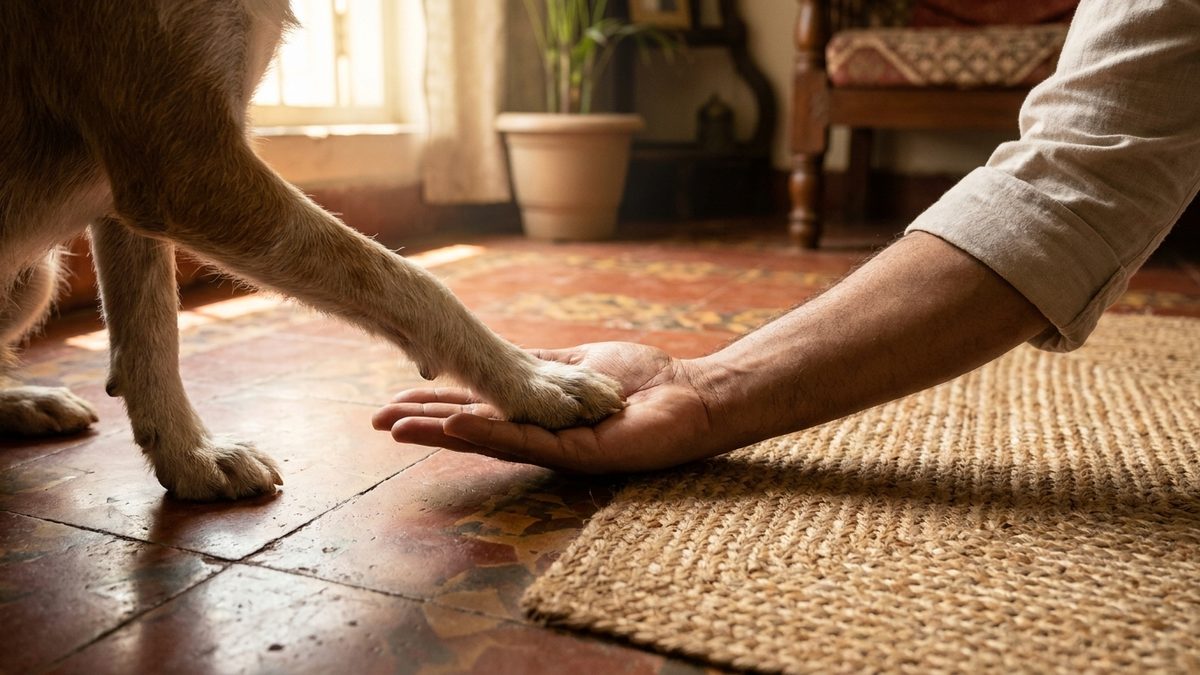
Quick answer
When a dog hates being groomed, rule out pain before training anything, because a dog that newly objects to one spot is often sore there. Then practise exam-style handling at home for five to ten minutes twice a week, starting with a hand resting on a paw, and advance only while the dog stays calm. Stop at the first turned head. Never hold a frightened dog still, and train a basket muzzle before the day you need one.
This guide is general information for Indian pet owners and is not a diagnosis. Always consult a registered veterinarian near you before acting on anything you read here, and treat any sudden change in your pet's condition as urgent.
What a dog that hates being groomed is objecting to
A dog that hates being groomed is objecting to being held and handled rather than to the brush, and the measurements all come from veterinary consulting rooms because nobody has counted grooming sessions.
Three surveys have put a number on it and they do not agree, which is useful rather than annoying. In a German study, 135 dogs were observed under practice conditions during a standardised test examination and their owners interviewed. Most dogs showed fear reactions, particularly on the examination table, with 78.5 percent (106 of 135) categorised as fearful on their behaviour, and age, gender and previous experience were significantly associated with that behaviour (P<0.05) while weight and castration were not.
A far larger analysis asked guardians instead of watching dogs. Across 26,555 valid questionnaire responses collected between 2005 and 2016, 41.02 percent of dogs showed mild to moderate fear of veterinary examination and 14.23 percent severe or extreme fear, so over half (55.25 percent) of all dogs showed fear in some capacity in a veterinary context.
The most interesting line in that paper is not a prevalence figure. Breed group was the largest single predictor of fearful behaviour at the clinic, ahead of the dog's role, its source, its weight and whether this was the guardian's first dog. But combined, those risk factors only explain a total of 7 percent of variance of fear observed during veterinary examination. Ninety-three percent of the difference between a dog that tolerates handling and one that does not sits somewhere other than in the dog's breeding, and most of it is experience.
| Study | Dogs | Method | Headline |
|---|---|---|---|
| Doring and colleagues, Germany, 2009 | 135 | Observed in practice during a standardised test examination | 78.5 percent (106 of 135) categorised as fearful, particularly on the examination table |
| Edwards and colleagues, 2019 | 26,555 | Guardian questionnaire, collected 2005 to 2016 | 55.25 percent fearful in some degree, 14.23 percent severe or extreme |
| Stellato and colleagues, Canada, 2019 | 56 recruited | Blinded observer scoring a mock appointment, dogs pre-screened for existing fear | Dogs with severe fear were deliberately excluded from the trial |
The gap between 78.5 percent watched and 55.25 percent reported is the familiar one. An observer scoring posture, avoidance and lip licking finds fear that an owner answering a single question does not call fear. Our guide to reading your dog's body language covers which signals people miss and how badly.
Which part of the handling the dog is actually objecting to
Dogs object to the invasive end of a procedure, not to the whole of it, and two trials found the same thing independently. In a Vienna trial, every examination that had to be stopped was stopped at the last step, measuring rectal temperature, with one exception; as all other parts of the examination were tolerated well, that procedure seemed to be the most invasive aspect of the examination. In the Canadian trial, most fear behaviours occurred during the more invasive physical manipulations compared to the less invasive physiological assessments of temperature, heart rate and respiratory rate.
That matters because it tells you where to spend your five minutes. The dog that flinches at a nail trim is not frightened of nail clippers in general; it is frightened of a foot being held in a particular way. Work out which thirty seconds of the job the dog objects to and train that, rather than retraining the whole session.
How to bathe, brush, clip a nail or clean an ear is the job of our guide to grooming a dog at home in India, and what a paw actually needs belongs to dog paw care in India. This page is about the animal, not the procedure. If you are here because the nail trim is going badly, read the technique there and the training here.
Why a dog that was fine as a puppy stops being fine
To work out why a dog that was fine as a puppy stops being fine, test four explanations in order of urgency, which are pain, a single bad experience, sensitisation from practice that went too fast, and age.
The four look similar from across the room and separate cleanly once you know what to watch. Only one of them is an emergency, and it is the one easiest to discount because the dog seems otherwise well.
| Cause | What it looks like | What separates it | What to do first |
|---|---|---|---|
| Pain | A new objection to one area, often while lying down, often with a general reluctance to move | The temperament looks changeable rather than consistently fearful, and the dog is described as Jekyll and Hyde | Veterinary examination this week, before any training |
| A single bad experience | The dog was fine until one session, and now resists from the moment the kit comes out | You can name the session, and the resistance starts earlier in the chain each time | Stop running the procedure, and rebuild from a step that was never frightening |
| Sensitisation | A slow worsening across months of well-meant practice | Nothing dramatic happened, and the dog is reliably worse at the end of a session than at the start | Cut the step size, shorten the session, and finish while the dog is still calm |
| Age | A dog that coped for years stops coping | Age was significantly associated with fear in the only observational study to test it, and the commonest suspected pain site in behaviour cases is the hip Mills, Demontigny-Bedard, Gruen, Klinck | Treat it as pain until a vet has said otherwise |
Pain, and the pattern that gives it away
Pain is behind far more behaviour cases than owners expect, and the published range is wide enough that it should be quoted rather than averaged. A review of recent dog behaviour caseloads at six clinics reported the proportion of behaviour cases where a painful condition was suspected as 68 percent at Bristol, 82 percent at Lincoln, 23 and 29 percent at two Pennsylvania caseloads, 79 percent in Missouri and Illinois, and 28 percent at Barcelona. The same table records how often that suspicion was confirmed, from 16 percent of cases at Barcelona to 79 percent at Bristol and at one Pennsylvania caseload. The clinics disagree by a factor of three and we are publishing both ends rather than splitting the difference, because the honest reading is that nobody knows the true figure and all six are high.
One detail is consistent across all six. The hip is at the top of every clinic's list of suspected pain sources, from 8 percent of pain cases at Barcelona to 71 percent at Bristol. A hip is also exactly what a grooming session asks a dog to stand on while you lift the opposite back foot.
The clinical picture of pain-related aggression is specific enough to use. Dogs in these cases are often described as having a poor and changeable temperament, with the phrase Jekyll and Hyde used frequently; the behaviour typically occurs when the dog is approached and often when the dog is lying down; and the background history often shows a more general reluctance to move. In an Indian flat that last one is easy to see and easy to explain away, and it is worth writing down: a dog that has become reluctant to jump onto the sofa, to take the last two stairs or to stand up from a tiled floor is giving you the same information as the dog that objects to its hip being touched. The bites themselves differ too. Targets are less specific, covering familiar and unfamiliar people and dogs alike, severity varies, bites go to the limb extremities rather than the face and torso, and the incidents are short and easy to interrupt.
The authors read that pattern as a low level threat aimed at saving the animal from further interaction, and add that the quieter signals that normally come first may have been ignored or not noticed, and possibly may no longer be expressed, which is what makes the behaviour appear sudden and without warning.
A dog that has always let you hold its back feet and now will not is telling you something about that leg. The same goes for one ear, one hip, the base of the tail or the mouth. Book the examination before you start any programme on this page, say which spot and when it changed, and ask the vet to check that joint specifically. Training a sore dog to tolerate being touched where it hurts is the one way to make all of this worse.
Sensitisation, which is what careful owners do by accident
Sensitisation is the opposite of what you intended and it arrives through practice, not through neglect. Reviewing their own trial's limitations, the Canadian team noted that it is possible that owners went too quickly, resulting in flooding, which might sensitise the dog to the clinic environment and exam-style handling, and cited earlier work in which sham dosing dogs before dosing without proper training sensitised them, shown by more escape attempts and reduced posture.
Repetition alone can do it. In a Canadian trial in which dogs attended four veterinary visits across eight weeks, there was a tendency for the composite stress index to worsen at visit four against visit one for the control group, the dogs receiving ordinary care. Four routine visits in eight weeks made the untrained dogs slightly worse, which is the mechanism by which a monthly grooming session a dog dislikes becomes a session it fights.
A single bad experience works faster. Negative experiences lead to conditioned fear, and over time more and more stimuli become predictive of veterinary visits, including cues such as transport, which lowers compliance at future visits. That is why a dog starts resisting at the gate rather than at the table, and why the car matters as much as the room.
Cooperative care, and what has actually been measured in dogs
Cooperative care is training an animal to take part in its own handling instead of being held for it, and in dogs it has been measured three times with results more mixed than any page selling it admits.
The definition used by the profession is plain. Cooperative care, also known as consent-based care, emphasises the importance of an animal's participation and emotional well-being during veterinary procedures, and allowing the animal to opt in or out builds trust and reduces resistance. The Vienna team's own wording is tighter still, which is training animals to participate in husbandry and medical care on a voluntary basis rather than being held for it. The older name for the same thing is husbandry training, which the American Kennel Club defines as a broad category that includes the ways we care for, groom and otherwise maintain our dogs.
The expectation that it would work in dogs came from other species. The Vienna team set out to test it precisely because compliance gains had been reported elsewhere in the husbandry training literature, and said so when their own hypotheses were not supported. Treat that as the honest position. Cooperative care is an established practice in zoo and laboratory husbandry, and in dogs it is three small trials old.
The start button, and the only trial that has measured one
A start button is a trained behaviour the animal performs to say it is ready, and stepping out of it says stop. The trainer community uses the phrase; the veterinary literature does not, and we found no peer-reviewed definition of it. What has been measured is one specific version of it, in one trial, and the detail is worth reading.
Twenty-six dogs and their owners took eight to twelve weeks of cooperative care training, a mean of ten group sessions plus homework. The training taught a front paw target, represented by a mat, and that behaviour was the cooperation signal or consent behaviour; dogs were then desensitised to common handling such as touching the ears and eyes while standing on the target, and received treats for staying. As soon as a dog stepped off the target, any manipulation and reinforcement with treats was stopped.
The training worked in the training room. By the trainer's assessment at the last session, almost 77 percent of the dogs (17 dogs) showed moderate to very good training progress, resulting in improved tolerance of handling by an unfamiliar person, and all six dogs rated as making very good progress had been classified as difficult to handle at the start.
It did not survive the clinic. There were no significant differences in heart rate or heart rate variability between the groups, compliance was lower in the trained group at the second visit (p = 0.04), and the authors' summary is blunt: overall, transfer of trained skills to the veterinary examination performed by a team blinded to the group allocation was poor. Those same six most-improved dogs did not complete the full examination at visit two.
The reason the authors give is the single most useful finding on this page. If a trained dog wanted to signal a desired break by stepping off the target, this had to be communicated to the veterinary staff by the owner, which almost never happened; the authors suggest this could have led to frustration and fear in these dogs, as their attempts to communicate were ignored and they were not able to use their training experience to get more control of the situation. They add a likely reason for the owners' silence, which is that owners perceived compliance during the examination to reflect their training success, and did not see the examination as another training session but rather as a test for the dog.
| Trial | What it changed | Dogs | Result |
|---|---|---|---|
| Stellato and colleagues, 2019 | What the owner did at home, over four weeks, plus a weekly clinic visit | 15 trained, 22 control | Mildly effective. Trained dogs had less reduced posture (odds ratio 3.79 for controls, CI 1.03 to 16.3) and lower fear scores (p = 0.046), but no change in temperature, heart rate, respiratory rate, avoidance, trembling or vocalising |
| Wess and colleagues, 2022 | Cooperative care training with a consent behaviour, 8 to 12 weeks | 22 trained, 18 control | Transfer to the examination was poor and compliance fell (p = 0.04), almost entirely at the rectal temperature step |
| Squair, Proudfoot and Overall, 2023 | What the clinic did, across four visits in eight weeks, plus owner homework | 14 intervention, 14 control | The clearest result of the three. A greater fall in cortisol than controls (p < 0.04) and an improved composite stress index (intervention p = 0.03, control p = 0.288) |
It supports doing this. The Canadian authors' own conclusion, after finding that few behavioural indicators moved in the predicted direction, was that veterinarians should continue to recommend this training until further research is conducted. What it does not support is the promise the ranking pages make. Four weeks of home practice produced a mild effect, a consent behaviour did not transfer to a standardised examination, and the intervention with the clearest measured benefit was the one where the clinic changed its procedure. Anyone telling you that eight weeks of chin rests will fix a frightened dog is ahead of the evidence.
The protocol to run at home, and the rule for moving on
To run this at home, practise exam-style handling for five to ten minutes twice a week in the place your dog is most comfortable, begin with the least invasive contact you can think of, and move up only while the dog stays calm.
Desensitisation and counter-conditioning are the two mechanisms underneath all of this, and this page does not re-teach them. The sequence, and the two rules that decide whether it works, are already set out in our guide to firecracker fear in dogs, and the systematic version for a clinical case is in separation anxiety in dogs in India. Prevention in a puppy is a bullet on puppy training basics in India, which is daily handling of ears, paws, mouth and tail paired with food so that a veterinary examination is nothing new. What follows is only the part that is specific to a dog that already objects to being touched.
Those numbers are not a guess. They are the protocol the Canadian trial actually issued, chosen after informally polling owners about what they would realistically do, and set against earlier evidence that one to two training sessions a week are enough to support learning in dogs. Owners were asked to practise exam-style handling for 5 to 10 minutes twice a week at a location in the home where the dog was most comfortable, gradually exposing the dog to handling of different body areas, beginning with least-invasive methods such as resting a hand on a paw and advancing to more invasive methods such as massaging the paw, at a rate tailored to the individual dog's response.
The second trial's homework is more specific about where to put your hands, and it is worth copying. Owners in the intervention group were asked to work for five consecutive minutes, three times a week, and to touch various parts of the dog's body including the neck, abdomen, chest and legs, to encourage the dog to turn its head to offer its ears, to pick up each foot, to apply unscented lotion to the front and back legs where blood draws would typically occur, and briefly to apply pressure to the leg veins. The control group was simply asked to pet their dogs for the same time.
| Stage | What the vet or groomer does | What to practise at home |
|---|---|---|
| The scale | Walks the dog onto a steel platform and waits for a number | Four feet on a mat or a bathroom scale, treat, walk off. Put a towel or a mat under the feet so the surface is not slippery |
| Head | Looks in the ears and eyes, lifts the lip | Hand under the chin, then a thumb lifting one lip, then a hand folding one ear back. Encourage the dog to turn its head to offer the ear rather than reaching across its face |
| Body palpation | Runs both hands down the neck, chest and abdomen | Flat palm resting on the shoulder, then moving, then light pressure on the abdomen |
| Limbs | Lifts and flexes each leg, looks between the toes | Hand resting on a paw first, then lifting it, then massaging it, then spreading the toes |
| Blood draw sites | Clips or parts the hair, applies pressure to raise a vein | Unscented lotion on the front and back legs where the vein is raised, then brief pressure with two fingers |
| Temperature | Lifts the tail and inserts a thermometer | The most invasive step and the one where examinations fail. A hand over the tail root, then lifting the tail, and nothing further at home |
The criterion for moving on, in one sentence
Advance only when the dog is calm and not displaying signs of fear or discomfort, which the trial listed as lowered posture, avoidance or escape attempts, freezing, vocalising, yawning and lip licking. That is the whole rule. It is not a number of repetitions, a number of sessions or a number of weeks, and any plan that tells you to move up on day four is describing a calendar rather than a dog.
Two of those six signs are the ones people miss. Yawning and lip licking are not tiredness and not hunger when they appear during handling, and they arrive well before anything a person would call a reaction. Our guide to reading your dog's body language sets out which signals the research shows people read badly, including the finding that non-owners read fearful dogs more accurately than owners did.
The commonest way this goes wrong, with a number
The commonest failure is not going too fast. It is not doing it at all. In the Canadian trial, despite motivated owners volunteering to participate, 44 percent of owners were non-compliant to the training programme, and twelve dogs had to be removed from the analysis for that reason. These were people who had answered a recruitment advertisement, driven to a clinic twice for a filmed appointment and agreed to a four-week programme, and nearly half of them did not complete it.
The second commonest failure is going too fast, and it has a name and a mechanism. Flooding means exposing the dog to the full intensity of the thing it fears, and the trial's own authors raise it as the likely reason some owners made no progress. The practical tell is the end of the session. If the dog is calmer at the end than at the start, the pace was right.
- Pick one body area per fortnight rather than working through the whole dog each time.
- Set a timer for five minutes and stop when it goes, even when the session is going well.
- Start every session one step below where the last one ended, which costs thirty seconds and prevents most of the backsliding.
- Pair the touch with food that arrives during the touch, not after it, so the hand predicts the food rather than the food paying for the hand. Save something the dog rarely gets for this, and see homemade dog treats in India for what to use.
- Finish on something the dog already finds easy, so the last thing it rehearses is a step it has never failed.
- Record the date and the step in a note on your phone, because the rule above depends on knowing where you were.
A smear of something good offered while the dog is handled is counter-conditioning and is standard in low-stress veterinary practice. Producing a spoon of peanut butter so you can rush the nail you could not otherwise cut is a different thing, and it teaches the dog that the spoon predicts the nail. The difference is whether the food is present before the dog is worried or produced because it already is.
Holding a dog still, and what to do instead
Holding a dog still is the first thing to change, because restraint is what laboratories use to induce stress deliberately and because the trial that moved the examination off the table got the clearest result of the three.
The Vienna authors state the position in one line while explaining why their own trained dogs did badly. Restraint is highly stressful for animals and is used as a standardised way to induce stress in laboratory animals, and they name the difference in restraint between the training room and the examination as a major reason for the lack of a clear training effect. In their trial the training gave the dogs freedom of unrestrained movement and free choice to step on or off the target, while the examination required them to be lifted onto a table and slightly restrained by an unfamiliar person for the whole exam.
Who does the holding changes the measurements. Summarising an earlier study, the same paper records that dogs held by their owners made fewer attempts to jump off the table and had a lower heart rate than dogs held by an assistant, and concludes that an assistant restraining the dog could be seen as a hindrance to performing a low-stress examination.
The Canadian intervention took that further and changed the whole procedure rather than one part of it. All dogs in the intervention group, regardless of size, were examined on the floor or, if preferred, in the owner's lap; a mat went down for traction; the owner held a licking mat loaded with the dog's preferred food; and no white coat was worn at any phase of the visit. The scale was pulled away from the wall, covered with a mat and baited with treats, and weighing happened at the end of the appointment rather than the start. Crucially, if the dog left the mat the examination was readjusted to its preferred position to accommodate the dog's needs.
That is the opt-out being honoured, and it is the difference between the trial that worked and the trial that did not. Those dogs showed a greater overall decrease in cortisol between the first and fourth visit than controls, and a composite stress index that improved for the intervention group and did not for the controls.
- Ask to have your dog examined on the floor. Most small dogs and many medium ones never need the table.
- Offer to hold the dog yourself, and say that you will let go rather than tighten if it struggles.
- Bring a non-slip mat or a folded towel. A steel table and a vitrified tile floor are both surfaces a dog slides on, and a sliding dog braces.
- Bring food the dog rarely gets, and hand it over before the procedure starts rather than during the struggle.
- Agree a stop word with the vet at the start of the appointment, and use it.
Grabbing the loose skin behind the neck, or rolling a dog onto its side and leaning on it, is a capture and restraint technique for an animal that cannot be handled any other way. Applied to a pet at home it removes the dog's only remaining option, which is to leave, and the behaviour you are left with is the one that comes after leaving. If your dog cannot be handled without being pinned, the answer is a veterinary appointment and a conversation about sedation, not a firmer grip.
India's one national handling curriculum, and why it is not for your dog
India's one national dog-handling curriculum is the Animal Welfare Board of India's module The Art and Practice of Humane Dog Handling, and it teaches scruffing and lateral restraint because it was written to catch street dogs for surgery rather than to groom a pet at home.
The module is a 40-page six-day training programme, produced with Vets Beyond Borders and circulated through India to organisations running animal birth control and anti-rabies work. Its restraint section runs four video lessons, on the single-handed scruff, the single-handed scruff with a muzzle wrap, the two-handed scruff and lateral restraint, and its catching section covers the soft catch, the net, the do bora or two-sack method, the box trap, the Y-pole and the catch-pole.
Read that list and the scope is obvious. This is a manual for a person who has to pick up an unowned animal that has never been touched, get it into a vehicle, and return it after surgery. The module says so itself in a sentence worth quoting in full, that in India there are dog catchers who have never touched a dog, and that they have only ever caught and moved them with catch-poles, often injuring the dogs in the process. It is a large improvement on that. It is not a model for your own dog on your own floor, and an owner who borrows the scruff from it is applying a street-capture technique to an animal that had other options.
Two further things about it are worth knowing before you use it. It describes establishing yourself as the pack leader so that an aggressive dog begins to show signs of submission, which is not the position the veterinary behaviour bodies now take; our guide to puppy training basics in India sets out the reward-based position and the studies behind it. And its practical restraint sessions are run on familiarised shelter dogs under a facilitator, two handlers to a dog.
The four lines in it that are worth taking home
The module's approach section is better than its restraint section, and four of its lines describe the discipline this whole page is about.
- Think small. Respect the dog and do not intimidate it by making eye contact, consider lowering your body to the dog's level if it is safe to do so, and think one step at a time, remembering that the size of each step is defined by the dog, not by you.
- Decide, with each movement you make, whether you are making the dog more tense or more relaxed.
- Offer food from one side. The module names the posture as well as the food, because keeping to one side of the dog is less threatening, and names the common mistake, which is throwing food from a distance so that the dog feels something has been thrown at it.
- Never handle a dog if you do not feel that it is safe to do so. The module prints that one in capitals, and it is the right instruction for an owner too.
The common mistake it names first is the one Indian households make with their own dogs every day. We walk straight into the dog, face to face, expressing our dominance and disrespecting the dog's space, so the dog feels threatened and runs away or shows aggressive behaviour to protect itself. Our guide to pet photography at home in India carries the eye-tracking evidence for the same point, that dogs avert their gaze from a threatening human face within the first fixations.
Muzzle training, which is a kindness and not a verdict on your dog
Train a basket muzzle before you need one, because the reason Blue Cross gives is the same as this page's, that even the most laid back dog can snap when it is in pain, and because Cornell's reason is that muzzled dogs can receive more gentle handling and experience less physical restraint.
That second reason inverts what most owners assume. A muzzle is not an admission that your dog is dangerous; it is the thing that lets a vet stop worrying about their hands and work slowly. Cornell's canine health centre lists the circumstances plainly, that a basket muzzle is a useful tool to humanely prevent dog bites and that in some medical situations a dog may need to wear one to receive medical care. Blue Cross adds that even if your dog does not need to wear a muzzle, it is still a great idea to train them to wear one, and lists a dog that struggles with handling or procedures, at the vet or at home, among the reasons.
The type matters more than the brand. A basket muzzle lets you feed treats through it and lets the dog comfortably pant and drink water while wearing it, and nylon muzzles that constrict a dog's mouth are not appropriate for most situations. Dogs Trust gives the same rule in one line, which is to choose a muzzle the dog can eat, drink and pant through, such as a basket type.
- Place a high-value treat into the nose of the muzzle and let the dog approach it at their own pace, then praise them once the nose goes in and slide the muzzle off.
- Present the muzzle without the treat, let the dog put its nose in, repeat a few times, and stop the session after one to two minutes.
- Practise those sessions a few times a week until the dog has had several positive experiences, keeping each one short.
- Condition the sound of the fastener separately, by closing the strap near the dog while the muzzle is off and rewarding the noise.
- Fasten the strap once the dog reliably wants to put its nose in, feed a treat through the gap, and remove it immediately, then build duration in very small increments.
- Add movement last, always walking away from the dog rather than towards it, and refresh the whole sequence every so often to keep the association positive.
The pace is gradual by design rather than by temperament. Cornell keeps each session to one or two minutes and asks for a few sessions a week until the dog has had several positive experiences before the strap is ever done up, and Dogs Trust's instruction is not to rush the steps and to keep sessions short.
Two rules decide whether it holds. Only give the dog treats while the muzzle is on and stop when it comes off, so the muzzle predicts the food rather than the other way round; and if the dog removes it during a session, take a break and go back to a step where it was previously comfortable. Let the dog come towards the muzzle rather than moving the muzzle towards the dog, which is also how you know it is going well. Fit is a final check, with one to two fingers under the strap so it cannot slip over the head.
Muzzles that completely close a dog's mouth do not allow it to pant, preventing the dog from losing heat. In Mumbai, Chennai or Kolkata, where the air is humid for months at a time, that is not a comfort question. Panting is most of how a dog sheds heat, and our guide to heat safety for dogs in India covers what happens when it cannot. The soft nylon sleeve sold at most Indian counters is the type to leave there, and it is also the type a first-aid page warns never to use on a dog that is vomiting or struggling to breathe. See pet first aid at home in India for when a muzzle is actively wrong.
A muzzle solves a safety problem and nothing else. Dogs Trust says it in the sentence this section exists to repeat, that a muzzle will not change the way your dog feels about a particular situation or trigger, and warns that exposing a dog to frightening situations because it is now muzzled is unpleasant for the dog and could make its behaviour worse in the long term. Muzzle the risk while you train the feeling, never instead of training it.
Whether anyone can require you to use one is a separate question with an Indian answer, and it is already written up. Our guide to pets in apartments in India covers the Animal Welfare Board's position on resident associations and muzzles and the municipal licence conditions that do apply, and handling a complaint about your pet covers what to do when a society asks.
Practising for an Indian clinic with no appointment slot
To practise for an Indian clinic, use the clinic itself as the training ground, because the Indian clinic pages you can read publish opening hours rather than appointment slots and the queue is part of what your dog is learning.
Look at what three Indian public veterinary clinics actually publish on their own pages. The Madras Veterinary College Teaching Hospital in Chennai, Tamil Nadu, describes itself as handling more than one lakh cases annually, and gives its hospital timings as 08.00 AM to 01.00 PM Monday to Friday and 08.00 AM to 11.30 AM on Saturday, Sunday and all government holidays, with small animal registration at Rs 100 valid for 7 days only. More than a lakh cases a year is over 270 a day, arriving into a window five hours long on a weekday and three and a half hours at the weekend. Nowhere on that page is there an appointment or a booking.
The New Delhi Municipal Council's veterinary hospital publishes OPD services from 08:00 AM to 08.00 PM on working days, with no night service, and a dog registration of ₹50 per dog per annum. Again, hours rather than slots. Private small-animal practice in Indian cities increasingly does book appointments, and this page is not claiming otherwise; what the public record shows is that the default your dog will meet is a room with other animals in it and no fixed time of its own.
Karnataka's veterinary college publishes the most useful hour of the three. The Department of Veterinary Clinical Practice at the Veterinary College, Hebbal, Bengaluru lists an evening clinics facility from 1.30 to 9.00 PM among its services, alongside a peripheral veterinary hospital at Yelahanka, and like the other two pages it names no appointment and no booking. That matters practically rather than academically. An evening clinic is what makes four weekly practice visits possible for somebody who works, so ask every practice within reach which hours are quietest instead of assuming the morning. A hundred rupees for seven days of access, which is what the Chennai hospital charges to register a small animal, is the cheapest training aid on this page.
That changes the training job in one specific way. Your dog is not learning about an examination room. It is learning about a journey, a gate, a corridor of other frightened animals, a wait of unknown length, and then an examination, and the fear attaches to the earliest reliable predictor in that chain. You cannot make the queue shorter, but you can make the rest of it predictable, and a predictable visit is the only part of this a reader actually controls.
The practice visit, which costs you the registration fee and nothing else
The Canadian protocol's second half was a weekly visit to the clinic that involved no treatment, and it is the part Indian owners skip. Owners travelled to the clinic by their normal mode of transport, had someone at reception greet the dog, walked the dog onto the scale, and then entered and stayed in the examination room for at least three minutes, with a minimum of five minutes in the building, once a week.
- Telephone first and ask whether you may bring the dog in for five minutes with no consultation, at the quietest hour of their day. Most practices say yes, and a registration fee is a reasonable thing to pay for it.
- Travel the way you normally would, because the auto, the car or the lift is part of what the dog is learning. If the car is itself the problem, dog car sickness in India is the page to read first.
- Stop at the gate if the dog will not go further, feed it there, and leave. A visit that ends at the gate is a successful visit.
- Walk onto the weighing scale, take the number if the staff offer it, and feed the dog on the scale.
- Stay three minutes in a room if one is free, do nothing medical, and go home.
- Repeat weekly for four weeks before any appointment that matters.
If no practice near you will do this, the veterinary technician's own version is to pay for the time. The profession's guidance to trainers is that guardians should plan to pay for brief sessions of 10 to 15 minutes with a veterinary team member for these introductions, using them to work out the ideal examination room set-up, handling preferences and comfort strategies. What a consultation costs across the Indian system is set out on our guide to what a vet visit costs in India.
The handover sheet, and the finding that makes it necessary
Write down what you have trained and hand it over, because the Vienna trial's dogs lost their training precisely at the point where nobody told the clinician what the dog had learned. The professional guidance lists what the veterinary team needs to receive, which is clear summaries of trained behaviours such as stationing and a chin rest, the defined learned behaviours and their corresponding stop behaviours, notes on sensitive areas such as the tail, feet and ears and what body parts can be handled comfortably, muzzle training status or conditioning for any other safety tools, any cue words or predictor cues that help prepare the patient, and a brief overview of what has been achieved and what still needs work.
One. What my dog can do: a chin rest, four feet on a mat, a paw held for ten seconds. Two. My dog's stop signal: it steps off the mat, and that means pause. Three. Where not to start: the back left leg and the right ear. Four. Where it is fine: head, chest, front feet. Five. The muzzle: trained, in my bag, I will put it on. Six. My phone number and what you may telephone me about if I am not the person who brought the dog in. Hand it over at reception, not in the room.
The thing to ask for in the room is also the thing that is hardest to ask for, which is a pause. A veterinary surgeon who stops, changes approach or reschedules a non-urgent procedure when an animal is panicking is making a clinical decision rather than giving up, and our guide to how to choose a vet in India covers what to look for in a practice on the question of handling.
Four people, one dog, four different criteria
When several people in a household handle the same dog, agree the stop signal and the stopping rule before anybody practises, because the criterion for moving on is a judgement and four people make it four different ways.
This matters more here than the research reflects, because the research was done in households where one named owner did the handling. In a great many Indian homes the dog is brushed by one person, fed by another, taken down by a third and carried to the vet by a fourth, and the dog's handling history is the sum of four different paces.
The mechanism is the one Wess found at the clinic, scaled down to the kitchen. A dog whose attempt to signal a break is honoured by one person and ignored by the next has learned that the signal does not reliably work, which is the condition the authors say could have led to frustration and fear in their trained dogs. A stop signal that works three times in four is not a stop signal.
- Name one person who runs the handling sessions. Everybody else may stroke the dog and nobody else practises feet, ears or mouth.
- Write the stop signal on the same sheet that goes to the vet, in the language the household reads, and tape it inside a cupboard door.
- Agree that anybody may stop a session and nobody may continue one.
- Tell the person who takes the dog to the clinic what the signal is and that relaying it is their job, because the trial's failure was a communication failure rather than a training one.
- Keep children out of the practice entirely, and teach them the greeting instead.
Who is allowed to make decisions when you are not there is a question with Indian specifics, and it is covered in our guide to house help, drivers and your pet, including who the vet may speak to on a clinic run. The separate question of how a child should approach any dog is set out in teaching children how to meet a dog.
One seasonal note for Indian households. The monsoon is when ear handling stops being optional, because a humid coat and a warm ear canal are the conditions under which ear disease rises; our page on ear infections in dogs carries the Indian seasonal figures, and the practical consequence for this page is that the ear is the body part most worth having trained before the rains. A dog that will let you fold one ear back for three seconds in February is a dog you can actually check in July.
Cats are a different animal with a different literature and their own guidelines, and our guide to grooming a cat at home in India carries the feline handling rules, including the measured finding that every restraint method tested raised fear indicators against minimal handling. Do not apply a dog protocol to a cat.
When this stops being a training problem
Stop training and telephone a veterinary surgeon when any one of four things is true, because the only home-protocol trial in dogs deliberately excluded the dogs most owners are worried about.
That exclusion is the most important limitation on this page and almost nobody repeats it. The Canadian trial enrolled only dogs whose owners reported mild to moderate fear, scoring 2 or 3 on a five-point scale, on the reasoning that these dogs had room for improvement but were not above their threshold fear level; dogs with severe fear scoring 4 were excluded because they would have required a tailored and carefully monitored training programme in order to keep the dog and the owner safe. So the evidence that a home protocol helps does not extend to the dog that is already snapping. For that dog there is no published home protocol at all.
- A new objection in one place. A dog that will not let you touch a spot it always allowed is a pain question until a veterinary examination says otherwise.
- Any bite, or any approach to one. A growl, an air snap or a hard stare during handling means the quieter signals are gone, which the behaviour literature treats as a sign the warning stages have been suppressed rather than a sign of a calm dog.
- A dog that is frightened from the first second. Panic at the gate rather than at the table is a different problem from poor tolerance of handling.
- No movement after four to six weeks of correct practice. A plateau at a low step, honestly assessed, is information worth taking to a professional rather than repeating.
Sedation belongs in that conversation rather than being a failure. The professional guidance for cooperative care patients is to agree an emergency plan in advance, and the questions on it include what type of restraint is best tolerated and by whom, which medications are appropriate or could be, whether the patient can be safely hospitalised, and which member of the veterinary team the patient is most comfortable with. Those are better questions to settle on a quiet Tuesday than in a crisis.
Do not give human medication, do not reuse another dog's prescription and do not buy a sedative on a shopkeeper's or a forum's advice US Food and Drug Administration. Drug, dose and whether a drug is appropriate at all depend on the individual animal, its age, its weight and what else is going on with it, and a dog that is physically slowed while still frightened is no better off than before. Bonbeno names no drug and no dose. That is a veterinary decision and this page publishes under the medical disclaimer for that reason.
Finding the right professional in India is harder than it should be, for a structural reason. None of the disciplines in which an Indian postgraduate veterinary degree is granted covers behaviour, which our guide to separation anxiety in dogs in India works through for one specific condition and which applies equally here. In practice that means asking your own practice who they refer behaviour cases to, by name, and accepting that the answer may be a remote consultation with somebody in another city.
Finally, be realistic about the timeline. The three trials ran for four weeks, eight weeks and eight to twelve weeks, and the best of them produced a measurable but modest shift in one stress marker Squair, Proudfoot, Montelpare and Overall Wess, Bohm, Schutzinger, Reimer, Yee. A dog that has spent six years learning that hands mean something unpleasant will not unlearn it in a fortnight, and a page that tells you otherwise has not read the trials.
Common questions
What to do if your dog hates getting groomed?
To deal with a dog that hates getting groomed, book a veterinary examination first if the objection is new or confined to one body part, because pain was suspected in 23 to 82 percent of behaviour cases across six clinic caseloads. Then practise exam-style handling for five to ten minutes twice a week in the place the dog is most comfortable, beginning with a hand resting on a paw, and advance only while the dog stays calm. Stop the grooming itself while you rebuild.
Why does my dog hate the groomer so much?
Your dog most likely learned it, because fear of handling has a large learned component and only 7 percent of the variation in veterinary fear is explained by breed, source, weight and history combined. Repetition alone can do it: in one trial, dogs given four ordinary visits in eight weeks showed a tendency for their stress index to worsen rather than improve. A single bad session does it faster, and the dog then starts resisting earlier in the chain each time, often at the car.
How do I immobilize my dog for grooming?
You should not. Restraint is highly stressful for animals and is used as a standardised way to induce stress in laboratory animals, and the one trial that compared handlers found that dogs held by their owners made fewer attempts to jump off the table and had a lower heart rate than dogs held by an assistant. Work on the floor rather than a table, use a non-slip mat, let the dog leave, and shorten the job instead of tightening your grip.
Why do dogs hate their nails being cut?
Dogs object to the foot being held rather than to the clipper, and they object most to the invasive end of any procedure. In two separate trials, fear behaviour clustered on the physical manipulations rather than the gentler steps, and the examinations that had to be abandoned were abandoned at the single most invasive step. A dog that has had a quick cut once has also learned that this specific hold predicts pain, which is a one-session lesson and a many-week repair.
Is muzzle training good for dogs?
Yes, for any dog rather than only for dogs that bite. Cornell's canine health centre notes that muzzled dogs can receive more gentle handling and experience less physical restraint, and Blue Cross says that even if your dog does not need to wear a muzzle it is still a great idea to train one, because even the most laid back dog can snap when in pain. Use a basket type the dog can pant, drink and take treats through.
How long does it take a dog to get used to a muzzle?
No trial has measured it, and the published protocols are paced by the dog rather than by a calendar. Cornell keeps each session to one or two minutes and asks you to practise a few times a week until the dog has had several positive experiences before the strap is ever fastened. Blue Cross says not to rush the steps, to space them out over a period of time, and to go back a stage whenever the dog is unsure. Expect weeks, not days.
What to do if your dog is terrified of the vet?
Start with practice visits that involve no treatment. The one trial to test this asked owners to travel to the clinic as normal once a week, have reception greet the dog, walk it onto the scale and stay three minutes in an examination room, alongside twice-weekly handling at home. Telephone first and ask for the quietest hour. Then write down what the dog can do and what its stop signal is, and hand that to the clinic, because trained dogs lost their training when nobody relayed it.
What can I give my dog to sedate him to cut his nails?
Nothing that you choose yourself. Do not give human medication, do not reuse another dog's prescription and do not buy a sedative on a shopkeeper's advice, because drug and dose depend on the individual animal. Sedation for a genuinely frightened dog is a reasonable veterinary decision and is worth raising in advance rather than in a crisis, alongside what restraint the dog tolerates and who it is most comfortable with. Ask your own practice, on a quiet day.