
Dog and cat health guide
Pet first aid at home in India: what buys time, what wastes it, and why nobody is coming to collect your dog
Every borrowed first aid page assumes an ambulance or a clinic down the road. India has 48 free animal ambulances for street animals and a government helpline built for cattle. Your own dog gets your own car, which changes what the kit is for.
Quick answer
Pet first aid at home buys time and nothing else. Protect yourself first, because a frightened animal in pain bites the person it loves. Press a clean cloth firmly on bleeding and do not lift it to look. Move an injured dog or cat on a rigid board, keeping the back straight. Give no human painkiller. Telephone the clinic before you leave, and drive.
This guide is general information for Indian pet owners and is not a diagnosis. Always consult a registered veterinarian near you before acting on anything you read here, and treat any sudden change in your pet's condition as urgent.
What pet first aid at home is for, and what it is not
Pet first aid at home is medical assistance given before professional treatment is available, and that is the whole of its job. It keeps an animal alive and undamaged for the time it takes you to reach a veterinary surgeon. It treats nothing.
The body that writes the veterinary guidelines defines it in exactly those terms. The RECOVER Initiative, the collaboration between the Veterinary Emergency and Critical Care Society and the American College of Veterinary Emergency and Critical Care that produced the first evidence-based CPR guidelines for dogs and cats, describes first aid as medical assistance provided in the preclinical setting, generally by people who are not medical professionals, until professional medical treatment is available. RECOVER published its 2026 First Aid Guidelines for Dogs and Cats this year, the first evidence- and consensus-based treatment recommendations of their kind. Not one page ranking in India for this question mentions them.
Hold on to the word until. Everything below is a holding action. If a section here seems to stop short of fixing the problem, that is the design, not an omission.
The order to do things in, before you touch the animal
PDSA's vets compress the sequence into an acronym worth memorising, Dr ABCs, which puts your own safety before the animal's airway for a reason.
- Danger. Keep yourself and everyone around you safe first.
- Response. Check whether the animal responds to its name or to touch.
- Airway. Establish whether the airway is clear.
- Breathing. Establish whether the animal is breathing.
- Circulation. Establish whether there is a pulse or a heartbeat.
- Send. Send somebody for help, which in an Indian flat usually means handing your phone to whoever else is home.
PDSA puts it plainly: in an emergency your pet is likely to feel frightened and may react differently to normal, and may even bite. Every handling instruction below exists because of that sentence.
This page covers injury and the handling that follows it. Poisoning is a different problem with different arithmetic, and our guide to foods toxic to dogs already owns it, including the one question owners most want answered, which is whether to make a dog vomit. The short version is that you do not induce vomiting unless a veterinary surgeon has told you to, for that exposure, in that animal, in that hour. The long version, with the published doses that do not agree with each other and the Indian bottle that is twice the strength the advice assumes, is on that page. Heat stroke is covered on heat stroke in dogs, snake bite on snake bite in dogs in India, and seizures on epilepsy in dogs.
Why the twenty minutes is longer in India, and who is actually coming
Nobody is coming to collect your pet dog or cat, and that is the single fact that separates an Indian first aid page from a borrowed one. India has two genuine animal ambulance networks. One is a government livestock service and the other is a charity for street animals. Neither is built for an owned animal in a flat.
Start with the government one, because the number circulates widely and is routinely misdescribed. India does have a toll-free animal helpline, 1962, and it is real and well funded. The Press Information Bureau records the Union Minister for Fisheries, Animal Husbandry and Dairying announcing that funds for Mobile Veterinary Units would be provided to the States and Union Territories at the rate of 1 MVU for every one lakh livestock population, and urging the farmer's community and dairy owners to utilise the 290 Mobile veterinary vehicles for all the veterinary services by calling Toll free Animal Helpline Number 1962.
Read the denominator in that sentence. The unit of planning is livestock population, not animal population. Karnataka was sanctioned 290 vehicles against 289 lakh animals, at Rs 16.00 lakh per vehicle, with an operationalisation cost of Rs 18.72 lakh per vehicle per year split between the centre and the state. Each vehicle carries a Veterinary Doctor, a Livestock Inspector and a driver cum attendant. Kerala's Animal Husbandry Department describes the same scheme in the same language, setting the target at one MVU per approximately one lakh livestock population and stating that veterinary services will be available to farmers through the toll-free number 1962, with the units operating through a call-centre-based service model. The operator GVK EMRI, which runs the service in several states, is blunter still: the main purpose of 1962 Mobile Veterinary Services is to meet the emergency and critical care demands of the livestock, and the ambulance reaches the door step of the livestock owner to assess the condition of the sick cattle.
Nowhere on any of those three pages does a pet dog or a pet cat appear. We looked specifically. Kerala's page mentions only livestock.
The second network is free, large, and for street animals
The charitable network is the one most Indian city dwellers have actually seen. Arham Always Care runs 48 fully-equipped ambulances with trained vets and paravets, dispatched free of charge, reaching injured street animals across 26 or more cities in India. Its live listing on 22 October 2026 showed ambulances across Ahmedabad, Vadodara, Gandhinagar, Surat, Bhavnagar, Rajkot, Junagadh and several smaller Gujarat towns, across Mumbai in about ten separate zone-level units, across Pune under both the PMC and PCMC, and in Nagpur, Solapur, Amravati, Akola, Indore, Raipur, Hyderabad and Kolkata, with partner services listed in Bengaluru, Chennai and Gurugram. Delhi appeared once, covering a named list of old-city neighbourhoods rather than the whole capital.
That is an extraordinary piece of civic infrastructure and it is not for you. The stated scope is injured street animals, and the service runs on donations, with the site asking ₹100 to help one injured animal. Calling a free street-animal ambulance to move your own insured, owned labrador takes it away from a dog lying on a road.
| What it is | Who it is for | What it costs | What it means for your pet |
|---|---|---|---|
| 1962 Mobile Veterinary Units, central government scheme | Farmers and dairy owners; planned at one unit per lakh livestock | Free to the livestock owner | Not designed for a pet in a city flat, and pets appear nowhere in the scheme documents |
| Arham Always Care and partner trusts | Injured street animals | Free, donation funded | The right number for a dog hit by a car outside your gate, not for your own animal |
| A commercial pet taxi | Owned animals | Quoted per trip, unregulated | Real, but it has to be found and booked, which takes time you do not have |
| Your own car, or an auto, or a cab | Your animal | Ordinary fare | This is the realistic answer, which is why the carry and the kit below matter |
The practical consequence runs through the rest of this page. You are the ambulance. There is no crew arriving with a stretcher and a muzzle and a trained pair of hands, so the lifting, the restraint, the pressure on the wound and the phone call all fall on whoever is in the room. Our guide to pet taxi and relocation services in India covers the commercial option and how little of it is regulated, and are pets allowed in Uber or Ola covers what happens when you try to get a bleeding animal into a cab at eleven at night.
Save two numbers and one address. Your own practice's daytime number and its after-hours number, saved as separate contacts, and the address of the nearest genuinely 24-hour veterinary hospital saved in your maps app rather than written on a fridge. Round-the-clock veterinary cover is realistic in Mumbai, Delhi, Bengaluru, Chennai, Hyderabad, Pune, Kolkata and Ahmedabad, and thinner everywhere else. Drive the route once, at night, before you need it.
Protect yourself first, because a frightened animal bites the person it loves
Restrain the animal before you examine it, because pain and fear override every year of training and affection. This is not a comment on your dog's temperament. It is the reason every veterinary first aid source puts handler safety above the injury.
Three independent sources say the same thing in three different registers. PDSA's vets write that even the friendliest pet can scratch or bite if they are painful, and that you should use a muzzle or towel to protect yourself and stop if you think you might get hurt. Their page on moving an injured pet repeats it: be careful, if your pet is in pain they may bite or scratch, and if necessary use a muzzle or towel to protect yourself. The VIN Emergency Medicine Consultants open their bleeding protocol with the instruction to use caution, avoid injury to yourself, and take appropriate precautions such as the use of a muzzle, wrapping your pet in a towel or blanket, and having someone assist you if possible, to avoid being bitten.
The reason to insist on this in India specifically is rabies. A bite from your own vaccinated dog is a wound and a conversation; a bite sustained while handling an unknown street animal is a post-exposure prophylaxis decision that will cost you a fortnight of appointments. Our page on rabies in dogs in India sets out why the calculus here is different from anywhere else.
When a muzzle is wrong
Never muzzle an animal that is vomiting, struggling to breathe, or unconscious. A muzzled animal cannot clear its own airway, and the commonest first aid injury of all is the one caused by closing the mouth of a dog that was about to be sick. For a cat, the muzzle is usually the wrong tool anyway: wrapping the body firmly in a thick towel, leaving the head out, controls the claws and the body at once and is what the veterinary sources describe.
- Use a proper muzzle if you own one, fitted before you start examining, not after the animal has already snapped.
- Use a soft cloth or a bandage roll tied around the jaws if you do not, and remove it the moment the animal retches or struggles to breathe.
- Use a thick towel around the whole body for a cat, a kitten, a puppy or a small breed, which is faster and safer than a muzzle on a short face.
- Use a second person wherever one exists, because one pair of hands cannot both restrain and treat.
- Use none of these on a brachycephalic dog with laboured breathing. A pug or a Shih Tzu in respiratory distress needs its mouth open.
Work slowly and speak normally. PDSA's advice is to keep your voice as calm as possible and make slow, gentle movements to reassure the animal, which sounds soft and is in fact the mechanical difference between a dog that lets you press on a wound and one that does not.
Bleeding: the four-step ladder, and where a tourniquet actually sits
Stop bleeding with direct pressure, then elevation, then pressure on the supplying artery, and only then consider a tourniquet. That order is published, and the step most Indian pages skip is the two in the middle.
Direct pressure on a wound is the most preferable way to stop bleeding, and the technique has one rule that owners break constantly. Press a pad of clean cloth or gauze gently over the bleeding area so it can absorb the blood and allow it to clot, and do not disturb blood clots after they have formed; if blood soaks through, do not remove the pad, simply add additional layers and continue the pressure more evenly. PDSA says it in one line: do not remove the bandage to see if the bleeding has stopped, because this is likely to disrupt any clots and cause the bleeding to start again.
Lifting the cloth to check is the universal instinct and it undoes the only thing that was working. If you have no compress, a bare hand or finger will do.
There is a limit at the other end, and Blue Cross states it: a bandage left on for too long or applied too tightly could stop the blood supply and cause further damage, so bandaging is a temporary measure to reduce bleeding while you travel and should follow your vet's advice. The practical test is a finger. If you cannot slip one under the wrap, it is too tight. Note the time you applied it and say that time out loud at the clinic.
| Step | What to do | Why it is at this position |
|---|---|---|
| 1. Direct pressure | Clean cloth or gauze held firmly over the bleed, more layers added on top if it soaks through, never lifted to look | It is the most preferable method and it costs nothing and risks nothing |
| 2. Elevation | Raise a bleeding foot or leg above the level of the heart while keeping the pressure on | Gravity reduces blood pressure in the injured area; most effective in larger animals with longer limbs |
| 3. Pressure on the supplying artery | Finger or thumb on the femoral artery inside the thigh for a hind leg, the brachial artery inside the upper front leg for a foreleg, the caudal artery at the tail base for a tail | Used only if pressure and elevation together have not worked, and always alongside continued direct pressure |
| 4. Tourniquet | Last resort only, for blood visibly spurting or pumping, on a limb or tail | Potentially dangerous, and can often result in disability or amputation |
The tourniquet, and the condition nobody prints
The VIN Emergency Medicine Consultants attach a condition to the tourniquet that changes what it is. The use of a tourniquet is potentially dangerous and it should be used only for a severe, life-threatening haemorrhage in a limb, leg or tail, not expected to be saved. Blood spurting or pumping from a wound is described as a rare occurrence. If one is applied, the published method is a wide piece of cloth of two inches or more wrapped twice and knotted, a short stick twisted into the knot to tighten until bleeding stops, the stick secured, the time written down, and the tourniquet loosened for 15 to 20 seconds every 20 minutes.
Set that against what the page currently ranking first in India for pet first aid tells a reader. AlcoVet's veterinary-reviewed guide states that tourniquets are appropriate only for life-threatening arterial spurting when pressure alone fails, apply above the wound, note the time, and inform the vet. That is not wrong, and it omits the price. It does not say the limb may be lost, and it leaves out elevation and arterial pressure entirely, so a frightened reader working down that page reaches the tourniquet at step five of five with nothing between it and ordinary pressure. We have published both positions rather than reconciling them, because the difference is the amputation.
A tourniquet is also the wrong instrument for the Indian injury that most often tempts people towards one. For envenomation, India's own national snakebite plan records that tourniquets impede venous and arterial blood flow and lead to limb ischaemia, gangrene and potentially amputation, and that they should be avoided. That ground belongs to snake bite in dogs in India and is set out there in full.
Loss of as little as 2 teaspoons per pound of body weight may cause shock, which clinicians detect as a high heart rate and low blood pressure. For a 10 kg Indian street-dog cross that is roughly 44 teaspoons, which looks like far less on a tiled floor than you expect. Judge urgency by the animal, not by the size of the stain.
The bleeding you cannot see
Internal bleeding kills quietly and has its own sign list. Look for weakness or collapse, cold feet, tail or ears, bruising, pale gums, difficulty breathing and a swollen belly. VIN adds that the animal may cough up blood and may be unusually subdued, and that white or blue gums are an emergency in themselves. Press a gum with a fingertip and count how long the colour takes to return; learn what your own animal's normal looks like now, while it is well, because the comparison is useless without the baseline.
An animal that has been hit by a vehicle, has fallen from a balcony or has been kicked needs examining whatever it looks like. A dog that gets up and walks after an impact has told you only that its legs work.
Moving an injured dog or cat to the car without making it worse
Move an injured animal as little as possible, support the head, neck and back as one rigid unit, and slide it onto a flat surface rather than lifting it in your arms. Improper technique causes further injury and risks a bite to the person doing the carrying.
Handle the animal as little as possible and handle it gently, because rough handling may cause further internal bleeding and more damage to the soft tissues around a fracture. Smaller dogs and cats are most effectively transported in a carrier or in a cardboard box with a lid. That box is the most underrated item in Indian pet first aid: every household has one, it contains a frightened cat that would otherwise bolt under the car seat, and it costs nothing.
- Check that you are safe before the animal is. Traffic, a live wire, a crowd, an unlit stairwell.
- Muzzle or towel-wrap, as above, before you put your hands near the injury.
- Call for a second person if the animal weighs more than about 15 kg, which PDSA gives as the rough threshold for not lifting alone.
- Support the head, neck and back by putting one arm under the head and shoulders and another under the pelvis.
- Slide the animal onto a large towel, blanket or board rather than scooping it up.
- Hold the four corners of the blanket, bend your knees, lift, and walk slowly without jolting.
- Telephone the clinic while you travel, so they are ready when you arrive.
The rigid board, and the thing in your flat that will do
If the animal seems paralysed or unable to get up, suspect a spinal injury and immobilise it firmly to prevent further damage to the nerves. Get a firm, flat support, an ironing board, a piece of plywood, a collapsed cardboard box or a table leaf, and the instruction that follows is the useful one: think of one in your house before you need it. Grasp the skin over the back of the neck and over the small of the back, gently slide the animal onto the support, keep the back and neck straight, and gently tie or tape it in place. If tying causes the animal to struggle, abandon it and use a blanket as a stretcher instead.
Spend ninety seconds now deciding which object in your home is the board. In most Indian flats the honest answer is the ironing board, a chess or carrom board, a removed shelf, or the flattened carton the air conditioner came in. Knowing which one it is converts a five-minute search into a ten-second fetch.
Do not splint a broken leg. Blue Cross's veterinary-approved advice on a suspected fracture is to handle the dog gently, support it so it does not have to put weight on the leg, avoid touching the leg because that will be extremely painful, and not to try to apply a bandage or a splint without your vet's advice. A splint applied by an untrained person to a limb whose fracture pattern nobody has seen can convert a closed fracture into an open one. Support and immobilise the whole animal instead, which is what the board does.
Three positioning rules that are easy to get wrong
Lie the animal on its side if it will tolerate it, but if it resents this or has more difficulty breathing on its side, that may indicate an injury to the chest or lungs, and it is better to leave it in a comfortable position of its own choosing. Do not put pressure on the stomach, which matters most for an animal having difficulty breathing, vomiting, or in abdominal pain. And if the animal is unconscious, position the head in normal alignment with the body, neither flexed downward nor extended upward, because improper flexing or extending can decrease blood drainage from the brain and cause serious damage. If it has vomited or looks likely to, put the head below the level of the heart so the vomit runs out of the mouth and not into the windpipe, and be aware that animals with severe head injuries are likely to vomit even while unconscious.
Cover the animal with a blanket. It has a calming effect and, more importantly, it prevents heat loss. This applies in Chennai in May as much as in Shimla in January, because an animal in shock loses heat whatever the room temperature says.
PDSA tells an owner that if a pet has obviously hurt its neck or back, hold them still until you have spoken to your vet. VIN tells the same owner to immobilise the animal on a backboard and drive. The two are reconcilable: PDSA is written for a country where a vet answers the phone and can send someone, and VIN for a reader who is going to do the moving regardless. In India, where no ambulance is coming for an owned pet, the VIN assumption is the realistic one. Make the call anyway, from the car.
Human painkillers: what paracetamol and ibuprofen actually do
Give no human painkiller to a dog or a cat on your own judgement. The reason is more interesting than the slogan, because paracetamol and ibuprofen behave completely differently in a dog, and the Indian internet gets both of them wrong in opposite directions.
Human analgesics reach dogs and cats either by accident or by a well-meaning owner, and the MSD Veterinary Manual states that acute ingestions of human analgesics are reported to animal poison control centres daily, with dogs the species most often involved. Its key point names the mechanism directly: ingestion of a human NSAID by small animals is one of the most common poisonings reported to animal poison control centers, and well-meaning but unknowledgeable owners often treat their pets with a human NSAID and do not recognise their error until clinical signs occur.
Paracetamol in a dog is not what Indian pages say it is
Paracetamol is a drug that veterinary surgeons prescribe to dogs. In a survey of 450 veterinarians in the United Kingdom, 96 percent of them working in small animal practice only, just 8 had never prescribed paracetamol, the most commonly reported frequency of use was one to three times a week, and it was used predominantly as an alternative to NSAIDs or as part of multimodal analgesia. Only 5 percent, 24 of 450, reported having experienced side effects, most commonly gastrointestinal signs in 14 cases and hepatotoxicity in 6. The paper records the recommended therapeutic dose as 10 to 15 mg/kg every 8 hours, with renal, hepatic, gastrointestinal and haematological adverse effects possible even there, and keratoconjunctivitis sicca inducible at 30 mg/kg and above.
Set that beside the toxic thresholds. In dogs, clinical signs of acute paracetamol toxicosis are not observed unless the dose exceeds 100 mg/kg, and methaemoglobinaemia has been reported above 200 mg/kg, with toxicosis possible at lower doses on repeated exposure. So a dog has a window between roughly 15 and 100 mg/kg, which is why the drug has a veterinary use at all.
Now do the Indian arithmetic, which is where the window closes. The tablet in an Indian kitchen drawer is 500 mg, and increasingly 650 mg, because it was made for a 60 kg adult. For a 10 kg dog, one 650 mg tablet is 65 mg/kg, four times the top of the therapeutic range and two-thirds of the way to the dose at which MSD says signs appear. For a 5 kg dog it is 130 mg/kg, which is past it. The molecule is not the problem. The problem is that a human tablet cannot be divided accurately enough to land inside a dog's window, and that an owner treating a limp for three days is in exactly the repeated-exposure case MSD warns about.
In cats the question is not close and the answer is different, because cats have low glucuronyl transferase activity and limited capacity for glucuronidation. Our page on indoor cat safety in India carries the cat arithmetic in full, including what one ordinary tablet does to a 4 kg cat, and we are not going to restate it here.
Ibuprofen has no window at all
Use of ibuprofen is no longer recommended in dogs, because it may result in gastric ulcers and perforations, and it has a narrow margin of safety. Dogs dosed at 8 to 16 mg/kg daily for 30 days showed gastric ulceration or erosions; a single acute ingestion of 100 to 125 mg/kg causes vomiting, diarrhoea, nausea, abdominal pain and anorexia; renal failure may occur at 175 to 300 mg/kg; central nervous system effects including seizures, ataxia and coma occur above 400 mg/kg; and doses above 600 mg/kg are potentially lethal. Cats are susceptible at approximately half the dose required in dogs.
The therapeutic figures above are published so you can see why a veterinary surgeon can use one of these drugs and you cannot, not so you can work out a dose. Which drug, which animal, which weight and which interval is a veterinary decision, which is why this page carries the medical disclaimer. The same applies to combination tablets: paracetamol and some NSAIDs are present in many cough and cold products, which makes accurate product identification essential. Keep the strip.
Where two good sources disagree about how these poisonings happen
MSD's framing puts the well-meaning owner at the centre. A retrospective series of 223 canine pharmaceutical poisoning cases at a Canadian veterinary teaching hospital between 2018 and 2023 found the opposite emphasis: accidental drug exposures were more common than intentional pharmaceutical administrations, at 211 against 12. NSAIDs were the commonest category at 86 cases and paracetamol second at 29, ibuprofen alone accounted for 47 cases, 21 percent of all pharmaceutical exposures, and exposure to human pharmaceuticals occurred five times as often as to veterinary ones.
Both can be true, and the practical reading is that the handbag on the floor and the strip on the bedside table matter at least as much as the well-meaning owner, even though the owner is the story everyone tells. Two further numbers from that series are worth carrying. Normal clinical examinations on presentation were noted in 164 of the 223 dogs, so three in four looked fine at the clinic door. And only one dog of 223 was euthanised, a survival-to-discharge rate of 99.6 percent. Going early works. Waiting to see does not.
The household remedies, each one checked
Put nothing on a wound or a burn except clean water and clean cloth. Five things an Indian household reaches for first have been checked against veterinary sources below, and four of them make the injury harder to treat.
This section exists because the instruction to apply haldi to a cut is handed down with real authority in Indian homes, and because the instruction not to is usually given without a reason. Here are the reasons.
| What people reach for | What the source says | What it actually costs you |
|---|---|---|
| Ghee, butter, coconut oil or any oil on a burn | Do not apply ointments or butter | Fat holds heat against the skin and has to be cleaned off before the burn can be assessed, which hurts the animal twice |
| Toothpaste on a burn | Named directly in Indian veterinary-reviewed advice as something not to use, alongside ice and butter, because these worsen tissue damage | It is abrasive, it is not sterile, and it hides the depth of the burn from the person who has to judge it |
| Turmeric, haldi or any powder on an open wound | No veterinary source we read recommends it; the published management advice for a contaminated wound is that all foreign particles should be removed from it | A powder packed into a wound is one more thing to irrigate out, and it masks the colour and depth the vet needs to see |
| Ice or iced water directly on a burn | Cool water compresses, kept cool and wet, are what the protocol specifies | Ice on damaged skin deepens the injury; cool is the word in the guidance, not cold |
| Cool running water on a thermal burn | Apply cool water compresses immediately, changing them frequently to keep the site cool and wet | This one is correct. It is the only thing on this list you should actually do |
How long to cool a burn, where three sources give three answers
The sources disagree on the single number a frightened person needs, and we are publishing the disagreement rather than averaging it. The VIN Emergency Medicine Consultants say to continue cool water compresses for at least 30 minutes. Blue Cross tells owners to put the burnt area under cool, not cold, running water for at least five minutes. The Indian page ranking first for pet first aid says 10 to 20 minutes. Nobody we read explains the spread.
The honest reading is that five minutes is a floor and thirty is a target, and that the number matters less than the direction. Cool water for as long as the animal tolerates it and the journey allows, then go. Burns can become worse before they get better and may require weeks of therapy, multiple surgeries and possibly skin grafting, so a burn that looks small on a dog is still a clinic visit. Diyas, candles and festive lights are the commonest Indian source and our guide to diyas, candles and burn risk to pets covers the prevention side.
- Do not attempt to remove burned hair or skin yourself.
- Do not touch an electrocuted animal until the power has been turned off, and move it away from the source with a wooden broom rather than a metal one if you must.
- Do not delay seeking veterinary attention because the animal has settled.
- Do not pull out anything embedded in a wound, and do not move it while you cut whatever is attached to it, which is the rule our guide to manja kite string injuries sets out in detail for the one Indian injury where it matters most.
- Do not give food or water to an animal that may need sedation or surgery within the hour.
The kit: what to keep, where to keep it, and what each item is for
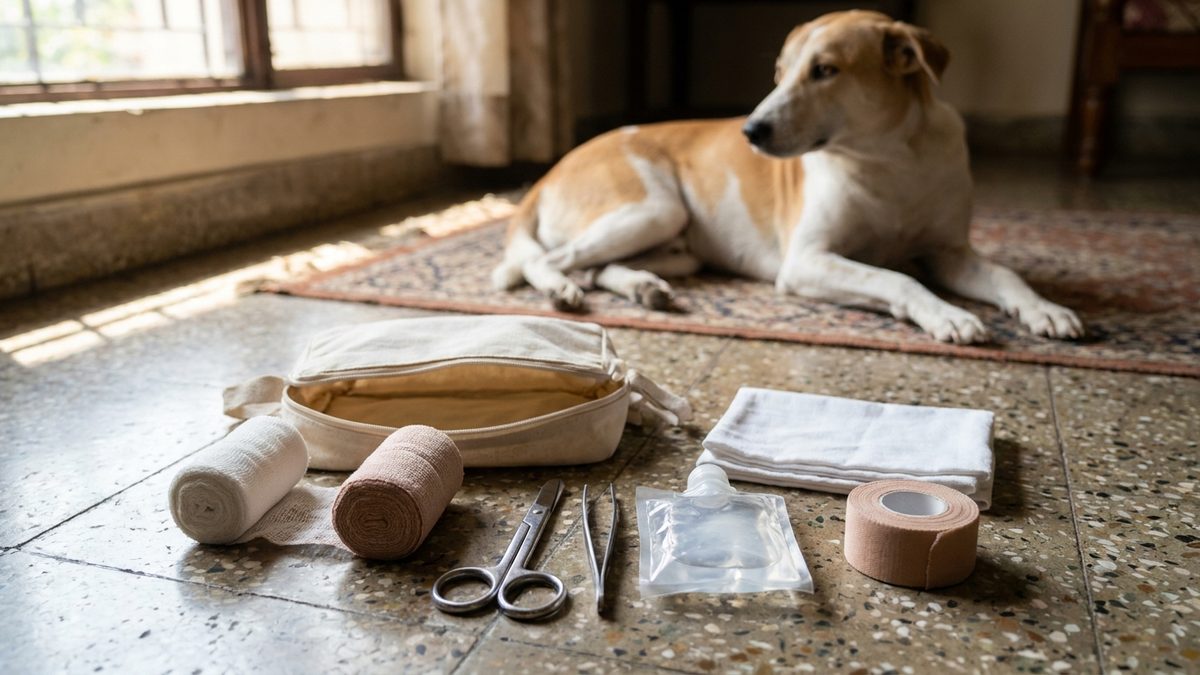
Assemble a kit that fits in one labelled box, because the difference between acting in the first minute and losing it to a search is knowing where the scissors are. Every item below earns its place by appearing in a named veterinary source's own list.
PDSA's published list for a pet first aid kit runs to bandages, blunt-ended scissors, wound wash, cotton wool, tweezers, tick tweezers, wound dressing, self-adhesive tape, dressings, vinyl gloves, a foil blanket, antiseptic wipes, and a blanket to use as a stretcher. That last entry is the one worth noticing: the blanket is kit, not furniture, because it is your stretcher.
| Item | What it is for | The mistake it prevents |
|---|---|---|
| Sterile gauze pads and dressings, several | The compress that goes under direct pressure, with more layers added on top if it soaks through | Tearing up a kitchen cloth while the animal bleeds |
| Self-adhesive bandage and medical tape | Holding the compress in place so your hands are free for everything else | One person trying to hold pressure and open a car door |
| Blunt-ended scissors | Cutting bandage and cutting hair or thread away from a wound | A pointed scissor tip in a struggling animal |
| Sterile saline | Flushing an eye and irrigating a wound | Tap water in an eye, or an undiluted antiseptic in one |
| Disposable gloves | Your own protection from blood and from whatever the animal walked through | Bare hands on a wound in a flat with no running water that minute |
| A muzzle, or a long soft bandage that can serve as one | Preventing the bite that a frightened animal in pain will deliver | An injury to you, which ends the rescue |
| A thick towel and a blanket | Restraining a cat, covering an animal in shock to prevent heat loss, and acting as a stretcher | Lifting a spinal-injured dog in your arms |
| A rigid flat object you have chosen in advance | The backboard for a suspected spinal injury | Five minutes spent looking for one |
| A cardboard box with a lid | Transporting a cat or a small dog without it bolting in the car | A frightened cat loose under the driver's pedals |
| A torch | Looking into a mouth, at a gum colour, or at a wound during a power cut | Assessing a pale gum by the light of a phone you are also trying to call on |
| Tweezers and a tick remover | Ticks and splinters, which is the kit's everyday job | Pulling a tick with fingers |
| A written card: your vet, the after-hours number, the 24-hour hospital address, your animal's weight | The two things a clinic asks first, available when you cannot think | Hunting for a number while holding a bleeding animal |
What we could not price, and why we are not guessing
We set out to price this kit from Indian pharmacy listings and could not do it to a standard we would publish. The Apollo Pharmacy product pages we tried on 22 October 2026 rendered their prices through scripts that did not return a figure we could read and stand behind, and a category-listing snippet is not a price we have verified. So this page carries no rupee total for the kit, and anyone quoting you one should be asked where it came from.
What we can say is where the items come from, which is the useful half. Every item above except the muzzle and the tick remover is a general human pharmacy item available at any Indian chemist, and the blanket, towel, cardboard box, torch and rigid board are already in your home. The kit is mostly an act of collection rather than an act of purchase. Keep it in one box, tell everyone in the house where it is, and check the saline's expiry once a year, because a bottle opened in the monsoon and forgotten is not sterile by the next one.
Heat and humidity are what will actually degrade this kit. Adhesive tape loses its grip in a humid Mumbai or Kolkata flat, sterile packaging that has been damp is not sterile, and a kit stored on a sunlit balcony shelf through a Chennai summer is not the kit you packed. Keep it inside the house, off the floor, out of the bathroom, and away from the window.
What to tell the vet on the phone while someone else drives
Give the clinic six things in the first thirty seconds: the species and weight, what happened and when, whether the animal is conscious and breathing, the gum colour, what you have already done, and your arrival time. Everything else can wait until you are there.
Telephone before you leave the house, or from the car, because most clinics can prepare for your arrival, direct you to a closer emergency facility, or give critical phone guidance for the specific emergency in front of you. VIN's instruction is the same and adds the reason: get precise directions, drive directly, and call to let them know you are on the way. A clinic that knows a road-traffic case is fifteen minutes out has a table cleared and a drip run.
- Say the species, the breed type and the weight in kilograms. Weight is the number every drug dose divides by, so give the real one, not last year's.
- Say what happened and at what clock time. Not twenty minutes ago; say the time you last knew the animal was fine and the time you found it.
- Say whether the animal is conscious, responding, and breathing, which is the Dr ABCs assessment you already made.
- Say the gum colour in plain words. Pink, pale, white, blue or brown. This is the single most useful observation an untrained person can hand a clinician.
- Say what you have already done. Pressure held for how long, what you put on the wound, whether you muzzled, whether anything was given by mouth.
- Say when you will arrive and from which direction, and ask whether to come to that clinic at all.
Ask one question before you hang up, which is what would make them send you somewhere closer instead. The answer tells you whether you are driving to care or driving past it. Ask too whether the case needs immediate attention on arrival or whether you will be waiting, because that changes how you handle the animal in the car park.
If the emergency is something swallowed rather than something broken, the four numbers a clinic needs are different, and our guide to foods toxic to dogs sets them out: weight, quantity, concentration and elapsed time. Use that script for a poisoning and this one for an injury.
Have the money conversation in advance rather than at the counter at one in the morning. Our guides to what a vet visit costs in India and building an emergency vet fund cover the deposit, which is what actually decides whether treatment starts, and many small-town clinics do not take a card.
CPR on a dog or cat at home, answered honestly
CPR on a dog or cat rarely works, and that is the honest answer to the question people most want a procedure for. Under 6 percent of dogs and under 20 percent of cats that experience cardiopulmonary arrest survive to hospital discharge, against over 20 percent of people.
Those figures are the RECOVER Initiative's own, published on the page introducing the 2024 veterinary CPR guidelines. RECOVER exists because, before evidence-based guidelines and standardised training arrived in human medicine, human survival was similar to the animal figures. The gap is a training gap, not a biological one. Over 113,000 people have completed RECOVER's online CPR training and over 38,000 have gone on to in-person certification as RECOVER Certified BLS or ALS Rescuers.
Blue Cross draws the conclusion for owners explicitly, and it is the only welfare body in this set that does. Its veterinary-approved advice states that CPR in pets is rarely successful even when performed in a hospital, so it is not recommended to attempt it at home, and that if a dog has collapsed you should not delay taking it to the vet, because getting there immediately gives the best chance of recovery. We are repeating that rather than softening it. A page that teaches chest compressions to an untrained reader is selling a feeling of control in exchange for minutes.
That is the useful conclusion for a reader in India. Chest compressions learned from a web page at the moment you need them are not the intervention that changes the number; the training is. If you want to be able to do this, do the course before the night you need it, and note that RECOVER published its 2026 First Aid Guidelines for Dogs and Cats specifically for people who are not medical professionals.
In the meantime, an animal that has stopped breathing needs a clinic and needs it in minutes, and the thing that most improves its odds is that the car is already moving and the hospital already knows. If a second person is in the house, one drives and one stays with the animal. If you are alone, the drive wins.
Do not put your fingers into the mouth of a seizing animal. Dogs and cats do not swallow their tongue during a seizure, and you will be bitten. The same caution applies to blind finger sweeps in a choking animal, which push an object deeper. Seizures are covered on our page on epilepsy in dogs.
What this page cannot tell you, and where we looked
Three questions behind this page have no answer we could source, and saying so is part of the answer, because an invented figure here would be acted on by somebody at two in the morning.
There is no Indian denominator for what actually happens in Indian homes
We went looking for a study describing which emergencies dogs and cats in India actually present with, and found none. Searches on 22 October 2026 returned Canadian, Romanian, Italian and Brazilian retrospective series and Indian single-case reports, which is the same gap our guide to foods toxic to dogs recorded for poisoning the previous day. Every claim on an Indian page about the commonest pet emergency in India is therefore either borrowed from a foreign dataset or unsourced, and the 223-case figure we use above is Canadian and labelled as such. If an Indian veterinary teaching hospital has published its emergency caseload, we would rather print it than keep this paragraph.
One government document we could not open
The Department of Animal Husbandry and Dairying's Rajya Sabha answer on Mobile Veterinary Units, at dahd.gov.in/sites/default/files/2024-10/RS1006.pdf, returned HTTP 403 Forbidden on this attempt, 22 October 2026. The 1962 figures on this page therefore come from the Press Information Bureau release, Kerala's Animal Husbandry Department and the service operator, all three of which we did read, and all three of which describe the scheme in livestock terms.
The ambulance picture is a snapshot and will move
The Arham Always Care city list we read on 22 October 2026 is a live page that changes. Treat the geography above as the shape of the thing, heavily concentrated in Gujarat and Maharashtra with a single Delhi listing and partner services in the southern metros, rather than as a directory. Check the current list before you rely on it, and remember what it is for, which is street animals.
An Indian emergency caseload series with a denominator, a verified Indian retail price list for the kit, or a pet ambulance service with published coverage and published fees for owned animals in an Indian metro. We did not find the third, and the absence is the finding.
Everything above is general information and none of it replaces an examination by a veterinary surgeon. Bonbeno names no drug and no dose. First aid buys you the drive, and the drive is the point.
Common questions
How can I provide first aid to a pet?
Work through Dr ABCs in order: danger to yourself first, then response, airway, breathing, circulation, and send someone for help. Restrain the animal with a muzzle or a towel before you examine it, control bleeding with firm direct pressure that you do not lift to check, move the animal on a flat rigid support rather than in your arms, cover it with a blanket, and telephone the clinic while you travel.
What first aid is safe for dogs?
Direct pressure on a bleeding wound, cool water on a fresh burn, covering with a blanket, and careful immobilised transport are all safe and useful. Inducing vomiting, giving any human painkiller, applying ghee, oil, turmeric or toothpaste, putting ice on a burn, pulling out an embedded object and sweeping your fingers through a mouth are not. Nothing you do at home treats the injury; it only keeps the animal stable for the drive.
How can I treat my dog's injury at home?
You do not treat it at home, you stabilise it for the journey. Protect yourself, press a clean cloth firmly over any bleeding and add layers rather than lifting it, keep the dog as still as possible, cover it to prevent heat loss, and get it examined. A dog that walks away from a vehicle impact can still have internal bleeding, a collapsed lung or a spinal injury that shows no external sign at first.
What is the safest way to carry a dog?
Slide the dog onto a large towel, blanket or rigid board rather than lifting it in your arms, supporting the head, neck and back as one unit with one arm under the head and shoulders and another under the pelvis. Hold the four corners, bend your knees, and walk slowly without jolting. PDSA advises not lifting a pet over about 15 kg alone, so call a second person before you start.
How to lift a dog that can't walk?
To lift a dog that cannot walk, first suspect a spinal injury and immobilise rather than carry. Get a firm flat support such as an ironing board, a piece of plywood, a table leaf or a collapsed cardboard box, grasp the skin over the back of the neck and over the small of the back, slide the dog onto it keeping the back and neck straight, and tie or tape it in place. If tying makes the dog struggle, use a blanket as a stretcher instead.
What is the ambulance number for animals?
India's toll-free animal helpline is 1962, and it is a livestock service rather than a pet one. The Press Information Bureau describes it as the number for farmers and dairy owners to use mobile veterinary vehicles, funded at one unit per one lakh livestock population. Free NGO animal ambulances exist in many Indian cities, including a network of 48 across 26 or more cities, but those are dispatched for injured street animals. For your own pet, plan on your own vehicle.
My dog ate a 500mg paracetamol. What should I do?
Telephone a veterinary surgeon now with your dog's weight, the tablet strength and the clock time, and take the strip with you. Whether 500 mg matters depends entirely on the dog's size, because signs in dogs are not generally observed below 100 mg/kg, which one 500 mg tablet does not reach in a 10 kg dog but does approach in a 5 kg one. Do not induce vomiting unless the vet tells you to, and do not give a second tablet for any reason.
How much paracetamol can you give a dog?
None on your own judgement, although a veterinary surgeon may prescribe it. In a survey of 450 UK veterinarians only 8 had never prescribed paracetamol to a dog, and the recommended therapeutic dose is recorded as 10 to 15 mg/kg every 8 hours. An Indian household tablet of 500 or 650 mg is sized for a 60 kg adult and cannot be divided accurately enough to land inside a dog's range, which is why this is a prescription and not a kitchen calculation.
What can I give my dog to stop bleeding?
Nothing given by mouth stops bleeding, and the answer is pressure rather than a product. Hold a clean cloth or sterile gauze firmly over the wound, add more layers on top if blood soaks through, and do not lift it to look, because that disrupts the clot you have just formed. Elevate a bleeding leg above heart level while keeping the pressure on. If blood is visibly spurting, drive now.
Will a dog stop bleeding on its own?
Minor bleeding often does, and that is not the question worth asking. Loss of as little as 2 teaspoons per pound of body weight can put a dog into shock, and internal bleeding produces no visible blood at all. Watch instead for pale or white gums, cold ears, feet or tail, weakness, a swollen belly and difficulty breathing. Any of those means the clinic now, whether or not you can see blood.
How do I give my dog CPR at home?
CPR learned from a web page at the moment you need it rarely changes the outcome, and the honest figures explain why. Under 6 percent of dogs and under 20 percent of cats that suffer cardiopulmonary arrest survive to hospital discharge. The intervention that moves that number is trained, certified CPR, which is why the RECOVER Initiative runs owner-level courses. If your animal has stopped breathing, the car and the phone call are what you have.