
Dog and cat health guide
How to choose a vet in India: registration, qualifications and what to watch on the first visit
Four state councils publish a practitioner list you can check and a fifth publishes its defaulters. The national register lists 29 editions and serves none of them. Here is what you can actually verify, and what you have to judge for yourself.
Quick answer
How to choose a vet in India starts with one check anyone can make. Only a registered veterinary practitioner may practise, the qualification is a veterinary degree recognised under the Indian Veterinary Council Act, and several state councils publish a register that shows whether a registration is current or lapsed. Then judge the first visit. Watch the handling, the weighing scale, the written record, and how the vet behaves when you raise a referral or a second opinion.
This guide is general information for Indian pet owners and is not a diagnosis. Always consult a registered veterinarian near you before acting on anything you read here, and treat any sudden change in your pet's condition as urgent.
The one qualification an Indian vet must hold, and the statute that creates it
An Indian vet must be a registered veterinary practitioner, which means holding a recognised veterinary degree and having that name entered on a State veterinary register under the Indian Veterinary Council Act, 1984. Section 30 of that Act is the whole of the legal test.
Section 30 provides that no person other than a registered veterinary practitioner shall hold office as a veterinary physician or surgeon in government or a local authority, or practise veterinary medicine in any State. Section 29 gives the other half: a person on the register is entitled, according to his qualifications, to practise and to recover his fees in law. Everything else on a clinic board is detail. This is the line.
There is one carve-out and it is narrow. A State Government may permit a holder of a diploma or certificate of veterinary supervisor, stockman or stock assistant to render minor veterinary services, and only under the supervision and direction of a registered veterinary practitioner. The Act's own Explanation defines minor veterinary services as preliminary veterinary aid, naming vaccination, castration and dressing of wounds. Our guide to periodontal disease in dogs and cats works through what that carve-out does and does not cover for one procedure.
The Supreme Court settled the question in 2007. A group of non-graduate practitioners challenged section 30 as unconstitutional, arguing they had an accrued right to carry on as before. The Court dismissed the petition and the connected appeal, holding that the right to practise had expressly been taken away upon laying down an essential qualification which the petitioners did not possess. It added that a higher qualification cannot be called unreasonable merely because people with lesser qualifications are excluded, given that new diseases and new techniques keep arriving.
The letters that are veterinary qualifications, and the letters that are not
The Act's First Schedule lists every recognised Indian qualification against the exact abbreviation a practitioner may use when registering, and the Second Schedule does the same for qualifications granted outside India. That schedule is the authority for what the letters mean. Anything outside it is not a recognised veterinary qualification, however medical it sounds.
| Abbreviation | What it stands for | Where it comes from |
|---|---|---|
| B.V.Sc. & A.H. | Bachelor of Veterinary Science and Animal Husbandry | The standard Indian primary degree, granted by most of the universities in the First Schedule |
| B.V.Sc. | Bachelor of Veterinary Science | The older Indian form, still listed for several universities in the First Schedule |
| B.V.A.Sc. and B.Sc. (Vet.) | Bachelor of Veterinary Animal Science, Bachelor of Science (Veterinary) | Two less common Indian variants, each tied to named universities in the First Schedule |
| G.V.Sc., G.B.V.C., G.M.V.C., L.V.P. | Graduate in Veterinary Science, and the graduate or licence awards of the old Bengal, Bihar, Bombay and Madras veterinary colleges | The First Schedule's diploma section, historical awards from before the degree era, L.V.P. conferred before 15 August 1947 |
| M.R.C.V.S., B.Vet.Med., B.V.M. | Member of the Royal College of Veterinary Surgeons, Bachelor of Veterinary Medicine | The Second Schedule, for qualifications granted by named institutions outside India |
| M.V.Sc., Ph.D. | Master of Veterinary Science, doctorate | Postgraduate awards, recorded as an additional qualification against an existing registration under section 26, never a substitute for the primary degree |
In practice almost every board you read in India will carry the same five letters. A board that reads B.V.Sc. and A.H. is telling you the holder has the standard Indian primary veterinary degree, and that is the qualification the whole system is built on.
Two things follow for a reader standing in front of that board. A postgraduate degree is an addition to a registration, not a registration in itself, because section 26 lets a registered person have a postgraduate degree or diploma entered against a name already on the register. And letters from outside these schedules, including human medical qualifications, nutrition certificates and training diplomas, tell you nothing about whether the person may legally treat your animal.
Section 56 makes it punishable to take or use the description of a veterinary practitioner without being registered, or to use a degree, diploma, licence or abbreviation indicating a qualification the person does not possess. Section 57 does the same for practising unregistered. Both carry a fine up to one thousand rupees on a first conviction and up to six months or five thousand rupees after that, figures fixed in 1984 and not revised in the bare Act.
How to check whether a vet is on the register
To check whether a vet is on the register, go to the State veterinary council where the practitioner is registered, not to the national council. The national register exists in law and is not published in any form you can download; the state registers are where a member of the public can actually verify a registration number.
The Indian Veterinary Practitioners Register, the IVPR, is created by section 23. It contains the names of everyone holding a recognised veterinary qualification who is for the time being enrolled on a State veterinary register, and sub-section (3) says in terms that it is deemed to be a public document within the meaning of the Indian Evidence Act, 1872. It is meant to be open.
In practice it is not reachable online. The Veterinary Council of India's own IVPR page lists 29 editions, from the 1994 register through the 2023 one, in a three-column table whose third column is headed File Download. Read on 22 October 2026, across both pages of that table, every cell in the File Download column was empty, in the rendered page and in the page source alike. The national register is listed and not served.
The Act anticipated paper rather than portals, and the right it gives you is still live. Section 51 requires the Registrar of each State Veterinary Council to have copies of the State veterinary register printed each year as it stood on 1 April, and provides that such copies shall be made available to persons applying for them on payment of a charge not exceeding ten rupees, and shall be evidence that the persons named in them were registered on that date. A ₹10 statutory entitlement to a certified snapshot of who was registered is the strongest verification tool a pet owner in India has, and almost nobody uses it.
What the register tells you that a degree certificate does not
A degree is permanent. A registration is not. Section 48 lets a State Government require a renewal fee every five years, and provides that where the fee is not paid the Registrar shall remove the name of the defaulter from the State veterinary register. Section 49 adds removal for entries made by error or misrepresentation, for conviction of an offence involving moral turpitude, and for violating the code of ethics.
So a register lookup answers a question a framed certificate cannot: is this person currently registered, today. That is why several state councils publish a renewal status beside each name, and why Kerala publishes a separate defaulters list of practitioners whose renewal is pending, with a warning that names will otherwise be removed from the State Veterinary Register. Renewal is not free either. Haryana's published schedule puts the renewal fee at Rs 1,515, with a late fee of Rs 200 per month once a registration has expired, which is part of why lapsed entries are common rather than rare.
Dismissing the challenge to section 30, the Court observed that unless a name is on the register it may not be possible for the State or the Veterinary Council to keep a watch on performance, particularly when a complaint is made, and that only once a name is on the register does the question of striking it off for misconduct arise. Registration is not paperwork. It is the thing that makes a complaint possible.
What each state veterinary council actually publishes
What a state council publishes varies from a searchable name lookup to a single annual PDF, and the difference decides how hard your check will be. We opened five state councils and the national council on 22 October 2026 and recorded what each one served.
This table is a snapshot of six sites on one day, not a survey of all 30-odd councils. Treat it as a method rather than a map: look for the same things on your own state's site.
| Council | What is published | What you get |
|---|---|---|
| Tamil Nadu State Veterinary Council | A live search on the home page, by name, council registration number, date of birth, mobile number or IVPR serial number | The strongest of the six. A search by one common first name returned 50 rows, each with the name, the father's name, the council number, a valid-upto date and a renewal status printed as VALID or INVALID |
| Karnataka Veterinary Council | An updated list of active practitioners, a separate active list with validity, and year-wise PDFs covering registration numbers from 1 to 6,634 | Downloadable registers in which entries carry a status such as active valid or deleted not renewed, with a renewal date |
| Maharashtra State Veterinary Council | A paginated web table headed NAME OF PERSONS REGISTERED UNDER M.S.V.C., NAGPUR, with an export option | 7,039 entries over 352 pages, each with a registration number, name, address, a due date and a remark reading Valid |
| Haryana Veterinary Council | One PDF, titled List of Valid Registered Veterinary Practitioners, updated till 12 June 2026 | A single dated file you download and search yourself |
| Kerala State Veterinary Council | A defaulters list of practitioners with pending renewal, plus an online services portal | The inverse check. You confirm a name is absent from the defaulters list rather than present on a register |
| Veterinary Council of India, national | A table of 29 IVPR editions, 1994 to 2023, with a File Download column | Nothing. Every File Download cell was empty on both pages of the table |
One number in that table does not reconcile, and we are publishing the disagreement rather than resolving it. Maharashtra's list holds 7,039 entries. The Department of Animal Husbandry and Dairying told the Lok Sabha in August 2022 that Maharashtra had 9,971 registered veterinary practitioners. The published list does not say whether it covers only current registrations, only a date range, or something else, and no note on the page explains the gap. Read it as a list to search, not as a count of the profession.
The five-minute check, in order
- Read the registration number off the clinic board, the prescription or the visiting card. The code of ethics contemplates it being there, which the next section explains.
- Open your state veterinary council's site and look for a search box, a register PDF or a defaulters list, in that order of usefulness.
- Match the number and the name, then read the renewal status or the valid-upto date beside it rather than stopping at the name.
- Ask at the counter if nothing is published online. Section 51 entitles you to a printed copy of the State veterinary register for a charge of not more than ten rupees, and the registrar's office is where you apply.
- Verify the state, not the city. A practitioner who has moved states transfers the registration under section 52, so a vet who qualified in Mumbai and now practises in Chennai may sit on either register.
Treat an absent name as a question, not a verdict. A list can be out of date, a transfer can be in progress, and a spelling can defeat a search box. Ask the practice before you conclude anything, and remember that the person treating your animal may be legitimately registered in a different state from the one you are searching.
What a clinic board is allowed to say
A clinic board in India is allowed to carry a short, closed list of things, and the Veterinary Council of India's 1992 code of ethics sets it out. Reading the board against that list is a faster filter than reading a website.
That code was notified in the Gazette of India at New Delhi on 1 April 1992 and it still governs. Clause 8 of its professional misconduct list makes it misconduct, while displaying a board or a name plate, to write anything other than the practitioner's name, qualifications obtained from a University or a statutory body, titles and the names of a speciality if any, and the registration number. Five items. A board carrying superlatives, unverifiable claims or qualifications from neither a university nor a statutory body is outside what the code permits, and the registration number is something the code expects to find there.
Four neighbouring clauses are worth knowing because each describes a practice you can observe in an afternoon.
- Secret remedies. Clause 12 makes it unethical for a veterinarian to prescribe or dispense a secret medicine or remedial agent whose composition or manufacture is unknown to them. Unlabelled powders and unnamed mixtures are the Indian form of this, and you are entitled to ask what is in them.
- Open shop. Clause 10 bars a veterinarian from running an open shop for the sale of medicine, dispensing prescriptions written by other doctors. Dispensing what the practice itself prescribes is normal. Running a pharmacy counter for everyone else's prescriptions is not.
- Unqualified staff. Clause 23 says a veterinarian should not employ, in connection with professional practice, any unqualified personnel to treat or perform operations on patients. This is the clause behind the single most useful question in this article: who will actually perform the procedure.
- Touts. Clause 10 of the misconduct list makes using touts or agents to procure patients professional misconduct, and clause 7 makes it misconduct to affix a signboard on a chemist's shop or anywhere the veterinarian does not reside or work.
Speciality in India means something specific, and it is broader than you think
India has no board certification in a body system. The Veterinary Council's draft postgraduate regulations list the disciplines in which an M.V.Sc or doctoral degree is granted by colleges and universities, and there are 19 of them: Veterinary Anatomy, Physiology, Biochemistry, Biotechnology, Pharmacology and Toxicology, Parasitology, Microbiology, Immunology, Pathology, Public Health and Epidemiology, Animal Nutrition, Animal Genetics and Breeding, Livestock Production Management, Poultry Science, Livestock Products Technology, Theriogenology, Veterinary Surgery and Radiology, Veterinary Medicine, and Veterinary and Animal Husbandry Extension Education.
Read that list against the words people use on websites. There is no cardiology, no dermatology, no oncology, no ophthalmology, no small-animal medicine and no behaviour on it. The three that touch a dog or a cat in a consulting room are Veterinary Medicine, Veterinary Surgery and Radiology, and Theriogenology, and each is broad. Our guide to separation anxiety in dogs in India works through what the absence of a behaviour discipline means for one specific problem.
None of that makes an Indian vet with a declared interest in cardiology a fraud. Deep interest, fellowships, overseas training and years of caseload are all real and none of them is a registrable speciality here. The practical move is to ask what the interest is built on rather than to treat the word as a credential: how many of these cases a month, what equipment is on site, and who they refer to when it goes beyond them.
Small-animal practice against a mixed caseload
A small-animal practice sees dogs and cats all day; a mixed practice divides its week between livestock and pets. Both are staffed by the same qualification, so the difference is caseload and equipment rather than credentials, and caseload is what you are actually shopping for.
Indian veterinary training is deliberately broad. The primary degree is a Bachelor of Veterinary Science and Animal Husbandry, and the Act's own schedules make no distinction between a small-animal and a large-animal award. One registration covers a buffalo and a Shih Tzu.
The scale of the profession is still described in livestock terms. When the Department of Animal Husbandry and Dairying reported the register to Parliament in August 2022, it gave 73,129 registered veterinary practitioners as on 31 March 2020, across 54 recognised veterinary colleges, and set the state-wise counts against cattle units per veterinarian, a national figure of 4,616. The later official count is 81,938, compiled by the Veterinary Council of India as on 31 March 2023 and given to the Rajya Sabha on 28 July 2023. That is the denominator the profession is measured by, and it tells you what most Indian veterinary careers are built around. Our guide to what a vet visit costs in India covers how the government and college networks are organised and what each door charges.
None of this is an argument against a mixed practice. A vet who handles 40 calvings a year is often the most competent surgeon in a small town. It is an argument for asking the question out loud instead of guessing from the signage.
- Ask roughly what share of the caseload is dogs and cats, and how many of your animal's species the practice sees in a week.
- Ask which equipment is on site and which is sent out, because a clinic that sends every radiograph elsewhere works at a different speed.
- Ask what the practice does not do, which is the question that gets the most honest answer of any on this page.
- Ask who they refer to, by name of hospital, for orthopaedics, imaging and overnight critical care.
- Ask whether cats are seen in a separate space or a separate slot, because a cat in a waiting room full of dogs arrives at the table already frightened.
Nine things to watch on a first visit
To judge a practice on a first visit, watch what is done rather than what is said, because every item below is observable in twenty minutes and none of it requires you to know any medicine.
Book a routine appointment rather than waiting for a crisis. You cannot assess a clinic while your dog is collapsing in your arms, and a first visit for a nail trim, a weight check or a vaccination costs little and tells you most of what you need.
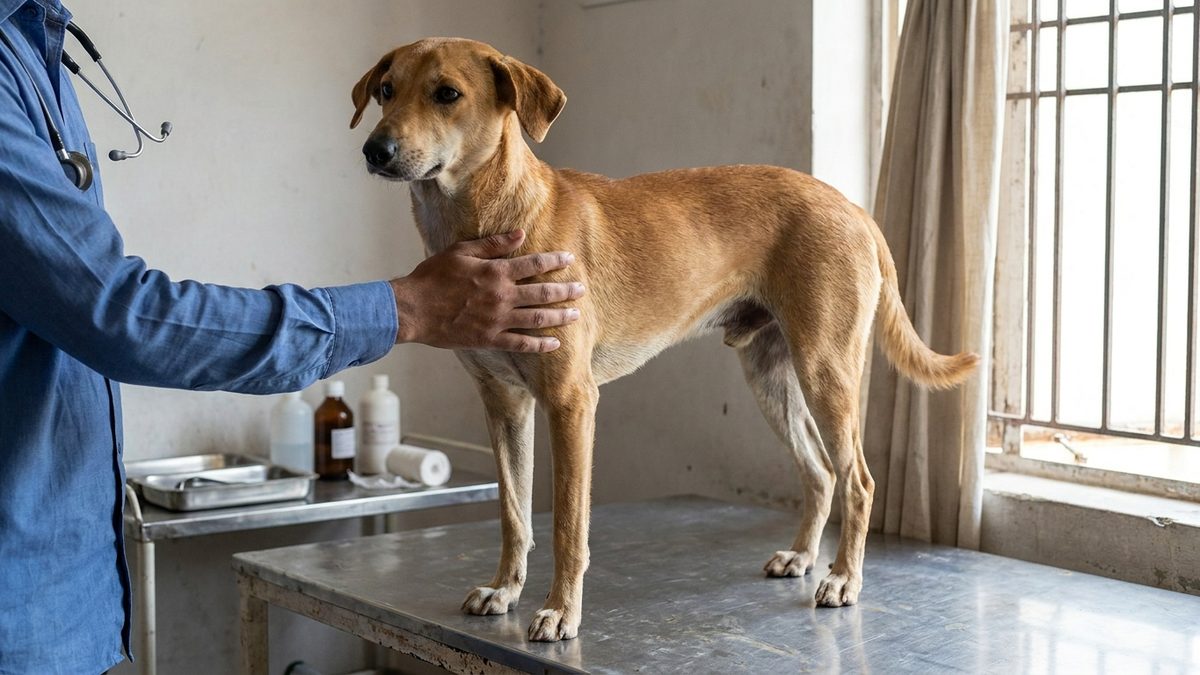
- Handling first. Watch the first thirty seconds. A vet who greets the animal, lets it settle and works at its level is doing something different from one who lifts a frightened dog straight onto a steel table. The code's own language is that the demeanour of a veterinarian towards the patient shall always be kind, tender and full of patience.
- A weight, every time. The WSAVA standardises five vital assessments in the physical examination, temperature, pulse, respiration, pain assessment and nutritional assessment, and the nutritional screening evaluation is performed on every patient, using a consistent method to measure body weight, body condition score and muscle condition score so that change over time can be read. A practice that does not weigh your animal cannot dose it accurately or notice it is wasting.
- A full examination. Ears, eyes, mouth, chest, abdomen, skin and joints, in an order the vet repeats every time. A consultation conducted entirely across a desk is not an examination.
- Case records kept and shared. Ask whether the practice keeps a file and whether you can have a copy of today's entry. A practice that writes nothing down has nothing to hand over later.
- A diagnosis in writing. Ask the vet to write down what they think is wrong, not only what to give. The code requires a veterinarian to neither exaggerate nor minimise the gravity of the condition and to ensure the owner knows enough about it to serve the animal's interest, and a written line is how you hold that.
- Written consent before an operation. Clause 9 of the misconduct list makes it professional misconduct to perform an operation without obtaining the client's consent in writing. A consent form handed to you to read is a good sign, not a bureaucratic one.
- Who performs the procedure. Ask directly. Clause 23 bars a veterinarian from employing unqualified personnel to treat or operate on patients, and the answer should be a named registered person.
- A referral answer. Ask what happens if this turns out to be beyond the practice. A vet who names a hospital and a person is telling you they have a network; a vet who says it never happens is telling you something else.
- The out-of-hours arrangement, in specifics. Not whether they handle emergencies but who picks up at 2 am, at which number, at which address, and whether an animal can be admitted overnight with someone physically present. Our guide to building an emergency vet fund covers the money side of that night.
The weighing scale is the cheapest test in the building
Weight is the one measurement that costs nothing, takes ten seconds, and underpins almost every clinical decision that follows. Doses are calculated on it. Weight loss between visits is often the first sign of chronic kidney disease, hyperthyroidism, diabetes and cancer. A body condition score written in the file turns a vague impression into a number you can compare next year.
So the weighing scale works as a proxy. A clinic that weighs every animal, writes the number down and reads it back to you next time is running a system. A clinic that estimates weight by eye is not, and the practices that skip the free measurement rarely do the expensive ones better.
Clause 8 of the code requires that remuneration be in the form and amount specifically announced to the client at the time the service is rendered. What that entitles you to ask for, and the words to use, is set out in full on our guide to what a vet visit costs in India, which also carries the published fee lists this page deliberately does not repeat.
Low-stress handling: what certification exists, and what it is worth
One recognised certification in low-stress handling exists and it is American, not Indian. Fear Free certifies individuals rather than buildings, the badge is real and checkable, and it is not a substitute for watching how your animal is actually handled.
The Fear Free Veterinary Professional Certification Program for canine and feline practice runs to 30 modules. Candidates must pass each one at 80 percent or higher, sign and uphold the Fear Free Pledge, and keep an active membership, which is renewed annually; the programme carries 7 hours of RACE continuing education and costs 299 US dollars in the first year and 149 US dollars a year to renew. Certified individuals may opt in to a public directory.
Three limits matter before you treat it as a filter. It certifies a person, so one certified vet in a six-person practice does not make the practice Fear Free unless the practice has been separately certified. The directory is opt-in, so absence from it proves nothing. And there is no Indian equivalent: none of the 19 disciplines in which an Indian postgraduate veterinary degree is granted covers handling, behaviour or welfare practice.
Indian clinic chains have begun advertising Fear Free certified staff on their own marketing pages, which is a claim rather than a verification. If a practice makes it, ask which named individuals hold the certification and when they last renewed. Bonbeno does not recommend particular clinics or chains, and a badge on a website is not a reason to choose one.
What low-stress handling looks like when nobody is certified
- Non-slip surfaces. A towel or a mat on the table, rather than a cat sliding on steel.
- Food during the examination. A smear of something the animal likes, offered while the vet works, is standard counter-conditioning rather than indulgence.
- Separation of species and of noise. Cats away from barking, and a quiet corner for an animal that is already frightened.
- Examination where the animal is. Many small dogs and most cats can be examined on the floor or in the bottom of an opened carrier.
- Stopping. A vet who pauses, changes approach or reschedules a non-urgent procedure when an animal is panicking is making a clinical decision, not giving up.
- Honest talk about sedation. For a genuinely terrified animal, light sedation for a procedure is often the kinder option, and it is a veterinary decision made on your individual animal, never from a page like this one.
Second opinions and changing vets
To get a second opinion, say so plainly and take your records with you, because the Veterinary Council of India's code already treats further advice as the client's right and puts most of the obligations on the two veterinarians rather than on you.
Clause 33(4) of the code states that it shall be open to the client to take further advice, and that the consulting veterinarian may, with the client's consent, consult yet another veterinarian, the rules of ethics remaining the same. That is the permission, written into the professional code, in the client's favour.
The code then constrains how the second vet behaves. Clause 33(1) requires that in consultation there be no place for insincerity, rivalry or envy, that due respect be shown to the veterinarian in charge of the case, and that no statement or remark be made which would impair the confidence the client has placed in them. Clause 32 says the benefit of the patient is of prime importance in every consultation and that it should not be done with an ulterior motive of evading responsibility or on monetary considerations.
The external position is the same. A veterinary school's own guidance describes second opinions as a normal part of good veterinary care rather than an insult, notes that primary vets often suggest them for complex cases and typically stay involved afterwards, and makes the point that open communication with your current vet usually makes the process smoother.
The clause that surprises people: the second vet is not supposed to take over
Clause 36 provides that when a consultant veterinarian is called upon to be consulted, none but the rarest and most exceptional circumstances justify the consultant taking charge of the case, and that they must not do so merely on the client's solicitation. Read that before you go in. A second opinion is an opinion; a transfer of care is a separate decision you make afterwards, and a second vet who declines to take your animal on the spot is following the code rather than brushing you off.
Clause 37 cuts the other way and is worth knowing: no veterinarian shall have consultation with a veterinary practitioner who is not registered. If a practice refuses to discuss your animal with the person who treated it last, that may be the reason.
Changing practices, and getting the case records out
- Decide whether you want a second opinion or a change of practice. They are different requests and conflating them is what makes the conversation awkward.
- Collect the paperwork you already hold: prescriptions, laboratory reports, imaging, discharge notes and vaccination certificates. Much of it is already in your file at home.
- Ask the current practice in writing for a copy of the case records and the reports. Our guide to what a vet visit costs in India sets out the clause of the code that governs what travels with a referred animal and the exact wording to use.
- Write a one-page timeline yourself: when the signs started, what was tried, what changed, what the animal weighs now. No clinic can reconstruct this and every clinic needs it.
- Tell both vets what you are doing. A practice that knows it is a second opinion will read the previous notes rather than repeat the previous tests.
Your vet also has obligations if the relationship ends from their side. Clause 15 provides that once having undertaken a case, a veterinarian shall not neglect the patient nor withdraw from it without giving the client notice sufficiently in advance to secure another professional veterinarian. Clause 16 lists the grounds on which a withdrawal is legitimate, among them that remedies other than those prescribed are being used, that advice is being refused, or that the client is resorting to quackery against veterinary advice. That is a fair deal in both directions, and it is worth knowing which side of it you are on.
The code requires a statement of the history, observations, clinical and laboratory examination and tentative treatments when a patient is referred, and the Supreme Court has pointed out that the register exists precisely so that complaints about a registered practitioner can be heard and acted on. A practice that will not give you your animal's own test results has told you something useful about itself.
Is unqualified practice a real problem in Indian pet care?
The evidence that unqualified people treat pets in India is real but thin, and we would rather say so than inflate it. No prevalence study exists. What exists is a statute with penalties, a Supreme Court judgment, council complaint machinery and local reporting.
Start with what we could not find. There is no published Indian study measuring how many people treating companion animals are unregistered, no national audit, and no dataset that would support a percentage. Any page giving you one has made it up.
What is on the record is narrower and more specific. In Pune, the municipal corporation made registration with the civic body mandatory for all veterinary clinics in late 2023 after cases of unauthorised operation surfaced. The head of the corporation's veterinary department said the registration would help streamline and monitor vet clinics. Officials said they would cross-verify whether clinics hold the Maharashtra State Veterinary Council licence needed to operate one, and that many clinics were running without it. The same report records a criminal offence registered at Hadapsar after a pet died having been treated by an unqualified vet, and a similar case at Kondhwa.
That is two criminal cases in one city, reported by one newspaper, with no denominator attached. It is enough to establish that the problem exists and nowhere near enough to tell you how common it is.
Kolkata produced the second data point three months later, and this one came from a court. In February 2024 the Calcutta High Court observed that a regulatory authority should monitor private pet clinics in the state, after a petitioner complained that his cat had died because of what he called extremely careless and wrong diagnosis by a veterinary clinic. Reporting the reaction, The Times of India quoted the veterinarian Surajit Basu saying that pet parents need to consult qualified vets rather than a para-vet or a groomer, and the veterinarian Chandrakanta Chakraborty saying that several unauthorised clinics had sprung up during the pandemic. The same report carried the claim that at some clinics unregistered vets conduct surgeries.
Note what that is: an allegation in a petition, a court observation, and named practitioners describing what they see. It is testimony, not measurement, and we are presenting it as testimony.
The machinery assumes it happens. The Tamil Nadu State Veterinary Council publishes two separate complaint forms on its site, one headed Register of Complaint Against UVP Quacks, meaning unregistered veterinary practitioners, and one for complaints about the professional conduct of registered practitioners. NITI Aayog's 2023 report on veterinary telemedicine states the position flatly: the only major provision in India is that a registered veterinary practitioner can provide veterinary services, and any person other than a registered veterinary practitioner practising veterinary medicine is to be considered illegal veterinary practice, which is punishable.
Complaints about an unregistered person practising go to your State Veterinary Council, which under the Act investigates by receiving complaints, and to the police where an offence under sections 55 to 57 is alleged. Complaints about a registered practitioner's conduct go to the council's disciplinary committee, which the code establishes to consider cases of indiscipline referred by the State Veterinary Council. Keep the prescriptions, the bills and the records; a complaint without documents goes nowhere.
Bonbeno names no clinic and no individual, here or anywhere. The point of this section is not to make you suspicious of the profession. It is that the single check in this article which is both cheap and decisive, the register, exists precisely because the law anticipated the problem in 1984 and built the remedy around a name being on a list.
One clinic, or none: choosing where there is little to choose from
Where there is one clinic within reach, choosing a vet turns into a different job: building the best relationship you can with the practice you have, and knowing in advance where the second opinion and the emergency will come from. The India-specific options are a government veterinary hospital, a veterinary college hospital, and a remote consultation whose legal position is unsettled.
India has 54 recognised veterinary colleges and 81,938 registered practitioners as on 31 March 2023, and neither is spread evenly. The 2023 state list runs from 199 registered practitioners in Sikkim and 351 in Mizoram to 10,570 in Maharashtra, 6,907 in Uttar Pradesh and 6,245 in Tamil Nadu. The cattle-units ratio is only published against the earlier count, as on 31 March 2020, and on that basis runs from 170 units per veterinarian in Puducherry to 12,528 in Madhya Pradesh, a national 4,616. Whether choosing a vet is a choice at all depends almost entirely on which of those lines you live on.
The college list in the same answer is worth reading for a different reason: it tells you where the teaching hospitals are. Among the 54 are Mumbai Veterinary College in Mumbai, Madras Veterinary College in Chennai, Veterinary College Hebbal in Bangalore, now Bengaluru, the College of Veterinary Science in Hyderabad, and colleges at Ludhiana, Patna, Guwahati, Bhubaneswar, Jabalpur, Bikaner, Hisar, Thrissur and Agartala. Most pet owners never consider them. What several of them charge, and when they open, is set out in what a vet visit costs in India.
Government veterinary hospitals are the other door, and the honest description is that the medicine is often better than the building suggests. The constraint there is hours and queue rather than competence.
- Map the three nearest options now: your routine clinic, the nearest hospital that admits overnight, and the nearest veterinary college hospital. Save all three in your phone with addresses, not just names.
- Drive the route to the emergency option once, in daylight, before you ever need it at night.
- Keep your own copy of every record, because in a thin market the second opinion is often in another city and will arrive with nothing but what you bring.
- Build the relationship with the one clinic you have. A vet who knows your animal's baseline weight and temperament is worth more than a better-equipped stranger.
- Plan the money before the emergency, through our guides to building an emergency vet fund and pet insurance in India.
Veterinary telemedicine in India: there is no framework for your dog
This is the question we expected to answer with a rule and could not, because the rule does not exist. NITI Aayog's 2023 report, Telemedicine for Livestock Health and Safety, states that while telemedicine for human health has statutory support through the 2020 amendment to the Indian Medical Council regulations, for animal health framework and guidelines for practising telemedicine do not exist, and the only major provision is that a registered veterinary practitioner can provide veterinary services.
The report then proposes a framework, and it is a framework for livestock. It defines livestock by the FAO description and the Livestock Importation Act, 1898, which names horses, kine, camels and sheep. A pet dog or cat is outside its scope. So the position in October 2026 is that India has a proposed telemedicine framework that does not cover companion animals, and no adopted one that does, while a growing number of Indian services sell remote pet consultations.
The proposed principles are still the most sensible guidance available, and three of them are worth holding a remote consultation to. The professional judgment of the registered veterinary practitioner should decide whether a remote consultation is sufficient or an in-person physical review is required. The practitioner may stop at any stage and request an in-person examination. And any diagnosis made through telemedicine must sit within standard operating procedures vetted by the Veterinary Council of India.
A camera cannot take a temperature, feel an abdomen, check a mucous membrane colour or weigh an animal, and the WSAVA's five vital assessments include three that require hands. Use a remote consultation to decide whether and how urgently to travel, to review results you already hold, or to follow up a case the vet has already examined. Do not use one to manage a collapsing, bleeding, straining, seizing or non-breathing animal. Go, and call ahead from the road.
Ask the same registration question of a remote service that you would of a clinic. The consultation is veterinary practice wherever it happens, section 30 applies to it, and a platform that will not tell you which registered practitioner you are speaking to, and in which state they are registered, has answered the question.
Six signals worth acting on
Act on a signal when it recurs, not the first time it appears, because every practice has a bad day and the pattern is what matters. Each of the six below maps to something concrete in the law or the code rather than to a feeling.
- No registration number anywhere. Not on the board, not on the prescription, not offered when asked. The code contemplates it on the board and section 30 makes registration the condition of practising at all.
- Nothing is ever written down. No weight, no diagnosis, no file, no copy for you. A practice with no records cannot refer, cannot hand over and cannot be checked.
- Unnamed medicines. Powders and mixtures dispensed without a composition. Clause 12 of the code calls prescribing or dispensing secret remedies unethical.
- Procedures done by whoever is free. Clause 23 bars employing unqualified personnel to treat or operate, and the answer to who will do it should be a named registered person.
- A reaction to the words second opinion. The code gives the client the right to take further advice and tells veterinarians not to impair the confidence a client has in a colleague. Defensiveness here is a professional-conduct matter, not a personality quirk.
- No answer on out-of-hours care. Vagueness about who covers the night is the one gap that will cost you at the moment it matters most.
Set against those, the strongest positive signal is dull: a practice that weighs the animal, writes things down, tells you what it does not do, and names the person it refers to. That combination is rarer than a well-fitted-out waiting room and worth more.
Choosing a vet in India is therefore two jobs rather than one. The first is a verification you can complete from your phone in five minutes, using a state register, and it rules out the small number of cases where the law has been broken. The second is a judgment you make with your own eyes across two or three visits, and no register will ever make it for you.
Common questions
How do I check if a vet is registered?
Check with the State Veterinary Council where the vet is registered, not the national council. Tamil Nadu runs a live search by name or registration number that returns a valid-upto date and a renewal status. Karnataka, Haryana and Maharashtra publish downloadable or paginated lists, and Kerala publishes a defaulters list. Where nothing is online, section 51 of the Indian Veterinary Council Act entitles you to a printed copy of the State veterinary register for a charge of not more than ten rupees.
How many registered veterinary doctors are there in India?
There are 81,938 registered veterinary practitioners in India, the count the Veterinary Council of India compiled as on 31 March 2023 and the Department of Animal Husbandry and Dairying gave the Rajya Sabha on 28 July 2023. The earlier Lok Sabha answer of August 2022 gave 73,129, which is the register as on 31 March 2020, and that is the answer which also records 54 recognised veterinary colleges and sets the state-wise counts against cattle units per veterinarian, a national ratio of 4,616. Those registrations lapse if the five-yearly renewal fee is not paid, so the live number in any state is lower than the number ever registered.
How do I know if my vet is good?
Judge a vet on what is done rather than what is said. A weight and a body condition score recorded at every visit, a full hands-on examination, a written diagnosis you can take away, written consent before an operation, a named person who performs each procedure, a clear referral answer and a specific out-of-hours arrangement together tell you more than any review. The WSAVA treats nutritional assessment as the fifth vital assessment, performed on every patient.
What questions should I ask my vet for my first visit?
Ask what share of the caseload is dogs and cats, which equipment is on site and which is sent out, what the practice does not do, who it refers to by name for orthopaedics and overnight critical care, who will personally perform any procedure, and exactly who answers the phone at two in the morning. Ask for the registration number too, and ask for today's record in writing before you leave.
Can I go to a different vet for a second opinion?
Yes. The Veterinary Council of India's 1992 code states that it shall be open to the client to take further advice. Take your records, reports and imaging with you and write a one-page timeline yourself. Expect the second vet to give an opinion rather than to take over: the code says that only the rarest and most exceptional circumstances justify a consultant taking charge of a case, and never merely because the client asks.
What are the key characteristics of a good veterinarian?
The characteristics you can verify are registration on a State veterinary register, a recognised veterinary qualification from the Act's schedules, and a current renewal status. The characteristics you have to observe are calm handling, a complete physical examination, honest prognosis in terms you follow, records kept and shared, a willingness to refer, and no defensiveness about a second opinion. The code requires a veterinarian to neither exaggerate nor minimise the gravity of a condition.
What does B.V.Sc. and A.H. mean?
B.V.Sc. & A.H. stands for Bachelor of Veterinary Science and Animal Husbandry, the standard Indian primary veterinary degree. It appears in the First Schedule of the Indian Veterinary Council Act, 1984 as the abbreviation for registration against most Indian universities, alongside the older B.V.Sc. and the rarer B.V.A.Sc. and B.Sc. (Vet.). An M.V.Sc or a PhD is recorded as an additional qualification against an existing registration, never in place of the primary degree.