
Dog life guide
Collar or harness for dogs in India: what the research measures, and what your dog should wear
Pulling against a collar raises pressure inside the eye. Pulling against a harness does not. That single measured difference decides this question for more dogs than any argument about comfort, and almost no page written for the Indian market mentions it.
Quick answer
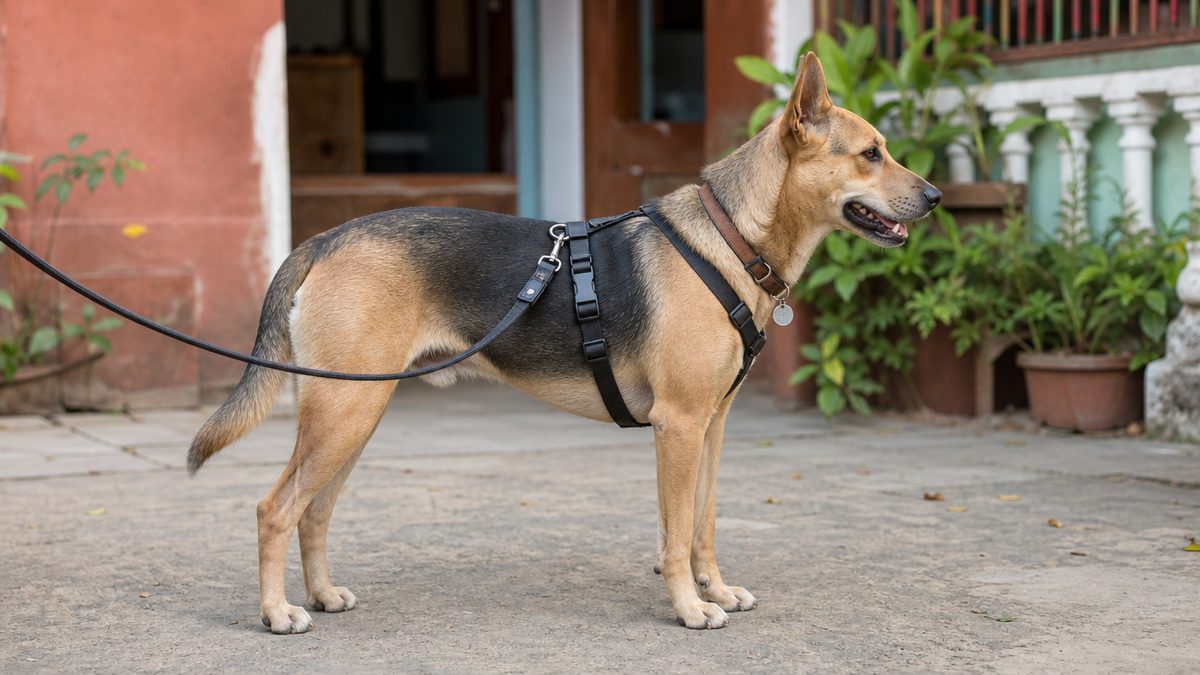
Collar or harness for dogs is settled by what the dog does on the lead, not by which is better. A collar raises eye pressure when a dog pulls and a harness does not, so a harness is the safer default for walking in India. Keep a flat collar on too, because Delhi and Mumbai both require the licence number or ticket on the dog's neck collar. A back-clip harness does not reduce pulling and a front-clip one does. Avoid choke chains, prong collars and shock collars.
This guide is general information for Indian pet owners and is not a diagnosis. Always consult a registered veterinarian near you before acting on anything you read here, and treat any sudden change in your pet's condition as urgent.
Which one your dog should wear, decided in one table
Your dog should wear a flat collar for identification and a harness on the lead, and the exceptions run the other way only for a dog that genuinely does not pull. That is the conclusion of the most recent peer-reviewed review of walking equipment, which examined 21 full-text articles and two abstracts and found no single best device.
The honest version of the collar or harness for dogs question is that it has four answers, not one, and the answer turns on whether your dog pulls, what shape its face is, and what your municipal corporation requires on its neck. The review's own summary states there is no one-size-fits-all device and that selection should consider the individual needs of guardian and dog.
| Your dog | What the review recommends | Why |
|---|---|---|
| Pulls hard on the lead | A non-tightening front-clip harness | It offers "the best balance between discomfort and reduction in pulling"; |
| Brachycephalic, meaning a flat face such as a Pug, Shih Tzu or Bulldog | A back-clip harness, chest-strap or Y-shaped | Collars raise eye pressure in flat-faced dogs even standing still |
| Does not pull | A back-clip harness, or a flat collar | A flat collar produces the least body restriction of any device |
| Any dog, for the licence token and tag | A flat collar, worn alongside the harness | Delhi requires the registration number on the neck collar at all times |
| Any dog | Not a choke chain, prong collar or shock collar | Tightening devices "can pose greater discomfort and should be used with caution";; the veterinary bodies go further |
Everything below is why. The short reason to keep reading is that the three findings that actually decide this question, measured neck pressure, measured eye pressure and measured lead tension, point in directions that contradict the advice on almost every Indian page selling the equipment.
What a collar does to a dog's neck when the dog pulls
A collar concentrates the whole force of a pull onto a narrow band of the ventral neck, and the one study that measured it found no collar type gentle enough to rule out injury.
Researchers built a canine neck model, a plastic cylinder with a pressure sensor underneath the collar, and tested seven collars and a slip lead at three realistic lead forces: a firm pull at 40 N, a strong pull at 70 N, and a jerk averaging 141 N. The devices exerted between 83 kPa and 832 kPa on the model neck, a tenfold spread. Collar type significantly affected both the pressure and the contact area over which it was spread.
The conclusion is the sentence worth remembering. "No single collar tested provided a pressure considered low enough to mitigate the risk of injury when pulling on the lead";. Not the padded one, not the wide one, not the soft one. The variable that matters most is not which collar you buy. It is whether the dog pulls at all.
The ventral neck is a crowded place. It carries the carotid arteries, the jugular veins, the vagosympathetic nerve trunk, the recurrent laryngeal nerves, the larynx, the thyroid and parathyroid glands and the trachea, and the region most exposed is the upper neck or throat latch, where the overlying muscle, skin and hair coat are thinnest. A harness moves the load off all of that and onto the chest and ribcage, which is the entire mechanical argument for one.
Why a figure from a plastic cylinder is not the figure on your dog
This is where most pages that quote the 832 kPa number stop, and where they go wrong. A 2026 review of dog-worn equipment flags the limitation directly: those results "may not reflect collar impacts on the far more structurally complex live canine neck, on which skin and other structures can shift, muscle tone is dynamic and tissues may absorb some force through compressibility or ability to shift position";.
Treat the pressure figures as a ranking of devices against each other rather than as a dose delivered to your dog's throat. The ranking is still useful. A separate study using sensors between the collar and the ventral neck of real walked dogs found significant differences in peak force and contact pressure between flat collars of identical size made of three different materials, and that the mean force varied with direction of travel, being highest turning counterclockwise and lowest walking in a straight line.
If your dog walks on a loose lead, the pressure numbers barely apply to it, because nothing is being applied. If your dog tows you down the street, no collar on sale fixes that. Both facts point at the same answer, which is that the real intervention is teaching loose-lead walking, and the equipment is what you use while you teach it.
Eye pressure is the finding that decides it for some dogs
Eye pressure rises measurably when a dog pulls against a collar and does not rise when the same dog pulls against a harness, which turns the choice from a comfort preference into a clinical one for any dog with an eye problem.
A team measured the force each dog generated pulling against a collar and against a harness, then applied the matching pressures while taking intraocular pressure readings in 51 eyes of 26 dogs. Intraocular pressure increased significantly from baseline when pressure was applied via a collar but not via a harness. Their recommendation is explicit: dogs with weak or thin corneas, glaucoma, or conditions for which an increase in intraocular pressure could be harmful should wear a harness instead of a collar, especially during exercise or activity.
The proposed mechanism is plumbing rather than mystery. Pressure on the underside of the neck compresses the jugular veins, which obstructs the outflow of aqueous fluid from the eye, which raises the pressure inside it. If your dog has been diagnosed with glaucoma in dogs, this is not a nuance. It is a reason to take the lead off the collar today.
A 2025 study extended the finding to the breeds Indian cities buy most. Twenty-four healthy brachycephalic and dolichocephalic dogs, meaning flat-faced and long-nosed, were tested standing still and exercising, in each of the two restraint types. Just wearing a collar while standing still raised intraocular pressure in the brachycephalic dogs but not the long-nosed ones. Exercising in a collar raised it in both groups. Exercising in a harness raised it in neither.
Read the first of those three results again. For a Pug, a Shih Tzu, a Lhasa Apso or a French Bulldog, the collar did not need the dog to pull. Standing still in it was enough. The authors conclude that collars may elevate intraocular pressure during exercise for all dogs and also during stationary conditions for brachycephalic breeds.
Glaucoma, a corneal ulcer, a thin or scarred cornea, lens luxation or recent eye surgery all make a rise in intraocular pressure worse rather than irrelevant. The 2025 authors put it as support for harness use in dogs with certain ocular diseases. The lead goes on a harness in those cases, and the question of what else to change is one for the veterinary surgeon who made the diagnosis. Bonbeno does not give treatment advice, and this page publishes under the medical disclaimer for that reason.
Collars and the windpipe: what is demonstrated and what is only alleged
No published report documents a collar causing tracheal damage in a dog, and the honest statement is narrower and more useful than the one circulating online: a collar does not appear to create a collapsing windpipe, but it severely worsens one that already exists.
This is the point where Indian pet blogs reach furthest past their evidence, so it is worth separating the two claims carefully. A 2026 review of the literature on dog-worn equipment puts the state of knowledge plainly. "Whether there are measurable health impacts in dogs of repeated lower-level episodes of collar pressure is unknown, though many postulate that collar injury may lead to thyroid dysfunction, tracheal damage, spine injury and other abnormalities in regional tissues. Documentation of any incidents or controlled investigations of these claims is, in almost all cases, absent";.
It is more specific still. "There is no reported documentation of tracheal trauma from chronic use of a collar for training despite claims to the contrary";. And on the wider family of claims: damage to the thyroid gland, trachea, jugular veins or carotid arteries from lead-pulling is "not supported in the literature: there are no published reports documenting neck injuries resulting from leash-pulling though some include extrapolations claimed to represent evidence of cause. Accessing the references for such claims reveals the lack of actual evidence";.
Now the part that is demonstrated, and it is the part that matters to an owner of a small dog. A radiographic study of tracheal collapse in small breeds concluded that a normal canine trachea withstands a direct compressive force of 20 mmHg without the airway closing, while in dogs with pre-existing tracheal collapse, 20 mmHg of collar pressure severely compromised the tracheal lumen.
That single comparison resolves the argument. The collar is not the cause. The collar is the thing that turns an existing, often silent, cartilage problem into a dog that cannot breathe properly on its walk. Our condition page on tracheal collapse in dogs covers the disease itself, its grades, its diagnosis and what treatment costs in India.
The small breeds Indian flats are full of
The breeds this affects are the ones sold hardest in Mumbai, Delhi, Bengaluru, Hyderabad, Pune, Kolkata, Chennai and Ahmedabad: Pomeranians, Spitz, Shih Tzus, Lhasa Apsos, Pugs, Chihuahuas and toy poodles. A small dog in a flat does most of its lead work in lifts, corridors and lobbies, which is exactly where it gets excited and lunges at a neighbour's dog. If you own one of these dogs, the cost of moving the lead to a harness is a few hundred rupees and the cost of not doing it is a cough you cannot undo.
Two documented harms do exist, and neither is theoretical. In a retrospective study of 35 dogs with negative-pressure pulmonary oedema, a fluid build-up in the lungs caused by forceful breathing against a blocked airway, 10 of the dogs, 28.6 percent, developed it following a lead-pull event; 28 of the 35 dogs, 80 percent, survived to discharge. And a German Shepherd subjected to a 60-second period of strangulation by a choke collar during training developed disorientation, ataxia, circling, nystagmus, blindness and left-sided facial paralysis, attributed to brain swelling from the loss of blood supply.
Saying "collars cause tracheal collapse" would make the harness recommendation sound stronger. It is also not true, and a reader who later learns it is not true has no reason to believe the rest of the page. The accurate claim is better advice anyway, because it tells the owner of a Pomeranian exactly why they personally should switch and it stops the owner of a healthy Labrador worrying about a risk that has never been documented.
The four harness types, and what each one actually does
Harnesses differ along two independent axes, where the lead clips on and whether a strap crosses the shoulder, and the two axes do different jobs: the clip position changes pulling, the strap position changes gait.
Get these two axes straight and the whole product category becomes legible. Every harness on sale in India is some combination of them, whatever the marketing calls it.
| Axis | Option | What it changes | Who it suits |
|---|---|---|---|
| Where the lead clips | Back-clip, a D-ring between the shoulder blades | Easy to fit, nothing near the face, but gives no steering and does not reduce pulling | A dog that walks on a loose lead; a brachycephalic dog |
| Where the lead clips | Front-clip, a ring at the chest | Turns the dog towards you when it pulls, which is the mechanism that reduces pulling | A dog that pulls |
| Where the lead clips | Dual-clip, rings at both points | One harness for both jobs; use the front ring while training and the back ring once the dog is steady | Most households, as the practical compromise |
| Where the straps cross | Y-front, labelled non-restrictive, crossing in front of the shoulder | Keeps webbing off the shoulder joint and the exposed shoulder extensor tendons | The default recommendation, with the caveat below |
| Where the straps cross | Horizontal chest strap, labelled restrictive, crossing over the shoulder | Sits across the scapula, shoulder joint or upper arm | Named restrictive on an assumption that the measurements did not confirm |
A harness contacts the neck, the thorax and the forelimb, and depending on design it may run across the thoracic inlet and the lower cervical trachea, across the shoulder or shoulder joint, and across the relatively exposed shoulder extensor muscles and their tendons. That anatomy is why strap placement is not a styling decision.
Y-front against the horizontal strap, and the result nobody expected
The terms restrictive and non-restrictive came from an assumption, not a measurement. The assumption was that a harness with a horizontal strap crossing the forelimb would restrict the shoulder, and a Y-front one would not. Then somebody measured it.
Nine dogs were walked and trotted on a treadmill, first with no harness and then in each harness type, with and without added weights, while the angle of shoulder extension was tracked on video. Both harness types significantly reduced shoulder extension compared with no harness at all. And the direction of the difference between them was backwards: shoulder extension was 2.6 degrees and 4.4 degrees LESS in dogs wearing the non-restrictive Y-front harness than in dogs wearing the restrictive chest-strap harness, at walk and at trot respectively.
The authors state the result in the paper's own words, that harnesses do limit shoulder extension "but perhaps not in the way originally anticipated";. The 2026 review confirms the pattern holds across the literature: in all reported studies of harnesses and canine gait, every harness type investigated has affected gait. A larger study of 66 dogs of varying breeds found differences in stride length, in how weight was distributed to the forelimbs, and in shoulder and elbow joint angles during loose-lead walking, with the magnitude and even the direction of the change varying by breed.
Two caveats keep this in proportion. The gait changes appear without any lead pressure applied, from simply wearing the harness, and may persist after the harness comes off in dogs walked in one often enough to develop the motor pattern. But whether those gait changes go on to cause musculoskeletal problems is "suspected" and "has not been documented";. Nine dogs on a treadmill is a small study. Do not let a 2.6 degree difference talk you out of a harness; do let it talk you out of believing a Y-front is biomechanically free.
Does a front-clip harness stop a dog pulling?
A front-clip harness does reduce pulling, and a back-clip harness does not, and the controlled measurements separate those two claims cleanly even though every shop page in India blurs them into one.
The claim on Indian retail pages is that a harness helps with pulling. Stated that way it is false for the type most Indians buy, and the evidence is not ambiguous.
In a study of 52 shelter dogs, a custom lead-tension meter recorded maximal tension, mean tension and time spent pulling as each dog strained towards a food treat or a toy, under a neck collar and under a back-connection harness. The maximal tension, the mean tension and the pulling time were all greater under the harness in the food-treat test. No significant difference appeared in stress-related behaviours such as tail and ear positions, lip-licking and panting, and no significant difference appeared in the toy test.
The 2026 review states the conclusion across both studies that have measured this. "The only studies to objectively assess differences in pulling forces between collars and harnesses refute the widely held belief that dogs walked in a harness pull less than dogs walked in a collar and, in fact, support that dogs pull harder or at least as hard in a harness";. The same review records a second finding from one of them that matters in a country of small flat-kept dogs: measured as a percentage of body weight, small dogs pulled more strongly than medium or large dogs.
Where the two best studies disagree, and why both are right
A 2024 trial reached what looks like the opposite conclusion, and reconciling them is the most useful thing on this page for anyone with a dog that tows. Twenty-three dogs were walked for five minutes each on four devices, a martingale collar as the baseline, a front-connection harness, a polymer prong-style collar and a standard metal prong collar, with a battery-powered strain gauge on the lead recording pulling force.
Pulling impulse differed significantly across the four. Every one of the other three beat the martingale collar: the front-clip harness at Z = -3.69, the polymer prong-style collar at Z = -3.62 and the metal prong collar at Z = -3.92, each at p < 0.001. And then the sentence that matters most: "No other differences among equipment types were significant";.
A front-connection harness reduced pulling as much as a metal prong collar did, and the difference between them was not statistically distinguishable. If you have been told that a prong collar is the only thing that will hold your dog, that is the measurement to put against it.
So the two studies do not actually contradict each other. One tested a back-clip harness and found dogs pull harder in it. The other tested a front-clip harness and found dogs pull less. The variable is not harness against collar at all. It is where the lead attaches, because a front attachment redirects a pulling dog sideways and a back attachment gives it something to lean into, the way a sled dog harness is designed to. The 2025 review lands in the same place, recommending non-tightening front-clip harnesses for dogs that pull as the best balance between discomfort and reduction in pulling.
A front-clip harness changes the physics of the next walk. It does not change what your dog has learned about walking. Loose-lead walking is a trained behaviour and our guide to puppy training basics in India covers the reward-based method, when to start it and what a trainer in an Indian city charges. Use the harness to stop the problem getting worse while you do the training, not instead of it.
Choke chains, prong collars and shock collars
Do not use a choke chain, a prong collar or a shock collar on your dog, which is the settled position of every veterinary body that has published one, and the controlled trial evidence shows these devices buy nothing that reward-based training does not.
Start with efficacy, because that is the claim that sells them. A controlled field trial assigned 63 pet dogs referred for recall problems to three groups of 21: trained by industry-approved trainers using electronic collars, trained by the same trainers without them, and trained by members of a professional association that does not use them. Each dog received two 15-minute sessions a day for four to five days, filmed for behavioural analysis, with saliva and urine assayed for cortisol.
After training, 92 percent of owners across all three groups reported improvement in the referred behaviour, and "there was no significant difference in reported efficacy across Groups";. The shock collar bought nothing. What it cost was measurable: the e-collar dogs "spent significantly more time tense, yawned more often and engaged in less environmental interaction" than the reward-trained dogs, and their owners were less confident of applying the method they had been shown. The authors' conclusion is that there is "no consistent benefit to be gained from e-collar training but greater welfare concerns compared with positive reward based training";.
The veterinary position follows from that. The British Veterinary Association and the British Small Animal Veterinary Association are "calling for a complete ban on the sale and use of electric pulse training collars used to deliver an electric shock in dogs and cats", and note that research shows "the application of electric stimulus, even at a low level, can cause physiological and behavioural responses associated with stress, pain and fear";.
On prong and choke collars, a veterinary behaviour specialist writing for the RSPCA is specific about the physical damage: "The repeated pressure of collars like choke and prong collars can cause severe inflammation of the skin and muscle, and in extreme cases can cause cervical spine injuries. These collars can make a dog cough and even cause the windpipe to collapse. It can also injure the thyroid glands";. She adds a clinical observation an Indian owner should weigh, that she has dealt with more than one case where the lesions were found only after severe infection set in, because the initial small puncture wounds were hidden by the dog's fur.
- A choke chain or slip collar tightens without a limit as the dog pulls, which is why it is held to carry the greatest strangulation risk of any neck device.
- A martingale collar tightens to a set stop rather than without limit. It is the baseline device dogs pulled hardest on in the four-equipment trial, and the 2025 review groups it with the devices to use with caution Cavalli and Protopopova, Review of collars.
- A prong or pinch collar closes metal points onto the skin of the neck, causing puncture wounds that fur hides until they are infected.
- A shock or e-collar delivers an electric pulse on the handler's command. It produced no better results than reward-based training and more signs of tension in the dogs that wore it.
There is also a mechanism by which an aversive collar creates a problem that did not exist. If a dog is pinched by the prongs at the moment a child approaches, it may associate the child with the pain, and come to view children as something to worry about. On an Indian street, where a walk means passing hawkers, children, two-wheelers and community dogs in the space of a minute, that mis-association has a great deal to attach itself to.
The evidence base is not equally strong across all three devices. The BVA and BSAVA, having called for an outright ban on shock collars, note that for choke collars, choke chains and prong collars they see "the current lack of research and evidence regarding the welfare implications" and recommend that more be collected. Read that as what it is. The case against shock collars is proven by trial; the case against prong and choke collars rests on documented injury, the mechanism, and the measured fact that a front-clip harness does the same job. Three independent reasons, none of which requires the fourth.
Bonbeno names no brand and ranks no product on this page. Our rule is that a verdict on a named commercial product requires first-hand testing, and we have not tested any walking equipment. What follows is about types and mechanisms.
What Indian law says about dog collars, which is almost nothing
Indian law says nothing specific about collars, harnesses, choke chains, prong collars or shock collars, and the only hook is the general cruelty provision, which carries a penalty last revised in 1960.
We checked this at the source rather than repeating what other pages assert. Section 11 of the Prevention of Cruelty to Animals Act, 1960 lists fifteen ways of treating an animal cruelly, lettered (a) to (o). Not one of them names a collar, a choke chain, a prong, a spike or an electric device.
Two clauses could in principle reach a walking device. Clause (a) covers anyone who "beats, kicks, over-rides, over-drives, over-loads, tortures or otherwise treats any animal so as to subject it to unnecessary pain or suffering", and clause (f) covers anyone who "keeps for an unreasonable time any animal chained or tethered upon an unreasonably short or unreasonably heavy chain or cord";. Clause (f) is about tethering a dog at home, not about a lead on a walk.
Then there is the penalty, and it explains why none of this bites. A first offence under section 11 attracts "fine which shall not be less than ten rupees but which may extend to fifty rupees", and a second or subsequent offence within three years attracts Rs 25 to Rs 100, or imprisonment up to three months, or both. Fifty rupees is the maximum fine for cruelty to an animal in India.
The Animal Welfare Board of India, the statutory body under the same Act, has issued guidelines on pet dogs and street dogs, and they are silent on equipment too. The Board advises that "leashing of pets in public places is advisable" because it reassures passers-by and protects the dog from being run over, and states that owners "are advised to and must leash their pets in all common areas" while resident welfare associations "cannot insist on the use of muzzles";. It says nothing about what the lead should be attached to.
You do. There is no Indian regulator telling you to use a harness, no Indian standard for one, no Indian body policing what is sold, and shock, prong and choke collars are on open sale online and in pet shops across the country. The AWBI advisory does record that animal cruelty is an offence under section 11 of the PCA Act and under the Indian Penal Code, punishable with imprisonment and fine, which is the route if you witness an animal being injured. It is not a route to a shelf.
Local bye-laws go further than national law in one respect only, which is lead length and muzzling in specific cities. Our guide on things to do with your dog in India sets out which municipal instruments actually state a lead length and which do not.
How to fit a collar and a harness, and what the two-finger rule misses
To fit either device, measure the dog rather than guessing from its weight, set the straps so two fingers slide under flat, and then recheck the fit on a schedule, because the failure that injures dogs is not a bad first fit but a fit nobody revisited.
The two-finger rule is repeated on every seller's page in India and it is a reasonable starting point. It is also incomplete in a way that matters. Two fingers under the strap tests one thing, whether the device is too tight today. It does not test whether the device is too loose for the dog to stay in, and it does not test anything at all next month. Most Indian advice on how to fit a harness stops at that rule, which leaves the escape risk, the one failure that puts a dog in traffic, untested entirely.
- Measure the chest girth, around the widest part of the ribcage just behind the front legs, with the dog standing on a flat floor. This is the measurement that picks a harness size. Weight does not, because two dogs of the same weight can be shaped very differently.
- Measure the neck girth, around the base of the neck where a collar naturally sits, for the collar size.
- Set the girth strap behind the elbow, not in the armpit. A strap that sits in the axilla will chafe with every stride and is a common cause of a bald patch behind a dog's front leg.
- Slide two fingers flat under every strap, at the neck and at the chest. Fingers flat against the dog, not stacked, which is how most people accidentally leave a harness far too loose.
- Run the escape test before you leave the compound. With the lead on, let the dog back away from you steadily while you hold light tension. A dog that can reverse its shoulders out of the chest loop will do exactly that on the road, at the worst possible moment.
- Check the fit again after any weight change, after a growth spurt in a puppy, and after a clip or a seasonal coat change.
That last step is the one with evidence behind it. Embedded collars, where the collar cuts into the neck tissue, are described as "a commonly encountered though under-reported health problem" in which underlying tissues "can become inflamed to ulcerated to necrotic as a result of pressure, friction and secondary infection";. The circumstances named are specific and preventable: a dog that grew without having its collar resized, a dog with a long dense coat where early inflammation was not obvious, and a chronically collared dog that did not get attentive care. The instruction is equally specific, that collar fit "needs to be adjusted for weight changes, growth, and hair coat changes";.
Three times the fit changes and nobody rechecks
A puppy outgrows a harness in weeks, and the adjustment slots run out long before the owner notices. A dog that gains or loses two kilograms changes girth without changing shape, so the harness still looks right. And a double-coated dog clipped down for the Indian summer loses a centimetre of standing coat all round, which turns a correct fit into a loose one overnight. Our guide to dog clothes and sizing in India covers measuring in more detail and why letter sizes on Indian charts cannot be trusted across brands.
This is the risk that outranks every biomechanical argument on this page. Indian roads have no verge, no gap and no pause. A well-fitted harness with a girth strap the dog cannot reverse out of is harder to escape than a flat collar, which is one of the strongest practical reasons to use one here. If it has already happened, our guide on how to find a lost pet in India sets out the first hour. This page is about the hour before.
Introduce a new harness slowly rather than wrestling a dog into it on day one. Leave it on the floor, feed beside it, drape it over the dog's back for a treat, then do up one strap and take it off again. A dog that learns the harness predicts food puts its own head through it within a week. A dog that learns the harness predicts being held down resists it for years.
Heat, humidity and the monsoon: the part nobody writes for India
Indian conditions change this decision in three ways that no imported advice covers, and the biggest of them is that the harness which protects your dog's neck can restrict its breathing in heat.
Here is the finding that should make anyone reach for the padded tactical-looking harness think again. Except for some sled and skijoring designs, every harness has a continuous strap or panel encircling the thorax, which "could be expected to restrict thoracic excursion (chest expansion) during inspiration". And the review is explicit that the effect scales with effort: "The greater the dog's exertion, the greater the excursion of the thorax during the respiratory cycle to sustain ventilation and the greater the potential for a fixed harness strap to impair breathing functions";.
Then the consequence, stated in the same review: "Equipment that impairs circulation or breathing may cause exercise intolerance or collapse and may predispose to heat stroke";. A dog in Chennai or Ahmedabad in May is already at the edge of what panting can shed. A solid chest panel is a thermal layer and a mechanical limit on the chest wall at the same time.
Be clear about how strong this evidence is, because the review is. The restriction effect has been investigated extensively in humans, where "decreased chest wall expansion caused by constraining thoracic straps, vests or other external devices has consistently been shown to impair respiratory function and endurance in healthy adults". Equivalent canine studies are "lacking but extrapolation from human studies seems reasonable in the absence of canine-specific data";. That is an extrapolation, labelled as one. We are publishing it as an extrapolation.
The design implication is usable today. Harnesses with a solid lateral chest panel connecting multiple thoracic straps are suspected to restrict breathing more than harnesses with single or multiple independent straps, and a thoracic strap sitting further forward, in the axillary region, may be better, because the front of the ribcage widens less with each breath since ribs 1 to 9 are fixed at both ends.
- Pick webbing over panels for Indian summers. Two or three independent straps cover less skin, trap less heat, and restrict the ribcage less than a solid vest.
- Skip the padding, or accept the trade. Fleece, felt, neoprene and similar linings "would likely collect and hold debris more readily" against the skin, which in a humid Indian monsoon means a damp lining held against the dog for hours.
- Dry the harness, not just the dog. A webbing harness dries in an hour on a balcony; a padded one stays damp all day and goes back on a wet dog the next morning. That is how chafing turns into a hot spot.
- Take the harness off indoors. Nothing about identification requires the harness to stay on at home, and a dog resting in 34 degrees sheds heat better without a strap around its chest.
- Move the walk, not the gear. No harness makes a 2 pm walk in Delhi in June safe. Our heat safety guide for dogs in India has the hour-by-hour windows, and monsoon care for dogs in India covers the wet-season skin problems.
The third Indian factor is hardware quality, and it is the one with no study behind it at all, so treat the following as observation rather than evidence. Cheap buckles and stitching fail under load, and they fail at the moment of maximum load, which is a dog lunging. Check the stitching at every strap junction and the plastic side-release buckles for hairline cracks each month, and replace the whole thing rather than the buckle. A harness is the one piece of equipment whose failure puts a dog in traffic.
The identification problem, and why most Indian dogs end up wearing both
A harness has nowhere obvious to hang a tag, and several Indian municipal bodies require the licence number on the dog's collar specifically, which is the practical reason the answer here is usually both rather than either.
The Municipal Corporation of Delhi's terms and conditions for pet dog registration are not ambiguous on this. Clause 2 reads: "The owner of the dog shall ensure that Pet Registration Number is on neck collar of the Dog at all times & on demand produce the registration certificate to the authority";. At all times, and on the neck collar.
Other cities write it the same way. A dog registered in Mumbai is issued a number ticket to keep attached to the collar, Chandigarh issues a metal token for the collar, and Guwahati issues a metal tag. None of these instruments contemplates a harness, which is unsurprising, because they were drafted when nobody used one. The practical consequence for an Indian owner is simple and nobody writes it down: a dog walked only on a harness is, in at least three cities, not carrying the identification its licence requires.
So the working answer for most households is a flat collar worn permanently, carrying the licence token and an identification tag with a working phone number, and a harness clipped on for the walk, carrying the lead. The collar never takes lead tension, so none of the neck-pressure findings on this page apply to it. It is a noticeboard, not a handle.
Three of our guides carry the detail. Dog registration in India has the fee, documents and portal for eleven authorities. The GCC pet licence in Chennai walks through one city screen by screen. And pet microchipping in India covers the backup, which matters because a collar comes off and a chip does not.
A microchip needs a scanner and somebody who thinks to look for one. A tag with a phone number works for the auto driver who finds your dog two streets away. Carry both, and treat the tag as the thing that gets the dog home today and the chip as the thing that proves it is yours next week.
What to use when, dog by dog
Match the equipment to the specific dog in front of you, because the six common situations below have six different answers and the general advice on the ranking pages serves none of them well.
- An ordinary walk, dog walks on a loose lead. A flat collar for the tag, and either a flat collar or a back-clip harness for the lead. A flat collar produces the least body restriction of any device, and if nothing is pulling, nothing is being compressed.
- A dog that pulls hard. A front-clip or dual-clip harness, plus loose-lead training. A front-connection harness reduced pulling impulse as much as a metal prong collar, with no statistically significant difference between them. Do not use a back-clip harness here; dogs pull harder in one.
- A brachycephalic dog, meaning a Pug, Shih Tzu, Bulldog or Lhasa Apso. A harness, always, for the lead. A collar raised intraocular pressure in flat-faced dogs even standing still, and these are the breeds already fighting for air. Our page on brachycephalic obstructive airway syndrome covers the breathing side.
- A small dog with a history of a honking cough. A harness for the lead and the collar for the tag only. In a dog with pre-existing tracheal collapse, 20 mmHg of collar pressure severely compromised the windpipe.
- A senior dog. A step-in or Y-front harness that does not have to go over the head, because a dog with a stiff neck or arthritic shoulders resents being posted through a loop. Check the fit more often, because senior dogs change weight without changing shape and the harness still looks right.
- A puppy. A lightweight adjustable harness and a flat collar, both rechecked fortnightly, because a puppy outgrows the adjustment range before the owner notices and an embedded collar starts exactly this way.
In a car, neither a collar nor an ordinary walking harness is a restraint, and clipping a lead to a seat belt is not a substitute for a crash-tested crate or harness. Our guide to how to travel with a dog in a car covers car restraint properly, including what the independent crash testing found.
Two situations deserve a word of caution rather than a recommendation. A head collar, the loop that goes over the muzzle, gives the most steering of any device and is also the one dogs object to most; the 2025 review groups head collars with tightening harnesses and martingale collars as devices that "can pose greater discomfort and should be used with caution";. And a retractable lead turns every piece of this analysis upside down by letting a dog build speed before the line goes tight, which converts a steady pull into the jerk that the pressure study measured at a mean of 141 N.
If you remember one thing from this page, make it this. The argument is not collar against harness. It is load against no load. Keep a tag-bearing flat collar on your dog, keep the lead's load off its neck, pick the clip position that matches whether your dog pulls, and recheck the fit every month. Everything else on this page is the evidence for those four sentences.
Common questions
Do vets recommend collars or harnesses?
Veterinary sources recommend a harness for the lead and a collar for identification, with the strength of that recommendation depending on the dog. The 2025 review of walking equipment concludes there is no one-size-fits-all device: front-clip harnesses for dogs that pull, back-clip harnesses for brachycephalic dogs, and flat collars for dogs that do not pull, since those produce the least body restriction.
Is a harness better than a collar for a dog?
A harness is better for any dog that pulls, has an eye condition or has a flat face, because pulling against a collar raises intraocular pressure and pulling against a harness does not. For a dog that walks on a loose lead, the difference largely disappears, because a collar only exerts pressure when something pulls against it. The research recommends a harness specifically for dogs with weak or thin corneas or glaucoma.
Why do dog trainers not recommend harnesses?
Because the harness most people buy is a back-clip one, and dogs pull harder in it. In a study of 52 shelter dogs, maximal lead tension, mean tension and time spent pulling were all greater under a back-connection harness than under a neck collar. A front-clip harness does not have this problem, which is why the objection applies to one type of harness rather than to harnesses in general.
What are the disadvantages of a dog harness?
Three disadvantages are documented. Every harness type studied alters gait, reducing shoulder extension even with no lead pressure applied. A strap or panel encircling the chest can restrict chest expansion during hard breathing, which matters in Indian heat. And a back-clip harness increases rather than reduces pulling. None of these outweighs moving the load off a pulling dog's neck, but all three are real.
Should I give my puppy a harness or collar?
Give a puppy both, a lightweight adjustable harness for the lead and a flat collar for identification, and recheck the fit fortnightly. Puppies outgrow the adjustment range faster than owners notice, and an embedded collar, where the strap cuts into neck tissue and the underlying skin becomes inflamed, ulcerated or necrotic, most often starts with a dog that grew without having its collar resized.
Are prong collars actually bad for dogs?
Yes. A veterinary behaviour specialist writing for the RSPCA states that the repeated pressure of choke and prong collars can cause severe inflammation of the skin and muscle, cervical spine injuries in extreme cases, coughing, windpipe collapse and thyroid gland injury, and that she would never recommend their use for training. Puncture lesions are often hidden by fur and found only after infection sets in.
Do prong collars work better than a harness at stopping pulling?
No. A 2024 trial walked 23 dogs on four devices with a strain gauge recording pulling force, and found that a front-connection harness, a polymer prong-style collar and a metal prong collar all reduced pulling impulse significantly compared with a martingale collar, while no other differences between equipment types were significant. The harness matched the prong collar on the measurement that matters.
Are choke, prong or shock collars illegal in India?
No. Section 11 of the Prevention of Cruelty to Animals Act, 1960 lists fifteen cruel acts and none of them names a collar, choke chain, prong, spike or electric device, and all three are on open sale in India. The general cruelty clause could in principle apply, but the first-offence penalty is a fine of between ten and fifty rupees, unchanged since 1960.
How do I know what size harness to get my dog?
Measure the chest girth around the widest part of the ribcage just behind the front legs with the dog standing, and match that number to the seller's own chart rather than buying by weight or by letter size. Then slide two fingers flat under each strap, set the girth strap behind the elbow rather than in the armpit, and run an escape test before leaving home.
Can my dog wear a collar and a harness at the same time?
Yes, and in India most dogs should. Several municipal instruments require the licence number on the collar specifically: Delhi's registration terms state the pet registration number must be on the neck collar of the dog at all times. Wear the collar permanently for the token and tag, clip the lead to the harness, and the collar then never takes any lead tension.