
Dog travel guide
How to travel with a dog in a car: what holds the dog when the car stops, and what the crash tests found
Almost nothing sold to restrain a dog in a car has been crash tested to any standard, and the one independent laboratory that has tested these products published failure rates most owners have never seen. No Indian motor-vehicle law requires a dog to be restrained at all.
Quick answer
How to travel with a dog in a car safely comes down to one decision, which is what holds the dog when the car stops suddenly. Independent crash testing by the Center for Pet Safety found that of eleven harness brands advertising crash testing, one met its description of ideal performance. No Indian motor-vehicle law requires a dog to be restrained. Use a secured crate or a crash-tested harness on the back seat, never a walking collar clipped to a seatbelt.
This guide is general information for Indian pet owners and is not a diagnosis. Always consult a registered veterinarian near you before acting on anything you read here, and treat any sudden change in your pet's condition as urgent.
What holds the dog when the car stops
Something holds your dog when the car stops suddenly, and if you have not chosen what that something is, the answer is the back of the front seat, the windscreen, or a person. This page is about that one decision and nothing else.
Two facts sit underneath everything below, and almost no Indian page carries either. The first is that the products sold to restrain a dog in a car are, with a handful of exceptions, untested against any standard. The second is that no Indian motor-vehicle law requires you to restrain a dog at all, so the decision is entirely yours and nobody is going to check it.
That combination is unusual. For a human passenger, a seatbelt is designed to a regulation, tested to a regulation, and legally required of the driver and the front-seat occupant. For a dog in the same car, there is no regulation, no mandatory test, and no requirement. The gap is not a small one, and the research below is what fills it.
The authors of a 2026 study in the American Journal of Veterinary Research put the position plainly. Restraint systems are commonly recommended, they wrote, but the safety and effectiveness of many commercially available pet restraint devices have not been validated, unlike human seat belt systems which undergo extensive regulatory testing and standardized crash performance evaluations, so the degree to which these devices reduce injury risk during motor vehicle collisions remains uncertain.
Three neighbouring questions live elsewhere on Bonbeno, and the conclusions are one line each. If your dog vomits or drools on every drive, that is two separate problems and our guide to dog motion sickness in a car separates them. Never leave a dog in a parked car for any length of time, for reasons set out in heat safety for dogs in India. How a harness should fit for walking is a different question from how it behaves in a crash, and collar or harness for dogs in India answers the first one.
Most dogs travel loose, and the bigger the dog the likelier that is. In a prospective survey of 533 dogs brought to a veterinary teaching hospital between May and August 2024, 338 (63.4 percent) travelled with no restraint system of any kind. Each additional kilogram of body weight cut the odds of being restrained by 3.3 percent, so giant dogs were 81 percent less likely and large dogs 48 percent less likely to be restrained than toy dogs. The animals that generate the most force in a crash are the ones least likely to be held.
What independent crash testing found
Independent crash testing found that of eleven harness brands advertising testing, crash testing or crash protection, exactly one performed the way the testing body said a harness should. The rest either broke, or let the dog leave the seat, or never reached the crash test.
The Center for Pet Safety is a non-profit research organisation in the United States that buys pet products at retail price and has them crash tested at MGA Research Corporation, a facility contracted by the National Highway Traffic Safety Administration. It uses no live animals, is not affiliated with the pet products industry, and states that it does not endorse products. Its 2013 harness study, funded by Subaru of America, is still the most complete public dataset on this question.
The selection rule is what makes the result so stark. CPS did not pick products at random. It deliberately bought only the eleven brands that advertised "testing", "crash testing" or "crash protection", purchased at retail from the manufacturer, the manufacturer's website or Amazon. Every product in the study was already telling buyers it had been tested.
Why four brands never reached the crash test
Four of the eleven never reached the crash test, because they failed a slow pull first. That stage is a quasi-static test, meaning the load is applied gradually rather than as an impact. CPS fitted each harness to a weighted static dog, ramped the pull up to a threshold derived from a 25 g deceleration pulse plus a 5 percent safety factor, and held that load for five seconds. For the 75 lb test dog the threshold was 1,969 lbf. A brand had to survive the quasi-static hold at small, medium and large before CPS would put it on the sled at all.
The four that did not qualify failed in different ways, and one of them is instructive about how these claims are made. One brand ships an adapter buckle with the harness and names it in the instructions as the attachment point, so the test used it. All three sizes failed. When CPS telephoned the manufacturer, it was told that although the harness itself had been tested, the adapter buckle had not been. The product was still sold as crash tested.
Head excursion, and the number that should settle the argument
Head excursion is how far the dog's head travels forward before the restraint stops it, and the measurements are the most useful thing in the study. CPS borrowed the crash conditions of Federal Motor Vehicle Safety Standard 213, the American standard for child safety seats, including its test pulse, its standardised bench and its 30 mph (48 km/h) frontal condition, because many of the manufacturers in the study were themselves citing FMVSS 213 in their marketing.
FMVSS 213 allows 32 inches, which is 81 cm. The worst harness in the study let the large test dog's head travel 74.44 inches, which is 189 cm, and it did that without breaking. Measure 189 cm forward from where your dog sits. In an Indian hatchback that is through the front seatback, past the headrest, and into the windscreen.
| Outcome | Brands | What happened |
|---|---|---|
| Named top performer | 1 of 11 | Controlled the launch and the rotation of the test dog, which stayed on the seat and restrained in every test, at all three sizes. A three-point connection and a tether that cannot be lengthened. |
| Held together, but let the dog leave the seat | 2 of 11 | No catastrophic failure, but the test dog launched off the seat and the harness did not control rotation. Head excursion of 50.8 to 74.44 inches, exceeded at every size. |
| Catastrophic failure at one or more sizes | 4 of 11 | Stitching at the connection point gave way, a neck strap tore, hardware deformed, or the harness released the dog entirely. One brand failed at both of the only two sizes it sells. |
| Never reached the crash test | 4 of 11 | A size failed the five-second static hold, so CPS judged the brand insufficient in strength, hardware integrity, design or quality control and stopped there. |
CPS wrote in the report that there is no "Pass" for this study, because at the time no performance standard or dynamic testing protocol for pet safety harnesses existed anywhere. So "crash tested" on a package in a Bengaluru pet shop in 2026 still does not name a standard, a speed, a dog weight or a pass criterion, and nothing obliges it to. Read any such claim as a marketing phrase until the seller tells you which standard, which load and which size.
One more detail from the report explains why the claims and the results diverge so widely. CPS found that manufacturers may test a single size, typically representing a 30 or 35 lb dog, and then print the crash-tested claim on every size in the range; that some had performed tensile testing only and described it as crash testing; and that in other cases the manufacturer made no claim at all and the retailer added one to the product description. If you buy a size large on the strength of a test done on a size medium, you have bought a claim and not a result.
Crates and carriers, tested the same way
Crates and carriers were tested by the same laboratory in 2015, and the pattern repeated. The products that held were a small minority, and the generic plastic carrier that most Indian owners already own was a complete failure.
CPS ran two further studies in 2015, again with Subaru. The crate study took travel crates costing under 1,000 US dollars that claimed testing, crash testing or crash protection, and the carrier study took eight products, four of which advertised crash testing and four of which did not but were marketed for use in a vehicle Center for Pet Safety.
Among the crates, one retained the test dog with the anchor straps holding firm, no structural failure, a door that still unlocked and opened easily, and no contact with the seatback; CPS judged a second test unnecessary. The others failed somewhere. On one, the supplied anchor straps ruptured completely and released the crate, the rear panel was destroyed, the rear end of the test dog protruded out of it, the lock failed and the door released inwards towards the dog, and the crate then tumbled in free flight off the test sled onto the floor. On another, the tie-down brackets failed on three of four corners, the door separated and broke into multiple pieces, and the test dog was not retained.
The carrier results are worse. Of the four carriers marketed for vehicle use that made no crash-testing claim, four of four were complete failures. The rigid plastic airline-style carrier, which is the carrier most Indian households already own, fractured on impact and released the test simulant entirely, which CPS recorded as a projectile and a complete failure. A soft-sided carrier and a collapsible fabric travel tube both released at the connection point. On the fourth, the restraint system held but contributed to the carrier fracturing around the dog.
Of the four carriers that did advertise crash testing, none met the criteria on the first attempt. Two later met them only after the manufacturer supplied a different connection system, in one case a separate locking accessory and in the other an ISOFIX-Latch connection in place of the fabric straps originally shipped. The carrier was never the whole product. The thing that attaches it to the car was.
The folding wire crate is a distraction tool, not protection
The folding wire crate does not protect a dog in a crash, and CPS tested that directly rather than assuming it. It anchored a wire kennel with the rubber straps people actually buy from a hardware shop, and the crate slid forward into the seatback and was severely deformed, with CPS recording that the rubber straps fail to provide any protection to the crate, the dog or the human passengers. It then designed a reinforcing system of strength-rated straps specifically to see whether a cheap crate could be made to work. The crate stayed in the cargo area, but the dog hit the back of it, the crate failed, and the dog struck the seatback anyway.
CPS's conclusion is the sentence to remember, because the folding wire crate is the default crate in Indian homes: test evidence indicates that even with strength rated support systems, wire crates should be considered as distraction prevention tools and will not provide significant protection in the case of an accident.
Where the crate sits changed the result more than which crate it was
Position changed the outcome more than brand did, which is the single most actionable finding in the crate study and one no consumer page repeats. Two crates were tested twice, once sitting free in the middle of the simulated cargo area and once hard against the seatback. The crate whose straps ruptured and which tumbled off the sled when centrally located stayed tethered and contained the dog when it was placed against the seatback. The crate whose brackets failed on three of four corners centrally located kept its brackets intact and retained the dog when placed against the seatback.
The American Veterinary Medical Association gives the same instruction from the other direction, advising owners to choose a crate or carrier big enough for the pet to stand up, turn around and lie down comfortably, to position it as near to the centre of the vehicle as possible, and to secure it in place to prevent movement. Read the two together and the rule is simple. The crate must not be able to travel. Distance to accelerate through is what destroys crates and the straps holding them.
The force, as arithmetic rather than as a measurement
The force an unrestrained dog carries in a sudden stop is arithmetic, not a measurement anyone has taken on a real animal, and you can do it yourself. Take the dog's mass, multiply by the deceleration, and the number that comes out is frightening enough without exaggeration.
Use the test laboratory's own figure rather than a number off a packet. CPS set its static threshold from a 25 g pulse plus a 5 percent safety factor, writing the calculation out as (g x m) x 1.05 = lbf, with g = 25, and publishing the three results it used: 657 lbf for a 25 lb dog, 1,182 lbf for a 45 lb dog and 1,969 lbf for a 75 lb dog. A 25 g pulse means the restraint must cope with twenty-five times the dog's own weight.
Apply that to real Indian dogs. The median body weight in the 533-dog veterinary study was 19 kg, which is about where an adult Indian Pariah dog, a Labrador or most of the mixed-breed Indies in Indian homes sit. The table below is that multiplication and nothing more.
| Dog's weight | Force at 25 g | In newtons | CPS static threshold (lbf) |
|---|---|---|---|
| 6 kg (an Indie pup, a small terrier) | 150 kgf | 1,471 N | 347 |
| 12 kg (a beagle, a small Indie) | 300 kgf | 2,942 N | 694 |
| 20 kg (an adult Indie, a small Labrador) | 500 kgf | 4,903 N | 1,157 |
| 30 kg (a Labrador, a boxer) | 750 kgf | 7,355 N | 1,736 |
| 40 kg (a German Shepherd, a Rottweiler) | 1,000 kgf | 9,807 N | 2,315 |
A 20 kg dog, which is an unremarkable Indian dog, arrives with about half a tonne of force behind it. A 40 kg dog arrives with a tonne. No human arm holds that, which is the whole reason a child is never carried on a passenger's lap, and the authors of the veterinary study drew exactly that comparison when they wrote that children do not sit in the passenger's lap because the crash force exceeds human ability to restrain a child.
Three sources, three multipliers, and no published method
Three widely quoted figures disagree with each other, and we are publishing all three rather than picking the one that reads best. The multiplier you see on Indian pages is almost always one of these, reproduced without a source.
| Multiplier | Where it comes from | What to make of it |
|---|---|---|
| 20 times body weight | Marketing copy on a harness manufacturer's own website, quoted in the reference list of the CPS 2013 report: "up to 20 times their bodyweight! (1200 lbs. for a 60 lb. dog!)" | A seller's claim about its own product category. No method, no test condition. |
| 25 times body weight | The 25 g pulse CPS used to set its static test threshold, with the formula published in the report | An engineering test condition chosen by an independent laboratory. Not a prediction about any particular crash. |
| 30 times at 30 mph, 50 times at 50 mph | A 2010 AAA press release: an unrestrained 10 lb dog at 50 mph exerts roughly 500 lb, an unrestrained 80 lb dog at 30 mph exerts 2,400 lb | The only one that varies with speed, which is physically sensible, but no method is published and the survey it accompanied was run jointly with a harness manufacturer. |
The three numbers are measuring different things. One is a sales claim, one is a laboratory test pulse, and one is an unexplained pair of worked examples. Averaging them would produce a figure with no meaning. The honest reading is that every credible source puts the force at twenty to fifty times the dog's weight, that nobody has published a measurement on a real animal, and that at the bottom of that range a 20 kg dog still arrives with 400 kg behind it.
Speed matters, and the Indian numbers are not low. The Ministry of Road Transport and Highways fixed the maximum speed for a car in India by notification S.O. 1522(E) of 6 April 2018, at 120 km/h on an access-controlled expressway, 100 km/h on a four-lane or wider divided carriageway, and 70 km/h on a road within municipal limits. The FMVSS 213 condition CPS used is 30 mph, which is 48 km/h, well under the limit on an ordinary road through Pune or Hyderabad.
What Indian law actually requires
Indian law requires nothing specific about restraining a dog in a car. We read the Motor Vehicles Act 1988 and the Central Motor Vehicles Rules 1989 looking for a provision and there is not one, so the safety case below rests on physics rather than on a rule.
Start with what does exist, because two provisions come close and both are about the driver rather than the dog. Section 125 of the Motor Vehicles Act 1988 reads, in full: "No person driving a motor vehicle shall allow any person to stand or sit or to place anything in such a manner or position as to hamper the driver in his control of the vehicle";. Regulation 26 of the Rules of the Road Regulations 1989 says the same thing in slightly different words: "A driver of a motor vehicle shall, not allow the person to stand or sit or anything to be placed in such a manner or position as hamper his control of the vehicle";.
Neither mentions an animal. Both would cover a dog that sits in the driver's lap, lies across the gear lever or gets into the footwell, because a dog in those positions plainly hampers control of the vehicle. Neither covers a dog sitting quietly loose on the back seat, which is the commonest arrangement and the one the crash data is actually about.
The seat-belt rule is explicitly about people. Rule 138(3) of the Central Motor Vehicles Rules 1989 provides that in a vehicle fitted with seat belts, it shall be ensured that the driver, and the person seated in the front seat or the persons occupying front facing rear seats, wear the seat belts while the vehicle is in motion. There is no animal equivalent anywhere in the Rules.
The one provision that plausibly bites, and its fifty-rupee ceiling
The one provision that plausibly bites sits outside motor-vehicle law altogether. Section 11(1)(d) of the Prevention of Cruelty to Animals Act 1960 makes it an offence if any person "conveys or carries, whether in or upon any vehicle or not, any animal in such a manner or position as to subject it to unnecessary pain or suffering", and the Act defines an animal as any living creature other than a human being.
That is a real provision and it is squarely about carrying an animal in a vehicle. Its weakness is the penalty. Section 11(1) sets a fine which may extend to fifty rupees for a first offence, and for a second or subsequent offence within three years a fine which may extend to one hundred rupees, or imprisonment up to three months, or both. Those figures have not moved since 1960. A ₹50 maximum is not a deterrent, and it is the honest reason nobody is prosecuted for how a dog travels.
| Instrument | What it says | Does it require you to restrain a dog? |
|---|---|---|
| Motor Vehicles Act 1988, section 125 | No person driving shall allow any person to stand or sit, or anything to be placed, so as to hamper the driver's control of the vehicle | No. It catches a dog in the driver's lap or footwell, nothing else. |
| Rules of the Road Regulations 1989, regulation 26 | The same prohibition, directed at the driver | No. Same scope. |
| Central Motor Vehicles Rules 1989, rule 138(3) | Seat belts to be worn by the driver, the front-seat occupant and persons in front-facing rear seats | No. It binds people only. |
| Prevention of Cruelty to Animals Act 1960, section 11(1)(d) | Offence to convey or carry an animal, in or upon any vehicle, in such a manner or position as to subject it to unnecessary pain or suffering | Not directly. It prohibits a cruel manner of carriage. Maximum first-offence fine Rs 50. |
Several Indian pages imply that driving with an unrestrained dog breaks a road rule. We looked for that rule in the Act and in the Rules and it is not there. Saying it is illegal is both wrong and counterproductive, because an owner who checks and finds no such law reasonably discounts everything else the page said. The argument for restraining your dog is the force in the table above, not a fine.
Enforcement would be a state matter in any case. The Press Information Bureau records the Ministry's position that implementation of the provisions of the Motor Vehicles Act 1988 and the rules made under it comes under the purview of the respective State Government and Union Territory administration. So even if a provision existed, what happened at a checkpoint in Maharashtra, Karnataka or Tamil Nadu would depend on that state's traffic police, not on a national instruction.
Every option, and how each one fails
Each option fails in a particular way, and knowing the failure mode is more useful than a ranking. Seven arrangements cover almost every Indian car, and only two of them have any test evidence behind them.
Work through the list below against your own car rather than looking for a winner. The right answer depends on the body style, on where the anchor points are and on the size of your dog, and the two arrangements with evidence behind them both require hardware most Indian pet shops do not stock.
| Arrangement | How it fails | Evidence |
|---|---|---|
| Walking harness or collar clipped to a seatbelt | The commonest shortcut and the worst. A walking harness is built for steady lead pressure, not a 25 g pulse, and a collar concentrates the entire load on the neck. Neither has been tested to anything. | None. No test exists for a walking harness as a car restraint. |
| Crash-tested harness with a short, fixed tether | Fails by stitching at the connection point, by hardware deformation, or by letting the dog launch off the seat even when nothing breaks. | 1 of 11 advertised brands met CPS's performance description. Tether length mattered: CPS marked down any tether that could not be shortened to 6 inches or less. |
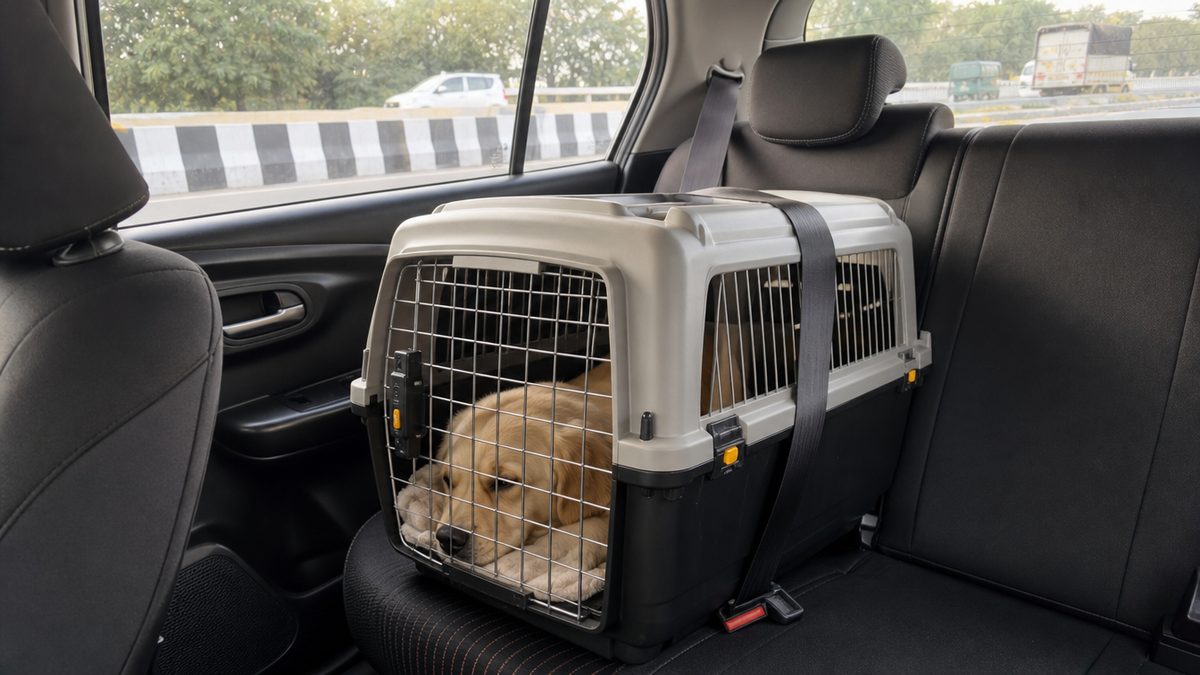
| Rigid crate strapped hard against the seatback | Fails at the anchor straps and at the tie-down brackets on the crate, not usually in the crate body. | The best results in the 2015 crate study came from this position, including from crates that failed when placed centrally. |
| Rigid crate loose in a boot or cargo area | Accelerates before the straps load, then rips its own brackets out or ruptures the webbing and goes into the seatback. | Repeatedly failed in the 2015 study in exactly this way. |
| Folding wire crate, any strapping | Deforms around the dog. CPS could not make one work even with strength-rated straps it designed itself. | Explicitly classed as a distraction prevention tool, not crash protection. |
| Rigid plastic airline-style carrier on a seat | The shell fractures on impact and the dog comes out through the opening. | Complete failure in the 2015 carrier study. All four carriers marketed for car use without a crash-test claim failed completely. |
| Zip line, booster seat, or the dog loose in a hatchback | A zip line is a long tether, which is the attribute CPS treated as inherently dangerous. A booster raises a small dog without restraining it in a crash. Loose in a hatchback the dog simply travels. | No test evidence in any of the three CPS studies. Treat all three as distraction management. |
We have not tested any of these products, and a verdict on a commercial product needs first-hand testing. What is above is what an independent laboratory published about products it bought at retail, attributed to those studies. CPS publishes its own test results and videos openly, and reading them for the specific product in front of you is more useful than any recommendation we could make, particularly because the 2013 and 2015 products are largely unavailable in India.
Two design features separate the one harness that worked from the ten that did not, and both are things you can check on a shelf without any test data. The top performer used a three-point connection, which controlled rotation as well as forward travel, and a tether that could not be lengthened. CPS treated an adjustable tether as a defect in itself, ranking brands down where the connection could not be reduced to six inches or less, because a long tether lets the dog accelerate before the restraint loads. A harness that comes with a generous adjustable strap is selling you comfort, and the strap is the failure mode.
Judge the seatbelt tether, in other words, and not the padding. The seatbelt tether is the short strap running from the harness to the belt buckle or to an anchor point in the car, and it is the component that decides how far the dog travels before anything stops it. Measure it at its shortest setting in the shop. If it cannot be brought under about 15 cm, the harness has already failed the one criterion you can test yourself.
The AVMA makes the same distinction between the two kinds of harness. Vehicle harnesses are different from the harness you might use to walk your dog, it tells owners, and the thing to look for is a crash-tested harness that works with the vehicle's seat belt and keeps the dog sitting upright rather than lying down.
The front seat, the lap and the open window
Three habits that are ordinary in Indian traffic each have a specific mechanism behind the harm, and the front seat is the one where an airbag turns a minor shunt into a fatal one.
An airbag is not a cushion. NHTSA describes a frontal airbag inflating within the blink of an eye, or less than one twentieth of a second, and warns that serious or sometimes fatal injuries can occur if an occupant is too close to, or in direct contact with, the airbag when it first begins to deploy. A dog on the front seat is, by definition, in direct contact with the dashboard it comes out of.
The threshold is lower than most drivers think. Frontal airbags are generally designed to deploy in crashes equivalent to hitting a solid fixed barrier at 8 to 14 mph or higher, which is 13 to 23 km/h, or to striking a parked car of similar size at about 16 to 28 mph. That is a Delhi traffic shunt. The short slow drive to the vet is exactly the trip in which the passenger airbag fires.
NHTSA's rule for children follows from the same mechanism and transfers without modification: children under 13 should sit in the back seat, and rear-facing car seats should never be placed in front of an active airbag. The AVMA states the consequence for animals directly, warning that during a collision unrestrained pets may be crushed by deployed airbags, or thrown out or through windows or windshields.
A third of dogs travel there anyway. In the 533-dog study, 181 dogs (34 percent) were carried in the front seat of a car, against 258 (48.4 percent) in the back seat and 67 (12.6 percent) in the cargo area or boot.
The dog in the driver's lap
The dog in the driver's lap is the one habit that Indian law already prohibits, and it does so through section 125 rather than through any animal provision. A dog sitting on the driver hampers control of the vehicle, which is precisely what the section forbids.
It is also commoner than owners admit. A New Zealand survey of 1,511 dog owners answering a question about how their dogs travel found 2 percent (29 respondents) letting the dog sit on the driver's knee and 12 percent (179) on the passenger's knee, with a further 44 percent (663) letting the dog roam free in the back seat area and 19 percent (280) putting it in the boot or hatchback area. Only 51 percent (767) restrained or crated the dog at all.
Holding the dog is not restraint, even when it feels like the most caring option. In the veterinary study, physically holding the dog was the second most common thing owners described as a restraint method, and the authors were blunt that holding a dog in a moving vehicle may increase the risk of injury to both the animal and the occupant, because the dog can become a projectile during abrupt stops or may distract the driver. The arithmetic in the table above is why. Nobody holds 500 kg.
The head out of the window
The head out of the window is a separate risk from the crash risk, and it does not need a collision to cause harm. The AVMA lists three mechanisms: injury to the head from flying debris, being thrown from the window on an abrupt turn or stop, and the dog jumping out, which also risks injury to anyone who tries to catch it.
On an Indian road the debris argument carries more weight than it does elsewhere, because of the volume of two-wheeler and truck traffic throwing up grit, and because a dog with its head out of a rear window in Mumbai or Kolkata traffic is level with the exhaust of the vehicle alongside. Our guide to air pollution and your pet in India covers that second problem.
A small dog that slips down into the front footwell can interfere with your use of the brake or accelerator pedal, which the AVMA lists first among the risks of a loose pet. This is the scenario where an unrestrained small dog causes a crash rather than being hurt by one, and it is also squarely within section 125.
The Indian car, the Indian road and the monsoon
The Indian car creates a problem the foreign advice does not address, which is that the standard instruction to put the crate in the boot assumes a boot that most Indian cars do not have in a usable form.
Think about the two common Indian body styles separately, because the word boot means two different things. In a sedan, the boot is sealed from the cabin: no ventilation shared with the passengers, no line of sight, and no way to reach the dog without stopping and getting out. That is unusable for a live animal on any journey, in any weather. In a hatchback, the luggage area is the same air volume as the cabin with a parcel shelf over it, and the parcel shelf restrains nothing. A dog behind it travels forward into the rear seat occupants.
So for the large majority of Indian cars, the honest answer is that the dog belongs on the rear seat, restrained there, rather than behind it. That is the opposite of the advice on most American pages, which assume an SUV or a station wagon with a cargo area, tie-down anchors and a seatback to brace a crate against. Where you do have that layout, the 2015 crate results apply directly and the crate goes hard against the seatback rather than free in the middle.
Ventilation, the monsoon and the humid months
A rigid crate on a rear seat in India has a ventilation problem a European page never has to solve. Air conditioning in most Indian cars is delivered from front vents, and a covered crate on the rear seat sits in the part of the cabin that cools last. In the humid months on the coast, in Chennai or Mumbai, a dog in a closed crate with a cover over it is in a smaller, stiller, wetter volume of air than you are.
Three practical consequences follow.
- Position the crate so the mesh door faces forward into the airflow rather than into a seatback.
- Do not cover a crate in a car the way you would at home to settle a dog, unless the cabin is already cold.
- During the monsoon, when you cannot run the windows open, check the dog by hand at every stop rather than by looking, because panting is hard to see through mesh.
Autos, app cabs and journeys in somebody else's vehicle
In an auto-rickshaw or an app-hailed cab, the carrier is often the condition of being accepted at all, and the restraint question is separate from the acceptance question. Our guide to taking a pet in an Uber, Ola or Rapido in India covers what the aggregator rules actually say and what gets a ride cancelled.
For the restraint itself in a vehicle you do not own, two things change. You cannot fit anything to the car, so a seatbelt-routed carrier is the only option, and an auto-rickshaw has no seatbelt and no enclosed cabin, which makes a rigid, closed, hand-held carrier the only sensible arrangement for a small dog and makes an auto a poor choice for a large one.
Restraint is about the inside of the car. Documents, permits and what you need at a state border are a separate subject, covered in our guide to interstate pet travel rules in India. The rhythm of a long drive, how often to stop and the parked-car risk are in a road trip with your dog in India. If you are travelling with a cat rather than a dog, the answer is a rigid carrier and nothing else, and travelling with a cat in a car in India sets out why.
Getting the dog to accept the restraint
To get a dog to accept a restraint, introduce it at home over days with food, fit it in a stationary car before you drive anywhere, and keep the first journeys short and pleasant. A dog that fights a harness in the car was almost always introduced to it in the car.
Work in the order below rather than skipping to the drive. The whole programme takes a fortnight of five-minute sessions, which is less time than one spoiled journey costs you.
- Fit the harness or open the crate indoors, with food, and take it off again before the dog loses interest. Repeat daily until the dog walks into it.
- Feed one meal a day in or wearing it, at home, for about a week. Food does the conditioning; your reassurance does not.
- Move the crate into the parked car with the engine off, doors open, and feed there. Do not shut anything yet.
- Clip the tether or close the crate for thirty seconds in the stationary car, then release and end the session on a good note.
- Drive to the end of the road and back. Then drive somewhere the dog likes, not to the vet, for the first five real journeys.
Fit the restraint to the dog rather than to the dog's collar size. A car harness must sit on the chest and ribcage, not on the throat, and it must be snug enough that the dog cannot turn inside it. How a harness should fit in general, and why a harness beats a collar for lead work, is set out in collar or harness for dogs in India; the crash question here is a different one, because a harness can fit perfectly and still fail at 25 g.
A dog that panics in the car rather than merely objecting to the harness has a different problem. If your dog drools, trembles or vomits every journey, read dog motion sickness in a car first, because it separates true motion sickness from learned car anxiety and the two need different handling. If the distress starts before the car, separation anxiety in dogs in India may be closer to the mark.
If your dog has no crate history at all, teach the crate as a resting place at home first, on its own timetable, and only then move it into a car. Our guide to puppy training basics in India covers the groundwork. A dog shut into an unfamiliar box in a moving vehicle for the first time learns that the box is the problem.
The checklist before the first drive
Run six checks before the first restrained journey, each of which takes under a minute and each of which corresponds to a failure mode the crash testing actually produced.
- Shorten the tether. Anything the dog can accelerate along before the restraint loads is working against you, and CPS marked down every brand whose connection could not be reduced to six inches or less.
- Move the dog to the back seat, permanently, for the airbag reason rather than the comfort reason.
- Push the crate against something. A crate with room to travel tears its own brackets out.
- Pull the anchor straps hard with your own weight. Straps and brackets, not crate bodies, were the commonest failure point in the 2015 study.
- Check the load path. The restraint should pull across the chest and ribcage, never the neck, and nothing should route through a plastic clip that came with a walking lead.
- Read the packaging again. If it says crash tested but names no standard, no speed and no dog weight, you are reading marketing.
Then accept what the evidence does and does not support. Restraining your dog is overwhelmingly better than not restraining it, for the driver and the other passengers as much as for the dog, because the alternative is an unguided mass of 150 to 1,000 kgf moving through the cabin. But the specific product you buy probably has not been validated, and the honest state of knowledge is the one the veterinary researchers published in 2026: the degree to which these devices reduce injury risk remains uncertain.
That uncertainty is an argument for choosing on structure rather than on claims. A short connection, a load path across the chest, a rigid crate that cannot move, and the back seat. Those four are supported by the test evidence that exists, and none of them requires you to believe a label.
Common questions
What is the best way to travel with a dog in the car?
The best way to travel with a dog in the car is restrained on the back seat, either in a rigid crate that is strapped so it cannot move or in a crash-tested harness with a short, fixed tether running across the chest. Keep the dog out of the front seat because of the airbag, and never clip a seatbelt to a neck collar or an ordinary walking harness.
Do dog seat belts really work?
Mostly not, on the evidence that exists. The Center for Pet Safety bought eleven harness brands that advertised testing, crash testing or crash protection, and only one met its description of ideal performance. Four never reached the crash test because a size failed a five-second static pull, and four of the seven that were crash tested suffered a catastrophic failure at one or more sizes, meaning the harness released the dog or let it become a full projectile.
Can you put a regular seatbelt on a dog?
No. A car seatbelt is designed around human anatomy and a human pelvis, and clipping one to a dog's collar concentrates the whole crash load on the neck. Clipping it to an ordinary walking harness is no better, because a walking harness is built for steady lead pressure rather than a 25 g pulse and has never been tested as a car restraint. Use a harness built and tested for vehicle use, or a secured crate.
Should dogs sit in the front or back of a car?
Dogs should sit in the back. A frontal airbag inflates in less than one twentieth of a second and is designed to fire in a crash equivalent to hitting a fixed barrier at 8 to 14 mph, which is an ordinary city shunt. NHTSA advises that children under 13 ride in the back for exactly that reason, and the AVMA warns that unrestrained pets may be crushed by a deployed airbag.
What is the safest dog restraint for a car?
On the published test evidence, a rigid crate braced hard against a seatback and anchored with strength-rated straps produced the best outcomes, ahead of harnesses. Among harnesses, the one design that controlled both launch and rotation used a three-point connection and a tether that could not be lengthened. Folding wire crates and rigid plastic airline-style carriers both failed outright and should be treated as distraction prevention only.
Can we travel with a dog in a car?
Yes, and no Indian law prevents it or regulates it. We read the Motor Vehicles Act 1988 and the Central Motor Vehicles Rules 1989 and found no provision requiring a dog to be restrained in a car. Section 125 of the Act prohibits anything that hampers the driver's control, which catches a dog in the lap or footwell, and section 11(1)(d) of the Prevention of Cruelty to Animals Act 1960 makes it an offence to carry an animal in a vehicle so as to cause it unnecessary pain or suffering.
How do I get my dog to stay still in the car?
To get a dog to stay still in the car, restrain it rather than train it to settle loose, and introduce the restraint at home over about two weeks before the first real journey. Feed meals in the crate or wearing the harness indoors, then in the parked car with the engine off, then on a thirty-second clipped session, then on a drive to the end of the road. Make the first five real journeys end somewhere the dog enjoys rather than at a clinic.