
Cat travel guide
Travelling with a cat in a car in India: the carrier is the method, and the goal is a dull journey
Carrier training is the only measure here with a controlled trial behind it, and even the trained cats averaged a stress score of very tense. Plan for a safe, quiet, uneventful journey rather than a happy cat.
Quick answer
Travelling with cat in car India is a carrier problem before it is anything else. Choose a rigid, top-opening carrier the cat can stand and turn in, secure it with a seatbelt on the back seat, and feed the cat inside it for weeks beforehand. Keep the carrier shut until you are inside a closed room. Expect no litter tray use, offer water at stops, and ask a veterinary surgeon about pre-visit medication.
This guide is general information for Indian pet owners and is not a diagnosis. Always consult a registered veterinarian near you before acting on anything you read here, and treat any sudden change in your pet's condition as urgent.
Why a cat in a car is a different problem from a dog in a car
A cat in a car is a different problem because a cat is territorial rather than social, and a car journey removes the only thing that makes a cat feel safe. A dog loses a room and keeps its people. A cat loses its territory and gains a moving metal box.
Set the goal correctly before you buy anything. The goal is a safe, quiet, uneventful journey, not a happy cat. Almost every page ranking for this query borrows its structure from dog road-trip advice, and the borrowed parts are the ones that fail: the walk at the break, the meal at the halt, the idea that enough exposure turns the car into a normal place.
The best measurement of that comes from the one controlled trial on the subject. Twenty-two cats were scored on a modified Cat Stress Score through carrier confinement, a ten-minute car ride and a waiting room. The average across all of them was 4.29, which that scale calls 'very tense', with individual scores running from 3.14 ('weakly tense') up to 5.31 ('fearful, stiff'). Training moved the number. It did not move it into comfortable.
| What dog advice assumes | Why it does not transfer to a cat | Source |
|---|---|---|
| The animal can be walked at a break | A cat cannot be walked at a highway stop, and International Cat Care's instruction for the whole car journey is that you do not let the cat out of the carrier | International Cat Care |
| The animal drinks at stops and eats at the overnight halt | A cat offered a litter tray inside a travel crate is unlikely to use it during the journey, and many refuse food as well | International Cat Care |
| Getting the animal used to the vehicle fixes the problem | Carrier training measurably reduced stress, and the group average across confinement, the ride and the waiting room was still 'very tense' | Pratsch and colleagues, 2018 |
| Distress is loud | Freezing and dilated pupils were among the signs of stress least recognised by 194 Italian cat owners | Mariti and colleagues, 2017 |
The quiet cat is the one you will misread
A silent cat is the most misread animal in an Indian car. In a face-to-face study of 194 Italian cat owners, the signs behaviourists treat as central, including freezing, mydriasis, recurrent cystitis and scratching the furniture, were the least recognised as stress. Only very prominent or annoying behaviours, excessive vocalising, ears back and urinating outside the tray, were named as stress by more than two thirds of owners.
The same study found something sharper. Twenty-three owners said their cat was never stressed and another 23 could not answer, and when those 44 were shown a list of situations, 42 of them picked at least one as stressful for their own cat. Nearly one owner in ten, 19 of 194, believed stress had no consequences for a cat at all.
Read it this way on the road. The cat that howls for the first twenty minutes and then goes quiet has usually not settled. It has frozen. A cat that is pressed flat at the back of the carrier with wide pupils and will not take a treat is a cat you should drive gently for, not a cat you can stop checking on.
The cat carrier is the method, and the type decides most of the outcome
Buy a rigid plastic carrier with a secure door, ventilation slats, quick-release clips and a removable top half, and treat everything else on this page as secondary to that choice.
International Cat Care is specific about why. Cardboard and cheap light plastic boxes suit only short journeys or very temporary confinement and are not strong enough for longer periods, especially once soiled and wet. Fabric and wicker are difficult to clean if the cat soils them. Backpack carriers can be unpleasant for a cat because the animal cannot hide, ventilation is poor and there is a lot of movement during travel. Solid plastic cleans easily, opens with quick-release clips, has a secure door against escape, carries slats to aid ventilation, and the removable top half lets a vet examine the cat without pulling it out.
That last feature matters more than it sounds. A top-opening carrier means nobody has to tip a frightened cat out head first at the other end, and the 2022 veterinary handling guidance assumes it. Cats Protection reaches the same conclusion about backpacks from a different direction and recommends a sturdy, handheld carrier instead.
Two welfare bodies disagree about size, and the disagreement is worth knowing
Cats Protection says to pick a carrier that is the right size for the cat so it can stand up and move around if needed. International Cat Care says larger is not necessarily better, because cats like to sit in a small space and are less likely to move around, and adds that if you use a large crate you still need a small carrier for the walk to and from the car.
Both are right about different things. A box too small to stand or turn in is a welfare problem on a fourteen-hour drive. A box the size of a dog crate gives a cat room to be thrown around when you brake. We are printing the disagreement rather than averaging it, because the resolution is a measurement rather than an opinion, and India has already published one.
India has a crate formula for cats, and no page quotes it
Rule 11 of the Transport of Animals Rules, 1978 sets crate sizes for dogs and cats by reference to Schedules B and C, which point at the design in IS 4746-1968 of the Indian Standards Institution. Schedule C is the cat one, and it asks for a bigger box than the dog schedule does: length is the cat's nose-to-tail-root measurement multiplied by two, against one and a half for a dog.
| Dimension | Schedule C, cat, by road | Schedule B, dog, by road | Worked example: a cat 45 cm nose to tail root, 25 cm ear tip to toe |
|---|---|---|---|
| Length | A x 2, where A is tip of nose to root of tail | A x 1.5 | 90 cm |
| Width | A | A | 45 cm |
| Height | B + 15 cm, where B is tip of ears to toe while standing | B + 15 cm | 40 cm |
| Mesh | Welded wire not less than 3 mm, spacing 12 x 12 mm; expanded metal and wire netting named unsuitable | Same wording | Nose and paw proof, with no protruding nails or unprotected wire edges |
Read the schedule honestly. It was written for an animal handed to a railway or an airline as a consignment, our interstate pet travel rules guide sets out who those rules actually bind, and almost no carrier sold in India is 90 cm long. It is still the only published Indian number on the question, and it tells you which way to err. If you cannot find a rigid carrier near that length, pick the largest one you can still secure properly with a seatbelt, and accept the trade.
Two cats travel in two carriers. International Cat Care gives three reasons: better airflow, more room, and less chance of overheating. It adds that even the best of friends can behave uncharacteristically during a journey, and that this can damage the relationship afterwards. If that happens, our guide to introducing two cats covers the repair.
Securing the carrier, and where it goes in an Indian car
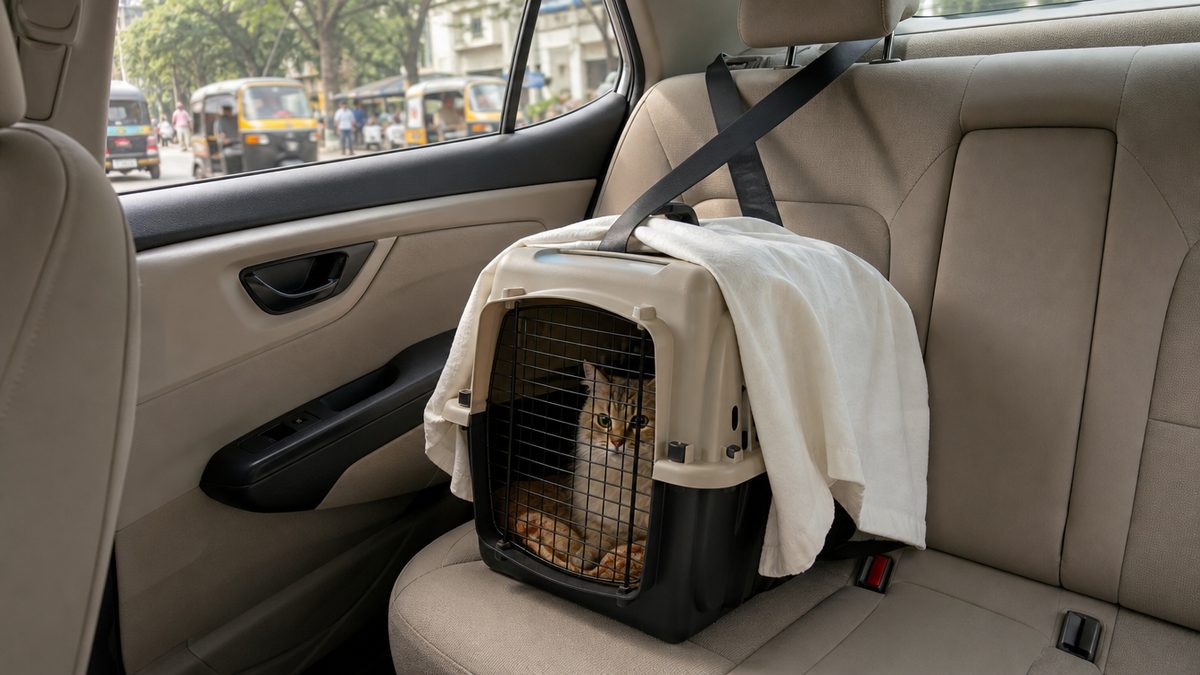
Secure the carrier with the seatbelt across it on the back seat, or wedge it in the footwell behind a front seat, and never drive with a cat loose in the cabin.
Cats Protection is direct about the loose cat: it should be kept in its carrier at all times when driving, because a loose cat is a distraction and an accident risk, and the carrier is best placed on the back seat and fastened with a seat belt. International Cat Care adds the escape half of the argument. A loose cat can become entangled with the driver or startle them, and if a window or door opens, or there is a collision, the cat escapes and is lost or injured.
The footwell behind a front seat is the other good position. It is enclosed on four sides, it cannot slide forward, and the carrier cannot tip. Place the carrier where it is secure if you brake suddenly and where air still flows past it.
A belted rigid carrier is the only practical way to restrain a cat in a car. One Indian pet-brand page ranking for this query tells readers to keep the pet in a harness or crate while driving, and the harness half of that is dog advice. Neither welfare body offers a harness or a lead as a restraint for a cat inside a moving vehicle; both say the cat stays in the carrier for the whole journey International Cat Care.
Where the Indian rule and the welfare advice point in different directions
Rule 9 of the Transport of Animals Rules, 1978 says the cage shall not go on the roof of the vehicle but inside it, preferably near the end of the vehicle. International Cat Care says the opposite about one specific case: do not put the cat in the boot, and be mindful of the back of hatchbacks, where ventilation may be poor and the cat may overheat.
The rule was drafted for a goods vehicle with a load bed, where the rear is the quietest place. A hatchback is not that vehicle. In an Indian hatchback the rear is the hottest, least ventilated part of the cabin, especially in a car with no rear air conditioning vents, so the welfare advice wins here and the back seat or footwell is the right answer.
The same rule 9 contains the single best piece of driving advice on this page, and it is Indian and statutory. The vehicle shall as far as possible maintain constant speed, avoiding sudden stops and reducing the effects of shocks and jolts to the minimum. That is a description of how to drive over a speed breaker with an animal in the back. Our dog car sickness guide carries the measurements on what an Indian speed hump actually does to a car, and the physics does not change for a cat.
Section 11(1)(d) of the Prevention of Cruelty to Animals Act, 1960 makes it an offence to convey or carry, whether in or upon any vehicle or not, any animal in such a manner or position as to subject it to unnecessary pain or suffering. Section 11(1)(e) covers keeping or confining an animal in a cage or receptacle that does not measure sufficiently in height, length and breadth to permit a reasonable opportunity for movement. The fine as enacted in 1960 was up to fifty rupees for a first offence, which is ₹50 and has never been raised, so treat these clauses as a statement of the standard rather than as a deterrent.
Carrier training: the only measure here with a controlled trial behind it
To habituate a cat to a carrier, feed it inside the carrier in short daily sessions for several weeks, with the door open and the carrier left out as ordinary furniture, and do it long before the journey.
A blinded randomised controlled trial put 22 cats through two visits to a sham veterinary practice. After the first visit, eleven of them received 28 sessions of positive-reinforcement carrier training over six weeks; the other eleven received nothing. On the second visit, the trained group's Cat Stress Score during the car ride fell further than the control group's (a change of -0.60 against -0.23, p = 0.007), they spent longer searching for food rewards (33 seconds against 6), they sat rather than braced, and the veterinary examination itself was significantly shorter (-42 seconds against -12, p = 0.010). Ear temperature patterns pointed the same way.
Three things make that trial worth more than the usual advice. It was randomised and blinded. It measured a car ride rather than a clinic. And it declared no conflicts of interest and no specific grant from any public, commercial or not-for-profit funder.
Our moving house with a pet guide already sets out carrier and crate habituation for a move, and the conclusion there is the same one: open the carrier now, feed in it, and let the animal choose to use it for weeks before the day it is shut. This page assumes you have read that and covers what the journey adds.
- Leave the carrier out in a room the cat already relaxes in, door open or the top half removed, for weeks rather than days.
- Feed treats and then meals inside it, so the cat walks in by choice and you never carry it in.
- Line it with familiar-smelling bedding and do not wash that bedding before the trip.
- Shut the door for a few seconds, then open it, long before you shut it for an hour.
- Add short stationary sessions in the parked car with the engine off, then the engine on, then a drive around the block.
What the trial does not show
It does not show that a trained cat enjoys the car. Every group average in that study sat in the tense half of the scale. It also tested a ten-minute ride, not a fourteen-hour one, and 28 sessions over six weeks is more work than most people will do. A gradual, honest version of it still beats the alternative, which is a cat meeting its carrier for the first time on the morning of a long drive.
Do the compressed version rather than nothing. Carrier out, top removed, bedding in, food in it twice a day, and one short drive. You will not reproduce the trial. You will remove the part where the cat learns that the carrier appears, then something frightening happens, which is the association the carrier usually carries.
What calming products and medicines actually buy, read honestly
Pheromone spray has one randomised transport trial behind it and a weak wider record; the prescription options have better trials and are all veterinary decisions. None of them replaces the carrier work.
Start with the pheromone spray, because it is the thing most people reach for. The only randomised, blinded, placebo-controlled trial of a synthetic feline facial pheromone during transport recruited 150 cats that already showed stress behaviours and split them 75 and 75. Fifteen minutes after the carriers were sprayed, curling, lack of motion and meowing during transport outside the home were significantly reduced against placebo. The effect on the overall stress score appeared only in cats whose baseline score was above 2.94 cm on a visual analogue scale.
Two caveats belong next to that, and the paper supplies both. It describes itself as a pilot study, and the work was supported by a grant from a company, Fiber Biotech (Shanghai), although the authors declared no conflicts of interest.
Set that against the wider record. A systematic review of prospective studies from 1998 to 2008 found seven cat reports and seven dog reports. Feline facial pheromone studies provided insufficient evidence for managing idiopathic cystitis or calming cats during catheterisation, and lack of support for reducing stress in hospitalised cats. Across all 14 reports, 11 provided insufficient evidence and one provided lack of support; the single study with sufficient evidence was a dog one.
The practical reading is that a pheromone spray in the carrier is cheap, carries no known harm, and has one supportive transport trial that its own authors call a pilot. Use it if you want. Do not plan the journey around it. Our guide to introducing two cats reads the separate diffuser evidence for inter-cat tension, which is a different question with a different trial.
International Cat Care says to wait at least 15 to 20 minutes after spraying the bedding inside the carrier before putting the cat in, because the spray initially smells of alcohol and that smell is offensive to a cat. Spraying and loading in the same minute is the most common way to make the product worse than nothing.
The prescription options, and what each trial actually measured
Three molecules carry real evidence for exactly this situation, and all three are veterinary decisions rather than things to buy.
- Gabapentin. A randomised, blinded, crossover trial in 20 pet cats with a history of fractious behaviour gave a single oral dose 90 minutes before the cat went into the carrier. Owner-assessed stress scores during transportation and examination, and the vet's compliance scores, were significantly better than placebo. Sedation was common, and ataxia, hypersalivation and vomiting were also reported; every effect resolved within eight hours.
- Trazodone. A double-blind, placebo-controlled randomised crossover study in 10 client-owned cats with a history of travel or examination anxiety found significantly improved signs of anxiety during transport against placebo, and it was generally well tolerated. Ten cats is a small study and the authors call it one.
- Pregabalin. This is the only molecule anywhere with a licence for the exact problem this page is about. The United States regulator approved an oral solution on 17 November 2023 for alleviation of acute anxiety and fear associated with transportation and veterinary visits in cats, given roughly 1.5 hours before the journey starts and repeatable on two consecutive days. In the field study, 83 of 108 cats on the drug improved against 46 of 101 on placebo, and a little over half had a good to excellent response during both transport and the visit, against about a third on placebo. Reported reactions were mild sedation, ataxia and lethargy.
Are any of these available in India?
All three molecules exist in India as human medicines, and none of them is listed with a veterinary indication. CDSCO's published list of new drugs approved in India, read on 21 October 2026, carries seven gabapentin entries (the earliest a capsule approved on 3 August 1995 for epilepsy), two trazodone entries from 1987, and ten pregabalin entries, the earliest a capsule approved on 25 November 2005 for neuropathic pain. Every indication on every one of those rows is human.
What that means in a consulting room in Pune or Hyderabad is straightforward. An Indian veterinary surgeon who prescribes gabapentin or trazodone for a cat is prescribing a human medicine outside its approved indication, which is an ordinary and lawful part of veterinary practice and is their judgement to make. The licensed feline pregabalin solution is a different matter: it does not appear on that list at all, so do not assume your vet can obtain it. Ask. The Indian owner who drove a cat 1,000 km from Bengaluru to Mumbai recorded getting an oral calming solution from the vet before leaving, which is evidence that the conversation happens here, not evidence about any particular drug.
Bonbeno does not recommend a drug or a dose for your cat. Dose depends on the individual animal, its weight, its kidneys, its age and everything else it is taking, and a cat is not a small dog for this either. Never give a human tablet on your own judgement, never reuse another animal's prescription, and ask your veterinary surgeon for a trial on a quiet day so you know how your own cat responds before the day it matters.
Litter, food and water on the road, and the answer nobody prints
Most cats will not use a litter tray in a moving car, so plan for absorbent lining inside the carrier instead of a tray, offer water at stops, and feed nothing between the start and the overnight halt.
International Cat Care says it plainly. If you are using a large crate you may be able to provide a litter tray, although it is unlikely that the cat will use it during the journey, and it may be better to line the carrier with absorbent pads in case of accidental soiling and carry familiar-smelling bedding to replace what gets wet. That is the honest answer, and almost no page gives it.
Cats Protection frames the same thing from the cat's side. A cat in an unfamiliar environment may hold on, and sometimes cannot. Its advice is to avoid letting the cat in and out of the carrier frequently, and if the cat becomes extremely loud and shows signs of distress, to have the tray ready beside the carrier and let the cat use it once you have stopped. On an Indian highway, read 'once you have stopped' as 'once you have stopped, with the windows up and the doors shut', which the escape section below covers.
Carry two absorbent pads per expected hour of soiling rather than one tray. A pad can be swapped through a top-opening carrier in thirty seconds without the cat leaving the box. A tray cannot. If your cat is new to a tray at all, our cat litter training guide is the place to start, and start weeks before you drive.
Four sources on when to stop feeding, and they do not agree
| Source | What it says | What it is solving |
|---|---|---|
| International Cat Care | Withhold food for about four to five hours before the journey, and offer water until you leave and again during the journey if possible | Vomiting inside the carrier |
| Cats Protection | Unless your vet says otherwise, limit food for at least a few hours before the journey | Vomiting and motion sickness |
| Transport of Animals Rules, 1978, rule 8(1)(a) | Fed and given water at least two hours prior to transport, and not packed for transport if hungry or thirsty | An animal handed to a carrier as freight for a long journey, which is not a family driving its own cat |
| Google's own AI answer for this query, India, 21 October 2026 | Fasting your cat for a few hours, or as advised by your vet | Nothing in particular. It names no source and no number |
The Indian rule points the other way from the welfare advice because it is solving a different problem: an animal in a consignment that may not be fed again for many hours. For a cat in your own car on a day trip, the four-to-five-hour window from International Cat Care is the more useful instruction The Transport of Animals Rules, 1978. Our dog car sickness guide carries the equivalent disagreement for dogs, which has five sources and different numbers; do not transfer one to the other.
Water is simpler. Offer it at every stop, and carry a bowl that clips to the carrier door so you can fill it without opening anything, which International Cat Care recommends specifically for delays. Most cats will refuse. Offer anyway, because on a hot Indian afternoon a cat that does drink has told you something useful.
Heat, and the problem that a carrier reduces airflow exactly when the cat needs it most
A carrier is a second enclosure inside the first, so a cat in a car is always hotter and less ventilated than the driver is, and a covered carrier makes both worse.
Our road trip guide carries the measured arithmetic on how fast a parked car heats, and our heat safety guide for cats carries the body-temperature line and the first aid. Neither of those is repeated here. What this page owns is the box inside the box.
Three things stack up against a travelling cat in an Indian summer. The cabin is hot. The carrier sits inside the cabin with slatted ventilation rather than open air. And the cat is usually at the back, where the air moves least. An owner who drove a cat from Bengaluru to Mumbai in September taped a digital thermometer to the rear left window so he could read the rear temperature over his shoulder. Behind a partition he had already cut airflow holes into, the rear reached 37 C, which is why he removed the partition mid-trip.
That is the Indian hatchback problem in one number. A great many cars on Indian roads have no rear air conditioning vents, so the back is not merely warmer than the front, it is a separate thermal zone that the driver cannot feel. If you are driving in March to June on the plains, check the rear with a cheap thermometer rather than with your hand on the front vent.
Covering the carrier, and when not to
Covering reduces what the cat sees, and it reduces what the cat breathes. Cats Protection recommends throwing a light blanket over the carrier to prevent overstimulation, and in the same sentence says to ensure there is adequate airflow. Those two instructions pull against each other, and in a humid Chennai or Kolkata August the airflow instruction wins.
- Cover three sides, never four. Leave the ventilated door face open to the cabin and to a flow of cool air.
- Use a light cotton cloth, not a fleece or a towel, and never a plastic sheet.
- Lift the cover at every stop and look at the cat, not at the carrier.
- Drop the cover entirely above about 30 C inside the cabin, and keep the air conditioning on the rear instead.
- Pick a basket that allows good airflow through if the weather is hot, which is International Cat Care's explicit instruction for a hot-weather journey.
Humidity is the part that catches people out. In a humid coastal month a cat in a ventilated box in saturated air sheds very little of the heat it is making, because evaporation is what the cooling depends on and saturated air will not take the water. A drive down the Tamil Nadu coast from Chennai in August is a different problem from the same distance out of Ahmedabad in April, even at the same thermometer reading, and the coastal one is the harder of the two for the cat.
International Cat Care is explicit that it is not enough to park in the shade and leave the windows open. Someone should stay with the cat, secure in its carrier, with doors or windows open so air flows through while you are stationary, or you take the carrier out and sit with it outside the car. At an Indian dhaba in May that means one person eats while the other stays with the cat, then you swap.
Escape is where cats are actually lost, and every one of them happens at a stop
The carrier does not open until you are inside a closed room with the door shut and the windows shut. That single rule prevents almost every cat lost on an Indian road trip.
A cat is not lost at 90 km an hour. It is lost in the four seconds a rear door is open at a toll plaza, at a dhaba, at a petrol pump while the attendant leans in, or in a hotel corridor while somebody fetches the luggage. The animal that bolts is not the nervous one; it is the quiet one that has been frozen for three hours and now sees daylight.
International Cat Care sets the end-of-journey rule: when you arrive, place the cat in one room, make sure that room is secure to prevent escape, and only then open the carrier. Apply it to every intermediate stop too. A car with a door open is not a secure room.
- Name one person as responsible for the carrier before you leave, and keep that job with the same person all day.
- Check the carrier door latch every time you stop, by hand, before anyone opens a car door.
- Open car doors on the side away from traffic, and only after confirming the carrier is latched.
- Keep the carrier belted in while the car is stationary at a toll plaza. A toll plaza is a stop with the engine running and windows down, which is the worst combination on the route.
- At a dhaba, carry the carrier out with you or leave a person with it. Never leave it on a seat with a window open.
- At the overnight halt, carry the carrier into the room, shut the door, shut the windows, check the bathroom window, and only then open the carrier.
Where we disagree with the best Indian account of this drive
The most detailed Indian first-hand account of a long car journey with a cat, a Bengaluru to Mumbai run posted in September 2020, advises being prepared to give the cat a chance to roam about in the car every four hours, while also saying to judge it and not to do it if you cannot safely get the cat back in. Both welfare bodies say the opposite. Cats Protection says the cat should be kept in its carrier at all times when driving, and that it is advisable to avoid letting the cat in and out of the carrier frequently. International Cat Care says your cat may meow throughout the journey, to speak calmly, and not to let it out of the carrier.
We side with the welfare bodies, and the reason is specific to India rather than to cats. On a route with twenty toll plazas, the number of moments when a door opens is not under your control, and a loose cat in the cabin turns every one of them into an escape opportunity. The account itself is honest about this: the author installed a partition as a last resort, then removed it when the rear reached 37 C. A cat loose in a car you cannot partition is a cat one door-handle away from a highway.
If the worst happens, our guide to finding a lost pet in India sets out the first hour, and the search for a cat is a completely different operation from the search for a dog. Microchip and tag your cat before the journey rather than after it.
Motion sickness in cats, briefly, because the cat answer differs from the dog answer
In cats the most common cause of travel vomiting is anxiety rather than the inner ear, which inverts the usual dog framing, and the licensed oral anti-motion-sickness product is for dogs.
Cats Protection states that motion sickness is a common occurrence in many cats, that there can be several causes, and that the most common cause of motion sickness in cats is anxiety and stress associated with travel. The signs it lists are fast breathing or panting, excessive lip licking and drooling, increased vocalising, vomiting, diarrhoea, and lethargy or inactivity.
That matters because it changes what you treat. Our dog car sickness guide sets out the two-syndrome split in dogs, the drug licensed to prevent vomiting due to motion sickness, and whether it is available in India. All of that material belongs to the dog and is not repeated here. The cat-specific point is short: if the cause in most cats is the anxiety rather than the vestibular apparatus, then the carrier work and the anxiolytic conversation in the sections above are the treatment, and an anti-sickness tablet aimed at the inner ear is aimed at the wrong thing.
Tell your vet what you saw, in order. Drooling and lip licking first, then vocalising, then vomiting, is a different story from a cat that is bright and quiet and then vomits once on a bend. Both are worth a consultation before a long drive, and neither is worth a tablet bought on a forum's advice.
The long Indian drive: the day's shape, toll plazas, the overnight stop and arriving
Plan the shortest day you can, break every two to four hours without opening the carrier, and build the whole route around where the cat sleeps that night.
Cats Protection gives the ceiling: if possible, avoid travelling with a cat for more than four hours in a day, and let the cat out in a room where it will spend the night; for longer journeys, take regular breaks every two to four hours to check on the cat.
Almost nobody in India can obey the first half of that. A Bengaluru to Mumbai run is about 1,000 km, and the owner who drove it with a cat left Koramangala at 04:18 and reached Vashi at 18:10, under fourteen hours, with two breaks of 15 to 20 minutes. Delhi to Jaipur is four hours on a good day. Pune to Goa is not. So the realistic rule is a two-part one: break every two to four hours whatever the plan says, and if the route cannot be done in a daylight day, split it with a confirmed overnight room rather than driving into the night.
Three Indian details that decide the day
- Toll plazas. That one route had 20 of them, the FASTag worked at 18, and the account records needing a balance of about Rs 1,500 for the run. Load the tag the night before. A cash lane means a longer stationary wait with the window down, which is both the heat problem and the escape problem at once.
- Start before dawn. In March to June on the plains, the cabin at 05:00 and the cabin at 14:00 are different environments, and the cat rides in the worse one if you leave late.
- A default halt, chosen in advance. The Bengaluru to Mumbai account had a family friend's house at Kolhapur as a default stop, and credits having it with removing the time pressure from the whole drive. Pick yours before you start. Also pick a point of no return, roughly a fifth of the way in, before which you will turn back if the cat is genuinely distressed.
The road surface changes at the state line, and the cat feels it
Rule 9(b) asks for constant speed with sudden stops avoided and shocks and jolts reduced to a minimum, and whether you can obey it depends on which state you are in. The same Bengaluru to Mumbai driver recorded the Karnataka stretch from Tumkur to Chitradurga as three lanes each way, straight and well paved, and then reported that Maharashtra roads were not good for high-speed cruising, with loads of undulations, sudden bad patches and sharp corners, and that 80 to 100 km/h was the sensible ceiling there.
That is one driver's impression of one route in 2020 rather than a road survey, and it is still the right way to plan. Work out before you leave which third of the route is the rough third, and put your longest stationary break on the smooth side of it, because a carrier on a rough surface is a box being shaken with a frightened animal inside. On a southern route the same logic applies to the ghat sections: a Bengaluru or Chennai departure into the Tamil Nadu or Kerala hills trades a smooth highway for continuous lateral movement, which is harder on a cat than speed is.
In the monsoon the dhaba stop becomes a wet, loud, crowded twenty minutes, and a carrier set down on wet ground soaks the bedding it is lined with. Carry a second set of dry bedding in a sealed bag. A cat sitting in damp bedding for six humid hours arrives with a skin problem on top of a stress problem.
Arriving
Carry the carrier into one closed room, set it down, open the door and walk away. Let the cat come out when it chooses. Offer water and a little food, and do not be alarmed if the cat ignores both; International Cat Care notes a cat may not be interested in eating until it is more settled.
If the drive was a permanent move rather than a trip, the arrival is a bigger subject than this page covers, and our moving house with a pet guide carries the settling-in timescales, the appetite deadlines and the reason a cat is kept in for two to three weeks afterwards. If you came by a hired vehicle instead of your own, our guide to pets in Uber, Ola and Rapido covers what the operators actually publish.
What this page can prove, and what it cannot
Five claims here rest on measurements with denominators, and several of the most useful instructions rest on welfare guidance and on reasoning about Indian roads rather than on a trial.
Drawing that line is more useful than pretending the whole page is evidence-based, so it is drawn below rather than left for you to guess.
| Claim | Status |
|---|---|
| Carrier training reduces measured stress during a car ride | Measured. Blinded randomised controlled trial, 11 trained against 11 controls, p = 0.007 |
| Even trained cats average 'very tense' through confinement and the ride | Measured. Mean Cat Stress Score 4.29 across 22 cats |
| Owners systematically miss the quiet signs of stress in their own cats | Measured. 194 owners interviewed face to face; 42 of the 44 who said 'never stressed' then named a stressful situation |
| A pheromone spray in the carrier reduces some transport stress behaviours | Measured, once. A 150-cat randomised placebo-controlled pilot, company funded, with the overall-score effect limited to higher-stress cats |
| Gabapentin, trazodone and pregabalin exist in India only as human-approved molecules | Measured against the register. CDSCO new-drug list read 21 October 2026; zero veterinary indications among 19 relevant rows |
| A cat should not be let out of the carrier at an Indian highway stop | Reasoned. Two welfare bodies say keep the cat in the carrier; the toll-plaza escape argument is ours |
| Cover three sides of the carrier and never four | Reasoned from two instructions that conflict, one to cover and one to ventilate |
| The back seat beats the hatchback rear in an Indian car | Reasoned. India's rule 9 prefers the rear of the vehicle; International Cat Care warns about hatchback ventilation; we follow the welfare advice |
| The Schedule C worked example dimensions | Illustrative arithmetic on example measurements, not a measurement of any cat |
Two things we could not establish. No Indian study of cat transport stress exists that we could find, so every behavioural number on this page is European. And no Indian standard crash-tests a pet carrier, so 'secure it with a seatbelt' is a restraint instruction rather than a tested safety rating. If either changes, this page changes.
Common questions
Can I travel with a cat in a car?
Yes, you can travel with a cat in a car, provided the cat stays inside a secured carrier for the whole journey. Cats Protection says the cat should be kept in its carrier at all times when driving, because a loose cat distracts the driver and escapes through any opened door, and that the carrier is best placed on the back seat and fastened with a seat belt. Most cats find travel stressful, so take only necessary journeys.
Is it okay for cats to travel in cars?
It is acceptable rather than pleasant, and the honest target is a safe, quiet, uneventful journey rather than a happy cat. In the one blinded trial that measured it, 22 cats averaged a Cat Stress Score of 4.29, which that scale calls very tense, across carrier confinement, a ten-minute car ride and a waiting room. Carrier training before the trip measurably lowered that score, so preparation changes the experience even though it does not make the car enjoyable.
Can you train a cat to go in the car?
Yes, and it is the only measure on this subject with a controlled trial behind it. Eleven cats received 28 positive-reinforcement carrier training sessions over six weeks while eleven got none. The trained cats showed a significantly larger drop in stress score during the car ride, searched for food rewards for 33 seconds against 6, and their veterinary examination was 42 seconds shorter. Leave the carrier out, feed in it daily, then add short stationary and then moving sessions.
What kind of cat carrier is best for car travel?
A rigid plastic carrier with quick-release clips, a secure door, ventilation slats and a removable top half, according to International Cat Care, which also warns against cardboard, cheap light plastic, wicker and fabric for longer journeys. It advises against backpack carriers because the cat cannot hide, ventilation is poor and there is a lot of movement during travel. Bonbeno names no brand, because we do not publish a verdict on a product we have not tested ourselves.
How to travel with a cat carrier in a car?
To travel with a cat carrier in a car, belt it across the back seat or wedge it in the footwell behind a front seat, where it stays put under braking and air still reaches it. Keep it out of the boot and out of the rear of a hatchback, where ventilation is poor and a cat can overheat. Cover three sides with a light cloth and leave the ventilated face open. Check the latch by hand before anyone opens a car door.
What are some tips for taking my cat on a road trip?
Start carrier training weeks ahead, leave before dawn in summer, belt the carrier on the back seat and break every two to four hours without opening it. Withhold food for about four to five hours before leaving and offer water at each stop. Line the carrier with absorbent pads rather than fitting a litter tray, because most cats will not use one in a moving car. Open the carrier only once you are inside a room with the door and windows shut.
How do you travel 12 hours with a cat?
Split a twelve-hour drive if you can, because Cats Protection advises avoiding more than four hours of travel in a day and letting the cat out in the room where it will sleep. If the route cannot be split, start before dawn, break every two to four hours, keep the carrier shut at every break, watch the rear cabin temperature rather than the front, and book a confirmed room for the night. One owner drove Bengaluru to Mumbai with a cat in under fourteen hours with two short breaks.
Will my cat use a litter tray in the car?
Probably not. International Cat Care says that where a large crate allows a litter tray, it is unlikely the cat will use it during the journey, and suggests lining the carrier with absorbent pads instead and carrying spare familiar-smelling bedding. Many cats hold on for the whole drive. Keep the tray in the boot for the overnight room rather than in the carrier, and swap a soiled pad through the top opening without letting the cat out.