
Dog health: infectious
Parvo in Dogs in India: Signs, Survival Odds, Treatment Cost and the Vaccine Gap
Canine parvovirus is one of the commonest causes of death in young dogs, and India has the case volume to show it. One Chennai teaching hospital confirmed 4,258 cases among 6,105 suspected across eight years. This page gives the first signs in the order they appear, survival rates with the population each was measured in, itemised rupee prices from two government veterinary hospitals, an honest answer on treating parvo at home, and what the near-total replacement of CPV-2a by CPV-2c across India does and does not mean for the vaccine in the fridge.
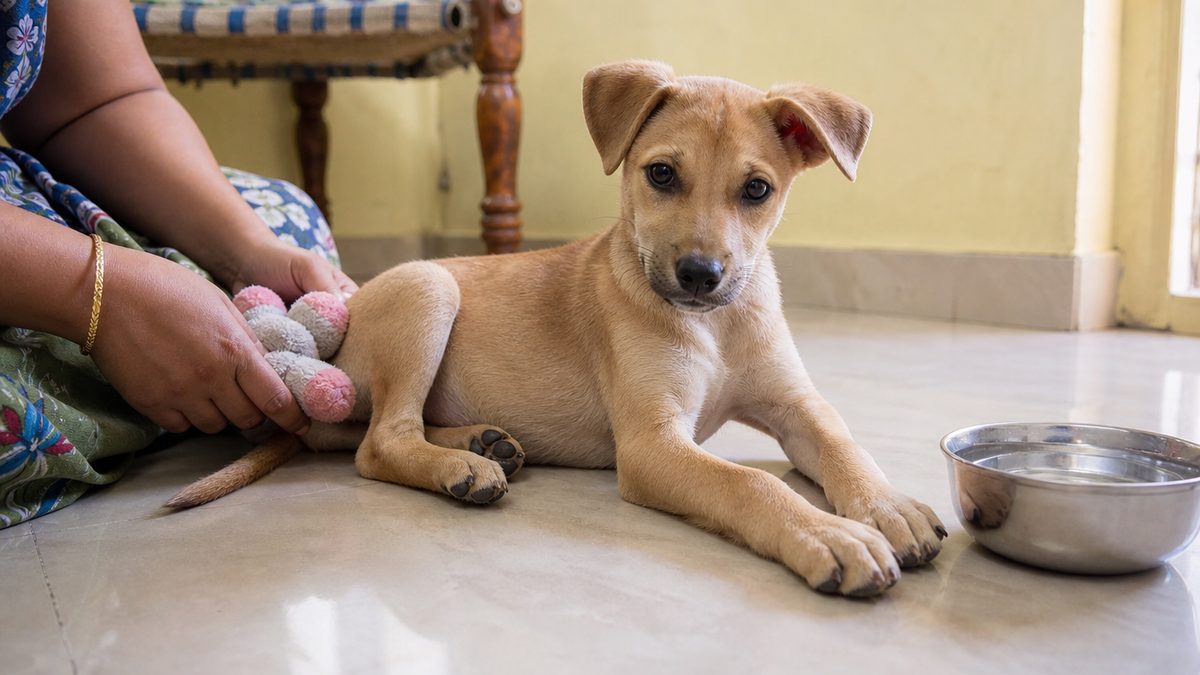
Canine parvovirus is an emergency. Go to a veterinary clinic now, and call ahead, if you see any of these signs.
- Any vomiting or diarrhoea in a puppy under six months old
- Blood in the stool, or a stool that is black and tarry
- Gums that are pale, grey or tacky to the touch
- A puppy that cannot stand, or collapses when it tries
- Cold ears and paws, or a temperature below normal
- Vomiting that stops the dog keeping any water down
- A swollen or painful belly alongside the diarrhoea
- Any of these in a dog whose vaccination course is unfinished
Quick answer
Parvo in dogs is a highly contagious viral infection that destroys the lining of the small intestine and the bone marrow, and it is one of the commonest causes of death in young dogs. Most dogs that reach a clinic survive, with published survival from 75 to 96.7 percent depending on the setting. At one Chennai teaching hospital, 4,258 of 6,105 suspected cases were confirmed over eight years. A parvovirus PCR costs Rs 600 at a government hospital in Patna; the vaccine costs Rs 360.
This guide is general information for Indian pet owners and is not a diagnosis. Always consult a registered veterinarian near you before acting on anything you read here, and treat any sudden change in your pet's condition as urgent.
Signs of Canine parvovirus
The 8 signs to watch for are listed below. Any one of them is a reason to consult your nearby vet; none of them is a diagnosis.
- Lethargy and a puppy that suddenly refuses food
- Repeated vomiting, often a day before any diarrhoea
- Bloody diarrhoea, although a quarter of cases have no blood
- A sudden high fever after a dull, quiet day
- Fast dehydration, with sunken eyes and tacky gums
- Collapse or weakness in a puppy that was playing yesterday
- Abdominal pain, which needs checking for a bowel complication
- A body temperature that has fallen rather than risen
Breeds on this site that document this condition
Canine parvovirus is an infection, not an inherited disease, so no breed screening scheme exists anywhere in the world and no breed is immune. The cards below carry within-breed positivity from the one Indian series that publishes a real denominator for each breed group, 71 diarrhoeic dogs tested by PCR in and around Bhubaneswar. Read them as small groups of already-sick dogs at one clinical complex rather than as population prevalence or as breed susceptibility, and note that the figure usually quoted from this paper, 34.48 percent for Deshi dogs, is the share of its 29 positives and not the share of Deshi dogs tested.
India has the case volume, the reservoir and now its own variant. One Chennai teaching hospital diagnosed 4,258 cases of parvoviral enteritis among 6,105 suspected cases across eight years, with winter and July the peak periods, and more than 88 percent of 219 free-ranging dogs sampled in central Maharashtra carried antibody to the virus, which the authors called enzootic. A 2023 whole-genome survey found CPV-2c has almost completely replaced CPV-2a across the country and sits apart from the current Indian vaccine strain, with predicted epitope changes the authors say might make vaccine failure more likely, while WSAVA holds that current vaccines protect against 2a, 2b and 2c when used to schedule. Three quarters of Indian positives in one northern series were unvaccinated. India's own breeding rules require annual rabies vaccination at a breeding establishment and make parvovirus vaccination merely preferable. A parvovirus PCR costs Rs 600 at a Patna government hospital and the vaccine that prevents the disease costs Rs 360 in Chennai, where the teaching hospital pharmacy dispenses drugs and fluids free of cost.
What canine parvovirus is, how it spreads, and who is most at risk
Canine parvovirus is a small, extremely hardy DNA virus that attacks the fastest-dividing cells in a dog's body, which are the ones lining the small intestine and the ones making white blood cells in the bone marrow. It reached dogs around 1976, spread unchecked worldwide by 1978, and almost certainly arose from two or three mutations in feline panleukopenia virus that let it jump into a new host. In India it is not a historical curiosity. At one Chennai teaching hospital, 4,258 dogs were diagnosed with parvoviral enteritis out of 6,105 suspected cases across eight years.
The damage is mechanical before it is dramatic. The virus first multiplies in the tonsils and throat lymph nodes, rides inside lymphocytes into the bloodstream, and then lands hardest on the bone marrow and on the crypts of Lieberkuhn, the nurseries that replace the lining of the small intestine every few days. With the nursery disabled, the gut lining cannot be replaced, so it stops absorbing, starts leaking fluid, and finally lets gut bacteria cross into the blood; death, when it comes, is from dehydration and shock together with the septic toxins those bacteria produce. Cornell states the balance plainly, that canine parvovirus is not always fatal, but that when it does kill it kills by that route.
How parvo spreads is the part owners get wrong. The virus is not airborne. It travels by the faecal-oral route, on shoes, clothing, hands, bowls, leashes, bedding and ground, and microscopic amounts of infected faeces are enough. That is why a puppy who has never left a third-floor flat can still catch it, and why a shelter, a boarding kennel or a busy Indian street corner is a harder place to keep a puppy safe than a house.
Who is most at risk, measured rather than asserted
Age is the single strongest risk factor, and two Indian series put numbers on it. In Bhubaneswar, the highest positivity sat in the 3 to 6 month group, where 12 of 22 dogs tested positive, against 8 of 20 at 1 to 3 months, 8 of 24 at 6 to 12 months and 1 of 5 above a year. In North India, 73.49 percent of the nested-PCR positives were dogs below 3.5 months of age. In Kolkata, the highest occurrence was in the 1 to 6 month group at 80.65 percent.
Sex shows up too, and the way it is usually quoted is misleading. The Bhubaneswar paper is often cited for males being 86.21 percent of cases, but that is the share of the 29 positives; its own Table 3 shows 25 of 50 males positive against 4 of 21 females, which is the comparison that means something. Two later series agree on direction, with 60.24 percent of North Indian positives male and low body weight and male sex both raising the risk of death in a 5,127-dog shelter series.
Breed risk is real but small next to age and vaccination status. The classic study, 96 dogs with definite parvoviral enteritis at the University of Pennsylvania, found significantly increased odds in Doberman Pinschers at 3.1, Rottweilers at 6.0 and English Springer Spaniels at 8.1. A 130-dog American outpatient series found Chihuahuas, German Shepherd Dogs, pit bull-type dogs and males over-represented against the general hospital population. The AVMA names the same cluster, listing Rottweilers, Doberman pinschers, bull terrier breeds, German shepherds and English springer spaniels alongside puppies between 6 and 20 weeks of age and unvaccinated or incompletely vaccinated dogs. The breed cards on this page come instead from the one Indian series that publishes a real denominator for each breed group.
One Indian finding has no parallel anywhere on the ranking pages. Free-ranging dogs in central India carry this virus as a matter of course: of 219 dogs sampled around the Great Indian Bustard Wildlife Sanctuary in Maharashtra, more than 88 percent showed antibody to canine parvovirus, and the authors concluded the pathogen is enzootic in that population. Our guide to stray dogs in India covers that population; this page covers what it means for a puppy who meets it.
Do not wait to see whether a young puppy with vomiting and diarrhoea perks up by morning. Signs develop within 5 to 7 days of infection and can escalate from lethargy and inappetence to vomiting and haemorrhagic small bowel diarrhoea within 24 to 48 hours, and in one 5,127-dog series 80 percent of all deaths occurred inside the first five days of treatment. The hours you spend deciding are the hours the odds move in. Telephone a veterinarian the same day, say the words canine parvovirus so they can isolate your dog on arrival, and let them decide what your animal needs. Find one through our directory of registered veterinarians.
The first signs of parvo, in the order they appear
The first signs of parvo are dull and easy to dismiss, which is exactly why the disease kills. Lethargy, depression and loss of appetite come first, followed by a sudden high fever, vomiting and diarrhoea. The Merck Veterinary Manual describes the same sequence and times it, with nonspecific signs giving way to vomiting and haemorrhagic small bowel diarrhoea within 24 to 48 hours. Nothing in that first day looks like an emergency, and by the second it is one.
Bloody diarrhoea is the sign everybody looks for and it is not reliable. Approximately 25 percent of affected dogs have nonhaemorrhagic diarrhoea, so an absence of blood does not rule parvovirus out. The Kolkata series collected its samples from dogs showing fever, vomition and bloody or mucoid diarrhoea, and mucoid counts.
How long after exposure, and why three sources give three answers
The incubation period is short and the published ranges do not match, so this page prints all three rather than averaging them.
| Source | Incubation given | What kind of statement it is |
|---|---|---|
| Cornell University College of Veterinary Medicine, Baker Institute | Three to seven days before the onset of first symptoms | An owner-facing summary from a research institute |
| Merck Veterinary Manual, professional version | Signs develop within 5 to 7 days after infection but can appear from 2 to 14 days | A clinical reference for veterinarians, with the outer range stated |
| PetYaari Pet Clinic, Hyderabad | Puppies between 6 and 20 weeks of age named as the risk window rather than an incubation range | An Indian clinic page, answering a different question |
The practical reading is the widest one. A puppy that met an infected dog, or an infected patch of ground, a fortnight ago is still inside the window that the professional reference allows. Treat any unexplained vomiting in an incompletely vaccinated puppy as a same-day question for a vet rather than as something to watch.
Abdominal pain deserves a separate mention, because it can mean something other than the disease itself. Merck notes that abdominal pain warrants further investigation to exclude intussusception, a telescoping of the bowel that is a recognised complication of acute enteritis in young dogs. That is a surgical problem sitting inside a medical one, and it is not something an owner can assess at home.
Two findings from the clinical literature are worth holding, because they run against intuition. In a 76-case Italian teaching-hospital series, a normal white blood cell count on admission was a positive prognostic factor, alongside normal sensory status, normal heart rate and normal hydration. And in a 95-dog American shelter clinic series, hypothermia on presentation, a body temperature below 37 degrees Celsius, was strongly negatively associated with survival. A cold, quiet puppy is a worse sign than a hot, distressed one.
One AVMA sentence is the most useful thing on this page for an owner deciding whether tonight can wait. Persistent vomiting and diarrhoea quickly cause dehydration, damage to the intestines and immune system can cause septic shock, and this can lead to death, with most deaths occurring within 48 to 72 hours after signs first appear. That is the window. A dog that started vomiting on Monday morning is inside it for the whole of Tuesday and Wednesday.
How parvo is diagnosed, and what the test costs in India
To find out whether a dog has parvo, a veterinarian runs a faecal antigen test in the clinic and confirms it, where it matters, with PCR on a faecal or rectal swab Behera M, Panda SK, Sahoo PK, Acharya AP. The in-clinic test takes minutes. PCR is more sensitive and is what every Indian study on this page used to establish its numbers, and two government veterinary hospitals publish what it costs.
The sensitivity gap between methods is not academic, and one Indian study measured it twice over. In North India, the same 118 rectal swabs gave 33 positives by conventional PCR, an incidence of 28 percent, and 83 positives by nested PCR, an incidence of 70 percent. In Kolkata, 41 samples gave 13 positives by haemagglutination at a titre of 32 or above, 31.71 percent, against 28 positives by PCR of the VP2 gene, 68.29 percent, which the authors read as showing the higher sensitivity of PCR. A negative in-clinic result on a sick puppy is therefore not an all-clear, and the decision about what to do next belongs to the attending veterinarian.
A blood count does more than confirm a suspicion. The virus destroys young immune cells in the bone marrow, producing the drop in circulating lymphocytes and the fall in protective white blood cell count that make an affected puppy so vulnerable to the bacteria crossing out of its own gut. Merck describes the mechanism, with lymphopenia and neutropenia developing secondary to destruction of haematopoietic progenitor cells in the bone marrow and lymphopoietic tissues and worsened further by an increased systemic demand for leukocytes. A 2020 review states the clinical use of that, recording that characteristic decreases in total leukocyte, neutrophil and lymphocyte counts increase the index of suspicion in affected cases and can be used to prognosticate morbidity and mortality.
One thing the in-clinic test does well is worth knowing before the variant section below. Commercial ELISAs for detecting parvovirus antigen in faeces are widely available and have good to excellent sensitivity and specificity even for the more recently evolved CPV-2c strain, and Merck instructs that all animals with relevant clinical signs be tested immediately so that isolation procedures can start. The known weakness is timing rather than variant, because false negatives occur early in the disease, before peak viral shedding and because a large volume of diarrhoea dilutes the sample.
What the tests cost at an Indian government veterinary hospital
Two Indian state veterinary universities publish itemised rate cards, and between them they price the whole diagnostic workup. The figures below were taken from each institution's own page and every one was divided by 84.38 and by 74 before publication; none resolves to a round dollar amount, so none is a converted foreign list.
| Line item | Published fee | Institution |
|---|---|---|
| PCR based diagnosis, Parvo | Rs 600 | Veterinary Clinical Complex, Bihar Veterinary College, Bihar Animal Sciences University, Patna |
| Complete blood count, canine | Rs 300 | Veterinary Clinical Complex, BASU Patna |
| Sodium, potassium and chloride | Rs 350 | Veterinary Clinical Complex, BASU Patna |
| Glucose | Rs 80 | Veterinary Clinical Complex, BASU Patna |
| Faecal examination, dog or cat | Rs 100 | Veterinary Clinical Complex, BASU Patna |
| Haematology, biochemistry, urine or culture | Rs 50 | Teaching Hospital, Madras Veterinary College, TANUVAS, Chennai |
| Post-mortem examination, canine | Rs 1,000 | Veterinary Clinical Complex, BASU Patna |
Set against the private market, those are striking numbers. A parvovirus PCR at Rs 600 and an electrolyte panel at Rs 350 put a properly evidenced diagnosis inside the reach of an owner who has just been quoted several thousand rupees a day. The catch is access rather than price, since these are teaching hospitals in Patna and Chennai with their own timings, and BASU's own page sets outdoor registration hours at 9 in the morning to 1 in the afternoon with an emergency window from 2 to 8.
One diagnostic distinction matters for an Indian reader in particular. Testing tells you which virus you are dealing with but not which variant, and no Indian owner is offered variant typing. Every statement on this page about CPV-2a, CPV-2b and CPV-2c comes from research laboratories sequencing the VP2 gene, not from a test anyone can buy.
Parvo treatment in general terms, and who decides what your dog gets
Parvo treatment is supportive, not antiviral, which means the veterinary team keeps the dog alive while its own immune system clears the virus. A 2020 review sets out the standard of care as intravenous crystalloid and sometimes colloid fluids, antiemetics, broad-spectrum antibiotics and early enteral nutrition, and the Merck Veterinary Manual's own treatment list opens with immediate isolation of suspected or confirmed cases followed by supportive care. This page names no amount of any drug, because how much of what your dog receives is a decision for the veterinarian examining it.
Each part of that list is doing a specific job. Intravenous fluids replace what is pouring out of a gut that can no longer hold water and correct the shock that kills. Antibiotics are given because the intestinal barrier has failed and bacteria that belong in the gut are now in the bloodstream. Antiemetics make it possible to feed, and early feeding is not a comfort measure. A German therapy review records that early enteral nutrition should be attempted because it has been shown to be associated with a shorter time to recovery, and Merck adds that the evidence points to earlier clinical improvement, weight gain and improved gut barrier function, against the older anecdotal practice of withholding food and water until vomiting stopped.
Two adjuncts have been tested properly and are worth knowing about before anyone offers them to you.
- Faecal microbiota transplantation was tested in a randomised trial of 66 puppies at two veterinary hospitals, 33 on standard treatment and 33 on standard treatment plus the transplant; among survivors it gave faster resolution of diarrhoea and a median hospital stay of 3 days against 6, while mortality fell from 12 of 33 to 7 of 33 without reaching statistical significance.
- Monoclonal antibody was tested against experimental challenge in 28 purpose-bred Beagles aged eight weeks, 21 treated and 7 controls; mortality was prevented in every treated dog against 57 percent mortality in the control group, and treated dogs had shorter, milder diarrhoea, fever, vomiting and viral shedding.
- Convalescent serum from recovered dogs has no evidence behind it, and the Merck Veterinary Manual says so plainly, recording that no evidence exists to support the use of serum from dogs recovered from parvoviral enteritis as a means of passive immunisation.
Inpatient or outpatient, and why the choice is usually financial
Where money is the constraint, an outpatient protocol is a real option rather than a euphemism for giving up, and it has been tested head to head. A prospective randomised study at Colorado State University's teaching hospital put 20 dogs on a standard inpatient protocol and 20 on a modified outpatient protocol, with both groups first resuscitated with intravenous fluids and their low blood sugar corrected on admission; survival to discharge was 18 of 20 against 16 of 20, a difference that did not reach significance. The outpatient dogs needed watching, though, with half requiring dextrose supplementation and 60 percent requiring potassium supplementation.
There is no cure for parvovirus itself and none is claimed here, because treatment works by supporting the dog rather than by killing the virus. What that means in practice is that the earlier a dog is rehydrated and stabilised, the more of the work its own immune system gets to finish.
A dog with parvoviral enteritis is shedding enormous quantities of an exceptionally contagious and environmentally stable virus, and immediate isolation of suspected or confirmed cases is the first item on the Merck Veterinary Manual's own treatment list. Telephone ahead so the clinic can take your dog in through a side door or into an isolation kennel rather than through a waiting room full of puppies. If you have other dogs at home, keep them apart from the patient and from anything it has touched, and change your own clothes and footwear between them.
The parvo survival rate, with the denominator and the population on every figure
The parvo survival rate is between 64 and 96.7 percent depending on which dogs were counted and where they were treated, so a single number is meaningless without its setting. Six series are set out below, from a 20-dog randomised arm to an 11.5-year shelter cohort of 5,127 dogs, each with what it actually measured. Read the population before the percentage, because a referral intensive care unit is not a village clinic and a 1985 hospital series is not a 2020 one.
| Survival | Dogs | Setting and what was counted |
|---|---|---|
| 90 percent | 18 of 20 | Inpatient arm of a randomised study at a university teaching hospital in the United States, survival to hospital discharge |
| 80 percent | 16 of 20 | Modified outpatient arm of the same randomised study, same hospital, same period |
| 75 percent | 97 of 130 | Retrospective series of client-owned dogs treated as outpatients at one American practice, survival for at least 3 days after diagnosis |
| 83 percent | 79 of 95 | Shelter-based low-cost urban clinic, outpatient protocol, owners electing it because inpatient care was unaffordable |
| 86.6 percent | 4,438 of 5,127 | 11.5 years of intake at one private animal shelter running mass treatment with a largely volunteer workforce |
| 64 percent | Of 96 definite cases | Veterinary hospital of a United States university, 1981 to 1982, before modern supportive care |
Three things fall out of that table and none of them is on a ranking page. The gap between the best and the worst modern figure is about fifteen points, 90 percent against 75 percent, not the collapse from 90 percent to below 20 percent that Indian owners are usually quoted. Outpatient care at 75 to 83 percent Perley K, Burns CC, Maguire C, Shen V is not far behind inpatient care at 90 percent, which matters enormously to an Indian owner choosing between treatment they can afford and none at all.
The first five days are the whole game. In the 5,127-dog shelter cohort, overall survival was 86.6 percent, but the probability of survival rose to 96.7 percent once a dog had been in treatment for five days, because 80 percent of all fatalities happened inside that window. A puppy that reaches day six has crossed the line.
Veterinarians themselves overestimate how often this kills. A survey of every Australian small companion animal veterinary hospital, with 534 responding, found perceived disease mortality of 50 percent against a reported 18.2 percent, an overestimate by a factor of 2.74. If the profession is out by that much, the figures circulating among owners are worse.
What actually moves the odds
Four variables come up repeatedly across these series and they are the ones worth acting on.
- Time to presentation. Reaching a clinic before shock sets in is what puts a dog into the populations above rather than outside them, and 80 percent of deaths in the largest series happened in the first five days of care.
- Fluid therapy. Both arms of the randomised study were resuscitated with intravenous fluids and had low blood sugar corrected on admission before the two protocols diverged, which is the intervention the whole outcome rests on.
- Body size and age. Low body weight raised the risk of death in the shelter cohort while age did not reach significance, and the Italian series found small breed and ownership among its positive prognostic factors.
- Feeding. In the outpatient series, dogs prescribed a caloric supplement offered every two to four hours had a mortality of 16 of 85, against 25 percent across the whole group.
One Indian caveat closes this section honestly. No Indian series we could open on 23 September 2026 published a survival or case-fatality rate with its own denominator for dogs treated in India. The Chennai eight-year study counted diagnoses rather than outcomes, the Bhubaneswar, Kolkata and North India studies were prevalence and typing studies Abhiram S, Mondal T, Samanta S, Batabyal K Singh P, Kaur G, Chandra M, and the one Indian kennel outbreak paper reports high mortality in pups in 2012 without a numerator or a denominator. A PubMed search of parvovirus and parvoviral against dog, dogs and canine and India in title or abstract returned 40 records on 23 September 2026 and none of them was an Indian outcome series. So the survival figures above are foreign, they are labelled as foreign, and the honest position is that India has the case volume to produce this study and has not published it.
Parvo treatment cost in India, itemised from two government rate cards
Parvo treatment cost in India runs from roughly Rs 900 for a diagnosis and a first inpatient day at a state veterinary teaching hospital to Rs 50,000 for a long private hospital stay, and both ends of that range come from pages published by the institutions themselves Dog With Blog, What Is the Dog Vaccination…. The query that brings most Indian owners here is answered on Google by two American pet insurers and a Quora thread, so the itemised Indian version below is the point of this page.
Start with the government route, because nobody publishes it. At the Veterinary Clinical Complex of Bihar Veterinary College in Patna, outdoor registration for a dog is Rs 200 in the morning outpatient window and Rs 300 in the afternoon emergency window, a parvovirus PCR is Rs 600, a canine complete blood count is Rs 300, and an inpatient day for a dog or cat is Rs 200. A diagnosed dog admitted for five days therefore carries about Rs 2,100 in published institutional charges before medicines.
At the Madras Veterinary College Teaching Hospital in Chennai, a constituent college of the Tamil Nadu Veterinary and Animal Sciences University and the same hospital whose records produced the 4,258-case parvovirus series, small animal registration is Rs 100 and valid for seven days, and one line on that page changes the whole calculation. The pharmacy unit functions with an average annual budget of Rs 25,00,000 wherein drugs and fluids are procured and dispensed free of cost for the treatment of animals brought to the hospital. Fluid therapy is the treatment for this disease, and at that hospital the fluids are free Naveenkumar V, Bharathi MV, Kannan P.
| Route | Published charges | Source |
|---|---|---|
| Government teaching hospital, Chennai | Small animal registration Rs 100 valid for 7 days; haematology, biochemistry, urine or culture Rs 50; drugs and fluids dispensed free of cost from a pharmacy running on an average annual budget of Rs 25,00,000 | Department of Clinics, Madras Veterinary College, TANUVAS |
| Government veterinary clinical complex, Patna | Registration Rs 200 outpatient or Rs 300 emergency; parvovirus PCR Rs 600; canine complete blood count Rs 300; inpatient Rs 200 per animal per day; dressing free | Veterinary Clinical Complex, Bihar Veterinary College, BASU |
| Private clinic, Hyderabad | INR 1,500 to INR 7,000 per day; total treatment cost stated as exceeding INR 7,000 to INR 25,000 | PetYaari Pet Clinic, the one Indian page ranking on the Indian cost query |
| Private hospital stay, national range | Rs 15,000 to Rs 50,000 for a parvovirus hospital stay | Dog With Blog, Indian owner publication |
| Prevention, government | DHPPi+L, the combination containing the parvovirus fraction, Rs 360 | Madras Veterinary College Teaching Hospital fee structure |
| Prevention, private chain | 9-in-1 DHPPiL from Rs 899; puppy DP, covering parvo and distemper, from Rs 849; full puppy course from Rs 6,499 | Vetic Pet Clinic national price page |
Every rupee figure above was divided by 84.38 and by 74 before it was published here. Rs 360 resolves to 4.27 and 4.86 dollars, Rs 600 to 7.11 and 8.11, Rs 15,000 to 177.8 and 202.7. None of them lands on a round foreign figure, so none of this is a converted dollar list being passed off as an Indian price.
The arithmetic that should decide it
Set prevention beside treatment and the case makes itself. The parvovirus vaccine is not sold on its own in India; it is the P inside the combined DHPPi or DHPPiL injection, so the price of that shot is the price of parvovirus cover. At a government teaching hospital that shot is Rs 360. At a private chain it starts at Rs 899, printed on that chain's own page as ₹899. The cheapest private hospital stay anyone publishes for the disease it prevents is Rs 15,000, which is roughly forty-two government doses.
Two honest caveats belong on any Indian price. These government fees are what the institutions publish on their own websites and they do not include what a case actually consumes in a private setting, where medicines, isolation and nursing dominate the bill. And the private figures are self-published by the businesses charging them, so treat the Rs 1,500 to Rs 7,000 a day range and the Rs 15,000 to Rs 50,000 stay as the two published Indian data points they are rather than as a national average. Where sources disagree here they disagree by a factor of ten, and this page prints both rather than splitting the difference. Our pet insurance guide for India covers whether any of it is claimable.
Can you treat parvo at home, and the honest answer to a dangerous search
You cannot treat parvo at home, and the reason is specific rather than defensive. The dog is dying of fluid loss into a gut that cannot hold water, and replacing that fluid fast enough requires an intravenous line, while the bacteria crossing out of the damaged intestine require antibiotics that a vet prescribes Canine Parvovirus Infection. Nothing sold over a counter does either of those things.
The one Indian page ranking on this question puts it as plainly as it can be put, recording that home treatment for parvo is not advisable and can be quite dangerous, that there are no proven home remedies or over-the-counter solutions, and that attempting home treatment with fluids, natural remedies or untested medications can worsen a dog's condition and delay urgent care. Bonbeno has nothing to add to that except the denominators, which follow.
What the evidence does support is a middle option that people mistake for home treatment. Outpatient care means a dog is stabilised at a clinic with intravenous fluids and correction of low blood sugar, then treated with subcutaneous fluids and injectable medicines during clinic visits rather than staying overnight. That is a veterinary protocol delivered partly outside a hospital, not a home remedy, and it survived a randomised comparison at 16 of 20 against 18 of 20 and a 95-dog low-cost clinic series at 79 of 95. If cost is the obstacle, ask your vet about an outpatient protocol by name rather than treating the dog yourself.
The AVMA describes what a severe case actually needs, and none of it exists in a house. Dogs with severe infection need immediate, intensive treatment and round-the-clock monitoring, which often involves several days of hospitalisation, with supportive care to correct dehydration and the physiological imbalances caused by vomiting and diarrhoea, to control nausea and pain, to keep the dog warm, to prevent other infections and to provide nutritional support. The same page is honest about the outcome, saying this can all be very expensive and the dog may die despite treatment, while prompt intensive treatment improves the chance of survival.
The things owners are told to do at home are worth addressing individually, because each has a specific failure.
- Oral rehydration. A dog that is vomiting cannot keep oral fluid down, and the fluid deficit in this disease is replaced intravenously on admission in both arms of the only randomised trial of the question.
- Serum from a dog that recovered. No evidence exists to support the use of convalescent or hyperimmune serum from recovered dogs as passive immunisation, in the words of the Merck Veterinary Manual.
- Waiting to see if it passes. In the largest published cohort, 80 percent of all deaths occurred within the first five days of treatment, so the waiting is happening inside the window where the dog is most likely to die.
- Antibiotics left over from a previous illness. Antibiotics are indicated here because of bacterial translocation across a failed gut barrier, and which one and how much is a prescribing decision your veterinarian makes for your dog.
There is one genuinely useful thing an owner does at home, and it is not treatment. Keep the sick dog isolated from every other dog, because the virus is exceptionally contagious and immediate isolation of suspected cases is the first line of the clinical treatment list. Then disinfect, which the last section of this page covers.
Puppy vaccination against parvo, and whether the 9-in-1 sold in India includes it
Yes, the 9-in-1 vaccine sold in India includes parvo. Indian clinic pages list the 9-in-1 as DHPPiL and describe it as protecting a puppy or dog against distemper, hepatitis, parainfluenza, parvo and leptospirosis, with the P standing for parvovirus Dog With Blog, What Is the Dog Vaccination…. The parvovirus vaccine is not sold separately in India, so the combined shot is the only way to buy it. The full schedule, with prices and products, sits in our dog vaccination schedule for India; this section covers only what is specific to this disease.
Parvovirus vaccine is core everywhere on earth, without qualification. The WSAVA Vaccination Guidelines Group defines core vaccines for dogs in all countries of the world as those protecting against canine distemper virus, canine adenovirus and canine parvovirus type 2 and its variants. Unlike rabies or leptospirosis, there is no geography in which it becomes optional.
Why the last dose has to land at 16 weeks or later
The timing rule exists because of one biological fact. A puppy absorbs maternally derived antibody from its mother's colostrum in the first hours of life, that antibody protects it for a while, and it also blocks the puppy from responding to a vaccine; it declines exponentially with a half-life of approximately 9 to 10 days and in most puppies falls far enough to allow an active immune response by about 8 to 12 weeks of age. Because the level varies substantially within and between litters, nobody can tell which week a given puppy becomes able to respond.
So the guideline stacks doses across the uncertainty. WSAVA recommends initial vaccination against distemper, adenovirus and parvovirus at 6 to 8 weeks of age, then every 2 to 4 weeks until 16 weeks of age or older, and states that the most important of these early vaccine doses is the one administered at 16 weeks of age or older. Where exposure risk is particularly high, 18 to 20 weeks may be more appropriate, and its own vaccine table says to continue until 20 weeks in especially high-risk situations. Vaccinating more often than every two weeks is not advised, and revaccination at or after 26 weeks is recommended to catch the minority still blocked at the 16-week dose.
One sentence in that guideline is written for owners on a budget and deserves repeating. Where a puppy can only ever receive a single vaccination because of cost constraints, the guideline says that vaccination should be with the core vaccines at 16 or more weeks of age. One well-timed dose beats three badly timed ones.
The Indian schedules, and where they diverge from the guideline
Indian practice does not match WSAVA exactly, and the divergence is worth seeing.
Two of the bodies an Indian owner is most likely to be quoted do not agree on when the puppy course ends, and the gap is about six weeks. The AVMA tells owners to give a first dose at 6 to 8 weeks of age and then two more doses 2 to 4 weeks apart, which on an early start and short intervals finishes a puppy at around 10 weeks. WSAVA instead requires the series to continue until the final dose lands at 16 weeks of age or older and names that dose the most important one. Both are current, both are credible, and this page prints both rather than choosing. The reason to follow the later endpoint in India is the maternal antibody arithmetic below, and the AVMA's own page concedes the mechanism, warning that immunity from a mother's milk may interfere with an effective response to vaccination so that occasionally even vaccinated puppies become infected.
| Source | Start | Then | Endpoint |
|---|---|---|---|
| WSAVA 2024 vaccination guidelines | 6 to 8 weeks of age | Every 2 to 4 weeks, and no more often than every 2 weeks | Final dose at 16 weeks or older, 18 to 20 weeks where exposure risk is high, revaccination at 26 weeks or after |
| American Veterinary Medical Association, pet owner page | 6 to 8 weeks of age | Two more doses 2 to 4 weeks apart for a puppy younger than 16 weeks | Booster within one year of the last initial dose, then every three years |
| Dog Breeding and Marketing Rules 2017, Second Schedule paragraph 8(9) | Seven to eight weeks | Not specified | Usually completed at the age of eighteen weeks |
| Vetic, private Indian clinic chain, published schedule | 30th day of life, puppy DP | DHPPiL on the 45th, 75th and 105th day, with corona and rabies interleaved | 120th day, anti-rabies and kennel cough |
| Dog With Blog, Indian owner publication | 6 to 8 weeks, first DHPPi or DHPPiL | Boosters at 9 to 11 and 12 to 14 weeks | Final puppy booster at 14 to 16 weeks, then annual |
The private chain's schedule starts a puppy at 30 days of life, which is earlier than any guideline on this page supports, and finishes its parvovirus-containing doses on the 105th day, which is about 15 weeks. Read against WSAVA's rule that the dose at 16 weeks or later is the important one, that course can finish before the window it exists to cover. Ask your own veterinarian to place the last parvovirus dose at or after 16 weeks whatever the package says.
An Indian study complicates the maternal antibody story rather than settling it. Following 27 healthy pups in Puducherry by haemagglutination inhibition and serum neutralisation, the authors reported that no interfering maternally derived antibodies were found in the pups at the age of primary vaccination on the 45th day, and that pups given a double booster maintained a higher response than single-booster pups, with peak geometric means of 3.57 against 3.18 at 21 days, though the difference was not statistically significant. That is one small Indian cohort against a global guideline, and it is recorded here as a disagreement rather than resolved.
The Prevention of Cruelty to Animals (Dog Breeding and Marketing) Rules 2017, notified as G.S.R. 496(E) on 23 May 2017, say at paragraph 28 of the Second Schedule that the dogs at every breeding establishment shall be annually vaccinated against rabies (and preferably against canine distemper, parvo-virus, leptospirosis and viral hepatitis). Rabies is compulsory; the disease that kills Indian puppies is parenthetical and preferable. The same rules do give a buyer real leverage, because rule 8(1)(a) forbids selling pups under eight weeks, rule 8(1)(d) requires that only dogs in good health that have been provided the medical inoculations are sold, and rule 8(2) requires the breeder to furnish the purchaser in writing with the dates of inoculations and the name and address of the attending veterinary practitioner. Ask for that document, in writing, before money changes hands. Our breeder checks guide sets out the rest.
What is different in India: CPV-2c took over, and the vaccine strain did not move with it
The Indian difference is not that there is more parvovirus here, though there is. It is that the virus circulating in India in 2023 is not the virus the Indian vaccine strain was built from. A whole-genome study of samples collected throughout India found that the CPV-2c variant had almost completely replaced the previously dominant CPV-2a variant in India, and that the predominant new strains grouped with Chinese and Nigerian CPV-2c sequences while sitting separately from the current Indian CPV vaccine strain and from the team's own earlier isolates.
That finding did not come from nowhere, and the sequence of Indian papers behind it is worth reading in order. A 2024 review of Indian outbreaks from 2010 to 2023, built on VP2 gene sequences drawn from the NCBI database, put CPV-2a at 45 percent, CPV-2c at 36 percent, CPV-2b at 12 percent and CPV-2 at 7 percent, with CPV-2a still the most prevalent. Those are shares among the variants recorded over thirteen years, not the share of Indian dogs infected, and the paper's own use of the word seroprevalence for what is a sequence analysis is a wording problem worth flagging rather than repeating.
The regional studies then show the handover happening. In Kolkata, of 41 diarrhoeic faecal samples, three were antigenic type CPV-2a and the rest were CPV-2b or CPV-2c, with six sequences showing 99 to 100 percent identity to published CPV-2c strains. In the North East, near-complete genomes from 20 cases across seven states all carried residues characteristic of the Asian CPV-2c lineage, formed one monophyletic clade with other Asian CPV-2c sequences, and traced a likely introduction of the strain to India from China. By 2023 the national picture had flipped.
What that does and does not mean for the vaccine in the fridge
Here is where a page could overclaim, so this one states both sides. The Indian genome study's own hedge is that VP2 epitope analysis predicted nine amino acid variations, including two new ones, in four potential linear B-cell epitopes in the dominant new variants, changes that might make vaccine failure more likely. That is a prediction from sequence, not a measured drop in protection, and the authors write it as a prediction.
The global guideline answers the same question directly and is not hedged. Asked whether currently available CPV vaccines provide protection from disease caused by CPV-2c in dogs, the WSAVA Vaccination Guidelines Group answers that currently available modified live and recombinant CPV vaccines can stimulate an active immune response that provides long term protection against the currently circulating CPV variants, 2a, 2b and 2c, assuming the vaccine has been used in accordance with the guidelines. Note the condition on the end. Most Indian breakthrough is a timing and completeness problem before it is a variant problem.
The Indian breakthrough data supports that reading. Of 83 nested-PCR-positive dogs in North India, 75.90 percent were unvaccinated and 24.10 percent had a vaccination history, which is 63 dogs against 20. In Kolkata, the highest occurrence was in non-descript breeds with no history of vaccination, at 85 percent. Three quarters of Indian cases are in dogs the vaccine never reached.
One Indian kennel study is the counterweight and it should not be buried. Over five years and 415 samples in an organised North Indian kennel, the 2012 outbreak was the most severe, with high mortality in pups, and the authors state plainly that the CPV vaccines used in that study failed to generate a protective antibody titre against the heterogeneous CPV antigenic types they found, which carried new mutations at two VP2 positions. So Indian vaccine failure against a divergent local strain is documented in at least one closed population, and the honest summary is that the guideline's confidence and the Indian genomic warning are both on the record and neither has been tested against the other in an Indian field trial.
The season, the reservoir and the volume
Indian parvovirus has a calendar. The eight-year Chennai analysis identified winter and the month of July as periods of higher incidence, and found the monthly case count correlated with lagged maximum temperature, morning relative humidity and rainfall across a range of lags. The Bhubaneswar sampling window that produced 29 positives from 71 dogs ran from December to March, inside that winter peak. July falls inside the south-west monsoon across most of India, which is worth holding beside the same study's rainfall correlations at two-month and seven-month lags. An Italian series independently found winter season a factor in its own population. The practical reading for an Indian owner is that a puppy bought in the monsoon or in early winter is meeting a higher case load than one bought in September.
The reservoir is the second Indian difference and it is the one no foreign page can carry. More than 88 percent of 219 free-ranging dogs sampled in central India had antibody to canine parvovirus, 93 percent had been exposed to at least one of parvovirus, distemper and adenovirus, and the authors concluded these pathogens are enzootic in that dog population, with 48 percent of 33 sympatric Indian foxes also exposed to parvovirus. Enzootic is the animal-population word for endemic, and it means this virus is permanently present in the Indian street dog population rather than arriving in waves. An Indian puppy is not at risk of meeting this virus; it is going to meet it, and the only question is whether it is protected first.
The parvo recovery timeline, then prevention and disinfection of the ground
A dog that survives parvovirus recovers over days in hospital and weeks at home, and the published hospital stay runs from a median of 3 days to a median of 6 depending on treatment. A large shelter series records a seven-day median treatment duration with an average of 9.03 hours of total care per dog, and the randomised trial's two arms averaged 4.6 and 3.8 days. The parvo recovery timeline is therefore about a week of intensive support, not an afternoon.
A dog hospitalised for parvoviral enteritis in the randomised study stayed an average of 4.6 days, against 3.8 days for the dogs treated on the outpatient protocol, a difference that did not reach significance. Owners who expect an overnight stay are usually planning for a third of the real thing.
The gut takes longer than the dog looks like it needs. The virus destroys the crypts that replace the intestinal lining, so absorption returns only as those cells regenerate, which is why feeding is reintroduced under veterinary direction rather than by appetite, and why early enteral nutrition shortens time to recovery. Ask your vet what to feed and for how long, and follow that rather than a general puppy feeding plan. Our puppy care guide for India covers the ordinary version of the first months.
Prevention and disinfection, because the virus outlives the dog
Canine parvovirus is one of the most environmentally stable viruses in small animal practice, persisting on floors, bedding, clothing, bowls, leashes and collars for extended periods, which is exactly why it is such a threat in multi-dog households, shelters, boarding kennels and areas with poor hygiene. Disinfect deliberately, ask your veterinarian which product and dilution to use on which surface, and assume soil and unsealed floors cannot be fully decontaminated. The AVMA puts the durability in one line, recording that the virus is resistant to heat, cold, humidity and drying and can survive in the environment for long periods, and that even trace amounts of faeces from an infected dog can contain the virus and infect other dogs, which is what makes proper disinfection practices critical.
Prevention and disinfection together carry a household through an outbreak, and the five habits below are the ones the evidence on this page supports.
- Finish the course with the last dose at or after 16 weeks, because that is the dose WSAVA names as the most important one and the one that clears maternally derived antibody in almost every puppy.
- Keep an unfinished puppy off shared ground, since the guideline tells owners of incompletely vaccinated puppies to socialise under controlled conditions while carefully preventing exposure to potentially contaminated environments outside the home.
- Socialise anyway, with the right dogs. WSAVA is explicit that careful socialisation during the sensitive period can begin before the vaccination series is complete, restricted to healthy puppies and fully vaccinated adult dogs.
- Isolate a sick dog immediately and tell the clinic before you arrive, because isolation of suspected or confirmed cases heads the clinical treatment list.
- Get the paperwork from a breeder in writing, which the Dog Breeding and Marketing Rules 2017 require them to provide, listing the dates of inoculations and the attending veterinary practitioner.
Bringing a new puppy into a house where a dog died of parvovirus is the question owners ask last and worry about most. There is no cure for a contaminated environment either, so the answer is time, thorough disinfection under veterinary advice, and a fully vaccinated new arrival rather than a young one Squires RA, Crawford C, Marcondes M. Discuss the interval with your own veterinarian, because it depends on the surfaces involved and on what else lives in the house.
Most dogs that reach a clinic survive this. Across six published series the modern figures run from 75 to 96.7 percent, the largest of them following 5,127 dogs to an overall 86.6 percent and to 96.7 percent for any dog still alive after five days of treatment. The profession itself overestimates the death rate by a factor of 2.74, so the fear circulating among owners is worse than the disease. Complete the course, keep the last dose at 16 weeks or later, and go in the same day if a young dog starts vomiting. Two other Indian conditions turn on the same reflex, and our pages on heat stroke in dogs and rabies in dogs in India cover them.
Questions people ask Google India about parvo in dogs
What are the first signs of parvo in dogs?
Lethargy, depression and loss of appetite come first, then a sudden high fever, vomiting and diarrhoea. The Merck Veterinary Manual times that progression, with nonspecific signs giving way to vomiting and haemorrhagic small bowel diarrhoea within 24 to 48 hours. Do not wait for blood, because roughly a quarter of affected dogs have diarrhoea with no blood in it at all.
Can a dog survive in parvo?
Yes, and most treated dogs do. In the largest published cohort, an animal shelter that took in 5,127 infected dogs over 11.5 years, 4,438 survived, an overall survival of 86.6 percent. Published survival elsewhere runs from 75 percent in an outpatient series of 130 dogs to 90 percent in the inpatient arm of a randomised hospital study of 40.
Can a vaccinated dog get parvo?
Yes, and India has the numbers. Of 83 nested-PCR-positive dogs in a northern Indian series, 24.10 percent had a vaccination history, which is about 20 dogs, while 75.90 percent were unvaccinated. Breakthrough usually reflects an incomplete course, maternal antibody blocking an early dose, or timing, rather than a useless vaccine. Finish the course and place the last dose late.
Can humans get parvo from dogs?
The documented host range is dogs and other canids. The AVMA describes the virus as attacking the white blood cells and gastrointestinal tract of dogs and other canids like coyotes, wolves and foxes, and lists people only as carriers, naming the hands and clothing of those who handle infected dogs among the contaminated surfaces. Wash and change before touching another dog.
Can a dog survive 3 days of parvo?
Day three sits at the end of the most dangerous window, so this depends entirely on whether the dog is in treatment. The AVMA records that most deaths occur within 48 to 72 hours after signs first appear. In a 5,127-dog cohort, 80 percent of deaths fell inside the first five days of care, and survival then rose to 96.7 percent. Three days untreated is the danger, not a wait.
Does the 9 in 1 vaccine include parvo?
Yes. The 9-in-1 sold in India is DHPPiL, and an Indian clinic chain describes it as protecting a puppy or dog against distemper, hepatitis, parainfluenza, parvo and leptospirosis, priced from Rs 899. The P is the parvovirus fraction. The parvovirus vaccine is not sold on its own in India, so a combination shot is the only way to buy protection against it.
How much does parvo treatment cost in India?
It depends entirely on where you go, and the published spread is more than tenfold. A government veterinary clinical complex in Patna charges Rs 200 to register a dog, Rs 600 for a parvovirus PCR, Rs 300 for a blood count and Rs 200 for each inpatient day. An Indian private clinic publishes Rs 1,500 to Rs 7,000 a day instead.
Does the parvo vaccine still work against CPV-2c in India?
WSAVA answers this directly, saying currently available modified live and recombinant parvovirus vaccines give long term protection against the circulating variants 2a, 2b and 2c, assuming the vaccine was used in accordance with its guidelines. An Indian whole-genome study is more cautious, predicting epitope changes in the dominant Indian CPV-2c strains that might make vaccine failure more likely.