
Cat life guide
Indoor cat boredom: what the evidence shows, and what to do in an Indian flat
Almost every page on this query is a list of twelve ideas with no source and a product link at the bottom. This one starts somewhere else: with the published work on whether animals get bored at all, with the accelerometer study that put a number on how much of the day a pet cat moves, and with the uncomfortable finding that three quarters of cats referred for behavioural overgrooming turned out to have a skin disease.
Quick answer
Indoor cat boredom is real and measurable. Boredom in confined animals is defined as under-stimulation, and barren-housed animals investigate novel things faster than enriched ones, which is how it is detected. Accelerometers put pet cats at 2.8 percent of the day active, and indoor-only cats at 2.0 percent in summer, roughly 29 minutes. Treat it with short frequent hunts, a food puzzle or scatter feeding for part of the ration, a netted window perch and weekly toy rotation. Several boredom signs, overgrooming above all, are medical until a veterinarian rules that out.
This guide is general information for Indian pet owners and is not a diagnosis. Always consult a registered veterinarian near you before acting on anything you read here, and treat any sudden change in your pet's condition as urgent.
Do indoor cats ever get bored, and what is the evidence?
Indoor cats do get bored, and boredom in a confined animal is a measurable state rather than a figure of speech, although the experiment that measured it was run on mink and has never been repeated in cats.
Start with what boredom is, because almost nobody writing about indoor cat boredom defines it. A conceptual review in Animal Behaviour by Dr Charlotte Burn at the Royal Veterinary College argues that non-human animals suffer it too, and sets out the signature: many animals 'will do almost anything to avoid monotony, even things they would normally dislike, such as eating food that makes them sick or pressing levers for very bright light'. Three aspects of boredom can be measured scientifically, namely avoidance of monotony, inability to maintain wakefulness, and trained behaviour indicating that time is perceived as 'dragging';.
The sentence in that work most worth keeping is the one about pets. 'Even if animals are healthy and loved, they can still suffer, and perhaps REALLY suffer, from sameness and lack of stimulation,' Burn says, adding that boredom 'when it is almost all day, every day, is not a luxury, as it is sometimes described as by busy humans';. A well-fed, affectionate, perfectly healthy cat in a clean flat is exactly the animal that sentence is about.
The experiment behind it is the one to know. Twenty-nine mink, 13 in complex enriched cages and 16 in non-enriched cages, were offered ten stimuli classed in advance as aversive, rewarding or ambiguous. The non-enriched mink contacted all of the stimuli faster, at P equal to 0.003, spent longer oriented towards them and in contact with them, and consumed more food rewards at P equal to 0.037. Crucially they showed no evidence of apathy or depression, but 'instead a heightened investigation of diverse stimuli consistent with boredom'. The authors' conclusion is the usable one: 'Boredom can thus be operationalized and assessed empirically in non-human animals. It can also be reduced by environmental enrichment';.
Boredom, apathy and depression predict opposite things
That study is useful because it separates three words that get used interchangeably on pet pages. As a negative state caused by under-stimulation, boredom should increase interest in stimuli of all kinds. Apathy, meaning lack of interest, should instead decrease interest in all stimuli. Anhedonia, the loss of pleasure that is a depressive symptom, should specifically decrease interest in normally rewarding stimuli.
| State | What causes it | What it predicts about a novel object | What it predicts about a favourite treat |
|---|---|---|---|
| Boredom | Under-stimulation, a monotonous and predictable environment | Faster approach and longer investigation than an enriched animal | Eats more of it, not less |
| Apathy | A different negative state, often grouped with boredom by observers | Less interest in everything, novel or familiar | Reduced interest |
| Anhedonia, a depressive sign | A different negative state again | Interest may be normal | Specifically reduced interest in what is normally rewarding |
| Illness or pain | A medical problem, which is not in this experiment at all | Any of the above, which is why the vet comes first | Any of the above |
So the home test an Indian pet parent can actually run is this. Put a cardboard carton the cat has never seen in the middle of the floor and do nothing else. A bored cat investigates it fast and stays with it. A cat that ignores it, and also ignores the food it normally loves, is not reporting boredom and needs a veterinarian rather than a new toy.
The operational test for boredom was run in mink, a model carnivore, in Canadian research housing. No published study has run it in domestic cats, and the systematic review of indoor cat welfare found that of 61 papers analysed, only 21 directly addressed at-home indoor scenarios, with 27 from shelters or catteries and 16 from laboratories. Its own conclusion is that 'the dearth of studies in the home indicates the requirement for more research' and that because so much of the work was done in shelters and laboratories, 'inference is difficult';. None of it was done in India. We say so here rather than letting a mink stand in for your cat without telling you.
Are cats ok with doing nothing all day? The 2.8 percent answer
Cats are not choosing to do nothing all day, because they are already doing almost nothing: 28 privately owned cats wearing accelerometers were active for 2.8 percent of their time, and the indoor-only ones for 2.0 percent in summer.
This is the single number the ranking pages are missing. Researchers at Massey University fitted accelerometers to 28 pet cats in ordinary households and used a validated machine learning model to classify being active, eating, grooming, littering, lying, scratching, sitting and standing. Overall the cats were active for 2.8 plus or minus 0.25 percent of their time. They sat for 36.6 plus or minus 2.04 percent and stood for 12.7 plus or minus 0.76 percent, with the rest of the day lying down.
The split by housing is the part that answers the question. Cats with outdoor access, 18 of the 28, were active for 3.9 plus or minus 0.39 percent of the day in summer against 2.0 plus or minus 0.36 percent for the 10 indoor-only cats, at P less than 0.001, and in winter 2.7 plus or minus 0.33 percent against 2.2 plus or minus 0.23 percent, at P less than 0.047. Two percent of 24 hours is about 29 minutes. An indoor cat's entire daily budget of movement, in that sample, was shorter than one episode of a television serial.
| What the cat is doing | Share of the day | In hours and minutes | What changes it |
|---|---|---|---|
| Active | 2.8 percent overall | about 40 minutes | Outdoor access nearly doubles it in summer; increasing age lowers it |
| Active, indoor-only cats in summer | 2.0 percent | about 29 minutes | This is the figure an Indian flat cat is working with |
| Sitting | 36.6 percent | about 8 hours 47 minutes | Higher in multi-cat households, at 39.2 percent against 32.4 percent |
| Standing | 12.7 percent | about 3 hours 3 minutes | Junior cats stand more than mature cats in summer |
| Lying | roughly 35 to 40 percent | about 8 to 10 hours | Lower in multi-cat households, at 35.1 percent against 39.6 percent |
What the bowl deleted
The reason 29 minutes is a problem is what it replaced. The 2016 veterinary review of food puzzles puts the natural pattern plainly: cats 'are natural predators that, in the wild, tend to eat multiple small meals each day', and 'when able to hunt, cats make several hunting attempts each day, only approximately half of which lead to a prey item';. Half of a cat's hunting attempts fail, and the failed ones still cost time, movement and attention. That is the activity budget a food bowl removes in one step.
The same review describes how most cats are now fed. 'Most cats are offered food ad libitum from a bowl, are often required to share feeding areas or dishes with other cats and have to expend little to no effort to acquire calories.' It then lists what indoor housing has been associated with: increases in obesity, type 2 diabetes mellitus, joint problems and chronic lower urinary tract signs, and a possible increase in the risk of behavioural and mental health problems with confinement. Those are associations rather than proven effects of boredom, and we are not going to upgrade them here.
None of this is an argument for putting your cat outside. The review of uncontrolled outdoor access lists the other side without softening it: increased risks of disease and parasites, injury or death due to traffic, predation or ingestion of toxic substances, and getting permanently separated from their owner, alongside the genuine welfare benefit of being able to hunt, explore and climb. In an Indian city, with free-ranging dogs and rabies on the same street, that trade is not close. Keep the cat in, and then put the 29 minutes back deliberately. The containment side of this, nets, mesh and balconies, is in indoor cat safety in India.
Twenty-eight cats in New Zealand is a small sample, the activity classifier counts only vigorous movement as active, and no equivalent measurement exists for cats in India. Use 2.8 percent as the order of magnitude it is, not as a target to hit. The direction, that an indoor-only cat moves less than a cat with outdoor access, held in both seasons.
How do I know if my indoor cat is unhappy? Nine signs, and the medical twin of each
To know whether your indoor cat is unhappy, watch for nine changes in what it does, then take each one to a veterinarian before you call it boredom, because most of them have a medical twin that looks identical from the sofa.
The signs of boredom themselves are not controversial. The 2016 review lists what owners actually report: 'commonly reported behavioral concerns from cat owners include aggression, attention-seeking behaviors and stress-related behaviors such as house-soiling and overgrooming';. What is missing from the pages that repeat that list is any sense of how common the problems are, and of how often the cause is medical.
One survey supplies the first half. Two hundred and seventy-seven clients at five veterinary practices, each presenting a cat for something other than a behaviour problem, were asked about six selected problems. Sixty-one percent reported that their cat engaged in one or more of them, the two most frequent being aggression to the owners at 36 percent and inappropriate urination at 24 percent. Only 54 percent of the owners who reported a problem had talked to their veterinarian about it. Read that last figure twice. Nearly half the households with a problem were managing it alone, which is the gap a boredom article is actually read into.
Overgrooming is the one everybody gets wrong
Here is the finding that should change how you read every other page on this query. Twenty-one adult cats were referred to a veterinary behaviourist with a presumptive diagnosis of psychogenic alopecia, the behavioural name for a cat licking itself bald. Each had a full dermatological work-up: skin scrapings, fungal culture, a parasiticide trial, an exclusion diet, assessment for atopy and endocrine disease, and skin biopsy. Medical causes of pruritus were identified in 16 of the 21, 76 percent. Only 2 cats, 10 percent, had psychogenic alopecia alone, and 3 more had a combination. An adverse food reaction was diagnosed in 12 of the 21, 57 percent, and suspected in 2 more. The authors' conclusion is blunt: 'Results suggest that psychogenic alopecia is overdiagnosed in cats';.
So when a page tells you a bald patch on your cat's belly means it is bored, the published odds are three to one that it means the cat is itchy. In an Indian flat the two commonest reasons for that are a flea burden and a food reaction, and both are cheap to rule out. Fleas and ticks are covered in cat ticks and fleas in India, and the diet side belongs with your veterinarian rather than with a blog.
| What you see | What the boredom pages say | The medical possibility to exclude first | First step |
|---|---|---|---|
| Licking a patch bald, usually belly or inner thigh | Stress or boredom, so add toys | Fleas, adverse food reaction, atopy, ringworm, pain referred to that spot; 76 percent of referred cases were medical | Dermatology work-up, not a new toy. See ringworm and cat ticks and fleas |
| Urinating outside the tray | Protest, or an unenriched home | Feline lower urinary tract disease, cystitis, kidney disease, diabetes | A male cat straining and producing nothing is an emergency. See feline lower urinary tract disease |
| Loud activity and vocalising at 3 am | Zoomies from a bored cat | Hyperthyroidism, hypertension, cognitive dysfunction, pain, failing vision in an older cat | In a cat over 7, a thyroid test. See hyperthyroidism in cats |
| Eating constantly, begging an hour after a meal | Food is the only entertainment | Hyperthyroidism, diabetes, parasites, or simple under-feeding | Weigh the cat and weigh the food. Calories are in can cats drink milk |
| Sleeping or lying more than usual | A bored cat sleeps more | Almost any illness, plus pain and arthritis, which is the commonest cause in an older cat | A veterinary examination. See arthritis |
| Biting ankles, grabbing hands, sudden aggression | Pent-up hunting drive | Pain anywhere, dental disease, and fear rather than frustration | A pain assessment first, then a daily wand hunt the cat is allowed to win |
| Weight gain and a slower, flatter cat | Nothing to do but eat | Hypothyroidism is rare in cats, but obesity itself is a disease with consequences | Body condition score monthly. See obesity |
| Hiding more, withdrawing from the family | An under-stimulated cat | Pain, illness, or tension with another cat in the house | Veterinary check, then the resource map in cat friendly home setup |
| Scratching the sofa rather than the post | Boredom and attention-seeking | Usually not medical, and usually a placement problem | Move the post to where the cat already scratches. See things to do with your cat |
Credit where it is due. Of the pages ranking for this query, Cats Protection is the only one that opens its signs list by telling you to consult your vet first so that medical causes can be ruled out before boredom is investigated. It then lists 'sleeping a lot' as a boredom sign, and that is where the one experiment on this disagrees with the advice. Bored mink were not asleep more. They spent much time lying still but awake, a state the authors themselves flagged as requiring replication. A cat that is genuinely asleep more is a cat to take to a clinic. A cat that lies in the same spot for hours, eyes open, tracking nothing, is the shape that matches the data.
This page is published under the medical disclaimer at the top because the honest version of 'is my cat bored' is 'is my cat ill'. A cat that has started overgrooming, stopped using the tray, started waking you at night, stopped eating or started biting has a differential diagnosis before it has an enrichment plan. Bonbeno does not diagnose and does not recommend a drug or a dose. Take the change you noticed to a veterinarian, and set the flat up for the cat you have while you wait for the appointment.
How much play, how often, and why the pattern beats the total
Play an under-stimulated cat in short bouts several times a day rather than in one long session, because the owner survey with a denominator found its threshold at five minutes a bout, not at a daily total.
In the 277-cat survey every owner reported playing with their cat. Sixty-four percent played more than twice a day. The commonest reported bout lengths were 5 minutes, at 33 percent of owners, and 10 minutes, at 25 percent. The finding that matters is the comparison: owners who reported play bouts of 5 minutes or more reported fewer behaviour problems than those whose bouts lasted 1 minute. That is a floor, not a dose. Two or three bouts of five to ten minutes, spread across the day, is what the data supports, and the cheapest place to put them in an Indian household is before each of the cat's meals.
We do not re-argue how long a session should run here, because things to do with your cat in India already carries that question, the wand method itself, the laser-pointer evidence and what a wand or a post costs in rupees. This page adds the two things that survey found which the duration debate skips: how often, and what happens to a toy that never goes away.
The toy left out all day is the toy the cat has stopped seeing
In the same survey, the average number of toys and activities per cat was 7, and 78 percent of owners left the toys available all the time. That is the habit worth breaking, and there is a measurement behind it. When shelter cats were shown televised images for 3 hours a day, the attention they directed at the monitors decreased significantly across each day's 3 hours, which the authors read as habituation. Novelty decays inside a single session. A furry mouse that has sat under the same chair since Diwali has decayed completely.
The 2016 review's instruction on this is one line, and it costs nothing to follow: have several different types of puzzle and toy available and rotate them, as is recommended with other toys. Three out, the rest in a box on top of the almirah, swapped every Sunday.
A day that fits an Indian working household is set out below. It assumes two people out of the house from roughly 9 to 7 and it costs nothing to run.
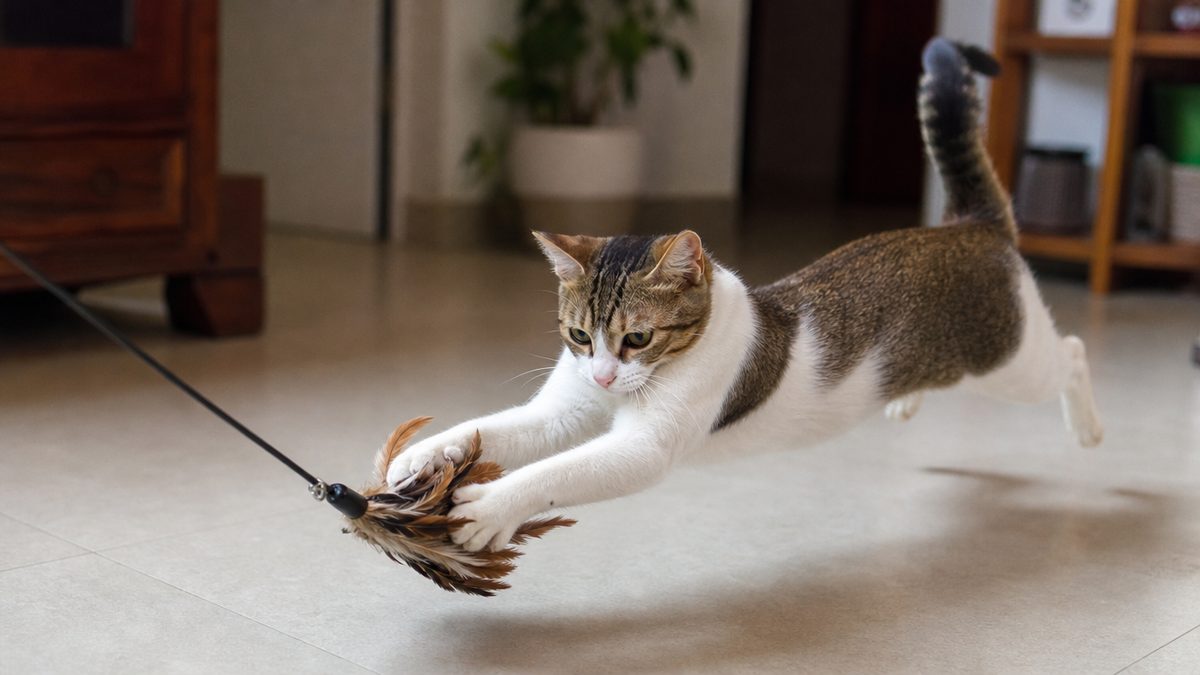
- Wake the cat with the hunt, not the bowl. Five minutes of wand work before breakfast, ending in a catch the cat is allowed to keep.
- Feed breakfast through a puzzle or scattered across a clean floor, so the meal takes minutes instead of seconds.
- Open the netted window before you leave, because the street is the only live stimulus the flat has while you are out.
- Leave one stationary food puzzle and nothing with string, thread or a bell in it, since unsupervised string is the hazard covered in indoor cat safety in India.
- Run the second hunt before dinner, longer than the morning one, and finish it with the meal rather than with a treat.
- Rotate the toy box once a week, and keep the three that are out of sight for the other six days.
The 277-cat survey is owner-reported, cross-sectional and American, so it shows an association between longer play bouts and fewer reported problems rather than proving that play prevents them. Owners who play more may also differ in other ways. It is still the only figure on this question with a denominator attached, which is more than any page currently ranking for indoor cat boredom offers.
Food-based enrichment, the case records, and the result that complicates it
Food-based enrichment means delivering part of the daily ration through a puzzle, a scatter or a hunting feeder instead of a bowl, and the veterinary review that opened the subject published its own case outcomes rather than claims.
That review is honest about its evidence base in its own abstract. 'The effect of food puzzles on cats is a relatively new area of study, so as well as reviewing the existing empirical evidence, we provide case studies from our veterinary and behavioral practices showing health and behavioral benefits resulting from their use';. The benefits the authors say they observed are weight loss, decreased aggression toward humans and other cats, reduced anxiety and fear, cessation of attention-seeking behaviors and resolution of litter box avoidance.
The case table is the part worth reading, because it is specific in a way that enrichment advice almost never is.
| The cat | What it presented with | What was recorded after food puzzles were introduced |
|---|---|---|
| Domestic shorthair, neutered male, 8 years | Obesity | Weight loss of 20 percent in 12 months, with homemade and purchased mobile puzzles |
| Domestic mediumhair, spayed female, 16 years | Obesity, no interaction with owners, secluded itself in one room, antisocial with new kittens despite a slow introduction | Weight loss of 32 percent in 18 months; it began to play with the owners, took an interest in the kittens' foraging toys, and rejoined the household |
| British Shorthair, neutered male, 3 years | Impulsive, frustration-based aggression, biting with no warning when anticipating meals or when attention was withheld | The puzzles 'immediately resolved the situations where the cat experienced frustration'; the aggression resolved within 6 months |
| Domestic shorthair, neutered male, 10 years | Disorientation, nocturnal vocalisation, disturbed sleep-wake cycle, diagnosed with cognitive dysfunction syndrome | Marked decrease in disorientation, improved sleep-wake cycle, nocturnal vocalisations ceased, and pharmacological treatment was avoided |
| Domestic longhair, neutered male, 12 years | Urination outside the litter box due to chronic feline idiopathic cystitis | Behaviour completely resolved within 6 months of treatment, alongside litter box management |
| Domestic mediumhair, two neutered males, 3.5 years | Meowing for food, waking the owner to be fed, stealing food from plates and counters | Eating slowed, meowing for food decreased, and mealtime behaviour improved while the cats had a puzzle |
| Domestic longhair, spayed female, 9 years | Anorexia, social withdrawal and loss of play when left alone, diagnosed as separation anxiety syndrome | Gradual improvement over 6 months; within a year the owner ranked improvement as excellent, alongside added vertical space and hiding areas |
Two cautions belong with that table. These are case records from the authors' own practices, not a controlled trial, and in several of them a puzzle was one part of a wider plan that also included desensitisation, litter box changes or added vertical space. Where other changes were made, the table says so and so do we. The one multi-cat reassurance that does come from a study is that 85 percent of group-housed cats, 23 of 27, in a shelter engaged with a food puzzle without increases in aggression between cats.
Cats do not actually prefer to work for food
Now the finding that cuts across all of it, and that no page recommending puzzle feeders mentions. Contrafreeloading is the willingness of an animal to work for food when identical food is freely available, and it has been shown in laboratory, domesticated and captive animals. Seventeen neutered indoor cats were offered a food puzzle and a tray of the same size and shape, side by side, across ten 30-minute trials with activity trackers on and video running. The cats ate more from the free tray than from the puzzle, t(16) equal to 6.77, P less than 0.001, and made more first choices to approach and eat from the tray. Eight of the 17 did not contrafreeload at all, 4 ate most of the food offered in the puzzle and 5 showed weak tendencies. Activity level, sex, age and previous puzzle experience made no difference.
Those two results disagree, and both are on this page because both are published. The reconciliation we would offer is not that one is wrong. It is that a food puzzle is not something a cat wants more than a bowl; it is something that puts time, movement and mental stimulation back into a day that has 29 minutes of activity in it. You are not indulging a preference. You are reinstating a cost the bowl removed. That also explains why staging matters so much, and why a puzzle dumped in front of a cat that has never worked for food gets ignored.
The introduction method from the review is six steps, and skipping them is the usual reason a puzzle ends up in a cupboard.
- Fill it as full as possible at first, with several large holes, so that obtaining food from the puzzle is as easy as obtaining it from the bowl.
- Offer it when the cat is hungry, before a meal rather than after one.
- Increase motivation at the start with a novel food, then move to the cat's usual ration as it gets adept.
- Scatter dry food on the floor next to and around the puzzle, so the cat moves it by accident and makes the connection.
- Remove the regular food dish once the puzzle is working, because some cats will not work while an easier option is visible.
- Give each cat in the house its own puzzle, and several of the popular type, so nobody has to compete for a feeding station.
Scatter feeding is the version that costs nothing and needs no equipment. Toss a quarter of the day's dry ration across a clean floor, a sofa back, a window sill and the top of the almirah, and let the cat find it. The review's own advice for slow starters is exactly this, placing handfuls of dry food in locations the cat frequents so it discovers food in novel places, and then transitioning to stationary puzzles in those same spots.
Every gram that goes into a puzzle is a gram that comes out of the bowl. Indoor housing is already associated with increases in obesity, and a cat that gets its meals plus a day of treats through a feeder gains weight while its owner believes it is being enriched. The calorie arithmetic, including why one saucer of anything is a large share of a 4 kg cat's day, is in can cats drink milk. We do not re-teach it here.
What does not work, and where the evidence is thin
Five popular fixes do less than the pages recommending them claim, and the television left on for the cat is the clearest case, because it has actually been tested.
One hundred and twenty-five cats in a rescue shelter were randomly assigned, 25 each, to five conditions: no visual stimulation, a blank television screen, and televised images of humans, of inanimate movement and of animate movement. Each cat got 3 hours a day for 3 days, with behaviour recorded every 5 minutes. The cats spent 6.10 percent of total observation time looking at the monitors. Images of animate and inanimate movement held attention significantly better than the moving images of humans or the blank screen, and attention fell significantly across each 3-hour presentation. The authors conclude that video sequences, 'notably that combining elements of prey items and linear movement', may hold some enrichment potential, but that cats 'may not benefit from this type of enrichment to the same degree as species with more well-developed visual systems, such as primates';.
Read what that does to the common advice. A screen showing birds is a weak intervention that holds a cat for about one minute in sixteen and habituates within a single sitting. A human television programme, which is what 'leave the TV on for the cat' usually means, performed no better than a blank screen in the one experiment that compared them. An Indian retailer's guide tells readers that 'cat TV videos of birds on YouTube work well for most Indian breeds, including Indies, Persians, and Bengals' and cites nothing for it. A large American veterinary site answers 'do cats get bored' by quoting a researcher's opinion and naming no study at all.
The five things to stop counting on are listed below, each with what the evidence actually supports in its place.
- Leaving the television on. Measured at 6.10 percent of observation time with habituation inside 3 hours, and human images were no better than a blank screen. Use a netted window onto a real street instead.
- Leaving every toy out permanently. Seventy-eight percent of owners do it, and novelty decays Ellis SLH and Wells DL. Rotate three at a time.
- Buying a second cat as the fix. Cats Protection warns plainly that cats are solitary animals, will not necessarily want to play with another cat, and that a second cat could cause a lot of stress. The measured evidence on multi-cat households is set out in cat friendly home setup.
- A laser pointer as the whole session. The published work on laser play and abnormal repetitive behaviour is covered in things to do with your cat in India; this page does not repeat it.
- Buying the expensive puzzle first. Eight of 17 cats preferred a free tray to an identical-sized puzzle, so stage the difficulty before you stage the spending.
One honest gap. Nobody has tested whether music, an open radio, a ceiling fan's moving shadow or a window onto a busy Indian street does anything measurable for a cat, and we could find no study on any of them. The window is still where we would spend first, because it is free, it is genuinely live rather than looped, and the one visual-stimulation experiment found that what held cats longest was movement rather than people. That is reasoning from an adjacent result, not a finding, and we are marking it as such.
The Indian cat's year: monsoon weeks, summer afternoons and a grille window
An Indian cat's year has two long stretches when the free enrichment runs out, and the monsoon is the longer of the two, because it closes the balcony and takes most of the sunlight at the same time.
The India Meteorological Department puts the southwest monsoon's normal onset over Kerala around 1 June, full coverage of the country around 8 July, and withdrawal from the entire country around 15 October. That is about nineteen weeks in which a balcony is wet, a window is shut and a cat's outdoor stimulus is a closed grille. The Press Information Bureau puts the season's share at about 75 percent of India's total rainfall, with the June to September 2025 total at 934.8 mm, or 108 percent of the long period average of 868.6 mm on the 1971 to 2020 baseline.
The city numbers make it concrete. On the 1991 to 2020 normals, the Santacruz station in Mumbai records 78.6 rainy days a year, of which 73.1 fall in June, July, August and September. Relative humidity at 17:30 IST reaches 81 percent in July and August, against 47 percent in February. A cat in Mumbai, Kolkata or Kochi therefore spends most of a quarter of the year in a humid flat with the balcony door shut, and the same is broadly true in Pune and Bengaluru with fewer rainy days and in Chennai with a second burst in the northeast monsoon. Hyderabad, Ahmedabad and Delhi get fewer wet days and a harder summer instead, which moves the same closed-window problem from July to May.
The window seat is a seasonal resource and nobody plans for it
Here is the part no page on this query has noticed. The free enrichment an Indian flat does provide, a warm patch of light on a sill where a cat watches a street, is not constant. At the Colaba station, mean daily sunshine falls from 9.1 hours in January to 2.6 in July and 2.5 in August. That is a 73 percent cut in the sunbeam, arriving in exactly the weeks the balcony closes. The cat loses two resources at once, and the household usually notices only the third thing, which is that the cat has started waking everyone at 3 am.
So the monsoon is when the deliberate enrichment has to go up, not down. That is the opposite of what happens in most homes, because the people in them are also indoors, also irritable and also behind on the laundry.
| Season | What the cat loses | What to add | What to watch for |
|---|---|---|---|
| March to May, the hot months | Daytime activity, because heat flattens it and the floor is the only cool surface | Move both hunts to before 8 am and after sunset; scatter-feed on cool tile rather than on a mat | Panting, drooling and lethargy are heat signs, not laziness. See keeping a cat cool in summer |
| June to September, the monsoon | The balcony, the open window and about three quarters of the daily sunshine | A third short hunt, the food puzzle promoted from occasional to daily, and the toy rotation tightened to twice a week | Damp bedding and a damp tray; cardboard enrichment turns soggy and needs replacing weekly |
| October to November, after withdrawal | Nothing, and this is the easiest stretch of the year | Reopen the netted window and move the perch back into the light | Diwali noise, which is covered in Diwali with your pet in India |
| December to February, the cool months | Nothing in most of India; in Delhi and the north, floor-level warmth | A raised bed in the sunbeam, which is at its strongest of the year | An older cat that has stopped jumping to the sill has lost the jump, not the interest. See senior cat care |
Three Indian specifics change the standard advice and none of them appears on an imported page.
- A grille window is ventilation, not containment, so the window perch that is the cheapest enrichment in the flat has to be meshed before it is used. Mesh sizes and prices are in indoor cat safety in India, and the perch itself belongs with the vertical-space map in cat friendly home setup.
- A cat that lives semi-indoors on an Indian terrace, a stairwell or a shared landing is not an indoor cat and not an outdoor one, and no study has measured this arrangement anywhere. It gets more novelty than a flat cat and more risk than one too. Treat the enrichment plan here as the floor for such a cat and the safety page as the ceiling.
- Ants find a food puzzle faster than the cat does in a humid month. Wash the puzzle daily, keep it off the kitchen floor and use a stationary design in the monsoon rather than a rolling one that ends up under the fridge.
Every figure here about cats comes from New Zealand, Canada, the United Kingdom, the United States or a shelter in Europe. Every Indian figure here is about weather. We could find no published study of enrichment, boredom or activity in pet cats in India, and the systematic review of indoor cat welfare found only 21 of 61 papers studied cats at home anywhere in the world. The climate reasoning in this section is ours, applied from Indian meteorological data, and we are telling you which part is measured and which part is inference.
DIY enrichment from what an Indian kitchen throws out
To build enrichment from an Indian kitchen's waste, cut holes in a container the cat can move or reach into, put part of the day's dry ration inside it, and make the first version far too easy.
Imported puzzle feeders are expensive here and entirely optional. The 2016 veterinary review names the homemade versions itself: puzzles for dry food 'can be made easily by cutting holes in containers such as yogurt pots, toilet paper rolls, egg cartons, margarine tubs or water bottles', while 'ice cube trays or muffin pans can be used for wet food, and yogurt lids can be placed over the individual reservoirs or cups to increase difficulty';.
The ASPCA publishes two builds in enough detail to copy. The reach feeder takes three or four toilet paper rolls and a shoe box with a lid: trace the end of each roll on the lid, cut the holes out along the traced lines so the roll sits snugly, slide the rolls in and drop kibble into each one. The slow feeder is one roll on its own: cut holes in the side large enough for kibble to pass through, fill it, then tape or fold the ends. Its standing instruction is the one to keep: supervise closely while any DIY item is accessible, and remove anything the cat tries to swallow.
| What you were going to throw away | What it becomes | How to make it | Cost |
|---|---|---|---|
| Dahi or curd cups, the 200 ml plastic ones | A stationary paw-fishing puzzle | Set four or five upright in a shoe box lid, put kibble at the bottom of each, and let the cat fish them out | Rs 0 |
| The cardboard egg tray | A beginner's foraging tray | Drop one or two pieces of kibble into each well and leave half the wells empty, so the search is not uniform | Rs 0 |
| Toilet or kitchen paper rolls | A rolling slow feeder | Cut kibble-sized holes in the side, fill, then fold the ends shut | Rs 0 |
| A courier or grocery carton | A hiding place and a den in one | Cut one entry hole on its side, leave the flaps on, and put it where the cat already sleeps | Rs 0 |
| An empty masala or atta dabba with a lid | A hard-level mobile puzzle for a cat that has mastered the easy ones | Punch two holes slightly larger than a kibble, fill a third full, and close the lid | Rs 0 |
| A steel muffin tray or ice tray from the back of the freezer | A wet-food puzzle for summer | A little wet food in alternate wells; add plastic lids over the wells once the cat is fluent | Rs 0 |
| Yesterday's newspaper | A rustling search layer | Crumple loosely over a scatter of kibble in a shallow tray, so the cat has to dig through sound to find food | Rs 0 |
The three things never to leave in a homemade toy are below, and each of them is a hazard rather than a preference.
- Never leave string, thread, sutli, ribbon or a tailor's spool where a cat can reach it unsupervised. This is the linear foreign body, and it is covered with the Indian cases and the surgical consequence in indoor cat safety in India.
- Never leave bells, buttons, bottle caps or anything small enough to swallow attached to a homemade toy. The ASPCA's rule is active supervision and immediate removal if the cat tries to ingest a piece.
- Never use a container that held phenyl, bleach, detergent or a pesticide, however well rinsed, because the smell alone will either repel the cat or sit on food it is about to eat.
Two practical notes for Indian conditions. Cardboard absorbs water and grows mould in a humid month, so a monsoon carton is a weekly replacement, not a permanent fixture. And an upturned plastic dahi cup on tile is loud at 2 am, which is a real objection in a 46 square metre flat; the review's own answer is to use stationary puzzles at night and keep mobile ones away from the bedroom.
A homemade puzzle is safe when you have watched the cat use it. Sit through the first two or three sessions with each new design and throw it away the moment the cat starts chewing the container rather than working it. Bonbeno does not name or recommend any commercial feeder, toy or brand, because a verdict needs first-hand testing.
A seven-day rotation that fits an Indian working week
Run a seven-day rotation so that the cat meets something different most days, because the measurable thing about enrichment is novelty and novelty is what a fixed routine destroys.
This plan assumes one cat, a flat, two working adults and no purchases. It takes about fifteen minutes a day in total, which is the sum of two play bouts above the five-minute floor the survey found, plus the thirty seconds it takes to load a feeder.
| Day | Morning, before breakfast | Breakfast delivery | Evening, before dinner |
|---|---|---|---|
| Monday | Five-minute wand hunt, ending in a catch | Scatter feed across the floor and one sill | Ten-minute hunt with a different toy from the rotation |
| Tuesday | Five-minute chase with a crumpled paper ball | Toilet-roll slow feeder | Ten-minute wand hunt |
| Wednesday | Five minutes of training, target and sit, rewarded from the ration | Curd-cup fishing puzzle | Ten-minute hunt, finishing with the meal |
| Thursday | Five-minute wand hunt at floor level | Egg-tray forage | New carton on the floor, left alone, cat investigates unaided |
| Friday | Five-minute chase up and down the corridor | Scatter feed, hidden in three rooms | Ten-minute wand hunt |
| Saturday | Longer hunt, because you are home and the cat knows it | Dabba puzzle, the hard one | Grooming session the cat starts and ends |
| Sunday | Rotate the toy box: three out, the rest away | Wet food in a muffin tray | Quiet evening, window open behind the mesh |
Four rules make the table work, and dropping any of them is why most enrichment plans die in the second week.
- Count the puzzle food as food. Weigh the day's ration once and split it, so the enrichment never arrives on top of the meals.
- Let the cat win every hunt. A session that ends with nothing caught is the one pattern the guidelines warn against, and the detail is in things to do with your cat.
- Change one variable a day, not five. Novelty is the active ingredient, and a cat that meets seven new things on Monday has nothing left for Thursday.
- Keep the window, the tray and the water exactly where they are. The resource map is the stable part of the flat and it is set out in cat friendly home setup; only the activity rotates.
If the cat ignores the whole plan for a week, stop adding things. A cat that will not engage with novelty, food or play is not under-stimulated, it is the apathy or anhedonia shape from the first section of this page, and that is a clinic visit. The year-round health routine this sits inside is in adult cat care in India.
The limits of this evidence, stated plainly
Six claims on this page are measurements with denominators and six common claims about bored cats are not established, so the line between them is drawn here rather than left for you to guess.
Six things here are measured, and each names its study.
- Boredom can be operationalised and measured in a non-human animal, and enrichment reduces it; barren-housed mink approached novel stimuli faster at P equal to 0.003 and ate more food rewards at P equal to 0.037, across 29 animals.
- Pet cats are active for 2.8 percent of the day on average, and indoor-only cats for 2.0 percent in summer against 3.9 percent for cats with outdoor access, in 28 accelerometer-tracked cats.
- Medical causes were found in 16 of 21 cats referred for presumed behavioural overgrooming, 76 percent, with an adverse food reaction in 12 of them.
- Cats spent 6.10 percent of observation time looking at televised images, with attention falling significantly within each 3-hour session, across 125 shelter cats.
- Cats ate more from a free tray than from an identical-sized food puzzle, t(16) equal to 6.77 at P less than 0.001, with 8 of 17 not contrafreeloading at all.
- Mumbai records 73.1 of its 78.6 annual rainy days in the four monsoon months, while mean daily sunshine falls from 9.1 hours in January to 2.5 in August.
Six further claims are not established, and this is where this page reasons rather than reports.
- Nobody has measured boredom in a domestic cat. The operational test exists and has been run in mink; applying it to a cat is an extrapolation we have flagged each time we made it.
- Nobody has measured anything about enrichment or activity in cats in India. The systematic review found only 21 of 61 papers studied cats at home anywhere, and none of those was Indian.
- The food-puzzle case outcomes are case records from the authors' own practices, several of them alongside other changes, and not a controlled trial.
- The link between longer play bouts and fewer behaviour problems is an owner-reported cross-sectional association in 277 American households, not a demonstrated effect of play.
- The claim that a bored cat sleeps more, which several ranking pages make, has no study behind it, and the one experiment that measured boredom found lying awake rather than sleeping, a result its own authors said requires replication Cats Protection, 'Is my cat bored? How….
- Whether a window onto an Indian street, a radio or a fan's shadow does anything measurable for a cat is untested. The window is our recommendation on adjacent evidence that movement holds attention better than people do, not a finding.
One last boundary. Bonbeno does not name, rank or recommend a feeder, a toy or a brand, and does not recommend a drug or a dose. If your cat has started overgrooming, stopped using the tray, started waking the house at night or started biting, that is a consultation about an individual animal with a veterinarian who can examine it, which is why this page publishes under the medical disclaimer at the top. The tray side of house-soiling is in litter training a cat or kitten in India.
Common questions
Do indoor cats ever get bored?
Yes. Boredom is a measurable state in animals rather than a figure of speech: in the experiment that operationalised it, 29 mink in barren cages approached ten novel stimuli faster than enriched mink at P equal to 0.003 and ate more food rewards, with no sign of apathy or depression. That test has never been run in cats, so applying it to your cat is a reasonable extrapolation rather than a proven result.
How do I stop my indoor cat from being bored?
Give it two or three play bouts of five to ten minutes a day, feed part of the ration through a puzzle or scattered across the floor, open a meshed window onto a street, and rotate three toys at a time rather than leaving them all out. In the 277-cat survey, owners reporting bouts of five minutes or more reported fewer behaviour problems than those with one-minute bouts.
Are cats ok with doing nothing all day?
They are already doing close to nothing, which is the problem. Twenty-eight pet cats wearing accelerometers were active for 2.8 percent of their time on average, and the 10 indoor-only cats for 2.0 percent in summer, roughly 29 minutes a day, against 3.9 percent for the 18 cats with outdoor access. A free-ranging cat would fill that time hunting, and only about half of its attempts succeed.
How do I know if my indoor cat is unhappy?
Watch for overgrooming, house-soiling, night activity, attention-seeking, aggression, hiding and changes in appetite, then take each one to a veterinarian before you call it boredom. Of 21 cats referred for presumed behavioural overgrooming, 16 had a medical cause of itch, 12 of them an adverse food reaction, and only 2 had a purely behavioural diagnosis. Most boredom signs are medical until proven otherwise.
What is the best enrichment for cats?
Food-based enrichment has the strongest published record. The 2016 veterinary review of food puzzles reports case outcomes including 20 percent body-weight loss in 12 months in an obese cat, frustration-based aggression resolving within 6 months, and nocturnal vocalisation ceasing in a cat with cognitive dysfunction. Those are case records rather than a controlled trial, and in several cases other changes were made at the same time.
How do I keep my cat entertained indoors?
Use the window, the ration and the recycling. A meshed window onto a live street beats a screen, since shelter cats spent only 6.10 percent of observation time watching televised images and their attention fell within each three-hour session. Deliver breakfast through a toilet-roll feeder or scattered across the floor, and swap three toys in and out weekly so novelty does not decay.
How can I mentally stimulate my cat?
Make it solve something for its food, and stage the difficulty properly. Start with a puzzle filled to the brim with several large holes, offer it before a meal when the cat is hungry, scatter kibble around it so the cat moves it by accident, then remove the bowl. Cats do not naturally prefer working for food: 8 of 17 tested cats chose a free tray over an identical puzzle every time.
Does the monsoon make indoor cat boredom worse in India?
It removes two resources at once. Mumbai records 73.1 of its 78.6 annual rainy days in June to September, humidity at 17:30 IST hits 81 percent in July and August, and mean daily sunshine at Colaba falls from 9.1 hours in January to 2.5 in August. The balcony closes and the sunbeam on the window seat largely disappears across the same nineteen weeks, so planned enrichment has to rise, not fall.