
Dog life guide
Dog agility in India: what the sport is, what you can actually enter here, and how to start without owning a jump
Four Indian pages tell you to buy a jump. The sport's own rulebooks tell you to measure your dog, wait until it is mature and start on flat ground. We checked what India actually runs, and the honest answer is almost nothing.
Quick answer
Dog agility training India is mostly private coaching rather than competition. We read the Kennel Club of India's site, the national show calendar and two clubs' own pages on 22 October 2026 and found no agility rulebook, no height division and no trial entry form. Start on flat ground anyway. Build a recall, a start-line wait and body awareness first, keep bars on the floor until the dog is mature, and train in the cool hours.
This guide is general information for Indian pet owners and is not a diagnosis. Always consult a registered veterinarian near you before acting on anything you read here, and treat any sudden change in your pet's condition as urgent.
What dog agility actually is, under the rules that define it
Dog agility is a timed obstacle course run off lead, scored on faults and on time together, with the handler running the course alongside the dog and steering it by voice and body position alone. The Fédération Cynologique Internationale, the world federation the Kennel Club of India belongs to, defines it as a competition open to all healthy and physically fit dogs whose aim is for dogs to negotiate different obstacles in a set order and within a set time.
Two things in that definition do most of the work, and the clips you have seen show neither clearly.
The first is that the handler is in the ring. The dog runs off lead with no collar, and the regulations state plainly that for safety reasons dogs must never wear a lead or collar during a trial and that the handler is not allowed to have anything in his hands. There is no food, no toy and no physical contact. A handler who gains an advantage by touching the dog or an obstacle is faulted five points each time it happens. Everything the dog does, it does on a cue you gave it from several metres away while running.
The second is that the score has two independent halves. Faults come in units of five: a knocked bar, a refusal, or a missed contact zone each cost five, and the number of time faults is equal to the amount by which the course time exceeds the standard course time, measured to 0.01 seconds. Ranking goes on total faults first and only then on speed, so a clear round that is slow beats a fast round with one knocked bar. Three refusals, exceeding the maximum course time, harsh handling of the dog, or a dog wearing a collar all end the run in elimination.
The obstacles, and the dimensions that define them
An FCI course runs 100 to 220 metres and asks the dog to take at least 15 obstacles and no more than 22, of which no fewer than 7 must be jumps. The weave poles must appear on every course. The table below is the regulation kit, and it is worth reading before you buy anything, because the gap between it and a home set is large.
| Obstacle | What the dog does | The regulation dimension |
|---|---|---|
| Hurdle | Jumps a single displaceable bar between two wings | 55 to 60 cm for Large, 45 to 50 cm Intermediate, 35 to 40 cm Medium, 25 to 30 cm Small; bar 120 to 130 cm wide, wood or safe synthetic, metal not allowed |
| Tyre | Jumps through a suspended hoop | Aperture 50 to 60 cm; centre 80 cm from the ground for Large, 70 cm Intermediate, 55 cm Medium and Small; must break away under a force equivalent to 8 kg |
| Long jump | Clears a run of low ascending platforms | 120 to 150 cm overall for Large down to 40 to 50 cm for Small; lowest unit 15 cm high, highest 28 cm |
| A-frame | Climbs one ramp and descends the other, touching the lower contact zone | Apex 170 cm from the ground for all dogs; ramps 265 to 275 cm long, 90 cm wide; non-slip surface with anti-slip slats about every 25 cm |
| Dog-walk | Crosses a raised plank with a ramp at each end | 120 to 130 cm high, plank 30 cm wide, ramps 360 to 380 cm, last 90 cm of each ramp a contrasting contact zone |
| See-saw | Walks a pivoting plank and rides it to the ground | 60 cm at the pivot; must tip in 2 to 3 seconds under a 1 kg weight placed on the down contact zone; anti-slip slats are NOT allowed |
| Weave poles | Weaves a line of uprights, first pole on its left | 12 poles, 3 to 5 cm in diameter, 100 to 120 cm tall, spaced 60 cm apart |
| Tube tunnel | Runs through a flexible tube | 60 cm diameter, 300 to 600 cm long, secured with at least one bag per metre |
An FCI course must be built in a ring of at least 20 m by 40 m, inside an area of at least 24 m by 40 m, and the organiser needs 14 hurdles, three different contact obstacles, four tunnels, a long jump and a weave set, plus a team of six people to build the course. That is 800 square metres of safe, level, non-slip ground plus a storeroom. It is the single clearest reason that a country can have plenty of interested owners and almost no agility rings.
Our parent page on canine sports in India sets out the wider landscape and reaches three conclusions worth carrying here: that organised dog sport in India is a far shorter list than the global one, that Indian law regulates the training and exhibition of performing animals through a chapter of the Prevention of Cruelty to Animals Act, 1960 whose register holds circuses and race horses rather than dog clubs, and that the dominant Indian commercial model, a residential course the owner does not attend, cannot produce a handler and dog who read each other. This page is the next step down: agility specifically, and how one beginner starts.
Where a beginner in India actually starts
To start agility in India, assume you are buying coaching rather than entering a sport, because we could not verify a single sanctioned Indian agility trial from any organiser's own page on 22 October 2026. Private trainers and facilities in a handful of cities sell agility classes. Nothing we opened published an agility rulebook, a height division, an entry form or a date.
We re-read the Kennel Club of India's public site ourselves on 22 October 2026, looking specifically for an agility document, and found none. The number one organic result in India for this exact query is a trainer's service page carrying a phone number and a short list of benefits, with no governing body, no rulebook, no age and no jump height anywhere on it. Here is exactly what we checked and what each source said, so you can re-check it yourself rather than taking our word for it.
| What we opened | What it published | Agility found |
|---|---|---|
| The Kennel Club of India's public site | A page of downloadable forms covering registration, transfer, judges, handlers and one application to hold a dog show | None. No agility regulation, height division, entry form or calendar |
| India's national show calendar portal, October 2026 | 13 championship, speciality and open conformation shows across Puducherry, Thiruvananthapuram, Hubli, Madurai, Belgaum and Bengaluru | None. The calendar's own filter offers Pointed, Non-Pointed, Speciality, Open and Obedience shows, and has no agility category at all |
| The Madras Canine Club's About Us page | The club's own claim that it was the first to introduce agility trials in India and wishes to popularise the sport all over India | A claim, with no date, venue, class list or result attached |
| The same club's published 20-page schedule for its 29 and 30 August 2026 shows | Breed classes by age, challenge certificates, the FCI group list, junior handling, an entry fee of Rs 4,000 for all breeds and Rs 3,000 for Indian breeds | None. Twenty pages of conformation and not one agility class |
| The top-ranking Indian guide for this query, a Delhi NCR article | A claim that the Kennel Club of India organises national agility trials and holds training days at a named Delhi sports complex, with trial entry fees of ₹500 to ₹1,500 a run | Unverified. The article cites nothing, and the club's own site carries no trial, no venue and no fee |
| The number one organic result for dog agility training india | An Indian trainer's service page listing the benefits of agility and a phone number | A service, not a sanctioned event |
The one Indian claim that came closest, and why we stopped short of it
A 2019 newspaper report from Bhubaneswar states that the Obedience and Agility Club of Bhubaneswar is the only obedience club in the country affiliated to Kennel Club of India, and describes obedience trials at the 56th championship shows of the Orissa Kennel Club with around 26 entries and more than 10 in the hardest open test. That is a newspaper, not the club, and it is seven years old, and what it describes is obedience rather than agility. We record it because it is the strongest signal we found that a club structure for scored, non-conformation work has existed in India, and we are not going to upgrade a 2019 news paragraph into a live club you can join.
Indian pages about this sport repeat each other's claims. One page ranking in the top five for this query states that the Kennel Club of India organises national-level agility trials and prints a rupee entry fee per run, while selling an indoor toilet pad for apartment dogs. We read the Kennel Club of India's own site the same day and found nothing of the kind. Before you buy equipment, book travel or pay an entry fee, open the organiser's own page and look for three things: a date, a venue and a downloadable entry form. If two of the three are missing, treat the event as not yet real.
What to do if you live where there is no club
- Train the foundation anyway. Every skill in the next section is built on flat ground with no equipment, and it is the part that takes months. A reader in Kolkata, Ahmedabad or a smaller city loses nothing by doing this first.
- Ask a trainer for one assessment session, not a package. Ask which rulebook they teach from and whether you attend every session. A trainer who answers "none" is selling coaching, which is fine if you know it.
- Measure your dog at the withers and write the number down. It decides its height category everywhere in the world, and you will need it before anybody sets a bar.
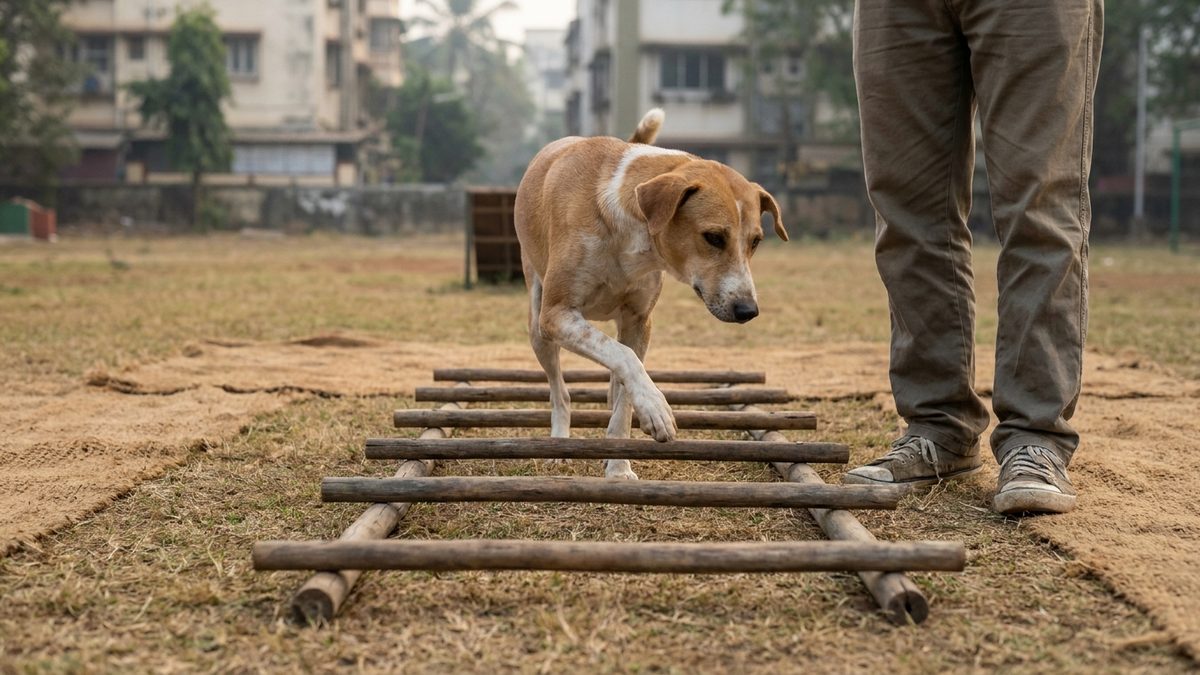
- Use the floor you have. Cones, a broom handle on two books, a cardboard box and a flat plank do the whole first six months of work.
- Watch a full run before you commit. Our guide to things to do with your dog in India sets out what else is open to a dog by life stage if agility turns out not to fit your city or your dog.
Agility classes in India cluster in the same few metros that everything else does. We found facilities advertising agility in Mumbai, Pune, Bengaluru, Hyderabad and the Delhi NCR and none advertising it in most Indian cities. That is a statement about who publishes a web page, not a census, and we are not naming or ranking any of them.
Foundation before equipment, and what the evidence behind that actually is
To build the foundation for agility, train eight things that need no obstacle at all, because the governing bodies describe the first year of agility as groundwork and games and because the only large survey of risk factors found the hazard sits with jumping specifically rather than with the sport as a whole.
The AKC's Director of Agility puts the content of a puppy class plainly: it should be all about groundwork and games, and dogs "should not be weaving, jumping, or working full-size equipment", with much of the work done "with one jump without a jump bar or just two weave poles (or cones)";. The programme manager quoted alongside her recommends a class that uses foundation equipment such as wobble boards, low walk planks and tunnels, and "concentrates on flat-work and focus exercises", with the motto "keep it low and slow";.
Here is the evidence that makes that more than a preference. In a survey of 4,197 agility dogs, 1,737 of them, 41.4 percent, had an injury history, and 629, 15.0 percent, had an injury that lasted more than three months. When the authors tested when each kind of training had started, only three variables survived the final model, and they were the age of starting jump training, teeter training and weave training. The direction is the part that matters to a beginner: among dogs that started jump training at the same age, those that started weaves and the see-saw EARLIER had lower odds of injury, so the highest risk belonged to dogs that jumped early and left the other obstacles until after 18 months.
Read that carefully, because it is the opposite of the folk rule. The contact obstacles and the weaves are not the things to postpone. The bar is.
The eight foundation skills, none of which needs a jump
- Flatwork. The dog holds station at your side at any speed and on either side, which the AKC calls the follow-me game. This is the single largest piece and it is pure running on grass.
- A recall that works under arousal. Round-robin recalls with several people and restrained recalls, where someone holds the dog while you run away, are the two drills named. A dog that cannot be called off a pigeon cannot run off lead.
- A start-line wait. The dog holds a sit or a down while you walk away and sets off only on release. Sit, down and stay are named as particularly valuable for the start line.
- Impulse control around food and toys. The slow-treats exercise, where the puppy waits for permission before taking anything, then the same with a toy on the ground.
- Body awareness, front and rear. Front paws onto an object on cue, then a wobble board; and backing up, which the AKC names as an excellent way to develop rear-end awareness for travelling a dog-walk at speed.
- Surfaces. Crinkly tarps, wooden and carpeted and open-backed stairs, slick floors, all introduced slowly and never forced. An Indian flat supplies vitrified tile and little else, so this one needs deliberate work.
- Nose targeting. The dog touches a target with its nose, so you can later place the target in a contact zone and position the dog without handling it.
- Directional cues and sending out. Right and left, taught through spins, and sending the dog away from you around a cone and back.
Tunnels are the one obstacle that belongs in this list rather than after it, because a tunnel asks nothing of a joint. The same survey found tunnel training before 18 months associated with higher odds of injury than after it, which is a correlation in a population of dogs whose whole training programme started early, and the authors are explicit that these are associations rather than proof of cause.
No published study we could find shows that a warm-up, a cool-down or a strength and conditioning programme reduces agility injuries in dogs. The 4,197-dog survey tested a long list of training variables and reports that many variables thought to be associated with injury risk were not significant in the final model. Warming a dog up before a fast session is sensible and costs nothing, and this page is not telling you to stop. It is telling you not to buy a conditioning package on the promise that it prevents injury, because nobody has shown that it does.
Reward timing, marker words and the mechanics of teaching any of the above are on puppy training basics in India, which owns that material. Nose work as daily enrichment, and what the sniffing evidence does and does not show, are on dog boredom and enrichment in India.
What age to start agility, and where the bodies openly disagree
The minimum age to compete in agility is 15 months, 18 months or 24 months depending on whose rulebook you read, and one national body states that a puppy's joints and bodies are fully developed at eight months, which is at odds with everything else on this page. We are publishing the disagreement rather than averaging it.
| Body | Minimum age | What else the same page says |
|---|---|---|
| Fédération Cynologique Internationale, international trials | Over 24 months | Also requires an FCI-recognised pedigree, a tattoo or microchip, and a valid record book or licence |
| Fédération Cynologique Internationale, national trials run by a member kennel club | Over 18 months | Open to all dogs "with or without pedigree", which is the clause that lets an unregistered dog compete |
| American Kennel Club | 15 months | "Both purebred and mixed breed dogs are welcome", and the same article urges owners to start age-appropriate foundation work long before that |
| Dogs Australia | 18 months to compete | But also says "Puppies could start from eight months of age when their joints and bodies are fully developed" |
The FCI sets 24 months for an international trial and 18 months for a national one, and the national clause is the interesting one for an Indian reader: those trials are "Open to all dogs over 18 months old, with or without pedigree". The AKC sets 15 months and says both purebred and mixed breed dogs are welcome, while telling owners not to wait before starting foundation work. Dogs Australia sets 18 months for competition and then writes that puppies could start from eight months of age when their joints and bodies are fully developed.
That last sentence is the one to argue with. A dog's growth plates have not finished closing at eight months in any breed of consequence, and the same AKC article says so in the opposite direction: puppies' growth plates are still open, "so it is crucial that they don't jump full height or climb on full-height contacts and do closed weaves before they are mature";. We are not resolving the conflict by picking a side. We are telling you that one national body's own agility page carries a developmental claim that its own peers contradict, and that an eight-month-old dog jumping at height is a decision no evidence supports.
What the injury data says about age, with its denominators
The 4,197-dog survey asked owners when each dog first jumped anything at all, and compared every answer against dogs that did not jump until after 18 months. Against that reference, dogs that first jumped at 3 to 6 months carried an odds ratio of 1.53 (95 percent confidence interval 1.20 to 1.95), at 7 to 9 months 1.70 (1.38 to 2.11), at 10 to 12 months 1.73 (1.41 to 2.13), at 13 to 15 months 1.38 (1.11 to 1.72) and at 16 to 18 months 1.52 (1.11 to 2.07). The 101 dogs that first jumped before three months of age were not at raised risk, at 0.66 (0.40 to 1.08), which the authors flag rather than explain.
In the final adjusted model the authors conclude that starting jump training at an earlier age was associated with greater risk of injury relative to starting after 18 months, and that it is possible that the high impact of jump training before skeletal maturity may increase the risk of injuries or musculoskeletal conditions. That is a survey of owner recall, so it cannot prove cause. It is still the largest thing anybody has measured, and it points one way.
The five minutes per month of age rule is repeated everywhere and has no identifiable author and no study behind it, which our guide to how much exercise a dog needs establishes from the veterinary sources themselves. That page also owns the growth-plate evidence, including the one prospective cohort that found free self-paced movement on soft ground protective and daily stairs harmful. Read it before you set any age rule for your own dog, and ask your own veterinary surgeon to examine the dog before it jumps anything at height. Bonbeno does not diagnose and does not prescribe.
The practical reading is narrow and it is the same whichever rulebook you prefer. Nothing stops you training flatwork, recall, targeting, tunnels and a start-line wait from the week the puppy settles in. The bar goes on the floor until the dog is mature, and mature means a dog your vet has examined, not a dog that has had a birthday.
Jump height and the shoulder measurement, where most of the injury argument lives
Jump height in agility is set by one measurement, the height of the dog at the withers, which is the ridge at the base of the neck between the shoulder blades. Every governing body divides dogs into categories by that number and sets a bar height for each, and the research on whether the bar height matters is genuinely unsettled.
The FCI uses four categories, measured at the withers: Small for dogs under 35 cm, Medium for 35 cm up to 43 cm, Intermediate for 43 cm up to 48 cm, and Large for 48 cm and over. The hurdle a dog jumps follows from the category and nothing else: 25 to 30 cm for Small, 35 to 40 cm for Medium, 45 to 50 cm for Intermediate and 55 to 60 cm for Large. A dog may only enter one category.
Notice what that means. A Large dog of exactly 48 cm jumps 55 to 60 cm, which is above its own shoulder. A Large dog of 60 cm jumps the same bar, which is well below its shoulder. The bar is fixed to the band, not to the animal, and that is the gap the research has been poking at.
How to measure your own dog, before anybody sets a bar
- Stand the dog square on a hard level floor, four feet under it, head up but not stretched.
- Find the withers, the highest point of the shoulder blades, by running a hand along the spine from the neck to the point where it stops rising.
- Lay something rigid and flat across the withers, a ruler or a book, held level rather than following the slope of the back.
- Measure straight down to the floor against a wall, in centimetres, and repeat three times on three different days.
- Write the number in your phone. It decides the dog's category under the FCI's four bands, and it is the number every jump-height argument below is relative to.
Now the evidence, and it points two ways at once. In the 4,197-dog survey, injury history rose with how far the competition bar sat above the dog's own height. Against dogs jumping 0 to 2 inches below their height, dogs jumping more than 4 inches above carried an odds ratio of 1.70 (1.19 to 2.43) and dogs jumping 2 to 4 inches above carried 1.47 (1.13 to 1.91), while the lowest risk of all belonged to dogs jumping 2 to 4 inches BELOW their height, at 0.74 (0.61 to 0.90). In the final adjusted model the effect survived, at 1.50 and 1.31.
Then the biomechanics. A Finnish group filmed 17 Border Collies taking a bar at 80 percent, 100 percent and 120 percent of their own withers height over force plates. At the higher bar the dogs decelerated more and accelerated less, produced greater vertical impulses through both fore and hind limb pairs, took off at a steeper angle, and moved more slowly into the jump, and the authors conclude that these changes may indicate greater load on the tissues at higher bar heights, which could explain the increased odds of injury at higher bar heights in agility dogs. Their own write-up adds the caution that the joint-angle differences were under five degrees, so their clinical significance remains unclear.
And then the result that does not fit. Nine Border Collies were run over a pressure-sensitive walkway taking a regulation bar at the AKC standard height of 20 inches and at the preferred height of 16 inches. There was no significant difference in landing force between the two jump heights for either peak force as a percentage of body weight or peak contact pressure, in either forelimb. The authors draw the obvious conclusion: dropping a dog down one jump height because it is old or injured "may not provide a significant decrease in the impact on the forelimbs";.
The Helsinki agility group states it in its own words: a higher jump height relative to a dog's withers height has been associated with a greater risk of injury in a questionnaire-based study, "although the same association was not observed in a Finnish study population";. The same page notes that over the past ten years rule changes in both Europe and the United States have lowered jump-bar heights and added height categories, and that "The decisions, however, have been made based on sparse scientific or anecdotal evidence";. The UK Kennel Club's change is the clearest example: after a three-year review, from 1 January 2020 it dropped Large from 65 cm to 60 cm, Medium from 45 cm to 40 cm and Small from 35 cm to 30 cm, and added a new Intermediate height of 50 cm, removing the old lower-height option so that every dog jumps one of four measured heights.
For a beginner in India the practical reading is short, and it does not require the argument to be settled. Keep the bar below your dog's withers height while you are learning, because that is where the epidemiology puts the lowest odds and the biomechanics puts the lowest load, and nothing in either literature suggests a lower bar teaches a worse dog. The forces involved are not small: the Helsinki group summarises the earlier landing work as putting peak vertical force in the forelimbs at roughly 2.5 times the dog's body weight even when it jumps below its own withers height.
Which dogs, including the Indie, and which should not
Agility is open to all healthy and physically fit dogs by the FCI's own first line, and the dogs the same regulations exclude are pregnant bitches, doped dogs and dogs that are apparently ill, hurt or physically unfit. Which breeds suit the sport is a weaker question than most people assume, and for three groups it is a hard one.
Start with the rule that matters most to Indian readers. FCI national agility trials are open to all dogs over 18 months "with or without pedigree", and the AKC states that both purebred and mixed breed dogs are welcome in agility. The sport's own rulebooks would take an Indian pariah dog without a second question.
Now hold that against what India actually runs. The Madras Canine Club's published show schedule states that exhibitors and dog owners who are a part of organisations not registered with the Kennel Club of India shall not enter their dog, and its indigenous breeds group lists seven named breeds: Chippiparai, Mudhol Hound, Rajapalayam, Rampur Hound, Caravan Hound, Kombai and Himalayan Sheepdog. An ordinary Indie is not on that list. So the one activity India runs at scale is the one an Indie cannot enter, and the one it could enter by rule is the one nobody here runs. What a registration certificate does and does not prove is on KCI registration explained.
The three groups that should not be doing this
Dogs Australia says it directly on its own agility page: a few breeds may not be suitable for agility and it may be advisable they become spectators rather than participants, and it is advisable not to train overweight dogs or dogs with joint problems without consulting your vet first. Three groups sit behind that sentence.
- Brachycephalic dogs. A Pug, French Bulldog, Bulldog, Shih Tzu or Boxer has an airway ceiling that conditioning does not lift, and agility is a maximal sprint. What that ceiling is, and when it is a clinical problem rather than unfitness, is on brachycephalic obstructive airway syndrome in dogs. The breed odds for heat-related illness are on heat safety for dogs in India.
- Very heavy and heavy-coated dogs. A Saint Bernard, Rottweiler, Mastiff or thick-coated Spitz carries mass through the same joints on landing and sheds heat worse in a humid Indian afternoon. Neither problem is fixed by enthusiasm, and both are worse in Mumbai or Chennai than the thermometer suggests.
- Any dog with known joint disease. Hip dysplasia in dogs, elbow dysplasia in dogs, cruciate ligament rupture and arthritis in dogs and cats each change what a dog can safely be asked to land on. This is a veterinary decision about your individual animal, not a decision this page can make.
What predicts a good first six months is temperament, not breed. Does the dog work for food or a toy for two minutes with another dog nearby? Does it recover quickly after a fright? Does it come back when it is excited? Does it offer behaviour rather than waiting to be told? None of those is on a pedigree, and all four are testable this week on your own floor.
Book an examination and say what you intend to do, so the vet is assessing a dog for repeated jumping and turning rather than for a walk. Ask specifically about the hips, the knees, the shoulders and the airway, and ask for a weight target if the dog is carrying any extra. A limp, a stiff rise the morning after a session, or a dog that stops taking food it took happily ten minutes earlier all stop the training and start a consultation. Bonbeno does not diagnose and does not recommend a drug or a dose, and this page publishes under the medical disclaimer for that reason.
Agility equipment at home: what to improvise, what not to, and the floor
To set up agility equipment at home, improvise the jump wings, the weave line and the body-awareness work, and do not improvise a see-saw, an A-frame or a dog-walk, because those three are the obstacles whose published specifications exist for safety reasons and whose homemade versions put a dog at height on a surface nobody has tested.
The regulation see-saw is the clearest case. It must tip between 2 and 3 seconds when a 1 kg weight is placed in the centre of the down contact zone, it must be properly balanced so that it neither tips too fast nor too slow, and anti-slip slats are specifically not allowed on it. A plank on a pipe meets none of that. An A-frame apex sits 170 cm from the ground and a dog-walk plank sits 120 to 130 cm up and is only 30 cm wide, with anti-slip slats every 25 cm and a filled contact zone with no gaps and no sharp edges. Those numbers are not aesthetic.
| Piece | Improvise or not | Why |
|---|---|---|
| Jump wings and a bar | Improvise | Two cones or two chairs and a light bar laid ON THE GROUND does the first months of work. The bar must fall when knocked, so use a loose broom handle or a bamboo cane, never anything fixed |
| Weave line | Improvise | Two cones first, then a line of garden stakes. The regulation set is 12 rigid poles 60 cm apart, which is the target, not the starting point |
| Tunnel | Improvise or buy | A regulation tube is 60 cm across and 3 to 6 m long. A children's play tunnel teaches the behaviour; check it cannot collapse and that nothing can snag a collar, which is off anyway |
| Wobble board | Improvise | A square of plywood on a tennis ball or a short length of pipe, used flat on the floor. This is body awareness work, not an obstacle |
| Contact training targets | Improvise | A painted strip of cloth or a plastic lid on the floor teaches the dog to find the contact zone with no height involved at all |
| See-saw | Do not improvise | It must tip in 2 to 3 seconds under 1 kg and must not carry anti-slip slats. A plank that drops fast teaches a dog to fear the obstacle and can throw it off |
| A-frame | Do not improvise | A 170 cm apex on a surface that has not been made non-slip is a fall from height onto a hard Indian yard |
| Dog-walk | Do not improvise | A 30 cm wide plank at 120 to 130 cm with no tested surface and no slats is the same problem with less margin |
Prices, as India's largest marketplace printed them in its own agility category on 22 October 2026. The best-selling item was a pylon and pole set at ₹2,794.00; a cone and pole hurdle set with 70 cm poles was ₹1,649.00; multi-piece backyard sets ran ₹3,495.00 to ₹3,905.00 at the cheap end and ₹31,625.46 at the top; a 10-foot tunnel was ₹7,893.31. Two things are worth noticing rather than any individual product. The spread is more than tenfold for things described almost identically, and the category is not curated: the eleventh best seller in "agility equipment" was a microchip scanner at ₹11,879.00. None of this is a recommendation and Bonbeno does not say which to buy.
The slippery floor, which is the commonest Indian problem
A polished floor is the thing most likely to hurt an Indian dog doing this, and it is also the easiest to fix. The FCI requires the surface of every contact obstacle to be non-slip and requires anti-slip slats at about 25 cm intervals on the A-frame and the dog-walk ramps, and requires that the ring surface present no danger to the dogs. A vitrified tile living room meets none of that, and a dog turning at speed on it is doing something no regulation anywhere permits.
The competition data points the same way. In the 4,197-dog survey, dogs that competed on rubber matting six or more times a year had lower odds of injury than dogs that never did, at 0.64 (0.51 to 0.81) for any injury and 0.62 (0.44 to 0.88) for severe injury, and the effect survived into the final adjusted models. Grass went the other way: competing on grass six or more times a year carried 1.50 (1.25 to 1.81) against never competing on it. The authors are careful that faster dogs and bigger events confound all of this, so read it as a reason to care about surface rather than as a ranking of surfaces.
What that means in a flat is concrete. Put rubber matting, yoga mats or rugs along every line the dog runs and every place it turns, and do nothing fast on bare tile. The measured odds attached to slippery flooring in an Indian home, and where to lay runners, are on keeping a dog in an Indian flat, which owns that question. Rough outdoor ground is a separate problem for the feet and is on dog paw care in India. Harness and collar fit is on collar versus harness for dogs in India, and note that in a trial the dog wears neither.
Heat and monsoon close most of the Indian training year
Heat closes agility for much of the Indian year, and the reason it closes it harder than it closes a walk is that you cannot slow a run down. A walk can drop to a sniffing pace at the same length. An agility run is a maximal sprint whose clock is the point of it.
Work the arithmetic from the sport's own numbers. The FCI sets the maximum course time by dividing the course length by 2.5 metres per second in agility and 3.0 in jumping, which is the slowest a run may be before it is eliminated, and its worked example of a national standard course time uses 4.0 metres per second: a 160 metre course at that speed gives a standard course time of 40 seconds. Forty seconds of near-maximal running with turns and landings, repeated several times in a session, is a different thermal event from an hour's walk, and the only variable you can reduce is the number of runs.
One agility body publishes a proper weather policy, and nobody writing about this in India quotes it. The Agility Dog Association of Australia classifies dog agility as Sport Risk Classification 4, comparable with equestrian and horseback riding, and sets its thresholds on the combined air temperature AND relative humidity forecast for the competition window rather than on temperature alone. That combination is exactly the thing an Indian thermometer hides: Mumbai, Chennai, Kolkata and the humid coast of Maharashtra, Karnataka and Tamil Nadu sit in a band where the air temperature understates the load because wet air blunts panting.
| Risk band | What the policy requires | How to use it at home in India |
|---|---|---|
| Yellow, low | Maintain hydration; cool coats and cool beds for dogs | The ordinary cool-season session |
| Orange, moderate | A minimum of 15 minutes of rest for every 45 minutes of practice, scheduled breaks extended by 10 minutes, shade and water freely available | This is the realistic ceiling for an Indian winter morning session that has run on |
| Red, high | A wading pool placed in shade and a tap with a hose MUST be made available by the host club | If you cannot provide shade and water on the spot, you are already past this band |
| Scarlet Red, extreme | "The Competition must be suspended. If the Competition/Judging has commenced, then all activities should be stopped as soon as possible" | Stop. Most of an Indian plains afternoon from March to June is here |
Two more lines from the same policy transfer directly. Dogs should only be on the field for as short a time as possible, in the marshalling area before their run and during it, and should go back to shade immediately afterwards. And on rain, judging may be stopped where there are safety concerns, which the policy defines as including risk of slipping by handlers and hazards on the contact equipment for dogs. That is the monsoon rule for an Indian reader, written by people who run the sport.
What the Indian year actually leaves you
Outdoor agility in Delhi, Ahmedabad, Hyderabad and Chennai is a cool-season activity in the early morning, which is roughly October to February in the north and a narrower window further south. The monsoon then removes whole days and soaks the ones it leaves, and a wet contact obstacle or wet grass is a slip rather than an inconvenience. In Bengaluru and Pune the window is wider than most of the country and owners over-estimate it on the genuinely hot weeks. The hour-by-hour city windows, the pavement test and the alert that cancels the session altogether are on heat safety for dogs in India, and the wet weeks are on monsoon care for dogs in India. What heat illness looks like and what to do is on heat stroke in dogs.
The same Australian policy tells owners not to use ice baths on an overheating dog. More recent cooling evidence and the welfare bodies do not support treating cold water as dangerous, and our heat safety for dogs in India page owns the first aid and cites the cooling literature. Follow that page, not this sentence, and get the dog to a veterinary surgeon. We are publishing the disagreement because a reader who finds the Australian policy themselves deserves to know it exists.
Sustained running with your dog, including the pace arithmetic and why a running dog takes one breath per stride, is a separate activity with its own evidence and is on running and cycling with your dog in India. Agility is the opposite shape: short, explosive, and over before the dog has settled into a rhythm.
What this page could not verify
Five things a reader would reasonably want from this page do not exist in any source we could open on 22 October 2026, and naming them is more useful than filling the space.
- No Indian agility rulebook. Neither Indian kennel body publishes one, and we found no Indian height divisions, no Indian class structure and no Indian judging guideline. Everything numerical on this page is FCI, AKC, UK Kennel Club or Dogs Australia.
- No sanctioned Indian agility event we could date. India's national show calendar for October 2026 lists 13 shows and has no agility category in its own filter. A club that says it introduced agility to India publishes a 20-page schedule without one agility class in it.
- No Indian injury data for any dog sport. Every odds ratio here comes from North American or European surveys of dogs training in conditions that are not Indian.
- No study of an Indian native breed in agility. The case for an Indie is reasoning from body shape and from the sport's own eligibility rules, not a finding.
- No Indian price for a sanctioned agility entry. The one page that prints a rupee entry fee per run attributes it to a body whose own site carries no trial, so we are not repeating the figure as if it were real.
Two things we tried and could not get. The Madras Canine Club's claim to have introduced agility trials in India carries no date, venue or result on its own site, and nothing in its published schedule or results pages supports or contradicts it The Kodaikanal Kennel Association…. And a Chennai trainer's social post shows agility at a March 2026 Madras Canine Club national show; we could not corroborate it from the club's own pages and have therefore not stated it as fact.
What would settle most of this is small. If one Indian kennel body published a height table, an entry form and a date, a reader could plan a season instead of guessing at one. Until then, measure your dog, train the foundation, keep the bar low, train in the cool hours, and verify every event before you travel to it.
Common questions
At what age should a dog start agility training?
Foundation training can start the week a puppy settles in, and jumping at height waits for skeletal maturity. The minimum competition age is 15 months under AKC rules, 18 months for an FCI national trial and 24 months for an FCI international one. In the largest survey, dogs that first jumped between 3 and 18 months carried higher odds of injury than dogs that waited past 18 months. Ask your own vet to examine the dog first.
How do I start my dog in agility?
To start a dog in agility, train eight things on flat ground before you touch an obstacle: flatwork at your side on both sides, a recall that holds under excitement, a start-line wait, impulse control around food and toys, front and rear body awareness, confidence on new surfaces, nose targeting and directional cues. Measure the dog at the withers, book a veterinary examination, and add tunnels before you add any bar.
Can I train my dog agility at home?
Yes, for most of the first year. Jump wings, a loose bar laid on the ground, a line of cones for weaving, a wobble board and a contact target can all be improvised safely. Do not improvise the see-saw, the A-frame or the dog-walk: the regulation see-saw must tip in 2 to 3 seconds under a 1 kg weight, and the A-frame apex sits 170 cm up. Lay matting on any polished floor first.
What equipment is used in dog agility?
An FCI course uses hurdles, a wall, a tyre, a long jump, an A-frame, a dog-walk, a see-saw, tube tunnels and 12 weave poles. A standard set holds at least 14 hurdles and three different contact obstacles, and the course runs 100 to 220 metres over 15 to 22 obstacles, at least 7 of them jumps. The ring itself must be at least 20 metres by 40 metres, which is why agility grounds are scarce.
How high should my dog jump in agility?
Jump height follows the dog's height at the withers, not its weight or breed. Under FCI rules, dogs under 35 cm jump 25 to 30 cm, dogs from 35 to 43 cm jump 35 to 40 cm, dogs from 43 to 48 cm jump 45 to 50 cm and dogs 48 cm and over jump 55 to 60 cm. While you are learning, keep the bar below your dog's own withers height, where the injury odds measured lowest.
What is a safe height for a dog to jump?
No study establishes a safe height, and the evidence pulls two ways. A survey of 4,197 dogs found the lowest injury odds in dogs jumping 2 to 4 inches below their withers height and raised odds above it, while a force-plate study of nine Border Collies found no significant difference in forelimb landing force between a 20-inch and a 16-inch bar. Below the withers is the defensible default for a beginner.
Can I build dog agility equipment myself?
Build the jumps, the weave line, the wobble board and the targets, and buy or skip the rest. A homemade see-saw is the one to avoid outright, because the regulation version must tip in 2 to 3 seconds under 1 kg and must carry no anti-slip slats, and a plank that drops fast frightens a dog off the obstacle for good. Any bar must fall freely when knocked.
Is agility training good for dogs?
For a sound, mature dog it is good exercise and good teamwork, and it is not risk-free. In the largest survey of the sport, 41.4 percent of 4,197 dogs had an injury history and 15.0 percent had an injury lasting more than three months. Brachycephalic dogs, very heavy or heavy-coated dogs and dogs with known joint disease should not do it. Everything depends on a veterinary examination before you start.