
Dog nutrition guide
Can dogs eat dal? What a pulse adds to a dog's bowl, and the one thing it cannot
Dal is the protein half of the Indian plate, and that is exactly why people put it in the dog's bowl. India's own national food tables say how far it goes. Dal closes the lysine gap that rice leaves, leaves the methionine gap untouched, and the two facts are not the same size.
Quick answer
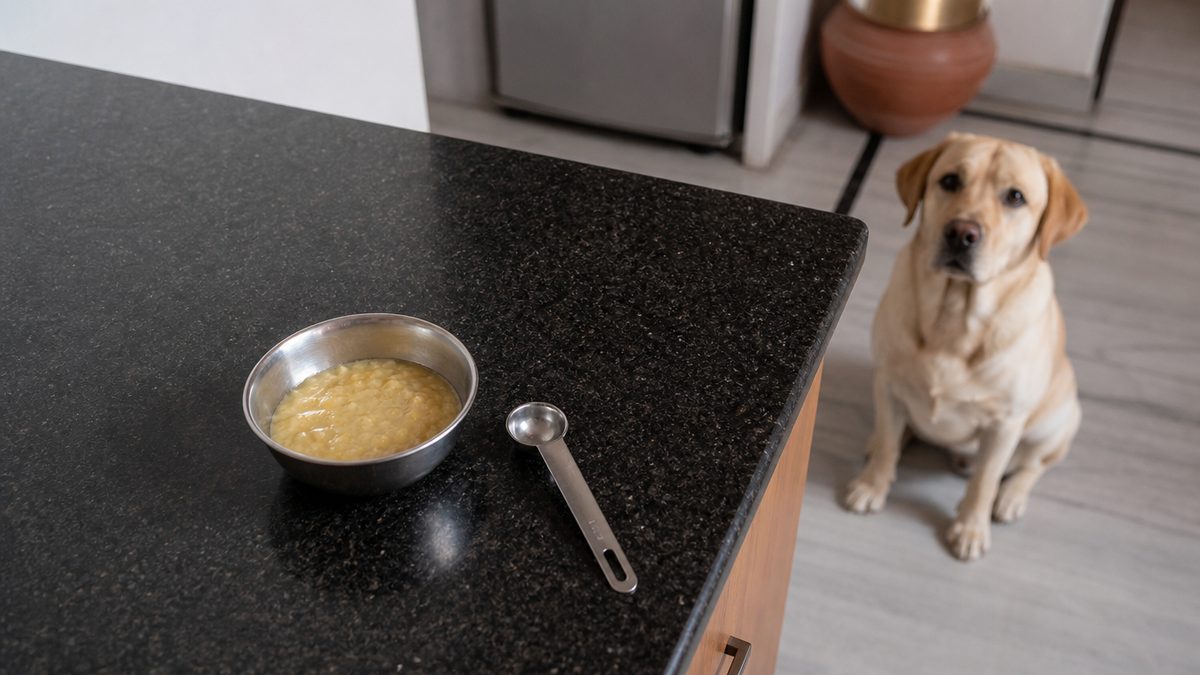
Can dogs eat dal? Yes, plain unsalted dal with no tadka is safe for a healthy adult dog, and it solves half the problem people hope it solves. Every common Indian dal clears a dog's crude protein minimum and every one falls short on methionine and cystine. Dal closes rice's lysine gap and leaves the sulphur gap exactly where it was. Cap it at a tenth of the day. Never give raw or soaked rajma.
This guide is general information for Indian pet owners and is not a diagnosis. Always consult a registered veterinarian near you before acting on anything you read here, and treat any sudden change in your pet's condition as urgent.
Can dogs eat dal, and what does a spoonful actually deliver?
Dogs can eat plain cooked dal safely, and what dal delivers is protein in the right quantity and the wrong shape: toor dal measures 21.70 g of protein and 1,384 kJ per 100 g in India's national food composition tables, which works out at 65.6 g of protein per 1,000 kcal against the 45.0 g an adult dog's diet is required to hold, while its methionine-cystine reaches only 1.01 g against a required 1.63 g.
Those composition figures come from the Indian Food Composition Tables 2017, published by the ICMR-National Institute of Nutrition in Hyderabad, which sampled each pulse in six regions of the country and reports both proximates and a full amino acid profile. This is the right table for an Indian kitchen, because it measured Indian dal rather than a foreign database's version of it.
The requirement figures come from the AAFCO dog food nutrient profiles expressed per 1,000 kcal of metabolisable energy. Adult maintenance sets crude protein at a minimum of 45.0 g, methionine at 0.83 g, methionine-cystine at 1.63 g and lysine at 1.58 g. Put a dal against all four and the answer to this question stops being yes or no and becomes which column you are reading.
| Food, ICMR-NIN code | Crude protein | Share of the 45 g minimum | Methionine | Methionine-cystine | Share of the 1.63 g minimum |
|---|---|---|---|---|---|
| Red gram dal, toor or arhar (B021) | 65.6 g | 146 percent | 0.57 g | 1.01 g | 62 percent |
| Green gram dal, moong (B010) | 73.3 g | 163 percent | 0.77 g | 1.08 g | 67 percent |
| Lentil dal, masoor (B013) | 75.5 g | 168 percent | 0.41 g | 0.82 g | 51 percent |
| Bengal gram dal, chana (B001) | 65.5 g | 146 percent | 0.73 g | 1.28 g | 79 percent |
| Black gram dal, urad (B003) | 71.2 g | 158 percent | 0.93 g | 1.28 g | 79 percent |
| Rajmah, red (B020) | 66.5 g | 148 percent | 0.59 g | 1.05 g | 64 percent |
| Soybean, brown (B024) | 93.3 g | 207 percent | 1.36 g | 2.82 g | 173 percent |
Read the third column and the sixth column together, because that pair is the whole page. Every dal in an Indian kitchen carries half again as much protein per calorie as a dog's food is required to hold, and every one of them carries between half and four fifths of the sulphur amino acids. Soybean is the single exception and soybean is not dal.
Why protein per 1,000 kcal is the only unit that survives cooking
Use protein per 1,000 kcal, because adding water to dal changes the grams in the katori and changes nothing about the ratio. Protein and energy both sit in the dry matter, so they rise and fall together when a dal is thinned or thickened. A unit that moves when you add a glass of water cannot tell you anything about a requirement.
The cross-check is clean. The United States Department of Agriculture record for cooked boiled lentils gives 116 kcal and 9.02 g of protein per 100 g, which is 77.8 g of protein per 1,000 kcal. The ICMR-NIN row for raw masoor dal gives 75.5 g per 1,000 kcal. Two independent databases, one measuring raw Indian dal and one measuring cooked lentils, land within 3 percent of each other.
This method is not ours. Our page on whether dogs can eat rice built the protein-per-1,000-kcal comparison for Indian cereals and worked out what the rest of the bowl has to carry when rice fills it. We are extending that arithmetic to the other half of the plate rather than presenting it as new, and where the two pages touch we point rather than repeat.
Goat leg, the mutton in an Indian butcher's shop, measures 22.07 g of protein and 669 kJ per 100 g, which is 138 g of protein per 1,000 kcal, and its methionine-cystine comes to 6.16 g against the dog's 1.63 g minimum Association of American Feed Control…. Masoor dal delivers 0.82 g in the same 1,000 kcal. That is a 7.5-fold gap on the one nutrient the bowl is actually short of, and it is the clearest answer there is to whether dal replaces meat.
The amino acid where every dal fails, and the one where every dal wins
Dal fails on methionine and cystine and wins on lysine, and both halves of that sentence are large. Across the five common dals, methionine-cystine runs 51 to 79 percent of the adult dog minimum while lysine runs 251 to 293 percent of it.
Cereals and pulses are short of opposite things, which is the oldest finding in human nutrition and the reason Indian meals pair them. Rice and wheat are poor in lysine and comparatively well supplied with sulphur amino acids. Pulses are the reverse. A dog's requirement is written for both, and the two deficits are not the same size against it.
| Food | Lysine | Share of the 1.58 g minimum | Methionine-cystine | Share of the 1.63 g minimum |
|---|---|---|---|---|
| Rice, raw, milled | 0.82 g | 52 percent | 0.99 g | 61 percent |
| Wheat flour, atta | 0.80 g | 51 percent | 1.32 g | 81 percent |
| Toor dal | 4.04 g | 256 percent | 1.01 g | 62 percent |
| Moong dal | 4.46 g | 283 percent | 1.08 g | 67 percent |
| Masoor dal | 4.62 g | 293 percent | 0.82 g | 51 percent |
| Chana dal | 3.97 g | 251 percent | 1.28 g | 79 percent |
| Urad dal | 4.43 g | 280 percent | 1.28 g | 79 percent |
| Goat leg, mutton | 9.40 g | 595 percent | 6.16 g | 378 percent |
The lysine column is why dal belongs in the bowl at all. A cereal-only bowl sits at about half the dog's lysine minimum and a spoonful of any dal pushes it past the line, because pulses carry two and a half to three times what the dog needs per calorie. That is a real contribution and the Indian pages that call dal a protein source are not wrong about it.
The methionine-cystine column is why dal does not finish the job. Rice sits at 61 percent of the minimum. Toor dal sits at 62 percent. Moving a calorie from one to the other moves the sulphur amino acid supply by almost nothing, because the two foods are nearly identical on that axis once you measure per calorie rather than per spoon.
Why the protein-richest dal is the methionine-poorest one
Masoor dal carries the most protein per calorie of any common dal and the least methionine of any of them. Its 24.35 g of protein per 100 g gives 75.5 g per 1,000 kcal, the highest in the table, while its methionine of 0.54 g per 100 g of protein is the lowest, giving 0.41 g per 1,000 kcal, which is 49 percent of the dog's minimum.
That pairing is the reason crude protein is a misleading test. A label, a chart or a blog that ranks dals by protein percentage puts masoor at the top. Ranked by the amino acid the bowl is actually short of, masoor is last. Both rankings use the same table.
The one dal that clears methionine and still fails methionine-cystine
Urad dal clears the methionine minimum on its own, at 0.93 g per 1,000 kcal against 0.83 g, and still fails the combined figure at 1.28 g against 1.63 g Association of American Feed Control…. AAFCO publishes both because cystine spares methionine in the body, so the combined requirement is set higher than twice the methionine figure rather than at exactly twice it.
Urad's cystine is 0.49 g per 100 g of protein, among the lowest of the pulses measured. So the dal that comes closest on one line is still short on the line that matters, and nothing in an Indian kitchen except soybean clears both.
Nothing here says a meat-free bowl cannot work. It says a bowl assembled by hand from cereals and pulses is not the same thing as one formulated to a profile. Our page on feeding a dog in a vegetarian household covers the six nutrients a meat-free diet has to be engineered to supply, the published testing of commercial vegetarian foods, and the blood work to run. We are not repeating that argument; we are supplying the Indian composition numbers underneath it.
Dal chawal, worked: what mixing them actually fixes
To work out what a dal-rice bowl delivers, blend the two foods on an energy basis rather than a volume one, and the result is lopsided: the lysine gap closes completely and the methionine-cystine gap does not move at all.
ICMR-NIN's Dietary Guidelines for Indians 2024 sets the ratio India actually cooks to. Good quality protein, it states, is derived from an appropriate combination of cereals and pulses at 3 to 1, and animal source foods such as milk, fish and flesh foods. Its My Plate for the Day gives 250 g of cereals and nutricereals against 85 g of pulses, eggs and flesh foods, which is that same ratio by weight.
Convert 3 to 1 by weight into energy and it comes out at about 76 percent of calories from the rice and 24 percent from the dal, because the two foods are close in energy density. So the row to read in the table below is the 75 and 25 row. That is the Indian plate, in a dog's units.
| Share of energy from rice and dal | Crude protein per 1,000 kcal | Share of 45 g | Lysine | Share of 1.58 g | Methionine-cystine | Share of 1.63 g |
|---|---|---|---|---|---|---|
| 90 rice, 10 dal | 26.6 g | 59 percent | 1.15 g | 73 percent | 0.99 g | 61 percent |
| 80 rice, 20 dal | 30.9 g | 69 percent | 1.47 g | 93 percent | 0.99 g | 61 percent |
| 75 rice, 25 dal, the ICMR-NIN plate | 33.1 g | 74 percent | 1.63 g | 103 percent | 0.99 g | 61 percent |
| 70 rice, 30 dal | 35.3 g | 78 percent | 1.79 g | 113 percent | 1.00 g | 61 percent |
| 50 rice, 50 dal | 43.9 g | 98 percent | 2.43 g | 154 percent | 1.00 g | 61 percent |
Read the last column down the page. It does not move. From a tenth of the bowl to half the bowl, adding dal to rice leaves methionine-cystine at 61 percent of the dog's minimum, because you are swapping one food that is short of sulphur amino acids for another that is short of them by almost exactly the same margin.
Now read the lysine column. At 10 percent dal the bowl is at 73 percent of the lysine minimum and at 25 percent dal it is at 103 percent. The complementation that ICMR-NIN describes is real, it works, and in a dog it finishes one job and not the other.
The crude protein column is the one that fools people. Even a half-and-half bowl reaches only 98 percent of the dog's crude protein minimum, so the bowl that looks generously protein-rich to a person is still marginal to a dog before you ask a single question about which amino acids are in it.
What the rest of the bowl then has to carry
Solve the same arithmetic the other way and the demand on the non-dal fraction is specific. With dal at a quarter of the day's energy, everything else in the bowl has to supply 1.84 g of methionine-cystine per 1,000 kcal to bring the total to the 1.63 g minimum. With dal at half the energy, the rest has to supply 2.25 g.
Those are not impossible figures. Goat leg carries 6.16 g. They are simply figures that no cereal, no vegetable and no other pulse in an Indian kitchen reaches, which is what makes the gap an animal-source gap rather than a quantity gap.
Our page on whether dogs can eat rice runs the same displacement arithmetic on crude protein and shows that at 70 percent of energy from rice the rest of the bowl must carry more protein than AAFCO publishes for any species at any life stage. We are not re-running that table. The sulphur amino acid version above is the dal-specific half of it.
If dal and rice are the base of your dog's diet rather than a scrap on top of a complete food, the whole bowl needs formulating by a veterinary nutritionist and these numbers are a diagnosis rather than a recipe. Our guides to homemade dog food in India and whether a home-cooked bowl is balanced cover the calcium, the mineral column and the verification a blood test will not do for you.
Which dal, since India cooks at least five of them
To choose between dals for a dog, compare them on three things that genuinely differ, which are the sulphur amino acids, the oligosaccharide load and the phytate, and ignore the protein percentage that every list ranks them by. On those three, chana and urad lead on amino acids, masoor leads on gas, and moong leads on phytate.
India does not have one dal, it has a different one in every kitchen. Toor or arhar is the default across Maharashtra as varan and amti, across Karnataka as tovve and huli, and across Tamil Nadu in sambar and paruppu. Moong is the north Indian light dal and the one a sick person is given. Masoor cooks fastest. Chana appears as cholar dal in Kolkata and as chana dal everywhere. Urad is the dal in dal makhani and the base of idli and dosa batter.
| Dal | Methionine-cystine, share of the dog minimum | Total oligosaccharides per 100 g | Phytate per 100 g | What it is best and worst at |
|---|---|---|---|---|
| Masoor, lentil dal | 51 percent | 0.72 g | 218 mg | Lowest oligosaccharide load of the five. Lowest methionine of any dal measured. |
| Chana, Bengal gram dal | 79 percent | 0.84 g | 450 mg | Joint best on amino acids and second lowest on oligosaccharides. Highest fat of the dals at 5.31 g. |
| Moong, green gram dal | 67 percent | 1.31 g | 170 mg | Lowest phytate by a wide margin. Not the lowest oligosaccharide dal, despite its reputation. |
| Urad, black gram dal | 79 percent | 1.39 g | 579 mg | Only dal that clears methionine alone. Highest phytate of the five. |
| Toor, red gram dal | 62 percent | 1.81 g | 277 mg | Highest oligosaccharide load of the five, and the most widely cooked. |
The spread on oligosaccharides is 2.5-fold between masoor and toor, which is the largest real difference between the dals on this page. The spread on phytate is 3.4-fold between moong and urad. The spread on crude protein, the thing every list ranks by, is under 16 percent.
The ranking on the Indian first page that India's own tables contradict
An Indian pet retailer's guide currently ranking on this query names moong dal the best dal to start with, on the stated ground that it contains lower levels of raffinose-family oligosaccharides, the carbohydrates responsible for gas formation. India's national food tables do not support that ordering. Moong dal totals 1.31 g of raffinose-family oligosaccharides per 100 g against masoor dal's 0.72 g and chana dal's 0.84 g, and the difference is almost entirely verbascose, which moong carries at 0.90 g and masoor at 0.08 g.
We are publishing the disagreement rather than resolving it, and the limits of our side are worth stating. The IFCT 2017 rows for chana dal print no verbascose or ajugose value at all, so its total is a floor rather than a measured sum. Moong dal's own standing as the gentle dal may rest on how fast it cooks and how finely it breaks down rather than on its sugar profile, and neither we nor the retailer has measured a dog.
Whole dal against split dal, which is not a small difference
Choose split dehusked dal over the whole pulse, because the husk carries most of the fibre and a good share of the phytate. Whole black gram measures 20.41 g of total dietary fibre per 100 g against 11.93 g for the split dal, and 679 mg of phytate against 579 mg. Whole red gram measures 22.84 g of fibre against 9.06 g for toor dal, and 604 mg of phytate against 277 mg.
That matters because fibre is the thing the measured dogs reacted to, as the next section sets out. Sabut moong, sabut masoor and kala chana are not interchangeable with their dehusked versions in a dog's bowl, and the fibre figures are roughly double.
Soybean is the only pulse in India's tables that clears both the methionine and the methionine-cystine minimums, at 173 percent of the combined figure, and it carries 19.82 g of fat per 100 g against toor dal's 1.56 g. Soya chunks are a processed product rather than the whole bean and this page has no composition figure for them. Treat the two as separate questions and raise soya with your veterinarian rather than reasoning from the dal rows.
Gas, stool and the oligosaccharides, with the only measurement that exists
Oligosaccharides reach a dog's large intestine undigested because the small intestine has no enzyme to cleave them, and the only in vivo measurement of canine flatulence against a pulse protein found no increase in gas at all. What it did find was more stool, and wetter stool.
The mechanism is not in doubt and it is specific. Stachyose and raffinose cannot be cleaved in the small intestine because of the absence of alpha-1,6-galactosidase in the small intestinal tract, so virtually all of these sugars pass intact into the large intestine, where they are hydrolysed and fermented by bacteria into short-chain fatty acids and gases causing flatulence. Dogs have no more of that enzyme than people do.
Then somebody measured it. Six adult dogs of 18.8 kg were run through a 6 by 6 Latin square comparing conventional soybean meal at 22.4 g of stachyose and 2.0 g of raffinose per kg of diet, a low-oligosaccharide low-phytate soybean meal at 0.1 g of each, and a poultry by-product meal diet. Flatulence was monitored for 12 hours after feeding with a gas monitor worn in a vest. No differences were detected for any treatment regardless of protein source for any flatulence components analysed, covering episodes per day, total hydrogen sulphide, peak concentration and offensiveness.
The authors' conclusion is the figure to hold on to. Diets containing less than 22.4 g of stachyose per kg and less than 2 g of raffinose per kg did not alter digestibility or increase flatulence in dogs.
Hold the Indian dals against that threshold. Toor dal, the highest, carries 0.81 g of stachyose per 100 g, which is 8.1 g per kg of raw dal. Even if dal were the entire dry matter of the bowl, every Indian dal sits below the stachyose concentration at which the one controlled canine measurement found no effect, and at the tenth-of-the-day ceiling this page recommends the diet figure is under 1 g per kg.
What changed in the measured dogs was the stool, not the gas
The same six dogs did react, in the one place nobody writes about. Fecal output on the soy diets ran 119 to 152 g a day against 65 to 68 g on the poultry by-product diet, fecal moisture ran 677 to 707 g per kg against 593 to 604, and visual volume scores ran 3.1 to 3.5 against 2.4 to 2.7. Roughly twice the stool, visibly wetter.
A second canine trial found the same direction. Ten adult beagles in a replicated 5 by 5 Latin square were fed garbanzo bean, green lentil, peanut flour, dried yeast or poultry by-product meal as the primary protein. Macronutrient digestibility stayed above 80 percent on every diet and fecal scores stayed in the ideal range, but the plant-based treatments produced total fecal short chain fatty acid concentrations averaging 627.6 micromol per g against 381.1 for the control, which is the fermentation the mechanism predicts.
So the honest answer to the commonest complaint about dal is that the complaint is usually misdescribed. A dog on dal is more likely to produce more and looser stool than to produce more gas, and the measurements say the smell is likelier to come from the meat. Dogs fed the poultry by-product diet had higher concentrations of thio and sulfides, phenols, indoles and ketones in their faeces than dogs fed either soy diet.
Gas is not bloat, and the distinction is an emergency one
Flatulence and gastric dilatation volvulus are different events and sharing the word bloat between them is dangerous. Dietary gas is uncomfortable and self-limiting. A stomach that has distended and twisted is a surgical emergency with a clock on it. Our condition page on bloat and GDV in dogs covers the signs, the breeds and what to do, and nothing on this page is about that.
Yamka and colleagues measured stachyose and raffinose. They did not measure verbascose, which soybean meal barely carries at 0.04 g per 100 g but which Indian dals carry at 0.67 to 1.13 g Yamka RM, Harmon DL, Schoenherr WD, Khoo C. The 28-day canine trial that found cardiac changes on a pea diet described that diet as high amylose, high in high-molecular-weight dietary fibre and verbascose-containing. Verbascose in a dog is therefore an open question, and we are not going to close it by assuming it behaves like stachyose.
Antinutrients, honestly: what a pressure cooker does to each
Cooking removes the three antinutrients in dal to very different degrees, and the honest summary is that an Indian pressure cooker handles two of them completely, reduces the third, and does nothing at all if the dal never gets cooked. Trypsin inhibitors go to zero in lentils, chymotrypsin inhibitors go to zero in every pulse tested, and phytate largely stays.
Take the enzyme inhibitors first, because they are the ones that actually interfere with protein digestion, which is the whole reason you put dal in the bowl. Twenty-two pulses including nine lentils, three chickpeas and four beans were soaked for four hours at room temperature and then cooked as presoaked seeds for one hour, with soybean as a control.
| Pulse group | Raw activity, trypsin units per mg | Reduction from soaking alone | Reduction from cooking presoaked seeds |
|---|---|---|---|
| Lentils, nine types | 4.98 to 6.29 | 5.57 to 19.35 percent | Total removal |
| Chickpeas, three types | 14.22 to 16.24 | 9.39 to 25.27 percent | 83.92 to 88.37 percent |
| Common beans including dark red kidney bean | 15.18 to 20.83 | 4.88 to 9.09 percent | 92.58 to 93.70 percent |
| Peas, four types | 3.16 to 4.92 | 17.34 to 30.74 percent | 78.74 percent to total removal |
| Soybean, the control | 45.89 | 18.58 percent | 92.83 percent |
Three things in that table are worth saying out loud. Soaking on its own is nearly useless, removing a fifth at best. Cooking is what works. And the raw figures differ roughly three-fold between a lentil and a dark red kidney bean, at 4.98 to 6.29 trypsin units per mg against 17.77, which is a real reason to treat rajma as a separate food rather than as another dal.
Chymotrypsin inhibitors are easier still. Complete removal of chymotrypsin inhibitory activity was found for all studied seeds after cooking, which the authors attribute to chymotrypsin inhibitors being more sensitive to heat than trypsin inhibitors.
Phytate is the one cooking does not fix, and the roti beside it carries more
Phytate binds minerals in the digestive tract and makes them less available, and it is the antinutrient that largely survives the kitchen. India's tables measure it at 170 mg per 100 g in moong dal, 218 in masoor dal, 277 in toor dal, 450 in chana dal and 579 in urad dal.
Set those against the other thing in the same kitchen. Wheat flour atta measures 632 mg of phytate per 100 g, higher than every dal on that list. A household worried about phytate from a spoon of dal is usually feeding several times more of it in the roti, which our page on whether dogs can eat roti covers from the wheat side.
The Indian failure mode is soaked and uncooked, not cooked and plain
Dal that has been pressure-cooked to a mush is the least of your problems, and that is the normal state of dal in an Indian home. The real exposures are three, and all of them are uncooked.
- The bowl of dal or rajma soaking on the counter overnight, which a dog can reach and which is the exact preparation that causes kidney bean poisoning in people.
- Sprouted moong and sprouted matki, eaten raw in chaat and in salads across Maharashtra and Gujarat, where sprouting reduces some compounds and cooking has not happened at all.
- Dry dal spilled from a dabba, which a scavenging dog will eat and which no cooking has touched.
The published failure cases turn on exactly this. In a 2026 case report of a child in severe shock after a home-cooked kidney bean dish, the family said the beans were thoroughly cooked; the history then showed they were soaked for only a few hours and boiled within a stew for about 15 to 20 minutes, and the authors note that stiff beans despite cooking can retain lectin. Judge by texture. Dal that still has bite has not had the heat it needs.
Rajma and the beans that need a warning the dals do not
Raw and undercooked kidney beans are genuinely toxic and cooked ones are not, and the gap between the two states is roughly a hundred-fold. Raw kidney beans contain 20,000 to 70,000 haemagglutinating units of phytohaemagglutinin while fully cooked beans contain 200 to 400.
The toxin has a name, a unit and a dose. Phytohaemagglutinin, the presumed toxic agent, is found in many species of beans but is in highest concentration in red kidney beans, and the unit of toxin measure is the haemagglutinating unit. White kidney beans contain about one-third the amount of toxin as the red variety, and broad beans contain 5 to 10 percent of what red kidney beans contain.
The dose is small and the onset is fast. As few as four or five raw beans can trigger symptoms, which usually begin with extreme nausea and vomiting within 1 to 3 hours of ingestion, with diarrhoea developing later within that timeframe. Recovery is usually rapid, within 3 to 4 hours of onset, and spontaneous, although some cases have required hospitalisation, and mortality is not reported.
The relevance to a dog is stated in the FDA's own chapter and it is the sentence Indian pet pages leave out. The mechanism and pathway of toxicity is not known, the chapter records, but oral ingestion of lectins is known to reduce intestinal absorption and cause weight loss, growth retardation, and diarrhoea in several animal species.
What actually destroys it, in numbers you can cook to
Boiling works and low heat does not. Boiling the beans for 10 minutes at 100 degrees C completely destroyed the toxin in the work the FDA cites, and consumers are told to boil for at least 30 minutes to be sure the product reaches sufficient temperature for sufficient time. The FDA's consumer guidance elsewhere puts the whole instruction in one line: soaking the beans for a minimum of 5 hours and then boiling them in fresh water for at least 30 minutes will remove and destroy this toxin.
The failure is always a low temperature held for a long time. Several outbreaks have been associated with beans cooked in slow cookers or in casseroles that had not reached an internal temperature high enough to destroy the lectin, and studies of casseroles cooked in slow cookers revealed that the food often reached internal temperatures of only 75 degrees C or less.
A sealed Indian pressure cooker is the opposite of a slow cooker. It holds water above its atmospheric boiling point, which is the condition the FDA names as sufficient, and rajma cooked until it mashes between two fingers has had far more than the ten minutes at boiling point that destroyed the toxin in testing. We have found no measurement of phytohaemagglutinin in pressure-cooked rajma and we are flagging that inference as an inference, but the direction is not in dispute.
- Never give raw or soaked uncooked rajma to a dog. The FDA's natural toxins chapter on phytohaemagglutinin names the kidney bean and the broad bean, and puts the human threshold at as few as four or five raw beans. No canine figure has been published for it, so the flat rule here is our precaution rather than a measured dog dose, and we would rather say that than imply a number we do not have.
- Keep raw lobia and raw sem off the bowl as well, on the same precaution but not on the same evidence. The FDA chapter covers the kidney bean and the broad bean and not those two, their lectins have not been characterised for risk in the way the kidney bean's has, and no canine figure exists for any of them.
- Throw away the soaking water rather than cooking in it, which is what the FDA guidance says and what most Indian kitchens already do.
- Pressure cook rajma until it mashes, which is the texture test that stands in for a thermometer.
- Serve rajma plain, set aside before the masala, because rajma-chawal as it reaches a Delhi table carries onion and garlic and is a different question entirely.
- Telephone your veterinary surgeon today if a dog has eaten raw or soaked beans, and say how many and how long ago.
The reported human severity is dose-related, and the one case report of shock and acute kidney injury from kidney beans involved an 8-year-old child who needed resuscitation and fluid therapy, while her father ate the same dish and had mild nausea that resolved without medical care. We found no published canine case series of phytohaemagglutinin poisoning. What is established is the toxin, the dose in people and the effect of lectins in animal species; what is not established is a canine dose, and a 5 kg dog eating a handful of soaked rajma is not a reassuring unknown. Call, do not wait and watch.
The dilated cardiomyopathy question, kept to its actual size
The reported association is between commercial pulse-heavy formulations and dilated cardiomyopathy, not between a spoon of dal and anything, and the clearest canine trial separated the two pulses and found the problem in only one of them. This section gives the diet association and points at the condition page for everything clinical.
Start with what the reports were about. The FDA's investigation concerned dogs eating certain pet foods, many labelled grain-free, which contained a high proportion of peas, lentils, other legume seeds and potatoes in various forms as main ingredients, listed within the first 10 ingredients before vitamins and minerals. Of the reported products, 91 percent were grain-free and 93 percent had peas and lentils, with peas in 89 percent and lentils in 62 percent.
That is a description of a kibble formulation, not of an Indian bowl. A pulse listed in the first ten ingredients of an extruded food is supplying a large share of the calories. A tenth of the day from dal is a different quantity by an order of magnitude, and every page that collapses the two is misreporting the source in one direction or the other.
The FDA has also said what its numbers do and do not establish. Its December 2022 status note records that it does not intend to release further public updates until there is meaningful new scientific information to share, and that while adverse event numbers can be a potential signal, by themselves they do not supply sufficient data to establish a causal relationship with reported products. The counts, the breed reporting bias, the product testing and the current state of the investigation are covered in full on our condition page for dilated cardiomyopathy in dogs, which is where the clinical material belongs.
The most useful study since then separated the pulses instead of lumping them. Beagles were fed three formulated diets in turn for 28 days each, built on white rice flour, whole lentil or wrinkled pea, and compared against a commercial grain-based diet. After 28 days the wrinkled pea diet impaired stroke volume and cardiac output, increased end-systolic ventricular diameter and increased plasma NT-proBNP, in a sub-clinical manner. The lentil diet did not produce those changes.
Two details in that trial matter for an Indian reader. Plasma taurine levels were unchanged on every diet, so the taurine explanation that circulates on this topic did not appear. And plasma methionine was significantly lower after feeding all three test diets compared with the commercial diet, which is the amino acid this whole page is about.
The limitation is the one to read last, because it sets the scale. The authors record that formulating the test diets to include 15 percent enzymatic starch required 58 percent inclusion of wrinkled pea flour. Fifty-eight percent of a diet is not a spoon of dal on rice, and the authors' own conclusion is carefully bounded to a link between pea-based diets and canine nutritionally-mediated DCM in a breed not known to be susceptible.
These are two different problems and this page refuses to merge them. The FDA's own product testing found that nearly all the grain-free products had methionine-cystine values above the minimum nutritional requirement of 0.65 percent for adult maintenance published in the AAFCO Official Publication. Those commercial foods were not measurably short of sulphur amino acids. A home dal-and-rice bowl, by India's own composition tables, is. One problem is unexplained and belongs to formulated pulse-heavy kibble; the other is arithmetic and belongs to the Indian kitchen. Do not use either to argue the other.
How much dal, worked for four sizes of dog
To work out a dog's dal allowance, take 10 percent of its daily energy from the published chart, divide by 3.3 kcal per gram of dry dal, and subtract those calories from the main meal rather than adding them to it. For a 10 kg dog that comes to 14 to 18 g of dry dal, about one and a half tablespoons.
The 10 percent treat ceiling is the right unit here, because dal is nutritionally a topper however it is served. Everything below follows from two published numbers, the daily energy chart and the energy density of dry dal.
| Dog | Daily energy | 10 percent of it | Dry dal | In dry tablespoons | Roughly, as cooked dal |
|---|---|---|---|---|---|
| 5 kg, a Pomeranian or a small Indie | 280 to 351 kcal | 28 to 35 kcal | 8 to 11 g | Under one | Two level tablespoons |
| 10 kg, a Beagle or a small Indie | 470 to 590 kcal | 47 to 59 kcal | 14 to 18 g | About one and a half | Three to four tablespoons |
| 20 kg, a medium Indie | 790 to 993 kcal | 79 to 99 kcal | 24 to 30 g | Two to two and a half | A third to two fifths of a cup |
| 30 kg, a Labrador or a German Shepherd | 1,080 to 1,346 kcal | 108 to 135 kcal | 33 to 41 g | About three | About half a cup |
The chart's ranges come from the 2006 National Research Council maintenance equations, 130 kcal times body weight to the power 0.75 for an active adult and 95 kcal for an inactive one. Most apartment dogs in Mumbai, Delhi, Pune or Bengaluru that get one walk a day are the inactive case, so use the lower end of each range.
Why we have given the portion in dry dal, which nobody else does
Measure the dal before it goes in the cooker, because cooked dal has no fixed strength. A thick Gujarati dal and a thin Tamil rasam-adjacent paruppu start from the same dry weight and end at wildly different volumes, and a katori of either tells you nothing. The dry gram is the only number that holds.
The cooked column above is an approximation anchored to one published figure and we are labelling it as such. The USDA record for cooked boiled lentils gives 116 kcal per 100 g, with a cup weighing 198 g and a tablespoon 12.3 g. That is a drained, firm lentil rather than an Indian dal thinned with water, so a runny dal will come to more spoons for the same calories. The raw record gives a tablespoon of dry lentils as 12 g, which is what the dry tablespoon column uses.
- Read the dog's daily energy off the chart at its ideal weight, not its current weight if it is overweight.
- Take a tenth of that figure, which is the whole treat budget for the day and dal has to share it with everything else.
- Weigh that many grams of dry dal once on a kitchen scale, so you know what it looks like in your own chammach, then stop weighing.
- Soak the dal, drain it, discard the soaking water rather than cooking in it, and pressure cook it until it mashes.
- Cook it plain, with no salt, oil, ghee, haldi, hing, onion, garlic or tadka of any kind.
- Cool it to room temperature and serve it over or beside the regular food rather than as a meal.
- Subtract those calories from the main meal the same day, because an uncounted topper is how a dog gains weight on wholesome food.
- Introduce it over a week and watch the stool, since the measured change in dogs on pulse protein was stool volume and moisture rather than gas.
Most of the dal handed out in Indian streets goes to a dog that is under its energy requirement rather than over it, which inverts this entire page. A thin community dog is not being diluted by dal and rice; it is being kept alive by them, and the lysine the dal supplies is a genuine addition to a rice-only plate. It is still a bowl at 61 percent of the sulphur amino acid minimum, so a daily plate of dal chawal is a poor substitute for anything with an animal protein in it. Our guide to feeding community dogs in India covers the law, the designated spot and what else to put down.
What goes into the dal is usually the bigger problem
The tadka costs more than the dal does, and in several standard Indian dishes it moves the question from portion to poisoning. Set the dog's share aside before anything goes into the pan, which is the only instruction on this page that is not negotiable.
A plain boiled dal and a dal as it reaches an Indian table are different foods. Nearly every finished dal in the country carries onion, garlic, salt, chilli, haldi and a fat, and three of those are problems of a different class from the amino acid arithmetic above.
| Dish | The problem | The answer |
|---|---|---|
| Dal tadka, dal fry, varan phodni, sambar | Onion and garlic in the tadka, plus salt and oil | Refuse the finished dish. Plain dal set aside before the tadka is a different food. |
| Dal makhani | Urad dal plus cream and butter, so an energy-dense dish on top of everything else | Refuse. The fat, not the dal, is the issue. |
| Rajma masala, chana masala, chole | Onion and garlic, plus a long-cooked gravy | Refuse. Plain pressure-cooked rajma set aside before the masala is acceptable at the ceiling above. |
| Sprouted moong chaat, matki usal | Raw or lightly cooked sprouts, plus chilli, chaat masala and lemon | Refuse. Raw sprouted pulses are the one preparation with an uncooked antinutrient load. |
| Plain pressure-cooked dal, unsalted, no tadka | Energy and an amino acid profile that does not finish the bowl | Fine, counted and capped at a tenth of the day. |
Onion and garlic are the line, not the seasoning. They are toxic to dogs at ordinary kitchen quantities and our page on onion and garlic toxicity in pets carries that toxicology in full. A small spoon of dal tadka is not a small portion of a safe food. It is a small portion of an unsafe one.
Salt, chilli, haldi and hing each have their own published position, and we are not going to summarise them badly here. Our page on spices, salt and masala for pets rates the whole Indian spice rack one item at a time, including the only salt dose with real evidence behind it. The timing rule it gives is the one that matters at the stove: take the dog's portion out before the tadka, not after.
Ghee is a separate calculation and a common addition to dal. Our page on curd, paneer and ghee for dogs has the fat arithmetic, and the short version is that a dog with any history of pancreatitis should not be getting added fat on a cereal-and-pulse bowl at all.
Leftover dal in a humid Indian kitchen
Refrigerate the dog's share within two hours and use it within a day. Cooked dal is a moist, low-acid, protein-rich food left at room temperature, which is the standard description of a food safety problem, and a Chennai or Kolkata kitchen through the monsoon is the worst case for it. Dal that has sat out overnight goes in the bin, however it smells. Our hub page on Indian food safe for dogs sets out the four questions that sort any plate, including the physical and microbiological ones this page does not cover.
Pulses are in practically every Indian kitchen, which is the reason this question comes up more than any other. The National Institute of Nutrition's figure, quoted in the government's own pulses backgrounder, is that pulses contribute nearly 20 to 25 percent of total protein intake in Indian diets, and that per capita consumption still falls short of the recommended 85 grams a day. In a household where the human plate is short of dal, the dog's spoonful is rarely the priority.
Five dogs for whom the answer changes
Five groups of dog should not be given dal on the general advice above, and in each case the reason is specific rather than cautious boilerplate. They are the growing puppy, the dog on a weight reduction plan, the dog with a pancreatitis history, the dog on a therapeutic diet, and the dog that has already reacted to it.
- A growing puppy has the highest nutrient density requirement of any life stage, and AAFCO sets growth and reproduction minimums above adult maintenance on every line that matters here, with crude protein at 56.3 g, methionine at 0.88 g and methionine-cystine at 1.75 g per 1,000 kcal. Household cereal and pulse dilute that bowl faster than any other. Our puppy feeding chart for India has the figures.
- A dog on a weight reduction plan has no treat budget to spend, so the 10 percent ceiling is zero rather than small. Our condition page on obesity in dogs and cats covers the Indian picture.
- A dog with a pancreatitis history should not be getting dal that has had ghee, cream or a tadka through it, and the dish most likely to appear in front of it is dal makhani. Our page on pancreatitis in dogs is the one to read first.
- A dog on a therapeutic or elimination diet should get nothing added to the bowl without the prescribing veterinarian's agreement, because a single new protein can invalidate weeks of work.
- A dog that has reacted to dal before, with loose stool or vomiting within a day of eating it, has given you the only individual evidence that exists. Stop, and say so at the next appointment.
One further group deserves naming because the arithmetic flips for them. A dog that is underweight and eating a rice-only or roti-only bowl is in a different position from the overfed apartment dog this page is mostly written for, and for that animal the dal is an improvement on what is already there rather than a dilution of something better.
Do not reason from this page to a cat. A cat's food must carry 65 g of crude protein per 1,000 kcal against the dog's 45 g, and a cat's dependence on preformed nutrients that plants do not supply is a different kind of constraint from a dog's. Our page on Indian food safe for cats works the feline version of this arithmetic and the list it produces is five items long.
What this page can prove, and what it cannot
Seven claims here are published measurements with denominators and six widely repeated claims about dal and dogs are not established, so the line between them is drawn below rather than left for you to guess.
Seven claims on this page are established, and the source for each is named beside it.
- Toor dal measures 21.70 g of protein and 1,384 kJ per 100 g, sampled in six Indian regions, and its amino acid profile gives 0.87 g of methionine and 0.67 g of cystine per 100 g of protein.
- An adult dog's food must carry a minimum of 45.0 g of crude protein, 0.83 g of methionine, 1.63 g of methionine-cystine and 1.58 g of lysine per 1,000 kcal under the AAFCO profiles.
- ICMR-NIN states that good quality protein is derived from an appropriate combination of cereals and pulses at 3 to 1 and animal source foods such as milk, fish and flesh foods.
- Diets containing less than 22.4 g of stachyose per kg and less than 2 g of raffinose per kg did not alter digestibility or increase flatulence in six dogs measured in vivo, while stool output and moisture on the soy diets were roughly double the animal-protein control.
- Cooking presoaked seeds removed trypsin inhibitor activity entirely in lentils and by 92.58 to 93.70 percent in common beans, while soaking alone removed at most 30.74 percent.
- Raw kidney beans contain 20,000 to 70,000 haemagglutinating units of phytohaemagglutinin against 200 to 400 in fully cooked beans, as few as four or five raw beans can trigger symptoms, and slow-cooked casseroles often reached only 75 degrees C.
- In a 28-day crossover trial in Beagles, a wrinkled pea diet at 58 percent inclusion produced sub-clinical DCM-like changes and a whole lentil diet did not, with plasma taurine unchanged on both.
Six further claims are not established, and the list below marks where this page reasons rather than reports.
- The blended dal-and-rice figures are Bonbeno's arithmetic on two cited composition tables, not a measured bowl. They assume protein is additive on an energy basis, which is sound for crude protein and amino acid supply and says nothing about digestibility, which is lower for plant protein.
- No study has measured amino acid availability from Indian dal fed to a dog. IFCT 2017 reports total amino acids in the raw pulse. How much of each one a dog absorbs from a pressure-cooked dal has not been published, and plant protein digestibility is generally lower than the total figure implies.
- No measurement of phytohaemagglutinin in pressure-cooked rajma was found. That a sealed pressure cooker exceeds the condition the FDA names is an inference from the mechanism, not a published result.
- No published canine case series of phytohaemagglutinin poisoning was found. The toxin, the human dose and the effect of lectins in animal species are documented; a canine dose is not.
- Verbascose has not been tested in a dog. The only canine flatulence measurement covered stachyose and raffinose, and Indian dals carry verbascose at levels soybean meal does not Yamka RM, Harmon DL, Schoenherr WD, Khoo C.
- The cooked-dal column in the portion table is approximate. It is anchored to the USDA figure for drained cooked lentils and an Indian dal thinned with water will come to more spoons for the same calories.
Three things circulating on this query that do not survive a check
The page currently ranking second in India argues from biology that is wrong in three places. It states that your dog, deep down, is still 99.9 percent wolf internally, that dogs have virtually no amylase in their saliva so starches hit the stomach whole, and that dal therefore puts a real strain on the pancreas. Salivary amylase is not where any mammal digests most starch, and the genomic evidence that dogs carry on average seven times a wolf's pancreatic amylase gene copies is set out on our page on feeding a dog in a vegetarian household. The same page also recommends four of its own products as the alternative to dal.
The second claim is the moong dal ranking already dealt with above, where India's own tables put moong's raffinose-family oligosaccharides above masoor's and chana's rather than below them thePack Store, 'Can Dogs Have Dal? 3 Safe….
The third is a portion unit rather than a fact. One Indian guide caps dal at a tablespoon or two for a medium dog once or twice a month; another caps it at 10 to 15 percent of the overall diet, two to three times a week; a third says rajma is not a practical daily protein because it is heavy and can cause gas. None of the three ties a quantity to a body weight or a calorie, so a 4 kg Shih Tzu and a 30 kg Labrador are given the same spoon. Portion size is a calculation from body weight and nothing else, which is why the table on this page begins with the dog.
Finally, the boundary of what a directory should say. Bonbeno names no product, recommends no supplement and prescribes no diet. If your dog is losing or gaining weight, has loose stool lasting more than a day or two, or has ever been treated for pancreatitis or heart disease, what goes in its bowl is a decision for the veterinary surgeon who has examined it, which is why this page publishes under the medical disclaimer at the top.
Common questions
Which dal can dogs eat?
Dogs can eat any of the five common dals when they are plain, unsalted and thoroughly cooked, and the differences between them are smaller than the lists suggest. Chana dal and urad dal come closest on the amino acid that matters, at 79 percent of a dog's methionine-cystine minimum. Masoor dal carries the lowest oligosaccharide load at 0.72 g per 100 g and the lowest methionine. Moong dal carries the least phytate. None of them is a complete protein for a dog.
Can I give my dog pulses?
Yes, you can give a dog pulses as a counted topper, capped at about a tenth of its daily calories. For a 10 kg dog that is 14 to 18 g of dry dal a day, roughly one and a half tablespoons measured before cooking, subtracted from the main meal rather than added on top. Pulses supply lysine that a cereal bowl lacks, and they do not supply the sulphur amino acids an animal protein does.
Is toor dal ok for dogs?
Toor dal is acceptable for a healthy adult dog in a counted portion, and it is the weakest of the five on two counts. It carries the highest raffinose-family oligosaccharide load of the common dals at 1.81 g per 100 g, which is the fraction that ferments in the large intestine, and its methionine-cystine reaches 62 percent of a dog's minimum. Cook it plain and set the dog's share aside before the tadka, which is where the onion and garlic go in.
Is chana dal ok for dogs?
Chana dal is one of the two best dals for a dog on amino acids, reaching 79 percent of the methionine-cystine minimum against masoor dal's 51 percent, and it carries the second lowest oligosaccharide load. It is also the fattiest of the dals at 5.31 g per 100 g and the second highest in phytate at 450 mg. Give it plain and cooked soft, and keep it inside the same tenth-of-the-day ceiling as any other dal.
Can dogs eat cooked dal?
Cooked dal is the only form a dog should get, and cooking is what removes the antinutrients people worry about. Cooking presoaked lentils removed trypsin inhibitor activity entirely in one study of 22 pulses, and removed chymotrypsin inhibitor activity completely in every seed tested, while soaking on its own removed at most about a fifth. Cook it until it mashes, and judge by texture rather than by time, because a pulse that still has bite has not had enough heat.
Can dogs eat boiled lentils?
Boiled lentils are safe for a healthy adult dog, plain and unsalted, within the treat ceiling. Masoor dal is the fastest of the Indian dals to cook soft and carries the lowest oligosaccharide load at 0.72 g per 100 g, which is the fraction associated with fermentation and loose stool. It is also the lowest in methionine of any dal measured, at 49 percent of a dog's minimum, so it dilutes the bowl's amino acid quality more than the others do even while it looks the most protein-rich.
Are lentils better for dogs than rice?
Lentils are better than rice on three of four measures and identical on the fourth, which is the one that matters most. Masoor dal carries 75.5 g of protein per 1,000 kcal against milled rice's 22.3 g, and 4.62 g of lysine against 0.82 g. On methionine-cystine, rice gives 0.99 g per 1,000 kcal and masoor dal gives 0.82 g, both well under the 1.63 g minimum. So swapping rice for dal fixes the lysine shortfall and leaves the sulphur shortfall where it was.
Are kidney beans safe for dogs to eat?
Cooked kidney beans are safe for dogs and raw or undercooked ones are not, and the gap is about a hundred-fold. Raw kidney beans contain 20,000 to 70,000 haemagglutinating units of phytohaemagglutinin against 200 to 400 in fully cooked beans, and in people as few as four or five raw beans can trigger vomiting within one to three hours. Soak rajma, throw the water away, and pressure cook it until it mashes. Never let a dog reach a bowl of beans soaking on the counter.
Which beans can dogs not eat?
No bean is permanently off the list, and every bean is off the list raw. Red kidney beans carry the highest concentration of phytohaemagglutinin, white kidney beans about a third of that, and broad beans 5 to 10 percent of it, so rajma is the one that most needs full cooking. Beyond the lectin, refuse any bean dish cooked with onion or garlic, which is most Indian bean dishes, and refuse raw sprouted pulses eaten as chaat.