
Dog health: neurological
Degenerative myelopathy in dogs: what the SOD1 test result actually means, why the disease is painless, and what it costs in India
The SOD1 test is a risk test, not a diagnosis, and a dog can carry two copies and never develop the disease. Degenerative myelopathy is confirmed only on spinal cord histopathology after death, it is painless, and a painful dog has something else. This page carries the per-breed OFA register for eight breeds, the four published stages with median ages, the physiotherapy evidence with its denominators, and the Indian route to a test and a cart.
Quick answer
Degenerative myelopathy in dogs is a painless, late-onset degeneration of the spinal cord that starts in the hind legs and ends in paralysis. The SOD1 test is a risk test, not a diagnosis: the variant is recessive with incomplete penetrance and only a post-mortem confirms the disease. Across the OFA register 13.2 percent of 90,958 dogs test at risk. A painful dog has something else, usually treatable disc disease. Your nearby vet examines your dog first.
This guide is general information for Indian pet owners and is not a diagnosis. Always consult a registered veterinarian near you before acting on anything you read here, and treat any sudden change in your pet's condition as urgent.
Signs of Degenerative myelopathy
The 9 signs to watch for are listed below. Any one of them is a reason to consult your nearby vet; none of them is a diagnosis.
- Hind feet knuckle over and scuff, wearing the nails on one side first
- The back end sways and crosses over when the dog turns
- One hind leg is clearly worse than the other at the start
- Weakness worsens over months rather than hours, and never overnight
- The dog is not in pain and does not cry out when handled
- Hind limb muscle wastes away as the legs stop being used
- The dog cannot rise or stand without help, and drags both hind legs
- Urinary and faecal continence goes as the disease reaches the later stages
- In the final stage the front legs weaken and the bark changes
Breeds on this site that document this condition
Each breed page below carries the figure for this condition with its denominator and its source. The 8 breeds listed are the ones on this site that document it, not a ranking of risk.
India has published nothing at all on canine degenerative myelopathy, and the absence was measured rather than assumed: a Europe PMC title and abstract search for the disease with India returned zero records on 27 September 2026 while the Labrador retriever hip dysplasia control returned 110 on the same instrument, and the single affiliation hit is a human cervical spine study from NIMHANS Bengaluru. The word India does not appear once in the 269-clinician international survey of 20 countries that this page leans on. No Indian laboratory sells the SOD1 test and the strings myelopathy and SOD1 appear zero times on three Indian dog DNA sellers' pages, so the swab goes to California at USD 58, roughly Rs 4,300 to Rs 4,900 before courier, with a turnaround of at least 15 business days. No Indian government veterinary teaching hospital publishes a price for magnetic resonance imaging, the scan 82 of 189 neurologists always require, although Madras Veterinary College, part of Tamil Nadu Veterinary and Animal Sciences University in Chennai, prices a CT scan four ways. What India does have is cheap: ICAR-IVRI Izatnagar prices physiotherapy and acupuncture for a pet animal at Rs 100, the only intervention with a published survival figure behind it, and Indian cart makers sell a rear-support wheelchair for a German Shepherd at Rs 9,500 to Rs 9,900 inclusive of GST against USD 375 as the American floor price. The Dog Breeding and Marketing Rules 2017 require testing for genetic defects including eleven named conditions and this is not one of them, and the words myelopathy, degenerative, SOD1, spine and spinal appear zero times in the 14-page gazette notification.
What degenerative myelopathy in dogs is, who gets it, and why it does not hurt
Degenerative myelopathy in dogs is a late-onset degeneration of the spinal cord that starts in the hind legs and ends in paralysis, and it is not a painful disease. It typically begins between 8 and 14 years of age, shows first as loss of coordination in the hind legs, and typically worsens over six months to a year into paralysis of the hind legs.
The damage is to the wiring, not the joints, and it is gradual. The laboratory that sells the test describes the phenotype as gradual muscle wasting and loss of coordination typically beginning in the hind limbs. Definitive lesions are axonal and myelin degeneration at all levels of the spinal cord, worst in the dorsal portion of the lateral funiculus of the middle to caudal thoracic cord. Because the nerve fibres that carry position sense sit in that region, the first thing an owner notices is a dog that has stopped knowing where its back feet are rather than a dog that is sore.
The progression has a fixed direction. The initial upper motor neuron spastic paraparesis and general proprioceptive ataxia in the pelvic limbs progress to a flaccid lower motor neuron tetraparesis, so the disease climbs the spine from the tail end towards the head. If euthanasia is delayed, the clinical signs ascend and cause flaccid tetraparesis and other lower motor neuron signs.
A painful dog does not have degenerative myelopathy. The Orthopedic Foundation for Animals states in terms that an important feature of the disease is that it is not a painful disease. The top-ranking veterinary page puts the same point the practical way round, that most affected dogs do not seem in pain and just seem very weak, and that if the dog appears to be in pain there may be another condition present. Yelping when lifted, a hunched back, a dog that will not settle, a dog that snaps when its spine is touched, or a back end that failed inside a day, all point somewhere else, most often to IVDD in dogs, which is treatable. That is a same-day veterinary visit, not a wait-and-see. Find a clinic through our veterinary directory.
The age it arrives, measured rather than estimated
This is an old dog's disease and the published ages are tight. Across 50 dogs with degenerative myelopathy seen at the University of Bern, the mean age at diagnosis was 9.1 years and both sexes were affected equally. In 53 histopathologically confirmed cases at the University of Missouri, the median age rose stage by stage, from 9.6 years at stage 1 through 11.2 and 12 years to 13.3 years at stage 4. In a Zurich cohort of 39 dogs carrying the mutation with compatible signs, the mean age at diagnosis was 115 months, which is 9 years and 7 months, and the mean weight was 29 kg.
Owner-reported ages agree. In the Pembroke Welsh Corgi parent-club health survey hosted by the Orthopedic Foundation for Animals, 142 owners said their dog was over 10 years old at diagnosis, 44 said 5 to 10 years, and only 5 said under 5. That survey prints a count and a percentage against every answer but never prints the number of people who answered each question, so the denominator of 191 used here is the printed rows added together, and the 74 percent, 23 percent and 3 percent it prints reproduce from that total exactly. Every denominator quoted from this survey on this page was derived the same way and checked the same way. A three-year-old dog with a wobbly back end almost certainly has something else.
How common it is, and in which population
The largest genotype denominator in the world is the Orthopedic Foundation for Animals register, and it is a register of tested dogs rather than a population survey. Across all breeds it holds 90,958 evaluations, of which 65.5 percent tested normal, 21.3 percent carrier and 13.2 percent at risk. Read that 13.2 percent as the at-risk share among dogs whose owners chose to test them, mostly in North America, mostly from breeds their clubs told them to test. It is not the share of dogs that get the disease and it is not an Indian figure.
The register lists 111 breeds, and the reason it is 111 rather than several hundred is a stated rule. A breed is not included in the statistics tables until a minimum number of individuals have been evaluated, 100 for hips and at least 50 for all other databases. Any breed missing from the list has fewer than 50 tested dogs on file, which is an absence of testing rather than an absence of risk.
The risk allele itself is far more widely spread than the register suggests. In a retrospective analysis of 35,359 genotypes from 33,747 dogs, the SOD1:c.118A allele was found in cross-bred dogs and in 124 different breeds, while a second allele, SOD1:c.52T, was found only in Bernese Mountain Dogs. The mutation is common in the general dog population and the disease is not, and the gap between those two sentences is what the next section is about.
Why the disease matters beyond dogs
Degenerative myelopathy is the reason a great deal of human money is spent on dog spinal cords. The mapping study that found the mutation described canine degenerative myelopathy as the first recognised spontaneously occurring animal model for amyotrophic lateral sclerosis, after finding neuronal cytoplasmic inclusions in affected dogs that bind anti-superoxide dismutase 1 antibodies, similar to those in the spinal cords of ALS patients with SOD1 mutations. For an owner that is cold comfort, but it explains why the genetics of this disease are unusually well described while its treatment is not.
The formal record is blunt about the outcome. The Online Mendelian Inheritance in Animals entry for this disease summarises it as an adult onset degeneration of the spinal cord that progresses to paraplegia and tetraparesis, states that there is no successful treatment, and notes that a genetic test is available.
What a positive SOD1 test actually means, and the four words most owners never hear
A positive SOD1 test means your dog is at risk of degenerative myelopathy, not that your dog has it or will get it. The variant is inherited in an autosomal recessive fashion with incomplete penetrance, and the laboratory that sells the test says plainly that not all dogs with two copies will develop the disease.
The four words are incomplete penetrance. They mean that carrying the at-risk genotype raises the probability of disease without determining it, and they were in the founding paper. All affected dogs tested were homozygous mutant, but some homozygous mutant dogs had no signs of degenerative myelopathy, which suggests incomplete penetrance or other causative loci. Sixteen years later that is still the position.
The variant itself is one letter. It is a G to A transition, c.118G>A, producing a p.E40K missense change in exon 2 of the SOD1 gene on canine chromosome 31. It was found by comparing 38 degenerative-myelopathy-affected Pembroke Welsh Corgi cases against 17 related clinically normal controls, and homozygosity for the A allele was associated with the disease in five breeds, the Pembroke Welsh Corgi, Boxer, Rhodesian Ridgeback, German Shepherd Dog and Chesapeake Bay Retriever.
| Result | How it is reported | What it means for this dog | What it means for a litter |
|---|---|---|---|
| Clear | N/N by UC Davis, Normal by the OFA | This dog will not develop degenerative myelopathy from this variant. Among hundreds of dogs studied at the University of Missouri, only two N/N dogs have been confirmed to have the disease | Cannot transmit the variant at all |
| Carrier | N/DM by UC Davis, Carrier (A/N) by the OFA | Will not develop the disease as a result of this allele, although the OFA records that it has confirmed the disease in a few carrier dogs | Transmits the allele to 50 percent of offspring |
| At risk | DM/DM by UC Davis, At-Risk (A/A) by the OFA | May develop degenerative myelopathy. Not all dogs testing A/A show clinical signs, and some that do have not begun until 15 years of age | Transmits the allele to every offspring |
| Equivocal | Equivocal by the OFA | Inconclusive, typically from poor sample collection. A second punch is taken from the card and the test rerun | No information until a clean sample is run |
Read the at-risk row twice, because it is the row owners misread. The Orthopedic Foundation for Animals says that research is ongoing to estimate what percentage of dogs testing A/A will develop the disease within their lifespan, and that at this point the mutation can only be interpreted as being at risk of developing it within the animal's life. No lifetime penetrance figure exists to quote, and anyone who quotes you one has made it up.
The disagreement about penetrance, printed rather than resolved
Two respectable sources give different impressions and both are right about their own population. The Veterinary Genetics Laboratory at the University of California Davis calls the inheritance autosomal recessive with incomplete penetrance, and adds that the variable presentation between breeds and the incomplete penetrance support a complex mode of inheritance in which other genetic and environmental factors likely play a role. A Royal Veterinary College study of 150 German Shepherd Dogs concluded the opposite way round, that the mutation has a high degree of penetrance, and wrote that in the United Kingdom at least, penetrance is relatively high if not complete.
The designs explain the gap. Holder's group compared three groups of 50 German Shepherds each. Among dogs under 6 years old, 8 were homozygous, 19 heterozygous and 23 clear, an allele frequency of 0.35. Among dogs over 8 years referred with pelvic limb ataxia, 21 were homozygous, and among age-matched dogs over 8 years referred with no neurological disease, none was. That design measures how strongly the genotype tracks with ataxia in a referral hospital. It does not follow homozygous puppies to death and count how many escape, which is the study that would give a true lifetime penetrance and has never been done.
A modifier gene shows the mechanism of the escape. Comparing affected against unaffected Pembroke Welsh Corgis who were all homozygous for the SOD1 mutation, a haplotype within the SP110 nuclear body protein was present in 40 percent of affected dogs against 4 percent of unaffected dogs, and was associated with a higher probability of developing the disease and an earlier onset. Genotype at one gene is therefore not the whole story even within a single breed.
| Register | Dogs evaluated | Normal | Carrier | At risk or abnormal | What it tests |
|---|---|---|---|---|---|
| DEGENERATIVE MYELOPATHY | 90,958 across 111 breeds | 65.5 percent | 21.3 percent | 13.2 percent | The common SOD1:c.118G>A variant, the one almost every laboratory means by the DM test |
| DEGENERATIVE MYELOPATHY B | 664 Bernese Mountain Dogs, the only breed row in it, within 727 dogs of all breeds | 91.6 percent | 7.8 percent | 0.6 percent | The second variant, SOD1:c.52A>T, found only in the Bernese Mountain Dog |
| DEGENERATIVE MYELOPATHY RISK MODIFIER | 82 Pembroke Welsh Corgis, the only breed row in it, within 84 dogs of all breeds | 79.3 percent | 18.3 percent | 2.4 percent | The SP110 haplotype that shifts risk and age of onset in Pembroke Welsh Corgis |
The second Bernese variant is worth an extra line because it changes the advice for one breed. A second causal mutation, c.52A>T producing p.Thr18Ser, was reported in a Bernese Mountain Dog, and in 408 Bernese genotyped for both variants the c.118G>A change was heterozygous in 188 dogs, 46.1 percent, and homozygous in 27, 6.6 percent, while c.52A>T was heterozygous in 65, 15.9 percent, and homozygous in two, 0.5 percent. Twenty-two dogs, 5.4 percent, carried one copy of each, one of them showed clinical signs, and the authors concluded that compound heterozygosity may confer a similar risk to homozygosity for the common variant. The Orthopedic Foundation for Animals accordingly advises testing for both variants in this breed only.
The breeds the laboratory will not vouch for
Any dog can be tested and the result does not mean the same thing in every breed. The Orthopedic Foundation for Animals states that it is possible that the genetic background predominating in some breeds prevents the development of symptoms even in dogs testing at risk, and says it is reluctant to recommend testing for members of breeds in which the University of Missouri has not yet proved susceptibility through microscopic examination of spinal cords from deceased dogs that showed symptoms. Thirty breeds are on that proved list, including the German Shepherd Dog, Boxer, Pug, Rhodesian Ridgeback, Siberian Husky, Labrador Retriever and Golden Retriever.
The allele has been found in 124 breeds and proved to cause disease in about a quarter of them Orthopedic Foundation for Animals. If your dog's breed is not on the proved list, a positive result tells you the allele is present in your dog and nothing reliable about what it will do to your dog. Say that sentence back to whoever is selling you the test.
The treatable disease this is mistaken for, and how a vet tells them apart
An old German Shepherd dragging its hind feet is more often suffering from a spinal disc problem than from degenerative myelopathy, and the disc problem can be treated. Despite the high frequency of the SOD1 allele in the dog population, other more common and treatable causes of progressive hind end weakness should still be considered even in homozygous at-risk dogs, which is the testing laboratory's own warning on its own product page.
Various types of compressive spinal cord disorders can look like early degenerative myelopathy. The commonest of them is intervertebral disc disease, which our page on IVDD in dogs sets out grade by grade with its published recovery rates, and which recovers in 80 percent of 115 dogs managed with rest and medicine at the mild end. Getting a reader to that diagnosis rather than to this one is the most useful thing this page can do.
Four things separate the two at the kitchen table, before any scan.
- Pain. Degenerative myelopathy is not a painful disease. Disc disease usually is, and a dog that yelps, hunches, shivers or snaps when its back is touched is showing spinal pain.
- Speed. This disease typically worsens over six months to a year. A type I disc extrusion arrives with an hour and a date attached, and a dog that was normal at breakfast and dragging by evening has not developed a degenerative disease in a day.
- Symmetry at the start. The first published stage is asymmetric general proprioceptive ataxia and spastic paresis in the pelvic limbs, so one back leg is usually worse than the other for weeks before the second catches up.
- Reflexes. Spinal reflexes are intact at stage 1 of degenerative myelopathy and become reduced or absent only at stage 2 and beyond. Your veterinarian checks these in the consulting room and they are the reason the examination comes before the genetics.
Hip disease is the other thing it gets confused with, and the confusion runs in both directions. A dog with bad hips is lame and sore and can be reluctant to rise, while a dog with degenerative myelopathy is coordinated badly rather than sore, and our page on hip dysplasia in dogs carries the grading schemes that settle the hip question with a radiograph. The two can also coexist in the same old dog, which is why a vet who finds arthritic hips has not thereby excluded a myelopathy.
The number that justifies the scan
Concurrent disc disease is common in exactly the dogs who test at risk. In a Zurich cohort of 39 dogs homozygous for the SOD1 mutation with compatible clinical signs and spinal magnetic resonance imaging available, 11 of the 39 had a thoracolumbar intervertebral disc protrusion affecting the T3 to L3 cord segment and 28 did not. Rather more than a quarter of dogs who looked like textbook degenerative myelopathy cases also had a disc lesion on the scan, and no genotype would have found it.
What the same study found next is the more useful half. Median survival from the onset of clinical signs was 13 months in the group without disc protrusion, 95 percent confidence interval 9 to 18 months, and 11 months in the group with it, and the hazard ratio for euthanasia in the disc group was 1.20 with a 95 percent confidence interval of 0.58 to 2.49 and p equal to 0.6, which is not a statistically significant difference. Concurrent disc protrusion did not change the course. The reason to image is still to find the compressive lesion that can be operated on in the dogs who have only that.
The published advice draws the practical line. Where co-morbidities exist, a clinician may decide it is not appropriate to consider surgical intervention for a concurrent spinal condition in a dog that is homozygous for the mutation, and opt instead for physiotherapy, which has been shown to prolong life in dogs with this disease. The genotype does not make the decision, it informs it, and a dog whose owner cannot fund spinal surgery still gains from knowing which answer the test gave.
The rest of the list a vet works through
Degenerative myelopathy is a diagnosis of exclusion and the list of exclusions is long. A presumptive clinical diagnosis rests on three things, a compatible history and clinical signs, the SOD1 mutation, and exclusion of other spinal cord and peripheral nerve diseases that can mimic it. Lumbosacral disease, spinal tumours, discospondylitis, fibrocartilaginous embolism, and endocrine and peripheral nerve disease all sit on that list, and hypothyroidism in dogs is worth naming because it is cheap to test for and treatable.
The complication is that the mimics can coexist rather than compete. Acquired spinal cord diseases can coexist with degenerative myelopathy, confounding the clinical diagnosis, and ageing dogs commonly have concurrent intervertebral disc protrusions and other diseases whose clinical contribution is difficult to gauge Bouche TV, Coates JR, Moore SA, Faissler D. That is why no honest page can promise you a clean answer, and why the next section is about what the diagnosis is actually worth.
The four published stages of degenerative myelopathy, and how fast the disease moves
Degenerative myelopathy in dogs is staged in four stages, not five, in the classification scheme used in the peer-reviewed literature. Stage 1 is asymmetric wobbliness with intact reflexes and stage 4 is flaccid tetraplegia with swallowing, voice and breathing affected, and the published median age climbs by roughly a year at every step.
The five-stage version circulating online has no source in the veterinary literature that this page could find. The classification scheme for disease severity of canine degenerative myelopathy, as printed in the Journal of Veterinary Internal Medicine, has four rows.
| Stage | Neurological signs, as printed | Dogs in that stage | Median age |
|---|---|---|---|
| Stage 1 | Asymmetric, general proprioceptive ataxia and spastic paresis in pelvic limbs. Intact spinal reflexes | 11 of 53 | 9.6 years, range 7 to 12.9 |
| Stage 2 | Non-ambulatory paraparesis, paraplegia. Reduced to absent pelvic limb spinal reflexes, pelvic limb muscle atrophy, with or without urinary and faecal incontinence | 13 of 53 | 11.2 years, range 8 to 13 |
| Stage 3 | Flaccid paraplegia, thoracic limb paresis. Absent spinal reflexes, severe pelvic limb muscle atrophy, urinary and faecal incontinence | 18 of 53 | 12 years, range 10 to 15 |
| Stage 4 | Flaccid tetraplegia. Absent spinal reflexes, severe generalised muscle atrophy, urinary and faecal incontinence, dysphagia, dysphonia, respiratory difficulty | 11 of 53 | 13.3 years, range 10.5 to 15 |
Most dogs never reach stage 4, because their owners stop the disease before it does. Among 190 neurologists surveyed across 20 countries, 114, which is 60 percent, reported that owners most often elect euthanasia when the dog becomes non-ambulatory paraparetic, and a further 62, 32.6 percent, when incontinence or paraplegia develops. Rehabilitation professionals saw it slightly later, with 38 of 79 reporting euthanasia at the point of incontinence or paraplegia. In practice the disease ends at stage 2 or early stage 3 for most families.
How long dogs live, with the denominators
Two independent sets of numbers answer the life expectancy question and they agree. In the Zurich cohort, median survival from the onset of clinical signs was 13 months with a 95 percent confidence interval of 9 to 18 months in dogs without a concurrent disc protrusion, and median survival from the date of diagnosis was 6 months with a confidence interval of 5 to 11 months. The gap between those two medians is the seven months owners typically spend wondering what is wrong.
The owner-reported figures land in the same place. In the Pembroke Welsh Corgi health survey, 81 owners said their dog lived one to two years after the initial diagnosis, 55 said two to four years, 18 said less than six months and 8 said more than four years, a denominator of 162. Half of that group had a year or more, a third had two years or more, and one owner in nine lost the dog inside six months. Treat those as owner recall in a self-selected club survey rather than as a clinical cohort, and read them alongside the clinical medians rather than instead of them.
Cornell states the clinical rule of thumb in the same range, that dogs are often humanely euthanised within six to twelve months after the onset of clinical signs because of the debilitating loss of mobility, and that without euthanasia the disease can progress for more than three years and lead to an inability to walk or even breathe normally. Small dogs progress more slowly than large ones.
What the end of the disease actually looks like
The fourth stage is the reason the earlier decision is usually made. Affected dogs may fully lose the ability to walk 6 months to 2 years after the onset of clinical signs, and in the late stages they may become incontinent and the forelimbs may be affected. The front legs weaken before that point, at stage 3, which is when thoracic limb paresis first appears alongside flaccid paraplegia. At stage 4 the dog has flaccid tetraplegia with dysphagia, dysphonia and respiratory difficulty, meaning the swallow, the bark and finally the breath go.
In the Pembroke survey, 115 owners against 51, which is 69 percent of a denominator of 166, said the cause of their dog's death was complications of the disease rather than something else. This is a fatal disease in the ordinary sense of the word, and planning for that from stage 1 is kinder than being surprised at stage 3.
Ask your veterinarian to record the date the gait first changed, which back leg went first, and the dog's weight, then repeat the weight monthly. Progression in this disease is measured in months and the single most useful thing an owner brings to the third consultation is a dated record of what has changed since the first. Your nearby vet decides what your dog needs at every step and nothing on this page replaces that examination.
How degenerative myelopathy is diagnosed, and why only a post-mortem confirms it
Degenerative myelopathy is diagnosed by exclusion while the dog is alive and confirmed only after death. A definitive diagnosis can only be made postmortem by spinal cord histopathology, and because SOD1 mutations are incompletely penetrant, genetic screening is insufficient for diagnosis.
The living diagnosis rests on three legs. A presumptive clinical diagnosis is based on a compatible history and clinical signs, the presence of the SOD1 mutation, and exclusion of other spinal cord and peripheral nerve diseases that can mimic the disease. Remove any one of the three and the diagnosis is not presumptive, it is a guess.
What confirmation looks like is specific, and it needs a pathologist. Histopathologic lesions include axonal and myelin degeneration at all levels of the spinal cord, with the most severe lesions in the dorsal portion of the lateral funiculus in the middle to caudal thoracic spinal cord. The Missouri case series added SOD1-immunoreactive aggregates within ventral horn motor neurons as a fourth inclusion criterion alongside the clinical picture, the genotype and the histopathology.
How rarely that confirmation actually happens
Almost nobody confirms it, and this is the page's least comfortable number. In the Pembroke Welsh Corgi health survey, owners were asked whether the diagnosis had been confirmed on necropsy, and 149 said no and 28 said yes, a denominator of 177. Sixteen percent. The other 84 percent of those dogs carried a diagnosis that was never checked against the only test that settles it.
The clinicians are candid about why. Asked how often they discuss the option of necropsy with owners for a confirmative diagnosis, 30 of 190 neurologists, 15.8 percent, said never and 54, 28.4 percent, said rarely. Among rehabilitation professionals, 30 of 79 said never and 27 said rarely. A conversation about a post-mortem examination sits badly at the end of a long decline, and so the confirming test is skipped, and the published prevalence of the disease is therefore built on a base of presumptive diagnoses.
What the vet does before the genotype
The examination comes first because it decides whether a scan is worth doing. Spinal reflexes, conscious proprioception, the pattern of asymmetry, a check for spinal pain and an orthopaedic examination together separate an upper motor neuron myelopathy from a disc, a hip and a nerve problem, and none of that requires a machine.
What clinicians add after that, measured across 190 neurologists in 20 countries, is a short list.
| Test | Neurologists who always use it | Why |
|---|---|---|
| Any test beyond history and examination | 189 of 190, 99.5 percent | Nobody diagnoses this on the consultation alone |
| SOD1 genetic test | 142 of 189, 75.1 percent | Confirms the risk genotype is present, which is one of the three legs |
| Spinal magnetic resonance imaging | 82 of 189, 43.4 percent | Excludes the compressive lesions that mimic it, and is the modality that finds a concurrent disc protrusion |
| Cerebrospinal fluid analysis | 41 of 189, 21.7 percent | Excludes inflammatory and infectious spinal cord disease |
| Electrodiagnostics | Not performed by 148 of 190, 78.3 percent | Rarely contributes at the point the diagnosis is being made |
The survey's own conclusion is the honest summary. The majority of dogs diagnosed with degenerative myelopathy have not undergone advanced imaging, and the combination of history, neurological findings and genetic testing is heavily relied upon. Most dogs carrying this diagnosis have never had the scan that would rule out the treatable alternative.
The test that might change this, and why you cannot buy it yet
One antemortem marker performs well in research hands. Cerebrospinal fluid phosphorylated neurofilament heavy above 20.25 ng per millilitre was 80.4 percent sensitive, with a confidence interval of 66.09 to 90.64 percent, and 93.6 percent specific, confidence interval 78.58 to 99.21 percent, for the disease, with an area under the receiver operating characteristic curve of 0.9467. That study compared 53 affected dogs against 27 neurologically normal dogs, 7 asymptomatic at-risk dogs and 12 dogs with conditions that mimic the disease.
Two things temper it. Serum was useless, with no difference in concentration between control and affected dogs, so the sample has to come from a cerebrospinal fluid tap under anaesthesia. The authors themselves called for further study on a larger cohort of mimics, particularly other central and peripheral axonopathies. It is not a routine test anywhere, and it is not available in India.
Treatment in general terms, and what the evidence for physiotherapy actually is
No treatment alters the course of degenerative myelopathy and no drug has been shown to slow it, so there is no cure to buy and the honest goal is keeping the dog walking for longer Online Mendelian Inheritance in Animals. Physiotherapy has the best evidence of anything tried, and that evidence is one retrospective study of 22 dogs.
Start with what has been tested and failed, because it saves money. Investigators examined treatment with epsilon-aminocaproic acid, N-acetylcysteine and supplementation of vitamins C and E on the strength of initial anecdotal reports of benefit, and found no evidence of benefit in slowing disease progression.
One of those trials is worth quoting on its own, because it is the kind of protocol still sold to owners. Twelve dogs meeting antemortem inclusion criteria were treated with that combination plus a corticosteroid for the first two weeks and on worsening, and followed for six months. Neurological signs progressively worsened in all 12 animals, ending in severe paraparesis or paraplegia, and the authors concluded that the medications do not appear to be an attractive alternative to conservative management, meaning physiotherapy, or euthanasia. Twelve of 12 got worse on the protocol.
This page names no drug amount anywhere and never will. The drug class and the amount are the decision of the veterinarian who has examined your dog, and pain relief in this disease is usually aimed at the arthritis that travels alongside it rather than at the myelopathy, which does not hurt Paws at Peace, Degenerative Myelopathy….
The physiotherapy evidence, with its denominators and its limits
One study is the whole evidence base and it is small. Fifty dogs with degenerative myelopathy were described at the University of Bern, and 22 of them were grouped by how much physiotherapy they received.
| Physiotherapy received | Dogs | Mean survival time |
|---|---|---|
| Intensive, daily controlled physiotherapy | 9 | 255 days |
| Moderate | 6 | 130 days |
| None | 7 | 55 days |
The difference reached statistical significance at P less than .05, and the authors also reported that dogs receiving physiotherapy remained ambulatory longer than dogs that did not. That is a 200-day gap between the best and worst arms, which is a large effect for an untreatable disease.
Now the honest reading. Nine dogs is nine dogs, the study was retrospective rather than randomised, the diagnosis in the title is suspected degenerative myelopathy rather than confirmed, and the clinician survey that leans on this work describes it as a small retrospective study Kathmann I, Cizinauskas S, Doherr MG. Owners who commit to daily physiotherapy for an elderly dog differ from owners who do not, in money, time and probably in when they choose euthanasia, and none of that was controlled for. The finding is worth acting on because the intervention is cheap and harmless, not because the evidence is strong.
The profession has acted on it anyway, nearly unanimously. Of 190 neurologists, 187 routinely recommend regular exercise and 184 recommend physical rehabilitation, while only 33 routinely recommend vitamins or supplements and 21 recommend diet changes. What the rehabilitation professionals actually do, out of 79 respondents, is at-home exercises in 75 cases, strength building exercises in 65, underwater treadmill in 64 and gait training in 55.
Carts and harnesses, the part nobody discusses enough
Assistive equipment is mainstream veterinary advice and most owners hear about it far too late. A majority of neurologists, 147 of 190 or 77.4 percent, routinely recommend assistive walking devices such as booties, socks, harnesses and wheelchairs. That is more than four times the number who recommend supplements.
The order to buy them in follows the stages. Booties and paw protection come first, because the dog is knuckling and wearing the skin off the top of its feet before it is weak. A sling or a rear-support harness comes next, to help with standing and stairs while the dog can still bear some weight. A rear-wheel cart comes at the point of non-ambulatory paraparesis, which is exactly the point at which 60 percent of owners in the international survey elected euthanasia instead.
One marketing claim needs separating from the evidence. A large American cart manufacturer states on its product page that its wheelchairs slow the progression of virtually all canine spinal diseases and conditions, including degenerative myelopathy. No study on this page supports that. A cart restores mobility, protects the front end from the strain of dragging, and buys the dog exercise, and the exercise is the thing with published evidence behind it. Buy the cart for the walk, not for the prognosis.
Adjunctive modalities are widely used and thinly evidenced. Of the 79 rehabilitation professionals, 69 use adjunctive modalities, and among those 69 the commonest are laser in 67, acupuncture in 49 and pulsed electromagnetic field therapy in 39. Usage is not evidence, and no page should sell you a laser course on the strength of a survey of who owns a laser.
What the SOD1 test and the equipment cost in India, in rupees
No Indian laboratory sells the SOD1 test, so an Indian owner posts a cheek brush to California and pays about Rs 4,300 to Rs 4,900 before courier, while an Indian-made cart for a German Shepherd costs about Rs 9,500. Those two numbers are the whole Indian cost picture for this disease, because nothing else about it costs much.
The test itself has a published price and a published turnaround. The Veterinary Genetics Laboratory at the University of California Davis charges USD 58 for the single test on one animal, USD 27 if it is added to another health test on the same animal, with USD 5 off for three or more dogs, and states a turnaround of at least 15 business days. Its German Shepherd Health Panel, which bundles this variant with others, is USD 130 per animal. Divided by 84.38 and by 74, USD 58 is Rs 4,894 and Rs 4,292 respectively, so budget Rs 4,300 to Rs 4,900 for the test and treat it as a dollar price that moves with the exchange rate. International courier in both directions is not in that figure and no laboratory on this page prices it.
The sample is one you take at home. Dog DNA tests are carried out using cells brushed from the cheeks and gums, the laboratory posts its own cytology brushes, the dog must have eaten and drunk nothing for at least an hour, and three brushes per dog are rubbed against the cheek and gums for 15 seconds each. The Orthopedic Foundation for Animals route works the same way, with the kit posted out, the owner collecting the sample at home with no veterinary appointment necessary, and the sample going on to the Small Animal Molecular Genetics Lab at the University of Missouri.
What the Indian laboratories sell instead, and what they do not name
Three Indian-facing dog DNA sellers were opened on 27 September 2026 and not one of them names this disease. The strings myelopathy and SOD1 appear zero times on the EasyDNA India KnowYourDog product page, which prices an array-based panel of about 700,000 markers at Rs 12,600, printed on the page as ₹12,600, and names epilepsy, haemophilia and muscular dystrophy as its example conditions. That company's Indian address on its own page is in Newtown, North 24 Parganas, Kolkata, West Bengal. The same two strings appear zero times on the Urban Animal and DNA Labs India dog test pages read the same day. An Indian panel that does not name the variant it runs cannot be checked, and our page on progressive retinal atrophy in dogs sets out the same problem with the same three sellers in more detail.
Ask a seller three questions before paying. Which variant, named by its nomenclature, which in this case is SOD1:c.118G>A. Which breeds that variant is validated in. And whether the result can be registered with the Orthopedic Foundation for Animals, which the UC Davis result can be. A laboratory that cannot answer all three is selling you an ancestry report with a health section.
The cart market, which is genuinely good in India
Indian cart makers price this properly and ship nationally. Mintbowl, an Indian manufacturer, lists a rear-support wheelchair for a 35 to 65 kg dog, the band it names for Labrador, German Shepherd, Doberman, Rottweiler, Golden Retriever and Dalmatian, at Rs 9,500 to Rs 9,900 inclusive of 5 percent GST, with a full-support four-leg version of the same frame at Rs 13,900. Its medium band for a 15 to 25 kg dog, named for the Indian street dog, Beagle, Pomeranian, Sheltie and Cocker Spaniel, is Rs 3,750, and it sells a Rs 1,350 frame for a puppy, cat or rabbit. Every rupee figure on this page was divided by 84.38 and by 74 before publication and exactly one lands on a round dollar amount: Rs 1,350 is USD 16.00 to the cent at 84.38, close enough that it may be a converted price rather than an independently set Indian one, and it is reported here as one.
| Supplier | Product | Price as printed | At 84.38 and at 74 rupees to the dollar |
|---|---|---|---|
| Mintbowl, India | Rear-support cart, 35 to 65 kg band, named for the German Shepherd | Rs 9,500 to Rs 9,900, inclusive of 5 percent GST | USD 112.59 to USD 117.33, or USD 128.38 to USD 133.78 |
| Mintbowl, India | Full-support four-leg cart, same size band | Rs 13,900, inclusive of 5 percent GST | USD 164.73 or USD 187.84 |
| Mintbowl, India | Rear-support cart, 15 to 25 kg band, named for the Indian street dog | Rs 3,750, inclusive of 5 percent GST | USD 44.44 or USD 50.68 |
| Sidekick, India | Rear-support dog wheelchair, ships pan-India in 3 to 5 days | Rs 12,990, listed against a struck-through Rs 18,990 | USD 153.95 or USD 175.54 |
| K9 Carts, United States | Rear-support wheelchair, custom built | USD 375 to USD 780 | Rs 31,643 to Rs 65,816 at 84.38 |
Not one of those rupee figures resolves to a round dollar amount and the Indian ones carry Indian tax on the face of the price, so these are Indian prices rather than converted American ones Sidekick, Dog Wheelchair for Back Legs. The gap is the finding. An Indian cart for a German Shepherd costs roughly a third of the cheapest American custom cart before shipping, and Mintbowl says it has more than 13 dealers across India while Sidekick ships nationally in three to five days. Mintbowl's own page lists the cities it markets into, naming Pune, Bangalore, Chennai, Mumbai, Chandigarh, Lucknow and Dehradun. That is a real Indian supply chain for a piece of equipment most owners are told to import.
One Indian seller names the disease on its own page. The Sidekick product page describes its cart as being for weak or paralysed back legs from IVDD, degenerative myelopathy, ageing and post-surgery recovery. That is the only place in the Indian commercial web this page found where the condition is named in plain sight by someone selling something useful for it.
What the clinic side costs at an Indian government hospital
Three government teaching hospitals publish fee tables and the numbers are small. The one that matters most is line 21 of the ICAR-Indian Veterinary Research Institute charge table at Izatnagar, effective June 2024, which prices Physiotherapy and Acupuncture for a pet animal at Rs 100.00, plus tax as applicable. The single intervention with published evidence for extending survival in this disease is priced at Rs 100 a session on an Indian government rate card.
| Item | ICAR-IVRI, Izatnagar | Madras Veterinary College, Chennai | BASU Veterinary Clinical Complex, Patna |
|---|---|---|---|
| Registration | Dog or cat Rs 30, rising to Rs 200 after 12:30 pm and Rs 400 after 5:00 pm or on a holiday | Small animal Rs 100, valid 7 days | Canine or feline Rs 200 for the 9:00 am to 1:00 pm window, Rs 300 for the 2:00 pm to 8:00 pm emergency window |
| Plain radiograph | Rs 150, plus tax | X-ray Rs 100 | X-ray, canine or feline, Rs 400 |
| Contrast study | Cystography, IVP and other contrast procedures Rs 400, plus tax | Contrast Rs 500 | No contrast line published |
| Computed tomography | No CT line published | CT plain Rs 2,000, plain with report Rs 2,500, contrast Rs 2,500, contrast with report Rs 3,000 | No CT line published |
| Magnetic resonance imaging | No MRI line published | No MRI line published | No MRI line published |
| Physiotherapy | Physiotherapy and Acupuncture Rs 100, plus tax | No physiotherapy line published | No physiotherapy line published |
| SOD1 or any DNA test | No DNA line published | No DNA line published | No DNA line published |
| Hospitalisation | Not separately listed on this page | Not separately listed | Canine or feline Rs 200 per animal per day |
| Euthanasia | Rs 200, plus tax | Not separately listed | Not separately listed |
Every rupee figure in that table went through the exchange-rate test before publication and not one lands on a round dollar amount, so these are Indian tariffs and not converted American ones Tamil Nadu Veterinary and Animal Sciences… Bihar Animal Sciences University. Read a subsidised teaching tariff for what it is, the fee charged at a counter inside published hospital hours rather than the economic cost of the service.
The two empty rows carry the argument. Not one of the three publishes a price for magnetic resonance imaging, the modality 43.4 percent of neurologists always require before calling a case presumptive, while Madras Veterinary College prices a computed tomography scan four different ways across 23 line items Bouche TV, Coates JR, Moore SA, Faissler D. And not one of the three prices a DNA test of any kind, which is why the swab goes to California.
What India has published on this disease, and what changes here
India has published nothing on canine degenerative myelopathy, and that absence was tested rather than assumed. A Europe PMC title and abstract search for the disease with India returned zero records on 27 September 2026, while the Labrador retriever hip dysplasia control run on the same instrument in the same session returned 110.
The affiliation search is the second instrument and it found one record, which is not about dogs. Searching author affiliations for India alongside the disease in the title or abstract returned exactly one paper, a retrospective cohort of 61 human patients who underwent decompressive cervical laminectomy for ossification of the posterior longitudinal ligament at the National Institute of Mental Health and Neurosciences in Bengaluru, Karnataka. It matched because cervical ossification of the posterior longitudinal ligament is a cause of degenerative myelopathy in people. A search for SOD1 with canine and an Indian affiliation returned zero.
The absence extends to clinical practice, not just to publishing. The international survey of clinicians that this page leans on gathered 190 neurology and 79 rehabilitation professionals from 20 countries, and the word India does not appear anywhere in it. Japan, Singapore and Hong Kong each contributed one respondent and India contributed none.
The nearest published surveys to India, and what they suggest
Three recent surveys from three continents give a sense of what an Indian survey would probably find. The closest geographically is from Turkiye, where 161 clinically healthy dogs of five breeds sampled across six provinces yielded 141 homozygous wild type, 20 heterozygous carriers and no homozygous mutant dogs, a mutant allele frequency of 0.062, with the variant present in the Kangal Shepherd for the first time at 0.057.
A Romanian survey of breeding kennels genotyped 230 dogs from 26 breeds and found 204 homozygous wild type, 16 heterozygous and 10 homozygous mutant, a mutant allele frequency of 0.0783, with the mutant allele present in the Wire Fox Terrier, Romanian Mioritic Shepherd, German Shepherd, Rottweiler, Belgian Shepherd and Czechoslovakian Wolfdog. A South American study of 158 German Shepherd Dogs found allele A frequencies of 0.23 in Uruguay and 0.15 in Paraguay, and reported that when clinical progression was evaluated, all animals aged over 10 years showed clinical symptoms compatible with the disease.
Read those three against the United Kingdom figure and the range is wide. Holder's 150 referral German Shepherds gave an overall allele frequency of 0.38, against 0.23 in Uruguay, 0.15 in Paraguay and 0.062 across five breeds in Turkiye Yuksel M, Ege K, Karakus I. The honest conclusion for an Indian owner is that the allele is present everywhere anyone has looked, at frequencies that differ several-fold by country and by the population sampled, and that nobody has looked in India.
What Indian law says, which is nothing about this disease
The Indian breeding rules require genetic testing and do not name this condition. Rule 8 sub-rule (10) of the Prevention of Cruelty to Animals (Dog Breeding and Marketing) Rules, 2017 reads that the dogs shall have been tested for genetic defects, including hip dysplasia, progressive retinal atrophy, night blindness, hypothyroidism, entropion, ectropion, overshot, undershot jaw, wry mouth, two or more missing teeth, unilateral cryptorchid or full cryptorchid males. Eleven defects are named and the word including makes that list illustrative rather than exhaustive, so degenerative myelopathy is unnamed rather than excluded.
The absence was tested against the document itself. The words myelopathy, degenerative, SOD1, superoxide, spine, spinal and neurological appear zero times in the 14-page gazette notification, read through pypdf to 51,953 characters on 27 September 2026. A registered Indian breeder can comply with rule 8 in full while never testing a single dog for the commonest inherited neurological disease of the German Shepherd, and our guide to dog breeder checks in India sets out what the rules do and do not oblige.
The four things that are genuinely different here
India changes the practical shape of this disease rather than its biology.
- The test travels and the result takes a month. No Indian laboratory offers it, UC Davis states a turnaround of at least 15 business days from receipt of the sample, and an international courier in each direction sits on top of that.
- The confirming scan is metro-only and unpriced. Not one of three Indian government veterinary teaching hospitals publishes a price for magnetic resonance imaging, the test 82 of 189 neurologists always require ICAR-Indian Veterinary Research Institute Bihar Animal Sciences University Bouche TV, Coates JR, Moore SA, Faissler D.
- The treatment with the best evidence is the cheapest thing on the rate card. Physiotherapy and acupuncture is priced at Rs 100 for a pet animal at ICAR-IVRI, against a mean survival gap of 200 days between the intensive and the no-physiotherapy arms in the only controlled comparison published Kathmann I, Cizinauskas S, Doherr MG.
- The cart is cheaper and easier to buy here than almost anywhere. An Indian-made rear-support cart for a German Shepherd is Rs 9,500 to Rs 9,900 inclusive of GST, against USD 375 as the floor price of a custom American cart.
One more Indian detail belongs on the record because it decides what many families do. The Orthopedic Foundation for Animals will accept results from outside the United States and Canada, stating that owners may submit their country's equivalent health screening results for listing on its website, that such requests are reviewed case by case, and that fees apply. An Indian breeder who tests through UC Davis can therefore have the result recorded on a public register that a buyer anywhere can search, which is the only route by which Indian testing would ever show up in a denominator.
Breeding decisions, and the one place these numbers are visibly moving
Breeding away from degenerative myelopathy works, and the OFA register can show it happening year by year. In the Boxer, the proportion of tested dogs that were genetically clear rose from 8.6 percent for dogs born between 1996 and 2000 to 56.6 percent for dogs born from 2021 onward.
That is what selection looks like in a register. The German Shepherd trend runs the same way and started from a better place, from 33.3 percent clear among dogs born on or before 1990 to 70.2 percent clear among dogs born from 2021. The Labrador Retriever barely carries the allele at all, with 96.1 percent of 3,004 tested dogs clear against 2.0 percent at risk. Testing changes breeding decisions and breeding decisions change the register.
The advice is not to eliminate every carrier, and every serious body says so. Breeding two carriers together is predicted to produce 25 percent of puppies at risk, so avoiding carrier to carrier matings removes the at-risk genotype without removing the dogs. The Orthopedic Foundation for Animals warns that in breeds where the mutated allele is very common, an overly aggressive programme to eliminate dogs testing at risk or carrier might be devastating to the breed as a whole because it would remove a large fraction of high-quality dogs, and recommends treating the result as one fault among many in a balanced breeding programme.
The arithmetic behind that warning is visible in the register. In the Pembroke Welsh Corgi, only 14.5 percent of 5,454 tested dogs are clear, so a rule that bred only from clear dogs would discard 85 percent of the tested gene pool at a stroke. Holder's group made the same point for the German Shepherd and noted that in breeds such as the Boxer and Pembroke Welsh Corgi the allele frequency has been estimated at over 0.7 in some studies, where selecting against every carrier would likely have a major impact on overall genetic health.
What to ask an Indian breeder, in order
Four questions separate a breeder who tests from one who says the parents are healthy.
- Ask for the SOD1 result on both parents, by name. The result reads N/N, N/DM or DM/DM at UC Davis and Normal, Carrier or At-Risk at the OFA, and a certificate carries the dog's identity, not just a tick.
- Ask whether two carriers were mated. That is the only mating that can produce an at-risk puppy from two apparently healthy dogs, and it produces them at 25 percent.
- Ask for the hip and elbow scores too, because the 2017 rules name hip dysplasia and this disease is not the only thing that takes a German Shepherd's back end away.
- Ask which laboratory ran it, and check that the laboratory names the variant SOD1:c.118G>A rather than selling an unnamed panel Veterinary Genetics Laboratory.
One breed needs a fifth question. A Bernese Mountain Dog should be tested for both variants, because the second one, c.52A>T, occurs only in that breed and compound heterozygosity for the two may confer a similar risk to homozygosity for the common variant Orthopedic Foundation for Animals.
The inconsistency worth knowing about
The two breeds at opposite ends of the register are treated in opposite ways by the same scheme. The Boxer, with 49.5 percent of 6,167 tested dogs at risk, must have a DNA-based test from an approved laboratory registered with the OFA to earn a Canine Health Information Center number. The German Shepherd Dog, the breed the disease was originally described in, lists the same test as optional on its own CHIC requirement table Holder AL, Price JA, Adams JP, Volk HA.
For a buyer that difference is worth a sentence at the door. A Boxer with a CHIC number has been tested for this by definition, and a German Shepherd with a CHIC number may not have been, so ask for the individual result rather than the number Orthopedic Foundation for Animals.
Living with a large dog that cannot use its back legs, in an Indian flat
Nursing a 30 kg paraplegic dog in a two-bedroom flat is the part of this disease nobody plans for, and it is physical work done several times a day, every day, for months. The equipment that makes it possible is cheap in India and the floor under the dog is the first thing to change.
Start with the floor, because Indian homes are tiled or stone almost everywhere. The standard home adaptations recommended for this disease are carpets or yoga mats on hard surfaces, pet ramps or steps where needed, a sling or harness to assist with standing and walking, booties to reduce damage to scuffed paws, a wheelchair to support the hind limbs, and treatment of anything else contributing to poor mobility such as arthritis. A dog that cannot push off a polished floor looks far weaker than it is, and a Rs 300 rubber-backed mat runway from the bed to the door restores more function on day one than anything else on the list.
The paws go before the legs do. Knuckling wears the skin off the top of the hind feet while the dog still walks, which is why booties come before a cart. Check the top of both hind feet every evening once you have seen the first scuff.
The daily work, in order
Three jobs repeat every day once the dog is non-ambulatory.
- Turning and skin checks. A dog that cannot shift its own weight needs repositioning every few hours to avoid pressure sores, and in a humid Indian summer or through the monsoon the mat under a heavy dog holds heat and damp against the skin for hours. Washable cotton over a rubber sheet, changed rather than dried in place, is the version of that advice that survives a Mumbai August.
- Bladder and bowel care. Incontinence arrives at stage 2 or 3 and dogs with urinary incontinence are predisposed to urinary tract infections, so regular checking with a vet for infection is part of the routine rather than an extra Paws at Peace, Degenerative Myelopathy….
- The exercise session. At-home exercises are the commonest rehabilitation intervention of all, used by 75 of 79 rehabilitation professionals, ahead of strength building in 65 and the underwater treadmill in 64. The at-home half is the half an Indian owner can actually deliver, because a canine underwater treadmill is a metro-only machine and no Indian government rate card prices hydrotherapy at all ICAR-Indian Veterinary Research Institute Bihar Animal Sciences University.
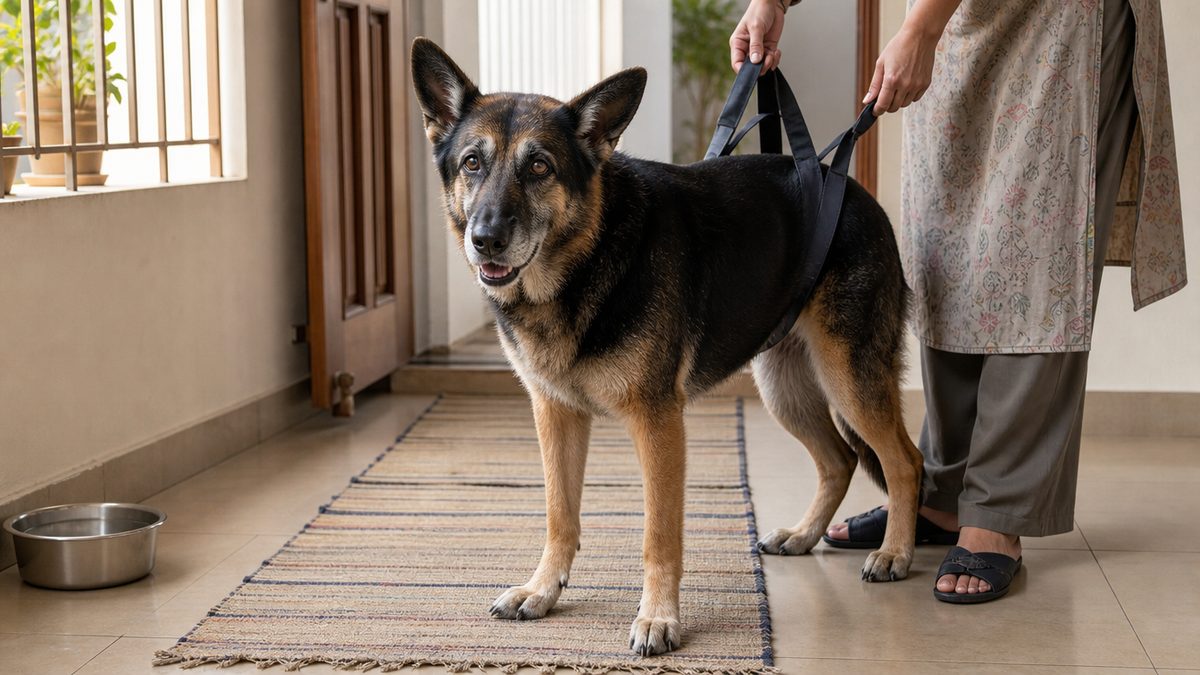
Lifting is where owners get hurt. A rear-support harness with a handle lets one person take the back half of a 30 kg dog with a straight back, and it is the piece of equipment to buy before the cart, since 147 of 190 neurologists routinely recommend assistive walking devices including harnesses and slings. In a flat with a lift, the harness plus a mat runway usually keeps a dog toileting outdoors for months longer than the stairs alone would.
When the flat stops working, and what that costs
Some dogs need hospital care that a flat cannot give. The Bihar Animal Sciences University Veterinary Clinical Complex prices indoor care for a dog or cat at Rs 200 per animal per day, which is the only published Indian figure this page found for nursing a large dog in a veterinary hospital rather than at home.
The hardest number belongs here too, because it is the decision most Indian families will actually face. Sixty percent of 190 neurologists reported that owners most often choose euthanasia at the point the dog becomes non-ambulatory paraparetic, which is stage 2. ICAR-IVRI prices euthanasia for a pet animal at Rs 200, plus tax. Knowing that both the cart and the ending are affordable is not morbid, it is the information that lets a family choose the cart first rather than defaulting to the ending because they assumed the alternative was unaffordable.
Mats, then a harness, then a cart. Rubber-backed mats or yoga mats over tile restore traction for a dog whose problem is coordination rather than strength. A rear-support harness protects your back and keeps the dog toileting outdoors. An Indian-made rear-support cart for a German Shepherd is Rs 9,500 to Rs 9,900 inclusive of GST and one Indian maker lists more than 13 dealers across the country. Buy the cart when the dog becomes non-ambulatory, not when it is already down and sore, and buy it for the exercise, since exercise is the only thing with a survival figure attached. Your nearby vet decides what is right for your dog.
Two related pages help with the rest of an old dog's year. Our guide to senior dog care in India covers pain scoring, mobility aids and the annual checks that catch the arthritis travelling alongside this disease, and our guide to pet insurance in India covers why cover has to exist before the diagnosis rather than after it.
Questions Google India asks about degenerative myelopathy in dogs
What is the life expectancy of a dog with degenerative myelopathy?
Roughly a year from the first signs, on the published medians. A Zurich cohort reports median survival of 13 months from the onset of clinical signs, 95 percent confidence interval 9 to 18 months, and 6 months from the date of diagnosis. In a Pembroke Welsh Corgi owner survey with 162 answers, 81 dogs lived one to two years after diagnosis and 55 lived two to four.
What are the 5 stages of degenerative myelopathy in dogs?
There are four published stages, not five. Stage 1 is asymmetric hind limb wobbliness with intact reflexes, stage 2 is non-ambulatory paraparesis or paraplegia with reduced reflexes and muscle wasting, stage 3 is flaccid paraplegia with front limb weakness and incontinence, and stage 4 is flaccid tetraplegia with swallowing, voice and breathing affected. Median ages ran 9.6, 11.2, 12 and 13.3 years.
Can degenerative myelopathy be cured in dogs?
No. No medical therapy has been shown to alter the progression of the disease, and the formal genetic record states there is no successful treatment. A trial of epsilon-aminocaproic acid, N-acetylcysteine and vitamins C and E in 12 dogs found all 12 worsened over six months. Physiotherapy extends survival without changing the outcome.
Is walking good for dogs with degenerative myelopathy?
Yes, and it is the single best-supported thing you can do. In the only controlled comparison published, 9 dogs on intensive daily physiotherapy had a mean survival of 255 days against 130 days for 6 dogs on moderate physiotherapy and 55 days for 7 dogs on none. Dogs receiving physiotherapy also remained able to walk for longer.
Is DNA test illegal in India?
No, and for breeding dogs Indian law requires the opposite. Rule 8 sub-rule 10 of the Prevention of Cruelty to Animals (Dog Breeding and Marketing) Rules, 2017 states that dogs shall have been tested for genetic defects, including hip dysplasia, progressive retinal atrophy, night blindness and eight others. The rule names no laboratory and no standard.
Is there a DNA test for degenerative myelopathy in dogs?
Yes, for the SOD1:c.118G>A variant, and it is a risk test rather than a diagnosis. UC Davis charges USD 58 for a single test, about Rs 4,300 to Rs 4,900, with a turnaround of at least 15 business days on cheek brushes you post yourself. No Indian laboratory offers it and three Indian dog DNA sellers do not name the variant anywhere.
Is degenerative myelopathy painful for dogs?
No. The Orthopedic Foundation for Animals states that an important feature of the disease is that it is not a painful disease. That single fact does more diagnostic work than anything else on this page, because a dog that yelps, hunches or snaps when its back is touched has something else, most often a spinal disc problem that can be treated.
My old German Shepherd is dragging its back feet. Does that mean degenerative myelopathy?
Usually not, and the alternative is treatable. Disc disease is commoner and painful, and 11 of 39 dogs in one cohort that carried the mutation and looked like textbook cases also had a thoracolumbar disc protrusion on magnetic resonance imaging. A genotype finds none of that. Ask for a neurological examination first and a scan second.
Does a dog wheelchair slow degenerative myelopathy?
No study shows that it does, despite one large American manufacturer claiming its carts slow the progression of virtually all canine spinal diseases including this one. A cart restores mobility and makes exercise possible, and exercise is the thing with a survival figure behind it. Buy the cart for the walk, not for the prognosis.
If my dog tests at risk, will it definitely get degenerative myelopathy?
No. Not all dogs testing at risk show clinical signs, some that do have not begun until 15 years of age, and research is ongoing to estimate what percentage will develop the disease within their lifespan. No lifetime penetrance figure exists to quote. The result means at risk, which is a probability rather than a forecast.