
Cat life guide
Can cats wear clothes: what a garment does to a cat that it does not do to a dog
Every page on this question argues about warmth. The cat answer turns on three things warmth has nothing to do with: a cat grooms its own coat, cools itself with saliva, and rights itself in a fall by twisting the one stretch of spine a sweater wraps.
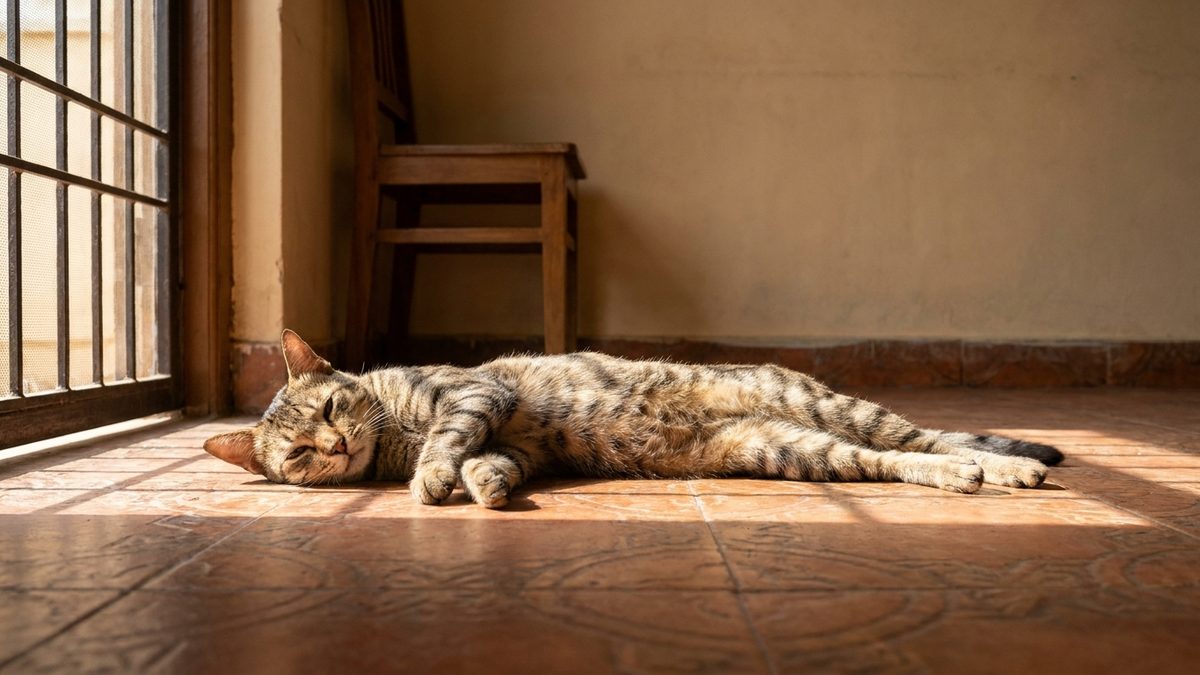
Quick answer
Can cats wear clothes? Almost never, and the reason is not warmth. A cat regulates heat by moving and by raising or flattening its own coat, cools itself by grooming, and rights itself in a fall by twisting a thoracic spine with a 47-degree neutral zone. A garment blocks all three. The documented exceptions are a vet-fitted wound garment and a hairless cat, on veterinary advice.
This guide is general information for Indian pet owners and is not a diagnosis. Always consult a registered veterinarian near you before acting on anything you read here, and treat any sudden change in your pet's condition as urgent.
Can cats wear clothes, and which cats actually should
Cats can physically wear clothes and almost none should. Two welfare bodies state it plainly: the RSPCA's knowledgebase says to avoid dressing cats up because most cats will not tolerate nor enjoy wearing any costume, and Cats Protection's Registered Veterinary Nurse Helen Crofts says there may be some cats who tolerate wearing items of clothing but this is quite rare Cats Protection, Is it okay to dress up….
Two exceptions are documented rather than assumed. The first is a wound garment fitted after surgery, which has a randomised trial behind it and belongs to the veterinary surgeon who made the incision. The second is a hairless cat, and even there Cats Protection's instruction is to warm the room and add bedding first and to speak to your vet about whether they would recommend your cat wears a jumper or sweater. Everything else on the shelf is for the person holding the phone.
This page does not re-argue the physics of a garment. That is published, with the temperature data and the sizing evidence, in do dogs need clothes in India. What follows is the part of the question that is about the cat, and the cat differs from the dog in four specific ways that no page ranking for this query mentions.
- A cat's thermoneutral zone starts far higher than a dog's, so an Indian room is already below it, which sounds like an argument for a garment and is the opposite of one.
- A cat maintains its own coat with its tongue, and blocking that has been measured, once, with a result worth knowing.
- A cat that stops moving in a garment is often not calm, and both welfare bodies above name the freeze as a sign of distress rather than tolerance.
- A cat rights itself in a fall by twisting its thoracic spine, the exact stretch of body a sweater, a t-shirt or a recovery suit wraps.
No brand, seller or garment is recommended anywhere below. Bonbeno publishes a verdict on a product only after testing it first-hand, and none of these has been tested here. Where an Indian listing is quoted as data, the listing sits in the source list so the figure can be checked. Nothing here is a diagnosis, and any garment on an unwell or post-operative cat is a decision for the veterinarian who examined it.
Why the cat answer is not the dog answer
The cat answer differs because the cat's comfortable temperature band sits much higher. The thermoneutral zone for domestic cats is 30 to 38 C, while most cat housing in homes and laboratories is kept closer to 22 C, plus or minus 2, so thermal discomfort is a common experience for many cats rather than an unusual one.
Hold that against the dog figure. A dog spends the least energy on thermoregulation between roughly 20 and 30 C, which is why most of the Indian year sits inside a dog's comfortable band and most dogs here need no sweater at all. A cat's floor is 30 C. By the same arithmetic, a cat in a Delhi flat in January, a Mumbai flat in August and a Bengaluru flat in any month at all is below its thermoneutral zone almost permanently.
That looks like a case for clothing and it is not, and understanding why is the whole page. A cat does not sit below its comfortable band waiting to be dressed. It solves the gap by moving. It finds the warm laptop, the sunny patch of floor, the gap behind the fridge, the folded blanket, the lap. Behavioural thermoregulation is the cat's primary tool, and it works by choosing a microclimate and leaving it again when the body has had enough. What a cat lives at is therefore not the room temperature but the temperature of whatever it is currently lying on, and the full picture of that hunt, including what it costs a cat in an Indian winter, is in winter care for cats in India.
A garment does not join that system. It overrides it. A cat wearing a sweater carries the same insulation into the sunny patch that it carried into the cool tile corridor, and it cannot take the layer off when the sum of coat plus fabric plus sunlight becomes too much. The one adjustment a cat normally makes continuously is the one a garment removes.
The dial a cat already has
A cat adjusts its own insulation continuously, through the small muscles at the base of each hair. A 2021 review of hair, feathers and glabrous skin across domestic animals sets out both directions. Pilorelaxation occurs in hot environments to flatten the hairs and reduce the amount of air trapped between skin and hair, which enhances heat loss and reduces body temperature; under exposure to cold, piloerection increases the loft of the coat and, as a result, the amount of motionless air trapped, which insulates and prevents a reduction in core temperature.
Read that as a dial rather than a fact about fur. The insulating value of a coat is the still air held inside it, and a cat turns that value up and down all day without thinking about it. A snug garment holds the coat flat, which is the hot-weather setting, at every temperature. A loose one traps a second layer of air the cat cannot shed. The review does not test a garment over a cat's coat and no study was found, on any search, that does. The dial is measured; the claim that fabric jams it is this page's reasoning from the mechanism, and it is labelled as such rather than dressed up as a finding.
The RSPCA is explicit that it is especially important that body costumes do not cause overheating, which can lead to heat stress, so avoid dressing your pet up during hot weather. In most of India, most of the year, that sentence rules out the garment on its own. What heat stress looks like in a cat, the 40 C line and the cool-first first aid are in heat safety for cats in India.
What a garment does to grooming, and what that costs
A garment blocks grooming over the skin it covers, and the one experiment that blocked feline grooming measured the cost. Nine cats in a flea-infested household were fitted with Elizabethan collars that prevented grooming and compared three weeks later with nine control cats in the same household. Flea numbers fell in the controls, reflecting a drop in adult fleas in the environment, but did not fall in the collared cats, and ended about twice as numerous as in the controls.
The authors attributed that gap to the collared cats' inability to groom off fleas, and a second experiment in the same paper showed the behaviour responds to pressure: cats from the flea-infested household groomed at about twice the rate of ten control cats from a flea-free colony. Grooming is not tidying. It is pest control the cat performs on itself, it scales up when it is needed, and it stops where something is in the way.
An Elizabethan collar blocks the mouth from reaching anywhere. A trunk garment blocks the mouth from reaching the trunk, which is where a cat spends most of its grooming effort and where flea dirt collects. The transfer from one to the other is reasoning rather than measurement and this page says so, but the mechanism is the same mechanism and nothing in the literature softens it. A cat in a sweater is a cat with a strip of unmaintained coat under the sweater.
Two other jobs stop at the same time. Saliva spread on the coat evaporates and cools the cat, which is one of the few cooling routes a cat has and is covered with the rest of the coat's work in cat grooming at home in India. And a cat that cannot reach an itch keeps trying, which is how the Reddit thread titled around a cat trying to lick its belly and failing ends up in a Google India result set for this query. The cat is telling the owner the answer and the owner is reading it as a styling problem.
August in Bengaluru, and the cats that groom least
The Indian clinical data points at grooming efficiency without being about garments at all. A series at the Small Animal Clinic of Veterinary College Hebbal in Bengaluru, Karnataka screened 2,134 cats between June 2023 and January 2024. The incidence of skin infection was 32.33 percent, and 67.10 percent of those were parasitic skin disease, 463 cases in all. Fleas were 47.35 percent of them, ear mites 37.1 percent, scabies 11.0 percent, ticks 3.0 percent and lice 1.5 percent. August was the peak month at 19.65 percent of parasitic cases and June the lowest at 7.97 percent of skin infections.
Now read who carried the load. Persian cats were 59.82 percent of the 463 cases, with an odds ratio of 2.998 for parasitic skin disease against mixed-breed cats, 95 percent confidence interval 1.810 to 4.965, p < 0.001. Cats under a year old were 71.05 percent of cases and carried an odds ratio of 5.233 for flea infestation specifically, 95 percent confidence interval 1.187 to 23.074, p = 0.029.
The authors' own explanation for both groups is grooming. They attribute the Persian excess partly to less efficient grooming behaviour of the long-haired cats, and the kitten excess partly to less efficient grooming in young cats, alongside an underdeveloped immune system and contact with an infected mother. That is an Indian dataset in which the two groups with the worst parasite burden are the two groups the clinicians say groom least well.
A garment does to any cat what a long coat does to a Persian, deliberately and in the place you fastened it, and it does so in a country where the flea season does not close. The Indian flea and tick picture, the product classes labelled for cats and the dog spot-ons that can kill a cat are in ticks and fleas on cats in India.
Run a hand and a fine-toothed flea comb over the skin the fabric covered, every time it comes off. You are looking for flea dirt, damp fur, matted patches, redness at the armpits and groin, and anything the cat was trying to reach and could not. Twenty seconds of checking is the difference between a garment worn for an hour and a skin problem found in a month.
Why a cat goes still when you put clothes on it
A cat goes still in clothes because it cannot get away from them, and that stillness is a freeze response rather than contentment. Both welfare bodies on this subject name it as a sign of distress. Cats Protection's account is the clearest: when cats are stressed they usually try to run away and hide, but if they cannot escape the situation they may shut down instead, and if they cannot escape the clothing they may go floppy or stop moving.
The next two sentences are the ones that matter, because they describe the mistake almost every photograph on this subject is built on. Many people mistake this behaviour for cats being relaxed and happy, Cats Protection says, but it does not mean your cat is comfortable in their new outfit; it means they are very distressed and the only way they can cope with it is to disassociate from the situation, and the instruction that follows is to remove the clothing and give the cat space to calm down.
The RSPCA reaches the same place from a different direction. Its knowledgebase lists the signs that mean an animal should not be dressed, and the first one named is difficulty moving normally, including freezing, alongside struggling to remove the costume and signs of anxiety such as panting. Two independent bodies, one in the United Kingdom and one in Australia, both file an immobile animal under do not continue.
The research literature on feline fear describes the same posture without mentioning clothes. A 2025 review of the tools for fear, anxiety and stress in the domestic cat records that when handled or constrained, cats may show lip licking, swallowing, excessive salivation, reducing their apparent surface area, placing their limbs under the body, wrapping their tail against it, ears positioned to the sides or back of the head, pupil dilation and tail movements. Read that list beside a cat in an outfit. A cat that has made itself small, tucked its legs under and wrapped its tail against its body is producing the constrained-cat response, not settling in.
The owner-reported survey on Elizabethan collars collected the same thing in the owners' own words. One cat owner wrote that their cat just stood in a crouched still position while wearing the Elizabethan collar; another that they noticed their cat walked lower and dragged the collar along the wall and seemed really depressed, and that once it stayed off she was back to her old self.
Reading a cat in a garment, in order
Watch for the signs in the order a frightened cat produces them, because the loud ones arrive last and the useful ones arrive first.
- First, avoidance. The cat tries to leave, hides, backs out of your hands, or walks away low and fast. Cats Protection lists trying to run away and hiding at the top of its discomfort list.
- Then, the body gets small. Limbs under the body, tail wrapped against it, apparent surface area reduced, ears to the side or back, pupils wide.
- Then, the mouth. Lip licking, swallowing, drooling.
- Then, the complaint. Hissing, clawing at the clothing, biting.
- Last, the shutdown. Freezing, going floppy, or standing in one place and not moving. This is the end of the sequence, not a happy beginning to it.
One practical consequence is easy to miss. The RSPCA notes that a costume can impair an animal's ability to communicate with its owners and with other animals, because animals communicate through body language involving ears, eyes, tails and body position, and if you cannot read their behaviour you may miss important signals such as their need to toilet. A cat's tail and flank are signal surfaces. Cover them and you have turned down the volume on the channel you were going to use to decide whether the cat was happy. How to hold a cat so that it keeps the choice, and what the handling research actually measured, is in how to hold and handle a cat in India.
The spine a garment wraps is the spine a cat falls with
A cat rights itself in mid-air by twisting the front half of its trunk first, and the flexibility that allows it is concentrated in the thoracic spine, which is the stretch of back a sweater, a t-shirt or a recovery suit sits on.
That has now been measured. Destructive failure testing on five cat cadavers compared the thoracic and lumbar regions under axial torsion, with trunk motion during air-righting filmed in two live cats. The thoracic region showed a larger range of motion, lower stiffness and a neutral zone of 47 degrees; the lumbar region had no neutral zone at all. During air-righting, anterior trunk rotation was completed earlier than posterior trunk rotation, and the authors conclude that a flexible thoracic spine and a rigid lumbar spine in axial torsion are suited to exactly that sequence.
A neutral zone is the part of a joint's range that moves under almost no load. Forty-seven degrees of it, in the thoracic spine, is the free play the cat spends in the first fraction of a second of a fall. Five cadavers and two live cats is a small study and it is the only quantitative answer available, so treat the number as the best measurement rather than the final one.
No study tests a garment against air-righting, and this page will not invent one. What the anatomy does establish is that the free play is not distributed along the back. It is in one segment, that segment is the barrel of the chest, and a garment is fastened precisely there, because the chest is where every cat garment takes its measurement. A snug fit is the fit sellers and vets both ask for, and snug over the thoracic spine is snug over the 47 degrees.
A cat that lands on its feet is not a cat that is unhurt. In the 1,125-fall Berlin series, 96 in 100 fallers were injured, and the righting reflex lands them feet-first without making the landing safe. That is why the answer to a balcony is a net rather than a trust in the reflex, and the fall-height data, the mesh sizes and the Indian per-square-foot prices are in indoor cat safety in India. This section adds only that a garment is a reason not to bet on the reflex, not a substitute for the net.
The practical reading is narrow and worth stating narrowly. A cat in a garment on the floor of a closed room is not in this argument. A cat in a garment on a balcony parapet, a window ledge, a stair rail, a wardrobe top or a terrace wall is, and in an Indian flat those are the surfaces a cat walks by default. If a garment goes on for a photograph, the photograph happens on the floor with the balcony shut.
Is there a cat with a genuine indication?
There is one, and it is the hairless cat, though the documented case is thinner than the internet suggests. Cats Protection names it: some breeds of cat are born without fur, which means that in cold weather they can struggle to keep warm, and its instruction is to make sure the environment is sufficiently warm, offer extra bedding and blankets, and speak to your vet about whether they would recommend your cat wears a jumper or sweater.
Note the order of that advice. Room, then bedding, then a conversation with a vet. The garment is third and conditional even for the one breed group everybody agrees about, which is a long way from how the category is sold.
The physics is real. A 2021 review across domestic animals records that hair is a physical barrier that intervenes in heat loss or heat retention, so hairless animals are more sensitive to extreme temperatures and are predisposed to consequences such as sunburn when exposed to direct sun radiation. It names Sphynx cats specifically, and adds that they sweat in the same way as other domestic animals but that insensible perspiration is higher than in animals with a full coat, leaving them reliant on acute peripheral vasomotor responses to thermoregulate. A Sphynx has no dial to turn. That is the structural difference, and it runs in both directions in India, where strong sun on bare skin is the bigger of the two risks for most of the year.
The four-degree claim, checked
The most repeated fact about hairless cats and temperature appears to have no published measurement behind it. The claim that a Sphynx runs four degrees warmer than other cats circulates widely on social media and in rescue posts, and no primary source for it was found on any search made for this page. The one study located that measured body temperature against hair type in cats points the other way.
A Thai study of 184 client-owned cats recorded rectal temperature alongside age, body condition score, gender, hair colour and hair type, the last split into long hair, short hair and no hair. Mean rectal temperature was 100.30 F in the hairless cats, 100.98 F in the short-haired and 101.13 F in the long-haired. On univariate analysis against short hair as the reference, no hair gave a coefficient of minus 0.68, standard error 0.73, 95 percent confidence interval minus 2.12 to 0.76, p = 0.350, and age was the only characteristic significantly associated with rectal temperature at all.
Two cautions belong with that. There were only 2 hairless cats among the 184, so the estimate is weak and the confidence interval is wide enough to contain almost anything. And the measured difference, 0.68 F, runs in the opposite direction from the folk claim and is a fraction of its size. The honest statement is that a hairless cat has no insulating coat, that the only measurement available does not show it running hot, and that a hairless cat feeling warm to your hand is a fact about touching skin instead of fur.
The indication belongs to the coat, not to the cat's cuteness. It covers a Sphynx or a near-hairless cat in a genuinely cool room, on the vet's advice, in a breathable layer that comes off indoors when the room warms. It does not extend to a healthy short-haired Indian domestic cat, which has a working coat and a working dial. The grooming and skin care a hairless cat does need, which is a bathing routine rather than a brushing one, is in cat grooming at home in India.
The one garment with a randomised trial behind it
The post-surgical garment is the only cat garment tested in a randomised controlled trial, and the trial compared it against the Elizabethan collar rather than against nothing. Twenty-six healthy female cats undergoing ovariohysterectomy at Burdur Mehmet Akif Ersoy University Animal Hospital in Turkey were randomly assigned after a 2.5 cm ventral midline celiotomy to wear either a 10 cm Elizabethan collar, 13 cats, or a wound protection corset made from breathable lycra, 13 cats.
What it measured, and what it found, matters more than the headline. Pain was scored at 6, 12, 24, 48, 72 and 96 hours on two validated feline scales, the Glasgow Composite Measurement Pain Scale-Feline and the UNESP-Botucatu Multidimensional Composite Pain Scale, with rescue butorphanol given above threshold. Discomfort was assessed by salivary cortisol, behavioural observation and the frequency of what the authors call misbehaviours.
| What was measured | Result | Did the corset win |
|---|---|---|
| Pain score on CMPS-F at every time point to 96 h | No significant difference between groups at any interval | No |
| Pain score on MCPS at every time point to 96 h | No significant difference between groups at any interval | No |
| Rescue analgesia administrations | 16 in the corset group against 17 in the collar group, p = 0.88 | No |
| Salivary cortisol | 0.05 in both groups by median, p = 0.09, and both below published feline reference values | No |
| Misbehaviours: trying to remove the device, head shaking | 10 of 13 in the collar group, 3 pawing and 7 head-shaking, against 0 of 13 in the corset group, p < 0.01 | Yes, decisively |
| Excessive grooming, vocalisation, restlessness | None observed in either group | Neither |
So the corset did not reduce pain and did not reduce cortisol. What it changed was the cat's relationship with the device: every cat in the corset group left it alone, and ten of thirteen cats in the collar group fought theirs. The authors' conclusion is calibrated to exactly that, saying both devices provided comparable pain management, that the significant misbehaviours associated with collar use suggest an increased discomfort level, and that the corset may offer a more comfortable recovery experience, warranting further investigation.
The limits are the authors' own and they are worth reading before extending the result. Assessment ran only 96 hours. The cats were housed in a hospital ward, which the authors note may have introduced stressors absent at home. There were no owner questionnaires, no accelerometer data, and no body weight or food intake records, so the fuller welfare picture is missing. The cortisol assay was not species-validated and returned values below feline reference ranges throughout, which the authors flag themselves. Rescue analgesia was needed often enough that they question whether the analgesia protocol was adequate at all.
The inclusion criteria matter just as much for an Indian reader deciding whether this applies to their cat. Every cat was female, healthy, between 1 and 3 years old, between 2 and 5 kg, graded ASA 1, scored 1 for temperament, non-aggressive, and off analgesics and anti-inflammatories for 14 days. A nervous street-rescue queen, a 7 kg cat, a kitten, a senior or a male after a scrotal castration is outside the tested population.
What the 77.4 percent figure does not say
A single number is quoted across the commercial pages on this subject and it is being read as a cat figure when it is not. An online survey of 434 owners whose dog or cat had worn an Elizabethan collar in the previous 12 months found that 77.4 percent reported a worse quality of life while the collar was worn, with 12.9 percent reporting better and 9.7 percent no difference, and a worse score was more likely where the collar interfered with drinking or playing or caused irritation.
Now read the limitation the authors themselves print. Their survey did not require owners to specify the species of companion animal, and they were therefore unable to determine differences between dogs and cats based on these responses. The 77.4 percent is a mixed dog-and-cat figure that cannot be split. Two of the pages quoting it on this query present it inside advice about cats. The figure is real, the finding is real, and the species attribution is an error introduced by whoever repeated it.
Two other features of that survey bear on how far it travels. Respondents self-selected, 93.5 percent were female and 36.4 percent worked with animals, which the authors list as sources of bias. And 66.6 percent were in Australia, 15.2 percent in the United Kingdom and 12.7 percent in the United States, with no Indian respondents recorded at all.
How a cat uses a litter tray in a recovery suit
A recovery suit designed for a cat leaves the rear clear, and the cat uses the tray normally. That is the difference between a fitted wound garment and a shirt pulled over a cat: a shirt has no rear opening, so it either rides up or is soiled, and a soiled garment against a fresh incision is worse than no garment at all.
The decisions that come with it belong to the clinic rather than to this page. How long the device stays on, which litter goes in the tray while the incision heals, and when a wound needs looking at the same day are set out, with the sources that disagree about the day counts, in cat sterilisation in India. Ask the surgeon which device they want on the wound they made, and ask before the day of surgery rather than in the car park afterwards.
A cut sock, a child's t-shirt or a strip of cloth taped over an incision is not the device in the trial. The trial used a manufactured breathable lycra corset fitted after surgery in a hospital, and the reason breathability and fit were specified is that a non-breathable or badly fitted covering holds moisture against a closing wound. If an Elizabethan collar is distressing your cat, the fix is to telephone the clinic and ask for the alternative, not to build one. Any decision about a surgical site is the veterinarian's.
Do calming compression vests work on cats?
No published study tests a calming compression vest on cats, and the only systematic review of these products covers dogs alone. It screened 229 studies, found four that met its inclusion criteria, and every one of the four was canine.
Its verdict on the dog evidence is not encouraging either. The review reports that the risk of bias in domains related to blinding was generally high, that most studies reported minimal benefits on behaviour or heart rate without adverse side effects, and concludes that there is weak and limited evidence to support the beneficial effect of pressure wraps in reducing physiological or behavioural signs of anxiety, with confidence in the available literature low because of moderate-to-high risks of bias and inconsistent findings.
The cat-side silence is the more telling half. A 2025 review of the tools for approaching fear, anxiety and stress in the domestic cat runs to a full survey of the field, covering environment, handling, restraint, pheromones and pharmacology, and it does not mention a compression garment, a pressure vest or a wrap worn on the body anywhere in its text. Its two uses of the word wrap are a cat wrapping its tail against its body as a sign of anxiety, and the passive towel-wrapping technique preferred over excessive restraint in a clinic.
That is worth printing because an answer engine is currently saying otherwise. Google's own AI Overview for this query, read on 31 October 2026 from a Google India mobile search, lists calming compression garments as one of three situations where clothing on a cat is appropriate, stating that they can help reduce stress in some cats. The evidence base behind that sentence, for cats, is empty. Four studies in dogs, rated weak and limited by the review that collected them, is what exists.
The same 2025 feline review spends its length on things that are not garments: the environment, low-stress handling, a maximum of 2 to 3 seconds of movement-restricting restraint where it is unavoidable at all, passive towel wrapping in preference to force, and pheromone and pharmacological options chosen by a vet. If your cat is frightened of a carrier, a visitor, a thunderstorm or a cracker, that is the list to work through. The festival-night version of it, including the room and the sound masking, sits in indoor cat safety in India.
The physical risks, and which one is most likely in an Indian home
Overheating is the most likely physical risk in an Indian home, entanglement the next, and swallowed fabric the most serious when it happens. All three are named in the RSPCA's own list of what makes a garment unsafe.
That list is worth having in full, because it is the only professional costume safety checklist written for this exact object. The RSPCA says to avoid any costume that covers the nose or mouth and restricts breathing, eating or drinking; covers the eyes and obscures vision; is too tightly fitted, causing overheating or distress; is too loosely fitted, causing accidents or tripping; prevents normal behaviours such as walking, toileting or resting; has dangling, sparkling or other attachments that pets can pull off and swallow, risking an obstruction or choking; encloses the head; or contains sharp items such as safety pins. It adds that even a pet which appears calm should be supervised closely at all times and should wear the outfit only for short periods.
- Overheating, first and by a distance. A cat's cooling routes are narrow, a layer over the coat blocks convective loss and blocks the saliva route at the same time, and the RSPCA tells you plainly to avoid dressing an animal in hot weather. In Chennai, Mumbai, Hyderabad, Kolkata or Pune that is most of the calendar.
- Entanglement and snagging. A loose garment catches on a balcony grille, a stair rail, a window mesh, a door latch or a ceiling-fan regulator cord, and a cat that is caught twists harder. A too-loose garment causing accidents is on the RSPCA list in those words.
- Swallowed fabric. A chewed-off bell, bow, button or strap is an obstruction and choking risk the same list names, and a pulled thread is worse than a bead. A swallowed thread in a cat is a linear foreign body, which is a different surgical problem from a discrete object, and that mechanism, with its survival figures and the Indian objects that cause it, is published in indoor cat safety in India. Do not re-learn it here; just treat any loose thread on a cat garment as the reason the garment goes in a drawer.
- Skin, which is the slow one. Fabric held against skin in a humid Indian month keeps the coat from drying and keeps the tongue from reaching, and the Bengaluru series above records what cat skin in this country already carries without help. The monsoon is the worst time to leave anything on a cat for hours.
- The cat that cannot be caught. A cat that has shut down in a garment and then bolts is harder to catch, harder to examine and harder to cool, and all three matter on the night a garment is most likely to be on it.
This is the one rule both bodies state without qualification. The RSPCA requires close supervision at all times and short periods only, and Cats Protection's instruction on seeing a cat freeze or go floppy is to remove the clothing and give it space. A cat left alone in a sweater for an afternoon fails that test whatever the weather, and a cat left alone in one overnight fails it twice.
What India actually sells as cat clothes
India sells dog clothes with the word cat in the title. On the first ten listings returned for cat winter clothes on amazon.in on 31 October 2026, every garment that named a fit reference named a dog breed, and not one named a cat breed.
The breeds given as the fit reference were Maltese, Shih Tzu, Pekingese, Papillon, Bichon, Pug, French Bulldog and Lhasa. Several titles carry both species at once, as in dog sweaters for small dogs cats, or small dog knitted winter puppy kitten cat sweater. A garment cut to the barrel of a Shih Tzu and the chest of a Pug is being labelled for an animal with a longer body, a narrower chest and the 47 degrees of thoracic torsion described above.
The sizing is worse, and the point is different from the one the dog page makes about letter sizes drifting between charts. Here the schemes are mutually incompatible, because they are not even measuring the same kind of thing.
| How the listing states the size | Price when read | What measurement it gives you | Fit reference in the title |
|---|---|---|---|
| Size L, Chest 45 cm, Length 35 cm | Rs 666 | Chest girth and back length | Shih Tzu, Maltese, small dog |
| Size M, Chest 38 to 42 cm | Rs 946 | A chest girth range, no length | Maltese, Shih Tzu, Pekingese |
| Size 16, Chest 38 to 50 cm, Length 35 to 39 cm | Rs 996 | A 12 cm chest span inside one size | Shih Tzu, Pug, French Bulldog |
| Size 2XL, Chest 50 cm | Rs 986 | Chest girth only | Shih Tzu, Pug, Lhasa |
| Size 2XL, Chest 55 cm | Rs 1,112 | Chest girth only, 5 cm larger at the same letter | Small dog, cat apparel |
| Back length 14 inch, chest circumference 16 inch, neck circumference 12 inch | Rs 497 | Three girths, but in inches | None, sold as cat sweater |
| Length 35.56 cm by width 20.32 cm, also given as 14 inch by 8 inch | Rs 500 | A flat rectangle. Width is not a body measurement at all | None, sold as cat sweater |
Read the two 2XL rows together. The same two characters mean a 50 cm chest on one listing and 55 cm on another, and one listing's single size covers a 12 cm chest span by itself, which across adult domestic cats is most of the range there is. Then read the last two rows, which come from the same seller: one variant is specified as three circumferences in inches and the other as a length and a width in centimetres. A width is the measurement of a flat piece of knitting laid on a table. It tells you nothing about whether the garment will close around a cat.
Prices on that page ran from Rs 170 for the cheapest item to Rs 2,318 for a multi-pack, with single garments between Rs 497 and ₹1,112 after discounts of 23 to 57 percent off a maximum retail price. A few hundred rupees is not the problem. The problem is that there is no Indian page anywhere in the result set that tells a buyer any of this. A Google India search for cat clothes winter India on 31 October 2026 returned ten results of which nine were shopping destinations and marketplaces and one was a Reddit thread, with no Indian informational page at all.
If you measure a cat anyway, measure the chest
Chest girth is the measurement that decides whether a cat garment closes, for the same reason it decides a dog's: it is the widest part the garment has to pass over and the first place a snug one rubs. Take it around the widest part of the ribcage just behind the front legs, with the cat standing, keeping the tape flat against the coat without pressing it down, and take it twice. Match the number in centimetres or inches to the seller's own figures and ignore the letter, which is a filing code rather than a size. The full method, and why weight is a poor instrument for this, is set out for dogs in do dogs need clothes in India and transfers unchanged.
Two cat-specific additions. A cat's forelimb has far more range than a dog's, so an armhole that is adequate on a Pug can pin a cat's shoulder; if the cat's gait changes at all, the garment is wrong whatever the tape said. And nothing should pass over or near the whiskers, because the vibrissae are a sensory field and not decoration.
Diwali, weddings and the photograph
Keep the cat out of the festival outfit and out of the room, because the night a costume is most likely to go on is the night a cat has the least tolerance for anything. The welfare position is the one already stated: short periods, close supervision, nothing in hot weather, and removal the moment the cat freezes Cats Protection, Is it okay to dress up….
Cats Protection also names the reason the trend exists, which is the most useful sentence on the subject. Social media is no doubt behind the growing trend to dress cats up, Helen Crofts says, and sharing photos of cats in costumes often gets likes and followers, but it is not in the best interests of our cats. The survey its article quotes gives a sense of how early the habit forms: 18 percent of children said they like dressing up their pet, in a nationally representative YouGov survey of 1,024 children aged 7 to 11 across the United Kingdom commissioned by the Pet Education Partnership, a collaboration of eight British welfare charities. No comparable Indian figure was found.
The rest of the festival question is published and this page cedes it rather than repeating it, with one difference worth naming. The costume rule in full, including the thermal trade-off and the swallowing risk from bells and sequins, is in pet birthdays and celebrations, and its instruction is to put the costume on, take the photograph and take the costume off. That is the right rule for a dog and the floor rather than the ceiling for a cat, because the RSPCA's cat-specific line is to avoid dressing cats up at all. Where the two differ, the species-specific one governs. What a staged photograph does to an animal, and how to get a good one without props, is in pet photography at home in India. Whether the animal should be at the function at all, which is the better question than what it should wear, is in pets during an Indian wedding. And a fabric outfit near a diya, a candle or a string of lights is a burn and a chewed-cord problem covered in diyas, candles and burn risk to pets.
Cats Protection offers three substitutions and all three work. Buy the cat a seasonal bed, blanket or toy and photograph it interacting with that on its own terms. Add the costume digitally to a photograph of a relaxed cat. Or wear the outfit yourself. A fourth, specific to an Indian festival week, is to photograph the cat in the quiet room with the door shut, because that is where it is going to be anyway and it is the only place it will look like itself.
What to do for a cat that is genuinely cold
Warm the place the cat sleeps rather than the cat. The gap between a cat's thermoneutral zone and an Indian room is real, at 30 to 38 C against roughly 22 C, and the thing that closes it is a surface, not a sweater.
The reasoning follows from the dial. A cat that is given a warm, enclosed, raised bed of its own takes the warmth when it wants it and leaves when it has had enough, which is the behaviour the 30 C floor produces and the behaviour a garment interrupts. A cat in a sweater on a cold tile floor is still on a cold tile floor, now with less ability to shed heat later and less ability to groom in the meantime.
- Get the cat off the floor. Tile, stone and mosaic are the coldest surfaces in an Indian flat and a cat lying on them loses heat by conduction all night.
- Give it an enclosed shape. A covered bed, a box with a blanket in it or a cupboard shelf traps the cat's own heat better than an open cushion, and it lets the cat regulate by going in and coming out.
- Move the bed away from the draught, which in most Indian flats means away from the window grille and the balcony door rather than away from a heater.
- Add layers the cat can burrow into rather than a layer it has to wear. A folded dupatta or an old blanket does what a sweater claims to and the cat decides how much of it to use.
- Check the cat, not the thermometer. A cat that has stopped using its usual spots, stopped greeting you or settled somewhere it never normally sleeps is telling you something, and it is not always the temperature.
Where it is actually cold, which in India means the northern plains in December and January and the hill stations for longer, the heat sources a cat picks for itself become the hazard. Contact burns from room heaters, the car bonnet and the scooter engine, how much more a cat eats in winter and what an outdoor cat shelter needs are all set out with the Indian evidence in winter care for cats in India. That page is the one to read if your cat is cold. This one exists because the question people type is about clothes, and the clothes are the least useful item on the list.
A cat that is hunched, hiding, off its food, unsteady or not coming out is not necessarily cold, and reaching for a garment delays the question that matters. Kidney disease, hyperthyroidism, pain, dental disease and weight loss all look like feeling the cold in a cat, and none is fixed by fabric. Call your nearby veterinarian. This page is information, not a diagnosis, and the annual check that catches most of this early is described in adult cat care in India.
What this page can prove, and what it cannot
Separate the measured from the reasoned, because the pages ranking for this query do not and a reader cannot tell which is which.
| Claim | Status | What it rests on |
|---|---|---|
| A cat's thermoneutral zone is 30 to 38 C while housing sits near 22 C | Established | A published review of feline environmental needs |
| Blocking a cat's grooming raises its flea burden | Measured, once, with a collar | 9 collared cats against 9 controls in one household, flea numbers about twice as high |
| A trunk garment blocks grooming the way a collar does | Reasoning from the mechanism | No study tests a trunk garment on grooming. The direction is not in doubt; the size of the effect is unmeasured |
| A cat's air-righting torsion is concentrated in the thoracic spine | Measured, small sample | 47-degree thoracic neutral zone against none in the lumbar region, 5 cadavers and 2 live cats |
| A garment over the chest impairs air-righting | Untested | Nobody has tried it. The anatomy says where the free play is; the garment's effect on it is unknown |
| A cat that freezes in clothing is distressed, not relaxed | Two welfare bodies, stated as position | Cats Protection and the RSPCA both name freezing as a reason to stop RSPCA Australia Knowledgebase |
| A wound protection corset is more comfortable than an Elizabethan collar | One randomised trial, behaviour only | 26 cats; no difference in pain or cortisol, 10 of 13 against 0 of 13 on misbehaviours |
| 77.4 percent of owners report worse quality of life in a collar | Established, but not a cat figure | 434 owners, species not recorded, so dogs and cats cannot be separated |
| A compression vest calms a cat | No evidence either way | 229 studies screened, 4 included, all canine, rated weak and limited; the 2025 feline review does not mention the product class Barrios F, Ruiz P |
| Hairless cats run four degrees warmer than other cats | Unsupported, and the one measurement points the other way | 100.30 F against 100.98 F, p = 0.350, with only 2 hairless cats among 184 |
| Indian cat garments are cut and sized for dogs | Observed on the listings themselves | First ten results on amazon.in, 31 October 2026: every fit reference a dog breed, 2XL meaning 50 cm on one and 55 cm on another |
The gap worth naming is the middle of that table. Nobody has put a garment on a cat and measured its coat insulation, its grooming coverage, its skin surface temperature or its righting time, and the absence is odd given how large the category is. Until somebody does, the honest position is the one the two welfare bodies already hold: most cats will not tolerate nor enjoy it, the exceptions are a vet-fitted wound garment and a hairless cat on veterinary advice, and the cat you are looking at will tell you which group it is in within three minutes if you let go of it and watch.
Common questions
Is it cruel to put clothes on a cat?
It is unkind for most cats and genuinely harmful for some. Cats Protection says that for most cats, having any sort of clothing or accessories placed on them will be a stressful and uncomfortable experience, even for a short period of time, and the RSPCA tells owners to avoid dressing cats up because most cats will not tolerate nor enjoy wearing any costume. Cruelty is not the useful test. The useful test is whether the cat can still move, groom, toilet and leave, and a garment interferes with all four.
Why do cats act like they can't walk with clothes on?
Because they have shut down, not because the garment is heavy. Cats Protection explains that a stressed cat normally runs away and hides, and that if it cannot escape the situation it may go floppy or stop moving instead, which many people mistake for the cat being relaxed and happy when it means the cat is very distressed and is dissociating. The RSPCA lists difficulty moving normally, including freezing, as a reason to take the costume off. Take it off and give the cat space.
Do cats like being dressed up?
Almost none do. Cats Protection's Registered Veterinary Nurse Helen Crofts says there may be some cats who tolerate wearing items of clothing but this is quite rare, and that those cats would have had many positive handling experiences during the socialisation period between two and seven weeks of age. She adds that even for kittens at that age, time is better spent on gentle handling, different people and household noises than on dressing them up for your own amusement.
How long can you leave a sweater on a cat?
Not unsupervised, and not for long. The RSPCA requires that even pets which appear calm be supervised closely at all times and wear their outfits only for short periods, and that the costume come off if the animal shows distress or becomes entangled. For a non-medical garment, treat the time as minutes with you in the room rather than an afternoon. A vet-fitted wound garment is the exception and its duration is the surgeon's instruction, not yours.
Is it okay for my cat to wear a shirt?
A human or child's shirt is the worst option available. It has no rear opening, so it rides up or gets soiled, no chest strap, so it bunches at the armpit, and the RSPCA's own list rules out anything too loosely fitted because it causes accidents or tripping. A shirt also covers the whole trunk, which is the coat a cat grooms and the thoracic spine it twists in a fall. If a cat needs a garment at all, it needs a fitted one chosen for a reason.
Can a cat wear an onesie after spay?
Yes, on the surgeon's instruction, and a randomised trial supports the comfort case. Twenty-six cats after ovariohysterectomy wore either a 10 cm Elizabethan collar or a breathable wound protection corset. Pain scores and salivary cortisol were no different between the groups, but 10 of 13 cats in the collar group tried to remove it or shook their heads while none of the 13 in the corset group did. Ask the clinic which device they want on the incision they made.
What are the differences between an e-collar and a Recovery Suit?
A collar stops the mouth reaching anything and blocks peripheral vision; a recovery suit covers the wound and leaves the head free. In the one randomised comparison in cats the two gave comparable pain control, so the difference is behavioural rather than analgesic: cats fought the collar and left the suit alone. A collar still wins where the wound is on a limb, the face or the tail, because a trunk garment does not cover those. The surgeon decides by where the incision is.
How does a cat go to the bathroom in a Recovery Suit?
Normally, because a suit made for the purpose leaves the rear open and the cat uses its tray as usual. That is the clearest practical difference between a fitted wound garment and an improvised one: a shirt or a cut sock has no rear opening, so it is soiled against a fresh incision. If the suit is wet or soiled, it comes off and the cat goes back to whatever the clinic advised while you call them.
Do cats need clothes in an Indian winter?
No, and the reason is that a cat solves cold by moving rather than by wearing. Its thermoneutral zone is 30 to 38 C against a room near 22 C, so it hunts warm surfaces all year, and what closes that gap is a warm, enclosed, raised bed it can enter and leave. A garment carries the same insulation into the sunny patch and the cool corridor alike, and blocks grooming while it is on. The exception is a hairless cat, on veterinary advice.