
Cat life guide
Winter care for cats in India: why a cat hunts heat all winter, and what that hunt costs it
Every Indian winter page for cats tells you to buy a warm bed. None of them tells you that the thermoneutral zone of a domestic cat is 30 to 38 C while the room it lives in sits at about 22 C, which is the single fact that explains why your cat is pressed against the heater.
Quick answer
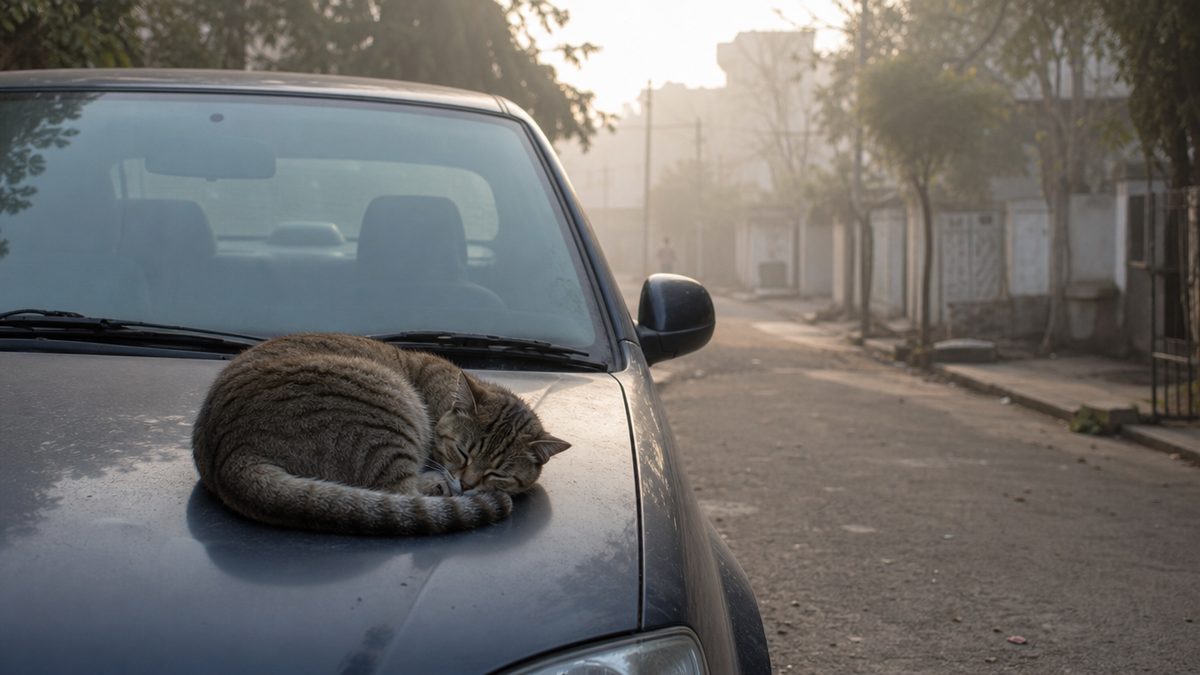
Winter care for cats turns on one fact. The thermoneutral zone of a domestic cat is 30 to 38 C, so an Indian room at 22 C leaves it hunting heat. That is why cats burn themselves on room heaters and climb into warm car bonnets. Feed to body condition, keep every heat source out of a sleeping cat's reach, tap the bonnet before starting the engine, and give an outdoor cat a small, raised, straw-filled shelter.
This guide is general information for Indian pet owners and is not a diagnosis. Always consult a registered veterinarian near you before acting on anything you read here, and treat any sudden change in your pet's condition as urgent.
Why a cat hunts heat, and why an Indian room never gives it enough
A cat hunts heat because the thermoneutral zone for domestic cats is 30 to 38 C, while most cat housing in homes and laboratories is kept closer to 22 C, plus or minus 2, so thermal discomfort is a common experience for many cats rather than an unusual one.
That sentence is the whole page. The thermoneutral zone is the band of air temperature in which an animal holds its body temperature without spending extra energy on it. Stella and Croney, reviewing the welfare of domestic cats in homes, shelters and research colonies, note that cats are often unable to express temperature-regulating behaviours because the resources to do so are not provided, and that the thermoneutral zone of the species is often not adequately considered in their housing. Their recommended fix is exactly what your cat is already trying to arrange for itself, which is warm bedding, resting areas, boxes or heating elements it can choose.
Now set that against the advice an owner actually reads. The RSPCA states that to keep cats warm in winter their environment should be between 10 C and 25 C, and that below 7 C to 8 C you keep them inside overnight. The top of that recommended range sits five degrees below the bottom of the measured thermoneutral zone. The two figures are not in conflict, because they answer different questions. The welfare range is about avoiding illness; the thermoneutral zone is about where a cat stops paying for its own warmth. We publish both rather than averaging them, because the gap between them is the reason a cat that is in no danger at all still spends every January evening wedged against a heat source.
Ten Indian cities, 452 winter nights, counted
To see how far an Indian winter sits from a cat's comfort, we pulled NASA POWER daily minimum air temperature at ten city points for the five winters from December 2019 to February 2024, which is 452 December-to-February nights per city, and counted the nights below each of the RSPCA's two thresholds.
| City | Mean night minimum | Nights below 10 C | Nights below 8 C | Coldest night |
|---|---|---|---|---|
| Delhi | 8.1 C | 320 (70.8 percent) | 227 (50.2 percent) | 0.5 C |
| Jaipur | 9.0 C | 275 (60.8 percent) | 166 (36.7 percent) | 1.1 C |
| Lucknow | 9.4 C | 270 (59.7 percent) | 158 (35.0 percent) | 1.8 C |
| Kolkata | 12.8 C | 90 (19.9 percent) | 21 (4.6 percent) | 5.1 C |
| Ahmedabad | 13.2 C | 71 (15.7 percent) | 29 (6.4 percent) | 5.5 C |
| Pune (Maharashtra) | 14.2 C | 23 (5.1 percent) | 4 (0.9 percent) | 6.0 C |
| Bengaluru (Karnataka) | 15.8 C | 1 | 0 | 9.2 C |
| Hyderabad | 16.0 C | 7 (1.5 percent) | 0 | 8.3 C |
| Mumbai | 17.8 C | 1 | 0 | 9.5 C |
| Chennai (Tamil Nadu) | 22.2 C | 0 | 0 | 18.6 C |
Read the table twice, because it says two different things. The first reading is the obvious one. Half of all Delhi winter nights, 227 of 452, fall below the temperature at which the RSPCA says bring the cat in, and seven in ten fall below 10 C RSPCA, How to help cats in cold weather. Jaipur and Lucknow are close behind. The India Meteorological Department describes the same thing from its own records, that minimum temperatures drop below 8 C over many parts of northern India from November to February, with December and January the coldest months. The cold-wave warning machinery behind that, and what it means for an animal left outside, is set out in winter care for dogs in India and is not repeated here.
The second reading is the one no Indian cat page makes. Chennai never had a single winter night below 15 C in five years, and its mean winter night was 22.2 C. That is a mild night by any human standard and it is still eight degrees below the bottom of a cat's thermoneutral zone. Mumbai, Bengaluru and Hyderabad are in the same position. Heat-seeking is therefore not a northern problem that southern owners can skip. A Chennai cat lying on the inverter and a Delhi cat lying on the heater are doing the same arithmetic; only the Delhi cat is in any danger from the cold itself.
The Animal Welfare Board of India's Animal Birth Control handbook sets a winter protocol for sterilisation centres. No surgeries shall be conducted below 10 C; between 10 C and 18 C, hourly hypothermia monitoring must be performed for at least four days post-surgery; and operation theatres must maintain a minimum of 20 C. That is India's own animal-welfare document treating a night under 10 C as a hypothermia risk for a recovering street animal. Delhi's outdoor night was below 10 C on 320 of 452 winter nights.
The heat sources a cat picks, and what each one does to it
A cat picks the warmest surface it can lie on rather than the warmest air in the room, and that single preference turns every Indian winter heat source into a contact burn risk rather than a fire risk.
The RSPCA describes the behaviour plainly. A cat will still look for cosy places to rest, and you might find them curled up on blankets, in the sunlight, beside radiators, or snuggled up to you. A dog lies near the heater. A cat lies against it, on it, or on the thing it has just warmed, and then goes to sleep there for four hours.
Two things make that dangerous in a way owners do not expect. A contact burn needs far less heat than a flame, and it needs time rather than intensity. And the animal most at risk is the one that cannot move away, which is the kitten in a carton, the arthritic eighteen-year-old, the cat sleeping deeply, and the cat whose skin over a burn has already gone numb.
The clearest cat-specific measurement of how hot we put things against cats comes from an anaesthesia study rather than a home. Thirty cats undergoing a 60-minute head MRI were randomised to a cloth blanket alone or to a silicone hot water bottle under the abdomen plus the same blanket. The bottle held 1.5 litres of water at 60 C at the start of the scan and 55 C at the end, and the authors record that it was made entirely of silicone and was covered with a soft fleece to prevent burning the patient. It worked: end-of-scan body temperature was 38.0 C in the heated group against 37.0 C in the blanket-only group, p equals 0.033.
Take the precaution seriously rather than the result. A veterinary team warming an unconscious cat under supervision for one hour still put a fleece layer between 60 C water and the skin. The hot water bottle that goes into a cat's bed in Lucknow in January has no fleece, no supervision, and eight hours rather than one.
| Heat source | What the cat does with it | The rule |
|---|---|---|
| Fan heater or blower at floor level | Sleeps directly in the airflow, often with one flank against the grille | Raise it, barrier it, or run it only while you are in the room |
| Oil-filled radiator | Sleeps touching the fins, which stay hot long after the thermostat cuts out | Keep the bed a clear arm's length away; the surface, not the air, is the hazard |
| Halogen or quartz rod heater | Sits close and face-on, because the radiant heat feels strongest there | Never at cat height and never unattended; whiskers and eyes are at the front |
| Hot water bottle in the bed | Lies on it for hours and does not move when it is too hot | Fill with warm, not boiling, water, wrap it thickly, and take it out before the cat settles for the night RSPCA, How to help cats in cold weather |
| Electric heating pad or heated blanket | Sleeps on the warmest spot all night, including over a fold | The two welfare bodies disagree here, and the disagreement is printed below Blue Cross, Looking after your cat… |
| Gas stove, tawa or kadhai just switched off | Jumps onto the warm hob or the warm vessel after the kitchen empties | Shut the kitchen, or keep the cat out until the surfaces are cold to your hand |
| Iron, its cord and the just-ironed pile | Settles on the warm clothes and knocks the iron doing it | Unplug and put the iron away before you leave the room |
| Laptop, set-top box, inverter and fridge top | Takes the warmest electronics in the house as a winter bed, including in Chennai and Mumbai | Harmless in itself; give the cat a better warm option so it stops |
| Coal angithi, sigri or brazier | Sits close to the glow in a closed room | Never in a room an animal sleeps in; the carbon monoxide evidence is in winter care for dogs in India |
Two welfare bodies, one question, opposite answers
Ask whether a heated blanket belongs in a cat's bed and you get two different answers from two vet-approved British charities, and we print both rather than choosing the one that reads better.
The RSPCA, listing the cats most at risk in winter, says of cats with no fur that providing a heated blanket in the home can help them keep warm. Blue Cross, in its own winter cat advice, says the opposite in its list of ways to keep a cat warm at home: use a petsafe microwavable heat pad and slip it under a cosy blanket, and avoid electric blankets, as they can burn your cat and the electrical cord can be dangerous if chewed.
Neither is careless. The RSPCA is writing about a Sphynx or Devon Rex that genuinely cannot keep itself warm; Blue Cross is writing about the mechanism, which is a powered surface that stays hot under a sleeping animal and trails a chewable cable. The reading that survives both is narrow. A heat source a cat can leave is useful, a heat source a cat sleeps on top of is a burn waiting for enough hours, and an unattended mains cable in a house with a cat is a separate problem from warmth. If you use anything heated, use it to warm the bed before the cat gets in, then switch it off.
The RSPCA's instruction for a cold cat is to warm the surroundings gradually, and not to heat them up too quickly or place anything hot directly on the skin. The reason that matters twice over is that a burned patch goes numb, so the cat keeps lying on it. Part the fur over the flank, belly and the side the cat sleeps on, once a week through winter. A patch of reddened, hairless, scabbed or weeping skin on the side a cat presses against a heat source is a veterinary appointment, not something to treat at home.
The car bonnet, the scooter engine and the stilt parking
To stop the commonest fatal version of heat-seeking, tap the car bonnet and look into the wheel arches before you start the engine, every morning from November to February.
Three welfare bodies give this instruction and one of India's own ranking pages repeats it, which is unusual agreement for anything in this category. The RSPCA says cats may take shelter under your car, including crawling under the bonnet and wheel arches, and that before starting the engine and driving off you tap the bonnet and check around the wheels and tyres. Blue Cross lists the risk in blunter terms, as crawling into a car bonnet or engine to keep warm, where when the engine is started up, cats can be seriously injured or even killed. Supertails, the best-ranked Indian page on this query, carries the same tip.
What nobody has is a number. We searched the veterinary literature for a case series counting engine-compartment injuries in cats and found none; the published material on this hazard is welfare-body advice, not measurement. This page does not invent a figure to fill the gap, and you should treat any page that gives you one as having made it up.
What is measured is what happens to cats and vehicles generally, and it is bad enough. In the Bristol Cats cohort of 2,444 UK pet cats followed through their first eight years, road traffic accident was the most common cause of death up to the age of eight at 45.6 percent of deaths, rising to 61.2 percent among kittens under one year. A Brazilian necropsy review found that 40 of 289 feline post-mortems over ten years were immediately fatal trauma in free-roaming cats, of which blunt force accounted for 32, with road traffic accident the most frequent recorded or presumed mechanism.
Winter adds the dark. Blue Cross names a higher risk of road traffic accidents during the dark nights, as cats are more difficult to see on the road, and the RSPCA notes that while cats see six to eight times better than we do in low light, they have no night vision and cannot see in the dark any more than we can. A cat crossing a service lane at 6:30 am in a north Indian December is in fog, in the dark, and warm from wherever it slept.
The twenty-second check, written for an Indian building
- Tap the car bonnet twice and wait two seconds before you unlock the car, so a cat inside has time to move.
- Look into both front wheel arches and under the sump, which is where a cat that has already been disturbed usually goes.
- Check the scooter and motorcycle too. A two-wheeler engine and the underside of its seat hold heat for an hour after a ride, they sit at exactly cat height, and no imported cat page mentions them because the writer has never parked one in a stilt parking.
- Walk the stilt parking before the first car leaves, not just your own, because a colony cat sleeps under whichever car ran last night.
- Open the generator and inverter enclosure with the same care, since both are warm, enclosed and at ground level.
- Make it the building's habit, not yours. One owner tapping one bonnet saves one cat; a note in the society group in the last week of November saves the colony.
Cats conceal injury, and blunt force trauma in the Brazilian necropsy series most often involved the thorax, in 31 of 40 cases, with multiple body regions affected in 25 of 40. Chest injuries are not visible from outside. If a cat was in or under a vehicle when it started, it goes to a veterinarian the same day even if it walks away, and the person who examines it decides what it needs.
Cats eat about 15 percent more in winter, and the Indian advice says the opposite
Set winter feeding by body condition rather than by a fixed chart, because measured food intake in cats rises through the cold months while the advice an Indian owner reads tells them to hold the ration down.
The measurement is unusually good for a question this ordinary. A four-year prospective observational cohort recorded daily individual food intake in 38 ad-libitum-fed adult colony cats of various breeds, ages and sexes, and compared it with temperature and daylight length for the region of southern France where the study ran. Intake varied by month at p below 0.001, in three broad periods: least in the summer months of June to August, greatest in late autumn and winter from October to February, and intermediate in spring and early autumn. The authors' conclusion is the line the RSPCA now quotes to owners, that average food intake in summer is approximately 15 percent less than food intake during the winter months RSPCA, How to help cats in cold weather.
One detail in that paper decides how to use it. A seasonal effect on bodyweight was not recorded. The cats ate 15 percent more through winter and did not get fatter, which means the extra intake was being spent rather than stored.
Where this qualifies a page we already publish
Our own adult cat care in India guide summarises winter for a flat cat as a weight watch, following International Cat Care, whose cold-weather advice is that a cat that stays in may eat more and exercise less, so the owner provides enrichment and monitors the weight. The advice holds; the stated reason does not. Serisier and colleagues found the extra winter intake is spent rather than stored, so that page now carries the measurement alongside the advice instead of attributing the weight to the season.
The two resolve on exposure, and a third measurement shows how. Accelerometers on 28 pet cats in New Zealand found that cats with outdoor access were less active in winter than in summer, while indoor-only cats showed no difference between seasons. Put the three together and the picture is consistent. A cat that goes outside meets a real cold load, burns more, eats more and holds its weight. A cat that never leaves a Bengaluru flat meets almost no cold load, does not change its activity, and has no reason to eat 15 percent more. The activity side of that, for a cat with nowhere to go, is covered in indoor cat boredom and enrichment.
| Source | What it measured | The cat it describes |
|---|---|---|
| Serisier and colleagues, 2014 | Daily intake in 38 ad-libitum colony cats over 4 years; summer intake about 15 percent below winter, no bodyweight change | A cat with real seasonal temperature exposure |
| RSPCA cold weather advice | Repeats the 15 percent figure as a reason cats may need more food when it is cold | A British cat, most of which have outdoor access |
| International Cat Care, as quoted on our adult cat page | No measurement; advises that a cat staying in may eat more and move less, so watch the weight | An indoor cat whose environment barely changes |
| Smit and colleagues, 2024 | 28 accelerometer-tracked cats; outdoor-access cats less active in winter, indoor-only cats unchanged by season | Explains why the first two disagree |
Weigh the cat on the same kitchen scale on the first of each month from November to March and write the number down. Feel the ribs and look at the waist from above. A cat holding its weight on a steady ration needs no change whatever the calendar says. A terrace cat or a community cat losing condition through January needs more food, split across more meals rather than piled into one bowl. The body condition chart and the maker's feeding tables are on adult cat care in India.
Does the cold make a blocked cat more likely? What the seasonality data says
No large dataset shows a winter peak in urethral obstruction in male cats, and the one study that looked for seasonality across thousands of cases found a spring peak instead, so the winter claim that circulates on Indian pages is not supported.
Sumner and Rishniw analysed admission dates for 2,443 male cats presenting with urethral obstruction at eight practices in the northern United States over four years. Significantly more cats presented in April and May, at p below 0.025. Stratified by location, the spring peak appeared in the North-East and no peak at all was demonstrable on the North-West coast, which led the authors to conclude that obstruction might depend, at least in part, on geographical climatic variations.
A later review argues for a slightly wider window. Reines and Wagner, building on that same spring finding, write that it adds to a large body of evidence that lower urinary tract problems occur most commonly in late winter and spring, and propose rising adrenal androgens driven by increasing day length as the mechanism. Note what both have in common. Neither points at cold. One points at spring and one at the transition into it, and the proposed driver in the second is light rather than temperature.
So the honest answer to the question in the heading is that an Indian January is not, on the evidence, the dangerous month. The levers that do work are not seasonal at all, and we have already set them out properly, with the Indian clinic costs and the studies behind each one, on FLUTD in cats. This page does not re-explain the condition, and nothing here replaces the examination of a cat that is straining.
The two things winter genuinely changes, and they are both furniture
What an Indian winter does change is where a cat is willing to go, and both welfare bodies say the same thing about it without dressing it up. The RSPCA's winter instruction is to keep an indoor litter tray in winter, noting that nobody likes a cold toilet seat, and to keep one per cat in the household plus one extra. Blue Cross says to make sure your cat has indoor litter trays for when it is too cold to go outside, even if they are not used to using one.
Apply that to an Indian flat and two pieces of furniture move. A tray on an open balcony or in an unheated back passage in a Delhi January is a tray the cat visits less often, and a water bowl standing against a cold outer wall is a bowl that gets used less. We are reasoning from the welfare instruction rather than from a measurement here, and we say so, because nobody has measured Indian cats' tray use by month. Move the tray inside for the season and put a second water bowl near wherever the cat has chosen to sleep. Neither change costs anything, and what goes in the bowl, including why milk is the wrong answer, is covered in can cats drink milk.
A male cat that is straining, crying in the tray, going in and out of it repeatedly, or producing nothing is a same-day emergency whatever the season and whatever this page says about months. Do not wait to see whether the cold passes. The signs, the work-up and what it costs in India are on FLUTD in cats, and the decision belongs to the veterinarian who examines the cat.
Which cats feel the cold first
Kittens, elderly cats, hairless and thin-coated breeds, arthritic cats, flat-faced cats and cats with heart disease feel an Indian winter first, and in every case the reason is a specific one rather than a general frailty.
The two welfare bodies list the same groups from different angles. Blue Cross says extra care should be taken with young and elderly cats, and cats with little or no hair, for example the Devon Rex or Sphynx, as they will feel the cold more than healthy adult cats. The RSPCA adds its own four higher-risk groups and a reason for each.
- Kittens and elderly cats. Both are named by Blue Cross as needing extra care, and the elderly cat is also the one least able to walk away from a heat source it is lying on.
- Hairless and thin-coated breeds. A Sphynx or Devon Rex has almost none of the coat that normally thickens over winter and traps warm air against the skin.
- Cats with arthritis. The RSPCA states that cold weather can affect cats with arthritis, making their joints stiff and painful, especially in older cats, and recommends warmth, soft supportive bedding, keeping the cat active to hold a healthy weight, and ramps to higher places.
- Flat-faced cats. Brachycephalic cats are at high risk of breathing difficulties because of their head structure, which the RSPCA flags among the cats more at risk of illness in winter.
- Cats with a known heart condition. The RSPCA asks owners to consult a vet about medication and dietary changes such a cat may need during the winter.
- Any cat that cannot move off a hot surface. Not a published risk group, and the one this page keeps returning to, because every group above is also the group that gets the contact burn.
Keep the senior cat's winter separate from its ageing in your own head, because the two get confused. A cat past ten that is slower to get up on a January morning may be cold, may be arthritic, or may have something the cold has nothing to do with, and the screening panel that tells them apart is set out with Indian prices in senior cat care in India.
One useful number for judging any of them at home. The cats enrolled in the MRI warming study had to have a pre-anaesthetic rectal temperature between 38 C and 39.2 C to be included, which is the band a healthy cat sits in. That is a clinic measurement rather than a home one, and a cat that feels cold to the touch at the ears, nose and paws in a room you find comfortable is worth a call rather than a thermometer.
Hypothermia and frostbite in a cat, and the sign that misleads
Judge a cold cat on behaviour and alertness rather than on shivering, because shivering stops suddenly once a cat's body temperature reaches dangerously low levels.
That parenthesis is the single most useful line in the RSPCA's cat hypothermia entry, and most readers skip it. Its sign list runs: shivering, which will stop suddenly when the cat's body temperature reaches dangerously low levels; low energy; loss of coordination or confusion; pale gums; cold extremities at the ears, nose and paws; weakness; slow heart and respiration rates; and collapse or loss of consciousness. So a cat that has stopped shaking has not necessarily warmed up, and the question to ask instead is whether it is responding to you normally.
Frostbite takes the parts with the least insulation and the least blood flow. The RSPCA names the tail, toes, nose and the tips of the ears, and lists pale skin with a blue-white hue from limited blood flow, pain over the area, blisters, and blackened or dead skin that may come away if touched. In India this is a Himalayan-states and high-altitude concern rather than a plains one; Delhi's coldest night in five winters was 0.5 C and nothing in the ten-city table reached freezing.
The first aid is short, and the last two lines of it are where this page's two halves meet.
- Move the cat somewhere warm and dry and gradually warm the temperature around it, the house or the car, rather than warming the cat directly.
- Wrap it in blankets and dry it completely if the coat is wet, because wet fur is how a cat gets to hypothermia in the first place.
- Do not heat it up too quickly and do not place anything hot directly on the skin.
- Never rub or massage a frostbitten part, and never warm it with a heating pad, heat lamp, stove, fireplace or radiator. India's own cold-wave guidance gives the reason in one line, that affected areas are usually numb and can be easily burnt.
- Take the cat to a veterinarian immediately, because hypothermia in cats can be fatal if it is not treated quickly.
A cold dog is conspicuous. A cold cat goes somewhere small and dark and stops coming out, which reads as ordinary winter behaviour. If a cat has stopped using its usual spots, stopped greeting you, or has settled somewhere it never normally sleeps, check it rather than leaving it alone. The shared picture of cold injury, including the frostbite literature and the first aid evidence, is in winter care for dogs in India.
Coat, dry skin and the long-haired cat in a dry north Indian winter
Brush more in winter rather than less, because the coat thickens, the heated indoor air dries the skin out, and both problems have the same answer.
A cat does most of the work itself. The RSPCA notes that a cat's coat tends to thicken over the winter and that cats can puff up their fur to trap warm air against the skin. That winter coat has to grow in behind the summer coat it is replacing, which is why the brushing interval matters more in November than in March. The RSPCA's interval is at least once a week, or daily for a long-haired cat. That is the same interval our cat grooming at home in India guide takes from International Cat Care, so the method, the comb and the mat rules are there rather than repeated here.
Dry skin is the winter-specific half, and the cause is the heating. Central heating is a great way to keep the house warm but can be bad for cats' skin, because the dry air dehydrates their skin, leaving it sensitive, itchy and flaky, and the RSPCA's prevention is regular brushing, which stimulates the production of natural oils in the skin and fur. A north Indian winter does this without any central heating at all. Delhi, Jaipur and Lucknow run dry and cold for three months, and a blower running in a shut bedroom dries that air further.
The mat that forms in January, and the flea season that does not stop
Two things catch long-haired cats out in an Indian winter. The first is that a thickening coat mats faster, especially behind the ears, in the armpits and along the trousers, and a mat found in February started in December. Never cut one out with scissors; that rule, and when a lion cut becomes a veterinary job, is on the grooming guide.
The second is counter-intuitive and the RSPCA says it outright. Though fleas struggle to survive in freezing temperatures, cats can still get fleas in winter, as they thrive indoors when the heating is on. Indian winters never get near freezing outdoors in nine of the ten cities in the table above, and the indoor environment only gets more hospitable, so the monthly parasite routine does not take a winter break. The monsoon care for cats guide covers the humid half of the same year-round problem.
Do not solve a winter coat problem by shaving it. A cat's coat is insulation in both directions, and the grooming guide sets out what the evidence actually supports about clipping.
Community cats in winter: an outdoor cat shelter that works, and the bedding argument
An outdoor cat shelter works when it is small enough for the cat's own body heat to warm the inside, dry, raised off the ground, and packed with straw rather than cloth.
This section is for two animals rather than one. The first is the colony cat that lives entirely outdoors. The second is the semi-outdoor cat, the commonest arrangement in India, which sleeps inside and spends its day on a terrace, a stairwell landing or a parking floor, and which in December finds that its daytime territory has become a cold one. Both want the same thing from you, which is one enclosed, dry, raised box in the place they already choose to sit.
The size rule is the one most people get backwards. Humane World for Animals puts it in one sentence: a shelter must trap the cats' body heat to warm its interior, and if the shelter is too large, it will be difficult for the cats' body heat to keep the space warm. There is no heater in a street shelter. The cat is the heater, so the box has to be close to cat-sized.
Straw, blankets, and a three-way disagreement worth printing
Ask three authorities what to put inside and you get three answers, and the Indian one is the odd one out.
| Source | What it says to use | Reason given |
|---|---|---|
| Humane World for Animals | Straw, or pillowcases loosely stuffed with packing peanuts and shredded newspaper. Explicitly not blankets, towels or folded newspaper, and not hay | Straw allows cats to burrow; blankets and towels absorb body heat and chill cats who are lying on them, and hay may irritate noses |
| Animal Welfare Board of India, ABC handbook | Sufficient bedding, including straw, blankets, and mattresses, plus elevated cots or dry areas | Helps maintain body heat and prevents cold stress, and avoids direct contact with cold surfaces |
| RSPCA | A secure, insulated and waterproof outdoor shelter filled with old blankets and towels | Gives a stray cat somewhere dry and safe to sleep, accessible as and when they need it |
All three agree on the two things that matter most, which are dry and off the cold ground. They split on cloth, and the mechanism Humane World gives is the one that decides it for an Indian street. Cloth absorbs body heat and chills the cat lying on it, and in an Indian compound it also soaks up dew, rain and urine, and stays wet for days because nobody comes to change it. Straw traps air, does not wick, lets a cat burrow into it, and can be thrown away when it is soiled. Humane World's own cleaning instruction is to replace straw and newspaper if moist or dirty. Our monsoon care for cats guide reached the same conclusion about damp bedding from the other end of the year.
The honest caveat is that the AWBI is writing for all street animals across a country where straw is not always to hand, and a dry blanket changed weekly beats nothing at all. If cloth is what you have, keep a dry spare and swap it, and keep it off the floor.
Building one in an Indian compound
- Pick a space the cat already uses, usually the back of the stilt parking, behind the society water tank, or a corner of the terrace stairwell, rather than somewhere you would like it to sleep.
- Raise the floor on bricks, a pallet or a low cot, which is the AWBI's own instruction, to avoid direct contact with cold surfaces.
- Keep it small. A plastic storage crate lined with a cardboard box is the cheapest version that works, because the cat warms the air inside it.
- Cut the entrance just big enough for a cat, which keeps the heat in and keeps street dogs out.
- Fill it with dry straw and change it whenever it is damp or dirty.
- Put food inside, far from the doorway, and water outside. Humane World is specific that water bowls do not go in the shelter, because water is easily spilled and a wet shelter feels more like a refrigerator than a warm haven.
- Turn the opening away from the prevailing wind and away from the open side of the compound.
The AWBI's ABC handbook bars surgery below 10 C and requires hourly hypothermia monitoring for at least four days after surgery between 10 C and 18 C. That protocol is written for dogs, and cats are returned to the street under the same programmes. Delhi was below 10 C on 320 of 452 winter nights. Humane World's rule for winter trapping is the practical version: do not attempt trap-neuter-return activities in the winter unless you can return the cats to a warm shelter. Build the shelter first, then book the surgery. The law, the costs and how a resident gets a colony sterilised are in street cats in India.
India's own position on the season is not in doubt, even if the detail is thin. The AWBI handbook states that during winter, especially in the northern parts of India, severe cold waves impact street animals, making it crucial to take extra precautions, and asks citizens, animal welfare organisations, RWAs and local bodies to prioritise their well-being. The IMD's red cold-wave alert carries the same instruction in two words, move pets indoors.
What this page can prove, and what it cannot
Six claims on this page are measurements with denominators behind them and six common winter claims about cats are not established, so the line between them is drawn here rather than left for you to guess.
| Claim | Status | What it rests on |
|---|---|---|
| A cat's thermoneutral zone is 30 to 38 C and typical housing sits near 22 C | Established | Peer-reviewed welfare review citing NRC 2006 |
| Cats eat about 15 percent more in winter than in summer without gaining weight | Established for colony cats with seasonal exposure | 38 cats, daily intake, four years |
| Half of Delhi's winter nights fall below the RSPCA's bring-them-in line | Established for outdoor air | 452 nights per city of NASA POWER daily minima; indoor temperature is warmer and unmeasured here |
| Road traffic accident is the leading cause of death in young pet cats | Established for the UK | 2,444-cat cohort, 45.6 percent of deaths to age 8; no Indian equivalent exists |
| A hot surface a cat cannot leave causes burns | Established as a mechanism, not counted in cats at home | Fleece layer used over 60 C water in 30 anaesthetised cats specifically to prevent burning |
| Shivering stopping means the cat is warmer | False | Shivering stops suddenly at dangerously low body temperature |
| Cold weather causes urinary blockages in cats | Not established | The largest seasonality analysis, 2,443 male cats, found an April and May peak, not a winter one |
| Engine-bay injuries to cats are common in India | Unmeasured | Three welfare bodies give the instruction; we found no published case series counting the injuries Blue Cross, Looking after your cat… |
| A heated blanket is safe for a cat | Disputed between welfare bodies | RSPCA suggests one for furless cats; Blue Cross says avoid electric blankets because they can burn your cat Blue Cross, Looking after your cat… |
| Indian cats use the litter tray less when it is on a cold balcony | Reasoning, not measurement | Both welfare bodies advise an indoor tray in winter; nobody has measured Indian tray use by month Blue Cross, Looking after your cat… |
| An Indian indoor cat needs extra food in winter | Not established, and probably wrong | Indoor-only cats showed no seasonal activity change; the intake rise was measured in cats with real cold exposure |
| Frostbite is a realistic risk on the Indian plains | Not established | No city in the ten-city table reached freezing in five winters |
Two absences are worth naming on their own. There is no Indian study of cold injury in cats, no Indian count of engine-compartment injuries, and no Indian measurement of indoor winter temperature in the rooms cats actually live in. And there is no published figure anywhere for how many pet cats in India are burned by a heat source each winter, which is the hazard this page spends most of its length on. We have used the mechanism and the welfare-body advice because that is what exists, and we have said so each time rather than dressing an inference up as a finding.
Common questions
Why does my cat sleep near the heater?
Your cat sleeps near the heater because the room is colder than it would choose. The thermoneutral zone for domestic cats is 30 to 38 C, while most homes sit nearer 22 C, so a cat spends the winter looking for a surface that closes that gap. The behaviour is normal. The risk is that the surface it picks is often hot enough to burn an animal that does not move away for four hours.
Are room heaters safe for cats?
No room heater is safe for a cat left alone with it. The hazard for cats is contact rather than fire, because a cat lies against or on top of the warm surface instead of near it, and a burn needs time rather than intensity. Raise the heater, barrier it, or run it only while you are in the room, and check the fur on the flank and belly weekly for a reddened or hairless patch.
Is it safe for a cat to sleep on a heating pad?
Two welfare bodies disagree, and the disagreement is worth knowing. The RSPCA suggests a heated blanket for cats with no fur, while Blue Cross advises avoiding electric blankets because they can burn your cat and the cord is dangerous if chewed. The reading that survives both is to use anything heated to warm the bed before the cat gets in, then switch it off, and never to leave a cat sleeping on a powered surface overnight.
How cold is too cold for a cat?
The RSPCA puts a cat's environment between 10 C and 25 C, says a cat is at risk of hypothermia, frostbite or respiratory problems if exposed below 10 C for too long, and advises keeping cats inside overnight once the temperature drops below 7 C to 8 C. Measured against that, Delhi fell below 8 C on 227 of 452 winter nights over five winters, while Chennai never once fell below 15 C.
How cold is too cold for a cat inside a house?
Indoors, 10 C is the floor the RSPCA gives and 25 C the top. The more useful number for comfort rather than safety is the thermoneutral zone of 30 to 38 C, which almost no Indian home reaches in January. A cat in a 20 C room is in no danger and is still cold enough to hunt for a heat source, which is why giving it a warm, enclosed, raised bed of its own works better than arguing with it.
Do cats feel cold in the winter?
Yes. Cats are descended from warm-climate animals and the RSPCA notes they do not typically like cold weather, which is why they seek out cosy places, radiators, sunlight and you. Their coats thicken over winter and they puff up their fur to trap warm air against the skin, but elderly cats, very young cats and cats with little or no fur still feel it well before a healthy adult does.
How do I know if my cat is too cold?
Judge behaviour rather than shivering. The RSPCA's hypothermia signs are shivering, low energy, loss of coordination or confusion, pale gums, cold ears, nose and paws, weakness, slow heart and breathing rates, and collapse. Shivering stops suddenly once body temperature reaches dangerously low levels, so a cat that has stopped shaking is not necessarily warmer. Any of those signs means a veterinarian immediately.
How do I keep my indoor cat warm during winter?
Give the cat a better warm option than the one it would choose itself. An enclosed, raised bed in the warmest draught-free corner, away from outer walls and cold floors, beats a heater it can lie against. Move the litter tray indoors for the season, add a second water bowl near where the cat sleeps, brush at least weekly to spread the skin's natural oils, and keep every powered heat source switched off while the cat is asleep.
How do cats stay warm in the winter outside at night?
They warm an enclosed space with their own body heat, which is why shelter size decides whether it works. Humane World for Animals states that a shelter must trap the cats' body heat, and that too large a shelter will not warm up. Build it small, raise it off the ground, cut the entrance just big enough for a cat, and fill it with dry straw rather than blankets or towels, which absorb body heat and chill the cat lying on them.
Can cats survive a cold winter?
Most healthy adult cats survive an Indian winter without difficulty, and the ones that do not are predictable. Kittens, elderly cats, hairless and thin-coated breeds, arthritic cats and cats with heart disease feel it first. A community cat survives on shelter rather than on toughness, and the published risk that actually kills young outdoor cats is traffic, which caused 45.6 percent of deaths before the age of eight in one 2,444-cat cohort.