
Cat life guide
The cost of keeping a cat in India, built around the one line a dog owner never pays
Litter is the line a dog does not have. At the cheap end it costs almost as much as the food, and the cheapest honest monthly total we could build is less than a third of the lowest figure on page one of Google.
Quick answer
The cost of keeping a cat in India runs ₹593 to ₹2,495 a month for one 4 kg indoor adult, on prices read on 21 October 2026. Litter is the line a dog does not have, and at the cheap end it is 44 percent of the food and litter bill. Food costs 39 percent more per kilogram than dog food from the same brand. Parasite control swings the total most.
This guide is general information for Indian pet owners and is not a diagnosis. Always consult a registered veterinarian near you before acting on anything you read here, and treat any sudden change in your pet's condition as urgent.
The shape of a cat's monthly bill, and the one line a dog does not have
A cat's monthly bill has a different shape from a dog's, because a cat has a litter line and a dog has none. On prices read on 21 October 2026 that line runs ₹249 to ₹264 a month for one cat, which is between 17 and 44 percent of what the same cat costs in food and litter together.
Start there, because every page ranking for this question starts somewhere else. They give a single range and move on. The Supertails blog says ₹2,000 to ₹8,000 a month. Wrapinfur says ₹3,500 to ₹8,000. HDFC ERGO says ₹2,500 to ₹6,500, or ₹30,000 to ₹78,000 a year. PetIndiaOnline is the most itemised of them and gives a basic budget of ₹2,000 to ₹3,000, moderate ₹3,500 to ₹6,500 and premium ₹6,500 to ₹12,000 and above. Google's own AI Overview on the same day gave ₹3,000 to ₹12,000 and above. Not one of them names a cat weight, a food, a pack size, a retailer or a date, so not one of them can be checked.
The monthly cost of a cat is knowable, and this page does the arithmetic in front of you for one reference animal, a 4 kg adult indoor cat over a 30-day month, labelling every input so you can swap in your own cat and your own shop.
Three buckets, and only one of them is monthly
- Recurring monthly cost: food, litter, parasite control, and the annual veterinary and vaccination spend spread across twelve months. This is the only bucket that belongs in a monthly figure.
- One-off cost: the trays, the carrier, the scratching post, sterilisation and the kitten vaccination course. These land in the first year and the second year does not repeat them.
- The unbudgeted bill: a urinary blockage, a swallowed thread, a fall, a fight wound, or boarding every time you travel. Dividing an unknown by twelve produces a number that is wrong in both directions.
The dog version of this exercise finds that food is the biggest line and that it scales with the animal's body weight. For a cat at the economy end that is simply false, and the reason is litter. Our monthly cost of a dog in India page builds the dog figure the same way, and the two are worth reading side by side if you are choosing between species.
A price is a fact with a shelf life. Every figure below was read on a named page on 21 October 2026, with the pack size beside it. Two of the price sets, the BearHugs litter and the Royal Canin Fit 32 4 kg pack, were identical to readings taken 33 days earlier, so this part of the Indian market moves slowly. Re-check the two or three lines that dominate your own budget rather than the whole table.
What the litter line does to the monthly total
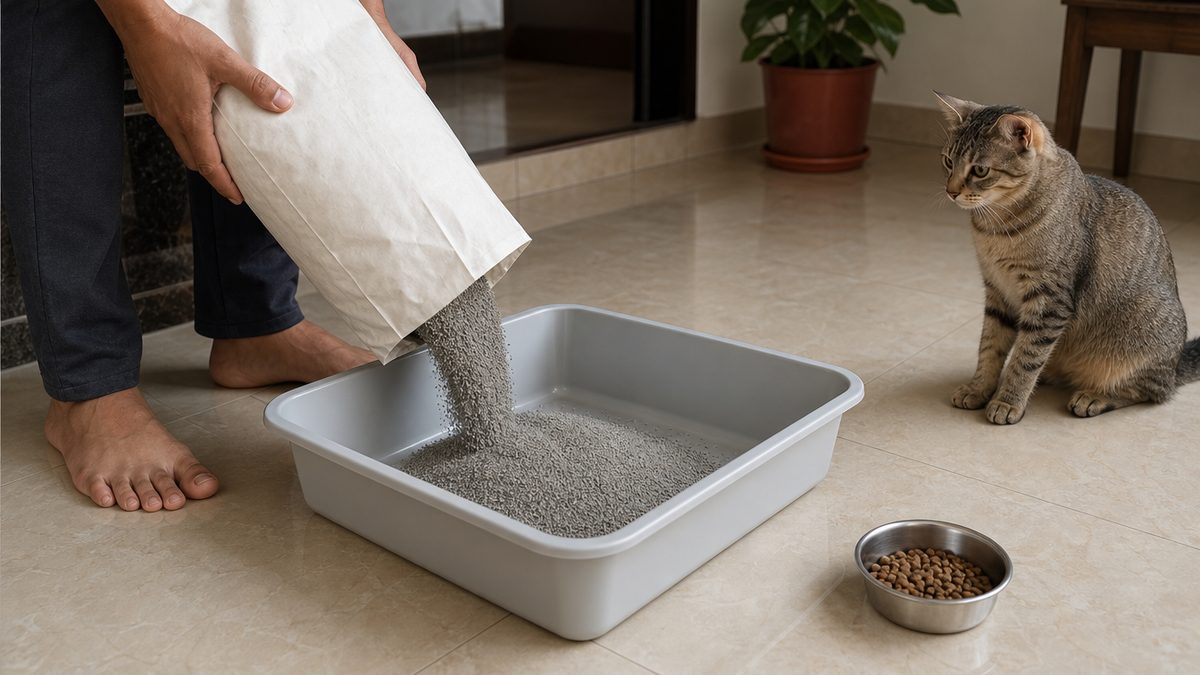
The litter line costs ₹249 to ₹264 a month for one cat on unscented clumping bentonite, which at the cheapest honest food price is almost as much as the food. That single fact reshapes the whole budget and no page in this field states it.
Two numbers build the line. The quantity comes from the seller's own claim that one tray lasts 3 to 4 weeks for a single cat, which works out at about 5 kg a month. The price comes from the cheapest unscented clumping bentonite that shop lists: ₹264 for a 5 kg bag, ₹516 for two and ₹747 for three, which is ₹52.80, ₹51.60 and ₹49.80 a kilogram.
| Food choice | Food a month | Litter a month | Litter as a share of the two | The dog equivalent |
|---|---|---|---|---|
| Drools Ocean Fish, 20 kg bag at ₹198 a kg | ₹321 | ₹249 | 44 percent | No litter line at all |
| Drools Ocean Fish, 3 kg bag at ₹248 a kg | ₹401 | ₹264 | 40 percent | No litter line at all |
| Royal Canin Fit 32, 10 kg bag at ₹750 a kg | ₹1,215 | ₹249 | 17 percent | No litter line at all |
Read the first row. A cat fed the cheapest complete dry food on the shelf spends almost as much on the stuff it buries its waste in as on the food itself. Buy the food in a small bag and the gap narrows further. Only at the premium end does litter fall back to a sixth of the two, and it gets there by the food line rising rather than the litter line falling.
The quantity is where this estimate is weakest, and it is worth saying plainly. The 5 kg a month figure is a retailer's claim about its own product, not a measurement, and it assumes daily scooping and a full change every three to four weeks. A cat that digs hard, a tray filled deeper than the guidelines ask for, or a scoop missed for two days all move it. Weigh your own bag against your own calendar for one month and you will have a better number than anyone publishes.
This page does not tell you which litter to buy
Bonbeno names a product to source a price, never to recommend one. Which litter suits your cat is a question about grain size, scent and your cat's history, and our cat litter training guide prices eight types sold in India per kilogram and per month and sets each against what the feline guidelines actually ask for. This page takes the cheapest guideline-compliant option from that work as a budget line and stops there.
One listing on 21 October 2026 sold a 7 kg bag of Drools Ocean Fish cat food at ₹1,655, and the same bag with 5 kg of litter attached at ₹1,716. That is ₹61 for 5 kg of litter that costs ₹264 bought on its own. We have no way to know what litter is in the box or whether it is scented, and the page does not say, so treat it as an arithmetic curiosity rather than a recommendation. It is still the single cheapest litter on any Indian page we opened.
Sand and soil: the option nobody costs
Plain sand costs about ₹1.45 a kilogram at the Telangana state corporation's notified 2026 rate, against ₹49.80 for the cheapest bentonite, so the substrate itself is roughly a thirty-fifth of the price. That comparison appears on no Indian cat page we could find, and the reasons to be careful with it are as important as the number.
The rate is public. The Telangana Mineral Development Corporation states that while the coarse sand price was Rs 1600 per MT in 2025, it plans to sell it at ₹1,450 per metric tonne in 2026. That is ₹1.45 a kilogram. At the same 5 kg a month a cat gets through in bentonite, the sand costs about ₹7.
Now the caveats, because this is the part the arithmetic hides.
- Nobody buys at that rate. The same corporation states that sand can be applied for from 32 MT up to 5,000 MT. A household buying two buckets from a building-materials shop pays a markup that no Indian source publishes, and this page is not going to invent one. Treat ₹1.45 a kilogram as the floor of the commodity, not as a quote.
- Sand does not clump, so the tray needs emptying whole rather than scooping. That multiplies the volume several times over, and even at four times the quantity the monthly cost stays under ₹30.
- Sand is heavy. Five kilograms of bentonite carried up three floors once a month is one problem; twenty kilograms of sand carried up the same stairs weekly is another.
- Garden soil is a different thing from washed construction sand, and the difference matters. Soil from outdoors can carry parasite eggs that the worms in our cat deworming schedule for India guide are the human-health half of. Sand is a mineral; soil is a habitat.
- The strongest reason for caution is that nobody has tested it. The one controlled substrate experiment we could read offered 46 adult cats a choice of clumping clay, clumping wood and clumping paper, and counted 258 excretions in the clay against 152 in wood and 66 in paper over three days. It did not test sand. Anyone telling you cats prefer sand, or refuse it, is going beyond the evidence in either direction.
So the honest position is this. Sand is the cheapest substrate available in India by an order of magnitude, a large number of Indian households use it or soil for exactly that reason, and the published evidence on whether a cat will reliably use it is absent rather than negative. If you try it, change it completely and often, keep it away from where the cat eats, and watch for the one thing that matters: a cat that starts going outside the tray is telling you something, and the first stop is a veterinary surgeon rather than a different bag.
A cat that was using its tray and stops, and above all a cat that strains or squats repeatedly with little coming out, needs a veterinary examination the same day. Changing the substrate first wastes the hours that matter. Our page on FLUTD in cats sets out why a straining male cat is an emergency. Nothing on this page replaces an examination.
Why a cat's food line has a floor a dog's does not
A cat's food line cannot be cut the way a dog's can, because a cat is an obligate carnivore and the cheap Indian bowl of rice and roti is not an option for it. The price evidence shows the same thing from the other direction: cat food costs 39 percent more per kilogram than dog food from the same brand on the same page.
The comparison is like for like and was read within minutes of itself. On 21 October 2026 the cheapest kilogram of complete adult dog food on one Indian retailer's Drools listing was ₹142, inside a 21 kg bundle at ₹2,992. The cheapest kilogram of complete adult cat food on the same retailer's Drools listing was ₹198, in a 20 kg bag at ₹3,959. Compare the plain 20 kg bags instead and the gap narrows but does not close, ₹174.75 a kilogram for the dog against ₹197.95 for the cat, 13 percent more.
A 39 percent premium on the cheapest option is not the whole story, though. The bigger difference is what the two species will tolerate at the bottom. A great many Indian dogs eat household food, and our guides to feeding a dog in a vegetarian household and whether dogs can eat roti exist because that question has an answer worth discussing. For a cat there is no equivalent discussion, and this page is not the place to have the nutritional one. Our cat diet chart for India carries the energy arithmetic, nine Indian foods priced per day, and the reason the bowl cannot be diluted.
A cheaper bag changes the price, not the quantity
The quantity is fixed by the cat. WSAVA's own chart puts a healthy 4 kg adult cat in ideal body condition at 225 to 250 kilocalories a day, derived from the maintenance formula of 100 kcal times bodyweight in kilograms to the power 0.67 for a lean adult, and notes that the recommendations are for guidance only. Royal Canin India's own feeding table converts that into grams for its food and gives 54 g a day for a 4 kg cat at ideal weight, rising to 63 g at 5 kg and 72 g at 6 kg, with a lower overweight column at 43 g for the 4 kg cat.
Fifty-four grams a day is 1.62 kg a month, and that figure drives every food number on this page. The only thing a cheaper bag changes is the rupees per kilogram.
| Food and pack | Price | Rupees a kilogram | Rupees a month |
|---|---|---|---|
| Drools Ocean Fish Adult, 20 kg | ₹3,959 | ₹198 | ₹321 |
| Drools Ocean Fish Adult, 3 kg | ₹743 | ₹248 | ₹401 |
| Royal Canin Fit 32, 15 kg as printed | ₹7,498 | ₹500 | ₹810 |
| Royal Canin Fit 32, 10 kg | ₹7,498 | ₹750 | ₹1,215 |
| Royal Canin Fit 32, 4 kg | ₹3,573 | ₹893 | ₹1,447 |
Two honest warnings about that table. The Drools rows apply Royal Canin's 54 g to a different maker's food, because the Drools page prints no feeding chart, so they show the price spread rather than Drools' own recommendation. And the two Royal Canin rows in the middle are both ₹7,498 against the same maximum retail price of ₹8,520, one for 15 kg and one for 10 kg, while the unit prices printed beside them differ at ₹49 and ₹74 per 100 g. One of those two listings is wrong and we cannot tell which. Read the per-100-gram figure on the page before you add anything to a basket, because it is the only number that compares bags honestly.
Both charts above are written for ideal body weight, not the weight on the scale today. Royal Canin's own table drops a 4 kg cat from 54 g to 43 g in its overweight column, so feeding an overweight cat to its actual weight locks in the extra cost and the extra weight together. Your veterinary surgeon sets the target weight, and our page on obesity in dogs and cats covers the health side. This page is general information and does not replace veterinary advice.
Parasite control, the line that swings the budget most
Parasite control swings a cat's monthly figure more than any other line, from about ₹15 a month on a quarterly tablet to ₹824 a month on a monthly spot-on. That is roughly 55 times, on one line, and the choice between them is a veterinary decision rather than a shopping one.
Both ends are published prices read on 21 October 2026. A strip of ten cat deworming tablets was ₹437, dosed at one tablet per 4 kg of body weight, with the seller's own instruction to deworm an adult cat every three months or as a veterinary surgeon directs. Four tablets a year for a 4 kg cat is ₹174.80, or about ₹15 a month. At the other end, three pipettes of a selamectin spot-on were ₹2,472 against a maximum retail price of ₹2,522, dosed once every 30 days and marked as requiring a prescription. That is ₹824 a month.
Notice what that does to the shape of the budget. At ₹824 a month the spot-on costs more than the food and the litter put together at the economy end, where the two come to ₹570. A cat budget can be dominated by a parasite product, and almost nobody warns a first-time owner of that.
The two products are not interchangeable, which is exactly why this is not a saving you can simply take. Flea control and deworming are different jobs. A broad-spectrum monthly spot-on covers fleas, ear mites and several internal parasites at once; a quarterly tablet covers intestinal worms and nothing else. Which your cat needs depends on whether it goes outside, whether there are other animals in the house, whether there are young children, and on where in India you live, because the humid months change the flea picture. Our cat deworming schedule for India sets out the intervals from three international guidelines and prices the classes, and our adult cat care guide carries the year-round flea position.
Several products sold for dogs contain actives that are seriously toxic to cats, and the cheapest way to turn a ₹824 line into a hospital bill is to split a dog pipette. Bonbeno does not recommend a drug, a dose or an interval for any animal. Name the class to your veterinary surgeon and let them choose.
The veterinary lines, spread across twelve months
Spread across twelve months, routine veterinary care costs between ₹8 and ₹192 a month for one cat, and the whole of that 24-fold gap is about which door you walk through rather than which city you live in.
The cheap door is published by the people charging for it. The Directorate of Animal Husbandry in the Union Territory of Chandigarh lists a purchee fee, the out-door ticket at its veterinary institutions, at Rs 30 for pet animals, an anti-rabies vaccination fee at ₹30, a blood or urine test at ₹20 and a stool test at ₹10. Two out-patient tickets and one anti-rabies a year is ₹90, which is ₹8 a month.
The private door is published too. A clinic of one national chain in Kalyan Nagar, Bengaluru, in Karnataka, listed vet consultation starting at ₹799, vaccination starting at ₹750 and blood tests starting at ₹200 on the same day. One consultation and two vaccine doses a year is ₹2,299, which is ₹192 a month.
A 27-fold gap on a consultation is the single largest lever in this budget, and it is worth understanding before you pull it. A government tariff is a counter fee, not the cost of the work. Chandigarh's own list prices an X-ray at ₹30 and notes in the same cell that the radiology wing is not functioning. Treat a government veterinary institution as genuinely affordable primary care, and treat an emergency as a question of which door is open rather than which is cheapest.
Three lines this page deliberately does not price
- What a consultation, a scan or a night in hospital actually costs, door by door, including veterinary college hospitals and after-hours loadings. Our what a vet visit costs in India page is built from published fee lists and this page does not reproduce its tables.
- Vaccination cost, which is a schedule question before it is a cost question. The cat vaccination schedule for India page carries kitten and adult timing against clinic and government prices.
- Sterilisation cost, which is a one-off in the first year rather than a monthly line. Our cat sterilisation in India page prices NGO wards, clinics and chain packages city by city, and the spread there is wider than anything on this page.
Insurance belongs in the same category: a choice rather than a cost, and one whose value depends entirely on the exclusions. Our pet insurance in India page reads the five products clause by clause, including which of them write a cat policy at all.
The two largest lines, food and litter, are shipped nationally at one price, so a bag costs the same in Mumbai, Chennai, Kolkata, Pune and Ahmedabad as it does in Delhi. A cat budget is therefore even less city-sensitive than a dog's, because a dog's budget carries walking and boarding, which are bought from people paying your city's rent. What genuinely varies for a cat is the veterinary door, and sand, whose notified rate is set state by state.
The male cat's bill, and the diet change that never ends
A blocked male cat is the most expensive predictable thing about owning one in India, and the part nobody budgets for is not the emergency. It is the prescription diet afterwards, which raises the monthly food line from ₹321 to ₹2,236 and does not come back down.
The emergency itself, what causes it, how the work-up runs and what Indian institutions charge for it, is set out in full on our page on FLUTD in cats, which is built from two government rate cards. This page adds only the thing a budget page should add, which is what happens to the monthly figure afterwards.
On 21 October 2026 the feline urinary prescription dry diet that Indian sellers stock was ₹2,070 for 1.5 kg, ₹4,140 for two of the same packs and ₹6,210 for three, which is ₹1,380 a kilogram at every pack count, so there is no bulk discount at all. A 7 kg bag was listed at ₹8,000, which works out at ₹1,143 a kilogram.
| Diet | Rupees a kilogram | Rupees a month | Rupees a year |
|---|---|---|---|
| Cheapest complete dry food, 20 kg bag | ₹198 | ₹321 | ₹3,852 |
| Premium complete dry food, 10 kg bag | ₹750 | ₹1,215 | ₹14,580 |
| Urinary prescription dry diet, 1.5 kg packs | ₹1,380 | ₹2,236 | ₹26,832 |
The difference between the first row and the last is ₹1,915 a month, or ₹22,980 a year, and for many cats it is permanent. A household that budgeted ₹593 a month finds its food line alone has become four times its entire previous budget.
That is the honest reason to keep an emergency fund rather than a monthly line for this, and it is why this page stops here rather than quoting a figure for the surgery. The published Indian evidence on what an unblocking costs is thin, it comes from two institutional rate cards rather than a market, and our FLUTD page says so in those words rather than averaging a number into existence.
A male cat that squats repeatedly and produces little or no urine may have a blocked urethra, which is fatal within a day or two and is a same-day emergency. Cost is a reason to go sooner, not later. Find out now, while nothing is wrong, which clinic near you is open after hours and what it charges to open the door.
The one-off list, and the tray the evidence actually supports
The one-off list for a cat is short and cheap next to the recurring bill, with trays from ₹349 and most boxes between ₹349 and ₹2,200. The trap is buying the small one, because the only controlled test of box size found cats avoiding it.
Eighty-six adult cats settled this question in a Japanese study published in April 2025. In the first experiment, 78 adult cats across three cat cafes were offered uncovered cardboard boxes 40 cm, 50 cm and 60 cm wide alongside the box they normally used. Over three days the 50 cm box was used 82 times and the 60 cm box 83 times, against 39 times for the 40 cm box and 27 for the familiar one, a significant bias at P below 0.0001. The authors arrived at 50 cm by measuring the thoracic and lumbar vertebrae of 102 cats, finding an average of 35.3 cm, and taking roughly 1.5 times that.
Against that, one Indian retailer's litter box range starts at ₹349 for an open tray and runs to about ₹2,200 for most everyday boxes, with one named rimmed tray at about ₹912. The cheap tray is not the problem. The small tray is. A plain rectangular storage tub from a hardware shop, 50 cm or longer, costs less than any of these and passes the only test the evidence sets.
- Trays, two for one cat, each at least 50 cm on its long side. The cheapest option is a storage tub, not a product sold as a litter box.
- A carrier, which you will need before the first veterinary visit rather than after it.
- A scratching post, which is cheaper than reupholstering anything.
- Sterilisation and the kitten vaccination course, both first-year lines, both priced on the guides linked above.
- Balcony and window netting, which for a flat above the ground floor is the one piece of gear with a safety case rather than a comfort case behind it. Our indoor cat safety in India page prices Indian netting and carries the fall data.
Bowls, a bed and toys are real purchases and small ones. They are not priced here because the figure would be whatever you chose to spend, which is not a fact about keeping a cat in India.
What an indoor cat costs that an outdoor one does not, and the reverse
An indoor cat costs more in litter and in enrichment, and an outdoor cat costs more in veterinary bills you cannot schedule. The first difference is a number you can budget; the second is not, and that asymmetry is the whole argument.
On the recurring side the indoor cat is clearly dearer. Its litter line is the full ₹249 to ₹264 a month, where a cat that eliminates outdoors may use the tray rarely or not at all. Add netting as a one-off and the indoor cat starts ahead on paper.
The other side of the ledger does not produce a monthly number, and a budget page should say so rather than guess. A 2020 review of outdoor access for cats reports, from the studies it cites rather than from its own data, that 45 percent of cats in one camera-tracked suburban American study crossed a road during monitoring; that in one Canadian clinic series trauma caused 39 percent of sudden deaths in cats, 87 percent of those from motor vehicles; and that of 127 cats involved in a motor accident in one series, 16 arrived at the hospital already dead, 11 died afterwards, and 25 developed long-term problems including limb amputations and ongoing bladder problems. Those figures are quoted here from that review rather than read at the primary papers, which is why they are described that way.
None of them is Indian, and we could not find an Indian denominator for any of it. Indian traffic, Indian free-ranging dog populations and Indian building density are all different from the settings those numbers come from, and in which direction is genuinely unknown. What transfers is the shape of the cost rather than its size: outdoor access converts a predictable monthly line into an unpredictable one, and the unpredictable one is larger when it arrives.
The line an indoor cat adds that is not litter
An indoor cat in a flat needs its environment to do the work the outdoors would have done, and in India that has a seasonal shape. The monsoon shuts the windows and keeps a bored cat inside for weeks; a humid flat makes a bentonite tray cake faster and pushes the litter line up. Enrichment is not priced here because almost all of it is free or improvised, and our guide to indoor cat boredom and enrichment is the right place for it.
Travel is the other line that behaves differently for a cat, and it belongs in the third bucket. Our boarding against a pet sitter page carries what each costs per trip in rupees and, more usefully, what the stress measurements say about which one a cat should get.
Two cats are not twice one cat
Two cats cost at least twice one cat and probably more, because the line that would have given you a saving is the one that scales worst. Food doubles exactly, veterinary care doubles exactly, and litter more than doubles.
The reason is the tray rule. The same seller that supplies the monthly usage figure states the rule plainly: one litter box per cat, plus one extra. Two cats means three trays, not two, and each of them has to hold enough substrate to be worth using. The per-cat volume does not fall when you add a second cat, and the third tray adds volume that no cat is exclusively responsible for.
| Line | One cat | Two cats | How it scales |
|---|---|---|---|
| Food | ₹321 | ₹642 | Exactly double, set by body weight |
| Litter | ₹249 | ₹498 at best | At least double, and more with a third tray kept filled |
| Parasite control | ₹15 | ₹30 | Exactly double, dosed per animal |
| Routine vet and vaccination, spread | ₹8 | ₹16 | Exactly double |
| Total | ₹593 | ₹1,186 | No economy of scale anywhere |
A multi-cat household is unusual among household budgets, and this is worth knowing before a second kitten arrives. Most costs get cheaper per head. A cat budget does not, because every line is consumed per animal and the one shared resource, the tray, is the one the guidelines insist you buy more of than you have cats.
There is one genuine saving and it is not financial. Two cats that get on entertain each other, which is the strongest argument for the second one. Whether yours will is a different question from whether you can afford it, and our guide to introducing a cat to a dog covers the mechanics of adding an animal to a household that already has one.
The honest total, in three columns
The honest total for one 4 kg adult indoor cat in India is ₹593 a month at the cheap end, ₹688 in the middle and ₹2,495 comfortable, on prices read on 21 October 2026. Every line below traces to a figure given earlier on this page.
| Line | Cheap | Middle | Comfortable |
|---|---|---|---|
| Food, 1.62 kg a month | ₹321, economy kibble in a 20 kg bag | ₹401, the same food in a 3 kg bag | ₹1,215, premium kibble in a 10 kg bag |
| Litter, 5 kg a month | ₹249, unscented bentonite bought three bags at a time | ₹264, the same bought one bag at a time | ₹264 |
| Parasite control | ₹15, quarterly tablet | ₹15, quarterly tablet | ₹824, monthly spot-on |
| Routine vet and vaccination, spread over twelve months | ₹8, government institution rates | ₹8, government institution rates | ₹192, private chain starting prices |
| Total a month | ₹593 | ₹688 | ₹2,495 |
| Total a year | ₹7,116 | ₹8,256 | ₹29,940 |
What each column assumes matters more than its total. The cheap column assumes you live near a working government veterinary institution, buy food and litter in the largest pack you can store, and that your veterinary surgeon is content with a quarterly tablet rather than a monthly spot-on. The middle column changes only the pack size, which is what most people actually do. The comfortable column assumes a private chain clinic, a premium food and the broad-spectrum monthly preventive.
The spread is about four times, and it is created almost entirely by two decisions: which food and which parasite product. Neither is about the cat.
Why these numbers sit below the whole field
The lowest figure any page ranking for this question gives is ₹2,000 a month Supertails, Cat Price in India 2026. The cheapest total here is ₹593, which is less than a third of that floor, and the comfortable column at ₹2,495 sits inside everybody's range. The field is not wrong about the top of the market. It has simply never costed the bottom of it, which is where most Indian cat households actually live.
Five things these columns leave out on purpose, and you should add back whichever apply to you. Treats, which the guidelines cap at a tenth of daily calories. Sterilisation and the kitten course, which are first-year one-offs. Grooming, which for most short-coated cats is a brush and for a Persian is not. Boarding whenever you travel. And anything going wrong, which is the section above this one.
Our adult cat care guide puts a year of routine care for the same reference cat at about ₹27,500 to ₹30,700, and its litter row reads "left blank" because the page could not source a monthly usage figure. Our cat litter training guide, built the same day, did find one and published ₹264 to ₹319 a month. We rechecked on 21 October 2026 and the usage statement is live, so the litter page is right and the annual figure on the care page is understated by roughly ₹3,000 to ₹3,800 a year. We are publishing the disagreement rather than quietly picking one.
Adoption against buying, in cost terms only
Adoption removes the purchase price, and the purchase price is the smallest number in this whole exercise. At ₹593 a month the cheap column comes to ₹7,116 a year and roughly ₹1.07 lakh across a 15-year life, before a single illness.
Set a pedigree kitten against that. Indian published prices for popular breeds run from several thousand rupees to several lakh, and our breed pages record the ranges with the sources that disagree laid side by side. Even at the top of those ranges, the purchase price is a minority of one decade of keeping the animal, and at the bottom it is a rounding error.
The arithmetic that actually decides anything is the other way round. A buyer who can find ₹20,000 for a kitten and not ₹593 a month for fifteen years has the wrong number in front of them. Work out your own monthly figure from the grid above, using your own cat's weight, your own bag and your own clinic. Multiply it by fifteen years, and you will know before you commit rather than after.
How adoption works in India, which shelters charge what, and what the first month looks like are all on our adopting a cat in India page, which also notes that several Indian cat shelters charge nothing at the door and hand over an animal already sterilised, vaccinated and dewormed. In pure cost terms that is the largest single change available to this budget, because it removes a purchase price and three first-year lines at once.
Not the purchase price. The monthly one, multiplied by fifteen years, with the litter line in it. That is the figure this page exists to give you, and it is the figure no page ranking for this query will tell you how it arrived at.
Common questions
Is it expensive to keep a cat as a pet?
Keeping a cat in India is cheaper than the ranking pages suggest, at ₹593 a month for one 4 kg indoor adult on prices read on 21 October 2026, against a floor of ₹2,000 on the pages that currently rank. The cheap figure assumes a government veterinary institution, an economy complete dry food bought in a 20 kg bag, unscented bentonite litter bought three bags at a time, and a quarterly deworming tablet rather than a monthly spot-on.
How much does it cost to keep a cat per month in India?
One 4 kg adult indoor cat cost ₹593 to ₹2,495 a month on prices read on 21 October 2026, depending on two decisions. The cheap column is ₹321 of food, ₹249 of litter, ₹15 of parasite control and ₹8 of routine veterinary care spread over the year. The comfortable column is ₹1,215 of premium food, ₹264 of litter, ₹824 of monthly spot-on and ₹192 of private clinic care. Neither difference is about the cat.
How expensive is cat litter per month?
Cat litter cost ₹249 to ₹264 a month for one cat on 21 October 2026, using the cheapest unscented clumping bentonite at ₹49.80 to ₹52.80 a kilogram and the seller's own figure that one tray lasts three to four weeks for a single cat. That is between 17 and 44 percent of what the same cat costs in food and litter together, and it is a line a dog owner never pays at all.
How much is 2 cats a month?
Two cats cost about ₹1,186 a month against ₹593 for one, so at least double with no economy of scale anywhere. Food, parasite control and veterinary care all double exactly because each is consumed per animal. Litter more than doubles, because the standard rule is one litter box per cat plus one extra, so two cats need three trays and the per-cat volume does not fall.
Is it expensive to take care of a cat?
The recurring cost is modest and the unscheduled cost is not, which is the honest answer. Routine care for one cat ran ₹593 to ₹2,495 a month on 21 October 2026. A single urinary episode in a male cat can move the food line alone from ₹321 to ₹2,236 a month permanently, because the prescription diet costs ₹1,380 a kilogram against ₹198 for an ordinary complete food. Budget the routine monthly and save for the rest.
How much is 3 months for a cat?
Three months of routine care for one 4 kg adult indoor cat came to about ₹1,779 at the cheap end and ₹7,485 at the comfortable end, on prices read on 21 October 2026. Those are the monthly totals of ₹593 and ₹2,495 multiplied by three. A three-month-old kitten is a different question, because the first year also carries the vaccination course, sterilisation and the trays, and none of those repeats.
Which cat breed is under 5000?
Bonbeno does not rank cats by purchase price, because the purchase price decides almost nothing about what a cat costs. ₹5,000 is roughly eight months of the cheapest honest monthly budget on this page and two months of the most expensive. An Indian domestic shorthair adopted from a shelter removes the purchase price entirely, and several Indian shelters charge nothing at the door for an animal already sterilised and vaccinated.
Does a cat cost less to feed than a dog in India?
Less in total, but more per kilogram, and the gap is smaller than the size difference suggests. On 21 October 2026 the cheapest kilogram of complete adult cat food at one Indian retailer was ₹198 against ₹142 for the same brand's adult dog food, a 39 percent premium. A cat is an obligate carnivore, so it cannot be fed down to the cheap plant-heavy bowl that keeps many Indian dogs inexpensive.
Can you use sand instead of cat litter in India?
Sand costs about ₹1.45 a kilogram at Telangana's notified 2026 state rate against ₹49.80 for the cheapest bentonite, so the substrate is roughly a thirty-fifth of the price. Three cautions apply. The state rate has a 32 metric tonne minimum, so no household pays it. Sand does not clump, so the whole tray needs emptying rather than scooping. And no controlled study has tested sand against commercial litter, so the evidence is absent rather than against it.