
Dog and cat life guide
Why your dog eats so fast, what the speed actually costs, and what slows it
One study put a stopwatch on 56 dogs and found a third of them never chewed a mouthful twice. That is the group this page is about, and most of them are fine.
Quick answer
Why does my dog eat so fast has a plain answer for most dogs, which is that speed is normal and not a disease. Competition in the litter, one large daily meal and ordinary food motivation explain most of it. Eating speed matters most in deep-chested dogs, where it is one measured bloat risk factor, and in flat-faced dogs that regurgitate. A slow feeder bowl does work, and a muffin tray does the same for nothing.
This guide is general information for Indian pet owners and is not a diagnosis. Always consult a registered veterinarian near you before acting on anything you read here, and treat any sudden change in your pet's condition as urgent.
Why dogs eat fast, and why that is usually normal
Why dogs eat fast comes down to three ordinary things in most households, which are competition learned early, a day built around one or two large meals, and plain food motivation. None of those is a disease, and a fast eater is not a broken dog.
Start with what a fast eater actually is, because almost nobody defines it. A Japanese research group filmed 56 healthy dogs across 21 breeds for 10 minutes each, weighed the food, timed the meal, and counted mouthfuls. They then split the dogs three ways. Dogs that finished the bowl and chewed every mouthful more than once were classed as slow, dogs that finished the bowl without chewing every mouthful were classed as fast, and dogs that left food were a third group. The split was 24 slow, 19 fast and 13 leftover.
That is the useful definition, and it is not about seconds on a clock. The marker of a fast eater is the mouthful, not the stopwatch. The same study found feeding speed and the amount of food taken per mouthful per kilogram of body weight moved together almost perfectly, at a Spearman rank correlation of 0.97. A dog that takes bigger bites eats faster, and a dog that chews takes smaller ones.
What a fast eater actually is, once somebody measures it
One finding from that work deserves to be better known, because it kills a lot of guesswork. Speed did not track sex, age or body size. A 4 kg Indian Spitz can be a fast eater and a 40 kg Labrador can be a slow one. If you have been waiting for your dog to grow out of it, the evidence does not support the wait.
Where does the habit come from? The honest answer is that nobody has run the experiment, so what follows is reasoning from feeding ecology rather than a finding. Litters compete. In free-ranging dogs, which is where most Indian dogs come from genetically and where many come from literally, pups share a mother with several siblings and then share a food patch with adults. Speed is how a small animal secures a share. The same authors suggest gorging reflects competitive feeding in the ancestral wolf. A puppy raised in a crowded litter learns the lesson early, and a dog fed once a day keeps practising it.
- Competition in the litter. A pup that waits in a litter of seven gets less. The habit survives the litter by years.
- One large meal a day. A dog fed once arrives at the bowl hungrier than a dog fed twice, and hunger raises the bite size.
- Plain food motivation. Some dogs are simply built to want food. This is normal, it is partly breed-linked, and it is not a deficiency.
- Competition at home. Two dogs fed within sight of each other both speed up, which is covered further down.
- A learned history of scarcity. A rescued street dog has a reason to gulp, and that reason is real rather than imagined.
So the first thing to settle is whether your dog's speed is a problem at all. For most dogs in most homes it is not. It becomes worth acting on in three situations, which the rest of this page covers one at a time: a deep-chested dog where speed is a measured bloat risk, a flat-faced dog where gulping ends in regurgitation, and any dog whose speed has changed recently.
What fast eating is actually associated with
Fast eating is associated with exactly one well-measured hard outcome, which is a raised bloat risk in large and giant breeds, and with one measured physiological change, which is a sympathetic response after the meal instead of the settling response slow eaters show.
The bloat evidence comes from one prospective cohort. Researchers recruited 1,637 dogs aged six months and over, across eleven breeds including the Great Dane, Irish Wolfhound, Saint Bernard, Rottweiler and Standard Poodle, measured each dog's chest, and followed them by post and telephone at roughly yearly intervals. Cumulative incidence of gastric dilatation volvulus over the study was 6 percent. Four factors were significantly associated with higher risk, and they were increasing age, having a first-degree relative with a history of it, having a faster speed of eating, and having a raised feeding bowl.
Read that carefully. Eating speed is in the list, and it is one of only two items on it that an owner can change at all. That is the whole case for slowing a big dog down, and it is a reasonable case. It is also an observational association from one show-dog cohort, not a trial, and nobody has randomised dogs to eating speeds. We do not re-run the bloat literature here, because bloat in dogs carries it in full, including the survival figures, the breed denominators, the gastropexy evidence and the studies that disagree with this one.
The second association is subtler and more interesting, and it is the closest thing to a mechanism anyone has published. In the 56-dog study, plasma norepinephrine rose after the meal in the fast group and fell after the meal in the slow and leftover groups. The low-frequency to high-frequency ratio of heart rate variability, a standard index of sympathetic activity, was higher in the fast dogs too. In plain terms, a slow eater's body shifts towards rest and digestion once the bowl is empty, and a fast eater's does the opposite.
The experiment that changed the response by changing nothing else
The same team then did the part that matters. They took 19 of the fast dogs and fed them through an automatic feeder set to release the ration over about 280 seconds, which is roughly how long the naturally slow dogs took. After three days of habituation and a nine-day run, the delayed-fed dogs showed a fall in plasma norepinephrine after eating rather than a rise, and their LF/HF ratio during and after the meal dropped to about the level of the slow group.
That is a small, well-controlled result and it is worth being clear about what it does and does not prove. It shows that stretching a fast dog's meal to about five minutes changes a measurable physiological response. It does not show that the dog is healthier, lives longer, bloats less or feels better. The authors' own conclusion is appropriately modest, that dogs eating rapidly with less chewing may benefit from delayed feeding. No page currently ranking in India for this query mentions the study at all.
Slowing a dog down reduces one risk factor. It does not prevent bloat, and no published source claims it does. Two of the agreed risk factors, a deep chest and a first-degree relative that has had it, cannot be changed. Treat a slower meal as a cheap bet on an uncertain effect, which is a reasonable thing to take, and keep an after-hours clinic number for a deep-chested dog regardless.
What about choking and vomiting, which every commercial page leads with? Those are real and they are also unmeasured. We could find no study putting a denominator on choking or on post-meal vomiting by eating speed in dogs. The American Kennel Club's own advice page on the subject states that a dog eating too quickly may choke and that eating quickly can lead to vomiting and discomfort, and cites nothing anywhere on the page. We have repeated the claim the way the AKC makes it, as a plausible clinical observation rather than as a figure, because there is no figure.
Does a slow feeder bowl work?
A slow feeder bowl works, and the measurement is real but small. Ten dogs fed from a commercial go-slow feeder ate more slowly than from a standard bowl, and they were still eating more slowly from it after nine days of practice even though they had got quicker at it.
The study is a veterinary nursing trial from Harper Adams University, published as a knowledge summary in Veterinary Evidence. Dogs were randomly allocated between a standard dog bowl and a go-slow feeder, given half their daily ration of a semi-moist diet familiar to all of them, and allowed 10 minutes to eat, with behaviour sampled at one-second intervals. The outcomes were latency to start, rate of consumption in grams per minute, and the behaviours performed while eating.
Two results came out of it. Experienced dogs were quicker at eating from the go-slow feeder on day 9 than on day 1, at T equal to 6.0 and P equal to 0.027, while there was no effect of day on the rate of eating from the plain bowl, at T equal to 9.0 and P above 0.05. Dogs learn the maze. They do not learn it well enough to beat a flat bowl.
The authors' conclusion is the single most honest sentence published on this question, and it is worth quoting as they wrote it. Go slow feeding bowls are effective at reducing eating speed and, while dogs become quicker at eating as they develop experience eating from these devices, consumption rate is still slower than that observed when eating from a standard dog bowl.
What the slow feeder measurement does not show
Three gaps sit inside that result, and the authors name two of them themselves.
- The dogs did not want it. The same group found no evidence that dogs wanted their rate of eating slowed down, and reported a canine preference for a regular dog bowl, while noting that feeder colour is a confound in interpreting that. Their explicit warning is against conflating a slower rate of eating with having fun and marketing these devices to clients on that basis.
- Ten dogs is ten dogs. This is a small nursing trial on one commercial feeder with one semi-moist diet. It tells you the direction and not the size of the effect for your dog and your kibble.
- Nothing downstream was measured. No trial has tested whether a slow feeder changes vomiting, choking, weight or bloat incidence. The link from a slower bowl to a healthier dog is an inference, and we are flagging it as one.
There is a cheaper intervention with a larger published effect, and it is the shape of the kibble you already buy. A research panel fed the same weight-loss diet as a round pastille kibble and as a cross-shaped one. Meal duration was 292 seconds on the cross kibble against 186 seconds on the round at the first meal, and 650 seconds against 282 at the second, both at P below 0.001. Palatability was unaffected, and in the field arm owners reported more chewing, slower ingestion speed and less food-seeking behaviour afterwards. That is a roughly two-fold change in meal duration from a kibble shape, and it costs nothing if the shape you need is already on a shelf you shop from.
| Change | What was measured | The result | Study |
|---|---|---|---|
| A go-slow feeder bowl instead of a standard bowl | Rate of consumption in 10 dogs, day 1 against day 9 | Slower than a standard bowl on both days; dogs got quicker with practice at T equal to 6.0 and P equal to 0.027 but never matched the plain bowl | Buckley and Lees, 2016 |
| A cross-shaped kibble instead of a round one | Meal duration on a research panel, same diet both ways | 292 seconds against 186 at the first meal and 650 against 282 at the second, P below 0.001 for both, with no loss of palatability | Sagols and colleagues, 2019 |
| An automatic feeder releasing the ration over about 280 seconds | Plasma norepinephrine and the LF/HF heart rate ratio in fast eaters | Both fell to approximately the level of naturally slow eaters; no health outcome was measured | Ohtani and colleagues, 2015 |
| Splitting the ration across more meals | Nothing, as an eating-speed intervention | No effect size exists. The case rests on the bloat cohort and on common sense, not on a stopwatch | Glickman and colleagues, 2000 |
On price, slow feeder bowls listed on the Indian Amazon marketplace ranged from Rs 200 for a stainless slow-feed bowl to ₹2,694 for a large imported maze feeder on 21 October 2026, with most moulded maze bowls between ₹200 and ₹660. Bonbeno does not tell you which to buy. We do not publish a verdict on a named product without testing it ourselves, and nobody has tested these in an Indian home.
Two things on that marketplace page are worth a buyer's attention. Several listings carry medical claims in the product name itself, including anti choke, anti bloat and stops dog food gulping, bloat and rapid eating, and no trial supports a bloat-prevention claim for any bowl. And the same search returns adjustable elevated bowl stands at ₹2,499, which is awkward, because the cohort that put eating speed on the risk list put the raised feeding bowl there as well, attributing roughly 20 percent of large-breed and 52 percent of giant-breed cases to it. That finding, its limits and the bodies that disagree with it are set out on bloat in dogs, which owns the question. The short version for a shopper is that buying a stand to fix gulping may trade one listed risk factor for another.
Five ways to stretch a meal that cost nothing
To stretch a meal without buying anything, spread the measured ration over a larger surface or a longer time. Five methods do that, and all five use food you have already weighed out rather than food added on top.
Each of these works on the same principle the kibble study demonstrated, which is that a dog slows down when each mouthful has to get smaller. None of them has been measured against a bowl in a trial, and we are saying so rather than inventing a percentage.
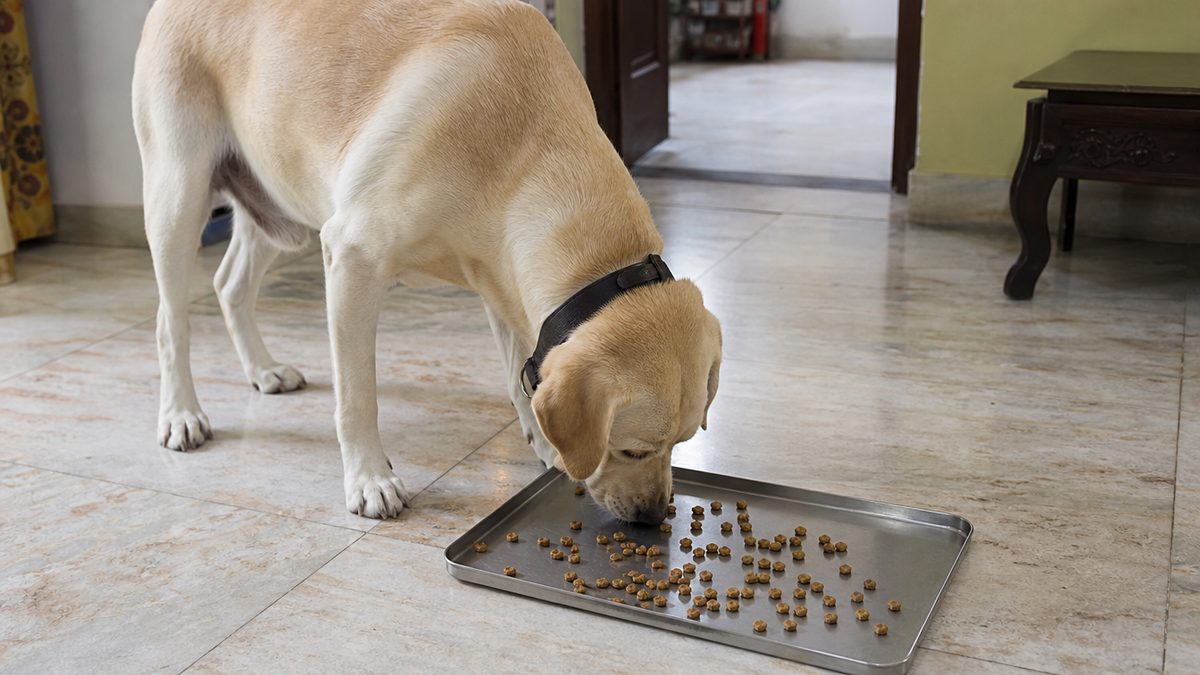
- Scatter the ration on a steel tray. Tip the measured portion across a large thali or parat so the pieces separate. The dog has to pick them up individually, which is the whole mechanism.
- Use a muffin tin. Put a spoonful in each cup. The AKC recommends exactly this, along with a cookie sheet, noting that the meal is broken into smaller portions so the gulping is eliminated.
- Spread it on a cloth. A clean cotton towel laid flat and loosely folded holds kibble between its folds and forces a slower pick-up. Wash it like any other kitchen cloth.
- Hand-feed part of the meal. Take a third of the ration and give it piece by piece during five minutes of training. The AKC frames this as using mealtime as training time, which is the right framing.
- Split the ration into more meals. Two or three smaller meals instead of one large one lowers the bite size at each sitting because the dog arrives less hungry. The grams-per-day arithmetic is on the dog diet chart for India, and for a growing dog on the puppy food chart for India.
Scatter feeding and a muffin tin appear on two different pages for two different reasons. Here they are tools for slowing a fast eater. The separate argument that foraging is good for a dog's day, the snuffle mat trials, the finding that most dogs do not prefer to work for food, and the chewing evidence all sit on dog boredom busters. Read that page for the enrichment case. Read this one for the speed.
Floor scatter feeding behaves differently in an Indian home depending on where you live and when. In humid coastal flats in Chennai, Kolkata and Mumbai, kibble left in the grooves of a tiled floor through a monsoon afternoon draws ants within the hour and softens by evening. Use a tray you can lift and wash rather than the floor itself, scatter only what the dog will finish in one sitting, and sweep immediately. In dry Delhi or inland Karnataka winters the floor is less of a problem, but the hygiene habit is worth keeping either way.
One rule governs all five. The food comes out of the measured ration and not on top of it. A dog that gets two meals plus a day of scattered extras gains weight while its owner believes it is being managed, and what that costs is set out on obesity in dogs and cats.
Flat-faced dogs, gulping and regurgitation
Flat-faced dogs gulp air with their food more readily than other dogs because the airway and the swallow are already compromised by the shape of the skull, and the consequence shows up as regurgitation rather than as bloat. This matters in India because the Pug and the Shih Tzu are two of the most commonly kept dogs in Indian cities.
The prevalence figures come from a referral teaching hospital in England that graded ptyalism, regurgitation and vomiting in 98 dogs presenting with brachycephalic airway syndrome, made up of 43 French bulldogs, 12 English bulldogs and 43 Pugs. Overall prevalence of gastrointestinal signs was 56 percent. Broken down by breed it was 93 percent in French bulldogs, 58 percent in English bulldogs and 16 percent in Pugs. Signs improved after corrective airway surgery, especially in the French bulldogs.
The aspiration figures come from the same hospital's records over a decade. Aspiration pneumonia was diagnosed in 41 of 2,141 Pugs, French Bulldogs and Bulldogs, which is 1.91 percent, against 396 of 80,137 dogs overall, which is 0.49 percent, a relative risk of 3.77. A history of gastrointestinal signs was the commonest identified risk factor, present in 27 of the 41 cases, or 66 percent.
Where two studies disagree about the Pug
Put those two papers side by side and they do not line up neatly, which is worth publishing rather than smoothing over. In the first, the Pug had by far the lowest rate of gastrointestinal signs of the three breeds, at 16 percent against 93 percent for the French bulldog. In the second, Pugs still turned up with aspiration pneumonia, but at a median age of 83 months, against 8 months for French Bulldogs and 6 months for Bulldogs, and neurologic disease was significantly more common in the Pugs than in the other two breeds.
The reading that fits both is that the Pug arrives at the same problem by a different and slower route, and that the French bulldog's version is an early, airway-driven one. Both studies are referral caseloads from one country, so neither is a population rate for Indian pet dogs, and no Indian series exists. For an owner of a Pug in Pune or a Shih Tzu in Hyderabad, the practical consequence is unchanged by the disagreement.
- Slow the meal deliberately in any flat-faced dog, because reducing the bite size is the one lever a feeding change gives you.
- Feed from the floor in a shallow wide dish rather than a deep narrow one, which lets the dog take food without burying its nose.
- Treat repeated regurgitation as a clinical sign, not a feeding quirk. Food brought back up undigested, minutes after a meal, with no abdominal effort, is regurgitation, and it belongs in a consultation.
- Separate the airway question from the feeding question. Whether your dog's breathing itself needs assessment is covered on brachycephalic obstructive airway syndrome in dogs, which carries the grading scheme, the surgery and the Indian heat argument.
One Indian aggravator deserves naming. A flat-faced dog eating fast in a humid May afternoon in Chennai or a Maharashtra pre-monsoon week is already breathing hard before the bowl goes down. Feeding in the coolest part of the day is not a cure for anything, and it removes one load from a dog that has several.
When fast eating is a symptom rather than a habit
Fast eating becomes a symptom when it changes. A dog that has always bolted its food is a fast eater, and a dog that started bolting its food this month is a dog with a question attached, especially when weight is moving the wrong way.
Three patterns move a feeding habit into veterinary territory, and the difference between them and ordinary greed is direction of travel rather than intensity.
- A sudden change in appetite or speed. The baseline is your own dog six months ago. A dog that now finishes in 20 seconds what used to take two minutes has changed, and the change is the finding.
- Weight loss despite eating normally or more. This is the one that matters most. Food going in and condition going down means the nutrition is not being absorbed or is being consumed by something else.
- Eating things that are not food. Soil, cloth, paper and faeces all belong in the history you give the vet, even when they feel embarrassing to mention.
An Indian veterinary source sets out the causes list clearly and in the right order for this country. Voice of Stray Dogs, writing under veterinary review, puts intestinal parasites first, noting that worms compete directly for nutrition and that this is one of the most common medical causes of excessive hunger in Indian dogs, particularly those not dewormed regularly. Diabetes mellitus, exocrine pancreatic insufficiency, hypothyroidism, hyperadrenocorticism, malabsorption and steroid medication follow. The investigation it describes starts with a stool examination and a blood panel, which is the sequence to expect.
Bonbeno does not name a drug or a dose for any of that, and a diagnosis is not something a page can give you. What a page can do is tell you which of those is worth asking about. If thirst and urination have risen alongside the appetite, say so, because that pairing points towards diabetes in dogs and cats. If the appetite rose while the weight also rose, that is a different direction and the thyroid is in the frame. Deworm on schedule regardless, because in India that is the cheapest thing on the list and the most likely to be the answer.
Stool eating tracks eating style, not a diet deficiency
Coprophagy is the point where this page has something genuinely surprising to offer, because the standard Indian advice about it is wrong. Two web surveys, one of 1,552 dogs comparing stool eaters with non-eaters and one of 1,475 owners of stool eaters, found that 16 percent of dogs sampled engaged in frequent conspecific coprophagy, defined as having been seen eating stools at least six times.
The variable most strongly associated with the behaviour was not diet. It was eating style. In the comparison survey, 51.1 percent of coprophagic dogs were described by their owners as greedy eaters against 28.2 percent of non-coprophagic dogs, at a chi-square of 27.90 and P below 0.0001, making it the top factor in the regression. Living in a multi-dog household was also significantly associated, at a chi-square of 11.07 and P equal to 0.0005. And the authors state plainly that no evidence was found relating the coprophagy to diet or to the dog's age.
Two further results from the same work save money. Coprophagic dogs were as easily house trained as other dogs, which argues against the behaviour being a training failure. And the reported success rate of eleven commercial anti-coprophagy products and of behaviour modification approaches was close to zero. If your fast eater also eats stool, the study says the two traits travel together, that your food is probably not the cause, and that the deterrent powder on the shelf is unlikely to work. Pick the stool up promptly instead, because 85 percent of what these dogs ate was less than two days old.
Book an appointment rather than buying a bowl if any of these is true. Your dog is losing weight while eating normally or more. Your dog's appetite or eating speed has changed noticeably in the last few weeks. Your dog is bringing food back up repeatedly, or straining, retching unproductively or swelling at the abdomen, which is an emergency in a deep-chested dog and is covered on bloat in dogs. Your nearby veterinarian decides what is right for your dog; this page does not.
The rescued street dog, and why the history matters
A rescued street dog gulps for a reason that was true, and the reason is food insecurity rather than a character flaw. Understanding that changes how you respond to it and how long you expect it to take.
The scale of the competition a street-born pup grows up in is documented. A five-year census-based study across seven locations in West Bengal followed 364 pups from 95 litters and found that only about 19 percent survived to reproductive age, with 63 percent of total mortality being human influenced. That is the environment a food habit is formed in. Four out of five litter-mates do not make it, and the animal in your house is one of the ones that did.
The behavioural read is the same one Indian rescue veterinarians give. Dogs that experienced periods without reliable food access often develop a strong drive to eat whenever food is available, and that drive persists long after they are in a stable, well-fed home, which is described as a natural psychological response to past deprivation rather than a sign of ongoing malnutrition. The same source puts the timeline at several months of consistent, reliable feeding before the behaviour settles, and recommends redirecting rather than punishing the food-seeking.
- Feed at the same two times every day. Predictability is the active ingredient. A dog that cannot predict the next meal eats this one as though it is the last.
- Do not free-feed and do not top the bowl up. Both teach the dog that the supply is variable, which is the belief you are trying to change.
- Expect months, not weeks. A rescued adult who spent two years scavenging will not relax about food in a fortnight.
- Run a stool test early. Parasites are common in street-rescued dogs and produce genuine hunger alongside the behavioural kind.
- Do not restrict food to teach manners. Hunger does not teach patience, and the history you are working against is hunger.
The adoption process itself, the paperwork, the fees and the first weeks of settling in are on how to adopt a dog in India. This page covers only the feeding part of that history.
Two dogs, one feeding spot
Two dogs fed in the same place eat faster than either would alone, because each is managing the possibility that the other will arrive. Fixing that is a question about distance and timing rather than about discipline.
The multi-dog effect shows up in the data as well as at the bowl. In the coprophagy surveys, living with multiple dogs in the household was one of the five factors significantly associated with stool eating, at a chi-square of 11.07 and P equal to 0.0005. The authors' reading is that a multi-dog home simply presents more opportunity. The feeding-speed version of the same pressure is easier to see: a dog that has ever had a bowl visited by a housemate eats the next one faster.
Draw a boundary here, because two different problems get run together. Speed is one thing. Resource guarding, which is a dog freezing, stiffening, lifting a lip or snapping over food, is a different thing with a different handling protocol, and it is covered on getting a second dog in India. If you are seeing any of those signals, go there, not to a slow feeder bowl. A maze bowl keeps a dog's head down and busy for longer next to a dog it is worried about, which is the opposite of helpful.
- Feed in separate rooms with the door closed, which is the only arrangement that removes the pressure rather than managing it.
- Pick the bowls up together once both dogs have finished, so neither learns to hover over the other's leftovers.
- Feed at the same moment, not one after the other, because a dog watching another dog eat is a dog learning to hurry.
- Keep the separation permanent if it works. Two dogs do not need to eat together, and nothing is lost by them not doing so.
An Indian flat often has one practical kitchen area and little else, which makes separate rooms harder than the advice implies. Two workarounds hold up. Use a bathroom or a balcony with the door shut for the faster dog's five minutes, and use a baby gate across a passage if your layout allows it. In a one-bedroom Mumbai or Bengaluru flat that is usually enough separation, because what the dogs need is not to be out of the building, only out of sight of each other.
Feeding before or after the walk in Indian heat
Feed with a clear gap on either side of the walk, and when the two have to be close together, walk first and feed after the dog has cooled and stopped panting. That is the conventional veterinary position and the honest note alongside it is that the interval has never been measured in a trial.
The reasoning behind the gap is the bloat cohort again. Exercise around meals is a standard item on every prevention list for deep-chested dogs, and the feeding changes that list recommends are the ones an owner can actually make. Nobody has published the number of minutes, in any climate, and anybody who gives you a precise one is guessing.
What the Indian day does to the question
Indian walk timing is set by heat before anything else, and that constrains the feeding schedule rather than the other way round. In Delhi, Ahmedabad and inland Maharashtra through April to June, the only usable windows are early morning and late evening, which means the walk sits right next to the two meals for most households. In humid coastal cities such as Mumbai, Chennai and Kolkata the temperature matters less than the humidity, because a dog that cannot shed heat by panting stays hot for longer after it comes in. The temperature thresholds themselves, the city-by-city walk windows and the heatstroke signs are on how to keep your dog cool in summer, which owns that question.
The practical sequence that fits an Indian summer is short.
- Walk in the cool window first, before the morning meal rather than after it.
- Let the dog settle indoors until the panting has stopped and it has drunk water calmly.
- Then feed, slowly, by whichever of the methods above suits your household.
- Leave the evening meal well before the late walk if the evening is your main walk, and do not compress all three into one hour because it was cooler than expected.
A monsoon note worth keeping. When the rain cancels the walk, the ration does not change, and a dog that is less active and eating the same amount at the same speed gains weight over a wet fortnight. The adjustment belongs in the grams, which is on the dog diet chart for India, rather than in the bowl design.
Finally, the honest limit of this whole page. No study of eating speed, slow feeders or feeding intervals has been conducted on dogs in India, in Indian conditions, on Indian diets. Everything measured here was measured in Japan, England, France or the United States, on research panels and referral caseloads, and the reasoning onto an Indian flat in a humid July is ours rather than a finding. We would rather say that than imply a precision nobody has earned.
Common questions
What causes a dog to eat fast?
Three ordinary things cause a dog to eat fast. Competition learned in the litter or from a housemate, a day built around one large meal instead of two or three, and plain food motivation, which is partly breed-linked and entirely normal. A fourth cause applies to rescued street dogs, which is a real history of food insecurity. Measured feeding speed does not depend on a dog's sex, age or body size, so a small dog can be just as fast as a large one.
Is it bad if my dog eats fast?
For most dogs it is not bad, and speed on its own is not a disease. It matters in two groups. In large and deep-chested breeds, a faster speed of eating was one of four factors significantly associated with gastric dilatation volvulus in a cohort of 1,637 dogs. In flat-faced dogs, gulping contributes to regurgitation and to aspiration risk. If your dog is neither, and its appetite has not changed, fast eating is a habit rather than a problem.
Are slow feeder bowls good for dogs?
Slow feeder bowls do slow eating, and that is measured rather than assumed. Ten dogs fed from a commercial go-slow feeder ate more slowly than from a standard bowl, and although they got quicker with nine days of practice, they never matched the speed of a plain bowl. What has not been measured is whether that slower meal changes vomiting, choking, weight or bloat risk. Treat the bowl as a way to stretch a meal, not as a medical device.
What are the downsides of slow feeder bowls for dogs?
Three downsides are documented or reasonable. The dogs in the one published trial showed no preference for the feeder over a regular bowl, and the authors warned against marketing these devices as a game for that reason. Dogs learn the maze with practice, so the effect shrinks. And in a multi-dog home a maze bowl keeps a worried dog's head down longer beside a housemate, which is the opposite of what you want. There is also no evidence any bowl prevents bloat.
What can I put in my dog's bowl to slow down eating?
Put the meal somewhere larger instead of putting something in the bowl. Scatter the measured ration across a steel thali, spread it in a muffin tin one spoonful per cup, lay it in the folds of a clean cotton cloth, or hand-feed a third of it during five minutes of training. A kibble with a cross shape rather than a round one roughly doubled meal duration in a research panel without reducing palatability. All of it must come out of the weighed ration, not on top of it.
Why is my dog suddenly eating so fast?
A sudden change in eating speed is worth a veterinary consultation, because the change itself is the finding rather than the speed. Intestinal parasites are the commonest medical cause in Indian dogs that are not dewormed regularly, and diabetes mellitus, exocrine pancreatic insufficiency, hypothyroidism, hyperadrenocorticism and steroid medication all raise appetite. The investigation usually starts with a stool examination and a blood panel. Weight loss alongside the increased appetite makes it more urgent, not less.
Why does my dog eat fast then throw up?
Bringing food back up shortly after a fast meal is usually regurgitation rather than vomiting, which means undigested food returning with no abdominal effort. It is common in flat-faced dogs, where 56 percent of 98 dogs with brachycephalic airway syndrome showed gastrointestinal signs, rising to 93 percent in French bulldogs. Slowing the meal is the first thing to try. Repeated regurgitation needs a veterinary assessment, because a history of gastrointestinal signs preceded 66 percent of aspiration pneumonia cases in these breeds.
Why does my dog eat like he's starving?
Persistent hunger in a well-fed dog is usually behavioural and occasionally medical. A rescued street dog that lived with unpredictable food develops a drive to eat whenever food appears, and that settles over months of consistent feeding rather than weeks. Learned begging, irregular meal times and boredom produce the same picture. Investigate medically if weight is dropping, thirst has risen, stools have changed, or the dog is eating soil, cloth or faeces alongside its meals.