
Breed profile
Romanian Mioritic Shepherd Dog: Price in India, Size and Health
A Carpathian flock guardian whose standard demands a coat at least 10 cm long, whose skull shape two peer-reviewed sources disagree about, and whose first genetic screening found a degenerative disease allele in half the dogs tested.
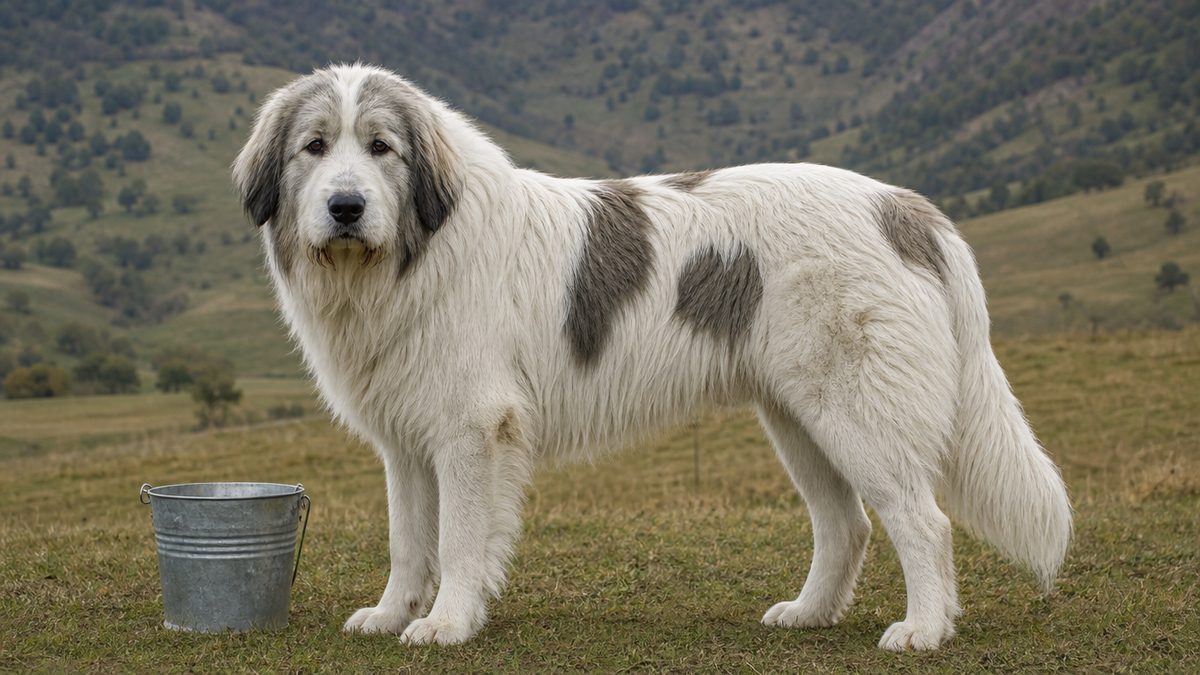
Quick answer
The Romanian Mioritic Shepherd Dog has no price in India and does not appear on any Indian dog price list. FCI standard 349 requires males to reach at least 70 cm at the withers with an ideal of 75 cm, and a coat at least 10 cm long, which is the single fact that decides whether this breed can live in an Indian city. It cannot.
This page reports published veterinary genetics, morphometrics, registry standards and Indian price and legal data. It is not a diagnosis and it is not a treatment plan. Consult your nearby vet, a registered veterinarian you can reach in person, before acting on anything here, and treat heat collapse, sudden hind-limb weakness or any abrupt change in your dog's condition as urgent.
Romanian Mioritic Shepherd Dog at a glance
What the Romanian Mioritic Shepherd Dog is, and the one number that settles India
The Romanian Mioritic Shepherd Dog is a very large Carpathian livestock guardian whose FCI standard requires males to reach a minimum of 70 cm at the withers and a coat at least 10 cm long, and that coat length is the single specification that decides whether the breed can live in an Indian city.
Most breed pages describe this dog with adjectives. The standard describes it with thresholds, and the thresholds are unusually strict. FCI standard 349 gives males a minimum of 70 cm at the withers with an ideal of 75 cm, and females a minimum of 65 cm with an ideal of 70 cm. It then does something most standards do not: it sets two separate floors.
| Height at withers | Males | Females | Consequence |
|---|---|---|---|
| Ideal | 75 cm | 70 cm | What the standard is aiming at |
| Minimum | 70 cm | 65 cm | Below this is a severe fault |
| Disqualification | Under 68 cm | Under 63 cm | Dog cannot be awarded |
So there is a two-centimetre band, 68 to 70 cm in a male, where the dog is severely faulted but not disqualified. That precision is worth noticing because it tells you the breed club cared about size specifically, and it means an adult male of this breed is genuinely enormous.
The coat specification, which no ranking page treats as important
The standard requires hair that is abundant on the head and body, of harsh texture, straight, and of minimum length 10 cm, over an undercoat that is denser, supple and of a lighter colour, with shorter hair on the limbs and a well-furnished tail. A coat shorter than 8 cm is listed as a severe fault. A curly coat, or one of a texture other than described, is also a severe fault.
India's Dog Breeding and Marketing Rules 2017 bar keeping certain dogs in outdoor facilities without the attending veterinary practitioner's written approval, and name the category in its own words: dog breeds that cannot tolerate the temperatures prevalent in the area or region in question, such as long-haired breeds in high temperature locations. A breed whose registry standard makes 10 cm of harsh outer coat a requirement, and 8 cm a severe fault, is the least ambiguous case that clause could ever be applied to.
Weight, and where every published figure comes from
The FCI gives no weight. Its size clause reads, in full, Weight: In proportion to the size. Every weight in circulation therefore comes from somewhere else, and the somewhere-elses do not agree.
| Source | Male height | Weight | Lifespan |
|---|---|---|---|
| FCI standard 349 | 70 cm minimum, 75 cm ideal | In proportion to the size | Not stated |
| American Kennel Club | 27 to 29 in (68.6 to 73.7 cm) | 100 to 130 lb (45 to 59 kg) | 12 to 14 years |
| DogBreedsList, first set | 70 to 75 cm, 27 to 29 in | 54 to 68 kg, 120 to 150 lb | 12 to 14 years |
| DogBreedsList, second set on the same page | 28 to 30 in, 26 to 28 in | 100 to 130 lb | 10 to 12 years |
DogBreedsList publishes both of its own rows, on one page, and they cannot both be right. Its two lifespans differ by two years and its two height sets differ by an inch at each end. This is the only ranking page that quotes a price, at USD 1,400 to USD 1,800, and it carries no rupee figure anywhere in its markup.
Colour, ears and tail
Colour is tightly specified. The standard permits piebald, meaning a white ground with well-defined black or grey markings, or solid white, or solid grey, with ear tips pigmented dark grey or black, which the standard calls earrings. Brindle markings are a severe fault and albinism is a disqualification. The ears are V-shaped with a slightly rounded tip, 10 to 15 cm long, hanging close to the cheeks, and cropping is forbidden in the standard's own words. The tail is high set, hanging at rest to or below the hock, and docking is forbidden, with a docked tail disqualifying.
History, a name from a sheep ballad, and a decade on the provisional register
The Romanian Mioritic Shepherd Dog was selected from a natural Carpathian mountain population for utility, standardised by the Romanian Kennel Club in 1981, and it took ten years to move from FCI provisional recognition in 2005 to definitive recognition in 2015.
The standard's historical summary is short and unusually candid about method. It records that the breed was selected from a natural breed of the Carpathian mountains, the principle reason being utility, and that the standard was drafted by the Romanian Kennel Club in 1981. The Technical Commission of the Romanian Kennel Club then adapted and revised the standard on 29 March 2002 to conform to the FCI model established in Jerusalem.
The recognition ladder, with both dates
The FCI's own breed record carries both steps, which is unusual and useful. It gives the date of acceptance on a provisional basis as 7/6/2005 and the date of acceptance on a definitive basis as 6/9/2015. The date format is proved from the same record rather than assumed: it prints the standard's publication as 9/22/2022, and 22 cannot be a month, so the first field is the month. Those dates therefore read 6 July 2005 and 9 June 2015.
Provisional recognition is not a formality that lapses into definitive status. It took this breed a decade, and its sibling the Romanian Raven Shepherd is still sitting at provisional number 373 today with no definitive date at all. When a page tells you a breed is FCI recognised, ask which register, because the two states have different consequences for what a pedigree is worth and where a dog can be shown.
The name is a literary reference, and it costs you half the search results
Mioritic derives from Miorita, the Romanian pastoral ballad whose title means the little ewe, and the word carries a heavy cultural load in Romanian well beyond dogs. That matters practically. Of the four PubMed records returned by Mioritic[tiab], only two are about this dog. The other two are a 2023 economics paper on the Romanian Mioritic Syndrome in perceptions of economic growth, and a 1979 *Journal of Medical Ethics* paper describing the Mioritic mode of conceiving death, in which a person passes into a realm of legend.
That is a fifty percent contamination rate on the breed's own name, and it is the reason a casual search for this dog's literature looks either empty or misleadingly full depending on which query you run. The quoted phrase Ciobanesc Romanesc Mioritic, which is the FCI's own registered name, returns zero.
Three Romanian shepherd breeds, and how to tell them apart
| Breed | FCI number | Group | Register |
|---|---|---|---|
| Ciobanesc Romanesc Mioritic | 349 | 1, Sheepdogs | Definitive since 9 June 2015 |
| Ciobanesc Romanesc Carpatin | 350 | 1, Sheepdogs | Definitive |
| Ciobanesc Romanesc Corb | 373 | Not yet grouped on the definitive register | Provisional |
A fourth, the Romanian Bucovina Shepherd, sits in FCI Group 2 rather than Group 1 and is a different animal again. Anyone reading about a Romanian shepherd dog should check the number, because these four are routinely confused with one another and with the Carpathian in particular.
Which registries hold this breed, and what the AKC page actually says about itself
The FCI recognises the Romanian Mioritic Shepherd Dog definitively as standard 349, and the American Kennel Club lists it with an empty group field, no popularity rank and a link to the FCI's standard rather than one of its own.
FCI recognition is settled. The breed sits in the Group 1 definitive list as CIOBANESC ROMANESC MIORITIC (349), Section 1 Sheepdogs, without working trial, country of origin Romania, in a 43-row register read with the German Shepherd Dog at 166 and the Border Collie at 297 as in-document controls. The official authentic language of the standard is English, which is worth knowing because it means the English text governs where translations differ.
The AKC listing, read from the page's own data
The American Kennel Club carries the breed in its 297-entry index. What its breed page says about itself is more informative than the listing. Its embedded page data contains a popularity attribute reading Ranks of 210 with no number in it, and a group attribute that is empty. Both are what a Foundation Stock Service listing looks like: a breed the AKC will record but has not admitted to a group or ranked by registration volume.
More telling still, the page's breed_standard_PDF field points at fci.be/Nomenclature/Standards/349g01-en.pdf. The AKC has no standard of its own for this breed and links the FCI's. That is a clean statement of where the authority sits, and it means anyone quoting an AKC standard for this dog is quoting a document that does not exist.
The page's display string reads height 27-29 inches for males and 22.5-28 inches for females. Its structured fields, which is what an answer engine or a comparison tool reads, set height_min_m and height_max_m to 22.5 and 29 for both sexes. The structured data therefore says a male of this breed can be 22.5 inches, which is 57 cm, when the FCI standard disqualifies any male under 68 cm. Read the sentence, not the field, and never take a size range from a structured extraction.
Recognition in India
India is a full FCI member represented by the Kennel Club of India, which issues pedigrees against FCI nomenclature, so an FCI pedigree for this breed is in principle recognisable here. That is a statement about paperwork and not about supply. The KCI publishes no breed list for any breed, so its silence is an instrument limit rather than a finding, and it must never be reported as this breed being unrecognised in India.
Romanian Mioritic Shepherd Dog price in India, tested against five price lists
There is no Romanian Mioritic Shepherd Dog price in India, because five Indian dog price lists covering more than ninety breeds contain zero occurrences of this breed while every one of them carries the Labrador Retriever.
The check was run on 9 September 2026 against five Indian price-list pages that rank for dog price queries. All five returned HTTP 200 with their correct titles, which rules out a soft 404 masquerading as a live page. Every one contains the Labrador Retriever, between ten and thirty times. None contains the strings Mioritic, Ciobanesc or Romanian. That is an absence with a passing control on five independent instruments.
| Slot | What came back | Mentions this breed |
|---|---|---|
| Organic 1 to 4 | The same Supertails Top 40 price list, four times over | No |
| People also ask 1 | How much does it cost to adopt a dog in India? | No |
| People also ask 2 | How much does a dog cost in India? | No |
| People also ask 3 | How much does a dog cost in India in 2026? | No |
| People also ask 4 | Which dog breeds are affordable in India? | No |
Four of the five organic slots were filled by one page, and none of the four People also ask questions names the breed. A search engine that has nothing to offer for a query does not say so, it substitutes, and a reader who scrolls that page comes away with a rupee band belonging to some other dog entirely.
The only published price anywhere, and how to test it
DogBreedsList gives USD 1,400 to USD 1,800, and it is the only ranking page for this breed that quotes a figure at all. Its raw markup contains no rupee figure, which we checked rather than assumed. Neither the AKC page nor the 101dogbreeds page nor Wikipedia publishes a price.
Divide it, and divide each end separately. A fabricated Indian band for a breed with no Indian market is usually a foreign asking price run through one exchange rate, and testing whether a single divisor fits both ends will clear a band that was converted per end and then rounded. If the quotients land on numbers a European or American seller would actually print, such as 1,400 and 1,800, you are looking at a conversion. And ask the separate question of whether the quotient is a price a human would quote at all: nobody sells a dog at 6,875 of anything.
Why no Indian price can form
The absence is structural, and the import restriction is the mechanism. India permits dogs to enter as accompanied pets under quarantine conditions and refuses applications to import dogs for trading or breeding purposes, so no breeding base can lawfully establish itself. The customs instruction of March 2024 is itself addressed to officers about dogs arriving at the border, which is where the constraint bites.
The Directorate General of Foreign Trade's pet import FAQ, which is the document that would give the ITC(HS) classification and the permitted ports, returned HTTP 403 at its published address on 9 September 2026 and has no Internet Archive capture. We have therefore quoted no DGFT clause on this page. The import position above rests on the customs instruction we did read and on the measured absence of any Indian listing.
Cost of ownership for a 70 cm guardian in India
Keeping a Mioritic-sized guardian in an Indian metro runs to roughly Rs 12,000 to Rs 22,000 a month once food, correctly-banded parasite control, grooming and cooling are counted, and the grooming line is far larger than the breed's own registry page implies.
No Indian cost data exists for this breed because no Indian dogs of it exist. What follows is built from published Indian rate cards for the services a dog of this size and coat would actually need, with each figure named and dated, because Indian retail prices move and municipal fees do not.
| Item | Published figure | Source and date read |
|---|---|---|
| Puppy core vaccination course | From Rs 6,499 national page, from Rs 7,199 Mumbai page | Vetic, 3 September 2026 |
| Annual booster | From Rs 3,199 national, from Rs 3,299 Mumbai | Vetic, 3 September 2026 |
| Anti-rabies, single dose | Rs 699 | Vetic, 3 September 2026 |
| 9-in-1 DHPPiL, single dose | Rs 899 | Vetic, 3 September 2026 |
| Bath | From Rs 934 | Vetic Delhi grooming, 3 September 2026 |
| Complete bath and styling | From Rs 1,869 | Vetic Delhi grooming, 3 September 2026 |
| Pet licence | Rs 50 | Greater Chennai Corporation |
The parasite line is quoted at the wrong weight everywhere
The most widely published Indian tick and flea figure is NexGard Spectra for 15 to 30 kg dogs, three tablets at Rs 3,308 against an MRP of Rs 3,375, about Rs 1,103 a month. A dog that must exceed 70 cm at the withers is well outside that band, so the correct product is a larger and dearer SKU. We publish the figure because it is the nearest verified Indian price and we flag it because quoting a 15 to 30 kg rate for a 55 kg guardian is exactly the quiet error that makes a cost table worthless.
The grooming line, and why the registry's own advice understates it
The AKC's page for this breed says that despite the breed's scraggly fur the dogs are very low-maintenance, that they do not require a bath, nor daily brushing, and that when they become wet or filthy they are simply confined for a time until the dirt may be easily brushed out, concluding that a dry Mioritic is a clean Mioritic. In Romania that is sound husbandry. In an Indian monsoon the premise fails, because the dog cannot be kept dry, and a 10 cm coat over a dense undercoat that never fully dries is where monsoon skin trouble begins. Indian salon rates give the scale: bathing from Rs 934 and a complete bath and styling from Rs 1,869 on a Delhi rate card, with a coat this size quoted above the base figure. Budget grooming as a recurring cost rather than an occasional one, because a heat-sensitive breed in a hot country needs the bath and the dry far more often than its own registry page assumes.
- Budget food for a dog above 70 cm at the withers, which is roughly twice a Labrador's intake.
- Budget parasite control at the correct weight band, not at the 15 to 30 kg price that every list quotes.
- Budget grooming as drying rather than styling, at a frequency the AKC page does not anticipate.
- Budget cooling as a fixed monthly cost from March to October in the plains.
- Budget a genetic test for SOD1 before any breeding decision, because the allele is documented in the breed.
Indian climate suitability, and the Carpathian cells that cannot be used
The Romanian Mioritic Shepherd Dog is unsuited to every Indian plains city, because the usable cell nearest its homeland averages 9.76 C across the year against Chennai's 27.94 C, and because its own breed standard mandates a coat at least 10 cm long.
The method comes first, because the Carpathians are exactly where NASA POWER goes wrong. The model returns a grid cell rather than a point, and in mountains the cell's mean elevation can miss the town beneath it by hundreds of metres, producing a figure that is right for the cell and wrong for the place. Every point below is therefore reported with the elevation the model returned against the real elevation.
| Point | Cell elevation | Real elevation | Error | Usable |
|---|---|---|---|---|
| Sibiu, Transylvanian plateau | 508.97 m | about 415 m | +93.97 m | Yes |
| Brasov, Carpathian foothills | 1048.26 m | about 625 m | +423.26 m | No |
| Fundata, Bran pass | 1097.91 m | about 1,360 m | -262.09 m | No |
| Bucharest, Romanian plain | 76.68 m | about 70 m | +6.68 m | Yes |
| Chennai | 48.95 m | about 6 m | +42.95 m | Yes |
Brasov's cell reads 6.21 C annual mean and Fundata's reads 5.92 C, a difference of 0.29 C, which looks like two independent points corroborating each other. They are not. Brasov's cell sits 423 m too high and Fundata's sits 262 m too low, errors in opposite directions on towns 30 km apart whose real elevations differ by 735 m. The model has flattened the Carpathians into a single plateau. Two nearby cells agreeing is not a check, it is the symptom, so this page uses Sibiu as its Carpathian-edge baseline and reports the high Carpathian pastures where the breed actually works as unmeasurable with this instrument.
The comparison
| Place | Annual mean | Hottest month | Coolest month | Annual RH | Peak wet bulb |
|---|---|---|---|---|---|
| Sibiu, Romania | 9.76 C | 21.44 C (Aug) | -2.72 C (Jan) | 74.27 % | 16.70 C (Jul) |
| Bucharest, Romania | 12.22 C | 25.01 C (Jul) | -1.58 C (Jan) | 71.28 % | 18.95 C (Jul) |
| Chennai | 27.94 C | 31.51 C (May) | 24.09 C (Jan) | 72.39 % | 26.11 C (May) |
| Delhi | 25.57 C | 35.88 C (Jun) | 13.61 C (Jan) | 45.51 % | 26.50 C (Jul) |
| Bengaluru | 23.74 C | 28.37 C (Apr) | 20.22 C (Dec) | 67.84 % | 21.86 C (May) |
| Kolkata | 25.80 C | 31.53 C (May) | 17.31 C (Jan) | 73.84 % | 27.09 C (Jun) |
The headline is the annual gap of 18.18 C between Sibiu and Chennai. The subtler number matters more for a working guardian: Sibiu's hottest month, August at 21.44 C, is barely above Bengaluru's coolest month, December at 20.22 C. The mildest month an Indian metro offers is roughly the hottest month this breed's homeland provides.
Humidity is not the problem, and saying it is gets the physiology wrong
Sibiu runs 74.27 percent annual relative humidity, which is higher than Chennai at 72.39, Bengaluru at 67.84, Pune at 66.68 and Delhi at 45.51. This dog comes from a damp place. What it has never met is heat, and heat combined with moisture is measured by wet bulb rather than by humidity alone. Sibiu peaks at 16.70 C wet bulb in July; Chennai reaches 26.11 C, Delhi 26.50 C and Kolkata 27.09 C. A gap of ten degrees on the variable that decides whether a panting animal can shed heat is not something a coat trim solves.
The skull question, which changes the heat answer and is genuinely unresolved
This breed has a specific complication that its neighbours do not. A 2023 3D geometric morphometric study of Balkan and West Asian livestock guardian skulls reported that most such breeds have a cranial morphology intermediate between mastiffs and large herding dogs, except for the Romanian Mioritic shepherd which has a more brachycephalic cranium strongly resembling the bully-type dog cranial morphotype. That is a heat claim, because Hall 2020a found dogs with a brachycephalic skull shape at greater risk of heat-related illness in a cohort of 905,543 dogs.
The study's abstract states that conclusion without a sample size. Its Table 1 gives one: the Romanian Mioritic shepherd is represented by a single specimen, against 17 Ilirian shepherds and 13 Kangals, out of 204 specimens in total, and Table 2 confirms it by printing the breed's minimum, maximum and mean centroid size as the identical 501.50. Meanwhile the 345-row breed classification table of McMillan 2024 records this breed as Mesocephalic. Two peer-reviewed sources, opposite classifications, and the brachycephalic one rests on one skull. The honest position is that the question is open, that a prospective owner should have the dog's actual airway assessed by a vet rather than trusting either label, and that nothing here should be reported as settled.
What is not in doubt is size. Hall 2020a found dogs over 50 kg carried 3.42 times the odds of heat-related illness, with a confidence interval of 1.54 to 7.57, and dogs above their breed and sex mean weight 1.42 times the odds. An adult male of this breed is over 50 kg. That factor applies whatever the skull turns out to be.
Temperament, and the sentence that rules out an Indian apartment
The Romanian Mioritic Shepherd Dog is calm and stable indoors and an uncompromising territorial guardian outdoors, and its own registry page states that its territory does not end at the property gate, which is what makes a high-rise balcony the worst possible home for it.
The FCI is brief and precise: a calm and stable dog, a good herd dog, very courageous and efficient fighter against possible animal prey (bear, wolf, lynx), wary of strangers. Its stated utilisation is excellent herding dog, incorruptible guardian and marvellous companion. Note the order of those, and note that the animals named are the ones it was expected to fight.
The AKC's own description is the most useful thing written about this breed
The AKC's training text, written by people who keep the breed, is unusually direct. It says the dogs are extremely territory conscious and incorruptible guardians, and then adds the line that decides Indian housing: their territory does not end at the property gate. It can be anywhere where the pack is or stays. Everything is guarded that can be seen from a watch post usually chosen at an elevated place. It continues that they are absolute creatures of habit which react immediately to anything unusual, first with attention, then by loud barking and, if necessary, with attack or defence.
An elevated watch post overlooking everything the dog can see is a description of a balcony in a city apartment block. A guardian that defines its territory by line of sight, in a building where several hundred strangers pass within view every hour, is a dog placed in permanent alarm by its housing. The barking is not a training failure and it is not solvable by training. It is the breed doing what the AKC page says it does.
Where a guarding temperament meets Indian law
The Dog Breeding and Marketing Rules 2017 contain a provision that reaches guardian breeds directly. Second Schedule Part IV paragraph 23(5), under the heading Compatibility, states that dogs with a vicious or aggressive disposition shall be housed separately from other dogs and that sedation shall not be used to control behaviour of such dogs. Two things follow for anyone keeping this breed in India: separate housing for a dog showing guarding aggression is a legal requirement rather than a suggestion, and chemical management of that behaviour is not a lawful route. Behaviour work with a qualified professional is, and your nearby vet is the first call.
Who this breed suits, and who it does not
- Suits livestock keepers with acreage, genuine predator pressure and a temperate climate.
- Suits experienced guardian owners who understand that independence is the working trait rather than a fault.
- Suits properties with a real, solid boundary, because this dog will otherwise choose its own.
- Does not suit apartments, shared walls, or any home whose outlook is a public thoroughfare.
- Does not suit first-time owners, and does not suit anyone who wants a dog that greets visitors.
Families with young children should weigh the size plainly. The FCI puts an ideal male at 75 cm at the withers, and the standard's own faults list penalises an overweight or weak subject, so this is an animal built to be substantial and fit. Calm is not the same as inert, and a courageous guardian that reacts immediately to anything unusual is not a dog to leave unsupervised with small children and their visiting friends.
Training an incorruptible guardian, and what it will not do
Train a Romanian Mioritic Shepherd Dog by managing its environment and building cooperation, because the breed is described by its own registry as an absolute creature of habit that reacts to anything unusual first with attention and then with barking, and no amount of obedience work removes that sequence.
The starting point is that this dog was selected to work without instruction against bear, wolf and lynx. Selection for independent decision-making at a distance from any handler is selection against instant compliance. An owner who reads a delayed response as defiance and escalates will lose, because the dog is 70 cm at the withers and was bred to hold its ground.
What works
- Start the socialisation window at eight weeks and treat it as the most important four months of the dog's life.
- Build a habit of voluntary check-ins rather than drilling formal obedience, so the dog learns to consult you.
- Train a settle before a recall, because settle is the behaviour an Indian household will actually need.
- Manage boundaries with fencing rather than with commands, since the breed defines territory by sight.
- Keep sessions short and varied, because a creature of habit disengages from repetition rather than resisting it.
What this breed resists
It resists being called off a perceived threat, which is the single most important limitation to plan around. At that moment it believes it is doing its job, and the registry's own description says the sequence runs attention, then loud barking, then attack or defence if necessary. You manage that with distance, barriers and early intervention, not with a stronger recall.
It also resists change. The same source calls the breed absolute creatures of habit who love their territory, their pack and their routines and do not want to see them disturbed. In practice that means a household with unpredictable visitors, deliveries and construction is a household that keeps this dog in a permanent state of alert.
Realistic timelines: house manners inside three to four months, a workable settle by six to eight months, and adult judgement about strangers somewhere between eighteen months and three years, because guardian breeds mature slowly. Anyone offering a finished guardian at a year is describing a different animal.
In Delhi the hottest month averages 35.88 C and in Chennai the peak wet bulb reaches 26.11 C. For a dog above 70 cm with a mandated 10 cm coat, the only workable sessions in the plains for eight months of the year are before sunrise and well after dark. That is a planning constraint rather than a nicety: a guardian that gets no training because it is too hot to work is how an unmanageable adult is made.
Daily exercise for a livestock guardian, which is less than you expect
An adult Romanian Mioritic Shepherd Dog needs one long daily walk plus territory to patrol rather than high-intensity exercise, because its own registry describes adults as taciturn and notes that livestock guarding dogs are not high energy since their preference is to stay with the flock.
The AKC page is explicit and it is worth quoting rather than paraphrasing: growing puppies will have plenty of energy and will need daily walks and attention, while adults will be much more taciturn and a daily walk would be enough for them, because livestock guarding dogs in general are not high energy given their preference to stay with the flock or people. That is a lower requirement than most large-breed pages assume, and it is consistent with the working pattern of a patrol animal: hours of watching, punctuated by decisive movement.
What a day should look like
- One long unhurried walk for an adult, two for a growing dog, on varied ground rather than pavement.
- Free access to a secure outdoor area during the cool hours so the dog can patrol on its own terms.
- Scent and problem-solving work, which satisfies a watching breed better than distance does.
- No forced running, no cycling alongside, and no repetitive impact while the growth plates are open.
Under-exercised guardians do not become hyperactive. They become reactive, because the unspent energy goes into the job the dog already believes it has. More patrolling, more barking, and a lower threshold for treating an ordinary event as a threat. In an Indian apartment block that is the failure path, and it arrives slowly enough that owners rarely connect it to the walks they stopped taking in April.
A dog over 50 kg carries 3.42 times the odds of heat-related illness, with a confidence interval of 1.54 to 7.57. Add a coat the standard requires to be at least 10 cm long and an unresolved question about the breed's skull shape, and the margin for error in Indian heat is very small. For eight months of the year in the plains any exercise this dog gets belongs in darkness, and on the worst days it should not happen at all. Panting that does not settle, unsteadiness or unresponsiveness after exertion in heat is an emergency: cool the dog with water and get to your nearby vet the same hour.
Grooming a 10 cm coat in Indian humidity, and why the registry's advice does not transfer
Groom a Romanian Mioritic Shepherd Dog in India by brushing to the skin about three times a week and force-drying it completely after every wetting, because the AKC's own advice that the breed needs neither baths nor daily brushing assumes a Carpathian climate in which the dog can simply be kept dry.
The standard sets the problem. Hair abundant on the head and body, harsh in texture, straight, minimum 10 cm long, over a denser and more supple undercoat of a lighter colour, with a well-furnished tail. A coat under 8 cm is a severe fault, so this is not something breeding will thin out for a warm climate.
What the breed's own registry recommends
The AKC page states that despite the breed's scraggly fur the dogs are very low-maintenance, that they do not require a bath, nor daily brushing, and that when they become wet or totally filthy they are simply confined for a time until the dirt, mud, or what-not may be easily brushed out, summarising the approach as a dry Mioritic is a clean Mioritic. It adds daily monitoring of eyes, ears and teeth plus a thorough grooming once a week.
The whole method depends on the premise that the dog can be allowed to dry. Sibiu runs 74.27 percent annual relative humidity but at an August mean of 21.44 C; Chennai runs 72.39 percent at 31.51 C in May and Kolkata 73.84 percent. Similar moisture, ten degrees apart, and it is the warmth that decides whether a dense undercoat dries or ferments. Waiting for a 10 cm coat to dry on its own in an Indian monsoon is how hot spots and ear infections start. Force-dry to the skin, plug the ears before any bath, and confirm the undercoat is dry rather than the surface.
The routine that does transfer
- Brush to the skin about three times a week with a slicker and an undercoat rake, working in sections.
- Brush daily during a coat blow, and expect a very large volume of undercoat.
- Check behind the ears, under the coat at the neck, in the armpits and around the tail base, where mats form first.
- Bathe only when genuinely dirty, and force-dry completely every time.
- Never shave the coat, and never clip it short to cool the dog.
One piece of the AKC's grooming text should be read with care rather than adopted. It says grooming serves establish hierarchy: the dog allowing the grooming, accepts the dominance of the one doing grooming. That framing belongs to an older model of dog behaviour that modern behavioural science does not support, and it matters practically, because an owner who approaches grooming a 60 kg guardian as a dominance contest is setting up a confrontation. Handle grooming as a cooperative husbandry skill taught with food and patience from puppyhood, and discuss any handling difficulty with your nearby vet or a qualified behaviourist.
Health, the first screening this breed ever had, and what it found
The Romanian Mioritic Shepherd Dog's first genetic screening, published in 2023, found the SOD1 mutation that causes canine degenerative myelopathy in two of the four Mioritics tested, which establishes that the allele is present in the breed and says nothing about how common it is.
Every ranking page for this breed repeats the AKC's line that because the Mioritic is recently rescued from the countryside in Romania there is little medical information available, adding that bloat is always a danger as with any large breed and that hip dysplasia has been seen. That was a fair statement when it was written. It is now out of date, and the correction is the most useful thing this page can give an owner. Wikipedia is the only page currently ranking for this breed that gives health its own top-level heading, and the two health concerns set out below, one genetic and one anatomical, were both published in 2023.
Degenerative myelopathy
In 2023 a group at Cluj-Napoca genotyped 230 dogs from 26 breeds in Romanian breeding kennels for the SOD1 c.118G>A mutation, using PCR-RFLP on DNA from oral swabs, and stated explicitly that the work included a first screening of the Romanian Bucovina Shepherd, Romanian Mioritic Shepherd, and Caucasian Shepherd breeds. Canine degenerative myelopathy is an autosomal recessive disease with incomplete penetrance and a progressive, ultimately paralysing course.
| Breed | Kennels | Dogs tested | G/G | G/A | A/A | Mutant allele frequency |
|---|---|---|---|---|---|---|
| Romanian Mioritic Shepherd | 1 | 4 | 2 | 2 | 0 | 0.2500 |
| Romanian Bucovina Shepherd | 2 | 25 | 25 | 0 | 0 | not applicable |
| Caucasian Shepherd | 1 | 8 | 8 | 0 | 0 | not applicable |
| All 26 breeds | many | 230 | 204 | 16 | 10 | 0.0783 |
The arithmetic closes on inspection, which is worth checking before quoting any table. Two carriers out of four dogs gives two mutant alleles in eight, which is exactly the 0.2500 printed. The total row gives 16 heterozygotes and 10 homozygotes across 230 dogs, or 36 mutant alleles in 460, which is exactly 0.0783. The paper also reports the Mioritic's genotype distribution as consistent with Hardy-Weinberg equilibrium, chi-squared p = 0.5050.
Four dogs from one kennel is not a breed prevalence. An allele frequency of 0.25 measured on four related animals in a single breeding establishment tells you the mutation exists in the breed and tells you nothing reliable about how widespread it is. Report it that way. What it does establish is actionable: the mutation is a single named base change, so it is testable, and anyone breeding this dog should be asking for both parents' SOD1 genotypes in writing. Two clear-looking carriers can produce an affected puppy, and degenerative myelopathy does not appear until middle age. Discuss testing with your nearby vet.
The contrast in that table is worth keeping. The Bucovina Shepherd's 25 dogs and the Caucasian Shepherd's 8 were all homozygous wild type. Of the Romanian guardian breeds screened, the Mioritic is the one in which the allele turned up.
The skull question, and why it belongs in a health section
A 2023 study using 3D geometric morphometrics on 204 canid skulls concluded that Balkan and Anatolian livestock guardians form a distinct cluster of large crania, except for the Romanian Mioritic shepherd which has a more brachycephalic cranium strongly resembling the bully-type dog cranial morphotype. Skull shape is not cosmetic on a page written for India: Hall 2020a identified brachycephalic skull shape as a risk factor for heat-related illness across 905,543 dogs.
The finding rests on one skull. The study's own Table 1 gives the Romanian Mioritic shepherd n = 1, against 17 Ilirian shepherds and 13 Kangals, and Table 2 prints its minimum, maximum and mean centroid size as the identical 501.50, which is what a single specimen looks like. The 345-row classification table of McMillan 2024 independently records the breed as Mesocephalic. We publish both and call the question open, because that is what the evidence supports.
Lifespan
No measured median lifespan exists for this breed. It appears in McMillan 2024's breed table flagged N, meaning enumerated and then excluded from the survival analysis, classified Large in the FCI sheepdog group. The AKC says dogs that live a normal healthy life have been known to reach 14 years, while DogBreedsList publishes 12 to 14 years and 10 to 12 years on the same page.
| Breed | Dogs | Deaths | Median survival | 95% CI | Hazard ratio |
|---|---|---|---|---|---|
| Anatolian Shepherd | 70 | 40 | 10.1 years | 7.6 to 11.2 | 1.53 (1.12 to 2.08) |
| Great Pyrenees | 260 | 128 | 10.9 years | 10.5 to 11.3 | 1.5 (1.26 to 1.79) |
| Black Russian Terrier | 163 | 71 | 10.9 years | 10.2 to 12.3 | 1.32 (1.05 to 1.67) |
| Labrador Retriever | 43,428 | 16,155 | 13.1 years | 13.0 to 13.1 | 0.8 (0.78 to 0.81) |
What Indian law requires you to screen
India's Second Schedule Part III paragraph 8(10) requires that breeding dogs shall have been tested for genetic defects, including hip dysplasia, progressive retinal atrophy, night blindness, hypothyroidism, entropion, ectropion, overshot, undershot jaw, wry mouth, two or more missing teeth and cryptorchidism. Hip dysplasia is directly relevant here, since the AKC notes it has been seen in the breed. The clause's word is including, so the list is illustrative rather than closed, and degenerative myelopathy testing sits comfortably inside its intent even though it is unlisted.
We publish no OFA hip or elbow figure for this breed. OFA's statistics page returned only its JavaScript shell on 9 September 2026 and a Labrador control returned zero on the same fetch, which proves the instrument failed rather than that the breed is absent from it.
Feeding, and the one piece of registry advice worth taking seriously
Feed a Romanian Mioritic Shepherd Dog considerably less than a large-breed feeding chart suggests, because its own registry page states that like every livestock guardian the breed uses its food well and needs much less than the amounts food manufacturers print on their packages.
The AKC's nutrition text for this breed is unusually specific and it is the part of that page that transfers best to India. It says the Mioritic uses its food well and needs much, much less than one might assume, particularly less than various food manufacturers recommend on their packages, that adults should be fed twice a day to avoid overeating and bloat, that puppies are fed four times a day while growing, that any food not consumed within 15 minutes should be removed, and that the dog should rest for one to two hours after eating.
The same passage advises choosing a kibble with low protein content because livestock guardian dogs do not metabolise high protein well. That statement carries no citation on the page and we could find no study supporting a breed-group difference in protein metabolism. We report it as what the registry page says rather than endorsing it. Protein levels for a growing giant-breed dog are a conversation to have with your nearby vet, not a rule to take from a breed page.
Life stages
- Weeks 8 to 16, four meals a day of a large-breed puppy formula, deliberately not filling out the frame.
- Months 4 to 12, three meals, with body condition assessed weekly by hand rather than by the scale.
- Months 12 to 24, two meals of an adult large-breed diet as growth slows, which happens later than owners expect.
- Adulthood, two meals a day, with intake reduced through the hot months as activity falls away.
- Seniority from about seven years, with joint support discussed with a vet rather than self-prescribed.
Two Indian feeding hazards for a deep-chested giant
Feed in the cool part of the day and never immediately before or after exercise. This is a deep-chested dog whose chest depth the standard sets at about half the withers height, which places it squarely in the classic risk group for gastric dilatation volvulus, and the AKC page names bloat as a danger in its own health text. Indian summer already compresses exercise into the two coolest hours, so the temptation to feed close to those hours is real and should be resisted.
Second, heat suppresses appetite. A dog that goes off its food in May is usually telling you about the temperature rather than about the diet. Sustained inappetence, retching without production, or a distended abdomen is an emergency and needs your nearby vet the same hour.
Water placement matters more for a guardian than for most breeds. Several bowls, refreshed through the day, in shaded spots the dog already patrols, works far better than one bowl indoors. A dog that will not leave its watch post is a dog that will not drink.
Month by month through the first year
Plan a Romanian Mioritic Shepherd Dog's first year around the socialisation window and the Indian summer, because a guardian's adult temperament is largely set by four months and the hottest Indian months are the worst possible time to be introducing a heavily coated puppy to the world.
Weeks 8 to 16, the window that decides the adult
This is what determines whether you get the calm stable dog the FCI describes or the aggressive or overly shy dog it disqualifies. Introduce the puppy to as many people, surfaces, sounds and situations as vaccination status safely allows. A guardian does not need to love strangers; it needs to have learned that strangers are unremarkable. Indian vaccination runs from Rs 6,499 for a puppy course with anti-rabies at Rs 699 a dose.
Months 4 to 6
Adult teeth arrive and the coat begins its change toward the harsh 10 cm adult texture. Start the grooming routine now, while the dog is 25 kg rather than 55 kg, so that brushing to the skin becomes routine and boring. Keep exercise low-impact. Guarding behaviour usually appears in this window as barking at the door, and how you answer it now is what you will live with.
Months 6 to 12
Growth is fast and coordination lags it. Avoid stairs, jumping and repetitive impact, and watch body condition closely, because this is the window in which giant puppies are most easily overfed. Expect the first real testing of boundaries and the first genuine displays of independence, which are developmental rather than defiant.
Months 12 to 24
The dog looks adult well before it is one. Guardian breeds mature slowly and adult judgement about strangers arrives long after adult height does. Keep socialising through the second year rather than treating it as finished at twelve months.
A puppy arriving in March in Delhi spends its socialisation window in the run-up to a 35.88 C June, when the only safe outdoor hours are before dawn. That is a socialisation window spent indoors, which is the most avoidable way to produce the shy adult the standard disqualifies. A late-monsoon or winter arrival buys four usable months before the heat closes the door.
Head to head against the guardians buyers cross-shop
Buyers looking at the Romanian Mioritic Shepherd Dog usually also consider the Carpathian, the Bucovina, the Caucasian Shepherd and the Great Pyrenees, and the useful way to separate them is by how much has actually been measured about each.
These are all very large flock guardians selected to work independently against predators, and they are more alike than the marketing suggests. What genuinely differs is the evidence base, and for an Indian buyer with no local vet familiarity to fall back on, the evidence base is what you are actually buying.
| Breed | FCI number | Male height | Screened for SOD1 in Romania | Named in the 2024 Indian list |
|---|---|---|---|---|
| Romanian Mioritic Shepherd Dog | 349 | 70 cm min, 75 cm ideal | Yes, 4 dogs, 2 carriers | No |
| Romanian Carpathian Shepherd Dog | 350 | Definitive register | Not in that study | No |
| Romanian Bucovina Shepherd | 357, Group 2 | Definitive register | Yes, 25 dogs, all clear | No |
| Caucasian Shepherd Dog | 328 | Definitive register | Yes, 8 dogs, all clear | Yes, entry 10 |
| Central Asian Shepherd Dog | 335 | Definitive register | Yes, 17 dogs, all clear | Yes, entry 9 |
Two things fall out of that table. The Mioritic is the only one of the Romanian guardians in which the degenerative myelopathy allele was found, on a small sample. And the Mioritic, unlike the Caucasian and Central Asian Shepherds, is not named in the March 2024 Indian import circular. Those are two genuinely different facts about two genuinely different risks, and no ranking page carries either.
For an Indian household the real choice is not between five European and Central Asian guardians. It is between any of them and a large Indian pariah dog, which is adapted to the climate, available for adoption at nominal cost, carries no imported recessive and is familiar to every vet in the country. If you want a calm, alert, territorial dog that will guard a property in Indian heat, that dog is already here.
One more distinction worth keeping straight. The Romanian Raven Shepherd, Ciobanesc Romanesc Corb, sits on the FCI's provisional register at number 373 and is a separate breed from this one. Pages that treat Romania's shepherd dogs as one breed with regional variants are wrong on the register's own terms.
Mistakes Indian owners make with heavily coated guardian breeds
The four errors that do the most damage with this breed in India are following overseas grooming advice literally, shaving the coat, losing the socialisation window to the summer, and reading a quashed circular as either a ban or an all-clear.
1. Following the registry's grooming advice literally
A dry Mioritic is a clean Mioritic is a true sentence about Romania and a dangerous one about Kerala. The method assumes the dog will dry. In an Indian monsoon a 10 cm coat over a dense undercoat does not, and the advice to confine a wet dog until the dirt brushes out becomes an instruction to keep it damp for hours. Force-dry instead, and treat the overseas guidance as climate-specific rather than wrong.
2. Shaving the coat to cool the dog
It is the most common intervention and it backfires. The undercoat insulates in both directions, and the standard makes a coat under 8 cm a severe fault precisely because the coat is the breed's weather system. Removing it exposes skin that has never met Indian ultraviolet, and it frequently grows back wrong. Cool the room, not the dog.
3. Losing the socialisation window to the heat
A guardian puppy that spends weeks 8 to 16 indoors because it is too hot to go out becomes the shy adult the FCI disqualifies. Owners rarely connect the two, because the consequence arrives a year later and looks like temperament rather than like a scheduling decision.
4. Getting the legal position wrong in either direction
The Department of Animal Husbandry and Dairying's letter of 12 March 2024 listed 24 entries for prohibition of import, breeding and sale, reproduced in full in CBIC Instruction 05/2024-Customs. Goa's Animal Husbandry Minister confirmed the count of 24 to the state assembly and said enforcement had been withheld. The High Court of Karnataka quashed the circular on 10 April 2024, finding that no stakeholder was heard, that the composition of the committee was not in consonance with the Rules, and that the circular travelled beyond what is found in the Rules.
The Karnataka judgment reproduces the list and its reproduction is abridged. Against the customs instruction's 24 entries the judgment's recital carries 17 as printed, and 18 once a missing comma between Akbash dog and Moscow Guard dog is restored. The six it drops are Mastiffs (boerbulls), Rottweiler, Terriers, Rhodesian Ridgeback, Wolf dogs and Canario, and four of those are bare undefined category words that reach whole groups of breeds rather than named ones. A page that clears a breed by checking the judgment's list will clear breeds the instrument actually reached. This breed is absent from both versions, which is why we can say so plainly.
So the precise position is this. No Indian law in force today bans owning, breeding or selling the Romanian Mioritic Shepherd Dog. It was never named, and the circular that named others was quashed. What does apply is the Dog Breeding and Marketing Rules 2017, which are in force and which reach this breed through the outdoor housing clause for long-haired breeds, the genetic-testing clause, and the separate-housing clause for a dog with a vicious or aggressive disposition.
Adoption, and the only responsible route into this breed
You cannot adopt a Romanian Mioritic Shepherd Dog in India because none are here, so the responsible options are adopting an Indian dog that does the same job better in this climate, or importing one as an accompanied pet with SOD1 genotypes verified in writing.
Start from what is real. There is no Indian rescue population for this breed, no Indian breeder, and no appearance on any of the five Indian price lists that rank for dog price queries. Anyone offering you a Mioritic puppy in India is offering something else, and the most likely somethings are a large Indian mixed breed or an unrelated guardian sold under a rarer name.
How to verify a claimed Mioritic
- Ask for the FCI pedigree and check the breed number reads 349, not 350 which is the Carpathian or 373 which is the Raven Shepherd.
- Ask for both parents' SOD1 c.118G>A genotypes in writing, since the allele is documented in the breed and the disease appears in middle age.
- Measure the dog. A male under 68 cm at the withers is disqualified by the breed's own standard.
- Check the coat length against the standard's 10 cm minimum, and the ear tips for the dark pigment the standard calls earrings.
- Confirm the tail is undocked and the ears uncropped, both of which the standard forbids and Indian law also prohibits.
The adoption route that works in India
Indian shelters are full of large, alert, climate-adapted dogs that will guard a property, and taking one costs very little. Greater Chennai Corporation licenses a pet animal at Rs 50 and runs six municipal pet clinics providing treatment and anti-rabies vaccination free of cost. Those are the real numbers of responsible dog ownership in India, and they sit an order of magnitude below what importing a European guardian costs before the animal has even landed.
In its own job this is a formidable and valuable animal. A calm, stable, self-directed guardian that will live outdoors with stock in a cold mountain climate and hold its ground against bear, wolf and lynx is precisely what Carpathian shepherds selected for, and the FCI standard says so in those words. Nothing on this page is a criticism of the dog. It is a statement about an 18 C annual temperature gap, a mandated 10 cm coat, an absent supply chain and a documented allele with no Indian testing route.
If you are relocating to India from Romania with a Mioritic already in your name, the accompanied-pet route exists and the dog can travel. Plan the heat before anything else: indoor cooling with a fallback that does not depend on the grid, exercise confined to darkness for eight months of the year, a grooming routine built around force-drying rather than bathing frequency, a vet briefed in advance that they are getting a 70 cm guardian with a 10 cm coat, and an honest conversation about whether the move is fair to the animal at all.
Questions people actually ask, answered as they were asked
How much does it cost to adopt a dog in India?
Adopting from an Indian shelter is usually free or costs a nominal fee covering vaccination and sterilisation, and Greater Chennai Corporation's six municipal pet clinics provide treatment and anti-rabies vaccination free of cost while licensing a pet animal at Rs 50. You will not adopt a Romanian Mioritic Shepherd Dog in India, because none are here and no rescue population exists.
How much does a dog cost in India?
Published Indian price lists put common pedigree puppies at roughly Rs 15,000 to Rs 75,000 in 2026, and for a guardian of this size the purchase price is the smallest number involved. Vaccination starts at Rs 6,499 for a puppy course, grooming from Rs 934 a bath, and a dog over 70 cm at the withers eats and is dosed accordingly. Those recurring figures decide affordability, not the sticker.
How much does a dog cost in India in 2026?
Indian dog price lists published for 2026 cover between 40 and 50 breeds and quote roughly Rs 15,000 to Rs 75,000 for the mainstream ones. This breed appears on none of them. Five such lists were checked on 9 September 2026 and every one carried the Labrador Retriever while none contained the strings Mioritic, Ciobanesc or Romanian, so there is no 2026 Indian price for this dog to quote.
Which dog breeds are affordable in India?
The affordable breeds in India are the ones with an established local breeding base, chiefly Indian pariah dogs from shelters at nominal cost, followed by Labradors, Beagles and Indian Spitz on published price lists. A breed with no Indian breeding base is not expensive, it is unavailable, and any rupee figure attached to it is a converted foreign asking price rather than a market rate.
What is the Romanian Mioritic Shepherd Dog price in India?
No Romanian Mioritic Shepherd Dog price in India exists. Five Indian dog price lists covering more than ninety breeds between them contain zero occurrences of this breed while carrying the Labrador Retriever on every page. The only published price anywhere is USD 1,400 to USD 1,800 on a foreign breed database, and that page carries no rupee figure at all in its markup.
How big is a Romanian Mioritic Shepherd Dog?
FCI standard 349 requires males to reach a minimum of 70 cm at the withers with an ideal height of 75 cm, and females a minimum of 65 cm with an ideal of 70 cm. Below 68 cm for a male and 63 cm for a female the dog is disqualified outright. The standard gives no weight at all, stating only that weight should be in proportion to the size, so every weight figure you will read for this breed comes from somewhere other than the standard.
Does the Romanian Mioritic Shepherd Dog have health problems?
Yes, and one is now documented. A 2023 Romanian study performed the first genetic screening this breed has had and found the SOD1 c.118G>A allele that causes canine degenerative myelopathy in two of the four Mioritics tested, an allele frequency of 0.25. That sample is four dogs from a single kennel, so it establishes that the mutation is present in the breed and establishes nothing about how common it is.
Is the Romanian Mioritic Shepherd Dog good for Indian weather?
No. Its breed standard requires a coat at least 10 cm long and treats anything under 8 cm as a severe fault, and its homeland reaches an August mean of 21.44 C against Chennai's 27.94 C annual average. Indian law separately bars keeping long-haired breeds in outdoor facilities in hot locations without a veterinarian's written approval, which removes the housing arrangement the breed was designed for.
Is the Romanian Mioritic Shepherd Dog recognised by the AKC?
It is listed in the American Kennel Club's breed index but not fully recognised. Its AKC page carries an empty group field and a popularity line reading Ranks of 210 with no rank in it, which is what a Foundation Stock Service listing looks like, and the page links the FCI's own standard 349 rather than an AKC standard. The FCI recognises it definitively, having moved it from provisional status in 2005 to definitive status in 2015.
What is the Romanian Mioritic Shepherd Dog lifespan?
No measured median lifespan exists. The breed appears in McMillan 2024's 345-row table flagged N, meaning it was enumerated and then excluded from the survival analysis. The AKC page says dogs living a normal healthy life have been known to reach 14 years, and one breed database publishes both 12 to 14 years and 10 to 12 years on the same page, which tells you how firm the figure is.
How much grooming does a Romanian Mioritic Shepherd Dog need in India?
Far more than its own registry page suggests. The AKC's advice is that the breed does not require a bath nor daily brushing and that a dry Mioritic is a clean Mioritic, which is written for a Carpathian climate. In Indian humidity a 10 cm coat over a dense undercoat cannot dry on its own, so plan brushing to the skin three times a week and forced drying after every wetting.
Is the Romanian Mioritic Shepherd Dog banned in India?
No. The March 2024 circular that listed 24 breeds for import and breeding prohibition never named this breed, and the High Court of Karnataka quashed that circular on 10 April 2024 for want of stakeholder consultation and a properly constituted committee. No Indian law in force today bans owning this breed, though importing one for breeding or sale remains impossible for a different reason.
Compare with similar breeds
Romanian Mioritic Shepherd Dog sits in 1 Bonbeno group. Each one compares it directly against the breeds it is genuinely an alternative to, on the same figures.