
Breed profile
Carpathian Shepherd Dog: The Complete India Guide
A wolf-grey Carpathian sheepdog whose own standard disqualifies any dog that looks like a mastiff, whose famous 32 to 45 kg weight appears in no breed standard on earth, and which two kennel clubs file in opposite groups.
Quick answer
The Carpathian Shepherd Dog is a Romanian sheepdog and flock guardian, FCI standard 350, with males standing 65 to 73 cm. Its standard gives no body weight at all, so the widely quoted 32 to 45 kg traces to the American Kennel Club's 70 to 100 lb converted twice. Heat tolerance rates 2 out of 5, because its home range averages 5.97 degrees Celsius while Bengaluru's coldest month averages 20.22.
This page summarises published veterinary research and registry data for general information. It is not a diagnosis and it is not treatment advice. Consult a registered veterinarian about your own dog before acting on anything here, and treat a rectal temperature at or above 41.0 degrees Celsius, a distended painful abdomen with unproductive retching, or sudden collapse in a large dog as an emergency.
Carpathian Shepherd Dog at a glance
What the Carpathian Shepherd Dog is, and what FCI-350 actually says
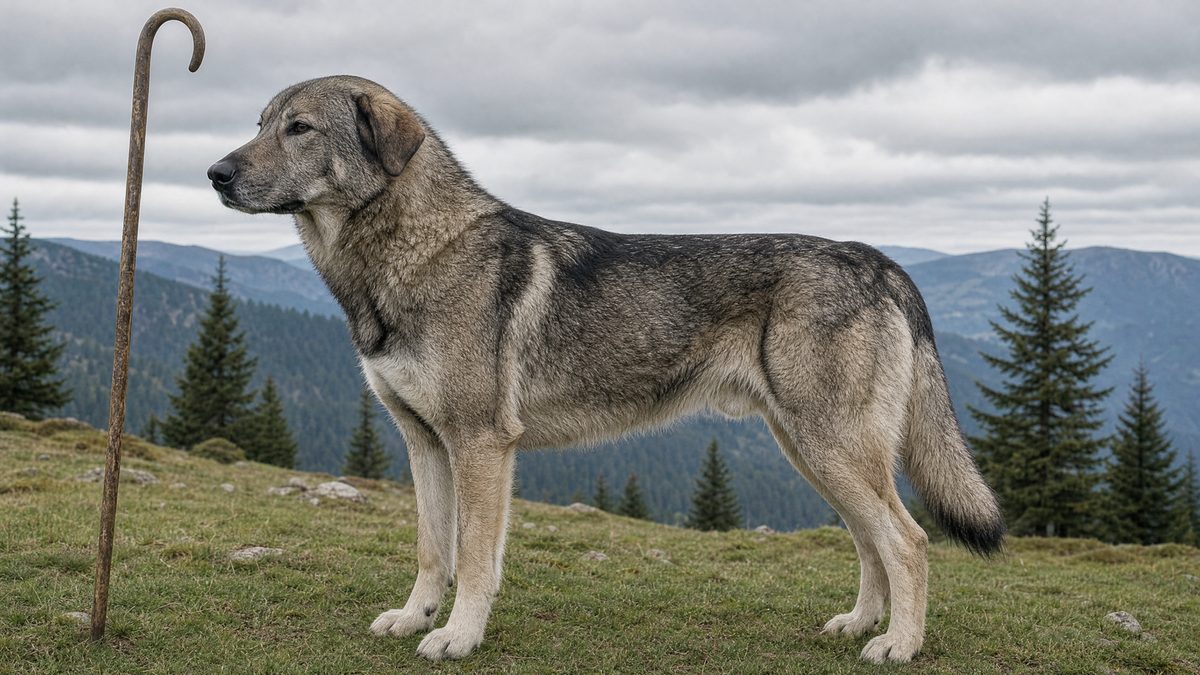
The Carpathian Shepherd Dog is a relatively large, wolf-grey Romanian sheepdog used for centuries in the Carpathian mountains to defend herds, recognised by the Federation Cynologique Internationale as breed standard number 350 in Group 1 Sheepdogs and Cattle Dogs, Section 1 Sheepdogs, without working trial.
Its Romanian name is Ciobanesc Romanesc Carpatin, and the FCI's official English name is Romanian Carpathian Shepherd Dog. The valid standard was published on 9 June 2015, with the English text dated 18 August 2015, translated by Jennifer Mulholland and Raymond Triquet and revised by Renee Sporre-Willes. English is the standard's official authentic language.
The standard describes a dog that is agile, never heavy, with the general appearance of a vigorous animal, a rectangular body, a broad and slightly sloping croup, and well defined sexual dimorphism in which males should be taller and stronger than females. Its stated job is a sheepdog defending the herds while at the same time being an excellent guard dog.
The measurements the standard actually gives
FCI-350 sets height and refuses to set weight. Males stand ideally 65 to 73 cm at the withers and females ideally 59 to 67 cm, each with a tolerance of plus or minus 2 cm, and the standard adds that the overall impression is always more important. Under SIZE AND WEIGHT the entire weight entry reads Weight: In harmony with the size, giving the impression of a powerful but not heavy dog.
There is no kilogram or pound figure anywhere in the document. The [body weight](#weight-myth) section traces where the famous 32 to 45 kg came from instead, because it is the single most repeated unsourced fact about this breed.
One measurement here is unusual enough to be worth a protractor. The standard specifies that the neck presents an angle of approximately 50 degrees to the horizontal, a figure almost no breed standard states and one FCI-350 even illustrates. It also fixes the forequarters proportionally: the depth of the chest corresponds more or less to half the height at the withers.
| Item | What FCI-350 states |
|---|---|
| Breed number and group | 350, Group 1 Sheepdogs and Cattle Dogs, Section 1 Sheepdogs, without working trial |
| Country of origin | Romania |
| Official authentic language | English |
| Valid standard published | 9 June 2015, English text dated 18 August 2015 |
| Utilization | Sheepdog defending the herds, and an excellent guard dog |
| Height | Males ideally 65-73 cm, females ideally 59-67 cm, tolerance plus or minus 2 cm |
| Weight | Not stated. 'In harmony with the size' |
| Head type | Lupoid, that is wolf-like, and mesocephalic |
| Neck angle | Approximately 50 degrees to the horizontal |
| Coat | Harsh, dense, straight, of moderate length, with a dense soft undercoat |
| Colour | Pale fawn overlaid with black, that is wolf-grey |
| Dewclaws | If any, should be removed except where the law forbids it |
| Disqualifying appearance | Subject clearly untypical with molossoid type appearance |
The line that defines the breed by exclusion
Among the DISQUALIFYING FAULTS, FCI-350 lists Subject clearly untypical with molossoid type appearance. Read that carefully, because it is the most useful sentence in the document for a buyer. A Carpathian that looks like a mastiff is not a poor specimen; it is disqualified from the ring outright. The breed is defined against the heavy mountain guardian type, not as an example of it.
The same list disqualifies lethargic dogs, which is rarer still. Very few standards make a lack of energy a disqualification rather than a fault, and it tells you what the selection pressure was: a dog that would not get up and go to the threat was of no use on a mountain.
Almost every aggregator calls the Carpathian a molosser. 101dogbreeds.com files it under 'Working, Molossers, Livestock Guardians, Mountain dogs';. That is the one description its own standard disqualifies. If a seller describes the dog to you as a mastiff type, they are describing a dog that would be put out of the ring.
Two kennel clubs, two opposite groups, one breed
The FCI files the Carpathian Shepherd Dog with the sheepdogs and the United Kennel Club files it with the guardian breeds, and the UKC made that change on a specific date, 1 January 2022 United Kennel Club.
This is not a trivia point. Which group a breed sits in decides what it is judged against, what its peer group is for health data, and what an owner is told to expect. On this breed the two largest registries that publish a standard for it disagree, and no page ranking for the term mentions it.
The FCI position is unambiguous. FCI-350 places the breed in Group 1, Sheepdogs and Cattle Dogs (except Swiss Cattle Dogs), Section 1 Sheepdogs, and disqualifies molossoid appearance.
The United Kennel Club recognised the Romanian Carpathian Shepherd Dog on 1 July 2006, a year after the FCI's provisional recognition, and its standard now carries the line Guardian Dog Group (Group change from Herding to Guardian effective: January 1, 2022). So the UKC originally agreed with the FCI, then moved the breed to the guardian side sixteen years later.
| Body | Where it files the breed | Dated |
|---|---|---|
| Federation Cynologique Internationale | Group 1 Sheepdogs and Cattle Dogs, Section 1 Sheepdogs | Standard valid 9 June 2015 |
| United Kennel Club | Guardian Dog Group, moved out of Herding | Change effective 1 January 2022 |
| dogbreedslist.info | Breed Group: Herding | Current |
| 101dogbreeds.com | Working, Molossers, Livestock Guardians, Mountain dogs | Current |
| Wikipedia | Described as a livestock guardian dog | Current |
| Royal Canin India | No group given, size category Large | Current |
Why the disagreement is real rather than clerical
Read the two standards side by side and you can see both bodies looking at the same dog and weighting different things. The FCI leads with a lupoid, mesocephalic sheepdog of moderate coat length that must be agile and never heavy, and it disqualifies mastiff type. The UKC opens its characteristics section with 'A natural and courageous guard dog, calm, dignified and unconditionally attached to the herd and his master' and lists its disqualifications as only cryptorchidism, viciousness or extreme shyness, and albinism.
The UKC standard, in other words, does not disqualify molossoid appearance at all. A heavy, mastiff-like Carpathian that the FCI would put out of the ring can be shown under the UKC. That is the substantive content of the group change, and it matters to anyone buying from a UKC-registered line and expecting an FCI-typical dog.
What the two standards agree on
More than they disagree on, which is worth saying plainly. Both give the neck angle as approximately 50 degrees to the horizontal. Both describe the head as wolf-like and powerful but not heavy. Both require a large, wide, always black nose and almond eyes set obliquely. Both describe triangular drop ears with slightly rounded tips carried close to the cheek. Both describe a harsh, dense, straight coat of moderate length, short on the head and the front of the legs and profuse on the neck, back of legs and tail United Kennel Club.
And both, critically, refuse to give a weight. The UKC text reads Weight should be in harmony with the size, giving the impression of strength but not heaviness. Two registries, two independently drafted documents, and zero kilograms between them.
UKC gives ideal height as 25.5 to 29 inches for males and 23 to 26.5 inches for females, which is 64.8 to 73.7 cm and 58.4 to 67.3 cm. FCI-350 gives 65 to 73 cm and 59 to 67 cm. The two are the same measurements in different units, to within a centimetre. So the standards are perfectly capable of agreeing on a number when there is one. On weight there is none to agree on.
FCI recognition: two dates, one circular, and three breeds admitted together
The Carpathian Shepherd Dog was accepted by the FCI on a provisional basis on 6 July 2005 and on a definitive basis on 9 June 2015, and its own nomenclature record prints both dates as separate rows.
Those are different events and the ranking pages collapse them. Provisional recognition makes a breed eligible for FCI titles such as Winner of the World Dog Show but not for the CACIB; definitive recognition adds the CACIB. Nine years and eleven months separated the two for this breed.
The recognition document survives and can be read in full. It is FCI Circular 36/2005, dated 13 July 2005 and signed by Y. De Clercq, Executive Director.
What the circular actually says
In its own words: 'The FCI General Committee held a meeting on July, 6th, 2005 in Buenos Aires and made the following decision: From July 7th, 2005, the breeds "Romanian Mioritic Shepherd Dog", "Romanian Carpathian Shepherd Dog" and "Australian Stumpy Tail Cattle Dog" are recognised by the FCI on a provisional basis';.
It then lists the three by number: Romanian Mioritic Shepherd Dog (Standard n 349), Romanian Carpathian Shepherd Dog (Standard n 350) and Australian Stumpy Tail Cattle Dog (Standard n 351). The same decision is repeated in French, German and Spanish on the same two pages, so there is no ambiguity about which breeds were meant.
Two details in that text are worth keeping. First, it was the General Committee, a body of a dozen or so people, not the General Assembly. Second, the circular sets the decision on 6 July and the effect from 7 July, one day later, and says the FCI logo may appear on pedigrees for these breeds from 7 July. The FCI's own register dates the acceptance to 6 July, the meeting day. So the breed has, strictly, two defensible provisional dates one day apart, depending on whether you date it to the decision or to its effect.
| Breed | Standard | Provisional | Status in August 2026 |
|---|---|---|---|
| Romanian Mioritic Shepherd Dog | 349 | 6 July 2005 | Definitive since 9 June 2015 |
| Romanian Carpathian Shepherd Dog | 350 | 6 July 2005 | Definitive since 9 June 2015 |
| Australian Stumpy Tail Cattle Dog | 351 | 6 July 2005 | Still on the provisional register |
That third row is the interesting one and nobody has published it. The FCI's live provisional register still lists AUSTRALIAN STUMPY TAIL CATTLE DOG (351) with a recognition date and effective date of 6 July 2005, making it the oldest entry on a register whose newest entries were added on 11 February 2026. Three breeds walked through the same door on the same day. Two were promoted a decade later and one has waited twenty-one years.
Where Royal Canin India gets it wrong
The only Indian domain in the ranking set states: 'Native Romanian shepherd dog breeds have existed for centuries, but they were not officially recognised until very recently. The FCI General Assembly ratified the standard in Buenos Aires, Argentina in 2005';.
Two errors in one sentence. The body was the General Committee, not the General Assembly. And nothing was ratified in Buenos Aires except provisional recognition; the standard in force today was published on 9 June 2015, ten years afterwards, and the English text carries the date 18 August 2015 Federation Cynologique Internationale. An Indian reader is being told the breed's paperwork was settled a decade before it was.
Go to the FCI nomenclature record for the breed number, not to a breed blog. It prints 'Date of acceptance on a provisional basis' and 'Date of acceptance on a definitive basis' as separate rows. One trap to know: the FCI resolves these URLs on the trailing number, not the name, so a URL reading ROMANIAN-BUCOVINA-SHEPHERD-349.html returns HTTP 200 and serves a complete Mioritic page. Check the breed name printed inside the document before you read anything off it.
The 32 to 45 kg weight: traced end to end, and in no standard
No breed standard for the Carpathian Shepherd Dog gives a body weight, and the 32 to 45 kg range printed across the internet is the American Kennel Club's 70 to 100 lb converted into kilograms and then converted back again American Kennel Club Wikipedia, Carpathian Shepherd Dog.
Start with the two documents that ought to settle it. FCI-350's entire weight entry reads Weight: In harmony with the size, giving the impression of a powerful but not heavy dog. The United Kennel Club's standard reads Weight should be in harmony with the size, giving the impression of strength but not heaviness. Two registries, two separately drafted standards, and not one number.
The conversion chain, with the arithmetic
The AKC trait block gives 70 to 100 lb, and 101dogbreeds.com reproduces exactly that, 'Weight 70 to 100 lb';. Now do the conversions and watch the number drift.
- 70 lb is 31.75 kg and 100 lb is 45.36 kg. Round both to whole kilograms and you get 32 to 45 kg.
- 32 kg is 70.55 lb and 45 kg is 99.21 lb. Round both to whole pounds and you get 71 to 99 lb.
- Wikipedia's infobox prints '32 to 45kg (71 to 99lb)' and dogbreedslist.info prints '71-99 pounds (32-45 kg)';, matching each other exactly.
- So the figure that circulates as this breed's weight has lost a pound at the bottom and a pound at the top relative to the AKC original, purely through a round trip between units.
That drift is the fingerprint. A measured range does not shrink by one pound at each end; a converted one does. And the source at the head of the chain, the AKC trait box, cites nothing.
The AKC contradicts itself on the same page
Its trait block caps males at 100 lb and 29 inches. Its prose, four screens down, says the Carpathians 'are big and strong, standing as high as 30 inches at the shoulder and often weighing more than 100 pounds';.
Both halves cannot be right. Thirty inches is 76.2 cm, which is above the AKC's own 29-inch ceiling and above the FCI's maximum of 73 cm plus a 2 cm tolerance. A dog at 30 inches is outside the standard, not a typical example of it.
| Source | Weight given | In kilograms | What it rests on |
|---|---|---|---|
| FCI-350, the breed standard | Not stated | Not stated | N/A. 'In harmony with the size' |
| UKC breed standard | Not stated | Not stated | N/A. 'In harmony with the size' |
| AKC trait block | 70-100 lb | 31.8-45.4 kg | No source given |
| AKC prose, same page | 'often more than 100 pounds' | Over 45.4 kg | No source, and above its own box |
| 101dogbreeds.com | 70-100 lb | 31.8-45.4 kg | The AKC figure, unconverted |
| Wikipedia infobox | 32-45 kg (71-99 lb) | 32-45 kg | No citation on the row at all |
| dogbreedslist.info | 71-99 lb (32-45 kg) | 32-45 kg | Identical to Wikipedia |
| Goofy Tails (India) | Male 30-50 kg, female 30-45 kg | 30-50 kg | No source, and matches nothing else |
| Smith et al. 2026 | '~32-45 kg' | 32-45 kg | A collar-weight assumption, not a measurement |
The one appearance in the peer-reviewed literature, read carefully
This breed's weight does reach a journal, and it deserves precision rather than a headline. A 2026 GPS study of Romanian livestock guarding dogs writes, in the ethics paragraph justifying its equipment: 'At 200 g, the weight of the GPS tracking collar was less than 1% of the body weight of the study animals (~32-45 kg for the average Carpathian Shepherd LGD)'.
So the range is not fabricated. It is in print, in a peer-reviewed paper, about this exact breed. But read what it is doing there. It is a parenthetical assumption used to show that a 200 g collar is light enough, it carries no citation, and the paper never reports a measured weight for any dog it tracked. It is the same number as the AKC's, and it is being used as background rather than produced as data.
A range of roughly 32 to 45 kg is the best available figure and it is honest to use it, provided you know it is an estimate that no breed standard endorses and no study measured. Do not accept a seller's claim that a Carpathian 'will reach 60 kg' or 'is a 100 lb dog'. The heavier the dog sounds, the more likely you are being sold a molossoid cross, and molossoid appearance is a disqualifying fault in this breed.
The four Romanian shepherd breeds, and what separates the Carpathian from its siblings
Romania has four native shepherd breeds with FCI numbers, and the Carpathian is the only one of them that is explicitly lupoid, that shares its group with the Mioritic, and whose standard disqualifies the type the Bucovina belongs to Federation Cynologique Internationale Federation Cynologique Internationale Federation Cynologique Internationale.
The group split is the cleanest separator there is and no ranking page mentions it. FCI-350 places the Carpathian in Group 1 Sheepdogs and Cattle Dogs, Section 1 Sheepdogs, and FCI-349 places the Mioritic in the same Group 1 Section 1 Federation Cynologique Internationale. FCI-357 places the Bucovina in Group 2, Section 2.2 Mountain type Molossoids.
The nomenclature records confirm the split independently of the standards: the Mioritic's record gives Group 1, Section Sheepdogs, and the Bucovina's gives Group 2, Section Molossian type, Subsection Mountain type. Then the Carpathian standard goes further and rules the Bucovina's type out of its own ring. Among FCI-350's disqualifying faults is Subject clearly untypical with molossoid type appearance. A Carpathian that looks like a Bucovina is disqualified.
Head, coat and colour, from the three standards
Read them side by side and the confusion disappears. The Carpathian is the only one whose standard names a head type at all: lupoid (wolf-like), mesocephalic, powerful but not heavy. The Mioritic requires skull and muzzle profiles that are almost parallel and a coat of minimum 10 cm. The Bucovina requires profiles that are slightly convergent, a coat of 6 to 9 cm, and prints a skull width in centimetres.
Colour separates them completely. The Carpathian is wolf-grey, that is pale fawn overlaid with black, with white markings permissible. The Mioritic is piebald, a white ground with well-defined black or grey markings, with pigmented ear tips the standard calls earrings. The Bucovina is white or white-beige with distinct patches. A grey-and-white patched dog is not a Carpathian.
| Carpathian (350) | Mioritic (349) | Bucovina (357) | |
|---|---|---|---|
| FCI group | 1, Sheepdogs | 1, Sheepdogs | 2, Molossoid, Mountain type |
| Head type named | Lupoid, mesocephalic | Not named | Massive, not heavy |
| Skull and muzzle profiles | Not specified | Almost parallel | Slightly convergent |
| Muzzle vs skull length | Slightly less than, at most equal | Equal or a little shorter | The same length |
| Male height | Ideal 65-73 cm (+/- 2) | Minimum 70 cm, ideal 75 | 68-78 cm, ideal 71-75 (+/- 4) |
| Female height | Ideal 59-67 cm (+/- 2) | Minimum 65 cm, ideal 70 | 64-72 cm, ideal 66-68 (+/- 4) |
| Weight in the standard | None. 'In harmony with the size' | None. 'In proportion to the size' | None. 'In proportion to height' |
| Coat length | Moderate | Minimum 10 cm | 6-9 cm on the body |
| Colour | Wolf-grey, pale fawn overlaid black | Piebald white with black or grey | White or white-beige with patches |
| Brindle | Disqualifying fault | Severe fault | Patches to be rejected |
| Dewclaws | Should be removed unless law forbids | Presence not penalized | Presence not penalized |
| Molossoid appearance | Disqualifying fault | Not mentioned | The breed's own section |
| Provisional FCI acceptance | 6 July 2005 | 6 July 2005 | 26 March 2009 |
| Definitive FCI acceptance | 9 June 2015 | 9 June 2015 | 29 April 2019 |
Two rows in that table matter more than the rest for an Indian reader. The weight row shows that not one of the three Romanian standards states a body weight, so the confident kilogram figures printed for all three come from outside the standards. And the dewclaw row shows the Carpathian standing alone: it is the only one of the three that instructs a breeder to remove dewclaws, and the [Indian law](#indian-law) section explains why that instruction cannot be followed here.
The fourth breed
The Romanian Raven Shepherd Dog, Ciobanesc Romanesc Corb, is FCI-recognised. It appears on the live provisional register as breed number 373, with a recognition date and an effective date both given as 17 September 2024. Pages describing it as an unrecognised local variety were correct until then and are not correct now. All four Romanian shepherd breeds hold FCI numbers: three definitively, one provisionally.
The Carpathian does not appear on the FCI provisional register today, and that is a promotion rather than a demotion. It left that list on 9 June 2015 by being accepted on a definitive basis. The register itself is real and populated, listing twenty breeds from the Australian Stumpy Tail Cattle Dog of 2005 to four added on 11 February 2026, so its silence about this breed has a direction.
History: a 1934 standard, an endemic breed, and a club founded twice
The Carpathian Shepherd Dog was selected from an endemic breed of the Carpathian-Danubian area, and its first written standard dates to 1934, which makes its paperwork older than either sibling breed's.
FCI-350's brief historical summary is short and unusually specific. The breed 'was selected from an endemic breed present in the Carpathian-Danubian area. For centuries the principle criteria for selection has been utilization, this dog having conserved its character intact to the present day';.
It then dates the documents. 'The first standard was written in 1934 by the Zootechnical National Institute. This standard was modified and updated in 1982, 1999 and 2001 by the Romanian Kennel Club. The Technical Committee of the R.K.C. adapted the standard on 30.03.2002 to conform to the model proposed by the FCI';.
Compare that with the Mioritic, whose standard was 'drafted by the Romanian Kennel Club in 1981' and adapted by the same Technical Commission on 29.03.2002, one day earlier, 'to conform to the F.C.I model established in Jerusalem'. The two Romanian sheepdogs were prepared for FCI submission on consecutive days by the same committee, which is why they then travelled to Buenos Aires together in 2005.
| Date | What happened | Source |
|---|---|---|
| 1934 | First standard written by the Zootechnical National Institute | FCI-350's own history |
| 1979 | A Bucharest dog show features 18 dogs of the Carpatin breed | Wikipedia, citing an ethnobiology paper |
| 1982, 1999, 2001 | Standard modified and updated by the Romanian Kennel Club | FCI-350's own history |
| 30 March 2002 | R.K.C. Technical Committee adapts the standard to the FCI model | FCI-350's own history |
| March 2003 | Conference on the Romanian breeds held at Bistrita | Wikipedia, uncited |
| 6 July 2005 | FCI General Committee grants provisional recognition at Buenos Aires | FCI Circular 36/2005 |
| 1 July 2006 | United Kennel Club recognises the breed | UKC breed standard |
| 28 April 2007 | Carpatin Club Romania founded at Reghin | The club's own site |
| 9 June 2015 | FCI accepts the breed on a definitive basis | FCI nomenclature record |
| 1 January 2022 | UKC moves the breed from Herding to the Guardian Dog Group | UKC breed standard |
The club founding date does not agree with itself
Wikipedia states that 'In March 1998, a group of fans of the Carpathian Shepherd Dog founded the Carpathian Shepherd Dogs Club. The club was later renamed the National Club of Carpathian Shepherd Dog Breeders', and that sentence carries a citation needed tag dated May 2024.
The club's own website tells it differently. Carpatin Club Romania states that it is a Romanian legal person founded on 28 April 2007 by breeders, owners and admirers of the Ciobanesc Romanesc Carpatin, that it is a member of the Asociatia Chinologica Romana, and that it is the only officially recognised national club concerned with the selection, improvement, conservation and growth of the breed.
Both can be true if a 1998 enthusiasts' association was later re-founded as a formal legal entity in 2007, which is a common pattern. What cannot be done is to state one date as the club's founding without the other. Bonbeno reports both and marks the 1998 claim as the one Wikipedia itself flags as unsourced.
The working culture is still live
This is not a breed reconstructed from photographs. Romanian transhumance still runs, sheep flocks in the Carpathians are still guarded by five to eight livestock guardian dogs, and a 2026 study found one flock of 900 sheep protected by fourteen of them. A conservation organisation, Fauna and Flora, has donated purebred Carpathian Shepherds to participating shepherds, so the breed is being actively placed back into the job it was selected for.
A buyer told that this is an 'ancient breed recently recognised' is hearing marketing. The accurate version is more interesting: the working population is genuinely old, the written standard is from 1934, and FCI recognition arrived in 2005 and 2015 Federation Cynologique Internationale. A seller who cannot tell you which of those three things they mean has not read any of them.
Carpathian Shepherd Dog price in India: there is none, and here is the proof
No Carpathian Shepherd Dog price in India exists, because no Indian price list or seller carries the breed at all, and four separate Indian dog price lists were downloaded and searched to establish that Wrapinfur, Dog Price List in India 2026 Aruani Pet Stop, Dog Breeds in India… PetBuddy, Dog Prices in India.
The test was built so that it could fail. Four Indian price-list pages were downloaded and searched for six spellings: Carpathian, Carpatin, Romanian, Mioritic, Bucovina and Ciobanesc. All six returned zero on all four pages. The same four pages were then searched for control breeds, and every one of them contains Labrador, German Shepherd, Golden Retriever, Rottweiler and Great Dane Aruani Pet Stop, Dog Breeds in India… PetBuddy, Dog Prices in India. The documents are real, populated Indian price lists running to 40 and 50 breeds. This breed is simply not in them.
| Indian price list | Carpathian mentions | Control breeds present | Nearest comparator it does list |
|---|---|---|---|
| supertails.com | 0 | Labrador, GSD, Golden, Rottweiler, Great Dane | German Shepherd Rs 20,000-75,000 |
| wrapinfur.com | 0 | Labrador, GSD, Golden, Rottweiler, Great Dane, Tibetan Mastiff | German Shepherd Rs 20,000-75,000 |
| aruanipetstop.in | 0 | Labrador, GSD, Golden, Rottweiler, Great Dane, Saint Bernard | German Shepherd Rs 20,000-70,000 |
| petbuddy.in | 0 | Labrador, GSD, Golden, Rottweiler, Great Dane, Tibetan Mastiff | Not published as a rupee band |
The overseas prices, and how far apart they are
Two published puppy prices exist and neither is Indian, and they do not agree. dogbreedslist.info gives an average of USD 1,500 to 2,000, adding that Carpathian Sheepdogs are 'still a somewhat rare breed in the United States'. 101dogbreeds.com says to 'expect to pay between USD 800 and 1,500'.
The two ranges overlap at exactly one point, 1,500 dollars. At the bottom end they differ by 700 dollars, which is nearly a doubling. Neither cites a breeder, a litter, a registry or a survey. Treat both as one aggregator's guess apiece.
The division test, before an Indian price ever appears
When an Indian page eventually does publish a rupee figure for this breed, run the three-rate check before believing it. Indian pages routinely republish a dollar figure through a single exchange rate and present it as a local price. Here is what the two overseas figures become at the three rates this site has caught in circulation.
| Dollar figure | At 84.38 | At 74 | At 80 |
|---|---|---|---|
| USD 800 | Rs 67,504 | Rs 59,200 | Rs 64,000 |
| USD 1,500 | Rs 1,26,570 | Rs 1,11,000 | Rs 1,20,000 |
| USD 2,000 | Rs 1,68,760 | Rs 1,48,000 | Rs 1,60,000 |
A suspiciously round Rs 1,20,000 or Rs 1,60,000 is USD 1,500 or 2,000 at a flat rate of 80, which is the rate a journalist reaches for. Divide any rupee figure you are quoted by 84.38, by 74 and by 80, and count how many other rows on the same page also divide cleanly. If most of them do, you are looking at a converted foreign list rather than an Indian transaction.
One figure to reject on sight: Rs 98,999. It is a rupee-native charm price that recurs across one Indian listing site attached to whichever puppy is in stock, including for breeds that site does not stock at all. It is not any breed's price.
There is no Carpathian Shepherd Dog puppy price in India, and anyone quoting one in rupees is quoting a number they converted or invented. The two published prices anywhere are USD 800 to 1,500 and USD 1,500 to 2,000, from two aggregators that disagree with each other and cite nothing. Before any money moves, read the [import law](#import-law) section, because the transaction being described to you is usually one the law does not permit.
Cost of ownership in India for a dog this size
A large-breed dog in India costs roughly Rs 8,000 to Rs 14,000 a month to keep before anything goes wrong, and a double-coated mountain sheepdog in a hot city adds cooling and skin costs on top of that.
The best published Indian breakdown by dog size comes from a 2026 Supertails price guide, which splits monthly costs into four size bands. A Carpathian at 65 to 73 cm and roughly 32 to 45 kg sits at the top of the Large band, whose exemplars are the Labrador, German Shepherd and Golden Retriever, and just below the Giant band exemplified by the Great Dane and Saint Bernard. Both bands are given below, because the honest planning figure sits between them.
| Line | Large band | Giant band | What changes for this breed in India |
|---|---|---|---|
| Dry or wet food | Rs 4,000-6,000 | Rs 6,000-10,000 | Budget the top of the Large band. This is a working sheepdog, not a couch dog |
| Routine vet visits | Rs 1,000-2,000 | Rs 1,500-3,000 | Add a skin and ear check at every visit through the monsoon |
| Vaccinations | Rs 1,800 a year | Rs 2,000 a year | Unchanged, plus rabies discipline for a dog that guards a boundary |
| Grooming | Rs 500-1,200 | Rs 600-1,500 | Higher. A dense double coat needs a weekly undercoat rake, not a monthly bath |
| Training, six months | Rs 3,000-8,000 | Rs 5,000-10,000 | Higher. Few Indian trainers have handled an independent flock guardian |
| Treats and toys | Rs 600-1,200 | Rs 800-1,500 | Unchanged |
| Flea, tick and deworm | Rs 500-800 | Rs 600-1,000 | Higher. Year-round tick pressure, not a seasonal problem |
| Cooling | Not in any Indian list | Not in any Indian list | Air conditioning or evaporative cooling from March to October |
| Monthly total | Rs 8,000-14,000 | Rs 12,000-20,000 | Rs 14,000-22,000 is the honest planning figure |
The Indian lists disagree with each other, and that is the useful part
Take the German Shepherd, the closest large working sheepdog Indians actually buy, and read what three lists say it costs to keep each month. wrapinfur gives Rs 4,000 to 8,000. aruanipetstop gives Rs 7,000 to 12,000. Those ranges barely overlap, and the top of one is below the bottom of the other's upper half. Nobody publishes an audited figure. Budget for the higher one.
The same disagreement runs through purchase prices. A German Shepherd puppy is Rs 20,000 to 75,000 on two lists and Rs 20,000 to 70,000 on a third Wrapinfur, Dog Price List in India 2026 Aruani Pet Stop, Dog Breeds in India…. A Saint Bernard is Rs 25,000 to 1,00,000, Rs 35,000 to 90,000, or Rs 45,000 to 1,20,000 depending on which page you open Aruani Pet Stop, Dog Breeds in India…. That is a spread of nearly five times for one breed.
The line no Indian price list carries
Cooling is the cost that decides whether this breed can live where you live, and it appears in none of the four lists checked. A dog carrying a harsh, dense double coat with a soft undercoat, bred for a grid cell whose warmest month averages 16.71 degrees Celsius, is not going to spend an Indian April on a balcony. Running one room's air conditioner through the hot months is a real, recurring, unavoidable line item, and anyone selling you this breed who does not mention it has not thought about the dog.
The costs that are not monthly
Three one-off costs dominate the first year. A crate and a raised bed a 73 cm dog can lie flat on. A secure boundary, because a flock guardian that roams is not a training failure but a working trait, and the GPS evidence for that sits in the [exercise](#exercise) section. And orthopaedic screening, because Indian law requires dogs to have been tested for hip dysplasia before breeding and this breed has no baseline anywhere to compare a result against Orthopedic Foundation for Animals.
Two Indian mountain guardian breeds do a similar job for a fraction of the cost. Indian lists put the Bakharwal Dog at Rs 10,000 to 30,000 with monthly costs of Rs 3,000 to 5,500 and a 10 to 14 year lifespan, and the Gaddi Kutta at Rs 10,000 to 35,000 with monthly costs of Rs 3,000 to 6,000 on the same terms. Both are built for Indian mountains rather than Romanian ones.
Why no lawful supply chain for this breed can form in India
India permits the import of dogs for only three purposes and commercial breeding is not one of them, so no lawful route exists for anyone to import a Carpathian Shepherd Dog in order to breed or sell them here.
Live dogs sit at ITC (HS) 01061900, Mammals: Other, and the import policy for that line is Restricted, subject to Policy Condition 6 of the chapter. DGFT Trade Notice No. 22/2022-23 of 19 December 2022 then sets out Policy Condition (7), which permits the import of dogs only for three specific purposes: a pet dog with a valid pet book and relevant records or documents in the name of the importer; dogs imported by R&D organisations for conducting research; and internal security by the Defence and Police Force.
Policy Condition (8) closes the gap: 'Import of commercial dogs for breeding or any other commercial activities other than the purposes mentioned above is not permitted';. Paragraph 6 of the same trade notice removes the workaround, stating that 'any applications for trading/breeding purposes, or applications made on behalf of some another person/entity shall be duly rejected'.
What a relocating family may lawfully do
Someone transferring their residence to India after two years of continuous stay abroad may bring up to two pets as passenger baggage without a DGFT authorisation, and only cats and dogs qualify under the baggage rules. An import authorisation is required if the period of continuous stay abroad is less than two years, or if the pet is not being transported with the owner.
Where an authorisation is needed it is applied for on ANF-2M against the applicant's Importer Exporter Code, or against the permanent IEC number IIHIE0153E for persons importing goods for personal use not connected with trade. DGFT advises initiating that application at least 2 months in advance of the travel dates.
| Question | The answer in the trade notice |
|---|---|
| Tariff line and policy | ITC (HS) 01061900, Mammals: Other, Restricted |
| Permitted purposes | Pet with pet book in the importer's name; R&D organisations; Defence and Police |
| Commercial breeding import | Not permitted. Applications shall be duly rejected |
| Baggage exemption | Up to two pets, on transfer of residence after two years continuous stay abroad |
| Application form | ANF-2M, against an IEC or the permanent IEC IIHIE0153E |
| Permanent-import documents | Vaccination Book or Pet Passport or Pet Book; Certificate for Emotional Support; Passport of the Pet |
| Temporary-import extras | Copy of return ticket or expected return date, and a local host undertaking |
| Permitted ports | Delhi, Mumbai, Chennai, Hyderabad, Bangalore and Kolkata only; DAHD added Kochi for pets arriving under the baggage rules in October 2024 |
| Lead time advised | At least 2 months before travel |
| Extra clearance | Advance No Objection Certificate from the Regional Officer or Quarantine Officer (AQCS) |
Entry is limited to the airports and seaports of Delhi, Mumbai, Chennai, Hyderabad, Bengaluru and Kolkata and, since October 2024, Kochi airport, with quarantine at the government quarantine station of those ports where required, and an Advance No Objection Certificate must be obtained from the Regional Officer or Quarantine Officer of the port after submitting a copy of the DGFT import licence and a veterinary health certificate. The full route is set out in how to import a dog to India.
Put that beside the registry position
The Carpathian is an FCI breed under the patronage of Romania's national canine organisation, and India's FCI member is the Kennel Club of India Federation Cynologique Internationale. Even if a Romanian breeder were willing to export, a buyer in India could not lawfully import the dog for breeding, so no founding population can form, so no Indian litter can be registered, so no Indian price can exist. That is why the [price](#price) section has nothing to report rather than a low number to report.
If an Indian seller says they can source a Carpathian Shepherd Dog puppy for a deposit, they are describing a transaction that DGFT says shall be duly rejected. Ask which of the seven permitted ports the dog will clear, and for the import authorisation number. There will not be one.
Heat tolerance: the Carpathian's warmest month is colder than Bengaluru's coldest
The Carpathian Shepherd Dog rates 2 out of 5 for heat tolerance, because the Carpathian highland grid cell it comes from averages 5.97 degrees Celsius across the year and 16.71 degrees Celsius in its warmest month, while Bengaluru's coldest month averages 20.22 degrees Celsius.
Those figures come from NASA POWER's climatology API, queried by explicit latitude and longitude so that no other place can be served by accident, with the coordinates POWER returned recorded in the table below. The breed's range is the Romanian Carpathians, so four points across that arc were queried rather than one, from the Fagaras massif to the Sibiu valley floor.
| Place | Coordinates POWER returned | Annual mean | Warmest month | Coldest month |
|---|---|---|---|---|
| Fagaras massif, central Carpathians | 24.73 E, 45.60 N, 1,098 m | 5.97 C | August 16.91 C | January -5.70 C |
| Poiana Sibiului, a transhumance village | 23.85 E, 45.72 N, 1,196 m | 5.66 C | August 16.48 C | January -5.61 C |
| Brasov | 25.601 E, 45.658 N, 1,048 m | 6.26 C | August 17.49 C | January -5.56 C |
| Sibiu valley floor | 24.126 E, 45.798 N, 509 m | 9.81 C | August 21.44 C | January -2.72 C |
| Bengaluru | 77.595 E, 12.972 N, 842 m | 23.74 C | April 28.37 C | December 20.22 C |
| Chennai | 80.271 E, 13.083 N, 49 m | 27.95 C | May 31.51 C | January 24.09 C |
| Delhi | 77.209 E, 28.614 N, 206 m | 25.60 C | June 35.88 C | January 13.61 C |
| Mumbai | 72.878 E, 19.076 N, 97 m | 26.77 C | May 31.19 C | January 23.19 C |
| Kolkata | 88.364 E, 22.573 N, 7 m | 25.81 C | May 31.53 C | January 17.31 C |
Read the Bengaluru row against the first row and the argument is finished. Bengaluru is the Indian metro most often described as having a pleasant climate, and it sits 256 metres below the Fagaras grid cell. Its coldest month, December at 20.22 degrees Celsius, is 3.31 degrees warmer than the warmest month the breed's home range ever sees. Chennai's annual mean of 27.95 degrees is 21.98 degrees above the Fagaras annual mean.
Now add the coat
FCI-350 requires a coat that is 'harsh, dense and straight' over an undercoat that is 'dense and soft', of moderate length and abundant all over the body, longer and profuse on the neck, the back of the limbs and the tail. It then makes lack of undercoat a disqualifying fault, alongside any coat that is not short on the head and the front of the limbs.
That matters more than it sounds. The undercoat is the layer that traps air, and the standard requires it. This is not a coat the dog can be relieved of, and shaving a double coat damages its ability to regulate temperature at all. The [grooming](#grooming) section covers what to do instead.
Where this breed differs from the heavier Romanian guardians
Be precise here, because the honest answer is better than the alarming one. United Kingdom primary-care data on 905,543 dogs found that dogs over 50 kg carried 3.42 times the odds of heat-related illness compared with dogs under 10 kg. On the best available weight estimate of roughly 32 to 45 kg, a Carpathian sits below that threshold, unlike the Bucovina or a Saint Bernard.
It also avoids the other big penalty. Brachycephalic dogs carried 2.10 times the odds of heat-related illness compared with mesocephalic dogs, and FCI-350 describes this breed as mesocephalic outright. A 3D morphometric study of Balkan and West Asian livestock guardians likewise found most such breeds have mesocephalic crania, with the Romanian Mioritic the brachycephalic exception.
So the Carpathian is the least heat-disadvantaged of the Romanian shepherd breeds on skull shape and on mass. Its problem is the coat and the origin climate, not its build, which is why it rates 2 rather than 1. Two is still a bad score.
Srinagar returns an annual mean of 9.13 degrees Celsius against the Sibiu valley's 9.81, and a July mean of 19.01 degrees against Sibiu's 21.26, so the Kashmir valley is actually cooler in summer than lowland Carpathian Romania. If this breed can live anywhere in India, it is there and in the high Himalaya, not in a metro.
Where in India this breed is least unreasonable, city by city
Only the Himalaya and the Kashmir valley offer an Indian climate this breed's range would recognise, and every metro on this list is warmer year-round than a Carpathian August.
The comparison below uses NASA POWER annual means and warmest-month means, queried by explicit coordinates, against the Fagaras highland cell's 5.97 degrees Celsius annual mean and 16.91 degrees Celsius August mean.
| Place | Grid-cell elevation | Annual mean | Warmest month | Verdict for this breed |
|---|---|---|---|---|
| Carpathian highlands, baseline | 1,098 m | 5.97 C | August 16.91 C | The reference |
| Leh, Ladakh | 4,533 m | -2.75 C | July 10.18 C | Colder than home. The only genuinely comfortable option |
| Manali grid cell, Himachal | 3,985 m | -0.56 C | July 8.75 C | Colder than home, but the cell sits far above the town |
| Srinagar grid cell, Kashmir | 2,631 m | 9.13 C | July 19.01 C | The closest real match to lowland Carpathian Romania |
| Darjeeling grid cell | 1,314 m | 18.42 C | June 23.09 C | Warm, and 89 percent humid in the monsoon |
| Shillong grid cell, Meghalaya | 1,225 m | 17.96 C | August 22.38 C | Closest annual mean of any hill town, but 92 percent humidity |
| Bengaluru | 842 m | 23.74 C | April 28.37 C | Coldest month warmer than a Carpathian August |
| Pune | 636 m | 23.86 C | April 28.93 C | As Bengaluru, plus 89 to 91 percent monsoon humidity |
| Delhi | 206 m | 25.60 C | June 35.88 C | No, and the highest peak temperature of any metro here |
| Kolkata | 7 m | 25.81 C | May 31.53 C | No |
| Hyderabad | 495 m | 26.10 C | May 33.30 C | No |
| Mumbai | 97 m | 26.77 C | May 31.19 C | No. 90 percent humidity in July and August |
| Chennai | 49 m | 27.95 C | May 31.51 C | No, and the least survivable on this list |
Two honest caveats on that table
POWER works on a coarse grid, so a hill town can fall into a cell whose elevation is nothing like the town's own, and three rows above are affected. The Srinagar query returned a cell elevation of 2,631 metres, well above the city at roughly 1,585 metres, so that row describes the surrounding high terrain rather than the city floor. The Manali cell came back at 3,985 metres against a town at roughly 2,050 metres, and the Darjeeling cell at 1,314 metres against a town at roughly 2,042 metres, so Darjeeling's real figure is cooler than the row shows and Manali's is colder.
The second caveat is that a cell mean is not a shade temperature. A dog lying on a Chennai terrace in May is not experiencing 31.51 degrees; it is experiencing that plus radiant load off concrete. Every figure here understates the dog's problem rather than overstating it.
Humidity is the second variable, and it reverses the hill-station answer
Temperature alone makes Shillong and Darjeeling look like the obvious Indian homes for this breed, at annual means of 17.96 and 18.42 degrees Celsius. Then read the humidity. POWER gives Shillong 91.9 percent relative humidity in July and Darjeeling 89.5 percent, against Mumbai's 89.6 and Pune's 89.1.
Panting cools a dog by evaporating water from the airway, and near 90 percent humidity that mechanism largely stops working. So the eastern hill stations are cooler than the plains and no better for shedding heat during the monsoon, and they are worse for the skin under a dense double coat. The dry-cold options, Ladakh and the Kashmir valley, are the only ones that solve both problems at once.
| Place | July relative humidity | August relative humidity |
|---|---|---|
| Leh | 46.8 percent | 50.0 percent |
| Srinagar | 63.0 percent | 67.3 percent |
| Delhi | 62.7 percent | 74.9 percent |
| Chennai | 67.5 percent | 72.4 percent |
| Hyderabad | 74.0 percent | 80.3 percent |
| Bengaluru | 76.8 percent | 78.7 percent |
| Kolkata | 87.0 percent | 89.1 percent |
| Pune | 89.1 percent | 90.8 percent |
| Darjeeling | 89.5 percent | 89.7 percent |
| Mumbai | 89.6 percent | 90.4 percent |
| Shillong | 91.9 percent | 91.4 percent |
An Indian source reaches the same conclusion for comparable dogs without ever discussing the Carpathian. A Bangalore-focused Indian price guide lists breeds 'Not Recommended' for the city's climate and names the Siberian Husky, the Saint Bernard and the Alaskan Malamute, on the ground that these cold-weather breeds struggle in India's warmer climate and require extensive cooling support. A Carpathian mountain sheepdog with a dense double coat belongs on that list.
Ladakh and the Kashmir valley: workable. High Himachal above about 2,000 metres: workable with shade and management. Darjeeling, Sikkim and the Meghalaya hills: cool enough on paper, too humid in the monsoon for a dense undercoat. Every plains and Deccan city, including Bengaluru and Pune: warmer in its coldest month than the breed's home range is in its hottest.
If a Carpathian Shepherd Dog already lives in India, run this heat protocol
Manage a Carpathian sheepdog in India by moving all activity outside daylight, keeping the dog's core cool rather than its coat short, and treating a rectal temperature at or above 41 degrees Celsius as an emergency.
This section exists for the small number of people who will actually need it: a family relocating to India with their own dog under the baggage rule, or someone who has inherited one. Nothing here makes the breed suitable for India. It makes an individual dog safer.
The daily schedule, March to October
- Walk before 06:00 and after 20:30, and check the surface temperature with the back of your hand before the dog's feet touch it.
- Cancel the walk entirely on any day the afternoon forecast exceeds 33 degrees Celsius, and substitute indoor scent work.
- Keep one room cooled continuously rather than cooling the whole house intermittently, and let the dog choose to use it.
- Offer water in at least three widely separated bowls, because a guardian patrolling a boundary will not walk back to one bowl.
- Weigh the dog monthly and record the figure, because dogs at or above their breed and sex mean weight carried 1.42 times the odds of heat-related illness.
- Never shave the double coat. Rake the undercoat out weekly instead, which removes the insulating dead layer without destroying the coat's structure.
The signs that come before collapse
In a dense-coated working dog the early signs are behavioural rather than dramatic. Refusing to move on a walk it normally enjoys. Lying flat on tile rather than on its bed. Seeking the bathroom floor. Drooling more thickly than usual. A change in the sound of the panting rather than only its rate. Any of those on an Indian summer afternoon means stop, cool and check.
The published numbers explain why acting early is worth the fuss. From the clinical records of 905,543 dogs under United Kingdom primary veterinary care in 2016, 395 confirmed heat-related illness events were identified, with an event fatality rate of 14.18 percent. Roughly one dog in seven that developed heat-related illness died of it.
Cooling, done correctly
- Wet the dog with tap-temperature water over the whole body, not ice water on the head.
- Put a fan on the wet dog, because evaporation is what removes heat, not the water itself.
- Concentrate on the groin, armpits and belly, where the coat is thinnest and the vessels are closest.
- Move to the vehicle and drive to the vet while cooling continues, rather than cooling first and travelling after.
- Take a rectal temperature if you can do it safely, and tell the vet the number and the time you took it.
One correction to the advice on the ranking pages
Royal Canin's India page lists 'Requires minimal grooming' among its key facts for this breed. Goofy Tails, another Indian page, prescribes brushing two to three times per week and daily brushing during seasonal shedding. They cannot both be right, and in an Indian monsoon the first is actively unsafe advice for a dog whose standard requires a dense undercoat and disqualifies its absence.
A dense undercoat that stays damp under a harsh outer coat is where hot spots, pyoderma and ear infections start. Rake weekly, all year. Do not clip.
A dog's healthy body temperature sits around 37 to 39 degrees Celsius. Treat 41 degrees or above, a distended painful abdomen with unproductive retching, or sudden collapse in a large dog as an emergency and get to a veterinarian immediately rather than continuing to cool at home.
Temperament and household fit: a dignified dog that makes its own decisions
FCI-350 describes the Carpathian Shepherd Dog as a natural guardian and courageous, distinguished by an instinctive and unconditional attachment to the herd and his master, and as a dignified, calm and stable dog.
The United Kennel Club's standard says almost the same thing in its own words: 'A natural and courageous guard dog, calm, dignified and unconditionally attached to the herd and his master';. The American Kennel Club's summary is the third independent version of the same description, calling the breed 'a natural guardian, very courageous and loyal' and 'a dignified, proud, calm, and balanced dog';. Two registries drafting separately reached the same four adjectives, which is unusual and worth taking seriously.
Read that list again and notice what it is describing. It is a job description, not a personality profile. And FCI-350 backs it with two disqualifications that tell you what the breed must not be: aggressive or overly shy dogs, and lethargic dogs. A correct Carpathian is neither nervous nor hair-trigger nor switched off. What it is, is decisive.
What this breed actually does all day, measured
The best evidence about this breed's behaviour is not a breed book, and it is unusually good. A 2026 study fitted consumer GPS trackers to 36 livestock guarding dogs across 11 sheep flocks in the Romanian Carpathians, and purebred Carpathian Shepherds were one of only two breed categories in the model, the other being mixed-breed. Shepherds using purebred Carpathians, mixed-breed dogs, or both were deliberately included, and the dogs ranged in age from 8 months to 10 years.
The headline finding is reassuring. The dogs stayed close to the sheep, averaging within 100 metres at night and 200 metres during the day, which the authors read as high attentiveness and effective guarding even during unsupervised periods.
The second finding is the one that changes how you house one. All the dogs were separated from the sheep at some point each day, more often because the dog roamed than because it failed to follow the flock; separation events lasted about an hour; and dogs roamed up to 4 km away. There was no significant effect of sex, age, breed or neuter status on that roaming.
| Measure | When sheep were in the sheepfold | When sheep were out on pasture |
|---|---|---|
| Separations over 200 m | About once per night | About five times per day |
| Separations over 500 m | About once every 10 nights | Just over once per day |
| Days with a separation over 200 m | Not stated separately | Almost all days, mean 98 percent of days |
| Days with a separation over 500 m | Not stated separately | Just over half of days, mean 55 percent |
| Maximum daily separations recorded | Up to 15 over 200 m | Up to 6 over 500 m |
| Typical duration of a separation | About 1 hour | About 1 hour |
| Furthest recorded roam | Up to 4 km | Up to 4 km |
Be precise about what that proves. It is evidence about working dogs on Romanian pasture, not about a Carpathian in a Pune housing society. But it is the only measured account of what these dogs do when nobody is watching, and it is a far better guide to household fit than any adjective.
Who should not buy one
- Anyone in an apartment. A dog that patrols a territory and covers kilometres unsupervised has nothing to do inside a flat, and apartment living is the wrong frame for it entirely.
- First-time owners. This is an independent guarding breed with a strong territorial response to strangers.
- Households with constant visitor traffic. Deliveries, domestic staff and building maintenance are all boundary events to a guardian.
- Anyone who cannot secure a boundary properly. Roaming is a working trait here, not a training failure.
- Anyone living below roughly 1,500 metres anywhere south of Kashmir, for the reasons in the [climate](#climate) section.
Who it can work for
A farm or an orchard in the Himalayan belt with livestock to guard, a real boundary, and an owner who wants a working dog rather than a companion. In that setting both standards are accurate: calm, dignified, courageous, attached to its stock and its handler United Kennel Club. Take the dog out of that setting and none of those traits becomes easier to live with.
Unlike FCI-357 for the Bucovina, FCI-350 says nothing about a strong low-toned bark or night patrolling around a household, and it does not build a barking requirement into the standard. That does not make the Carpathian quiet, and any flock guardian barks. It does mean the noise complaint problem is not written into this breed's definition the way it is into its sibling's.
Exercise: the measured answer is 4 km of roaming, not a daily walk
A working Carpathian covers ground on its own initiative rather than on a schedule, and GPS tracking of Romanian flock guardians recorded daily separations lasting about an hour with dogs roaming up to 4 km from the sheep.
That single finding reframes the whole question, and the ranking pages do not have it. Royal Canin India lists 'Needs a lot of exercise' among its key facts. Goofy Tails says the breed 'has moderate exercise requirements' and recommends daily walks. Two India-facing pages, opposite answers, neither with a number.
The measured picture is different in kind from both. Across 36 dogs at 11 sheep flocks in the Romanian Carpathians, dogs held station within about 100 metres of the sheep at night and 200 metres by day, and then every dog left every day, more often by roaming than by failing to follow the flock. Separations over 200 metres happened on a mean of 98 percent of pasture days, about five times a day.
What that means for an Indian owner
- Fence for a roamer, not for a pet. A dog that puts 4 km between itself and its charges is not contained by a 4-foot boundary wall or a gate someone might leave open.
- Do not substitute distance for purpose. Two long lead walks will not satisfy a dog whose drive is patrolling a territory, and in India those walks are also the highest-risk activity of the day.
- Give the boundary a job. A defined patrol route around a compound, walked with the dog morning and night, uses the actual instinct rather than fighting it.
- Front-load mental work. Scent games, food puzzles and slow chew work fill the hours that heat has taken off the table.
- Fit a tracker. The Romanian study used ordinary consumer pet GPS trackers on dog collars and found them a low-cost and effective way to monitor working dogs, and suggested they could also support targeted training to manage excessive roaming.
The finding with a direct Indian application
The study offers one practical recommendation that transfers almost unchanged. Its authors suggest that maintaining livestock at distances of over 700 metres from popular trails during summer months may help reduce conflicts between guardian dogs and recreationists, while noting the approach requires testing and might not be feasible in practice.
Swap trails for Indian realities and the logic holds. If a Carpathian is working a Himalayan property that sits on a trekking route, a village path or a road, 700 metres is the published starting point for how much separation to build in. No Indian source offers any figure at all for this, and a guardian breed meeting unfamiliar people on a shared path is precisely where trouble starts.
The Indian constraint that overrides all of it
In the plains and the Deccan, exercise is capped by heat rather than by the dog's appetite for it. Bengaluru's coolest month averages 20.22 degrees Celsius and Chennai's coolest averages 24.09 degrees, both above the 16.91 degrees of a Carpathian August. Exertional heat load is the dominant risk pathway for large working dogs, and the UK cohort recorded a 14.18 percent event fatality rate once heat-related illness occurred.
So the honest Indian answer is that in a hot city the exercise requirement cannot be met safely. Not that it is inconvenient. It cannot be met. That is a reason not to own the breed there, and it is more useful to a reader than a minutes-per-day figure copied from a temperate market.
A Himalayan farm with livestock and a real perimeter meets this breed's exercise need with no scheduled walking at all, because the dog exercises itself doing its job. Everything difficult about this breed's activity requirement is a consequence of taking it out of that context Federation Cynologique Internationale.
Training: you are negotiating with a decision-maker, not commanding a worker
Train a Carpathian Shepherd Dog by building cooperation and boundaries rather than obedience drills, because the breed was selected to act alone against predators and both its standards reward independent judgement United Kennel Club.
Start from what the standard disqualifies. Aggressive or overly shy dogs are disqualifying faults, as are dogs clearly showing physical or behavioural abnormalities, and so is lethargy. So a well-bred dog of this type is neither nervous nor hair-trigger nor passive. What it is, is decisive. The dog that goes to a disturbance at midnight on a mountain is not waiting for instructions.
The FCI classifies this breed without working trial, which is the register's own way of saying it is not tested on formal obedience.
The four things worth training, in order
- Recall under distraction, trained from eight weeks and never allowed to lapse. This is the safety behaviour, and the GPS evidence on roaming is the reason.
- Threshold control at gates and doors, because a guardian that pushes past you at a gate has decided the boundary is its call rather than yours.
- Settle on a mat, so a 70 cm dog has a default position when visitors arrive rather than a decision to make.
- Cooperative handling for ears, feet, mouth and the undercoat rake, so grooming and veterinary care never become a contest of strength.
Note what is not on that list. Competitive obedience, sit-stay precision and trick work are not what this breed was selected for, and pushing them tends to produce a dog that complies slowly and an owner who escalates. Goofy Tails lists 'Obedience' and even 'Search and rescue' among the fields the breed excels in, which is an aspiration rather than a documented use; neither standard mentions either job United Kennel Club.
Realistic timelines
| Age | What is achievable | What is not yet |
|---|---|---|
| 8-16 weeks | Name, recall on a long line, handling, crate, first socialisation outings | Reliable recall off-lead |
| 4-8 months | Threshold control, settle on mat, loose-lead walking on a flat collar | Trusting the dog alone with an open gate |
| 8-18 months | Guarding behaviour appears and must be shaped, not suppressed | Assuming the adult temperament has arrived |
| 18-30 months | Adult judgement settles; territorial response is now established | Changing the dog's mind about who is a stranger |
| Up to 2 years | The adult wolf-grey topcoat finishes developing | Judging final colour from a puppy |
That last row is not a training point but it belongs on the timeline, because it changes what you are looking at. The AKC notes that Romanian Carpathian Shepherds 'are born black and white' and that the permanent black wolf-grey topcoat 'continues to develop until 2 years old';. A buyer judging a Carpathian puppy's colour against the adult standard is judging a coat that has not arrived.
The legal floor on socialisation
The socialisation window is short and Indian law sets its edges. Rule 8(1)(a) of the Prevention of Cruelty to Animals (Dog Breeding and Marketing) Rules 2017 requires every breeder to ensure that 'pups less than eight weeks in age are not sold', and Second Schedule Part III paragraph 8(9) states that all pups shall be vaccinated starting at seven to eight weeks and usually completing at eighteen weeks.
Use every one of those weeks deliberately, and socialise the puppy against a written plan rather than by accident. Take the puppy to see two-wheelers, autorickshaws, cattle, free-roaming dogs, lifts, tiled floors, umbrellas and household staff, in short sessions in the cool hours.
One warning specific to this type. Do not use correction-based handling, prong collars or physical confrontation on a flock guardian. You will not win the argument at forty kilos, and the breed's value is its judgement, which punishment degrades. Both standards ask for a dog that is calm, dignified and stable; those are the traits a confrontational method destroys first United Kennel Club.
Ask a prospective trainer directly whether they have worked with a livestock guardian breed, not merely with large dogs. Handling a Rottweiler or a German Shepherd is not the same job, because those breeds were selected to take direction and this one was selected to act without it. If nobody local has, budget for more sessions and a slower timeline rather than for a harsher method.
Grooming a harsh double coat in Indian humidity
Groom this breed with a weekly undercoat rake and a daily skin check through the monsoon, and never clip the coat, because FCI-350 requires a dense soft undercoat and makes its absence a disqualifying fault.
The coat is not one coat. FCI-350 describes it as harsh, dense and straight, with a dense and soft undercoat; short and flat on the head and the front of the limbs; of moderate length and abundant all over the body; and longer on the neck, the back of the limbs and the tail, profuse coat on these parts being typical. The UKC standard describes the same structure and calls it 'double' outright.
Then read the disqualifications, because they define what you must not do to it. FCI-350 disqualifies lack of undercoat, any coat 'other than short on the head and front of limbs', and coats that are curly, bushy, wire, long, limp or silky, or that form a distinct parting along the spine.
So the correct Indian care is to thin the undercoat rather than shorten the outer coat, and a groomer who offers a summer clip is offering to remove the structure the standard protects.
The routine, adjusted for India
| Task | Temperate advice | Indian adjustment |
|---|---|---|
| Undercoat rake | Seasonal, at the spring moult | Weekly all year. Indian double coats shed continuously rather than in two moults |
| Brush-out of neck and rear fringing | Weekly | Twice weekly, because sweat and dust mat the longest hair first |
| Skin check | Occasional | Daily in the monsoon, especially armpits, groin, under the neck coat and between the toes |
| Ear check | Occasional | Every second day in the monsoon, and always after any bath or swim |
| Bath | As needed | As needed, and dry the dog actively with a blower or towels rather than letting it air dry |
| Clipping or shaving | Sometimes suggested | Never. It destroys the coat structure the standard defines and does not cool the dog |
| Nails | Monthly | Monthly. Ash grey or black nails are preferred by the standard, so do not be alarmed by dark nails |
The overseas and Indian advice that does not transfer
Two pieces of guidance in the ranking set were written for another climate, and one of them is on an Indian domain. Royal Canin India lists 'Requires minimal grooming'; among its three key facts for the breed, immediately after noting that its facts are sourced from the FCI. FCI-350 says nothing about grooming frequency at all; what it says is that the coat is dense with a dense undercoat and that lacking an undercoat is disqualifying.
Goofy Tails goes the other way, prescribing brushing two to three times per week with daily brushing during seasonal shedding, and noting that the breed 'sheds moderately throughout the year and heavily during seasonal coat changes';. That is much closer to right for India, and it still assumes a temperate two-moult year that Indian dogs largely do not have.
In an Indian monsoon, minimal grooming is not a feature. A dense undercoat that stays damp under a harsh outer coat is where hot spots, pyoderma and otitis externa start, and none of that appears on any page ranking for this breed.
Run both hands slowly through the coat against the lie of the hair once a day, feeling for heat, damp patches, lumps and ticks. On a dog with profuse coat at the neck, the back of the legs and the tail, that habit finds a developing hot spot two days before you would see it, and it finds ticks before they engorge.
Health: what is actually known, and how little that is
The honest answer about this breed's health issues is that nothing has been measured: the Carpathian Shepherd Dog has zero rows in every Orthopedic Foundation for Animals database, zero genuine records in PubMed, and it was excluded from both peer-reviewed studies of the Romanian shepherd breeds National Library of Medicine, PubMed Cocostirc V, Pastiu AI, Dobosi AA Gundemir O, Koungoulos L, Szara T, Duro S.
That is a finding rather than a gap, and each part of it was established with a control rather than assumed.
1. The OFA databases, with controls
The full OFA disease-statistics dump was downloaded and searched case-insensitively for Carpathian, Carpatin, Romanian, Mioritic, Bucovina, Ciobanesc and Corb. All seven returned zero. The same dump was then searched for control breeds and returned 109 rows containing LABRADOR, 75 GERMAN SHEPHERD, 49 GREAT PYRENEES, 24 TIBETAN MASTIFF, 21 ANATOLIAN, 21 KOMONDOR, 7 KUVASZ, 1 CAUCASIAN and 1 BERGAMASCO. The database is real, complete and full of guardian and sheepdog breeds. This one is not in it.
OFA publishes a breed's hip statistics only once it has 100 evaluations, or 50 for the other databases, so the zero means the breed has never reached that threshold in North America rather than that its hips are sound.
2. PubMed, where a non-zero count meant nothing
A PubMed search for 'Carpathian Shepherd' on 24 August 2026 returned 3 records, which looks encouraging until you open them. PubMed's own query translation shows it searched ('carpathian' OR 'carpathians') AND ('shepherd' OR 'shepherds'), so it matched the mountain range and the word shepherd rather than the breed. The three records are a study of farmer-sheep interactions in Polish Mountain Sheep, and two papers on the genomic make-up of the Czechoslovakian Wolfdog, which mention Carpathian wolves and German Shepherds.
Searching the Romanian name was worse. 'Ciobanesc Carpatin' returned 1 record, the translation collapsed to 'Carpatin'[All Fields], and the record is a paper on extracting phenolic compounds from Romanian cultivars of the plum, Prunus domestica.
Controls run in the same session returned 1,811 records for Labrador Retriever, 780 for canine hip dysplasia and 80 for livestock guardian dog, so the search was working. The honest count of peer-reviewed papers naming this breed as a subject is zero, and anyone reporting three has not opened them.
3. Excluded from both Romanian breed studies, which is the sharpest absence
Two peer-reviewed studies exist on the Romanian shepherd breeds, and both name every breed they sampled, so their sample lists are their own controls.
The 2023 degenerative myelopathy screening tested 230 dogs from 26 breeds across Romanian breeding kennels and lists all 26 by name. The list includes the Romanian Bucovina Shepherd, the Romanian Mioritic Shepherd, the Caucasian Shepherd, the Kangal Shepherd, the Central Asia Shepherd and the Tibetan Mastiff. The Carpathian is not among them.
The 2023 cranial morphometrics study sampled seven livestock guardian breeds and lists them in its Table 1: Aksaray Malaklisi (2 specimens), Bernese Mountain (1), Bucovina shepherd (1), Caucasian shepherd (1), Ilirian shepherd (17), Kangal shepherd (13) and Romanian Mioritic shepherd (1). The Carpathian is not among them either.
So the two Romanian sibling breeds have each been measured twice and this one has been measured neither time, in studies that were looking directly at its relatives in its own country.
Searching PubMed for 'Romanian shepherd dog' returns 3 records and all three are genuine papers about Romanian shepherd dogs. None of them is about the Carpathian. Two are the studies above, which name their breeds and exclude it, and the third is an orthopaedic case report that says only 'Romanian Shepherd Dog' without stating which of the four breeds it means. A result count is not evidence until you open the records.
The health claims on the ranking pages, and what they actually rest on
Every health condition attributed to the Carpathian Shepherd Dog on a ranking page is an inference from body size rather than a measurement of the breed, because no screening dataset for it exists anywhere Goofy Tails, Romanian Carpathian Shepherd….
Goofy Tails, the Indian retail page ranking fourth, gives the fullest list. It says the breed 'is generally healthy but may be prone to several health concerns', naming hip dysplasia, elbow dysplasia, gastric dilatation volvulus, obesity if under-exercised, osteochondritis dissecans and progressive retinal atrophy. It cites nothing for any of them.
That list is not wrong so much as unearned. It is the standard large-breed panel, and it would be a reasonable prior for any 65 to 73 cm working dog. What it is not is data about this breed, and presenting it as 'the Carpathian is prone to' converts a guess into a fact.
The peer group, since there is no breed figure
Because the Carpathian has no row of its own, the useful thing is to show how wide the range is among comparable breeds, so you can see how little the group tells you. The table below is taken from the OFA hip database, which reports 1,711,996 hip evaluations across all breeds at an average of 84.3 percent normal.
| Breed | Hip evaluations | Normal % | Dysplastic % | Severe % |
|---|---|---|---|---|
| Carpathian Shepherd Dog | 0 | No data | No data | No data |
| Caucasian Shepherd | 117 | 46.2 | 49.6 | 5.1 |
| Polish Tatra Sheepdog | 127 | 64.6 | 33.1 | 2.4 |
| Armenian Gampr | 121 | 66.9 | 29.8 | 1.7 |
| Central Asian Shepherd | 243 | 72.8 | 24.7 | 0.4 |
| Bergamasco | 105 | 75.2 | 24.8 | 2.9 |
| Kangal Dog | 146 | 76.7 | 23.3 | 2.1 |
| German Shepherd Dog | 146,658 | 77.2 | 20.4 | 1.6 |
| Maremma Sheepdog | 272 | 79.4 | 18.0 | 0.4 |
| Kuvasz | 2,122 | 80.4 | 17.7 | 1.6 |
| Tibetan Mastiff | 1,403 | 82.1 | 16.7 | 1.1 |
| Briard | 3,144 | 84.7 | 14.0 | 0.9 |
| Komondor | 1,103 | 85.8 | 13.1 | 0.8 |
| Labrador Retriever | 324,662 | 87.5 | 11.3 | 0.8 |
| Beauceron | 1,316 | 88.8 | 10.1 | 0.3 |
| Great Pyrenees | 7,494 | 89.3 | 9.5 | 0.4 |
| Anatolian Shepherd | 3,073 | 89.3 | 9.8 | 0.7 |
| All breeds combined | 1,711,996 | 84.3 | 14.2 | 0.8 |
Three things are worth reading off that table. The guardian and sheepdog group is not uniformly bad: the Great Pyrenees and Anatolian Shepherd both sit at 89.3 percent normal, above the all-breed average of 84.3 percent. The range inside the group is enormous, from 46.2 percent normal in the Caucasian Shepherd to 89.3 percent in the Great Pyrenees, a spread of 43 percentage points. And the closest geographic comparator available, the Polish Tatra Sheepdog from the Tatra range at the northern end of the same Carpathian chain, sits near the bottom at 64.6 percent normal across 127 evaluations.
Where a Carpathian would fall inside a 43-point range is unknown, and anyone who tells you otherwise is guessing. Note also that these are live registers: OFA counts move as evaluations are added, so quote the sample size beside any percentage.
The one orthopaedic case in the literature
A single Romanian shepherd dog appears in the recent orthopaedic literature and it is a cautionary case rather than a prevalence figure. A 2026 case report from the veterinary faculty at Cluj-Napoca describes a one-year-old, 42 kg intact female Romanian Shepherd Dog treated by bilateral stifle arthrodesis for end-stage bilateral grade IV lateral patellar luxation. The report does not say which of the four Romanian breeds, so it cannot be read as a Carpathian figure at all. It is worth knowing only because it shows what a large, fast-growing Romanian shepherd frame can do when growth goes wrong.
Second Schedule Part III paragraph 8(10) of the 2017 Rules requires that dogs have been tested for genetic defects including hip dysplasia and progressive retinal atrophy. You can lawfully radiograph and grade a Carpathian in India. You cannot compare the result to anything, because no breed baseline exists on earth. An Indian source puts the practical version well: one price guide advises buyers to 'always ask for OFA/hip scores on large breeds';. On this breed, a seller producing a confident dysplasia rate has invented it.
The Indian health risks nobody in Romania has to think about
A Carpathian sheepdog in India faces four pressures its home range does not impose: continuous heat load, monsoon skin and ear disease, year-round tick exposure, and orthopaedic problems in a large frame with no breed screening baseline Orthopedic Foundation for Animals.
1. Heat, stated precisely rather than dramatically
The measured risk is not a matter of opinion. From the clinical records of 905,543 United Kingdom dogs under primary veterinary care in 2016, 395 confirmed heat-related illness events were identified, with an event fatality rate of 14.18 percent. Dogs over 50 kg carried 3.42 times the odds of dogs under 10 kg, brachycephalic dogs 2.10 times the odds of mesocephalic dogs, and dogs at or above their breed and sex mean weight 1.42 times the odds of lighter dogs of the same breed.
Now apply those three findings to this breed honestly. On the best available estimate of roughly 32 to 45 kg it falls below the over-50 kg band, so it does not carry that multiplier. It is mesocephalic by its own standard, so it does not carry the brachycephalic multiplier either Gundemir O, Koungoulos L, Szara T, Duro S. The one risk factor that does apply directly is the third: keep the dog at the lean end of its range, because being at or above the mean weight for its breed and sex measurably raises the odds.
What remains is the coat and the origin climate, and they are enough. A dog bred where the warmest month averages 16.91 degrees Celsius, kept where the coldest month averages 20.22 degrees or worse, is carrying a dense double coat it cannot take off.
2. Monsoon skin and ears, under a coat that cannot be removed
FCI-350 requires a harsh, dense, straight outer coat over a dense soft undercoat, profuse at the neck, the back of the limbs and the tail, and disqualifies a dog that lacks the undercoat. In monsoon humidity of 87 to 92 percent in Kolkata, Pune, Mumbai, Darjeeling and Shillong, that structure holds moisture against the skin for hours.
Pyoderma, hot spots and otitis externa are the predictable results, and the triangular ears carried close to the cheek that both standards require make the ear canal harder to dry United Kennel Club. The practical rule is in the [grooming](#grooming) section and it is short: rake weekly, check skin daily in the monsoon, dry the dog actively after any wetting, and never clip.
3. Ticks, which are a year-round problem here
A guardian breed spends its time at a boundary, in vegetation, at dawn and dusk. In India that is continuous tick exposure rather than a summer season, and tick-borne disease is a routine Indian small-animal presentation rather than an exotic one. Budget for year-round preventive treatment as a fixed cost, not a seasonal one, and add a tick check to the daily two-minute coat run described in the grooming section.
4. Orthopaedics in a frame nobody has measured
This is where the absence of data stops being academic. Indian law mandates hip dysplasia testing before breeding, the breed has zero OFA hip evaluations, and the closest geographic comparator, the Polish Tatra Sheepdog from the same mountain chain, sits at 64.6 percent normal across 127 evaluations Orthopedic Foundation for Animals. Radiograph the dog at 12 to 18 months anyway, keep the record, and grow the puppy slowly.
| Risk | Why it is worse here | Action |
|---|---|---|
| Heat-related illness | Origin range 5.97 C annual mean; every Indian metro above 23 C | All activity in the dark hours; one cooled room; keep the dog lean |
| Pyoderma and hot spots | Dense undercoat plus 87 to 92 percent monsoon humidity | Weekly undercoat rake, daily skin check, active drying |
| Otitis externa | Drop ears carried close to the cheek, required by both standards | Check every second day in the monsoon; never bathe without drying ears |
| Tick-borne disease | A boundary-patrolling dog in year-round tick pressure | Year-round prevention, daily tick check |
| Hip and elbow dysplasia | Large frame with zero breed screening data worldwide | Radiograph at 12-18 months anyway; grow the puppy slowly |
| Bloat and torsion | Chest reaching to the elbows, required by the standard | Split meals, no exercise around feeding, know your night vet |
A distended, painful abdomen with unproductive retching in a deep-chested dog is a surgical emergency and hours matter. A rectal temperature at or above 41 degrees Celsius after exertion, with thick drool and a change in the panting sound, is heat-related illness, which carried a 14.18 percent event fatality rate in the UK cohort. Cool and travel at the same time; do not cool first and travel after.
Life expectancy: one number in print, and nobody has measured it
No measured life expectancy exists for the Carpathian Shepherd Dog, four separate pages print 12 to 14 years without citing anything, and the breed is absent from the 155-breed United Kingdom longevity dataset that would settle it McMillan et al. 2024.
The figure is remarkably consistent, which is exactly why it is suspect. The AKC gives 'Life Expectancy 12-14 years';. Royal Canin India gives 'Avg life expectancy: 12-14 years' on a page that says its facts come from the FCI. Goofy Tails gives '12-14 years';. dogbreedslist.info gives 'Life span 12-14 years' and 101dogbreeds.com gives '12 to 14 years'; 101dogbreeds.com.
Five pages, one identical range, and not one source between them. FCI-350 contains no life expectancy at all, so Royal Canin's attribution to the FCI cannot be right for this figure Royal Canin India.
The absence was tested, with fourteen controls
The largest measured longevity dataset available covers 584,734 United Kingdom dogs and publishes per-breed survival for 155 recognised purebreds in its Supplementary Table 3 McMillan et al. 2024. That table was downloaded and searched directly.
Carpathian, Carpatin, Romanian, Mioritic, Bucovina, Ciobanesc and Raven all return zero. The same file was then searched for controls, and the Caucasian Shepherd Dog, Tibetan Mastiff, Leonberger, Newfoundland, St Bernard, Anatolian Shepherd, Bernese Mountain Dog, Great Pyrenees, Polish Lowland Sheepdog, Border Collie, Old English Sheepdog, Briard, Labrador Retriever and German Shepherd Dog all appear with full rows. The absence is earned.
| Breed | Dogs | Deaths | Median lifespan | Hazard ratio vs baseline |
|---|---|---|---|---|
| Carpathian Shepherd Dog | Absent from the 155-breed table | N/A | Not measured | N/A |
| Caucasian Shepherd Dog | 52 | 22 | 5.4 years | 2.44 (1.61-3.71) |
| St Bernard | 1,129 | 509 | 9.3 years | 1.66 (1.52-1.81) |
| Leonberger | 676 | 321 | 10.0 years | 1.61 (1.44-1.79) |
| Anatolian Shepherd | 70 | 40 | 10.1 years | 1.53 (1.12-2.08) |
| Bernese Mountain Dog | 1,116 | 449 | 10.1 years | 1.42 (1.30-1.56) |
| Rottweiler | 6,275 | 3,442 | 10.6 years | 1.27 (1.23-1.32) |
| Great Pyrenees | 260 | 128 | 10.9 years | 1.50 (1.26-1.79) |
| Newfoundland | 1,529 | 633 | 11.0 years | 1.20 (1.11-1.30) |
| German Shepherd Dog | 19,908 | 10,773 | 11.3 years | 1.24 (1.22-1.27) |
| Old English Sheepdog | 1,210 | 604 | 12.1 years | 0.98 (0.90-1.06) |
| Briard | 201 | 76 | 12.6 years | 0.82 (0.66-1.03) |
| Border Collie | 12,917 | 7,969 | 13.1 years | 0.85 (0.83-0.87) |
| Labrador Retriever | 43,428 | 16,155 | 13.1 years | 0.80 (0.78-0.81) |
| Polish Lowland Sheepdog | 83 | 24 | 13.2 years | 0.80 (0.53-1.19) |
| Tibetan Mastiff | 117 | 22 | 13.3 years | 0.95 (0.63-1.45) |
Which peer group you pick changes the answer by three years
Sort that table by type and a pattern appears that nobody has published for this breed. The mountain molossoids and giant guardians cluster low: Caucasian Shepherd 5.4, St Bernard 9.3, Leonberger 10.0, Anatolian 10.1, Bernese 10.1, Great Pyrenees 10.9. The Group 1 sheepdogs cluster high: Old English Sheepdog 12.1, Briard 12.6, Border Collie 13.1, Polish Lowland Sheepdog 13.2.
The FCI files the Carpathian with the second group, not the first, and its standard disqualifies molossoid appearance. So the defensible peer inference for this breed is the sheepdog cluster at 12 to 13 years rather than the guardian cluster at 9 to 11. That happens to bracket the 12-to-14 figure everyone prints, which is worth saying, and it is still an inference from a group rather than a measurement of a breed.
Note the counter-example that keeps everyone honest. The Tibetan Mastiff, a large double-coated mountain flock guardian, has a measured median of 13.3 years with a hazard ratio of 0.95 that is not statistically distinguishable from the baseline, while the Caucasian Shepherd, doing the same job in similar terrain, has a measured median of 5.4 years. Those two differ by 7.9 years. 'Guardian breeds are short-lived' is simply false as a generalisation.
No measured figure, and the reason. The 12 to 14 years on five pages is unsourced and internally uncheckable, though it sits inside the measured range for the sheepdog peer group, which is the group the FCI actually puts this breed in. In India the variables that shorten it are known and controllable: heat-related illness with a 14.18 percent event fatality rate, unmanaged tick-borne disease, gastric torsion in a deep-chested dog, and orthopaedic failure in a fast-growing large frame.
Feeding a large-breed puppy slowly, and an adult sheepdog in the heat
Feed this breed a large-breed growth diet through the first eighteen months to slow skeletal growth, split every adult meal into at least two, and move the main meal to the coolest hour of the day once you are in India.
The growth argument is standard large-breed veterinary practice, and it matters more than usual here rather than less. On a breed with zero published hip screening data anywhere in the world, controlling the one growth variable you can control is the only lever you have.
Two meals is a floor rather than a preference. FCI-350 requires a chest that is well developed, deep, reaching to the elbows and relatively wide, with strong well-sprung ribs. That is the conformation associated with gastric dilatation and volvulus, and it is one of the six conditions the Indian retail page lists for the breed without evidence. Split feeding, no vigorous activity in the hour either side of a meal, and a known route to a night-duty veterinary hospital are three mitigations that cost nothing.
Life-stage plan
| Stage | Meals per day | What to prioritise | What to avoid |
|---|---|---|---|
| 8-16 weeks | 4 | Large-breed puppy formulation, controlled calcium | Free feeding, adult food, calcium supplements |
| 4-8 months | 3 | Steady body condition, ribs easily felt | Letting the puppy get heavy 'because it is a big breed' |
| 8-18 months | 2 to 3 | Continue large-breed growth food to at least 18 months | Switching to adult food early to save money |
| Adult | 2, never 1 | Weigh monthly, keep the dog lean | One large evening meal in a deep-chested dog |
| Senior | 2 to 3 smaller | Joint support and weight control | Weight gain as activity falls |
Indian adjustments
- Move the main meal to the coolest part of the day, usually just after the pre-dawn walk, because digestion generates heat a double-coated dog cannot easily shed.
- Watch the summer appetite drop and do not force it. A dog eating less in May is regulating; a dog eating less and lying flat on tile is overheating.
- Add water to dry food through the hot months, which raises total fluid intake without the dog having to choose to drink.
- Keep body condition at the lean end. Dogs at or above their breed and sex mean weight carried 1.42 times the odds of heat-related illness.
- Store food against humidity. Indian monsoon humidity of 87 to 92 percent will spoil an opened sack of kibble faster than most owners expect.
What it costs
Indian large-breed food budgets run Rs 4,000 to Rs 6,000 a month on the published breakdown, rising to Rs 6,000 to Rs 10,000 in the giant band, and it is already the largest single line in the [cost of ownership](#cost-of-ownership) table. Buying a cheaper adult food to save money during the growth phase is the single worst economy available on a large breed, because the bill arrives later as an orthopaedic one.
One thing this breed does not need is a hypoallergenic marketing story. Neither standard says anything about shedding rate at all, and the Indian retail page that ranks for the term states plainly that the breed 'sheds moderately throughout the year and heavily during seasonal coat changes'; Goofy Tails, Romanian Carpathian Shepherd…. There is no such thing as a non-allergenic dog, and nobody is claiming otherwise for this one.
Run your palm flat along the ribs with light pressure. You should feel each rib the way you feel the knuckles on the back of your own hand, without pressing. You should see a waist from above and a tuck-up from the side, and FCI-350 asks for exactly that: a belly 'moderately rising, tucked up but never drawn in nor pendulous';. If you have to press to find ribs on a growing large-breed puppy, reduce the portion now rather than at the next weigh-in.
The one place this breed's standard tells you to break Indian law
FCI-350 instructs breeders to remove the Carpathian's dewclaws, and Indian law prohibits exactly that, which makes this the only one of the three Romanian shepherd standards an Indian breeder cannot follow as written Ministry of Environment.
Under HINDQUARTERS, FCI-350 states: 'Dewclaws, if any, should be removed except in countries where their removal is forbidden by the law';. The standard itself anticipates that some countries forbid it. India is one of them, and the drafting means an Indian breeder is complying with the standard by leaving them alone rather than defying it.
The prohibition sits in the Prevention of Cruelty to Animals (Dog Breeding and Marketing) Rules 2017, notified as G.S.R.496(E) on 23 May 2017. Second Schedule Part II paragraph 6(8) reads: 'There shall be no tail docking, ear cropping, de-barking, de-clawing, branding, dyeing, injecting substances to enhance visual appeal, performing a surgery or procedure to camouflage or hide any defect or infirmity or any other kind of mutilation of any body part of the pup and any change of appearance by artificial means is strictly forbidden'.
Removing a dewclaw for conformation is a mutilation of a body part of the pup and a change of appearance by artificial means. Both limbs of 6(8) catch it.
How the three Romanian standards differ on this exact point
This is the clearest practical difference between the breeds and no page mentions it. FCI-349 for the Mioritic states that 'The presence of dewclaws should not be penalized', and FCI-357 for the Bucovina says the same Federation Cynologique Internationale. Only the Carpathian's standard tells a breeder to remove them.
So a Carpathian bred lawfully in India will keep its dewclaws, and an Indian judge or buyer must not treat that as a fault. Trim them like any other nail, and check them at every grooming session, because a rear dewclaw on a dog that patrols vegetation is the nail most likely to catch and tear.
Get the clause numbering right, because the document numbers twice
The 2017 Rules contain a Rule 8, Conditions for sale, and separately a Second Schedule Part III paragraph 8, Health related requirements. Quoting 'rule 8' without saying which is how confusion starts, and it has misled people before. Rule 6 of the Rules is a different provision headed 'Requirements to be met by breeders and establishments', and what it does is make the Second Schedule binding, which is why paragraph 6(3) and 6(8) have force but are not themselves Rules.
| Provision | Where it sits | What it says |
|---|---|---|
| Eight-week floor on sale | Rule 8(1)(a) | 'pups less than eight weeks in age are not sold' |
| Sterilisation before sale | Rule 8(1)(b) | Dogs over six months not sold without first being sterilised, unless to another licensed breeder |
| In breeding and incest breeding | Second Schedule Part II para 6(3) | In breeding within the first four generations and incest breeding are prohibited |
| Breeding age limit | Second Schedule Part II para 6(4) | Female dogs shall not be mated after the age of eight years |
| Docking, cropping, mutilation | Second Schedule Part II para 6(8) | Strictly forbidden, including 'any other kind of mutilation of any body part of the pup' |
| New breeds and unusual looks | Second Schedule Part II para 6(9) | 'Breeding to create new breeds of dogs or unusual looks shall be strictly prohibited' |
| Vaccination schedule | Second Schedule Part III para 8(9) | All pups vaccinated starting at seven to eight weeks, usually completed at eighteen weeks |
| Mandatory genetic testing | Second Schedule Part III para 8(10) | Testing for hip dysplasia, progressive retinal atrophy, night blindness, hypothyroidism and others |
Paragraph 6(3) is worth reading in full for a rare breed, because a small founding population is exactly where it bites. It prohibits in breeding, defined as breeding between relatives of the second to fourth grade in straight or side line within the first four generations, giving uncle to niece, nephew to aunt, cousin to cousin and grandparents to grandchildren as examples; and incest breeding, meaning matings between parents and children or between brother and sister.
Only out breeding and line breeding are permitted. Any attempt to establish this breed in India from a handful of imported dogs would run into that paragraph within two generations, which is a second, independent reason no Indian population can form on top of the [import law](#import-law).
Unlike the Bucovina standard, FCI-350 contains no instruction about docking or cropping at all, because the Carpathian's tail and ears are natural by definition: the tail reaches the hock and is carried low or sabre-like, and the ears are triangular drop ears carried close to the cheek. A Carpathian offered with cropped ears or a docked tail has been altered for no reason the standard recognises, and unlawfully under 6(8) if it happened in India.
Month by month through the first year in India
Plan a Carpathian puppy's first year around three fixed constraints: an eight-week legal floor on sale, a vaccination course running from seven or eight weeks to eighteen weeks, and a guarding instinct that appears between eight and eighteen months and must be shaped rather than suppressed Federation Cynologique Internationale.
| Age | What is happening | What you do |
|---|---|---|
| 0-8 weeks | With the litter. Sale below eight weeks is unlawful under Rule 8(1)(a) | Refuse any offer of an earlier collection, whatever the reason given |
| 7-8 weeks | Vaccination course starts, usually completing at eighteen weeks | Get the vaccination record in writing with dates and product names |
| 8-12 weeks | Socialisation window, and the only time the dog is portable | Short cool-hour outings: two-wheelers, cattle, lifts, tiled floors, household staff |
| 3-4 months | Rapid growth begins. Large-breed puppy food is non-negotiable | Weigh fortnightly. Ribs easily felt at all times |
| 4-6 months | Teething, and the first tests of the boundary | Threshold training at gates. No stairs work, no jumping, no forced running |
| 6-8 months | Sterilisation decision. Rule 8(1)(b) bars sale after six months unsterilised | Discuss timing with your vet against large-breed growth-plate closure |
| 8-12 months | Guarding behaviour emerges and the territorial response starts | Shape the alert-then-settle sequence now, before the dog is 65 cm at the shoulder |
| 12-18 months | Skeleton still maturing. Hip and elbow radiographs become meaningful | Radiograph at 12-18 months even though no breed baseline exists |
| Up to 24 months | The black wolf-grey topcoat is still developing | Do not judge adult colour, and do not let a seller judge it for you |
| First summer | The first real heat load the dog has met | Full protocol from the [heat management](#heat-management) section, from February |
The coat colour changes, and sellers use that
This breed does not look like its adult self for two years. The AKC states that Romanian Carpathian Shepherds 'are born black and white' and that the permanent black wolf-grey topcoat 'continues to develop until 2 years old';. That is a genuinely useful fact and it appears on almost no other page.
It cuts both ways for a buyer. You cannot judge a Carpathian puppy's adult colour, so a seller promising a particular shade is promising something nobody can deliver. And a black-and-white puppy is not evidence of a Bucovina or a Mioritic cross, which is the accusation an inexperienced buyer might otherwise make.
The socialisation list that matters in India
Overseas puppy socialisation lists were written for suburbs with no free-roaming dogs, no cattle on the road and no domestic staff coming through the gate daily. Rewrite the list for where the dog actually lives.
- Free-roaming community dogs, seen at a distance and calmly, repeatedly, before the guarding instinct wakes.
- Cattle, goats and poultry, which a flock guardian should read as stock rather than as prey.
- Two-wheelers, autorickshaws and horns, which are the dominant Indian sound environment.
- Household staff, delivery riders and security guards, introduced as regulars rather than as intruders.
- Lifts, tiled floors, metal grilles and staircases, all of which are novel to a dog bred on grass and stone.
- Monsoon rain and active drying, so bathing and towel-drying are never a fight later.
The window closes fast and Indian law defines its edges. Sale is barred below eight weeks and the vaccination course usually completes at eighteen weeks, so the practical socialisation period is roughly ten weeks long. In a hot city, half of each day is unusable, which halves it again. Plan it deliberately.
What not to do in year one
No forced exercise, no stair repetitions, no jumping, no long runs beside a bicycle and no weight-pulling on a growing large-breed skeleton. The one Romanian shepherd dog in the recent orthopaedic literature is a reminder of what that frame looks like when growth goes badly: bilateral grade IV patellar luxation with femoral valgus and tibial torsion in a one-year-old. Nothing in that case was attributed to exercise, and it is still the right image to keep in mind while a large puppy grows.
A crate a 73 cm dog can stand up in, a bed it can lie flat on, a flat collar and a long line rather than a retractable lead, and a boundary you would trust against a dog that roams 4 km on its own initiative. Buying puppy-sized kit twice is the most common avoidable cost on a large breed.
Registration data: what Romania publishes, and what it stopped publishing
No per-breed registration figure for the Carpathian Shepherd Dog is published by anyone, the Romanian Kennel Club reports only national totals to the FCI, and it stopped reporting those after 2020.
The FCI publishes a statistics page for every member organisation, and the Romanian one covers 2014 to 2025. Asociatia Chinologica Romana registered 10,741 puppies with the studbook and appendix in 2014, 11,621 in 2015, 12,683 in 2016, 12,683 again in 2017, 13,051 in 2018 and 14,592 in 2020, from 2,241 litters in 2014 rising to 2,952 in 2020.
The columns for 2019, 2021, 2022, 2023, 2024 and 2025 are blank. Read that carefully: the FCI's own footnote says a blank cell means no answer was received from the national organisation, so it means no figure was reported, not that no dogs were registered. Romania's last reported year is 2020.
None of those totals is broken down by breed, so there is no published answer to the obvious question of how many Carpathians are registered each year. The breed's own national club, Carpatin Club Romania, publishes a pedigree section and a members-and-breeders list but no registration statistics.
| Year | Romania, puppies | Romania, litters | India (Kennel Club of India), puppies |
|---|---|---|---|
| 2014 | 10,741 | 2,241 | 40,251 |
| 2015 | 11,621 | 2,443 | 40,563 |
| 2016 | 12,683 | 2,660 | 38,883 |
| 2017 | 12,683 | 2,660 | 40,088 |
| 2018 | 13,051 | 2,738 | 44,584 |
| 2019 | Not reported | Not reported | 43,651 |
| 2020 | 14,592 | 2,952 | 53,890 |
| 2021 | Not reported | Not reported | 88,261 |
| 2022 | Not reported | Not reported | 73,499 |
| 2023 | Not reported | Not reported | 46,466 |
| 2024 | Not reported | Not reported | 36,616 |
| 2025 | Not reported | Not reported | 32,219 |
The Indian column is not decoration. The Kennel Club of India is the FCI's member for India, and its reported puppy registrations more than doubled from 40,251 in 2014 to a peak of 88,261 in 2021, then fell by 63 percent to 32,219 in 2025. That is the pandemic puppy boom and its collapse, measured on the registry rather than guessed at, and it is the context any Indian breed page should be read against.
KCI does not publish a breed breakdown either, so there is no route to establish how many Carpathians are registered in India. Combined with the import position and the four price lists that do not mention the breed, the reasonable conclusion is that the number is zero, but it is stated here as an inference rather than as a registry fact.
One reason to treat self-reported registry data carefully
The same Indian statistics page carries a row that cannot be right as printed. Under 'Approximate TOTAL number of DOGS (PURE-BRED OR NOT)' it reports 147,200,000 for 2014 and 157,500,000 for 2017, then 15,794,584 for 2018, a tenfold drop from one year to the next. Real dog populations do not fall by 90 percent in a year. One of the two series is out by a factor of ten, and the FCI publishes both without comment.
That is worth knowing before anyone quotes an FCI statistics figure as authoritative. The puppy registration rows are internally consistent and are used above; the population estimate rows are self-reported and, on this page, self-refuting.
A blank cell on the FCI statistics page means the national organisation did not submit a figure that year. Romania's 2019 blank sits between a reported 13,051 in 2018 and a reported 14,592 in 2020, so nobody should read it as a collapse in Romanian registrations. This is the same discipline as reading an absence from a register: check whether the silence means nothing happened or nobody wrote it down.
Carpathian Shepherd Dog against the breeds Indian buyers actually cross-shop
An Indian buyer drawn to this breed is really choosing between a German Shepherd, a Caucasian Shepherd, a Tibetan Mastiff and an Indian mountain guardian, and on the two measures that decide it in India, availability and heat, the Carpathian loses to all four NASA POWER, Prediction Of Worldwide Energy….
Availability settles it before temperament matters. The German Shepherd, Saint Bernard and Tibetan Mastiff appear on the Indian price lists checked; the Carpathian appears on none Wrapinfur, Dog Price List in India 2026 Aruani Pet Stop, Dog Breeds in India… PetBuddy, Dog Prices in India. A buyer comparing the two is not comparing two purchases, because one of them is not a purchase.
| Breed | Indian price band | Measured UK median lifespan | OFA hip evaluations | Available in India |
|---|---|---|---|---|
| Carpathian Shepherd Dog | None published | Not measured, absent from the table | 0 | No |
| German Shepherd | Rs 20,000-75,000 | 11.3 years | 146,658, 77.2 percent normal | Yes, everywhere |
| Caucasian Shepherd | Sold, price varies widely | 5.4 years | 117, 46.2 percent normal | Yes |
| Tibetan Mastiff | Rs 90,000-2,50,000 | 13.3 years | 1,403, 82.1 percent normal | Yes |
| Saint Bernard | Rs 25,000-1,20,000 | 9.3 years | Listed under St. Bernard | Yes |
| Great Pyrenees | Rare in India | 10.9 years | 7,494, 89.3 percent normal | Rarely |
| Anatolian Shepherd | Rare in India | 10.1 years | 3,073, 89.3 percent normal | Rarely |
| Bakharwal Dog | Rs 10,000-30,000 | Not measured | 0 | Yes, in the north |
| Gaddi Kutta | Rs 10,000-35,000 | Not measured | 0 | Yes, in the north |
| Labrador Retriever | Rs 15,000-45,000 | 13.1 years | 324,662, 87.5 percent normal | Yes, everywhere |
The Caucasian Shepherd row is the one to sit with, because it is the breed most often offered as a substitute when a buyer asks for a large European guardian. Its measured United Kingdom median lifespan is 5.4 years with a hazard ratio of 2.44, the worst in the entire 155-breed study, and its OFA hip figure of 46.2 percent normal across 117 evaluations is the worst in this comparison. Buying the available substitute is not a safe fallback.
Against the German Shepherd, which is the real comparison
This is the honest head-to-head, and nobody makes it. Both are large Group 1 sheepdogs of roughly the same height. The German Shepherd is 146,658 OFA hip evaluations deep at 77.2 percent normal, has a measured UK median lifespan of 11.3 years from 19,908 dogs, is available in every Indian city at Rs 20,000 to 75,000, and has trainers in India who know it Supertails, Dog Price List in India 2026.
The Carpathian has zero of all of that. What it has instead is a working temperament selected for independent guarding rather than handler direction, which is the opposite of what most Indian buyers of a German Shepherd actually want.
Against the other Romanian shepherds
If the appeal is specifically Romanian, the Carpathian is the most sensible of the four on paper for three reasons. It is the lightest, at roughly 32 to 45 kg against published estimates that put the Bucovina far heavier, so it stays under the 50 kg heat-risk threshold. It has the shortest coat, of moderate length rather than the Mioritic's minimum 10 cm or the Bucovina's 6 to 9 cm Federation Cynologique Internationale Federation Cynologique Internationale. And it is mesocephalic, where the Mioritic's cranium is the brachycephalic exception among Balkan guardians, carrying 2.10 times the odds of heat-related illness Hall EJ, Carter AJ.
None of them is available in India, and none of them can be imported for breeding.
Against the Indian answer
If what you want is a large, calm guardian that can live in this climate, the honest comparison is not with another import. The Himalayan Sheepdog and the Bakharwal are built for Indian mountains, cost a fraction as much, and are already here. An Indian Pariah Dog is adoptable, locally adapted and the lowest-risk dog anyone in India can own. None of them will look like a Carpathian. All of them will do better here.
A living working culture with modern evidence behind it. Romanian transhumance still runs, flocks are guarded by five to eight dogs against brown bears and grey wolves, one flock of 900 sheep in a 2026 study was protected by fourteen dogs, and a conservation organisation is donating purebred Carpathians back into that job. Very few guardian breeds still have that, and fewer have had it measured. It is just not something you can buy from India.
What the pages ranking for this breed get wrong, item by item
Eight checkable errors sit in the first page of results for this breed, and every one can be verified against a primary document in under five minutes Federation Cynologique Internationale.
This section exists because the errors are not random. They propagate from a small number of sources, and knowing which claim came from where tells you which claims to distrust in future.
| Claim | Where it appears | What the primary document says |
|---|---|---|
| Weighs 32 to 45 kg (71 to 99 lb) | Wikipedia, dogbreedslist.info | FCI-350 and the UKC standard give no weight. This is the AKC's 70-100 lb converted twice |
| Often weighs more than 100 pounds | AKC prose | The AKC's own trait block on the same page caps it at 100 lb |
| Stands as high as 30 inches | AKC prose | 30 in is 76.2 cm. FCI-350 caps males at 73 cm plus a 2 cm tolerance |
| Weighs 30 to 50 kg | Goofy Tails (India) | Matches no standard and no other source |
| A molosser or mastiff type | 101dogbreeds.com | 'Subject clearly untypical with molossoid type appearance' is a DISQUALIFYING fault |
| The FCI General Assembly ratified the standard in 2005 | Royal Canin India | It was the General Committee, and it granted provisional recognition. The standard dates from 2015 |
| Requires minimal grooming | Royal Canin India | The standard requires a dense undercoat and disqualifies its absence |
| Moderate exercise requirements | Goofy Tails (India) | GPS-tracked dogs roamed up to 4 km daily. Royal Canin says the opposite on the same SERP |
| Common colours include fawn and sandy | Goofy Tails (India) | The colour is pale fawn OVERLAID WITH BLACK. Yellow and brindle coats are disqualifying |
| Life expectancy 12 to 14 years | AKC, Royal Canin, Goofy Tails, and two aggregators | No source anywhere. FCI-350 gives no lifespan and the breed is absent from the UK longevity study |
The weight, traced
The AKC trait box prints 70 to 100 lb and 101dogbreeds.com reproduces it unchanged. Convert to kilograms and round and you get 32 to 45; convert that back and round and you get 71 to 99. Wikipedia and dogbreedslist.info both print exactly '32 to 45 kg (71 to 99 lb)', a pound light at the bottom and a pound light at the top relative to the original. Wikipedia attaches no citation to the row at all, on an article whose entire reference list runs to three items.
The two pages written for India, which contradict each other
Royal Canin India and Goofy Tails are the only India-facing pages in the top ten, and on the two questions an Indian owner most needs answered they give opposite advice. On grooming, Royal Canin says 'Requires minimal grooming' while Goofy Tails prescribes brushing two to three times weekly Goofy Tails, Romanian Carpathian Shepherd…. On exercise, Royal Canin says 'Needs a lot of exercise' while Goofy Tails calls the requirement moderate Goofy Tails, Romanian Carpathian Shepherd….
Neither gives an Indian price, an Indian climate figure, a legal position or a single citation. Goofy Tails is an Indian pet retailer, and the product grid at the bottom of its own breed page returns 'We're sorry. There are no results';. It is a breed-page shell rather than a shop.
The colour drift, which is checkable in one line
FCI-350 gives the colour as 'Pale fawn overlaid with black (wolf-grey) of different tones, often lighter on lateral parts and darker on the upper part of the body', with white markings permissible on the muzzle, forehead, neck, chest, limbs and tail. It then disqualifies any 'Coat color that is brown, brindle, yellow or flecked in these colors';.
Goofy Tails lists 'Wolf grey, Grey, Fawn, Sandy' as common colours. Plain fawn without the black overlay is not the breed's colour, and a yellow coat is disqualifying. dogbreedslist.info goes the other way and reduces the breed to 'Colors: Black Gray', dropping the fawn ground entirely. The UKC adds the qualifier the others omit, that white markings 'are acceptable but should not be predominant';.
Open the FCI standard PDF at fci.be and search it for the figure you were given. Open the FCI nomenclature record for breed number 350 and read the two acceptance dates. Then open the UKC standard, because this is one of the few breeds with a second independent registry document. If a claim survives all three, it is probably real. If a page cites a standard for a number the standard does not contain, treat every other number on that page as unverified too.
Nine mistakes Indian buyers make with this breed, and how to catch each
Most Carpathian mistakes in India are made before the dog arrives, and eight of the nine below are caught by asking for one document or checking one number Federation Cynologique Internationale.
- Accepting a heavy, mastiff-type dog as a Carpathian. FCI-350 lists 'Subject clearly untypical with molossoid type appearance' as a DISQUALIFYING fault. This is the single most common substitution, because a heavier dog looks more impressive. Ask to see the dog standing in profile: the outline should be a shallow rectangle on a dog that reads as agile, never heavy.
- Treating 32 to 45 kg as a measurement. No breed standard on earth gives this dog a weight, and the figure traces to the AKC's 70 to 100 lb converted twice United Kennel Club American Kennel Club. Ask the seller which document the number comes from.
- Paying a deposit for an import. DGFT permits dog imports only as a pet with a valid pet book in the importer's name, for R&D organisations, or for Defence and Police, and says applications for trading or breeding shall be duly rejected. Ask for the import authorisation number.
- Removing the dewclaws because the standard says so. FCI-350 does say so, and then adds 'except in countries where their removal is forbidden by the law';. India is such a country under Second Schedule Part II paragraph 6(8).
- Buying at six or seven weeks. Rule 8(1)(a) makes selling a pup under eight weeks unlawful, and on a guardian breed the missed litter learning shows up at forty kilos.
- Judging a puppy's adult colour. The permanent black wolf-grey topcoat continues developing until two years old, and the puppies are born black and white. A seller promising a shade is promising something nobody can deliver.
- Clipping the coat for summer. The standard requires a dense soft undercoat and disqualifies its absence; clipping removes the sun barrier and leaves the wet layer in place. Rake, do not clip.
- Trusting a fence built for a pet. GPS-tracked Romanian guardians left their flock every single day and roamed up to 4 km, with no significant effect of sex, age, breed or neutering.
- Taking a substitute because the real breed is unavailable. The Caucasian Shepherd is the usual substitute and its measured United Kingdom median lifespan is 5.4 years, the worst in a 155-breed study, with 46.2 percent normal hips across 117 OFA evaluations Orthopedic Foundation for Animals.
The mistake sellers make, which is your best tell
Anyone genuinely dealing with this breed knows three things: that it is FCI 350 in Group 1 with the sheepdogs, that it became definitive on 9 June 2015 after ten years as a provisional breed, and that its standard rules out molossoid type Federation Cynologique Internationale. Someone who tells you it is a mastiff, or a Group 2 molossoid, or that it was 'recognised in 2005 and that was that', is reading an aggregator rather than handling dogs.
The same test works on health claims. Ask what the breed's hip screening data looks like. The honest answer is that there is none, anywhere, and that OFA lists zero evaluations against 324,662 for the Labrador and 7,494 for the Great Pyrenees. A seller who produces a confident dysplasia rate for this breed has invented it.
The Indian-specific tell
Ask where the dog will live in May. A seller who has thought about this breed in India will talk about a cooled room, dawn and dusk activity, and altitude. A seller who has not will tell you the breed is 'hardy and well adapted to harsh climates', which is a line that appears verbatim as an Advantage on the Indian retail page ranking fourth. It is true and it is about the wrong harshness. The climate this dog is adapted to averages 5.97 degrees Celsius.
For any dog presented in India as a Carpathian Shepherd Dog, ask for an FCI export pedigree naming registered parents, a microchip number that matches that pedigree, the DGFT import authorisation, and the Advance No Objection Certificate from the port Quarantine Officer. If any one of the four is missing, you are not being offered what you were told, and no photograph fixes that.
Adoption and responsible sourcing: what to do instead
Adopt rather than import, because there is no lawful commercial route to a Carpathian Shepherd Dog in India and there are Indian mountain guardians doing the same job in a climate they were built for.
Start from the honest position. This page is not a buying guide, because there is nothing to buy. No Indian price list carries the breed, no Indian seller was found on the searches that ran cleanly, no breeding import is permitted, and no Indian registry publishes a Carpathian Supertails, Dog Price List in India 2026 Wrapinfur, Dog Price List in India 2026. A page that ended with 'find a reputable breeder' would be describing a transaction that cannot lawfully happen.
The Indian dogs that actually do this job
- Bakharwal Dog, a Himalayan flock guardian priced by Indian lists at Rs 10,000 to 30,000 with monthly costs of Rs 3,000 to 5,500 and a 10 to 14 year lifespan, described on one Indian list as having a guardian instinct and suited to large properties.
- Gaddi Kutta, listed at Rs 10,000 to 35,000 with monthly costs of Rs 3,000 to 6,000 and the same 10 to 14 year lifespan.
- Himalayan Sheepdog, the mountain guardian type of the Indian Himalaya, already adapted to the altitude and the seasons.
- Indian Pariah Dog, adoptable, locally adapted, and by a distance the lowest-risk dog anyone in India can own.
- Rajapalayam or Bully Kutta for buyers who want size and presence rather than a flock guardian specifically.
Every one of those is available now, costs a fraction of an import, and has a body built for the climate it will live in. None of them needs a DGFT authorisation or a quarantine slot.
If you are relocating with your own dog
The lawful route exists and it is narrow. A person transferring residence to India after two years of continuous stay abroad may bring up to two pets as passenger baggage without a DGFT authorisation, and only cats and dogs qualify. Everyone else needs an import authorisation on ANF-2M, filed against an Importer Exporter Code or the permanent IEC IIHIE0153E, with the vaccination book or pet passport, a Certificate for Emotional Support and the pet's passport, submitted at least two months before travel.
Entry is only through Delhi, Mumbai, Chennai, Hyderabad, Bengaluru, Kolkata or, since October 2024, Kochi, quarantine may apply at the government station of that port, and an Advance No Objection Certificate is needed from the port Quarantine Officer Department of Animal Husbandry…. Then read the [climate](#climate) and [city guide](#city-guide) sections before you choose which Indian city to land in, because that decision matters more for this dog than any other you will make.
If someone offers you one anyway
Verify four documents before any money moves: an FCI export pedigree naming registered parents, a microchip number matching that pedigree, the DGFT import authorisation, and the port Advance No Objection Certificate. Then check the dog against the standard: 65 to 73 cm for a male, a lupoid wolf-like head, a wolf-grey coat of moderate length that is short on the head and the front of the legs, drop ears carried close to the cheek, a tail reaching the hock, dewclaws left alone, and above all an outline that is agile rather than heavy Ministry of Environment.
Where a genuine dog does exist, its paperwork trail runs through Romania. The breed's national club, Carpatin Club Romania, was founded on 28 April 2007 at Reghin and is the only officially recognised national club for the breed inside the Asociatia Chinologica Romana, which is Romania's FCI member organisation. A pedigree that cannot be traced to that system is not an FCI pedigree.
And register the dog properly once it is here, because an unregistered large guardian with no paperwork is a problem for the next owner as well as for you.
Ask the seller which of the seven permitted ports the dog cleared, and on what date. A lawfully imported dog has an answer, a document and a quarantine record. Everything else is a photograph and a deposit request.
Common questions
What is the Carpathian Shepherd Dog price in India?
No Carpathian Shepherd Dog price in India exists, because no Indian seller or price list carries the breed. Four Indian dog price lists were checked and all four contain Labrador, German Shepherd, Golden Retriever, Rottweiler and Great Dane, and all four contain zero mentions of Carpathian, Carpatin, Romanian, Mioritic, Bucovina or Ciobanesc. The only published puppy prices anywhere are USD 800 to 1,500 and USD 1,500 to 2,000, from two aggregators that disagree with each other.
How much does a Carpathian Shepherd Dog weigh?
No breed standard says. FCI-350 states only 'Weight: In harmony with the size, giving the impression of a powerful but not heavy dog', and the United Kennel Club standard says almost the same thing. The 32 to 45 kg figure printed by Wikipedia and dogbreedslist.info is the American Kennel Club's 70 to 100 lb converted to kilograms and then converted back, which is why it reads as 71 to 99 lb rather than 70 to 100.
Is the Carpathian Shepherd Dog recognised by the FCI?
Yes, definitively since 9 June 2015. The FCI first accepted it on a provisional basis on 6 July 2005 at a General Committee meeting in Buenos Aires, and its nomenclature record prints both dates as separate rows. It is FCI standard 350, Group 1 Sheepdogs and Cattle Dogs, Section 1 Sheepdogs, without working trial.
Is the Carpathian Shepherd Dog a molosser or a sheepdog?
A sheepdog, and its standard is emphatic about it. FCI-350 files the breed in Group 1 with the sheepdogs and lists 'Subject clearly untypical with molossoid type appearance' among its disqualifying faults, so a mastiff-type Carpathian is put out of the ring. The United Kennel Club nevertheless moved the breed from its Herding Group to its Guardian Dog Group effective 1 January 2022.
How many Romanian shepherd dog breeds are there?
Four, and all four now hold FCI numbers. The Mioritic (349) and the Carpathian (350) were accepted provisionally on 6 July 2005 and definitively on 9 June 2015. The Bucovina (357) followed in 2009 and 2019. The Raven, Ciobanesc Romanesc Corb, joined the provisional register as number 373 on 17 September 2024.
Can I import a Carpathian Shepherd Dog into India?
Only as your own pet. Live dogs sit at ITC (HS) 01061900 as a Restricted import, and DGFT Trade Notice 22/2022-23 permits dogs only as a pet with a valid pet book in the importer's name, for R&D organisations, or for Defence and Police use. Applications for trading or breeding purposes shall be duly rejected, and entry is limited to seven ports.
Can a Carpathian Shepherd Dog live in Indian heat?
Not below the Himalaya. The Carpathian highland cell this breed comes from averages 5.97 degrees Celsius across the year and 16.91 degrees in its warmest month, while Bengaluru's coldest month averages 20.22 degrees. The dog carries a dense double coat whose undercoat the standard requires, so it cannot be reduced, and no Indian metro is comfortable for it between February and November.
What is the difference between the Carpathian and the Bucovina Shepherd Dog?
The FCI files them in different groups. The Carpathian is Group 1, an explicitly lupoid wolf-grey sheepdog of moderate coat length whose standard disqualifies molossoid appearance. The Bucovina is Group 2, a mountain-type molossoid, white or white-beige with distinct patches and a 6 to 9 cm coat. A grey-and-white patched dog is not a Carpathian.
How long do Carpathian Shepherd Dogs live?
No measured figure exists. Five pages print 12 to 14 years and not one cites a source, and FCI-350 gives no lifespan at all. The breed is absent from the 155-breed UK longevity study where fourteen comparable controls appear with full rows. Group 1 sheepdog comparators in that study run 12.1 to 13.2 years while giant guardians run 5.4 to 10.9, so which peer group you pick changes the answer by three years.
Does the Carpathian Shepherd Dog have hip dysplasia?
Nobody has measured it. The breed has zero rows in every Orthopedic Foundation for Animals database, against controls of 324,662 hip evaluations for the Labrador Retriever and 7,494 for the Great Pyrenees. OFA publishes a breed only after 100 hip evaluations, so the zero means the breed has never reached that threshold rather than that its hips are sound. Comparable breeds range from 46.2 to 89.3 percent normal.
What are the Carpathian Shepherd Dog's health issues?
None have been measured for this breed, and every health issue attributed to it is an inference from body size. An Indian retail page lists hip dysplasia, elbow dysplasia, bloat, obesity, osteochondritis dissecans and progressive retinal atrophy without citing anything. The breed was excluded from both peer-reviewed studies of the Romanian shepherd breeds, each of which named the Bucovina and the Mioritic in its sample and not the Carpathian.
What are the Carpathian Shepherd Dog's coat colours?
One colour, described precisely. FCI-350 gives pale fawn overlaid with black, that is wolf-grey, of different tones, often lighter on the lateral parts and darker on the upper body, with white markings permissible on the muzzle, forehead, neck, chest, limbs and tail. Coats that are brown, brindle, yellow or flecked in those colours are disqualifying, so plain fawn and sandy are not breed colours.
Does a Carpathian Shepherd Dog need a lot of exercise?
It needs territory more than it needs distance. GPS tracking of 36 Romanian livestock guarding dogs, in which purebred Carpathian Shepherds were the modelled purebred category, found they stayed within about 100 metres of the sheep at night and 200 metres by day, but every dog left every day, with separations lasting about an hour and roaming of up to 4 km. Sex, age, breed and neutering made no significant difference.
What living conditions does a Carpathian Shepherd Dog need?
A secure boundary, a job and a cool climate. This is a working flock guardian that patrols a territory and roams kilometres on its own initiative, so apartment living is unworkable and a four-foot wall will not hold it. In India only Ladakh, the Kashmir valley and high Himachal offer conditions its home range would recognise, and every plains and Deccan city is warmer in its coldest month than the Carpathians are in their hottest.
Should I remove my Carpathian's dewclaws like the standard says?
Not in India, and the standard itself allows for that. FCI-350 says dewclaws 'should be removed except in countries where their removal is forbidden by the law', and India forbids it under Second Schedule Part II paragraph 6(8) of the 2017 Rules, which prohibits any other kind of mutilation of any body part of the pup. This is the only one of the three Romanian shepherd standards that asks for removal at all.
Why is my Carpathian puppy black and white instead of grey?
Because that is normal, and it changes. The American Kennel Club records that Romanian Carpathian Shepherds are born black and white and that the permanent black wolf-grey topcoat continues to develop until two years old. So a puppy's colour tells you nothing about its adult coat, and any seller promising a particular adult shade is promising something nobody can deliver.
Are Carpathian Shepherds good family dogs?
Only in the setting they were bred for. Three registries reached the same adjectives: FCI-350 and the United Kennel Club describe a natural, courageous guard dog, calm, dignified and unconditionally attached to the herd and its master, and the American Kennel Club calls it dignified, proud, calm and balanced and devoted to the whole family, so the risk to a child is mass rather than temperament. GPS tracking of 36 Romanian livestock guardians found every dog left its flock every day to roam, which is why the breed suits a Himalayan farm with a real boundary and not an apartment, a first-time owner or a household with constant visitors.
What is the Carpathian Shepherd Cross?
In Romania it usually means a mixed-breed guardian working the same flocks. The 2026 GPS study of 36 livestock guarding dogs across 11 Carpathian sheep flocks modelled exactly two breed categories, purebred Carpathian Shepherds and mixed-breed dogs, and found no effect of breed on roaming. In an Indian sales listing the word means something else: a Carpathian that will supposedly reach 60 kg or 100 lb is more likely a molossoid cross, and molossoid appearance is a disqualifying fault under FCI-350.
Compare with similar breeds
Carpathian Shepherd Dog sits in 2 Bonbeno groups. Each one compares it directly against the breeds it is genuinely an alternative to, on the same figures.