
Breed profile
Peruvian Hairless Dog: Price in India, FOXI3 and the Sun Question
One gene decides the coat, the teeth and how many puppies are born alive. Peru wrote a law about the dog. India has never seen one.
Quick answer
No verified peruvian hairless dog price in india exists. Against a control search that returned ten genuine Indian Labrador price pages in the same session, not one Indian result offers a live dog, and the only rupee figures in the Indian result set price craft items on Etsy. Treat this as an import question governed by Peruvian export law, and ask any breeder about litter size before price.
This page reports published veterinary and genetics literature for general information. It is not veterinary advice and cannot diagnose or treat any animal. Hairless skin disease, dental abnormality and heat illness all need hands-on assessment, so consult a registered veterinarian in your city before acting on anything here, and treat sudden collapse, seizure or unexplained lethargy in hot weather as an emergency.
Peruvian Hairless Dog at a glance
What the Peruvian Hairless Dog is, in three sizes and two coats
The Peruvian Hairless Dog is a slim primitive-type companion dog from Peru, recognised by the FCI as breed 310 in three sizes, existing in a hairless variety whose dentition is nearly always incomplete and a fully coated variety that the same standard also registers.
FCI Standard 310, dated 26.10.2021 with Spanish as the official language and its latest amendments made by the Kennel Club Peruano, opens with ORIGIN: Peru and files the breed in Group 5 Spitz and primitive type, Section 6 Dogs of primitive type, without working trial. The register agrees on country and section and adds that the official valid standard was published on 15 September 2021. The breed number was read off the FCI's own letter-P index rather than guessed, because on fci.be the trailing number decides the document.
Size and weight, and a naming mismatch inside the FCI's own files
The standard gives three sizes in both sexes: small 25 to 40 cm and 4 to 8 kg, medium 41 to 50 cm and 8 to 12 kg, large 51 to 65 cm and 12 to 30 kg, with a height above 65 cm or below 25 cm as a disqualifying fault. The FCI's own register lists the three CACIB-eligible varieties as Large, Medium-sized and Miniature. The standard calls the smallest one Small. Two documents from the same body, published in the same year, use different names for the same variety, which is worth knowing before you argue with a seller about what a miniature is.
| Variety | FCI height | FCI weight | AKC height | AKC weight |
|---|---|---|---|---|
| Small | 25-40 cm | 4-8 kg | 9.75-15.75 in (24.8-40 cm) | 8.5-17.5 lb (3.9-7.9 kg) |
| Medium | 41-50 cm | 8-12 kg | 15.75-19.75 in (40-50.2 cm) | 17.5-26.5 lb (7.9-12 kg) |
| Large | 51-65 cm | 12-30 kg | 19.75-25.75 in (50.2-65.4 cm) | 26.5-55 lb (12-24.9 kg) |
The heights agree closely and the top weight does not. The FCI allows a large dog up to 30 kg; the AKC stops at 55 pounds, which is 24.9 kg American Kennel Club. A 28 kg dog is inside the FCI standard and above the AKC's. Publish the gap rather than averaging it.
The two varieties, and the breeding rule that comes with them
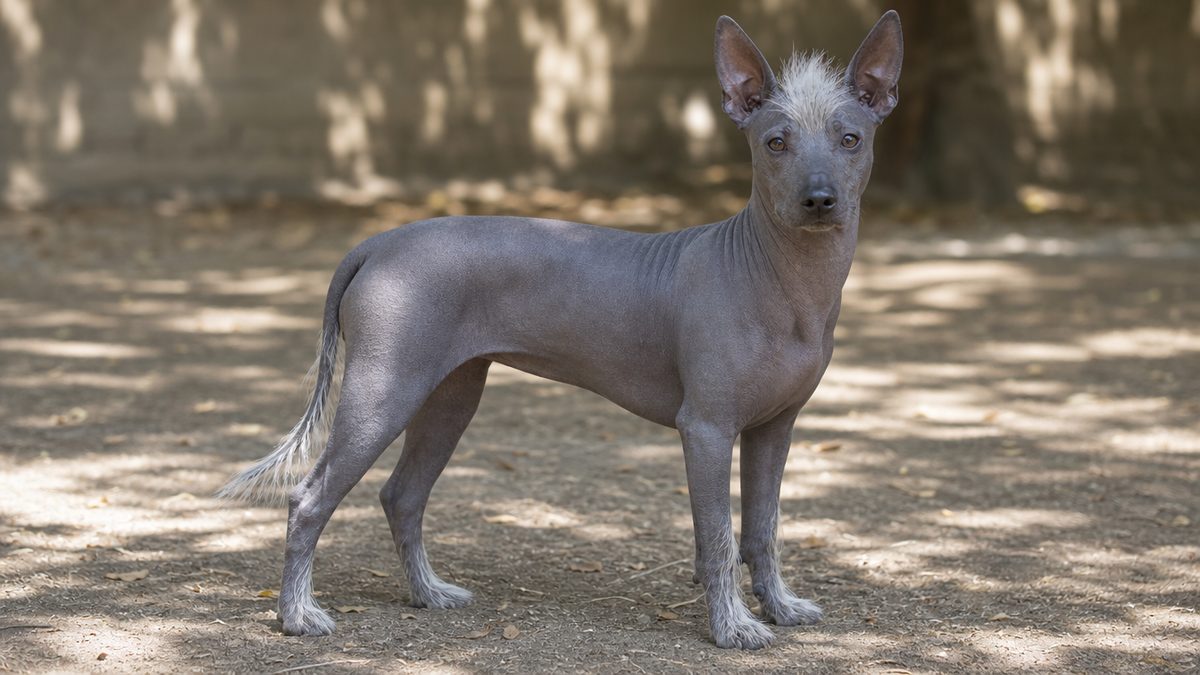
The hairless variety carries no coat except a few hairs on the head, at the ends of the legs and on the tail, sometimes sparse hair on the back. The coated variety is smooth, short and tight, in any colour except merle. Skin colour in the hairless variety runs from black through slate, elephant and bluish black, the whole scale of greys, bronze, copper and dark brown to light blond, and depigmented areas must not exceed 20 percent of the body.
The standard's preamble carries a rule most buyers never see. Coated dogs entering the register for the first time must be the product of two registered hairless parents, may then be mated only to hairless dogs, and crosses between two dogs of the coated variety are prohibited, as is entering an unregistered coated dog into any register. That is a registry deliberately keeping the coated variety tied to the hairless line rather than letting it become a separate population.
The teeth are part of the breed definition, not a defect
The standard states it twice. Under general appearance: the dentition in the hairless variety is nearly always incomplete, associated with the congenital alopecia. Under jaws and teeth: in the hairless variety the absence of one or more teeth is accepted, while in the coated variety the dentition must be complete with teeth normally developed and in a normal position, and more than one tooth missing in the coated variety is a disqualifying fault. A toothless mouth in a hairless dog is the breed. A toothless mouth in a coated one is a fault.
The presence of dewclaws is listed as a fault. A breeder tempted to remove them runs into Second Schedule Part II paragraph 6(8) of India's Dog Breeding and Marketing Rules, 2017, which forbids de-clawing, docking, cropping and any other kind of mutilation of any body part of the pup, adding that any change of appearance by artificial means is strictly forbidden. A fault in a standard is not a licence to operate.
FOXI3: the gene that decides the coat, the teeth and the litter
Hairlessness in this breed comes from a 7 base-pair duplication in the first exon of FOXI3, inherited as a semi-dominant trait whose homozygous state is not found in living dogs, so the gene decides how many puppies are born alive as well as how they look.
Drogemuller and colleagues published the mechanism in Science in 2008, working from Mexican and Peruvian hairless dogs and Chinese crested dogs, all showing missing hair and teeth in a phenotype they termed canine ectodermal dysplasia. Genome-wide association mapped the mutation to a 102 kilobase interval on chromosome 17, and the interval contained a previously uncharacterised forkhead box transcription factor, FOXI3, specifically expressed in developing hair and teeth. The abstract states that canine ectodermal dysplasia is inherited as a monogenic autosomal semidominant trait.
The Peruvian Hairless Dog was one of the breeds sampled in that original paper, which matters. Several South American hairless populations are only presumed to carry the variant on the strength of a shared phenotype. This one was tested.
The molecular detail, and the sentence that decides litter size
Parker and colleagues describe the variant as a 7 base-pair duplication in exon 1 producing a frameshift, a premature stop codon and the loss of 95 percent of the normal protein, and record that in addition to the Chinese crested, the Xoloitzcuintli and the Peruvian Hairless Dog carry the same mutation. Their next sentence is the one a buyer needs: 'The lack of homozygotes in either breed suggests that the mutation is embryonic lethal, perhaps due to other functions of the gene.';
Read the arithmetic off that. Every hairless dog of this breed is an obligate heterozygote. A hairless-to-hairless mating produces, on average, one homozygote in four, and that one is not born. Of the puppies that are born, two in three are hairless and one in three is coated, which is exactly why breeders like the pairing.
| Mating | Conceptions lost | Born hairless | Born coated |
|---|---|---|---|
| Hairless x hairless | about 25 percent | about 50 percent of conceptions, two thirds of those born | about 25 percent of conceptions, one third of those born |
| Hairless x coated | none from this allele | about 50 percent | about 50 percent |
| Coated x coated | none from this allele | none | 100 percent |
Ask what the sire and dam were, hairless or coated, and how many puppies were born against how many were expected. A breeder pairing two hairless dogs is choosing a mating that loses a quarter of the litter before birth, and a breeder who has never thought about it is not the person to buy a semi-dominant lethal from. This is also why the FCI standard's own rule tying coated dogs to hairless parents matters: it keeps a route open to matings that do not carry the loss.
One hairless breed is genuinely different
Not every hairless dog carries this problem. The American Hairless Terrier is, in the same paper's words, the only hairless breed in which the trait is recessive, so the homozygous state is not lethal, and those dogs are described as remarkably healthy animals born with a sparse fuzzy coat that is lost within the first months. If the appeal is a coatless dog rather than this specific breed, that difference is worth a conversation before any money moves.
The breed is not genetically tidy, and the paper says so
A 161-breed genomic study assessed how cleanly each breed forms its own clade. Of the 15 breeds that failed the monophyly criteria, two were split between divergent clades outright, and they were the Xoloitzcuintli and the Peruvian Hairless dog. That is not a criticism of the dogs. It reflects a real population history in which regional hairless dogs were assembled into modern breeds from partly distinct stock, and it is the reason a pedigree matters more here than the label on it.
The teeth evidence, and what it does and does not say
The definitive study of the hairless dental phenotype describes lost permanent canines, premolars and some incisors, and it was done on fourteen museum specimens from a German breeding experiment of 1914 to 1919, not on Peruvian dogs. Both halves of that sentence belong on a page an Indian buyer will act on.
Kupczik and colleagues extracted ancient DNA from a historical skeletal collection, identified the FOXI3 variant, and described the associated dentition. Their words: 'Unlike in the coated wild type dogs, the hairless dogs were characterised in both the mandibular and maxillary dentition by a loss of the permanent canines, premolars and to some extent incisors. In addition, the deciduous fourth premolars and permanent first and second molars consistently lacked the distal and lingual cusps';. The paper's title names the mechanism as FOXI3 haploinsufficiency, meaning one working copy of the gene is not enough.
Whose skulls they were
The methods section is specific and almost nobody who cites this paper quotes it. The samples came from a breeding experiment by the German zoologist Ludwig Plate, who studied the heredity of hair, skin and skeleton-dental characteristics across four generations between 1914 and 1919. The founding pair was a male hairless dog originally from Ceylon and a female coated dachshund, producing 33 animals over three filial generations with one F2 male backcrossed three times. Of the original 35 animals, 13 macerated skulls and one alcohol-fixed juvenile survive at the Phyletisches Museum of the Friedrich Schiller University Jena. DNA was recovered from 10 of the 14 specimens, and six individuals with the ectodermal dysplasia phenotype were heterozygous for the 7 base-pair duplication.
Six heterozygous dogs from one century-old German cross is a small, precise, honest sample, and it is not a sample of Peruvian Hairless Dogs. The finding transfers because the variant is the same one the Peruvian breed carries, established directly by Drogemuller and colleagues. What does not transfer is any implied prevalence. Nobody has counted teeth across a population of living Peruvian Hairless Dogs and published it. And the founding sire came from Ceylon, which puts a South Asian hairless dog at the root of the most-cited dentition study in this literature.
What the histology found, which is the opposite of what gets repeated
The claim that hairless dogs have defective sweat glands is widely printed and is contradicted by the only detailed histological study of the tissue. Wiener and colleagues took skin biopsies from 22 Chinese crested dogs and examined glands from a further two on post-mortem, comparing true hairless, semi-coated and powderpuff phenotypes. FOXI3 mutants had only simple primary hair follicles where non-mutant powderpuffs had compound follicles identical to other breeds, and all the dogs had an anagen-dominated hair cycle. Then the sentence that matters: apocrine glands in the skin and respiratory mucous glands of the mutant Chinese crested dogs were present and normal.
Set that against a review in the same field which lists 'defects in teeth, nails, sweat glands' among the health issues of the hairless Chinese crested. Two papers, one primary histology on 24 animals and one narrative review, disagreeing on the same breed. This page follows the histology and says so, because a study that sectioned the tissue outranks a sentence summarising older sources.
Two limits on the glandular finding, stated plainly
- It was done on Chinese crested dogs, not Peruvian ones. The variant is shared; the breed is not. Do not present it as a measurement of this breed.
- It does not make the dog better at cooling. Dogs shed heat by panting rather than by sweating through skin, so normal apocrine glands are good news about skin health and are not a thermoregulation advantage.
- It says nothing about cats. The canine FOXI3 tooth-loss and glandular evidence is specific to dogs carrying this variant and does not transfer to feline hairlessness, which has a different genetic basis entirely.
The Indian legal clause the phenotype runs into
India's Prevention of Cruelty to Animals (Dog Breeding and Marketing) Rules, 2017 require at Second Schedule Part III paragraph 8(10) that breeding dogs shall have been tested for genetic defects, 'including hip dysplasia, progressive retinal atrophy, night blindness, hypothyroidism, entropion, ectropion, overshot, undershot jaw (when incisors do not touch or mesh), wry mouth, two or more missing teeth, unilateral cryptorchid or full cryptorchid males'. That clause sits in the Second Schedule, not in the Rules, which run only from 1 to 13.
Read the collision plainly. This breed's defining phenotype is missing teeth, and Indian law names two or more missing teeth as a genetic defect a breeding dog must have been tested for. The word in the clause is 'including', so the list is illustrative rather than closed. Bonbeno does not claim that breeding a hairless dog is unlawful in India, because no court has read the clause that way and no Indian breeder of this breed exists to test it against. What is fair to say is that anyone planning to breed hairless dogs in India is planning around a trait their own law names.
History and recognition, where three official dates disagree
The pre-Columbian claim for this breed survives genetic testing better than most, and the FCI's own two documents give recognition dates four years apart.
The FCI standard's brief historical summary calls the dog the viringo and places it on the ceramics of pre-Inca cultures including Vicus, Mochica, Chancay, Chancay with Tiahuanaco influence and Chimu, stating that the hairless dog appears in the archaeological periods of pre-Inca times from 300 BC until 1460 AD. Unusually for a breed origin story, that claim has been tested.
The pre-Columbian claim, tested with mitochondrial DNA
Van Asch and colleagues traced the mitochondrial lineages of Inuit, Eskimo and Greenland dogs, the Alaskan Malamute, the Chihuahua, the xoloitzcuintli and the perro sin pelo del Peru against 984 East Asian and 639 European dogs plus previously published pre-Columbian sequences. They found evidence for a pre-Columbian origin for all of these breeds except the Alaskan Malamute, where the result was ambiguous, and reported that North and South American breeds carried at most 30 percent European female lineages, indicating only marginal replacement by European dogs.
So the Peruvian Hairless Dog belongs to a small group of breeds whose antiquity claim is supported rather than contradicted by molecular work. That is worth stating precisely, because this site more often reports the reverse: a modern breed wearing an ancient story.
It means the maternal lineage traces to dogs present in the Americas before European contact. It does not mean the modern registered breed is unchanged since 300 BC, and the same corpus of work shows the modern breed failing a monophyly test and splitting between divergent clades. Old ancestry, modern breed. Both are true at once.
Three official dates for one recognition
The FCI's own breed record gives the date of acceptance on a definitive basis as 30 June 1981. The FCI's own standard, in its preamble, says the naked variety 'was officially recognized as a breed native to Peru in 1985, during the ordinary Assembly of the FCI at Amsterdam city, thanks to the initiative of the Cynologist Ermanno Maniero, who did the first breed standard', and that it was registered under number 310 of the nomenclature.
| Document | Date given | Read 8 September 2026 |
|---|---|---|
| FCI breed register, record 310 | 30 June 1981, definitive acceptance | month-first format proven on the record's own face, since 30 cannot be a month |
| FCI Standard 310, preamble | 1985, FCI ordinary Assembly, Amsterdam | the standard's own account of how the breed entered the nomenclature |
| Peruvian public commemoration | 12 June, Dia del Perro Peruano | widely observed, and the year attached to it in circulation is 1985 |
Both FCI documents are current and official and they cannot both be right. This page prints both and picks neither. The pattern is a known one on this site: a registry's dated record and its own breed standard disagreeing about the same event.
The names, because they matter for searching
Peru's own regulation lists the alternative names in a single article: perro viringo, perro chimu, perro chino, perro ccala, perro calato, perro de sechura, perro alco and perro de castilla. English adds Peruvian Inca Orchid, Inca Hairless Dog, Moonflower Dog and Perros Flora, while Wikipedia's own lead calls the breed the only living breed of dog indigenous to Peru. A search under one name misses the literature under the others, and the phrase 'Peruvian Hairless' returns zero records in a quoted title-and-abstract PubMed search while unquoted terms return real ones.
Peru protects this breed by law, and that changes the buying question
Peru declared the Peruvian Hairless Dog national heritage in 2001 and regulated it in 2005 with a 29-article decree that controls breeding, microchipping, sale and export. A buyer who reads only the FCI has read the smaller half of the story.
Ley N 27537 is two articles long and does exactly two things. Article 1 recognises the canine breed 'perro sin pelo del Peru' as a breed native to Peru, granting it the quality of patrimonio nacional, especie a preservar, national heritage and a species to be preserved. Article 2 directs the Ministry of Agriculture to regulate the law and permits it to entrust the conservation, promotion of breeding and export of the breed to public or private entities, within 60 calendar days.
The dates are worth getting right because four circulate. The Congress passed it on 26 September 2001; the President did not promulgate it within the constitutional deadline, so the President of Congress ordered its publication on 22 October 2001 under Article 108 of the Constitution; it was published in El Peruano on 23 October 2001 at page 211663 and entered into force on 24 October Congreso de la Republica del Peru.
The law says patrimonio nacional. A Ministry of Culture publication describes the same instrument as 'Decreto Ley N 27537' declaring the breed 'Patrimonio Cultural de la Nacion' on 22 October 2001. It is a Ley rather than a Decreto Ley, the category it confers is patrimonio nacional rather than Patrimonio Cultural de la Nacion, which is a different legal designation, and the publication date is 23 October. The error is repeated by SENASA and across the Peruvian press. Read the gazette, not the celebration post.
The regulation is where the operative rules live
Decreto Supremo 036-2005-AG, published on 11 August 2005 at El Peruano page 298322 and in force from 12 August, runs to 29 articles across ten titles. It creates a Comite Nacional de Proteccion del perro sin pelo del Peru whose nine seats include SENASA, INRENA, the Ministry of Health, the Instituto Nacional de Cultura, a university veterinary faculty, CONCYTEC, an accredited animal protection body, the Kennel Club Peruano and the breeders themselves.
| Article | What it requires | Why it matters to you |
|---|---|---|
| Art. 6(i) | The National Committee must issue guidelines to control hereditary defects in breeding centres | the state has named hereditary defect control as a duty, which is the FOXI3 question in official language |
| Art. 12 | Research lines include population genetics and biennial national population counts | there is meant to be a live headcount of the breed in Peru |
| Art. 17 | Breeding centres must register with the municipality and hold at least three litters and three generations recorded with the Kennel Club Peruano | an unregistered Peruvian seller is outside the scheme |
| Art. 18(e) | No artificial insemination using animals that have not previously bred naturally | a specific restriction on how the line may be propagated |
| Art. 18(g) | Every puppy must be registered with the Kennel Club Peruano and marked with a microchip | ask for the chip number, not just a pedigree |
| Art. 19 | Breeding centres must leave the best specimen of each litter in the country as breeding stock | the best puppy in the litter is not for export, by law |
| Art. 21 | Sellers must issue a certificate of origin naming the dog, place and date of birth, sex and microchip code | this is the document to demand |
| Art. 22 and 24 | SENASA issues the export zoosanitary certificate after the National Committee's technical opinion, and customs verifies it | export is a committee decision, not a private sale |
Article 19 is the one nobody outside Peru mentions and it reframes the whole purchase. A Peruvian breeding centre is legally obliged to keep the best specimen of every litter in the country. Whatever is offered for export is, by the regulation's own design, not that puppy.
A state recognition that is not a kennel club, and living dogs in museums
Before the law, the Instituto Nacional de Cultura issued Resolucion Directoral N 001-INC directing that the Peruvian dog be included in the site museums and archaeological zones of the National System of Museums and Archaeological Zones on the Peruvian coast that could assure its breeding, care and normal development. That is a culture ministry putting living animals into archaeological sites as heritage, and the dogs are named: Nam and Tallan at the Narihuala site museum in Piura; Celeste and Namla at Tucume in Lambayeque, parents of Ceterni, Tucume and Cium; Killa and Chimoc at Cabeza de Vaca in Tumbes, joined in March 2020 by Chaska.
The registries, and one status change dated in the future
The FCI holds the breed definitively as 310. The American Kennel Club has had it in the Miscellaneous Class since 1 January 2011 and eligible for lure coursing since 1 September 2012, with the Peruvian Inca Orchid Club of the United States as parent club since November 2010, and its own page states that the breed has been approved to Full AKC status effective 30 December 2026, in the Hound Group. That date is still in the future as this page is published, so the status is Miscellaneous today and full recognition is four months away. Register membership drifts in weeks, so both readings are date-stamped here rather than smoothed over.
Note also a classification disagreement worth knowing: the AKC calls the breed a sighthound and places it in the Hound Group, while the FCI files it in Group 5 among primitive types rather than in Group 10 with the sighthounds Federation Cynologique Internationale. For India the FCI reading governs in practice, because the Kennel Club of India is the FCI's full member for India The Kennel Club of India.
Peruvian Hairless Dog price in India: none exists, and the rupee figures are craft items
No verified peruvian hairless dog price in india exists. The Indian result set for that exact query contains a video about a different breed, a craft marketplace, and eight foreign pages pricing the dog in dollars or pounds.
The India-located search on 8 September 2026 returned, in order: a YouTube video about the Xoloitzcuintli, a Pinterest board, a US hairless-breeds listicle, an Etsy market page, a US breeder marketplace, a UK breed page, a US kennel's social page, the AKC breed page, a US puppy marketplace and a New Zealand insurer. Not one of them offers a live dog in India.
The only rupee figures in the set price objects, not animals
Position four is an Etsy market page whose title reads, literally, 'Buy Peruvian Hairless Dog Online In India'. The search snippet shows Rs 413, Rs 418, Rs 467, Rs 523, Rs 582 and Rs 930. Opening the page settles what those are: 659 relevant results, and Etsy's own copy on that page describes 'one-of-a-kind handcrafted options to vintage treasures', 'makers and independent designers', and 'personalized, made-to-order items';. Those rupee figures price prints, stickers and ornaments.
A page titled 'Buy Peruvian Hairless Dog Online In India' ranking fourth on the Indian commercial query, carrying real rupee prices, none of which is for a dog. To a scraper, and to an answer engine, that looks exactly like Indian price data. Before quoting any rupee figure for any breed, confirm the listing is for a live animal.
The control, because an absence has to be earned
In the same session, on the same instrument, with the same India location, 'labrador retriever price in india' returned ten genuine Indian pages with real rupee bands: Supertails at Rs 8,000 to Rs 70,000, Mr n Mrs Pet at Rs 30,000 to Rs 1,20,000 with a city table covering Hyderabad, Bangalore, Delhi, Chennai, Lucknow, Mumbai, Jaipur and Pune, and two more retailers at Rs 8,000 to Rs 65,000 and Rs 15,000 to Rs 50,000 Mr n Mrs Pet, Labrador Retriever puppies…. The instrument reads Indian commercial queries correctly and simply has nothing Indian to show for this breed. The bare informational control on Google India passed too, returning genuine Labrador results and a live People-also-ask box.
What the breed costs where it is actually sold
| Source | Currency | Band |
|---|---|---|
| Good Dog, US breeder marketplace | USD | 2,100 to 3,250 nationally |
| Good Dog, one US listing | USD | 250 deposit plus 300 to 2,250 final payment |
| Dog Breeds List | USD | 2,000 to 4,000 |
| Wamiz, UK | GBP | 1,500 to 2,500, with 50 to 80 a month running cost |
| Google AI summary, Google India | USD | 1,500 to 3,200, and 2,000 to 4,000 for hairless against about 800 for a coated littermate |
Wamiz's UK band of 1,500 to 2,500 pounds with 50 to 80 pounds a month in running costs, and Dog Breeds List's 2,000 to 4,000 US dollars, are the two most widely copied figures in that table. Two things about the last row. Google's own generated answer for the Indian query prices the breed only in dollars and offers no rupee figure at all, which is unusual and, on this occasion, honest. And its coat-based price split is the FOXI3 arithmetic showing up in a price list: the coated littermates that a hairless-to-hairless mating produces as one third of the surviving puppies are the cheap ones.
And Peru controls the supply at the other end
Even with money and a willing breeder, the export is not a private transaction. Every exported dog needs a SENASA zoosanitary certificate issued after the National Committee's technical opinion, every puppy must carry a microchip whose code appears on the pedigree, and the breeding centre must have left the best specimen of the litter in Peru. At the Indian end, DGFT Trade Notice 22/2022-23 makes dogs Restricted under ITC(HS) 01061900, permits entry only for a pet with a valid pet book in the importer's name, for research with CPCSEA recommendation or for Defence and Police use, and states that applications for trading or breeding purposes shall be duly rejected. Those import rules mean a commercial Indian supply chain for this breed cannot lawfully form.
Bonbeno publishes no landed-cost figure here, because every band on offer is a foreign price plus a guess, and because the one Indian-currency number in the whole result set is the price of a poster. Treat every Indian rupee figure you meet for this breed as unverified until somebody names the litter it came from. The dog is expensive everywhere it is genuinely sold, and it is unpriced here.
Monthly cost of keeping a Peruvian Hairless Dog in India
Budget roughly Rs 3,200 to Rs 7,500 a month for a 10 to 12 kg medium Peruvian Hairless Dog in an Indian metro, plus a sun-protection line no other breed page carries and no grooming line at all.
This breed inverts the usual Indian cost table. There is no coat to clip, so the grooming line that dominates a Shih Tzu's budget is close to zero, and in its place sit skin care, sunscreen and, in most Indian cities, more hours of indoor cooling than a coated dog needs.
| Line | Basis | Per month |
|---|---|---|
| Food, dry complete diet | about 180-240 g a day for a lean 10-12 kg adult | Rs 1,800-3,200 |
| Parasite control, ticks and worms | monthly combination cover in the small-dog band | Rs 700-950 |
| Vaccination, annualised | Vetic annual booster from Rs 3,199, anti-rabies Rs 699 | Rs 320-420 |
| Skin care and sunscreen | a dog-safe sunscreen and a plain moisturiser | Rs 250-600 |
| Municipal registration, annualised | Delhi Rs 500 a year, Chennai Rs 50 | Rs 4-42 |
| Grooming | no clipping, no stripping, occasional bath and nails | Rs 0-450 |
| Dental care reserve | a breed whose dentition is nearly always incomplete | Rs 300-800 |
| Vet reserve | one consultation a quarter at Rs 500-1,000 | Rs 170-330 |
| Total, ordinary month | Rs 3,544-6,792 |
The vaccination line comes from Vetic, a chain of more than 50 clinics across seven Indian metros, whose published card gives an annual booster starting at Rs 3,199, anti-rabies at Rs 699, a 9-in-1 DHPPiL at Rs 899 and kennel cough at Rs 1,349. Treat those as one chain's promotional floor rather than a market average. Deworming is dosed by weight, so a 12 kg dog takes between one and two Drontal Plus tablets at about Rs 126 each, roughly Rs 126 to Rs 252 per cycle.
The two lines that are specific to a hairless dog
- Dental reserve. The FCI standard says the dentition in the hairless variety is nearly always incomplete, and the teeth that are present carry abnormal cusp morphology. Budget for annual dental checks from puppyhood rather than from middle age.
- Sun protection. The AKC's own guidance is that these are not outdoor dogs and require sunscreen on sunny days. A dog-safe sunscreen is a recurring consumable in India, not a holiday purchase.
- Cooling and shade, which is an electricity cost rather than a product cost, and which the boarding operator also has to provide.
- Clothing in the north, because a naked dog in a Delhi or Jaipur January meets mean air temperatures of 13.6 C and 14.5 C, and the same skin that burns in May gets cold in December.
Municipal registration is cheap and legally real. Delhi charges Rs 500 for a new pet dog registration and Rs 500 to renew, with a Rs 100 monthly late fee, and it registers dogs only. Greater Chennai Corporation licenses pet animals at Rs 50, issued 9,115 licences in 2024, and runs six pet clinics where you can vaccinate the dog against rabies and have it treated free of cost.
Boarding is the line that ruins a travel plan and it is worse for this breed than for most. PawSpace in Bengaluru publishes Rs 599 for up to four hours, Rs 799 for daycare to ten hours and Rs 899 overnight, so a two-week trip is about Rs 12,600. Before booking, ask the operator two specific questions: is there shade over every outdoor run, and what happens to the air conditioning during a power cut.
Heat, humidity and sun, worked from measured data instead of assumptions
The Peruvian coast is more humid than any Indian city measured here and carries a higher mean surface UV than Delhi, Kolkata, Jaipur, Mumbai or Chennai. The thing India adds is heat and the length of the hot season, not damp air and not sunlight.
Getting the homeland baseline right took work, because NASA POWER returns a grid cell rather than a place and two obvious Peruvian points are unusable.
| Point | Real elevation | POWER cell elevation | Error | Used? |
|---|---|---|---|---|
| Lima | about 154 m | 1,194.76 m | +1,041 m | no |
| Trujillo | about 34 m | 1,872.38 m | +1,838 m | no |
| Chiclayo | about 29 m | 33.93 m | +5 m | yes |
| Tumbes | about 8 m | 61.27 m | +53 m | yes |
Trujillo's cell sits 1,838 m above the real town, which is worse than Lima's already-documented 1,041 m error, and the annual mean temperature it returns, 18.04 C, looks entirely plausible for coastal Peru. The Humboldt current cools this coast in the same direction the elevation error does, so the two mistakes cancel and nothing in the temperature would have flagged the problem. Only the elevation echo caught it, twice, on one coastline.
Homeland against India
| Place | Annual air temp | Annual RH | Annual wet bulb | Peak monthly wet bulb |
|---|---|---|---|---|
| Chiclayo, north coast Peru | 20.33 C | 88.10 % | 18.86 C | 21.89 C in February |
| Tumbes, far north Peru | 24.79 C | 73.71 % | 21.26 C | 23.05 C in March |
| Bengaluru | 23.74 C | 67.94 % | 19.48 C | 21.86 C in May |
| Pune | 23.86 C | 66.80 % | 19.43 C | 22.97 C in June |
| Jaipur | 25.58 C | 40.94 % | 17.02 C | 25.33 C in July |
| Delhi | 25.60 C | 45.56 % | 17.80 C | 26.50 C in July |
| Mumbai | 26.77 C | 67.39 % | 22.20 C | 25.77 C in June |
| Kolkata | 25.81 C | 73.93 % | 22.25 C | 27.09 C in June |
| Chennai | 27.95 C | 72.39 % | 24.04 C | 26.11 C in May |
Read the humidity column first, because it kills the commonest claim made about this breed. Chiclayo runs 88.10 percent mean annual relative humidity, higher than Kolkata at 73.93, Chennai at 72.39, Bengaluru at 67.94, Mumbai at 67.39, Pune at 66.80, Delhi at 45.56 and Jaipur at 40.94. The dog's own heartland is the most humid place on that table. A page telling you Indian humid air will harm a Peruvian hairless dog has not looked at Peru.
The wet-bulb column is more interesting still. Bengaluru's peak of 21.86 C is below Chiclayo's 21.89 C and below Tumbes's 23.05 C, and Pune at 22.97 C sits between them. Chennai at 26.11, Delhi at 26.50 and Kolkata at 27.09 are two to five degrees above anything the homeland produces. So the Deccan cities are, on combined heat load, no worse than coastal Peru, and the coastal and northern plains cities are meaningfully worse.
POWER's T2M_MAX on the climatology endpoint is the highest value ever recorded in the period, not a mean daily maximum. Delhi's May figure of 48.08 C and Chennai's of 42.70 C are period extremes. Never feed T2M_MAX into a wet-bulb calculation: any wet bulb above about 35 C is physically impossible and is the fingerprint of exactly that error.
Sun, and a second claim that does not survive the data
Mean surface UV was pulled from the same source by explicit latitude and longitude. Chiclayo returns 2.16 and Tumbes 2.11 as annual means, against Bengaluru 2.08, Chennai 1.95, Mumbai 1.79, Jaipur 1.65, Kolkata 1.54 and Delhi 1.36. These are POWER's monthly means of a daily-mean quantity on its own scale, not WHO noon UV Index values, and they are useful only for comparing one place with another. On that comparison the homeland is at least as sunny as the Indian cities and sunnier than most of them.
That does not make sunburn a non-issue. It relocates the issue. The dog is adapted to sun in the sense that its ancestors lived under it, and it is still an animal with exposed skin, so the AKC's instruction stands: not an outdoor dog, and sunscreen on sunny days. Peru's own history is the argument. A Ministry of Culture account records that in colonial cities the viringo was despised because the lack of care for skin exposed to the sun made it form crusts, so it was taken for a mangy, sick animal. Unmanaged sun exposure has been damaging this dog's skin for four centuries. Management, not latitude, is the variable.
The practical day, city by city
- Bengaluru and Pune are the best Indian fit, with a combined heat load no worse than the breed's own coast and a shorter hot season than the plains.
- Mumbai and Chennai need indoor cooling through the hot months and a hard stop on midday walks from March to June.
- Delhi and Jaipur are a two-season problem: 35 C mean May temperatures and January means near 14 C, so the same dog needs shade in summer and a coat in winter.
- Kolkata carries the highest peak wet bulb on the table and the least relief from the monsoon.
- Everywhere, walk before 07:00 and after 19:00 in the hot season and use shade rather than sunscreen as the first line of protection, because this is a sun-sensitive dog in a sunny country and a heat-sensitive one in a hot one.
Size is its own risk factor. Hall and colleagues, from 905,543 UK dogs under primary veterinary care in 2016, found bodyweight at or above the breed and sex mean carried an odds ratio of 1.42 for heat-related illness, and the companion paper found that of 879 heat-illness events with a recorded trigger, 652 were exertional, which is 74.2 percent. Even in a temperate country the danger was exercise, not the parked car.
Temperament and household fit
The Peruvian Hairless Dog is noble and affectionate with its own people, lively, alert and wary of strangers, and its temperament range is wider than most breeds because it is a primitive type rather than a heavily standardised companion breed.
The FCI standard's behaviour clause reads: noble and affectionate at home with those close to him, at the same time lively and alert, he might be wary of strangers and is a good watch dog. The AKC repeats that and adds the harder half. Because they are a primitive breed, these dogs have a wide range of temperaments, from a typical docile sighthound to a more feral temperament, they require a great deal of socialisation, they are not recommended for families with small children though they can do well with older considerate ones, and rough play with puppies is discouraged because it can promote aggressive behaviour.
Household fit in an Indian flat
- Well suited to an apartment, and the AKC says the breed should be kept in the house and does not make a good outdoor dog. In India that instruction is a heat and sun instruction as much as a behavioural one.
- Good with a calm adult household that wants a quiet, clean, close-contact dog and can supply consistent handling.
- Cautious with small children, on the parent club's own advice, and better with older ones who understand that a hairless dog is physically fragile.
- Watchful of strangers, which in an Indian building means deliberate, repeated, positive exposure to domestic staff, delivery riders and the watchman rather than hoping the dog settles.
- Manageable with cats and small dogs if raised together, with supervision, though the AKC notes caution around small pets that may be seen as prey.
The physical fragility deserves stating because Indian households often handle dogs the way they handle a Labrador. There is no coat between this dog's skin and a fingernail, a wicker basket, a rough floor or another dog's tooth. Scratches mark, heal slowly and scar visibly. A household that cannot commit to gentle handling should not buy the breed.
A naked dog will find the warmest surface in the room and stay on it, which in an Indian winter means your bed and in an Indian summer means the tiled floor under the fan. Give it both deliberately: a raised warm bed for December in the north, and a cool mat or plain tile in shade for May. Fighting the behaviour is pointless; providing for it is cheap.
Training and socialisation for a primitive breed
Train this breed with patience, food and repetition, and treat socialisation as the main job rather than obedience, because the AKC calls it intelligent, a challenge to train, and in need of a great deal of socialisation.
The AKC's own training note is direct: Peruvian Inca Orchids require a great deal of socialisation and should be kept in the house, the breed is intelligent and can be a challenge to train, and new owners should be able to commit to a substantial amount of time to train and socialise a puppy. That is a registry warning buyers off an impulse purchase, which is worth taking at face value.
What works
- Food first, always. A primitive breed works for something it wants rather than to please you, and food is the clearest currency.
- Short sessions. Three five-minute blocks beat one twenty-minute block with a dog that disengages when bored.
- Socialise in the first sixteen weeks and carry the puppy out before the vaccination course finishes, because the window closes on its own schedule.
- Handle the whole dog daily. Ears, feet, mouth and belly, so that skin checks, sunscreen and dental examination are routine rather than a fight.
- Build an indoor settle, because this is a house dog that will spend the Indian hot season indoors.
What does not work
Do not use aversive equipment. A prong collar, choke chain or slip lead on a thin-skinned, thin-necked dog is a welfare problem before it is a training problem, and this breed has no coat to spread the pressure. Do not use rough play to tire a puppy, on the parent club's own advice. And do not expect a primitive breed to generalise a cue from the living room to a Chennai footpath without being taught it again in that context.
Where to train, in Indian heat
Move training indoors from March to June. A dog that is asked to work outdoors in the middle of an Indian afternoon learns that training is unpleasant, and it is also being exposed to the exact risk the heat data warns about: exertional heat illness dominated the UK heat-illness dataset even in a temperate country. Early morning and late evening for physical work, air-conditioned indoors for everything else.
If a breeder abroad suggests close matings to hold type in a small population, check that against Second Schedule Part II paragraph 6(3) of India's Dog Breeding and Marketing Rules, 2017, which prohibits in breeding between relatives of the 2nd to 4th grade within the first four generations, naming uncle to niece, nephew to aunt, cousin to cousin and grandparent to grandchild, and separately prohibits incest breeding between parents and children or brother and sister. A founding population of a handful of imported dogs runs into that clause quickly.
Daily exercise, and why the schedule matters more than the distance
Give a Peruvian Hairless Dog two walks a day plus indoor activity, and set the timing by the wet-bulb table rather than by your own convenience, because the exposure risk is the sun and the heat rather than the distance.
The AKC's exercise guidance is unusually flexible for a hound: play time in a preferably fenced yard, walks several times a day, and indoor options such as hide-and-seek, chasing a ball rolled along the floor or learning new tricks, with a note that short walks in apartment hallways can supply exercise during inclement weather, plus agility, obedience and rally as structured outlets. That indoor emphasis is exactly right for India, where the outdoor window shrinks to two hours a day for four months of the year.
| Slot | What it is | Duration |
|---|---|---|
| Before 07:00 | lead walk with sniffing time, shaded route | 20-30 minutes |
| Mid-morning, indoors | scent game, food puzzle or a short training block | 10-15 minutes |
| Afternoon, indoors | rest on a cool surface in shade, no activity | - |
| After 19:00 | second lead walk, longer if the ground has cooled | 20-30 minutes |
| Twice a week | enclosed run or agility practice in a shaded or indoor space | 15-20 minutes |
The breed is eligible for lure coursing at the AKC and has been since 1 September 2012, and it does well at rally and agility. Those are good Indian outlets precisely because they are short, structured and can be run early or indoors.
The three exercise mistakes that matter here
- Walking on hot ground. A surface that is uncomfortable to your palm for five seconds will burn paw pads, and this dog has no belly coat shielding it from radiated heat off the pavement.
- Midday sun exposure, which on unpigmented skin is a burn rather than a tan. Shade first, timing second, sunscreen third.
- Letting a keen dog set the pace. A dog that wants to keep going in May is not reporting that it is safe. Stop the session early and carry water.
In Delhi and Jaipur the January mean air temperature is 13.61 C and 14.51 C, and the same skin that needs shade in May needs a fitted coat in December. A hairless dog is a two-season management problem in north India and a one-season problem in the south.
Grooming a dog with no coat, in Indian conditions
Grooming this breed means skin care rather than coat care: bathe rarely, moisturise where the skin is dry, manage sun exposure, and use the daily handling session as a tick check.
There is no coat to brush, no undercoat to blow and nothing to strip. The AKC's grooming guidance is a bath as needed, nails trimmed to avoid overgrowth splitting and cracking, ears checked for wax and debris, teeth brushed when needed, and the line that matters most in India: these are not outdoor dogs and require sunscreen on sunny days.
The Indian skin routine, week by week
- Daily, a two-minute hands-on pass over the whole dog, looking for scratches, new pigment, crusts, ticks and dry patches.
- Before any daytime outing, sunscreen on the nose bridge, ear tips, belly and every unpigmented patch, using a product your veterinarian approves for dogs.
- Weekly, nails, and ears wiped rather than flushed.
- Monthly at most, a bath in lukewarm water with a mild dog shampoo. Bathe more often than that and you strip the skin, which is the commonest self-inflicted problem in this breed.
- After a bathe, dry the dog properly rather than letting it air dry, because Mumbai and Pune run above 89 percent relative humidity through July and August and a damp dog simply stays damp.
That last point is an example of a general rule on this site: care advice written for a temperate country does not always transfer. Air drying is fine in a Lima winter and questionable in an Indian monsoon.
Blackheads, acne and what not to do about them
Comedones on the chin, chest and belly are common in hairless breeds and Indian owners frequently attack them with human acne products, alcohol wipes or aggressive scrubbing. Do not. The skin is thin, the barrier is easy to damage, and a chemical burn on a naked dog is far worse than the blemish. Take a persistent or spreading eruption to a veterinarian rather than treating it at home.
The one genuine advantage of having no coat in India
Ticks have nowhere to hide. Studies of dogs presented at Indian veterinary clinics report very high tick-borne disease rates: 76.54 percent of 584 dogs positive for Babesia gibsoni in West Bengal with 72.9 percent carrying two or more pathogens, and 66.7 percent of 120 dogs positive for Babesia in Kerala with a pre-monsoon peak. Those figures come from dogs tested at veterinary clinics rather than a random population, so they overstate the risk for a healthy pet, and they set the direction clearly. On a hairless dog you will see a tick the day it attaches, which on a Labrador you would not, and that is a real clinical advantage rather than a consolation.
A-Z Animals, which ranks for the breed internationally, states the same requirement in one line: the Peruvian Inca Orchid is often hairless and therefore needs sun and cold protection and gentle handling.
There is nothing to clip, nothing to trim and nothing to blow-dry on a hairless dog. If a grooming parlour proposes a package, the only items on it that make sense are a mild bath, nails and ear cleaning. Flaky skin is a veterinary question, not a grooming upsell.
Health, screening and life expectancy
The Peruvian Hairless Dog's health profile is dominated by one gene and one organ: FOXI3 and the skin. Screen for patella, heart, eyes and hearing, plan for dental care from puppyhood, and treat sun exposure as the chronic risk.
The AKC's recommended tests from the national breed club are patella evaluation, cardiac exam, ophthalmologist evaluation and BAER testing. BAER is a hearing test, and its presence on the list for a breed with substantial unpigmented skin is not an accident: pigment and inner-ear function share a developmental pathway across species. Ask for BAER results specifically, because it is the test most often skipped.
Dentition, and what to do about it
Incomplete permanent dentition is a breed feature rather than a disease here, and it still has consequences. The FCI standard accepts the absence of one or more teeth in the hairless variety, and the dental phenotype associated with the variant includes loss of permanent canines, premolars and some incisors, and molars lacking their distal and lingual cusps. Practical consequences follow: fewer teeth means less self-cleaning, abnormal cusps mean food traps, and the remaining teeth carry more load.
- Start dental checks at six months, not at six years.
- Feed to the mouth the dog actually has. A dog missing its carnassials cannot process a hard chew the way a coated dog can.
- Brush the teeth that are present, daily if the dog will accept it, which is a training job started in puppyhood.
- Ask the breeder for the parents' dental radiographs if the line is being bred rather than kept.
Skin: sun, and a four-century-old observation
Sun damage is the chronic risk. A Ministry of Culture account of the breed records that in colonial Peruvian cities the dog was despised because the lack of care for skin exposed to the sun made it form crusts, so people took it for mangy and diseased. That is a description of chronic solar damage on unprotected skin written about the seventeenth century, and it is still the mechanism today.
Manage it with shade first, timing second and sunscreen third. Watch specifically for persistent redness on the nose bridge, ear tips and flanks, for crusting that does not resolve, and for any raised lesion on a lightly pigmented area that changes shape, and take those to a veterinarian rather than to a groomer.
What the histology does and does not say about the skin
The only detailed histological study of FOXI3-mutant skin found simple primary hair follicles instead of compound ones, an anagen-dominated hair cycle, and apocrine glands and respiratory mucous glands present and normal. So the common assertion that these dogs lack functioning skin glands is not supported by the tissue. That is good news for skin health and it is not a cooling advantage, because dogs shed heat by panting rather than through skin. Do not let a seller turn a histology finding into a claim that the dog tolerates heat better than a coated one.
Life expectancy, and an honest gap
The AKC gives 12 to 14 years. Google India's knowledge panel gives 11 to 12. No breed-specific life-table study covers this breed, and this page publishes no median from a paper that did not model it. Both published ranges are printed above and neither is presented as settled.
A quoted title-and-abstract PubMed search for 'Peruvian Hairless' returns zero records, and for 'Peruvian Inca Orchid' zero, while a Labrador and hip dysplasia control in the same session returned 126. Unquoted, 'Peruvian hairless dog' returns three records. Almost everything published about this breed is about the gene it shares with two other breeds, not about the breed itself. Treat any confident breed-specific health statistic you meet elsewhere with suspicion, and ask where it came from.
Feeding a dog whose mouth is part of the breed standard
Feed a Peruvian Hairless Dog to a visible waist on food its actual dentition can process, and check the mouth before choosing the format, because incomplete permanent dentition is normal in this breed rather than exceptional.
The AKC's nutrition guidance is generic, and the breed-specific part is not on the packet: match the food to the teeth the dog has. A dog missing permanent canines and premolars, with molars lacking their distal and lingual cusps, cannot shear and grind the way a full-mouthed dog can. That is a texture question before it is a nutrition question.
| Stage | Meals a day | Focus |
|---|---|---|
| 8 to 16 weeks | 4 | small-to-medium puppy food, softened if the deciduous teeth are sparse |
| 4 to 8 months | 3 | watch the mouth through teething, note which permanent teeth do not arrive |
| 8 to 12 months | 2 | transition to adult food, set the texture to the adult dentition |
| Adult, 1 to 8 years | 2 | hold a body condition score of 4 to 5 out of 9, ribs felt easily |
| Senior, 8 years and over | 2 | reduce calories, keep protein up, reassess the mouth annually |
Portions, and the arithmetic
A 10 to 12 kg active adult on a good dry complete diet eats roughly 180 to 240 g a day, which at Indian retail prices for a mid-to-premium kibble is about Rs 1,800 to Rs 3,200 a month. Verify grams per day against the bag you actually buy rather than against a number on a breed page, because feeding guides differ by more than 30 percent between brands at the same bodyweight. A large-variety dog at 20 kg eats roughly double.
Three Indian feeding realities
- Heat suppresses appetite. A dog that eats poorly in May and well in December is usually normal. Move the main meal to the coolest hour.
- Roti and rice fill a dog without feeding it. A hairless dog carrying extra weight shows it immediately, and bodyweight at or above the breed mean is itself a heat-illness risk factor.
- Hard chews need a mouth check first. A dog missing its shearing teeth may swallow a chew whole rather than reduce it, which is a foreign-body risk rather than a dental benefit.
Water matters more than any supplement. Carry it on every outing from March to June, offer it before and after activity rather than only after, and cool a hot dog with water on the belly, groin and paws rather than pouring it over the back.
Indian pet retail sells a large range of coat and skin supplements, and on a breed with no coat the marketing simply does not apply. Dry or flaky skin on this dog is a veterinary question about bathing frequency, sun exposure, parasites or diet quality, in that order, and a fish-oil capsule is not a substitute for working out which one it is.
Month by month through the first year in India
Plan the first year around four fixed points: the eight-week legal floor on sale, the socialisation window closing at about 16 weeks, the first Indian hot season, and the arrival or non-arrival of the permanent teeth.
Indian law sets the earliest possible start. Rule 8(1)(a) of the Prevention of Cruelty to Animals (Dog Breeding and Marketing) Rules, 2017 requires that pups less than eight weeks in age are not sold, and that is a Rule rather than a Second Schedule paragraph. Peru adds its own condition at the other end: every puppy must be registered with the Kennel Club Peruano and marked with a microchip, and the seller must issue a certificate of origin naming the dog, its birthplace and date, sex and microchip code.
| Age | What happens | What it costs or needs |
|---|---|---|
| 8-10 weeks | home, indoor settle, first vaccinations, daily whole-body handling | puppy DP from Rs 849, first vet consult Rs 500-1,000 |
| 10-14 weeks | core course continues, carried socialisation, first sunscreen habit | 9-in-1 DHPPiL from Rs 899 per shot |
| 12-16 weeks | anti-rabies, BAER hearing test if not already done, municipal registration | rabies Rs 699, Delhi Rs 500 or Chennai Rs 50 |
| 4-8 months | teething, and the moment to record which permanent teeth arrive | first dental assessment, deworming about Rs 126-252 a cycle |
| 6-9 months | first Indian hot season, indoor exercise, shade discipline | monthly parasite cover about Rs 700-950 |
| 9-12 months | adult food transition, patella and cardiac screening discussion | screening costs vary by city, ask for written reports |
| 12 months | annual booster, adult body condition set, dental baseline recorded | booster from Rs 3,199 |
The four things that go wrong in an Indian first year
- Sunburn in the first summer. A puppy sleeping in a sunny patch on a tiled floor for two hours in April is being burned, slowly, indoors. Move the bed.
- Socialisation lost to the vaccination schedule. Carry the puppy out rather than waiting for the course to finish, because the window closes on its own timetable.
- Nobody records the dentition. Write down which permanent teeth arrive between four and eight months. That record is the baseline every later dental decision is made against.
- Over-bathing. New owners bathe a naked dog weekly because it looks like skin that needs washing. It does not, and the flaky itchy result gets treated as an allergy.
If the puppy is coming in on an import pedigree, read the Kennel Club of India's checklist for registering an imported dog before the dog travels rather than after it lands, and keep the Peruvian microchip number, the certificate of origin and the SENASA zoosanitary certificate together. The KCI is the FCI's full member for India, so an FCI export pedigree is the document that makes an Indian registration possible.
Against the other hairless breeds, and against the Khala
Four hairless breeds are genuinely comparable, and they differ on the one thing that matters most: whether the hairless allele is dominant with a lethal homozygote or recessive without one.
| Breed | Hairless allele | Homozygote | Directly genotyped? | Verified Indian price |
|---|---|---|---|---|
| Peruvian Hairless Dog | FOXI3 7 bp duplication, semi-dominant | not found in living dogs, suggested embryonic lethal | yes, sampled in the 2008 Science paper | none found |
| Xoloitzcuintli | the same FOXI3 variant | the same, not found | yes | none found |
| Chinese Crested Dog | the same FOXI3 variant | the same, not found | yes, and the histology was done on this breed | occasionally listed in India |
| American Hairless Terrier | SGK3 frameshift deletion, recessive | viable, and the dogs are described as remarkably healthy | yes | none found |
| Khala (Bolivian hairless) | presumed FOXI3, never tested | unknown | no | none found |
The American Hairless Terrier is the outlier and the useful one. Its hairlessness comes from a four-base deletion in exon 4 of SGK3 rather than from FOXI3, the trait is recessive, and Parker and colleagues describe it as the only hairless breed in which the homozygous state is not lethal, with dogs born carrying a sparse fuzzy coat that is lost within the first months. If what you want is a coatless dog without a semi-dominant lethal in the pedigree, that is where to look.
The Khala, and what our own page on it can and cannot say
Bonbeno's Khala page covers the Bolivian hairless dog and states that the breed is presumed to carry the same FOXI3 variant on the strength of an identical phenotype and a shared regional origin, without ever having been genotyped. Reading Parker 2017 in full for this page confirms that judgement rather than overturning it. The Khala appears in that paper exactly once, in a list of other hairless breeds alongside the Argentine Pila, the Ecuadorian Hairless dog, the Abyssinian Sand Terrier and the African hairless, with the note that many of these breeds are very rare and that the latter are not recognised by any breed registry. No Khala sample was analysed.
Parker 2017 describes the Hairless Khala as being 'also from Argentina', in the same clause as the Argentine Pila, while the breed is normally called the Bolivian hairless dog and our own page treats it as Bolivian. That is a discrepancy in a peer-reviewed source rather than an error on either page, and it is recorded here rather than quietly resolved. It also illustrates why the Peruvian breed is the better documented one: it has a country, a law, a studbook and a genotype.
Against the Indian alternative
For an Indian buyer the honest comparison is not among hairless breeds at all. An adopted Indian Pariah Dog gives you a short-coated, heat-adapted, fully pigmented dog that needs no sunscreen, has a complete mouth, costs nothing beyond vaccination and sterilisation, and can be seen by any vet in the country. The Peruvian Hairless Dog gives you a rare and genuinely interesting animal with an import file, a Peruvian export committee, a skin that burns, a mouth that needs lifelong management and, in India, no breed rescue if it does not work out.
Mistakes Indian owners make with this breed
Six mistakes account for most of the harm done to hairless dogs in India, and the first three are made before the dog is bought.
1. Never asking about litter size
The hairless allele is semi-dominant and no homozygotes are found in living dogs, which the literature reads as embryonic lethal. A hairless-to-hairless mating therefore loses about a quarter of the conceptions. Ask what the parents were and how many puppies were born against how many were expected. A breeder who has never considered the question is not the person to buy from.
2. Believing a rupee figure from a search result
The only rupee prices in the entire Indian result set for this breed sit on an Etsy market page titled 'Buy Peruvian Hairless Dog Online In India', which returns 659 results, all of them handmade or vintage goods. Before quoting any rupee figure for any breed, confirm the listing is for a live animal.
3. Assuming the dog is hypoallergenic
Google's own knowledge panel for this breed says Hypoallergenic: Yes, and the evidence says otherwise. Vredegoor and colleagues measured Can f 1 across 196 dogs of supposedly hypoallergenic breeds against 160 controls and found the hypoallergenic group higher on hair and coat, concluding that there is no evidence for classifying any dog breed as hypoallergenic. Allergen comes from dander, saliva and skin, and a dog without hair still has all three. An allergic family that buys this breed on that basis has bought the wrong dog.
4. Treating the dog as sun-proof because it comes from a sunny country
Coastal Peru does carry a higher mean surface UV than Delhi, Kolkata, Jaipur, Mumbai or Chennai, and that is an argument about the environment rather than about the skin. Peru's own historical record shows the same skin crusting under unmanaged sun exposure in colonial cities, and the AKC's instruction is unambiguous: not an outdoor dog, sunscreen on sunny days.
5. Bathing a naked dog like a dirty surface
Weekly bathing strips a thin skin barrier, and the flaky itchy result then gets treated as an allergy, sometimes with steroids. Bathe monthly at most, dry the dog properly rather than letting it air dry in monsoon humidity, and take persistent skin change to a veterinarian instead of a grooming parlour.
6. Waiting until middle age to look at the mouth
Incomplete dentition is the breed's defining trait, not a late-life problem, and the teeth that are present carry abnormal cusps and extra load Federation Cynologique Internationale. Record which permanent teeth arrive between four and eight months, start brushing in puppyhood, and book a dental assessment annually from the first birthday.
Two of the top ten results for the Indian commercial query are about a different animal: position one is a video about the Xoloitzcuintli. If somebody in India offers you a Peruvian Hairless Dog, the substitution risk is not theoretical. Ask for the Kennel Club Peruano registration, the microchip code that appears on the pedigree, and the certificate of origin the Peruvian regulation requires a seller to issue.
Adoption, and how to verify anyone who claims to have one
Adopt an Indian dog rather than importing a Peruvian one, and if you still want this breed, verify it through Peru's own paperwork before any money changes hands.
No Peruvian Hairless Dog rescue exists in India, because no Peruvian Hairless Dog population exists in India. What does exist, in every Indian city, is a supply of short-coated, heat-adapted, fully pigmented dogs in shelters and on the street, and Greater Chennai Corporation's six pet clinics give treatment and anti-rabies vaccination free of cost, so the first-year medical cost of an adopted dog there is close to zero.
If somebody offers you one in India, verify in this order
- Ask for the Kennel Club Peruano registration and the microchip code, which the Peruvian regulation requires on every puppy and requires to appear on the pedigree of any dog authorised for export.
- Ask for the certificate of origin, naming the dog, its place and date of birth, sex and microchip code, which a Peruvian seller is obliged to issue.
- Ask for the SENASA zoosanitary export certificate, which is issued only after the National Committee's technical opinion, and which customs is required to check.
- Ask for the import file at the Indian end. DGFT Trade Notice 22/2022-23 permits a pet with a valid pet book in the importer's name and says applications for trading or breeding purposes shall be duly rejected.
- Ask for patella, cardiac, eye and BAER results on the parents, and read the dates on them.
- Refuse any dog under eight weeks, which Rule 8(1)(a) prohibits selling outright, and refuse any dog whose coat status the seller cannot state, because that answer is the first thing a real breeder knows.
The adoption route that actually matches this search
- Indian Pariah Dog, from any municipal shelter or city rescue, with pigmented skin, a complete mouth and the best heat adaptation of any dog in this comparison.
- Short-coated Indian hounds such as the Chippiparai and the Mudhol Hound, often surrendered as adults by owners who underestimated the exercise need.
- Chinese Crested Dogs, which do occasionally appear in Indian rescue, and which carry the same FOXI3 variant so the skin and dental care transfers directly.
- Any dog with pale skin already in a shelter, which needs exactly the sun management this page describes and will not cost an import file to obtain.
Bonbeno does not recommend breeders, link puppy listings or quote a live price as an offer. Every price here is a published figure reported as editorial content with its source named, so you can check it and see whether it has moved since 8 September 2026.
One last argument for the local dog, put plainly. Peru wrote a law to keep this breed at home, obliged its breeders to retain the best puppy of every litter, and routed every export through a national committee. India makes commercial import of dogs impossible and has no population, no breed club and no rescue for the breed. Between those two positions sits a naked, thin-skinned, partly toothless animal that will live twelve years or more and will need shade, sunscreen, dental care and a vet who has read this page. Wanting one is entirely reasonable. Importing one on the strength of a search result is not.
Peruvian Hairless Dog questions Indian buyers actually ask
How much do Peruvian hairless dogs cost?
Abroad, roughly 1,500 to 4,000 US dollars or 1,500 to 2,500 pounds depending on which page you read. In India, nothing verifiable: no Indian seller, litter or breeder appears in the top ten for the Indian commercial query, and the only rupee prices in that result set belong to craft items on Etsy.
Are Peruvian hairless dogs the same as Xolos?
No, but they carry the same mutation. The Xoloitzcuintli and the Peruvian Hairless Dog are separate FCI breeds from separate countries, and both carry the identical 7 base-pair duplication in exon 1 of FOXI3. A 2017 genomic study found both breeds split between divergent clades rather than forming clean single-breed groups.
Which dog is RS 5000?
No purpose-bred imported hairless dog is, and any Indian listing offering one at that price is selling something else. An adopted Indian Pariah Dog costs nothing beyond vaccination and sterilisation, and Greater Chennai Corporation's six municipal clinics give treatment and anti-rabies vaccination free of cost.
Are Peruvian hairless dogs friendly?
Noble and affectionate at home and wary of strangers, in the FCI standard's own words, and a good watchdog. The AKC warns that this is a primitive breed with a wide temperament range, from a docile sighthound type to a more feral one, and that it needs a great deal of socialisation and is not recommended for families with small children.
Why do Peruvian hairless dogs have missing teeth?
Because the same FOXI3 variant that removes the coat disrupts tooth development. The FCI standard states that the dentition in the hairless variety is nearly always incomplete, associated with the congenital alopecia, and accepts the absence of one or more teeth in that variety while requiring complete dentition in the coated one.
How many puppies are in a Peruvian Hairless Dog litter?
Fewer than were conceived, if both parents are hairless. No homozygotes for the FOXI3 variant are found in either the Xoloitzcuintli or the Peruvian Hairless Dog, which the authors say suggests the mutation is embryonic lethal, so a hairless-to-hairless mating loses about a quarter of the conceptions before birth.
Is the Peruvian Hairless Dog hypoallergenic?
No, although Google's own knowledge panel for this breed says yes. Vredegoor and colleagues measured the allergen Can f 1 across 196 dogs of supposedly hypoallergenic breeds against 160 controls, found the hypoallergenic group higher on hair and coat with no airborne difference, and concluded there is no evidence for classifying any breed as hypoallergenic.
Will Indian sun and humidity harm a hairless dog?
The sun needs managing and the humidity does not. Coastal Peru runs 88.10 percent mean annual relative humidity at Chiclayo, higher than any Indian city measured here, and its mean surface UV is above Delhi's, Kolkata's, Jaipur's, Mumbai's and Chennai's. The homeland is humid and sunny; the difference in India is heat and the length of the hot season.
Can I legally import a Peruvian Hairless Dog into India?
Only as your own pet, and Peru controls the other end too. DGFT Trade Notice 22/2022-23 makes dogs Restricted and says applications for trading or breeding purposes shall be duly rejected, while Peru's Decreto Supremo 036-2005-AG routes every export through a SENASA zoosanitary certificate issued after the National Committee's technical opinion.
Is the Peruvian Hairless Dog really an ancient breed?
The pre-Columbian claim holds up better here than for most breeds sold on antiquity. A mitochondrial DNA study traced the perro sin pelo del Peru against 984 East Asian and 639 European dogs and found evidence for a pre-Columbian origin, with North and South American breeds carrying at most 30 percent European female lineages.
What health tests should a breeder show me?
Patella evaluation, cardiac exam, ophthalmologist evaluation and BAER hearing testing, which is the AKC parent club's recommended list for this breed. Ask separately about the parents' coat status and the number of puppies born against the number of implantation sites, because that is what tells you how the litter was bred.
Does a Peruvian Hairless Dog need sunscreen in India?
Yes on any dog with pale or depigmented skin, and the AKC says so plainly: these are not outdoor dogs and require sunscreen on sunny days. Use a product your veterinarian approves for dogs, apply it to the nose bridge, ear tips, belly and any pink patch, and treat shade and timing as the primary protection.
Compare with similar breeds
Peruvian Hairless Dog sits in 2 Bonbeno groups. Each one compares it directly against the breeds it is genuinely an alternative to, on the same figures.