
Breed profile
Khala (Bolivian Hairless Dog): Price in India, Teeth and Sun
The rare South American hairless dog that three good sources place in three different countries, read off the genetics literature and the registers rather than off the pages that copy each other.
Quick answer
No khala dog price in india can be verified, because no Indian listing for a live Khala exists and no lawful route to import one for breeding does either. The breed is absent from the FCI's definitive and provisional registers, so the Kennel Club of India cannot issue it a pedigree. Its hairlessness belongs to the FOXI3 group, where the mutation is semi-dominant, kills homozygous embryos and takes most of the permanent teeth with it.
This page reports published veterinary and genetics evidence and is not a diagnosis. No inherited-disease screening data exists for this breed and no Khala has ever been genotyped in a published study, so nothing here can substitute for examining an individual dog. Consult a registered veterinarian before acting on any health, skin, dental, feeding or vaccination decision, and take any dog showing collapse, laboured breathing, a spreading skin lesion or a rectal temperature above 40 C to a veterinarian the same day.
Khala at a glance
What the Khala is, and what is actually known about it
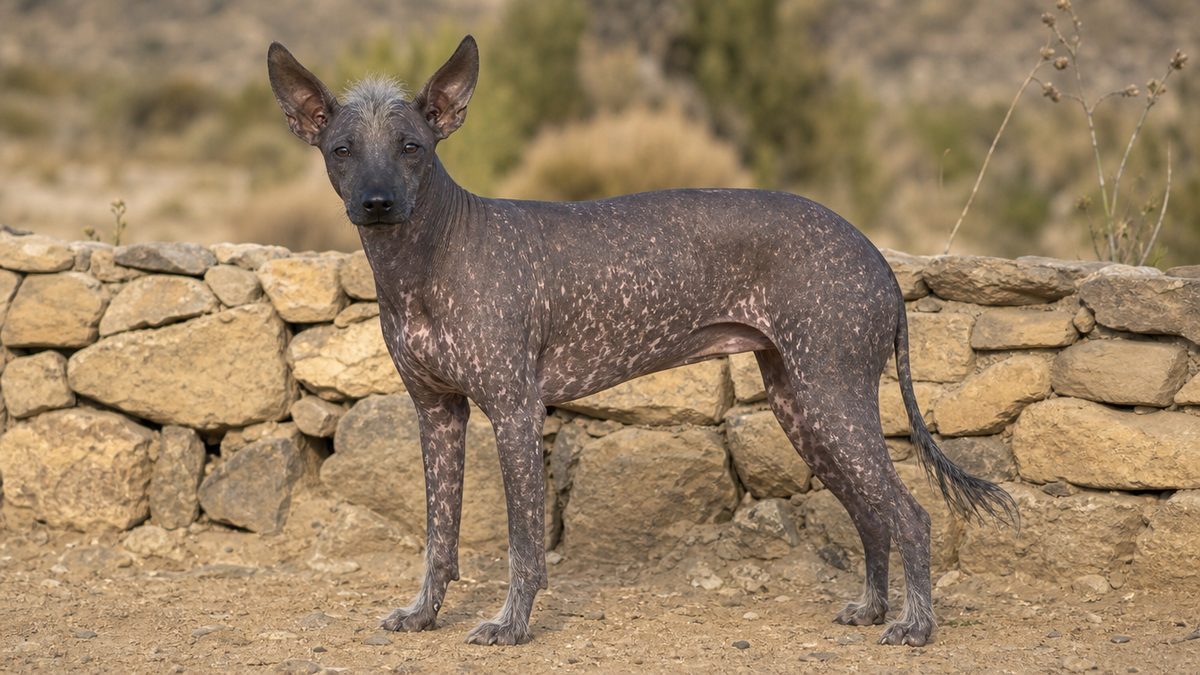
The Khala is a rare South American hairless dog kept in two types, the short-legged Khala Medio and the longer-legged Khala Grande, and almost everything published about it in English traces back to one breed-club standard written by hand. It holds no FCI standard, no national kennel-club standard in any Andean country, and no published genetic study has ever sampled one.
Start with the name, because it is the only part every source agrees on. Khala is the Bolivian Quechua word for without clothing, and the American Khala Association's own standard says so, adding that the Peruvian Quechua equivalent is *caa allepo*, meaning without vestment, and that similar words are used in other Andean countries. The association's stated position is that the dogs "are known by different names, even within the same country" and that "we have only recently classified them simply as Khala";. That sentence is worth reading twice. The breed name is a recent administrative decision taken in the United States about a group of village dogs spread across several countries, not a label those villages used.
The history and origins of the Khala are told the same way by every source that tells them at all, and the account is cultural rather than documentary. The Continental Kennel Club dates artefacts depicting these dogs in ceremonial dress to roughly 2,000 years ago across an Incan and Moche territory reaching from the northern Andes through modern Peru, Bolivia, Ecuador and southern Colombia into the Chilean and Argentine mountains, and says the Quechua people would trade or gift their khala dogs. It adds that Spanish colonists, finding the dogs sleeping among flowers, called them *Perros Flora*, flower dogs, and that centuries of isolation after the conquest let the regional populations drift into the separate landraces recognised today. None of that is documented in a stud book, and no page should present it as though it were.
Two types, and no agreement on how big either one is
Every source that describes the breed at all splits it into a Medio and a Grande. The Dog Breed Info Center gives the Medio as short-legged, also called the pottery type, and the Grande as long-legged or sighthound type, and states plainly that "both types can and do appear in the same litter and no attempt has been made, as yet, to breed selectively for one type or the other";. That is a landrace description, not a breed description, and it is the single most honest line on the ranking set.
The published measurements then scatter, and so does the life expectancy. Four sources that all claim to describe the same animal cannot be reconciled, and a buyer should see that before anything else. DOGICA, working from the same two-type split, gives the Medio as 14 to 17 inches and the Grande as 17 to 20 and places the breed in Bolivia.
| Source | Height | Weight | Lifespan |
|---|---|---|---|
| Dog Breed Info Center, from the AKAR standard | Medio 14-17 in, Grande 17-20 in | Medio 15-30 lb, Grande 18-30 lb | "Unknown" |
| Continental Kennel Club | 19-26 in male, 18-26 in female | 26-55 lb both sexes | 10-14 years |
| Dogster | 14-20 in | 15-30 lb | 12-20 years |
| Hepper | 19-29 in | 26-55 lb | 10-14 years |
| DOGICA | Medio 14-17 in, Grande 17-20 in | not given | not given |
Dogster and Hepper are the interesting pair, because they are sister publications running the same template and the same section headings, and they disagree by nine inches at the top of the range and by six years at the top of the lifespan Hepper Pet Resources. Hairless Khala. Nothing on either page explains where its numbers came from. The Dog Breed Info Center, which at least prints the breed-club standard it is working from, answers the lifespan question with the single word Unknown. That is the correct answer, and this page adopts it.
What the dog is for
The Khala's historical jobs were domestic rather than working. The Continental Kennel Club's history section says the dogs were used "for food, sentries, companionship, religious purposes, and as bed warmers", and that spotted dogs were kept more as companions while solid-coloured dogs did outdoor work. A German breed database describes the same animal as "a vigilant companion and a living heat source in the Andes";. A bare-skinned dog sleeping against a person at 3,800 metres is doing a real job, and it is worth holding on to that image, because it is the exact opposite of what the dog is being asked to do in Chennai.
A Khala is a naked Andean village dog with an American breed name, no international register, no published genetics of its own, and a defining trait that is a semi-dominant mutation with a lethal homozygous state. Everything else on this page follows from those five facts.
One figure is agreed and it is the litter size. The Dog Breed Info Center's breed record gives a litter size of about four to eight puppies, which matters more here than on most breed pages, because a quarter of a hairless-to-hairless litter never reaches term. On that mating a stated litter size of four to eight born is a conception count nearer five to eleven, and the genetics section works the arithmetic through.
Bolivian, Argentine or Peruvian: three sources, three countries
The Khala's country of origin is genuinely unsettled, and the disagreement runs between the best sources rather than between good and bad ones. A Royal Society paper from Elaine Ostrander's laboratory places it in Argentina, English Wikipedia places it in Bolivia, and the only registry that publishes a Khala standard files it as Peruvian.
The peer-reviewed source first, because it is the highest-authority document that names the breed at all. Parker and colleagues, writing in *Philosophical Transactions of the Royal Society B* in 2017, list the hairless dogs of the Americas and write that "Other hairless breeds include the Argentine Pila dog, the Ecuadorian Hairless dog, Abyssinian Sand Terriers, the African hairless and the Hairless Khala also from Argentina", continuing that "Many of these breeds are very rare and the latter are not recognized by any breed registry". That is one sentence in a long paper, and no Khala was sampled for it, so it is a naming rather than a finding. It is still the only statement about this breed in the peer-reviewed literature.
English Wikipedia, the page that ranks internationally for the category term, says the opposite: "The Argentine Pila, the Hairless Khala from Bolivia, and the Ecuadorian Hairless Dog are not registered hairless dog breeds";. Spanish Wikipedia lists the *khala boliviano* among the hairless populations of the Americas, and Infobae, writing in 2021, names the *khala boliviano* as a Bolivian relative of the Peruvian hairless dog.
The registry that recognises the breed says it is Peruvian
This is the part no ranking page has noticed. The Continental Kennel Club is the register most often cited as recognising the Khala, and its own breed page says: "The Khala, also known as the Peruvian Inca Hairless Dog, the Peruvian Inca Orchid, is the spotted variety of the Peruvian Hairless Dog and the Argentinian Pila Dog";. Its Quick Facts panel files the origin as South America / Central America, not Bolivia. So the body that grants the standard treats the Khala as a colour variety of an FCI-recognised Peruvian breed, which if taken at face value would mean it is not a separate breed at all.
The Peruvian breed in question is real and fully documented. FCI Standard 310, *Perro sin Pelo del Perú*, dated 26 October 2021 with the official valid standard published 15 September 2021, puts it in Group 5 Section 6, dogs of primitive type, and its preamble records recognition at the FCI's ordinary assembly in Amsterdam in 1985. That document does not mention the Khala once.
| Source | Type of source | Origin given | What it calls the breed |
|---|---|---|---|
| Parker et al. 2017, Phil Trans R Soc B | Peer-reviewed, NHGRI | Argentina | A hairless breed recognised by no registry |
| English Wikipedia | Encyclopedia | Bolivia | An unregistered hairless dog breed |
| Continental Kennel Club | Registry with a published standard | South America / Central America | The spotted variety of the Peruvian Hairless Dog |
| American Khala Association, via DBI | Breed club standard | Latin America, Mexico to South America | One landrace under many local names |
| ExpertoAnimal, El Periodico | Spanish-language guide | Bolivia | Perro sin pelo boliviano, unrecognised by canine federations |
Two Spanish-language guides side with Bolivia and both add the same caveat. ExpertoAnimal writes that the *perro sin pelo boliviano*, also known as the *Khala boliviano*, is from Bolivia as its name says, and that these dogs "no están reconocidos por las federaciones caninas", meaning they are not recognised by the canine federations. Patitas and Co describes the *khala boliviano* as a breed little known outside South America, existing in two varieties, short-legged *khala medio* and long-legged *khala grande*, and again notes it is not recognised by all cynological federations.
Bonbeno does not pick one country. The honest position is that a landrace of hairless village dogs spans Peru, Bolivia and northern Argentina, that the American breed name Khala was applied to that whole population from outside it, and that no document exists which could settle a national origin, because no register in any of the three countries holds the breed. Any page that states a country flatly is stating a preference.
Khala breed recognition, register by register
The Khala is recognised by four private American registries and by no national kennel club anywhere, including in the Andean countries it comes from. That matters in India for one concrete reason: the Kennel Club of India registers an imported dog against an export pedigree from the country of origin, and no body in Peru, Bolivia or Argentina issues one for this breed.
Take the FCI first, because for India it settles the question. India is a full FCI member represented by the Kennel Club of India in Chennai, and Bolivia is a full FCI member represented by the Kennel Club Boliviano in La Paz, so both countries issue pedigrees against FCI nomenclature. The FCI's alphabetical index for the letter K lists exactly 14 breeds, running from KAI 317 through KOMONDOR 53 and KUVASZ 54 to KANGAL SHEPHERD DOG 331, and the Khala is not among them. The provisional register holds 20 entries and the Khala is not among those either.
The FCI's own members and contract partners register is where the India route starts. It lists Bolivia, Peru, Argentina and India all as full members, which means each of their national bodies issues pedigrees against FCI nomenclature, and it is why the FCI's register effectively answers the Indian recognition question for any breed.
A plain fetch of either FCI index returns a chrome-only shell with zero breeds on it, so a naive check would report every breed as absent, including the Labrador. Both indexes were therefore read through a JavaScript-rendering fetch with in-document controls present on the returned page: the Kai, Komondor, Kuvasz and Kangal on the letter K index, and the Brazilian Campeiro Bulldog 374 on the provisional list. The absence above is a reading of a document that demonstrably rendered.
The registries that do hold the breed are private and American
The Dog Breed Info Center lists four: AKAR, the American Khala Association Registry; APRI, American Pet Registry Inc; CKC, the Continental Kennel Club; and DRA, Dog Registry of America Inc. Of those, the Continental Kennel Club is the one publishing a full breed page and standard, filing the Khala in Breed Group 1, Primitive, Pariah and Feral Breeds, with a coat-type field reading "Hairy hairless, Naked hairless, Tufted hairless, Close coat, Flat coat";.
None of these is a national kennel club and none of them is an FCI contract partner. That is a description rather than a criticism, and it has one practical consequence worth stating plainly: a pedigree from any of them will not convert into a Kennel Club of India registration.
The disagreement worth publishing
Parker et al. 2017 states that the breeds in its list, the Khala among them, "are not recognized by any breed registry";. The Continental Kennel Club publishes a Khala breed standard. Both statements are true as written, and the gap between them is the difference between a registry in the FCI and AKC sense and a private registry that accepts dogs on documentation or photographs. Bonbeno reports both rather than resolving them, because which one matters depends entirely on what a buyer wants the paperwork for.
| Body | Holds the Khala | Evidence | In-document control |
|---|---|---|---|
| FCI, definitive register | No | Letter K index, 14 breeds | Kai 317, Komondor 53, Kuvasz 54 |
| FCI, provisional register | No | 20 entries listed | Buldogue Campeiro 374 |
| Kennel Club of India | No | Registers against FCI nomenclature as a full FCI member | India listed as a full member |
| Kennel Club Boliviano | No | Full FCI member, so it issues FCI-nomenclature pedigrees | Bolivia listed as a full member |
| Continental Kennel Club | Yes | Published breed page and standard, Breed Group 1 | Page titled Khala Breed Information |
| AKAR, APRI, DRA | Yes | Listed as recognising registries | Standard quoted verbatim |
Why this page exists even though the site excludes hairless dog as a category
Bonbeno's roster excludes hairless dog as an entry, on the ground that it names a coat phenotype shared by unrelated breeds rather than a breed. The Khala passes the same test where the phenotype fails it, on two conditions. First, it is a specific named population rather than a trait: it has its own name, its own two types, its own geography and its own breed club, and it is listed *alongside* the Xoloitzcuintle, the Peruvian Hairless and the Chinese Crested rather than as a synonym for them. Second, a published standard exists under that name and can be quoted, so real care, size and temperament content can be written rather than invented Dog Breed Info Center, Hairless Khala. Both conditions hold, so the page is written. What does not hold is a national origin, and the page says so rather than picking one.
That has a direct consequence for the import rules, which the adoption section works through in full. India permits a pet dog to be imported with a valid pet book in the importer's name and rejects any application made for trading or breeding purposes outright, and the Kennel Club of India's own registration checklist for an imported dog demands an export pedigree in original. A breed no register holds cannot produce that document.
The hairless gene is a welfare question, not a curiosity
Hairlessness in the South American and Chinese hairless dogs is caused by a 7 base-pair duplication in the first exon of FOXI3, inherited as a monogenic autosomal semi-dominant trait, and the homozygous state kills the embryo before birth. Every hairless dog of these breeds is therefore an obligate heterozygote, and a hairless-to-hairless mating loses a quarter of the litter.
Drögemüller and colleagues published the mechanism in *Science* in 2008. Working from Mexican and Peruvian hairless dogs and Chinese Crested dogs, all showing missing hair and teeth in a phenotype termed canine ectodermal dysplasia, they mapped the mutation to a 102 kilobase interval on chromosome 17 and identified a frameshift in a previously uncharacterised forkhead box transcription factor, FOXI3, specifically expressed in developing hair and teeth. The abstract's own words are that "CED is inherited as a monogenic autosomal semidominant trait".
Parker et al. 2017 gives the molecular detail and the consequence. The variant is a 7 base-pair duplication in exon 1 producing a frameshift, a premature stop codon and the loss of 95 percent of the normal protein, and "the lack of homozygotes in either breed suggests that the mutation is embryonic lethal";. Kupczik and colleagues describe the same variant as "a semi-dominant 7-base-pair duplication in the first exon of the forkhead box I3 gene (FOXI3) shared by all three breeds";.
The arithmetic a buyer should be able to do
A commercial laboratory that sells the FOXI3 test publishes the segregation table directly, which is the clearest form of it. Dogs carrying two copies "die in prenatal stage and therefore only 2 variants are born";. The consequence for a litter is fixed by that.
| Mating | Dies before birth | Born hairless | Born coated |
|---|---|---|---|
| Hairless x hairless (Hr/N x Hr/N) | 25 percent | 50 percent | 25 percent |
| Hairless x coated (Hr/N x N/N) | None | 50 percent | 50 percent |
| Coated x coated (N/N x N/N) | None | None | 100 percent |
Read the first row again. Of the puppies actually born from a hairless-to-hairless mating, two in three are hairless and one in three is coated, which is why breeders like that pairing. The price is a quarter of the conceptions. The same laboratory adds that "neonatal deaths are more common in hairless pups than among their normal littermates";, so the loss does not stop at birth.
The honest limit: no Khala has ever been genotyped
The FOXI3 variant was found in the Chinese Crested, the Peruvian Hairless and the Xoloitzcuintle Genomia genetics laboratory. Those are also the three breeds the commercial test is validated for, and the Khala is not one of them. Parker's paper names the Khala only in a list of rare unregistered breeds and analysed no sample from one. So the correct statement is that the Khala is *presumed* to carry the same variant on the strength of an identical phenotype and a shared regional origin, and that presumption has never been tested.
That matters commercially. Bing India's own AI summary for this breed states flatly that Khala hairlessness "is caused by a dominant FOXI3 gene mutation, shared with other Latin American hairless dogs";. No study supports that sentence about this breed, and an answer engine asserting it does not make it a finding.
Two further papers show how far the gene's reach goes beyond a coat. Shirokova and colleagues, working in mice, showed that mutating Foxi3, described in their own abstract as "a Forkhead family transcription factor mutated in several hairless dog breeds", compromises hair follicle stem cell specification, impedes follicle downgrowth and progression of the hair cycle, and produces poor hair regeneration after plucking with a sparse coat that worsens with age through progressive stem-cell depletion. In humans, Tassano and colleagues described a girl with a FOXI3 deletion presenting congenital aural atresia, a closed ear canal, together with agenesis of the internal carotid artery. Parker's review notes the same human line of evidence, a FOXI3 deletion in a child with microtia.
One hairless breed is genuinely different
Not every hairless dog carries this problem, and the exception is instructive. The American Hairless Terrier is "the only hairless breed in which the trait is recessive, and therefore, the homozygous state is not lethal", and the paper describes those dogs as remarkably healthy animals born with a sparse fuzzy coat lost in the first months. A separate recessive hairless variant, a frameshift insertion in SGK3, was found in Scottish Deerhounds with a 12 percent carrier frequency in that breed. Hairlessness in dogs is therefore not one thing, and the version the Khala is presumed to carry is the version with the lethal homozygote.
Ask what the sire and dam were, coated or hairless, and how many puppies were born against how many were conceived. A breeder pairing two hairless dogs is choosing a mating that loses a quarter of the litter, and a breeder who has never thought about it is not the person to buy a dog with a semi-dominant lethal from.
One consequence is worth stating in the plainest terms available. A breeder who tells you the litter size was six is describing the puppies that were born. On a hairless-to-hairless mating the number conceived was closer to eight, and the two that are missing are the homozygotes.
The teeth go with the hair, and Indian law has a word for that
The same FOXI3 variant that removes the coat removes most of the permanent dentition, and a study of pedigreed hairless dog skulls found the permanent canines and premolars lost, some incisors missing, and the fourth premolars and first two molars consistently stripped of their distal and lingual cusps. India's Dog Breeding and Marketing Rules 2017 name two or more missing teeth as a genetic defect.
Kupczik and colleagues identified the FOXI3 variant in a historical museum sample of pedigreed hairless dog skulls using ancient DNA extraction, then described the dental phenotype that came with it. Their paper's title is literally that: the dental phenotype of hairless dogs with FOXI3 haploinsufficiency. Their words: "Unlike in the coated wild type dogs, the hairless dogs were characterised in both the mandibular and maxillary dentition by a loss of the permanent canines, premolars and to some extent incisors. In addition, the deciduous fourth premolars and permanent first and second molars consistently lacked the distal and lingual cusps". The paper's title names the mechanism as FOXI3 haploinsufficiency, meaning one working copy of the gene is not enough.
Drögemüller's original description had already said as much in one clause: the hairless dogs are "characterized by missing hair and teeth". The commercial test page puts the practical version bluntly, describing wrongly developed teeth that are not strong enough, and dogs of higher age losing them.
What the breed club itself says about it
The American Khala Association's own standard does not soften this. It states that "as with most hairless dogs, adult dentition is very bad. The root system is shallow and even puppy teeth are primitive", and it explains the breed's temperament partly by that fact: the dogs "tend to walk (or run away) from a serious confrontation, which is good since they don't have hair and adult teeth are usually few and far between";. A breed club describing its own dogs' mouths that way is unusual and it is credible.
Second Schedule Part III paragraph 8(10)
India's Prevention of Cruelty to Animals (Dog Breeding and Marketing) Rules, 2017 require that breeding dogs "shall have been tested for genetic defects, including hip dysplasia, progressive retinal atrophy, night blindness, hypothyroidism, entropion, ectropion, overshot, undershot jaw (when incisors do not touch or mesh), wry mouth, two or more missing teeth, unilateral cryptorchid or full cryptorchid males". That clause sits in the Second Schedule, Part III, at paragraph 8(10), not in the Rules themselves, which run only from 1 to 13.
Read the collision plainly. A Khala's defining phenotype is missing teeth, and Indian law lists missing teeth as a genetic defect that a dog used for breeding must have been tested for. The word in the clause is including, so the list is illustrative rather than closed. Bonbeno does not claim that breeding a hairless dog is unlawful in India, because no court has read the clause that way and no Indian breeder of this breed exists to test it against. What is fair to say is that anyone planning to breed hairless dogs in India is planning around a trait their own law names.
| Clause | What it says | Why it touches this breed |
|---|---|---|
| Second Schedule Part III para 8(10) | Breeding dogs must have been tested for genetic defects including two or more missing teeth | Missing permanent teeth is the breed's defining trait, not an incidental fault |
| Second Schedule Part II para 6(9) | Breeding to create new breeds of dogs or unusual looks is strictly prohibited | A question rather than an answer, and one no Indian regulator has been asked about hairlessness |
| Second Schedule Part II para 6(3) | In breeding within four generations and incest breeding are both prohibited | A founding population of a handful of imported dogs cannot be bred on without hitting this |
| Rule 8(1)(a) | Pups less than eight weeks in age are not sold | Applies to every breed, and a hairless neonate is more fragile than most |
| Second Schedule Part IV para 21(1) | Dogs not accustomed to local temperatures may not be kept in outdoor facilities without the attending veterinary practitioner's written approval | An Andean dog at 3,800 m is the textbook case of a dog not accustomed to Indian temperatures |
The words sunburn and hairless appear zero times across all 14 pages of the gazette, checked with a whitespace-tolerant search because the PDF splits words at arbitrary points. There is no Indian dental-testing requirement and no skin-protection requirement. The nearest hook is paragraph 21(2), which requires outdoor facilities to provide separate areas of shade large enough to hold all the animals and protect them from the direct rays of the sun.
Khala dog price in India
No khala dog price in india can be verified, because no Indian seller lists the breed and no lawful route exists to import one for breeding. The useful content here is what an Indian search actually returns instead, which is a dictionary entry, and what the European price that does circulate turns out to rest on.
Two India-targeted searches were run on 2 September 2026 and neither returned a listing for a live Khala anywhere in India. To prove the search worked, a labrador retriever price in india control was run in the same tool in the same session and returned About 28,600 results and ten genuine Indian breed-price pages, including Mr n Mrs Pet's stated average of INR 30,000 to INR 1,20,000 Mr n Mrs Pet, Labrador Retriever puppies…. The instrument was working. There is simply nothing to find.
The Indian search returns a maternal aunt
Searching khala dog price in india on Bing India returns no dog at all. The ten organic results are Rekhta and Hindwi dictionary entries for ख़ाला, a GitHub repository, an AI-tooling startup, an Instagram handle, a wikiHow guide to Arabic slang and two Hindi translation pages. Khala is the Urdu and Hindi word for a maternal aunt, so in India the breed name collides with an everyday word. Running khala dog breed against the same endpoint returned a byte-identical result set under an identical count of About 1,17,000 results, so the engine was not reading the query either.
That is homonym capture rather than a thin market or a broken search, and the two look identical from the outside. Switching to bolivian hairless dog returns About 2,000 results, ten on-topic pages and a live People also ask box. Anyone researching this dog from India should use that phrase and not the breed's own name.
A marketplace test, and a 404
Puppiezo is one of the larger Indian puppy marketplaces and its product URLs follow a fixed pattern. The Khala URL on that pattern returns HTTP 404 with an og:title of "Page not found - Puppiezo";, while the Labrador Retriever URL on the identical pattern returns HTTP 200 titled "Buy Labrador Retriever Puppies for Sale in India | Puppiezo";. A 404 on a guessed URL proves only that the guess was wrong, which is why the control matters: the pattern is right, and the breed is not stocked.
The one price that circulates, and what it rests on
A German breed database prints a Hairless Khala puppy price of 2,000 to 3,500 euro and a lifetime cost of about 28,110 euro. Three things on that same page undermine it. It states "No verified Hairless Khala breeders on HonestDog yet", so the price describes no transaction the site can see. It describes the coat of a hairless dog as "hard, dense, wiry, medium length", which is a template default rather than an observation. And its cost model is explicitly "average German prices, as of July 2026";. Bonbeno publishes no rupee conversion of it, because converting a European estimate for a breed with no European breeders would manufacture exactly the kind of figure this site exists to catch.
Creatures.com is the other page that looks like a price source and is not. It maintains a Khala species page carrying a marketplace, a herdbook, a breeder directory and a set of breed tools, and its own description concedes that the Khala is "a rare South American hairless dog type rather than a widely standardized international breed";. Infrastructure is not inventory, and a herdbook for a breed with no register holds nothing.
| Figure | Where | What it describes | Usable as an Indian price |
|---|---|---|---|
| EUR 2,000-3,500 | HonestDog, Germany | A model output on a page with no verified breeders | No |
| EUR 28,110 lifetime | HonestDog, Germany | German average costs over 12 years | No |
| No figure | Puppiezo India | URL returns 404 while the Labrador control returns 200 | Not offered |
| No figure | Creatures.com | Marketplace, herdbook and breeder directory pages exist for the breed | No |
| A live Khala puppy in India | Nowhere found | No listing exists | No figure exists |
Why no Indian price can form
The supply side is closed by law. DGFT Trade Notice 22/2022-23 puts dogs under ITC(HS) 01061900 as Restricted, and Policy Condition 7 permits import only for a pet dog with a valid pet book and records in the importer's name, for R&D organisations with the recommendation of CPCSEA, or for internal security by the Defence and Police Force. Policy Condition 8 states that import of commercial dogs for breeding or any other commercial activity is not permitted, and paragraph 6 of the notice provides that any applications for trading or breeding purposes "shall be duly rejected";. Entry is limited to the airports and seaports of Delhi, Mumbai, Chennai, Hyderabad, Bengaluru and Kolkata and, since October 2024, Kochi airport Department of Animal Husbandry…. The full route is set out in how to import a dog to India.
No lawful founding stock means no Indian litters, and no Indian litters means no price. The paperwork side closes it independently: the Kennel Club of India's own checklist for registering a dog with import status requires an export pedigree in original together with a DGFT licence, customs and quarantine clearance, and no body in Peru, Bolivia or Argentina issues an export pedigree for a Khala.
Any hairless or near-hairless dog offered in India under this name is far more likely to be a Chinese Crested, a Chinese Crested cross, or an Indian dog with demodectic mange, a bacterial pyoderma or an endocrine alopecia. The last group is a medical emergency dressed as a rare breed. A dog that lost its coat is not the same animal as a dog born without one, and the difference is worth a veterinary examination before any money changes hands.
What a Khala-sized dog actually costs to keep in India
The monthly cost of keeping a 7 to 14 kg dog runs roughly Rs 3,500 to Rs 8,000 to keep properly in an Indian metro, and the first year is dominated by the vaccination course. None of these figures is a Khala price, because no Khala price exists. They are published Indian rates for a dog of this size, which is the number an Indian reader can actually use.
The Khala sits in the small-to-medium band on every published size set, from 15 to 30 pounds on the American Khala Association standard and Dogster, up to 26 to 55 pounds on the Continental Kennel Club and Hepper Hepper Pet Resources. Hairless Khala. The costs below are worked for roughly 7 to 14 kg and scale up if your dog lands at the CKC's top end.
Vaccination, the largest first-year line
Vetic, a chain running more than 50 clinics across seven Indian metros, publishes a rate card: the four-visit puppy course starts at Rs 6,499, the annual booster starts at Rs 3,199, and single doses start at Rs 699 for anti-rabies, Rs 849 for puppy DP, Rs 899 for the 9-in-1 DHPPiL, Rs 899 for canine corona and Rs 1,349 for kennel cough. Read those as promotional floors from one chain rather than a market average, because the phrase on every line is "Starts at".
Home vaccination costs less than it looks. Easzo Pets, working in Bengaluru, Hyderabad and Chennai, lists a home visit from Rs 799 for members and Rs 999 for non-members, with a first-puppy package including a DHPPi L4 dose, deworming and the home visit at Rs 1,299 for members against Rs 1,499 otherwise. Independent Indian guides put the per-dose ranges wider again Omelo. Dog and Cat Vaccination Schedule… PetYaari. Dog Vaccinations in India, which is the honest picture: prices move with the city, the clinic and the vaccine brand.
Parasite control, worked from a unit price
Deworming is the one line where the arithmetic is clean. Drontal Plus sells at Rs 754 for a strip of six tablets against an MRP of Rs 838, which is Rs 125.67 a tablet, and the tablet is dosed at one per 10 kg. A 7 kg Khala therefore takes one tablet and a 14 kg Khala takes two, so a deworming costs Rs 126 to Rs 252. Run quarterly, that is Rs 500 to Rs 1,000 a year.
| Line | Published figure | Per month | Source |
|---|---|---|---|
| Annual booster | From Rs 3,199 | Rs 267 | Vetic rate card |
| Deworming, quarterly | Rs 126-252 per dose | Rs 42-84 | Drontal Plus unit price |
| Consultation, routine | Rs 500-1,000 per visit | Rs 83-167 at two visits a year | One data point, see the caution below |
| Food, dry, 7-14 kg dog | Roughly 130-260 g a day | Rs 2,500-5,000 | Worked from retail kg prices |
| Boarding, if you travel | Rs 899 per 24 hours, Bengaluru | Rs 150 at two weeks a year | PawSpace |
| Skin care specific to a hairless dog | Sunscreen, shirts, moisturiser | Rs 300-800 | Estimated, no Indian rate card exists |
| Municipal registration, Delhi | Rs 500 new and Rs 500 renewal | Rs 42 | MCD |
| Municipal licence, Chennai | Rs 50 | Rs 4 | Greater Chennai Corporation |
The Rs 500 to 1,000 consultation band and the Rs 1,500 to 3,000 core-vaccination band are published byte-identically by VOSD, a dog sanctuary, and by HDFC ERGO, a general insurer. Two unrelated organisations agreeing exactly on two separate quantities is evidence that one copied the other, not two confirmations, so this page counts it as a single data point and prefers the named clinic chain's own rate card wherever one exists.
The line a coated breed does not have
Everything above applies to any 10 kg dog in India. A Khala adds a skin and dental budget that no ranking page prices. Sun protection is a consumable, dental disease arrives earlier and harder in a FOXI3 dog, and grooming shifts from a monthly haircut to a daily routine. Set aside a contingency for dental work specifically. A dog whose permanent canines and premolars never erupted does not need a scale and polish, but it does need a veterinary dentist looking at what is there.
Municipal costs are small and real. Delhi's MCD charges Rs 500 for a new pet-dog registration and Rs 500 to renew, with a late fee of Rs 100 per month and a one-month grace period tied to the anti-rabies certificate. The Greater Chennai Corporation issues a pet licence on payment of Rs 50 and issued 9,115 of them in 2024. Register the dog. A hairless dog is conspicuous, and an unregistered conspicuous dog is the one a housing society complains about.
Khala heat tolerance in India, tested against measured data
The Khala's homeland is cold, not hot, and that is the opposite of what a naked dog suggests. The NASA POWER cell over La Paz and El Alto averages 7.6 C across the year at a wet bulb of 5.2 C. Chennai averages 28.0 C at a wet bulb of 24.0 C, a gap of 18.8 wet-bulb points.
Every figure here comes from NASA POWER's Source Native Resolution Climatology, queried by explicit latitude and longitude, with the returned coordinates and the grid cell's own elevation checked against each place's real elevation. Wet-bulb values are computed from the returned air temperature and relative humidity using Stull's approximation, published in the *Journal of Applied Meteorology and Climatology* in 2011. Two of the Bolivian points cannot be taken at face value and the next section explains exactly why.
| Place | Cell elevation m | Mean air temp C | Mean RH percent | Annual wet bulb C | Gap vs the altiplano cell |
|---|---|---|---|---|---|
| La Paz and El Alto, one shared cell | 3,873 | 7.6 | 74.6 | 5.2 | - |
| Oruro | 3,976 | 7.8 | 60.3 | 4.0 | -1.2 |
| Sucre | 2,707 | 14.2 | 65.8 | 10.5 | +5.3 |
| Santa Cruz de la Sierra, lowland Bolivia | 489 | 24.5 | 65.5 | 19.8 | +14.6 |
| Bengaluru | 842 | 23.7 | 67.9 | 19.5 | +14.3 |
| Pune | 636 | 23.9 | 66.8 | 19.4 | +14.2 |
| Delhi | 206 | 25.6 | 45.6 | 17.8 | +12.6 |
| Mumbai | 97 | 26.8 | 67.4 | 22.2 | +17.0 |
| Kolkata | 7 | 25.8 | 73.9 | 22.3 | +17.1 |
| Chennai | 49 | 28.0 | 72.4 | 24.0 | +18.8 |
Look at the altiplano numbers first. The cell covering La Paz and El Alto never rises above a monthly mean of 9.4 C in November and never falls below 5.1 C in July, at humidity between 68.7 and 81.9 percent. That is a cold, damp, almost seasonless climate, and it is where a dog gets kept indoors against a person as a bed warmer. Chennai's *coldest* month, January, averages 24.1 C. The two climates do not overlap at any point in the year.
The half of the breed that is heat-adapted
Bolivia is not only altiplano, and this is where the Khala's case is stronger than a Nordic breed's. Santa Cruz de la Sierra, in the lowlands, averages 24.5 C at a wet bulb of 19.8 C, with a January mean of 26.2 C and an annual maximum reaching 40.1 C. That is within 0.3 wet-bulb points of Bengaluru and 0.4 of Pune. The breed club's own standard says the dogs live "from the seaside to high in the mountains";, so a landrace spread across that range genuinely does include heat-tolerant animals. A Khala from Santa Cruz is a heat-tolerant dog in a way a Khala from El Alto is not, and nothing on a puppy tells you which one you are looking at.
What none of it includes is Indian humid heat. Kolkata's worst month, June, reaches a mean wet bulb of 27.1 C, and Delhi's July reaches 26.5 C. Santa Cruz's worst month is January at 22.5 C. A gap of four to five wet-bulb points is the difference between a dog that pants and recovers and a dog that cannot shed heat at all, because evaporation is what fails first as wet bulb rises.
| Place | Worst month | Mean air temp C | Mean RH percent | Mean wet bulb C |
|---|---|---|---|---|
| La Paz and El Alto cell | December | 9.1 | 77.0 | 6.8 |
| Santa Cruz de la Sierra | January | 26.2 | 73.3 | 22.5 |
| Kolkata | June | 29.9 | 80.4 | 27.1 |
| Delhi | July | 32.3 | 62.7 | 26.5 |
| Chennai | May | 31.5 | 64.5 | 26.1 |
| Mumbai | June | 28.7 | 79.5 | 25.8 |
| Pune | June | 25.6 | 80.3 | 23.0 |
| Bengaluru | May | 27.0 | 63.8 | 21.9 |
Hall and colleagues, working the VetCompass cohort of 905,543 UK dogs under primary veterinary care in 2016, found 1,259 heat-related illness events from 1,222 dogs, with 380 having no recorded trigger. Of the 879 events that did carry one, 652, or 74.2 percent, were exertional rather than a dog left in a car. The companion paper in *Scientific Reports*, on the same cohort with a different case definition, gives 395 confirmed events, an incidence of 0.04 percent and a case fatality of 14.18 percent. Neither paper studied this breed, so no odds ratio here is the Khala's. The transferable finding is the trigger split, and it says the danger is the walk, not the car.
Walk before sunrise and after dark, year round, in every Indian metro. That is not a heat rule for this breed, it is a sun rule, and the next section explains why it binds harder than the temperature does.
Why two Bolivian cities returned one climate, and what we did about it
NASA POWER returns a grid cell rather than a point, and in the Andes one cell can cover two cities half a kilometre apart in altitude. La Paz at 3,640 m and El Alto at 4,150 m came back byte-identical, from a single cell whose stated elevation is 3,873.04 m, so neither figure is that city's.
Publishing a climate comparison without this check is how a page ends up asserting that a hill station is habitable for a cold-climate dog when it is not. Every point on this page was therefore queried by explicit latitude and longitude with the cell's own elevation echoed back, and compared against the town's real elevation. Three of the ten South American points failed that check.
| Place | Cell elevation m | Real elevation m | Error m | Usable at face value |
|---|---|---|---|---|
| La Paz | 3,873.04 | 3,640 | +233 | With a correction |
| El Alto | 3,873.04 | 4,150 | -277 | With a correction, same cell as La Paz |
| Oruro | 3,976.34 | 3,706 | +270 | With a correction |
| Potosi | 3,670.07 | 4,090 | -420 | With a correction |
| Cochabamba | 3,126.04 | 2,558 | +568 | Marginal |
| Sucre | 2,706.54 | 2,810 | -104 | Yes |
| Santa Cruz de la Sierra | 488.89 | 416 | +73 | Yes |
| Lima | 1,194.76 | 154 | +1,041 | No |
| Delhi | 206.37 | 216 | -10 | Yes |
| Chennai | 48.95 | 6 | +43 | Yes |
| Mumbai | 97.15 | 14 | +83 | Yes |
| Kolkata | 7.35 | 9 | -2 | Yes |
| Bengaluru | 841.72 | 920 | -78 | Yes |
| Pune | 635.99 | 560 | +76 | Yes |
Two things follow, and the second is the more useful one. The Indian plains are fine, with every one of the six metros landing within 83 m of its real elevation, so those cells genuinely describe those cities. The mountains are not, and the error runs in both directions, so no rule of thumb can correct for it without knowing the real elevation first.
The correction applied, stated as an estimate
Air temperature falls with elevation at roughly 6.5 C per 1,000 m. Applying that lapse rate to the elevation error gives an estimate for each town, and this page labels it an estimate rather than a measurement. La Paz sits 233 m below its cell, so its real annual mean is about 1.5 C warmer than the cell's 7.6 C, around 9.1 C. El Alto sits 277 m above the same cell, so it is about 1.8 C colder, around 5.8 C. Either way the conclusion for an Indian reader is unchanged, because a 3 C spread inside a 5 to 9 C homeland does not move it any closer to Chennai's 28.0 C.
Lima is the instructive failure
The Lima cell reports an elevation of 1,194.76 m for a city that sits at 154 m, an error of 1,041 m, and it is the largest single-point error found in this session. What makes it worth recording is that the returned temperature, 18.2 C annual mean, looks entirely reasonable for Lima, because the Humboldt current keeps the coast cool and the elevation error happens to push in the same direction. A plausible temperature is therefore not evidence that the cell is right. Only the elevation echo caught it, and this page uses no Lima figure.
If two places you query come back identical to the decimal, you have queried one cell twice and you cannot use them to distinguish anything. La Paz and El Alto did exactly that, and so did two pairs of towns in the Brazilian highlands checked in the same session.
Sun protection is the whole care plan in India
Ultraviolet exposure, not air temperature, is what makes India hard for a Khala. Bera and colleagues measured a monthly mean UV index of 13.84 over Chennai in March 2019, against a World Health Organization threshold of 11 for the extreme category, and this is a dog with no coat over most of its body.
The WHO's own guidance for the top of its scale is not subtle. Its exposure-category action table reads "Avoid being outside during midday hours! Make sure you seek shade! Shirt, sunscreen and hat are a must!", and it defines the UV index as a measure where the higher the value, the greater the potential for damage and the less time it takes for harm to occur. Below a UV index of 2 no protective measures are needed even for very fair-skinned people.
Bera and colleagues, publishing in *Stochastic Environmental Research and Risk Assessment* in 2022, measured monthly average UV index over four Indian megacities across March, April and May of 2019 and 2020. Their Table 3 gives the numbers directly.
| City | March | April | May | WHO category at the peak |
|---|---|---|---|---|
| Chennai | 13.84 | 13.64 | 12.79 | Extreme |
| Mumbai | 13.12 | 13.23 | 12.90 | Extreme |
| Kolkata | 11.79 | 12.10 | 13.03 | Extreme |
| New Delhi | 9.55 | 11.20 | 12.19 | Extreme |
Every one of those twelve monthly means is at or above the WHO's extreme threshold of 11 except New Delhi in March. These are monthly averages, not peak-day readings, so the worst days sit above them.
What sun does to unpigmented dog skin
Kansas State University's Veterinary Diagnostic Laboratory describes canine solar dermatitis as "a severe dermatologic disorder" affecting the medial legs, ventrolateral abdomen and thorax, lateral flank and bridge of the nose in non-pigmented skin, beginning as erythema and scaling and evolving into thick, firm, wrinkled skin with alopecia and comedones. The endpoint is what matters: chronic exposure causes "keratinocyte proliferation, mutagenesis, and premalignant actinic keratosis which can evolve into sun-induced skin tumors like squamous cell carcinoma, hemangioma, and cutaneous hemangiosarcoma".
The laboratory's own list of susceptible breeds is Beagles, Boxers, Bull Terriers, Dalmatians, Pit Bulls and Whippets, chosen for short coats or light pigment. A Khala has neither a coat nor, in the paler and mottled individuals, full pigment. Its stated best treatment is the cheapest one: "The best treatment option is to minimize the exposure to sunlight";.
Pigment is the one defence the breed brings
Most Khalas mature dark. The Dog Breed Info Center says colour is immaterial but "most Khalas are a dark gray at maturity";, and the Continental Kennel Club's history records that the Inca preferred spotted dogs as companions while solid dogs did the outdoor work. KSVDL's own case photographs show "sharp demarcation between areas of normal skin with dark pigment and damaged unpigmented skin" on a boxer, which it reads as evidence of the protective effect of melanin. So a solid dark Khala is better protected than a pink and mottled one, and the pale patches on a mottled dog are where the lesions will start.
Sunscreen, and what not to put on the dog
The ASPCA's Animal Poison Control Center is more cautious about pet sunscreen than the ranking pages are. Its guidance is that instead of using sunscreen "you should be mindful and limit their time in the bright sunshine during peak hours", and it warns that products marketed for pets "are usually not tested by the FDA" so their effectiveness is unknown. The ingredients to avoid are zinc oxide, which with repeated skin exposure can cause zinc toxicity damaging red blood cells, and salicylates, which are in the aspirin family and can cause skin redness and irritation. A dog that eats sunscreen off its own skin can develop stomach upset, and a large amount of salicylate can cause gastric ulcers.
That rules out most human sunscreens for a dog that licks itself, which is every dog. The practical order is shade first, timing second, a light shirt third, and a veterinarian-approved product without zinc oxide fourth. Dogster's advice that Khalas "need doggy sunscreen to stay out in the sun"; inverts that order, and an Indian owner following it in a UV index of 13 would be relying on an untested product instead of avoiding the exposure.
Solar noon in India falls between noon and 2 p.m., and the WHO reports the UV index as the maximum level during the four-hour period around it. For a hairless dog in Chennai, Mumbai or Kolkata that is a four-hour window, every day from roughly February to May, in which the dog does not go outside uncovered.
Temperament and household fit
A Khala is warm with its own household and reserved to the point of aloofness with everyone else, and the breed club's own standard says the reserve is defensive rather than social. It is a primitive landrace dog that wants an experienced owner and, unusually, wants a second dog of its own kind.
The American Khala Association's standard is the most specific account in print, and it is blunt. The dogs are "loving and docile with family and friends" and "can be aloof, standoffish, even unfriendly with strangers, so socialize them well", and they are "tolerant and packish with household animals";. It then explains the mechanism, which no consumer page repeats: "generally, because of the loss of protection provided by hair and good dentition, flight is preferable to fight";. A dog with few adult teeth and no coat has good reasons to leave.
One behaviour in that standard is worth planning around. "When startled, they freeze";. In a show ring that is convenient. On an Indian street with traffic, a freezing dog on a long lead is a serious problem, and it argues for a short lead, a harness rather than a collar, and routes chosen for quiet rather than for distance.
The pack point, which changes what you are buying
The standard states that "The Khala tends to identify very closely with others of its kind (most hairless dogs do) and is happiest when there are at least two of them in a home";. For an Indian buyer that is close to disqualifying on its own, because sourcing one dog of a breed with no lawful import route is already impossible and sourcing two is not a smaller problem. Take it as a description of what the dog needs rather than as a shopping instruction.
Where the ranking pages agree, and where they read like a template
Dogster lists the temperament as "Friendly, loving, loyal, laidback"; and Hepper calls the breed "very adaptable", doing "well in most situations";. A German database is closer to the breed club, describing an agile primitive companion "deeply bonded to its humans" that "always remains reserved toward strangers";. Where a source says adaptable and the breed's own club says aloof and startle-prone, follow the club.
Small Dog Syndrome, in the standard's own words
The standard warns not to let the dog "develop Small Dog Syndrome, human induced behaviors where the dog believes he is pack leader to humans";. That framing is dated, and the useful translation is ordinary: a dog that is small, cold-sensitive and carried about gets very little practice at being a dog. Put the Khala on the ground, let it walk, and socialise it deliberately, and the aloofness stays manageable.
| Household | Verdict | Why |
|---|---|---|
| Experienced owner, ground-floor home with shade, works from home | Good fit | Indoor daytime routine is feasible and the skin can be checked daily |
| First dog, first-time owner | Poor fit | The breed club asks for an owner with dog experience to understand a primitive breed |
| Household with toddlers | Caution | A startle-freeze dog with fragile skin and few teeth is not a robust family dog |
| Apartment with a west-facing balcony | Caution | The dog will find the sun on its own terrace and burn there |
| Anyone wanting a low-maintenance dog because it does not shed | Poor fit | No brushing, and a daily skin and dental routine instead |
A veterinary-authored survey of hairless breeds describes the Khala in one paragraph, calling it scruffier in appearance than the other hairless dogs, found in the Medio and Grande varieties, and "loyal and protective, often forming a deep attachment to their family";. That is consistent with the breed club and with the German database, and the composite picture is a dog that is affectionate indoors, alert to everything outside the door, and trainable in the specific sense that it will learn quickly from an owner it trusts and disengage entirely from one it does not.
Training a primitive breed with a defensive startle response
Train a Khala with short reward-based sessions built around a reliable recall and calm handling of the body, and expect an independent dog that disengages rather than argues. The breed club asks explicitly for an owner with dog experience, and the two hardest behaviours to build are tolerance of handling and tolerance of clothing.
The standard says the breed "needs very little in care BUT requires an owner with dog experience to understand it", and that owners "need to display gentle but firm authority";. Read that as a warning about consistency rather than a licence for corrections. A dog whose default under pressure is to freeze or flee learns nothing useful from confrontation.
Four things to teach first, in order
- Handling of the whole body, daily, from week eight. You will be inspecting skin every day for the dog's entire life, so make the inspection the reward rather than the price.
- Wearing a shirt, built up in seconds rather than minutes. Sun protection only works if the dog accepts clothing without being held down for it.
- Recall on a long line, practised at dawn and after dark, because those are the only hours this dog walks in most of India.
- Nail handling, which the standard flags as a specific problem: the Khala's nails are "heavy claws somewhat longer than most breeds" and the dogs are "very sensitive and resistant to having them trimmed".
Socialisation is the load-bearing one. The standard's own instruction is to socialise them well precisely because they can be unfriendly with strangers, and in an Indian apartment block a hairless dog attracts approach from strangers constantly. Every lift ride is a socialisation session whether you planned it or not, so plan it.
Mouth work is training, not grooming
A FOXI3 dog's dentition is abnormal from the start, with shallow roots and primitive puppy teeth and permanent canines and premolars that may never erupt. That makes routine mouth examination a veterinary necessity rather than a nicety, and a dog that will not let you look in its mouth turns every dental check into sedation. Teach it in the first eight weeks you have the dog.
What Indian law says about the training equipment you will be offered
Nothing in the Dog Breeding and Marketing Rules 2017 addresses training methods, but the same instrument does forbid "de-barking" alongside tail docking and ear cropping, and prohibits "any change of appearance by artificial means";. If a trainer or breeder proposes a surgical answer to a behaviour problem, the clause is Second Schedule Part II paragraph 6(8) and the answer is no.
Expect body handling to be reliable within two weeks of daily work, clothing within a month, recall to be a lifelong project on a primitive breed, and stranger tolerance to improve for two years and then plateau wherever it plateaus. A Khala that tolerates strangers politely without seeking them out is a fully trained Khala.
The daily exercise requirement, and the hours it has to happen in
A Khala needs roughly 45 to 60 minutes of walking a day split into two sessions, and in almost every Indian city both of them have to happen before sunrise or after dark. The constraint is ultraviolet exposure rather than distance, and it is a scheduling problem rather than a fitness one.
The breed club describes a hound that "tends to give chase without thought" and recommends a fenced yard, adding that the breed "needs to be taken on a daily walk";. Dogster and Hepper both place the exercise requirement in the moderate band Hepper Pet Resources. Hairless Khala, and nothing about the breed suggests a working dog's requirement. This is a village dog, not a livestock guardian.
Why the timing matters more than the distance
Chennai, Mumbai and Kolkata run monthly mean UV indices between 11.79 and 13.84 through March, April and May, which is the WHO's extreme band. Solar noon in India falls between noon and 2 p.m., and the WHO reports the index as the maximum during the four hours around it. So the middle of the day is out for a hairless dog from February to May and largely out for the rest of the year.
Heat compounds it. The largest study of heat-related illness in dogs found that of the 879 events with a recorded trigger, 652 or 74.2 percent were exertional rather than a dog left in a vehicle. That study did not include this breed and its odds ratios are not transferable here, but the trigger split is, and it says the risk is created by the walk you choose to take.
| Season | Morning session | Evening session | Middle of the day |
|---|---|---|---|
| February to May | Before sunrise, 30 min | After full dark, 30 min | Indoors, no exceptions |
| Monsoon | Early, 30 min, dry the dog properly afterwards | After dark, 30 min | Indoors, and watch the skin folds |
| October to January | Soon after sunrise, 30 min | After sunset, 30 min | Short shaded outings acceptable in the north |
What happens without it
An under-exercised Khala in a flat becomes a vocal, restless dog that patrols and reacts to the corridor, which is exactly the profile that generates housing-society complaints. The dog is small enough that owners substitute play for walking, and that works for the muscles and not at all for the head. A primitive landrace dog needs to go somewhere and smell things.
Indoor substitutes that actually work are scent games, a food-dispensing toy for the main meal, and stair work in an air-conditioned block. Fetch on tile is a poor idea for a dog with thin skin over its elbows and hocks, because a skid burn on a hairless dog does not have a coat to heal under.
Grooming a hairless dog in Indian humidity
Grooming a Khala means skin care and dental care, not brushing, and the Indian monsoon makes the skin half harder rather than easier. The breed club's whole grooming instruction is "an occasional bath", which is correct for the Andes and incomplete for Chennai in July.
Start from what the coat actually is. The Continental Kennel Club's standard admits five coat states under one breed name: "Hairy hairless, Naked hairless, Tufted hairless, Close coat, Flat coat";. Histology explains why the hairless ones look the way they do. Wiener and colleagues biopsied 22 Chinese Crested dogs and found that the FOXI3 mutants "had only simple primary hair follicles, whereas the nonmutant powderpuffs had compound follicles identical to other dog breeds", with an anagen-dominated hair cycle throughout.
The sweat-gland question, answered properly
The same study settles something the internet gets wrong in both directions. In the FOXI3 mutant dogs, "apocrine glands in the skin and respiratory mucous glands of the mutant Chinese crested dogs were present and normal". So a hairless dog has not lost its skin glands, and the popular claim that hairless dogs cannot sweat is wrong as a matter of anatomy. It is also beside the point, because dogs do not thermoregulate through skin sweating in the first place. What the dog has lost is the coat's insulation and its ultraviolet shield, and only the second of those matters in India.
A workable Indian routine
- Bathe roughly weekly in humid months and fortnightly in dry ones, with a soap-free veterinary shampoo. The breed club's "occasional bath" is written for a climate where the dog does not sweat into 80 percent humidity for four months a year.
- Dry the dog completely, and dry inside the ears rather than letting them air dry. Overseas club guidance to towel a dog and let it air dry does not transfer to an Indian monsoon.
- Inspect the whole skin daily, working to a pattern: nose bridge, ear tips, belly, inner thighs, flanks. Those are the sites Kansas State names for solar dermatitis in non-pigmented skin.
- Moisturise lightly and only where the skin is dry, because a heavy occlusive product on a dog that already runs comedones invites blocked follicles.
- Trim the nails on a schedule and not by feel, since the standard describes heavy claws longer than most breeds on a dog that resents having them handled.
- Brush the teeth that are there, daily, and book a veterinary dental examination twice a year rather than once.
The blackhead problem nobody warns Indian buyers about
Comedones, which are dilated and plugged hair follicles, are a documented feature of sun-damaged canine skin, and hairless dogs get them on the chest and belly without any sun at all because the follicles are simple and shallow. In Indian humidity, with dust and sweat, they fill faster. Squeezing them is how a pyoderma starts. Wash, dry, and take a spreading or painful lesion to a veterinarian rather than treating it at home.
The selling line for a hairless dog is that there is no shedding and no brushing. Both are true. What replaces them is a daily skin inspection, a weekly bath with proper drying, a permanent sun routine and twice-yearly dental work. Net, a Khala is a higher-maintenance dog than a short-coated Indian pariah, not a lower-maintenance one.
Health, screening and lifespan: what is known and what is not
No published study has ever examined the health of a Khala, no screening scheme covers the breed, and no life table includes it. What is known comes from the FOXI3 breeds it resembles, and from the conditions any thin-skinned dog meets in India. Every figure below is labelled with which of those two it is.
The evidence base is genuinely empty. The commercial FOXI3 test is validated for the Chinese Crested Dog, the Peruvian Hairless Dog and the Xoloitzcuintle, and the Khala is not on that list. Parker et al. 2017 names the breed once, in a list of rare unregistered breeds, and sampled none. A German breed database that maintains health-test fields for every breed prints, for this one, "No specific health tests are currently available for this breed";. That is the honest state of the field.
Lifespan: four sources, four answers, no measurement
The Continental Kennel Club prints 10 to 14 years. Hepper prints 10 to 14. Its sister site Dogster prints 12 to 20. The Dog Breed Info Center, working from the breed club's own standard, answers the question with the word Unknown, adding the reason: the figure is unknown in the United States "where they are provided for and protected". Bonbeno publishes no lifespan for this breed, because a number nobody measured is not made real by four websites printing it.
What the FOXI3 phenotype brings, on the evidence from related breeds
| Risk | Evidence | Applies to the Khala |
|---|---|---|
| Loss of permanent canines, premolars and some incisors, with absent molar cusps | Kupczik 2017, pedigreed hairless dog skulls with the FOXI3 variant confirmed | Presumed, by phenotype. Confirmed by the breed club's own description of very bad adult dentition |
| Prenatal death of homozygous embryos | Parker 2017 and the published inheritance table | Presumed, by phenotype |
| Higher neonatal death among hairless pups than coated littermates | Stated on the commercial test page | Presumed, by phenotype |
| Solar dermatitis progressing to squamous cell carcinoma, hemangioma or hemangiosarcoma | Kansas State Veterinary Diagnostic Laboratory | Direct. The mechanism is the absence of a coat |
| Simple rather than compound hair follicles, and comedones | Wiener 2013 histology of 22 Chinese Crested dogs | Presumed, by phenotype |
| Hip dysplasia, patellar luxation, eye disease | No data of any kind for this breed | Unknown. Do not assume absence means health |
The Indian half, which is real and measurable
Tick-borne disease is the health risk an Indian owner of any breed should plan for, and the Indian literature is substantial. Four recent series, all sampling dogs presented at veterinary clinics rather than random populations, found *Ehrlichia canis* in 51 of 442 dogs by PCR in Andhra Pradesh, in 56 of 178 in Odisha, *Babesia* in 80 of 120 in Kerala with a pre-monsoon peak from March to May, and *Babesia gibsoni* in 76.54 percent of 584 dogs in West Bengal, where 72.9 percent carried two or more pathogens Venugopal V, Deepa PM, Muhasin Asaf VN Shil S, Chini DS, Mukherjee. Those are clinic caseloads, so they overstate population prevalence, and the framing matters.
A hairless dog has one genuine advantage here and it is worth saying. Ticks are easier to see and remove on bare skin, and the breed club claims hairless dogs are "less prone to fleas and other parasites";. Treat that as plausible for detection rather than proven for infestation, and keep the dog on a veterinary-prescribed parasiticide regardless.
Every rare-breed page is tempted to describe its subject as robust because no disease has been recorded in it. Nothing has been recorded in the Khala because nothing has been looked for. The breed club's own explanation for the dogs' apparent health is that in their home countries "veterinary care is seldom available or affordable", which is a description of dogs going untreated rather than of dogs staying well.
Feeding a dog that cannot chew normally
Feed a Khala on the assumption that its permanent canines and premolars may be missing, which changes the food's form more than its formula. A 7 to 14 kg adult needs roughly 130 to 260 g of dry food a day, and the practical question is whether the dog can pick it up and break it down at all.
The dentition comes first because it is the constraint no other breed page has. Kupczik and colleagues found hairless dogs missing the permanent canines and premolars and, to some extent, the incisors, with the remaining fourth premolars and first two molars stripped of their distal and lingual cusps so that only a single enlarged cusp remained in the heel of the tooth. A tooth with one cusp does not shear. The breed club adds that the root system is shallow and even the puppy teeth are primitive.
- Choose a small-breed kibble size regardless of the dog's bodyweight, because bite mechanics rather than jaw size is what is limiting.
- Soften the kibble with warm water for any dog that drops food, chews on one side or eats slowly.
- Avoid bones, antlers, hooves and hard dental chews entirely. A shallow-rooted tooth in a FOXI3 dog is not a tooth to test.
- Weigh the food rather than scooping it, because a 7 kg dog and a 14 kg dog sit at opposite ends of this breed's published weight range.
- Watch the body condition score monthly. Dogster notes the breed runs lean and has less use for dietary fat than coated dogs, which is an observation rather than a study, so manage by what the dog looks like.
What that costs in India
Dry food is the largest recurring line for any dog in India. At Indian retail prices for a premium dry food, roughly Rs 636 a kilogram at the 15 kg bag size, a 7 to 14 kg dog eating 130 to 260 g a day costs about Rs 2,500 to Rs 5,000 a month. Treat that as arithmetic rather than a quoted price, and check the grams per day printed on your own pack before budgeting from it, because feeding guides differ by brand.
Boarding is the line most owners forget and it is worth pricing before you commit, because a hairless dog is harder to board than a coated one. PawSpace in Bengaluru charges Rs 899 for overnight boarding up to 24 hours, against Rs 799 for daycare to ten hours and Rs 599 for up to four hours. Ask any boarding facility where the dog will sit during the middle of the day before you book it.
Feeding through the Indian heat
Appetite drops in April and May in most of India and that is normal. What is not normal is a dog that stops eating and is also lethargic, because those are early signs of both heat stress and tick-borne disease, and the Kerala series found the *Babesia* peak in exactly those pre-monsoon months of March to May. Feed the main meal after the evening walk, keep water available in more than one room, and treat a two-day appetite loss as a reason to see a veterinarian rather than to change the food.
Month by month through the first year
Plan a Khala puppy's first year around three things a coated puppy does not need: a sun routine from the day it arrives, a dental examination as soon as the permanent teeth are due, and daily handling so that skin inspection is never a fight. The vaccination schedule is the same as any Indian puppy's.
Indian law fixes the earliest date. Rule 8(1)(a) of the Dog Breeding and Marketing Rules 2017 requires that "pups less than eight weeks in age are not sold", and a breeder offering a younger puppy is telling you something about the rest of their practice.
| Age | Veterinary | Skin and teeth | Behaviour |
|---|---|---|---|
| Weeks 6-8 | Core vaccination starts, typically the puppy DP dose | Daily whole-body handling begins | Stays with the litter until eight weeks minimum |
| Weeks 8-12 | Second and third doses on the vet's schedule, first deworming | Introduce a light shirt in seconds, not minutes | Household socialisation, no street walking yet |
| Weeks 12-16 | Anti-rabies from around 12 weeks, course completed by 16 to 18 weeks | Establish the daily skin check as routine | Controlled outdoor exposure at dawn and dusk only |
| Months 4-6 | Deworming quarterly from here | Permanent teeth due. Book a dental examination and ask what is missing | Recall on a long line, at the hours the dog will actually walk |
| Months 6-9 | Discuss neutering timing with your own vet | First full Indian summer. Sun routine is now permanent | Stranger tolerance work in lifts and corridors |
| Months 9-12 | Annual booster due at about one year | Second dental examination. Adult skin routine settled | Adult exercise pattern, two sessions in the dark |
Vaccination costs are published and predictable. Vetic's four-visit puppy course starts at Rs 6,499, with single doses from Rs 699 for anti-rabies and Rs 899 for the 9-in-1, while home vaccination through Easzo Pets starts at Rs 799 for members and Rs 999 otherwise. Indian guides put the schedule at core doses from 6 to 8 weeks, repeated every 3 to 4 weeks until at least 16 weeks, with anti-rabies from around 12 weeks.
The month that decides the dog's dental future
Between four and six months the permanent teeth either erupt or they do not, and in a FOXI3 dog several will not. Book a veterinary dental examination in that window specifically, and ask for a written record of which teeth are present. You will need that baseline for the rest of the dog's life, and it is far easier to obtain on a four-month-old puppy that has been handled daily than on a three-year-old that has not.
Do not shave, wax, or apply hair-removal products to the coated patches on a hairy hairless or tufted dog to make it look more like the breed picture. The Dog Breeding and Marketing Rules 2017 prohibit "any change of appearance by artificial means" at Second Schedule Part II paragraph 6(8), and the skin under those patches has had no ultraviolet exposure at all.
Khala against the dogs an Indian buyer can actually get
The Khala loses every practical comparison in India, and the honest reason is availability rather than quality. A Chinese Crested carries the same FOXI3 phenotype and is obtainable through an FCI route, an American Hairless Terrier carries a recessive mutation with normal teeth, and an Indian pariah dog is free, local and adapted to the climate.
Anyone drawn to a Khala is drawn to hairlessness, so the comparison that matters is against the other hairless dogs rather than against dogs of similar size. Three of them are FCI or AKC breeds with published standards, screening routes and real populations.
| Breed | Hairless gene | Homozygote | Teeth | FCI or AKC route | Obtainable in India |
|---|---|---|---|---|---|
| Khala | Presumed FOXI3, never tested | Presumed lethal | Very bad, per its own breed club | Neither | No |
| Chinese Crested Dog | FOXI3, confirmed | Prenatal lethal | Malformed and often missing | FCI 288 and AKC | Yes, with care |
| Peruvian Hairless Dog | FOXI3, confirmed | Prenatal lethal | Malformed and often missing | FCI 310 | Rarely |
| Xoloitzcuintle | FOXI3, confirmed | Prenatal lethal | Malformed and often missing | FCI 234 and AKC | Rarely |
| American Hairless Terrier | SGK3, recessive | Lives, and is healthy | Normal | AKC and UKC | Rarely |
| Indian Pariah Dog | Not applicable, fully coated | Not applicable | Normal | Not applicable | Free, everywhere |
Two rows deserve reading again. The American Hairless Terrier is the only hairless breed whose mutation is recessive, which means the homozygous state is not lethal and the dogs are described in the literature as remarkably healthy, born with a sparse fuzzy birth coat they lose in the first months. Because the gene is SGK3 rather than FOXI3, the dentition is normal. If hairlessness is what you want and the welfare arithmetic is what worries you, that is the breed to look at, and Bonbeno's American Hairless Terrier guide works it through.
The Chinese Crested is the practical comparison, because it is the one FOXI3 breed with an established Indian presence, a published FCI standard, a commercially available genetic test and a real body of veterinary literature behind it. Everything a buyer wants from a Khala is available in a dog they can actually verify.
The comparison nobody makes, and should
Against an Indian Pariah Dog, the Khala loses on every axis an Indian household actually experiences. The pariah is free, locally adapted, coated against the sun, normally dentate, available for adoption in every Indian city and carries no lethal allele. The Khala's advantages are that it does not shed and that it looks extraordinary. Those are real, and they are the whole list.
For a buyer who likes the Khala's shape rather than its skin, two Indian sighthound-type breeds sit in the same size and build. The Chippiparai is short-coated, lean and South Indian, and the Rajapalayam is the Indian breed whose own white coat and pink skin bring a version of the same sun problem, worked through on its own page. Both are obtainable, and both are adapted to the climate they will live in.
And the two siblings named in the same sentence
Parker's list places the Khala beside the Argentine Pila and the Ecuadorian Hairless Dog, and all three sit in the same position: named in one sentence of one paper, held by no national register, never genotyped. Bonbeno publishes all three, and the three pages agree with each other because they are reading the same document.
What Indian buyers get wrong about this breed
The five mistakes below all start from the same assumption, that a dog with no hair is a low-maintenance dog. The opposite is true in India, and each mistake has a specific published fact behind it.
1. Buying it as a hypoallergenic dog
No dog is hypoallergenic and a hairless dog is not an exception. Vredegoor and colleagues measured Can f 1 across 196 dogs of so-called hypoallergenic breeds against 160 control dogs and found the hypoallergenic group higher, at 2.26 against 0.77 micrograms per gram in hair and 27.04 against 12.98 in coat, with no difference in airborne allergen, concluding that "There is no evidence for the classification of certain dog breeds as being 'hypoallergenic'". Dogster nonetheless tells readers Khalas are "close to being hypoallergenic" and "trigger allergies at a far lower rate than dogs with full fur coats";. Allergens are in dander and saliva, and a hairless dog has both.
2. Assuming no coat means no grooming
The breed club's grooming instruction is "an occasional bath";, written for the Andes. In Indian humidity the routine is a weekly bath with proper drying, a daily skin inspection at the sites Kansas State names for solar dermatitis, and twice-yearly dental examination Kupczik K, Cagan A, Brauer S. Net time spent is higher than for a short-coated Indian dog, not lower.
3. Treating sunscreen as the sun plan
The ASPCA advises limiting time in bright sunshine rather than reaching for sunscreen, warns that pet products are usually not FDA tested, and names zinc oxide and salicylates as the ingredients to avoid. In a Chennai March with a monthly mean UV index of 13.84, against a WHO extreme threshold of 11, a cream is not a substitute for staying indoors.
4. Believing a price you found online
The only published purchase figure for this breed is a German database's 2,000 to 3,500 euro, printed on the same page as "No verified Hairless Khala breeders on HonestDog yet" and beside a coat description reading "hard, dense, wiry, medium length" for a hairless dog. Bing India's AI summary asserts that Khala hairlessness "is caused by a dominant FOXI3 gene mutation";, which no study of this breed supports. Pretty Fluffy runs a section headed "7. Hairless Khala" whose body text is the Argentine Pila's entry. Every one of those is confidently written and none is evidence.
5. Searching the breed's own name from India
Searching khala in India returns Urdu and Hindi dictionary entries, because khala means maternal aunt. Buyers read that as the breed being obscure, and then trust the first page that does mention a dog. Search bolivian hairless dog instead, which returns a genuine result set and a real People also ask box.
Buying a hairless dog offered locally without a veterinary examination first. An adult dog that lost its coat to demodicosis, a pyoderma or an endocrine disease looks like a rare hairless breed to someone who wants one. A Khala is born without hair. A sick dog stops having it, and the difference is a skin scrape and a blood test away.
Adoption, and what to do instead
No Khala rescue exists in India and no Khala is available for adoption here, so the responsible route is either an FCI-recognised hairless breed obtained with paperwork you can verify, or an Indian dog that needs a home. Both are better outcomes than importing a dog with no lawful supply chain.
Take the legal position first, because it removes an option people spend months pursuing. Dogs are Restricted under ITC(HS) 01061900, import is permitted only for a pet dog with a valid pet book in the importer's name, for CPCSEA-recommended research or for Defence and Police use, and applications for trading or breeding purposes "shall be duly rejected";. Even the permitted personal route needs an import authorisation applied for at least two months before travel, and entry only at Delhi, Mumbai, Chennai, Hyderabad, Bengaluru, Kolkata or, since October 2024, Kochi Department of Animal Husbandry….
The paperwork then fails separately. Registering an imported dog with the Kennel Club of India requires an export pedigree in original, a DGFT licence, customs clearance, quarantine clearance and a pet passport. No body in Peru, Bolivia or Argentina issues an export pedigree for a Khala, because no body there recognises the breed Federation Cynologique Internationale. A dog that arrives will be a pet with no papers, which is a legitimate thing to be and is not what most buyers think they are getting.
If it is hairlessness you want
Adopt or buy a Chinese Crested Dog with a genetic test result you can read, since the FOXI3 test is commercially available and validated for that breed. Ask the breeder what the sire and dam were, coated or hairless, and whether powderpuff littermates were kept. A breeder who pairs hairless to coated is choosing the mating that loses no puppies, and that is the answer you want to hear.
If it is the dog you want
India euthanises and abandons more dogs than any hairless-breed shortage could justify, and every Indian city has a shelter with dogs in it. An Indian Pariah Dog costs nothing, arrives vaccinated from most shelters, and is the only dog on this page adapted to the climate it will live in. Register it: Delhi's MCD charges Rs 500 and the Greater Chennai Corporation Rs 50.
Verifying any dog offered to you as a Khala
- Ask for the registry and the registration number, then check it. AKAR, APRI, CKC and DRA are private American registries and none of them converts into a Kennel Club of India registration.
- Ask how the dog entered India, and for the DGFT authorisation and quarantine clearance by number.
- Ask a veterinarian to examine the skin before money changes hands, specifically for demodicosis, pyoderma and endocrine alopecia.
- Ask what the parents were and how many puppies were born alive, because a hairless-to-hairless mating loses a quarter of the litter before birth.
- Walk away from any seller quoting a rupee price without being able to answer the first two.
Do not try to obtain a Khala in India. There is no lawful supply chain, no register that will recognise the dog, no genetic test validated for the breed and no Indian veterinary experience of it. If the appeal is the hairless phenotype, the Chinese Crested is the same phenotype with paperwork and a test. If the appeal is a rare, primitive, low-shedding dog that suits India, the Indian pariah is sitting in a shelter three kilometres away.
Khala questions India actually asks
What is a Bolivian Hairless Dog?
It is the Khala, a rare South American hairless landrace kept in two types, the short-legged Medio and the longer-legged Grande. No FCI member body recognises it, and the only peer-reviewed paper that names it places it in Argentina rather than Bolivia.
Are Bolivian Hairless Dogs friendly?
Yes with their own household, and reserved to the point of aloofness with strangers. The American Khala Association's standard calls them loving and docile with family and friends, and adds that without hair and with few adult teeth they prefer to leave a confrontation rather than settle one.
What is a hairless Khala dog?
A hairless Khala is a dog of the Andean hairless landrace whose skin carries no coat beyond a tuft on the crown and wisps on the tail and lower legs. Khala is the Bolivian Quechua word for without clothing, and the Peruvian Quechua equivalent is caa allepo, without vestment.
What is a Bolivian Shepherd?
Nothing in this breed's family, and the question appears in Google's own People also ask box for the Bolivian Hairless Dog. No register holds a breed called the Bolivian Shepherd. Bolivia's cynological association is an FCI member and issues pedigrees against FCI nomenclature, which contains no Bolivian breed at all.
What is the Khala dog price in India?
There is no verifiable Khala dog price in India. No Indian marketplace lists the breed, a control search for a Labrador in the same session returned ten Indian pages carrying real rupee bands, and importing one to breed from is prohibited outright, so no Indian price can form.
Can two hairless dogs be bred together?
They can, and a quarter of the litter dies before birth. The FOXI3 variant is semi-dominant, so a hairless-to-hairless mating gives 25 percent homozygotes that never reach term, 50 percent hairless and 25 percent coated. Of the puppies actually born, two in three are hairless.
Do hairless dogs have bad teeth?
Yes, and it is the same gene. Kupczik and colleagues examined pedigreed hairless dog skulls and found the permanent canines and premolars lost, some incisors missing, and the fourth premolars and first two molars consistently lacking their distal and lingual cusps.
Are Khala dogs hypoallergenic?
No dog is, and a hairless dog is not a special case. Vredegoor and colleagues measured Can f 1 across 196 dogs of so-called hypoallergenic breeds against 160 controls and found the hypoallergenic group higher in hair and coat, concluding there is no evidence for the classification.
Does a Khala need sunscreen in India?
It needs shade first and a product second. The ASPCA's poison control centre advises limiting time in bright sunshine rather than reaching for sunscreen, and warns that zinc oxide and salicylates are the ingredients to avoid, because pet sunscreens are usually not FDA tested.
How long does a Khala live?
Nobody has measured it. The Continental Kennel Club prints 10 to 14 years, Dogster prints 12 to 20 for the same breed, and Dog Breed Info Center answers the same question with the single word Unknown. No published life table covers this population.
Is the Khala recognised by the Kennel Club of India?
No, and it cannot be on the ordinary route. India is a full FCI member represented by the Kennel Club of India, the FCI holds no Khala on either its definitive or its provisional register, and the KCI's own import-registration checklist requires an export pedigree in original from the country of origin.
Why does searching khala in India return dictionary results?
Because khala is the Urdu and Hindi word for a maternal aunt. Searching khala dog price in india on Bing India returns Rekhta and Hindwi dictionary entries, a GitHub repository and a wikiHow guide to Arabic slang. Search bolivian hairless dog instead.
Compare with similar breeds
Khala sits in 1 Bonbeno group. Each one compares it directly against the breeds it is genuinely an alternative to, on the same figures.