
Breed profile
Mojee: The Chinese Encyclopedia Says This Is a Trademark, Not a Breed
English pages call the Mojee a Chinese dog breed created in the 19th century by crossing German Shepherds. China's own largest encyclopedia says the Mojee is a registered trademark applied to a line of a north-Chinese landrace, and the German Shepherd did not exist as a breed until 1899. Here is what the documents actually say.
Quick answer
The Mojee is not a breed. Baidu Baike's entry on the Heilang Quan states plainly that the Mojee is not a breed but a brand, and that a Beijing breeding base registered the Mojee trademark in 2008 and applied it to a selected line of that north-Chinese black guardian landrace. No kennel club anywhere holds it, no independent studbook records it, and it has never been offered for sale in India at any price.
This guide summarises Chinese encyclopedia entries and a Chinese trade-journal standard, FCI register documents, Indian breeding and import law, Indian parasitology surveys and satellite climate data as general information for Indian readers. It is not veterinary advice and no page can substitute for examining an animal. Consult a registered veterinary practitioner before any decision about vaccination, parasite control, diet, heat management or breeding, and seek veterinary help the same day for any large guarding dog showing sudden behavioural change, which can have a medical cause.
Mojee trait ratings, and what can honestly be rated
What the Mojee actually is
The Mojee is a commercial name applied to a selected line of the Heilang Quan, a large black short-coated guardian landrace of northern China. It is not a separate breed, and the largest Chinese encyclopedia says so in one sentence.
Begin with the thing every English page gets backwards. English Wikipedia opens by calling the Mojee a dog breed that originated in China and states that Heilang Quan is the official name of this breed. Baidu Baike, China's largest encyclopedia, runs the relationship the other way round.
Its lemma on the 黑狼犬, the Heilang Quan, carries a section headed 相关品牌, Related brand, which reads: 很多人认为墨界犬就是黑狼犬,实际上墨界犬不是一个犬种而是个品牌。墨界犬繁育基地注册了墨界犬商标,创立墨界犬品牌. In English, many people think the Mojee dog is the Heilang Quan; in fact the Mojee is not a breed but a brand; the Mojee breeding base registered the Mojee trademark and created the Mojee brand.
So the dog is the Heilang Quan and Mojee is the label on a line of it. That page is not an obscure blog. It has been edited 93 times, was last updated on 4 June 2025, and carries a named reviewer under China's 科普中国 science-communication programme, 杨红珍, a research curator at the Beijing Museum of Natural History.
What the underlying dog looks like
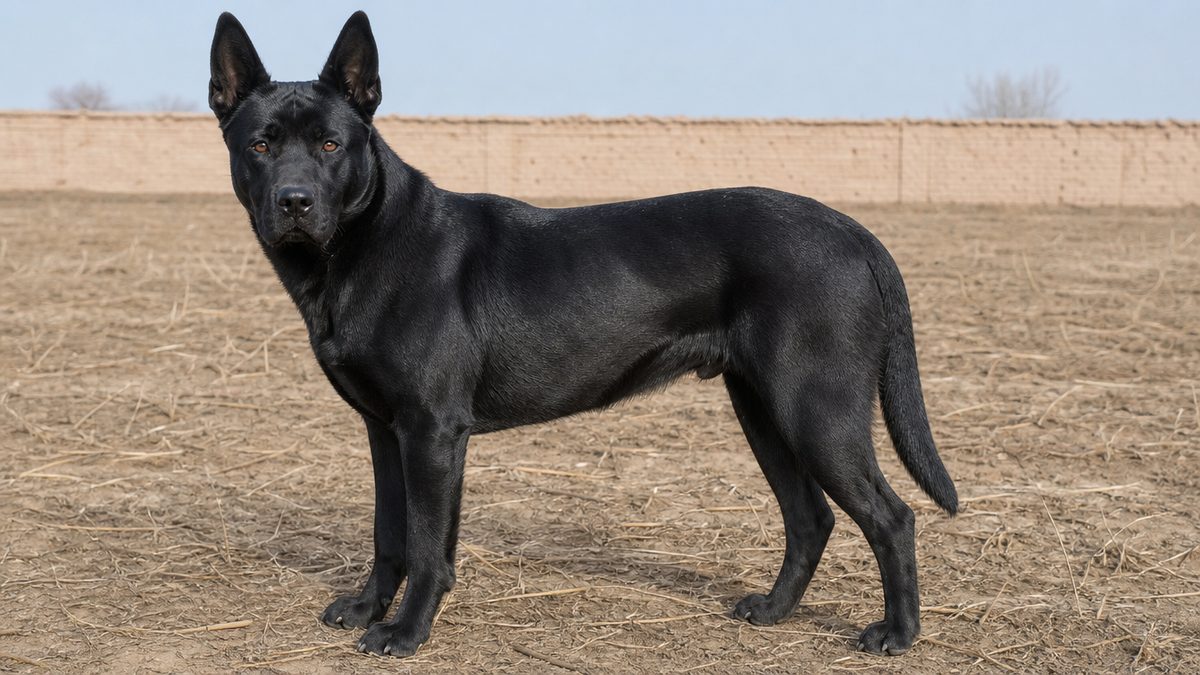
The appearance is consistent across the Chinese sources, and it is a large, powerful, plain animal. The standard published on the Baidu lemma gives males 70 to 75 cm at the withers and 45 to 55 kg, and females 65 to 70 cm and 40 to 45 kg. The coat is short, dense and glossy and the colour is solid black; white body hair is listed among the serious faults, along with excessive height or weight, slackness, timidity and poorly developed feet.
The head is broad and clean with a slight centre line, the eyes medium and dark brown, the ears large and fully erect and turned toward sound when the dog is alert, the neck strong and muscular with no dewlap, the chest broad and deep to the elbow, the back level in stance, and the tail long, thick at the root, uncurled and carried down at rest. The feet are round and tight with thick pads and short black nails.
A contradiction inside the single most-cited source
Read that same page's morphology section and the eyes change colour. It states that puppies' eyes are blue-black, that at around three months they become light red, close to orange, and that the adult dog has red eyes. The conformation standard lower down the same page calls for medium-sized dark brown eyes.
Both statements sit on one page under one reviewer. Bonbeno cannot reconcile them and does not try. Where a source contradicts itself, this site prints the contradiction rather than choosing the more convenient half.
Origin region
Chinese sources place the landrace in northern China, with the Baidu infobox giving the distribution as mainly concentrated in northern China, and other Chinese accounts naming Shandong, Hebei and Beijing. The commercial operation is in Beijing, founded in 2008.
A 72 cm solid black Chinese yard dog, with a trademark on one line of it and an English internet that mistook the trademark for the animal.
A trademark, a standard and a studbook, all held by one man
Every institutional claim made for the Mojee traces back to a single person: the breeder who registered the trademark. He wrote the standard, he was granted the registration authority, and he is the author of the trade-journal articles English Wikipedia cites as its evidence.
This is not an accusation of bad faith. A breeder who develops a line, writes a standard for it and registers it is doing something ordinary. The problem is downstream, where those three acts get reported in English as though three independent institutions had each validated the dog.
The trademark
Baidu's account of the development history is specific. In 2008 the founder of the Mojee breeding operation happened to obtain a Heilang Quan, then bred, purified and documented the line systematically, and after consultation decided to name the resulting descendants 墨界犬, with the English name Mojee. The same page states that the breeding base registered the Mojee trademark and created the Mojee brand.
The standard
The detailed conformation standard reproduced on that page is the only written breed standard that exists for this dog anywhere. It is a real standard in form, covering heights, weights, skull, eyes, nose, ears, bite, neck, chest, ribs, loin, croup, back, fore and hind limbs, tail and feet. What it is not is a standard adopted by any body other than the programme that wrote it.
The registration authority, and what it actually says
Here is the sentence English pages summarise as recognition. Baidu records that on 25 July 2011 experts of the China Working Dog Association assessed the Mojee's obedience and retrieve drive, affirmed the breed, supported the breeder in expanding the population, and 特授权赵翊钧先生对其品种的工作犬犬籍进行登记与芯片植入, specifically authorised Mr Zhao Yijun to carry out working-dog studbook registration and chip implantation for his breed.
Read that again slowly. The authority granted was permission for the breeder to register his own dogs. A studbook in which the only registrar is the person selling the animals is not an independent record, and it cannot do the job a studbook exists to do, which is to let a buyer check a claim against something the seller does not control.
And the English sourcing closes the loop
English Wikipedia's ten references reduce to far fewer real sources. Seven are Sohu, TW Great Daily, DayDayNews, wenmi.com or jendow blog and content-farm posts. Two are articles in the Chinese trade journal 中国工作犬, China Working Dog, and both are by Zhao Yijun, the trademark holder.
Three of the references share a title. Reference 6 is Zhao Yijun's 2013 article 墨界黑狼 源自本能的吸引; reference 9 is a 2017 Sohu post titled 墨界黑狼 源自本能的吸引; reference 7 is a 2022 wenmi.com post titled 墨界黑狼源自本能的吸引. The three differ only in spacing and punctuation, and they are cited as three separate authorities for three separate claims about coat, white chest markings and companion suitability.
When a rare breed has many citations, check the named author inside each one rather than counting the domains. Ten references that resolve to one man and one republished article are one source, and a page that looks well-evidenced can be resting on nothing.
Is the Mojee a recognised breed? The two-condition test
No body independent of the trademark's owner publishes a standard for the Mojee, and no independent studbook records it. Condition one passes only trivially and condition two fails, so the honest answer is that this is an unrecognised commercial line of a real landrace.
Bonbeno applies the same two questions to every obscure dog. Does anyone publish a written standard for it? Does anyone maintain a register that actually records individual animals?
Condition one: a written standard
A standard exists, in genuine detail, and it is published by the trademark's owner in a trade magazine and reproduced on Baidu. No kennel club, government body or third party has adopted it. So the condition passes in form and fails in substance: there is a document, and no independent body stands behind it.
Condition two: a studbook
This fails outright. The only registration route described anywhere is the 2011 authorisation of the breeder himself to register his own dogs. No independent register anywhere records dogs of this breed as such.
The FCI, checked with in-document controls
The FCI holds nothing. Its Group 2 nomenclature, covering pinschers, schnauzers, molossoids and mountain dogs, carries a country heading reading 3. CHINA, and under it exactly one breed, the SHAR PEI (309); a separate heading, 14. Tibet (China), carries the TIBETAN MASTIFF (230). The Great Dane (235) sits on the same page under Germany, which matters because it is one of the breeds the Mojee's origin story names.
Group 5, the spitz and primitive types, carries a heading reading 1. CHINA with exactly one breed under it, the CHOW CHOW (205). The provisional register holds 20 breeds, none of them Chinese, with its four newest entries dated 11 February 2026. There is no Mojee, no Heilang Quan and no Chinese black wolfdog on any of the three documents, and each was read with a control breed visible on the same page.
How this differs from a genuinely nationally recognised breed
The distinction is worth drawing, because absence from the FCI is not by itself a verdict. Several breeds hold no FCI number and are still properly recognised at home: Russia's Kynological Federation, for instance, publishes standards for such breeds, lists them in the nomenclature appendix to its breeding regulation, and grants them pedigrees from a national studbook with breeding rights, all under documents anyone can read.
That is what national recognition looks like, and nothing of the sort exists here. There is no Chinese national studbook entry, no adoption of the standard by China's FCI member body, and no register outside the breeder's own.
| Register | Result | In-document control |
|---|---|---|
| FCI definitive, Group 2 | Absent. China heading holds one breed | Shar Pei 309 present; Great Dane 235 present |
| FCI definitive, Group 5 | Absent. China heading holds one breed | Chow Chow 205 present |
| FCI provisional | Absent. 20 entries, none Chinese | Four newest entries dated 11 February 2026 |
| Independent studbook | None found anywhere | Registration authority held by the trademark owner |
| Written breed standard | Exists, authored by the trademark owner | No third-party adoption |
The Heilang Quan is a real dog. The Mojee is a real trademark. Neither is a recognised breed, and no register anywhere will confirm one for you.
The origin story requires a breed that did not exist yet
English Wikipedia says the Mojee was formed in the 19th century by crossing German Shepherds with northern Chinese village dogs and wolves. The FCI's own German Shepherd standard dates methodical breeding of that breed to 1899, which leaves the story almost no room to have happened.
The claim is precise enough to test. Wikipedia states that Mojee Quan originated in northern China in the 19th century and is a Chinese breed formed by crossing the German Shepherd with the tugou native to northern China and the wild wolf from northern China.
When the German Shepherd began
FCI Standard 166 answers this on its own face. Its brief historical overview records that the Verein für Deutsche Schäferhunde, the society it names as the founding club of the breed and the author of its standard, was established at the first General Meeting at Frankfurt am Main on 20 September 1899, on suggestions by A. Meyer and Max von Stephanitz. The same passage states that the German Shepherd Dog's methodical breeding was started in 1899 after the foundation of the society.
The 19th century ended fifteen months later. For the story to hold, a breed whose systematic breeding had only just begun in Germany would have to have reached northern China in numbers and been crossed into a local population before 31 December 1900. Nothing about that is credible, and no source offers evidence for it.
The Baidu account dates the actual line to 2008
The same encyclopedia that carries the Chinese origin folklore dates the Mojee itself to 2008, when the founder obtained a Heilang Quan and began breeding the line. A page can carry a 19th-century origin myth for the landrace and a 2008 founding date for the trademark without noticing the two are doing different jobs, and English summaries then merge them.
Where the Great Dane comes from, and why it is probably the wrong dog
English aggregators add a precise-sounding composition, usually given as German Shepherd 48 percent and Great Dane 30 percent. Two things are wrong with it. The figures do not sum to 100, and no primary source for them exists in any language.
More interestingly, the German Shepherd plus Great Dane motif appears to belong to a different Chinese dog. Chinese Wikipedia's article on the 狼青犬, the Langqing Quan, records that since the early 20th century Chinese breeders, kennels and north-China enthusiasts have crossed that dog with the German Shepherd, the Great Dane and the Czechoslovakian Wolfdog to produce new Langqing types. That is a documented account about a neighbouring north-Chinese dog, and it looks very much like the source the Mojee story borrowed.
Is there any wolf in it?
No evidence supports wolf ancestry, and the Chinese sources do not even claim it. Baidu's Heilang Quan lemma, read in full, describes no wolf cross anywhere. What it does say is that the dog has the stability, intelligence and loyalty of the German Shepherd while having shed that breed's defective genes, which is a marketing sentence rather than a pedigree.
The wolf is in the name, and Chinese naming is where this goes wrong in translation. Chinese Wikipedia states directly that the term 狼青 refers to a canine coat colour, characterised by a wolf-like grey-blue or steel-blue tone, and that the dog carrying that name is generally regarded as a type in the broad sense rather than a strictly defined purebred breed. A name element meaning wolf-coloured or wolf-like becomes a claim of wolf ancestry only when it crosses into English.
English Wikipedia nonetheless files the Mojee under its Wolfdogs category. A reader in India deciding whether to seek out a wolf hybrid should know that the category is an English editorial choice with no Chinese source behind it.
Mojee price in India
There is no Mojee price in India, because no Mojee has ever been offered for sale here. No breeder, importer, shelter, classified listing or marketplace entry exists under any name variant, and that absence was established against a control search that returned a full Indian commercial result set.
State the absence first, because it is the answer, and then say what the Indian search results actually contain instead.
What an Indian search returns
Pull the Indian result page for the commercial query and there is not one Mojee in it. What ranks is generic Indian dog-price content, an Instagram page about wolfdog prices in general, a Bengaluru news story about an expensive imported wolfdog, and marketplace listings for entirely different breeds.
- On Indian marketplaces the word Mojee is a beverage-syrup brand, sold by the litre, which is the only Indian retail meaning the term has.
- The wolfdog price figures that surface are for wolfdogs generally, not for this dog, and applying them here would be inventing a price.
- The Bengaluru wolfdog story concerns an imported animal of entirely different ancestry and has no connection to the Heilang Quan.
- One English aggregator does publish a euro price band for a Mojee, on a page that also gives the dog as 20 to 28 cm and 3 to 5 kg, which is off by roughly an order of magnitude against the Chinese standard's 70 to 75 cm and 45 to 55 kg.
Why no rupee figure appears on this page
No rupee figure for this dog exists anywhere, so there is nothing to test and nothing to convert. Bonbeno does not take a foreign price, divide it by an exchange rate and print the result as an Indian price, because a converted figure is not an Indian price, and a fabricated one is worse. Any rupee price you are shown for a Mojee was invented.
The useful cost question for an Indian reader is therefore not what the dog costs but what a 50 kg guarding dog costs to keep here, and every figure in that calculation is real and published. The next section does it.
Could you import one?
Not on any ordinary route. The Department of Animal Husbandry and Dairying states that import of live animals is on the restricted list, is not free to import, and requires a licence from the Director General of Foreign Trade issued on the Department's recommendation after examination and risk analysis, with animal imports allowed only through the sea ports and airports of Bangalore, Chennai, Delhi, Hyderabad, Kolkata and Mumbai where quarantine and certification services exist.
Now add the supply side. There is no independent studbook, so there is no pedigree document an Indian importer could present, and the only registration authority described anywhere belongs to the seller. An import application for a rare breed with no verifiable pedigree is a difficult application on its face.
Assume it is something else. A black German Shepherd, a black Labrador cross, a large Indian black mixed dog or a Rottweiler cross are all vastly more likely than a genuine imported Heilang Quan. Ask what document proves it, and remember there is no register anywhere that could issue one.
Monthly cost of ownership in India for a 50 kg guarding dog
A dog of this size costs real money in India, and unlike its purchase price every figure below is published and checkable. Food and preventive medicine scale with bodyweight, so a 50 kg dog costs roughly twice what a 25 kg dog does on the lines that matter.
The Mojee has no Indian price, but the cost of ownership of a very large short-coated guarding dog in India is entirely calculable. Treat the figures below as one operator's published rates rather than a national average, because Indian veterinary pricing varies by city and by delivery model.
| Item | Published rate | Source and note |
|---|---|---|
| Puppy vaccination course | From Rs 6,499 | Vetic national page, a promotional floor against a struck-through Rs 8,111 |
| Annual booster | From Rs 3,199 | Vetic, against a struck-through Rs 3,806 |
| Anti-rabies, single | Rs 699 | Vetic. Free at Greater Chennai Corporation pet clinics |
| 9-in-1 DHPPiL | Rs 899 | Vetic |
| Kennel cough | Rs 1,349 | Vetic |
| Consultation | Rs 500 to 1,000 | VOSD, counted as one data point, see the note below |
| Deworming, per dose | About Rs 629 | Drontal Plus at Rs 125.67 a tablet, one per 10 kg, so five tablets at 50 kg |
| Grooming, bath | From Rs 934 | Vetic Delhi. A short coat needs bathing rather than styling |
| Boarding, 24 hours | Rs 899 | PawSpace Bengaluru. Large-dog surcharges are common |
| Municipal registration, Delhi | Rs 500 a year | MCD, late fee Rs 100 a month |
| Municipal licence, Chennai | Rs 50 | Greater Chennai Corporation |
| Microchipping, Chennai | Rs 1,250 | One clinic's own transacted price |
VOSD and a large general insurer publish byte-identical consultation and vaccination ranges. Two unrelated organisations agreeing exactly on two separate quantities is evidence of copying rather than corroboration, so the Rs 500 to 1,000 consultation band is counted here once.
Where the money actually goes at this size
Food dominates, and it is the line no rate card covers because it depends on what you buy. A 50 kg dog eats roughly twice what a 25 kg dog eats, every day, for a decade, and that single fact outweighs every clinic fee on the table above.
Parasite control is the second scaling cost. Deworming at one tablet per 10 kg means five tablets a dose for this dog, about Rs 629 at Drontal Plus's per-tablet price, against roughly Rs 189 for a 14 kg dog. Tick and flea products are similarly banded by weight.
Grooming is the one place the Mojee is cheap. A short coat needs a bath and a weekly brush, not a salon appointment, so the Vetic Delhi bathing rate from Rs 934 is the relevant line rather than the Rs 1,869 full styling Voice of Stray Dogs (VOSD).
Two costs that never appear on a price list
The first is containment. A 50 kg guarding dog described in its own Chinese sources as very fierce and suited to factory and courtyard work needs real fencing, and in an Indian city that is a construction cost, not a pet cost.
The second is liability. A large protective dog that bites a visitor or a passer-by creates a problem that no rate card prices, and a published Chinese training manual warns specifically that even well-trained healthy individuals of this type occasionally injure the owner.
Two Indian facts worth knowing
Chennai residents pay Rs 50 for a pet dog licence, and the Corporation's pet clinics provide treatment and anti-rabies vaccination free of cost. Delhi residents pay Rs 500 a year to register with the MCD, with a late fee of Rs 100 a month. Municipal fees are stable in a way retail prices are not.
Boarding deserves a separate line for a dog this size, because it is where owners of large guarding breeds discover the surcharge. PawSpace in Bengaluru publishes overnight boarding to 24 hours at Rs 899, daycare to 10 hours at Rs 799 and short stays to 4 hours at Rs 599, and VOSD reports a wider Indian band of Rs 500 to 2,000 a day. Two practical cautions apply here that do not apply to a Labrador. Many Indian facilities will not take a large guarding breed at all, and those that do will require the dog to be fully vaccinated and will often want to assess it first. Ask both questions before you need the answer.
Heat tolerance: north China summers transfer, north China winters do not
The Mojee's homeland is genuinely hot in summer, which makes this a harder climate question than it looks for a foreign dog in India. The catch is that north China is hot and dry with a freezing winter, while India is hot and humid with no winter at all.
This is not the usual imported-breed climate story, and it deserves the honest version. Chinese sources place the Heilang Quan in northern China, mainly Shandong, Hebei and Beijing, and that region is not a cool one.
NASA POWER was queried by explicit latitude and longitude for four north-Chinese points and four Indian cities, with the model's cell elevation echoed and compared against each place's real elevation. The north-China plain cities sit near mountain fronts and their cells run 111 to 178 m above the towns, which at a standard lapse rate implies the model reads roughly 0.7 to 1.2 C cooler than the ground; coastal Qingdao's cell is accurate to 5 m and is the reliable anchor.
| Place | Annual mean | Coldest month | Warmest month | Annual humidity |
|---|---|---|---|---|
| Jinan, Shandong | 13.08 C | Jan, -2.50 C | Jul, 27.00 C | 63.9% |
| Qingdao, Shandong | 13.60 C | Jan, 1.54 C | Aug, 25.81 C | 75.1% |
| Shijiazhuang, Hebei | 13.78 C | Jan, -2.43 C | Jul, 28.17 C | 53.1% |
| Beijing | 11.61 C | Jan, -5.23 C | Jul, 26.55 C | 52.4% |
| Delhi | 25.60 C | Jan, 13.61 C | Jun, 35.88 C | 45.6% |
| Chennai | 27.95 C | Jan, 24.09 C | May, 31.51 C | 72.4% |
| Mumbai | 26.77 C | Jan, 23.19 C | May, 31.19 C | 67.4% |
| Bengaluru | 23.74 C | Dec, 20.22 C | Apr, 28.37 C | 67.9% |
The half that transfers
Shijiazhuang's July averages 28.17 C and Jinan's 27.00 C, which is very close to Bengaluru's hottest month at 28.37 C and not far below Chennai's at 31.51 C. Unlike an Arctic breed, this dog's ancestors did experience genuine summer heat, and its short coat is the right coat for it. That is a real point in its favour and most India-facing pages about foreign breeds never get to make it.
The two halves that do not
The first is humidity. Shijiazhuang runs 53.1 percent annual humidity and Beijing 52.4, against Chennai's 72.4 and Mumbai's 67.4. A dog cools by panting, and panting is evaporative, so identical air temperatures are not identical heat loads. A dog adapted to 28 C at 53 percent humidity has no experience of 31 C at 72 percent. The exception is coastal Qingdao at 75.1 percent, and its warmest month reaches only 25.81 C, so even the humid part of the homeland is a cooler humid than India's.
The second is the missing winter. Jinan drops to minus 2.50 C in January and Beijing to minus 5.23 C. A north-Chinese dog's year has a genuine cold season to recover in, shed into and rest through. Chennai's coolest month averages 24.09 C. In much of India this dog would never come out of summer, and continuous heat load is a different problem from seasonal heat load.
The colour problem, which no source mentions
The standard requires a solid black coat and treats white body hair as a serious fault. A black coat absorbs more solar radiation than a pale one, so in direct Indian sun this dog carries a penalty its own breed standard mandates. It is heat-sensitive in a way a fawn dog of the same size and coat length is not, and the fix is shade and timing rather than anything you can do to the coat.
What Indian law says
Second Schedule Part IV paragraph 21(1) of the Prevention of Cruelty to Animals (Dog Breeding and Marketing) Rules, 2017 bars keeping in outdoor facilities, without the attending veterinary practitioner's written approval, dogs not accustomed to the temperatures prevalent in the area and breeds that cannot tolerate them. Its worked example is long-haired breeds in high temperature locations, which this dog is not, so the first limb rather than the second is the one that would apply to an imported animal.
Treat north-China summer experience as transferable to Delhi's dry heat and not to coastal humidity. Walk before sunrise and after dark from March to October, keep shade and water constant, and get any dog panting heavily and not settling in shade to a veterinary practitioner the same day.
Temperament and household fit
The Heilang Quan is a large, fierce, highly protective guarding dog that Chinese sources say is not suited to city life. For most Indian households that is the whole answer, and it comes from Chinese sources rather than from our opinion.
The Chinese description is blunt in a way English breed pages rarely are. Baidu's section on who should keep this dog reads that it is tall and very fierce, is frequently used as a guard dog, and is suited as a guardian for factories, villas and household courtyards. There is no companion framing anywhere in it.
The temperament summary is more favourable: confident, calm, unconstrained, obedient to commands, spirited, light and agile in movement, and, in a puppy, curious about the world. Both descriptions are of the same dog, and a confident calm guardian is exactly what a working yard dog should be.
The warning that matters most, and where it comes from
One passage on that page is sourced to a conventionally published book rather than to a blog, and it is the most important sentence about this dog anywhere. Citing 王廷选, 训犬绝招, China Agriculture Press, 2002, pages 335 to 337, Baidu records that the dog becomes very affectionate to its owner after strict but gentle training, needs a great deal of training time, is not suited to city life, that some individuals will have a sudden fit of wildness and attack the owner or bite neighbours and passers-by, and that even well-trained healthy dogs will occasionally injure the owner's hand or leg.
That is a domestic Chinese training manual, published six years before the Mojee brand existed, describing the landrace rather than the product. It is not a foreign critic and it is not a competitor. Weigh it accordingly.
Who this dog is not for
- Anyone in an Indian flat, because a 50 kg guarding dog with a low threat threshold has nowhere to work and no way to be managed in a corridor.
- First-time owners, since the same source calls for a great deal of training time and strict handling.
- Households with frequent visitors, because a protective dog bred to challenge strangers will keep doing so.
- Anyone wanting a family companion, which is not what the selection history produced.
- Anyone who cannot fence properly, since containment is the whole safety plan for a dog this size.
What would make it work
A walled compound, a job, an experienced handler and early structured exposure. Puppies of guarding types need to be socialised deliberately and early, because the adult default is suspicion and that default hardens fast. None of that changes the fact that the dog cannot be obtained in India.
Nothing here says the Heilang Quan is a bad animal. It says it is a working guardian doing the job it was bred for, and that the job is incompatible with most Indian homes. A dog is not at fault for being kept wrongly.
Training a large guardian, and what the programme itself demands
Train this dog early, strictly and gently, with a great deal of time, because that is what the one conventionally published Chinese source on it says it requires. The Mojee programme's own schedule shows how seriously its breeder takes that.
The training advice in the Chinese literature is unusually specific about effort. The China Agriculture Press manual quoted on Baidu says the dog becomes very affectionate toward its owner after strict but gentle training and that it needs a very large amount of training time. Strict but gentle is a useful pairing, and it rules out both permissiveness and harshness.
What the breeding programme actually requires
The Mojee programme publishes a working schedule that is more demanding than most breed pages describe. Puppies begin systematic early training at 45 days to develop working potential, take a first assessment at 90 days, and are then graded by test result together with pedigree and conformation, with higher-graded puppies going on to higher-level work.
Adults intended for breeding face a harder gate. A dog must pass a level-one obedience and a level-one protection test at 1.5 years of age and obtain a breeding qualification certificate before it may be used. Whatever one concludes about the trademark, that is a real working requirement, and it is stricter than what many recognised breeds ask.
What that means for a household
- Start early, because the guarding default hardens and a 50 kg adult is not a dog you retrofit manners onto.
- Socialise deliberately and widely in the first months, exposing the puppy to visitors, traffic, other dogs and handling.
- Train a reliable recall and a reliable settle, and treat both as safety equipment rather than tricks.
- Teach a controlled greeting, since a protective dog needs a rule for what to do when someone arrives.
- Keep handling consistent across everyone in the household, because a guarding dog reads inconsistency as an opening.
What this dog resists
Being asked to accept strangers on someone else's judgement, and being left without a job. Both are structural rather than trainable away, and neither is a defect: a guardian that greeted everyone warmly would have failed at the thing it was bred for.
No training programme removes the risk a 50 kg protective dog carries in a dense Indian neighbourhood. Training manages it. Fencing and supervision manage the rest.
Daily exercise requirement
Give this dog about an hour of walking or running a day plus space to move in, and do not keep it indoors for long stretches. That is the Chinese guidance, and it assumes a courtyard rather than a flat.
Baidu's husbandry section is direct about space and movement. Because the dog is large, it must be given plenty of room to move, so the best place to keep one has an outdoor yard; it should be given a suitable amount of exercise, taken out for a walk or a run for about an hour a day, and should not be left indoors for long periods, which would affect its development and growth.
Read the assumption inside that. The advice is written for a household with a courtyard, which is the setting the dog is used in. It is not exercise advice for an apartment, and translating it into one changes the animal's life rather than its schedule.
Adapting it to Indian conditions
- Move the hour to before sunrise and after dark from March to October, since a solid black dog in direct sun carries an avoidable heat load.
- Split it into two sessions rather than one, which suits a large dog's joints as well as the temperature.
- Check the road surface with your hand, because Indian pavement holds heat well after sunset.
- Substitute scent and problem-solving work on the worst days, which tires a working dog without generating much heat.
- Do not run a growing large-breed puppy on hard surfaces, since rapid growth and impact together are how large dogs acquire joint problems.
What happens without it
A large under-exercised guardian becomes a reactive one. The energy does not disappear; it redirects into barking at the gate, patrolling and escalating responses to ordinary movement outside. In a dense Indian street that is a serious problem rather than a nuisance.
Coat care in Indian humidity
Brush the short coat weekly, bathe occasionally, and spend the saved effort on ticks instead. This is the one area where the Mojee is genuinely low-maintenance in India, and the risk shifts from coat management to parasite detection.
The coat is simple. Chinese sources describe it as short, dense and glossy, in solid black, with white body hair treated as a serious fault. There is no undercoat management, no seasonal blowout to plan around and no professional de-shedding schedule.
That makes the grooming budget small. Bathing at Vetic Delhi starts from Rs 934, against Rs 1,869 for a full bath and styling that this coat does not need, and VOSD reports a wider Indian market band of Rs 300 to 2,000 Voice of Stray Dogs (VOSD).
Where the real work goes instead
Ticks. A short coat makes them easier to find, which is an advantage worth using rather than an excuse to skip looking. Run your hands over the whole dog weekly, checking ears, neck, armpits, groin and between the toes, and treat tick control as a year-round programme rather than a seasonal one.
- Brush weekly with a rubber curry or a short-bristle brush to lift dead hair and spread skin oils.
- Bathe every six to eight weeks, or when actually dirty, since over-bathing a short coat strips it.
- Screen the whole dog for ticks by hand every week, and after any walk in long grass.
- Check the ears fortnightly, because erect ears collect dust in Indian conditions even though they drain well.
- Watch for sun damage on the muzzle and belly, which are the thin-coated areas on a short-coated dog.
A monsoon note
A short coat dries fast, which is the opposite of the problem heavily coated northern breeds have in India. The monsoon risk here is not trapped moisture but the tick and flea population that rises with it, so the seasonal change to make is in parasite control rather than in coat care.
Health, screening and lifespan: what is actually known
Nothing is known about this dog's health from any study, so this page publishes no lifespan and no inherited-disease profile. What can be said is what Indian conditions do to any large dog, and what Indian law requires of anyone breeding one.
The evidence position is as thin as it gets. A sweep across fifteen name variants on PubMed, Europe PMC and Crossref found no scientific or veterinary literature on this dog at all, with controls returning 126 and 401 records in the same session and the Chinese-character handling separately verified.
- No cohort study, so no median lifespan can be calculated. The 10 to 12 year figure that circulates carries no citation on the Chinese page that prints it.
- No hip or elbow scheme, no eye scheme and no genetic testing programme exists for the breed.
- No breed club publishes prevalence data, because the only organisation is a commercial breeding base.
- No veterinary case literature exists under any name variant.
- Chinese sources report the population declining and degrading through crossbreeding, and note cases of crossbred dogs being passed off as purebred.
What size alone predicts
A 45 to 55 kg dog carries the risks every giant breed carries, whatever its ancestry, and those are worth planning for even with no breed data. Hip and elbow dysplasia, cruciate injury, and gastric dilatation-volvulus are the standard large-breed concerns, and the last is an emergency measured in hours. Feeding pattern and growth rate are the two things an owner controls.
Do not import another breed's numbers to fill the gap. A German Shepherd's dysplasia statistics are not this dog's, and using them because the origin story mentions German Shepherds would be compounding an unverified story with a borrowed figure.
What Indian law requires of a breeder
The 2017 Rules set a testing floor regardless of what any breed programme does. Second Schedule Part III paragraph 8(10) requires that dogs shall have been tested for genetic defects, including hip dysplasia, progressive retinal atrophy, night blindness, hypothyroidism, entropion, ectropion, overshot, undershot jaw, wry mouth, two or more missing teeth, and unilateral or full cryptorchid males, and the word including makes that list illustrative rather than closed.
One clause bears on this dog with unusual force. Second Schedule Part II paragraph 6(9) states that breeding to create new breeds of dogs or unusual looks shall be strictly prohibited. A programme whose entire premise is the directed creation of a new named line from a landrace would run straight into that clause if it were operated in India, which is worth knowing before anyone imagines starting one.
Rule 8(1)(a) also prohibits selling pups under eight weeks old, and Second Schedule Part III paragraph 8(9) records that vaccination can start at seven to eight weeks and is usually completed at eighteen weeks. A puppy should be vaccinated on that schedule regardless of breed.
The Indian disease pressure that would actually apply
Tick-borne disease is the health risk a large dog in India meets that Chinese sources never discuss, and Indian veterinary surveys measure it. A Kerala study of 120 dogs found Babesia in 66.7 percent and Ehrlichia canis in 5.0 percent, peaking pre-monsoon from March to May. A West Bengal study of 584 dogs found Babesia gibsoni in 76.54 percent and Anaplasma in 55.75 percent, with 72.9 percent carrying two or more pathogens. An Odisha study of 178 dogs found E. canis in 56, or 31.46 percent, and reported that 75 percent of infected dogs weighed over 20 kg. An Andhra Pradesh study of 442 dogs found E. canis in 11.54 percent by PCR against 8.37 percent by microscopy.
Every one of those studies sampled clinically suspected dogs or clinic caseloads, not random populations. They describe how common these pathogens are among dogs already brought to a vet, not among Indian dogs in general. Quoted without that caveat, 76.54 percent is materially misleading.
The Odisha weight finding is the one to act on for a dog this size. Where 75 percent of infected dogs in that series were over 20 kg, a 50 kg dog is squarely in the exposed group, and year-round tick control matters more than any breed-specific screening that does not exist.
Feeding and body condition
Feed a dog this size on measured meals split across the day, keep it lean while it grows, and manage bloat risk from the first week. Chinese guidance emphasises protein and calcium for a fast-growing large puppy; the Indian addition is heat and portion discipline.
Baidu's feeding guidance is aimed squarely at growth. It states that the dog develops and grows very fast, that diet and nutrition are therefore very important, that it should eat plenty of high-protein food with an appropriate calcium supplement, that puppy feed should be finer and given as small frequent meals, and that puppies need adequate rest and sleep.
Take the frequency advice and treat the growth-pushing advice with care. Rapid growth in a giant breed is a risk factor for joint disease rather than a goal, and calcium supplementation on top of a complete food can do harm rather than good. Feed a complete large-breed formulation and let the food do the balancing.
- Feed measured portions two to three times a day for life, never free-choice, and weigh the food rather than scooping it.
- Keep a growing puppy lean, since a visible waist at nine months protects joints at nine years.
- Split adult food across two meals and avoid hard exercise for an hour either side, which is the standard bloat precaution for deep-chested dogs.
- Score body condition monthly: ribs easily felt, waist visible from above, tuck visible from the side.
- Shift the main meal to the cooler end of the Indian day, because digestion generates heat.
What it costs to feed at this size
No published Indian figure exists for this breed, and none is needed, because food cost scales with bodyweight rather than with ancestry. A 50 kg dog is the most expensive category of dog to feed in India, roughly double a 25 kg dog on every meal for a decade, and that single line dominates the whole cost of ownership. Anyone unsure whether they can carry it should price ten years of large-breed food before doing anything else.
Availability
Nothing about this dog needs a special diet. Any complete Indian large-breed food meeting a recognised nutritional adequacy standard will serve, and the parasite-control budget matters more than the brand. Deworming a 50 kg dog takes five Drontal Plus tablets at Rs 125.67 each, about Rs 629 a dose.
Month by month through the first year
Plan a large guardian puppy's first year around three fixed points: the eight-week legal floor on sale, a vaccination course completing near eighteen weeks, and a socialisation window that closes long before the dog is big enough to be a problem.
No breed-specific developmental data exists, so this timeline combines Indian legal requirements, the Mojee programme's own published schedule and general large-breed development. Where a figure is specific to the programme it is marked as such.
Months 0 to 2
The puppy stays with its litter. Indian law makes this non-negotiable: Rule 8(1)(a) prohibits selling pups less than eight weeks in age, and vaccination can start at seven to eight weeks. The Mojee programme begins its own systematic early training at 45 days, before a puppy could lawfully be sold in India.
Months 2 to 4
The core vaccination course runs, usually completed near eighteen weeks, costing from Rs 6,499 at Vetic's published rates. This is the single most important window in a guarding dog's life, and it is spent on people. Every calm meeting with a stranger now is one fewer confrontation at three years old. The Mojee programme's first formal assessment falls at 90 days.
Months 4 to 8
Growth is fast and this is where joints are made or lost. Keep the puppy lean, avoid repetitive impact on hard surfaces, and resist any advice to push size. Basic manners must be solid before the dog outweighs the person holding the lead, which for this breed happens early.
Months 8 to 14
Adolescence arrives and with it the guarding behaviour the dog was bred for. Barking at the gate, suspicion of visitors and territorial patrolling appear now rather than in puppyhood, and they need rules rather than correction. This is also the first full Indian summer for most puppies, so the walking routine moves to darkness.
Months 14 to 18
The dog approaches adult size at 70 to 75 cm and 45 to 55 kg. Under the Mojee programme, a dog intended for breeding must pass level-one obedience and level-one protection at 1.5 years to obtain a breeding certificate.
Registration and identification
Register with your municipality in the first year. Delhi charges Rs 500 with a Rs 100 monthly late fee; Chennai charges Rs 50 and its clinics vaccinate free. Microchipping in Chennai runs about Rs 1,250 at one clinic's transacted price. For a large guarding dog, permanent identification protects you as much as the animal.
Head to head against the large guardians Indian buyers actually cross-shop
Anyone reaching this page in India is choosing between a dog that cannot be obtained and several that can. The comparison worth making is against the large guardians that are genuinely available here, and against the two Chinese breeds that carry real FCI numbers.
Set the frame first. This is an unrecognised commercial line of a Chinese landrace with no independent register, no health data, no Indian supply and no lawful import route. So the question is what to do with the preference that brought a reader here.
| Breed | Registry status | Male height | Available in India | Verifiable pedigree |
|---|---|---|---|---|
| Mojee / Heilang Quan | None. A trademark on a landrace line | 70 to 75 cm | No | No register exists |
| Chow Chow | FCI 205, definitive | 48 to 56 cm | Yes | Yes |
| Shar Pei | FCI 309, definitive | 44 to 51 cm | Occasionally | Yes |
| Tibetan Mastiff | FCI 230, definitive, filed under Tibet (China) | 66 cm minimum | Yes | Yes |
| German Shepherd | FCI 166, definitive | 60 to 65 cm | Yes, very widely | Yes |
| Rajapalayam | Indian breed | 65 to 75 cm | Yes | Through Indian channels |
If the appeal is a large black guarding dog
A black German Shepherd delivers almost everything the Mojee's own Chinese description promises, and it does so with FCI 166 behind it, published screening schemes, real health data and an Indian population you can actually inspect. It is also, ironically, the breed the Mojee's origin story leans on for credibility.
If the appeal is a Chinese breed
The FCI recognises two, and only two, breeds under a China heading: the Chow Chow at 205 in Group 5 and the Shar Pei at 309 in Group 2, with the Tibetan Mastiff at 230 filed separately under Tibet (China). All three are obtainable in India with paperwork that means something.
If the appeal is a rare indigenous guardian
Then buy an Indian one. The Rajapalayam is a large indigenous guardian with a real history in Tamil Nadu, actual availability, and a climate it was built for rather than one it must survive. A rare foreign dog that cannot be verified is not rarer in any useful sense than a rare local dog that can.
Mistakes buyers make with this name
The commonest mistake with the Mojee is treating a trademark as a breed, and the second is buying a black dog in India under a Chinese name. Both are avoidable by asking one question: which register would confirm this, and may I see the entry?
1. Believing the English framing over the Chinese source
English Wikipedia says the Mojee is a dog breed and that Heilang Quan is its official name. Baidu Baike's Heilang Quan entry says the Mojee is not a breed but a brand. When an English page and the source-language encyclopedia disagree about what a thing is, the source language is usually the one that has read the trademark filing.
2. Counting citations instead of reading them
Ten references look like evidence. Seven are blog and content-farm posts, two are by the trademark's owner, and three share one title across nine years. The check that catches this takes two minutes: open the references and look at the author names.
3. Accepting an origin date nobody tested
A 19th-century Chinese cross using German Shepherds requires a breed whose society was founded on 20 September 1899 and whose methodical breeding began that year. The date is printed in the FCI's own standard for the other breed, and checking it costs one download.
4. Reading the wolf in the name as ancestry
Chinese Wikipedia states that the comparable term langqing denotes a wolf-grey coat colour rather than wolf descent, and Baidu's Heilang Quan entry describes no wolf cross at all. English Wikipedia files the dog under Wolfdogs anyway. A colour word became a pedigree claim in translation.
5. Trusting a specification card that fails arithmetic
One English aggregator publishes this dog at 20 to 28 cm and 3 to 5 kg with a euro price band, against the Chinese standard's 70 to 75 cm and 45 to 55 kg Google India search results for 'mojee dog'…. A page that describes a 50 kg guardian as a 4 kg lap dog has checked nothing, and its price is worth exactly as much as its weight.
6. Assuming rarity means value
Rarity here is a consequence of there being no register, not of scarcity being managed. A dog nobody can verify is not a rare breed; it is an unverifiable animal, and in India it would also be an animal with no pedigree to present at import.
Ask which register would confirm this dog, and ask to see the entry. For the Mojee there is no answer, because the only registration authority described anywhere belongs to the seller.
Adoption and responsible sourcing
No Mojee exists in India to adopt, and none is coming. What an Indian reader can do is adopt the large guarding dog this preference actually points at, and there are more of those in Indian shelters than anyone would like.
Adoption is the real ending to this page. A dog with no independent studbook, no Indian supply and a restricted import regime has no rescue pipeline into India and will never develop one 百度百科 (Baidu Baike).
What to adopt instead
- A large black Indian mixed dog, which supplies the whole look and is the most heat-adapted option in the country.
- A German Shepherd or GSD cross from breed rescue, since these are surrendered across Indian cities in large numbers by owners who underestimated the work.
- An Indian pariah dog, which costs nothing, needs no import licence and is verifiably suited to the climate.
- A Rajapalayam or other Indian guardian through Indian channels, if a working guardian is genuinely what the household needs.
- Any adult dog with a known temperament, which for a guarding-type dog is worth far more than a puppy's pedigree.
The second option deserves weight. Indian shelters take in large protective dogs bought on an image and given up when the dog turned into what it was bred to be. Adopting one of those addresses the exact problem this page is about.
If someone in India claims to have a Mojee
Verify the paperwork rather than the dog, because a black German Shepherd cross looks the part to almost anyone.
- Ask which register issued the pedigree, and remember no independent register for this dog exists anywhere.
- Ask for the import documentation, since a live animal entering India needs a DGFT licence issued on the Department of Animal Husbandry and Dairying's recommendation and must arrive through one of the named ports.
- Check the size against the published standard, because an adult under about 65 cm is outside it.
- Look for tan markings, which would indicate a black-and-tan German Shepherd rather than the solid black the standard requires.
- Walk away from any seller offering a puppy under eight weeks, which Rule 8(1)(a) prohibits outright.
A word on the dog itself
None of this is the Heilang Quan's fault. It is a real north-Chinese working animal with a real job, described by its own people as fierce, large and suited to guarding a yard. What it does not have is an institution standing behind it, and an Indian buyer needs that institution far more than a Chinese farmer does, because the buyer is a decade and several thousand kilometres away from anyone who could check.
We report the Heilang Quan as a genuine landrace and the Mojee as a genuine trademark, and we decline to report either as a recognised breed. That is not a criticism of the dog. It is a description of the paperwork.
Mojee questions people actually ask
Is dogo argentino legal in India?
Yes. No Indian statute or rule in force today bans owning a Dogo Argentino, and India's principal dog-breeding regulation, the 2017 Rules, names no breed at all as dangerous or prohibited, which we confirmed by searching the gazette text directly. A 2024 central circular listing breeds was reported and then challenged in court; Bonbeno has not seen that circular and does not repeat counts of what it named.
Is Bully Kutta aggressive?
The Bully Kutta is a large subcontinental guardian bred for protection, and guarding breeds are selected for a low threshold to threat rather than for tolerance. Aggression is not a fixed breed property, but size makes consequences severe. Indian law contains no breed-specific finding on it, and our Bully Kutta guide covers temperament and management in full.
What dog breed did Shivaji Maharaj have?
No primary source Bonbeno has verified identifies a breed by name, so we will not assert one. The association usually made in India is with the Mudhol Hound, the Deccan sighthound of northern Karnataka also called the Caravan Hound, whose working history in the region is real and documented. Treat any confident single-breed claim about a seventeenth-century figure with caution.
Which dog is RS 5000?
In practice, an adopted one. Indian shelters and rescues place dogs for a nominal fee or none, and the Indian pariah dog costs nothing to adopt and is the most heat-adapted dog in the country. Municipal costs are also small: a Chennai pet dog licence is Rs 50, and Delhi charges Rs 500 to register.
Is the Mojee a real dog breed?
No, not in the sense the English pages mean. Baidu Baike's entry on the Heilang Quan states verbatim that the Mojee is not a breed but a brand, and that a breeding base registered the Mojee trademark and created the Mojee brand. The underlying dog, the Heilang Quan, is a real north-Chinese landrace; Mojee is a commercial name applied to a selected line of it.
Is the Mojee recognised by any kennel club?
No. It appears in neither the FCI's definitive register nor its 20-entry provisional list. The FCI's Group 2 country heading for China holds exactly one breed, the Shar Pei, and Group 5's holds exactly one, the Chow Chow, both read with in-document controls on the same pages.
Is the Mojee part wolf?
There is no evidence that it is. English Wikipedia asserts a cross with wild northern Chinese wolves and files the dog under wolfdogs, but Baidu Baike's Heilang Quan entry, read in full, describes no wolf cross at all. Chinese Wikipedia notes that the comparable term langqing denotes a wolf-grey coat colour rather than wolf ancestry.
What is the price of a Mojee in India?
There is no price, because no Mojee has ever been offered for sale in India. No breeder, importer, shelter or classified listing exists under any name variant, and that absence was established against a control search that returned a full Indian commercial result set. On Indian marketplaces the word Mojee returns a beverage syrup brand.
How big is a Mojee?
Large. The standard published by the trademark's owner gives males 70 to 75 cm at the withers and 45 to 55 kg, and females 65 to 70 cm and 40 to 45 kg. One English aggregator publishes the same dog at 20 to 28 cm and 3 to 5 kg, which is wrong by roughly an order of magnitude and is a useful test of whether a page checked anything.
Was the Mojee really created in the 19th century?
It cannot have been. English Wikipedia says the dog was formed in the 19th century by crossing German Shepherds with northern Chinese village dogs, but the FCI's own German Shepherd standard records that the breed's society was founded at Frankfurt on 20 September 1899 and that methodical breeding began only then. Baidu separately dates the Mojee line itself to 2008.
Can a Mojee live in India?
Its homeland summer partly transfers and its winter does not, which makes India harder than it looks. Jinan reaches 27.00 C in July, close to Indian levels, but at about 64 percent humidity, and north China drops below freezing in January. A solid black short-coated dog in Chennai, where the coolest month averages 24.09 C, never gets the cool season it is built to recover in.
How long does a Mojee live?
Nobody has published a lifespan study, and Bonbeno will not repeat the 10 to 12 year figure that circulates, because the Chinese page carrying it gives no citation for it. There is no cohort study, no breed-club survey and no veterinary literature on this dog under any of fifteen name variants we searched.
Is the Mojee used as a fighting dog?
English Wikipedia lists fighting among its uses, citing a Sohu blog post. Bonbeno does not repeat that as a fact about the dog, and notes that organised animal fighting is an offence in India under the Prevention of Cruelty to Animals Act. What Chinese sources do consistently describe is guarding work at factories, villas and courtyards.
What is the difference between the Mojee and the Heilang Quan?
The Heilang Quan is the dog and the Mojee is the label. Under the Mojee programme, only an animal whose three generations have been tested and conform to the published standard counts as a standard Mojee, so the name marks a line within the landrace rather than a separate population, and every Mojee is a Heilang Quan while most Heilang Quan are not Mojee.
Compare with similar breeds
Mojee sits in 1 Bonbeno group. Each one compares it directly against the breeds it is genuinely an alternative to, on the same figures.