
Dog health: ophthalmic
Entropion and ectropion in dogs: rolled eyelids, breed odds, surgery and the Indian rule
A cited, vet-reviewed page on the two eyelid faults dogs are bred into. It carries the 2025 UK study of 2,250,417 dogs with breed odds ratios and confidence intervals, the null results, the Indian breeding clause that names both defects, an Indian government rate card next to a private Indian quote, and the honest number on whether a puppy grows out of it.
Quick answer
Entropion in dogs is an eyelid that rolls inward so hair rubs the cornea, and it was diagnosed in 0.33 percent of 2,250,417 UK dogs in one year, rising to 15.41 percent of Shar-Pei. Ectropion, the same fault rolling outward, runs at 0.04 percent. Both follow the head shape a breed is bred for. Eyelid tacking settles roughly one puppy eye in three; the rest need surgery, which usually works. India's 2017 breeding rules name both defects by name.
This guide is general information for Indian pet owners and is not a diagnosis. Always consult a registered veterinarian near you before acting on anything you read here, and treat any sudden change in your pet's condition as urgent.
Signs of Entropion and ectropion
The 8 signs to watch for are listed below. Any one of them is a reason to consult your nearby vet; none of them is a diagnosis.
- Sticky or persistent discharge from one or both eyes
- A watery eye that overflows down the face
- Squinting, or an eye held half shut
- Rubbing the eye against furniture, a wall or a paw
- A visibly rolled-in lower eyelid
- Both eyes doing the same thing at the same time
- A cloudy, blue or coloured patch on the clear front of the eye
- A wrinkled puppy that started squinting in its first weeks
Breeds on this site that document this condition
Each breed page below carries the figure for this condition with its denominator and its source. The 10 breeds listed are the ones on this site that document it, not a ranking of risk.
India changes four things about this condition. First, the law already names it: the Prevention of Cruelty to Animals (Dog Breeding and Marketing) Rules, 2017 require breeding dogs to have been tested for genetic defects including entropion and ectropion by name, in Second Schedule Part III rule 8 sub-clause 10, but the clause names no test, no standard and no register, and 128 breed pages on this site quote it. Second, the exposure is the mastiff group rather than the Shar Pei: the Bully Kutta and the heavy working mastiff types kept across north India carry exactly the loose-skinned, heavy-headed conformation the UK model penalises hardest, and the UK dataset contains none of them, so no odds ratio for an Indian breed exists anywhere. Third, the price gap is enormous and nobody publishes it: the ICAR-IVRI Referral Veterinary Polyclinic rate card charges Rs 250 for the entropion and ectropion procedure line for a pet, while a private Indian clinic chain quotes Rs 15,000 to over Rs 40,000 for the whole episode. Fourth, there is no published Indian clinical series at all: both PubMed instruments returned zero records on 24 September 2026 while their parvovirus controls returned 40 and 84, so every prevalence on this page is British.
What entropion and ectropion are, and how common each one is
Entropion in dogs is an eyelid margin that curls inward, so haired skin and eyelashes abrade the corneal surface with every blink. Ectropion is the same fault running the other way, an eyelid margin that rolls outward and leaves the eye exposed. Both are conformational disorders, meaning they follow from the head and face a breed has been selected for, which is why they concentrate in a handful of breeds and are nearly absent from others.
The scale of the problem was measured once, properly, and this page leads with that number. Researchers at the Royal Veterinary College screened the anonymised clinical records of all 2,250,417 dogs under UK primary veterinary care in 2019 and confirmed 3,029 conformational eyelid disorder cases from a random sample, of which 2,752 (90.86 percent) were entropion and 344 (11.36 percent) were ectropion. The two overlap in some dogs, which is why the percentages add to more than 100.
After accounting for the subsampling, the annual prevalence of conformational eyelid disorder in dogs overall was 0.36 percent (95 percent CI 0.35 to 0.37), made up of 0.33 percent for entropion (95 percent CI 0.32 to 0.34) and 0.04 percent for ectropion (95 percent CI 0.04 to 0.05). Entropion is therefore almost tenfold commoner than ectropion in a general dog population. Read those as UK insured and primary-care figures rather than Indian ones, because no equivalent Indian survey exists.
| Record set | Dogs counted | What was found | What the figure actually is |
|---|---|---|---|
| VetCompass, UK primary veterinary care, 2019 | 2,250,417 dogs screened | 0.36 percent with a conformational eyelid disorder, 0.33 percent entropion, 0.04 percent ectropion | A national primary-care prevalence, the largest published anywhere |
| VetCompass Shar Pei study, UK primary care, 2013 | 455,557 dogs, of which 1,913 were Shar Pei | Entropion in 17.88 percent of Shar Pei in one year, the breed's single commonest diagnosis | A within-breed annual prevalence, not a lifetime risk |
| Guide Dogs for the Blind breeding colony, California | 4,064 Labrador Retriever puppies across two cohorts | 6.46 percent incidence before selective breeding, 3.12 percent after | A closed breeding population, so it measures what breeding choices do |
| Two Californian ophthalmology practices, 2010 to 2020 | 116 client-owned dogs under three years old | Entropion resolved after temporary tacking in 36.6 percent of 71 eyes | A referral caseload of young dogs, not a prevalence |
None of that arithmetic appears on the pages currently ranking for this query in India. PetMD runs 1,459 words and carries no percentage at all; VCA runs 1,943 words and carries none; the PDSA page runs 1,315 words and carries none; Eye-Vet runs 1,407 and carries none. Every one of them is accurate. Not one is quantified, and that is the hole this page is written into.
Four kinds of entropion, and why the label changes the plan
Entropion comes in four recognised forms and the form decides the treatment. The American College of Veterinary Ophthalmologists separates primary entropion, which is inherited and sometimes congenital, from senile entropion, which is age-related, from spastic entropion, which is secondary to pain caused by something else, and from secondary entropion, which sits alongside macroblepharon, an eyelid longer than the eye needs. A spastic lid that rolled inward because the dog was squinting at an ulcer may straighten once the ulcer is treated. A primary lid will not.
The mechanics are simple enough to picture. Entropion follows uneven tension between the orbicularis oculi muscle, which closes the lids, and the muscles that open them, and its severity is influenced by the length of the palpebral fissure, the shape of the skull, the orbital anatomy, the sex of the dog and how much facial skin folds around the eyes. Ectropion follows from the same list read differently, with long eyelids, excessive facial skin folds, heavy ears and an unstable lateral canthus pulling the margin outward.
One more distinction matters before anything else. Entropion is not primarily an eye disease that dogs catch; it is a shape they are bred into. The authors of the UK study put it plainly, that many modern dog types are deliberately bred for abnormal eyelid conformation associated with severe health and welfare issues. That framing is the reason this page carries a section on Indian breeding law rather than stopping at symptoms.
What an owner actually sees, and when the eye cannot wait
The commonest thing an owner notices with entropion is discharge from the eye, not a visibly rolled eyelid. Among 1,540 UK entropion cases with at least one clinical sign recorded, the three commonest were ocular discharge in 735 (47.73 percent), epiphora, meaning a runny overflowing eye, in 426 (27.79 percent), and blepharospasm, meaning squinting, in 353 (22.92 percent). A dog holding one eye half shut in a photograph is the classic presentation.
What makes this painful rather than merely untidy is contact. Hair on the densely innervated ocular surface causes discomfort and inflammation, and it causes corneal ulceration ranging from superficial ulcers all the way to perforation of the globe, with the risk of losing vision or losing the eye. That is why a rolled lid is not a cosmetic problem to watch for a few months.
The comorbidity numbers say how often the cornea is already involved. At least one other ocular condition was recorded alongside entropion in 1,019 of 2,275 cases (44.79 percent), and of those the commonest were conjunctivitis in 414 (40.63 percent), corneal ulceration in 278 (27.28 percent) and trichiasis, meaning hair growing toward the eye, in 104 (10.21 percent). The college's own summary of it is that more than one quarter of dogs with in-turned eyelids suffered corneal ulceration each year. Eight changes are worth acting on.
- Sticky or persistent discharge from one or both eyes, the commonest recorded sign at 47.73 percent of cases.
- A watery eye that overflows down the face, recorded in 27.79 percent.
- Squinting, or an eye held half shut, recorded in 22.92 percent.
- Rubbing the eye on furniture, a wall or a paw, which is the dog telling you it stings.
- A visibly rolled-in lower lid, which in 75.63 percent of 1,432 recorded cases is the lower eyelid rather than the upper.
- Both eyes behaving the same way, since 1,148 of 1,875 entropion cases with laterality recorded were bilateral, 61.23 percent.
- A blue, grey or cloudy patch on the clear front of the eye, which suggests the cornea is already involved.
- A wrinkled puppy that started squinting in its first weeks, since the median age at first diagnosis is 2.02 years but the recorded range starts at 0.02 years.
Age is the surprise in the data. The median age at first recorded diagnosis of entropion was 2.02 years, with an interquartile range of 0.69 to 5.15 years and a full range of 0.02 to 16.99 years. The odds of being diagnosed were highest in the 1 to under 2-year-old age band. This is a young dog's diagnosis far more often than an old dog's, which is the opposite of what most owners assume about eye disease.
A painful eye is a same-day appointment, not a wait-and-see. Corneal ulceration can run from a superficial ulcer to perforation of the globe, with the risk of loss of vision or loss of the eye, and it accompanied 27.28 percent of recorded entropion cases. Take your dog in today if the eye is held shut, if the dog is rubbing it, if there is a cloudy or coloured patch on the clear front of the eye, or if the discharge has turned thick or green. Do not put any leftover eye drops in, because some drops make an ulcer worse, and do not wait for a wrinkled puppy to grow out of a squint that is already producing discharge. Find a clinic through our vet directory if you do not have one. Your own veterinarian decides what this is; a website cannot.
Why the true number is probably higher than 0.33 percent
The researchers argue their own figure is an undercount, and the reason matters to an Indian buyer. Normalisation of conformational eyelid disorders as normal for breed, based on published breeding standards and breed norms, may have led many owners and veterinarians to overlook cases; a disorder diagnosed once at an early age may then be absorbed into the patient's background problem list and stop being recorded as a formal diagnosis at later appointments. A Shar Pei that squints has a diagnosis. A Shar Pei that has always squinted often does not.
The lead author's public framing is blunter than the paper. Dr Dan O'Neill, Associate Professor of Companion Animal Epidemiology at the Royal Veterinary College, said that even though some diseases are so common that they become almost normal for breed, this should never be interpreted as being normal for a dog. That sentence is the single most useful thing an owner of a wrinkled breed can carry into a conversation with a breeder.
Which breeds get it, with the odds ratios and the breeds that never do
Breed is the strongest predictor of a conformational eyelid disorder, and the spread is extreme. Against general crossbred dogs, 27 breeds showed increased odds and 15 showed reduced odds, with the Shar-Pei at an odds ratio of 107.38 (95 percent CI 92.51 to 124.64, P below 0.001), the Chow Chow at 60.05 (95 percent CI 48.06 to 75.01) and the Neapolitan Mastiff at 58.7 (95 percent CI 31.77 to 108.46).
Prevalence tells the same story in a form an owner can use. In one year, conformational eyelid disorder was diagnosed in 15.49 percent of Shar-Pei (95 percent CI 14.08 to 17.00), 9.55 percent of Chow Chow, 9.45 percent of Neapolitan Mastiff, 6.34 percent of Clumber Spaniel, 6.10 percent of Saint Bernard and 4.92 percent of English Bulldog. Restricted to entropion alone, the figures are 15.41 percent for the Shar Pei, 9.28 percent for the Chow Chow, 6.88 percent for the Neapolitan Mastiff, 6.34 percent for the Clumber Spaniel, 5.00 percent for the Saint Bernard and 4.65 percent for the Bulldog O'Neill DG, Mustikka MP, Brodbelt DC.
The case mix is a different question from the risk, and confusing the two is the commonest mistake made about breed data. Among the 3,029 cases themselves, the commonest breeds were English Bulldog at 433 (14.30 percent), Shar-Pei at 377 (12.45 percent), Crossbreed at 350 (11.55 percent), English Cocker Spaniel at 244 (8.06 percent) and Pug at 229 (7.56 percent). The English Bulldog leads the caseload because there are a great many English Bulldogs, not because it carries the highest risk. The Shar-Pei carries the highest risk by a wide margin and contributes fewer cases.
The breeds where the study found almost nothing
Publishing the null results is the part that makes the breed data usable, so here they are. No cases of conformational eyelid disorder were detected in the Greyhound or the Lurcher at all, and the college reports prevalences of 0.01 percent for the Border Collie, 0.02 percent for the Whippet and 0.03 percent for the Husky. In the model, the Border Collie had an odds ratio of 0.05 (95 percent CI 0.01 to 0.21, P below 0.001), the Whippet 0.12 (95 percent CI 0.02 to 0.83, P equals 0.032) and the Husky 0.18 (95 percent CI 0.04 to 0.70, P equals 0.014). All of those are breeds with a natural, unexaggerated head shape, and the authors say so explicitly.
Four whole-population risk factors sit underneath the breed list and each one is quantified. Purebred dogs were 2.6 times more likely to have conformational eyelid problems than general crossbreds, spaniel breeds as a group 2.5 times, and brachycephalic, meaning flat-faced, breeds 1.7 times, while newer designer crosses such as the Cockapoo, Cavapoo and Labradoodle were only half as likely as general crossbreds. In the entropion model specifically, brachycephalic dogs showed an odds ratio of 1.83, and it was further exaggerated in the severely brachycephalic subset.
Folded skin is the mechanism the authors keep returning to, and it is exactly the trait Indian buyers of heavy mastiff types pay extra for. Breed predisposition here is a predisposition to a shape, not to a virus. The paper notes that selection by breeders for heavy skin folds is a compounding factor encouraging development of entropion, and that the frequency and form of entropion in the Shar-Pei and Chow Chow has been recognised as a particularly severe problem for decades. The final sentence of the discussion is that the results provide further evidence for brachycephalism and excessive skin fold as predisposing factors.
What this means for the heavy-fold breeds kept in India
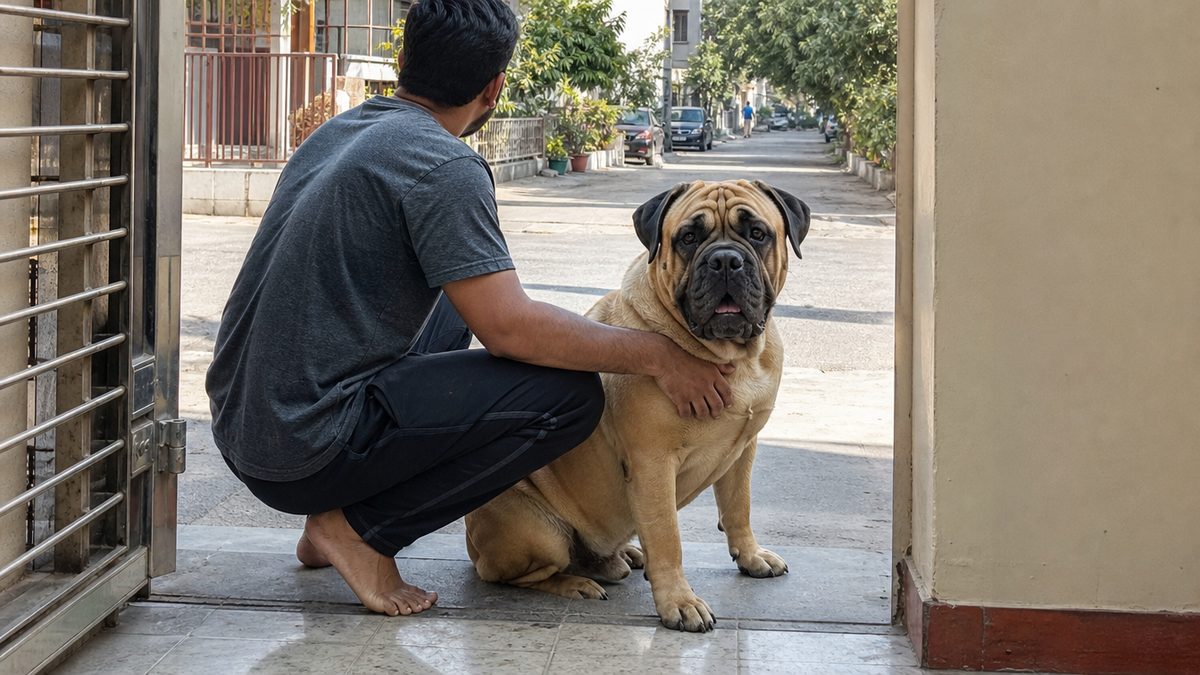
India's exposure is not the Shar Pei, it is the mastiff group. The Bully Kutta and the working mastiff types kept across Punjab, Haryana and Uttar Pradesh are large, loose-skinned, heavy-headed dogs of exactly the conformation the UK model penalises hardest, and the UK dataset contains no Bully Kutta at all, so no odds ratio for that breed exists anywhere. That absence is a fact about the evidence, not a clean bill of health. The nearest measured relatives in the dataset are the Neapolitan Mastiff at an odds ratio of 58.7 and the Saint Bernard at an annual ectropion prevalence of 1.72 percent.
A second register measures the same breeds in a different country on a different population, and setting the two side by side is the most useful thing on this page. The Orthopedic Foundation for Animals publishes a Companion Animal Eye Registry table headed ENTROPION (EYELIDS 21.000), carrying 109 breed rows on a Breed, Tested, Affected, percent schema, alongside ECTROPION (EYELIDS 22.000) with 50 rows. Its denominator is not a national dog population. It is dogs whose owners paid for a certification eye examination, which is a breeding-minded, actively screened sample, so it should read higher than a primary-care caseload, and it does.
| Breed | OFA eye register, United States: affected of dogs examined | OFA percent | VetCompass, UK primary care 2019: annual prevalence |
|---|---|---|---|
| Chinese Shar-Pei | 113 of 309 | 36.6 percent | 15.41 percent (95 percent CI 14.00 to 16.91) |
| Neapolitan Mastiff | 35 of 98 | 35.7 percent | 6.88 percent (95 percent CI 3.02 to 13.14) |
| Saint Bernard | 92 of 416 | 22.1 percent | 5.00 percent (95 percent CI 3.44 to 6.99) |
| Clumber Spaniel | 191 of 931 | 20.5 percent | 6.34 percent (95 percent CI 3.22 to 11.09) |
| Chow Chow | 118 of 745 | 15.8 percent | 9.28 percent (95 percent CI 7.64 to 11.14) |
| Bulldog | 176 of 1,243 | 14.2 percent | 4.65 percent (95 percent CI 4.22 to 5.11) |
| Pug | 273 of 2,266 | 12.0 percent | Not published as a breed prevalence; 229 of 3,029 cases |
| Labrador Retriever | 478 of 101,680 | 0.5 percent | Not published as a breed prevalence |
| Golden Retriever | 208 of 126,200 | 0.2 percent | Not published as a breed prevalence |
Read the two columns as a lesson about denominators rather than as a contradiction. Every breed is higher in the American register, roughly two to five times higher, and the reason is who was examined: a certification exam is somebody looking for the fault on purpose, while a primary-care record is a diagnosis written when a dog came in with a problem O'Neill DG, Mustikka MP, Brodbelt DC. The ranking order barely moves, which is the reassuring part. The Shar-Pei tops both, and the same handful of heavy-faced breeds fills the top of both lists.
The huge denominators at the bottom of that table are the ones an ordinary Indian owner should read twice. The Labrador Retriever shows 478 affected of 101,680 dogs examined, 0.5 percent, and the Golden Retriever 208 of 126,200, 0.2 percent. Those are the two most commonly kept pedigree dogs in Indian cities, they are measured on denominators a hundred times larger than the Shar-Pei's, and their rates are low. Entropion is a real problem concentrated in a specific set of faces, not a general hazard of owning a dog.
The mastiff group is where the two registers matter most for India, because this is the conformation kept here. In the American eye register the Mastiff shows 157 affected of 2,204 examined (7.1 percent) for entropion and 198 of 2,204 (9.0 percent) for ectropion, the Bullmastiff 109 of 1,797 (6.1 percent), the Boerboel 6 of 169 (3.6 percent), the Cane Corso 16 of 458 (3.5 percent) for ectropion and the Tibetan Mastiff 2 of 127 (1.6 percent). The Bully Kutta appears in neither register and in neither study, so it still has no measured figure anywhere. What the mastiff rows show is that the fault is measurable across the whole group at rates ten to thirty times the general-population figure, which is the closest evidence an Indian buyer of a heavy mastiff type can get.
One caution on the ectropion numbers, because two of them are probably one number. The Neapolitan Mastiff reads 4.30 percent in UK primary care, 23.4 percent in an Italian study of 152 dogs, 51.2 percent in the United States breeding-examination data the UK authors cite, and 45 of 98 certification exams, 45.9 percent, in the live OFA register today. The last two are both American breeding-examination data and are most likely the same stream at two different snapshots rather than two independent confirmations, so this page counts them once. The Great Dane shows the same pattern, 4.1 percent in the cited United States data against 4.0 percent in the register read today. Sources that agree to a tenth of a percent are usually one source.
The Shar Pei numbers are worth dwelling on because they are the ceiling. A separate VetCompass study of 455,557 dogs including 1,913 Shar Pei found entropion in 17.88 percent (95 percent CI 16.16 to 19.59) of the breed in a single year, the single most commonly diagnosed disorder in the breed ahead of otitis externa at 16.36 percent. Its authors say that even that figure may substantially underestimate the true scale, because the American College of Veterinary Ophthalmologists Blue Book reported entropion in 50.7 percent of Shar Pei from 1991 to 2015 and 28.7 percent from 2016 to 2020 among dogs actively assessed for the condition. Roughly one Shar Pei in five is treated for it every year, and up to one in two is affected when somebody looks for it.
Ectropion, the same fault rolling outward
Ectropion is an eyelid margin that everts, turning outward and away from the eye, and it is roughly one tenth as common as entropion in dogs overall at an annual prevalence of 0.04 percent (95 percent CI 0.04 to 0.05). It gets a section here rather than a page of its own because the two conditions share their causes, their breeds and often the same dog.
The breeds differ from the entropion list in an instructive way. The highest annual prevalences of ectropion were Neapolitan Mastiff at 4.30 percent (95 percent CI 1.41 to 9.77), Saint Bernard at 1.72 percent (95 percent CI 0.86 to 3.05), Basset Hound at 1.59 percent (95 percent CI 0.94 to 2.49) and Great Dane at 1.47 percent (95 percent CI 0.83 to 2.42). These are the heavy-headed, droop-lidded, loose-jowled breeds rather than the flat-faced ones, which is what the mechanism predicts.
The odds ratios for ectropion are the largest numbers in the whole study. Against general crossbred dogs, the Neapolitan Mastiff sits at 426.97 (95 percent CI 156.82 to 1162.50, P below 0.001), the Saint Bernard at 200.71 (95 percent CI 94.36 to 426.92), the Great Dane at 153.4 (95 percent CI 77.05 to 305.41) and the Basset Hound at 147.09 (95 percent CI 76.32 to 283.48). Nineteen breeds showed increased odds, no breed showed statistically reduced odds, and 22 breeds had no ectropion case identified at all.
Three populations, three numbers, one breed
Where sources disagree this page prints the disagreement rather than picking a winner. Ectropion in the Neapolitan Mastiff is recorded at 4.30 percent in UK primary care, at 23.4 percent in a study of 152 Neapolitan Mastiffs, and at 51.2 percent in United States eye-test data gathered for breeding purposes, with the same US dataset putting the Great Dane at 4.1 percent. The three populations are not comparable and that is the point. A primary-care record counts dogs a vet wrote a diagnosis for; a breed study counts dogs somebody examined for this specific fault; a breeding-examination dataset counts dogs whose owners chose to have them screened. The same breed reads as 1 in 23, 1 in 4 or 1 in 2 depending on who was looking.
| Measure | Entropion | Ectropion |
|---|---|---|
| Annual prevalence in dogs overall | 0.33 percent (95 percent CI 0.32 to 0.34) | 0.04 percent (95 percent CI 0.04 to 0.05) |
| Cases among the 3,029 confirmed | 2,752 (90.86 percent) | 344 (11.36 percent) |
| Highest-prevalence breed | Shar-Pei, 15.41 percent | Neapolitan Mastiff, 4.30 percent |
| Highest odds ratio against crossbreds | Shar-Pei, 107.38 | Neapolitan Mastiff, 426.97 |
| Median age at first recorded diagnosis | 2.02 years (IQR 0.69 to 5.15) | 2.15 years (IQR 0.69 to 6.90) |
| Recorded as affecting both eyes | 1,148 of 1,875 (61.23 percent) | 179 of 230 (77.83 percent) |
| Operated on within the study year | 414 of 2,275 (18.20 percent) | 12 of 305 (3.93 percent) |
| Commonest comorbid eye condition | Conjunctivitis, 414 of 1,019 (40.63 percent) | Conjunctivitis, 55 of 117 (31.07 percent) |
The clinical picture differs from entropion in ways worth knowing. Among 167 ectropion cases with a sign recorded, the commonest were ocular discharge in 87 (52.10 percent), conjunctival redness in 46 (27.54 percent) and epiphora in 25 (14.97 percent), and the commonest comorbid conditions were conjunctivitis in 55 (31.07 percent), diamond eye in 17 (9.60 percent) and corneal ulceration in 16 (9.04 percent). Ectropion scars the cornea less often than entropion does, because nothing is rubbing on it; the damage comes from exposure and from debris reaching an eye the lid no longer protects.
Ectropion is also far less often operated on, and the gap is large. Surgery was carried out in 12 of 305 ectropion cases (3.93 percent) against 414 of 2,275 entropion cases (18.20 percent). Of the eight surgical ectropion cases with a method recorded, six were wedge resections (75.00 percent), two Celsus-Hotz (25.00 percent), one a Stades forced granulation procedure and one a tarsorrhaphy. Mild ectropion is often managed rather than corrected. The UK researchers write that conformational eyelid disorder cases only mildly affected with ectropion may show minimal clinical signs, or the signs may be controlled with appropriate management by the owner, and they give that as one reason a veterinary surgeon may miss the diagnosis or leave it out of the clinical record altogether. They separately confirm that many cases of conformational eyelid disorder are managed under primary care, either without surgery or with the surgery done at the primary care clinic rather than at a referral centre.
One direction-of-travel note separates the two conditions over a dog's life. A proportion of dogs grow out of mild entropion as the head matures, while ectropion may potentially worsen with age, on the analogy of involutional ectropion in humans that follows age-related reduction in tissue tone. That is the honest reason an older dog's drooping lower lid is a new problem and a puppy's rolled-in lid may not be a permanent one.
How entropion is diagnosed, and the one drop that changes the answer
To diagnose entropion, a veterinarian looks at the eyelid margin, then puts a numbing drop in the eye to see whether the lid unrolls once the pain stops. That single step separates the two conditions that look identical from the sofa. If the lid unrolls, the entropion was spastic, caused by pain from something else. If it stays rolled, it is a developmental or conformational fault.
Getting that distinction right decides whether your dog is operated on. Secondary or spastic entropion is where another disease causes pain, which retracts the eyeball and rolls the eyelids inward, and medical treatment is used to determine whether the entropion is primary or secondary; if it is secondary, treating the underlying condition is what fixes the lid. Operating on a spastic lid corrects a shape that was never the problem.
Three further tests usually run in the same consultation and each answers a different question. Five steps make up a full eyelid work-up.
- Look at the lid margin in good light, on both eyes, with the dog relaxed rather than squinting from restraint.
- Instil a topical numbing drop and watch whether the eyelid unrolls, which distinguishes spastic from primary entropion.
- Stain the cornea with fluorescein, which glows under a cobalt blue light wherever an ulcer has broken the surface.
- Run a Schirmer tear test, to check whether the eye is making enough tears, since dry eye both mimics and worsens this picture.
- Measure the pressure inside the eye with tonometry, to rule glaucoma in or out as the source of the pain.
Two of those tests point at conditions with their own pages on this site. A low Schirmer reading points toward dry eye, or keratoconjunctivitis sicca, and a raised intraocular pressure points toward glaucoma, which is painful and is an emergency in its own right. A third eyelid that has flipped out and sits as a pink lump in the corner is a different condition again, cherry eye, and it is often confused with an eyelid fault by owners describing it over the phone.
Which eyelid, which eye, and why the answer is usually both
The location data is more consistent than most owners expect. Among 1,432 entropion cases where the eyelid position was recorded, 1,083 (75.63 percent) involved the lower eyelid and 294 (20.53 percent) the upper. Among 1,875 cases with laterality recorded, 1,148 (61.23 percent) were bilateral, with 385 (20.53 percent) confined to the right eye and 342 (18.24 percent) to the left. For ectropion the bilateral share is higher still at 179 of 230 (77.83 percent), and 133 of 141 recorded locations (94.33 percent) were the lower lid.
Bilateral disease is the default, and that has a practical consequence for an Indian owner budgeting a procedure. A quote for one eye is usually a quote for half the job. Ask whether the estimate covers both eyes and both lids before you agree to it, because the surgical literature reports operating bilaterally as the norm: in an Italian series of 47 dogs, surgery was performed bilaterally in 41 dogs (87.2 percent) and unilaterally in only 6 (12.8 percent).
One diagnostic caution belongs on this page because no ranking page carries it. A dog can have entropion and a second inherited eye disease at the same time, and the breeds at the top of the eyelid list are not free of the rest. A dog being examined for a rolled lid is a dog whose retina, lens and pressure are worth checking while it is on the table, and our page on progressive retinal atrophy in dogs covers the one an ophthalmoscope will not find early.
Eyelid tacking, surgery and what each one actually achieves
Eyelid tacking is a temporary procedure that holds a puppy's lid in a normal position with sutures or staples while the head grows, and in the best published series the entropion resolved in 36.6 percent of 71 tacked eyes and needed no further therapy at all. Roughly one tacked eye in three is finished with. The other two thirds go on to definitive surgery, which is what tacking is designed to buy time for.
The mechanism is straightforward and worth understanding before you consent to it. Tacking uses stitches or surgical staples in puppies less than 12 weeks old who have not yet developed corneal ulceration or other significant disease, and it allows young puppies to grow into their eyelids. The PDSA describes the same procedure as holding the eyelids in a more natural position until the dog is 5 to 12 months old. VCA notes it is used especially in breeds such as the Chinese Shar Pei and Chow Chow, with the entropion monitored as the puppy grows and definitive surgery at four to five months if it has not resolved.
The single best piece of evidence on timing is a retrospective study of 116 client-owned dogs under three years old, treated at two Californian ophthalmology practices between 2010 and 2020. Forty-four dogs with entropion, 71 eyes, had a temporary tacking procedure, and the entropion resolved in 36.6 percent of eyes requiring no further therapy, with the dogs successfully treated by tacking having a younger median age than those in which it failed. Younger is better, and waiting reduces the chance that tacking alone will be enough.
That study also settled a question owners are given the wrong answer to. Forty-seven dogs (75 eyes) had entropion surgery at maturity and 52 dogs (79 eyes) had it as juveniles, and there was no statistically significant difference in recurrence between adult eyes at 6 of 75 (8 percent) and juvenile eyes at 10 of 79 (12.7 percent). The authors conclude that entropion surgery in juvenile dogs is not associated with a higher risk of recurrence and need not be delayed until dogs are older than one year. A puppy in pain does not have to wait for its first birthday.
| Procedure | What it does | Published outcome, with its denominator | What it does not do |
|---|---|---|---|
| Temporary tacking, also called stay sutures | Holds a growing puppy's lid everted with sutures or staples | Resolved the entropion in 36.6 percent of 71 eyes in 44 dogs, no further therapy needed | Does not correct a mature dog's conformation, and 38.43 percent of 216 UK surgical cases used stay sutures |
| Celsus-Hotz, or modified Hotz-Celsus | Excises a crescent of skin beside the lid margin to roll it outward | The commonest method recorded in UK primary care, 86 of 216 cases (39.81 percent) | Can over-correct into ectropion, which is why two operations are often planned |
| Wedge resection | Shortens an over-long eyelid by removing a wedge | 28 of 216 UK entropion cases (12.96 percent) and 6 of 8 ectropion cases (75.00 percent) | Addresses length rather than the inward roll on its own |
| Stades forced granulation, upper lid only | Leaves a strip of upper lid to heal by secondary intention | Resolved ocular signs in 50 of 54 eyes in 27 Shar Pei whose tacking had already failed | Two of those dogs still needed lower-lid revision with Hotz-Celsus |
| Brow rhytidectomy, with or without a Stades-like step | Removes a band of heavy brow skin to lift the upper lid | Adequate conformation in 19 of 27 Chow Chow and Shar-Pei dogs (70.4 percent) | 7 of 27 (25.9 percent) were under-corrected and 1 (3.7 percent) over-corrected |
| Hyaluronic acid subdermal filler | Plumps the tissue near the margin to evert the lid, under topical numbing | Resolution by the first week in the majority of 40 animals, 28 dogs and 12 cats | Temporary, and 3 dogs and 1 cat still needed permanent surgery |
The honest answer on fixing it without surgery
Google India asks whether you can fix entropion without surgery, and there is one real answer with published numbers behind it. Hyaluronic acid subdermal filler is injected 1 to 2 mm from the eyelid margin until normal conformation is achieved, and in a series of 40 animals, 28 dogs and 12 cats, no patient required sedation or general anaesthesia and the only complication recorded was minor skin bleeding at the injection sites. Resolution of the entropion and of secondary problems including corneal ulceration, epiphora and blepharospasm was noted by the first week in the majority of cases, with a median follow-up of 152.5 days.
The limits are equally clear and this page prints them. Three dogs and one cat in that series failed to resolve and needed additional permanent surgical intervention, and the authors describe the technique as suitable for mild to moderate entropion, especially in geriatric patients and those at high anaesthetic risk. The ACVO describes it as a reasonable surgical alternative for owners whose pet is not a safe general-anaesthesia candidate, or who need time to plan financially. It is a bridge and a fallback, not a substitute for correction in a young dog with a structural fault.
The other non-surgical route is not a treatment at all; it is a correct diagnosis. If the entropion is secondary to another painful eye condition, treating that condition is what unrolls the lid, and no eyelid surgery is required. That is why the numbing-drop test in the previous section matters more than any single decision on this page.
Why two operations are normal rather than a failure
Two procedures exist specifically for the heavy-browed breeds, and both were studied on dogs whose tacking had already failed. In 27 Shar Pei with bilateral upper and lower eyelid entropion, all of which had previously undergone unsuccessful temporary palpebral tacking, a Stades forced granulation procedure on the upper eyelid alone resolved the ocular signs in 50 of 54 eyes at four weeks, with only two dogs needing lower-lid revision by Hotz-Celsus and no long-term recurrence in the 38 eyes re-examined a year later. Those dogs had a median age of 7.9 months and 13 of their 54 eyes already carried a corneal ulcer at presentation.
The second is a brow lift, and its results are honest about falling short. Brow rhytidectomy, with or without a Stades-like step, was performed on 27 dogs, 15 Chow Chow and 12 Shar-Pei, aged 1.9 years on average, for pseudoptosis and trichiasis-entropion of the upper eyelid. At the last recheck, 19 of 27 dogs (70.4 percent) had adequate eyelid conformation, 7 (25.9 percent) were under-corrected and 1 (3.7 percent) was over-corrected, with 81.5 percent of owners satisfied and 96.3 percent of cases free of recurrence over the follow-up. A quarter under-corrected is the realistic expectation to carry into a consultation about a severely wrinkled dog, and it is a number no ranking page prints.
Being told your dog needs a second operation is not evidence that the first went wrong. In many cases a primary major surgical correction is followed by a second minor corrective surgery later, and two surgeries are often performed deliberately to reduce the risk of over-correcting the entropion into an outward-rolling eyelid, which would be ectropion. The PDSA puts it the same way, that the operation sometimes needs to be repeated more than once to cure the problem completely.
Outcomes after proper correction are good, and this is the reassuring number on the page. The prognosis for surgical correction of entropion is generally good and most dogs enjoy a pain-free, normal life, although if the condition is treated late and corneal scarring has occurred there may be permanent, irreversible visual deficits. In a guide-dog breeding population, surgical repair was corrective in 164 of 181 puppies (90.61 percent) with no recurrence of entropion, at a median age at first repair of 7.9 weeks. In an Italian series of 88 eyes the only complication across 47 dogs was wound dehiscence from self-injury in one dog, with a median follow-up of 574 days.
Only a minority of diagnosed dogs are actually operated on, which is worth knowing before you assume surgery is automatic. Surgical management was carried out for 414 of 2,275 incident entropion cases (18.20 percent) in the UK study year, while at first diagnosis the commonest recorded plans were medical care in 1,133 of 1,906 cases (59.44 percent) and surgery in 1,098 (57.61 percent). Many dogs are treated medically first and operated on later, or never. This page names no drug dose anywhere, because the drops, the pain relief and the timing are decisions your own veterinarian makes for the dog in front of them.
What entropion surgery costs in India, from a government rate card and a private chain
Entropion and ectropion surgery is priced in India at Rs 250 for a pet on the ICAR-IVRI Referral Veterinary Polyclinic rate card and at Rs 15,000 to over Rs 40,000 by a private Indian clinic chain Vetic, an Indian veterinary clinic chain. Both numbers are real, they describe different things, and the gap between them is roughly sixtyfold. No page currently ranking on Google India for the India cost query prints either one.
The government figure comes from a published institutional rate card rather than a blog. ICAR-IVRI at Izatnagar lists its charges for surgical procedures and diagnostic imaging services with effect from July 2022, and line 31 of that table reads Entropion/Ectopion, Pets Charge Rs 250.00, Small Animal Rs 100.00, Large Animal Rs 150.00, marked plus tax as applicable. The institute's own page misspells the second word as Ectopion, and it is reproduced here as printed. Registration is charged separately at Rs 50.00 for a dog or cat in normal hours, Rs 150.00 after 12:30 PM and Rs 300.00 after 5:00 PM and on holidays.
| Source and what it is | Price as printed | What the price covers | Exchange-rate test |
|---|---|---|---|
| ICAR-IVRI Izatnagar, Referral Veterinary Polyclinic rate card, w.e.f. July 2022 | Rs 250.00 for a pet, plus tax as applicable | The Entropion/Ectopion procedure line only, with registration charged separately at Rs 50.00 | USD 2.96 at 84.38 and USD 3.38 at 74, so rupee-native and clearly a subsidised institutional charge |
| ICAR-IVRI Izatnagar, neighbouring eye lines on the same card | Cataract surgery Rs 600.00, cherry eye Rs 500.00, enucleation Rs 300.00, tarsorrhaphy Rs 200.00, corneal surgery Rs 300.00 | Procedure charges only, on the same July 2022 schedule | All divide to small odd dollar amounts, so none is a converted dollar price |
| Vetic, an Indian clinic chain, entropion cost article | Rs 15,000 to Rs 40,000 and above | A whole-episode private range, varying by severity, clinic facilities and required expertise | USD 177.77 to 474.05 at 84.38 and USD 202.70 to 540.54 at 74, so not a rounded dollar list |
| PetMD, the top-ranking page on Google India for the bare query | USD 500 to USD 2,000 | A United States figure, given in dollars with no Indian equivalent | Rs 42,190 to Rs 168,760 at 84.38, which is a conversion and is reported here as one |
Every rupee figure above was divided by 84.38 and by 74 before publication and none lands on a round dollar amount, so none of them is a converted dollar price presented as an Indian one. The only converted figure in the table is PetMD's, and it is labelled as a conversion rather than as an Indian price.
Why the two Indian numbers are sixty times apart
The two figures are not in conflict, and reading them as a contradiction would mislead a buyer. The IVRI number is a procedure charge at a government teaching institute, listed alongside a Rs 50 registration fee and marked plus tax; it does not state what anaesthesia, hospitalisation, medication, follow-up or a specialist ophthalmologist's involvement add. The Vetic number is a whole-episode private range that the clinic says varies with the number of eyelids affected, the severity of corneal damage, whether specialist care from a veterinary ophthalmologist is needed, pre-surgical diagnostics and medications, and follow-up visits.
The practical reading is that an Indian owner has a genuine choice of two very different routes, and almost nobody tells them so. A government veterinary college or ICAR institute charges institutional rates for the operation itself. A private chain quotes an all-in figure in the tens of thousands. Which one is right for your dog depends on severity, on whether a specialist is needed, and on how far you live from a teaching hospital. Ask for a written estimate that names both eyes, both lids, the anaesthesia, the follow-up visits and the likelihood of a second operation, since two operations are commonly planned rather than exceptional.
Geography decides whether the cheap route is a real option for you. The Rs 250 line is a charge list for one institute, ICAR-IVRI at Izatnagar in Uttar Pradesh, and it is printed as 250.00 under a column headed Pets Charge (INR), which is ₹250. An owner in Mumbai, Delhi, Bengaluru, Chennai, Hyderabad, Pune or Kolkata is nowhere near it, and nothing on that page says any other institute charges the same. Treat it as proof that an Indian government teaching hospital prices this operation in hundreds of rupees rather than tens of thousands, then ask your own nearest state veterinary college what it charges, because a comparable published card for Maharashtra, Karnataka or Tamil Nadu was not found on this attempt.
The search result itself is the other Indian finding. Google India's cost query for this surgery, run on 24 September 2026, returned an organic set made up almost entirely of American, British and Australian clinic pages, with a single Indian clinic chain and a Justdial listings page as the only local results. An Indian owner searching this in English is being priced in dollars by default, which is how a Rs 250 procedure line and a USD 2,000 quotation end up describing the same operation.
One caveat belongs on the government figure. The IVRI schedule has been in effect since July 2022 and prices on a published card move more slowly than private ones, so confirm it with the institute before you travel. The card is also a list of charges, not an offer of an appointment, and Bonbeno reports published prices as editorial content rather than brokering treatment. Ask your own veterinarian what the operation costs where you live.
The Indian rule that names entropion by name, and the evidence that breeding works
Indian law already names both of these conditions. The Prevention of Cruelty to Animals (Dog Breeding and Marketing) Rules, 2017 require that breeding dogs shall have been tested for genetic defects, including hip dysplasia, progressive retinal atrophy, night blindness, hypothyroidism, entropion, ectropion, overshot, undershot jaw (when incisors do not touch or mesh), wry mouth, two or more missing teeth, unilateral cryptorchid or full cryptorchid males. The clause is Second Schedule, Part III, rule 8, sub-clause (10), notified as G.S.R. 496(E) on 23 May 2017.
Read the word including carefully, because it decides what the rule covers. The eleven defects named are illustrative rather than exhaustive, so a condition the clause does not list is unnamed rather than excluded. Entropion and ectropion are both on the list, which puts them among the handful of conditions an Indian breeder is explicitly told in law to have tested for before breeding a dog.
What the rule does not do is say which test, to which standard, read by whom, or recorded where. It names no scheme, no examining qualification, no certificate and no register. There is no Indian national canine eye scheme equivalent to the British Veterinary Association's, and no Indian equivalent of the Companion Animal Eye Registry. The Kennel Club of India registers pedigrees rather than health results, so a KCI certificate records ancestry and states nothing about a parent's eyelids. So an Indian buyer asking a breeder to comply with the rule is asking for a private veterinary record rather than for a scheme certificate, which is a weaker instrument and worth knowing in advance. Our guide to dog breeder checks in India covers what to ask for in writing, and KCI registration explained covers what a Kennel Club of India certificate does and does not state about health.
A register that does exactly this job already exists, and it is worth an Indian breeder knowing what compliance could look like. The Orthopedic Foundation for Animals publishes Companion Animal Eye Registry statistics breed by breed, including a table headed ENTROPION (EYELIDS 21.000) with 109 breed rows and one headed ECTROPION (EYELIDS 22.000) with 50, each giving the number of dogs examined, the number affected and the percentage. That is a public, per-breed, denominator-carrying record of exactly the two defects clause 8(10) names, maintained on a voluntary certification scheme with no statute behind it. India has the statute and no register; the United States has the register and no statute. Neither half works alone.
The number that shows breeding choices work
Selective breeding against entropion has been measured, once, in a closed population, and the effect is large. Guide Dogs for the Blind reviewed 4,064 Labrador Retriever puppies, 2,106 whelped between July 2013 and October 2016 before a selective breeding strategy and 1,958 whelped between May 2020 and December 2024 after it. The incidence of entropion fell from 6.46 percent before to 3.12 percent after, with dogs in the pre-selection cohort carrying 1.96 times the risk of an entropion diagnosis.
The heritability figure is the one that should end the argument about whether this is a breeding problem. In that population the heritability of entropion was estimated at h2 of 0.80. A trait with heritability that high responds fast to selection, which is exactly what the two cohorts show. The same study found 197 puppies diagnosed at a median age of 6.7 weeks, 181 of them repaired at a median age of 7.9 weeks, with repair corrective in 164 cases (90.61 percent) and no recurrence.
The other side of that coin is what happens where nobody selects. The veterinary advice on breeding is unambiguous: because of the concern that the condition is inherited, dogs with severe entropion requiring surgical correction should not be bred. Researchers studying the Shar Pei go further and name the specific practice to refuse, writing that it is critical that dog producers, the dog showing community and buyers do not normalise routine conformation-altering surgeries such as eye tacking of young puppies with entropion as an ethically acceptable option to justify ongoing breeding of dogs with extreme conformation.
Ask the breeder four questions and ask for the answers in writing. First, have both parents been examined for entropion and ectropion by a veterinarian, as clause 8(10) of the Dog Breeding and Marketing Rules, 2017 requires. Second, has either parent or any littermate from a previous litter had eyelid tacking or eyelid surgery. Third, may I see the clinical record rather than a summary in an advertisement. Fourth, what happens if this puppy needs surgery, given that heritability in a measured Labrador population was 0.80. A breeder who cannot answer the second question has not been keeping records, and a puppy whose parents both needed surgery is a puppy at high risk. Your own veterinarian, not the breeder, should examine the puppy's eyes before money changes hands.
The Indian clinical literature, searched and absent
There is no published Indian clinical series on canine entropion or ectropion, and this page says so with the searches recorded rather than as a bare assertion. On 24 September 2026, PubMed was searched through NCBI E-utilities with two separate instruments. The title and abstract search, combining entropion or ectropion with dog, dogs or canine and India[tiab], returned 0 records. The author-affiliation search, the same terms with India[ad], also returned 0 records.
Both instruments were controlled in the same session and both passed. The identical query shape run on canine parvovirus returned 40 records for India[tiab] and 84 for India[ad], so neither instrument was broken and neither was silently mangled. The unrestricted canine query, entropion or ectropion with dog, dogs or canine and no country term, returned 81 records, so the literature itself is not thin. Widening the India title search to entropion or ectropion with India[tiab] and no species limiter returned 18 records, every one of them human ophthalmology, dermatology, leprosy or trachoma rather than veterinary. The absence is real, it is specific to Indian canine work, and it is the reason the prevalence figures on this page are British. There is no published canine eyelid series from Maharashtra, from Karnataka, from Tamil Nadu or from Delhi, and none from anywhere else in India.
That absence has a direct consequence for an Indian reader and it should be stated plainly. Every prevalence, odds ratio and confidence interval on this page was measured in the United Kingdom, in a population of insured and primary-care dogs whose breed mix is not India's. The UK dataset contains Shar-Pei, Chow Chow and English Bulldog in numbers; it contains no Bully Kutta, no Gull Dong and no Indian working mastiff. Treat the breed table as evidence about conformation rather than as an Indian prevalence, and treat the absence of an Indian figure as a gap in the research, not as evidence that Indian dogs are unaffected.
Living with it, from the recovery cone to the next generation
Recovery from eyelid surgery is short, and the job for the first fortnight is stopping the dog undoing it. Most practices use absorbable sutures that dissolve on their own, so there is no need to remove stitches near the eye. The one recorded complication across 88 operated eyes in an Italian series was wound dehiscence caused by a dog injuring itself, in one dog.
Eye drops usually run before, during and after the operation, especially if a complication such as inflammation or infection has already developed. This page names no drug dose, because the drops that suit a dog with an ulcer are different from the drops that suit a dog without one, and the wrong drop on an ulcerated cornea makes it worse. Your veterinarian sets both the drug and the schedule for your animal.
The Indian climate adds two practical problems to that fortnight that a British recovery sheet does not mention, and they split by season and by city. Dust and construction grit in the air during the dry months land in an eye that is already inflamed, and the monsoon months make a damp cone and a damp surgical site harder to keep clean. Keep the dog indoors during the dustiest part of the day, keep the cone dry, and take the dog back if discharge changes colour or the eye starts being held shut again rather than opening more each day.
Season the surgery where you can, and there is a clinical reason rather than a convenience one. Ocular discharge is the commonest recorded sign of this condition at 47.73 percent of cases, and a humid monsoon fortnight in Mumbai, Kolkata or Chennai is the hardest possible setting in which to tell ordinary post-operative discharge from an infected surgical site. A dry-season slot in Delhi or Pune has the opposite problem, since construction dust and traffic grit land in an eye that has just been cut. Neither is a reason to delay a painful eye, because corneal ulceration accompanied 27.28 percent of recorded entropion cases and a delayed cornea scars permanently. It is a reason to ask your veterinarian which fortnight is easiest to keep a cone dry where you live.
Long-term outlook is genuinely good when the eye is treated before the cornea scars. Most dogs enjoy a pain-free, normal life after surgical correction, and permanent, irreversible visual deficits follow when treatment is late and corneal scarring has already occurred. The difference between those two outcomes is measured in months of delay, which is why the alert earlier on this page is about a same-day appointment rather than a same-month one.
- Keep the cone on, since self-injury was the only complication recorded in a 47-dog series.
- Give every drop on the schedule your vet wrote, including the ones that start before surgery.
- Expect a second operation to be possible, because two are often planned to avoid over-correcting into ectropion.
- Watch the other eye, since 61.23 percent of entropion cases are bilateral.
- Book the recheck rather than judging the lid yourself, and take photographs in daylight between visits.
- Retire the dog from breeding if the entropion was severe enough to need surgery.
What an adopter or second-hand buyer should look at
An adult dog offered for rehoming can already carry the scar of this surgery, and it is visible if you know where to look. Look at both lower lid margins in daylight for a thin pale line of scar running parallel to the lash line, ask whether the dog has had eyelid surgery and how many times, and ask whether it currently needs drops. A dog that has been corrected and is comfortable is a good adoption; a dog that is squinting and has never been seen is a veterinary appointment on day one. Adopting an adult from an Indian rescue has the advantage that the eyes you are looking at are the eyes the dog will have, which is not true of an eight-week-old wrinkled puppy.
A dog treated properly for entropion goes on to live a normal, comfortable life, and the evidence supports saying so. Prognosis after surgical correction is generally good and most dogs enjoy a pain-free normal life. In a guide-dog population, repair was corrective in 90.61 percent of 181 puppies with no recurrence, and in a specialist Italian series every one of 47 dogs had a favourable outcome with resolution of clinical signs. What is not reasonable is expecting a breed with an odds ratio of 107.38 to stop producing the problem on its own. Individual dogs are treated; the condition is reduced by breeding, and by buyers choosing differently.
The last word belongs to a specialist who does this work. Dr Minna Mustikka, a co-author of the UK study and a veterinary ophthalmology specialist, said that in daily practice she meets dogs suffering pain and distress from eye problems caused by improper eyelid positioning, often stemming from unhealthy appearance goals in dog breeding, and that such suffering is not only unnecessary but entirely preventable. Preventable is the operative word, and in India it is the clause in the 2017 rules that nobody enforces.
What Google India asks about entropion in dogs
How do you treat entropion in dogs?
Treatment is surgical in most dogs. A section of skin is removed from the affected eyelid to reverse the inward rolling, and two operations are often planned to avoid over-correcting into ectropion. In puppies, temporary tacking sutures are placed first, and the entropion resolved in 36.6 percent of 71 tacked eyes without further therapy.
How much does entropion surgery cost for dogs?
Two published Indian prices exist and they differ enormously. The ICAR-IVRI Referral Veterinary Polyclinic rate card, effective July 2022, charges Rs 250 for the entropion and ectropion procedure line for a pet, plus tax, with registration at Rs 50. A private Indian clinic chain quotes Rs 15,000 to over Rs 40,000 for the whole episode.
Can you fix entropion in dogs without surgery?
Sometimes, in mild to moderate cases. Hyaluronic acid subdermal filler was injected near the eyelid margin in 40 animals, 28 dogs and 12 cats, with no sedation or general anaesthesia needed, and the entropion resolved by the first week in most. Three dogs and one cat still needed permanent surgery afterwards.
What is the best treatment for entropion?
The best treatment depends on which of the four types your dog has. Spastic entropion caused by another painful eye condition resolves when that condition is treated, so no eyelid surgery is needed. Primary or conformational entropion needs surgical correction, and the prognosis after it is generally good, with most dogs living pain-free normal lives.
How much does entropion surgery cost for a dog?
In India, expect Rs 15,000 to over Rs 40,000 at a private clinic, varying with how many eyelids are affected, the severity of corneal damage and whether a veterinary ophthalmologist is needed. The top-ranking international page instead quotes USD 500 to USD 2,000, which converts to roughly Rs 42,190 to Rs 168,760 and is not an Indian price.
Can dogs outgrow entropion?
Some puppies do, which is exactly why eyelid tacking exists. A proportion of dogs grow out of mild entropion as the head matures into adult conformation. In the best-measured series, entropion resolved in 36.6 percent of 71 tacked eyes and needed nothing further, and the puppies that succeeded were younger than those that failed.
Is entropion surgery risky?
The published complication rates are low. Across 88 operated eyes in 47 dogs, the only complication was wound dehiscence from self-injury in one dog, with every patient having a favourable outcome and a median follow-up of 574 days. Recurrence after surgery ran at 8 percent of 75 adult eyes and 12.7 percent of 79 juvenile eyes.
Which dog breeds get entropion most often?
The Shar-Pei by a wide margin. In UK primary care, entropion was diagnosed in 15.41 percent of Shar-Pei in one year, 9.28 percent of Chow Chow and 6.88 percent of Neapolitan Mastiff, against 0.33 percent of dogs overall. The Shar-Pei odds ratio against crossbred dogs was 107.38.
What are the symptoms of entropion in dogs?
Discharge first, then a runny eye, then squinting. Among 1,540 recorded cases the commonest symptoms were ocular discharge at 47.73 percent, epiphora at 27.79 percent and blepharospasm at 22.92 percent. More than a quarter had corneal ulceration alongside, which is painful and can threaten the eye, so a squinting dog needs seeing today.
Does Indian law require breeders to test for entropion?
Yes. Clause 8(10) of the Prevention of Cruelty to Animals (Dog Breeding and Marketing) Rules, 2017 says breeding dogs shall have been tested for genetic defects including entropion and ectropion by name. Prevention is the only real answer, but the clause names no test, no standard and no register, so ask for the clinical record.