
Dog and cat life guide
Rehoming a dog or cat in India: when it is the right call, what the law on abandonment actually says, and the handover that protects the animal
Most pages on this query either moralise or sell a shelter. This one establishes what the statute reaches, what the published relinquishment data actually says, and the handover checklist that decides whether the animal lands safely.
Quick answer
Rehoming a dog in India is lawful and sometimes right. Abandonment is not: section 11(1)(i) of the Prevention of Cruelty to Animals Act makes it an offence, and Chennai now fines it ten thousand rupees. Place the animal yourself where you can, keep it at home while you search, meet the adopter in person, and hand over the records, the sterilisation status and the microchip transfer in writing.
This guide is general information for Indian pet owners and is not a diagnosis. Always consult a registered veterinarian near you before acting on anything you read here, and treat any sudden change in your pet's condition as urgent.
Is rehoming a dog in India ever the right answer?
Rehoming a dog in India is sometimes the right answer, and the welfare body most often quoted against it says so in its own words.
The RSPCA's guidance on giving up a pet reads: "Sometimes giving up a pet is the right thing to do, but it can be distressing for you and them, so it needs to be done carefully";. That sentence is the whole position of this page. A page that tells every reader not to rehome pushes some of them towards the one outcome that is genuinely indefensible, which is leaving the animal somewhere and walking away.
The distinction that matters is not between keeping and giving up. It is between a transfer and an abandonment. A transfer ends with a named person who has agreed to feed the animal tomorrow. An abandonment ends with nobody. Indian law draws the line in the same place, and so does every welfare body we read.
What the evidence says about whether a dog forms a new bond
Dogs do form attachments to a new person, and it takes less contact than owners fear. Gacsi and colleagues tested 60 shelter dogs in a modified Strange Situation Test; 40 of them had been handled three times for ten minutes each by an unfamiliar handler beforehand. The handled dogs behaved differently from the unhandled ones towards that handler, in a pattern the authors judged to meet the three operational criteria of attachment. Their conclusion is unusually direct: "in this experiment we demonstrated that in certain conditions a short responsive interaction with an unfamiliar human individual may result in attachment behavior even in the case of dogs that are more than 1 year old";.
Read that honestly rather than as reassurance. The same paper records "considerable individual variation in attachment behaviors toward the familiar handler among the handled dogs";. Thirty minutes of kindness is not a guarantee for your animal. It is evidence that the capacity is there, which is the question people are actually asking when they ask whether a rehomed dog ever recovers.
Releasing an owned animal on a street, at a temple, outside a shelter gate or in a market is not a gentler version of rehoming. It is a separate act with a separate outcome, and the section below on what happens to it is the reason.
What Indian law says about abandoning a pet, and where rehoming sits
Indian law says nothing at all about rehoming and a great deal about abandonment, which is the single most useful thing to know before you start.
Section 11(1)(i) of the Prevention of Cruelty to Animals Act, 1960 makes it an offence if any person "without reasonable cause, abandons any animal in circumstances which render it likely that it will suffer pain by reason of starvation or thirst". Three words in that clause do the work. "Without reasonable cause" means the Act contemplates that some reasons are good ones. "Abandons" means leaving the animal to itself, not handing it to a person. And "any animal" is unqualified.
The neighbouring clause reaches a pet just as plainly, and the reason is an amendment most summaries miss. The gazette copy hosted by the Animal Welfare Board of India prints clause (h) as "being the owner of [any animal] fails to provide such animal with sufficient food, drink or shelter", with a footnote recording that those words were substituted for "any captive animal" by section 10 of Act 26 of 1982, with effect from 30 July 1982. The bracketed words are the current text and the footnote names what they replaced, so the narrower wording that circulates online is the pre-1982 version. Since 1982 both duties, the duty to feed and shelter and the duty not to abandon, are written about any animal, and a pet dog is squarely inside both.
There is no corresponding clause about giving an animal to another person. Transferring a pet is not regulated at all. The Prevention of Cruelty to Animals (Pet Shop) Rules, 2018 bar carrying on the business of selling or trading in pet animals without registration, which reaches a trade and not a household placing its own animal, and the detail of that regime sits on our guide to checking a dog breeder in India. The practical consequence is blunt. Nobody will check your adopter for you. There is no Indian rule that makes anyone screen the home your animal goes to.
The ten thousand rupees that does what fifty rupees cannot
The penalty under section 11(1) is a fine "which may extend to fifty rupees" for a first offence, rising to one hundred rupees or up to three months in prison for a second offence within three years of the first. That figure was set in 1960 and has not moved. It is the reason no Indian owner has ever been meaningfully deterred by the central Act, and several of our other guides say so at the same figure.
One city has now acted on its own. In a resolution passed by its monthly council on 26 September 2026, the Greater Chennai Corporation set a fine of ₹10,000 on owners who abandon pet dogs or cats registered with it, applying from 1 October 2026. The enforcement mechanism is the thing to notice: "If abandoned pet dogs are found on roads and public spaces and scanned using the microchip scanner, the identity of the owner will be traced from the details in the microchip and the owners will be fined";. Fines are collected by Corporation veterinary, medical and sanitary officers through point of sale machines. Chennai's chief veterinary medical officer, Dr J Kamal Hussian, told the New Indian Express that enforcement would begin the following week.
That is 200 times the central Act's maximum, and it exists because Chennai's pet register already holds the microchip number. The licence and microchip machinery behind it is covered on our guide to the Chennai GCC pet licence.
| What you do | What the law treats it as | Exposure |
|---|---|---|
| Hand the animal to a named person who accepts it | Not regulated. No Indian rule requires screening, a contract or a fee | None |
| Surrender to a shelter or sanctuary that accepts it in writing | A transfer of ownership on that organisation's terms | None, but usually irreversible |
| Leave the animal on a street, at a temple or outside a gate | Section 11(1)(i), abandonment without reasonable cause | Fine up to fifty rupees; ₹10,000 in Chennai if the animal is registered and microchipped |
| Give the animal up because a housing society told you to | Still your offence, and the association may have abetted a violation | As above, plus the complaint you did not have to lose |
The Animal Welfare Board of India's pet dog rules state that no amount of pressure should lead to the abandonment of a pet animal, and that an association which intimidates an owner into giving one up has abetted a violation of law. The position, the documents and the reply that settles most of these are on handling a complaint about your pet and society rules for pets in India. If someone has already harmed the animal, the procedure is on reporting animal cruelty in India.
Why people actually give up a pet, with denominators
People give up pets mostly for reasons about themselves rather than about the animal, and the largest study to ask them directly puts housing and lifestyle at the top.
Salman and colleagues interviewed 3,772 owners surrendering animals at 12 US shelters between February 1995 and April 1996, covering 3,676 dogs and litters and 1,409 cats and litters, and coded up to five reasons each from a list of 71. Grouped into 12 classes, human housing issues accounted for 29.1 percent of dogs and 26.3 percent of cats, and human lifestyle for 25.4 percent of dogs and 34.7 percent of cats. The single commonest reason given for a dog was moving, at 341 mentions; for a cat it was too many animals in the house, at 348.
Two numbers in that paper change how a reader should think about their own situation. First, 94.4 percent of the dogs and 95.5 percent of the cats were recorded as healthy at the counter. These were not sick animals. Second, "new baby" accounted for 48 dog mentions and 50 cat mentions out of 7,980 reasons recorded, about one percent. The trigger that dominates the conversation in Indian families is close to the bottom of the measured list.
Where two good studies disagree, and why the method explains it
A 2024 content analysis of 2,836 randomly selected relinquishment records from one open-admission US shelter, covering 2018 to 2023, put behaviour issues first at 28 percent, ahead of housing or moving at 18 percent, unable to care at 16 percent, too many pets at 10 percent, financial at 6 percent and owner allergies at 5 percent. Within the behavioural surrenders, aggression was 32 percent, social conflict 28 percent and soiling 13 percent.
So one study puts housing first and the other puts behaviour first. Do not average them. Salman's figures come from an interviewer standing at the counter asking a person who is upset; the 2024 figures come from what staff wrote in a record afterwards. Those two instruments do not collect the same thing, and the 2024 authors describe their own results as only partially replicating the older work. What both agree on is the shape: most surrenders are driven by the household, not by the animal being defective.
The most useful study for an Indian reader is none of these. Carroll, Torjussen and Reeve analysed 3,945 responses across three pandemic surveys and found that of those who had already given up a cat or dog, 66.7 percent gave the pet directly to a new owner, 14.3 percent relinquished it to a shelter and 19 percent arranged temporary care with someone else. Rehoming is overwhelmingly a private transaction between two households, which is exactly the transaction nobody regulates and nobody writes a guide for. The same survey offered "The cat or dog was let loose" as an option and not one of the 3,945 respondents selected it.
No Indian relinquishment dataset exists, and that is the finding
We found no published Indian study of why owners give up pets, no national register of owner surrenders, and no Indian shelter publishing an intake-by-reason breakdown. The only peer-reviewed study of Indian sheltering we located is a set of ten semi-structured interviews with managers, veterinary nurses and caretakers at three shelters, in Karnataka, Himachal Pradesh and Rajasthan, whose reported annual intakes were 400, 1,500 and 11,182 animals. Its named challenges were inadequate funding, community conflict and high intake numbers. That is the evidence base. Every percentage you will read about Indian pet abandonment on a commercial blog traces back to a marketing survey rather than to a study, and we have not reproduced any of them here.
| Study | What it measured | Top reason | Second |
|---|---|---|---|
| Salman and colleagues, 12 US shelters, 1995-96 | 3,772 owner interviews at the counter, up to 5 coded reasons each | Human housing issues, 29.1 percent of dogs | Behaviour other than aggression, 28.8 percent of dogs |
| Kisley, Chung and Levitt, one US shelter, 2018-23 | 2,836 written relinquishment records, content analysis | Behaviour issues, 28 percent | Housing or moving, 18 percent |
| Carroll, Torjussen and Reeve, UK and Ireland, 2020-21 | 3,945 survey responses across three waves | Financial constraints, most mentioned | COVID-specific health concerns, then behaviour |
| India | No published dataset found | Not measured | Not measured |
Seven problems that look like reasons to rehome and already have a fix
Before you place the animal, check whether your reason is one of the seven this site has already answered in full, because each one is a solved problem with a page behind it.
Every row below is a reason that appears in the published relinquishment data and has a specific, evidenced answer. Read the page before you decide, not after. None of these is a lecture; each is a method with sources.
| The reason | What to read first |
|---|---|
| A baby is coming, or has arrived | Introducing a dog to a new baby carries the dated plan and the bite evidence. New baby was about one percent of recorded reasons in the 12-shelter study |
| Someone in the family is allergic | Pet allergy in children covers testing before deciding, what a positive result does not mean, and Indian test prices |
| The housing society has complained or served a notice | A society complaint about your pet sets out the seven stages and the reply in the first 72 hours |
| The dog destroys the flat or howls when left | Dog separation anxiety separates the four distinct problems the one label hides |
| The dog guards food, the sofa or a person | Resource guarding in dogs is a management and training problem, not a temperament verdict |
| Two cats are fighting | Introducing two cats gives the resource arithmetic that ends most of it |
| You are moving house or cities | Moving house with a pet and pet taxi and relocation services cover the move itself and who can legally carry an animal |
Cost deserves its own line, because it is the reason Carroll and colleagues found mentioned most often and the one Indian owners most often underestimate at the start. Our monthly cost of a dog in India prices the real figure, and a cheaper vet is a different problem from an unaffordable animal.
Both welfare bodies we read say this first. The RSPCA's advice is to "contact the original seller to see if they would be willing to take your pet back";, and Humane World for Animals notes that some adoption contracts require a return to the organisation and that even where they do not, the shelter or breeder may help you place the animal. If you adopted through the process on adopting a dog in India or adopting a cat in India, your adoption form may already say so.
The four routes out of your house, and what each one offers
Four routes exist for rehoming a pet in India, and they differ less in effort than in how much control you keep over where the animal ends up.
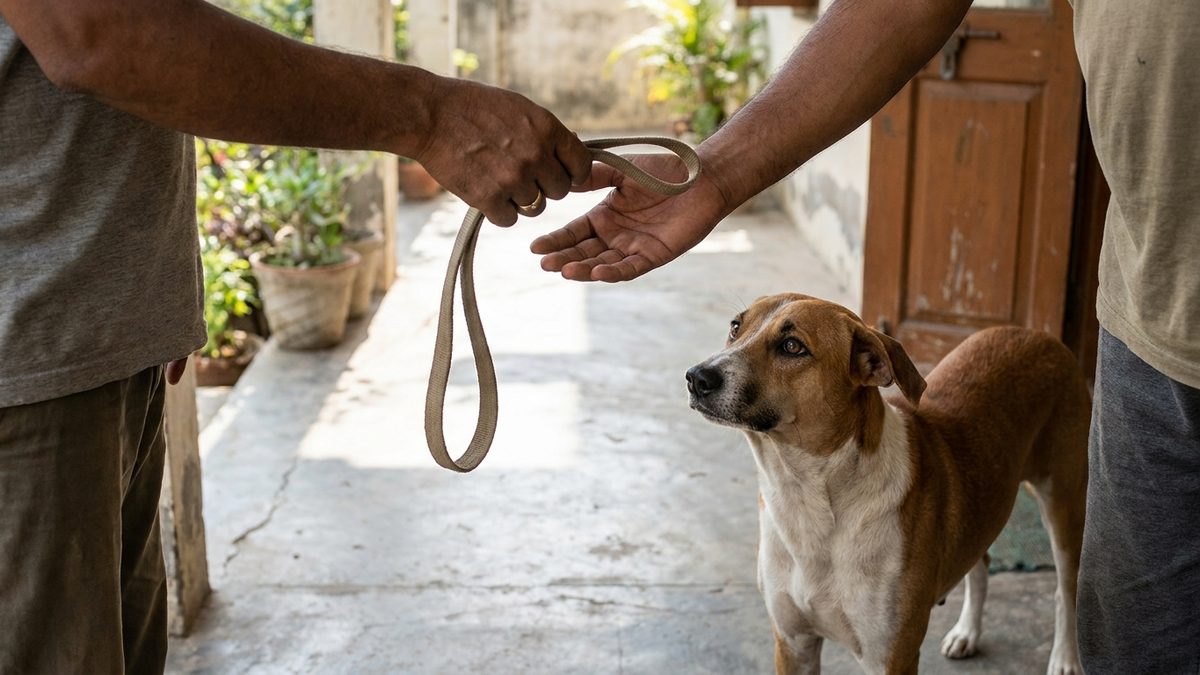
- Someone you already know. A relative, a colleague, a neighbour or the person who has walked the dog for two years. You can verify the household without asking a single awkward question, the animal often already knows them, and you can agree in advance that the animal comes back to you if it does not work.
- Your own network, widened. A post shared through friends, a notice at your veterinary clinic, a flyer at work. Humane World for Animals puts it plainly: "Your personal network is the best pool of adopters for your pet".
- A listing platform or a rescue network. An Indian rehoming site, an Instagram adoption account or a city WhatsApp rescue group. Reach is large and screening is yours alone to do.
- A shelter, a breed rescue or a sanctuary. Someone else takes legal ownership. You lose control of the outcome, usually permanently.
Where two major welfare bodies disagree, and the disagreement is real
The RSPCA and Humane World for Animals give opposite first advice, and an Indian reader should know it rather than be handed one of them as consensus. The RSPCA's route is the original seller, then "a charity or rescue centre experienced in matching each pet with the right owner";. It does not suggest advertising the animal yourself at all.
Humane World for Animals goes the other way. Its guidance is that "despite the best efforts of shelters and rescues to care for their animals, your home is usually the best place for your pet while you search for an adopter", and that by placing the animal yourself "you can also reduce competition for limited space and resources in shelters or rescues";. It treats surrender as a last resort and private placement as the default.
On the evidence available, the Humane World position fits Indian conditions better, and we say so with the reason rather than the preference. Indian shelter intake is dominated by street animals and by the Animal Birth Control programme, the three shelters in the only published interview study reported annual intakes of 400, 1,500 and 11,182 against funding their staff described as inadequate, and 66.7 percent of owners who gave up an animal in the largest survey to ask placed it directly with a new owner anyway. A kennel in an Indian shelter is a scarce resource. A bedroom in your flat is not.
Asked whether you can surrender a pet to a vet, the RSPCA's answer is "No. Vets are not rehoming centres and are not equipped to rehome animals";. An Indian clinic may let you put up a notice, which is useful and is a different thing from leaving the animal there.
Temporary care is the route people forget, and 19 percent of the owners in the pandemic survey used it. If your reason has an end date, a hospital admission, a six-month posting, a flat that will not allow pets until the lease turns over, then a foster placement rather than a permanent transfer is the honest ask. How that works in India, who pays and how long it runs is on fostering a dog or cat in India.
How to vet an adopter, and the home check one person can do
To vet an adopter yourself, borrow the screening a shelter already does and run the parts of it that one person can actually verify.
Indian shelters have a published adoption protocol, an application form, a home check, a fee and a follow-up, and our guide to adopting a dog in India tables what seven of them ask, clause by clause, from their own pages. Do not rebuild that from scratch. Read it as a checklist written from the other side of the table, and use the parts you can check.
Six things one person can verify in an afternoon
- See the home. Go there. A video call is better than nothing and much worse than standing in the room. You are looking for where the animal will sleep, whether the balcony is netted, whether the door to the stairs stays open, and who else lives there.
- Meet everyone who lives in the house. The commonest failure in a private rehoming is one family member agreeing on behalf of a household that was never asked. Ask directly whether anyone objects.
- Check the housing position in writing. Housing was the largest single reason class for dogs in the 12-shelter study, so ask whether the adopter owns or rents, whether the rent agreement allows pets, and whether the society has rules about dogs. Society rules for pets in India sets out what an association can and cannot actually do, which is also what a prospective adopter should know.
- Ask for their veterinarian's name. Someone who has kept animals before can name one in a second. Someone who cannot is not disqualified, and the answer tells you how much handover support to plan for. Choosing a vet in India is worth sending them.
- Ask what happens if it does not work. The answer you want is that they call you. Write that down and mean it.
- Take their identity details and keep them. Name, address, phone number and a photograph of an identity document. You are transferring a living animal, not selling a sofa.
Five answers that should stop the handover
- They want the animal today and will not wait for a second meeting.
- They will not say where it will live, or the address changes between conversations.
- They ask whether the dog is sterilised in a way that suggests they hope it is not, or ask about papers and pedigree before asking about temperament.
- They want several animals, or they have taken other free animals recently.
- They refuse to let you visit, or arrange to collect the animal from a public place only.
None of those is proof of anything. Each is a reason to slow down, and slowing down costs the animal nothing because it is still in your house.
What to hand over with the animal
Hand over the animal's complete record, its identity paperwork and a written note of everything the new household will not discover for a month.
A handover is a transfer of knowledge as much as of an animal. The new owner will not know that she refuses the stairs, that he eats only after the lights are off, or that the limp comes back in the monsoon. Write it down. The table below separates what must change hands on paper from what only you can supply.
| What changes hands | Why it matters | Where the detail is |
|---|---|---|
| The vaccination card, with the vial sticker for each dose | Decides what the new vet gives and when, and is the only proof of rabies cover | Carry the original, not a photograph |
| Microchip transfer into the new owner's name | A chip still in your name sends a found animal back to you, and in Chennai sends the ₹10,000 abandonment fine to you too | Pet microchipping in India prices the transfer and names the registries |
| The municipal licence or registration | Delhi's registration is non-transferable, so the new owner applies afresh; Chennai's portal completes an ownership transfer by OTP between the two of you | Dog registration in India and the Chennai GCC pet licence |
| Sterilisation status, with the certificate if there is one | Changes the new owner's next six months, and an unsterilised animal placed casually becomes more animals to place | Dog sterilisation in India |
| Kennel Club of India papers, if the dog has them | Transfer is a form and a fee, and an unregistered transfer leaves the pedigree in your name | KCI registration explained |
| The full veterinary history, including anything ongoing | Withholding a condition is how a rehoming fails in month two | Ask your clinic to print the file |
| Diet in writing: brand, quantity, times, and what causes a stomach upset | A diet change on top of a home change is two changes | Note the exact product, not the category |
| Known behaviour, including anything that has ever caused a bite or a scratch | The adopter cannot manage what nobody told them about | Write it as a plain list, not as an apology |
In Chennai the Corporation traces an abandoned animal to its owner by scanning the chip and reading the registered details. If the record still carries your name because the transfer was left for next week, a scan six months later names you. This is the one item on the checklist with a legal consequence attached to leaving it undone.
Write a one-page handover note and give a signed copy to the adopter, keeping one yourself. An adoption agreement between two households does not need a lawyer and does not need to be a court document. It should carry both names and phone numbers, the date, the animal's description and microchip number, a line stating that ownership passes on that date, and a line stating what the adopter agrees to do if the placement fails. It is the thing you will be glad of if you ever need to find the animal again.
Writing the listing, and the words the evidence says to avoid
Write the listing as a personality description rather than a breed label, because that is the variable that has actually been measured.
Archer, Hall and Andrukonis showed 1,216 participants, 103 recruited at a municipal shelter and 1,113 online, ten randomly assigned dog photographs each under four conditions: photograph alone, photograph with a breed label, photograph with a personality description, and both. Adoptability was rated out of 100. A description raised the average rating from 51.73 with no description to 63.82 for "calm", 63.63 for "non-dominant", 62.45 for "affectionate" and 62.43 for "sociable". Adding a breed label lowered it, from 55.95 without to 54.06 with.
One descriptor went the other way and it is the one Indian listings use constantly. A dog described as "energetic" scored 48.64, lower than every other description and lower than giving no description at all. The authors note that in earlier work the same word added 24.3 days to the average length of stay for Australian Cattle Dogs. If your dog is active, say that it walks twice a day and settles indoors. Do not write "high energy" and expect it to read as honesty.
The finding is about which true things to lead with, not about hiding anything. Humane World for Animals is explicit that you should "share any medical or behavior issues your pet is experiencing so that potential new owners will have the information they need to determine if your pet would be a good fit";. A placement that fails in week three because you left something out costs the animal a second move.
Four other things belong in the listing. A clear, well-lit photograph of the whole animal. Its age, sex and sterilisation status. One sentence on what it is like with children, with other dogs and with cats, because those are the three questions every reply will ask. And the city, because an adopter four states away is not an adopter.
A free online listing: what goes wrong, and how to cut the risk
A free online listing fails in a specific way, which is that the platform does none of the screening its name implies and you may believe it has.
Read what the Indian platform ranking first on this query actually does. ThePetNest charges a ₹249 platform fee to list a pet and describes the process as filling in the details, uploading pictures, submitting, and then: "Potential owners would contact you for more details if required and talk to them to see if they are a great fit for your fur baby";. The adopter is not checked, no home visit is arranged, no agreement is provided and no follow-up is described. That is not a criticism of the platform, which does what it says. It is a correction of what readers assume a listing site is for. It is a noticeboard.
The same holds for the Instagram adoption accounts and the city WhatsApp rescue network that place a very large share of Indian animals. They are distribution, run largely by unpaid volunteers, and the vetting is yours. Our guide to volunteering with an animal shelter in India describes what those networks run on and how little of it is funded.
Six ways to cut the risk of a public listing
- Do not write "free to good home". The phrase selects for people whose interest is that the animal costs nothing, and it is the one phrase a reseller searches for.
- Charge a small adoption fee and say what it is for. Indian shelters charge one, typically modest, and the reason is the same as a shelter's: it filters. Our adopting a dog in India page prices what Indian shelters actually charge.
- Never post your home address. Meet first somewhere public, and visit their home rather than inviting them to yours.
- Keep every message. If something goes wrong later, the conversation is the only record you will have.
- Say in the listing that you will visit the home before handing over. It removes most of the wrong replies before you have to answer them.
- Do not hand the animal to a courier, a driver or a third party. Meet the person who will keep it. If distance makes that impossible, the distance is the problem.
One caution about pedigree dogs specifically. A breed that fetches a price is a breed somebody can sell, and a dog given free today can be advertised tomorrow. An unsterilised pedigree bitch is the highest-risk animal to place publicly in India, because she has a commercial use that has nothing to do with being a pet. Sterilise before you place, or place her only with someone you can verify in person. The breeding regime she would end up inside is described on checking a dog breeder in India.
What a shelter can and cannot promise
A shelter can promise custody and care, and cannot promise adoption, contact, or that you will ever see the animal again.
Read the terms before you sign anything, because Indian surrender terms are stricter than most owners expect. One Bengaluru sanctuary that accepts surrenders publishes its conditions in full, and they are worth quoting because they are typical of the honest end of the field rather than the harsh end.
On reversibility: "Once surrender has been formally completed and the dog has been admitted, the surrender is permanent and irreversible. The surrenderer cannot reclaim, remove or demand the return of the dog";. On contact: "VOSD operates a closed-door sanctuary and does not permit individual visitation by surrenderers or members of the public to surrendered dogs", and it "does not provide ongoing individual updates or routine progress reports after surrender". On adoption: "VOSD does not undertake any obligation to re-home a surrendered dog", and its own FAQ answers the question directly with "No. VOSD does not run an adoption pipeline."
The practical conditions matter as much. Admission needs baseline diagnostics including a complete blood count, serum biochemistry, distemper and parvovirus testing, tick-borne disease profiling and valid anti-rabies records; the surrenderer arranges and funds transport to the Bengaluru intake point; a surrender contribution may be required; and an application is reviewed within 48 to 72 business hours before anything is agreed. The sanctuary houses more than 1,800 dogs. The RSPCA states the same consequence in one line: "Once you've signed your pet over, you'll have no right to receive the animal back or exercise any other rights in respect of the animal";.
What happens to an animal nobody adopts
In an Indian shelter, an animal nobody adopts usually stays. That is the honest answer and it cuts both ways. Euthanasia for space is not a lawful route in India in the way it is in the open-admission US shelters the published data comes from, where 55 percent of animals leaving the 12 study shelters were euthanised. Indian shelters instead carry the animal, which is why their standing challenge is intake volume against inadequate funding and why their kennel blocks include geriatric and paraplegic sections that never empty. Our page on volunteering with an animal shelter in India sets out what that looks like from inside.
Ask the organisation what happens to a dog or cat that is never adopted, and ask whether this surrender is reversible. The answer, and how readily it comes, tells you more than any photograph on the website. If you want a route back, say so before you sign rather than after.
A breed rescue is the overlooked option for a pedigree animal. Rescues organised around one breed exist in several Indian cities, run mostly on volunteer foster homes, and they place animals into households that already know what the breed needs. They are small, they are often full, and they are worth a message before a general listing goes up.
Why the street or the temple is not a soft option
An animal released on an Indian street does not join the local dogs, and the only Indian study to follow the question says so directly.
Paul and colleagues ran a five-year census of free-ranging dogs across seven locations in West Bengal, following 364 pups from 95 litters to seven months of age. About 19 percent survived to reproductive age; the median survival time was 82 days, with a 95 percent confidence limit of 72 to 92 days. Only 32 percent of the mortality was natural. The remaining 63 percent was influenced by humans, through road accidents, poisoning, beating, malnutrition, or being removed from the population.
Buried in that paper's methods is the sentence that answers this question outright. Describing pups taken away by people, the authors write that "while some of these pups are adopted as pets, most are abandoned", and then: "Abandoned juveniles typically face aggression from adult dogs if they are not released back in their own groups and they too rarely survive";. That is a qualitative observation rather than a counted outcome, and the authors present it as such. It is also the only Indian field evidence on the specific act this section is about, and it points one way.
The mechanism is group territory, not cruelty. Indian free-ranging dogs live in groups with defended ranges, and the background to that is on free-ranging dogs in India. A dog released into a street it did not grow up in has no group, no territory and no established feeders. A pedigree dog has, in addition, never scavenged, often cannot tolerate the heat of an Indian summer or the parasite load of a humid monsoon, and is conspicuous enough to be taken by someone with a commercial interest in it. A house cat put outside faces the same arithmetic without the option of begging.
Leaving an animal where people gather feels like leaving it with people. It is not. Nobody present has agreed to feed it tomorrow, which is the definition the law uses and the only one the animal experiences. Section 11(1)(i) reaches all three.
If you have already done this and want to undo it, go back to the place quickly and in daylight, ask the people who work nearby, and take a photograph with you. Our guide to how to find a lost pet in India is the method, and it works best in the first 48 hours.
Costs and timelines, so you can plan instead of panicking
Plan on four to eight weeks for a private placement and on a few thousand rupees in preparation, so the decision is not made for you by a deadline.
A common mistake in an Indian rehoming is starting the search a week before a move. The routes that work best are the slow ones, and the fastest route is the one with the worst outcomes. The figures below are the ones we could source; where we could not source one, the row says so rather than guessing.
| Step | Typical cost | Time to allow |
|---|---|---|
| Veterinary check and bringing vaccinations current | A consultation plus the doses due | One visit, plus a booster interval if one is due |
| Sterilisation before placement, if not already done | Varies widely by city and by whether a subsidised clinic is available | Surgery plus 10 to 14 days of recovery before a move |
| Microchip, if the animal has none | Chip plus the veterinary fee; a registry transfer is charged separately | Same visit |
| Listing on an Indian rehoming platform | ₹249 at ThePetNest | Immediate; replies take days to weeks |
| Finding and vetting a private adopter | Nothing, beyond your time | Four to eight weeks is realistic; plan for longer for a senior or a large dog |
| Surrender to a sanctuary | A surrender contribution may be required, amount set case by case, plus transport you arrange and fund | 48 to 72 business hours for the application review alone, before transport |
| Transport to the receiving household or facility | Depends on distance and whether a pet taxi is used | Book ahead; see our pet taxi guide |
Two of those rows deserve emphasis. Sterilisation before placement removes the single largest downstream risk of a private rehoming, which is that your animal produces more animals in a household less equipped than yours. And four to eight weeks is a median, not a maximum. A senior animal, a large dog in a city of small flats, or a dog with a bite history will take longer, and the honest thing to do is start earlier rather than lower the bar at the end.
The Indian cases this page was written for
Four Indian situations drive most voluntary rehoming here, and each one has a step that is usually skipped.
The baby, the marriage, the move and the society
A baby arriving in a joint household is the commonest trigger people describe, and it is close to the bottom of every measured list of reasons. What is usually happening is not a safety problem but a space problem, because the room the dog slept in has become the baby's room and six weeks of visitors have removed every quiet corner. The dated plan on introducing a dog to a new baby exists for precisely this, including the joint-family version.
A marriage moves one adult into a household that did not choose the animal. Settle the question before the move, not after, and settle it with the person whose objection is real rather than with whoever is easiest to talk to. A move between cities is a logistics problem with a documented answer on moving house with a pet, including what the interstate paperwork actually requires. And a society complaint is a dispute to answer in writing, not an instruction to obey, which is the whole point of handling a complaint about your pet.
The fifth case is the one nobody plans for, which is illness or death. If that is why you are reading this, the page you want is who cares for your pet if you cannot, which covers the legal position in India and the admission plan that matters in the first three days.
Indies, pedigrees and what is actually measured
Whether an indie dog is harder to place than a pedigree in India is widely asserted and, as far as we can establish, never measured. We found no Indian study, no shelter publishing adoption rates by type, and no denominator behind any of the percentages circulating on Indian blogs and social media about breed preference among adopters. Treat every one of them as unsourced, because that is what they are.
What has been measured, in a different country, points gently the other way. In the 1,216-participant experiment above, adding a breed label to a dog's photograph lowered its perceived adoptability on average, and only one label of twenty, "Lab mix", improved it. If that transfers at all, the implication for an Indian listing is that the breed line is not the thing selling the animal. The temperament line is. For an indie, write what the dog is like and leave the parentage question to the photograph.
One Indian structural point does hold. Indian rescue capacity is organised around street animals and the Animal Birth Control programme rather than around owner surrender, so an owned pedigree dog does not arrive at the front of any queue. In practice an indie placed through a volunteer rescue network often moves faster than a pedigree placed through a shelter, because the network is built for exactly that handover and the shelter is not.
What this page can prove, and what it cannot
This page can prove what the statute says, what the overseas relinquishment studies measured, and what Indian organisations publish about their own terms, and it cannot prove how Indian rehoming turns out.
Three things here are solid. The text of section 11(1)(i) and the fifty-rupee penalty come from the Act as hosted by the Animal Welfare Board of India. The Chennai fine, its date and its enforcement mechanism come from the Corporation's own council resolution as reported with the chief veterinary medical officer named. And the surrender terms quoted are the organisation's own published terms.
Three things are borrowed and labelled. Every relinquishment denominator on this page is from the United States, the United Kingdom or Ireland Kisley, Chung and Levitt Carroll, Torjussen and Reeve. The attachment evidence is from 60 Hungarian shelter dogs. The listing-words evidence is from 1,216 US participants rating photographs rather than adopting animals. None of them was collected in India and none of them should be quoted as an Indian figure.
One thing is genuinely missing. No Indian dataset records why owners give up pets, how many do, how long a private rehoming takes here, or what happens to the animal afterwards. The only Indian survival evidence that touches the question is a five-year census of street-born pups whose authors note in passing that abandoned juveniles rarely survive, and that is an observation inside a study designed to measure something else. We have not filled the gap with a borrowed number, and no page that gives you an Indian abandonment percentage has read a study either.
Common questions
What to do with a dog that you can't keep?
To place a dog you cannot keep, start with the organisation or breeder you got it from, then your own network, then a listing platform or rescue, and treat a shelter surrender as the last step rather than the first. Keep the dog at home while you search, because that is where it is least stressed and it frees a kennel for an animal with nowhere. Meet the adopter at their home, hand over the vaccination card, the veterinary history and the microchip transfer, and write the agreement down.
Is it okay to rehome my dog?
Yes, in some circumstances, and the RSPCA says so in its own guidance: "Sometimes giving up a pet is the right thing to do, but it can be distressing for you and them, so it needs to be done carefully." What is not okay is abandonment, which section 11(1)(i) of the Prevention of Cruelty to Animals Act, 1960 makes an offence. Check first whether your reason is one of the solvable ones, such as a new baby, an allergy, a society complaint or separation anxiety, because each of those has a method behind it.
Where can I surrender my dog in India?
Indian shelters, breed rescues and sanctuaries accept owner surrenders, with conditions, and most require an application before they will agree to anything. Expect baseline veterinary tests and current anti-rabies records, transport that you arrange and fund, possibly a surrender fee, and a review period before admission. Read the terms before you commit: one Bengaluru sanctuary states that surrender is permanent and irreversible, that visitation is not permitted, and that it takes on no obligation to rehome the dog at all.
Do dogs feel abandoned when rehomed?
Dogs show stress when their household changes, and they also form new attachments, which is the part owners rarely hear. In a study of 60 shelter dogs, those handled three times for ten minutes by an unfamiliar person afterwards behaved towards that person in a pattern meeting the operational criteria of attachment, and the authors concluded that a short responsive interaction can produce attachment behaviour even in a dog over a year old. Individual variation was considerable, so this is evidence that recovery is possible rather than a promise about your dog.
Is it traumatic for a dog to be rehomed?
A move is hard on a dog and the evidence does not support treating it as permanent damage. The same experiment that found shelter dogs forming attachment to a new handler after three ten-minute sessions also found wide variation between individuals, so some dogs settle in days and others take much longer. You reduce the cost by sending familiar bedding, writing down the routine, warning the new household what the first fortnight usually looks like, and staying reachable by phone for the first month.
What is the best way to rehome a dog?
The best way to rehome a dog is privately, from your home, to a household you have visited. Two thirds of owners who gave up a cat or dog in the largest survey to ask placed the animal directly with a new owner rather than through a shelter. Keep the dog with you while you search, write the listing as a temperament description rather than a breed label, charge a small adoption fee instead of offering the animal free, meet everyone who lives in the adopter's home, and transfer the microchip record on the day.
Is it okay to rehome your cat?
Yes, and the published reasons differ from a dog's in a way worth knowing. In the largest counter-interview study, the commonest single reason for surrendering a cat was too many animals in the household, followed by allergies and moving, and human lifestyle accounted for 34.7 percent of cat surrenders against 25.4 percent of dog surrenders. If the trigger is a second cat fighting the first, that is a resource problem with a documented fix, and it is worth trying before you place either animal.
Is abandoning a pet illegal in India under the Prevention of Cruelty to Animals Act?
Yes. Section 11(1)(i) makes it an offence to, without reasonable cause, abandon any animal in circumstances which render it likely that it will suffer pain by reason of starvation or thirst. The penalty in the Act is a fine which may extend to fifty rupees for a first offence, unchanged since 1960, which is why municipal action matters more in practice: the Greater Chennai Corporation began collecting a 10,000 rupee fine from 1 October 2026 from owners who abandon a registered, microchipped dog or cat.