
Dog care guide
Puppy teething: timeline, what to expect and what to give
The exchange of 28 milk teeth for 42 adult teeth, dated from the Merck Veterinary Manual and the AAHA dental guideline rather than from a blog, with the retained-canine figures for the Chihuahua, Shih Tzu and Pug, the AAHA and AVDC line on hard chews and cooked bones, three Indian chews priced on the seller's page on 18 September 2026, and the short list of things that mean the vet.
Quick answer
Puppy teething runs in two waves: 28 milk teeth erupt from 3 to 5 weeks and are in by 8 weeks, then from about 14 weeks they fall out and 42 permanent teeth replace them by about 7 months. Give cold and soft, a frozen wet cloth or a natural-rubber chew (Rs 698 to Rs 1,238 for the Kong Puppy, Supertails, 18 September 2026), never cooked bones, antlers or hooves. Book a 6-month oral exam for retained milk teeth, found in 7 percent of dogs; your nearby vet decides.
This guide is general information for Indian pet owners and is not a diagnosis. Always consult a registered veterinarian near you before acting on anything you read here, and treat any sudden change in your pet's condition as urgent.
Puppy teething timeline: 28 milk teeth by 8 weeks, 42 adult teeth by 7 months
Puppy teething runs in two waves: the 28 milk teeth erupt from 3 to 5 weeks and are all in by 6 to 8 weeks, then from about 14 weeks they fall out group by group and 42 permanent teeth replace them, the last in place by about 7 months Reiter AM. Dental Disorders of Dogs. Merck… Kanwal M (DVM, DAVDC). Everything You Need….
How many teeth does a puppy have? Most dogs have 28 deciduous teeth, the milk teeth or baby teeth, and 42 permanent teeth; the deciduous set erupts from 3 to 5 weeks, the permanent set begins at 4 to 5 months, and all permanent teeth are present by 7 months. The adult set is 12 incisors, 4 canines, 16 premolars and 10 molars. The extra 14 are not replacements: the first premolars and the molars have no milk predecessor, so a puppy that has lost nothing can still be cutting new teeth.
The exchange starts at the front. Shedding begins around 14 weeks with the upper central incisors, and over the next 3 months the milk teeth are replaced group by group. PetMD's veterinary dentist and the VCA handout date the groups the same way, incisors and canines first from 3 to 5 months and molars last at 5 to 7 months, with large breeds slightly ahead of small ones.
| Age | What happens | Source |
|---|---|---|
| 0 to 2 weeks | No visible teeth | Greencross Vets |
| 3 to 5 weeks | Milk incisors, canines and premolars erupt; sharp enough to help weaning | Merck, pet owner version |
| 6 to 8 weeks | All 28 milk teeth in place | PetMD; VCA says by 6 weeks |
| About 14 weeks | Upper central milk incisors are the first to fall | Merck, Reiter |
| 3 to 5 months | Adult incisors and canines erupt; a milk canine beside an adult canine is the classic retained tooth | PetMD; Merck, Mulherin |
| 4 to 6 months | Adult premolars erupt | PetMD |
| 5 to 7 months | Adult molars erupt, teeth with no milk predecessor | PetMD; Merck, Wright |
| 7 months | All 42 permanent teeth present | Merck, pet owner version |
| 7 to 18 months | Merck's stage 3: crowding and rotated teeth show up, mostly in flat-faced breeds | Merck, Reiter |
Small breeds run late, and the order can scramble under 3 kg
The one breed followed tooth by tooth is the Yorkshire Terrier: in 61 puppies, a 4.5 kg pup lost its milk incisors at 21.9 weeks, premolars at 23.9 and canines at 26.1 weeks, while the permanent incisors erupted at 22.3 weeks, canines at 23.8, premolars at 24.7 and molars at 26.4; puppies of 3 kg or less ran later and lost the usual order. So a 3 kg Shih Tzu or Chihuahua is still swapping canines at 6 months when a Labrador is done, which is what the 6-month check in the last section is for.
Where the ranking pages disagree, and which figure governs
Three ranking pages give three end dates: PetMD says most puppies finish by about 6 months, Greencross says the 42 are in by 7 months, PetLab says teething lasts 6 to 8 months and can run to a year. Merck's 7 months governs for the teeth. PetLab's longer figure is adolescent chewing, which Blue Cross puts at 7 to 12 months, after the teeth are in, when a young dog chews more than it did as a puppy. The teeth stop at 7 months; the chewing does not.
What puppy teething looks like: chewing, drool, blood spots and a tooth on the floor
The signs of teething are more chewing and mouthing, drooling, small blood spots on toys, red gums, a gap or a lost tooth on the floor and, in some puppies, a day or two of eating less, all of them normal between roughly 3 and 7 months Hunter T, Hiscox L Blue Cross, Dogs and chewing.
Seven signs recur across the veterinary sources. Each is listed below with the source that records it.
- More chewing and mouthing. Between 3 and 7 months a puppy explores with its mouth while milk teeth fall and adult teeth erupt, so sore gums and plain curiosity are hard to tell apart.
- Drooling and puppy breath. A characteristic breath odour comes with teething and lasts as long as it does.
- Spots of blood on toys. A few specks on a chew are the milk tooth leaving; the AKC's chief veterinarian adds that unusual drooling or bleeding should be mentioned to the vet because both can also mean something else.
- A tooth on the floor, or none. Most milk teeth are swallowed while eating or chewing, to no ill effect, so never finding one is as normal as finding one.
- Red or swollen gums at the site of an erupting tooth.
- Eating less or eating slowly, with a preference for softer food for a few days.
- Irritability, especially at night when there is less to distract from a tender mouth.
The signs that are not teething are red gums with discharge, bleeding that does not stop at a spot, and pain that goes on for days, which Greencross Vets lists as reasons to book an appointment. The full list is in the last section of this page.
The People Also Ask box on Google India asks for the five stages of puppy teething, and no veterinary source defines five. Merck divides dental development into three stages, birth to 16 weeks, 16 weeks to 7 months, and 7 to 18 months, each with its own problem to catch: the jaw interlock, the retained milk tooth, and crowding. A five-stage list is a blog's own construction.
The People Also Ask box on Google India asks what the five stages of puppy teething are, and no veterinary source defines five. The Merck manual divides dental development into three stages, each with its own problems: stage 1 from birth to 16 weeks, when the lower jaw's growth spurt can be blocked by milk teeth caught behind the upper ones; stage 2 from 16 weeks to 7 months, when retained milk teeth are the main problem; and stage 3 from 7 months to 18 months, when crowding and rotated teeth appear. Any five-stage list you find is a blog's own construction, and the stages that matter for a decision are Merck's three.
What to give a teething puppy: the fingernail test, a frozen cloth and three Indian chews with prices
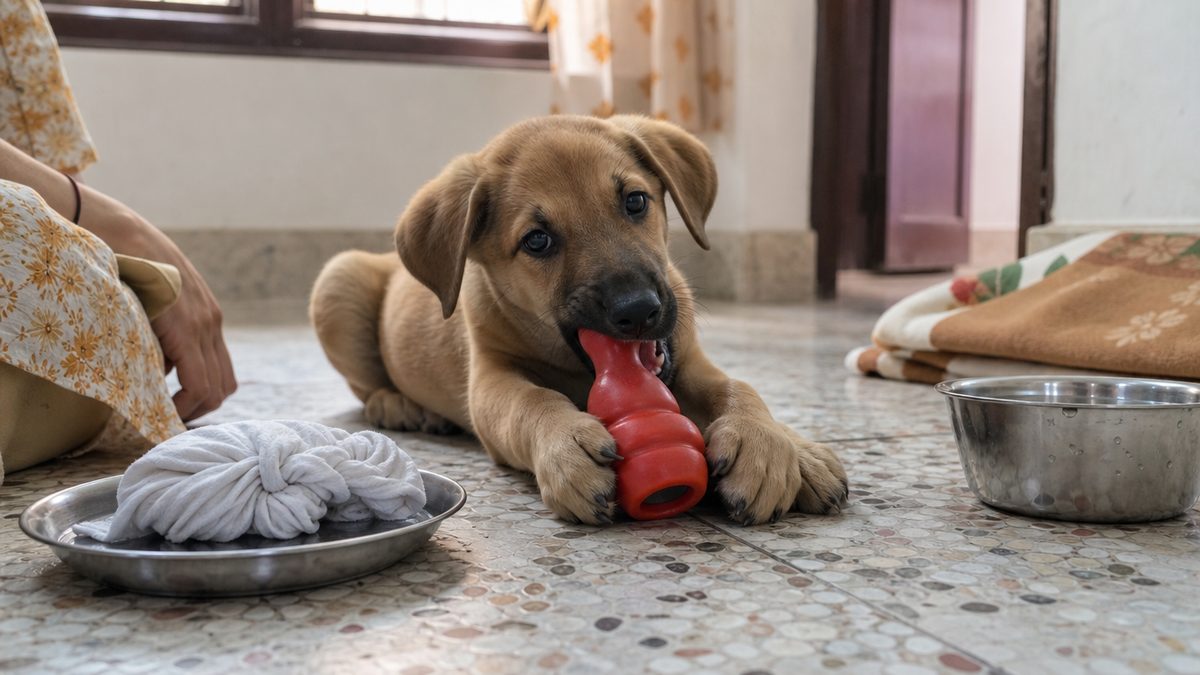
Give a teething puppy something cold and something that dents under a fingernail: a wet cotton cloth knotted and put in the freezer, a natural-rubber chew toy chilled or stuffed and frozen, and chilled pieces of carrot or green bean, always with you in the room Kanwal M (DVM, DAVDC). Everything You Need… PDSA (People's Dispensary for Sick….
The fingernail test sorts every chew. PDSA says a safe chew toy or treat is soft enough to indent with your fingernail, because anything harder can fracture teeth or bleed gums, and bigger than the dog's throat so the whole thing cannot fit in the mouth. The VCA dentists list what fails: hard toys, nylon chews, cow hooves, ice cubes and bones, cooked or otherwise.
Cold costs nothing. Greencross suggests freezing a wet tea towel or a puppy-safe toy; PetMD's dentist suggests freezing the puppy's regular kibble inside a Classic KONG, and lists chilled blueberries, green beans and carrots. On a May afternoon in Delhi or Chennai a frozen cloth is soft again in minutes, so keep two in rotation.
Ice cubes are the one item the ranking pages contradict each other on: PetLab calls them helpful, the VCA dentists say avoid them, and they fail the fingernail test. The dentists govern: cold yes, ice cube no.
Three Indian chews, priced on the seller's page on 18 September 2026, with the exchange-rate test
Three products cover three jobs, a rubber chew to freeze and stuff, a rope for supervised tug, and a dental chew for after the adult teeth are in. Each rupee figure was divided by 84.38 and by 74 to check that it is an Indian price and not a converted dollar list.
| Product | Seller price (MRP) | What the seller's page says | Division test |
|---|---|---|---|
| Kong Puppy Toy (natural rubber), sizes S, M, L | Rs 698 (Rs 775), Rs 945 (Rs 1,099), Rs 1,238 (Rs 1,375) | Designed to suit teething pups, for dogs up to nine months, fill with a treat and freeze; S is 1.75 by 3 inches, L is 2.75 by 4.25 inches | 698, 945 and 1,238 divide to 8.27, 11.20 and 14.67 at 84.38 and to 9.43, 12.77 and 16.73 at 74: rupee-native prices |
| Skatrs Cotton Loop Rope Tug Toy, 41 cm | Rs 199 (printed as ₹843 MRP) | A cotton rope loop for tug; the page shows a 76 percent discount off the MRP | Rs 199 gives 2.36 and 2.69, rupee-native; the Rs 843 MRP gives 9.99 at 84.38, a USD 10 figure, so the discount is against a converted number and the selling price is the real one |
| Pedigree Dentastix Oral Care, Small Breed 5 to 10 kg | Rs 152 (Rs 160) for the 110 g weekly pack of 7; Rs 304 for 2 by 110 g; Rs 864 for 6 by 110 g | For adult dogs over 4 months of age, one stick a day | 152, 304 and 864 divide to 1.80, 3.60 and 10.24 at 84.38 and 2.05, 4.11 and 11.68 at 74: rupee-native |
The rope and the dental chew each carry a condition. PDSA warns that long pieces of rope or stuffing can cause fatal gut blockages, so the rope is for tug with you holding the other end and goes away when it frays; in monsoon humidity a rope that never dries goes sour, so wash it and dry it in the sun between games Supertails, Skatrs Cotton Loop Rope Tug Toy…. The Dentastix listing carries the line 'over 4 months of age';, while Pedigree India's own product page says only 'adult dogs of all breeds and sizes' and prints no age; Supertails' dental-treats page says adult dental treats are not recommended under 4 months and are introduced once the adult teeth are in, which matches the AAHA line that home oral hygiene starts with erupted permanent dentition. Pedigree Dentastix, Virbac C.E.T. VeggieDent Flex and Purina DentaLife are on the Veterinary Oral Health Council's accepted list, and the VOHC's two rules for any dental chew are the size made for the dog's weight and an owner watching the dog chew.
The five things to do are listed below, in order.
- Freeze a wet cotton cloth, knotted, and swap it for a second one when it thaws.
- Chill a natural-rubber chew toy, or stuff it with the puppy's own soaked kibble and freeze it, so the chewing lands on the toy and not the sofa leg Supertails, Kong Puppy Toy for Dogs (Pink).
- Offer a chilled carrot stick or green beans as the food option, sized larger than the throat PDSA (People's Dispensary for Sick….
- Rotate three or four chews through the week so novelty keeps the puppy off your belongings.
- Supervise every chewing session, check each toy for tears or missing chunks and bin it when a piece could come off Veterinary Oral Health Council.
What not to give: cooked bones, antlers, hooves, nylon bones and rawhide, with the evidence
Do not give a teething puppy cooked bones, antlers, hooves, hard nylon bones or rawhide: the AAHA dental guideline finds no strong rationale for hard treats, the Merck manual lists real bones, hooves, antlers and hard nylon toys as causes of fractured teeth, and bone is the commonest object a vet removes from a dog's oesophagus Reiter AM. Dental Disorders of Dogs. Merck… Defarges A. Esophageal Foreign Bodies….
The rule comes from the dental bodies. The 2019 AAHA dental guideline task force finds there is not a strong rationale for offering hard treats, naming antlers and synthetic or natural bones, that could damage the structural integrity of the tooth; the AAHA life stage guideline has the vet discuss avoiding hard toys, bones and chews at preventive visits. Merck lists the objects that fracture teeth: real bones, hooves, antlers, hard nylon toys, rocks, fences and cages, treated by extraction or root canal. The scale is not small: AAHA cites fractured teeth in up to 49.6 percent of companion animals, from a review of 959 injuries in 660 referral visits, a referral population rather than every pet dog, and still the reason this page disagrees with the AKC toy guide's advice to buy nylon or hard rubber.
A fractured milk tooth matters too: Merck notes that infection in a fractured baby tooth often affects the enamel of the permanent tooth behind it, which puts a chipped milk canine on the see-the-vet list.
Cooked bones: the Indian habit and the evidence against it
Bones are the most common oesophageal foreign body in dogs, and stricture is the commonest complication after removal. Across published series bone accounts for 30 to 80 percent of oesophageal foreign bodies; in a 129-dog record from North Carolina State's teaching hospital, 45 dogs had a bone in the oesophagus, 42 of them cleared without surgery and 3 needing the oesophagus opened. The Indian evidence is a 2026 report from the Veterinary College at Hebbal, Bengaluru, Karnataka: an 8-month-old and a 6-year-old Shih Tzu, both with a history of swallowed bone, both with a radio-opaque bone in the chest, both cleared by gastrotomy. An Indian chew seller's nutritionist page says many households pressure-cook chicken and feed it whole, bones and all; it sells the alternative and gives no count, so treat the habit as reported and the Bengaluru cases as the evidence.
No cooked bone, ever, at any age: not the chicken bones from the curry, not the mutton bone from the biryani, not the leftover from the tandoor. A cooked bone breaks teeth and splinters in the gut, the veterinary dentists say to avoid bones cooked or otherwise, and the two Bengaluru dogs in the case report were a Shih Tzu puppy and an adult, so size and age protect nobody PDSA (People's Dispensary for Sick… Likhitha GN, Karajagi G, Mahesh V.
Rawhide fails differently: PDSA says it breaks into large pieces that are swallowed and block, may carry bacteria or chemicals, and that bones break teeth, splinter, pierce the gut or constipate from the calcium. The AKC adds sticks. Dehydrated chews, the chicken feet and goat ears the Indian seller prices at Rs 199 to Rs 400 a pack, are claimed to crumble rather than splinter; no dental body this page opened has a position on dehydrated bone, the VCA rule is bones cooked or otherwise, and the fingernail test still applies, so ask your nearby vet.
The full do-not-give set is listed below, each with the reason.
- Cooked bones of any kind. Fracture teeth, splinter, lodge in the oesophagus.
- Antlers, hooves and hard nylon bones. Named by AAHA and Merck as tooth fracturers.
- Rawhide. Swells, breaks into swallowable pieces, blocks.
- Ice cubes and rocks. Too hard for a milk tooth or a fresh adult tooth.
- Sticks. Splinter and puncture.
- Human toothpaste. Not made to be swallowed and some brands contain xylitol, toxic to dogs.
- Any toy small enough to fit whole in the mouth. The PDSA throat rule.
Retained milk teeth: 7 percent of dogs, 15 percent of breeds under 6.5 kg, and the breeds India buys
A retained, or persistent, milk tooth is one still in the mouth when its adult successor erupts; it was recorded in 7 percent of almost 3 million dogs at a US hospital chain over five years and in 15 percent of extra-small breeds under 6.5 kg, and the rule is extraction as soon as the adult tooth begins to erupt.
The mechanism decides the treatment. The adult crown presses on the milk root, the root resorbs and the tooth falls; if the adult tooth erupts in the wrong position the milk tooth keeps its root and stays, most often a canine, so the mouth holds two canines at once. Merck's rule is that no two teeth trying to occupy the same space should be in the mouth at once, and that the milk tooth is extracted as soon as its successor begins to erupt. The VCA dentists give the order, upper canines, then lower canines, then incisors, more often in small and brachycephalic breeds.
The harm is crowding: a milk canine crowding its successor traps food and predisposes the site to periodontitis, and AAHA says immediate extraction prevents the displacement that becomes a malocclusion Bellows J, Berg ML, Dennis S, Harvey R.
The figures by breed, each with its denominator
| Population | Figure | Denominator and note | Source |
|---|---|---|---|
| All pure-bred dogs, US hospital chain, 5 years | 7 percent | Almost 3 million dogs, 60 breeds | Wallis 2024 |
| Extra-small breeds under 6.5 kg | 15 percent | Same record; higher than every other size band | Wallis 2024 |
| Chihuahua, UK primary care, 2016 | 5.7 percent | 324 of 5,660; third most common disorder in the breed; median age 1.6 years | O'Neill 2020 |
| Shih Tzu, UK primary care, 2016 | 2.6 percent | 62 of 2,423; 8.47 percent of Shih Tzus under 2 years, 0 to 1.37 percent over 2 | Dale 2024 |
| Pug against non-Pug, UK, 2016 | 5.5 against 1.0 percent | 235 of 4,308 Pugs; 210 of 21,835 non-Pugs; odds ratio 4.31 | O'Neill 2022 |
| Yorkshire Terrier puppies followed through teething | 69 percent | 61 puppies; worse and more often surgical under 3 kg | Wallis 2023 |
Three of those breeds have pages on this site that carry the figures: the Chihuahua at 5.7 percent, the Shih Tzu at 2.6 percent overall and 8.47 percent under 2 years, and the Pug at 4.31 times the odds of other dogs. Read the Shih Tzu figure carefully: retained teeth are counted when found, so a breed-wide 2.6 percent hides an 8.47 percent rate in the age band where they exist, and the authors say they add to plaque and periodontal disease later. No study reports a figure for the Indian pariah dog; the size gradient in the Waltham and VetCompass records, with odds falling as body weight rises, is the only guide, and a desi dog is neither extra-small nor flat-faced, which puts it at the low-risk end of both without anyone having measured it O'Neill DG, Mitchell CE, Humphrey J.
Two more Waltham findings: dogs above ideal body condition had higher odds of a retained tooth (odds ratios 1.11 to 1.60), and small dogs two years without a professional cleaning had 2.17 to 3.36 times the odds of one being found, teeth going unnoticed until someone looked.
When it is checked, who extracts it, and why extraction is not trivial
The check is the 6-month awake oral exam, which AAHA calls appropriate for evaluating the permanent dentition, retained deciduous teeth, unerupted teeth and crowding, noting that extracting a persistent milk tooth as the adult tooth erupts avoids more extensive work later. The life stage guideline adds that small breeds sterilised at 5 to 6 months can have persistent deciduous teeth corrected in the same anaesthetic, the one argument for booking sterilisation and the tooth check together.
Extraction carries a measured risk. The milk canine is long, thin and lies against the developing adult tooth, and Merck warns that instruments must not be worked on its tongue side, because damage to the bud shows later as brown enamel defects on the adult crown. In a record from five veterinary dentistry practices, 74 puppies had 143 lower milk canines extracted at 8 to 12 weeks by board-certified dentists or supervised residents; 13 of 74 (17.5 percent) developed enamel defects on the adult canine and 28 of 74 (37.8 percent) still needed further treatment. That was the hardest version of the job, early extraction for a bite problem; a plain retained canine at 6 months is routine, but the number is why it is a vet's job and never a breeder's with pliers. Most cases are genetic, and Merck advises against breeding the dog unless trauma caused it.
Malocclusion: the four classes, why a Pug's underbite is normal, and the 6-week to 12-month window
Malocclusion is a bite that does not meet properly, graded in four classes: class 1 is a single tooth out of place, class 2 an overbite with the lower jaw short, class 3 an underbite with the lower jaw long, and class 4 a wry, asymmetric jaw; the AVDC says malocclusions require timely treatment, typically within the first 6 to 8 weeks to 12 months of life American Veterinary Dental College.
Malocclusions are nearly always genetic, and breeding made two of them. Merck explains that selecting for a longer face selects for class 2 (lower jaw short), while selecting for a blockier head produces class 3 (lower jaw long); class 3 in the adult teeth is considered normal for many brachycephalic breeds and needs no treatment unless it is traumatic, whereas class 2 often needs orthodontic or surgical treatment because the lower canines hit the roof of the mouth. A Pug or Shih Tzu with an underbite is the breed, not a defect; the question is whether any tooth is hitting soft tissue.
Timing matters because the jaws grow at different rates. Merck's owner page describes the newborn overbite that lets a puppy nurse, the lower jaw's growth spurt as solid food starts, and the trap where lower milk teeth catch behind upper ones and hold the jaw back; an underbite can be detected as early as 8 weeks, and the treatment in both cases is extracting a few milk teeth to release the interlock, which the professional page calls interceptive orthodontics Mulherin BL. Developmental Abnormalities…. The AVDC's 2023 position statement asks for the occlusion to be checked at every veterinary visit, sets the treatment window at the first 6 to 8 weeks to 12 months of life, and says orthodontics belongs with a board-certified veterinary dentist or a vet with equivalent training, never for cosmetic reasons. The AVDC's owner page adds that more than half of North American veterinary colleges teach fewer than four hours of dentistry, so asking what training your vet has before a bite is treated is reasonable anywhere.
Enamel: distemper, fever and a chipped milk tooth all mark the adult teeth
The adult teeth are being built under the gum while the milk teeth are in use, and anything that hits the enamel-forming cells then leaves a permanent mark. Merck names canine distemper virus as especially damaging, because it attacks those cells and causes fever, leaving thinner enamel; other fevers, severe malnutrition and the infection from a fractured milk tooth do the same to individual teeth Mulherin BL. Developmental Abnormalities…. Distemper is in the core course, one more reason the dog vaccination schedule in India finishes at 16 weeks or later rather than at the first shot.
Missing teeth get a radiograph. Merck says an empty space where a tooth should be is an indication for imaging in every animal, because an unerupted tooth can form a cyst that destroys jaw; the lower first premolar is the usual culprit, particularly in brachycephalic breeds, and small breeds such as the Maltese are prone to delayed eruption. AAHA repeats it for young pets with missing permanent teeth.
Biting, chewing and eating during teething: what changes, what does not, and where the how-to lives
Teething raises mouthing and chewing but does not change the training rule: redirect to a chew, never punish, and teach bite inhibition, which the AAHA puppy checklist has your vet discuss at the puppy visits Blue Cross, Dogs and chewing PDSA (People's Dispensary for Sick….
Chewing has its own calendar. Blue Cross puts teething chewing at 3 to 7 months, when a puppy chews to relieve gum discomfort and to help the milk teeth out, and adolescent chewing at 7 to 12 months, when many young dogs chew even more; it names Labradors and Staffordshire Bull Terriers as breeds with a stronger need to chew and says chewing is a calming activity most dogs need for life. The Labrador Retriever and Golden Retriever pages describe chewing as the boredom behaviour of a retriever left alone all day, the adolescent version of the same drive.
The training rule does not change. Blue Cross and PDSA both say not to punish a puppy for chewing the wrong thing, because it frightens the dog and teaches it to chew when you are absent; keep valuables out of reach, direct the puppy quietly onto an acceptable chew, praise it there, and rotate the chews PDSA (People's Dispensary for Sick…. Bite inhibition, the puppy learning to moderate its mouth, is on the AAHA puppy checklist for the vet to discuss; the AKC's version is a high-pitched ow when teeth land, a toy in place of your hand and the game ended if nipping continues, or a quiet walk away for the puppy that gets more worked up when you yell. The step-by-step method is in how to stop puppy biting, and the first-six-months curriculum in puppy training basics.
Puppy-proofing is the other half: PetLab's advice to keep wires and valuables out of reach and to redirect rather than punish is the charities' advice too, and in a Mumbai or Pune flat the items that matter are phone cables, slippers and the mosquito-repellent bottle on the floor.
Food during the exchange: soften for the sore days, keep the diet complete
Some puppies eat less for a few days as a tooth cuts. PetLab's consultant veterinarian suggests canned puppy food or kibble softened with warm water for that period; the VCA dentists list eating less robustly among the normal signs. Keep the food itself unchanged, a complete growth diet at the grams the puppy feeding chart for India gives, and treat soaking as a week's measure: the UK periodontal paper notes that a soft diet is considered to increase periodontal risk, and Merck says dogs on hard kibble develop fewer problems because chewing it cleans the teeth Reiter AM. Dental Disorders of Dogs. Merck….
Brushing starts after the adult teeth, handling starts now
AAHA says home oral hygiene training starts once the permanent dentition has erupted, and warns that a juvenile shedding milk teeth may find home dental care uncomfortable, so negative experiences should be avoided; the VCA dentists say to begin gently as soon as the puppy comes home. The two reconcile as handling now and brushing later: touch the lips and gums daily from week one, and start the brush once the adult teeth are in at about 7 months, three times a week at minimum with a dog toothpaste, as dog grooming at home in India sets out. The reason is the adult figure: periodontal disease was diagnosed in 12.52 percent of 22,333 UK dogs in one year, with Toy Poodles at 3.97 times the odds of crossbreds and the odds falling as adult body weight rises. AAHA tells the owner of any puppy that will weigh under 9 to 11 kg that dental care will be more involved, and that brachycephalic breeds have more trouble from rotated and crowded teeth.
When to see the vet: eight signs, the 6-month check and the radiograph rule
See the vet the same week if a milk tooth is still standing beside an erupting adult tooth, a tooth is missing with nothing coming through, the gums bleed more than a spot or show discharge, a tooth is chipped or has changed colour, the puppy stops eating, or the bite looks wrong, and book the 6-month awake oral exam whatever you see Greencross Vets (Australia) Mulherin BL. Developmental Abnormalities….
The eight signs below each come from a veterinary source, and the first two are the ones an owner most often waits on.
- A milk tooth still in place when its adult tooth has begun to erupt, most often a canine: Merck and AAHA both say extract it at that point, not later Bellows J, Berg ML, Dennis S, Harvey R.
- A gap where a tooth should be with nothing erupting, or an adult tooth count short of 42 at 7 months: Merck's rule is a radiograph for every empty space, because an unerupted tooth can cyst.
- Bleeding beyond a spot on a toy, or red gums with discharge: Greencross lists infection, excessive bleeding and ongoing pain as reasons to book.
- A chipped, broken or discoloured tooth, milk or adult: Merck lists fracture, a reddish-brown, purple or grey tooth and a swelling on the face as signs of endodontic disease, and a fractured milk tooth can damage the adult tooth behind it.
- Lower canines pressing into the roof of the mouth, or an upper and lower jaw that visibly do not match, at any age from 8 weeks: the interlock and the class 2 bite that need early extraction Mulherin BL. Developmental Abnormalities….
- Refusing food for more than a day, or drooling with pawing at the mouth: the AKC's chief veterinarian says unusual drooling or bleeding can also mean something other than teething.
- A swallowed bone, or gagging, repeated swallowing and regurgitation after chewing anything: Merck's oesophageal foreign body signs, and a same-day emergency.
- Nothing at all, at 6 months: the AAHA awake oral exam for permanent dentition, retained teeth, unerupted teeth and crowding is booked on the calendar, not on symptoms.
Two checks belong to every puppy visit regardless. The AAHA life stage table has the vet evaluate the deciduous dentition, persistent deciduous teeth, extra or incomplete dentition, oral development and the occlusion, and discuss acceptable chew toys; the AVDC asks for the occlusion at every examination. After the 6-month exam, AAHA recommends a first full dental prophylaxis, with cleaning, polishing and intraoral radiographs, by 1 year for small and medium breeds and by 2 years for larger breeds.
Everything on this page is a published guideline or a measured figure, and none of it has seen your puppy's mouth. A retained canine, a bite that does not meet, a chipped milk tooth and a swallowed bone are each a decision for the veterinarian who can look, probe and, where Merck says so, take the radiograph. The first-year calendar, including which visit the tooth check falls on and what a puppy consultation costs at a government hospital against a private chain, is in puppy care in India.
Common questions about puppy teething
What are the 5 stages of puppy teething?
No veterinary source defines five stages. The Merck Veterinary Manual divides a puppy's dental development into three: stage 1 from birth to 16 weeks, when milk teeth erupt and a jaw interlock can be caught; stage 2 from 16 weeks to 7 months, the exchange, when retained milk teeth are the main problem; and stage 3 from 7 to 18 months, when crowding and rotated teeth show. Five-stage lists are blog constructions.
What helps with puppy teething?
Cold and a chew that dents under a fingernail. Freeze a wet cotton cloth or a natural-rubber chew toy, freeze the puppy's own kibble inside a rubber toy, offer chilled carrot or green beans, and keep the toy in the puppy's reach so the chewing lands there. Skip ice cubes, bones, antlers, hooves and nylon bones, which can fracture a tooth.
What age is teething worst for puppies?
The exchange runs from about 14 weeks, when the upper central milk incisors fall first, through the next 3 months, so 3.5 to 6 months is the busiest period and the canines, the largest teeth, come through at 3 to 5 months. Blue Cross puts teething chewing at 3 to 7 months and warns that adolescent chewing from 7 to 12 months is often heavier still, after the teeth are in.
How long does puppy teething pain last?
No study measures it. The exchange itself runs from about 14 weeks to about 7 months, when all 42 permanent teeth are present, and Greencross Vets says the process itself is not usually painful, though the sensation of teeth pushing through can cause some distress for a few days at a time. Pain that lasts for days, or bleeding beyond a spot, is a reason to see the vet rather than something teething explains.
What's the best thing for a teething puppy to chew on?
Something that indents under your fingernail and is bigger than the puppy's throat, cold if possible: a frozen wet cloth or a natural-rubber chew toy such as the Kong Puppy, which Supertails sold at Rs 698 to Rs 1,238 by size on 18 September 2026 and which the maker describes as designed for teething pups up to nine months, stuffed and frozen. Nothing hard, no bones.
What toys are good for teething puppies?
Soft natural-rubber chew toys that can be chilled or stuffed, a cotton rope toy for supervised tug (Rs 199 on Supertails on 18 September 2026, and away when it frays because swallowed rope blocks the gut), and puzzle toys that hold food. The AAHA puppy checklist has your vet discuss acceptable chew toys, and the VOHC rule for any dental chew is the size for the dog's weight and an owner watching.
What can I give my 10 week old puppy for teething?
At 10 weeks the 28 milk teeth are all in and the exchange has not started, so the chewing is exploration and sharp new teeth, not loose ones. A frozen wet cloth, a soft rubber puppy chew and the puppy's own kibble soaked and frozen inside it are enough; dental chews such as Dentastix are listed for dogs over 4 months, and Supertails' own guidance says wait for the adult teeth.
At what age can a puppy start teething?
Milk teeth erupt at 3 to 5 weeks of age and the full set of 28 is in by 6 to 8 weeks; the second wave, which is what most owners mean by teething, starts at about 14 weeks when the upper central milk incisors fall, and ends by about 7 months with 42 permanent teeth. Large breeds run slightly earlier and toy breeds under 3 kg run later.
What are some good soft puppy teething toys?
Anything that passes the PDSA fingernail test, soft enough to indent, and the throat test, too big to fit whole in the mouth. The natural-rubber Kong Puppy is the widely sold example in India, at Rs 698, Rs 945 and Rs 1,238 for S, M and L on Supertails on 18 September 2026, and it can be frozen; a knotted wet cloth, frozen, is the free version. Plush toys are for play with you, not unsupervised chewing.
How painful is teething for puppies?
The sources disagree and no study scores it. The AKC page calls the process awfully painful, with sore gums; Greencross Vets says the process itself is not usually painful, though teeth pushing through can cause some distress. Both agree on the behaviour: more chewing, drooling, an off day of eating and blood spots on toys, none of which needs painkillers, and human painkillers are never given to a dog.