
Dog and cat life guide
Pet evacuation plan for an Indian flood: the decision, the bag, and the place to go that does not exist yet
Urban flooding is an annual certainty in Indian cities and almost nobody has written the plan for an animal. The research says the impediments are physical and fixable. India's own documents say the destination is not arranged for you.
Quick answer
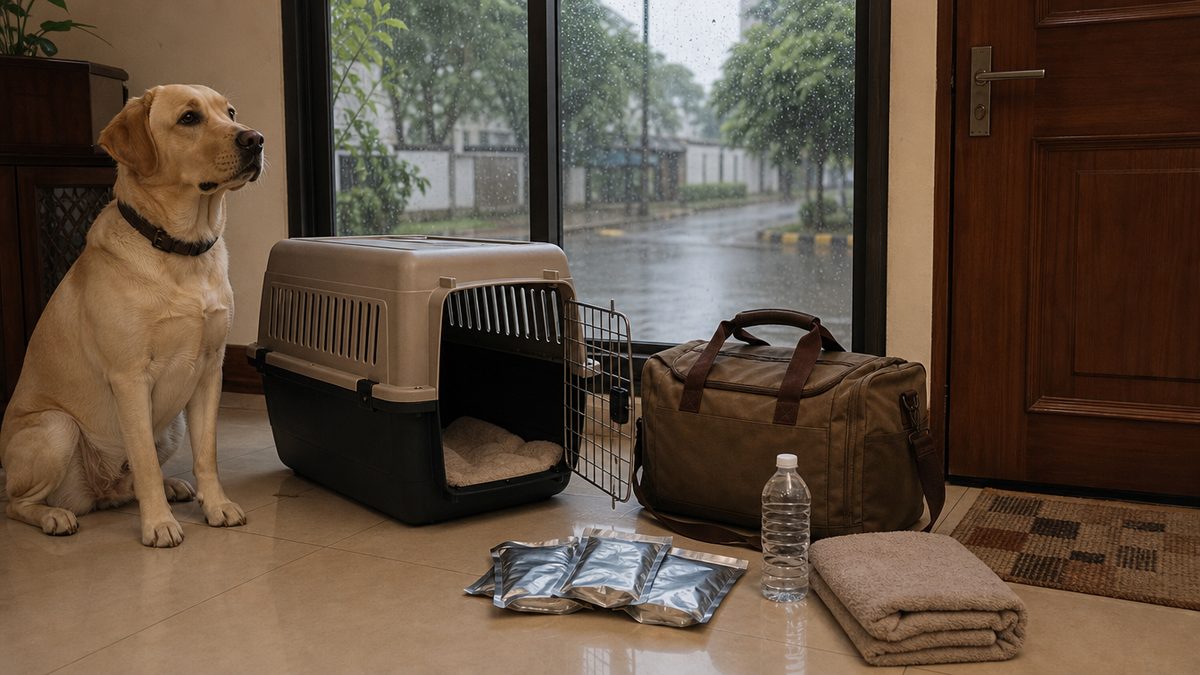
A pet evacuation plan starts with one decision, which is that you take the animal with you. Pack a carrier per animal, a week of food and water, medication, vaccination records and a photograph of you together. Fit a collar and tag now, and fix the destination in advance, because India's national animal guidelines are advisory and Kerala's relief camp SOP never mentions a pet.
This guide is general information for Indian pet owners and is not a diagnosis. Always consult a registered veterinarian near you before acting on anything you read here, and treat any sudden change in your pet's condition as urgent.
Why a pet evacuation plan comes down to one decision
A pet evacuation plan comes down to the decision that you take the animal with you, because the research on flood evacuation found that the things which stop people doing it are physical objects rather than feelings. You fix objects in an afternoon.
Two studies measured this in the same place, a flood in Yuba County, California. A random-digit-dial survey of 397 households six months after an evacuation notice found that 19.4 percent of households failed to evacuate at all. Households with pets failed more often than households without, 20.9 percent against 16.3 percent, but that difference did not reach statistical significance at p equals 0.11. Say that part plainly, because the popular version of this finding overstates it.
What the same paper did find, significantly, is more useful. Within pet-owning households, those without children carried an odds ratio of 1.3 for evacuation failure against those with children, with a 95 percent confidence interval of 1.1 to 1.5, and the more pets a household owned the higher the risk went. The authors named the reasons themselves. Impediments to pet evacuation, including owning multiple pets, owning outdoor dogs, or not having a cat carrier, explained why many households that owned pets failed to evacuate.
The companion study is the one that should change your afternoon. Of 203 pet-owning households under evacuation notice in a flood, 102 evacuated with their pets and 101 evacuated without them. Half the households that got themselves out left the animals behind. The predictors were again ordinary and fixable, namely dogs kept outdoors most of the time, and owners not having carriers for their cats. More than 90 percent of owners made housing arrangements for their pets without any assistance at all.
| Study | Who was surveyed | Headline finding | What it does not say |
|---|---|---|---|
| Heath, Kass, Beck and Glickman, American Journal of Epidemiology, 2001 | 397 households, Yuba County, California, July 1997, six months after a flood evacuation notice | 19.4 percent failed to evacuate; pet households failed more often (20.9 against 16.3 percent) but not significantly | It does not establish that owning a pet by itself predicts refusing to evacuate |
| Heath, Beck, Kass and Glickman, Journal of the American Veterinary Medical Association, 2001 | 203 pet-owning households under flood evacuation notice | 102 households evacuated with their pets and 101 evacuated without them | It does not measure how many of the animals left behind died |
The strongest result in this literature is not that pet owners refuse to leave. It is that the predictors of leaving an animal behind exist before the disaster and are modifiable. A carrier the cat has never been in, a dog that lives outside, and three animals against one pair of hands are all things you can change this month.
India's own national guideline states the stronger version of the claim as a given. It defines companion animals as pets such as dogs and cats kept in homes as companions, and says their inclusion is critical as the human-animal bond often leads owners to risk their own lives. Elsewhere it records that a strong human-animal bond at times leads owners to refuse evacuation or re-enter hazardous areas if provisions are not made for pets, risking both people and responders. That is the policy framing, and it is the right one. The evidence underneath it is about carriers and outdoor dogs.
What that finding changed abroad, and what it has not changed here
Abroad, the finding changed a statute. In the United States the Pets Evacuation and Transportation Standards Act of 2006 made pet-inclusive planning a condition of approval for state and local emergency plans. In India the equivalent document exists, is one year old, and is advisory.
Public Law 109-308 was approved on 6 October 2006 and it is short. It amends the Stafford Act so that in approving standards for state and local emergency preparedness operational plans, the Director shall ensure that such plans take into account the needs of individuals with household pets and service animals prior to, during, and following a major disaster or emergency. A second section adds provision of rescue, care, shelter, and essential needs to individuals with household pets and service animals, and to such pets and animals, to the list of essential assistance the federal government may fund. A third lets the Director make financial contributions for emergency shelter facilities and materials that will accommodate people with pets and service animals.
Three words in that statute do the work, and they are shall, plans and shelter. A plan that ignores animals does not get approved, and the money for a shelter that takes them is appropriable.
India published its own document in April 2026. The National Guidelines on Animal-inclusive Disaster Risk Reduction run to 133 pages, cover livestock, aquatic animals, companion animals, community and stray animals and wildlife, and state that all States and Union Territories must incorporate them into their own Disaster Management Plans. It is a serious piece of work and the first national document of its kind here. Its own disclaimer page states that these guidelines are advisory in nature and intended to support Animal-inclusive Disaster Risk Reduction across States and Union Territories.
| United States | India | |
|---|---|---|
| Instrument | Pets Evacuation and Transportation Standards Act of 2006, Public Law 109-308 | National Guidelines on Animal-inclusive Disaster Risk Reduction, NDMA, April 2026 |
| Force | Statute. Amends the Stafford Act at 42 U.S.C. 5196b, 5196 and 5170b | Advisory in nature, by its own disclaimer |
| What it requires of a plan | Plans shall take into account the needs of individuals with household pets and service animals | States and UTs must incorporate the guidelines into their own plans |
| Money | Financial contributions permitted for shelter facilities that accommodate people with pets | No funding line created by the guidelines themselves |
| Age | 20 years in force | Published April 2026 |
A 2025 scoping review of the global literature on pet management in disasters screened 2,532 records down to 57 included articles. Thirty came from the USA, 11 from Australia, three from Canada, and two each from Italy, New Zealand and India. Two papers out of 57 is the entire Indian evidence base in that review, which tells you how little has been measured here. The review's four named challenges are restrictions on pets in residential areas, the ethical and legal difficulty of retrieving a pet during the response phase, the lack of a comprehensive evacuation plan for pets, and a lack or shortage of suitable shelters for keeping pets.
What India's disaster framework says about your dog
India's framework now names companion animals at national level and says almost nothing about them at the level where a flood is actually managed. We checked a state SOP and a state flood memorandum rather than assuming, and both gaps are findings worth publishing.
Start with the good part. The NDMA guideline devotes a section to the vulnerability of companion animal populations, and it is accurate. Companion animals are entirely reliant on their owners; the lack of pet-friendly emergency shelters complicates evacuations; animals left behind are exposed to starvation, dehydration, debris injuries, and conflicts with stray animals; and the absence of permanent identification, such as microchips or tags, hampers reunification with owners. It also tells owners to habituate animals to carriers and crates during peace-time to prevent panic during rapid evacuation. Our monsoon care guide for dogs in India sets out the eight-item emergency kit that guideline prescribes.
The word that does not appear in Kerala's relief camp SOP
Kerala is the fair test, because it is the state that was hardest hit in 2018 and the state now building India's first animal evacuation shelter. Its Orange Book of Disaster Management is the standing standard operating procedure for the monsoon and cascading hazards, it runs to 84 pages, and it mentions relief camps 28 times. The words pet, pets, cattle, livestock and veterinary appear zero times in it. The only animal provision is Emergency Support Function 15, Animal care, assigned to the Department of Animal Husbandry with local self-governments supporting, covering treatment of animals, provision of vaccination, disposal of dead animals, ensuring adequate food and water to animals, and establishing animal shelters.
Nothing in it says that a household arriving at a relief camp may bring its dog. Nothing says it may not. The document simply does not contemplate the question, and a procedure that does not contemplate a question gets answered at the gate by whoever is standing there.
We looked for a provision allowing a companion animal into an Indian relief camp and did not find one in the documents we read. Treat the relief camp as a destination you have not secured, and secure a different one this week.
Assam's accounting says the same thing from the other direction. The Assam Flood Memorandum 2024 records all 35 districts affected, 7,794 villages, 42,95,611 people affected, 121 human lives lost, 866 relief camps and shelters and 1,86,685 inmates in them. Its animal loss account has exactly three lines, which are big animals lost 1,165, small animals lost 2,048 and poultry lost 4,036. There is no line for a dog or a cat. A later table in the same memorandum gives 1,168 big animals rather than 1,165, which is a small internal inconsistency in the document rather than a correction we are making.
The national guideline is honest about where this leads. Writing about India's recent history, it records that the 2015 Chennai floods displaced lakhs of people and caused massive, unquantified animal loss due to drowning and infection. Unquantified is NDMA's own word. For the animals that are counted, the same chapter reports Central Water Commission data spanning 1953 to 2011, as carried in the TANUVAS Technical Reporter, giving an average of 97,000 cattle lost to floods and heavy rains every year in India. We read that figure inside the NDMA guideline rather than at the Commission, and we flag it as such.
The 2026 flood advisory tells the same story about who these documents speak to. When severe floods hit Assam and Gujarat, the Animal Welfare Board of India issued a two-page letter attaching the NDMA guidelines, addressed to District Collectors, state Animal Husbandry Directors, state animal welfare boards and recognised animal welfare organisations, asking them to undertake immediate rescue, relief, and rehabilitation measures for affected animals and to furnish an action taken report. It is a reasonable instrument. It contains no sentence addressed to a household.
The metro flat, and the authority that is supposed to plan for it
Urban flooding is a different hazard from river flooding, and if you live in a flat in Mumbai, Bengaluru, Delhi, Chennai, Hyderabad, Kolkata, Pune or Ahmedabad it is the one you will meet. It arrives in hours rather than days, it carries the contents of a drain, and the national forecast that triggers everyone else's warning is watching a river rather than your lane.
The early warning chain is built around rivers and cyclones. The NDMA guideline records that warnings are issued by the India Meteorological Department for cyclones and the Central Water Commission for floods, and that these trigger alerts passed down from national to state and district level. A cloudburst that puts half a metre of water through a ground-floor flat in three hours is not a river forecast, and your plan cannot wait for one. For an urban household the trigger is the rainfall warning for your own city, not an evacuation order.
There is now an institution that is meant to own this, and almost no pet owner has heard of it. The Disaster Management (Amendment) Act, 2025 establishes a separate Urban Disaster Management Authority for state capitals and major cities, chaired by the Municipal Commissioner and responsible for preparing and implementing a dedicated Urban Plan. In its own jurisdiction a UDMA exercises the same powers and responsibilities as a District Disaster Management Authority, applying all the provisions of the animal guidelines.
What that means for a city resident is a specific thing to ask for. The guideline recommends that the senior-most veterinary officer of the Municipal Corporation and a representative of the District SPCA be permanent members of the UDMA, so that urban animal issues, including the management of companion and community animals, are fully integrated into urban disaster planning. It also says the authority shall oversee the development of disaster rescue and first aid teams for animals at ward level in cities, as the primary first responders for urban wildlife and community animals. Ask your corporation whether your city's Urban Plan has an animal chapter. The question is now a reasonable one to ask, which it was not two years ago.
Vertical evacuation, which is what a flat actually gives you
In a tower or a walk-up your evacuation is usually upward within the same building rather than outward from the district, and that is worth agreeing with your neighbours while the weather is fine. Four flat-specific rules follow from how water behaves in an Indian building.
- Never use the lift, and never leave an animal in one. Power fails first and lift pits fill first.
- Treat basement and stilt parking as the most dangerous place in the building. It fills fastest, it has one ramp, and it is exactly where a frightened animal goes looking for somewhere dark and dry.
- Agree an upper-floor landing with a named neighbour now, with their flat number written on your kit. Two carriers on a fifth-floor landing is a workable outcome; knocking on strange doors at midnight is not.
- Know where your building's water tank, sump and electrical room are, and keep animals away from all three once water is in the compound.
Society rules are the other half of this, and they do not pause for a flood. Our guides to keeping a dog in an Indian flat and pets in apartments in India cover how those conversations usually run, and the time to have this one is now.
Where you can actually take an animal, and why to settle it now
You can take an animal to a named person outside the flood-prone area, to a boarding facility on higher ground, or to a hotel that waives its policy. You cannot assume a relief camp, and the one purpose-built alternative in the country is in one district and is not open.
Read India's model carefully, because it is not the model most readers assume. The NDMA guideline does not describe a pet-friendly human shelter. It describes a separate animal facility placed nearby. Animal camps should be organized near human relief camps so that owners can take care of their animals, in the guideline's own words. Its site-selection criteria repeat the point, saying shelters should ideally be near human relief camps to allow owners to visit and care for their animals, reducing stress for both. Near, and visit. That is a different promise from co-sheltering, and it is the honest one, because co-sheltering raises real crowding and zoonotic concerns that the 2025 review documents in both developed and developing countries.
The one purpose-built facility in India is worth knowing about and worth not over-reading. In Kottathara, Wayanad, Kerala, the foundation stone has been laid for the country's first permanent emergency animal evacuation shelter, built by Humane World for Animals India with the Kerala State Disaster Management Authority, the Wayanad District Disaster Management Authority and the Kottathara Gram Panchayat. It covers 21,780 square feet, will house up to 150 animals including goats, cows, pigs, dogs and cats, will hold food and water for 150 animals for up to a week, and carries a corpus fund of ten lakh rupees from the state so the panchayat does not bear maintenance. It is expected to be operational by 2027.
Two sources describe that building slightly differently and we are publishing both. The NDMA guideline, written in April 2026, says authorities have undertaken the construction of India's first permanent animal evacuation shelter. The partner organisation's own announcement, in October 2026, reports the foundation stone ceremony and an expected operational date of 2027. The practical position today is that nothing is open.
Four destinations, in the order you should secure them
- A named person on higher ground. Ask one friend or relative outside the flood-prone area this week whether they would take your animals for a fortnight, and ask a second as the backup. Blue Cross advises exactly this, arranging for a pet to be taken in by someone living outside a flood risk area, or for a trusted neighbour to take them if you are away when an evacuation order comes.
- A boarding facility above the flood line, with your paperwork already lodged. Most boarding kennels, veterinarians and animal shelters require medical records showing a current rabies vaccination before they will accept an animal, and nobody is scanning a vaccination card at 2 a.m. in a power cut. Our guide to boarding versus a pet sitter in India covers how to inspect one.
- A hotel, with a list made in advance. Hotels often lift their no-pets policies during emergencies, but keep a list of the ones that always accept companion animals just in case. Often is not a plan.
- The relief camp, treated as unsecured. Go there if it is the only option and your own safety requires it, and expect to have the animal question decided by an individual rather than by a rule.
| Destination | Arrange this week | What fails on the day |
|---|---|---|
| A named person outside the flood-prone area | Ask two people, not one, and send them a photograph of each animal and your vet's number | The one person you asked is also flooded, or is travelling |
| Boarding on higher ground | Lodge the vaccination record now and do one trial night so the facility is not new on the worst day | They are full, or they refuse an animal whose rabies date they cannot verify |
| A pet-friendly hotel | Write down three names and their landline numbers, not just an app listing | The waiver is discretionary and the manager on duty says no |
| A relief camp | Nothing you can arrange, because no procedure we read provides for it | You are admitted and the animal is not, at the point where you have already lost the house |
If evacuation means leaving the city altogether, the transport rules are their own subject. Our guides to pets on trains in India and taking a pet in an Uber, Ola or Rapido set out what each operator actually publishes, which is less than you would hope.
The emergency kit, the carrier, and what it costs in rupees
Build one pet emergency kit per household and one carrier per animal, and keep both where you can reach them in the dark. The carrier is the item the research singles out, because not having one for the cat predicted leaving the cat.
Buy the carrier before you need it and then leave it out. The NDMA guideline is explicit that owners must habituate animals to carriers and crates during peace-time to prevent panic during rapid evacuation, and the flood study found that owners not having carriers for their cats was among the management practices associated with pet evacuation failure. A carrier that appears once a year, smelling of a clinic, is a wrestling match at the moment you have least time for one.
On one Indian seller's own collection page, read on 21 October 2026, carrier prices range from ₹499 for a compact carrier pouch at the bottom of the range to ₹4,999 for a car travel crate at the top. The cheapest things in that band are soft pouches, and in moving water a rigid carrier with a door the animal cannot push open is the one to want. Price the rigid version for every animal in the house rather than the lowest number on the page, and buy it in a month when nothing is happening. We do not recommend a brand; a verdict needs first-hand testing we have not done.
How much food and water, and why the published answers disagree
The quantity is the one point on which the sources openly conflict, so here they are rather than an average. The NDMA guideline lists the contents of a grab-and-go bag as food, water, medication, records, carrier, leash, waste bags and comfort items, and gives no quantity at all. PETA India tells owners who have no choice but to leave an animal behind to leave out at least a ten-day supply of water and at least a ten-day supply of dry food, noting that canned food will go bad quickly. That ten-day figure is for an animal left alone, not for a bag you carry.
Our reading is that the two numbers answer two different questions and both are right. Pack roughly a week of food in the bag you carry, because that is what one person can physically lift alongside the animal, and keep the ten-day standing supply in the house for the scenario nobody plans for. Water matters more than food over the first days, and the water has to be bottled, because the water outside is the hazard the rest of this page is about.
- Carrier per animal, labelled with your name and two phone numbers in permanent marker, not on a tag that can tear off.
- Food for a week, in the animal's usual diet, sealed. A diet change on top of a flood is two variables at once.
- Bottled water and a collapsible bowl, because floodwater is not drinking water and a bowl that tips is a bowl that empties.
- Medication with the prescription, with the label on the box, so a strange vet can read the drug, the dose and the prescriber.
- Vaccination records in a sealed waterproof bag, which both the RSPCA and Blue Cross list alongside the microchip number and the vet's details.
- A printed photograph of you with the animal, not of the animal alone. A photograph of a brown indie dog identifies no dog. A photograph of you holding that dog proves it is yours.
- Collar, tag and a fixed-length leash, never a retractable one in moving water.
- Litter and a small tray for a cat, plus a spare pillow case, which is the thing that gets a cat out of the gap it has wedged itself into when the carrier is three rooms away.
- A blanket to cover the carrier, which Blue Cross recommends to keep an animal warm and help it feel safe in transit.
Identification, which is the part that fails
Identification fails in a flood because a collar comes off in water and a microchip is only as good as the nearest scanner. Fit both anyway, and add the one thing neither of them does.
India's national guideline names this directly, listing the absence of permanent identification, such as microchips or tags, among the things that hamper reunification with owners. The honest qualifier is that a chip is a number and nothing else, India has no national registry, and a chip read in a town your animal has been carried to is a number nobody can resolve. Our guide to pet microchipping in India prices the chip and sets out the registry problem in full, and we are not restating it here.
What a flood adds to the usual advice is water. A buckle collar soaked and dragged through a fence comes off; a tag ring corrodes and opens. So write the information on the animal as well as on its collar. A phone number in permanent marker on the inside of a collar strap survives what a dangling tag does not, and it costs nothing to do this evening. We have not found a study measuring how often either method gets an animal home, so treat both as cheap redundancy rather than as a solved problem.
PETA India advises placing an emergency window sticker near the front door noting how many animals are in the home and where they can be found, so that rescuers know to look. Write the number of animals, the species, their names and your mobile number. A door that says two cats, under the bed is a door that gets opened.
Preventing the separation is this page's job. Finding the animal afterwards is a different job with different methods, and our guide on how to find a lost pet in India covers the first hour, the search radius and who to tell on an Indian street.
During the flood, inside the house
Move the animals up, never leave one tethered, and decide the loose-animal question before you are standing in water, because the three welfare organisations that answer it do not agree with each other.
The tethering rule is the one instruction nobody disputes. PETA India states it flatly. Do not leave animals tied up and unattended, because during floods animals who are tied up can easily drown or starve if no one is there to help them. A tethered animal in rising water has a radius and the water does not. This applies to the rope on the terrace, the chain in the compound and the lead clipped to a grille while you carry things to the car.
A tethered animal cannot climb, a caged animal cannot climb, and an animal on a balcony or terrace cannot get back inside through a door that has swung shut. Every one of those is a drowning that an unclipped lead would have prevented.
High ground inside the home is the next instruction, and here the top-ranking page needs translating. The RSPCA tells owners to bring all small animals inside and, if possible, move them upstairs, and to move food, bedding and fresh water somewhere dry. Most Indian households do not have an upstairs. The instruction still holds; the furniture changes. Work out now which surface in your home is highest and stable, whether you have terrace access and whether that door locks, and whether a neighbour on an upper floor would take two carriers at an hour's notice. For a cat, the top of a sturdy almirah is high ground. For a large dog it is not, which is why the dog's answer is usually a neighbour's floor rather than a shelf.
The three welfare bodies disagree about the instruction that matters most
If you genuinely cannot take the animal, what you do with it is the most consequential decision on this page, and the three organisations that publish an answer give three different ones. No page we read acknowledges that.
| Organisation | What it says to do | What it assumes |
|---|---|---|
| PETA India (page last modified April 2016) | Never turn animals loose and do not assume they can get by on instinct; leave them in a secure area inside your home with at least a ten-day supply of food and water | The house stays standing and somebody returns within days |
| Blue Cross, UK (reviewed February 2023) | Shut them inside an upstairs room with ample food and water, leave notices on external doors saying there are animals inside, and contact the RSPCA immediately | A house with an upstairs, and a national animal rescue service that answers the phone |
| Best Friends Animal Society, USA | Leave an escape route through an open window or door so the animal is not trapped, because in a fire or flood pets have a higher chance of survival with a way out of an enclosed space | The animal is better off loose than confined, and can be recovered later |
These three cannot all be followed, and the reason they differ is that they assume different buildings and different rescue capacity. Our reading, for an Indian ground-floor flat or an independent house, is that letting an animal loose is a last resort and not a kindness. A domesticated dog or cat turned out into a flooded street faces traffic, other frightened animals, no clean water and no way home, and India does not have the organised animal rescue capacity the Blue Cross instruction quietly assumes. Choose the highest enclosed space in the building that the animal can leave if the water reaches it, leave food and water above floor level, put the sticker on the door, and tell a named neighbour. Reserve the open window for the case where you are leaving a building you expect to be submerged and nobody will reach for days.
One rule overrides all of it, and Blue Cross states it in a single line. Never put your own or another human life in danger to save an animal.
After the flood, when the water goes down
After the flood the hazards change from drowning to water, wounds and wildlife. Rinse the animal in clean water, keep it from drinking anything that stood, check every paw, and treat the house as occupied by something else until you have looked.
Leptospirosis is the documented one. India's National Centre for Disease Control records that the disease is found more commonly during the post-monsoon period and that in natural disasters such as floods it may assume epidemic potential. The mechanism is specific. Waterlogged areas force the rodent population to abandon their burrows and contaminate the stagnant water with their urine. The national programme runs in six endemic states, Kerala, Karnataka, Tamil Nadu, Gujarat, Maharashtra and the Andaman and Nicobar Islands, which between them cover most of the Indian coastline that floods.
Why a vaccinated dog is not a safe dog to share floodwater with
The NCDC guideline carries a sentence about animal vaccination that owners rarely hear. While the vaccine prevents illness, it does not necessarily protect from infection and renal shedding. A vaccinated dog that waded a flooded lane can therefore be well and still be passing organisms in its urine into a house where people are mopping. Wear gloves, keep children off the floor until it has dried, and do not treat a vaccination certificate as a reason to relax. The clinical picture, the serogroups found in Indian dogs and the vaccine coverage question all live on our leptospirosis in dogs in India page, and the seasonal version of the same hazard is in our monsoon care guide for cats in India.
- Rinse, then dry to the skin. Clean water, then towels, then a check of the ears and the webbing between the toes. Floodwater carries sewage, fuel and whatever was in the drains.
- No drinking from anything that stood. Carry bottled water for the animal for as long as the supply is in doubt.
- Check every paw and run your hands over the whole body. Submerged glass, nails and sheet metal cut quietly, and a cut that was in that water is a cut that gets infected.
- Watch appetite and urine. A dog that stops eating or passes very little in the days after wading is a same-week veterinary appointment, not a wait-and-see.
- Expect the behaviour to be off. The NDMA guideline's welfare framework asks responders to assess the animal's mental state and to prioritise reducing fear, panic and anxiety. An animal that has been through a flood may hide, cling, startle or lose house training for days.
Snakes, and the reason they end up where your animals do
Displaced snakes are real and the explanation is tidy. A 2020 review in the Journal of Environmental and Public Health gathered 68 scientific articles and five reports dating from 1892 to 2018, plus 68 web media reports, linking flooding to increased snakebite incidence. It was prompted by the 2018 Kerala floods, the worst there since 1924, and by the many snakes left by the receding waters. The mechanism the authors give is the natural tendency of all terrestrial animals to seek dry, higher grounds during flooding, so that snakes abandon flooded burrows or are swept from their home ranges and end up in or near human dwellings and other places where animals and humans seek refuge.
That sentence explains the collision. The instinct that sends your dog to the highest dry surface in the house sends the snake to the same surface. Check the almirah top, the bedding, the shoe rack and the stack of things you piled up before you left, before you let an animal explore. Treat a suspected bite as an emergency and read our snake bite in dogs in India page before you need it rather than during.
The honest caveat belongs here too. The same review reports that 92.3 percent of the articles it examined positively associated flooding with increased snakebite, while 7.7 percent found no increase or reported the opposite, and that the relationship has rarely been quantified. The risk is real and the size of it is not settled.
The community animals, who have nobody to evacuate them
Community animals lose their food source and their shelter in the same hour you lose yours, and India's guideline says they must be in preparedness plans without saying who does it. On a street, that is the feeders.
The national guideline defines community and stray animals as unowned animals that pose public health risks if not managed and must be integrated into preparedness plans, noting that cattle too are often abandoned and left to stray in the face of disasters. Its vulnerability assessment is precise about what happens to them. They are highly vulnerable to injury from debris, to starvation when informal food sources disappear, and to exposure to the elements without access to adequate shelter, and they can become public health hazards when their populations concentrate in new areas or come into increased contact with displaced humans.
Informal food sources disappear is the phrase to sit with. In most Indian neighbourhoods those sources are four or five residents with a bucket, and in a flood several of them leave.
- Hand the feeding over to a named person before you go, not to the group. A message saying somebody please feed them produces nobody.
- Move the feeding point and the water to higher ground on the same street, and tell the other feeders where it is now.
- Open what you can, upward. A stairwell, an upper landing or a gate left unlatched is the difference between a dog on a step and a dog in the current. Leave the basement and the stilt parking shut, because they fill first.
- Raise the shelters. A carton on the ground is gone. A crate on a plinth or a ledge survives.
- Check wheel arches and engine bays before starting a vehicle, every time, for the whole week. Animals looking for somewhere dry climb into the warmest enclosed space available.
The NDMA guideline treats the safe handling of community animals as a trained skill needing humane capture equipment such as nets and traps, and training in reading the body language of stray and feral animals. A terrified animal bites, and in India a bite becomes a rabies exposure question for you and often a complaint against the animal. Call people who do this for a living.
The practice on an ordinary week is covered elsewhere and we are not repeating it. Our guides to feeding community dogs in India and street cats in India set out the law, the feeding spot rules and what to feed.
How much flood warning you get, and the day to act on
You get your flood warning from the same chain everyone else does, and by the time the district starts opening relief camps your window has already begun closing. Act one step earlier than the official trigger.
The chain is published. The NDMA guideline records that early warnings are issued by designated national agencies, the India Meteorological Department for cyclones and the Central Water Commission for floods, and that these forecasts trigger alerts communicated from national to state and district level. It also directs that disaster management authorities and Animal Husbandry Departments must translate technical warnings into simple, clear, and actionable messages tailored specifically for livestock keepers and pet owners. That is written as a thing to be built, which tells you it does not yet exist. No warning you receive this monsoon will mention your dog.
Kerala's SOP shows what the official triggers look like on the ground, and they are useful to a household because they are observable. On an Extremely Heavy Rainfall Warning, low-lying primary and community health centres and hospitals are to be evacuated within 24 hours, the Tahsildar is to start the relief camps, local self-governments are to relocate the vulnerable population to relief camps and other safe locations, particularly those living in kutcha houses, and irrigation and electricity board staff are to monitor river levels every three hours.
- On a heavy rainfall forecast for your district, charge every power bank, fill drinking water, move the pet food and the records above waist height and put the carriers by the door.
- On an extremely heavy rainfall warning, message your named person and confirm they can still take the animals. This is the step people skip and regret.
- When the district begins opening relief camps, go. The camps open because the administration already expects displacement, and that is one step later than the moment you wanted to leave with two carriers and a bag.
- If the water reaches the compound before you have moved, stop planning to leave and start moving everything upward, because wading a flooded street with a carrier is more dangerous than a first floor.
Lead time is the whole argument for doing the boring parts in advance. A household with carriers by the door, a phone number agreed and records in a bag leaves in fifteen minutes. A household without them spends those fifteen minutes finding a cat.
What this page can prove, and what it cannot
Six claims here rest on documents or measurements you can check, and four of the most useful instructions rest on reasoning from welfare guidance rather than on a trial. The line is drawn below rather than left for you to guess.
| Claim | Status | Where it comes from |
|---|---|---|
| Half the pet-owning households that evacuated in one flood study left the animals behind | Measured, 101 of 203 households | Heath and colleagues, JAVMA, 2001 |
| Owning a pet, by itself, significantly predicts refusing to evacuate | Not established; the difference was 20.9 against 16.3 percent at p equals 0.11 | Heath and colleagues, American Journal of Epidemiology, 2001 |
| US law requires state and local emergency plans to account for household pets | Documented statute since 6 October 2006 | Public Law 109-308 |
| India's national animal disaster guidelines are advisory | Documented, on the guidelines' own disclaimer page | NDMA, April 2026 |
| Kerala's monsoon SOP contains no provision for a pet in a relief camp | Documented absence across 84 pages | Kerala SDMA Orange Book |
| Flooding raises snakebite incidence | Associated in 92.3 percent of articles reviewed, but rarely quantified | Ochoa and colleagues, 2020 |
| A week of food in the bag and ten days in the house | Reasoned, from two sources answering different questions | Our reading of NDMA and PETA India |
| Letting an animal loose is a last resort in India rather than a kindness | Reasoned, and three welfare organisations disagree | Our reading of PETA India, Blue Cross and Best Friends |
| A phone number marked inside the collar strap outlasts a tag | Reasoned, not tested | Our judgement |
| Go when the district starts opening relief camps | Reasoned, from published official triggers | Our reading of the Kerala SOP |
One more thing we could not establish. We looked for any published count of dogs and cats killed, rescued or sheltered in an Indian flood and did not find one. The national guideline calls the animal loss in the 2015 Chennai floods unquantified, Assam's flood memorandum counts big animals, small animals and poultry and nothing else, and the global review found two Indian studies out of 57. If a number exists we would like to publish it. Until then, plan as though nobody is counting, because nobody is.
Common questions
How to evacuate with pets?
To evacuate with pets, put each animal in its own carrier, take the pre-packed bag, and go to a destination you arranged before the warning. Fit a collar and tag, carry vaccination records in a sealed waterproof bag, and keep a fixed-length leash on the dog. Never leave an animal tethered or shut in a cage. Leave earlier than the official trigger, because the research found that the common impediments are owning several animals and not having a carrier ready.
How can I keep my dog safe during a flood?
Keep a dog safe during a flood by bringing it indoors, unclipping any tether or chain, and moving it and its food, water and bedding to the highest dry level you have. Keep the dog off the terrace and the balcony, where a door can swing shut behind it. If you evacuate, take it with you on a fixed-length leash. Afterwards rinse it in clean water, dry it to the skin and stop it drinking anything that stood.
What should be in a pet emergency kit?
A pet emergency kit holds a carrier for each animal, a week of the animal's usual food, bottled water and a bowl, medication with the prescription label, vaccination records in a sealed waterproof bag, a printed photograph of you with the animal, a collar, tag and fixed-length leash, litter and a tray for a cat, waste bags and one comfort item. India's national guideline lists food, water, medication, records, carrier, leash, waste bags and comfort items, and gives no quantities.
What happens to animals when there is a flood?
Animals drown, are swept away, starve or are injured by debris, and in India most of them are never counted. The national guideline calls the animal loss in the 2015 Chennai floods massive and unquantified. Assam's 2024 flood memorandum records 1,165 big animals, 2,048 small animals and 4,036 poultry lost across 35 districts, with no category at all for a dog or a cat. Displaced animals also concentrate in new places, which is how snakes end up indoors.
How to save pet animals during natural disasters?
Save pet animals during natural disasters by planning three things before the event, which are a carrier the animal is already used to, a destination outside the hazard area agreed with a named person, and identification that survives water. India's national guideline asks owners to habituate animals to carriers during peace-time and names the absence of permanent identification as the thing that stops animals getting home. During the event, never leave an animal tied up, caged or on a balcony.
Do relief camps in India accept pets?
No published procedure we read says they do. Kerala's Orange Book of Disaster Management runs to 84 pages, mentions relief camps 28 times and never uses the word pet. India's national guideline describes animal camps organised near human relief camps so owners can visit and care for their animals, which is a separate facility rather than a pet-friendly shelter. Treat a relief camp as unsecured and arrange a named person or a boarding facility on higher ground instead.
Should I let my pet loose if I cannot take it with me?
Only as a last resort, and the welfare organisations genuinely disagree. PETA India says never turn animals loose and leave them in a secure area inside the home. Blue Cross says shut them in an upstairs room and leave notices on the doors. Best Friends says leave an escape route so the animal is not trapped, because pets have a higher chance of survival with a way out. In an Indian street a loose animal faces traffic and no way home, so choose the highest enclosed space it can leave if water reaches it.